
Podcast
NXTLVL Experience Design
Hosted by David Kepron · EN
NXTLVL Experience Design will bring you daring and different dialogues about “DATA: Design, Architecture, Technology and the Arts.”
You’ll hear from provocateurs for whom disruption and transformation are a way of engaging in work and play everyday.
My guests will include thought leaders who are driven by a passion to create the ‘new possible’ and promote new paradigms of experience into the mainstream.
Designers from all disciplines.
Architects who are changing the landscape of the built world.
Techno-philes – visionaries who make deeply sensory-based but digitally-mediated experiences.
And I’ll explore the transformative process of creativity with artists of all sorts.
24episodes
Episodes
Newest firstAll episodes
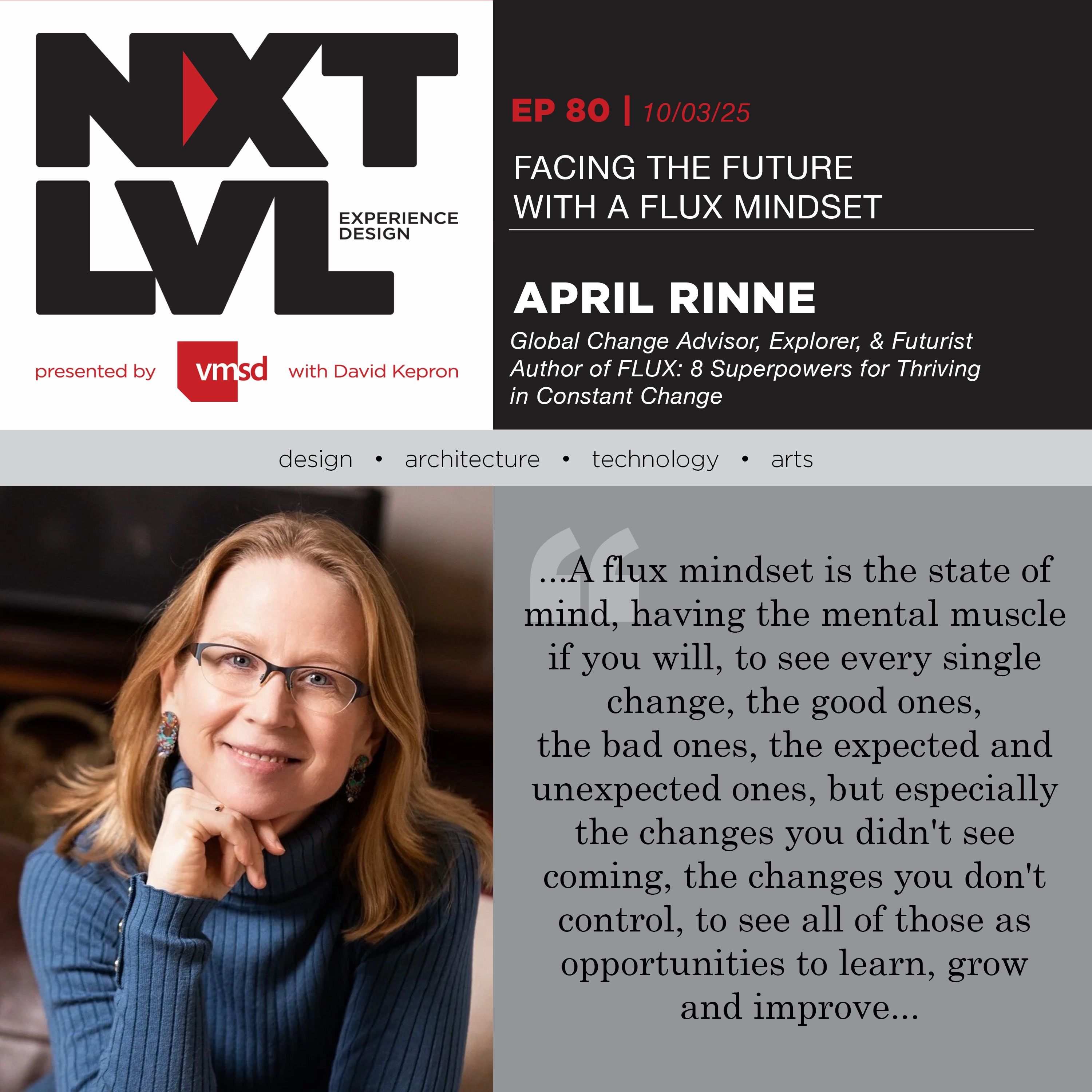
EP.80 FACING THE FUTURE WITH A FLUX MINDSET - with April Rinne, Author of FLUX: 8 Superpowers for Thriving in Constant Change
Oct 301:22:52Tap to summarizeABOUT APRIL RINNE:BIO: My North Star: Helping people and organizations understand what's on the horizon – and how they fit into it. I decipher signals of change, help leaders and teams improve their tolerance for uncertainty, and scout new insights and opportunities in a world in flux. Over 25+ years and 100+ countries, I’ve been exposed to a wide range of companies, cultures, business models, leadership styles, and norms. And I’ve seen time and time again: Every organization, every team, and every individual struggles with change and uncertainty in some way. Even before the pandemic, and especially today. We’ve all had different experiences of change, and we could all use some help with the unknown. Leveling up our relationships to change and uncertainty is the opportunity of our lifetimes.My career portfolio includes futurist, speaker, author, advisor, global development executive, microfinance lawyer, investor, mental health advocate, certified yoga teacher, globetrotter, insatiable handstander, and ambassador of joy. Along the way I've been named one of the 50 Leading Female Futurists in the world, a World Economic Forum Young Global Leader, a member of Thinkers50 Radar and the Silicon Guild, and one of the earliest Estonian e-Residents. I'm also the author of the international bestseller Flux: 8 Superpowers for Thriving in Constant Change.My journey to Flux has been deeply personal. It began with the death of both of my parents in a car crash when I was 20. My entire life flipped upside-down. And today, there is nothing I enjoy more than sharing with others how I learned to see differently, find meaning, and strengthen my Flux Superpowers -- and how you can do so, too.April’s LinkedIn Profile: https://www.linkedin.com/in/aprilrinne/Websites: https://aprilrinne.comBUY THE BOOK: https://www.amazon.com/Flux-Superpowers-Thriving-Constant-Change/dp/1523093595email: april@aprilrinne.comSHOW INTRO:Welcome to Season 7 of the NXTLVL Experience Design podcast – Episode 80!What started at a pivotal moment during the COVID pandemic in early 2020 has continued for seven seasons and now 80 episodes. This season we continue to follow our catch phrase of having “Dynamic Dialogues About DATA: Design, Architecture, Technology and the Arts. In the coming weeks we have some terrific conversations that are both fun and inspiring. They are going to include thought provoking futurists, AI technology mavens, retailers, international hotel design executives as well as designers and architects of brand experience places.We’ll talk with authors and people focused on wellness and sustainable design practices as well as neuroscientists who will continue to help us look at the built environment and the connections between our mind-body and the built world around us.We’ll also have guests who are creative marketing masters from international brands and people who have started and grown some of the companies that are striking a new path for us follow.And I don't know, maybe there will be a couple of mystery guests that will just shake things up and give us a perspective on things that we've never thought about before.As in the past couple of seasons, we are grateful for the support of VMSD magazine.VMSD brings us, in the brand experience world, the International Retail Design Conference. The IRDC is one of the best retail design conferences that there is bringing together the world of retailers, brands and experience place makers every year for two days of engaging conversations and pushing us to keep on talking about what makes retailing relevant. You will find the archive of the NXTLVL Experience Design podcast on VMSD.com.Thanks also goes to Shop Association the only global retail trade association dedicated to elevating the in-store experience. SHOP Association represents companies and affiliates from 25 countries and brings value to their members through research, networking, education, events and awards. Check then out on SHOPAssociation.org So, fasten your seat belt we’re in for some good times…Today, EPISODE 80… I talk with April Rinne whose North Star is helping people and organizations understand what's on the horizon – and how they fit into it. April deciphers signals of change, helps leaders and teams improve their tolerance for uncertainty, and scouts new insights and opportunities in a world in flux. As well as being an excellent hand stander, (check out pics of her doing handstands in places all over the world on her website), she is also the author of the international bestseller “Flux: 8 Superpowers for Thriving in Constant Change.”We will get to her book, some of the key ideas and so much more in a minute but first a few thoughts…It seems to me that over the past few seasons I've tended to talk about the idea of ‘the pace of change’ a lot.I'm beginning to think it's a little like my unnatural fear of sharks (thank you Steven Spielberg) and that I keep on talking about them and seeking out images of them on Instagram as some sort of cognitive behavioral therapy to get me better with the idea that I can actually go swimming in the ocean and not feel afraid of Spielberg’s Bruce sneaking up on me. I seem to talk about change a lot for a few reasons…maybe because, I will confess, that I don't think that I was actually good with change for years. I was pretty set in my ways about having a plan and making sure the plan was followed. I got significantly bent out of shape if the plan didn't go as, well… planned.If we were off on our timing, if something was late or if some spontaneous moment interrupted the calendar and I was going to have to re-adjust, it took me sometimes quite a while to recalibrate and get with the ‘new’ program.And then there was the spring of 2020 where, well…everything changed. No doubt for someone who wasn't so good with the idea that things could change on a dime and a path you had so expertly crafted into the near future would just disappear in front of you,I came to understand that there were three types of change:the change that's innate - you know built into the system of everything the seasons the sun rising in the east and setting in the West and that kind of change that if it didn't happen you would think something was significantly wrong with the universethere was the change that we choose that gives us a sense of agency the kind of change we actually like more than others because we get to determine where it's going and what it actually means for usand then there's a kind of change like the COVID pandemic that is thrust upon you and in those moments shifting circumstances open a door to uncertainty that sense of clarity and purpose dissipates into a swell of unknowns and deep discomfort settles in making everything seem tenuous.That kind of change, I would hazard a guess, not many of us are fond of.That sort of change demands an openness to confront the necessity of things we have often held so dear or the veracity of things we've believed in about ourselves and others.This type of change asks us to embrace the unknown and find an opportunity for transformation in the ambiguity.This kind of change is the kind of change that requires you to stare long into the face of hard questions, discover inconvenient answers and make challenging decisions.That kind of change, turns out, is where all the growth is.That kind of change is embracing the Robert frost poem of the ‘path not travelled…’The thing is… as I think I’ve said before… it's easy for us to fall for nostalgia.It's cozy. It's welcoming and reassuring because it's familiar and it's easy to continue to keep doing the same thing that we have always done because, for some, there's security in choosing the familiar in preference for going on an adventure.I love that one scene from The Hobbit where Bilbo Baggins, after refusing to go on the trip with the dwarves, finally gets it that maybe there's something in it for him, a growth opportunity, and he runs after the company exclaiming to neighbors, when asked where he was going, that he was ‘going on an adventure.’But there's a strange paradox in all of this and that is; we both avoid the perceived danger of the unknown because the unfamiliar signals potential dangers and our neurobiology is geared to sounding the alarms when the unfamiliar lurks near…while at the same time being driven towards novel and the unexpected because that's where our brain ultimately finds learning opportunities (should we care to pay attention).There's no point in continuing to pull a covers over your head and hope that the uncertainty will pass because it's quite likely that when you reemerge whatever the challenge was it will still be thereand you'll open up your eyes and feel a like Dorothy and you not being in Kansas anymore,because while you were conveniently not paying attention, the world was swept up tossed upside down and blown into a new reality in the context of the ever-increasing pace of change that we are all now exposed to.Of course, all of the speed that we're exposed to these days is forcing cultural shifts to happen, some of which we are not neurobiologically or evolutionarily adequately adapted to. Remember, it's taken a few billion years to get where we are. We can't expect that we'll be able to keep up with the mental machinery we now have. (Another challenge to talk about another time.)As we...
Transcribe →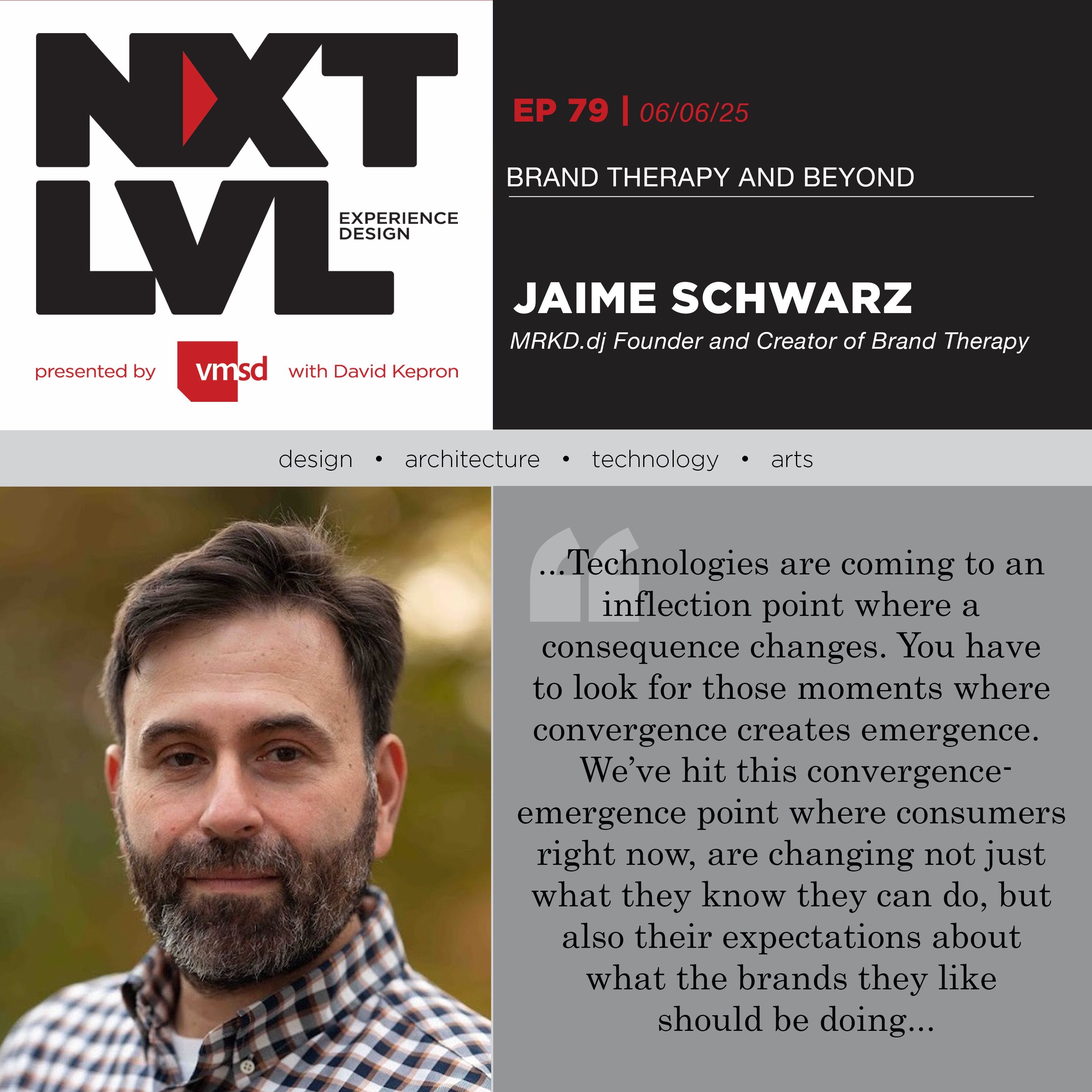
EP.79 BRAND THERAPY AND BEYOND with Jaime Schwarz, MRKD.dj Founder and Creator of Brand Therapy
Jun 7, 202501:32:51Tap to summarizeABOUT JAIME SCHWARZ:BIO: Jaime Schwarz is an award-winning copywriter and creative director, having worked with over 100 brands at NYC agencies before starting his entrepreneurial journey.In 2017 he authored the world's first NFT-focused patent and launched BrandTherapy.coach, a product market fit-focused consultancy built on the technique of letting the brand speak for itself. After co-founding seven startups and consulting for dozens more, in 2022, Jaime pivoted into the web3 world by using AI to literally teach brands to speak for themselves and co-founding The TeamFlow.Institute using team intelligence to maximize the momentum of decentralized teams to create the Company Betterment Industry. He also co-founded ParallelWorlds.us and positioned it as the world's first spatial transformation company. Since then, once his patent was granted, he has been building MRKD as an IP-founded venture focused on empowering the IP economy through co-creationism. He serves on the board of Wayfinders on the Hudson, is an advisor to XRSI.org, and lives in Hastings on Hudson with his wife and two boys.Jaime’s LinkedIn Profile: linkedin.com/in/jaimeschwarzWebsites:brandtherapy.coach (Company)jaimeschwarz.com (Portfolio)calendly.com/getbrandtherapy/30min (Other)Email: jaimeschwarz@gmail.comSHOW INTROWelcome to the NXTLVL Experience Design podcast EPISODE 79 … and my conversation with Jaime Schwarz an award-winning copywriter and creative director, founder of Brand Therapy and a number of other ventures.On the podcast our dynamic dialogues based on our acronym DATA - design, architecture, technology, and the arts crosses over disciplines but maintains a common thread of people who are passionate about the world we live in and human’s influence on it, the ways we craft the built environment to maximize human experience, increasing our understanding of human behavior and searching for the New Possible. he NXTLVL Experience Design podcast is presented by VMSD Magazine part of the Smartwork Media family of brands.VMSD brings us, in the brand experience world, the International Retail Design Conference. The IRDC is one of the best retail design conferences that there is bringing together the world of retailers, brands and experience place makers every year for two days of engaging conversations and pushing the discourse forward on what makes retailing relevant. You will find the archive of the NXTLVL Experience Design podcast on VMSD.com.Thanks also goes to Shop Association the only global retail trade association dedicated to elevating the in-store experience. SHOP Association represents companies and affiliates from 25 countries and brings value to their members through research, networking, education, events and awards. Check then out on SHOPAssociation.orgJaime Schwarz spent years work in the fast-paced world of New York advertising agencies where he came to deeply understand brands. Since then, his entrepreneurial journey has led to patent awards, and a few business ventures that truly bring things to the NXTLVL. We’ll get to all of that in a moment but first though, a few thoughts… * * *OK so where to start on this one...You know… I try to lead teams by being authentic and transparent. Candid when it matters to get to the heart of the matter and circumspect when sharing the whole story it might not be appropriate. But thinking about my interview with Jamie Schwarz makes me sit back in my chair and consider what I think I know.I think I know a little about a lot and I say that not lacking humility, but I've been always compulsively curious about stuff. All kinds of stuff.I like to know why things work the way they work, how people got to the places they got to in their careers, how history unfolds and the story of culture is our told and retold. And all sorts of other stuff. I like reading about quantum physics but will confess I still get confused about how traveling at the speed of light and coming back to your origin will mean that you come back years in the future while the passage of time for you may only be a few moments. I loved the movie interstellar. I don't know things like that just sort of confused me, but they fascinate me nevertheless.I digress.I think I probably know a little bit about enough and in some cases it just might be that I know enough to be dangerous as the saying goes. One of the motivations to doing the podcast is that I get to speak to lots people who are just way smarter and tuned in than me…and I generally add here that the bar is actually set pretty low because there are so many really smart people in the world.I like studying about the things that I try to engage in conversations about. I'll read books, watch hours of online content – presentations, speeches and interviews. I'll dig up articles and make sure that I show up ready to go for a conversation.Early on in the podcast series I had someone thank me for showing up well prepared. I just sort of thought that that was my responsibility to make sure that if someone was offering their time to have a discussion that I would have done my necessary background preparation to make it worth their while. Some interviews I sort of set as stretch goals - people who I want to talk to because they have deep insight on areas that I am interested in but in which I may not have more than an intermediate or novice education. My wife, a veteran of print and television journalism, a multi-book author, strong advocate of radical listening and who also has the uncanny ability to see way beyond the immediate conversation would always say to me that when in discussion you need to leave the interview questioning whether you know more about the person at the close of the conversation than you did when it started. That's an interesting starting point when entering a conversation because it sets the basic premise for who's doing the talking - how much listening is going on and how you listen not to simply add your own opinions, solve the problem or give advice, but to dig deeper in your understanding, resulting in better attunement.I will confess that sometimes I am fully aware that my enthusiasm for subject matter leads to jumping in, offering personal experiences and contributing ideas. Conversations can chase multiple ideas, but I also think that's a result of what I consider as associative thinking - one idea connects to another and sets off a cascade of related or interdependent subjects. And then a whole array of rabbit holes lay before us. Each one leading to a delightful journey. Oh now which one to choose – why not all – let’s go!I have come to use these introductions to podcast interviews as replacements of a sort for a blog I used to write for VMSD magazine called “Brain Food.” I take the time to consider what the conversation with my guest is about and set to musing on ideas that emerged in the conversation. Some of them are personal, stories that resonate deeply with personal or professional experiences. Others are thought bubbles that I offer up for further investigation. I think that most of this episode is like thought bubbles. It covers the nature of branding and relationships with consumers, trust in marketing and storytelling, NFTs and creating derivative works and related IP legal issues, Web 3.0, Deconstructivism, co-creation in a digital mediated world, Ai and collective intelligence, the pace of change, art and digital twinning and the inherent value of co-creative works, quantum computers and hacking bitcoin, object permanence in the digital space… and, and, and you get the idea. There is so much here that you might say it lacks focus, but I think it actually offers up the idea of complexity in our fast-paced digitally mediated world where interdependencies reign, everything is connected to everything in one multi-dimensional system and to what end it is sweeping us along. We can come to these various rabbit holes of conversation because Jaime Schwarzis an award-winning copywriter and creative director, having worked with over 100 brands at NYC agencies before starting his entrepreneurial journey.In 2017 he authored the world's first NFT-focused patent and launched BrandTherapy.coach, a “product market fit-focused” consultancy (about which he speaks in our talk) that is built on the technique of letting the brand speak for itself. After co-founding seven startups and consulting for dozens more, in 2022, Jaime pivoted into the web3 world by using AI to literally teach brands to speak for themselves and co-founding The TeamFlow.Institute using team intelligence to maximize the momentum of decentralized teams to create the Company Betterment Industry. He also co-founded ParallelWorlds.us and positioned it as the world's first spatial transformation company. Since then, once his patent was granted, he has been building MRKD as an IP-founded venture focused on empowering the IP economy through co-creationism. I could have prompted Jaime with any of these subjects and just sat back and taken it all in.ABOUT DAVID KEPRON:LinkedIn Profile: l...
Transcribe →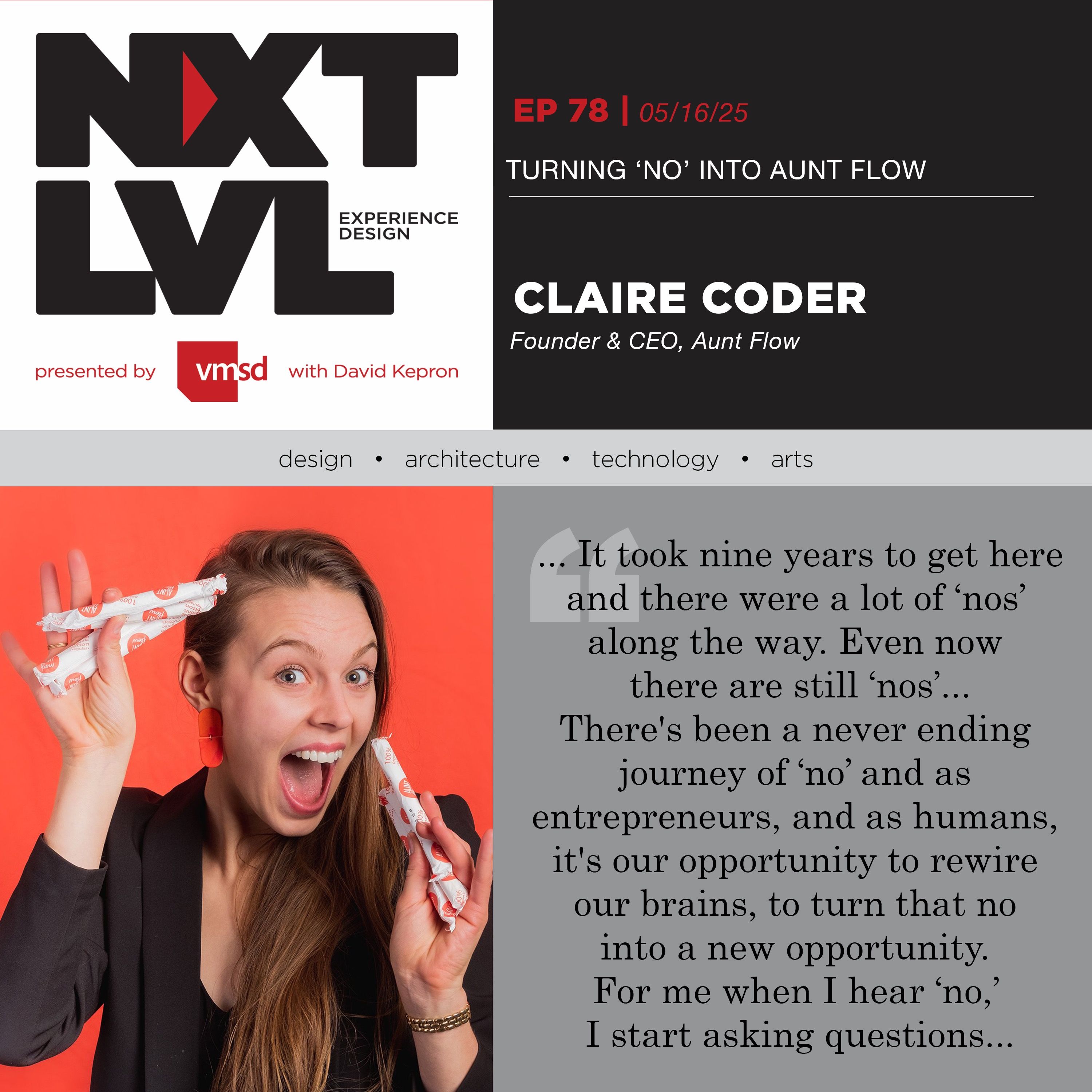
EP. 78 TURNING "NO" INTO AUNT FLOW with Claire Coder - Founder and CEO, Aunt Flow
May 16, 202501:08:08Tap to summarizeABOUT CLAIRE CODER:BIO: Claire Coder (Forbes 30under30) is a 28-year-old Thiel Fellow and founder and CEO of Aunt Flow. On a mission to make the world better for people with periods, Aunt Flow stocks public bathrooms with freely accessible tampons and pads. Through Claire’s leadership, Aunt Flow launched patented tampon & pad dispensers in 60k+ bathrooms and raised $17m+ in venture capital. Coder launched her first company at age 16, designed a bag for Vera Bradley that sold out in 24 hours, and has her own line of GIFs. After getting her period in public without the supplies she needed, at 18 years old, Claire dedicated her life to developing a solution to ensure businesses and schools can sustainably provide quality period products for free in public bathrooms. Since 2016, Aunt Flow has worked with thousands of businesses and schools, including organizations like Google, Princeton University, Netflix, and 30+ professional sports stadiums, to offer freely accessible period product dispensers, filled with organic cotton tampons and pads. Aunt Flow has donated over 7 million organic cotton tampons and pads to menstruators in need since 2021. Claire’s ultimate goal in life is for any menstruator to walk into any bathroom and never need to worry if they start their period, because Aunt Flow period products are freely available!Claire’s story has been featured in TeenVogue, Forbes, Fortune, and she starred in TLC’s Girl Starter Season 1. Claire speaks regularly surrounding her advocacy work, starting a social enterprise and journey as a female founder. For more information, please visit LinkedIn Profile: https://www.linkedin.com/in/clairecoder/ Websites:clairecoder.com (Personal)goauntflow.com (Company)SHOW INTROWelcome to the NXTLVL Experience Design podcast.EPISODE 78 … and my conversation with Claire Coder the Founder and CEO of Aunt Flow. On the podcast our dynamic dialogues based on our acronym DATA - design, architecture, technology, and the arts crosses over disciplines but maintains a common thread of people who are passionate about the world we live in and human’s influence on it, the ways we craft the built environment to maximize human experience, increasing our understanding of human behavior and searching for the New Possible. The NXTLVL Experience Design podcast is presented by VMSD Magazine part of the Smartwork Media family of brands.VMSD brings us, in the brand experience world, the International Retail Design Conference. The IRDC is one of the best retail design conferences that there is bringing together the world of retailers, brands and experience place makers every year for two days of engaging conversations and pushing the discourse forward on what makes retailing relevant. You will find the archive of the NXTLVL Experience Design podcast on VMSD.com.Thanks also goes to Shop Association the only global retail trade association dedicated to elevating the in-store experience. SHOP Association represents companies and affiliates from 25 countries and brings value to their members through research, networking, education, events and awards. Check then out on SHOPAssociation.orgWhen Claire Coder was 18 years old she was at an event and she used a public restroom. While there, she discovered that she had unexpectedly started her period. And… she didn't have a quarter. Why she would have needed a quarter and what happened as a result of not having one is the subject of an exceptional entrepreneurial trajectory that has changed woman's public bathrooms around the country.We’ll get to all of that in a moment but first though, a few thoughts… * * *What if you had an amazing idea that you knew was a no-brainer, an idea that provided something deeply necessary, but it seemed that everyone had overlooked it.What if you had a moment of insight from a personal experience that chartered out a clear path for providing a product and service that seemed to satisfy the deeply under met needs of more than 50% of the population?And what if when you took this moment of clear mental insight to a group of venture capitalists explaining that this was not just an idea that would not only satisfy a certain customer need but that could be an extraordinarily profitable business operation but when you asked for their involvement, they simply said… “NO”.And what if you heard “NO” 86 times when trying to get people interested in supporting your idea. Would you give up? Would you have already given up after the 1st or 10th or 50th “NO”? And what if you happened to be an 18-year-old young woman with this vision and enthusiasm and the subject of your VC pitches dealt with menstruation and woman's public bathrooms... How far do you think that would have gotten you?I could focus in on this intro by talking about the thing that we don't talk about, at least as a guy I can't imagine me and my guy friends would have ever talked about…as a teen, young man or frankly even today.Which is to say… women and monthly periods. I could focus in on this somewhat taboo subject of a naturally occurring bodily function that we somehow sweep under the social discourse carpet, despite that more than 50% of the population has one every single month. Or I could talk about the strange discomfort that comes up because somehow, we've made this discussion something to be ashamed about or talked only about between mothers and grandmothers and their daughters. The strange irony here is that the other 49.53% of the North American population will end up living with, perhaps marrying and having children with the 50+ percent of the population who has their period every single month and yet, we'd prefer not to talk about it…But, if I did focus on those subjects, which by the way are not unimportant to talk about, it would potential we derail another story about a passion for entrepreneurship and the overwhelming need to address the needs of a population who are wholly unserved.It takes a lot of guts to be an entrepreneur. Being an entrepreneur is not easy. In fact, there are a lot of people who would say you’d simply have a few screws loose to actually want to be an entrepreneur.It's highly risky and you carry an extraordinary amount of responsibility. Everything from fundraising and decision-making, planning operations, accepting both successes and failures.When the entire enterprise is your baby, and relies on you as the key driver of the big idea, it can be incredibly emotionally taxing. The working hours can be extraordinary too. If we think that an average work week is neatly packed into 40 hours, an entrepreneur may end up spending twice or maybe even three times that amount in trying to get their business off the ground...and there's constant pressure to keep on pushing forward. One success does not necessarily guarantee the next and so there's this cycle of continuing to push and to make forward strides create product extensions and to expand the brand footprint that is unrelenting. This is especially true if folks have lent you money to get your big idea off the ground.There's also a great degree of isolation that can emerge on the entrepreneurial path. You, and often you alone, are focused on birthing your brainchild, developing it and bringing it to market. This ‘child rearing’, if you will, often happens in times of extraordinary uncertainty and ambiguity. In the current state of the world we live in today, ambiguity is the name of the game. What with the pace of change exponentially increasing, government shifting the rules of the game with tariffs and regulations, funding cuts and banning more that 250 words that according to PEN AMERICA are no longer considered acceptable including:advocacy, abortion, all-inclusive, biologically female, community equity, DEI, female, inclusive, sex, sexuality, vulnerable populations, and woman or women, just to name a few. So if your big idea is squarely focused on women, menstruation and period products, I would imagine it’s tricky.So, this means that you have to be built for understanding the pace of change the ability to flex and move and be resilient when things don't happen to go your way. Like for example if you are launching a new product line and a COVID pandemic hits that effectively shuts your business down.You could stop and pack up shop and be done or you could be resilient and change direction asking ‘what do people need right now?, and turn what you thought was going to be a business into a completely different thing that was not at all what you had planned in the 1st place.As an entrepreneur, you also have to wear many hats. You are at the same time the company owner, marketing and sales rep. You're dealing with HR issues, product design and materials sourcing and assortment planning.You're often doing customer service and trying to keep them satisfied while dealing with shipments that go missing or supply chains that get disrupted, because of say tariffs, for example, when your products were coming from out of the country and all of a sudden now they are more expensive than you had anticipated.And you have to be good, I mean really good, at dealing with rejection and failure.Most entrepreneurs face repeated setbacks, investor rejections, failed launches or people who just don't get what you're trying to deliver...
Transcribe →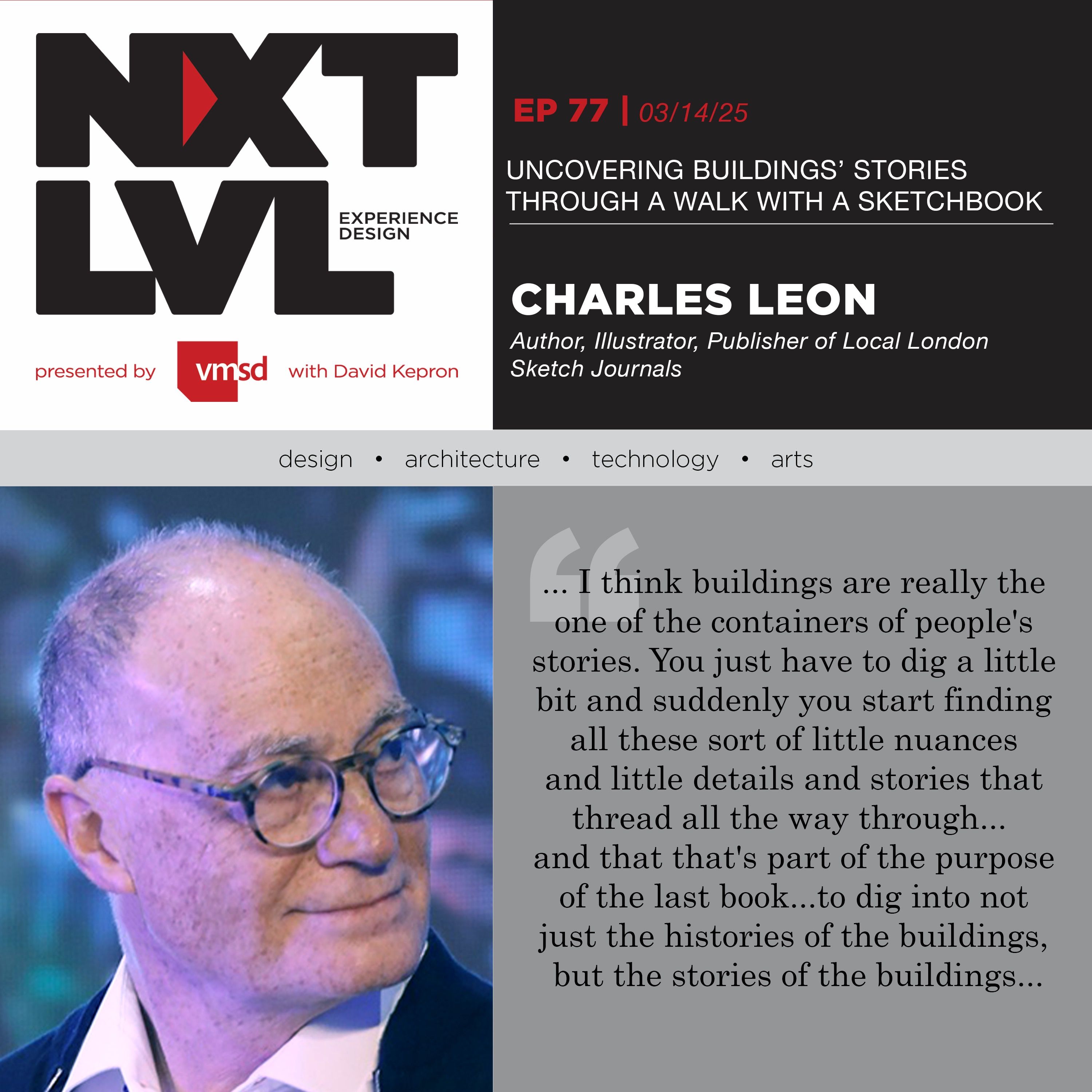
EP.77 UNCOVERING BUILDINGS’ STORIES THROUGH A WALK WITH A SKETCHBOOK with Charles Leon, Author, Illustrator, Publisher of Local London Sketch Journal
Mar 15, 202501:43:50Tap to summarizeABOUT CHARLES LEON:CHARLES' LINKEDIN PAGE: https://www.linkedin.com/in/chleon/COMPANY WEBSITE: charlesleon.uk CHARLES' BIO:Writer and Illustrator of Sketch Journals, including The Kew Sketch Journal. International Speaker and Trainer on the Creative Process and how Applied Innovation actually works. With more than 30 years experience in design, and an extensive knowledge of neuroscience and the working of the creative mind, I bring a wealth of knowledge and experience to helping Organisations and Individuals overcome Innovation Stagnation and achieve Creative Breakthrough.SHOW INTRO:Welcome to the NXTLVL Experience Design podcast.EPISODE 77… and my conversation with Charles Leon. On the podacast our dynamic dialogues based on our acronym DATA - design, architecture, technology, and the arts crosses over disciplines but maintains a common thread of people who are passionate about the world we live in and human’s influence on it, the ways we craft the built environment to maximize human experience, increasing our understanding of human behavior and searching for the New Possible. he NXTLVL Experience Design podcast is presented by VMSD Magazine part of the Smartwork Media family of brands.VMSD brings us, in the brand experience world, the International Retail Design Conference. The IRDC is one of the best retail design conferences that there is bringing together the world of retailers, brands and experience place makers every year for two days of engaging conversations and pushing the discourse forward on what makes retailing relevant. You will find the archive of the NXTLVL Experience Design podcast on VMSD.com.Thanks also goes to Shop Association the only global retail trade association dedicated to elevating the in-store experience. SHOP Association represents companies and affiliates from 25 countries and brings value to their members through research, networking, education, events and awards. Check then out on SHOPAssociation.org On this episode I connect with Charles Leon who has 30 years experience in design, and an extensive knowledge of neuroscience and the working of the creative mind.We’ll get to all of that in a moment but first though, a few thoughts… * * *When I was nine years old my mom put me in a after school art program in a small little studio a few minutes walk from my school. Every Thursday afternoon, after my regular school classes were done, I would walk down the street, sit in an art studio and learn how to paint in oils. For the next 10 years this was a welcome change in my daily routine that became in some sense a safe place. A place where all the world's troubles or the typical challenges I was having as a teenager would disappear and I would spend a couple of hours focused on painting. My mom had recognized early on that I was pretty handy with a pencil and very interested in creative expression. She did her very best to make sure that I was continually engaged in creative processes whether it was doing Ukrainian Easter eggs or sketching and drawing or baking creative Christmas cookies.She was always there pushing the go button on creativity. As it turns out, she was actually a pretty good artist herself and later in her life she began doing decorative painting which she became exceptionally adept at and the house was full of wonderful pieces of her craftsmanship.My interest in art followed me through the first few years of high school and finally landing in a place where it was just time to decide where I was going to university and to which program I would go.My mom, recognized that I was firmly sitting on either side of the creative and scientific fence, 1 foot firmly in both worlds, and she suggested architecture since it seemed to combine both of my interests.While I was studying to be an architect I took every single drawing and painting course that I could possibly take, whether they were weekly freehand drawing studios or evening classes or sketching schools.These courses during my university years were a safe place there I had more confidence than in doing pretty much anything else.But it really wasn't until those years in university under the tutelage of a great art teacher Gerry Tondino that I really began to understand drawing and painting.It wasn't so much that I was learning technical aspects of drawing or painting but that I was more learning how to see rather than simply look at things.Gerry would say, ‘once you learn to see and draw what you actually se, rather than what ou think you see, the drawing takes care of itself.’I had deep respect for Gerry Tondino and I think I really finally learned how to deeply appreciate the world around me to see the color, texture and value relationships. To understand how objects exist within a context and it wasn't specifically the thing you looking at but everything around it that helped to define its edge.In college I would continue to take afterschool watercolor courses thinking that it was more convenient than painting in oils since there was a technical challenge of oil painting taking much longer to dry.There was something about the immediacy of watercolor that I liked. You had to think fast and plan. Watercolor was the process of painting in the shade and shadows leaving the white of the paper as the light and highlights. In oils, or now acrylic which I use almost exclusively, you are starting from the dark tones and building in layers to bring out the light.In watercolor there was equally some unpredictability and a learned skill of being able to get certain effects like running a clean wash of graduated blue for a sky over a background or how some pigments we opaque and others transparent, or how colors would interact with each other as water spread across the paper.I was taking workshops once and the teacher said to me “well it's clear you can draw and you've got, you know, a good hand, but I guess the question really is what do you want to say with the work that you create”That was a whole different way of thinking that I'd never really spend time with prior to that moment. I painted and drew simply because it was fun.What did I want to say?...And so I began to think pretty significantly about what message I wanted to convey or rather what stories the things that I drew or painted I might want to share with other people.It was interesting when I began to study architecture and think about design of places and things that I was drawn to the same question about what the architecture meant and what stories it would hold over the years that people would use it.I was always fascinated with traveling and standing within old buildings and wondering what the people wore when they were visiting here hundreds of years ago.What would they talk about. What was the news of the day or the politics what secrets were being not told as people visited and who came and went from within a building’s walls.As I moved along my career, thinking about the stories that buildings would hold, it's perhaps not surprising that I somehow serendipitously end up in the world of brand experience place making,that the places that I would create for retailers would be imbued with a brand narrative and that somehow the buildings, stores or hotels would need to be able to demonstrate that subplot about who the intended user was, what their story was and how the place was a physical expression of both the person and the brand.Another experience while an architecture school was with a visiting professor and while I don't remember the exact project we were working on, I do remember her saying a phrase including the word “hodological”Hodological refers to the study of pathways or connections. It's used in fields of neuroscience sometimes thinking about the pathway and connections between neurons and synapses how signals move from one place to the other how information is shared across brain functional areas – In psychology it talks about things like paths in a person's life space and in the world of philosophy it might be considered to take in things like the interconnection between ideas a pathway between thought exercises and where one thought leads to another and what conclusions we might draw from that that decision making treein terms of geography it’s really is about actual paths, walking paths for example, connection paths between geographic locations thing like trade route pathsThe interesting thing about the word hodological is not just that all these years later I clearly recall that word but that it also seemed to me that the idea of ‘transition’ - moving from one place to the other - was very much a part of experience - that we don't stand still in buildings or public squares or on streets, we move and as we move, we naturally have a different experience at every moment.Sure, there's a gestalt experience of being in Times Square for example but every time we take a step our perspectival view of the context around us ends up changing and every moment technically speaking is also new,We're are clearly taking in some constants in sensory input but our point of view within that context ends up changing.I love this idea of walking through space and experiencing it differently with every step. Every step is a different vantage point to learn something new to see something from a different angle. In a broader sense, my fascination with the nature of change...
Transcribe →
Ep. 76 BUILDING A BRIDGE BETWEEN NEUROSCIENCE AND ARCHITECTURE with Natalia Olszewska Co-founder & Chief Scientific Officer @ IMPRONTA
Feb 21, 202501:25:48Tap to summarizeABOUT NATALIA OLSZEWSKA:NATALIA'S LINKEDIN PAGE: https://www.linkedin.com/in/natalia-olszewska/COMPANY WEBSITE: improntaspace.com EMAIL: gardener.natalia@gmail.comNATALIA'S BIO:Natalia is a versatile professional with a foundation in medicine and neuroscience, dedicated to applying neuroscientific principles to architectural design. She adeptly connects these two realms, striving to improve our built environment by making it more human-centered and conducive to well-being. Furthermore, Natalia is an accomplished researcher and practitioner in the field of neuroscience applied to architecture, specializing in evidence-based and neuroscience-informed design. She garnered invaluable experience during her tenure at Hume, a pioneering architectural and urban planning firm founded by Itai Palti, where she led the 'Human Metrics Lab.' Natalia lent her expertise to design projects for prestigious clients such as Arup, Skanska, HKS Architects, EDGE, the Association of Children's Museums, the Harvard University Center on the Developing Child, Google, as well as numerous individual clients.Her interdisciplinary approach transcends boundaries, allowing her to craft built environments that foster individual well-being across various dimensions - social, psychological, and cognitive. Natalia's co-founding role at IMPRONTA, a consultancy specializing in health and well-being design, underscores her commitment to leveraging neuroscience and applied sciences in architecture. Since 2020, she has also been contributing to the NAAD (Neuroscience Applied to Architecture) course at IUAV University in Venice.Natalia's educational journey is characterized by a distinctive blend of backgrounds, encompassing medicine from Jagiellonian University and Tor Vergata, neuroscience from UCL, ENS, Sorbonne, and neuroscience applied to architectural design from Università IUAV.SHOW INTRO:Welcome to the NXTLVL Experience Design podcast.EPISODE 76… and my conversation with Natalia Olszewska. On the podacast our dynamic dialogues based on our acronym DATA - design, architecture, technology, and the arts crosses over disciplines but maintains a common thread of people who are passionate about the world we live in and human’s influence on it, the ways we craft the built environment to maximize human experience, increasing our understanding of human behavior and searching for the New Possible. The NXTLVL Experience Design podcast is presented by VMSD Magazine part of the Smartwork Media family of brands.VMSD brings us, in the brand experience world, the International Retail Design Conference. The IRDC is one of the best retail design conferences that there is bringing together the world of retailers, brands and experience place makers every year for two days of engaging conversations and pushing the discourse forward on what makes retailing relevant. You will find the archive of the NXTLVL Experience Design podcast on VMSD.com.Thanks also goes to Shop Association the only global retail trade association dedicated to elevating the in-store experience. SHOP Association represents companies and affiliates from 25 countries and brings value to their members through research, networking, education, events and awards. Check then out on SHOPAssociation.orgOn this episode I connect with Natalia Olszewska is a versatile professional with a foundation in medicine and neuroscience, dedicated to applying neuroscientific principles to architectural design. We’ll get to all of that in a moment but first though, a few thoughts… * * *For a while now I have had a fascination with the connection between buildings and brains. While I loved psychology, and studied it before getting into architecture school, it occurred to me in the middle of the 20-teens that buildings, or the environments we design and build, have a direct effect on our psychology. There are places in which we feel good or bad or uneasy or exhilarated, or a sense of awe or agitation. There are places where we feel calm, and others that make me feel ill at ease. And all of those feelings have a body sense to them as well. Heart rises or decreases. I sweat more or less. My chest feels tight or relaxed. Cortisol, adrenaline, norepinephrine, serotonin, dopamine, and other neurochemicals and hormones are released and coursing through my body as I experience places. And many of these hormones and neurochemicals being released into my blood stream I have little control over. My brain-body reacts to environmental stimuli and biochemistry does its thing.Buildings may make me feel certain way, induce certain emotions, that we may think are just about your thoughts, brain activity, but at the core, our body too is in a relationship with conditions in the environment.We feel architecture with our bodies, we don’t just intellectually experience them in our heads. The experience of buildings, and our emotional reactions to them, is as much a ‘bottom-up process’ - our body’s sensory processes taking in stimuli from the environment - as a ‘top-down’ process – our brains processing that sensory information and making decisions about who we should behave in response to them.Our bodies and brains are in continual dialogue with the world around us. In fact, through a process of neuro plasticity, our brains are wired partly in response to our experiences. Yes we are hard wired through our millions of years of evolution to have what we consider innate responses to the environment and then there are those neuronal connections that area direct result of experiences in the here and now. As you listen to this podcast, your brain is creating new wiring shaping the neural pathways that allow for learning and behaviors.And as we repeatedly experience something, those pathways are reinforced facilitating understanding. Those pathways recognize patterns in our experiences, and they are codified so that when we experience them again our brains are not continually trying to decipher every element anew. If it weren’t for our brain’s ability of recognize patterns and anomalies in them, we would live a life of extreme ground hog day and would likely be immobilized with the processing necessary to analyze every element we encounter every moment of every day. Over millions of years some of these patterns have become deeply ingrained in our neurobiology. They are part of our brain structures that allow us to react instinctually. You might say that some of them operate ‘below the radar’ of our conscious awareness. But because they are not front row center in our awareness doesn’t mean that they don’t have an influence of our mindbody state.Colors, lighting, materials, geometries, visual patterns and spatial arrangements, to name of few, have an effect on us. We might not necessarily pay attention to these elements of our environment as we move through it, but they have an effect on us. We may not consciously feel the influence of these things, but the effects are there, nevertheless. Acute angles, loud sounds, bright fluorescent lights, certain colors and texture patterns, repetitive and banal patterns, things devoid of detail and out of scale with our human body all have an effect on our sense of well-being. University of Waterloo cognitive neuroscientist Colin Ellard has worked for more than three decades in the application of psychology and neuroscience to architectural and urban design. His work illustrates the impact of ‘boring buildings’ on how we feel and our sense health and well-being. We humans, it turns out, function and feel better in environments of physical and visual intricacy. We seek our variety and complexity, layered environments that pique our curiosity and sense of intrigue. And yet…far too many of our built environments at simply banal.Ellard says the - “The holy grail in urban design is to produce some kind of novelty or change every few seconds,” “Otherwise, we become cognitively disengaged.”Imagine for a moment what is happening inside our mind-bodies when we live 8 + hours in a sea of detail-less white cubicles under a blanked of fluorescent lights. We might think this is an efficient office space, but we are creating brain numbing environments and at the same time asking people to reach optimal performance in the workplace. We may wish hotels guests a good night sleep on a heavenly bed and then we fill the room with light that completely counteracts the production of melatonin telling our brain that it is still daytime and to stay alert.And… we have built city block after city block of repetitive, banality. Efficient to build, very economical yes, but a boredom inducer for the brain.Now this doesn’t mean that every environment needs to be a rollercoaster for the senses nor be pristine and bucolic. In fact, some environments are better because they are well…messier. Charles Montgomery, author of Happy City: Transforming Our Lives Through Urban Design suggest that successful design is about “shaping emotional infrastructure.” Montgomery argues that some of the happier blocks in New York are “kind of ugly and messy.” The energy of New York can be both energizing and exhausting.It would be perhaps unfair to heap the respo...
Transcribe →
EP. 75 TIKTOK CONTENT CREATION AND ACCESSIBLE ARCHITECTURE CRITIQUE with Louisa Whitmore TikTok Content Creator and Documentary Host
Jan 30, 202501:24:15Tap to summarizeABOUT LOUISA WHITMORE:TIK TOK: LOUISA'S BIO:Louisa Whitmore is an architecture content creator on TikTok with over 350K followers, as well as the host of the cable television documentary series “The Nature of Design.” A former commentator for the USModernist podcast, Whitmore has also worked as a live radio host and PSA producer at CHMA 106.9FM, the local radio station at Mount Allison University, where she’s currently an honors student studying international relations and French. She enjoys telling stories, and is passionate about sustainable design.SHOW INTRO:Welcome to the NXTLVL Experience Design podcast.EPISODE 75… and my conversation with Louisa Whitmore. On the podacast our dynamic dialogues based on our acronym DATA - design, architecture, technology, and the arts crosses over disciplines but maintains a common thread of people who are passionate about the world we live in and human’s influence on it, the ways we craft the built environment to maximize human experience, increasing our understanding of human behavior and searching for the New Possible. he NXTLVL Experience Design podcast is presented by VMSD Magazine part of the Smartwork Media family of brands.VMSD brings us, in the brand experience world, the International Retail Design Conference. The IRDC is one of the best retail design conferences that there is bringing together the world of retailers, brands and experience place makers every year for two days of engaging conversations and pushing the discourse forward on what makes retailing relevant. You will find the archive of the NXTLVL Experience Design podcast on VMSD.com.Thanks also goes to Shop Association the only global retail trade association dedicated to elevating the in-store experience. SHOP Association represents companies and affiliates from 25 countries and brings value to their members through research, networking, education, events and awards. Check then out on SHOPAssociation.orgLouisa Whitmore is a TikTok creator phenom whose content is about architecture. With almost 400 thousand followers her no holds-barred, straight from the heart and to the point commentary about the buildings she loves and loves to hate, brings a user experience point of view and accessible critique into the mainstream.We’ll get to all of that in a moment but first though, a few thoughts… * * *The great thing about doing this podcast is it gives me an opportunity to rethink some of the assertions that have held to be true and cross check whether in fact they are immutable or whether there is room for challenging myself and maybe digging into some subtleties and nuances… and seeing things a different way.Like for example the idea of criticism – who does it and its value…I have to admit I haven't been particularly fond of the idea of critics for a very long time. This would be generally true of the kind who dole out the negative kind of commentary.Years ago when commenting on something, I think it was some art piece, and my son said to me “…dad why is it that you never really say you hate anything…”which I sort of thought was kind of funny then. I think I responded “…well because I don't really hate anything… I try to always view things from the other side - a different point of view. I try to get beyond the visceral reaction and look to design principles and comment from a place of applying principles to the work and see how they line up…and then make a comment that is based yes on whether I simply like it, the colors, shapes, energy, feeling , may be a message it is trying to impart AND whether I can see the value in it based on principles determined to be generally accepted by experts in the domain…” so yeah I don’t really hate things…If I apply the idea of casting judgement on art, music, architecture… it got me thinking… again…What is the value of judgement? Is it to determine the appropriateness of something to a particular context or challenge?I have my favorite architects and artists and musical performers, I like different styles and periods. But I don’t listen to heavy metal (though my sons love it). I don’t know that I can say that I hate it. Perhaps I just don’t understand it and maybe if I did, it still wouldn’t jibe with me.It just doesn’t go in my body well. It’s a sensory mismatch.I don’t hate it – It makes me agitated. So, I just don’t listen to it. And I guess you could say the same thing for certain genres of art.For example… I'm not particularly crazy about a lot of contemporary art.I have a hard time understanding a performance artist dipping her hair in paint and swinging aloft from a rope while her hair drags across a canvas and the painting while on lookers wrapped in dimly lit light bulbs stand slightly by selling for millions of dollars… it isn't something I quite get. And I know that authorized replicas of the Marcel Duchamp sculpture called the “Fountain” - which is a urinal - sell for somewhere between 3 and $4 million each and here's the kicker... apparently because the original has been lost the financial the value of the original piece is unknown and might be considered as being priceless. I don't know… it sort of leaves me just trying too hard... knowing I'm falling profoundly short of ascending to the intellectualized rarefied air that somehow makes this sort of thing makes sense. And I also suspect that if I'm voicing these concerns or questions that I am likely to get a lot of people commenting that my remarks point out my ignorance, that I just don't understand and I would …well…agree with them.I’m ok with that. Really.And I think I'm not alone in this category of not understanding contemporary art and the extraordinary prices that contemporary art paintings fetch at auctions and then again maybe if I did, I still wouldn't spend $25 million on a Rothko painting.The thing about critics, I think, is that we entrust these individuals with being in the know, of having deep insight, knowledge or experience into the making of the art. That these are people who understand its value and relevancy to culture and somehow able to unfold the deep meaning in the work whatever format the creativity comes in and to bestow upon us their opinion as if it is fact.The challenge of course is that I think there may be an ignorance in the public and that the deeper inner meaning of things is somehow held in reserve for the creators of the work or select few who follow it.But I've always had a challenge with the idea that the critic seems to have the extraordinary power to completely destroy the creative work as well as raise it to high levels of adulation and praise.I think that in some ways we have come to trust to the critic as certainly knowing more than we do and therefore what they say about a particular piece of art or architecture should be taken as truth and the presumed value of the creation lies in whether their commentary is positive or negative.How many people have not gone to see a movie because it only got 2 stars… and who said it should only have two stars?Maybe I would have found the comedy hilarious… but not the critic.I often don't even check reviews by the masses on restaurant or hotel booking sites and if I do read the reviews, I do it very carefully. I look to see what it was that these people did or didn't like. What it was that made their experience a must see or a definite red tomato. Personally, I dig to see if there is anything at a lower level that suggests what was driving the positive or negative review? What it was in this message that this particular critic is trying to convey?I've often thought that to be able to criticize art or other forms of creative invention you'd have to understand what it was the maker was intending to convey.You'd have to understand the basic ideas, for example, of composition to be able to determine whether a Jackson Pollock or a Kandinsky or a Basquiat was worth all the fuss and on what basis you were making the comments about the work.I guess it’s not all critics that I have a problem with but maybe more those who simply present negative opinions. And it’s not like I should even care that critic X didn’t like thing Y. It was their opinion. Okay so they have an opinion. The challenge is the uninformed may come to accept the opinion as fact and turn away from somethings simply because some one says its not good.I guess the role of the professional critic is to study and assess the value of a creative work and pass judgment on the product based on facts and logical assertions. This is kind of like knowing a bit about composition before offering an opinion the write something off.It seems to me that the idea of a critic is to connect ideas, arrive at reasonable conclusions and perhaps open avenues for discussing new directions and fostering an awareness of ideas and cultural trends.It also seems to me that the role of the critic is to challenge our general assumptions about things to get us to look more deeply at our assertions and to get us to not simply accept things at face value but to continue to search for excellence, challenge the status quo, in all of the things that we bring into the world so that we don't fill it with the mundane or banal.There's something about the critic as ‘educator’ - increasing our collective level of understanding of things, pointing out where things might likely be improved and offering positive commentary on what might be a ser...
Transcribe →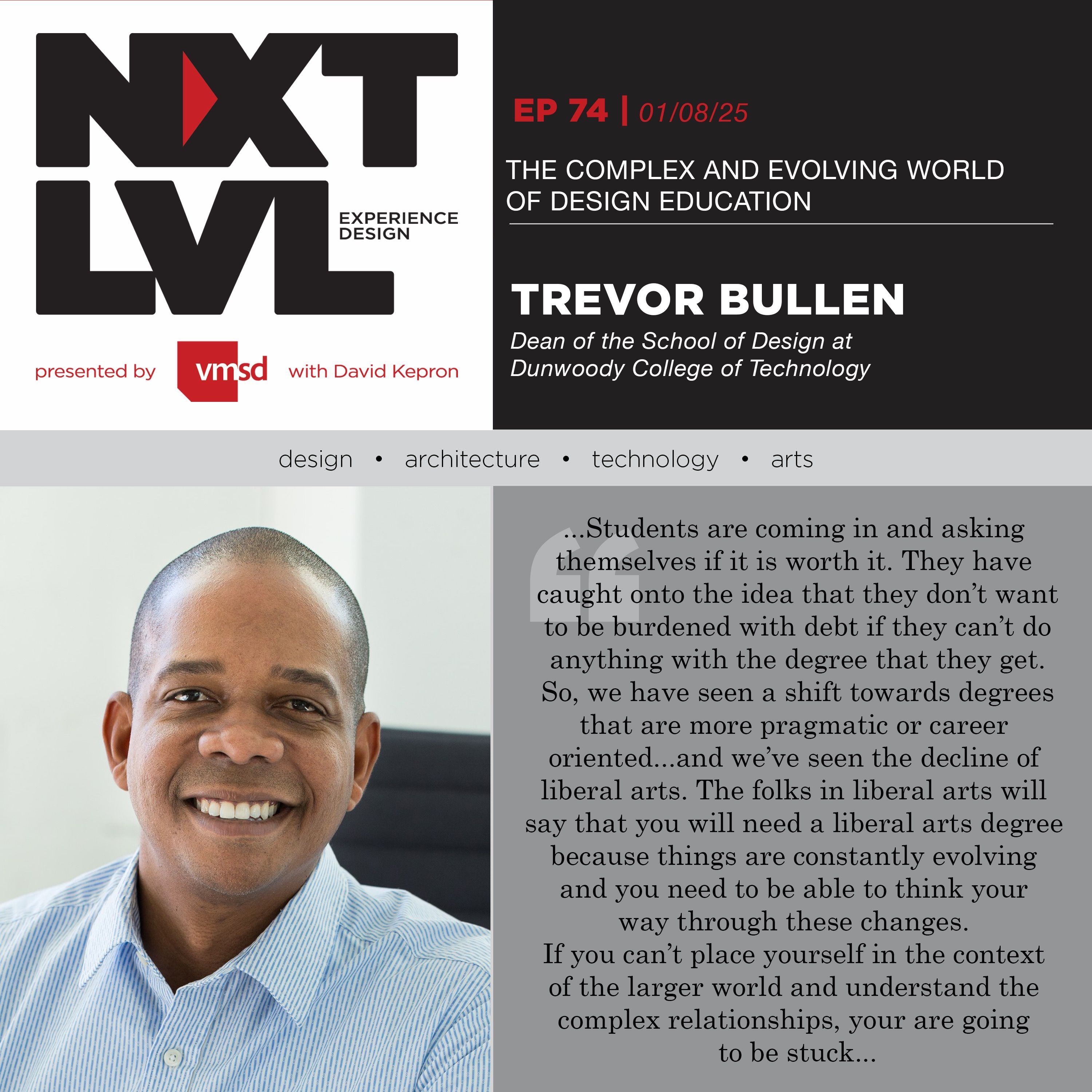
Ep. 74 THE COMPLEX AND EVOLVING WORLD OF DESIGN EDUCATION with Trevor Bullen, Dean of the School of Design at Dunwoody College of Technology
Jan 9, 202501:28:35Tap to summarizeABOUT TREVOR BULLEN:LINKEDIN PROFILE: https://www.linkedin.com/in/trevor-bullen-6b55b615/DUNWOODY COLLEGE OF TECHNOLOGY: https://www.linkedin.com/school/dunwoody-college-of-technology/TREVOR'S BIO:Trevor is the Dean of the School of Design at Dunwoody College of Technology. He is an award-winning architect with over 25 years of professional experience. He has significant international experience; working on a wide range of architecture, landscape architecture and planning projects in Europe, the Caribbean, and the United States. In addition to his role as Dean, Trevor has taught architectural design at the Boston Architectural College, the City College of New York as well as the University of Minnesota and is a frequent guest critic at schools of architecture nationwide.Prior to joining Dunwoody, he was a Senior Associate and Director of Operations at Snow Kreilich Architects, the recipient of the 2018 AIA Architecture Firm Award. From 2000 to 2016, he co-founded and led an architecture and planning studio on the island of Grenada, completing more than 30 built projects. The work of his firm has been published extensively in journals and books as well as being exhibited at the 2021 Architecture Biennale in Venice. SHOW INTRO:Welcome to the NXTLVL Experience Design podcast.EPISODE 74… and my conversation with Trevor Bullen. On the podacast our dynamic dialogues based on our acronym DATA - design, architecture, technology, and the arts crosses over disciplines but maintains a common thread of people who are passionate about the world we live in and human’s influence on it, the ways we craft the built environment to maximize human experience, increasing our understanding of human behavior and searching for the New Possible. The NXTLVL Experience Design podcast is presented by VMSD Magazine part of the Smartwork Media family of brands.VMSD brings us, in the brand experience world, the International Retail Design Conference. The IRDC is one of the best retail design conferences that there is bringing together the world of retailers, brands and experience place makers every year for two days of engaging conversations and pushing the discourse forward on what makes retailing relevant. You will find the archive of the NXTLVL Experience Design podcast on VMSD.com.Thanks also goes to Shop Association the only global retail trade association dedicated to elevating the in-store experience. SHOP Association represents companies and affiliates from 25 countries and brings value to their members through research, networking, education, events and awards. Check then out on SHOPAssociation.orgTrevor is the Dean of the School of Design at Dunwoody College of Technology. He is an award-winning architect with over 25 years of professional experience who believes that design and teaching architecture is synonymous with discernment.We’ll get to all of that in a moment but first though, a few thoughts… * * *When I think back to my architecture education, it seems like another universe to today’s practice. And then again, in some ways it is much the same.Architecture school was 4 long years of hard work and all-nighters that, at the time, we wore as a badge of honor. It seemed that there was never enough time to do what we were being asked to accomplish. Or maybe I was trying to do more than was necessary to fulfill the learning objectives. I certainly felt I had a lot to prove since it had taken me a couple of years to finally get accepted into the program after not doing particularly well at calculus and linear algebra in junior college. I also took extra math in fifth grade. Yeah… math wasn’t my thing.Or at least it wasn’t my thing until I had a good tutor in second year who helped me understand that I was visual spatial learner and if I could draw or make models of the problems they would all make sense. Seeing algorithms… my eyes would roll back in my head.Anyway…I stuck with it, took every drawing class I could, loved design studio and managed the engineering. I was proud to graduate from the McGill School of Architecture school, go on to study for my licensing exams - another series of all-nighters – pass and be able to enter the profession of reserved title and call myself an “Architect.”I was proud to wear the traditional pinky-finger white gold ring with 7 notches in it representing the 7 Lamps of Architecture by John Ruskin. Ruskin was an English polymath – a writer, lecturer, art historian, art critic, draughtsman and philanthropist of the Victorian era. The Seven Lamps were seven principles which Ruskin viewed should be reflected in a building: Sacrifice, Truth, Power, Beauty, Life, Memory, and Obedience. The white gold ring was a tradition of McGill 4th year architecture graduates, as symbols of having legitimately put the time in, done the work on the design thesis and survived it. In those days we drew our projects by hand and built models in the workshop. We got our hands dirty. There were 4 years of design studio projects that, in the real world, would take months or more, and we were trying to get them done in weeks. Back in those days, the mid 80’s, Computer Aided Design was emerging as a new tool. I remember that we had to take a class in computer programming – I think it was Fortran or something – and we had dinosaur computers that some students were playing around with to create drawings.In the mid-80’s email didn’t exist, or not to students in any case,Cell phones had just arrived with the Morotrola DynaTec 8000 which was the size of a brick and weighed almost the same, We used this thing called a fax machine that magically sent images across the telephone wires and could print it out on the other end on thermal paper (which you didn’t want to leave on the window sill, because it would fade away),The blue print shop was an ammonia fumigated workplace where diazo prints, as they were technically called, were actually blue hence the term “blue prints.”We used pencils or ink pens on paper or mylar, and if you screwed up you actually used an eraser to rub the error out and you drew it again.I remember one of my first summer jobs in an architecture office, I was quickly assigned renderings due to my love of drawing. I had made some mistakes when plotting out a perspective using the Plan Projection Method, and I was erasing what I had drawn. One of the principals came by my desk, stopped, watched and then remarked “hey… we hired you to draw not erase…” and then walked away.Nice…Our go to reference books were by Francis D.K Ching – ah… the drawings and hand lettering in “Architecture Construction Illustrated”, or “Form Space and Order”And… the social media, google, Ai and computer generated 3D modeling didn’t exist.It wasn’t until around 2005 or so that Facebook became popular and the iPhone came out in 2007.Then the world seemed to shift on it axis and life as we know it was on the path towards Artificial General Intelligence and all of the miraculous - and scary - things we are now so familiar with shaped our everyday lives. The world sped up and the way I learned in university was both a thing of the past and then again it wasn’t.Many of the ways architecture is taught are similar to my experience. Courses are taught as individual, disaggregated subjects, that graduates have to piece together in actual life experience. A wholistic approach to learning the discipline of architecture is not generally the norm. Which when you consider all of the components of a building it is a challenge since everything is connected to everything and the amount of ‘everything’ in a building can indeed be overwhelming if you try to consider it all at the same time.The number of professional and skilled labor disciplines is enormous. And most of us simply see buildings as ‘fait a complis’ – completed works - with no idea what actually had to be wrangled to go from concept to completed construction.Going back to social media and the internet for a moment, students now have never known a time without ubiquitous access to the world’s information through the internet. The tools for designing buildings have changed.One could say it is easier to some degree now. Computer programs manage all of the interrelationships between engineering, architecture, building systems, interior design elements, as well as the cost estimating, construction management and more.It is also easier to rely on tools to think for you and disconnect you from discernment – one of the key features of the architects’ role in puting a building together.And this is where my guest on this episode comes into the frame. Trevor Bullen is the Dean of the School of Design at Dunwoody College of Technology. Trevor is an award-winning architect with over 25 years of professional experience. He has significant international experience, working on a wide range of architecture, landscape architecture and planning projects in Europe, the Caribbean, and the United States.In addition to his role as Dean, Trevor has taught architectural design at the Boston Architectural College, the City College of New York as well as the University of Minnesota and is a frequent guest critic at schools of architecture nationwide.He believes in introducing real world problems into the architecture curriculum so that students begin to understand the relationships between theory and practice as well as that good projects are buil...
Transcribe →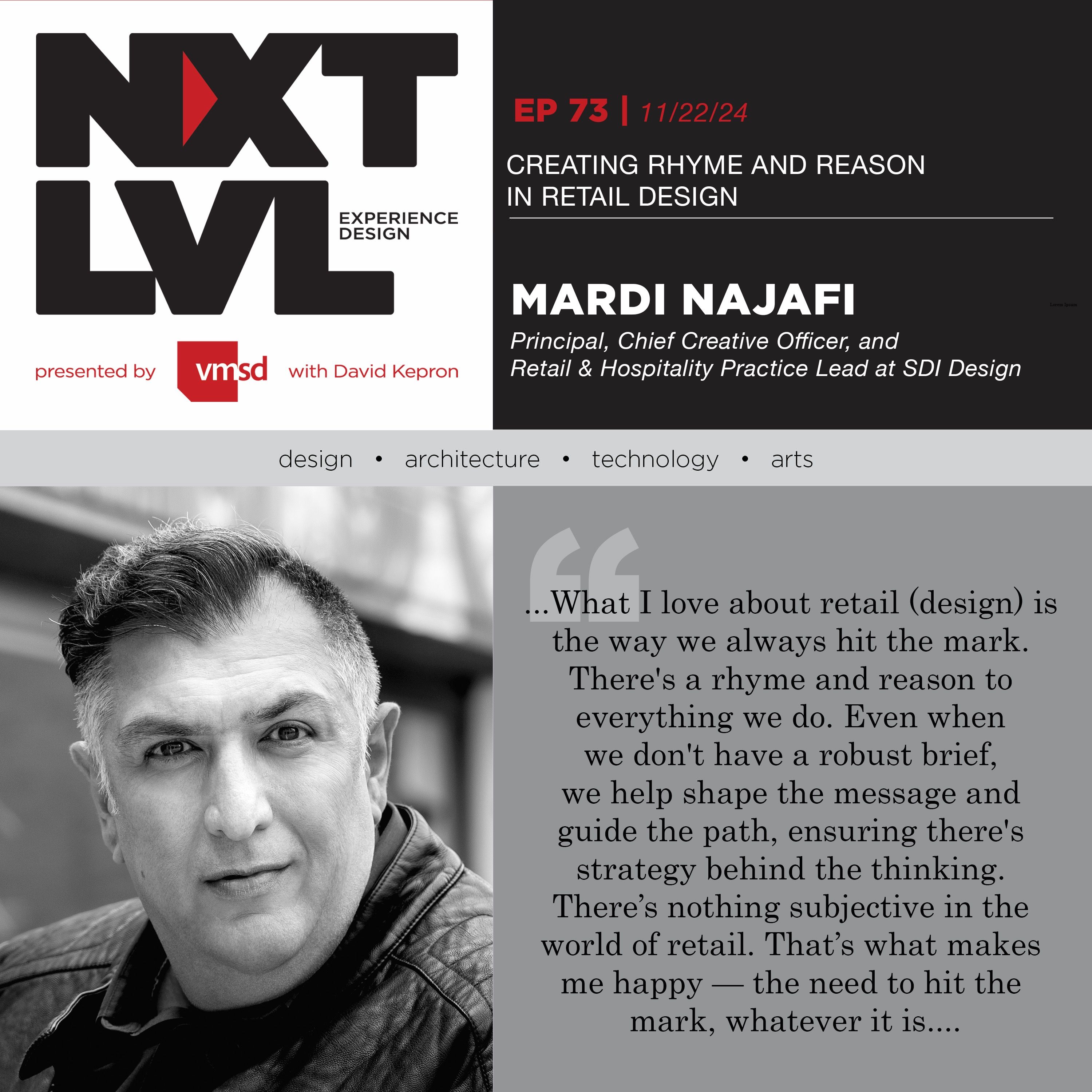
EP.73 Creating Rhyme and Reason in Retail Design with Mardi Najafi, Principal, Chief Creative Officer, and Retail & Hospitality Practice Lead at SDI Design
Nov 22, 202401:34:28Tap to summarizeABOUT MARDI NAJAFI:LINKEDIN PROFILE: https://www.linkedin.com/in/mardi-najafi-rdi-idc-772b1328/MARDI'S BIO:Mardi Najafi is an award-winning, multidisciplinary designer with over 30 years of experience at the forefront of the design world. A visionary leader in the field, Mardi believes that design has the power to evoke emotion, create unforgettable experiences, and leave a lasting impact. His work spans a diverse range of high-profile retail environments, from intimate boutiques to large-scale, branded experiences for some of the world’s most iconic companies, including Coca-Cola, Adidas, Virgin Mobile, Telus, Loblaws, Penguin Random House, Keilhauer, and Versace. His global portfolio reflects his ability to blend innovation and cultural context, with projects across Paris, New York, Toronto, and beyond.As the Principal, Chief Creative Officer, and Retail & Hospitality Practice Lead at SDI Design, Mardi is passionate about pushing the boundaries of design to craft immersive, transformative environments that captivate audiences. Known for his attention to detail and his ability to seamlessly merge art and commerce, he excels at creating spaces that are not only visually striking but also deeply meaningful and engaging. His work continues to redefine the retail landscape, setting new standards for brand experiences that resonate long after customers leave.Beyond his design practice, Mardi is an active voice in the industry as an accomplished speaker, educator, and panelist. He is deeply committed to fostering innovation, sharing his expertise with the next generation of designers through mentorship and his involvement in various professional advisory committees. A lifelong advocate for education, Mardi has taught at prestigious design schools around the world, inspiring students and shaping the future of the design community.In 2023, Mardi was honored as the first Canadian inductee into the Retail Design Institute's prestigious Legions of Honor, recognizing his exceptional contributions to the field. He is also currently serving as the President of the Retail Design Institute Canada, where he continues to shape industry standards and advocate for the advancement of design excellence. SHOW INTRO:Welcome to the NXTLVL Experience Design podcast.EPISODE 73… and my conversation with Mardi Najafi. On the podcast, our dynamic dialogues based on our acronym DATA - design, architecture, technology, and the arts crosses over disciplines but maintains a common thread of people who are passionate about the world we live in and human’s influence on it, the ways we craft the built environment to maximize human experience, increasing our understanding of human behavior and searching for the New Possible. The NXTLVL Experience Design podcast is presented by VMSD Magazine part of the Smartwork Media family of brands.VMSD brings us, in the brand experience world, the International Retail Design Conference. The IRDC is one of the best retail design conferences that there is bringing together the world of retailers, brands and experience place makers every year for two days of engaging conversations and pushing the discourse forward on what makes retailing relevant. You will find the archive of the NXTLVL Experience Design podcast on VMSD.com.Thanks also goes to Shop Association the only global retail trade association dedicated to elevating the in-store experience. SHOP Association represents companies and affiliates from 25 countries and brings value to their members through research, networking, education, events and awards. Check then out on SHOPAssociation.orgMardi Najafi is the Principal, Chief Creative Officer, and Retail & Hospitality Practice Lead at SDI Design.We discuss his life of growing up the son of an Iranian diplomat, a professional path through the fashion, exhibit design and retail industries and how teaching is about giving back to young designers in their fledgling careers…We’ll get to all of that in a moment but first, a few thoughts… * * *There are interviews that I have done over the past 73 episodes that have been specifically about a person’s work, There have been those that have been about a brand or product category, Or the study of neuroscience and its role in experience making, We’ve delved into art and creativity, leadership, climate issues, and many other subjects.And there are other interviews that I have done that focused in on a person’s career path, how their experiences brought them to where they are today. In these cases, I often find that my guest and I identify how serendipity stepped in front of them as they careened through a career, how taking the road less traveled lead them to creative professional journeys that were unexpected, and how a shift in their mindset resulted in profoundly rewarding roles at companies or with personal and professional relationships. I love discussions about serendipity – how our life paths seem to be guided by novel circumstances that were unforeseen, yet when confronted with them, we found a moment to step aside from our pre-determined story, one that we might have created with specific objectives, a place to be at some future moment, and in the midst of new circumstances, a choice was to be made about what the next move would be without really knowing where it would lead.There seems to be some magic in this process – a sense of wonder that keeps the creative spirit alive. There is also a good dose of courage needed at the nexus of ‘now and next, when a calling summons new thinking and a re-evaluation of our pre-suppositions about how things are supposed to be now, or in the future, need re-evaluation.I think it is often the case with creative paths or projects.To start out knowing where you are going would suggest that you have you have already been. To start out with the end in mind creates a path of production, of doing, rather than one of seminal discoveries along the way.There is something in the unknowing that I believe maintains the creative path as an adventure, one where in the doing of the thing we are continuously discovering rather than just in production mode.In the discovering, we remain engaged, learning, exploring and the path is laid out as we move along it. However… being in a place of unknowing, can be fear inducing since I think we so often like the assuredness of the pre-determined and predicable.I have found this particularly true in teaching at universities in design fields. Students don’t like the unpredictable so much. Many prefer the determinism of knowing where their projects will eventually end up. But I think in taking this approach we short circuit the opportunity to discover something new – something we could not have predicted but when discovered, results in a sense of awe that shifts our perspective and maybe our purpose. And I think it takes courage to follow a set of rules about designing something, call it strategy, and let the rules of the strategy guide the process. As we pursue the path of the work the rules help to guide decisions that make the next step self-evident. Then the next, and the next and so on, until a conclusion to the process meets the requirements of the design brief.Assuming the strategy is well founded, you can rely on the rules to guide the process and decision-making. Along the design path, all decisions can be cross-referenced against the strategy and the outcomes that don’t align with the determined set of rules can be set aside in a preference for the ones that best exemplify them.Then there is the emergence of circumstances that throw you a curve ball – conditions shift within which you have little control – and your path necessarily changes. The resilience and the flexible mindset that is required in these moments are factors that influence your ability to adjust – to find yourself in a place of positive transformation or maybe to simply survive.I have found that the key to positive transformation is to keep saying yes to serendipity. To loosen the rigidity in my mindset and welcome the unexpected. It can be a struggle because I have generally been geared to knowing where I’m going. I don’t mind saying that I have long preferred the predictable over the mercurial. It is at times not easy, but these moments of re-alignment with new realities can be the success factor supporting our determination to keep going and to leverage the “new” for the purpose of re-making ourselves. I think that in this, there is a sense of agency. I think that we are, in fact, in little control of anything but for our own reactions to adversity or the everchanging circumstances of life.Perhaps this is the proverbial ‘making lemonade out of lemons.’ When life gives you lemons… you know… make lemonade.And this is where the life path of my guest in this episode comes in. Mardi Najafi has had a colorful host of experiences influencing his professional path.Having grown up the son of an Iranian Diplomat, he was schooled in multiple countries including Iran, France and Russia. He was conscripted into Iranian military service and made a friend with whom he, after his release from service, created a business bringing watches into Iran. That adventure eventually allowed him to earn enough money to buy his father’s release from prison and ironically lead to a career in design.After a building a successful professional track record working in Europe, he landed in Canada where he fostered his interest in ret...
Transcribe →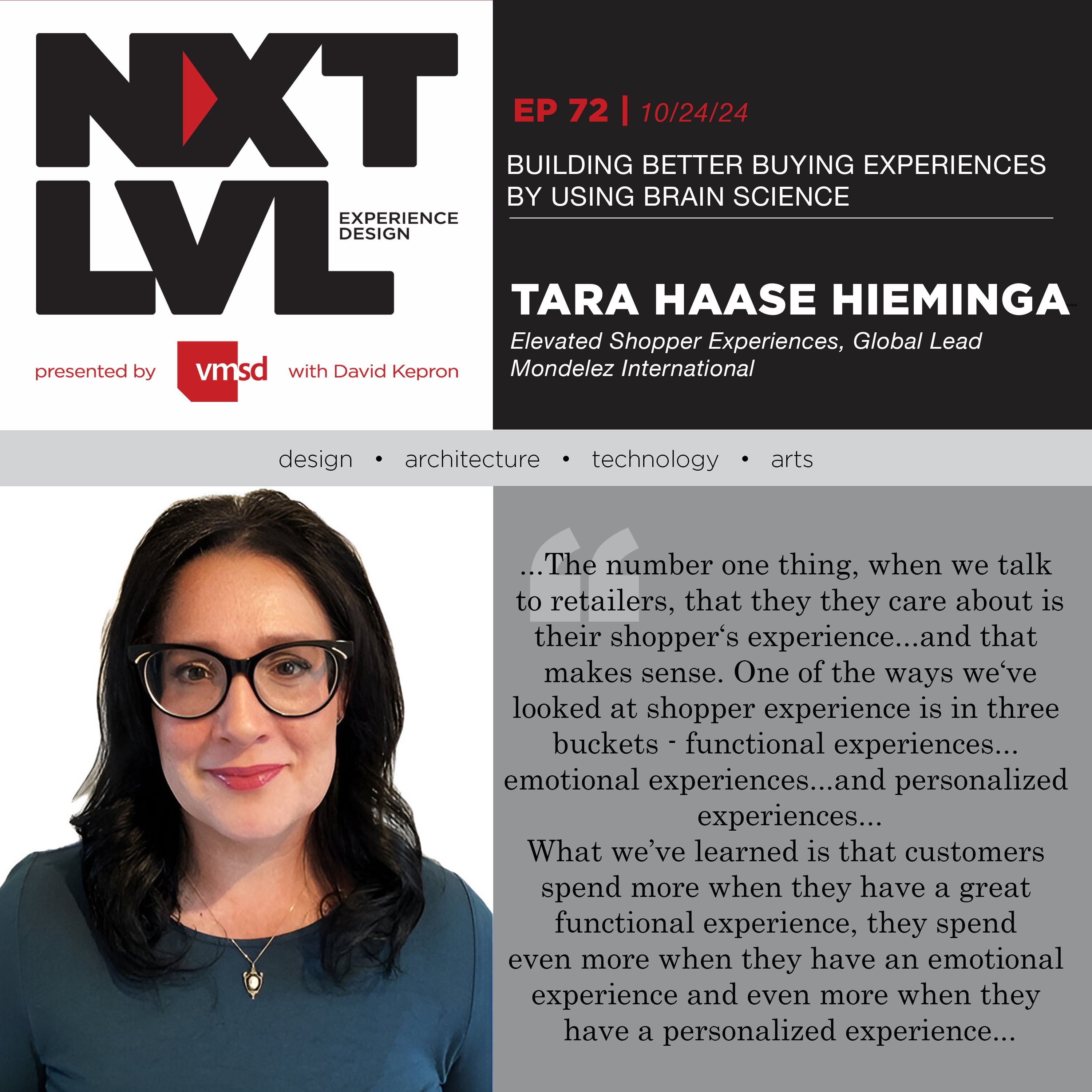
Ep.72 BUILDING BETTER BUYING EXPERIENCES BY USING BRAIN SCIENCE with Tara Haase Hieminga, Elevated Shopper Experience, Global Lead, Mondelez International
Oct 24, 202401:08:26Tap to summarizeABOUT TARA HAASE HIEMINGA:LINKEDIN PROFILE: https://www.linkedin.com/in/tara-haase-hieminga-48124621/TARA'S BIO:Tara Haase Hieminga is the Elevated Shopper Experience Global Lead at Mondelez International. With more than 12 years at Mondelez he has previously held roles such as Senior Manager Shopper Marketing & In-Store Merchandising, Sr. Manager Design & Digital Engagement. Prior to Mondelez, Tara was at Kraft Food Group as the Design Strategy Leader and before that, she worked for Mars as the Brand Manager, Candy and In-Store Marketing Manager for Snackfoods.SHOW INTRO:Welcome to the NXTLVL Experience Design podcast.EPISODE 72… and my conversation with Tara Haase Hieminga. On the podacast our dynamic dialogues based on our acronym DATA - design, architecture, technology, and the arts crosses over disciplines but maintains a common thread of people who are passionate about the world we live in and human’s influence on it, the ways we craft the built environment to maximize human experience, increasing our understanding of human behavior and searching for the New Possible. The NXTLVL Experience Design podcast is presented by VMSD Magazine part of the Smartwork Media family of brands.VMSD brings us, in the brand experience world, the International Retail Design Conference. The IRDC is one of the best retail design conferences that there is bringing together the world of retailers, brands and experience place makers every year for two days of engaging conversations and pushing the discourse forward on what makes retailing relevant. You will find the archive of the NXTLVL Experience Design podcast on VMSD.com.Thanks also goes to Shop Association the only global retail trade association dedicated to elevating the in-store experience. SHOP Association represents companies and affiliates from 25 countries and brings value to their members through research, networking, education, events and awards. Check then out on SHOPAssociation.orgTara Haase Hiemanga who is the Global Lead for Elevated Shopper Experiences at Mondelez.She is using an understanding of neuroscience to enhance customer experiences across a number of the Mondelez brands. What brands are those, well there is a pretty big list but let me just say a few of my favorites – OREO, Toblerone, Cadbury, Wheat Thins and I could go on…We’ll get to all of that in a moment but first though, a few thoughts… * * *Back around 2008, 9 and 10 my wife was studying interpersonal neurobiology with Dr. Dan Siegel. I used to come downstairs and listen to her and all the videos she was watching and various conversations she was having and I was often saying ‘wow that really replies to the work that I'm doing in trying to create retail stores.’As I listened it became clearer and clearer to me that I could perhaps rely on the lessons of understanding neuroscience as being the core driver to customer experience rather than simply thinking of it in terms of psychology, demographics and culture.What fascinated me then and still continues today is the idea that – there was something beyond simple psychology that we would be able to use to design better stores something that would relate to almost all humans in terms of how they understood environments specifically how they would look through product assortments, identify key item presentations, understand graphics, and how color, pattern and texture would all come together to either hinder or help decision making in the shopping aisle.Interestingly, back in the day, it took me a little while to get into architecture. I'd had a great time in junior college but my grades weren't great so I ended up enrolling in a Bachelor of Science in psychology which I was fascinated in anyway because I wanted to understand human dynamics but, I also had a sense that there was something deeply rooted and not just how buildings looked from the design point of view and but how they made people feel from an embodied / sensory point of view. And so, when I finally got into architecture a lot of my thinking about design was about how these places that we were creating would have qualities about them that would make people feel a certain way.I sometimes used to say that I didn't care whether you loved it or hated it (of course I hoped you loved it) but I wanted to make sure that you felt something as you were experiencing some place. And that later in my retail design career that you were satisfied with the experiences as well as the things that you bought in the store.In 2012 I did a presentation at global shop that was ostensibly about emotions and how we had to begin to understand that creating stores was about building emotional relationships and long term connections and then the awareness of how empathy played into this equation.This single presentation was a turning point in my career because someone came up to me at the end of it and said “…that idea should be a book.”And so, taking that as a sign…I was on my way to immersing myself for the next couple of years in writing “Retail (r)Evolution: why creating right brain stores will shape the future of shopping in the digitally driven world. “In the book I really dug into the nature of shopping as a cultural phenomena; it's power across the ages to tie together ideas and commerce the growth of shopping places around the world from the intersections of silk trade routes to the mega malls of North America and I also dug into brain science. In fact over a third of the book deals with understanding functional areas of the brain and how if we we're able to appreciate more how our gift in perception through our body was directly tied to our emotional connections and long term memory could be used - that all shoppers and retailers would be better off.I tried to explain it this way: imagine you're in your car - what I'd like you to do is write down 5 things that make the engine of your car run now if you're actually in your car while listening to this, do not start to write down these five things but hold them in your head as an idea what are the five things that make your car engine run? OK got 5 of them?Now, I want you to think about your brain and think of five things that make you run - through your engine - in other words your brain. The strange thing is and I've done this at multiple presentations around the world people are more apt to be able to describe 5 things that make the engine of their car run where they might spend 2 hours a day in rather than being able to identify more than two things that make themselves run ( the functional areas of their brain) that they spend 24hrs a day in.I also put forward the following proposition:- if we understood that all of our behaviors, thoughts and feelings are run by our brain-body connection, how is it possible that we could be designing stores and not have any clue about the very thing that is so influential in making decisions in the shopping aisle and our willingness to maintain relationships with the brands we love?So, it became a little bit of a career mission to bring the understanding of neuroscience to the retail design masses hoping that they would understand the power of the brain-body and design and creating effective selling spaces.Now, the other influence here was the emergence of digital technologies and how that was fundamentally changing the way our brains were being wired. With the idea that the more you use a functional area of your brain the more you maintain its wiring between neurons and the less used something is the more though the brain goes on a wonderful topiary garden creating extravaganza trimming away neural pathways that are not being used. This whole subject is referred to as “synaptic pruning” and fits together neatly with an idea around “neuroplasticity” - how your brain changes over time in relation to the things that you're exposed to in the patterns of behavior you engage in.So my premise then was: - if you are increasingly not using certain areas of your brain related to the exercise of empathy in face to face embodied interactions with other people like we continually do by communicating through our digital devices, what does that mean for the pathways for empathy in our brains and how we communicate with others?If stores were about empathic engagement, we might have a significant challenge ahead of us. In other words, if we are communicating less and less in embodied, face-to-face ways, what happens to the neural pathways built for empathic connection if we are using them less? Does synaptic pruning play a role here eventually diminishing our ability to engage in empathic extension?This became particularly interesting when you began to look at an entire cohort of emerging customers whose lives were very much directed by their interaction through social media that works and the digital devices they held in their hands. That is the subject of a bigger and equally interesting conversation which I'll save for another podcast but for now let’s continue to focus on trying to understand what actually motivates people in the shopping aisle there have been fantastic studies that I came across the work of Baba Shiv and how decision making was made in the shopping aisle in relation to the potential for customers cognitive overload how they decided to choose one thing or another or the work of Sheena Iyengar who did a famous study of jams and the idea that a huge selection did not infact increase more purchases and satisfaction in the products chosen.The...
Transcribe →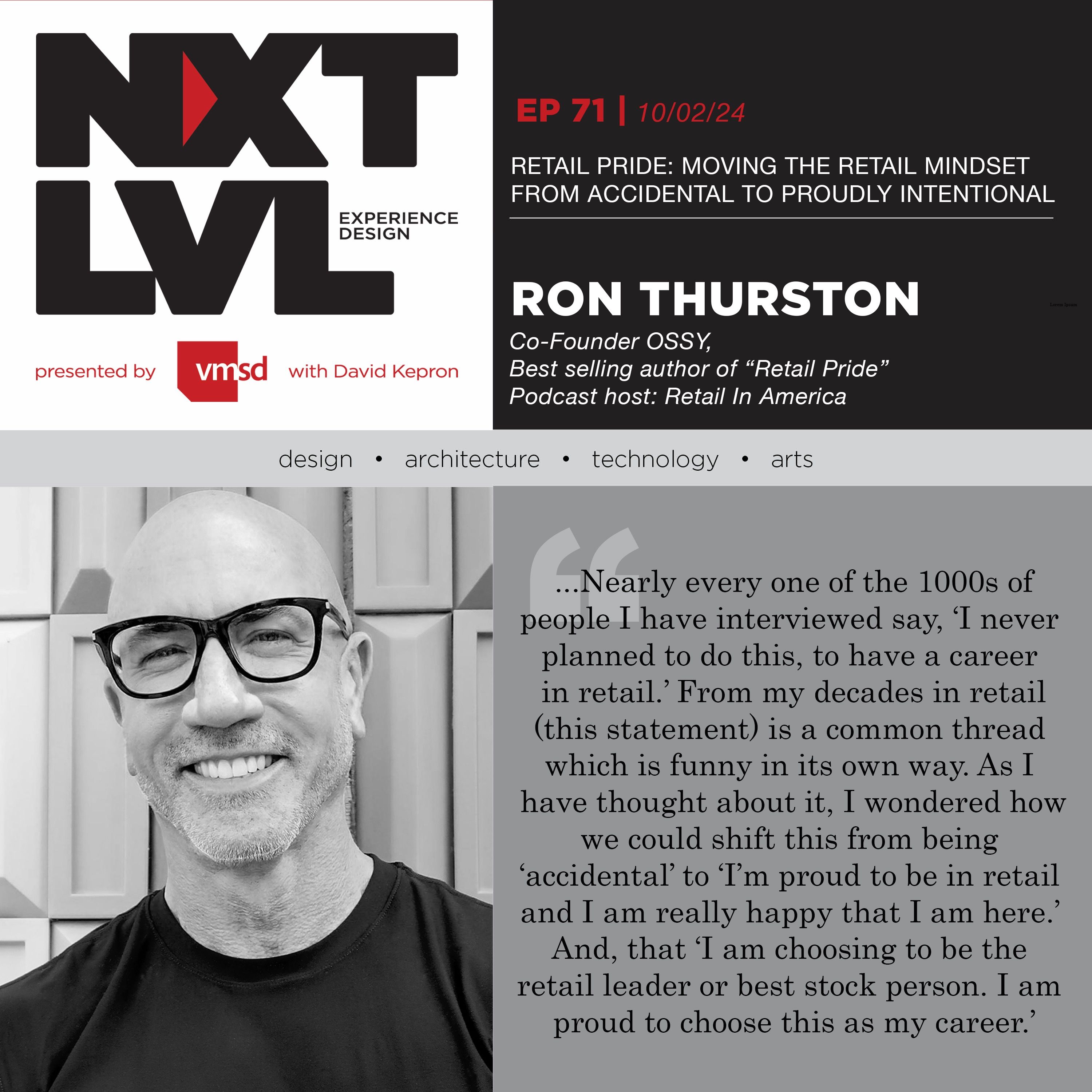
Ep.71 RETAIL PRIDE: MOVING THE RETAIL MINDSET FROM ACCIDENTAL TO PROUDLY INTENTIONAL with Ron Thurston, Co-Founder OSSY, Best selling author of “Retail Pride”
Oct 3, 202401:15:47Tap to summarizeABOUT RON THURSTON:LinkedIn Profile: https://www.linkedin.com/in/rthurston/Websites:Retail Pride book: https://www.amazon.com/Retail-Pride-Celebrating-Accidental-Career/dp/1544515928OSSY: https://www.useossy.comRetail In America podcast: https://podcasts.apple.com/us/podcast/retail-in-america/id1618323713 Ron Thurston's Bio:Ron Thurston's life mission is to celebrate, elevate, and empower the people and spirit of the retail industry.With over three decades of leading retail stores and operations for top American brands like Gap, West Elm, Apple, Tory Burch, Bonobos, and Saint Laurent, Ron has honed an extensive skill set in retail strategy, management, and innovation.In January 2024, Ron co-founded OSSY, a forward-thinking retail recruiting agency. This venture is dedicated to addressing the biggest hiring and recruiting challenges in retail, reinforcing Ron’s unwavering commitment to the industry.As the best-selling author of RETAIL PRIDE, Ron inspires retail professionals to embrace their unique career paths. He also hosted the RETAIL IN AMERICA podcast and tour, journeying across the nation in an Airstream trailer during 2022/2023 to uncover and highlight the remarkable stories and individuals in retail.Ron also serves on the Advisory Boards of several rapidly growing retail tech companies, including Ometria, Butterfly, and YOOBIC, lending his expertise to drive their success.SHOW INTRO:Welcome to the NXTLVL Experience Design podcast.EPISODE 71… and my conversation with Ron Thurston, retail veteran, best-selling author, podcast host and man on a mission to celebrate, elevate, and empower the people and spirit of the retail industry.On the podacast our dynamic dialogues based on our acronym DATA - design, architecture, technology, and the arts crosses over disciplines but maintains a common thread of people who are passionate about the world we live in and human’s influence on it, the ways we craft the built environment to maximize human experience, increasing our understanding of human behavior and searching for the New Possible. The NXTLVL Experience Design podcast is presented by VMSD Magazine part of the Smartwork Media family of brands.VMSD brings us, in the brand experience world, the International Retail Design Conference. The IRDC is one of the best retail design conferences that there is bringing together the world of retailers, brands and experience place makers every year for two days of engaging conversations and pushing the discourse forward on what makes retailing relevant. You will find the archive of the NXTLVL Experience Design podcast on VMSD.com.Thanks also goes to Shop Association the only global retail trade association dedicated to elevating the in-store experience. SHOP Association represents companies and affiliates from 25 countries and brings value to their members through research, networking, education, events and awards. Check then out on SHOPAssociation.orgIn this 70th episode I talk with Samar Younes is a Beirut-born hybrid artist, futurist, and creative catalyst whose work embodies a transcultural approach. Ron Thurston has spent years opening stores for major internationally recognized brands and knows a thing or two about a career in retail. In our talk we dig into the shifting the mindset of retail being an accidental career to one of choice, about with you should be proud. We’ll get to all that in a moment but first though, a few thoughts… * * * Throughout my career in the retail design world I have often heard this statement “I never planned to be in retail”.And it's often said with some slight lilt of apology, that in a way somehow as an architect it was somehow not taken quite as seriously as the design of public buildings or housing or other things that architects with a capital “A” do.What's more, when I entered into the retail design world, quite by serendipity I might add, I came into the design of stores by way of visual merchandising. I was the resident architect of a small 4 personn design and visual merchandising consulting firm on 36th street just east of Park.Working with a couple of seasoned pros, I learned that visual merchandisers were often regarded simply as window trimmers and I don't think quite got the respect that they were due for the power they had in shaping the retail experience for customers. Often seen as the silent seller, visual merchandising was a key component to how the customer journey unfolded in a shopping experience. Mannequins and other displays in the store added that extra flavor to the store as a stage set in which the merchandise was the principal actor.Architecture wasn’t unimportant, but it wasn’t the be all and end all of the in-store experience. You could have terrific architecture but if you couldn't get your assortment planning right department layouts an in store messaging you were likely not to perform quite as well.It was through my first employer and mentor Joe Weishar of New Vision Studios in New York that I began to really understand the power of visual merchandising in the store designers toolboxand that it couldn't be simply left to be an afterthought but had to be integral to the initial strategic design thinking of how a store would be laid out. Where those special moments of surprise and delight would occur often had little to do with architecture but a lot to do with theatrics, art, marketing, graphics – in short, storytelling.Going back to that comment a moment ago about serendipity finding me and putting me firmly in the world of retail design, it does very much align with the often heard message that “I didn't plan to be in retail.” It is in fact true, that one now is an architecture I had no awareness and probably no interest in designing stores for a living.But, that said, I actually had no shame about being in retail.Retail combined all the things that I loved:stage set design, industrial design architecture, marketing, consumer behavior, trend analysis, fashion and advertising - all of these disciplines came together in the experience that a brand or retailer would provide for their customers.The fact of the matter is, that the exchange of goods and services otherwise know as ‘retail,’ is one of the key cornerstones of cultures around the world. Exchange has always been tied with ideas and that makes it extremely powerful. And, these ideas change over time influenced by the comings and goings of merchants and trends and technologies. It seems to me, and this comes from someone who was educated trained and licensed as an architect, that retail locations are probably more frequented by the general population than are the major civic buildings that would have been typically called “architecture” in the past.Think about it, when was the last time that you went to a post office, a library, an Opera House, a government building, a church, synagogue, or mosque or a courthouse?When did you last walk the campus of a university or visit a museum?And I am sure that there are some of you who will say well I did all of those yesterday but I'd also hazard a guess that they would be in the minority.now, when was the last time you went to a store a shopping mall a department store or used your phone to buy something from Amazon or some other online company?The point here is that shopping is so deeply ingrained in our everyday lives that it's inextricably tied to how we come to understand the world around us. Shopping places therefore are important and even though many people who work in the retail space find their way there as a transition between the end of one semester and the beginning of another.Students or younger members of our society are not the only people who find meaningful work in retail and who ultimately end up building their entire careers around working for retailer or brand or some company in the design and construction industry who's connected to designing and building stores.And somehow our society has often placed a judgment on what type of retail you might likely be engaged in. I have often heard the position that price point of product is somehow equated to pride in a sales associate’s work or price of products being a precursor to better service but this should not be the case. Experiences in retail stores should not be better if the products it sells are expensive. Service should be excellent across the product price spectrum of retail experiences.In fact we've all probably had experiences where being in high priced stores did not render necessarily better service.The point is that you need to strip away what you sell and deliver high levels of experience regardless of the product or the service that you're providing to your customers.Providing great service often has to do with how people connect to others and the level of emotional intelligence that sales associates bring to their job every day. Which also suggests that the way we train sales associates in customer interaction protocols might likely be less about the rubric of sequential steps on how to connect – first you do this, say that, then do this, and say that – but might likely be more effective if you train on why we all need emotionally resonant, empathic connection – how empathy is built into our collective DNA.And this is where my guest, Ron Thurston comes into the story.Ron suggests that empathy, curiosity and focus translate into e...
Transcribe →