← Once We Were Spacemen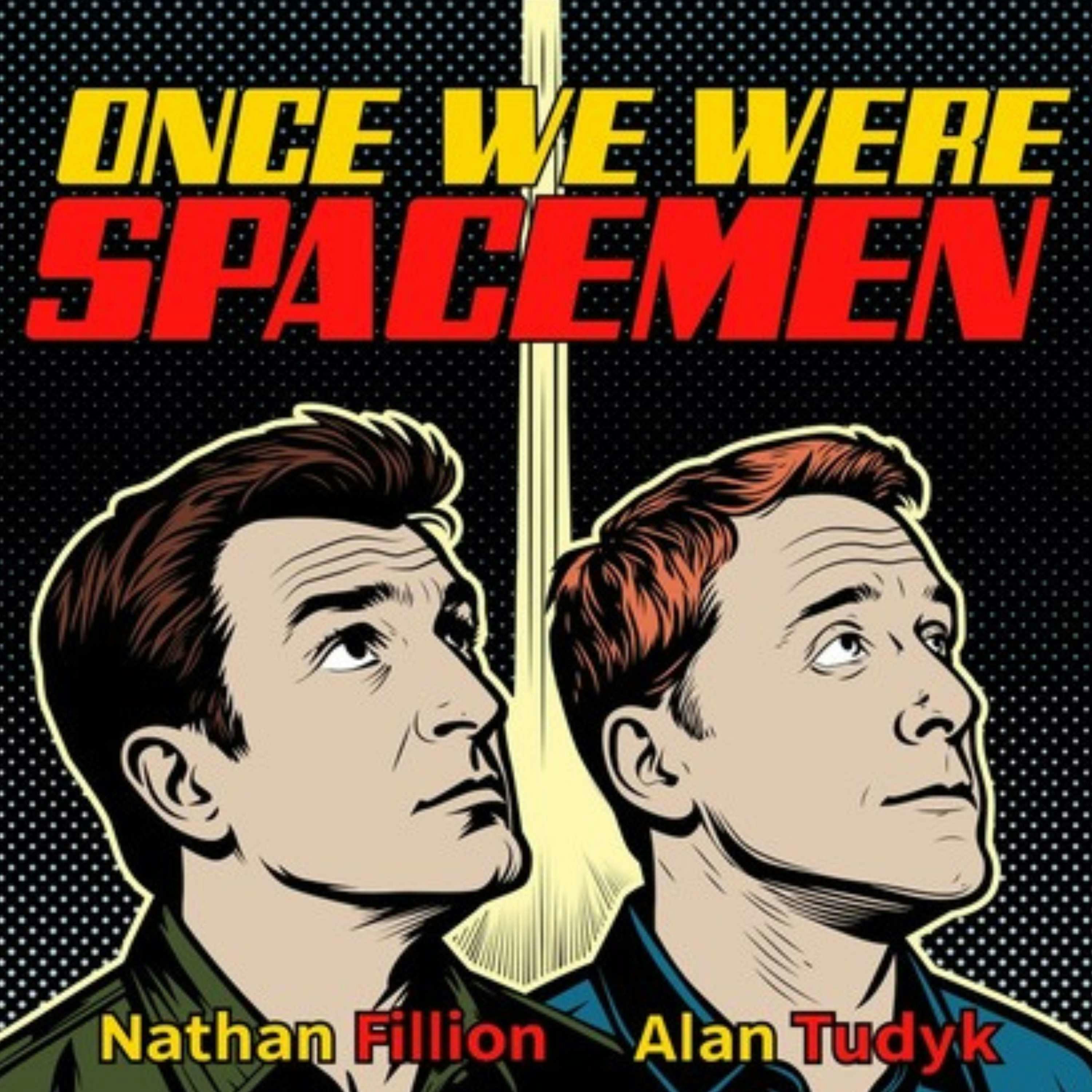
Once We Were Spacemen
Episode #1: Once We Were Spacemen
Once, Nathan Fillion and Alan Tudyk were spacemen… who played a lot of Halo in their downtime. They once did a photo shoot in the back of a Walmart, and this other time Nathan got revenge on an inc...
Loading summary
Transcript365 lines
- [00:00]
A
When I first saw you, I was, like, looking at everybody coming in, because this is when we were meeting the cast for the first time. Everybody looked apart, and then the captain walked in and I said, I get it. Good looking, definitely got it. I went up and I said, hi, there, I'm Alan. I'm playing the character of Wash. And he said, hi, I'm Sean Marr. I'm playing the Doctor. Once we were spacemen. Spacemen. I tend to play weird people, usually aliens and robots and things that don't have romance.
- [00:43]
B
I once didn't get a job where they were looking for a Nathan Fillion type. Once we were spacemen.
- [00:51]
A
Once we were spacemen. Alan Tudyk, Nathan Fillion.
- [00:58]
B
Tell me why we were doing this.
- [01:00]
A
Because once we were spacemen. Once we were spacemen. And at that time, back in the 1900s, we. No, no, it was in the 2000s. We were in this. It was early 2000s.
- [01:14]
B
Early aughts.
- [01:15]
A
Early aughts. You and I became friends as fellow travelers on a spaceship.
- [01:22]
B
Our lives have intersected at a number of interesting points, but I would say probably being spaceman is probably the coolest.
- [01:31]
A
That's where we were cognizant of one another.
- [01:34]
B
Yeah. That's where we actually got to know one another and became pals.
- [01:38]
A
Yeah. I didn't like you when I first met you.
- [01:41]
B
What?
- [01:42]
A
Yeah, I didn't like you. I didn't like you only because I considered you. You know how you are when you're a young man and you. You create enemies where there are no enemies because you decide to compete. You're always in some form of competition because you haven't. You're struggling and you're striving for your life still in that place. And so you find competition wherever you turn. Did that happen?
- [02:07]
B
You were competing with me?
- [02:08]
A
I was. And I decided to compete with you for your girlfriend.
- [02:13]
B
Oh, Jesus.
- [02:13]
A
Yeah, but see, how it happened, though, was I met her first. And so I decided she is the most beautiful woman I've ever seen in my life. And so I was always happy to see her, because certainly in my competition for supremacy, which, thank God that's over, I made it crested when you showed up on the scene. And I realized, oh, she is. She's connected with this, what I called handsome guy back then. And I felt like my chances with her were really, really not good.
- [02:51]
B
So what you were talking about is our first ever encounter, which was at.
- [02:57]
A
A Mexican restaurant, Harry's Burritos, on Columbus. Columbus, yeah. No longer exists there. It's between 70. It was between 72nd, 71st Street.
- [03:10]
B
That was a restaurant I frequented. I. I loved the. The Harry's Bay Burrito with chicken and black beans.
- [03:18]
A
Black beans.
- [03:19]
B
My usual order.
- [03:20]
A
Yeah, you like to sit upstairs in the corner with my girlfriend. And I accepted pretty quickly. You were a nice guy and a handsome guy, which would just only bothered me. I. Of course, I never got to know her as anything other than just the impression she made when light bounced off of her.
- [03:39]
B
You know, knowing you as I know you now, I. I'm gonna go ahead and tell you right now, that probably would not have worked out between the two of you.
- [03:47]
A
How did it work out between the two of you?
- [03:49]
B
Probably. I mean. No. So we never married, she and I.
- [03:55]
A
That's why I don't see her.
- [03:57]
B
Yeah.
- [03:58]
A
Never seen her at your house.
- [04:00]
B
But however, you and I continue to now. So the next time we encountered each other.
- [04:04]
A
Yes.
- [04:05]
B
I was looking at you across the table saying, holy crap, we got Alan Tudyk. He's a movie star right now.
- [04:15]
A
See, I think your definition of movie star is different from many other people's definition of movie star.
- [04:20]
B
An actor who acts in movies is.
- [04:23]
A
Not a movie star.
- [04:25]
B
Beg to differ, sir.
- [04:26]
A
They are lucky if they're a celebrity. You are a movie actor. You are. I mean, a movie star. I think of stars as people who have, you know, they. They get the star in the Hollywood Walk of Fame. Even some of those people, you're like.
- [04:42]
B
Him or her, you know, that's why they're stars. All the way over on Ivar and not on Highland.
- [04:52]
A
And then you see, like, a really nice. Like, you're like, why is Jack Benny on Ivar? And it's sad. He used to run, you know, he was the top of the top, anyway. Yes, you're right. You're right.
- [05:02]
B
And then that's. We became buddies there, so we. We would hang out in what we call IRL in real life.
- [05:10]
A
Oh, I don't know. I know so few of those.
- [05:14]
B
I'll. I'll clue you in on this. On the six that I know. Great. We've worked together a number of times.
- [05:20]
A
We have worked together a number of times since then. When I first saw you at that. I did not make the connection. When I. When I saw you at that same table re. Where you gave me the. I don't know, the generous moniker of movie star I saw, I was, like, looking at everybody coming in, because this is when we were doing Firefly and.
- [05:39]
B
That's right.
- [05:39]
A
Meeting the cast for the first time. And I was Going, okay. Oh, so. Oh, I know who that. You know, I saw Summer, and I'm like, that's the. That's the little. That's the girl. That's the young girl. That's got to be. Because she was 17. 16. 17. She. She so looked apart. Everybody looked apart. And then the captain walked in, and I said, that is not gonna work. I mean, I get it. I guess it's gonna work. Good looking, definitely got it. But there's just not an air of, that's a captain. That's the person who's in charge.
- [06:09]
B
Well, that's. I would think that. I mean, I don't really have that in real life, but I would hope that I can. I could act that part.
- [06:16]
A
That was my hope. So I went up and I said, hi, there. I'm Alan. I'm playing the character of Wash. And he said, hi, I'm Sean Mar. I'm playing the Doctor. I went, oh, good God, yes. Thank you. You're perfect for the Doctor.
- [06:38]
B
I see where this story is going.
- [06:40]
A
That's really what happened. And then you walked in, and I went, I see. That's a captain.
- [06:46]
B
Oh, that. Well, I feel much better now.
- [06:47]
A
Yeah, yeah, yeah.
- [06:48]
B
You.
- [06:48]
A
You. You nailed it. And I didn't recognize you from the black beans and the girlfriend stealing, but I knew you were right for the role.
- [06:59]
B
So back to where I started, which was, why are we doing this? We. We do these conventions together, these sci fi conventions. We go visit them. They're very kind to us. When I go to these panels, I think I get drunk on my own.
- [07:13]
A
It's not healthy. Because your ego. Your ego is susceptible to believing it. Believing this beautiful reality that we were all creating at the convention, this alternate reality where nerds are king and compassion reigns, that you are one of the leaders of this realm. And then you come back to regular life and you say, hey, I'd like to do this in my career, because I don't know if, you know, I'm a star. And your agents say, I'm sorry, you're gonna have to remind me of your name again. Those panels are so much fun because you are among friends. It feels like a party. And somebody gave you the microphone for the party, and you get to say or do anything during an hour's long time, and it never feels like long enough.
- [08:02]
B
A very forgiving audience.
- [08:04]
A
Yes, a very forgiving audience. We stole. Listen, this is how forgiving. One of the first panels we did. You stole somebody's little body mover thing.
- [08:15]
B
Mobility scooter.
- [08:16]
A
Mobility scooter. Thank you.
- [08:17]
B
I borrowed it.
- [08:19]
A
You bought, so I borrowed one as well. And we raced each other around the room and it was a. It was a hoot.
- [08:26]
B
The secret is to turn that little dial towards. From the turtle towards the rabbit.
- [08:30]
A
Mine was worn down. I. I had like a badger and I think I just thought it was a rock. But now you're saying turtle. It's okay. It's been. It's been a long time. It's been almost 20 years.
- [08:43]
B
It has been.
- [08:44]
A
Yeah.
- [08:45]
B
God. When we say. When we say 20 years. Oh, my God. There's people out there who haven't lived that long listening to this right now.
- [08:53]
A
I mean, they're listening, but they're also scrolling on TikTok and good for them. I'm going to get that app as soon as I. Lol.
- [09:02]
B
Did I use it right back to cons panels. Michelle Chapman said to us, hey, you guys, you could do exactly what you're doing up on that panel in a podcast. You'd be a huge success. The one difference, Alan, that I'm noticing is when we're doing a panel, there is a live audience who is not just a live audience. They are. It's a stacked deck. They will laugh at anything. Yeah.
- [09:32]
A
And right now all you got is me. And I'm a tough crowd.
- [09:35]
B
You are. Tough nut to crack. So we said, okay, we'll do a podcast. And then. Oh, my God. Trying to name this thing. We went through a lot of Firefly esque names because that's how we know each other. And we're going to talk about Firefly, but we didn't want it to be Firefly centric because, you know, we. We wanted the ability to kind of go elsewhere and do other things.
- [10:00]
A
But, Nathan, am I going to get to find out things about Firefly that I've never known before on this podcast? Because that is what I came. That's why I'm here.
- [10:10]
B
Is there something about Firefly that you haven't told somebody already?
- [10:14]
A
I think at this point, some of the things that I knew about Firefly, I have since forgotten about Firefly and learning of them again feels like new information. It really does.
- [10:28]
B
I love hearing other people talk about Firefly, other cast members talking about their experience, other. Anybody who was involved with the project. I love hearing them talk about it because it opens up the doorway to my memories that have been locked up for almost 20 years.
- [10:45]
A
Well, they were criminals and they needed to be locked away. So.
- [10:50]
B
So we, we named it. We went through a lot of names.
- [10:53]
A
Right. What Was your favorite that didn't make the cut.
- [10:56]
B
My favorite that didn't make the cut was don't cancel this one.
- [11:00]
A
I know that. I knew that was going to be it.
- [11:02]
B
Yeah. And I just thought it was kind of. It kind of touched on the show. But it has a negative. I get it. It has a negative connotation.
- [11:12]
A
Yeah. It's from a negative posture of.
- [11:15]
B
I agree. I thought it was funny. And it is.
- [11:19]
A
Yes.
- [11:20]
B
Yeah, I get it.
- [11:20]
A
The one that I liked. My other top one was Meant to be.
- [11:25]
B
Okay.
- [11:26]
A
Yeah. Meant to be. And I know it sounds a little. A little.
- [11:29]
B
Hey.
- [11:30]
A
And wind chime sound now. We can just put that in later. Right? Wind chimes. A little. A gong, please. There we go. And one singing bowl. And more wind chimes. Meant to be. Because that is something that actors say when every actor and probably artist has that in their back pocket. When things don't work out the way that they want, when they don't get the role that they want, when they don't get the things that they want, they say, is this meant to be? And you just got to move on to the next thing. So that was mine. Meant to be. But we landed on Once We Were Spacemen. I think that should also echo just as a sound note. Once we were Spacemen.
- [12:16]
B
It's not bad.
- [12:17]
A
Yeah. Because once we were spacemen. And I hope that. I hope that we can have people on also. Like, we've talked about different people we've worked with that we can talk about what they once were. Like, let's say we had Mark Addy on here from Knight's Tale.
- [12:32]
B
I hope we.
- [12:33]
A
He's somebody we both mentioned. Like, wouldn't that be fun? Just because I don't think people get to hear from Mark Addie. He's over there in York. And once he and I were jousters. Once we were living in the 15th century and we were medieval. Yes. And I, you know, that's the kind of evil you want to be. You don't want to be too high end evil. You want to just be mid.
- [12:55]
B
So we figured once we were spacemen, kind of tied us in. It touches Firefly, but it leaves it open for whatever direction we want to go to. Let's say Marquette. Medieval.
- [13:08]
A
Yes. Or anyone else that we would be lucky enough to have on this podcast that we could talk about what they once were in their past.
- [13:19]
B
So one of our plans, our many plans for this podcast was something we did at the. At our panels, something we always do at our panels is when people Come up and ask a question which is always so lovely. We give them stuff from our house. The junk, the castaways. Right. You call it crap.
- [13:38]
A
Well, that seems to really, really nails it, what it is. Just last weekend I gave away a rat trap that I didn't use. I had a rat and I killed it with one trap. I had a backup trap, didn't need it because the rat's dead. So I gave it away to a nice young man, signed, that bastard gave it away, called it crap.
- [13:59]
B
And I was that man. I'm holding up my hand with one finger missing.
- [14:03]
A
Gosh, this should be a visual medium because that killed.
- [14:07]
B
Well, I described the joke. Nathan holds up his hand with one finger folded down as if missing a digit. We'll select a couple people every week or so or whenever the show comes out, and we'll send them some crap from your house and my house.
- [14:23]
A
Could we give them something better than just crap, though? I feel like this, this warrants something special. Like.
- [14:30]
B
Like swag.
- [14:31]
A
Yeah, like you get crap and swag. Sure. I'm looking around the room.
- [14:37]
B
Our podcast would have, like, what do you call? Merch.
- [14:40]
A
Merch.
- [14:41]
B
We'll have merch.
- [14:42]
A
Or I could give like some really good swag. I don't know if I would remember.
- [14:46]
B
The bottled water merch idea. No. Do you remember you were doing 310 to Yuma and you had grown your hair longer than you'd ever had it and you wanted to do a photo shoot, so we went to Olin Mills.
- [14:59]
A
Yes.
- [15:00]
B
The Kmart. Kmart.
- [15:03]
A
Yeah, I think it's Walmart. Or Kmart. Yeah, I think it's Walmart in la.
- [15:07]
B
Walmart. And we went to like the little photo studio, the Owen Mills studio at the back of the. And we were wearing turtlenecks and I combed all my hair down like a. Like a bowl cut type. And I wore a fake handlebar mustache.
- [15:20]
A
Yes.
- [15:21]
B
Hanging. We took some dramatic poses. And then the idea was to put that photo on a bottle of water and call it personal magnitude because we looked like self help gurus. Do you lack confidence? You need personal magnitude. I think some of our merch, I.
- [15:52]
A
Think that was solely your idea. And if you told it me, I forgot it quickly after. I think it's a great idea. And that is. I think that's a possibility.
- [16:05]
B
I think you named it.
- [16:07]
A
Really?
- [16:08]
B
Yeah.
- [16:08]
A
See, this is what happens when you know each other for this long. Things just.
- [16:13]
B
I'm here to remember stuff for you.
- [16:15]
A
Stuff spills out of your mouth.
- [16:17]
B
I'm going to open up these memory doors for you.
- [16:19]
A
Ah, great. They are stuck. Personal magnitude. Yeah. When you need. Is it any good, this water? Are we getting it from a bottle?
- [16:30]
B
From a source, extra wet. Also, I'm developing another product I like to call powdered water. Just add water.
- [16:40]
A
This sounds good. That sounds good.
- [16:44]
B
Alan, what brings you joy?
- [16:47]
A
What brings me joy?
- [16:48]
B
Yeah.
- [16:50]
A
Clowns.
- [16:51]
B
Really?
- [16:53]
A
What do you mean, really? Oh, my God. I think this is going to be a discovery, the two of us.
- [16:58]
B
A lot of people are afraid of clowns.
- [17:00]
A
I know. And they're. And it's because they. It's because they've been taught to be afraid of clowns. But clowns are here to give joy. They are joyful creatures.
- [17:10]
B
There's a difference between American clowns and, like, a proper, like, French clown. Cigarettes.
- [17:16]
A
Yeah, cigarettes. Cigarettes and a healthy wine intake.
- [17:20]
B
And they're pretty sad. A lot of French clowns are pretty sad.
- [17:23]
A
Well, they're constipated from all the cheese. But it is a European clown tradition, Lecoq school of clowning that I think you are referring to. It's the type of clown you're going to see at more of a Cirque du Soleil as opposed to a Ringling Brothers and Barnum and Bailey circus. They're clowns. They are abominations. They seem to be. I know that there's some skilled clowns in there, but it's. It is a. It is like a child's birthday party clown. It is. Let me make you some kind of inflated rubber animal or something. I don't like it. I don't. I don't. I'm not finding humor in this, but if you get a European clown, they are the simplest. They're Laurel and Hardy. They're Buster Keaton. These are clowns, like silent film artists. I did a movie. I don't know. I know you weren't invited to the premiere, and it's been a point of contention for years.
- [18:19]
B
I can't wait to go to that premiere.
- [18:22]
A
Dodgeball already premiered, buddy.
- [18:25]
B
I'm so excited what I'm gonna wear. I have it all picked up.
- [18:28]
A
Yeah, well, we. You were shooting a movie called Serenity during the premiere, so you were invited. You just were tired when I invited you. I guess you don't remember it. Anyway, in that movie. One of the biggest bits that was in that movie was taking rubber balls and throwing them into the faces of people. And that's the bit. That's it. That is a. That's a clowny thing. That is just a basic bam, hit you in the face with something. That's a. That's a good. That's a good clown move. I'll go back to this. Clowns bring me joy. You know my friend Orlando who teaches clowning? He teaches clown. Well, he taught clowning at nyu and now he runs a department, a movement department, like Juilliard. He is magic, and he can create joy in people. I've seen productions at clown shows of his that leave me happy for days. Days. Days of joy.
- [19:21]
B
This brings me to something else. I once asked you, Alan, I said, hey, we were working on Firefly together. It was my first lead role. I was always the other guy or the girl's boyfriend or something along the line.
- [19:36]
A
You were good in both of those shows, by the way.
- [19:38]
B
Thanks. You're very kind. But I had no. No experience. I had nothing to draw on. And I was. I was still a novice, a beginner in a lot of ways. And I said to you, hey, Alan, how do you come to your choices? You said, what do I mean? And I said. I said, wait, when you open your mouth to say a line, how do you come to the choice as to, like, what's your process? And you looked at me and you said, nathan, I make three choices before I ever open my mouth. And I thought, I'm out of my league.
- [20:05]
A
I don't know.
- [20:05]
B
Out of my league.
- [20:06]
A
I don't know if that's. I don't remember. I don't know what that is now. Like, if I did say that, which I'm not saying I didn't say that.
- [20:14]
B
Well, you can't say you didn't because you'd be gaslighting me, because it's. It's had a profound effect on my life.
- [20:18]
A
But I. I don't know what I meant. I don't know what I meant by that. I make three choices before I even open my mouth. I mean, are the choices, like, brush my teeth?
- [20:29]
B
I took it to mean. And I have carried this with me, by the way. I take that to mean you are making choices while you are listening to someone else speak. You are making choices while your character is processing the information he just heard and is now going to react to that information. And you are making choices as to. All right, this is how I'm going to react. This is the reaction I want to elicit. I'm going to use this tactic like I've built that all and took it with me, by the way, for the rest of my career.
- [20:59]
A
Oh, no.
- [21:00]
B
This little casual comment. You don't remember.
- [21:03]
A
Wow, that Just goes to show you, be careful what you say. I think we are.
- [21:08]
B
Because you might make someone a better actor and I think you did. But this is something that has always really wildly impressed me about you, is that the level of your training, you don't. You don't scratch the surface of anything. You crack the surface, you pry it apart, you get into the sticky bits underneath and you. You squish around down in there and you root everything so deep that by the time it's left to you to. And this is, I think one of the main reasons and one of the incredible advantages anyone gets when they hire you is they get your brain. Your brain to say what? Okay, listen, we can. We can write this down and we can put it on paper, the scripted and we can hand it to Alan and that's great. But what's going to be really great is what he does with this and where he takes it and what he finds within this to make it live and breathe. This is what you bring. You bring this very particular Alan Tudyk intellect that is so incredibly informed.
- [22:18]
A
Yes. This is so much, this is so much. This is so much generosity and I want to thank you for it. I don't. I'll. I'll just accept it just to. So that we can all.
- [22:30]
B
You are a trained actor. You went to Juilliard.
- [22:31]
A
I did, I did, I did. But here's, here's something that.
- [22:34]
B
And you took Orlando's classes about clowning. And you do movies like Irobot, where you are or a resident alien. You do your program where you are someone experiencing humanity for the first time. What is that? I. This is not in my wheelhouse. But you curl up into a beetle and you discover and you go, what would it be? What would Discovery. Everything you see is a new discovery. And everything you process is the first time and like you can bring it down you base.
- [23:03]
A
Ah, so that's very. Just. You know, I used to play a game for a long time. This just to the weirdness of me. Like when I was in my teenage years, all the way up into my teen years and like 20, 21, I would just imagine that I woke up in my body and I don't know who I am or where I am. And I have to discover from the things around me what and who I am. And I would do this when I was alone, thank goodness. And I would just find things in my room, like, what is this? And I would just look around my room or where usually in my room alone, away from others, discovering who and What I was and how old I was, and.
- [23:42]
B
I don't know.
- [23:42]
A
It was fun. It was a fun game.
- [23:45]
B
What prompted you to say, oh, I know what I'm gonna do? This thing that no one would think to do.
- [23:51]
A
I don't know. I don't know. I enjoyed it. I would just play that game of. Well, I would sometimes do it while I was driving. I'm driving a car. Okay. I'm. I'm. Where am I? What city am I in? Okay. Oh, and, like, try to see what would give me what. What would clue me into where I am or who I am or all of that. Like, what am I wearing? Who I. It was just a fun game I would play with myself.
- [24:17]
B
How brilliant that. That is actually a mindset that you possess.
- [24:22]
A
I think it's a clowning mindset. Like, you mentioned the fetal position, which, when I'm in that, it's a hell getting me out of my trailer. They're like, he's in the fetal position again. I think he's trying to root down under the surface to get to.
- [24:35]
B
We can't find Alan. Check the bottom of his closet.
- [24:39]
A
Exactly.
- [24:40]
B
Under the table. Under the couch. Check under the couch.
- [24:43]
A
He is knee deep in the gushy bits. It's gonna. We're gonna have to. Let's take lunch. Everybody. Take lunch. But that is a clowning. Doing that. Going into digging around and figuring stuff out. Definitely the. The alien. That is a clown. Clowns are people who are born into the world and don't know how everything works, and they're just out to have fun and mischief. But I need to return the favor, Nathan. I have benefited from learning some skills in the acting. It's a skill.
- [25:16]
B
It's.
- [25:16]
A
It's a craft. That's what I'm looking for. It's a craft. So I. I have been given different tools in the craft of acting. You, sir, are an instinctual actor who just knows things and understands things in a way that. That can't be taught.
- [25:33]
B
I put the stink in instinctual.
- [25:36]
A
That is. That's one way to. That's one way to say it. And it. That. That we could maybe put that on some merch, but I don't see it that way. You understand scenes in a way that just comes immediate and is simple. So much of acting when you do go into, you know, all these acting classes is simplify, simplify, simplify. What are you doing? You're getting too. Well, you're. You're making it too complicated. It's a simple thing just being in a Room, especially on film. You can just be in a place and it's engaging you. You understand the simplicity of acting inherently. I, on the other hand, will go a million miles out of the way to come back to simple. If I'm lucky, I get back to simple. You know, it. It. It's limiting. So I think we're. We're a good compliment because you. You have something I will never have. No matter how many tools I have, no matter how many classes I take, I can never. I will never have your inherent talent. I have a different muscle that does a different thing that I feel like is made for stage. Ultimately, I think I'm a stage actor that has just been mining.
- [26:49]
B
Well, I disagree.
- [26:50]
A
We.
- [26:51]
B
I don't know if you remember this, but you came and you did a couple episodes of a television program called the Rookie. I watched you kind of, oh, okay. Well, I have to start here, and I'm putting the mystery together because all the clues that are around. So it's going to take me from here. I'm going to go over here. I watched you explore this space and go, okay. And then we go. And we're running, and we're running. And you started kind of adding. You know what I'm talking about right now, right?
- [27:12]
A
Yes.
- [27:13]
B
And we're running, we're tripping, we're falling. And, like, you started adding all these bits because you care. Like, again, because you find this thing and I watch you and I go, ah, man. To witness this process is, number one, educational, Number two, a little bit intimidating.
- [27:31]
A
How is that even?
- [27:32]
B
Listen, buddy, you're not gonna convince anybody. Oh, I don't know how good I am. I understand society says, hey, man, don't toot your own horn so much. But, buddy, you are very, very good at your job. People hire you because of it. How many years have you been an actor now?
- [27:52]
A
A lot of them. I. I'd spend the majority of my life more.
- [27:56]
B
More than 30.
- [27:57]
A
At 18, I said, I'm gonna be an actor. I'm. When I made the decision to I'm gonna be an actor, I went to school for two years and I got out. So when I was 19, 20, I was pursuing a career as an actor. I was in an improv group. I did a little play in Dallas. I did another little thing in Dallas, and then I realized I'm not going to make it. If I make it in Dallas, then that's. That'll be the extent of my life. I will have made it in Dallas, and I want to go to New York Or LA and somebody's.
- [28:26]
B
How many people? Yeah, just. I mean, you probably can't give me a number, but I want you to kind of think. And I'm going to watch your face while you're thinking. Think of all the people that you've started with, you worked with along your journey who are no longer on this path.
- [28:46]
A
Yeah, that's rough.
- [28:47]
B
And you are still on the path and it's not for no reason.
- [28:52]
A
Yeah, I think I agree. It isn't. I mean, I think that is part of that, is part of making it as an actor is your commitment to it for a certain period of time above all else.
- [29:03]
B
We met on Firefly.
- [29:04]
A
Yes, I was in that.
- [29:06]
B
How did Firefly. I say that too. How did Firefly change your life?
- [29:12]
A
It changed my life. Oh so completely and totally personally, professionally.
- [29:17]
B
There's a couple of ways there that there's some life changes.
- [29:20]
A
I moved to LA when I left New York. I was very much New York actor and talked about it probably way too much. I, I told my friends in New York, I'll be right back. I'm not going to do that thing that people do where they go out to LA and they never come back. And that was 20 over 20 years ago. So I, I moved to LA and I became friends with you.
- [29:42]
B
That actually happened. Yeah, true.
- [29:44]
A
Which is sort of, I don't know if anybody knows or anybody listening has, is friends with Nathan. It's sort of an indentured servitude. You do become friends with Nathan, but there are certain responsibilities you have. When I came to la, one of the first things, when Nathan and I were working on Firefly, he said, do you play the game Halo? And I said, I don't know what that is. And he said, do you have an Xbox? I said, I also do not know what that is. And he said, great. Looks like you're probably working to around 4 today. Looking at the schedule, you're living in Venice. So when you go home you're going to probably take Washington. So there's that Best Buy on the way home. Duck in there. You're making a good paycheck right now. So why don't you pick up an Xbox, pick up the game Halo, plug it into your tv, play tonight and let's talk about it tomorrow. And so I saw you the next day and you said, what do you think I said? I'm sorry, what about what he said? Halo and Xbox. I was like, oh. Oh, you were. Oh no, I didn't, I didn't get that, Alan. Okay. I'm looking at the schedule. Looks like you get up early again today. So great you have another opportunity while I'm working. You should go to the Best Buy on your way home. Take Washington, take Venice. And I bought it, and you would test me on it, how good I got. And so this was a requirement within my friendship of Nathan. I had to learn a skill. But that skill ended up paying off immensely because it was a lot of enjoyment playing Halo once I got good enough at it. But then you invited me onto your Halo team with Choreo, and we played with your other friends, pj, Marisa, and. And a guy named Patty. We used to link our. Our Xboxes together. And then we would play and we would normally win because of you. And Coro and I would drag us down to where the score was close, which made it fun for them because when I got too good, we just destroyed them every game.
- [31:44]
B
And this was our. This was our way of socializing. It was before Internet. You know, you could get online and. And. And play multiplayer. You had to get together and do LAN parties.
- [31:55]
A
It was great. It was fun. It is. I consider that boxes that. That time period lives in my memory as one of the best times.
- [32:03]
B
We keep getting. We keep getting distracted.
- [32:06]
A
Oh, yes.
- [32:07]
B
Firefly. Oh, yeah.
- [32:08]
A
Well, I started going to Cons. That's the.
- [32:11]
B
I mean, had you ever had fandom?
- [32:15]
A
God, no. I had the signature I use now, like. Like, just like on that level of, you know, somebody saying, hi, would you sign? This thing, which is a part of conventions, was shaped by these old women. Outside the stage door of my first Broadway show, I came out, there was like five of them. They had note cards, and they said, hello, you were in the show. I don't think they had seen it. You were in the show. Could you sign our cards? And I said, oh, wow. I was so flattered. I was so happy. I'm such a star now I'm signing and I signed it with my signature that's on my checks, my legal signature. And they looked at and said, I can't read this. What is this? This is your signature. No, this is nothing. I'm going to. I can't have this. Sign it so I can tell. And so I did a cursifies version of me printing my name, which is my signature to this day, thanks to the little old ladies outside the Broadway stage.
- [33:10]
B
You changed your autograph so that it could be red.
- [33:15]
A
Yes. But now if you look at it, you be like, somebody could read that. It's.
- [33:20]
B
It's a signature.
- [33:22]
A
Yeah, it's a Anthony Daniels signature. He played C3PO in the Star wars franchise. He and I have become begrudging friends as we both played robots and at a. At a Star wars convention. His signature is a beautiful thing, and he has all these specifications about that. He has to standing desk, desk. It has to be at a certain height. He has to have a certain pen. They have to be lined up in a certain way just like C3PO would have it. And it's hysterical. And he's always beside me. They are always putting us beside each other. If we're at the same con and he trashes my signature, he'll just come over into my little booth where I'm signing things for people, and he'll be like, that's what you call a signature. Look at this. He pulls it up, waves it around in my face. Waves it around in people's face. I can't read this. This is terrible. You know, he should be friends with those ladies outside the Broadway. They would be friends, but, yeah, that's how I changed my signature. That doesn't say, how did Firefly change? What was the question?
- [34:27]
B
How has Firefly changed your life?
- [34:31]
A
Well, I think cons is the biggest one, is the fandom, is conventions, is meeting people who watch the things that I make and give me a sense of what it is I'm doing. Because you meet somebody who says, I watched this with my father. My father and I didn't really get along that well. And this is the one thing we had, and the one time when we really enjoyed each other's company was watching this. And we both appreciated that this was the thing that brought us together, and we looked forward to it. I don't know how you. That. That's incredible. And there's so many of those stories, right? You have it. You've had a lot of that.
- [35:11]
B
Definitely. One of the things that kind of excited me about becoming an actor was in both of us, when we got our start, it was on stage, and there was a very immediate sense of if you're doing a good job or a bad job. The applause, the laughter, the tomatoes, the lettuce. Heads of lettuce, the tomatoes. It's immediate, but, you know, as we move on and we become television and start doing different kinds of mediums, the audience isn't really there anymore, but it is replaced with these occasional tidbits where someone tells you the moments that you created is something that I share with my. With the people that are important to me. And. And thus, those moments that you created become important to them.
- [35:54]
A
I just realized in this moment there's a benefit to also the conventions that the people you're meeting by the nature of them being fans, weeds out all the people who don't like what you do. So you end up only hearing the positive reviews. You don't have to wade through all of the. The hell was that? Swinging a miss?
- [36:16]
B
Tell me if this is true for you. Sometimes people are don't know what to say to you when they meet you. They're excited, they don't know what to say and they say something maybe off putting or perhaps too loud or perhaps they want to show you how they're very impressed and they want to show you how impressed they aren't. So they're going to take you down a peg.
- [36:39]
A
Right?
- [36:40]
B
Those fortunately are few and far between. Going back to robots because this is something you said to me more than one occasion, Nathan. I don't want to be typecast as a robot and I'm going to because I'm going to argue with you on this because the gentleman who plays C3PO.
- [37:00]
A
Anthony Daniels.
- [37:01]
B
Yes, Anthony Daniels. I'm certain he's an extremely talented actor. I'll never know such a Lovely job with C3PO, but I've never seen anything else he's done.
- [37:10]
A
Yeah, I don't think he's, he wants to do anything else.
- [37:12]
B
But yes, so I would say that there, there might be, maybe he, you could, might better be able to say that he is typecast as a robot. However, yes, I would argue that you are not typecast as a robot. But I would say that you, Alan Tudyk, have created the new standard for what we culturally accept. Oh, that's what a robot would be like if we made one.
- [37:39]
A
Oh, that's, that's a really generous and very cool way to look at it.
- [37:46]
B
They want a robot and they have an idea in their head as to how it's going to be and how he's going to sound and how he's going to react and behave. Guys, we're gonna need Alan Tudyk.
- [38:01]
A
Wow. Wow, that's generous. That's cool, that's nice. I, I did just accept a animated robot character this past week which would mark, I don't know, number six. Number five. Number six robots.
- [38:16]
B
I'm thinking of four off the top of my head and I'm sure I'm forgetting something.
- [38:20]
A
IRobot K2. So, oh, I'm a robot in this electric state. I didn't even know it when I took the Job. I was like, yeah, I'll do that. Sounds great, people. Yeah, sure, I'll do this. And then I got there like, you're a robot. What? Oh, shoot. I wasn't gonna do these. I really should read the full email. And so there's that one. There's. Yeah, there's just a lot of them. Some I can't talk about. How many things do you have going that you can't talk about? That's such an interesting thing with the. With the way that the. The business works these days is you have secrets.
- [38:56]
B
My last one was Deadpool Wolverine. And someone kind of in an interview, kind of spilled it, and I was like, they asked me one thing. It's just like, don't tell anybody. And I felt awful. I was like, I'm not gonna say anything about that. They asked me one thing. Just don't say anything. So I'm not gonna say anything. But now that's over it.
- [39:17]
A
Who were you in Deadpool Wolverine?
- [39:20]
B
I was Headpool in Deadpool Wolverine. I was the floating zombie head with the little beanie chopper. You didn't know this?
- [39:28]
A
I did not know this. I bet many people did not know this. I did see the movie. I've only seen it once.
- [39:34]
B
You know, if you. If you had read the credits, you wouldn't know because, A, I'm unrecognizable. B, I'm doing a voice, right? So there's no way to go, hey, is that. I think that's Nathan. Never know.
- [39:48]
A
He does that a lot.
- [39:48]
B
My family had no idea.
- [39:50]
A
He had. He'll ask. He'll ask celebrities and stars to come on and then cover them all up in makeup so you can't tell who they are. I did it with Matt Damon. I did Deadpool 2 with Matt Damon.
- [40:02]
B
Yes, you did.
- [40:03]
A
And he looked.
- [40:04]
B
You were unreg. Both of you were unrecognizable.
- [40:06]
A
I was fairly. I was just. I was just down homeboy me.
- [40:09]
B
Yeah. It could have been anybody, though.
- [40:11]
A
What are you talking about? It could have been anybody. I was so classically, individually, I was the standard of me. I was the.
- [40:21]
B
Bringing back the Texas Alan Tudyk. By the way, I should have put this in your intro. I had an intro down home. Texan, often mistaken for British.
- [40:30]
A
That has been cool because it's a. It's a compliment when people think you're British, because that means that you. You tricked them. You fooled them. Because I've played British.
- [40:39]
B
Why do they think you're British?
- [40:40]
A
Because I played. It seems like Knight's Tale was one that a lot of people got introduced to me as a night sale. And I haven't done that voice in a long time, but that I learned the accent of Bob Hoskins driver. They gave me a dialect coach to help to teach me how to talk as Wat, the character of Wat. And he had extremely red hair. He was like to fight. And he talked about pain and that he'd fong you. Fong you in a hole of your ass. And she would. And what dialect people did back then possibly still do just tape. Have a recording device and record people's actual accents in the world. And she had met Bob. She was working with Bob Hoskins. And his driver had this incredible accent. She's like, do you mind if I record you? And had him read a bunch of like, prose into a tape recorder. And then she had. She basically said all of his ah. Sounds are all. All of his th sounds or whatever. That she just transcribed what his accent was. And then we applied that to Watt. And that's a little piece of history that now, you know.
- [41:46]
B
Bing.
- [41:47]
A
That's gonna be another thing. Oh, that's a Hollywood Secrets. Okay.
- [41:58]
B
I like that one. I like that. The other one was you wanted to do a piece of the show. You wanted to do every episode, learn something new about you.
- [42:07]
A
Oh, yes. I think you and I should tell one another something that we don't know about each other.
- [42:13]
B
I know you and you know me, but let's get to know you better.
- [42:21]
A
Ah. Is that a pre existing song or is that.
- [42:24]
B
I don't think so. I think the first part, I think is Homer Simpson's Mr. Plow. But then I changed it in the end, so I think we can get away with it.
- [42:34]
A
I like it. So do you want to share with me the first thing that something.
- [42:41]
B
I want you to open it up because I want to kind of see, I want to kind of. First of all, I'm trying to. I'm struggling to find something that you don't know about already.
- [42:48]
A
Here's something I don't think you know about me.
- [42:50]
B
Go.
- [42:51]
A
You know how when you go to a restaurant, like a nice restaurant, and you order an Italian restaurant, typically you order a thing and then the waiter comes back out with some kind of cheese delivery device. Some. Either it's a rolly thing for parmesan or it's a little. A little scraper. It's already getting me. But it's a scraper grater. The grater. Or it's pre grated and it's in Some kind of porcelain. This is the worst kind. Once pre grated in a porcelain little dish, and they've got a small spoon to sift it out over your salad, your pasta, whatever. That whole experience is so upsetting to me. It is disquieting. It makes me want to jump out of my skin.
- [43:40]
B
Doesn't matter. The delivery device. You don't like getting Parmesan put on your food.
- [43:44]
A
I. It's. It's not even the Parmesan. There's some kind of. There's an. There can be an apologetic nature to it.
- [43:49]
B
I.
- [43:50]
A
Did you want some cheese? What? I'm sorry. I can't. I'm sorry. They seem to want to quiet themselves while they ask to give you the cheese.
- [43:58]
B
Are you shy about how much cheese you want? Like, keep going. Keep going. And you don't like the production nature of it because everybody's seeing how much cheese you want.
- [44:06]
A
I'm more disturbed by the theme, doing it, and being uncertain how much to do. And then you'll say, stop. And they continue for just a little while longer before they register that you said stop. And there's a certain apology that comes along. Oh, is that too much? Just. I don't need any cheese negotiation happening at my table. I don't want any. I don't. I. I don't want any of it. And luckily, I am now allergic to dairy, so I can't have any of it. But I think that crap should happen in the. In the kitchen. But it doesn't even have to be mine. It's somebody else at the table. The leaning over, the arms across the table, the sifting and the sound as it falls on the. On the salad. I can't take it, man. I need to calm down. Okay. I'm okay. Did you know that about me?
- [44:59]
B
No.
- [45:00]
A
Yeah, that's. That's something about me. It's like they've decided to make part of the dinner a show. Like we're gonna put on. It's like the. It's like when bringing out the birthday cake at the end and they're singing a song, and suddenly your meal is transformed into a production and people are focused. Like, the focus changes. It's not a meal anymore. It's about cheese and its dispensation and how much. And I feel like there's judgment over.
- [45:26]
B
How much cheese you want.
- [45:27]
A
Yeah. There was one Italian restaurant in Venice that I used to go to, and they brought out the cheese, and. And they go, here's some cheese. And I said, can I have some more? And they said no because they didn't want to ruin the dish because they knew the right amount of cheese. And that made me feel good. I need a. I need a cheese. I need a parmesan cheese strongman to dictate to me how much cheese. Or a strong woman. You know, I like a good, muscly woman with a.
- [45:57]
B
With a.
- [45:58]
A
With a wedge of cheese or. Or a whole wheel. But I. I can't make that decision on my own, and I. And I don't want it being made over me. You need it in front of me. A parmesan sponsor that I can just give over my. My power to.
- [46:13]
B
Cheese doula.
- [46:14]
A
Yeah, there we go. I need a cheese doula. I need somebody who knows their way with cheese, and I don't. I just don't have to think I'm not in the driver's seat.
- [46:23]
B
I didn't know that about you.
- [46:24]
A
Yeah. And now you know that is. That's not. That's not melodic enough.
- [46:30]
B
And now you know a little more about me.
- [46:33]
A
Thank you. So, Nathan, what about you, buddy? What don't I know about you?
- [46:38]
B
I don't know if this counts, because I just told you this yesterday. When I'm on a plane.
- [46:42]
A
Yes.
- [46:42]
B
And the person behind me uses my seat to get up.
- [46:46]
A
Yes.
- [46:47]
B
It's like when you're in a rocking chair or an office chair and you lean back and you expect support, but it goes. Whoop. It goes back. And you think you're gonna. You think you're gonna fall back over. You think you're gonna. So when someone grabs my chair and just reefs on it, and I think for a minute, I'm gonna fall.
- [47:02]
A
So it's. Is it a wee?
- [47:04]
B
No, no, it's a. Oh, Jesus.
- [47:07]
A
Oh, not a wee. Jesus.
- [47:11]
B
That chair is not your handle. You want to get up, use the armrests on your chair. Stand and turn.
- [47:21]
A
I'm remembering now.
- [47:22]
B
Don't face the front of the plane.
- [47:23]
A
Right.
- [47:23]
B
Face the back of the plane ergonomically, and then use your chair as balance to get in and out of your row. Now, that's just reasonable to me. That's just kind of how I was raised. Like, have a good time. But if your good time is stepping on other people's good time.
- [47:40]
A
Right.
- [47:41]
B
You're out. That's just. You're not functioning in society the way people want you to function in society.
- [47:46]
A
I think you're helping.
- [47:47]
B
Why do I got to put up with your crap?
- [47:48]
A
I think you're helping people right now. My guess is that those people don't realize that your seat is attached to a human.
- [47:54]
B
That's inconsideration. That's just not good enough. Oh, I didn't know. I'm spatially unaware. I. What's the word I'm looking for? It's not an excuse. It's ignorance. I'm ignorant of the fact that this chair is what you're sitting in. I'm grabbing what you sat on. I'm ignorant of. It's just. Ignorance is not an excuse. No, no. So here's what I do, Alan.
- [48:15]
A
So what I know. So this is what I'm learning about you right now, is what I do.
- [48:19]
B
Is when they come back from the bathroom or what have you. I have now pulled my chair up. Oh.
- [48:24]
A
To a full upright position.
- [48:26]
B
Yes. So they can go into their chair properly with consideration. I am holding the button down. So if they grab my chair to sit down, it's loose, and it'll drop them around the chair, put them right down there. Because they're expecting some resistance on that.
- [48:43]
A
And then you're educating them one at a time.
- [48:46]
B
I need a little something for me that says, screw you for doing that thing. And, I mean, if that's what it is, that's what it is. You know, I think I have given you on more than one occasion, a little stack of magnets.
- [49:02]
A
I'm about to put one on the car outside my house that say, you.
- [49:06]
B
Know exactly what I'm talking about. It's a little magnetic business card. And it says, it is quite possible you are a fine human being.
- [49:14]
A
Yes.
- [49:14]
B
And then in small print below, it says, but you park like an asshole.
- [49:18]
A
Yes.
- [49:20]
B
Now, I have given these to many people, and they laugh, but they also look at it with, like, hungry eyes going, this could be great. And then I'll get a report or a text or a call saying, hey, I used one today. And I'm going to tell you. I'm going to tell you the truth. I felt better. I felt better because there's, like, a crime. It's like there's a crime being committed right here. This guy took up two spots, and I. My day could continue right now if that guy parked better.
- [49:50]
A
Right.
- [49:50]
B
I could. My day would. But no, you're stepping all over my good time, Mr. Good Time Stepper. I think.
- [49:56]
A
I think you're defining your good times. I mean, by the. By the parking, which is. That's. That's very la.
- [50:02]
B
It's just by consideration.
- [50:04]
A
I see.
- [50:04]
B
Just by consideration.
- [50:06]
A
It is a good tool to have.
- [50:07]
B
We're all in this Together, man. Somebody told me the other day that they saw one in the wild. Oh, and it was in your neighborhood.
- [50:15]
A
Oh, that was mine. The guy parked his car right in front of my house for three months and just left it there, getting weirdly dirty, and parked way far away from the curb on a curve. So it narrowed our street. And it was really dangerous. So I put. That was. My response was to put a magnet on it.
- [50:37]
B
I like. I like little revenges. I'm gonna say I haven't. We have an overdeveloped sense of vengeance. I lived in a little kind of fourplex in West Hollywood. There was fourplexes all up and down the street. So parking was. Was difficult. Yeah, I would, you know, park at night, get up in the morning and go. I don't know where I parked. I'd be like walking six blocks to find my car. But we had a neighbor with a muscle car, and he made a practice out of tearing out every time he would peel out his tires every time he pulled away from his house, just like. And I talked to a girl one time and she said, yeah, that's my building. I said, what is that guy doing? She goes, I've told him I run a business out of my apartment. And he does that right outside my window every time he leaves. And I was pissed. And I was unemployed and I was watching TV late at night and I could hear him coming down the street being an a hole about it, just doing that kind of crap.
- [51:42]
A
That's how my a hole sounds. After certain foods, though, just certain foods.
- [51:48]
B
I waited till very late. I went to the local CVS on. They were selling gift cards. They have the little cards, you know, you open them up and they play a little tune.
- [51:59]
A
Yeah.
- [51:59]
B
And I tore out the machine, the mechanism in there, the little speaker, the battery, the chip, and the little paper plug that when you pull it, it, you know, makes a connection. It plays the music. And I took a. A spatula, like for flipping hamburgers, you know, like a little flat little ladle thing, the burger flipper. And I meandered over to his house about like 3:30 in the morning, as you do.
- [52:23]
A
As you do.
- [52:24]
B
His car was parked in a little garage with an open, no door kind of carport kind of thing. And I took the burger flipper, put it against his window on his driver's side. And I pulled the weather stripping away and I dropped the device in the door, pulling the paper tab as it went in. Slip out the burger flipper. I go home now he's hearing that little Digital, whatever. That tune was from somewhere in his car. And it's gonna either play till the battery wears out or he takes his panel off his door. Oh, my God, dude.
- [53:10]
A
You'Ve been fillioned. That is. That's good. That's good, man, because nobody got hurt. Maybe his weather stripping took a little bit of damage, but that's it. That's good. Wholesome. Get your backery.
- [53:27]
B
No one gets hurt.
- [53:28]
A
No one gets hurt. I. I can't. I can't. I can't even begin to do it. I can't give in to anger or being righteous for a second because my Texas wiring is mental.
- [53:41]
B
I thought you were English.
- [53:43]
A
Oh, that's such a compliment. I'm not. I am. I'm not off on you in the holier ass.
- [53:53]
B
Any regrets?
- [53:54]
A
Any regrets? Good God, yes. You.
- [54:00]
B
I mean, you're not supposed to. No, no, I. I. Look at where we are right now, what we're doing with our lives. Everything we've done has brought us to this point. How can. What can you regret?
- [54:12]
A
You know, I smoked for 19 years. That was pretty stupid. And I. And I quit smoking with the help from you.
- [54:26]
B
Now, I don't think every. Listen. A lot of people who are listening to this probably have heard this story on a panel, but please, Regalis, how did I help you quit smoking?
- [54:36]
A
Every time I tried to light a cigarette at your house, you'd hand me a lighter that was wired to shock me and would electrocute me. Drop the lighter. So there was a negative connection with smoking. And then I was like, damn it, you got me again. You're like, I'm sorry. Laughing your ass off. Hand me another lighter. You had an absurd amount of shocking devices around your house. Different games that involved electrocution. There was a lot of electrocution. Just you were wired to electrocute to the point where. When I looked at after your house at one time, there was nothing on your coffee table but a pad of paper and a pen. And I taken care of your cat and looked after your house for a couple of weeks while you were shooting something.
- [55:22]
B
Yeah, I was, I think, in Vancouver. For two weeks? Yes, I think I was in Vancouver for two weeks. You were looking for your apartment or your place to stay in la, because you were just moving and I needed someone to watch the cat. Just feed the cat. Yes.
- [55:37]
A
And when it was all done and I wanted to say you were coming back the next day. Everything's great. Nothing to report. I was it. On the coffee table, there's the pad of papers, a pad of Paper and a pen right there ready to go. I clicked the pen and you had set that trap so long ago, knowing that at some point I would probably write something down. And if not, during the stay, at the very end, I would do it. And I did it. But you also took me to go see the Dan band one night. Oh, you also had a sit down intervention with me about my smoking. Do you remember that?
- [56:20]
B
No.
- [56:20]
A
Alan, I love you as a friend and I don't want you to keep doing this. It kills you. And yeah, it was the. I was like, whoa, whoa, what? Wait.
- [56:28]
B
I mean, intervention might be a little elaborate.
- [56:31]
A
I mean, you didn't read off.
- [56:33]
B
I told you, I sat you. What?
- [56:34]
A
You didn't read off of a letter and then forced me into a program that's.
- [56:38]
B
But I. I sat you down and I said, here's how I really feel about.
- [56:40]
A
Yeah, yeah, buddy.
- [56:43]
B
I gotta tell you, you've been a grand friend for a very long time. I admire you. I love hanging out with you. You. You brighten my day. I can't just fathom losing you to a cigarette.
- [57:01]
A
Yeah, that's true. You too, brother. I agree. And thank you for that. And thank you for. For showing me the way. It was actually, oddly, the thing when I went to the Dan band with you, which you brought me to because you knew the Dan band is a band, obviously, and Dan Fennerman is the finnerdy. Finnerdy is the singer, the lead singer. And you were friends with him. And we went backstage one night and we went to the backstage and he is very funny. It's a very fun show. They sing women's power ballads, but it's all guys. Couldn't give a girl a job. Obviously. It was very much a early 2000s act. Anyway. They were very funny and very fun to go see. And we were backstage and I said, hey, can you. Can you smoke in here? And he goes, you still smoke. You'll beat the odds. Tap me on my shoulder like, patted me on my shoulder like, you'll beat the odds. Clap, clap. And I was like, whoa. And it hit me hard because he was still the glow of being on stage in front of a bunch of people. Like, there's a power that you are imbued with. After that, you kind of have a. Anyway, I quit smoking. I think that next week I went to a hypnotist. And that one in Venice, that weird dude in Venice that all the stars go to, that Laurence Fishburne had given me his number and I had never used it. And then after that, I was like, time to call weird dude who's gonna hypnotize me. And I quit later.
- [58:30]
B
Fantastic.
- [58:31]
A
Yeah.
- [58:31]
B
I will take a little bit of credit. I think we should give Dan Finnerty some credit. And here's a great thing. If you're out there right now listening to this, the Dan Band still tours.
- [58:40]
A
Really?
- [58:40]
B
Yeah. So Dan Finnerty and the Dan Band, look it up. Alan. This was kind of a sound check.
- [58:48]
A
Yes.
- [58:48]
B
Kind of an equipment check.
- [58:50]
A
Yes.
- [58:50]
B
Kind of a practice run.
- [58:52]
A
Yes. Just to see.
- [58:52]
B
Quite possibly our first episode.
- [58:55]
A
Quite possibly. Quite possibly.
- [58:58]
B
We covered a lot of ground, I'm going to be honest. I thought we would talk more about Firefly, but we have time.
- [59:04]
A
Every time we tried to talk Firefly, we talked about other things. We'd start. We'd start with Firefly, and it would drag us into our lives because it's.
- [59:13]
B
It's ingrained in.
- [59:15]
A
Yeah.
- [59:15]
B
Intertwined. Interweaved.
- [59:18]
A
Yes. Interwoven.
- [59:21]
B
Congrats, buddy. Well, well done. You did a fantastic job. Yeah, I enjoyed this. This is basically what we do when we hang out.
- [59:28]
A
Yeah, I know. Just with less weed.
- [59:34]
C
Hello and thank you for listening. This is Nathan Fillion. Now is the part where I read aloud the credits for our show in my best telephone voice. So put on some headphones, lay back and relax because this is our time.
- [59:50]
B
If you haven't yet, you can always.
- [59:51]
C
Head over to our Patreon to get bonus content, longer episodes, and a chance to get your hands on some incredible crap. If you love the show, please leave us a review and feel free to tell all your friends. If you didn't love the show, now is the time for quiet contemplation. Once We Were Spacemen is a collision 33 production. Some of the names I will mention are my favorite people in the world, and some of them have room for improvement. You know who you are. If you hear your name being read, please stand up. This show is produced by Siobhan Homan and Josh Levy of Collision 33. We are edited, mixed and produced by Resonate Recordings, with special thanks to Courtney Blomquist and Adam Townsell. Our theme music is done by Carlos Sorsa and Joshua Moore. Artwork by the incredible and incomparable Louis Jensen. But going to tell you right now, I think he fakes his accent. Until next time.
- [60:50]
A
Thanks to the little old ladies outside the Broadway stage.