
Podcast
Partnering Leadership
Hosted by Mahan Tavakoli · EN
Partnering Leadership is a top global podcast designed to help CEOs and senior leaders navigate the complexities of leadership, strategy, culture, and innovation. Hosted by Mahan Tavakoli—a seasoned leadership advisor with over 25 years of experience and recognized as a top thought leader in management—the podcast brings you real-world insights and practical advice to drive meaningful results.
Mahan’s experience as a trusted advisor shapes each discussion, driving deeper insights that challenge conventional thinking and uncover innovative approaches. Drawing from his extensive advisory background, Mahan dives into candid conversations with purpose-driven CEOs and global thought leaders, exploring how they overcame their biggest challenges and achieved transformative success. Each episode provides actionable strategies, real-world examples, and proven approaches to help you navigate change, align teams, and drive lasting impact.
Hear directly from top experts such as Ram Charan, Ken Blanchard, John Kotter, Stephen M.R. Covey, Hal Elrod, Carmine Gallo, Daniel Burrus, Garry Ridge, Jacob Morgan, Emily Field, Jonah Berger, Barbara Kellerman, Rich Diviney, Andrea Sampson, Ajay Agrawal, Dave Ulrich, Jerry Colonna, Renee Cummings, Brian Johnson, Warren Berger, Gustavo Razzetti, Azeem Azhar, David McRaney, Tim Clark, Jim Detert, Gary Bolles, Greg Satell, Robert Wolcott, Alden Mills, Minter Dial, Greg Wooldridge, Pete Steinberg, Joseph Fuller, Paul Roetzer, Whitney Johnson, Ron Adner, Bob Johansen, Leidy Klotz, Paul Smith, Louis Rosenberg, Rob Sadow, Dan Turchin, Steve Robinson, Park Howell, Mark Crowley, Maz Jobrani, LaTonya Wilkins, Rob Cross, Aiden McCullen, Eduardo Briceno, Jan Rutherford, Stephen Wunker, Charlene Li, Jon Levy, Anu Gupta, John Rossman, David Marquet, Tamsen Webster, Jack Phillips, Vanessa Bohns, Patrick McGinnis, Hakeem Oluseyi, Ed Hess, and Carolyn Dewar as well as renowned leaders like David Rubenstein, Jean Case, Tony Pierce, Linda Rabbitt, Paul Daugherty, Richard Bynum, John Veihmeyer, Howard Ross, Bill Novelli, Tien Wong, Stephanie Linnartz, Chuck Robb, Doug Dennerline, Charlene Drew Jarvis, Robert Rosenberg, Diane Hoskins, Deidre Paknad, David Gardner, and Marty Rodgers, and many more!
Their insights, paired with Mahan's expertise, equip you to tackle complex challenges, foster a high-performance culture, and stay ahead in a rapidly evolving world.
Listen today to gain the tools, perspectives, and proven strategies that can transform your leadership journey.
Available on all major podcast platforms or visit https://partneringleadership.com.
45episodes
Episodes
Newest firstAll episodes

466 [Leadership Reset] Trust & Inspire: Why the Future of Leadership Requires a Different Operating System with Stephen M. R. Covey
3d ago01:07:15Tap to summarizeWelcome to the Summer Leadership Reset on Partnering Leadership.We have more access to ideas than ever before.More books. More podcasts. More articles. More insights.The challenge isn’t finding more information. It’s spending enough time with the ideas that can change how we think, decide, and lead.I have seen this in my own life. The books and conversations that have influenced me most aren’t the ones I rushed through and moved on from. They are the ones I returned to, wrestled with, and understood differently as my own experiences changed.After more than 450 Partnering Leadership conversations with CEOs, researchers, authors, and leadership thinkers, there are a few I continue coming back to because the ideas become more valuable the more we sit with them.Throughout July and August, I’ll be sharing 10 of those conversations.They explore some of the questions I see leaders wrestling with most: adapting to change, building trust, making better decisions, rethinking work, using AI wisely, and creating organizations ready for what comes next.Whether you are listening for the first time or revisiting these conversations, I hope they help you find an insight you can apply and a question worth thinking about long after the episode ends.—MahanConnect with Mahan Tavakoli:Mahan Tavakoli Website Mahan Tavakoli on LinkedIn Partnering Leadership Website
Transcribe →
465 [Leadership Reset] CEO Excellence: The Mindsets and Practices of the World’s Best CEOs with Carolyn Dewar, Scott Keller, and Vik Malhotra
1w ago00:44:15Tap to summarizeWelcome to the Summer Leadership Reset on Partnering Leadership.We have more access to ideas than ever before.More books. More podcasts. More articles. More insights.The challenge isn’t finding more information. It’s spending enough time with the ideas that can change how we think, decide, and lead.I have seen this in my own life. The books and conversations that have influenced me most aren’t the ones I rushed through and moved on from. They are the ones I returned to, wrestled with, and understood differently as my own experiences changed.After more than 450 Partnering Leadership conversations with CEOs, researchers, authors, and leadership thinkers, there are a few I continue coming back to because the ideas become more valuable the more we sit with them.Throughout July and August, I’ll be sharing 10 of those conversations.They explore some of the questions I see leaders wrestling with most: adapting to change, building trust, making better decisions, rethinking work, using AI wisely, and creating organizations ready for what comes next.Whether you are listening for the first time or revisiting these conversations, I hope they help you find an insight you can apply and a question worth thinking about long after the episode ends.—MahanConnect with Mahan Tavakoli:Mahan Tavakoli Website Mahan Tavakoli on LinkedIn Partnering Leadership Website
Transcribe →
464 [Leadership Reset] Turn the Ship Around: Creating Leaders Instead of Followers with L. David Marquet
1w ago00:44:37Tap to summarizeWelcome to the Summer Leadership Reset on Partnering Leadership.We have more access to ideas than ever before.More books. More podcasts. More articles. More insights.The challenge isn’t finding more information. It’s spending enough time with the ideas that can change how we think, decide, and lead.I have seen this in my own life. The books and conversations that have influenced me most aren’t the ones I rushed through and moved on from. They are the ones I returned to, wrestled with, and understood differently as my own experiences changed.After more than 450 Partnering Leadership conversations with CEOs, researchers, authors, and leadership thinkers, there are a few I continue coming back to because the ideas become more valuable the more we sit with them.Throughout July and August, I’ll be sharing 10 of those conversations.They explore some of the questions I see leaders wrestling with most: adapting to change, building trust, making better decisions, rethinking work, using AI wisely, and creating organizations ready for what comes next.Whether you are listening for the first time or revisiting these conversations, I hope they help you find an insight you can apply and a question worth thinking about long after the episode ends.—MahanConnect with Mahan Tavakoli:Mahan Tavakoli Website Mahan Tavakoli on LinkedIn Partnering Leadership Website
Transcribe →
463 [Leadership Reset] Leading Through Uncertainty: How CEOs Make Better Decisions When Everything Is Changing with Ram Charan
2w ago00:31:36Tap to summarizeWelcome to the Summer Leadership Reset on Partnering Leadership.We have more access to ideas than ever before.More books. More podcasts. More articles. More insights.The challenge isn’t finding more information. It’s spending enough time with the ideas that can change how we think, decide, and lead.I have seen this in my own life. The books and conversations that have influenced me most aren’t the ones I rushed through and moved on from. They are the ones I returned to, wrestled with, and understood differently as my own experiences changed.After more than 450 Partnering Leadership conversations with CEOs, researchers, authors, and leadership thinkers, there are a few I continue coming back to because the ideas become more valuable the more we sit with them.Throughout July and August, I’ll be sharing 10 of those conversations.They explore some of the questions I see leaders wrestling with most: adapting to change, building trust, making better decisions, rethinking work, using AI wisely, and creating organizations ready for what comes next.Whether you are listening for the first time or revisiting these conversations, I hope they help you find an insight you can apply and a question worth thinking about long after the episode ends.—MahanConnect with Mahan Tavakoli:Mahan Tavakoli Website Mahan Tavakoli on LinkedIn Partnering Leadership Website
Transcribe →
462 [Leadership Reset] Why Successful Organizations Struggle to Change with Marcus East
3w ago00:46:39Tap to summarizeWelcome to the Summer Leadership Reset on Partnering Leadership.We have more access to ideas than ever before.More books. More podcasts. More articles. More insights.The challenge isn’t finding more information. It’s spending enough time with the ideas that can change how we think, decide, and lead.I have seen this in my own life. The books and conversations that have influenced me most aren’t the ones I rushed through and moved on from. They are the ones I returned to, wrestled with, and understood differently as my own experiences changed.After more than 450 Partnering Leadership conversations with CEOs, researchers, authors, and leadership thinkers, there are a few I continue coming back to because the ideas become more valuable the more we sit with them.Throughout July and August, I’ll be sharing 10 of those conversations.They explore some of the questions I see leaders wrestling with most: adapting to change, building trust, making better decisions, rethinking work, using AI wisely, and creating organizations ready for what comes next.Whether you are listening for the first time or revisiting these conversations, I hope they help you find an insight you can apply and a question worth thinking about long after the episode ends.—MahanConnect with Mahan Tavakoli:Mahan Tavakoli Website Mahan Tavakoli on LinkedIn Partnering Leadership Website
Transcribe →
461 [Leadership Reset] How AI Is Reshaping Value Creation and Competitive Advantage with Sangeet Paul Choudary
Jul 1400:55:09Tap to summarizeWelcome to the Summer Leadership Reset on Partnering Leadership.We have more access to ideas than ever before.More books. More podcasts. More articles. More insights.The challenge isn’t finding more information. It’s spending enough time with the ideas that can change how we think, decide, and lead.I have seen this in my own life. The books and conversations that have influenced me most aren’t the ones I rushed through and moved on from. They are the ones I returned to, wrestled with, and understood differently as my own experiences changed.After more than 450 Partnering Leadership conversations with CEOs, researchers, authors, and leadership thinkers, there are a few I continue coming back to because the ideas become more valuable the more we sit with them.Throughout July and August, I’ll be sharing 10 of those conversations.They explore some of the questions I see leaders wrestling with most: adapting to change, building trust, making better decisions, rethinking work, using AI wisely, and creating organizations ready for what comes next.Whether you are listening for the first time or revisiting these conversations, I hope they help you find an insight you can apply and a question worth thinking about long after the episode ends.—MahanConnect with Mahan Tavakoli:Mahan Tavakoli Website Mahan Tavakoli on LinkedIn Partnering Leadership Website
Transcribe →
460 [Leadership Reset] The Octopus Organization: Why Smart Teams Still Wait for Permission with Phil Le-Brun and Jana Werner
Jul 700:54:08Tap to summarizeWelcome to the Summer Leadership Reset on Partnering Leadership.We have more access to ideas than ever before.More books. More podcasts. More articles. More insights.The challenge isn’t finding more information. It’s spending enough time with the ideas that can change how we think, decide, and lead.I have seen this in my own life. The books and conversations that have influenced me most aren’t the ones I rushed through and moved on from. They are the ones I returned to, wrestled with, and understood differently as my own experiences changed.After more than 450 Partnering Leadership conversations with CEOs, researchers, authors, and leadership thinkers, there are a few I continue coming back to because the ideas become more valuable the more we sit with them.Throughout July and August, I’ll be sharing 10 of those conversations.They explore some of the questions I see leaders wrestling with most: adapting to change, building trust, making better decisions, rethinking work, using AI wisely, and creating organizations ready for what comes next.Whether you are listening for the first time or revisiting these conversations, I hope they help you find an insight you can apply and a question worth thinking about long after the episode ends.—MahanConnect with Mahan Tavakoli:Mahan Tavakoli Website Mahan Tavakoli on LinkedIn Partnering Leadership Website
Transcribe →
459 The Hidden Work Behind Successful AI with Fern Halper
Jun 3000:31:37Tap to summarizeMany organizations have an AI strategy. Far fewer have built the organizational foundations needed for AI to create lasting business value.Generative AI has made it easier than ever to experiment with AI. Yet many leaders are discovering that deploying AI tools and creating meaningful business value are two very different things.In this episode of Partnering Leadership, Mahan Tavakoli speaks with Fern Halper, internationally recognized AI and data strategist, founder of the AI Foundations Group, and author of Data Makes the World Go Round: The Data, Tech, and Trust Behind AI Success. Drawing on decades of experience in data, analytics, and AI, Fern explains why successful AI initiatives begin long before an organization deploys its first model.Together, they explore why some organizations move beyond AI experimentation while others struggle to scale their efforts. Rather than focusing on the latest tools or technologies, the conversation examines the leadership, organizational, and data foundations that determine whether AI becomes a source of lasting business value or another initiative that falls short of expectations.Whether you're shaping your organization's AI strategy, leading a transformation effort, or trying to separate today's AI hype from long-term reality, this conversation offers practical insights for building an organization that is prepared not just to adopt AI, but to create sustained value from it.Actionable TakeawaysYou'll learn why an AI strategy should begin with a business problem rather than a technology initiative.Hear how organizations can avoid the "value ceiling" that prevents many AI efforts from delivering transformational business value.You'll discover why trusted, governed, and connected data has become one of the biggest differentiators in successful AI adoption.Hear how leaders can identify AI use cases that create measurable business impact instead of isolated productivity gains.You'll learn why governance is becoming an enabler of innovation rather than a barrier to it.Hear how leading organizations are responding to the rapid rise of shadow AI across every department.You'll discover why AI literacy is becoming an essential leadership capability for executives and boards.Hear why successful AI adoption depends as much on leadership, organizational readiness, and change management as it does on technology.Connect with Fern HalperFern Halper Website AI Foundations GroupFern Halper LinkedInConnect with Mahan Tavakoli:Mahan Tavakoli Website Mahan Tavakoli on LinkedIn Partnering Leadership Website
Transcribe →
458 Why Your Team Is Busy, Exhausted, and Still Not Moving the Needle with Liane Davey
Jun 2300:40:54Tap to summarizeWhy do so many teams work harder than ever but still struggle to make meaningful progress?In this episode of Partnering Leadership, Mahan Tavakoli speaks with organizational psychologist and bestselling author Liane Davey, author of Thoughtload: Manage the Madness and Free Your Team to Do Great Work, about why leaders need to rethink how they approach priorities, productivity, and performance.Liane explains why the biggest challenge facing many organizations is not simply the amount of work people have to do. It is the invisible thought load created by competing demands, constant interruptions, emotional strain, and unclear priorities. Drawing on her work with leadership teams, she shares why many organizations are operating at full throttle but losing altitude because they keep adding effort instead of reducing drag.In the conversation, Liane discusses why leaders often confuse activity and output with meaningful progress. She explores how organizations unintentionally reward busyness, why constant responsiveness can pull people away from their highest-value work, and how leaders can help teams focus on outcomes rather than simply doing more.Liane also explores the impact of AI on leadership and the future of work. While AI can reduce some workload, she explains why it can also increase thought load by creating more information, more decisions, and more complexity. Her insights challenge leaders to think differently about human capacity, emotional energy, and creating the conditions where people can do their best work.Actionable TakeawaysYou’ll learn why teams can be working harder than ever and still fail to achieve the outcomes that matter most.Hear why Liane Davey believes leaders need to move beyond measuring activity and productivity to focus on true effectiveness.Discover how rewarding constant responsiveness can unintentionally reinforce distraction and prevent people from doing their most important work.You’ll learn the difference between workload and thought load and why the hidden mental burden on teams impacts performance, creativity, and collaboration.Hear why productivity can become a trap when organizations create more outputs without questioning whether those outputs create value.Discover why emotions are not separate from performance and how leaders can help teams process emotions before they create unnecessary friction.You’ll learn why a lack of conflict can be a warning sign and how healthy tension helps teams make better decisions.Hear how leaders can uncover the unseen work that drains people’s capacity and address the sources of overload.Discover how AI can reduce workload while increasing thought load, requiring leaders to rethink how people and technology work together.Learn why managing focus, energy, and human capacity will become even more important as organizations face greater complexity and faster change.Connect with Liane DaveyLiane Davey WebsiteThoughtload WebsiteLiane Davey LinkedInConnect with Mahan Tavakoli:Mahan Tavakoli Website Mahan Tavakoli on LinkedIn Partnering Leadership Website
Transcribe →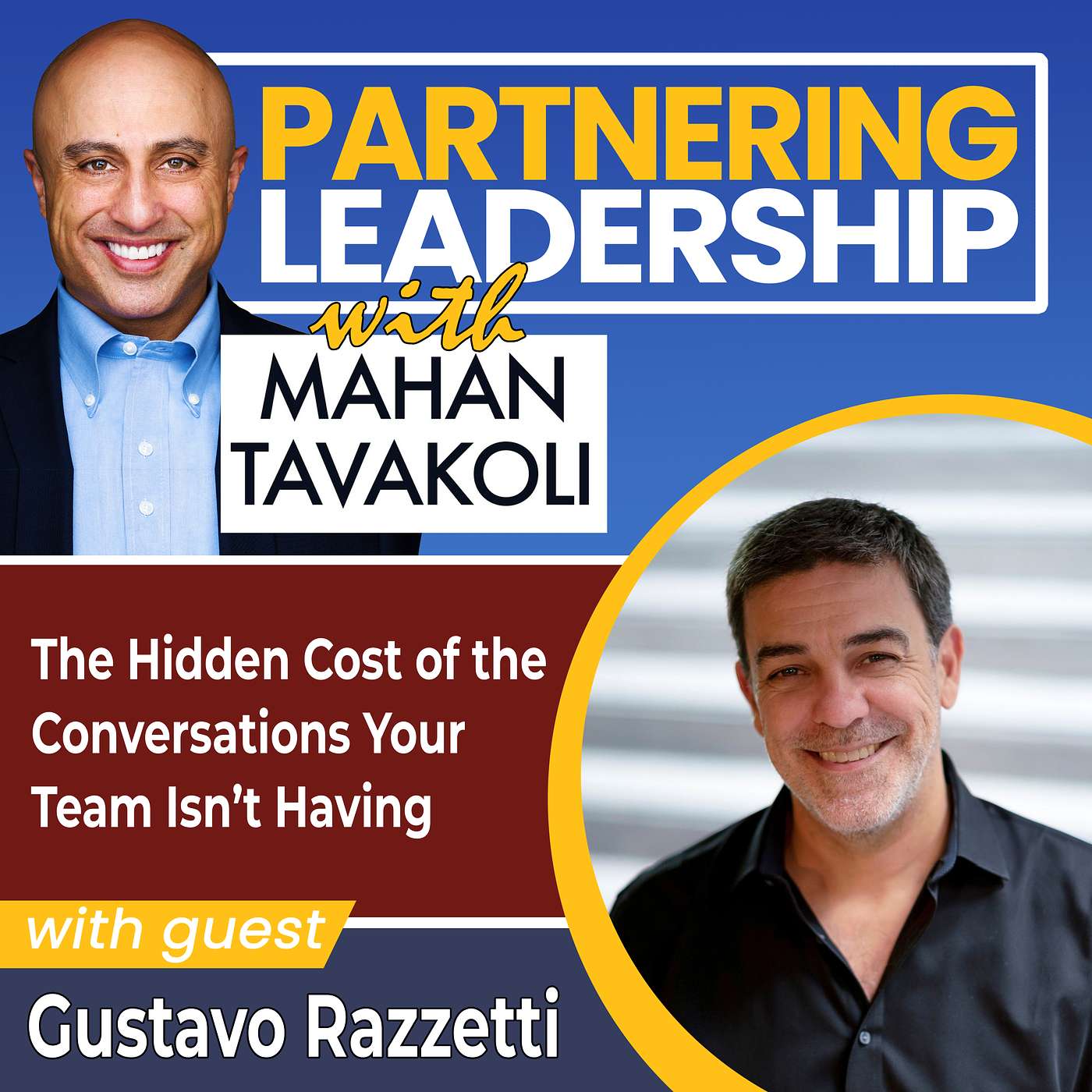
457 The Hidden Cost of the Conversations Your Team Isn’t Having with Gustavo Razzetti
Jun 1600:39:41Tap to summarizeIn this episode of Partnering Leadership, Mahan Tavakoli speaks with Gustavo Razzetti, workplace culture strategist, founder of Fearless Culture, and author of Forward Talk: The Bold New Method for Getting Teams Unstuck. Gustavo shares why many leadership teams struggle not because they lack talent or commitment, but because they accumulate “conversational debt,” the cost of the conversations they avoid.Gustavo explains why silence in organizations doesn’t always mean agreement. While leaders often focus on creating environments where people feel safe to speak up, many teams face a different challenge: people have stopped believing their input will make a difference. This “pointlessness paradox” creates hidden barriers to alignment, accountability, and execution.Throughout the conversation, Gustavo explores how leaders can recognize the signs of conversational debt, from meetings that create more meetings to teams that move too quickly to agreement without surfacing different perspectives. He also challenges the assumption that harmonious teams are always healthy, showing how “too nice” cultures can unintentionally prioritize comfort over progress.Mahan and Gustavo also discuss the changing dynamics of collaboration in the age of AI. They explore how AI can strengthen team conversations when used intentionally, but also how it can increase disconnection when people start trusting technology more than their colleagues. Gustavo shares practical ways leaders can create teams that challenge ideas, make better decisions, and move forward together.Actionable Takeaways:• You'll learn why the conversations your team avoids might be creating hidden costs that slow execution and weaken alignment.• Hear how leaders can identify conversational debt before it turns into missed opportunities, frustration, and organizational drift.• Discover why people don’t always stay silent because they’re afraid, and what leaders often misunderstand about getting honest feedback.• Learn why some “nice” cultures struggle with accountability and how prioritizing harmony can sometimes prevent teams from doing their best work.• Hear how to recognize the warning signs that your leadership team might be agreeing too quickly without true alignment.• Discover why reducing meetings alone rarely solves the real issue and how better conversations can improve decision-making.• Learn how leaders can encourage productive tension and disagreement without damaging trust or relationships.• Hear Gustavo’s perspective on how AI is changing collaboration and why teams need to think differently about integrating AI into how they work.• Learn how forward-looking conversations help teams move from blame and obstacles toward ownership and action.Connect with Gustavo Razzetti:Gustavo Razzetti WebsiteGustavo Razzetti LinkedInConnect with Mahan Tavakoli:Mahan Tavakoli Website Mahan Tavakoli on LinkedIn Partnering Leadership Website
Transcribe →