Podcast
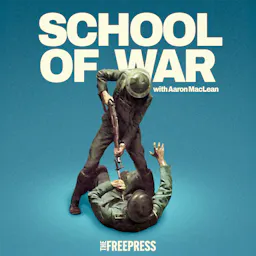
School of War
Hosted by The Free Press · EN
In School of War, CBS News National Security Analyst and Free Press columnist Aaron MacLean sits down with secretaries of state, top military historians, war planners, and key political decision-makers to help understand the lessons of war.
Tune in as School of War takes you to the front lines.
Aaron MacLean is a senior fellow at Hudson Institute. He has worked as a foreign policy advisor and legislative director to Sen. Tom Cotton of Arkansas and spent seven years in the U.S. Marine Corps.
Visit our Substack for episode transcripts
Follow along on Instagram
65episodes
Episodes
Newest firstAll episodes
The Dangerous Pause in Iran, with Mark Montgomery
3d ago00:40:09Tap to summarizeMark Montgomery, senior director of the Center on Cyber and Technology Innovation at the Foundation for Defense of Democracies and a retired U.S. Navy rear admiral, returns to School of War to analyze the latest military developments across the world. Why has the Iran war entered such a dangerous and uncertain phase? What role will the Strait of Hormuz and the Red Sea play in its next stage? And what do Iran and Ukraine reveal about the changing shape of global conflict? 02:22 - Why the Iran War Suddenly Paused 04:44 - An Uneasy Ceasefire and Dueling Blockades 05:35 - The Challenge of Escorting Ships Through Hormuz 07:19 - Why America's Convoy Strategy Isn't Working 09:15 - The Navy's Readiness Dilemma 09:59 - Blockade vs. Convoy 12:08 - Why the U.S. Must Take More Risk at Sea 14:10 - America's Munitions Problem 15:05 - The Weapons Shortages Shaping the War 16:29 - America's Drone Defense Gap 21:11 - The Electronic Warfare Deficit 23:13 - The Red Sea and the Houthi Threat 26:15 - How Iran and Ukraine Are Connected 30:37 - Russia's Options for Escalation 35:04 - Is a Long Blockade Better Than Escalation? This episode of School of War is brought to you by Maven Smart System, the builder platform for the American warfighter, fielded across the force and live on the frontline today. Learn more at palantir.com. Learn more about your ad choices. Visit megaphone.fm/adchoices
Transcribe →The Rise of the Navy SEALs, with Ben Milligan
1w ago01:01:43Tap to summarizeBen Milligan, a former U.S. Navy SEAL, Bronze Star recipient, and author of By Water Beneath the Walls: The Rise of the Navy SEALs, joins School of War to discuss the origins and evolution of one of America's most storied special operations forces. How did the Navy SEALs grow out of the Underwater Demolition Teams of World War II? What does it take to become a SEAL? How did the Vietnam War shape the institution into the force we know today? And what role should the SEALs play as the U.S. military shifts its focus from the war on terror to great power competition? 02:10 – Why Ben Became a SEAL 03:34 – Joining Before 9/11 05:17 – Inside BUD/S 09:17 – Who Makes It Through? 11:26 – What Elite Training Builds 14:29 – The Origins of the SEALs 23:18 – The Origins of UDT 27:10 – Korea Changes the Mission 38:06 – Birth of the SEALs 43:36 – Vietnam Transforms the SEALs 47:33 – The Capture-Kill Raid 49:50 – Lessons for the War on Terror 54:36 – Great Power Competition 56:13 – What Makes Special Operations "Special"? 59:31 – The Future of the SEALs This episode of School of War is brought to you by Maven Smart System, the builder platform for the American warfighter, fielded across the force and live on the frontline today. Learn more at palantir.com. Learn more about your ad choices. Visit megaphone.fm/adchoices
Transcribe →How Trump Decided to Go to War with Iran, with Jonathan Swan
1w ago00:36:09Tap to summarizeJonathan Swan, a White House reporter for The New York Times, joins School of War to discuss the reporting behind his new book, Regime Change: Inside the Imperial Presidency of Donald Trump, co-authored with Maggie Haberman. How does Donald Trump make geopolitical decisions? What drove him to join Israel’s war against Iran? How has his thinking on Ukraine evolved? And how does China fit into all of this? 02:23 - Inside Regime Change 05:29 - Trump's View of the World 09:04 - Why Trump Sees Iran Differently 11:25 - Trump's Proxy Strategy 12:44 - Steve Witkoff's Worldview 13:43 - The Principles Behind Iran Policy 14:45 - North Korea vs. Iran 16:15 - Ron Dermer's Prediction 17:58 - Why the 12-Day War Matters 20:48 - Netanyahu's Case for War 25:20 - Trump's Inner Circle on Iran 28:01 - Trump's Turn on Ukraine 30:36 - Trump's Approach to China 31:55 - Taiwan and the China Challenge 33:16 - The Future of Trump's Foreign Policy Follow along on Instagram, X @schoolofwarpod, and YouTube @SchoolofWarPodcast, or at The Free Press This episode of School of War is brought to you by Maven Smart System — the builder platform for the American warfighter, fielded across the force and live on the frontline today. Learn more at https://www.palantir.com/ Learn more about your ad choices. Visit megaphone.fm/adchoices
Transcribe →‘The Odyssey’ and the Search for Historical Truth, with James Diggle and John Underhill
2w ago01:05:12Tap to summarizeJames Diggle, emeritus professor of Greek and Latin at Cambridge University, and John Underhill, professor of geoscience and energy transition at the University of Aberdeen, join School of War to discuss their decades-long search for the real Ithaca of Homer’s Odyssey. Based on their recent Antigone journal article, “In Search of Ithaca,” they explain why the island we’ve called Ithaca for centuries may actually be the wrong one. Can modern geology solve a 3,000-year-old mystery? Have we finally found the true home of Odysseus? And what would that mean for one of the greatest stories ever told? 02:44 – The mystery of Homer's Ithaca 04:45 – Can Homer be treated as history? 06:19 – The Bronze Age world of Odysseus 09:25 – Why modern Ithaca doesn't fit Homer's description 12:02 – Robert Bittlestone's hypothesis 17:15 – The geology expedition begins 23:17 – The million-euro search for Ithaca 28:37 – Disproving the original theory 31:19 – The geological breakthrough 35:09 – The discovery that changes everything 37:22 – Homer never actually calls Ithaca an island 41:24 – Solving a 3,000-year-old mystery 46:22 – Telemachus' journey finally makes sense 50:54 – Would Robert Bittlestone have agreed? 57:43 – The hidden cave Follow along on Instagram, X @schoolofwarpod, and YouTube @SchoolofWarPodcast Find more at The Free Press. Learn more about your ad choices. Visit megaphone.fm/adchoices
Transcribe →America’s Iran Problem Isn’t Going Away, with Mike Doran
2w ago00:52:14Tap to summarizeMike Doran, senior fellow and director of the Center for Peace and Security in the Middle East at the Hudson Institute, returns to School of War to examine why the war with Iran continues despite devastating military setbacks for Tehran. Is President Trump’s Iran strategy truly different from President Obama’s, or are the similarities overstated? What does the fight over the Strait of Hormuz reveal about the limits of American power? And what does this war tell us about the future of U.S. strategy in the Middle East—and its broader competition with China? 01:22 - Recap of the Iran War 06:03 - Iran's Leverage 09:05 - MoU Misunderstandings 12:28 - The Crux of the MoU Dispute 15:42 - The Nuclear Status Quo 17:58 - Iran's Degradation Since October 7 21:13 - The Democrats' View 22:02 - The Right's View 23:25 - Trump's "Obama-Style" Rhetoric 28:10 - Should America Reimpose the Blockade? 28:53 - The Drone and Ballistic Missile Problem 31:10 - Drone Warfare Has Changed Everything 32:01 - The Vulnerability of America's Gulf Allies 37:21 - Is the MoU Still in Effect? 39:34 - Why Nobody Is Buying Iranian Oil 46:32 - China and the Bigger Picture Follow along on Instagram, X @schoolofwarpod, and YouTube @SchoolofWarPodcast Find more at The Free Press. Learn more about your ad choices. Visit megaphone.fm/adchoices
Transcribe →Lindsey Graham: The Last of the ‘Three Amigos’ with Vance Serchuk
2w ago00:58:12Tap to summarizeVance Serchuk, executive director and Partner at the KKR Global Institute, and former senior national security adviser to Senator Joe Lieberman, was uniquely positioned to witness one of the most influential partnerships in modern American foreign policy: the “Three Amigos” of John McCain, Joe Lieberman, and Lindsey Graham. What made their partnership so effective? What vision did they share for America’s role in the world? And what does the end of the “Three Amigos” mean for the future of American foreign policy? 02:21 - Lindsey Graham and the Three Amigos 10:42 - First Impressions of Lindsey Graham 13:20 - Lindsey Graham’s Sense of Humor 15:47 - Graham’s Spontaneity 21:44 - The Three Amigos’ Bond Through Travel 23:31 - Oversight on the Front Lines 24:56 - The Russian Threat 27:00 - The Three Amigos’ Shared Convictions 28:28 - Russia’s Invasion of Georgia 32:56 - Senator Graham’s Political Courage 33:27 - What Made the Three Amigos Different 37:24 - Graham’s Political Instincts 37:56 - Why the Three Amigos Worked 39:33 - The Power of Political Friendship 42:28 - Graham’s Work in the Trump Era Follow along on Instagram, X @schoolofwarpod, and YouTube @SchoolofWarPodcast Find more at The Free Press. Learn more about your ad choices. Visit megaphone.fm/adchoices
Transcribe →How Choke Points Became Weapons of War, with Edward Fishman
3w ago00:45:03Tap to summarizeEdward Fishman, senior fellow and director of the Greenberg Center for Geoeconomics at the Council on Foreign Relations, joins School of War to discuss his New York Times best-selling book, Chokepoints: American Power in the Age of Economic Warfare. How has the United States turned the global economy into a strategic weapon? What are the strengths and limits of sanctions? And how are China, Russia, and Iran adapting to a new era of economic warfare? 02:46 - Edward Fishman's background 04:26 - Understanding economic chokepoints 05:35 - The dollar as a strategic chokepoint 07:02 - Semiconductors as a strategic chokepoint 09:24 - The Iraq embargo and modern sanctions 11:05 - Airpower vs. economic warfare 12:14 - Are sanctions a "nuclear weapon"? 13:23 - America's sanctions strategy toward Iran 14:25 - Trump pulling out of the JCPOA 16:20 - The limits of economic warfare 18:00 - Iran, the Strait of Hormuz, and the MoU 20:44 - Shadow fleets and Iranian oil 22:54 - The evolution of Russia sanctions 27:59 - China and the economic arms race 29:53 - How nations mitigate economic chokepoints 34:20 - What makes a strategic chokepoint? 39:40 - Chokepoints beyond economics 41:05 - Can Iran institutionalize control over the Strait of Hormuz? Follow along on Instagram, X @schoolofwarpod, and YouTube @SchoolofWarPodcast, or at The Free Press Learn more about your ad choices. Visit megaphone.fm/adchoices
Transcribe →Four Years Fighting Russia: An American Soldier’s Testimony
3w ago01:21:57Tap to summarizeDavid, a U.S. military veteran who has been fighting voluntarily alongside Ukrainian forces, joins School of War to discuss how four years on the front lines have transformed modern warfare. How has combat in Ukraine changed since Russia’s 2022 invasion? Why have first-person view drones become the defining weapon of the war? What misconceptions does the West still have about the Russian military? And what lessons must the United States absorb before its next major conflict? 02:49 - David’s military history 05:56 - What brought David to Ukraine 07:37 - Russia's failed invasion of Kyiv 10:24 - How Ukraine turned the tide in 2022 17:04 - How Ukraine adapted to Russia's invasion 19:06 - America's role in Ukraine's early success 23:59 - How the battlefield has evolved since 2022 28:15 - Experiencing Russian artillery 37:22 - From artillery warfare to drone warfare 40:41 - Why FPV drones are terrifying 44:20 - The modern "gray zone" 49:26 - Why Russia is still a military threat 01:00:49 - What Ukraine must do to survive 01:11:41 - Is the U.S. military learning the right lessons? 01:15:55 - The future of warfare and America's defense industry Follow along on Instagram, X @schoolofwarpod, and YouTube @SchoolofWarPodcast Find more at The Free Press. Learn more about your ad choices. Visit megaphone.fm/adchoices
Transcribe →The American Revolution Was a World War, with Richard Bell
4w ago00:48:15Tap to summarizeRichard Bell, historian, professor at the University of Maryland, and author of The American Revolution and the Fate of the World, joins School of War to discuss how the American Revolution became a global conflict that stretched from Boston to the Caribbean, Europe, India, and beyond. How did George Washington's strategy force Britain to fight a world war? Why was France's intervention decisive to American victory? And what does the revolution reveal about the nature of coalition warfare? 00:53 - Rick Bell's background 02:05 - The American Revolution was a global war 06:09 - What led to the Boston Tea Party 12:45 - Patriot motivations 14:38 - Who was Edmund Burke? 16:50 - Britain divided over the Revolution 20:47 - Why France backed the Patriots 23:45 - France and Spain vs. Britain 27:01 - The Caribbean: Britain's crown jewel 30:08 - The forgotten theater of the Revolution 35:49 - Washington's global coalition strategy 38:55 - Germany and the Hessian soldiers 41:50 - The Patriots' European officers 43:10 - The myth of guerrilla warfare 44:50 - Final thoughts Follow along on Instagram, X @schoolofwarpod, and YouTube @SchoolofWarPodcast Find more at The Free Press. Learn more about your ad choices. Visit megaphone.fm/adchoices
Transcribe →One Battle of Hormuz After Another, with Sal Mercogliano
Jun 2900:42:24Tap to summarizeSal Mercogliano, professor of history at Campbell University and host of the What’s Going on with Shipping YouTube channel, joins the show once again to discuss Iran's renewed attacks on commercial shipping in the Strait of Hormuz. Why is the ceasefire already beginning to unravel? What is Iran trying to accomplish by asserting control over the strait? And what could the long-term consequences be for global trade, energy markets, and freedom of navigation? 02:11 - New arrangement in the Strait of Hormuz 05:19 - Humanitarian situation for sailors 06:53 - Jobs at sea and AI 08:05 - New rounds of violence 11:02 - Route options for ships 13:30 - Why did the ceasefire break down? 15:05 - Iran asserts control over the strait 16:10 - Why were these ships targeted? 19:08 - Strait of Hormuz as a strategic choke point 21:49 - What Iran learned from the Houthis 23:21 - Why energy prices haven't spiked 28:20 - Impact on developing nations 29:13 - The endgame in the Strait of Hormuz 33:22 - U.S. naval presence in the Gulf 36:26 - Iran's maritime protection racket Follow along on Instagram, X @schoolofwarpod, and YouTube @SchoolofWarPodcast, or at The Free Press Learn more about your ad choices. Visit megaphone.fm/adchoices
Transcribe →