
Podcast
Sermon Audio – Cross of Grace
Hosted by Cross of Grace Lutheran Church · EN
Weekly audio of sermons preached at Cross of Grace Lutheran Church in New Palestine, Indiana
48episodes
Episodes
Newest firstAll episodes
Parade of Grace
Mar 29Tap to summarizeMatthew 21:1-11When they had come near Jerusalem and had reached Bethphage, at the Mount of Olives, Jesus sent two disciples, saying to them, ‘Go into the village ahead of you, and immediately you will find a donkey tied, and a colt with her; untie them and bring them to me. If anyone says anything to you, just say this, “The Lord needs them.” And he will send them immediately.’ This took place to fulfil what had been spoken through the prophet, saying,‘Tell the daughter of Zion,Look, your king is coming to you,humble, and mounted on a donkey,and on a colt, the foal of a donkey.’The disciples went and did as Jesus had directed them; they brought the donkey and the colt, and put their cloaks on them, and he sat on them. A very large crowd spread their cloaks on the road, and others cut branches from the trees and spread them on the road. The crowds that went ahead of him and that followed were shouting,‘Hosanna to the Son of David!Blessed is the one who comes in the name of the Lord!Hosanna in the highest heaven!’When he entered Jerusalem, the whole city was in turmoil, asking, ‘Who is this?’ The crowds were saying, ‘This is the prophet Jesus from Nazareth in Galilee.’ What’s your favorite parade? From the Macy’s Day Parade to Mardi Gras, St. Patrick’s Day, and countless Independence Day celebrations, we Americans love parades. Some of my favorite childhood memories are from attending or marching in one. Growing up in Anderson, we had the Midnight Parade. It was on the night of July 3rd, but it started at midnight, claiming to be the first July 4th parade in all the land. I loved watching the civic groups march along the route, many I would have never known existed had it not been for the parade. I remember the joy of little kids getting so excited about terrible candy thrown at their feet. Who knew Tootsie Rolls and Airheads could make someone so happy?Most special of all was when we surprised my mom with tickets to the Rose Parade in Pasadena. Every New Year’s Day it was on in our house growing up. As we watched, she always said, “Can’t you just smell it? I bet the smell is amazing.” And the parade did not disappoint. The floats were extraordinary, the bands terrific, and the smell indeed was amazing.Every parade tells a story — a story of identity, values, and heritage. Mardi Gras tells a story of joy, indulgence, and fun. Pride tells a story of celebration, love, and identity. The Rose Parade tells a story of creation and beauty.And what makes a parade good is that it draws you in. You don’t want to just watch it. You want to be part of it, not just a spectator. The people of Jesus’ time were no strangers to parades. Because if one ancient people can be credited with the culture of parades, it’s the Romans. They were known for their grand displays of power. One example was called the Adventus. That’s when a Roman governor or emperor entered a city under Roman control. First came the golden eagle — the symbol of Rome. Then banners and battle flags with Roman gods on them. Then the trumpeters announcing their arrival. Then the display of power: cavalry and foot soldiers dressed in full armor. And then finally came the governor or emperor himself, riding a war horse or chariot. And behind him, chained prisoners — living proof of Rome’s power.The Adventus parade told a story that was very clear: Rome is in charge. Rome has power. Rome wins. The Jews of Judea, including Jesus, were familiar with Adventus, because that’s how Pontius Pilate would have entered Jerusalem for Passover. Pilate didn’t actually live in Jerusalem. He lived in a Roman city near the coast. But every year, during Passover, he would come to Jerusalem.Because Passover made Roman officials nervous. It was a celebration of liberation from oppression under Pharaoh. And Pilate knew people might take that opportunity to protest their oppression under Caesar. So to remind everyone who was in charge, who had the power, Pilate would hold an Adventus. Coming from Caesarea, this huge procession would have entered Jerusalem from the west, quelling even the idea of an uprising.But there was another parade into Jerusalem, this one coming from the East. Jesus and his disciples were in Bethphage when he made an unusual request: Go into the next little town and bring me a donkey and her colt. Matthew even tells us Jesus somehow sits on both of them, which is a little odd and maybe even a little funny to picture. But that’s not really the point.Matthew tells us this happened to fulfill the words of the prophet Zechariah: “Look, your king is coming to you, humble and riding on a donkey.” Jesus isn’t just finding a ride into town. He is making a statement. He is telling the people exactly who he is. He is the one they have been waiting for.And thus begins the parade. With no flags or banners to wave, they take off their cloaks and line the street with them. There are no drums, just the sound of branches snapping off trees and being spread along the road. And the only music is the crowd shouting, “Save us, Son of David! Save us!” That’s what Hosanna means: save us, please. This was a crowd of poor peasants, hurting under the occupation of Rome. And finally here comes their hope — the one they call Son of the king, the rightful heir to the throne; coming to overthrow Rome and restore the kingdom of David, just like his ancestor talked about, like his own mother sang about.Now that’s a story. That’s a parade that draws you in, one you want to be a part of, not just a spectator. I guess that’s why we reenact this parade with palms of our own every year. We find ourselves in that crowd. We may not be poor peasants under Roman occupation, but we still know things are not as they should be. We need a change. We too want to crown Jesus. We too shout Hosanna — save us, O God.Save us from war and division.Save us from hatred and injustice.Save us from everything that keeps this world from being what you created it to be.I wonder when the crowd realized that their parade was not what they thought it was. When did it register that what they wanted Jesus to do and what Jesus was about to do were two very different things? At some point in the week ahead, the crowd is going to realize that their hope isn’t going to play out like they thought it would. I imagine at some point they wandered over to the west side of town. Maybe they saw the Adventus, Pilate with all his power entering the city. Or maybe they just heard about it — the horses, the soldiers, the brute force. That parade lured them in. It told them a story, veiled in threats, about how the world works: a world governed by strength and power.Pretty soon after that parade of branches and cloaks, the crowd remembered Jesus on a donkey and compared that to Pilate’s parade, Rome’s parade, and realized he didn’t stand a chance.They weren’t in a parade on the east side of Jerusalem that day. They were in a funeral procession, following the hearse the whole time.So they switch sides. And in just a few short days they will go from “Save us!” to “Kill him,” from hail him to nail him.We are still in that same crowd. It’s tempting to t...
Transcribe →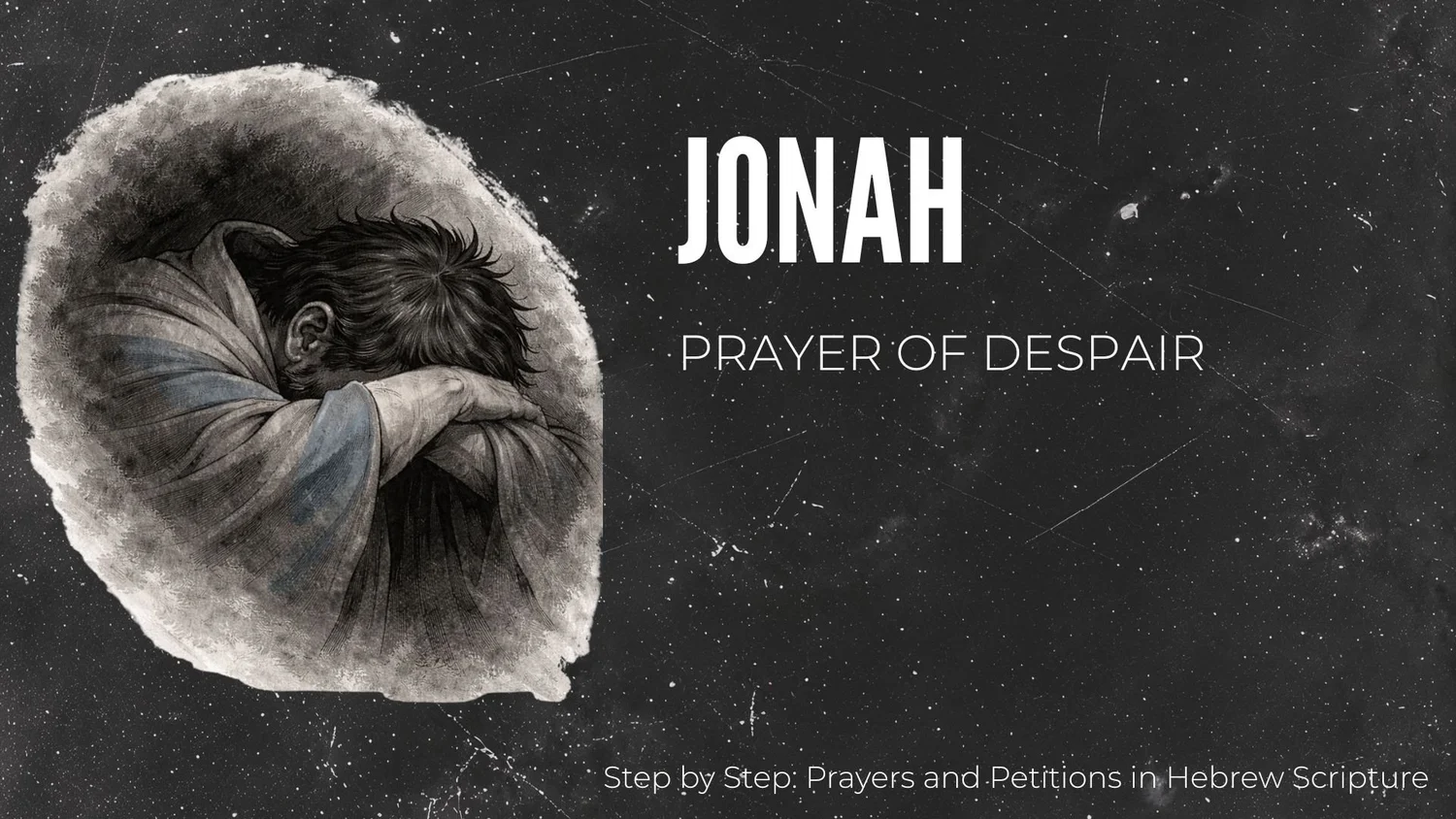
Jonah: Prayer of Despair
Mar 25Tap to summarizeJonah 2:1-9Then Jonah prayed to the Lord his God from the belly of the fish, saying, “I called to the Lord out of my distress, and he answered me; out of the belly of Sheol I cried, and you heard my voice. You cast me into the deep, into the heart of the seas, and the flood surrounded me; all your waves and your billows passed over me. Then I said, ‘I am driven away from your sight; how shall I look again upon your holy temple?’ The waters closed in over me; the deep surrounded me; weeds were wrapped around my head at the roots of the mountains. I went down to the land whose bars closed upon me forever; yet you brought up my life from the Pit, O Lord my God. As my life was ebbing away, I remembered the Lord; and my prayer came to you, into your holy temple. Those who worship vain idols forsake their true loyalty. But I with the voice of thanksgiving will sacrifice to you; what I have vowed I will pay. Deliverance belongs to the Lord!” First of all, it’s meaningful to see Jonah’s prayer as one about thanksgiving as much as it is about despair. Oddly enough, Jonah sees his place in the belly of that fish as a sign of God’s deliverance. What most of us would imagine as a great source of despair – being swallowed by a large fish and living in its gut for three days – was ultimately seen as a sign of his rescue, for Jonah.His real fear … the great despair … to which he refers in the prayer we just heard, actually took place on the ship and in the storm that landed him in the sea in the first place. I’ve talked before about what a source of fear and punishment the sea was for ancient people – and for those in Jesus’ day, too. The sea and its depths were as unknown as outer space is – or has been – for us. Without means to deep sea dive, snorkel, or see beyond the depths to which even the best swimmer might swim on a single breath’s worth of air, what lived and moved beneath the surface of the sea was left to the imagination – and that was terrifying. (I’d still much rather swim in a pool than a pond, to be honest.)And not only that, Jonah was under the impression that it was his own disobedience that caused the storm and upset the crew of the ship on which he had stowed away, and that got him tossed overboard into the deadly waters that closed over him, that surrounded him with weeds and darkness, until his life ebbed away with the waves that engulfed and threatened him.In those moments Jonah sounds as desperate as Jesus on the Cross. He talks about being removed from the home and presence of God – the Temple in Jerusalem – where God was believed to live and move and breathe. He laments the prospect of never getting back there. And Jonah wails about the Sea, he bemoans the Pit, and he cries over Sheol – all expressions of utter lostness, insurmountable distance from the Divine, despair upon despair upon despair.It reminds me of Jesus, dying on the cross, when he cries, “My God, My God, why have you forsaken me.” The separation, the distance and the lostness sound familiar. And I’m always struck by the way Walt Wangerin describes that moment, which we’ll hear again on Good Friday. He calls it “obliteration,” says, “not even God was there,” imagines that Jesus had been “blotted out of the book of life,” and that “the universe was silenced” by Christ’s cry of despair.So, as we gather on this last of our Wednesday worship services inspired by the prayers of our ancestors … with Holy Week on the horizon … as we wonder about what it means to pray while in the throes of despair … we are in good company. Not just that of Jonah, but of Jesus, too. And, I want our feelings of despair – and our invitation to pray our way with and through that desperation – to serve as an expression of hope and as some inkling of the faith that may seem missing in our most desperate moments... days… seasons… whatever.When the diagnosis seems like you’ve been plunged into the depths of the sea…When the grief feels like you’ve been swallowed up and carried far from anything safe, or sure, or like home…When the pain and suffering literally hurts, burns, and stings like Sheol…When the fear, frustration, and stubbornness of whatever it is that just won’t give feels as insurmountable as the highest mountain or as deep as the darkest pit...When the unknown wraps itself around your heart of hearts like so many weeds and refuses to relent…It may help to know – hard as it is may be to see or celebrate in the moment – what Jonah trusted: that the same sea that caused his despair in the first place was also home to the fish that delivered him to dry land, in the end.I don’t mean for this to sound like a platitude. I’m not implying that God gives us our troubles as a test of faith. I’m certainly not saying our despair is unfounded or unfaithful, or pretending that we don’t have a right to our desperation when it comes.In fact, and this may sound harsh – and hard to hear or believe, coming from your Pastor – and I could be wrong. But I kind of think that if you haven’t found reason to despair at certain times in your life – if you haven’t lost or left your faith or felt lost or left by your faith or by our God at some point – maybe you’re just better than the rest of us; maybe you’re not watching the news; or maybe you’re not living in the same reality as so many of the rest of us.And I’m fairly certain that – no matter how great your faith, how deep your trust – if it hasn’t happened to you yet, despair will find you. And you’ll feel left with nothing but the desire and need to try to pray your way out of it. And sometimes that kind of despair is exactly how, where, and when God shows up for us. In the emptiness. In the void. In the doubt and fear and uncertainty we’re running from or feel so self-righteously indignant about in those moments when we’ve given up, chucked it all, thrown in the towel, felt like our life, our purpose, our hope is ebbing away into oblivion.And that kind of desperation is sad and scary, for sure. Not sinful, mind you. But sad and scary and lonely, as can be.So tonight, let’s acknowledge the despair that has found us – or that will one day. Let’s not be afraid to give it a voice, like Jonah did and like Jesus does, too. And let’s be as patient as we are able, as faithful as God allows, and let’s let love hold us, until hope – however great or small – returns by the grace of God.Because it’s also worth knowing that when Jesus cried “My God, My God, why have you forsaken me?” He was quoting Psalm 22. He knew his scripture, remember. So, in the depths of his despair, he was praying the prayers of his ancestors, much like we’ve been trying to do. And it’s believed Jesus latched onto that particular Psalm because he knew it ended with the kind of hope he was so desperately clinging to – or trying to find.That Psalm starts with “My God, my God, why have you forsaken me?”; it begins with words of groaning, mockery, and sneering … it starts with feeling despised and scorned and in need of rescue (just like Jonah) … it points to Jesus feeling poured out like water, bones out of joint, a heart melting in his chest, and being layed out like the dust of death, surrounded by dogs and bulls and evildoers, and more …But that Psalm – that prayer - ends, in spite of all that, with a request for – with hope that – with belief in – God’s capacity and desire for rescue. Hope for a God who will deliver and be worthy of praise. Trust in a God who does not despise… neglect… ignore… or hide.“My God, my God, why have you forsaken me?” Though I know you won’t forever!May our prayers be as desperate and despairing; as honest and hopeless; as angry and afraid and as overwhelmed and underwater as we feel more often than we wish was true. And because of that – may they also be tinged with – and leave plenty of room – for God’s rescue to find us, for God’s love to win the day, for God’s grace to lead us to the dry land of our deliverance.Amen
Transcribe →
Bagged Salad, Lazarus, and the Glory of God
Mar 22Tap to summarizeJohn 11:17-44When Jesus arrived, he found that Lazarus had already been in the tomb four days. Now Bethany was near Jerusalem, some two miles away, and many of the Jews had come to Martha and Mary to console them about their brother. When Martha heard that Jesus was coming, she went and met him, while Mary stayed at home. Martha said to Jesus, “Lord, if you had been here, my brother would not have died. But even now I know that God will give you whatever you ask of him.” Jesus said to her, “Your brother will rise again.” Martha said to him, “I know that he will rise again in the resurrection on the last day.” Jesus said to her, “I am the resurrection and the life. Those who believe in me, even though they die, will live, and everyone who lives and believes in me will never die. Do you believe this?” She said to him, “Yes, Lord, I believe that you are the Messiah, the Son of God, the one coming into the world.”When she had said this, she went back and called her sister Mary and told her privately, “The Teacher is here and is calling for you.” And when she heard it, she got up quickly and went to him. Now Jesus had not yet come to the village but was still at the place where Martha had met him. The Jews who were with her in the house consoling her saw Mary get up quickly and go out. They followed her because they thought that she was going to the tomb to weep there. When Mary came where Jesus was and saw him, she knelt at his feet and said to him, “Lord, if you had been here, my brother would not have died.” When Jesus saw her weeping and the Jews who came with her also weeping, he was greatly disturbed in spirit and deeply moved. He said, “Where have you laid him?” They said to him, “Lord, come and see.” Jesus began to weep. So the Jews said, “See how he loved him!” But some of them said, “Could not he who opened the eyes of the blind man have kept this man from dying?”Then Jesus, again greatly disturbed, came to the tomb. It was a cave, and a stone was lying against it. Jesus said, “Take away the stone.” Martha, the sister of the dead man, said to him, “Lord, already there is a stench because he has been dead four days.” Jesus said to her, “Did I not tell you that if you believed you would see the glory of God?” So they took away the stone. And Jesus looked upward and said, “Father, I thank you for having heard me. I knew that you always hear me, but I have said this for the sake of the crowd standing here, so that they may believe that you sent me.” When he had said this, he cried with a loud voice, “Lazarus, come out!” The dead man came out, his hands and feet bound with strips of cloth and his face wrapped in a cloth. Jesus said to them, “Unbind him, and let him go.” I hate bagged salad. To this day, I can still remember the: like fermented lettuce soaked in apple cider vinegar and cat pee. It was putrid. Pallets of it were taken to the farm every week. You’ve probably heard me talk about the farminary before: farm plus seminary equals farminary. It was agriculture and theological education wrapped into one. Before my first class started, I had grand ideas about what the farminary would be like: romanticized thoughts about growing a huge, flourishing garden that would compete with Eden.On the first day of class, Nate Stucky, our professor and director of the farminary, led us to our first hands-on agricultural assignment. It wasn’t tilling rows, planting seeds, and certainly not picking any harvest. Instead, he led us to the compost pile and a pallet of bagged salad swarming with flies. Even now, I am convinced you could see green streaks of stench floating above it like in a cartoon.Nate told us, “Today you continue to help bring this farm back to life.” Before the farminary began, the land had been a sod farm and a Christmas tree farm. Both of those stripped the land of the good, rich soil, leaving behind infertile dirt that no one wanted. Nate knew when he began the farminary that the first thing he had to do was bring the soil back to life. Which meant students like me spent much of our time at the compost pile, ripping open thousands of bagged salad kits, dumping the contents onto the pile, and turning it over and over. And it wasn’t just rotten lettuce. Food waste from the dining hall. Coffee grounds from a local shop. Leaves from last fall. All of it together—a giant pile of smelly, dying compost—was what brought life to this barren land. When we stirred it all up and revealed the black soil at the bottom, Nate would say, “That’s resurrection.”The obvious, yet difficult thing about resurrection is that it requires death first. Most of us approach death like either Martha or Mary. Martha approaches it with hope. She is certainly grieved by her brother’s death—“Lord, if you had been here…” but at the same time she remembers the promises she’s heard her whole life about resurrection and life everlasting. So she responds with hope for the future: “God will do what you ask, and I know there will be resurrection s...
Transcribe →Solomon: Prayer for Discernment
Mar 18Tap to summarize1 Kings 3:4-14The king went to Gibeon to sacrifice there, for that was the principal high place; Solomon used to offer a thousand burnt offerings on that altar. At Gibeon the Lord appeared to Solomon in a dream by night, and God said, “Ask what I should give you.” And Solomon said, “You have shown great and steadfast love to your servant my father David because he walked before you in faithfulness, in righteousness, and in uprightness of heart toward you, and you have kept for him this great and steadfast love and have given him a son to sit on his throne today. And now, O Lord my God, you have made your servant king in place of my father David, although I am only a little child; I do not know how to go out or come in. And your servant is in the midst of the people whom you have chosen, a great people so numerous they cannot be numbered or counted. Give your servant, therefore, an understanding mind to govern your people, able to discern between good and evil, for who can govern this great people of yours?”It pleased the Lord that Solomon had asked this. God said to him, “Because you have asked this and have not asked for yourself long life or riches or for the life of your enemies but have asked for yourself understanding to discern what is right, I now do according to your word. Indeed, I give you a wise and discerning mind; no one like you has been before you, and no one like you shall arise after you. I give you also what you have not asked, both riches and honor all your life; no other king shall compare with you. If you will walk in my ways, keeping my statutes and my commandments, as your father David walked, then I will lengthen your life.” Listen to your heart when’s he’s calling for you. Listen to your heart, there’s nothing else you can do. I don’t know where you’re going and I don’t know why, but listen to your heart, before you tell him goodbye. Yes, that’s Roxette’s 1988 power-ballad “Listen to Your Heart.” Be honest: how many of you wore out the cassette tape, belting it in the car? Songwriter Per Gessle says he wrote the tune after an all-night talk with his best friend whose marriage was crumbling. That pep-talk became a #1 hit, but here’s my problem with Per: catchy tune. Terrible advice; not only to his friend, but to the millions of people who listen to that song and think, “that’s how I’ll know what to do, I just need to listen to my heart.” The sentiment has become the go-to cliché for discernment. The motto sounds innocent enough, but its implications are anything but. “Listening to your heart” is really code for turning inward—figuring out what you want, what you think you need—and letting that be the deciding factor. We say it all the time in different ways: To the student choosing a major, study what makes you happy. To the friend considering a relationship, be with the one who makes you happy. To anyone eyeing a new city or job, go where you’ll be happy. With this Roxette wisdom, the most important person in the equation is you, and the measure of a good choice is whatever benefits you most. After all, as the song says, “there’s nothing else you can do.”Except there is. Because sooner or later we realize that turning inward pulls us in a dozen directions. We don’t really know what we want; we misjudge what will make us happy—and we end up right back where we started, unsure what to do next. That’s the crossroads where Solomon stood, and his prayer flips the slogan on its head: discernment isn’t listening to your heart; it’s asking God for a listening heart, one attuned to God and to the people around you.That request, a listening heart, is the heartbeat of this prayer. But notice how it starts. God says to the brand-new king, “Ask me for what I should give you.” Translation: Anything you want, Solomon - name it. Solomon responds with a little speech about how great God is and how faithful God was to his father David. It sounds a bit like a child buttering up a parent before the big ask: “Mom, you’re the best mom; can I have candy for breakfast?”Solomon even calls himself “a little child who doesn’t know how to go out or come in.” Meaning, he has zero military experience; he doesn’t know how to lead an army out or bring one home—let alone guide a nation. That honesty is ironic, given how Solomon reached the throne. He wasn’t ushered in by popular acclaim like his father David; others were ahead of him. With some help, he muscled his way in, banishing rivals to far-off places, arranging a few convenient deaths. He rose less like an anointed king and more like a mafia boss. Now he admits he’s in over his head.Solomon fought hard to reach the throne, only to realize he suddenly doesn’t know what to do. He could have made a candy-for-breakfast request—asking for the things kings usually crave: a long life, a larger kingdom, protection from rival nations. Had he turned inward and listened to his own heart, that’s likely what he would have asked for. But he doesn’t. Instead, he owns up to his limits and asks for help: “Give your servant an understanding mind to govern your people, able to discern between good and evil, for who can govern this great people of yours?” Understanding mind doesn’t quite get at the depth of the Hebrew. Solomon is literally asking for a listening heart. In the Old Testament world, the heart was the decision-making center where thought and passion met. Notice he isn’t asking for a good heart, but a listening one: attentive to the petitions of the people he now leads, tuned to God’s voice, able to choose between good and evil—between what brings life and what brings death.This request almost seems surprising to God, who expected riches and long life and the death of enemies. But because Solomon did not ask for any of that, God gives the new king not only what he asked for, but also the very things he didn’t.This is not a story telling us that if we butter God up just right and ask for the perfect thing, God will give it to us and then some. Rather, what I hope you see is that we have all been in something like Solomon’s position. Sure, you haven’t acted like the Godfather to get what you want—or at least I hope not. But all of us have found ourselves in a situation where others need us, depend on us, and we don’t know what to do. Maybe it’s something you’ve always wanted, something you’ve envisioned a thousand times, but once you finally arrived, you realized you had no idea what you were doing. Or perhaps you were thrust into a position you never wanted, and suddenly people are looking to you for help.It’s the newly married couple with no idea what they’ve gotten themselves into. The new father who is overwhelmed with parenting. The person who just got a promotion—or a divorce, or a diagnosis, or a diploma—but has no idea what to do next.What Solomon shows us is that rather than listen to your heart, we ask God for a listening heart: one that opens us to the needs of those around us, makes us aware of how our decisions affect others, and leads us to choose what brings life, not just for ourselves, ...
Transcribe →Love is Not Blind
Mar 15Tap to summarizeJohn 9:1-41As he walked along, he saw a man blind from birth. His disciples asked him, “Rabbi, who sinned, this man or his parents, that he was born blind?” Jesus answered, “Neither this man nor his parents sinned; he was born blind so that God’s works might be revealed in him. We must work the works of him who sent me while it is day; night is coming when no one can work. As long as I am in the world, I am the light of the world.” When he had said this, he spat on the ground and made mud with the saliva and spread the mud on the man’s eyes, saying to him, “Go, wash in the pool of Siloam” (which means Sent). Then he went and washed and came back able to see. The neighbors and those who had seen him before as a beggar began to ask, “Is this not the man who used to sit and beg?” Some were saying, “It is he.” Others were saying, “No, but it is someone like him.” He kept saying, “I am the man.” But they kept asking him, “Then how were your eyes opened?” He answered, “The man called Jesus made mud, spread it on my eyes, and said to me, ‘Go to Siloam and wash.’ Then I went and washed and received my sight.” They said to him, “Where is he?” He said, “I do not know.”They brought to the Pharisees the man who had formerly been blind. Now it was a sabbath day when Jesus made the mud and opened his eyes. Then the Pharisees also began to ask him how he had received his sight. He said to them, “He put mud on my eyes. Then I washed, and now I see.” Some of the Pharisees said, “This man is not from God, for he does not observe the sabbath.” But others said, “How can a man who is a sinner perform such signs?” And they were divided. So they said again to the blind man, “What do you say about him? It was your eyes he opened.” He said, “He is a prophet.”The Jews did not believe that he had been blind and had received his sight until they called the parents of the man who had received his sight and asked them, “Is this your son, who you say was born blind? How then does he now see?” His parents answered, “We know that this is our son, and that he was born blind; but we do not know how it is that now he sees, nor do we know who opened his eyes. Ask him; he is of age. He will speak for himself.” His parents said this because they were afraid of the Jews; for the Jews had already agreed that anyone who confessed Jesus to be the Messiah would be put out of the synagogue. Therefore his parents said, “He is of age; ask him.”So for the second time they called the man who had been blind, and they said to him, “Give glory to God! We know that this man is a sinner.” He answered, “I do not know whether he is a sinner. One thing I do know, that though I was blind, now I see.” They said to him, “What did he do to you? How did he open your eyes?” He answered them, “I have told you already, and you would not listen. Why do you want to hear it again? Do you also want to become his disciples?” Then they reviled him, saying, “You are his disciple, but we are disciples of Moses. We know that God has spoken to Moses, but as for this man, we do not know where he comes from.” The man answered, “Here is an astonishing thing! You do not know where he comes from, and yet he opened my eyes. We know that God does not listen to sinners, but he does listen to one who worships him and obeys his will. Never since the world began has it been heard that anyone opened the eyes of a person born blind. If this man were not from God, he could do nothing.” They answered him, “You were born entirely in sins, and are you trying to teach us?” And they drove him out.Jesus heard that they had driven him out, and when he found him, he said, “Do you believe in the Son of Man?” He answered, “And who is he, sir? Tell me, so that I may believe in him.” Jesus said to him, “You have seen him, and the one speaking with you is he.” He said, “Lord, I believe.” And he worshiped him. Jesus said, “I came into this world for judgment so that those who do not see may see, and those who do see may become blind.” Some of the Pharisees near him heard this and said to him, “Surely we are not blind, are we?” Jesus said to them, “If you were blind, you would not have sin. But now that you say, ‘We see,’ your sin remains.” I’m not proud of it, but I binge-watched two-and-a-half seasons of the Netflix reality show “Love is Blind” over the course of two or three days, following my emergency gall bladder surgery in September. Again, I’m not proud. I confess. I repent. And I blame the pain meds.The premise of this waste of time is that men and women go on literal blind dates, where they spend a period of time dating one another behind walls and closed doors, in private rooms. They sit in pods and have all manner of discussion about all manner of things and decide without ever seeing each other, that they are in love, or not. During all of this, the men live in one shared space and the women in another. So, there’s competition and gossip and lies and drama. Eventually, there are marriage proposals and then face-to-face meetings those who get engaged. Then the lucky, newly-engaged couples travel together for a group romantic getaway where there is lots of sunshine, beaches, swimsuits, hot tubs, and the like. And more competition, in-fighting, gossip, lies, and drama, of course.All of this is build-up to each couple’s potential wedding day, the outcome of which is never known by anyone, for certain, until they reach the altar, dressed in tuxedos, wedding gowns and before very real pastors, priests, rabbis, and justices of the peace – according to their faith tradition, or lack thereof. Neither the viewer, nor the potential brides or the prospective grooms or their families, know for sure … until the very last moment … if the betrothed are going to say “I do.” Of course, the drama really comes when one of the two says “No” or “I Can’t” or “I Don’t” to their partner’s hopeful expression of love and commitment.It’s terrible – once the meds wore off, the pain was gone, and I was on the mend, I didn’t even bother to finish that third season. It’s one of the many signs of the decline of western civilization, I’m sure. It’s one of many reasons, I suspect, that, if there is intelligent life on other planets, they’ve decidedly NOT bothered to make contact. All of this is mostly confession and repentance, but I’ll come back to it – however briefly – in a minute.But first, this miracle story, which is a doozy … and a well-known one at that … the spit, the dirt, the mud pie – and this guy who’d been blind his whole life – who gets his eyesight back. And there are so many others … miracle stories, I mean, in Scripture: the little girl who gets up from a death-bed nap; Simon Peter’s mother-in-law, whose fever breaks; the demons who leave from that guy in the synagogue; the woman who had been hemorrhaging for years, the leper who’s made clean, and so on.And you can’t help but wonder about all those people – in Jesus’ day and in our own – whose healing never comes: the demon that never leaves; the fever that never breaks; the blindness that never goes away, the cancer, the diabetes, the dying that seem to win the day.And because of all that – because so many of us go without the miracles we long for – I can’t help but believe Jesus’ willingness and ability to heal doesn’t have as much to do with ridding people or the world of sickness as much as we’d like to believe or pretend. Just like the Pharisees, we get caught up in the “who, what, how, when, and where” of what Jesus did for this blind guy and we ignore or don’t care so much about what Jesus tells us – right at the beginning of it all – about the WHY of what he had done that day.This guy had been born blind, remember. And to his parents, to his neighbors, to the Pharisees, certainly, and even to the blind guy himself, that meant he was sinful in some way. As we know, medical science back in the day wasn’t what it is for us now – so many generations later. When someone was sick or even just different somehow – whether it was leprosy, leukemia or whatever it is that makes a lame person unable to walk – their difference was understood to be proof that they were being judged by God and punished, then, for some kind of sin.You can hear it in the disciples’ question to Jesus, before the healing occurs: “Rabbi, who sinned, this man or his parents that he was born blind?” (Apparently, on top of all the rest, your physical diseases and differences could also be the result of another person’s sins, as well as your own.) But Jesus doesn’t break out the medical books, give the man an eye exam, make a diagnosis, or chart a treatment plan. He says, “Neither this man nor his parents sinned; he was born blind so that God’s works might be revealed in him.” (Not only does this imply that there’s nothing wrong with being blind, but it lets us know God was up to something more than just a magic trick.)So, Jesus gets to the business of doing “God’s works,” by way of a little mud and some spit. And if “miracle” means supernatural, irrational, unexpected, unexplainable – or something like that – here is where the real miracle of this morning’s Gospel occurs. The miracle of what God accomplishes through Jesus, not just for the blind man on the roadside that day so many years ago, but for every one of us – and our neighbors out there in the world, too – isn’t so much that God cures blindness; it’s that the eyes of those who can already see are opened to a God who loves without measure and promises eternal life, on this side of Heaven.What the disciples, the Pharisees, the blind man and his family, friends and nei...
Transcribe →Hannah: Prayer for Justice
Mar 11Tap to summarize1 Samuel 2:1-10Hannah prayed and said, “My heart exults in the Lord; my strength is exalted in my God. My mouth derides my enemies, because I rejoice in my victory.“There is no Holy One like the Lord, no one besides you; there is no Rock like our God. Talk no more so very proudly, let not arrogance come from your mouth; for the Lord is a God of knowledge, and by him actions are weighed. The bows of the mighty are broken, but the feeble gird on strength. Those who were full have hired themselves out for bread, but those who were hungry are fat with spoil. The barren has borne seven, but she who has many children is forlorn. The Lord kills and brings to life; he brings down to Sheol and raises up. The Lord makes poor and makes rich; he brings low, he also exalts. He raises up the poor from the dust; he lifts the needy from the ash heap, to make them sit with princes and inherit a seat of honor. For the pillars of the earth are the Lord’s, and on them he has set the world.“He will guard the feet of his faithful ones, but the wicked shall be cut off in darkness; for not by might does one prevail. The Lord! His adversaries shall be shattered; the Most High will thunder in heaven. The Lord will judge the ends of the earth; he will give strength to his king, and exalt the power of his anointed.” It wasn’t intentional that we saved Hannah’s prayer for the week of International Women’s Day, which was this past Sunday, but sometimes happy, holy accidents just happen. So it’s good and right that we hear a prayer for justice from one of our ancestors – a woman – who prays a beautiful, bold, faithful, full-throated appeal like what we just heard; and another, which we’ll hear shortly.Hannah, we know, was the mother of the prophet Samuel. And it’s knowing that Hannah was one of two wives to a guy named Elkanah. Elkanah’s other wife was a baby-making machine – she had sons and daughters aplenty, though we don’t know how many. And Elkanah’s other wife, described as Hannah’s “rival,” was terrible about it. According to the story, she “provoked” and “irritated” Hannah, which I imagine means she mocked her and made fun of her and shamed her for not being able to have children as easily or as prolifically as she could.And, as Pastor Cogan reminded us on Sunday, in teaching about that un-named woman at the well who’d had five husbands by the time she met up with Jesus, having children – back in the day – was confirmation of your worth as a woman; it assured your status and place in a family; it was a very practical source of security (you’d have people to protect and provide for you, should you ever be widowed or alone); it was how you mattered as a woman in a misogynistic, patriarchal, man’s world. So Hannah may have wanted a child because her mothering instincts were in full effect. She may also have wanted a baby because she wanted to make her husband happy. (The Bible tells us that Elkanah loved Hannah, in spite of the fact that she hadn’t given him a child, yet.) But Hannah may have wanted a child – and a boy, in particular – simply because she longed for affirmation of her worth, of her value, of her esteem, in her own eyes, in the eyes of God, in the eyes of the world … and maybe so she could tell that “sister wife” of hers … Elkanah’s other wife … to take a hike – or something similar.That’s why Hannah prayed to and bargained so intensely with God. She promised she would commit her baby boy to a life of sacrifice and service to the Lord. And then it happened. God delivered. And Hannah delivered. And she kept her promise, too. She loved, cared for, fed and nurtured her little boy Samuel until she handed him over to the Lord; to live in the house of the high priest, Eli, and to become one of the greatest prophets in all of Israel’s history.And Hannah’s prayer for justice that we heard was prayed in celebration and with thanksgiving for God’s answered prayer … for the gift of her baby boy. And Hannah’s song sounds like the original to the Virgin Mary’s cover version, so many generations later, in the Gospel of Luke – the Magnificat – which gets a whole lot more air-time because … Jesus.See, in Hannah’s song, her heart “exults in the Lord,” she “smiles at her enemies” because she “rejoices in God’s salvation.” Likewise, Mary’s soul “magnifies the Lord” and her spirit “rejoices in God her savior.”Hannah says, “the bows of the mighty are broken,” and “the feeble gird on strength.” Mary says “the mighty are cast down from their thrones” and “the humble in heart are lifted up.”For Hannah, “Those who were full have hired themselves out for bread, but those who were hungry are fat with spoil.” Mary says the same, just more simply, “God has filled the hungry with good things.”You get the picture.The undeniable similarities between Hannah’s prayer, like Mary’s, show a profound theological understanding about our God. A God who treasures and cares for the least among us. A God who protects the vulnerable and who challenges the powers that be. A God who listens to and uses the least likely suspects to bring justice, to provoke peace, to proclaim grace, to practice mercy, to do hard, holy, brave, beautiful things for the sake of the Kingdom.Of course, justice of all sorts is worth praying about and working for in the world today. And since, as Martin Luther King, Jr. said, “injustice anywhere is a threat to justice everywhere,” because it’s International Women’s Month, and in honor of our ancestor Hannah, I found some things we could pray about, very specifically, where justice for women is concerned, and that impacts us all – or should:• Did you know that every year more than 2 million girls are subjected to female, genital mutilation?• Also, every year, 12 million girls in the world are married before their 18th birthday.• 3.9 billion women live in countries with at least one law restricting their economic opportunities or access to the same justice as men.• 90% of the world’s current billionaires were born before women could even get a line of credit.• In the US, women get paid something like only 81-85% of what men do.• Still, 6 in 10 Gen Z men believe/agree that we – men – are being expected to do too much to support gender equality. (For what it’s worth 4 in 10 Gen Z women believe the same.)So, not only is there plenty to pray about because there’s plenty to be mad about, too. Which brings me to my last point for tonight. And that is the righteous anger I hear in the spirit of Hannah’s prayer, as much as all the rest. It’s what I hear when she prays that the lord “cuts off the wicked,” “shatters the adversaries,” and “thunders in heaven,” too.So, I’ve asked Mallory to read again … something I’m taking liberties to call a modern-day protest prayer – not for babies, or for value that’s found in men’s approval, or for worth by way of society’s unfair standards – but a prayer for freedom and justice, generally, for women. It’s a poem by the play write and feminist Eve Ensler. (You might remember her as the creator of “The Vagina Monologues” from back in the day.) This is a slightly abridged piece, minimally edited for content that’s safe for worship.I Am Leaving My Father’s House by Eve EnslerI am leaving my father's house.Stepping out, stepping off, free falling outside the confines of what is acceptable and known.I am leaving this cage which suppressed me, depressed me, made less of me so thoroughly I came to call it my legacy, my country, my home.I am leaving those angry men whose broken hearts and wounds became more painful and urgent than my own.I'm not going to be sorry anymore or responsible or wrong.I'm going to stop believing I can wake you up or break open your shell or get you to feel your grief, your tenderness.I'm going to stop mainlining my life force into your self-esteem.Air pump girl blowing up boy rubber ball. You can stay flat and go nowhere by yourself.I am leaving my father's house.I'm not going to whisper anymore or tiptoe or lay flat on my back.I'm not ducking, flinching, waiting till you finish or whimpering in the dark.I am moving out. I'm not going back.I am leaving my father's house.Because I no longer believe your lies about freedom and democracy – that it hurts you more than your whips or words or policies hurt me.I'm going to believe what I see: bruises on my neck, Iraqi women with their voting fingers chopped off, emaciated polar bears in the Arctic melting from corporate greed.I'm fleeing your disguised terror of my bigness, my hunger, my vagina, my tongue.I am leaving my father's house.I don't want a position there.I'm not going to leash your prisoners.I'm not going to starve your workers, organize your lynch mobs, or camouflage your crimes.I'm not going to be a trophy on your arm or smile till my face breaks off.I am leaving my father's house.Corporate towers, cathedrals, mosques, and synagogues, picket ...
Transcribe →Kletskassas, Mattering, and the Woman at the Well
Mar 8Tap to summarizeJohn 4:4-42Jesus left Judea and started back to Galilee. But he had to go through Samaria. So he came to a Samaritan city called Sychar, near the plot of ground that Jacob had given to his son Joseph. Jacob’s well was there, and Jesus, tired out by his journey, was sitting by the well. It was about noon.A Samaritan woman came to draw water, and Jesus said to her, “Give me a drink.” (His disciples had gone to the city to buy food.) The Samaritan woman said to him, “How is it that you, a Jew, ask a drink of me, a woman of Samaria?” (Jews do not share things in common with Samaritans.) Jesus answered her, “If you knew the gift of God and who it is that is saying to you, ‘Give me a drink,’ you would have asked him, and he would have given you living water.” The woman said to him, “Sir, you have no bucket, and the well is deep. Where do you get that living water? Are you greater than our ancestor Jacob, who gave us the well and with his sons and his flocks drank from it?” Jesus said to her, “Everyone who drinks of this water will be thirsty again, but those who drink of the water that I will give them will never be thirsty. The water that I will give will become in them a spring of water gushing up to eternal life.” The woman said to him, “Sir, give me this water, so that I may never be thirsty or have to keep coming here to draw water.”Jesus said to her, “Go, call your husband, and come back.” The woman answered him, “I have no husband.” Jesus said to her, “You are right in saying, ‘I have no husband,’ for you have had five husbands, and the one you have now is not your husband. What you have said is true!” The woman said to him, “Sir, I see that you are a prophet. Our ancestors worshiped on this mountain, but you say that the place where people must worship is in Jerusalem.” Jesus said to her, “Woman, believe me, the hour is coming when you will worship the Father neither on this mountain nor in Jerusalem. You worship what you do not know; we worship what we know, for salvation is from the Jews. But the hour is coming and is now here when the true worshipers will worship the Father in spirit and truth, for the Father seeks such as these to worship him. God is spirit, and those who worship him must worship in spirit and truth.” The woman said to him, “I know that Messiah is coming” (who is called Christ). “When he comes, he will proclaim all things to us.” Jesus said to her, “I am he, the one who is speaking to you.”Just then his disciples came. They were astonished that he was speaking with a woman, but no one said, “What do you want?” or, “Why are you speaking with her?” Then the woman left her water jar and went back to the city. She said to the people, “Come and see a man who told me everything I have ever done! He cannot be the Messiah, can he?” They left the city and were on their way to him.Many Samaritans from that city believed in him because of the woman’s testimony, “He told me everything I have ever done.” So when the Samaritans came to him, they asked him to stay with them, and he stayed there two days. And many more believed because of his word. They said to the woman, “It is no longer because of what you said that we believe, for we have heard for ourselves, and we know that this is truly the Savior of the world.” In 2019, Jumbo’s, a Netherlands supermarket chain, introduced Kletskassas, slow checkout lanes that encourage conversations and human connection. The goal is the opposite of what you normally want at a check line, but for good reason. They are a part of the Netherlands public health campaign to lessen loneliness and help people feel like they matter, one long conversation. This week, I heard and read in many places how we are in a crisis of mattering. In her new book by the same name, journalist Jennifer Breheny Wallace describes mattering as feeling valued by othersAnd having the opportunity to add value back to the world around us. She argues it is an even deeper need than other core needs such as purpose or belonging. One might belong to a workplace, a family, or a church and still not feel like they matter to the people there.Wallace believes that young people are struggling with mattering more than anyone—that this need is going unmet for them. After hundreds of interviews, she heard over and over how young people felt they only mattered when their GPA was high, the number on the scale was low, when they had a certain number of likes or views on social media, or they were a top athlete. But by no means is the crisis of mattering limited to young people. Nearly anyone who has gone through a major transition has struggled with the question: Do I matter?You worked for 35 or 40 years and suddenly, one day, it all stops. You cared for a child or children in your home every day, and then they moved out. You made nearly every decision in life with a spouse but then left to make those decisions alone. We are familiar with this feeling of mattering.And with the rise of AI and the threat of it replacing more jobs and roles, the question of mattering will only become more poignant and prevalent. Jesus—and thereby the church—have something to say about this crisis, and we see it in the story of the Samaritan woman at the well. Mattering is at the heart of this story.But in order for us to really see that, we have to remember last week—when Jesus was approached by Nicodemus. Near the end of their conversation, Jesus tells him that God loves the whole world. This encounter with the woman at the well reveals just how encompassing God’s love really is.Jesus is leaving Jerusalem and heading back to Galilee when we’re told he had to go through Samaria. As you can see, Samaria is immediately north of Judea and the fastest way to get to Galilee. But most Jews did everything they could to avoid traveling through that land, lest they come into contact with a Samaritan. Usually they would cross over the Jordan River and then go up. So this necessity of Jesus is not geographical, but theological. Samaritans were already despised outsiders—idolaters even—seen as a lowly, unclean enemy. Women were lower in social status than men, especially women who were not married. Jesus arrives at a well at noon and here comes someone the world didn’t think mattered at all: An unmarried Samaritan woman coming to quench her thirst just like Jesus.She could not be more at odds with Nicodemus: a male, Jewish religious leader (who came at night, mind you). If anyone mattered, it was him. His words held value. He had status. The woman, who isn’t even given a name, does not. Yet Jesus engages both of them.In fact, the conversation Jesus has with the woman is the longest conversation he has with anyone. Ironically, a long conversation was precisely what the woman was trying to avoid. That’s one reason she went to the well at noon—the hottest part of the day, if I had to guess.To be clear, we don’t know exactly why she’s there at noon. There could be all kinds of reasons. One of them is NOT...
Transcribe →Look and Live
Mar 1Tap to summarizeJohn 3:1-17Now there was a Pharisee named Nicodemus, a leader of the Jews, who came to Jesus by night and said to him, “Rabbi, we know that you are a teacher who has come from God because no one can do the signs that you do apart from the presence of God.” Jesus answered him, “Very truly I tell you, no one can enter the Kingdom of God without being born from above.” Nicodemus said, “How can one be born after having grown old? Can one enter a second time into the mother’s womb and be born?”Jesus answered him, “Very truly I tell you, no one can see the Kingdom of God without being born of water and Spirit. What is born of the flesh is flesh and what is born of the Spirit is Spirit. Do not be astonished that I’ve said to you, ‘You must be born from above.’ The wind blows where it chooses and you hear the sound of it, but you do not know where it comes from or where it goes. So it with everyone who is born of the Spirit.” Nicodemus said to him, “How can these things be?”Jesus answered him, “Are you a teacher of Israel and yet you do not understand these things? Very truly I tell you, we speak about what we know and we testify to what we have seen and yet, you do not receive our testimony. If we speak to you about earthly things and you do not believe, how can you believe when we tell you about heavenly things?“No one has ascended to heaven except the one who descended from heaven, the son of Man. And just as Moses lifted up a serpent in the wilderness, so must the Son of Man be lifted up so that everyone who believes in him may have eternal life.“For God so loved the world that he gave his only son so that everyone who believes in him may not perish, but may have eternal life. Indeed, God did not send the Son into the world to condemn the world, but in order that the world might be saved through him.” I heard about the shoes long before stepping foot into the Holocaust Exhibition yesterday in Cincinnati with the group of Cross of Gracers who made the trip there. Not only had I heard about the shoes, but I’d seen something similar at the Holocaust Museum in Washington, D.C. several years ago. In Cincinnati there were pictures and a couple of stories about individual shoes from murdered Jews. D.C.’s museum hosts an exhibit of actual shoes, though, piled several feet deep – hundreds of them – men’s shoes, women’s shoes, the tiny shoes of children – stacked, like bodies you might say, as a grisly reminder – not just of the number of lives destroyed by the Holocaust, but the very simple, profound, fairly universal symbol of humanity that was lost in those years.What’s also sobering to realize is that there are museums and memorials around the world with equally large and disturbing piles of shoes of their own. Which makes sad, terrifying sense of course. More than six million murdered Jews leave behind plenty of shoes to go around. (And let us not forget the queer folk, the Roma people, those with disabilities, and thousands of others who were also murdered as part of Hitler’s Holocaust and Final Solution.)Anyway, and of course, we also saw, yesterday, plenty of pictures, video footage, and so many living, personal testimonies about the horrors of that regime, and of those days, and of that sinful stain on humanity’s history. And they are difficult to see – sad, shameful, and scary – but necessary, to look at, in my opinion; as people of faith, as responsible citizens, as human beings on the planet, as children of God.And, for so many reasons, I thought of these things when I thought about this morning’s Gospel.See, when Jesus reminds Nicodemus about that time in Israel’s history when “Moses lifted up the serpent in the wilderness,” he’s recalling that strange story from the book of Numbers when God’s people had lost faith and had been disobedient and doubtful of God, so that poisonous serpents showed up to bite them as punishment, so the story goes. When they realized the error of their ways and asked for help, Moses – at God’s direction – put a bronze serpent on a pole, and set it up so that God’s people could look at the serpent – like some sort of sacred, spiritual anti-venom – and be healed from the poisonous of those snakes that had plagued them. They were called to look back; to face their fear; to stare their struggle, their sadness, their sin – the source of their pain and punishment – in the eye – in order to be healed of it.And isn’t that, a lot of the time, the very last thing we are inclined to do – get close to and look at the source of our struggle and sinfulness, I mean? Isn’t it hard and scary, sometimes, to look our fear, our shame, our guilt, and our greatest threat in the eye? Aren’t we pretty good at – if not inherently wired for – avoiding so many of the difficult, scary, broken parts of our lives and of our history, rather than face them, admit them, let alone engage and get close to them and expect good things to come of it?And it’s no wonder, really. Our world is an unforgiving, judgmental, punishment- seeking, vengeance-hungry, score-keeping, death-dealing kind of place to live in. Admitting mistakes is bad for approval ratings – just ask a politician. Failure is to be avoided at all costs – just ask a student or a young athlete in your life. Admitting sin and seeking forgiveness feels like weakness – just look in the mirror.But this is what I hear Jesus ask of us in this morning’s Gospel. “Just as Moses lifted up the serpent in the wilderness, so must the Son of Man be lifted up” … on a pole… on a tree… on a cross for all the world to see, so that we might look at him, so that we might look to him for deliverance from that which we fear threatens us most – our greatest mistakes, our deepest guilt, our darkest shame, our unfathomable brokenness, our Sin – with a capital S – heaped upon God, in Jesus, and left to die on a cross.And that’s the power – and the practical, holy importance – of museums and memorials that point to and remind us of our history, and that force us to look it straight in the eye, even when, especially when, it’s terrible and terrifying – like any Holocaust exhibit, like the Lynching Memorial in Montgomery, Alabama, like the Vietnam Wall, the 9/11 Museum, the Stonewall National Monument in Greenwich Village, New York.These are hard, holy reminders of humanity’s capacity for inhumanity. But there is also warning and hope and potential for transformation when we dare to confront, study, learn from, and be changed by what we’ve done.- I don’t know how anyone could spend 5 minutes in that Cincinnati exhibit and deny the atrocities of Hitler’s regime – but there are too many who still pretend it didn’t happen or that it wasn’t as bad as it was, and who refuse to believe what their eyes could see if they’d just look.- After learning that some of the Nazi’s first sinister steps toward “Making Germany Great” included very deliberately “Germanizing” the names of towns, villages, and streets, I’ll think even harder every time I hear or see someone refer to “The Gulf of America” on a map.- And when I hear about innocent US Citizens being unfairly, unjustly detained, imprisoned, and deported, I’ll remember the way that happened to innocent Japanese Americans once before, too, while we were simultaneously, ironically, fighting to liberate Jews from similar tyranny in the same damn war.We...
Transcribe →Abraham:Prayer of Bargaining
Feb 26Tap to summarizeGenesis 18:20-33Then the Lord said, ‘How great is the outcry against Sodom and Gomorrah and how very grave their sin! I must go down and see whether they have done altogether according to the outcry that has come to me; and if not, I will know.’So the men turned from there, and went towards Sodom, while Abraham remained standing before the Lord. Then Abraham came near and said, ‘Will you indeed sweep away the righteous with the wicked? Suppose there are fifty righteous within the city; will you then sweep away the place and not forgive it for the fifty righteous who are in it? Far be it from you to do such a thing, to slay the righteous with the wicked, so that the righteous fare as the wicked! Far be that from you! Shall not the Judge of all the earth do what is just?’ And the Lord said, ‘If I find at Sodom fifty righteous in the city, I will forgive the whole place for their sake.’ Abraham answered, ‘Let me take it upon myself to speak to the Lord, I who am but dust and ashes. Suppose five of the fifty righteous are lacking? Will you destroy the whole city for lack of five?’ And he said, ‘I will not destroy it if I find forty-five there.’ Again he spoke to him, ‘Suppose forty are found there.’ He answered, ‘For the sake of forty I will not do it.’ Then he said, ‘Oh do not let the Lord be angry if I speak. Suppose thirty are found there.’ He answered, ‘I will not do it, if I find thirty there.’ He said, ‘Let me take it upon myself to speak to the Lord. Suppose twenty are found there.’ He answered, ‘For the sake of twenty I will not destroy it.’ Then he said, ‘Oh do not let the Lord be angry if I speak just once more. Suppose ten are found there.’ He answered, ‘For the sake of ten I will not destroy it.’ And the Lord went his way, when he had finished speaking to Abraham; and Abraham returned to his place. How annoying is Abraham? What a nuisance. What a pest. What a nag. Am I right?And haven’t we all been there? Begging. Pleading. Nagging. Bargaining with God for the things we want and need and long for in life?We wanted to start our first bit in this series with Abraham, because his prayer is – along with this Gospel bit from Jesus – like a primer of sorts for how we do – or could do – prayer as faithful people in the world.Because, for me, the most instructive, inspiring thing about Abraham tonight is that he embodies the things that, I believe, are marks of a faithful pray-er:First, Abraham knows – and is known by – the God to whom he prays. There’s no way this is the first time he’s been in conversation with his maker. In the story of Abraham, he is righteous from the get-go. [SLIDE 1] His faithful, righteousness is what set him apart in the first place – several chapters earlier – called to leave his homeland, his family, all he had ever known, and to travel – at God’s direction – to be a blessing for the world. Abraham’s faithful, righteous ways are the reason God chose him, to begin with, to be the father of a great nation. They had struck deals with each other before – Abraham and God. They had made covenants, held promises, counted the stars together, traveled long distances. These two – Abraham and the Divine – knew each other; they were very well-acquainted; they were intimately familiar, one with the other.Secondly, Abraham is humble. Not only has he done God’s bidding in so many ways until we meet up with him tonight, in all the ways I’ve already described, but we get a glimpse of his humility in his praying today. For one, he declares himself nothing more than dust and ashes. (He would have gladly covered his shoulders with sackcloth for the occasion, I suspect.) And before his petitions, over and over again, he asks permission, with deference to God’s power: “Let me take it upon myself to speak to the Lord…” “If you’ll allow me…” “If I may…” And lastly – for my money, anyway – Abraham is as bold as he is righteous and humble. Perhaps he’s bold because he is so righteous and humble. Because he has such a faithful, familiar relationship with his God and because he’s so genuinely humble in the presence of his Lord, Abraham is not shy about shooting his shot; about asking for his heart’s desire; about putting the screws to the God of all creation, like he does. “But what if there are 50 … what about 45 … okay 40 … okay 30, 20, 10 …” “Far be it from you, God, to do such a thing…” That takes some nerve and persistence, don’t you think?So, again, when I think about the posture and perspective with which we enter into the prayers of our ancestors tonight and in the days to come – and as we wonder about the way we pray, ourselves – I think Abraham is a model worth emulating: Let’s engage a faithful regular relationship – let us practice and pray often; Let us approach God with deference and humility; And then let us be bold; let us say what we mean, what we need, let us be honest and clear about what we long for – trusting that God already knows anyway.Which brings me to Jesus – and that bit from Luke’s Gospel. The disciples have just asked Jesus to teach them how to pray and, after some petitions that have since been turned into the Lord’s Prayer, Jesus does all of that “Ask, Search, Knock” stuff.“Ask and it will be given to you. Search and you will find. Knock and the door will be opened for you.” And that’s hard because who would believe it? “Ask, search, knock?” It sounds so easy, too simple, impossible and unlikely, really, that God would bother with any of what any one of us has to say. And we can all cite examples, I’m sure, that prove Jesus wrong: times when questions didn’t have answers; times when we never found what we were looking for; times when doors – not only wouldn’t open – but times when doors were slammed in our face.That’s why I think Jesus must have been up to something else. After all, very rarely is Jesus so certain about anything as he seems to be here. All throughout his ministry he answers questions with questions. He teaches in parables, not lectures. He leaves so much up in the air about the very nature of his identity, even, all the way up to the very end when he’s about to be crucified. Yet, we read this passage about prayer and want so badly for this one to be black and white or cut and dried.But, maybe Jesus was up to something else, entirely, when he invited us to pray. And I have to believe it didn’t have so much to do with any one of us getting whatever we want at any given moment. I happen to believe Jesus is trying to teach us – little children that we can be too much of the time – about what we need to live differently as people of faith in this world.I believe Jesus invites us to pray, not so that we’ll get whatever it is we want or simply that we’ll change the things and the stuff and the circumstances in our day to day lives. I believe Jesus invites us to pray so that we will be changed – from the inside out – when we learn to encounter the things and the stuff and the circumstances in our day-to-day lives with hearts and minds centered on God’s place and power in the midst of it all.And I think that’s what the gift of regular, humble, bold praying – like Abraham and practiced – still offers to us as believers.Samuel Shoemaker is a long-dead Episcopal priest, who gets credit for saying something like, “Prayer may not change things for you, but it sure changes you for things.”“Prayer may not change things for you, but it sure changes you for things.” See, the other thing you might notice about Abraham’s prayer tonight – and the truth about the rest of that story – is that it his prayer didn’t have anything to do with him. And God didn’t answer it exactly as Abraham seemed to expect, either. That’s not the moral of this story – Sodom and Gomorrah were decimated, in the end, remember.See, maybe, with all of that back and forth with God, Abraham was negotiating grace just for the sake of it. Maybe, with all of that bargaining, Abraham was testing the capacity of God’s compassion. Maybe, in all of that math and number-crunching, Abraham was trying to measure the mercy of his maker. But the truth seems to be, some have said, that Abraham was doing all of that praying with hopes that God would spare the life of his nephew Lot and his family. Abraham’s persistent longing wasn’t for his own blessing and benefit. It was all for the protection, blessing, and benefit of someone he knew and loved – even if they had been estranged and separated, as the story goes.And if that’s the power and purpose and result of our praying – if our prayer doesn’t always change things for us, but changes the way we care about and consider things for others and the world around us – that’s a gift and a blessing that can’t be measured.“Prayer may not change things for you, but it sure changes you for things.”So let us pray. Let us ask, search, and knock. Let us be faithful, humble, and bold. Let us be selfish if we dare, but let us be prepared for God to make us selfless, just the same. Let us be greedy, if we must. But let us be open and prepared for God to turn that greed into generosity. Let us be persistent and unyielding in our requests, but don’t be so sure – or surprised – if God turns that into trust and patience, in the end.I believe prayer changes things, as even the cheesiest bumper sticker suggests, no matter how or when or what we’...
Transcribe →Same Devil
Feb 22Tap to summarizeMatthew 4:1-11Then Jesus was led up by the Spirit into the wilderness to be tempted by the devil. He fasted forty days and forty nights, and afterwards he was famished. The tempter came and said to him, “If you are the Son of God, command these stones to become loaves of bread.” But he answered, “It is written,‘One does not live by bread alone, but by every word that comes from the mouth of God.’”Then the devil took him to the holy city and placed him on the pinnacle of the temple, saying to him, “If you are the Son of God, throw yourself down; for it is written, ‘He will command his angels concerning you,’ and ‘On their hands they will bear you up, so that you will not dash your foot against a stone.’ ” Jesus said to him, “Again it is written, ‘Do not put the Lord your God to the test.’ ”Again, the devil took him to a very high mountain and showed him all the kingdoms of the world and their splendor; and he said to him, “All these I will give you, if you will fall down and worship me.” Jesus said to him, “Away with you, Satan! for it is written, ‘Worship the Lord your God, and serve only him.’ ” Then the devil left him, and suddenly angels came and waited on him. Some of you might have seen my Facebook post last week about how I was listening to Brandi Carlile in preparation for the show Christa and I saw on Friday, up in Chicago. (Brandi Carlile sings “The Story” that we sang in worship last year every Wednesday, during Lent. She’s the woman who sang “America the Beautiful” before the Super Bowl a couple of weeks, too. She’s one of my favorites.) Anyway, with today’s Gospel on my brain, my concert-prep turned into sermon-prep when her duet with Brandy Clark showed up in my playlist by way of a song called, “Same Devil.”Among other things, in this song about the way evil sneaks into our lives the Brandies sing:Everybody’s got some kind of hellJust different levelsDifferent demonsSame devilHe don't knockHe walks right inAnd if you're not watchin'You'll run right into himSame wrong, different rightDifferent tunnel, same bright lightEverybody lookin' for God on every levelDifferent demonsSame damn devilIt felt like the universe and my Spotify playlist were on the same page as the lectionary and this perennial story of Jesus’ temptation showed up at the beginning of another Lent.And as we live into and begin this season of Lent together, as we consider a journey to the Cross of Good Friday and as we look forward to the hope of Easter, what does this little game of “Truth or Dare” between Jesus and the Devil have to do with us? What does this duel of wit and willpower, good and evil, Truth and temptation have to do with you or with me?For my money, the power of this story comes in its persistent relevance – the nearness of this devil and the evil he represents; these temptations that belong to us just as much as they showed up for Jesus; the way we’re all “looking for God on every level,” as the song goes; how we each struggle with different demons, but it’s the same damn devil – the same evil of Sin and temptation – that dogs us all, that walks right in on every one of us, without knocking, at some time or another in our lives.And the evidence of how prolific it is – this sin, this evil, this temptation – and the impact of our capacity to choose and fall victim to it, is everywhere.Remember that unfaithful couple who got caught red-handed on the Kiss Cam at the Coldplay concert this summer? Their temptation – and its ramifications – were as public as it gets.And did you see the controversy over that Canadian Olympic curler who, video evidence seems to show, just couldn’t resist poking that stone ever-so slightly and every-so slyly, over the line and outside of the rules? And it can be deeper and darker than any of that, of course, too.We’ve all heard about the man who shot and killed that police officer in Beech Grove, Brian Elliott, last week. What Devil … what Evil … what choices rolled around in his heart of hearts before he made the worst, wrong decision to pull the trigger last Monday evening?And how about those social media oligarchs who are on trial for manipulating algorithms to influence the hearts and minds and lives of us all – and especially our young people – for the sake of more of our time, more of our allegiance, more of their money. What Devil of greed and power must be whispering in their ear and winning their allegiance in all of that?And what about those Epstein Files? What ugly, depraved, sinful temptation crept into the mind and body of every grown man who’s name – redacted or not – released or still hidden – is listed in that infamous and evil treasure trove of sin?Obviously, temptation and its results in the world surround us. All over the place, people are trying in all the wrong ways to prove their worth, to put their God to the test, to gain and abuse power, to test the limits of Sin. In other words, too many take the dare every time. And sometimes, if we’re honest, the sort of cosmic “Truth or Dare” – this duel between truth and temptation – is even closer than the evening news.I’m grateful and pray that most of us won’t ever have the chance to play this game on a world-sized stage or with such devastating results, but we’re familiar with the wilderness Jesus finds himself in this morning, are we not?We can always measure and minimize our sinfulness against something as ugly and depraved as the Epstein Files, but we can also opt to misuse privilege and abuse power in ways that shame children or that take advantage of others unfairly.We may not have the capacity to commit corporate-level fraud … but there’s always the option of being honest with our taxes; and we decide daily what “enough” is for us and with whom we will share our treasures – our God or our greed.We may not have influence over something as grand as the Olympic games, but we are faced often with the opportunity to choose, to support, and to vote for fairness, equity, and justice.We may never get caught cheating on the big screen at Madison Square Garden, but we make choices daily about whether to treat our spouses or significant others with integrity – or not. Truth or Dare. The nature of the game has changed for those of us who find ourselves playing it NOT at birthday parties or in our pajamas at a sleep-over, but in our offices and in our schools and in our relationships and in our churches, too.So maybe the greatest lesson we learn here is the simple fact that Jesus had to play this game, too. We’ve learned of Jesus’ coming to be with us – to be like us – as a baby in a manger. And we’re preparing to witness again that he died like we will, too. But it’s easy to forget that, in the meantime, even while he was preaching and teaching and healing and doing all kinds of miraculous things, Jesus was tempted and tested just like us as well.The same damn devil that hounds us all … the same evil with which we contend … knocked on Jesus’ door, too.But, thankfully, Jesus – as one of us – shows us how to play the game more faithfully. Jesus could have answered the temptations of evil by changing stones into bread and he could have jumped head-first off the top of the temple and lived, but where would that leave you and me? Who of us here can respond to temptation with that kind of power?That’s why the hope for me in this morning’s Gospel is that Jesus dealt with the evil that confronted him without miracles, without relying on his own wisdom and without even his friends, his family and his disciples to help bail him out, that day in the wilderness. Jesus relied on nothing more and nothing less than his faith in the God who loved him, no matter what. The God who – at his baptism, not long before – had declared him beloved; and with whom God was already and always “well pleased.” And there’s hope in that good news for each of us.Because of that, we get to see that faith is not only about miracles, grand gestures, and demonstrations of power – like the Devil likes to pretend. Jesus’ proved – even in the darkest moments of his temptations – in his solitude, when no one was looking – that faith is about nothing more and nothing less than relying on the Word, the promises, the Truth, and the love of God.So I don’t know what your greatest temptations may be – the juicy stuff – vices of drink or drug or pornography or gambling, maybe. The small sacrifices some of us give up for Lent – chocolate, coffee, cursing, or social media, perhaps. (Frankly, I don’t believe God cares as much about those thing as the world likes to pretend – unless or until they do damage to our lives, our relationships, or to the world around us, of course.)Maybe what tempts you is harder to see – the temptation to keep holding that grudge, or to refuse that forgiveness; the temptation to selfishness or pride or perfection; the temptation to let your fears and your grief trump your faith and your hope, too much of the time.Whatever the case, Jesus shows us today that, because of his victory – not just that day in the wilderness but in his victory over the cross, too – that because he has already won the game between truth and temptation, between good and evil, between life and death, you and I get to play it all differently.Because of his victory, new dares, new challenge...
Transcribe →