← Silver Linings with The Old Gays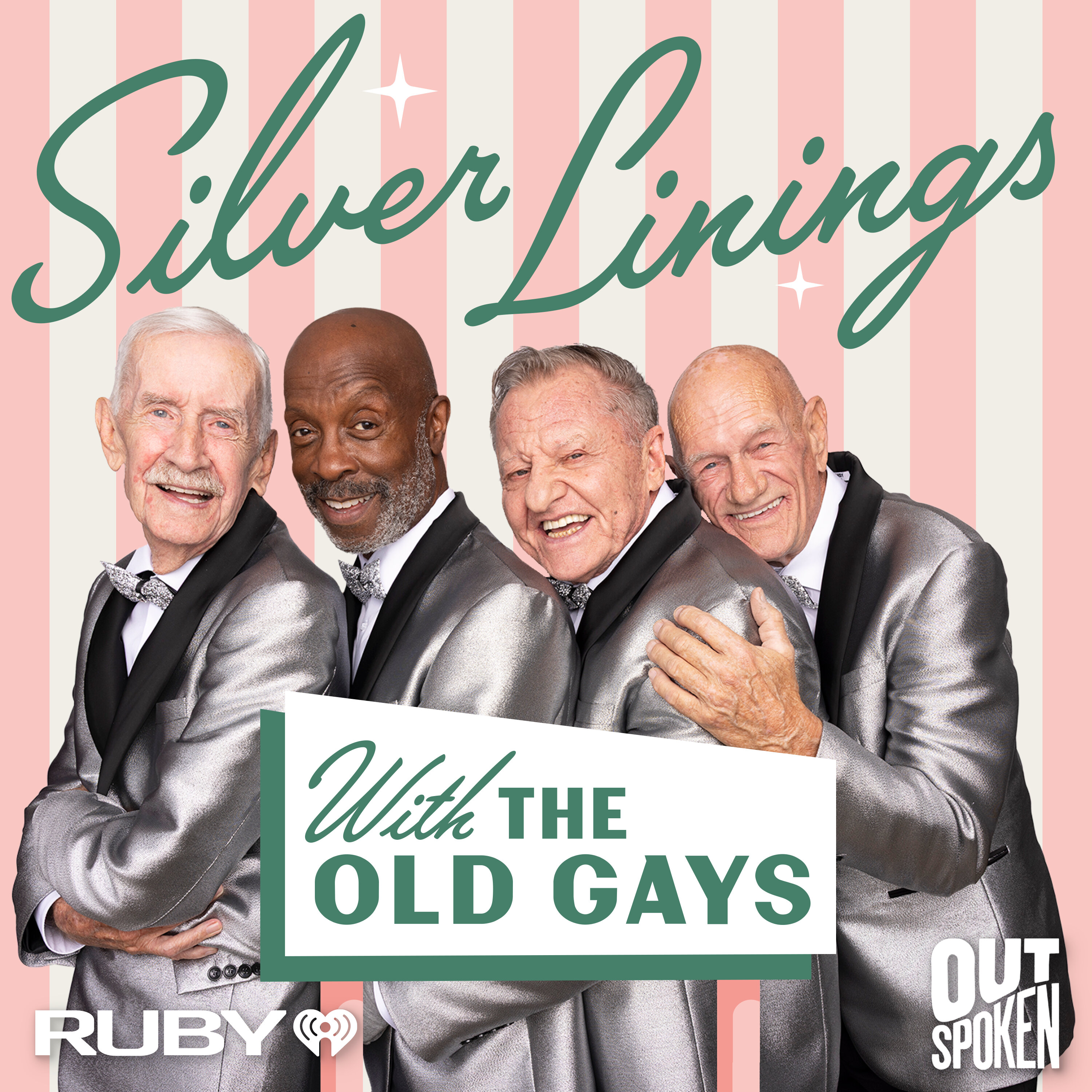
Silver Linings with The Old Gays
From The Closet to The Red Carpet (Queer on Screen, Part 2): “A lot of hot gravy over cold meat.”
00:31:00
Loading summary
Transcript140 lines
- [00:04]
Mick Peterson
Ruby
- [00:07]
Bill Lyons
street people liked it, and I think it made a big difference.
- [00:12]
Robert Reeves
I didn't see the episode, but I heard about it immediately afterwards.
- [00:21]
Jesse Martin
As far as the heated rivalry is concerned, we'll see how long it lasts.
- [00:26]
Mick Peterson
From just beyond the lights of Los Angeles in St. Steamy Palm Springs, California,
- [00:31]
Robert Reeves
it's Mick, Robert, Bill.
- [00:34]
Mick Peterson
Just say, and this is silver linings
- [00:39]
Robert Reeves
with the old gays. So where did we leave off? Oh, that's right.
- [00:48]
Jesse Martin
We're talking 100 years of queerness in mainstream movies and television.
- [00:52]
Mick Peterson
100 years. Speak for yourself. It's supposed to be throughout our lives.
- [00:58]
Jesse Martin
Tomato, tomato.
- [01:00]
Bill Lyons
Last time we talked about how difficult it was to see ourselves reflected in TV and film. Leaving off at the start of the 1980s when everything changed.
- [01:13]
Mick Peterson
Today, we're setting the record.
- [01:15]
Jesse Martin
Gay Part two begins.
- [01:19]
Mick Peterson
Now to kick things off, it's time for my current addiction.
- [01:27]
Bill Lyons
This is where we get to share something that we're really into right now.
- [01:33]
Robert Reeves
Well, my current addiction is a bowl of Raisin Bran cereal without clusters before I go to bed.
- [01:42]
Bill Lyons
Ew.
- [01:46]
Robert Reeves
It's kind of a revisiting of my childhood. There's so much on these media feeds about diet and nutrition and stuff like that. I'm being forced to be conscious about trying to find foods that are good for you.
- [02:07]
Jesse Martin
Well, at least you're clean by the morning.
- [02:10]
Robert Reeves
Well, that's part of it.
- [02:12]
Jesse Martin
Cleaned out. You know, talk about nature's broom.
- [02:16]
Mick Peterson
Okay, so where were we?
- [02:18]
Jesse Martin
We. We're picking up our conversation in 1981 with the book the Celluloid Homosexuality in the Movies by Vito Russo. The reason why we picked this is it's sort of a demarcation. 1980 represents more or less 100 years of film in which we discuss the gay people have been in the films from the very beginning. And it goes up to 1981. It's been about 100 years. And there are two really momentous events that propel gay lesbians and queer people in the movies. And that is the continuous march for equal rights, human rights, and also the onset of the HIV AIDS epidemic.
- [03:07]
Robert Reeves
And if I may add a thought, the year of HIV and AIDS caused a kind of a change in the way gay characters are depicted. And I think there are many reasons for it. The reaction of the gay community to the epidemic. And I felt that the portrayal of gay people to me seems to be different after the 80s.
- [03:45]
Jesse Martin
Also in the 1980s. I don't exactly know the date that it was formed, but GLAAD was formed, and they specifically counseled the entertainment industry on how to Develop gay characters, lesbian characters, queer characters that more resemble reality. And the work of Glad has been very much a part of that. And that's where we're going to start.
- [04:13]
Bill Lyons
First question, what gay or queer things in movies and TV do you remember from the 1980s that had an impact
- [04:22]
Jesse Martin
on you from the 1980s? The film that had the most impact on me was released in 1982. Called KREL. It is a hyper homoerotic art film directed by Rainer Werner von Fassbender. The film stars Brad Davis and depicts a story of a Belgian sailor by the name of Georges Corel who is a thief and a murderer. And really the action takes place in and outside a bar brothel in Brest, France, which is a port. The fuck house is run by a lady named Lyciane. There's a lot of rough action, anal and oral, with various types of individuals. Role types like dock workers and leatherman also know that Crel's superior, a man by the name of Lieutenant Ceblon, is in love with Karel. And to prove his manliness to cruel, he keeps providing him protection and cover for all his crimes. Now the look of the film is very stylized and very erotic. It is wonderful to watch. Now for anybody here who wants to see what the look of the film was, I did wanted to show the guys what the poster looks like. Wow. Mm. Notice the white pants.
- [06:04]
Bill Lyons
Uh huh.
- [06:05]
Jesse Martin
And notice the crotch. Not only is it dirty, but it's big. And Brad Davis was known for being well endowed.
- [06:16]
Bill Lyons
Moving along. Torch Song Trilogy came out in 1988, right in the middle of the AIDS epidemic. It was written and starring Harvey Fierstein, based on his successful play about an openly gay man in the 1970s looking for love. But when he finds it, he loses it, tragically. Did any of you see it?
- [06:41]
Mick Peterson
I saw Torch Thong Trilogy, which kind of worked me up because of all the stuff that was going on. It was deep, it was stirring.
- [06:51]
Jesse Martin
Why was it stirring?
- [06:54]
Mick Peterson
It was a busy AIDS time. We were still learning so much about this disease. And even though the movie wasn't about aids, I watched it and cried. I cried because I was on the road. I was so innocent then. I was in a singing group and I was so out of touch with what was really going on. So it was like living there for a moment, knowing that I could step out the door and be away from it because it was affecting my friendship, my family, from people dying. And I don't handle death well at all. I lost a partner and I don't want to go through it again. Any of that time.
- [07:45]
Robert Reeves
Yeah.
- [07:46]
Jesse Martin
I'm very partial to the play because it was through this play that I was introduced to Estelle Getty. Estelle Getty created the role of the mother on Broadway. And honestly, I felt very differently. I came out of the theater so hopeful. One of the first things I remember in the play, or even in the. I don't know if it's in the movies, but Harvey wears a pair of bunny slippers. He wears a pair of bunny slippers and the mother, his mother, played by Estelle, comes running out on stage with the same slippers and they all dance and have a happy time together. And I thought, gee, I wish I had a mother like that. You know, there were so many things in the play that I loved so much. I don't know if they transferred to the. I think the play is far more effective.
- [08:48]
Robert Reeves
Okay, next question. How did mainstream depictions of HIV and AIDS compare to how it was actually lived in your community in films like Philadelphia?
- [09:05]
Bill Lyons
Well, I didn't see the movie Philadelphia, but I was living in San Francisco. And in the Chronicle, you'd read about, you know, this person, you know, died or this or that, but they really didn't get down to the nitty gritty of what was really happening in the understories initially.
- [09:31]
Robert Reeves
I don't think any of the media really touched on the amount of grief that this was causing for so many people.
- [09:45]
Jesse Martin
Well, I disagree. And I found at least 42 titles that deal with HIV in the film library.
- [09:56]
Mick Peterson
And now a word from Mick.
- [10:00]
Jesse Martin
The first one that made the most impression on me was a film entitled Long Time Companion. It was released by the Samuel Goldwyn Company in 1990, and it is a romantic drama film starring Bruce Davidson, Campbell Scott, Patrick Cassidy and Mary Louise Parker. It's the first wide theatrical release of a film to deal with the subject of aids. And it takes its title from the euphemism the New York Times used in the 1980s to describe the surviving same sex partner of someone who has died. Okay. His long term companion. The most touching scene for me in the movie, it's a scene where Bruce Davidson and his longtime partner, played by an actor by the name of Mark Lamos, is dying of aids. And at that time, as is depicted in the movie, they take the guest bedroom and turn it into a hospital room because no hospital was going to take Mark Lemos. He was going to have to die at home, which is exactly what happened to somebody very close to me. So I disagree. I think that if you look for certain films, I think the realism is very clear, which culminated in the movie Philadelphia. I thought Tom Hanks gave an incredible performance. This is the story about a lawyer in Philadelphia who is fired by his law firm because he has aids. I think Philadelphia changed the way Hollywood approached AIDS because they played it for the realism of it and the emotion, and it was so inspiring. And I just wish Hollywood would make more films like this.
- [11:59]
Mick Peterson
Yeah, it took you through it took you through it. This ad is brought to you by Vive Healthcare, the makers of Devato Dolutegravir Lamivudine.
- [12:26]
Jesse Martin
We're here, we're queer and we're old.
- [12:29]
Robert Reeves
Honey, these knees may not just go like they used to, but I'm still dancing to my own beat.
- [12:38]
Bill Lyons
When you're gay, being old is something to celebrate.
- [12:41]
Mick Peterson
That's the tea right there. For those of us who survive the HIV AIDS epidemic, there's a big sense of gratitude for every day at the disco.
- [12:52]
Jesse Martin
And now we love to see the next generation learning to use their voice, build strong community and think about treatment options.
- [13:02]
Bill Lyons
Dovato is a complete HIV treatment by prescription only for some people 12 and older. Your doctor will determine if Devato is right for you.
- [13:14]
Robert Reeves
Unlike most HIV treatments that have three or four medicines, Dovato has just two medicines in one pill.
- [13:25]
Jesse Martin
No other complete HIV pill contains fewer medicines to help you stay undetectable than Dovato.
- [13:35]
Medical Disclaimer Voice
It is unknown if Dovato is safe and effective if you have HIV and hepatitis B if you have hep B. Don't stop Dovato without talking to your doctor as it may get worse or harder to treat. Don't take Dovato if you're allergic to its ingredients or taking Dofetilide due to serious or life threatening side effects. If you have a rash or allergic reaction symptoms, stop Dovato and get medical help right away. Other serious or life threatening side effects include severe liver problems and lactic acid buildup. If you're female or obese, you may be more at risk. Tell your doctor about your medicines or supplements. Medical conditions, liver or kidney problems, pregnancy, breastfeeding or planned pregnancy.
- [14:11]
Robert Reeves
Whether you are a disco diva or sugar daddy, know the power of staying undetectable.
- [14:20]
Bill Lyons
So if you're living with hiv, do dream about tomorrow.
- [14:25]
Jesse Martin
Do ask your doctor about fewer medicines. Do Devato.
- [14:30]
Mick Peterson
Visit devato.com or call 1-877-844-8872 to learn more. Shifting gears a bit A very famous gay Movie is the 1996 film the Birdcage with Robin Williams and Nathan Lane. What did you think when that became a hit, did it feel like a good thing?
- [15:04]
Robert Reeves
Yes. Yes, because it was a comedy. And I think serious subject matter comes across much better when it's done in a comedic way.
- [15:19]
Bill Lyons
I think one of the reasons why the Birdcage was so popular was because straight people liked it. And I think it made a big difference. I mean, it was so over the top campy that you really couldn't help laugh at it.
- [15:37]
Mick Peterson
The Birdcage was my life in Miami. And it happened in Miami with my gay parents, Bob and Joe, who I thought I was watching a home comedy of them. The characters were amazing. We didn't have a housemaid that would have been cute with bare feet all over the floor. But the characters were just as Bob said, it was hilarious to me. I came out of it fine because they got through and imagining a man who's never done drag doing it for the first time going to a nightclub and then going out. And he looked pretty good. He really did. But that was my experience. I thought of them because my mom. Joe would sit with his legs crossed and just his little feet going. And I told him, I says, we should bury you just doing that. And Bob would cater to his every little wham of what he did. And it was just cute. It was a kind of feel good movie. And I like that. I like joy and fun, you know. So that's how I think of the Birdcage.
- [16:50]
Jesse Martin
Right around the time of the Birdcage, there were some other pivotal television moments for gay representation. First, Ellen came out on her own sitcom, which was a big deal. Do you remember when that happened?
- [17:07]
Mick Peterson
I wasn't surprised. I know she felt better. It freed her and it freed a lot of people too, to come out.
- [17:17]
Robert Reeves
She was a major character and it had widespread impact. I didn't see the episode, but I heard about it immediately afterwards.
- [17:29]
Mick Peterson
Of course. Yes, yes.
- [17:31]
Bill Lyons
And then of course, there was Will and Grace. Did you feel seen in those characters or did it just feel like entertainment for straight audiences?
- [17:42]
Mick Peterson
The latter to me. I wasn't any of those characters, but I enjoyed it.
- [17:47]
Bill Lyons
Well, I kind of related to Will because when I was younger, I worked in a clothing store and I was gay, but I had to act straight, just as Will, as an attorney, had to act straight in his job. I related very much to Will.
- [18:07]
Jesse Martin
Yeah. You know, all of us learned very early on how to present two different versions of ourselves.
- [18:16]
Bill Lyons
Absolutely.
- [18:16]
Jesse Martin
You had your own version that you had with your friends and stuff like that. And then that's the Persona that you wanted to project in business, yes.
- [18:25]
Mick Peterson
But was it an act? My question. Because it was a natural feel for. I don't know how it would transition between the straight guy I was talking to like this and the queen that I was talking to like this, or the lady that I was talking to like they were all real to me. But it was just the environment, I guess. You know, it wasn't a pretend thing for us. I mean, for me at least, I just was flexible.
- [18:52]
Jesse Martin
Well, I think the way psychologists produce it is that you presented different identities of yourself as really as a form of protection, isn't it?
- [19:02]
Mick Peterson
Yes. I love that everybody doesn't have to be this feminine, flamboyant character in films nowadays that we're seeing that gay men are masculine also, not all feminine.
- [19:18]
Jesse Martin
Well, I guess that begs the question about, you know, why Brokeback Mountain was such a seminal event. It was released in 2005. It's really a cowboy love story. And there is such romance in that film. First of all, it takes place up in the mountains of Wyoming, which are beautiful. And the way the movie was shot, I mean, just incredible. And, you know, the relationship between Heath Ledger and Jake Gyllenhaal, you know, they're up in the mountain alone with the sheep, and their relationship is allowed to develop very slowly until finally it culminates in a scene in which one of them says to the other, look, it's so cold up here. And so they get in the same sleeping bag together for warmth. And that's where the most beautiful sex scene I have seen in a long time takes place. And I don't remember there being much nudity. And right from that point, you know, it's so wonderful. They're together and they do these things together. They help each other out up on top of the mountain, you know. Only problem is, when they come down from the mountain and they have to go into the real world, he pledges the character's already married. And he goes back to his wife and their children. And Jake Gyllenhaal marries a childhood sweetheart. And they move down to Texas. Cause that's where she's from. And he slips off every weekend or so, every chance he can get into Mexico to fool around. Until he is murdered. Most brutally. Ang Lee won for Best Director, I believe. But his picture did not make it as Best Picture. And everybody in Hollywood was expecting Brokeback Mountain to be the breakthrough movie, just like Midnight Cowboy had been. And instead, there was a marketing campaign against the picture, spearheaded by Ernest Borgnine and Tony Curtis, which I thought was very rich. Considering Tony Curtis, not more than 20 years earlier was dressed in drag in Some Like It Hot. So I don't know where Tony was coming from at that point, but whatever it is, their campaign worked. And all I remember is watching the Oscars and the absolute dismay on Jack Nicholson's face. And I really think after that point I really lost interest in Hollywood. I really kind of thought, you know, if we're gonna do things, it's going to be outside of this system because it isn't really representing us.
- [22:22]
Mick Peterson
Yeah.
- [22:22]
Jesse Martin
You know, looking at this era, I'm thinking about a lot of queer films. Brideshead Revisited, the Jewel in the Crown Dynasty, the Talented Mr. Ripley, Kiss of the Spider Woman, My Beautiful Laundrette, Maurice, Moonlight 2016, now that won the Oscar. And was that Cher? It is a.
- [22:47]
Mick Peterson
What moonlight was. What was that?
- [22:50]
Bill Lyons
No, there's moonlight and moon lighting.
- [22:54]
Mick Peterson
Okay, gotcha.
- [22:54]
Bill Lyons
Share with them.
- [22:57]
Jesse Martin
Yeah, moonlight won the Oscar in 2016. The lead is a young black man and who comes to grips with his homosexuality. It's a really wonderful coming age story that you don't see. And that the Academy gave this the best picture, I think is a wonderful thing.
- [23:20]
Mick Peterson
What's it like for you to see queerness and gay identity be so mainstream today? It's freeing.
- [23:27]
Jesse Martin
Well, we could talk about Mid Century Modern, the TV show.
- [23:31]
Bill Lyons
Uh huh.
- [23:33]
Jesse Martin
And I think we did some work on that.
- [23:35]
Mick Peterson
We went to a party.
- [23:36]
Bill Lyons
Yeah, yeah, we went to the premiere.
- [23:38]
Jesse Martin
That's it.
- [23:39]
Mick Peterson
At the house.
- [23:40]
Jesse Martin
Yes. So what did you guys think of it?
- [23:44]
Bill Lyons
I thought it was a cliche. It's been done so many times before. The same kind of story that I really didn't get that much of enjoyment out of wasn't bringing out anything new. It was just kind of going back to the same old thing.
- [24:05]
Jesse Martin
What's the same old thing?
- [24:07]
Bill Lyons
Just the everybody just being gay and laughing and that kind of thing.
- [24:12]
Jesse Martin
So you think the characters were cliches?
- [24:14]
Bill Lyons
Yes.
- [24:16]
Jesse Martin
Two dimensional.
- [24:18]
Bill Lyons
Yeah.
- [24:19]
Jesse Martin
I guess what I'm going after is the fact that none of these characters are a victim and none of these characters are really villains. And gay people and lesbians have been portrayed as victims because they get murdered when they're cruising. They get murdered by their tricks or they're criminals like in Cruel or they can never achieve happiness like the two cowboys in Brokeback Mountain. And even though the series didn't work properly, at least it showed, I think, a pretty mundane kind of everyman kind of characters that were just pretty much. Yeah, pretty much anybody that you find. And that's really Refreshing. It is because, you know. Yeah. You see somebody who's, you know, as a real human being, as authentic as, you know, it can be on television.
- [25:23]
Mick Peterson
I agree with Mick. As you said, it wasn't the typical. What everybody expects from us. It was. It was real.
- [25:30]
Jesse Martin
Yeah. Yeah.
- [25:32]
Mick Peterson
And that's been rare.
- [25:33]
Jesse Martin
Yeah. And I think that that's. There's a relaxed kind of feel to it, you know, that it didn't find an audience. You know, that's it. It may have been the scripts, I don't know.
- [25:45]
Mick Peterson
Or maybe it's just because we're more comfortable nowadays. So the shock of everything is kind of over. And that's sad because we still need to be aware of what's going on.
- [25:57]
Jesse Martin
Okay. So that brings up something. You know, I think of the gay couple that I remember that's most up to date was the gay couple presented in Modern Family. I never watched it, but my roommate Abraham across the hallway used to listen to it all the time. And so I just listened to the scripts and, you know, I think that was a pretty successful attempt to try and depict a gay couple and the
- [26:27]
Bill Lyons
pressures that they feel pretty accurately on Mid Century Modern. They were also a trio, so it was a fun dynamic in that way. And their dysfunctions.
- [26:40]
Jesse Martin
Yes.
- [26:41]
Bill Lyons
And working the gay couple in there was like covering all the bases.
- [26:47]
Jesse Martin
Yeah. And it presented them in the same way.
- [26:51]
Bill Lyons
Yeah.
- [26:52]
Jesse Martin
That we weren't exotic. There's a feeling like, well, now we're not exotic anymore. The show is. The dog and pony show has moved on, but in a lot of ways, that's kind of good.
- [27:08]
Bill Lyons
Well, boys, we've really covered all the bases about queerness in film and television since the very beginning.
- [27:16]
Jesse Martin
And now the moments some of you have been waiting for. Our raw, honest thoughts about heated rivalry.
- [27:25]
Robert Reeves
Drum roll, please.
- [27:29]
Mick Peterson
I've not seen it.
- [27:31]
Bill Lyons
I haven't either.
- [27:33]
Robert Reeves
I more or less know the storyline. You know, hockey player expressing their sexuality. I've only seen clips of it, so I don't know the whole story, but it's not surprising.
- [27:51]
Jesse Martin
A lot of hot gravy over cold meat. Okay. You know, it's not enough. It's not enough to force a rivalry. That's all just kind of a setup because one person is on one team and one person is on the other. And that instead of making love, they fight. Well, I don't know how many couples I've known, including my own, where you fight and then you make up and then you fuck. And that's the basis of a lot of male. On male relationships. Until it kind of just fizzled out. So, you know, as far as the heated rivalry is concerned, we'll see how long it lasts. It's a little bit of Johnny One note there.
- [28:42]
Mick Peterson
What is heated rivalry on hbo? Oh, that's why I don't see.
- [28:47]
Robert Reeves
Did you ever think you'd see a love story like heated rivalry be so celebrated in the mainstream? No. You know, I think it's not surprising because it's like people who are creating media are searching for every different spin on.
- [29:12]
Jesse Martin
No, they want to see naked men bodies, you know, writhing around on some bedsheet. You know, that's what they want to see. That's what women want to see. Women want to see gay men screwing. Come on, Bob, loosen up. Okay?
- [29:28]
Robert Reeves
You haven't convinced me yet.
- [29:30]
Jesse Martin
This is not a new story. I said I'm glad they have a new audience, but, you know, quite frankly, I watch much steamier stuff.
- [29:46]
Robert Reeves
We did it. We've reached the end of our two part episode. In the midst of the world right now, what about queerness in mainstream media is a silver lining for you?
- [30:02]
Jesse Martin
The silver lining is that it's trial by error. We continue to make progress, but there is still more to be done. And I'm thinking about how media now presents people who are transgender and that right now there's a lot of scapegoating going on that is very serious. And that represents, like, understanding that is part of our queer community. And if there is one queer person who is being discriminated against or ostracized or made a scapegoat, then it means all of us.
- [30:44]
Mick Peterson
For me, it's just being accepted. That's a start. I want to be accepted by everybody. I know I won't. But just letting me be me because I allow you to be you.
- [30:56]
Bill Lyons
And for me, it's the progress that we made. You know, growing up, when I always knew I was gay, we were looked down upon. And the silver lining to me is the progress that we've made over the years.
- [31:14]
Robert Reeves
And I'm kind of in the same boat with you because we do have visibility now. I have a lot of faith in the younger generation and they're growing up now with that visibility. And there it seems to be a much greater acceptance, acceptance of young people with being gay and alternative cultures. And I think the more people express gay characters and seek ways to express gayness, the more comfortable people will become.
- [31:58]
Jesse Martin
I think we're more visible and I think the stories that are being told are more realistic. And that has a lot to do with the fact that writers and directors and producers are themselves gay and they're very comfortable living with it and they know that we represent a significant market of the film going public. But we're not done yet. And so we have a ways to go.
- [32:28]
Bill Lyons
Silver Linings is a production of iHeart's Ruby Studios and the Outspoken Network. We're your hosts Bill Lyons, Robert Reeves,
- [32:39]
Mick Peterson
Mick Peterson and Jesse Martin. Our executive producer is Sierra Kaiser, supervising producer, Kelly Kyle Story production Ryan Amador with pictures post production by Eric Zeiler. See you in two weeks.
- [33:02]
Jesse Martin
You gotta plant that kiss. Even if it's a French one? Even oh, even if it's a French one.
- [33:08]
Robert Reeves
How many dates does it take to be a boyfriend?
- [33:12]
Bill Lyons
Boyfriends are something you have between lovers.
- [33:16]
Robert Reeves
We explored each other's crevices.
- [33:20]
Jesse Martin
Oh, come on, you don't. Don't play around with me.
- [33:23]
Mick Peterson
Oh my goodness.
- [33:27]
Advertisement Voice
This ad is brought to you by Vive Healthcare, the makers of dolutegravir Lamivudine. Devato is a complete HIV treatment by prescription only for some people 12 and older. Your doctor will determine if Devato is right for you. With time comes perspective, and sometimes the silver linings show up where you least expect them. If you're living with hiv, find out how you could stay undetectable with fewer medicines. No other complete HIV pill contains fewer medicines to help you stay undetectable than Dovato.
- [33:56]
Medical Disclaimer Voice
It is unknown if Devado is safe and effective if you have HIV and hepatitis B if you have Hep B. Don't stop Dovato without talking to your doctor as it may get worse or harder to treat. Don't take Dovato if you're allergic to its ingredients or taking Dofetilide due to serious or life threatening side effects. If you have a rash or allergic reaction symptoms, stop Dovato and get medical help right away. Other serious or life threatening side effects include severe liver problems and lactic acid buildup. If you're female or obese, you may be more at risk. Tell your doctor about your medicines or supplements, medical conditions, liver or kidney problems, pregnancy, breastfeeding or planned pregnancy.
- [34:32]
Advertisement Voice
Do create your own path forward. Visit devato.com or call 1-877-844-8872 to learn more.
- [34:39]
Jesse Martin
This is an iHeart podcast.
- [34:42]
Medical Disclaimer Voice
Guarantee.