← Silver Linings with The Old Gays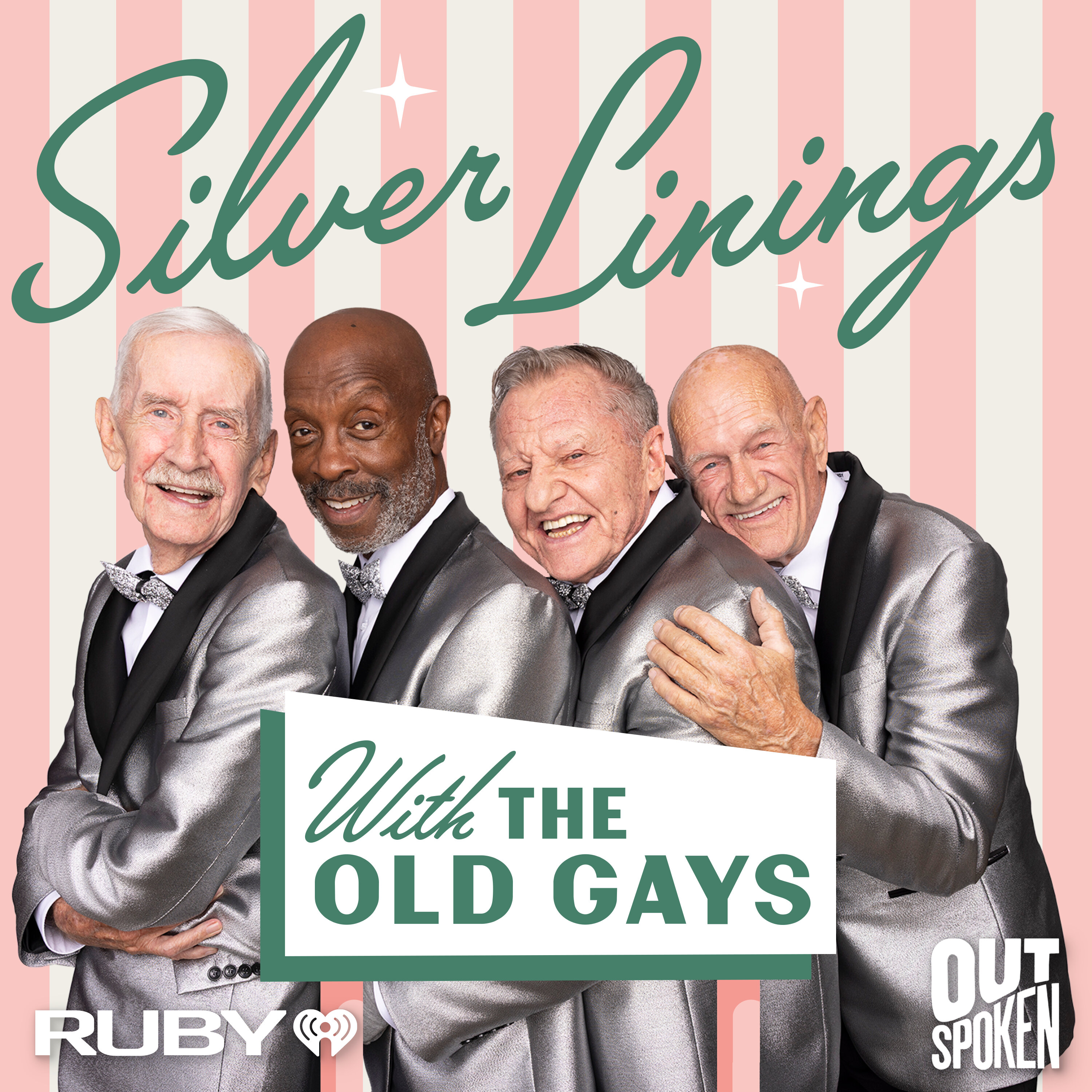
Loading summary
Transcript69 lines
- [00:04]
Mick
Ruby.
- [00:08]
Robert
I started hearing rumors of gay cancer.
- [00:14]
Bill
I've been in the desert now 35 years. There are healing powers here.
- [00:20]
Mick
Being queer and having sex is at the root of our liberation.
- [00:27]
Jesse
From just beyond the lights of Los Angeles in steamy Palm Springs, California, you.
- [00:32]
Mick
It'S Mick, Robert, Bill, Jesse, and this.
- [00:37]
Bill
Is Silver Linings with the old gays.
- [00:49]
Mick
Welcome back, kids.
- [00:51]
Jesse
While you're still digesting last weekend's hot dogs and fireworks, we're here to serve you something even more explosive. A very personal new episode of Silver Linings.
- [01:02]
Bill
It's July and certainly heating up over here in Palm Springs. So today we're going to cool things down a bit with a conversation about living with or in community with hiv.
- [01:20]
Mick
Both Robert and I are HIV positive and open about our experiences. The journey hasn't just shaped our lives, it's reshaped our community and in many ways, the world. Since the beginning of the epidemic, over 88 million people worldwide have been infected with HIV and about 43 million have already died.
- [01:50]
Jesse
Nowadays, with access to proper prevention and treatment, HIV is manageable. And most people with the virus can't transmit it to others.
- [02:00]
Mick
If left untreated, HIV can lead to the disease AIDS and no cure exists at this time.
- [02:09]
Robert
In the 1980s, the virus spread rapidly throughout the gay community. At first there was no way to treat it, so during that time we lost a large number of gay men. The backdrop of this crisis was terrible fear and vilification of our community.
- [02:31]
Bill
As of 2023 report by the CDC, approximately 1.13 million people age 13 and older are living with diagnosed HIV in the United States today. We want to share our stories because it is not only a part of who we are, but part also an integral part of our community history. I've been living with HIV for 38 years now. I was diagnosed in early 1987. And when I was diagnosed, there were no treatments available other than azt, a drug which was very potent and in itself was probably killing people. And when I learned of my diagnosis, it was an enormous shock to me. And for several months I was processing what had happened to me.
- [03:47]
Robert
When I first heard about it, I was working in the interior design business in Showplace Square in San Francisco. And all of a sudden I started hearing rumors that the showroom across the street from us, one of his salesman's boyfriends had died of gay cancer. And that's what it was called then. It was just gay cancer. And it shocked the life out of me. I really didn't know what to think and no one else really did, too. It was all in sort of a cloud kind of a thing.
- [04:32]
Jesse
And I was on the road singing. So I wasn't in the community then. I wasn't even out. But I actually knew about five people who had died from it, which was more than enough for me going through it with them.
- [04:45]
Mick
I read about it in the New York Times. There was an article about a group of men in San Francisco and Los Angeles and New York City who were coming down with a very rare form of cancer called Karposi sarcoma, which was found only in men of Southern European descent whose immune systems were compromised. And that's the first time I had read it. Just like Bill had mentioned the gay cancer. And the cancer was Karposi's sarcoma.
- [05:22]
Bill
As for me, I remember hearing about AIDS and HIV. It was the early 80s, living in San Francisco, and almost every day I would go down to the Castro and have breakfast in one of the restaurants. And it was during one of those times. I think this was probably early 1980, 81. And one of the clearest memories I have in the early 80s is that one particular newspaper, Bar Bay Area Reporter, began publishing an obituary column that started out with a few names every week. So one of the exercises I think probably every gay person did at that time was look at that obituary column to see who had died. And that column grew until it was a whole page of the newspaper.
- [06:41]
Mick
Yeah. You remember when they published the photographs of the first, like, 100,000 victims, people who had succumbed to AIDS, and they published it in Time magazine, and you went through it and just marked who you knew.
- [06:57]
Robert
Yeah.
- [06:57]
Mick
You know, one person put it, being queer and having sex is at the root of our liberation. What I think HIV represents, it's the intersection of three things. First of being homosexual, that means being queer. The second is that it is passed through sex, okay, which defines us. And finally, it is religion and societies, persecution and murder of people like me. You know, it wasn't until 1974 that the American Psychiatric association officially removed homosexuality from its list of mental disorders or mental illness. 1974. I remember that year. That was the year I graduated high school. Throughout my entire lifetime, I have not only seen and witnessed discrimination, murder, persecution, just for being who you are, but also a disease for which there is no cure. By the 1980s, when HIV swept across America, our government did nothing. They did nothing. Which sparked social protests, because the only way we got the medicines that we needed, the care that we needed, and the protection that we needed is that we went to the streets. You know, Ronald Reagan was the president at that time, and it wasn't until well into his second term that he even mentioned the word aids. And that was at the behest, can you believe it, of Nancy Reagan? So that's how I'm going to stop.
- [09:05]
Bill
When it first became public that this disease was affecting the gay community specifically, one of the major assumptions that people made was that if you hugged someone or kissed someone, you could catch aids. And so it had a very repressive impact on people's affection towards each other. And also the health treatment that people were receiving where when you did make it to a hospital or a hospice, that even the medical professionals were very reluctant to get very close to people who had contracted the disease. And of course, as time has passed, we've learned that it's not that easily transmitted, thankfully.
- [10:22]
Mick
What I thought was the most disgusting thing was a conspiracy of silence. I can't tell you the number of actors that I knew who were sick and went to the grave denying their diagnosis because they were too afraid of coming out. And if you think there's a little bit of bitterness in my voice. There is. Because I think of those people often and what wonderful persons they were, but they were so frightened by what society and the business would think of them, which was throwing you out the door and into the street. Yeah. And that is what sticks in my mind, period.
- [11:05]
Jesse
I just thought of one bad memory of a friend of mine who I went to college with. I thought he was one of the sexiest guys on campus, dressed to the table. When I found out that he was HIV positive and then converted to being having aids. His self denial. I mean, you could see what he was going through. And I remember being in West Hollywood, in the pharmacy there. I don't remember the name of it.
- [11:36]
Mick
Capital drugs.
- [11:37]
Jesse
Capital drugs, yes. With him picking up meds. And he was just, I'm fine, I'm fine. I'm going to do this. I'm going to do it. He wasn't living in a real world. And I just remember just stopping and holding him and telling him to say, I love you so much, Curtis, but you're dying. And he died. It was hard, but he finally came to the realization that it was his ending. And it hurt because I saw him go from this amazing person down to skin and bones. But the thing was, him coming to terms with himself, you know, it was. It didn't have to do with anybody else.
- [12:18]
Robert
Yeah. I had quite a few friends, very close friends, who did not tell me that they were infected with the virus. And two of my friends had been to Macy's and saw my good friend Tom in the pajama department. And they got right back to me and said, you know, Tom has aids. He never told me that. There was a shame attached to it, but I would have done anything to been able to jump in and help Tom right away, but he would not reach out to me and let me help him. But he kept it all inside of himself.
- [13:09]
Mick
Yeah. And I think that's really what it was because they were afraid of telling their friends, their co workers because they had seen what had happened to the first victims. I mean, there were mortuary companies that refused to take dead bodies. It was horrific. And you know, given the prejudice already that exists towards homosexuals in this country, it's like this really double edged sword that just sticks in your heart.
- [13:42]
Bill
Yeah.
- [13:44]
Jesse
Does anyone have any stories where you've seen hostility expressed towards the HIV community and people living with hiv?
- [13:54]
Robert
I did not. But I was living in San Francisco at the time. And if you found out that somebody had aids, you jumped in and you helped them. People were helping each other.
- [14:10]
Bill
Yeah. San Francisco was probably at the forefront of trying to figure out how to best deal with this disease. And the care structure that developed was basically setting up a system of hospices, which were places where you could go to die and die with compassionate care.
- [14:44]
Mick
For me, yeah, I mean, there were. Did I personally see people attack people who had HIV aids? Yes, you could hear it in the streets, but mostly I heard it in public discourse. There was a senator from North Carolina, I think his name was Jesse Helms, and he vilified from the floor of the Senate gay people aids. And that quite frankly, that AIDS was God's retribution to us. That was God's answer or punishment. In the 1990s, there was a group called act up and they engaged in social protest to develop awareness among people. And what they did is they snuck out and found Senator Helms home and they had made a giant condom and covered his entire house with this condom, which got a lot of national recognition, a lot of humor. And after A while, the D.C. police came by and told the protesters to take the condom down from the senator's home. And all they got was a parking ticket. It gets even better. It wasn't their car.
- [16:11]
Robert
Can you imagine, Mick and Robert, how have you navigated telling people about your status? What have been the most surprising responses?
- [16:23]
Bill
Well, I didn't run around saying, hey, I'm HIV positive. But whenever the subject came Up. And I was directly asked about my status. I was always honest.
- [16:42]
Mick
And.
- [16:42]
Bill
And again, because of where I live, first San Francisco and then Palm Springs, I never experienced a negative reaction to someone else learning that.
- [16:59]
Mick
All right, here's an admission. You know, I was in a relationship at the time, and when I told my partner that was the end of our marriage, he wanted to throw me out. You know, we wrote a book, and one of the things that I talked about as how much I owed Joel for so many things in my professional life and on my personal life that I learned from him and appreciated, and I will always thank him for that. But the other side of the story is that he couldn't accept it, which comes down to this. I forgive myself for having gotten infected. I was in the wrong place at the wrong time. But you know what I can do? I forgive the person who gave it to me because either he didn't know his status or he went ahead and did it anyway. And I forgive him for that. And I forgive myself. You have to understand that I am not a victim. End of story.
- [18:08]
Robert
How does HIV influence your daily life now?
- [18:14]
Bill
Well, certainly one of the major impacts is the daily routine of taking medications. And beginning in the mid-90s, when the Protease inhibitors came out, that's when I started taking medications. And ever since then, I have had to make a point of taking my HIV meds twice a day, every day.
- [18:55]
Mick
Yeah.
- [18:55]
Bill
Knowing that if I didn't, it could lead to complications and potentially eventually death.
- [19:10]
Mick
I'm a little lucky. I take one pill in the morning, and that is certainly a whole lot better than the five or six pills I had to take when I first was diagnosed. But Bob is right. He stresses a point that was very early on impressed upon me by my doctor. He said, every time you take one of these pills, it reminds you of what has happened, and you must confront your own self loathing because you are homosexual. And the pressure that's put upon you is that you are a bad person. Okay. That kind of pressure can stop a person from taking their meds. It is very important that I take my pill every morning. But it reminds me of my being in the wrong place and making the wrong choice. But, you know, there are good things about this as well. You know, our community organized at least in Los Angeles, but also in the Gay Men's Health Crisis in New York and in San Francisco and all across the country. In Los Angeles, it was AIDS Project Los Angeles. The APLA First Commitment to Life Dinner, which honored Betty Ford, was such an Enormous outpouring of just support. It was also coinciding with the time that Rock Hudson had just died. And that was a real shock to Hollywood because he finally came out and he said he had aids, and then he subsequently died from it. And that really rocked the city.
- [21:04]
Bill
It rocked the world.
- [21:06]
Mick
And people started looking around and saying, well, people are dying all around us.
- [21:13]
Bill
I think the biggest thing to know about this disease is that it is no longer a death notice.
- [21:23]
Robert
I totally concur. That's exactly how I feel about it, too.
- [21:29]
Bill
Yeah. There are medications available now that if you take them, they will save you.
- [21:39]
Robert
I mean, not only does it save them, but it can also become undetectable, which I think is an absolutely amazing achievement.
- [21:52]
Bill
Yes.
- [21:53]
Mick
Yeah. The last test I had, I was undetectable. Yeah. You know, I'm not completely defined by hiv. However, it is a part of my life. It does affect how I date. And, you know, I have it really in for tops who say that they will only have intercourse with somebody who is HIV negative. You know, I'd rather have raw sex with a person who I knew their viral count. But if you are going to practice unprotected sex, not only is it important that you get tested, but you see a physician, because there is a prevention method called prep that your insurance may be able to provide for you. And I would encourage you strongly to take up prep. You know, there was this. There's a case before the Supreme Court right now by certain Christian companies who say they don't want to. They don't want their insurance to pay for prep. And that case is now before the Supreme Court. And I don't know what's going to happen there. But if companies are allowed to cherry pick and decide what kind of treatments they're going to fund, we're just moving right back down that slope and people are going to pay for that.
- [23:25]
Jesse
And got to remember, too, it's not just gay people that HIV positive. So it's a. It's a world thing that people need to take care of themselves and educate themselves and make sure that they stay healthy.
- [23:37]
Bill
Yeah. This is not just confined to the gay community.
- [23:43]
Mick
And that's why my message to you is get tested, Be honest about yourself, be honest with your partners, and use prep.
- [23:59]
Jesse
So, folks, we're reaching the end of our episode, and it's time to ask the gold in question, or should I say silver. What's the silver lining for you about your experience with hiv?
- [24:11]
Bill
Looking back, there are many silver linings. The first is after learning of my diagnosis. And after I had processed at a time that it was medically untreatable. And I attended a workshop that was on meditation and visualization. And during that workshop, I learned conclusively of the power of the mind over the body. And if you can learn to harness the energy of your mind, you can deal with your body in physical ways that are astonishing. And the second biggie was that in my process, I made a decision to move from San Francisco to the Palm Springs area. And that had to do with.
- [25:31]
Jesse
One.
- [25:31]
Bill
Of the recommendations that was being given to the community was get the stress out of your life. And so for me, that was moving from the big city to a. I guess what I'd say a gentler community. And I have to say that my life, I've been in the desert now 35 years, and I think that move has done a lot to keep me alive for the past 38 years. There are healing powers here.
- [26:17]
Mick
Yeah, there's something about the desert that, I don't know, calls you back.
- [26:22]
Jesse
Silver linings. The desert, it is a savior. It really is. I set out some almost every evening and just look up at that sky because it scared me when I first got here. You're living in a city and all of a sudden there's nothing. But I have learned to breathe. I have learned to sit and cry from sadness and from gratitude.
- [26:48]
Bill
Yeah. Bill.
- [26:52]
Robert
My biggest silver lining was meeting my partner at the beginning of the AIDS epidemic who would be my partner for 16 years. And I had just gone through the 70s in San Francisco, which was the wildest time I've ever experienced. And all of a sudden, it changed and I had a part and we were monogamous together. And that is the only reason that I'm here right now. I know I would have been one of the victims of the AIDS crisis had I not met my partner.
- [27:38]
Mick
Yeah. For me, behind every silver lining is another silver lining. There was the most tragic irony that not only should I have hiv, but I should also be diagnosed with a rare autoimmune condition. You know, I've had four near death experiences in the last five years, so every day is a blessing. And I realized that my life is really not my own anymore. I'm part of something much larger, and I learned who my friends are.
- [28:16]
Jesse
Thank you for joining us for such a vulnerable and heartfelt conversation.
- [28:22]
Bill
That's a wrap for today. Silver Linings is a production of iHeart's Ruby Studio and the Outspoken Network. We're your hosts, Bill Lyons, Robert Bries.
- [28:37]
Jesse
Nick Peterson and Jesse Martin.
- [28:40]
Bill
Our executive producer is Sierra Kaiser. The episode was written by Ryan Amador with post production by Eric Zeiler. Our theme music was composed by Mats Hertenow with audio direction and designed by Matt Stilo. And if you're having fun with us, please subscribe to follow along. And don't forget to rate and review the show wherever you get your podcast. Thanks for listening. That disco music gets into your blood.
- [29:23]
Mick
It's poppers, man. I go what I said. Guys, we're closing in 15 minutes. Wash your mouths out and get out of here.