
Podcast
Skurnik Unfiltered
Hosted by Skurnik Wines & Spirits · EN
No reservations required—listening to these conversations feels like you've been invited to pull up a chair and share a glass with some of the most remarkable dinner guests, giving you a level of access that was previously gatekept for those in the know.
Skurnik Unfiltered is a weekly podcast that curates deep conversations with some of the finest winemakers, distillers, and industry leaders about the world of wines, spirits and hospitality. The show is hosted by Harmon Skurnik of Skurnik Wines & Spirits, a leading importer and distributor of the finest terroir-driven beverages crafted at a human scale.
Episodes are guest-hosted by sommeliers and experts in the subfields of wine, spirits, sake, and specialty beverages.
Skurnik Unfiltered is recorded at Skurnik Wines & Spirits headquarters in the Flatiron District of New York City.
20episodes
Episodes
Newest firstAll episodes

Graham Pirtle and Young Stowe of Unified Ferments
6d ago00:37:08Tap to summarize“We use fermentation to help you taste tea in a different way, to refract it into something that can live in the same category as wine or higher-end spirits, where you’re tasting this storytelling that tea can do—of places, of regions, of people around the world.” – Graham PirtleFermentation can do many things. It can preserve our produce, rise our bread, give us a buzz, and multiply subtle flavors. That last function is the one that most fascinates Graham Pirtle and Young Stowe, the co-founders of Unified Ferments.From their 4-person facility in Brooklyn, they seek to draw out the hard-to-get-to flavors existing in thoughtfully sourced, single-origin teas through a kombucha-style fermentation process. Unlike commercial kombuchas that use fermentation to augment added fruit flavors, Graham and Young use fermentation as a means of translating or recontextualizing the core ingredient itself, without the interference of alcohol: tea.In this episode, they interrogate the overlooked terms of “kombucha” and “tea,” discuss the key decisions that differentiate their ferments from any other product in the US today, and survey the future of the blooming category of NA craft beverages. Ferments tasted in this episode:Wen Shan Bao ZhongSobaRhododendronLapsang SouchongAutomatically generated transcripts often make mistakes. Find a corrected version here.Skurnik Wines & SpiritsFollow us on Instagram
Transcribe →
Vittorio Zoppi of Antica Torino
2w ago00:26:02Tap to summarize"Vermouth rosso is like the skeleton in a human body. It keeps the Boulevardier, the Manhattan, and the Negroni cocktails standing. Our goal was to produce Vermouth di Torino, which is the peak of the pyramid of vermouths." – Vittorio ZoppiGrowing up in Genoa, Vittorio Zoppi was born with an instinctive appreciation for good food and wine and a passion for all things Italian. As a young man, he made a career out of connecting Italian wine estates with American importers, and by the mid-2010s, savvy American drinkers were looking for craft spirits and wine-based aperitivi that communicate a sense of place the same way fine wines do. Vito jumped at the opportunity to combine his love for northern Italian flavors with his extensive network of American beverage professionals, and with its flagship Vermouth di Torino, Antica Torino was born. To date, the lineup has grown to include historic Piemontese classics such as Vino Chinato, Amaro, Genepì, and Genziana.In this week's episode, Uncle Vito, as he's affectionately known at Skurnik, discusses his journey from selling IBM software in Milan, to slinging Nebbiolo in San Francisco, to developing his uncompromising recipes for Antica Torino. He explains the appellation's rules for producing Vermouth di Torino IGP and shares the cocktail he's been obsessed with lately.Automatically generated transcripts often make mistakes. Find a corrected version here.Skurnik Wines & SpiritsFollow us on Instagram
Transcribe →
How Gaetana Jacono pioneered the New Sicily wine movement
3w ago00:19:56Tap to summarize"Wine is a culture of the people. This Frappato represents a link between the past and the future." – Gaetana JaconoToday’s guest is Gaetana Jacono, the woman who pioneered a new style of Sicilian wine in the province of Ragusa. Before she conquered the market with her perfumed, elegant, and enticing wines from Valle dell’Acate, Sicilian wines were typically bold, oaky, Nero d’Avola-based wines pushing 15% alcohol. Her terroir revealed a more delicate and playful expression that redefined expectations and captured the attention of the wine world.In this episode, Gaetana joins Skurnik’s Italian Portfolio Director, Mark Fornatale, to discuss the evolution of this misunderstood grape, from its days as an important Sicilian export in the 1800s to its revival and worldwide acclaim among today’s curious and open-minded drinkers.Automatically generated transcripts often make mistakes. Find a corrected version here.Skurnik Wines & SpiritsFollow us on Instagram
Transcribe →
Climate Change in the Kamptal: Andreas Wickhoff of Weingut Bründlmayer
4w ago00:26:15Tap to summarize“From an historical point of view, every century has always had a crisis, but wine has always survived. Wine culture will always survive. We still have a bright future ahead. There is no doubt.” – Andreas WickhoffClimate change has arrived, and weird things are happening in Europe. Hailstorms in March. Bud break in October. Deadly flooding during harvest. Despite it all, Andreas Wickhoff's radiant optimism is rooted in an historical perspective, that wine must survive. At the helm of Austria's iconic Kamptal estate, Weingut Bründlmayer, Andreas directs the precision farming and careful winemaking across classic Riesling and Grüner Veltliner, top-tier Sekt sparkling wine, and refined Pinot Noir and Zweigelt. In this week's episode, Andreas discusses the sobering realities of modern farming alongside a changing climate, the growing popularity of Sekt, and the creative ways the Bründlmayer estate continues to lead the Kamptal forward.Automatically generated transcripts often make mistakes. Find a corrected version here.Skurnik Wines & SpiritsFollow us on Instagram
Transcribe →
Tegan Passalacqua of Turley and Sandlands
Jul 1300:28:00Tap to summarize"I love the Europeans for believing that their wines can't be emulated, but if that's a truth, Americans need to have that too. Zinfandel is the one grape that California does better than anywhere else in the world. And I'm proud to say that just as a Burgundian should be able to say that about Pinot Noir." – Tegan PassalacquaThis week's guest is Tegan Passalacqua, the legendary winemaker for Turley Wine Cellars and founder of Sandlands. As a leading historian on old-vine California viticulture, Tegan discusses his mission to protect centuries-old vineyards from being lost to modern industrial development. He shares the story behind purchasing Lodi’s historic Kirschenmann Vineyard planted in 1915 and tracks how the Sierra Nevada's unique granite snowmelt created deep, sandy soils that shielded these ancient, own-rooted vines from succumbing to phylloxera.At a time when some vineyard owners are abandoning their vines for cash crops, Tegan provides an optimistic view of California. He speaks about his work preserving pre-Prohibition Cinsault, championing new Lodi-grown Assyrtiko, and planting unexpected varieties in previously undeveloped regions. The episode ends with a look back on the personal challenges of pursuing his passion and the essential communal purpose of wine.Automatically generated transcripts often make mistakes. Find a corrected version here.Skurnik Wines & SpiritsFollow us on Instagram
Transcribe →
Justin Willett breaks down the Santa Ynez Valley
Jul 600:29:24Tap to summarize“I think there’s this moment in wine now where people are being more honest with themselves. I want to make the wines I believe in and that I want to consume, and then I’m going to find my audience; I’m not going to make wine for an audience. For me, it’s more about a job well done.” – Justin WillettWhen people talk about wines from Santa Barbara, they're probably talking about the Santa Ynez Valley. But the range of varieties and microclimates found here makes the valley perhaps the most densely diversified wine region in the world, so what is Santa Barbara wine really? Justin Willett has a few answers. His projects Tyler, Lieu Dit, and Ad Ripa experiment with dozens of varieties and seek to produce classic European-styled expressions, spanning the valley from the Santa Rita Hills to Happy Canyon.In this episode, he breaks down the varietal differences between the three brands and explains the philosophical and practical reasons for planting certain varietals at certain sites. He also reflects on the transition from his very first label as an apprentice to building a home at Mae Estate and now stewarding the iconic Fiddlestix Vineyard.Automatically generated transcripts often make mistakes. Find a corrected version here.Skurnik Wines & SpiritsFollow us on Instagram
Transcribe →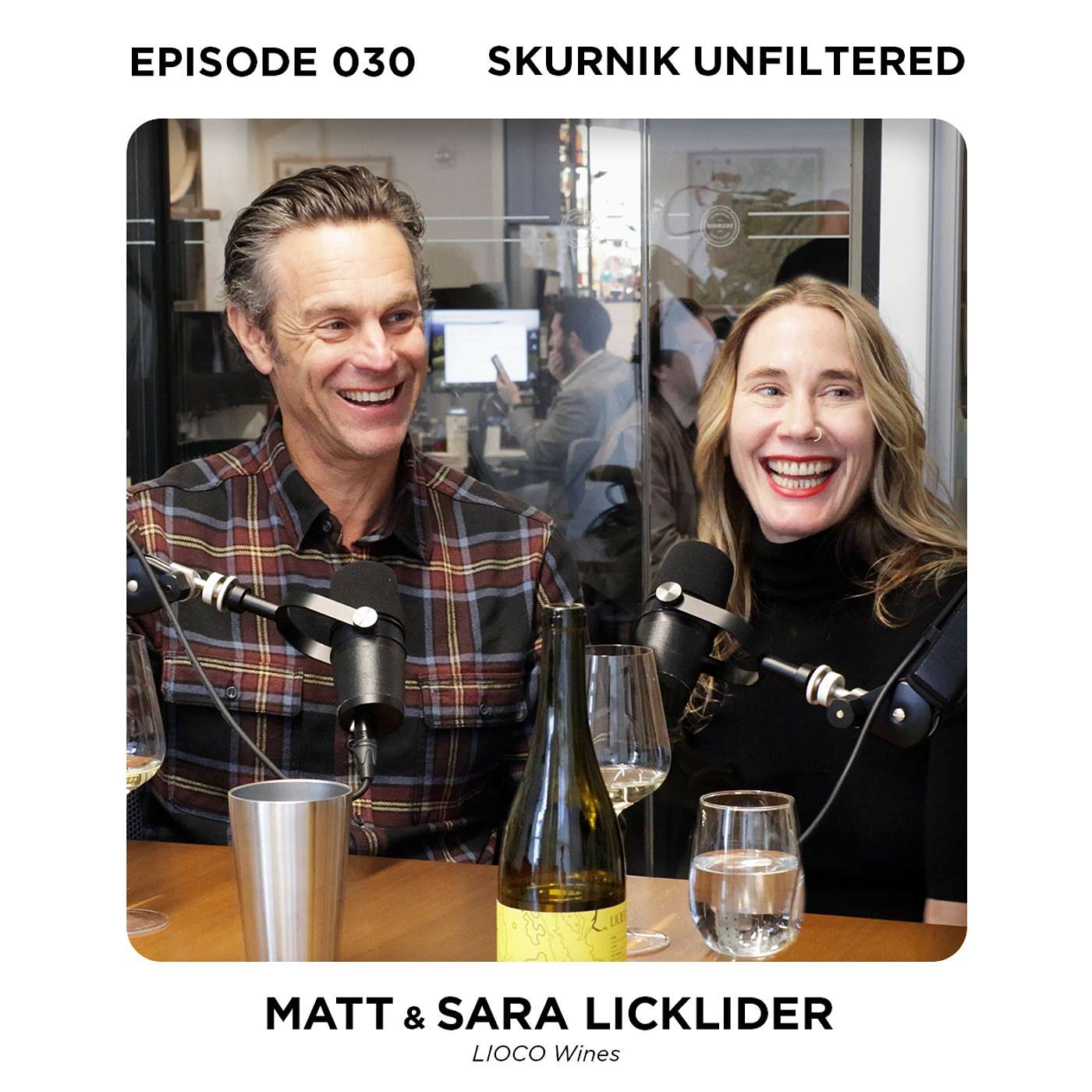
Matt and Sara Licklider of LIOCO Wines
Jun 2900:32:57Tap to summarize"We're in the business of making agricultural wines, and I think we need to make a distinction right here between agricultural wine and industrial wine. A lot of these vineyards that have these really amazing histories attributed to them also have people with interesting histories. It's not selling the widgets—it's teasing out the stories about these very authentic places and these interesting people and then being able to share those stories." – Matt Licklider Twenty years ago, LIOCO was founded to disrupt the California wine status quo of high-alcohol, oak-heavy bottles, proving instead that California soils could produce wines with the same energy, acidity, and restraint as Europe's classical regions.This week, Matt and Sara Licklider, the dynamic vintners behind LIOCO, discuss operating as a négociant producer, embracing an elastic model that prioritizes storytelling, regional transparency, and agricultural authenticity. They share behind-the-scenes stories of their legendary growers—from the late Jim McCutchen hand-planting Carignan in the early 1960s to John Balletto carving a full "Field of Dreams" baseball diamond out of his Russian River Valley Chardonnay vineyard.The conversation also tackles how climate change is forcing the industry to adapt. Matt and Sara discuss why Chardonnay and Pinot Noir may eventually migrate out of traditional regions, prompting LIOCO to explore heat-tolerant Mediterranean varieties and vibrant Albariño from the Sacramento River Delta. Finally, they dive into what "perfection" really means in the cellar, exploring how to balance microbial loads to ensure a wine's typicity always shines through.Automatically generated transcripts often make mistakes. Find a corrected version here.Skurnik Wines & SpiritsFollow us on Instagram
Transcribe →
Tom Jackson of Supergay Spirits
Jun 2200:24:44Tap to summarize"Spirits, when they are at their best, are about facilitating joy and connection and building community. If we can be a small part of that in any way, then I think we've done our job." – Tom JacksonJune is Pride Month, but Tom Jackson likes to say he's Supergay for 365 days a year. After an advertising career and founding the iconic GAYLETTER magazine, Tom launched Supergay Spirits with a flagship vodka. It was a natural place to start; vodka is known as "gay water" for its popularity among the queer community. He wanted to offer an alternative to massive, impersonal brands and overly pretentious craft distilleries, proving that a spirits brand can be fun and joyful while maintaining the highest quality standards. His would be a vodka made for and by the queer community, rather than marketing toward it from the outside. In this week's episode, Tom explains the strategic and intentional choices that define Supergay, from using a 100% corn base for a softer, slightly sweet profile to finding the sweet spot with a three-pass coconut charcoal filtration. The conversation also tracks the evolution of the brand’s lineup with the new Fire Island Dry Gin, featuring kelp from WNBA hall-of-famer-turned-kelp-farmer Sue Wicks. Tom details the unique formulation hurdles of their low-sugar "Two Fruits" ready-to-drink canned cocktails, highlighting their two newest summer flavors: a savory Black Sesame Espresso Martini and a fiery Chili Mango Spritz. Finally, he talks brand identity, discussing why a bold name sometimes requires working twice as hard on a quality distillate, and what "Farm to Disco" truly means for LGBTQ+ community support during Pride Month and beyond. Supergay Spirits supports New York City's LGBT Center year round, and you can too.Automatically generated transcripts often make mistakes. Find a corrected version here.Skurnik Wines & SpiritsFollow us on Instagram
Transcribe →
Nicola Libelli of Dr. Bürklin-Wolf
Jun 1500:27:04Tap to summarize“If you want to make exceptional wine, you have to feel at home because it’s about so many little things—little things that you have to observe and feel and catch over the season to make the wine. It’s always important to be there and to feel the place.” – Nicola LibelliNicola Libelli feels at home in the Pfalz. Though he was born and raised in Northern Italy, a taste of 1992 Merkelbach Kinheimer Rosenberg Riesling Spätlese completely changed the course of his life, compelling him to move to Germany and learn everything about German wine.At the age of 26, he was unexpectedly thrust into the head winemaking role at one of Germany's most historic estates, Dr. Bürklin-Wolf, where he has since earned his reputation as one of the best Riesling winemakers in the world.In this episode, Nicola reflects on the mentors who shaped his life and how a culture of friendship and healthy competition among winemakers can move the wine industry in the right direction. Meet Nicola at FLXcursion in Geneva, NY June 27-29, 2026. Automatically generated transcripts often make mistakes. Find a corrected version here.Skurnik Wines & SpiritsFollow us on Instagram
Transcribe →
Corinne Rich and Katie Rouse of Birdhorse
Jun 800:31:29Tap to summarize“I think joyful, colorful people can still make beautiful, classically-styled, serious wines.” – Corinne RichThe standard California playbook of Chardonnay and Cabernet often overshadows a rich history of alternative varieties perfectly suited for the modern climate.This week’s episode features two guests: Corinne Rich and Katie Rouse, the partners and winemakers behind Birdhorse. Balancing their own independent label with day jobs at respected wineries, they discuss how they built a brand from scratch, choosing to champion forgotten, climate-resilient Mediterranean grapes through close grower partnerships rather than traditional landownership.The conversation centers on the unexpected potential of Valdiguié—a historic, bulletproof grape once known as “Napa Gamay.” Corinne and Katie explain how working with lesser-known varieties creates an even playing field for drinkers, stripping away the gatekeeping of traditional “wine speak.” They share their vision for making the industry more inclusive through approachable pricing, thoughtful low-intervention winemaking, and joyful, colorful labels designed to bring everyone into the conversation.Automatically generated transcripts often make mistakes. Find a corrected version here.Skurnik Wines & SpiritsFollow us on Instagram
Transcribe →