← Slow Burn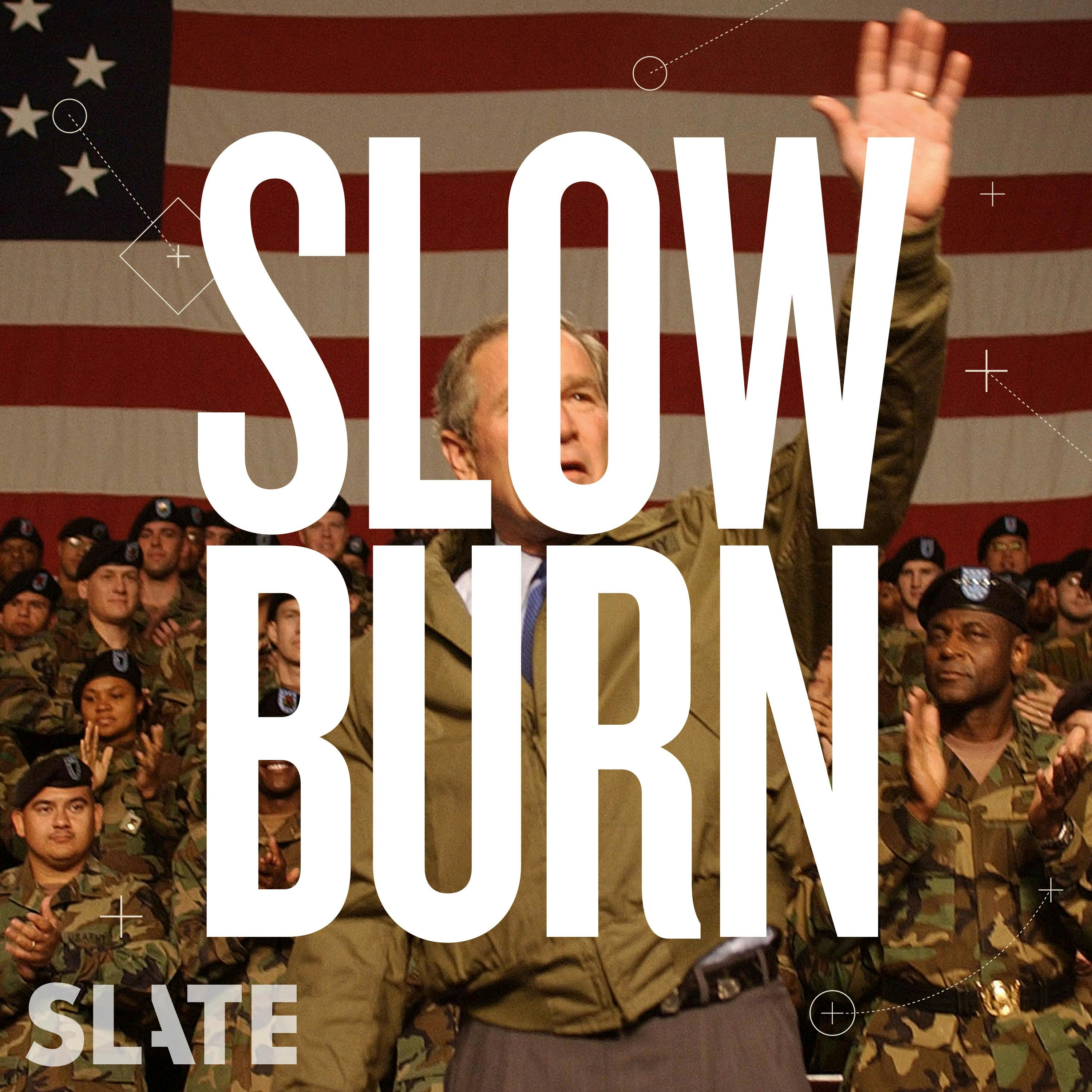
Slow Burn
The Road to the Iraq War | 6. Big, if True
00:39:39
Why the U.S. relied on faulty intelligence from a man code-named Curveball.
Loading summary
Transcript124 lines
- [00:01]
Narrator / Host (Noreen Malone)
Hey, I'm Elise Hu, host of the podcast TED Talks Daily. Did you know Paylocity offers one platform for HR finance and it that means innovative solutions like On Demand Payment which offers employees access to wages prior to payday, flexible time tracking features which enables staff to clock in through their mobile device and numerous other cutting edge integrations are available to all your teams in one single place. Learn more about how Paylocity can help streamline work and bring teams together. @paylocity.com.
- [00:34]
Margaret Henoch
We interrupt this program to bring you an important Wayfair message Wayfair's got Style Tips for Every Home this is Stiles Mackenzie helping you make those rooms sing. Today's Style Tip when it comes to making a statement, treat bold patterns like neutrals. Go wild like an untamed animal. Print area rug under a rustic farmhouse table. From wayfair.com fierce this has been your Wayfair style tip to keep those interiors superior.
- [01:00]
Narrator / Host (Noreen Malone)
Wayfair Every style, Every home in late December 2002, most of Washington was winding down for Christmas. Young White House staffers were hard at work writing thank you notes for the gifts that had been sent to the president. But Bush wasn't ready to sign off for the holiday yet. He called a meeting and he asked the CIA to give him its best version of the case for war with Iraq.
- [01:24]
Bill McLaughlin
The call went out when they started developing the case for anybody who had anything they would like to contribute.
- [01:31]
Narrator / Host (Noreen Malone)
Bill McLaughlin had joined the CIA about six months earlier. He was part of a team from the agency presenting to the President.
- [01:39]
Bill McLaughlin
Because I had a UN inspection experience, I was to answer any of the President's questions on UN Inspections.
- [01:44]
Narrator / Host (Noreen Malone)
Bush walked into the Oval Office meeting wearing his cowboy boots with the presidential seal on them, and for the next 20 minutes CIA Director George Tenet's deputy presented the case.
- [01:57]
Bill McLaughlin
The presentation of the case was done by John McLaughlin, who is a very senior analyst.
- [02:03]
Narrator / Host (Noreen Malone)
That's not related to Bill McLaughlin, by the way.
- [02:05]
Bill McLaughlin
And John had the briefing on a laptop. We also had briefing charts and John McLaughlin went through the briefing.
- [02:14]
Narrator / Host (Noreen Malone)
Tenet's deputy talked about the biological and chemical weapons Iraq had not accounted for since the Gulf War, and he wrapped up by playing radio intercepts that were supposedly from Iraqi agents talking about a weapons site.
- [02:26]
Bill McLaughlin
After the presentation, the president fired off a number of questions, made a number of comments, solicited our views on things.
- [02:36]
Narrator / Host (Noreen Malone)
Bush wasn't asking the CIA to take a closer look at the intelligence. What he wanted was a more convincing pitch.
- [02:46]
Bill McLaughlin
He asked perhaps if a Madison Avenue type could look at it to see about the ordering of the arguments, if it could be examined by an attorney, to look at the structure of the arguments that were made. Everyone in that room, including me, strongly believed that Iraq did have wmd. It was not a subject that came up for discussion. The discussion centered around whether we could make the presentation more effective.
- [03:11]
Narrator / Host (Noreen Malone)
George Tenet, the head of the CIA, was at that meeting. This is where he famously used the phrase slam dunk, which got a lot of press. Originally reporting suggested Tenet called the presence of WMDs in Iraq a slam dunk. But according to Bill McLaughlin and Tenet himself, he was actually promising the President the CIA would tighten up the presentation to make it a slam dunk. He wasn't talking about the facts. He was talking about the sale.
- [03:39]
Bill McLaughlin
As the meeting broke up, the President charged us with improving the quality of the presentation. Among other things, he asked was, can you work in a stronger angle related to terrorism? And I think some of us weren't all that happy to hear that since we didn't believe the connection was that strong to begin with.
- [03:59]
Narrator / Host (Noreen Malone)
After the meeting, Vice President Cheney pulled Bush aside. Cheney told him that people in his office had been working on the terror links. He suggested they could help out with.
- [04:08]
Bill McLaughlin
The presentation once the case was revised. After we got back to CIA, people worked on it again for another month, and then it was sent down to the White House for their review. Eventually, while it was at the White House, they had added in a whole additional section on terrorism.
- [04:30]
Narrator / Host (Noreen Malone)
For months, the Bush administration tried to make the case for war to the public on TV and in press conferences. Now, to make the closing argument, Bush tapped Secretary of State Colin Powell. He wanted Powell to present the United States Official case for war at the UN Security Council in February. Powell was the obvious choice for a closer. Unlike some of his colleagues, he wasn't seen as an ideologue. He was a military commander, but he was skeptical of overusing military might. And as a black man who'd risen to the top of the army, he was a kind of American success story both Republicans and Democrats could admire. Here's Robert Draper, the author of To Start a War.
- [05:10]
Robert Draper
Colin Powell was far and away the most popular person in the Bush administration. And there were a lot of people on Capitol Hill, a lot of Democrats, who didn't believe one thing that Cheney had to say, but believed everything Colin Powell had to say. So Powell would achieve maximum credibility as the deliverer of this case in a way that nobody else would.
- [05:31]
Narrator / Host (Noreen Malone)
Powell agreed to do it. All along, he'd been telling the President, they needed the United nations backing them. But when Powell looked at the intelligence summary he'd been handed by the White House, he wasn't impressed. It looked shoddy, and it included things like the discredited Al Qaeda Iraq link.
- [05:48]
Robert Draper
And Powell essentially threw almost the entire document away. And they started from scratch. And when they started from scratch, with only really a few days to go, Pallet actually asked Condi Rice, can I get an extension on giving this speech? We're going to need more time. Conde said, nope, the President has already booked you, has already said you're going to be doing this on February 5, 2003, before the UN. Then a kind of frantic effort ensued. They turned back to the CIA, and George Tennant said, well, look, why don't you just do this? Make the basis of the speech, our nie, our National Intelligence Estimate. Because this is, after all, the definitive consensus view of the intelligence community as to Saddam's weapons program. What he failed to say to Powell was, and we did it in 19 days. So it's a piece of crap.
- [06:36]
Narrator / Host (Noreen Malone)
Powell and his team spent three days vetting the report alongside CIA analysts. He questioned them, asked to see evidence. For a lot of people watching up close, this seemed like Colin Powell at his best. Careful, rigorous, honorable. With Powell in charge, the administration felt confident the speech was going to be a huge success. Before the presentation, the speech was circulated through the CIA. They wanted to make sure it didn't expose sources or methods of intelligence gathering. One person who looked it over was Margaret Henoch. She handled Central Europe for the Directorate of Operations. That's the spy part of the CIA. Henoch was shocked by what she saw.
- [07:17]
Margaret Henoch
And so I look at it all, and I take a big magic Marker and I scratch all the way through it, and I write in the margins, you cannot use this. There is no way to verify this. It's not even sort of leaky. It's a gigantic sieve with a hole in it.
- [07:34]
Narrator / Host (Noreen Malone)
The night before the speech, Powell asked Tenet one last time if everything in his speech was solid. Tenet told him there were no doubts. Powell asked Tenet to sit next to him at the UN to symbolize that the CIA was backing everything he said. The CIA director agreed.
- [07:52]
Colin Powell
This is important day for us all as we review the situation with respect to Iraq and its disarmament obligations under U.N. security Council Resolution 1441.
- [08:05]
Narrator / Host (Noreen Malone)
On February 5, 2003, Colin Powell made his presentation to the U.N. the Bush administration's best case for war. He was staking his reputation on it.
- [08:16]
Colin Powell
My colleagues, every statement I make today is backed up by sources, solid sources. These are not assertions. What we're giving you are facts and conclusions based on solid intelligence. I will cite some examples, and these are from human sources.
- [08:33]
Narrator / Host (Noreen Malone)
Powell wore a dark suit jacket with an American flag pin on it. His delivery was intense, and he talked for well over an hour.
- [08:42]
Colin Powell
One of the most worrisome things that emerges from the thick intelligence file we have on Iraq's biological weapons is the existence of mobile production facilities used to make biological agents. Let me take you inside that intelligence file and share with you what we know from eyewitness accounts. We have firsthand descriptions of biological weapons factories on wheels and on rails.
- [09:10]
Narrator / Host (Noreen Malone)
Margaret Henock was watching the speech with her boss at the CIA when she heard the line about mobile weapons labs. She knew her warning never made it to Powell.
- [09:19]
Margaret Henoch
We're just like, what the fuck? Did you guys see that? You shouldn't have used that?
- [09:25]
Narrator / Host (Noreen Malone)
Powell was relying on what the CIA had told him. But there was a lot the CIA hadn't told him, including the fact that some of their information had come from a sketchy source, a man with the codename Curveball.
- [09:39]
Margaret Henoch
Curveball was a slug. Curveball was a slime. But Curveball didn't make anybody believe something that they didn't want to believe.
- [09:52]
Narrator / Host (Noreen Malone)
This is Slow Burn. I'm your host, Noreen Malone. Leading up to Powell's UN speech, the Bush administration had told the American public that the country needed to invade Iraq, that Saddam Hussein was a threat. Key pieces of intelligence were cited over and over again as evidence to support the case for war. The repetition gave the illusion of credibility even when that intelligence was unproven. So who was Curveball? Why was the information he had so valuable? And how did unvetted intelligence make its way into Colin Powell's case for war? This is episode six, Big if true. Throughout the 1990s, lots of Iraqis fled to Germany. The German government questioned them all to see if they might have useful information about Saddam's bath party. Some did, like Saddam's former driver and a janitor from the presidential palace. Most of them, though, were just ordinary people fleeing a brutal regime. Rafid Ahmed Alwan Al Janabi was a chemical engineer in his early 30s. He arrived in Germany in 1999 seeking political asylum. At first, Janabi said he'd embezzled money from the government, and that's why he feared for his life. But then he talked to German intelligence officials at the bnd. That's the equivalent of the CIA, and I'm incapable of pronouncing the full name in German.
- [11:20]
Bob Drogan
He told the BND that he had been hired directly out of University in 1994 to work on a secret program to install these sophisticated laboratory equipment on the back of trucks of trailer trucks.
- [11:35]
Narrator / Host (Noreen Malone)
Bob Drogan, the former deputy Washington bureau chief for the Los Angeles Times, later wrote a book about Janabi.
- [11:42]
Bob Drogan
And the Iraqis, he said, would use this equipment to ferment germs and viruses and toxins for biological weapons. And since they could drive the trucks from place to place, these mobile production facilities would be able to evade detection by UN weapons inspectors who were then inside the country. His version of events was that the first truck began operating in 1997 and that similar vehicles were built or hidden in six other locations across Iraq.
- [12:14]
Narrator / Host (Noreen Malone)
This made Janabi a lot more interesting. The BND gave him money and hid him from the Iraqi government. They interviewed him in Arabic over the course of two years. The officer who debriefed him officially described him as shrewd, personable, possibly a genius, but also possibly a manipulator. The information Janabi told his interrogators was highly technical. He gave specifics about project code numbers. He told them the names of who had worked on what and even where they'd sat in the office. He said the trucks only operated on Fridays, the Islamic day of worship, because UN weapons inspectors rarely popped in on those days. He drew sketches, and he helped the Germans build a little model of what the mobile labs might have looked like. In early 2000, the BND shared what they learned from Janabi with an American officer from the Defense Intelligence Agency. The Americans gave him the codename Curveball. Ball was the suffix they used for sources whose information involved weapons. It's unclear why they picked Curve.
- [13:21]
Bob Drogan
When the Americans began looking at his files, they said, this must be it. This is perfect. We have an eyewitness. He has seen all of these things. He's worked directly on them.
- [13:33]
Narrator / Host (Noreen Malone)
But the BND didn't allow the Americans to talk directly to Curveball. They couldn't even look at transcripts or videos of the interviews, just the reports written up by German intelligence. The Germans told them it was because Curveball didn't speak English and hated Americans. That wasn't true. The reality was that American and German intelligence agencies didn't have a great relationship, and some of what Curveball was saying looked bad for Germany. Curveball told them Iraqis were using German manufactured materials for the bioweapons. So the Germans wanted to maintain control of Curveball's testimony. Meanwhile, Curveball kept hitting his handlers up for more money. He'd disappear for days or weeks at a time. The Germans got him food service jobs at Burger King and at a Chinese restaurant. He kept getting fired. He'd show up in the morning smelling like alcohol, looking like death by itself. This wasn't all that unusual. If spy agencies wanted clean living in their defectors and sources, they'd never learn anything. Outside of the drinking, though, there were other things about Curveball's story that didn't add up.
- [14:40]
Bob Drogan
When he initially came out, he claimed he had personally directed one of these trucks, the construction of one of these trucks. And over time, his role became less and less specific. Suddenly, he was no longer the director of that operation. He just worked on it. And maybe he only heard about these trucks and there was some question about an accident where he said he had witnessed people who had died, and then, well, he heard about it and his friend knew about it, and then his friend had only heard about it so suddenly. As time went on, his story, in fact got less specific.
- [15:14]
Narrator / Host (Noreen Malone)
The Germans were getting skeptical of Curveball. They'd interviewed him for 21 months, and they still weren't sure if he was lying or not. Finally, on September 8, 2001, they closed his file and terminated him as a Source.
- [15:30]
Bob Drogan
And then 911 happened. And in the United States, these reports that he had given to the Germans, the information he'd given to the Germans, were suddenly taken out of a safe if he and dusted off, and they were rushed to the top of the food chain and they took on a life of their own.
- [15:47]
Narrator / Host (Noreen Malone)
By the time Bill McLaughlin joined the CIA in 2002, the mobile weapons story was widely circulating within the agency. McLaughlin knew a lot about Iraq's weapons from his time on the ground in the 90s, but he hadn't heard about this Curveball guy.
- [16:02]
Bill McLaughlin
I asked a biological analyst, where is this reporting? And she gave me a stack more than an inch thick of Curveballs reporting. And I was absolutely astonished by it. Most of what we received in Iraq reporting was from exile sources or from opposition sources, and most of it was very vague. On the other hand, Curveball's reporting was vastly different than anything else that we had seen. Specific as to people, locations, agents, production techniques. I remember thinking at the time as I was reading it, human intelligence doesn't get any better than this.
- [16:41]
Narrator / Host (Noreen Malone)
There were some small inconsistencies that McLaughlin noticed, like curveball was using an outdated name for one of the places he claimed he'd worked. But that was small, and explanations for it were easy to Imagine we didn't.
- [16:54]
Bill McLaughlin
Have any of the background of. Of this guy. We didn't know anything about his living conditions. US Analysts were not allowed to interview him directly until long after the war. We had a limited ability to check on the reporting. Meanwhile, the US Military who was providing all this reporting said they had confidence in his reporting, and we had no means to contradict that.
- [17:23]
Narrator / Host (Noreen Malone)
If you had a certain mindset, the inconsistencies in Curveball story could also be seen as proof. For instance, Curveball had very specific descriptions of the facility where the trucks were supposedly operating, but those descriptions didn't quite match existing evidence.
- [17:39]
Bob Drogan
Bob Drogan and he said the trucks went in one entrance and they came out a back entrance, and that's how they did their thing. And so say, send satellite pictures up. They sent satellites over, they analyzed satellite pictures, and they said, well, there's a wall here, so obviously the trucks can't do it. And rather than say, well, so his story is false, they said, aha. The truck was. This wall was put up to trick the satellites. And maybe there's a secret door in the wall that moves at night when the satellites aren't watching, or that kind of thing. And ironically, in sort of just like medieval clerics looking for angels on the head of a pin, their inability to find the trucks became proof that they must exist. That showed how sinister and how diabolical Saddam Hussein was that he was hiding these things and they couldn't find them.
- [18:32]
Narrator / Host (Noreen Malone)
There were other human sources who appeared to corroborate parts of Kirbal's story. A civil engineer who defected in June 2001 and an Iraqi official who talked to the British in September 2002, both said they'd heard about the trucks. And there was another defector who showed up in 2002 and claimed that Iraq had decided to create mobile labs in 1996. The CIA also had Curveball's story vetted by technical analysts at its weapons group, known as WinPAC. The Deputy Director of that office was Andy Liepman.
- [19:04]
Andy Liepman
I now have the best job in all of California, by the way. I drive the train at the Santa Barbara Zoo. Yeah, I get 15 bucks an hour, but only because they made me take the money.
- [19:16]
Narrator / Host (Noreen Malone)
Liebmann's team determined that what Curveball was describing was possible the trucks could make biological weapons or BW.
- [19:24]
Andy Liepman
These are guys with PhDs in microbiology and epidemiology or whatever. And they came back and said, yep, we think it's viable. Obviously, they're making no judgment on whether Curveball as a good human being, or whether this is the best way to make BW or whether it was sensible. They were just saying, yep, it would work. And that's what they said.
- [19:47]
Narrator / Host (Noreen Malone)
Winpack had been given a copy of a cable from the Germans. It described Curveball as out of control and unable to be located. But again, intelligence sources weren't always steady, clean living people, and the cable didn't really come up for discussion. Besides, there was another reason WINPAC backed the Curveball intel. It confirmed what the intelligence community already believed.
- [20:10]
Andy Liepman
Things that agree with your current assessment, you weigh heavier than things that disagree with your assessment. So if Curveball had come in and said, iraq has no biological weapons, you guys are chasing a phantom. And they actually gave it up. They, all of those inspectors were right. They've given up their program. We would have probably taken that with.
- [20:35]
Robert Draper
A grain of salt at that point.
- [20:38]
Narrator / Host (Noreen Malone)
Liepman says the CIA had been judging for more than a decade that Iraq had weapons capabilities. To rethink that assessment on the brink of war would have been ludicrous. He told me, I would have fired.
- [20:50]
Andy Liepman
Myself if, based on the information we had at the time, we changed a decade's worth of analysis.
- [20:59]
Narrator / Host (Noreen Malone)
Curveball's story made it into the National Intelligence Estimate. That's the document that the CIA prepared for Congress in just 19 days. And it wasn't just that Kerbal made it in. His reporting was almost the entire basis for what that report said about Iraq's bioweapons capabilities, that they were greater than they'd been in the Gulf War. The NIE authors came to that conclusion by guessing how much material could fit into the trucks. Kerbal described Bob Droghin.
- [21:27]
Bob Drogan
They then multiplied that by the six other trucks that he said he had heard about but had never actually seen. And then they multiplied all that with the assumption that the trucks could run for six months round the clock, non stop. You know, why six months and not six weeks or six years? I don't know. The point was, of course, that it was sheer nonsense. Nothing in Iraq ran non stop for six months.
- [21:53]
Narrator / Host (Noreen Malone)
Curveball seemed to vindicate all the worst fears of a resurgent Iraqi weapons program. In fact, for the American intelligence service, Curveball's mobile labs confirmed far more than just the existence of biological weapons.
- [22:07]
Bob Drogan
The belief in Curveball story became so strong that people in the other programs that were looking at Saddam said, well, basically, if, if he has these biological weapons, he must have these other things as well, even though the evidence hasn't changed. And you could literally chart within their Paperwork where their assessments changed from low probability and possibly and maybe and could have to high probability. And nothing had changed other than that the curveball material had come in and made them reassess what they believed they already had.
- [22:45]
Narrator / Host (Noreen Malone)
But there were cracks in the consensus on curveball. Other countries, intelligence agencies, had written to the Americans saying explicitly that curveball showed signs of being a liar.
- [22:56]
Bob Drogan
There were warnings that came in from the CIA station chief in Berlin and also from the British saying, you know, there are real concerns here. We don't think we've got this. Why are you so sure? And they just sort of ignored all of that and just kept pushing this story forward.
- [23:23]
Margaret Henoch
I was born in Los Alamos. My daddy was a nuke. I know. Don't need a microwave tan from the inside out. The whole thing.
- [23:31]
Narrator / Host (Noreen Malone)
That's Margaret Hennock, the CIA officer who tried to flag the curveball stuff in Colin Powell's speech. If I just met her, I wouldn't guess her for a spy. She comes across like a character who might be played by Jane Fonda in a movie directed by Nancy Meyers.
- [23:45]
Margaret Henoch
I'm sorry, you guys. Can I pause this so I can feed the animals?
- [23:49]
Narrator / Host (Noreen Malone)
Yeah, of course.
- [23:50]
Margaret Henoch
Excuse me one second.
- [23:51]
Narrator / Host (Noreen Malone)
Sure, Mike. When the CIA recruited her, Henoch was working at a research institute in Menlo Park. She was trying to figure out what weapons the Soviet Union might be developing.
- [24:02]
Margaret Henoch
And some guy walks up to me, and he's wearing a raincoat. And he says to me, are you Margaret? I said, I am. And he said, are you bored? And I was like, great. I'm at a classified test location and some pervert in a raincoat finds me. Is the story of my life. I was like, bored with what? And he said, your career? And I thought, well, I might be. So I said, well, I might be. And he handed me an envelope, and he said, fill this out and mail it in. Goodbye. And he left. And it was an application, sort of, for something unclear. I get a call about two weeks later, and they say, can you come to a building for an interview? And I thought, okay, this has to be CIA. Who else would do this?
- [24:45]
Narrator / Host (Noreen Malone)
Henock didn't fit the typical CIA profile. She was outspoken, which could be polarizing. She didn't love the people who dominated the place. She describes them as kind of fratty white guys. But being a little different worked for her. Mostly she was in counterintelligence, which sounds exciting, but within the Agency, it wasn't all that prestigious.
- [25:07]
Margaret Henoch
It was just. It was boring. It was tedious. I mean, I happened to really like it because I thought it was puzzling. It was putting together a jigsaw puzzle. I had kind of a, you know, nothing special career. And then Curveball came along.
- [25:24]
Narrator / Host (Noreen Malone)
In late September 2002, the agency started to kick the tires on some sources they'd been using, like Curveball. Henoch's boss asked her to look into whether the Curveball intel made sense.
- [25:36]
Margaret Henoch
I was too important to actually do any work, so I got two guys. One of my. One of the guys who worked for me was an old German hand, and another was a young woman who's, like, really good at technology, so that if we needed to find documents, she would know what she was doing. As you guys know from this morning, having me do that would have been like a goat grope. So I got the two of them and I said, here are the words that I know we're looking for. Here's the general story, which is, this guy's given us a lot of information and we need to vet him. Go find me the stuff and come back.
- [26:09]
Narrator / Host (Noreen Malone)
The first big red flag. Henoch's team found they didn't have access to any biographical information about Curveball, which someone at Henoch's level should have had. No data on his background, his expertise, how he'd left Iraq. And once she got her hands on his file, there was no evidence that anyone on the American side had independently vetted Curveball's biography.
- [26:30]
Margaret Henoch
I don't know that anybody ever sat down with Curveball and said, where were you born? How many sisters do you have? How many brothers do you have? Where do your parents? Do you know? What hospital were you born in? It was never in the records. And that's part of where my problems with the case started.
- [26:47]
Narrator / Host (Noreen Malone)
And the second big red flag? Well, everything Curveball said to Henoch, it didn't pass the common sense test.
- [26:56]
Margaret Henoch
Let's see, you were involved in a super sensitive weapons program, and yet they let you walk out of the country. That doesn't happen in places like Iraq. They kill you.
- [27:10]
Narrator / Host (Noreen Malone)
For Henoc, the picture wasn't adding up. She wrote a memo saying as much. It didn't seem to make a dent. People within the Agency continued to act like Curveball's information was reliable. A couple months later, around Christmas time, Henoch joined a meeting about Curveball. She told the group in no uncertain terms that Curveball didn't seem legit. The meeting got heated. There was an analyst there from winpac, the Weapons Research Center. Margaret told me this analyst argued it was meaningful that Curveball knew just where the Weapon site was.
- [27:43]
Margaret Henoch
And she says, well, that verifies that he's been there. And I say, well, no, I mean, it may verify that he's been there, but he may also be the guy who delivers Cokes, because there's a whole slew of people to include movie directors who go in and out of the CIA front lobby, but they've never worked there. They're delivering soda, they're delivering groceries. We even had a Dunkin Donuts. It doesn't mean, excuse me, you work there or have any idea what they do.
- [28:11]
Narrator / Host (Noreen Malone)
The analyst also told Henock the curveball scenario was plausible.
- [28:15]
Margaret Henoch
And I said, what do you mean, plausible? And she said, well, we can find similar things on the Internet. So, you know, genius that I am, I said, well, how do you know that's not where he found it?
- [28:25]
Narrator / Host (Noreen Malone)
To Henoch, it seemed obvious that Curveball's information was bad.
- [28:29]
Margaret Henoch
Saddam Hussein may have weapons of mass destruction, but this guy doesn't know anything about him. If you're going on his word, you're going to be disappointed. I don't know what he has, but neither does curveball. You get to be wrong. But when somebody says, have you thought about this? Like that he got it off the Internet, then you have to go back. If you're talking about sending people to die, you have to go back and check.
- [28:54]
Narrator / Host (Noreen Malone)
Henoc sent an email to a large group. It begins, although no one asked, it is my assessment. That's for me.
- [29:02]
Margaret Henoch
And you're shocked by that.
- [29:04]
Narrator / Host (Noreen Malone)
The opening, though, has a real tone to it. No one asked. But the email goes on to say, it is my assessment that Kerr Ball had some access to some of this information and was more forthcoming and cooperative when he needed resettlement assistance. Now that he does not need it, he is less helpful, possibly because when he was being helpful, he was embellishing a bit. That email and the rest of Henoch's concerns made it into the official 2005 congressional postmortem on intelligence failures. Henoc thought her email got through to people, that maybe she'd stop the curveball thing until she heard President Bush's State of the Union address in January.
- [29:44]
Bob Drogan
We know that Iraq in the late 1990s had several mobile biological weapons labs. These are designed to produce germ warfare agents and can be moved from place to a place to evade inspectors. Saddam Hussein has not disclosed these facilities. He's given no evidence that he has destroyed them.
- [30:07]
Narrator / Host (Noreen Malone)
This, as it turned out, was just a warm up for Colin Powell.
- [30:11]
Colin Powell
It was quite a show on 10.
- [30:13]
Narrator / Host (Noreen Malone)
By 10 video screens Powell explained for.
- [30:15]
Colin Powell
The world how Iraq is allegedly producing biological weapons in up to seven different movies.
- [30:20]
Narrator / Host (Noreen Malone)
Mobile labs.
- [30:21]
Colin Powell
The source was an eyewitness, an Iraqi chemical engineer who supervised one of these facilities. He actually was present during biological agent production runs. He was also at the site when an accident occurred in 1998.
- [30:44]
Narrator / Host (Noreen Malone)
In late November 2002, a team of weapons inspectors from the United nations entered Iraq. It was the first time they'd been there since Saddam Hussein kicked them out four years earlier. The inspectors searched a brewery, a dump, a hospital, an ice factory. Nothing. They didn't find any evidence of weapons, just grain silos and chicken coops. So many chicken coops that one weapons inspector made shirts for the whole group. They read, ballistic Chicken Farm inspection team. In February 2003, three days after Powell's speech, inspectors arrived at a site Curveball had described. Still no weapons. That didn't stop the U.S. after all, the logic went, the Iraqis were liars. So why would a lack of weapons be evidence that there were no weapons? The US invaded Iraq on March 20, 2003. At the White House Correspondents Dinner in April, the deputy Director of the CIA, John McLaughlin, was seated at the same table as Colin Powell. Powell and John McLaughlin were both guests of the LA Times, where Bob Drogan worked. Drogan was also there that night.
- [31:56]
Bob Drogan
And John performed a wonderful card trick that involved bringing a $20 bill or $100 bill, you know, out of nowhere, whatever it was. And Colin Powell is watching and very tersely says, now find the weapons of mass destruction. It was clear he was felt set up about it.
- [32:15]
Narrator / Host (Noreen Malone)
And was he laughing when he said that, or just totally serious?
- [32:19]
Bob Drogan
No, no, he was totally serious. I think he was very angry. He was. My memory is. He was. His lips were pursed and his. His face was not. It was not a joke. And McLaughlin said, oh, we will, we will, we will.
- [32:31]
Narrator / Host (Noreen Malone)
By early May, two Iraqi trucks turned up. They seemed like they could have been the trailers Curveball was talking about. They didn't have bioweapons on them, but there were traces of ammonia. It looked like maybe the Iraqis had tried to clean them up in a hurry. And back in Germany, Curveball corroborated the discovery. George W. Bush announced that the WMD had been found.
- [32:53]
Bob Drogan
We discovered mobile biological laboratories, the very same laboratories that Colin Powell talked about at the United nations, the very same laboratories that were banned by the resolutions of the United Nations.
- [33:06]
Narrator / Host (Noreen Malone)
Bush's announcement was premature. Other experts were brought in for a second opinion. These were not mobile biological weapons trucks. They weren't Technically capable of making bioweapons at all. These trucks were meant to produce hydrogen, which is exactly what the Iraqis had told inspectors they were for. And the trace ammonia that had been found, it wasn't the remains of a cleaning agent. It was urine. Someone just took a leak in the trucks. The mobile labs Kerbal described never showed up. No WMD were ever found. All three of the other Iraqi sources who had backed Kirbal's story either recanted or were straight up lying.
- [33:48]
Colin Powell
President Bush acknowledged today a new report proves Iraq had no weapons of mass destruction.
- [33:54]
Bob Drogan
The man who led the search for Iraq's weapons of mass destruction made it official when the war started. Saddam Hussein had no chemical or biological weapons and no secret programs to build them.
- [34:08]
Narrator / Host (Noreen Malone)
Curveball was a full on liar. But how'd he figure out what to say to convince his interrogators that he knew what he was talking about? Well, for one thing, by the late 90s, the intel reports from the UN weapons inspectors were available on the Internet. Plus, the BND gave Kerr ball a chemical engineering handbook to help him communicate details better across the language barrier. They asked him leading questions, and he was a trained engineer, so he knew how to answer them, especially with the help of a book.
- [34:40]
Bob Drogan
Curveball's entire story was a hoax. It was a con. It was a fraud. He just wanted a visa. He wanted a Mercedes. He wanted a new life. He wanted, you know, live in Germany, wanted to get out of Iraq. He was, you know, it turned out, a schlub, a nobody, a refugee who told a few lies to get asylum and instead wound up helping to start a war.
- [35:05]
Narrator / Host (Noreen Malone)
Curveball later admitted that he'd made it all up. In his telling, he claimed he wanted more than a visa. I had the chance to fabricate something to topple the regime, he told The Guardian in 2011. I and my sons are proud of that, and we are proud that we were the reason to give Iraq the margin of democracy. So was Curveball really an anti Saddam freedom fighter? It's not clear. He had an estranged brother who worked for Ahmed Chalabi at the Iraqi National Congress. But there's never been any proof that Curveball was working with the inc. The mobile labs weren't the only WMD evidence that turned out to be dead wrong. In Bush's 2003 State of the Union address, he claimed that Iraq had purchased a substance called yellowcake to make nuclear weapons.
- [35:54]
Bob Drogan
The British government has learned that Saddam Hussein recently sought significant quantities of uranium from Africa.
- [36:02]
Narrator / Host (Noreen Malone)
That was based on discredited Italian intelligence, a bad forgery of papers showing the sale. George Tenet had warned Bush off from that intelligence before. Regardless, the president chose to use the information, but attribute the sourcing to British intelligence. Colin Powell had already refused to use the yellow cake stuff in his speech, but he did talk about aluminum tubes that could be used in centrifuges as proof that Iraq was restarting its nuclear program.
- [36:32]
Colin Powell
Saddam Hussein is determined to get his hands on a nuclear bomb. He is so determined that he has made repeated covert attempts to acquire high specification aluminum tubes from 11 different countries, even after inspections resumed. These tubes are controlled by the Nuclear Suppliers Group precisely because they can be used as centrifuges for enriching uranium.
- [36:58]
Narrator / Host (Noreen Malone)
The CIA backed that assessment of the tubes, but analysts at the Energy and State departments didn't think they were the right size for enriching uranium. Those analysts turned out to be right. For her part, Henoc still gets mad that no one listened when she raised doubts about curveball.
- [37:15]
Margaret Henoch
There were too many shortcuts. There were too many people who weren't versed in the craft. There were too many people who were too eager to make their bosses happy. It was a goat grope.
- [37:27]
Narrator / Host (Noreen Malone)
Tenet and his deputy both deny they were warned about curveball in advance of Powell's speech. The American intelligence community screwed up badly in the lead up to the Iraq invasion. It's easy to blame the war on that, and that's what a lot of people who supported it now do. But the CIA was responding to clear pressure from the administration to support a preordained conclusion. Bill McLaughlin.
- [37:50]
Bill McLaughlin
At the time, it didn't seem strange to me, but my views have changed entirely. What we were doing was putting together a presentation based on intelligence reporting. Certainly that's our function to do that for the national leadership. But the real intention of this thing was to sell a policy. I've since become very skeptical about intelligence officials being involved in various decisions to sell policy.
- [38:17]
Narrator / Host (Noreen Malone)
A few years back, after she'd decided to retire, Henock ran into Tenet in the parking lot at the CIA headquarters at Langley.
- [38:25]
Margaret Henoch
And he said, what do you want to do? And I said, I think I want to go on to the Hill. I said, I'm thinking about the Hill. And he said, don't do it. You'll hate it and they'll hate you. I was like, whoa. And I'm sure he was right on both counts, but really the latter. And he said, you know what? You really have to do whatever you decide to do, you have to follow your heart. And I said, you know, I think I pretty much do that. And he said, I wish I had.
- [39:03]
Narrator / Host (Noreen Malone)
Next time on Slow Burn, the New York Times, Judith Miller and the Blame Game. Judy's a force of nature.
- [39:10]
Robert Draper
Intense, intense, intense.
- [39:12]
Bill McLaughlin
I kept asking the editors what's going.
- [39:14]
Robert Draper
On with my stories, and they'd always act like they didn't know.
- [39:17]
Bob Drogan
I had one reporter describe it to me as, you know, the horror, horror film trope. You know, the phone call is coming.
- [39:24]
Narrator / Host (Noreen Malone)
From within the house. Slow Burn is a production of Slate Plus, Slate's membership program. Slate plus members get bonus episodes of Slow Burn every week, where we'll go behind the scenes into making the show and air clips and interviews that we couldn't fit in here. On this week's bonus episode, you'll be hearing from Carl Ford, who is the assistant Secretary at the Bureau of Intelligence and Research, otherwise known as inr, at the State Department. Carl's small team was one of the few to challenge the administration on key pieces of intelligence in the run up to the war. Head over to slate.com slowburn to sign up and listen. Now it's only a dollar for your first month. We couldn't make Slow Burn without the support of Slate plus, so please sign up if you can. Head over to slate.com slowburn Slowburn is produced by me, Jason De Leon and Sophie Summergrad, with editorial direction by Josh Levine and Gabriel Roth. Our mix engineer is Merritt Jacob. Brendan Angelides composed our theme song. The artwork for Slow Burn is by Jim Cook. Special thanks to Jared Holt, June Thomas, Megan Kallstrom, Rachel Strom, Seth Brown, Chow Tu, Asha Soluzia and Katie Rayford. Thanks for listening. Foreign.
- [40:48]
Robert Draper
Health Goals and Wealth Goals Protecting your identity is an important step. Your info is in endless places that could expose you to identity theft leading to lost funds. LifeLock monitors millions of data points per second. If your identity is stolen, our restoration specialists will fix it. It guaranteed or your money back. Resolve to make identity, health and wealth part of your New Year's goals with Lifelock. Save up to 40 your first year. Visit lifelock.com Special offer terms apply.