Podcast
Sovereign Finance
Hosted by Rob Drummond · EN
Connect the dots between personal finance, global finance trends, and deep human history. Tune in every week to demystify the money puzzle, and protect your interests in a turbulent world.
sovereignfinance.substack.com
sovereignfinance.substack.com
33episodes
Episodes
Newest firstAll episodes
Is the United States an Empire in Violent Decline?
Jan 1200:30:28Tap to summarizeRob’s comments below are in italics.Derek’s comments below are in normal font.Editor’s note: this episode contains two discussions covering current affairs, one from 12th December 2025, and one from 5th January 2026. (The Editor got distracted by Christmas!) We’ve published them together as one backs up the other regarding our stance on the dollar. There is an audio interlude between the two segments on the audio version.Comments from 12th DecemberWe’re wrapping up some recent current affairs today. What’s been going on that people need to know about?Well, one of our themes has been that we’re plainly at an end-of-the-empire situation with the United States. The US has been the predominant world power since the end of the Second World War. It’s been a remarkably short run as empires go, because it’s clearly in decline.Empires do some pretty crazy things as they die as well.Yeah, they usually do. What makes this situation unique is that we’re now literally in a position to end life on this planet. Certainly all higher life forms, or even if it didn’t go that far, the complete destruction of the human global civilisation, possibly the extinction of the human race. We’ve never been in that situation before. How we navigate this is obviously critical, and it’s obviously out of our hands. The more people who have a realistic assessment of the situation, the more likely it is that pressure will mount to navigate it safely.I just wanted to indicate a few of the areas where it’s showing up. It’s like Groundhog Day. We keep saying it’s the situation as it has been, but it’s getting more extreme. You’ve got the Israeli government continuing its devastating destruction on the Palestinian areas of its own state, also lashing out into surrounding states like Lebanon and Syria. It’s a matter of time before there’s another attack on Iran, although you’d have thought that the decisiveness of the response last time might hold that off. Who knows?The other ongoing conflict is, of course, Ukraine. The way that it’s developed on the ground over there in the last month or two has come as no surprise to me because I’ve been following this. It was quite obvious that despite the accounts we’ve had in the Western mainstream media trying to put the best gloss possible on it, Russia was making the running. However, this has now become so obvious and so unavoidable that it’s no longer possible to pretend otherwise.Yet the so-called leaders of Britain, France and Germany continue to deny this. They think that somehow or other they can roll it back. They continually try to find a way to confiscate the frozen Russian assets, which are mostly held in a Belgian bank. The Belgian government is resisting that. The logic of doing that really defies common sense because the idea was that when Russia had been defeated, these could be legitimately confiscated. I don’t know whether legitimate is quite the right word.There’s no logic whatsoever if you assume that there’s any chance that Russia might not be defeated. The chances of it being defeated look increasingly remote. Also, the unmistakable support that the Europeans are giving to the Ukrainians really amounts to the reality of their being in conflict with Russia. Of course, we’re all hoping that it remains contained. Russia doesn’t actually strike out at our own countries, which it could make a very strong case for doing.Recent developments have been the attacks on Russian oil tankers. Most of the ones that have been attacked have been empty, as far as I can figure out, and on their way to pick up a shipment. There have now been five that have been badly damaged, probably rendered unusable. The logic behind this was supposedly that if they could strangle Russia economically by cutting off its oil exports, it wouldn’t be able to continue to maintain the war in Ukraine. There hasn’t been any sign.So the sanctions didn’t work, so we’re going to try and sink all the ships instead.As I say, they’ve attacked five so far. I don’t know how many tankers they have in total, but I believe it’s somewhere in the region of 1,000 or 1,500. They’d have to sink a lot more before it would have any real impact on Russia’s economy. But it’s obviously a flagrantly illegal act under any interpretation of international law, as is the sinking of half a dozen to a dozen small Venezuelan boats because they were transporting drugs destined for the USA.Yeah, that’s a cover story for implementing the geopolitical change they want to enact.This has been taken a step further. I don’t know whether you noticed, but one of these boats was heavily damaged and its hull was still floating in the water. It’s on video, which has gone around the world, that two passengers were seen clinging to the hull of the boat. Another attack went in there and killed them in cold blood. That is an absolutely black and white war crime under the Geneva Convention.Even if the original attack was justified, which it clearly isn’t—assuming that there was a strong case that they were smuggling drugs, which is highly unlikely because the United States coastline is 2,000 miles away and those boats don’t have that range—but even assuming that, the right thing to do obviously would be to intercept them, search them, collect the evidence and put them on trial. Give them an appropriate punishment, which isn’t the death penalty for smuggling drugs anyway. Certainly not in international waters.This has taken another notch up with the American commandos dropping from a helicopter onto a Venezuelan oil tanker and capturing the tanker on whatever pretext, which is simply an act of piracy. This is visible for the whole world to see. So America seems to me to be eroding its own credibility faster than it’s achieving anything useful.Yeah, I sometimes wonder what goes through the minds of those commandos. They must just blindly follow orders.You have very little option but to follow orders if you are in the military.It’s not a—I don’t mean this to be patronising—it’s not a thinking man’s occupation.That’s the way I would look at it.If you turn the tables on any of these situations, if these things were happening to the United States boats or oil tankers, it would be the end of the world. It would trigger a chain of events that could be catastrophic.Yeah, we’re still in the phoney war stage. We don’t know what’s going to happen. The usual way these situations work out is that the CIA have paramilitary forces in the country and they execute a coup against the leader, which could well happen. However, what would happen after that is anybody’s guess. Maduro obviously does have enemies. No leading politicians fail to do so, but he obviously enjoys enormous support from the majority of the population.Any attempt to set up a puppet government there would be extremely troublesome, to say the least. So there we’ve got it. The other thing from the economic realm is that the stranglehold the United States has had over world finances, because there was really no alternative, has now decisively come to an end. The entire BRICS group now has sufficient trade among themselves that it no longer needs the United States or the Western world in general as a marketplace.It no longer depends on them for supplies of anything because China’s manufacturing and technical sophistication is rapidly outstripping everybody else’s. They don’t need them for the financial arrangements because they’ve set up a parallel system that will almost certainly work better anyway. The necessity of holding dollars as the reserve currency has more or less eroded over the past year or two.China steadily reduces its holding of US Treasury bonds of one sort or another. It’s replacing that either by gold or by holding the currencies of its trading partners. So, in a way, we’ve come full circle to the way the system of international exchange worked before America essentially monopolised it in the aftermath of World War II.I was thinking that maybe this was the primary change that happened after World War II.Yeah, it was. The Bretton Woods system really locked the rest of the world into subservience to the United States. At the time, that made sense. It was by far the most economically powerful nation in the world. It was by far the richest. It was owed money by most of the European countries. It had gold backing to the dollar, which rendered the dollar literally as good as gold. That lasted less than 30 years, 25 years until Nixon closed the gold window.Now that it can no longer rely on that and no longer enforce the dollar as the purchasing mechanism for oil, it could unravel very much more rapidly than anybody expects. I don’t know at what point it would become the case that it can no longer pay all these military personnel stationed all over the world in any currency with meaningful buying power. But that would handicap its ability to exert military force.The unknown quantity is whether it would do something utterly destructive in response. For all that, I’m still of the opinion that we’re going through some kind of birth process of a more positive era for the human race. Time will tell whether that was fruitless optimism or whether there is some hope of that.I think it has to be, otherwise we won’t be here. There isn’t a middle way. I don’t think we can continue in this manner.It’s not doing us any harm to be aware of what’s going on as long as we don’t let it drive us into depression, which I’m doing my best to avoid.Yes, keep standing in the light.Comments From 5th January 2026I’ve noticed every January that the ‘False Matrix’ or ‘The Empire’ doesn’t waste a...
Transcribe →
The Essential Nature of Money
Jan 400:22:56Tap to summarizeRob’s comments below are in italics.Derek’s comments below are in normal font.We’re going to get back to a core topic today: the nature of money. At some point in the sovereign finance journey, everyone realises that the money that you thought was real in your pocket isn’t as real as you were led to believe growing up. So what else do we have to say on this?First, at the end of the day, money is a tool. It’s a tool that can be used like any other tool for good or for ill. If you’ve got a knife, you could use it to prepare your dinner, or you could use it to stab somebody.If you’ve got a hammer, you could use it to construct things, or you could use it to break things up. The same goes for money. It’s a tool that can be used to generate prosperity. We’ll say in more detail in a minute about how to do that, or it could be used to exploit and to expropriate, which is a lot of what’s happening at the moment. But it is value-neutral as a thing in itself.So what is money’s purpose? Its purpose is to smooth the path of the accumulation of wealth. How is wealth accumulated? It’s accumulated either by creating it, that is by, let’s say, manufacturing something, or by growing food or other products from the ground. The accumulation of wealth is furthered by trade. Once somebody’s manufactured something, it’s of limited utility to them, assuming they could have made all of whatever product it is they wanted for themselves. Beyond that, the value lies in trading it with someone else to get something they want. Money is obviously the means by which they can do that.Other ways wealth is increased are by moving things and people around. Things that are abundant in one region of the world have a much higher value where they’re more scarce. So moving them from where they’re abundant to where they’re less abundant is a form of trade. Money facilitates that. Operationally, the obvious nature of money is as a medium of exchange. There are two or three other classic definitions, but I wanted to examine its essential nature.It seems to me that the essential nature is that it’s a store of energy. If you think about it, any work that we do requires energy. If we’re moving things around, we’ve got to use our muscles to move them. If we’re growing vegetables, the vegetables are essentially harnessing energy from the sunlight. The physical effort that’s gone into planting them and tending them and harvesting them is also an expenditure of energy.Of course, some commodities are actual literal direct stores of energy, a sack of coal or a tank of petrol, a charged up battery. These are literally stores of energy. They are worth something. The money that could be used to purchase them is, if you like, a store of the energy of whatever work was done to earn that money. Is that a useful way of looking at it to you?Yeah, so it sounds a bit like the fuel in your tank being a store of energy that originated from sunlight. We’re pretty distanced from this in terms of money actually being that store of energy. Thinking about all of the money that is going off to Ukraine in places that’s just been magicked into existence out of nowhere. I don’t think much energy went into creating that!Exactly. That provides an insight into the system’s dysfunctionality, because what you have there is money that did not have the energy put into earning it in the first place.So coming back to the classic economic definitions, I’ve already mentioned that it’s a unit of exchange. If I’ve got a violin, I need to eat. If I’ve made the violin, that’s a certain amount of energy gone into the construction of that violin. I can’t necessarily directly exchange that for a year’s supply of potatoes, for example, nor would I want to. I’d like to convert that into something fungible that I can use to buy my potatoes, pay my energy bills, maintain my car, and do whatever else I want. That’s the most immediate and direct way.It’s also a store of value, in that I might do some work now, be paid for it, and not necessarily want to spend it immediately on other things. I’d want to put it to one side and be able to expend it at some later time that suits me.For instance, you might want to wait until someone drives into the back of your car so that you need to buy a new car in a hurry. Not that that might have happened to me this week!Yeah, exactly. It’s a unit of account, which means that, say, in a village situation, a farmer requires a set of new shoes for his horse but doesn’t have the wherewithal to purchase them immediately. So he makes an arrangement with the blacksmith that he can have the shoes now. He’ll pay them in a couple of months after he’s brought in the harvest. So the money represents the amount of the transaction to be settled at some future time.Finally, money is a unit of measure. It’s to answer questions such as: How much profit did we make this year compared with last year?Having tremendous rates of inflation can’t help with that measurement.Well, this is exactly the point I was going to make. The unit of exchange, as long as you’re expending it as quickly as it comes in, inflation really cancels out. But any time there’s a delay between the two, as there is in this situation where you’re using it as a store of value or a unit of account, it’s clearly not fit for purpose. This is true in a situation where we have inflation, particularly inflation running at the rates that it has been over the past year or so. It’s likely to continue into the immediate future.The same thing applies to its use as a unit of measure. If I’m trying to answer the question, how do my earnings this year compare with last year? If I’ve increased it by 10% but the actual purchasing power of the money has decreased by 20%, that’s not an accurate measure of change because the goal posts have shifted. So the periods of time when we’ve had stable currency, which was, for instance, the case in the United States between 1945 and 1971, or in the case of Britain between the late 1600s and 1914, was a time when the money system worked.Within that environment, it served all its purposes. As we’ve seen and as we’re learning experientially right now in a situation where we no longer have that stability, it no longer serves that purpose. It undermines the actual smooth operation of commerce in all its aspects.Money in my brain is associated with this idea of flow. If you think about the infinity sign, the number eight on its side, like it comes in and it goes out. Anything that impedes that flow will damage the long-term viability of whatever we’re using as money.Yeah. Okay, so that was my reflection for today. It’s something that it does well to bear in mind because in general, we don’t actually go any further than the abstract notion of taking money for granted.Everyone has an emotional connection to money as well.Yeah, there is that too, which is not constructive.No, that’s right. Do you think Bitcoin could eventually become money?Well, I’ve been thinking about this. I recently saw an article about electricity generation in China. There was a sideways comment in that article about Bitcoin. It’s the first time I’ve noticed anyone saying out loud and explicitly what I’ve been beginning to feel about Bitcoin.For one thing, the analogy of Bitcoin mining is actually flawed. It’s supposed to be an analogy of the mining of gold. Obviously, if you dig gold out of the ground, you can then trade that gold for anything you want. But it’s taken a lot of effort to pull that gold out of the ground. But once you’ve actually got the gold, it is persistent. It continues. It doesn’t require anything else other than making sure it doesn’t get stolen and moving it, if necessary, from one place to another to make transactions with it. It doesn’t require an ongoing effort.Bitcoin mining was arguably an analogy of that when new coins were being created. But the supposed inherent advantage was that there was a finite quantity. We’re now getting to the point where virtually all of the coins that can be brought into existence have been. It requires the same amount of computation, which requires an enormous amount of energy going into the special purpose computers that do those calculations to verify each transaction.As there are no new Bitcoins coming in, that has to be paid for by charges in the transactions, which undermines its long-term potential as a serious element in global trade. It doesn’t have the scalability to replace all other transaction mechanisms.So its only real attraction is that anyone investing in Bitcoin is hoping that someone else will value it more highly and sell it. That is the classic characteristic of a Ponzi scheme.That’ll go bust at some point.I would suspect so. There’s obviously a great deal of effort going into maintaining the illusion. Another aspect of it which is concerning is the fact that originally this was propagated as being an anarchic freedom loving attempt to generate something that would be outside the control of the existing powers that be. Of course, now we’ve got major financial institutions and major banking institutions moving into it. China has apparently banned the trading of Bitcoin internally. So that is a factor.Anyway, the point is that this article as a sideways comment actually suggested that the only merit of Bitcoin was that people were expecting somebody else to come along and be prepared to pay a higher price for it. Certainly, it is essentially a monetary exchange system, which even more than all of the fiat currencies in the ...
Transcribe →
The State of Globalism
Jan 23, 2025Tap to summarizeRob’s comments are in italics.Derek’s comments are in normal font.We're going to do a bit of a recap as we approach the end of January. We keep saying every week on the show, if you don't like what's going on this week, come back next week because the world might be different.We were having a chat before the call, we established that I've been head down in my bunker, not paying attention to worldly goings on. So what should we be aware of?Ceasefire In The Middle EastWell, in Israel, the Israelis and Hamas have signed a ceasefire. The Israeli cabinet has just had a meeting today after some shilly-shallying and agreed to it. So this does seem to be in place.This is something that Donald Trump sent over an envoy to insist they go ahead with, which is interesting because Biden could have applied the same pressure at any time in the last year. He could stop sending them ammunition.Anytime he wanted, a very quick phone call.So we'll see how that works out.The worry with Trump is that he might ramp up aggressions against Iran, just move the shift of focus somewhere else. All of this remains to be seen, doesn't it?There is a lot of alarming talk about getting into a battle with Iran. With all of these things, you've got to take everything with a pinch of salt. Anything on the official news will be spun in the direction that people in charge want portrayed.I get a distinct impression that Israel is punching above its weight with the number of different directions it's going in. They're not only attacking Gaza mercilessly but also the West Bank occupied territories.They're moving into Syria as well as Lebanon. There's a lot of ambiguity because the other side of Syria, they've got Turkey, whilst Turkey's not really a friend of Israel. Then there's the issue between Turkey and the Kurds.The Americans were supporting the Kurds. The whole thing doesn't appear to have a coherent strategy to me.Bit opportunistic.Yes, then there's this war in Ukraine. We've just had news today that Sunak has been to Kiev, announcing that we're friends of Ukraine. The UK is going to play its part. There's even an announcement that we'll be friends for 100 years.Can you imagine if in 1920, anybody in any government anywhere in the world thought they could make commitments for 100 years' time where we've been now? That's ridiculous.That's it.The Russians are really calling the shots in Ukraine. This talk from some of our politicians about keeping the fighting going to be in a stronger position - the longer the fighting goes on, the weaker the Ukrainian government's position becomes. It's a war of attrition.There appear to be many desertions in the Ukrainian army. I couldn't blame them if I were in that position. The Russians have got swarms of drones attacking NATO tanks used by the Ukrainian army.They're destroying them left, right and centre, capturing larger amounts of territory every day. The only thing that really worries me is that it could spiral into a much wider conflict.The potential for unintended consequences is always a risk, isn't it? I keep coming back to the fact that there was going to be a peace deal signed at the outbreak of this conflict. Boris Johnson went over on behalf of the NATO alliance and sabotaged that. Here we are with millions of deaths later that were avoidable.The Russians are going to be demanding at least what they offered then.Then, so what was the point?Right, I was going to mention a couple of books I've read lately. One is called The Collapse of Globalism by John Walston Saul, a Canadian political commentator and journalist. The other is The Energy Imperative by Herman Scheer.Herman Scheer was a social democrat, member of the German parliament, a big campaigner for renewable energy. That second book was published in 2010.The Collapse of Globalism was originally published in 2005 with a second edition in 2009. You'll remember when we were talking the other week I mentioned the Empire of Illusions, that also was 2009.The Collapse of Globalism?Looking back on books about the state of the world from that time, 15-16 years ago, 20 years ago in the case of the first edition of The Collapse of Globalism - apart from an afterword he added, I don't know how much of the text was updated.People were saying things which appear entirely sensible if anybody was saying them now. They were saying it then, to anybody who actually read this and reflected on it would make perfect sense at that time.Here we are, we've drifted along. It seems like the entire world situation has been marking time or drifting sideways, not actually getting anywhere. The book on the collapse of globalism made a very interesting point.It was just a throwaway line, but quite significant in the discussion. He said there's no reason why globalism in the sense of a unified view of the world should be collapsed with neoliberalism.When people are talking about globalism, they've got in mind the international movement of capital. They've got in mind outsourcing to low labour, low regulation countries, manufacturing goods which are then consumed in the world.The extortion, the extraction, the consumption.It's an unworkable situation. If you go back to the 1950s and 1960s when the Western world was functioning pretty healthily, there was full employment. Due to union pressure, the labour force was being rewarded better than ever throughout history.They were in a position to buy the output of all that industry. It was explicitly Henry Ford's agenda, at least publicly stated, that he intended to sell cars cheaply enough whilst paying assembly workers well enough to buy them.That was happening through the 50s and 60s. Now, most drastically in America but also in this country, the entire manufacturing base has been hollowed out. We have to buy mostly from China, Vietnam and India.Japan is now in the Western camp, suffering from the same things. With wages driven down in the United States and Britain, larger levels of unemployment in both countries, there isn't the buying power to purchase these things.How many people who work for Tesla driving home in a Tesla that they own?Very few I would imagine.Essentially the argument of the book was that this was an unworkable situation. It had become contradictory, a classic reduction to absurdity. It couldn't go on much longer.We're now 15-16 years ahead from when that second edition came out, 20 from when the first came out. The same international structures are still hanging on. That inevitable fracturing of it in some way is almost certain.The End of the ‘Fossil Fuel’ EraReturning to The Energy Imperative, the key argument is that, like it or not, we're getting to the end of the fossil fuel era. The sooner we wake up to that - he was saying this back in 2010. He died that year, the book came out posthumously.People might not like the fact that the fossil fuel age is drawing to a close. We need to operate with reality, not wishful thinking. What's essential is that we harness currently available power from the sun.We need to set things up so this provides all our energy needs. The energy arriving on earth from the sun is 20,000 times the amount that the entire human race currently consumes for everything.We now have the technology to capture that in various ways. He was arguing very strongly for distributed energy production. If you look at poverty-stricken areas of Asia and Africa, there's no way we'll cover those with electrical distribution grids.Feels like a key point, doesn't it?Every house, every farm, every village could have its own generation capacities. There'd be no need for a grid.The ultimate form of distributed energy creation like that is having a diesel generator in your backyard. We're not going to have the diesel generator, but you might have something on a more local level.You could easily have each household with a methane digester. This would get rid of all food waste, gardening waste and sewage without causing downstream problems by pumping it into rivers and sea.It would generate methane for cooking, domestic heating and electricity generation. A mix of those things is entirely feasible. Everywhere in the Western world we could probably have as comfortable a lifestyle on 50% of current energy consumption.The inefficiencies in every direction are enormous. We've hinted at one of those in recent talks regarding built-in obsolescence and throwaway items, throwaway pens, throwaway lighters.It's extraordinary how we've gradually over a few decades come to accept spending a pound on a lighter to get effectively a penny's worth of fuel refill, or spending a pound on a pen for a penny's worth of ink.To play devil's advocate, if you're not replacing stuff as often then the profit incentive for manufacturers is going down. But I don't think that's unsurmountable. There can still be a profit incentive there of refilling pens or repairing washing machines. I think there's a workable solution. It just needs rethinking, reframing.I often think of Alice in Wonderland where Alice is running with the Red Queen. She says we don't seem to be getting anywhere. The Red Queen says you have to run this fast to stay in the same place.I don't know what Lewis Carroll had in mind for that metaphor. Maybe it was apparent to some people in the Victorian era that with all this machinery and industry, to keep the machine going, we were all working just as hard.That's definitely the case now. It's within our capabilities...
Transcribe →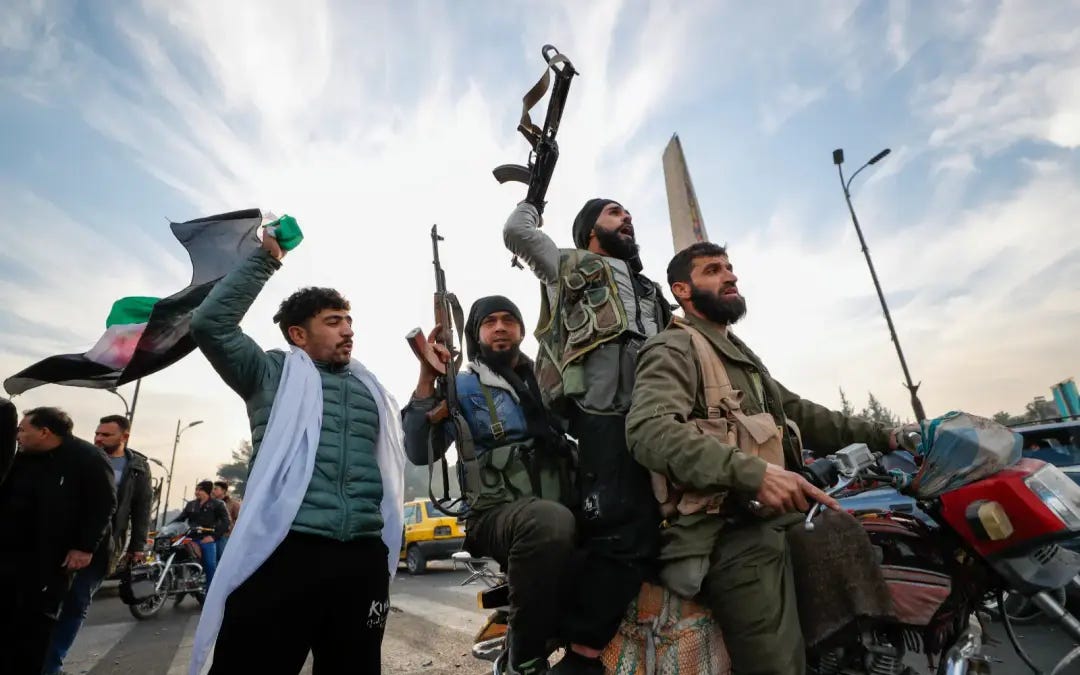
2024 Roundup: Current Affairs Commentary
Dec 17, 202400:18:10Tap to summarizeThis conversation rounds up goings-on in mid-December 2024, including events in Syria. This episode is audio-only, please use the ‘transcript’ button above to read an automatically generated transcript.Thanks for joining us in 2024, Sovereign Finance will be back in January!Thanks for listening this episode of Sovereign Finance. For more episodes, transcripts, in-depth articles, and the community, please take a minute now to subscribe free using the button above. You’ll receive a free email notification whenever we publish a new article or conversation. This is a public episode. If you would like to discuss this with other subscribers or get access to bonus episodes, visit sovereignfinance.substack.com
Transcribe →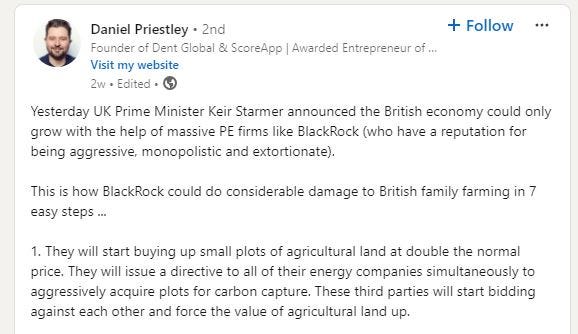
Will Blackrock Soon Control Your Local Farm?
Dec 10, 202400:14:48Tap to summarizeKay: Rob’s comments in italicsDerek’s comments in normal fontOur topic today is farming, some of the changes coming in the agricultural sector and BlackRock's potential involvement and firms like BlackRock. I wondered if I should just start.This topic was requested by a listener who pointed us towards one of Daniel Priestley's LinkedIn posts. I'm going to start by reading that out just as a starting point…Yesterday UK Prime Minister Keir Starmer announced the British economy could only grow with the help of massive PE firms like BlackRock (who have a reputation for being aggressive, monopolistic and extortionate). This is how BlackRock could do considerable damage to British family farming in 7 easy steps ...1. They will start buying up small plots of agricultural land at double the normal price. They will issue a directive to all of their energy companies simultaneously to aggressively acquire plots for carbon capture. These third parties will start bidding against each other and force the value of agricultural land up. 2. Initially farmers won't believe their luck - "these city folks are mad! if they want to buy an acre for £50K, who am I to say no to these fools" is what you'll hear down the pub. 3. These crazy prices will set record high comparisons for agricultural land. When a farmer dies, their farm will be valued using these new metrics and the next generation will discover the farm they thought was worth £3M is worth £9M and they don't have anything close to the money needed to cover the tax. 4. In swoops a BlackRock subsidiary with a "Agri Debt Finance Tax Relief" product to lend them 20% the "value" of their farm so they can pay the taxes. 5. The debt will come with conditions (a covenant) that the farm has to adopt and maintain certain practices. It has to use certain BlackRock owned fertilisers, software, machinery and labour solutions that get the farm ready to interface with a larger conglomerate. 6. When a farm cannot make its debt payments, it is sold at auction. BlackRock subsidiaries are instructed NOT to buy these farms at auction. They have a special arrangement to buy the unsold farms at a rate that covers the unpaid debt plus outstanding fees and taxes to government... basically what the farm was originally worth. 7. A BlackRock subsidiary then takes over the farm, consolidates it with a massive group of farms that uses illegal immigrant labour to staff the farms (which will be another government program they institute to deal with the immigration crisis). The government will subsidise the labour costs as part of this plan making the farms wildly profitable and making small family farms unable to compete. To anyone unfamiliar with the mind of a Private Equity General Partner, this will seem totally far fetched. To anyone who's had even the smallest dealings with the PE world, you will recognise this as a standard playbook for extracting value at a large scale. Mark my words, save this post and watch it all play out.What's your take, Derek?Well, I think that's 100% spot on. Within the last couple of weeks, BlackRock announced it has a $100 million hedge fund specifically targeted at British agriculture. The background includes one of the most surprising moves from the budget - the inheritance tax relief for family farms was effectively eliminated. Did we talk about this?I think we discussed this two weeks ago, but it might be worth revisiting…The situation involved an inheritance tax exemption for family farms so farms could pass to the next generation intact. This has effectively been eliminated. The budget presented a threshold for inheritance tax at a million pounds.Most of the population probably thought, “well, if they've got a farm worth more than a million pounds, they might as well pay inheritance tax!”All in the value is in the farm though, isn't it? It's all tied up.It's all tied up. The farmhouse alone in many places would be worth a million pounds on the open market. Then you've got barns, farm machinery, fields. Agricultural land has roughly tripled in price in the last 10 years.A thousand-acre farm, which isn't big by any means, would have farmland value of seven million. This BlackRock Agricultural Fund isn't only investing in farms potentially, but already invests in fertiliser and pesticide companies. It's quite obvious that any farms that come under their control would be integrated into all of the agriculture, which is going completely in the wrong direction for a sustainable future. Immediately prior to the budget, Keir Starmer entertained Bill Gates and Larry Fink at 10 Downing Street. Lo and behold next week came a budget with this ridiculous measure, then BlackRock announced their British agriculture investment fund. lackRock announced that they have this fund to invest so-called in British agriculture. You'd have thought that they'd at least be subtle enough to leave it a couple of months before making that announcement just so it wasn't quite so obvious!Anyway, the post has gone viral, cropping up on forums and discussions. I found a reference to it on Facebook.More people realise these things are happening. We must reach some threshold of awareness before anything changes, but sooner or later we must get some pushback.Well, I've been following the farmers' protest in the Netherlands regarding nitrogen-based fertilisers and climate change limits. It's part of a wider trend we discussed before this call, going back a hundred years.This mirrors the Great Depression playbook. In 1930, America comprised small plots with individual family farms. By decade's end, most farmland belonged to gigantic agribusinesses.Big business and banking achieved a dual victory. Every small town had its own bank in 1930. Banks lent money to farmers to modernise their techniques through modern agricultural machinery.The Great Depression hit, worsened by weather systems and the Dust Bowl. Unsound agricultural practices aggravated everything - stripping hedgerows that formed windbreaks, making vast monoculture fields.Yeah. It's the opposite of regenerative farming, wasn’t it?Farmers struggled with loan repayment payments to local banks for machinery. Local banks foreclosed mortgages, repossessing farms and machinery. Small banks across America found themselves with farms and machinery they couldn't manage.The banks faced a liquidity crisis. Big banks bought the little banks, then sold acquired farmland to big agricultural conglomerates. That's how the transfer occurred. So we're looking at a fairly blatant rerun here.It's amazing how often these things happen in different circumstances, though perhaps not on this scale. It comes down to controlling money, food, energy. We need local-level control where people have vested interests in their surroundings and land. That has to happen, doesn't it? Otherwise, do we have a long-term future as a species if we don't care for the land?We certainly don't. Life on Earth will continue regardless! The human race could easily go extinct. The other threat we face, which nobody seems bothered about, is nuclear war.Yeah, the earth will be fine. I'm just not sure we will be.Our friend in the Salisbury campaign for nuclear disarmament drafted a letter to the local paper. Surprisingly, they published it prominently, highlighting Britain's reckless participation in aggravating Russian conflict.The answers lie in shining light on these issues through conversation. We're looking to change the root metaphors guiding our decision-making. Productive discussion can change "us versus them" and "man versus nature" metaphors.I noticed something today. I went to drop off a parcel at Morrison's Daily, a small high-street shop in their chain. All supermarkets have them - Sainsbury's has a local version, Tesco has local stores.Thirty years ago, these shops were all completely independent. They've been absorbed into larger chains. Now a few big retailers effectively share monopoly control over former competitors.This follows any large quoted company's imperative to keep growing. They must keep expanding profits. Of course, some methods to expand profits are legitimate, others highly dubious. As legitimate ways become exhausted, profits expand by consuming smaller competitors.It's got to reach a point where those processes themselves have got no further to grow. Eventually, we're going to have some kind of reckoning. Exactly what kind, we don't know. But I think that you and I are a stand for the fact that out of this, it's entirely possible that a completely different and more humane, sustainable way of organising human affairs is going to come out of it.Thanks for reading this episode of Sovereign Finance. For more episodes, transcripts, in-depth articles, and the community, please take a minute now to subscribe free using the button above. You’ll receive a free email notification whenever we publish a new article or conversation. This is a public episode. If you would like to discuss this with other subscribers or get access to bonus episodes, visit sovereignfinance.substack.com
Transcribe →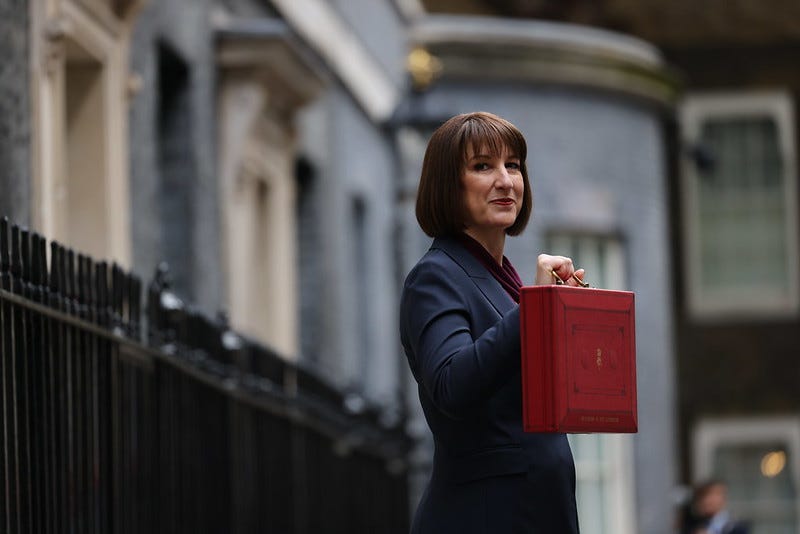
Labour's Plan For The UK Economy
Dec 4, 202400:16:18Tap to summarizeKey: Rob’s comments are in italics, Derek’s are in normal font.Our topic today is Labour's plans for the British economy and how those plans appear to be highly divorced from reality. Which sounds like a big topic. Where do we need to start with this one?The best place to start might be Rachel Reeves' statement in the budget. She said the only way to deliver economic growth is to invest, invest, invest. The first thing to say is that it's taken as an assumption, without debate or question, that economic growth will solve the problems.Whether or not that's true, the next question is whether economic growth is actually possible, particularly in Britain currently. This would be very interesting as we talk about the budget.Depends how many missiles you make, I think!I've never seen many reports when they do a budget on what you or I would determine that to be. If we were doing a household budget, it would clearly state proposed expenditure and income sources.The only budget reports seem to focus on tweaks to money collection methods, with little breakdown of actual spending. Another element in general conversation is the “cost of living crisis”, as though this is something like the weather.I hate that term, despise the term cost of living crisis. Just call it what it is—the cost of lockdown is the hyperinflation associated with very damaging economic policies!The trade restrictions and immense bureaucracy costs in trading with Europe since leaving the European Union haven't helped either.Blowing up the fuel supply from Russia probably didn't help.That probably wouldn't have helped, thanks to our friends, the Americans. Furthermore, funnelling enormous amounts of money into sending weapons to Ukraine doesn't help, not to mention the possible hazardous consequences.Have you seen any indication whether we receive money from elsewhere in return for the weapons we ship over there, or are taxpayers paying for that?I’m fairly confident it's the latter. It’s worth saying actually, the governments do not have their own money, they have our money. Or money that they've just made up out of nowhere. Money imagined into existence degrades the value of the money the rest of us have, so it comes from us either way. The other reason for the cost of living crisis is the vast wealth transfer from us to billionaires during COVID.This happened during the financial crisis due to mortgage manipulations in 2007 and 2008.Keir Starmer stressed his objective has always been about fixing the foundations of the country—a nice vague term. This government has pledged to deliver one and a half million new homes by 2029.Presumably for all the immigrants that have arrived over the last year, like a million plus in 12 months?Well, presumably they'd have more than one per household if it's for them. This rate hasn't been achieved since 1977, when something more resembling a Labour government was in power.The real house-building boom occurred under the post-war Labour government, building council houses for about £1,000 each. They were solid, well-constructed houses rented for about £1 weekly.I don't know who will build these one and a half million houses, where the money will come from, or what living in them will cost, assuming it happens.I'll tell you that - Taylor Wimpey et al are going to build them, and the money is going to come from us!They're going to cost a fortune.That's going to cost half a million pounds plus, yeah.They've argued planning rules are the single biggest obstacle to economic success—so-called neoliberalism in its outset. They suggest stopping government interference with people who want to rip everybody off.The future requires responsible thinking. Fixing foundations means considering the future responsibly. The benefits won't materialise immediately. Labour's challenge is modernising Britain's economic foundations—transport hubs, energy supply, planning rules, market regulations.Since the 2008 global economic crisis, Britain's productivity growth has slowed from a claimed 2% to 0.4%. The measurement method for productivity growth remains unclear. Growth in GDP serves as a poor proxy for human well-being.Claiming 2% growth assumes accurate inflation figures. To achieve 2% real economic growth, you must account for inflation. Official figures typically claimed around 2% inflation until last year.Yeah, it's not apples to apples.If they're claiming 2% economic growth in 2006-2007, raw figures must show 4% increased economic activity minus 2% inflation.If official statistics underreport inflation at 2% instead of 4%, zeroing that out from raw figures shows no growth. With real inflation at 6%, despite showing 4% increase, the economy actually contracted by 2%.I think you can manipulate these figures to show whatever you want to show...Politicians should acknowledge economic growth hasn't really happened and isn't necessarily desirable. We should focus on what constitutes a viable life for everyone.The latest buzzword is 'modern supply-side economics', coined by Janet Yellen as American Treasury Secretary. Supply-side economics suggests freeing up people's ability to pay rather than fixing goods and services delivery.This coded message implies reducing taxes, especially for the rich, allowing people to decide how to spend their money.Through the miracle of trickle-down economics, we'll all magically get richer in the process.This breaks from the Keynesian approach of creating demand by putting money in people's pockets through real actions. The Americans did this in the 1950s building interstate roads, similar to Hitler's autobahn construction in the 1930s.Hidden agendas existed in these cases. Hitler wanted autobahns for efficient troop movement. However, the economic logic remains sound. In the 1930s, crops rotted because people lacked money to buy harvested food.Keynes proposed government projects like Germany's approach. This benevolent use of government money-creation paid workers who could spend in local shops.Keynes never advocated irresponsible money creation. His idea suggested government intervention during economic crisis would generate increased taxes to repay infrastructure project debt.The post-war council house-building boom produced tangible benefits. Recent government investment programmes show little comparable benefit. HS2 raises questions about life improvements.It seemed like a massive scam to me, just the price of the project and the route it was taking. There's already a serviceable network in place.Many people had houses compulsorily purchased unnecessarily. Has it been completely abandoned now?I don't know actually. Yeah, haven't heard anything for a while, but yeah, the costs involved were crazy.That money has gone somewhere. It's a mixture of traditional thinking and pie in the sky, but we'll see what happens next.Assuming we survive the next couple of months, Trump's potential power transition could prove interesting. Even if Kennedy were blocked from becoming Health Secretary, it would open public debate about medical interventions.So watch this space.Thanks for reading this episode of Sovereign Finance. For more episodes, transcripts, in-depth articles, and the community, please take a minute now to subscribe free using the button above. You’ll receive a free email notification whenever we publish a new article or conversation. This is a public episode. If you would like to discuss this with other subscribers or get access to bonus episodes, visit sovereignfinance.substack.com
Transcribe →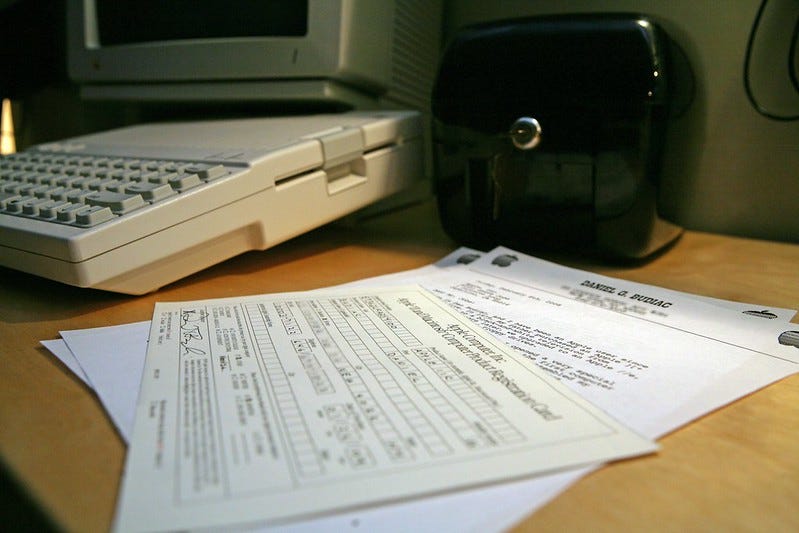
Unexpected Revenue From a Letter to Apple!
Nov 28, 202400:27:05Tap to summarizeRob’s comments are in italicsDerek’s comments are in normal fontYou were telling me about a letter you wrote to Apple once that generated a lot of revenue...Being an Apple dealer was possible as a small player once, although they rapidly weeded out those not operating at their desired scale. My letter aimed to retain my dealership, which provided a tidy revenue. Apple relayed the contents of the letter to someone else who provided substantial business and opened many doors.In the late 70s, I partnered in an Apple dealership until discovering my main co-director was dishonest, prompting resignation. The Apple II, their entire product line, represented the first convincing desktop computer. Several contacts maintained their relationship, including BP Research Laboratory in Sunbury. They purchased an Apple to automate their electron spectrometer operations. One customer published an academic paper, generously offering co-authorship credit.Becoming an Apple dealer required buying and steadily selling a small stock. Later, they focused on dealers shifting dozens monthly, not occasional sellers.Apple did their 80/20 analysis and you were not in the 20!No! Some friends running a West End security systems business suggested developing a retail point-of-sale stock control system for desktop computers.Kick the can down the road a bit…The letter to Apple described this development process, which kept the account open. Jeffrey Wallace, from a family running women's fashion shops nationwide in the 50s and 60s, noticed. The family had sold to retail conglomerates but retained a Benetton franchise, hoping his son would operate it.Unlike most single-shop franchisees, Wallace operated four shops with young women managers. Benetton's barcode system implementation had a three-year timeline. Wallace contacted Apple seeking solutions, leading to our collaboration.The system expanded from 4 shops to 35 before Wallace sold the business. Relationships with cash register dealers developed through Omron connections. New capabilities included foreign currency functionality for airport and boat operations.The Tamar Bridge project emerged through a 10% commission arrangement. Total revenue exceeded three-quarters of a million pounds, stemming from that initial Apple letter. Though Apple eventually closed the account, established connections generated ongoing business, including toll systems for Cleddau Bridge and Sandbanks ferry.This is why you should never burn bridges with outgoing employers or old clients who have decided to cancel. Like you just never know. The laws of unintended consequences can work in your favour as well as working against you.Perry Marshall often says, sleep with one eye open. Keep an eye out for these opportunities when they come along and they will come along and seize the day. Carpe Diem.Thanks for reading this episode of Sovereign Finance. For more episodes, transcripts, in-depth articles, and the community, please take a minute now to subscribe free using the button above. You’ll receive a free email notification whenever we publish a new article or conversation. This is a public episode. If you would like to discuss this with other subscribers or get access to bonus episodes, visit sovereignfinance.substack.com
Transcribe →
Understanding Stocks and Flows
Nov 21, 202400:13:44Tap to summarizeRob’s comments are in italicsDerek’s comments are in normal fontOur topic today then is "stock" and "flow".Right, this is a fundamental point. I sometimes worry whether I'm labouring the point in our broadcast series by stating the obvious. This concept will provide clarity to every aspect of what you examine once you're clear on it.A stock is the measurement of any quantity. We think immediately of stocks in retail terms - your stocks are the goods you've got on hand ready to sell. For manufacturers, stocks are the raw materials available to start manufacturing.In the broader sense, it's any static measurable quantity. Your stock of money is the total cash lying around plus the contents of your various bank accounts. With a large water system, it's the number of gallons or litres in the tank.The flow is the rate at which that stock increases or decreases. Taking that water tank example, the flow measures litres per minute, second or week being extracted or filled up. Both activities might happen simultaneously.For retailers, stock means the total items available for resale. For manufacturers, it's the total raw materials ready for production.I want to examine this more broadly. We could discuss the stock of money you own - the total of your cash, bank accounts, savings systems.We've talked about this before on a macro level when we were talking about the profit and loss accounts and the balance sheet, for example.Exactly. Consider a water tank - it's the number of gallons or litres of water inside. The flow measures the rate of increase or decrease in that stock.Water might be drawn from the tank at specific litres per second while simultaneously being refilled. The net flow represents the difference between these rates.The same applies elsewhere. With shop goods, you monitor corn flakes packets sold daily versus deliveries. The difference affects stock levels.Regarding cash flow, expenditure represents money spent per day, week or month. The inflow comparison determines whether stock levels rise or fall.This becomes particularly relevant when examining economic health through gross domestic product or gross national product. These flow measurements don't reflect total country wealth.Sounds like that's eerily relevant to today's world.Though simple, this idea deserves consideration whenever statistics appear. Question whether it's a stock or flow. Consider what we wish to optimise as a reasonable proxy for measuring well-being.I was thinking of Carol Dweck's book, The Growth Mindset. She argues your mindset on any issue is either fixed, as in I am good at finances or bad at finances. Or it's a growth mindset where you might be bad at finances, but on an upward trajectory.Right.Maybe that's the same thing, maybe that's stock and flow of skills for instance or knowledge or something else.Okay, so a brief, brief episode this week, but I think as I say, that's an important point to take on board and to really internalise.Thanks for reading this episode of Sovereign Finance. For more episodes, transcripts, in-depth articles, and the community, please take a minute now to subscribe free using the button above. You’ll receive a free email notification whenever we publish a new article or conversation. This is a public episode. If you would like to discuss this with other subscribers or get access to bonus episodes, visit sovereignfinance.substack.com
Transcribe →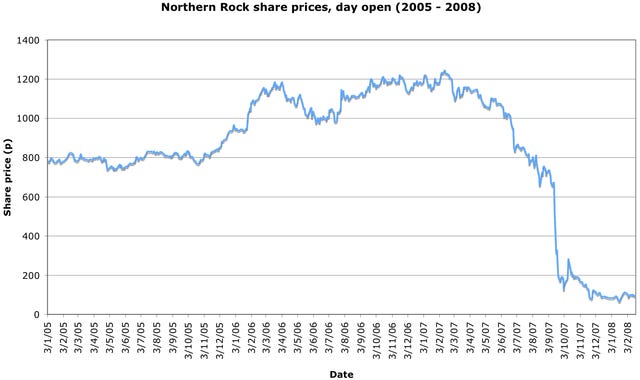
Are Share Prices Meaningful?
Nov 19, 202400:27:00Tap to summarizeRob’s comments are in italicsDerek’s comments are in normal fontInitial Comments on the US ElectionThe American election results on November 8th produced a Trump landslide. Many people tried to convince themselves it was neck and neck.Not to anyone paying attention - I had it fairly nailed on that it was quite likely.The significance for our discussion lies in the effect this outcome has had on various share prices. The most obvious impact will emerge over the next few months regarding pharmaceutical companies. Robert Kennedy's suggested appointment as Trump's Minister for Health, combined with his declared war on regulatory agencies, their industry capture, the harm from vaccines - this could puncture an enormous bubble.That was the main one that came to mind. Bitcoin prices notably rose quite a lot after the election results. Bitcoiners were fairly bullish about the outcome. We'll see what comes next now. Judge them by what they do, not what they say.Kennedy's presence in the government will make things interesting. The media's huge onslaught against him seems inevitable.Very interesting.It will be intriguing to see whether they can sustain that opposition, particularly if he gains wider credibility or makes progress with his stated aims. Simply bringing these issues into open public debate marks a huge step forward compared with the manipulated, suppressed public narrative. This manipulation has existed since the invention of newspapers to some degree.In the past, more independent voices existed across different publications. Now they've been amalgamated into monopolistic conglomerates. They've continued what worked well for them, unable to think differently. We're experiencing some kind of era change. The next five to ten years will prove astonishingly interesting.Let's go back to the issue of share prices then…The Original Purpose of Share OwnershipShare ownership's original purpose emerged during the Industrial Revolution. Starting an enterprise then - perhaps a cotton spinning factory, steam engine production, railway line, coal mine or steelworks - required substantial capital. This meant literal capital: equipment, land, buildings, rolling stock, rails - everything needed for operation. The concept addressed two issues: these ventures typically exceeded individual funding capacity, people wanted opportunities without risking total ruin if the venture failed. Their liability remained limited to their shareholding investment.The expectation was that profitable businesses would share their profits. Historically, as previously discussed regarding government bonds, the baseline interest for a very safe investment yielded two and a half percent. People were satisfied if £10,000 yielded £250 annually without concern. This represented substantial income in the early 19th century, providing a comfortable living.Investing in an enterprise with returns from profits involved less certainty. Successful ventures typically yielded higher returns on investments, perhaps double the safe government bond rate. A dividend of roughly 5% of the investment seemed normal. Another general benchmark suggested that whatever the operational setup cost - land, factory, machinery, initial stock - should yield a 10% return. This meant 5% distribution to shareholders, leaving 5% for capital maintenance, machinery replacement, or operational expansion.Present-day stock exchange shares differ, as the initial shareholding money's use for company infrastructure lies in the past. Investors tap into income streams derived from enterprise properties and profits. Many stock exchange shares yield significantly less than 5% dividend. Investors seek share price rises for returns. These expectations have been well fulfilled over the past 70 years, raising questions about sustainability and real value regarding money's purchasing power.Looking at Apple’s Early YearsApple Computer's early years provide an excellent illustration. Their Apple II, the first successful desktop computer, surpassed several rival machines. Once established beyond technological enthusiasts, VisiCalc spreadsheet software transformed it into a useful business tool.VisiCalc represented the spreadsheet prototype, preceding Microsoft Excel. Despite Excel's sophistication running on vastly more powerful computers, VisiCalc satisfied perhaps 80% of current Excel uses. This basic spreadsheet managed rows, columns, numbers, labels, and formulae. It supported management tasks, stock lists, small business accounts, and future business projections.Apple maintained solid gross profit margins on component costs against sales prices. They reinvested profits into manufacturing, marketing, and distribution expansion. This strategy yielded approximately 700% annual growth for several years, with turnover doubling quarterly. Six-month periods saw fourfold increases, reaching eightfold annual growth.Richard Koch would describe that as a 'Star Business'.That would be a star business by any standards!Two Principle StatisticsIn a business like this, early investors would not seek immediate profit distribution as dividends. Their interests were better served through profit reinvestment into business expansion. Tech firms typically avoid declaring dividends for many years, reinvesting profits into business growth with shareholder approval.Two principal statistics help evaluate shares: dividend yield and price-to-earnings ratio. For dividend income seekers, yield proves significant. The simpler business models historically suggested avoiding yields below 5%, whilst higher yields indicated good investments, barring warning signs.Long-term shareholders focused on growth potential examine the price-to-earnings ratio. This represents total profits, accounting for interest payments and tax obligations. Available profits amounting to one-tenth of share price yearly equals 10% investment earnings. These earnings might be fully distributed to shareholders or completely reinvested for expansion.Nineteenth-century investors considered shares reasonably priced at ten times current earnings. Modern stock markets show higher price-to-earnings ratios. This historical figure compares last reported profits against current share prices. Apple Computer's scenario, projecting eightfold profit increases, rationally justified paying up to ten times anticipated earnings - an 80 price-to-earnings ratio betting on future performance.Yes, because you're betting on the future really.Contemporary tech stocks, particularly on American exchanges, dominate Western economic activity. Similar principles apply to the British Stock Exchange. Half-dozen tech firms' enormous nominal capital governs aggregated performance. Their faltering would significantly impact overall market performance.Amazon, Meta, Microsoft maintain 25-35 price-to-earnings ratios, suggesting doubled or tripled profit projections. Nvidia, producing graphics cards and high-end mathematical computing hardware, demonstrates enormous sales growth, maintaining a 65 price-to-earnings ratio - approaching early Apple Computer growth levels.Scale differences matter. Companies previously growing from £10 million to £100 million revenue yearly eventually plateau. Modern corporations worth trillions, like Apple's £3 trillion paper value, raise questions about sales justifying 60 times earnings share prices.Early Apple expanded profits through increased machine sales, peripheral additions, and software sales - genuine growth opportunities. Modern profit expansion often relies on price gouging and planned obsolescence, forcing upgrades as previous models become unusable.Workforce pressures intensify, demanding increased output from fewer personnel under harsher conditions. Companies often relocate to regions with lenient labour protection laws, offering minimal benefits.Fiat currencies' declining purchasing power continues, likely to accelerate. Paper nominal gains in share prices partially offset currency inflation. Examining high-tech companies' extreme price-to-earnings ratios against real growth potential for new business activity raises questions about future revaluation.Additionally, crowd dynamics significantly influence rising stock markets through herd behaviour and fear of missing out.There's a feedback loop in play there.Yes indeed, a positive feedback loop exists between rising prices and increased willingness to pay more, regardless of underlying rationality. This overview helps evaluate potential direct or indirect investments sceptically.Comparing to Google Ads Click PricesIt feels like some prices reflect adding two plus two plus two to reach 222. This continues for years, creating shifting baseline syndrome where it becomes the new normal. We both encountered this working with Google ads. Google ads remain their primary revenue source. Share price movements seemingly influence click pricing adjustments.Going back to the early 2000s, the price per click seemed fair or underpriced. Now it appears overpriced, particularly challenging for small businesses. Share price concerns likely drive this trend.Precisely. Share buybacks significantly affect prices. Google recently demonstrated this after reporting enormous profits. They laid off numerous technical staff - concerning for a tech company - using profits for share buybacks rather than staff retention or company expansion. This practice, historically illegal in Britain, now represents accepted business practice.Thanks for reading this episode of Sovereign Finance. For more episodes, transcripts, in-depth articles, and the community...
Transcribe →
Doughnut Economics
Nov 5, 202400:23:00Tap to summarizeKey: Rob’s comments are in italics, Derek’s are in normal font.So we're going to talk about doughnut economics today. And you mentioned before the call that there's a topical item for us to talk about too. So what is that topical item?Developments in the BRICS Alliance…Well, the topical item is that already it must be a year since the last time this was happening because they've just had a conference or they're in the process of having a conference of the so-called BRICS nations. BRICS acronym for Brazil, Russia, India, China and South Africa. Of course, that alliance group is getting expanded more or less on a weekly basis and now seems to encompass, I'm wondering whether it's actually a majority of the sovereign nations of the world.Seems to be getting bigger.So it's a pretty significant power block and it was quite interesting to see that Vladimir Putin was there, naturally enough, and addressed the leaders of all the other nations that had come to this conference and listened to attentively. It's very interesting that that contrasts with the situation in the West where we don't get to be addressed by Putin at all and nothing he says directly is seen to be reported in our media except to put some specific spin on it.When one of our journalists, Tucker Carlson, went over to Moscow and interviewed him, he was roundly condemned for doing so. You would have thought that in a strange world, any leader of a large, prosperous, resourceful country would be of interest to the population at large and any journalist would be congratulated for having talked to them. And at least we would get to evaluate him on the merits of what we make of what he says. Anyway, the point being that it's yet again come back to the top of the agenda that these people are trying to set up a mechanism for trading between themselves that doesn't involve the dollar financing and the American banking settlement system. That is going to very seriously change the landscape of the financial structure of the world, if and when it happens. So watch this space really.Anyway, let's get back to the topic of doughnut economics…What is Doughnut Economics?I mean, it's a funny name. It's the title of a book by a woman called Kate Raworth who studied economics at Oxford and was thoroughly disillusioned with it in terms of its relevance to the current world. That slightly odd title, Doughnut Economics, is a metaphor for her view of how we should be looking at economic activity.And the image is that you have, if you like, a ring doughnut. And on the inside of the edge of the ring, you've got what she calls the social foundation of various aspects of human wellbeing, water, food, health, education and so forth and what we consider to be a satisfactory level of that. And on the outer edge of the doughnut you've got the ecological ceiling. It's quite interesting because virtually everything that she's highlighted - and the idea is the little ring because if you like there are segments of that inner boundary that cover different aspects as I indicated, you know, water, food, health, education and so on. And then there are segments around the outside of the ecological limitations.And with one exception, all of the ecological aspects that she was enumerating were all aspects of what we might broadly call pollution. Whereas the way I would look at it personally is that pollution and all the different aspects of pollution are part of the ecological limitations. But other parts of the ecological limitations are things like resources, resources of raw materials, resources of energy, resources of food and agricultural land and so forth.Yeah, having good quality topsoil and things like that.And she has a number of images covering different aspects of what is covered in economic thinking. The seven ways to think, as outlined in the book, are:* Change the Goal: Move beyond GDP growth as the sole objective and adopt a doughnut framework that sets a minimum threshold for human well-being (social foundation) and caps it by available ecological resources (ecological ceiling).* Think in Systems: Recognize that economies are part of larger systems, including natural and social systems, and consider the interconnections and feedback loops between them.* Design for Distribution: Prioritize distribution and equity, ensuring that economic benefits are shared fairly and that no one is left behind.* Measure What Matters: Move beyond narrow economic indicators like GDP and focus on metrics that capture human well-being, such as life expectancy, education, and social connections.* Regenerate the Economy: Emphasize regeneration and restoration of natural systems, rather than just exploiting them for growth.* Decentralize and Democratize: Encourage decentralized decision-making and democratic participation, allowing diverse voices to shape economic policies and outcomes.* Explore and Experiment: Foster a culture of experimentation and learning, recognizing that economic systems are complex and evolving, and that we need to continually adapt and improve our approaches.Questioning Indefinite Economic GrowthShe has a bunch of images about the way that this was seen in 20th century economics and the way it should be seen in what she calls 21st century economics. I think these are all well worth looking at and of course the goal in 20th century economics and the goal that all of our politicians, economists, and business people are talking about is that economic growth cannot be questioned. More economic growth is better and anything that inhibits it is bad!I have a big problem with assumptions, can't be questioned. This runs across the board. If you can't question it, it's got something to hide.There are several things about this. Whether we like it or not, we live in a finite world and growth of anything doesn't go on indefinitely. So that whole way of framing the discussion is absurd on its own grounds. And also, we've discussed previously that what they mean by economic growth is not the growth of more wealth or more prosperity, it's the growth of the rate of transactions.It's extraordinary to me that that even gets off the ground as an idea.Could you just define that, sorry, the growth of the rate of transactions?Economic growth is defined as growth of gross domestic product. When you're talking about an individual country and if you're talking about the world as a whole, you're talking about the total of gross domestic product. And gross domestic product is within a year or some other period. It’s the total volume of economic transactions that have been made, the total volume of sales if you like.You could have the situation that we have at the moment, for example, where over the course of our lifetime, we buy numerous washing machines, for example, and we have to replace them every few years. Now that obviously creates more transactions, which creates greater economic growth. But I'm no wealthier when my old washing machine wears out and I'm forced to buy a new one than I would had that been made to be more long-lasting and I still had the original one.It's the opposite, you're poorer!Yes, quite so. And so she suggests changing the goal to be living within this doughnut, the doughnut constrained on its inner ring by satisfactory social living conditions for every human being on the planet and on its outer ring by living within the constraints of our environment. As I say, she's mainly focusing on the negative aspects.The Self-Contained Market No Longer AppliesShe contrasts the 20th century economics as being the self-contained market. As most of these are from most of the 20th century images she has of the market are from Paul Samuelson's seminal work on economics written in about 1946 or 48, which is the basis of most economic courses at universities. Samuelson’s big picture was the self-contained market where you've got businesses and households and the transactions are going round between the two. Rawson’s image for the 20th century is what she calls the ‘embedded economy’, which is interesting because it's got energy coming in from the sun and energy going out into space and in between the two of them it carries out all the transactions on the earth, which is an image that we've had before.The third one was the question of human nature and it's a core concept in economics as I'm sure you'll remember from when you studied it somewhat that the idea is that we're all self-motivated individuals who are aware of the situation and act to optimize our own situation.And apparently we have infinite wants and desires.Yes, of course that homo economicus is a complete myth. It's an abstraction that bears no resemblance to reality. Everybody's knowledge of the marketplace or anything else is finite and limited and constrained. And mercifully, most people are not 100% self-interested and self-directed.This was famously summed up by Margaret Thatcher saying there's no such thing as society. Whereas that is the attitude that taken to the logical extreme has created all the unworkability of the world. So the contrasting image for 21st century economics is socially adaptable humans. This is what we have to be moving toward if we are ever going to create a functional workable world. And it's got to be one which is based on empathy and based on collaboration.Dynamic Complexity Instead of Market EquilibriumThe image of systems in the 20th century was an attempt to be rather like physics and to be seeking equilibrium. One example of this is the crossover between supply and demand, which produces a certain equilibrium rate of production of goods and ...
Transcribe →