← The Bible in a Year (with Fr. Mike Schmitz)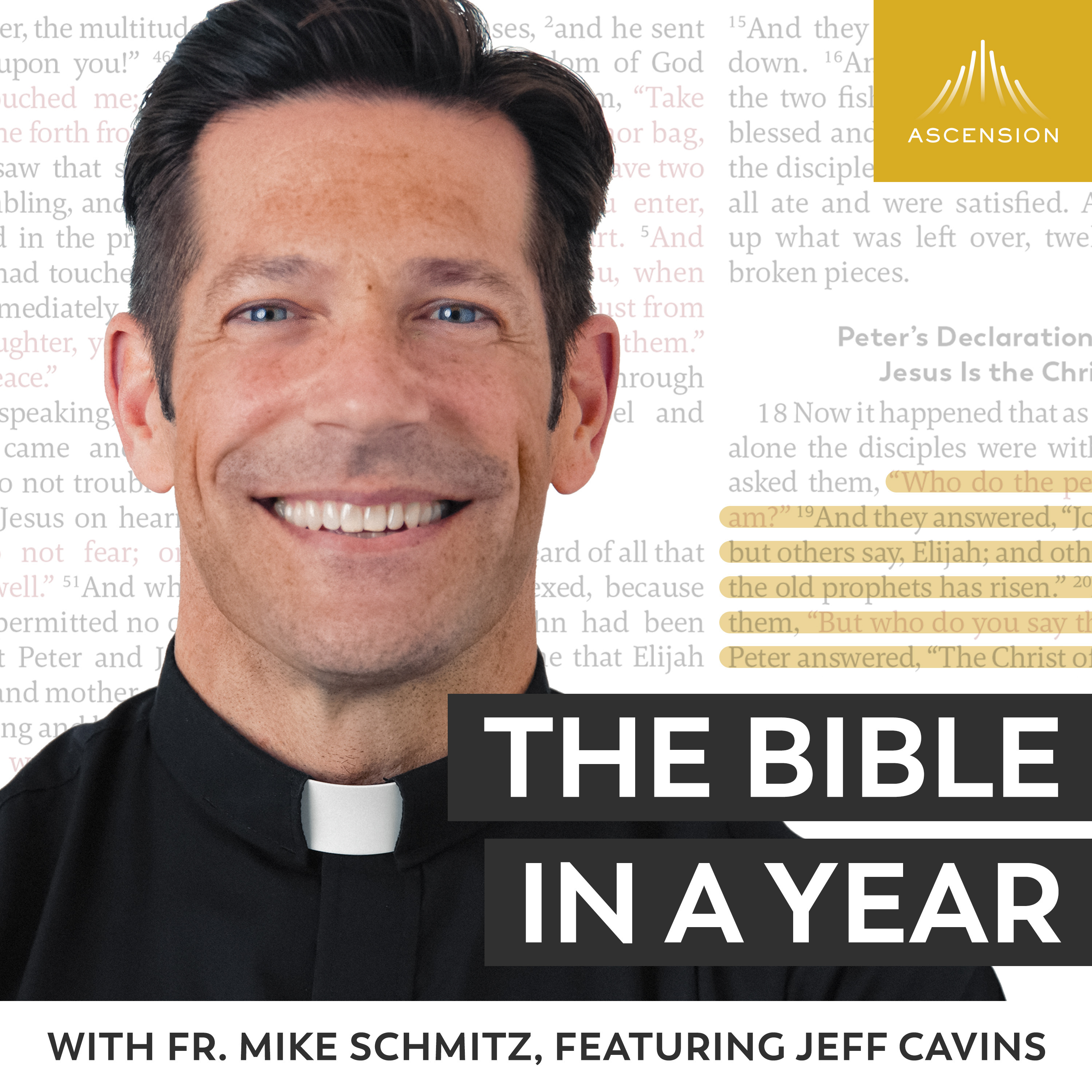
The Bible in a Year (with Fr. Mike Schmitz)
Messianic Checkpoint: The Gospel of Matthew (with Jeff Cavins) - 2025
00:39:07
Welcome to the third Messianic Checkpoint! Jeff Cavins joins Fr. Mike to introduce the Gospel of Matthew and explain what makes this gospel unique, such as its emphasis on joining the call of Christ as his disciple, sharing the things we've learned during this journey with others in our lives.
Loading summary
Transcript43 lines
- [00:04]
A
Hi, my name is Father Mike Schmitz, and you're listening to the Bible in a Year Podcast where we encounter God's voice and live life through the lens of Scripture. The Bible in a Year podcast is brought to you by Ascension. Using the great adventure Bible Timeline, we'll read all the way from Genesis to Revelation, discovering how the story of salvation unfolds and how we fit into that story today. Today we are joined by Jeff Cavins once again as we move from the period of exile into our next messianic checkpoint. We had John, then we had Mark, and now we have Matthew. And so we have Jeff. Because we have Matthew, we also have Jeff. And so Jeff is going to give us that introduction into what we should pay attention to, what we should attend to when it comes to the Gospel of Matthew. Jeff, it's awesome to have you again on the show.
- [00:47]
B
Well, it's good to be with you again. And the story continues.
- [00:51]
A
Yes. And also, I just said on the show. Is this a show? I don't know. On the podcast, on our show, we always have this. Yeah, the story continues. And, gosh, we just. I think when I say the period of exile, I. Not only period of exile, but the period of. Not the period of the prophets, but we got. Just got done with a long section of the prophets. I think it was. Was it a hundred days? I mean, it was at least, I think 90 or something in there of prophets, which probably for most people was their first exposure to the prophets. And what a. What a gift to be able to walk all the way through and hopefully have some context. And now we have the context launching into the Gospel of Matthew as well.
- [01:27]
B
Right. It was long enough for people to say, how many prophets are there exactly. And I think that, you know, in all fairness, people can get a little bit confused during that time, and it is a lot. And it might be good just to remind all of our friends that one time through the Bible is not enough. One time through is like an introduction, and then, hey, you got your rest of your life to work it out, and that's what you've done. That's what I'm doing. And it's been years and decades for me, and I never get tired of it. But the more you do it, the easier the story gets. And I don't know if it gets easier to live, but it's easier to understand the more you do it.
- [02:08]
A
That's a good way. That's a good distinction, I think, to make. It's not necessarily any easier to live, but to get that sense of, okay, I have my bearings. I know for a lot of people who have contacted me, they said over the prophets, they had to have their Bible in front of them as they were listening. Maybe not everybody, but a lot of those are just like, okay, I need to follow along and be really attentive. I can't. I mean, I think there's something good about this podcast, which is, get in your car, drive, and let the God's word wash over you. Let him pour his word into you. But sometimes there's that sense of like, okay, I need to. I need to pause, and I need to actually carve out some time where I can not only hear the word of God, but also see it. Because, again, those prophets, sometimes it's easy to get lost. And so I'm glad we're here now.
- [02:55]
B
Well, it's kind of a reprieve now because we are taking a look at one of the Messianic checkpoints, which is the Gospel of Matthew. And it kind of, you know, when we go into this, people are like, ah, okay, all right. Now, yeah, I know where we're at. I know what's going on here. So we want to take a look at this gospel. And, you know, I get that question all the time. What's your favorite book? Book of the Bible? And I always have to divide it up into the Old Testament and the New Testament. And when we come to the New Testament, I always say it's the Gospel of Matthew. I love.
- [03:24]
A
I would probably say the same thing.
- [03:25]
B
Yeah, yeah, I love it. And, you know, it's written to Jewish people. And so being written to Jewish people means that Matthew is going to use some words and some phrases and some ideas that the Jewish people will get, but other people might not get it, you know, unless they have somebody to explain a little bit of this to them. But it is just filled with so many good things. And we'll talk about a few of those today.
- [03:54]
A
So when it comes to the Gospel of Matthew, we've already covered the Gospel of John and Gospel of Mark. What are some of the ways, what are some things that we can be listening for that are differences? When it came to John, then Mark, and now here's Matthew.
- [04:09]
B
Sure. Well, I think that more than the other three Gospels, again, this is one of the synoptic Gospels. That's Matthew, Mark, and Luke. And John is not a synoptic gospel. The synoptic Gospels really mean that they seem to come from a common source, the common stories and so forth. I think that Matthew Even more than the other Gospels, is dependent upon you knowing the Old Testament. So as our friends read through with you through the New Testament, I think on this particular Gospel, they're going to get a lot of things out of it as far as. Wait a minute, I think we visited that in the Old Testament in some ways, and we can talk about a couple of those here today. But starting off at the very beginning of the Gospel of Matthew, you have one of the most well read portions of scripture, which is called a genealogy. And it's so funny because we've come to the New Testament and everyone's so excited and all of a sudden it's, oh, Jacob begot. So. And they're into that. And in the Hebrew, that is actually a tool, it's a literary tool called a Toledot, which means really the generations of. And when Matthew is using this at the very beginning, he's trying to show you something, and he's trying to show you something that is dependent upon the Old Testament. And he's trying to show you that there is something new that is about to begin that is a fulfillment of everything we've been through so far this year. And so when you read the genealogy, the two things that are unusual is number one, there are four women mentioned. And those four women that are mentioned are all women who have sort of a question, you know, about their life. You have Rahab and Tamar and Bathsheba, and you have women who kind of bring up the eyebrows a little bit as to, hmm, why would he bring up women in the genealogy? And the answer to that is that Matthew's saying, I'm about to unload something on you here that is going to be, well, different. And I want to show you that your whole history has been riddled with different stories, you know, and of course he's going to say that a virgin shall conceive and give birth. And they're like, say what? And that he wants them to remember your background was a little bit different. The second thing is that the genealogies, Matthew tells us, are really reduced to three sets of 14 generations. And the number seven for the Jewish community is a number of covenant. It is a number of fulfillment. It is very important. Shava in HEBREW and so when, when Matthew gives this genealogy, he says, from Abraham to David is 14 generations. David to the Babylonian deportation, which all of our friends know about now, which everyone should know.
- [07:17]
A
Exactly. Yeah, exactly.
- [07:18]
B
14 generations. And from the Babylonian captivity to Joseph and Mary, 14 generations. Now pause for a second and you realize that is six Sets of seven. And then suddenly Jesus is brought onto the scene. And that is the beginning of the seventh seven. And that is the completion, the fulfillment of everything that we've been reading in the car, in the backyard, on the beach, in airplanes. We've come to the fulfillment now. And that is Jesus Christ. And that's basically the introduction.
- [07:55]
A
Yeah. And that is so incredible to realize that these names that we'll be hearing starting today or whenever people press play for that first day, Matthew chapter 1:4, maybe for the first time, some of the people who listen are going to say, oh, I know those names. Like not just, I know the Babylonian exile and how significant that was, but also, oh, some of these other names in here. I know that story. And it's kind of like when I go with you to the Holy Land, there's the people who have gone through the great adventure Bible timeline, and you mention, oh, the story of Solomon and they're like, oh yeah, they dial right in on this. Or you mentioned the divided kingdom or how Solomon was a builder and all these kind of pieces and they're just lasered in on and they understand what you're talking about. And some of those, you know, Catholics who might not be as familiar and they might not have gone through the Bible timeline, that it's like, okay, this is good, but who is that? This is, I think, going to be for so many people, you know, on day 258 to be able to say, I've been. No, no, no, I. I have been exposed to God's word for 258 days. I know, even if I can't remember exactly who or what they did, I know that name and I know the context here. And it sounds like that's one of the things that Matthew is doing for us at the beginning of his Gospel, is giving us, this is not out of nowhere, this is not out of the blue, but this is the fulfillment, as you mentioned, of God's covenant that his promises to his people are fulfilled in Christ. And this is. This is our Father being faithful.
- [09:27]
B
Right, Exactly. And that sets the table for us as we start off by establishing that this Jesus is the son of David, related to David, related to Abraham and goes all the way back. And that's very Jewish to put a genealogy right at the beginning there. So I would encourage people in the future to don't just gloss over that. Think about it. Look at the history and the story of Jesus Christ. And I would remind you that on your Bible timeline chart, if you have one, there's A red line all the way through that chart. And that red line is taken from here. This is where we get a lot of that information, that bloodline.
- [10:11]
A
Yeah, that's incredible. And it's one of the things, I don't know if we've mentioned that I think St. Augustine had said it, that the Old Testament is revealed in the New and the New Testament is hidden in the Old. And that sense of that's what we've been doing for all of this time has been having the hidden fulfillment in the Old Testament. And now here when we hit Matthew's Gospel, like the other gospels as well, we have that all this stuff that was hidden now revealed and we can see those pieces and those connections.
- [10:42]
B
Like you're saying, one of the points that I get excited about with Matthew's Gospel is that, and we'll share a little bit of that right now, is that it gives our listeners, our friends, an opportunity to see how Jesus teaches and how it's so important to know the Old Testament when it comes to understanding the teachings of Jesus. And we get this right away after the genealogies in chapters three and four of Matthew. And it starts off where you have in chapter three, in those days came John the Baptist preaching in the wilderness of Judea. Repent, for the kingdom of heaven is at hand. For this is he who was spoken of by the prophet Isaiah when he said, the voice of one crying in the wilderness, prepare the way of the Lord, make his path straight. And then it goes on for 4, 5 and 6, verses 4, 5 and 6. And it tells us what he wore, what John wore and what he ate. And I look at that like, okay, was that really necessary? I mean really, I want to know what he thought and what he did.
- [11:48]
A
Thanks for the details. Yeah, right.
- [11:50]
B
What Matthew's doing is he is drawing your attention to John the Baptist and linking him to someone in the Old Testament. And this is one of the, the keys to reading the Gospel is you have to read and listen for things that are being fulfilled. And in Jesus life, what he did, where he went, what he said, how he taught it is all linked to the Old Testament. And I love this type of history. And Pope Benedict was really big on this in his multi volume set on Jesus of Nazareth where he talks about this type of history where Jesus, Jesus is fulfilling everything in the Old. And so when you come, and I'll use this as an example, Matthew 3, 4, Matthew 3, 4 should remind people of something in the Old Testament that Jesus is fulfilling. So in chapter three you have John the Baptist coming on the scene. And he shows up at the Jordan river just north of the Dead Sea. And he's dressed like someone. Now who is that someone? Elijah. Right? It's Elijah. He's dressed like Elijah. So we have to, as Bible students, ask ourselves the question constantly. All right, ask yourself a question. He's looking like Elijah. Where was Elijah? Let's go back and look at Elijah. And all of a sudden you realize the last place we see Elijah was way back in 2 Kings, chapter 2. And it was right here. This is where the last place we saw Elijah was, at the Jordan River. And John. Exactly. John comes running in there dressed like Elijah. I love that. And so then it leads to verse 13, where Jesus is going to come down there himself and submit himself to baptism. And John says, wait a minute, I should be baptized by you? And Jesus said, no, this is necessary. We have to fulfill all righteousness. Which means in Hebrew, literally, that I have to complete the story. I have to immerse myself in everything in the Old Testament. So that's in chapter three. And then in chapter four, right after Jesus is baptized, he comes up out of the water. And then in chapter four, he goes off into the wilderness for 40 days, where he is tempted three major times. Now, the student of scripture needs to ask themselves the question, has this ever happened before in the Old Testament?
- [14:37]
A
Yeah. Yeah. These particular temptations, this particular. In the wilderness for a time of 40 that. Just like all of these things that Matthew is highlighting to point us to. Yeah. Remember, here's what happened in the past. Here is what Jesus is doing now.
- [14:55]
B
Yeah, yeah. And so, you know, we just ask people to pause for a moment right now. Does this ring a bell? It should ring a bell. It rings a bell because it did happen in the Old Testament. Israel went into bondage for 400 years. They came out of bondage, went through the water of the Red Sea, went out into the wilderness for 40 years, and tried the the Lord three major times. And they failed. They failed. They failed. They failed. And what does Jesus do? He's fulfilling all righteousness. He comes up out of the waters of baptism, goes into the wilderness for 40 days. He's tried. And he's the faithful son. He's showing us how to live. And I love this. And we see this kind of history over and over in the Gospel of Matthew. So as people are listening with you and reading with you, I would encourage them, don't listen lightly. Think. Think as they're hearing this, because they're going to see it over and over.
- [15:54]
A
You know, it's one of the things that we always encourage people. Whenever we take a moment, even, you know, at Mass when the word is proclaimed, we sometimes, I sometimes invite people like, listen to this or read this as if you've never heard it before, as if you've never read this before. Because then we're going to be more attentive as opposed to, oh, yeah, yeah, Jesus got baptized. Yep. Moving on. But to be able to stop and ask that question, okay, why Jesus is baptized? Why? Or even these three temptations. Why these three temptations? Like why is why. Why them? As opposed to any. Any other things that Christ could have been tempted to. To do. And, and that's so good, as you're saying. I think now that we've had so much. I mean, it was great to have that first Messianic checkpoint with John's Gospel, but I think we were still so new into the big picture story that we weren't necessarily prepared to make all of these connections or as many as we will be able to make now, or even ask the questions of, as it's been three quarters of a year, basically where we've been on a daily basis exposing ourselves to God's word. And to be able to ask why this. Because these are going to be stories that for the most part, people will know. Right. Matthew's Gospel is pretty widespread. I mean, I think most people who go to church would have a familiarity with them maybe more than they would with, you know, the book of Esther or the book of Judith. And so this is really, really great opportunity to listen with new ears, to read with new eyes, and to, like you said, ask the question with a new perspective.
- [17:30]
B
Right, Right. Well, you move on in the Gospel. And one of the greatest portions of Scripture in the entire that people absolutely love is the Sermon on the Mount. And you and I, along with many of our friends, have been there. It's chapters five through seven. And it is, some people say, the greatest concentration of Jesus teaching and what he came to do in the entire Bible. And it's amazing. That Sermon on the Mount, it is.
- [18:03]
A
And I love how at the end of the Sermon on the Mount, Jesus, like you said, this concentration of his teaching. And at the end he says, okay, there's a difference between hearers of this and doers of this. And that famous example of building your house on sand, you heard it but didn't do anything with it, versus building your house on rock. You heard these words and then acted on them. And that's just so Powerful. I just love the fact that I never had noticed until, I guess, must have been a decade ago, maybe less than a decade ago, where. Oh, my gosh. I mean, I've always known that example or analogy Jesus makes about building on sand versus building on rock, but didn't realize, oh, this comes at the end of this, as you said, most concentrated portion of the Bible of Jesus's teachings. And just that sense of, wow, okay, I can know this, I can hear this. I have to do it. I have to build my life on this.
- [18:56]
B
And you can think of the Sermon on the Mount as being Jesus. Fulfillment of Moses going up on Mount Sinai and receiving the law. This is the new law of the kingdom. And a lot of people, it's kind of funny because people will say, oh, thank God, we're in the New Testament. This is so much easier than the Old Testament. That was really, really hard. And they actually have it completely upside down. This is harder because what the Sermon on the Mount is going to reveal to us is that the law is not merely external, but it is internal in that you couldn't commit adultery in the Old Testament. Now you don't even think about it, you know, and it's internalized. And it's harder than you think to follow every aspect. And you can only do it by the power of the Holy Spirit and this intimate relationship with Jesus Christ. And this is going to call people to a whole new level of living. The Sermon on the Mount. And in chapter six of the Sermon on the Mount, it's beautiful because you started off in Genesis talking about the problems with Adam and Eve and looking at the tree of the Knowledge of Good and Evil, that it was beautiful and it tasted good and it made one wise. And we always wonder, well, what is the solution to this? How do I battle the lust of the eyes, the lust of the flesh and the pride of. Of life? And the answer is right here in chapter six, where Jesus gives us three forms of piety that are. That word piety kind of sounds funny, doesn't it? It's like people like, so pious, so pious.
- [20:40]
A
Very, very churchy. But that's good.
- [20:42]
B
Yeah, but it's really weapons. It's weapons he gives you for the lust of the eyes. He gives you what? Almsgiving. If you're having a problem with lust of the eyes, divest yourself of those things that are attaching to you. Almsgiving. Almsgiving. The lust of the flesh, whatever form that might come in. It's fasting. It's fasting. You're dealing with that lust of the flesh by fasting and then the pride of life. How do we deal with the pride of life? Prayer, humble ourselves. We need God's help. And that's just a little picture right there just from the Sermon on the Mount of the type of thing that people are going to receive. Receive.
- [21:25]
A
Yeah. And that's, that's incredible. I mean, even just that way of again, having both the macro story and applied in this micro way and recognizing that, okay, this isn't just, oh, concerning almsgiving, oh, concerning prayer, oh, concerning fasting. But okay, this is going to be like even you said, I love how you went from here's some norms of piety, which is legit word. That's a word, that's a good word. We can still use. But be able to say weapons. That makes, that gives me more of a clear sense that I need to engage with these three weapons, Almsgiving, prayer and fasting, to battle against the parts of me that want to rebel, that, you know, want to give in to the lust of the flesh, the lust of the eyes and the pride of life, as opposed to. Oh, these are pious acts that kind of help you like. No, no, no. These are weapons that we pick up and use in pursuit of the Lord and in battle against our fallen human nature. That's so good.
- [22:23]
B
And it takes work. You know, you gotta roll up your sleeves and you gotta follow him, pick up your cross and follow him. But he hasn't just left you alone, he has given you these powerful weapons. And later at the end of the New Testament with first John John, he kind of bookends the Bible by mentioning these three things again and says, these aren't of God. You know, the lust of the flesh, the lust of the eyes and the pride of life. In Hebrew they'd say, that ain't God. You know, that's not God. That isn't God. But God has given us of dealing with these. And you know, being a book or a gospel that is written to the Jewish people, it would be incomplete if Matthew didn't write about the papacy, if he didn't write about that position in the Old Testament that worked with the king that ran the kingdom. And in Matthew 16, that's exactly what we have. We have the introduction to the papacy and that goes all the way till today. And it is a gift from God to make sure that we're cared for, that we receive the Eucharist and that the church holds together as a family, as a unit.
- [23:38]
A
Yeah, and we had talked about That a little bit when we went through Isaiah. But here we get to see it in the context of, as you said, here is the king. Here he is establishing a kingdom. All of the promises of the past are that here is the fulfillment, a kingdom that will not end, a kingdom that will not end by a king who will rule forever. And you're like, oh, my gosh, here it is Jesus reconstituting the kingdom under his lordship. And as you noted in Matthew 16, establishing that role of the prime minister or the al habait of the. Of the kingdom. And it's so good. I mean, here I am telling you about that or mentioning it to you when you're probably the one who taught it to me.
- [24:20]
B
No, no, no, it's good.
- [24:21]
A
But I learned it. I learned it. That's good news.
- [24:23]
B
It's really good. And it. You know, when. When you and I go to Israel, we. Every time we go to. We go to Caesarea Philippi, way up in the north, by Lebanon and Syria. And. And when I used to give trips as a. Is a Protestant, they didn't go up there. And when we started going up there as Catholic. As a Catholic, the guides would say, why are you taking a whole day to go all the way up there? I mean, can't you just talk about it? And I said, no, you don't get it. This is important. It's important for Catholics to know the place that Jesus gave the first prime minister the first papa, which was St. Peter. And I love that. I'll just read this real quick because it's so good. Jesus said, who do they say the Son of Man is? And they said, well, Jeremiah, Elijah, one of the. John the Baptist, one of the prophets. No, no, no. He says, but who do you say that I am? And you know, he says, who do you say? Who do you say I am? They give him these. These guesses, and they get it wrong. He says, well, who do you say I am? That's what I was trying to say. And Peter steps up to the plate and says, you are Christ, the Son of the living God. And then Jesus at that point, does something that you know as well as I do, Father. It blew away the rest of the disciples. He pulls out the keys, gives them to Peter and says, blessed are you, Simon bar Jonah, for flesh and blood did not reveal this to you, but my Father, who is in heaven. And I say to you, you are Peter, and upon this rock I'll build my church. And the gates of hell will not prevail. What you Bind on earth will be bound in heaven. What you loose on earth will be loosed in heaven. And so the question is, well, what was Jesus doing there in Matthew 16? Well, he was establishing Peter as the prime minister, as the first Pope who is really tasked with leading the church when the king ascends and the king, the key there, and the pun is purposeful, is the keys. Whoever has the keys is the prime minister, period. That's in a Catholic Bible, that's in a Protestant Bible, that's in all of the Bibles. And the reason is because it's so important to know that Jesus didn't just establish his kingdom and walk away and say, hey, hope you guys can make it work. He put leadership in place. And that has been such a gift all throughout the years. Because even if we've had poor leadership throughout all these centuries, the faith hasn't changed. And that's the work of the Holy Spirit through the papacy. So that is really, really important.
- [27:17]
A
And that is not just an invisible or spiritual kingdom, although it is that, but it also has structure to it. How it has, like, as you mentioned, there's leadership, there's, there are roles that people, people, people fulfill. Not just kind of this vague sense of the church. But, oh, here is, you can point to, you can see and say, oh, the kingdom is here, that the kingdom has structure. I mean, if, if God is going to fulfill these promises, the promise wasn't just for, again, a merely a spiritual kingdom, but a kingdom where you could point to and see it and it would give God glory and it would save people, it would serve people and save people. God would, through his church, through his kingdom.
- [28:01]
B
One of the most powerful moments I've ever had in my entire life was a year before Pope John Paul II passed away. And I was invited to meet with him and my family in his library, his private library. And I wouldn't normally talk about that. In fact, Pope Benedict told me not to be a name dropper. But I remember going in there and we knelt down, the whole family knelt down in front of Pope John Paul ii and I looked up and there were keys on the collar of his, of his garments. And I got so choked up, I looked and I thought, oh, my, I have come to the seat of Peter. And it was an amazing moment. I put a fork in me. You know, this was an amazing moment too have. That's the closest I can come to Peter, you know, and the history of the Church. And so the Pope is such a gift to us. And I'm very, very Grateful for all of the popes who have served so well in loving us and loving Christ and making sure that we are fed and taken care of. And you are an extension of that yourself, Father, and you've done a great job.
- [29:12]
A
Well, that mystery of what we're going to read about in Hebrews of, you know, God choosing men to serve as priests and to have that Jesus, the one high priest, but he shares that work, shares that ministry, shares that grace, and gosh, get to be able to be able to be brought into that and do what we can as human beings. That's amazing. So as it move and just kind of go into, you know, all the way to the end of Matthew's or through Matthew's Gospel, what are some things that I know you already said he pay attention to these things. Pay attention to the fact that, that Matthew is a Jew writing to Jews, and pay attention to the reality that we're going to need to be seeing how the New Testament reveals the Old. The Old is hidden in the New. Vice versa. The New Testament is revealed, is hidden in the hidden. Hidden in the Old. But are any kind of like launching points to take away as maybe a lot of us start Matthew 1 through 4 today?
- [30:16]
B
Well, I do think that again, we've talked about it several times, but reading the Bible and listening to the Bible, not just as a curiosity seeker, but as a disciple. And in the Gospels, we see the language used over and over that they followed Jesus. And after the Gospels, we see in the Book of Acts that we only see one time where they use the word follow Jesus. But now it changes to walking with him. And he is inside of you and he's empowering you. And so I would encourage people to listen to the Gospel with both of those in mind that I'm learning to follow him. But I also am aware that now I'm walking with him because he has given me the responsibility to carry out his wishes, his will. And you will see that laid out in the Gospel, the. That great bracelet. What would Jesus do? Well, you're going to be soaked in it now. And so what Jesus would do, that's the type of things that we do. And we want to come to know his voice. You know, I would encourage people, especially those who are married, to get ahold of chapter 19 that talks about marriage. It's a very powerful teaching on marriage. And then in chapter 24, it is the end time scenario, where for that chapter, Matthew's going to talk about the end of an age and the beginning of a new Age, which is the end of the old covenant, the beginning of the new. And all of the gospel writers have one of these. Mark has chapter 13, Luke has chapter 21, Matthew 24, and John has an entire book called the Book of Revelation. And they. They all four talk about the end is coming, which is 2,000 years ago. But I think it has also something to do about the future as well and how we are to live. And so that is really, really important. And perhaps in kind of our closing thoughts, one of the great parts of Scripture is the Great Commission at the very end. And this is one of the parts of Matthew's Gospel that speaks to me so clearly, where Jesus came to them and he said, look after all of this, all authority in heaven and on earth has been given to me. Go, therefore, and make disciples of all nations, baptizing them in the name of the Father and the Son and the Holy Spirit, teaching them to observe all that I have commanded you. And behold, I am with you always to the close of the age. So you ask me the question of a launching point. Well, I think that one of the launching points is as you listen to chapters one through four and the rest of the gospel, listen carefully, because at the end, he's going to ask you to teach other people to observe all of this. And so you don't want to get to the end and say, oh, I wasn't really paying attention there. Maybe I ought to go back. So as you're listening, listen carefully. Yeah. Rewind.
- [33:33]
A
Yeah. No, and I'm so glad you made that. Those points, uh, one of the things Matthew was the first. I think I would probably say that Matthew was the first part of the Bible I ever read on my own, when I picked up to read the Bible, um, because I had one of those little Gideon New Testament and Psalms and Proverbs. And so Matthew being the first book, that's the first thing I read. And one of the things that I was struck by then and was struck by so many times, and I got a full Bible and we go back to Matthew is the conditions for discipleship. The call to follow him, the call to, you know, the. The harvest is abundant, but the laborers are few. Like all these, these calling to belong to him, to follow him, to deny yourself, pick up your cross and follow in his footsteps. But then also, as you're saying, that sense of, okay, there is a past that's real, but there's also this present reality, and that is where we're following Christ. Of course, we're being called to follow him, we're also walking with him. And that is, I think, as we, as we listen to Matthew's gospel and hear Jesus is called to follow him, to also recognize that for those of us who have become disciples of Jesus, that both of these things are happening. We are following him and we're walking with him. And yeah, I'm so glad you pointed that out because this is actively going on so that then we can be commissioned by him to, as you said, to teach. It's, you know, I talk to our students. It is so much, so different to show up to class when you're just there to learn. You know, you throw on a hat, throw on a hoodie and sit down, make it in time for class versus to teach the class. You know, oh, man, I responsible. I have to say something. Not only I have to say something, I have to lead this. I have to have something to offer. That's a massively different experience. And so it's what a. Again, great piece of wisdom to realize at the end of this gospel, Jesus is going to say, you go now and teach. Okay, so let me do this with preparing myself to be able to not just listen, but to share.
- [35:31]
B
And the last launching point, I would say, is that everything you hear in this gospel and every way of living, every way of learning, every way of speaking, thinking, is what the world is looking for. What you are going to listen to is what the world is searching for. And as the great rabbi in Jesus Day Hillel once said, if not you, who? If not now, when? And this is our time. This is. We're on the stage now. And the baton, we got through with watching Olympic Games. The baton is in your hands now.
- [36:15]
A
Yeah.
- [36:15]
B
And it's your leg. It's your leg.
- [36:17]
A
It's your time to run. Yeah. That's awesome. Thank you so much, Jeff. I'm so grateful for not only for these opportunities to check in and to have you give us the insight of just here's we move forward like this, but also just for all that you continue, have done and continue to do to run your leg of the race. I mean, as I said, even the number of the elements that I will teach or have taught over the course of my leg has been. Have come from you. And I'm just so, so grateful that you have been running so well and so faithfully. And yeah, thank you. Hopefully all the people who are with us can do their part too. And that's one of the things that I would say that's why at the end of all these episodes Every podcast is like, I'm praying because we have to pray for each other, because the task is huge. That Great Commission. It's not the small commission. It is the great Commission. It is a big task that is bigger than all of us. And so we just. We need God's grace, or else it is impossible. It's an impossible.
- [37:23]
B
You're doing a great job, Father. And I hear all the time from people saying, you know, that it's changing their life. The word of God is changing their life. They love how you're teaching them. And I'll tell you this as a concluding remark. The other day, I had to call the police, really? Because somebody had broken into our garage, and I had to call the police just to get a report. And I was talking to the officer, and we got around to it. Well, what do I do? Well, I'm a Bible teacher, and I do podcasts. And I said, one of our podcasts did very well. I said, bible in a year. And he goes, father Mike Schmitz. I said, yeah. He says, I listen to him. He's pointing to the car. I listen to him. I said, fantastic. That's great. You never know who's you're talking to. Someone. And that person may have just five minutes ago listened to the scripture when we were teaching. It's just. It's amazing.
- [38:16]
A
That is really cool. I'm glad you shared that. I'm sorry about your garage, and hopefully everything's intact and you're safe. I always. You know, I. Well, someone broke into the house the other day, and they stole my limbo stick. I mean, how low can you go? Okay. Sorry, I don't want to. I don't want to make the joke, because you actually did get broken into some. Sorry, but I couldn't resist. I am so grateful. Yeah. So team, family, this community that is going through the Bible in a year, we are grateful for Jeff and grateful for each other. And so what do we do? Just please, as the last word, we'll continue to pray for Jeff. Continue. Continue to pray for each other. Please pray for me. I am praying for all of you. My name is Father Mike. I cannot wait to see you tomorrow. God bless Sam.