Podcast
The Book I HAD to Write
Hosted by Paul Zakrzewski · EN
THE BOOK I HAD TO WRITE features interview with critically-acclaimed writers about the stories they just HAD to get out in the world. Listen to stories about the stuff that gets in the way of showing up; or about craft challenges; or just how to navigate the changing landscape of publishing. "A killer interview podcast" -- Sarah Fay from Writers at Work.
bookiwanttowrite.substack.com
bookiwanttowrite.substack.com
10episodes
Episodes
Newest firstAll episodes
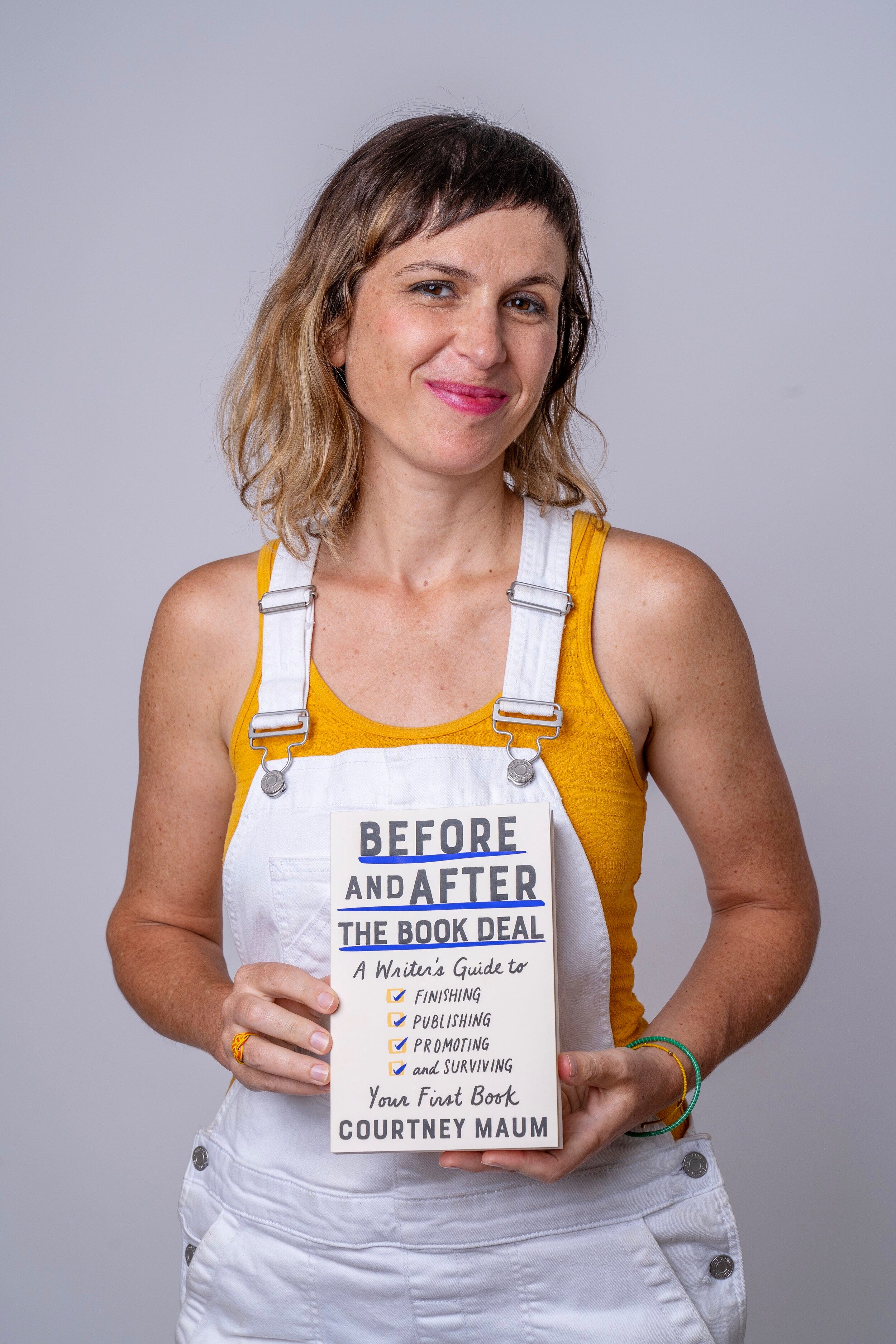
Two reasons you're not landing a memoir book deal in 2024, with Courtney Maum
Oct 1, 202400:42:46Tap to summarizeIn today’s episode I talk with author and creativity coach Courtney Maum of Before and After the Book Deal about what it means to write and publish memoir in 2024. She describes her own unconventional route into publishing, highlighting the importance of hard work and persistence over connections. She also shares insights into the craft of memoir, including the benefits of using a "dual timeline” structure, plus the need for writers to turn personal stories into universally relatable books. We also talk about the importance of publishing “off the book” pieces to gain attention, and the evolving landscape of self-publishing.Key Takeaways* There’s often a major disconnect between writers’ neuroses and what agents/editors think writers are worried about. This was a driving factor behind writing and publishing Before and After the Book Deal in 2020.* More than a developmental editor or book coach, Courtney calls herself a creativity coach. That reflects the core of her approach—diagnostic, focused on moving past emotional and psychological blocks, and providing “big picture” guidance.* Many writers of memoir set all the action in their books in the past; there’s no “present day” story in their books. This leads to “no forward momentum…no motor in the car,” as Courtney says. You can help resolve this issue by using a Dual Timeline structure.* In today’s market, writers of memoir also make the mistake of sticking to hyper-specific and personal stories. However, the books that are connecting most with publishers and agents now have a strong universal topic woven in. Again, a challenge that a Dual Timeline structure helps you address.* The idea that you’ll score a “quick Big 5, 6-figure book deal” in 2024 is a fantasy. Be prepared to put in hard work, and lots of trial and error with your agent queries, book drafts, proposals etc. Consider doing readings, book reviews, and publishing “off the book” pieces to help build your author platform.* Today many successful writers can move between self- and traditional publishing during their careers. Self-publishing can be a viable and lucrative option for authors, offering more control over their work and direct engagement with their audience.Discussed on this Episode* Before and After the Book Deal, by Courtney Maum. Buy it here.* Writing & Pitching Hybrid Memoir in Today’s Market was a course offered by Courtney Maum for Jane Friedman on June 26, 2024.* Memoir: Write a Personal Story for a Universal Audience is Courtney Maum’s online course introducing the “3-Act, Dual Timeline” structure* “Let’s Talk Self-Publishing,” published at Before and After the Book Deal, explores many of the same points Courtney makes on the showAbout Courtney MaumCourtney Maum is the author of five acclaimed books, including the groundbreaking publishing guide that Vanity Fair recently named one of the ten best books for writers, Before and After the Book Deal and the memoir The Year of the Horses, chosen by The Today Show as the best read for mental health awareness. Her parallel 20-year career in marketing and advertising has allowed Courtney to help writers improve their craft while also learning about the business of publishing so they can feel empowered—instead of bewildered—in a competitive and often classist industry. A Joyce Carol Oates prize nominee and frequently published essayist, Courtney writes across multiple genres and has published with the “Big 5,” Indies, Micro-presses, Audible and vanity presses, making her the perfect companion for the writing journey you are on. This is a public episode. If you would like to discuss this with other subscribers or get access to bonus episodes, visit bookiwanttowrite.substack.com
Transcribe →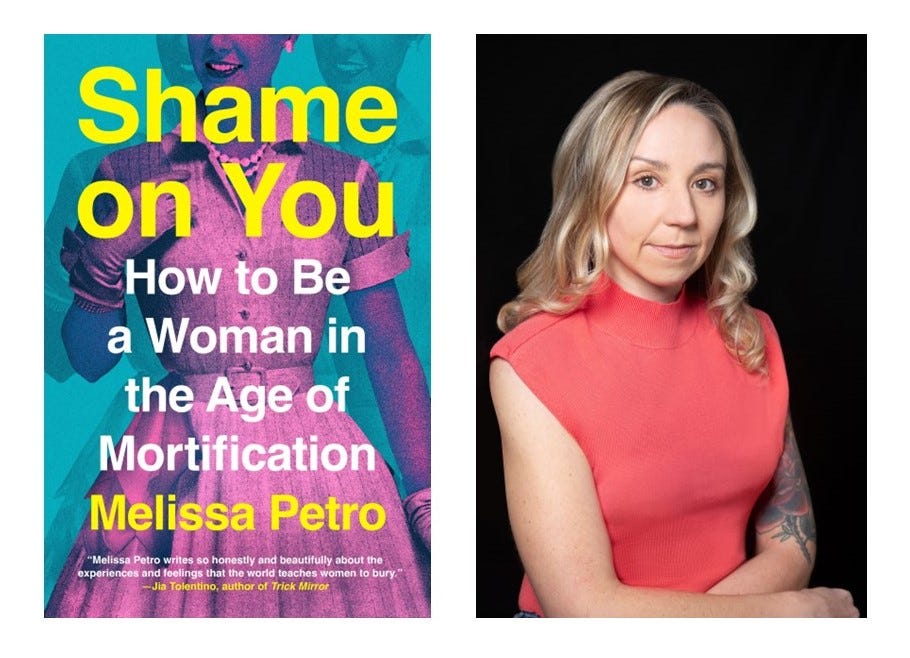
From a rejected memoir to a 6-figure book deal with Melissa Petro
Sep 11, 202400:39:23Tap to summarizeIn today’s episode I talk with author and cultural journalist Melissa Petro about her new book, Shame On: How to Be a Woman in the Age of Mortification. The book explores how, in a patriarchal society, shame is often weaponized against women, keeping them small and lessening their impact. Petro weaves in her own personal story, which included an early stint with sex work and her brush with public humiliation in 2011.We also talk about Petro’s 20-year journey to a six-figure book deal, the challenges she had selling a previous (PEN-nominated) memoir, and how becoming a mother triggered deeper insights into her own experience with shame. Her journey included interviews with over 150 people, which allowed her to understand how shame can be used as a tool for social control.----------“I had this idea that I was going to write a memoir. And for the next 20 something years, I wrote, edited, revised, rewrote, pursued agents, went to the New School [to study] creative nonfiction, and I really was determined to write and publish a memoir. Only recently did it become the project it is.”----------Key Takeaways* Shame as a weapon of control: The book argues that in a patriarchal society, women are indoctrinated to feel shame about almost every aspect of their lives—be it career, motherhood, or personal choices.* Intersection with motherhood: Melissa’s experience as a mother deeply influenced her understanding of shame. “The shame I experienced as a mother was so profound and familiar," she says. It gave her a broader perspective on societal expectations.* Hybrid memoir is a story bigger than yourself: A turning point in her writing journey came when her agent, Laura Mazer, told her she didn’t represent memoir. But she also suggested that her story could be about about something bigger. The work of excavating this bigger “what” shifted her writing career.* Becoming a “shame whisperer”: Beyond her own personal story, the book incorporates insights from over 150 interviews. Melissa describes herself as a “shame whisperer,” someone people naturally open up to with their deepest, most shameful experiences.* Confessional Essays: The confessional essay boom of the early 2010s was a pivotal moment for Petro and other women. Despite backlash, it gave women permission to tell their stories publicly, breaking down taboos. It led to stories about “complex sexual experiences, including assault and other forms of sexual violence,” which anticipated #MeToo by a few years.----------"Shame doesn’t do anything to make us better. It does not make us work harder. It doesn’t make us correct our behavior. Shame just suppresses us, puts us down, and keeps us from rising up."----------About Melissa PetroMelissa Petro is a journalist whose writing has been featured in The Washington Post, Allure, Cosmopolitan, Rolling Stone, Good Housekeeping, The Guardian, InStyle, and many other national publications. She was a finalist for the PEN/Fusion Emerging Writers Prize, and she holds a bachelor in Women’s Studies from Antioch and an MFA in Creative Nonfiction from The New School. She lives with her husband and two young children in Upstate New York.CreditsThis episode was edited and produced by Chérie Newman at Magpie Audio Productions. Theme music is "The Stone Mansion" by BlueDot Productions. This is a public episode. If you would like to discuss this with other subscribers or get access to bonus episodes, visit bookiwanttowrite.substack.com
Transcribe →
Book coach Joelle Hann: There's a big gap between the dream and the published book (Re-release)
Aug 28, 202400:31:11Tap to summarizeBook coach Joelle Hann—aka “The Brooklyn Book Doctor”—joins me to discuss the journey from book idea to finished product. Joelle delves into common obstacles for first-time authors, the transformative nature of writing, and the importance of mindset and resilience.She also shares insights from her Book Proposal Academy and highlights trends happening in the publishing industry, especially post-pandemic. Whether you’re stuck at the beginning or seeking to refine your manuscript, this episode provides great guidance on navigating the daunting path to publishing. (This episode was originally released in July 2023.)---------"When people get serious about writing a book and fulfilling this desire to have a book, that voice is really loud. Voice that says, no one wants to hear from you. This is not a good idea. It's already been done before. It's not interesting."---------Key Takeaways* What many writers need is “mindset guidance” and “expectations guidance,” says Joelle Hann.* Developmental editing vs. book coaching: It's not just about refining the manuscript but nurturing the author's confidence and creative process.* Traditional publishing has shifted, especially since the pandemic. Joelle highlights the pressures on big publishers and how it affects new authors trying to break in.* One thing that surprises Joelle—and flummoxes new authors—is that while they bring enthusiasm to the process, they also face a big crash when confronted with their inner demons.* “When you get serious about the thing you want to do, your inner resistance comes and says, hold on a second,” she says. One way around this? Introducing mindfulness and somatic techniques to help authors move past blocks.* As a book coach, Joelle emphasizes the transformative process of writing, which often reveals bigger personal revelations beyond just the book. For those who face down their inner critics, they often discover unexpected resilience—a key to successful authorship.---------"Editors can love a book and think it's phenomenal, still not be able to sign it because they don't have what they call a ‘vision’ for the book, which usually means they can't quite see directly how it'll turn into big sales…Now, that said, people are still getting book deals. My clients are still getting book deals. But it can take more work.”---------About Joelle Hann & the Book Proposal AcademyJoelle Hann is a book coach & writer helping authors write their books and proposals, discover their ideas, and harness their creative process. Her clients have been published with Big 5 and independent presses such as TarcherPerigee (Penguin Group), North Star Way (Simon & Schuster), Harper Wave, Workman, Wiley, Sounds True, Shambhala Publications, and more.Joelle’s Book Proposal Academy is a live, hands-on coaching program to help writers craft a top-tier book proposal, structure their book, write chapters, and prepare to become an author. Pitch a book that agents and editors are excited to buy!Past clients include authors Jillian Turecki, Sebene Selassie, Amanda Griffith-Atkins, Eileen Rosete, Catherine Simone Gray and more.This six-month program is the fast track to publishing and making book dreams come true. Learn more and apply here. The next cohort starts October 15th.CreditsThis episode was edited and produced by Chérie Newman at Magpie Audio Productions. Theme music is "The Stone Mansion" by BlueDot Productions. This is a public episode. If you would like to discuss this with other subscribers or get access to bonus episodes, visit bookiwanttowrite.substack.com
Transcribe →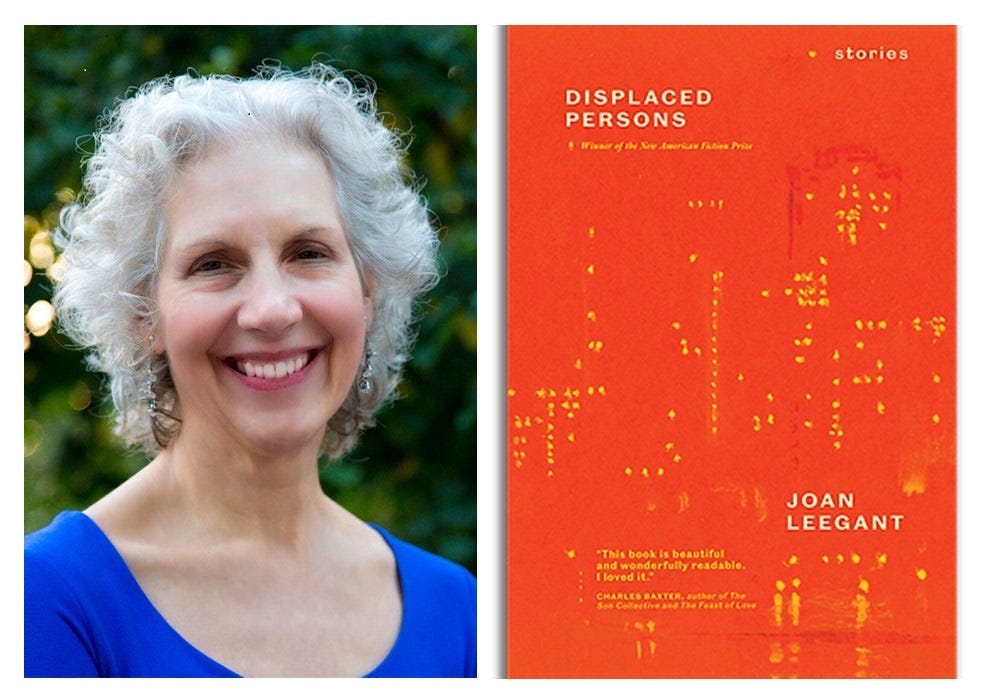
Joan Leegant:"I have no clue what I'm going to do when I sit down to write stories"
Aug 14, 202400:34:46Tap to summarizeIn today’s episode, I’m joined by Joan Leegant to discuss her new short story collection, Displaced Persons. Joan shares insights into her writing process, including how she often begins stories with no preset idea and allows stories to emerge from a first sentence. Many of Joan’s stories are set among immigrants and Americans living in Israel. And while Joan’s collection was accepted for publication before October 7th, it came in June, in the midst of a highly polarized and frightening time for people on every side of the current conflict. So we talk about what it’s been like for Jewish writers publishing today, and also the way that fiction allows for empathic connections not always available in daily life."My method of writing anything, particularly short stories, is that I have no clue what I'm going to do when I sit down to write it. I have no clue what it's going to be about." Key Takeaways* Joan's collection is set in Israel and America, focusing on displaced individuals. She highlights the interplay of naive Americans with complex realities, particularly in Israel.* A notable story, Displaced Persons, features an American teaching English to African refugees. Joan explores the absurdity of a country founded by displaced persons dealing with new displaced populations.* "The material just was kind of urging itself to come out," Joan says about the stories she wrote while working on other novels. It's a testament to the compelling nature of the themes she explores.* In Remittances, the narrator empathizes with marginalized workers in Tel Aviv. It's a story of immigrants in a land that symbolizes a second chance, reflecting Israel as a haven for those on the edge.* Another powerful story, Beautiful Souls, follows two American girls in Jerusalem. Their naivete leads them into dangerous situations, showcasing the often startling collision of American innocence with Israeli realities.* Joan’s stories on mental illness are deeply human, exploring family dynamics through the lens of mental health, not as a central theme but as a way to navigate complex relationships.* We discuss the impact of the Israel-Gaza war and the polarized publishing landscape. Though accepted before the October 7 attacks, Displaced Persons landed post-crisis, and Joan says she’s navigated the current landscape by focusing on the universal human elements of her stories.* Fiction is transformative. Joan cites the power of fiction to expand empathy, offering a “glimpse into some deeper truth.” It’s about illuminating the complexities of life through imagined worlds.* Leegant’s belief in the power of fiction to expand empathy is echoed by George Saunders, who describes a story as a "black box" that provides a deeper glimpse into human nature. "You need to illuminate human truth, but you do it through imagined stories," says Leegant.* Joan’s idea of “associative leaps” in writing, where characters’ truths emerge organically, enriches her storytelling. Her characters' voices and feelings drive the narrative, rather than a pre-planned agenda.* On navigating the current volatile landscape: Joan learned to balance sensitivity with openness, not shying away from broader literary and academic engagements, while being mindful of the potential for polarization.* During a recent visit to Israel, Joan facilitated writing workshops helping teachers process trauma through expressive writing, a poignant testament to the healing power of storytelling.* We discuss fiction’s ability to explore complex human conditions and to bridge gaps of empathy and understanding. "Our capacity should not be just read about people we already know, or we are exactly alike, but people we are nothing like," Leegant remarks."Our capacity should not be just read about people we already know, or we are exactly alike, but people we are nothing like." About Joan LeegantJoan Leegant's new story collection, Displaced Persons, won the New American Fiction Prize. Joan's first collection, An Hour in Paradise, won the PEN/New England Book Award and the Wallant Award, and was a finalist for the National Jewish Book Award and a Barnes & Noble Discover Great New Writers pick. She is also the author of a novel, Wherever You Go, named a "Significant Jewish Book" by the Union of Reform Judaism.Formerly a lawyer, from 2007 to 2013 Joan was the visiting writer at Bar-Ilan University outside Tel Aviv where she also gave talks on American literature and culture under the auspices of the U.S. Embassy and was a volunteer ESL teacher for African refugees and asylum seekers. She has taught at Harvard, Oklahoma State, and Cornish College in Seattle where she was the writer-in-residence at Hugo HouseAdditional Links* Displaced Persons has been selected for Hadassah’s One Book, One Hadassah read! Register here to join the virtual conversation on August 22 at 7 PM (ET)* Joan Leegant’s website and events schedule* On Moral Fiction (Kirkus Review), by John Gardner, 1978* Ron Carlson Writes a Story, by Ron Carlson* “Writing About Jews,” by Philip Roth, Commentary Magazine, December 1963.CreditsThis episode was produced by Magpie Audio Productions. Theme music is "The Stone Mansion" by BlueDot Productions. This is a public episode. If you would like to discuss this with other subscribers or get access to bonus episodes, visit bookiwanttowrite.substack.com
Transcribe →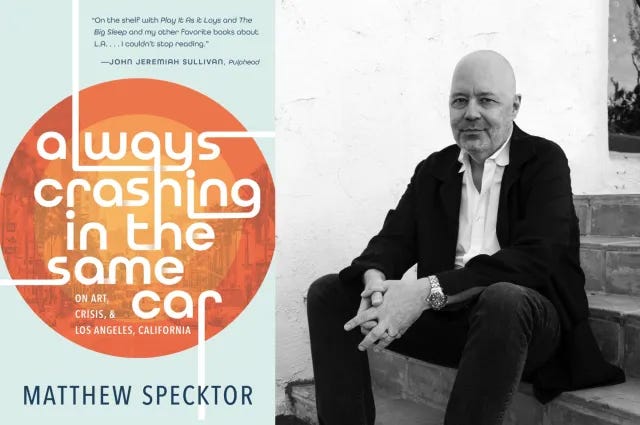
Matthew Specktor on hybrid memoir, Hollywood failure & that time Marlon Brando left a voicemail
Jul 31, 202400:38:28Tap to summarizeIn this episode, I talk with author and novelist about his recent hybrid memoir and cultural exploration, Always Crashing in the Same Car. We discuss his fascination with figures who faced creative crises in Hollywood, from F. Scott Fitzgerald, filmmaker Hal Ashby or musician Warren Zevon to more overlooked but similarly brilliant figures like Carole Eastman, the screenwriter of the 1970s classic Five Easy Pieces.We also explore the realities of growing up in LA, including being “celebrity-adjacent.” That’s perhaps best illustrated by the time Marlon Brando left an incredible monologue in the form of a voicemail. We do a deep dive into the attraction of hybrid memoir for fiction writer, Matthew’s approach to research, and whether it’s possible any longer to be a middle-class creative in Hollywood.--------------------------“All of those kind of impulses fused in me, and eventually, and I sort of realized, like, oh, this is what I want to write. I want to write a book that's a memoir that isn't about me, or a memoir that's only kind of, you know, partly about me.”--------------------------Key Takeaways* Always Crashing In the Same Car pays homage to figures who've faced both genius and marginalization in Hollywood, including Thomas McGuane, Renata Adler, Carole Eastman, Eleanor Perry, Hal Ashby, Michael Cimino, Warren Zevon & more. The book is about “those who failed, faltered, and whose triumphs are punctuated by flops...”* Matthew shares his fascination with Carol Eastman, best known for Five Easy Pieces. He was deeply touched by her prose writings, comparing her to poets like Hart Crane and Wallace Stevens.* The book and the interview also delves more deeply into women's contributions to Hollywood, focusing on other overlooked talents like Eleanor Perry and Elaine May. Matthew reflects on his mother, a one-time screenwriter, and how her generation had less opportunity to develop their skills.* Why a hybrid memoir? Matthew was reading, and inspired by, writers like Hilton Als, Heidi Julavits, and Olivia Laing. He wanted to create a narrative that wasn’t limited to—or rather moved beyond—the self, weaving together cultural criticism about Hollywood and creative crises.* We talk a lot about voice, which Matthew says is crucial for him to discover early on. “Once I can locate the voice for any piece of writing... I have it in the pocket,” he says. The narrator of this book blends personal reflections with a noir quality, he says.* Matthew sees himself as a novelist at heart. He considers the narrative tools of a novelist indispensable, even when writing memoirs and cultural critiques: “I am fundamentally a novelist….I think that's part of being a fiction writer or novelist is, you know, anything that you write is a kind of criticism in code. You're always responding to other texts.”* Matthew begins by explaining his unique research style: "I'm kind of ravenous and a little deranged about it…” His research process involves intuitive dives, like a two-day blitz through Carol Eastman's archives.* The discussion also touched on Matthew's upbringing with a mom who was a one-time screenwriter and who crossed the picket line during one writer’s strike, and his father, who had modest beginnings but went on to become a famous Hollywood “superagent” representing Marlon Brando, Morgan Freeman, Helen Mirren & many others.* At the same time, Matthew explores misconceptions around Hollywood glitz, addressing the middle-class reality of many involved in the film industry. For a long-time, Hollywood could support such middle-class creatives, Matthew contends, something that is no longer really possible.* Addressing the evolution of the entertainment industry, Matthew notes the shift towards debt servicing, influenced by corporate acquisitions. This financial pragmatism often overrides the creative impulse, squeezing the middle class out.* Another takeaway? The creative world, especially in Hollywood, is fraught with periods of drift and struggle. In one sense, Always Crashing In the Same Car is a love letter to that state of things.--------------------------"I still kind of think of [Always Crashing…] as being secretly a novel. Not because it's full of made up s**t…but because I think sometimes our idea of what a novel is is pretty limited. You know, there's no reason why a novel can't be, like, 98% fact."--------------------------About Matthew SpecktorMatthew Specktor’s books include the novels That Summertime Sound and American Dream Machine, which was long-listed for the Folio Prize; the memoir-in-criticism Always Crashing in The Same Car: On Art, Crisis, and Los Angeles, California, and The Golden Hour, forthcoming from Ecco Press. Born in Los Angeles, he received his MFA in Creative Writing from Warren Wilson College in 2009. His writing has appeared in the New York Times, GQ, The Paris Review, Tin House, Black Clock, and numerous other periodicals and anthologies. He is a founding editor of the Los Angles Review of Books.Resources:Books by Matthew Specktor:* Always Crashing in the Same Car: On Art, Crisis, and Los Angeles, California* American Dream Machine* That Summertime Sound* Slow Days, Fast Company by Eve Babitz, introduction by Matthew SpecktorReferenced on this episode:* The Women, by Hilton Als* Low, by David Bowie* The Great Gatsby, This Side of Paradise, The Last Tycoon, The Pat Hobby Stories, and The Crack-Up, by F. Scott Fitzgerald* F. Scott Fitzgerald on Writing, edited by Larry W. Phillips* The Folded Clock: A Diary, by Heidi Julavits* The Lonely City, by Olivia Laing* 300 Arguments, by Sarah Manguso* “Bombast: Carole Eastman,” by Nick Pinkerton* “The Life and Death of Hollywood,” by Daniel Bessner, Harper’s, May 2024.CreditsThis episode was produced by Magpie Audio Productions. Theme music is "The Stone Mansion" by BlueDot Productions. This is a public episode. If you would like to discuss this with other subscribers or get access to bonus episodes, visit bookiwanttowrite.substack.com
Transcribe →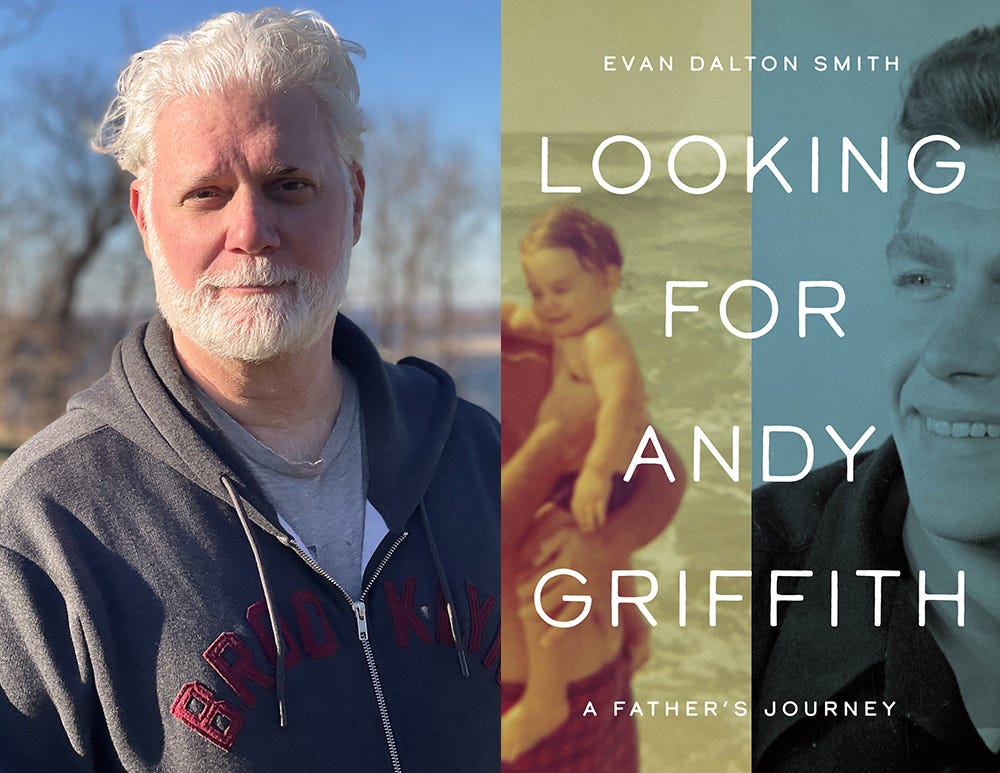
Evan Dalton Smith:"'You can make a career out of writing weird, little books'"
Jul 17, 202400:32:10Tap to summarizeToday’s guest is the writer and poet Evan Dalton Smith. His first book, part personal story and part cultural study, is called Looking for Andy Griffith: A Father’s Journey. We talk about the power of nostalgia, finding personal resilience, and pursuing meaningful storytelling.We also discuss the nearly decade-long journey of taking an 8,200-word essay (published in the Los Angeles Review of Books in 2013) and turning it into a full-length manuscript. And we talk about Andy Griffith's impact on pop culture, Evan's own experiences with father figures, and the challenges of writing through life's upheavals.I think Evan’s story exemplifies the intense and highly personal journey of writing a book—and how the most unexpected things can happen once you embark on that journey.--------------“When we first met, [my agent said], ‘this is a weird little book, but you can make a career out of writing a lot of weird little books.’ —Evan Dalton Smith--------------KEY TAKEAWAYS* The book explores the power of cultural nostalgia: Nostalgia is a power force in our media consumption. And The Andy Griffith Show is a rare phenomenon, like Star Trek or the Twilight Zone, in that its become a touchstone for many generations of viewers. Even in the 1960s, the show’s writers were feeling nostalgic—for them, the show’s setting and characters were based on their own experiences of the 1930s.* Evan's personal connection to the show is rooted in his childhood experiences of loss and search for father figures. Evan’s father was tragically killed in an car crash when he was 5, and his mother grew dependant on narcotics. Discovering The Andy Griffith Show provided something stable missing at home. What Evan discovered writing this book is that the show’s mythic, idealized version of small-town America has provided a similar balm for its many fans.* The journey of transforming an essay into a book-length manuscript can be a tough one. Transforming an essay into a full-length book can be fraught with challenges, especially when it involves personal stories interwoven with cultural analysis. Particularly when, as in Smith’s case, real-life intervenes.* Writing a book that balances cultural inquiry with personal narrative means pushing past discomfort into telling your own story. “I did struggle putting myself into the narrative…I added a lot more about my life than I intended to,” he says.* Often times one book project will point to the next one. In this book, Evan explored his mother’s struggle with narcotics, something he hadn’t originally planned to do. But it also laid the groundwork for his next book, which will wrestle with the personal and cultural costs of this particular drug.* Evan’s story dramatizes the very real life struggles many authors face to balance their writing with their life. Over the decade of this book’s journey, Evan went through an unexpected divorce and relocation, and he found himself working multiple jobs. In the end, it’s always about figuring out figuring out how to make use of little bits of time and learning to become more resourceful.--------------"I learned to write on my phone, which is annoying for the people in my life [who] think I'm just, you know, jerking around on my phone. But a lot of times I'm working." —Evan Dalton Smith--------------ABOUT EVAN DALTON SMITHEvan’s writing has appeared in the Washington Post, LA Times, Slate, Salon, LA Review of Books, Paris Review, Ploughshares, The New Yorker, and elsewhere.Formerly, he served as Associate Web Editor at Poets & Writers, Inc., and Director of Publications for the Student Press Initiative at Teachers College, Columbia University.Originally a native of North Carolina, he now lives in Ipswich, Massachusetts. Looking for Andy Griffith: A Father’s Story is his first book.DISCUSSED* Looking for Andy Griffith: A Father’s Story UNC Press | Bookshop | Amazon* Our Town: Andy Griffith and the Humor of Mourning, Los Angeles Review of Books, April 20, 2013* “Ten Questions for Evan Dalton Smith,” Poets & Writers, May 28, 2024* Out of Sheer Rage, by Geoff Dyer* Another B******t Night in Suck City, by Nick Flynn* Sherman’s March, a classic documentary by Ross McElweeCREDITSThis episode was produced by Magpie Audio Productions. Theme music is "The Stone Mansion" by BlueDot Productions. This is a public episode. If you would like to discuss this with other subscribers or get access to bonus episodes, visit bookiwanttowrite.substack.com
Transcribe →
How Jennifer Lang turned a "boring" 90K-word book into a 14K-word gem...& got her groove back
Jul 3, 202400:30:24Tap to summarizeToday’s episode features my interview with Jennifer Lang. Her memoir, Places We Left Behind, is a marvel of brevity and form. It’s the story of how one woman, a hybrid of American-French-Israeli identities, navigates cultural and religious differences with her husband over the course of three decades, as her family searches for what it means to find a sense of home.In our interview, Jennifer shares how she transformed a “long-winded, boring, and flat” 90,000-word draft into a concise and sharp 14,000-word memoir told through a fragmented structure—what she’s calling a “memoir-in-miniature.” She also addresses the critical feedback from a developmental editor, which helped her uncover an innovative structure.Finally, we talk about writing about other”: the emotional and creative negotiations involved in writing about her husband and their marriage, revealing how this process has both challenged and strengthened their relationship.----------------------"I had a very traditional manuscript of over 90,000 words when all was said and done. And it was really long-winded and boring and flat, and I hated it…I hired a developmental editor who gave me a lot of feedback. And one of the last things she said was, put it away for a while. Just let all of this sink in. And I think that was the best advice she gave me."----------------------KEY TAKEAWAYS* Transformation Through Editing: Jennifer Lang's journey from a 90,000-word manuscript to a 14,000-word concise and effective memoir underscores the fact that it can take time to figure out to figure out your story, and that brevity can be a crucial factor to remember.* Cultural Identity and Belonging: The memoir reflects Jennifer's complex relationship with her Jewish identity and her experiences living in California, France, and Israel.* Marriage and Memoir Writing: Writing about others is one of the most fraught areas of memoir for a reason. And writing about intimate relationships requires especially careful consideration. In Jennifer’s case, it ended up unexpectedly strengthening the bond with her husband.* Innovative Structure & Form: The fragmented, playful structure of Jennifer's memoir, with elements like strike-throughs and “chapterettes” as she likes to call them, adds a unique layer of engagement and depth to her storytelling.* Literary Community Engagement: Jennifer's work with the Israel Writer Studio highlights the importance of community in a place with fewer English-language writers.----------------------"The level of pain, trauma, loss is so beyond. I don't know how we're going to get out of it." —about the impact of Oct 7, 2023 on the Israeli psyche----------------------NOTABLE QUOTES"I have been writing around it for years, if not decades. I have been writing about longing, belonging, culture, language, community, other, and home. In short, in long, in essay, in short, memoir, in flash. I just kept going around and around and finally had time to figure out how to get through it." (0:02:50)"I really feel like the story of me bouncing between cultures starts way back. Like kindergarten way back." (0:03:46)"I think that when we write long or when we write without any kind of constraint, we are lazy with our word choice. And so putting the constraint on makes a writer understand that every word counts." (0:21:16)"If you're going to reveal a character's underbelly, you have to reveal your own. If you're going to fault a character for their flaw, you have to do the same for yourself." (0:24:01)"I think I did anything but make him a villain. I think in the end, it's like a love letter." (0:24:41)ABOUT TODAY'S GUESTJennifer Lang was born in the San Francisco Bay Area, lives in Tel Aviv, and runs Israel Writers Studio. Her essays have appeared in the Baltimore Review, Crab Orchard Review, Under the Sun, Ascent, Consequence, and elsewhere. A Pushcart Prize and Best American Essays nominee, she holds an MFA from Vermont College of Fine Arts and serve as Assistant Editor for Brevity.She is the author of the memoir Places We Left Behind. Her forthcoming memoir Landed: A Yogi's Memoir in Pieces and Poses, will be published by Vine Leaves Press in October 2024. Building off themes explored in her first memoir, Landed spans seven years (and then some), each punctuated with chakra wisdom from nationally-acclaimed Rodney Yee, her first teacher.LINKS* Jennifer Lang at the Israel Writer Studio* Places We Left Behind: A Memoir-in-Miniature* Landed: A Yogi's Memoir in Pieces and Poses (October 15)* “From Writer to Publicist: An Unexpected Pivot,” Brevity, March 15, 2023.CREDITSThis episode was produced by Magpie Audio Productions. Theme music is "The Stone Mansion" by BlueDot Productions. This is a public episode. If you would like to discuss this with other subscribers or get access to bonus episodes, visit bookiwanttowrite.substack.com
Transcribe →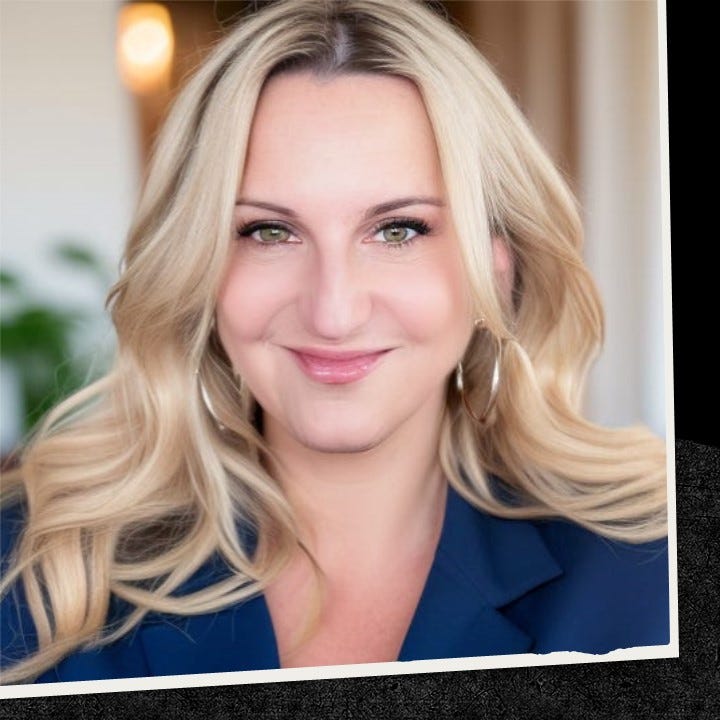
What do you need to know about marketing your book in 2024? with Kathleen Schmidt
Feb 21, 202400:34:13Tap to summarizeLast year, I came across an essay called “Book Publishing is Broken” by today’s podcast guest, Kathleen Schmidt .Using her decades of experience in book PR & strategy, Kathleen laid out several reasons why traditional publishing fails writers. (If you haven’t already read that post, you’ll get to hear Kathleen’s reasons in our interview).And the essay really stood out…not just because Kathleen presented solutions to the problems she diagnosed…but also because her perspective was clear-sighted, well-informed, but also so honest, direct, and personal.I’ve been hooked on Publishing Confidential , Kathleen’s Substack newsletter, ever since. With over 5,000 subscribers, I think of it as one of the must-reads for any writer looking to understand today’s publishing landscape.In our interview, we talk about that landscape, about the utility of hiring an independent publicist, and the value of creating work that reaches beyond traditional media outlets.We also discuss why memoirs are one of the hardest categories for agents to sell right now, and what authors can consider to make their books more marketable.Kathleen Schmidt is the Founder and President of Kathleen Schmidt Public Relations, a boutique firm specializing in branding, PR, marketing, consulting, and business strategy for authors, publishers, and booksellers. She also writes and publishes the Publishing Confidential newsletter.Warning: this episode includes a brief mention of suicidal ideation. If you or someone you love is struggling with a mental health crisis, you can contact the National Suicide Prevention Lifeline at 1-800-273-TALK (8255). (In Spanish, dial 1-888-628-9454). Some of my biggest takeaways:Publishing too many books and lack of marketing support are primary reasons why the industry struggles.Publishers produce more books than the market can sustain, often neglecting to back many with substantial marketing efforts. "They publish far too many books," Schmidt states unequivocally. It's a perplexing situation that challenges authors and industry insiders alike. The ramifications of this are profound—not just for the discoverability and success of individual titles but for the long-term sustainability of publishing entities themselves.Schmidt expresses her consternation over the lack of direction regarding advances and acquisitions: "It's all kind of garbled and I feel like if you're not able to pay authors an amount that they can live on, what are we doing?" These pivotal industry dynamics are not just numbers on a spreadsheet but represent the livelihoods of creatives whose stories shape our culture.Authors need to participate actively in the marketing and publicity of their books, using strategies tailored to their specific audience.In the digital age, a robust social media presence is often considered non-negotiable. But where should authors concentrate their efforts? Schmidt advocates for targeted strategies—"find where your audience lives when they're not reading books"—and identifies threads and Instagram as effective platforms. However, she aptly recognizes that "every author should do" does not mean straitjacketing all writers into a one-size-fits-all approach. Instead, authors need to be authentic, engage with their readers, and leverage digital surrogates when necessary to carry their message.Schmidt's distinction between pitch-focused publicity versus sales-driven strategies underscores the complexity of book marketing in the current landscape. "I am the publicist who thinks about how are we going to sell the book?" she poses, aligning author success with commercial viability and practical application.Memoir faces challenges due to market oversaturation and authors should consider additional angles to be sellable.The realm of memoir publishing is undergoing profound change, leaving many authors pondering the fate of their personal stories. With the market oversaturated by similar stories, distinguishing a memoir requires more than just a riveting life story—it requires a unique angle or an additional layer of value such as the 'Memoir Plus' concept.Schmidt pushes authors to grapple with the real question: "is it a book or is it an essay?" This discernment is crucial in a world where the distinction between public sharing and a publishable memoir is increasingly blurred by the constancy of social media narratives. The trend now demands memoirists to consider if their life narratives are enough to stand alone as books or if they are better shared in smaller, perhaps digital, formats."Know who your audience is. Be very specific about that because, again, your book is not for everyone."Writing and sharing personal stories can connect with audiences deeply, but authors should thoughtfully consider the platform and format.In a moment of vulnerability, Schmidt shares her battles with depression, shaping a compelling narrative of resilience. This particular insight is significant not only for its personal nature but for its illustration of the human element that pervades the publishing world—a reminder that beneath industry trends and strategies lie individual stories of struggle and perseverance.Writing her substac essay on depression was both a personal catharsis and a means to reach others amidst their trials. Her advice resonates powerfully: "tomorrow is a new day... it's a brave decision to be alive."Additional Links:* Kathleen Schmidt Public Relations* Find Kathleen on Twitter | Threads | Instagram | Tiktok* “Do You Need to Build a Platform?” by Kathleen Schmidt, Feb 6 2024.* “Book Publishing is Broken,” by Kathleen Schmidt, July 19, 2023.* “A Personal Note About Mental Health,” by Kathleen Schmidt, May 12, 2023.CreditsThis episode was produced by Magpie Audio Productions. Theme music is "The Stone Mansion" by BlueDot Productions. This is a public episode. If you would like to discuss this with other subscribers or get access to bonus episodes, visit bookiwanttowrite.substack.com
Transcribe →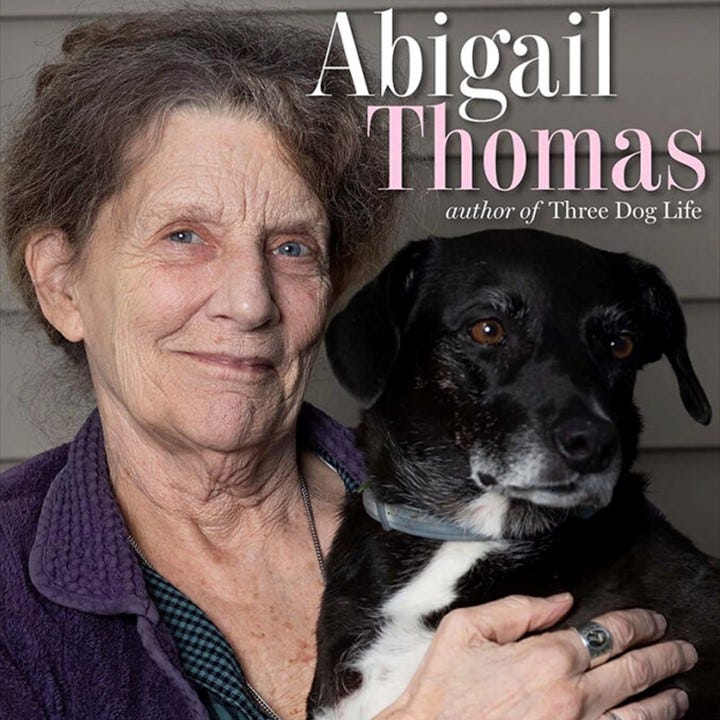
The past is every bit as unpredictable as the future, with Abigail Thomas
Feb 14, 202400:29:04Tap to summarizeIn this converation with memoirist Abigail Thomas, we discuss the backstory of writing Safekeeping, and that now-classic memoir was initially turned down by all the editors the book was sent, except for one. We talk about how crafting a memoir-in-fragments like Safekeeping allows a writer to depict memories in a way a more conventional structure doesn’t permit. She talks about why writing what you don’t remember is as important as what you do; and the value of following what interests and obsesses you, even if it doesn't seem to go anywhere at first.Thomas’s is one of the great voices in memoir—shrewd, warm, devoid of self-pity—and like all wise teachers, she imparts insights about a life well spent, even when talking about a book well-crafted.This conversation was recorded in 2022 and just updated.Abigail Thomas is the author of several memoirs, including Safekeeping, A Three Dog Life, What Comes Next and How to Like it, and most recently Still Life at Eighty, as well as three works of fiction: Getting Over Tom, An Actual Life, and Herb’s Pajamas.Some of my biggest takeaways“Chronological order makes little sense to me…”Most of Thomas’s memoirs eschew the conventional chronological approach, opting instead for fragmented structures that mirror the way memory works. Abigail Thomas believes that "life has been lived like a series of moments," and memoirs are stronger when they reflect that."Well, I will confess that I have a poor memory, except for the things I remember. So putting them in chronological order makes very little sense to me. It's why this now? Why am I thinking of this now? Why this memory? Write it down. You'll find out why. The trick is not to boss them around, you know. Just let them come, and they will."This memoir-in-fragments approach unexpectedly draws the reader inSafekeeping, for example, is comprised of dozens of short sections—some four or five pages, others as brief as a single sentence. Then there’s the narrator herself, frequently switching between past and present tense, or between first- and third-person.With all that lack of connective tissue, all that shifting of tenses and point-of-view, you’d expect the narrative flow to be constantly disrupted. Instead this approach creates a genuine connection with readers, in part because it invites them to piece together the narrative puzzleThe key to writing a great memoir-in-fragments is to have a strong, unified voiceMarried for the first time at 18, remarried at 27—Abigail Thomas’s life was full of wrong turns. She had a lot of living under her belt. Yet the narrator here keeps things light and crisp, avoiding self-judgment. Instead, here the persona is vulnerable, startlingly honest, unsentimental, wry, and above all, entertaining.In The Situation and the Story, Vivian Gornick writes that great memoirs feature a “truth-telling” narrator. We trust the voices of George Orwell, Annie Dillard, or James Baldwin because they seem so honest and self-aware. Thomas’s narrator is one of these."The more vulnerable you make yourself, the stronger you become”Thomas urges writers to be honest and vulnerable, since revealing truths about oneself tends to have a liberating effect. This openness serves as a conduit through which readers can see their truths reflected in the author’s life, reinforcing the fact we all tend to feel similar things inside.The key is to write without an agenda—to connect with an emotion and let go of outcomes.“You need to write about the stuff you don't wanna write about…[but] you have to find a side door, and it isn't therapy. Writing isn't therapy. But if you're truthful, and honest, and write what you need to write, it has the effect of you've made something out of it separate from yourself, you've revealed things to yourself about yourself, and it's a way of forgiving yourself, you know, and others.”“The past is every bit as unpredictable as the future”The unpredictable nature of memory can be troubling for both writer and reader. Yet, Thomas says that this unpredictability is where the real magic of memoir writing lies. The unpredictable becomes an asset, turning writing into a journey of self-discovery and an act of creative courage.“I don't believe in chronology. And the older you get, the more you don't believe in chronology or even time. What is it? I mean, I'm at the age now where I live entirely in the moment. Sometimes the moment is a good one, sometimes it's a more interesting one, but that's where I am. I never think about the future. I do have memories, and I write about them because I wrote somewhere, ‘You discover that the past is every bit as unpredictable as the future.’ And for me, the future is behind me. You know, I don't have... I just have now.”What you don’t remember can be as powerful as what you doMany writers (me included) tend to get hung up by the fact they don’t remember enough when it comes to memoir. But embracing the fallability of memory is exactly the point of memoir, says Thomas. It’s what makes a narrator more authentic—and believable:“I really do think that what you don't remember belongs in there, because in the course of writing this, you may begin to remember, or you may begin to remember why you don't remember. But it is interesting for the reader to know that the writer is at least honest enough to say, ‘I don't remember why I did this. I don't remember what came before,’ because it's so human.”Discussed on this episode* “Getting Started” - reflections on how Abby started writing Safekeeping* Safekeeping: Some True Stories from a Life Bookshop.org | Amazon* What Comes Next and How to Like it Bookshop.org | Amazon* Still Life at Eighty: The Next Interesting Thing Bookshop.org | The Golden Notebook | Amazon* Read my essay “How to create narrative tension in a memoir-in-fragments”CreditsThis episode was produced by Magpie Audio Productions. Theme music is "The Stone Mansion" by BlueDot Productions. This is a public episode. If you would like to discuss this with other subscribers or get access to bonus episodes, visit bookiwanttowrite.substack.com
Transcribe →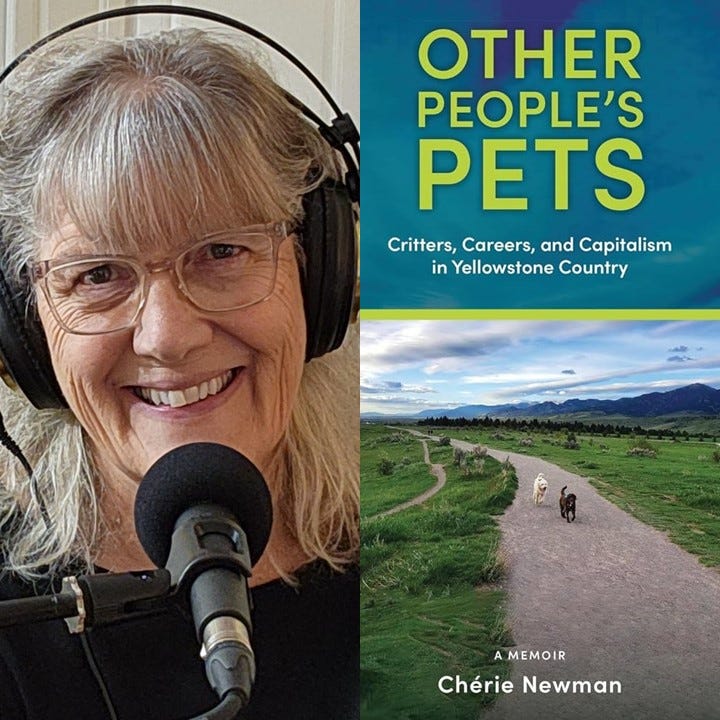
From Pet-Sitting to Publishing, with Chérie Newman
Feb 7, 202400:33:08Tap to summarizeIn this episode, I talk with author, musician and audio producer Chérie Newman about her humorous experiences pet-sitting unruly critters during the pandemic. The need to turn this one-time side hustle into a fulltime gig coincided with a more sobering reality: the way that wealthy out-of-state residents reshaped her hometown of Bozeman, Montana.Newman merges both stories into her debut memoir, Other People’s Pets: Critters, Careers, and Capitalism in Yellowstone Country. We also discuss her highly focused approach to writing, which helped her complete a first draft of her memoir in 83 days. And we delve into her decision to pursue an unconventional publishing route, one that allowed her to retain control and profits, and permitted her to get her book out quickly.Chérie Newman is a former producer and and on-air host for Montana Public Radio, and a freelance writer. She founded a weekly literary program, The Write Question, which is still broadcast on several public radio stations, and her articles and essays have appeared in many publications. She is the owner of Magpie Audio Productions, and produces The Book I Had to Write podcast. Some of my biggest takeaways:Chérie was compelled to write Other People's Pets less as a typical “feel good” story and more to explore the humorous challenges of corraling disobedient pets—and her own deep connection to animals.In this interview, Newman describes how she set about writing her memoir after frequently hearing from friends that she ought to record her stories. But while the unexpected challenges she faced pet-sitting unruly dogs made for humorous stories, the reality of her job sometimes left her unmoored. "I came away from this year of intense pet sitting with a little bit of PTSD," she says.The pandemic brought about immediate and dramatic changes to Bozeman, Montana as real estate prices soared and community dynamics shifted. Newman's memoir addresses some of the significant societal shifts she saw in her home city of Bozeman, Montana during the pandemic. And our interview highlights rapid socioeconomic changes, with real estate prices doubling and the influx of people seeking “the last best place,” as writer William Kittredge dubbed Montana.One of the drivers of this influx was no doubt a glorified depiction of Montana in shows like Yellowstone, which don’t have a lot of basis in reality, at least as Newman sees it. She juxtaposes media depictions of Montana with some of starker realities for long-term residents.People were moving here so fast that there was no place for anybody to live. We started getting, for the first time, rows and rows of RVs parked on streets that were near places that were going to be subdivisions but weren't yet. And it was just insanity.This phenomenon, fueled by the pandemic, led to a bifurcation of the local community where “there's a lot of animosity between people who've lived here for a long time and people who've moved in.”Newman set an ambitious and structured writing goal, completing the first draft of her book in less than her goal of 90 days…While Other People’s Pets isn’t Newman’s first attempt at a book, it’s one she was able to draft in record speed, thanks in part to her discipline of setting a writing schedule of (at least) 90 minutes a day for 90 days, and the transformational journey of taking that manuscript through numerous drafts.And so there were some times when it would be 7.30 at night and I still hadn't done my 90 minutes, but because I had this little chart on the wall and I was making, I was ticking off….I committed to those 90 days, and I committed to those 90 minutes, and I wasn't gonna let bad self-confidence defeat me. …But the book really came together in revisions.In this interview we also discuss the ways Newman’s approach mimicked but also diverged from strategies such as one recommended by Allison K. Williams in her book Seven Drafts: Self-Edit Like a Pro from Blank Page to Book.I did pay attention to [Williams’s] Seven Drafts but I just also went way beyond seven drafts because every time I went through it I found a way to make it better and I found a way to make it more succinct and I found a way to say what I wanted to say in a richer, deeper, clearer way.Choosing the Path Less Traveled in PublishingThe publishing journey that Newman chose reflects a rising trend among authors seeking greater autonomy. She discusses the importance of time, quality control, and financial considerations in her decision to forgo the search for an agent and large publishing deal.In her case, Newman chose a publisher that served as both a curator and distributor, enabling her to maintain control over the final product and gain a more significant portion of profits from sales.In many ways, Newman’s approach is also indicative of the changing relationship to hybrid and self-publishing, as authors now feel more empowered to make decisions that align their financial goals with their visions for their work. "I decided I didn't want to... wait two years to have my book published and getting none of thse [returns],” she says.Discussed on this show* Other People’s Pet: Critters, Careers, and Capitalism in Yellowstone Country Bookshop.org | Barnes & Noble | Amazon* Magpie Studio Productions, specializing in storytelling and podcast production* “Economic Disparity in the Treasure State,” blog post about economic realities in Montana* “How to Write a Book” blog post about publishing Other People’s Pets* Listen to my episode with editor Allison K. Williams, author of Seven DraftsDid you enjoy today’s episode?Please consider leaving a review on Apple Podcasts. Reviews really help the show get discovered by new listeners! This is a public episode. If you would like to discuss this with other subscribers or get access to bonus episodes, visit bookiwanttowrite.substack.com
Transcribe →