Podcast
The Deep dive podcast
Hosted by Eric Demers · EN
Welcome to "The Deep Dive" podcast, your ultimate exploration into the most intriguing and thought-provoking topics of our time. Hosted by passionate storytellers and curious minds, we embark on a journey through the realms of science fiction and reality, bridging the gap between imagination and scientific possibility.
In each episode, we delve into the captivating world of science fiction literature, offering in-depth reviews and discussions on the latest and greatest books that transport you to otherworldly dimensions. From classic masterpieces to contemporary gems, we analyze the themes, characters, and futuristic technologies that fuel our imaginations.
But we don't stop there. "The Deep Dive" goes beyond fiction to explore real-life scientific phenomena that challenge our understanding of the universe. Join us as we unravel the mysteries of time travel, quantum mechanics, and the potential for parallel universes. We interview leading scientists, authors, and thinkers who share their insights and groundbreaking research, bringing you closer to the cutting edge of discovery.
With a perfect blend of storytelling and scientific inquiry, "The Deep Dive" is your go-to podcast for expanding your horizons and satisfying your intellectual curiosity. Whether you're a science fiction aficionado or a science enthusiast, our show promises to ignite your imagination and leave you pondering the possibilities. Tune in, and let's dive deep into the wonders of the unknown together.
16episodes
Episodes
Newest firstAll episodes

Global Trade 2026: Nearshoring, Arctic Routes, and Green Fuels
May 3000:39:27Tap to summarizeGlobal trade is entering one of its most dramatic rewrites since containerisation, and this episode of The Deep Dive takes you straight into the engine room of that transformation. We explore how nearshoring and additive manufacturing are reshaping supply chains once stretched thin across continents, replacing fragility with regional resilience. We look north—far north—to the emerging Arctic shipping corridors, where melting sea ice is opening a controversial shortcut that could redraw global logistics maps. And we examine the race toward green fuels like ammonia and methanol, technologies that promise zero‑emission shipping but demand massive infrastructure, political will, and a new generation of digitally fluent maritime professionals.This is a world where automation meets decarbonisation, where ports become data hubs, and where the pressure of environmental regulation forces innovation at a pace the industry has never seen. By 2050, the maritime sector may look nothing like the one we know today—leaner, cleaner, and far more regionalised. But the path there is anything but simple. Join us as we unpack the technologies, trade routes, and geopolitical tensions steering the future of global commerce in 2026 and beyond.
Transcribe →
The Next Frontier of Sustainable and Autonomous Aviation
May 2300:52:52Tap to summarizeA new era of flight is taking shape—one where aircraft are cleaner, quieter, smarter, and built for a world that can no longer afford the old way of flying. In this episode of The Deep Dive, we explore how the aviation industry is reinventing itself from the wings up.Across the sector, engineers are abandoning traditional tube‑and‑wing designs in favour of blended‑wing bodies that slash drag and fuel burn. Hydrogen fuel‑cell propulsion—once a speculative idea—is now being tested as a viable path to zero‑emission regional travel. And as global demand for aircraft surges, manufacturers are racing to deploy truss‑braced wings and ultra‑efficient aerodynamics that could redefine long‑haul flight.At the same time, the skies below 5,000 feet are becoming a laboratory for the future. The FAA is rolling out pilot programmes to integrate electric vertical takeoff and landing aircraft, paving the way for autonomous cargo shuttles and short‑hop passenger flights that run on renewable energy. These aren’t distant concepts—they’re prototypes already flying, backed by major aerospace players betting on a cleaner, more flexible air‑transport ecosystem.What emerges is a picture of an industry in full transformation: a strategic shift toward sustainable propulsion, autonomous operations, and radically efficient aircraft architectures. Not just to cut emissions—but to solve an impending global aircraft shortage and meet the mobility needs of the next century.This episode of The Deep Dive unpacks the technologies, the stakes, and the race to build the next frontier of sustainable aviation.
Transcribe →
Canadian Armored Modernization and Defense Procurement Strategy
May 1600:58:51Tap to summarizeIn this episode of The Deep Dive, we examine the Canadian Army’s most consequential transformation since the Cold War. A sweeping, multi‑billion‑dollar plan is underway to rebuild the armoured corps for a world defined by high‑intensity conflict. At the centre of this shift is the Heavy Direct Fire Modernization project — a race against time to replace or overhaul Canada’s ageing Leopard 2 fleet before maintenance failures cripple readiness. We explore why the mid‑2030s have become a hard deadline, and what’s driving the urgency. Then we break down the contenders: Germany’s Leopard 2A8, America’s M1A2 SEPv3, and South Korea’s K2 Black Panther. Each offers power, protection, and prestige — but also trade‑offs in weight, delivery speed, and Arctic survivability. Beyond tanks, Ottawa is fast‑tracking 360 combat support vehicles and at least 250 new tracked Armoured Fighting Vehicles. It’s a push to restore mobility, lethality, and sovereignty across the North. But modernization isn’t just about buying steel. Drone warfare and electronic attack are rewriting the rules of armoured combat. Commanders are being forced to rethink doctrine that has defined tank warfare for a century. Meanwhile, the Parliamentary Budget Officer warns of a familiar problem: billions allocated, billions unspent. Procurement delays threaten to undermine the very strategy meant to prepare Canada for a harsher battlefield. We unpack the politics, the technology, and the stakes behind this armoured renaissance. Is Canada building a force ready for the next war — or repeating the mistakes of the last one? Join us as we dive deep into the future of Canadian heavy armour.
Transcribe →
Modernizing Canada's Navy: Strategy, Procurement, and Team Vigilance
May 900:55:00Tap to summarizeIn this episode of The Deep Dive, we chart the Royal Canadian Navy’s most ambitious transformation in decades. A fleet long strained by delays, spiralling costs, and geopolitical pressure is being rebuilt from the keel up. At the centre of this shift is the Canadian Multi‑mission Corvette — a rugged, ice‑ready warship designed for a harsher century. These vessels aim to replace the aging Kingston‑class and restore Canada’s ability to patrol, deter, and fight across the Arctic and Indo‑Pacific. We explore the Navy’s new tiered fleet vision, pairing high‑end River‑class destroyers with agile corvettes and upgraded Arctic patrol ships. Behind the hardware lies a deeper institutional overhaul. A massive recruitment drive seeks to reverse years of personnel shortages. The Canadian Coast Guard edges closer to a defence‑integrated role. And Ottawa confronts a critical gap: the urgent need for a new submarine force. Industry is being pulled back into the fight through Team Vigilance, a coalition pushing modular, off‑the‑shelf designs to speed delivery. This episode unpacks how domestic shipyards are being retooled to revive a sovereign, sustainable naval industry. We examine why modularity, standardisation, and rapid procurement are becoming strategic imperatives. And how these choices could finally break Canada’s cycle of naval stagnation. From Arctic sovereignty to Indo‑Pacific deterrence, the stakes are rising fast. The question is no longer whether the RCN must modernise — but whether it can do so in time. Join us as we navigate the politics, the technology, and the urgency behind Canada’s maritime rebirth. This is the story of a navy fighting to become blue‑water again. And the future of a country defined by its oceans. Welcome to The Deep Dive
Transcribe →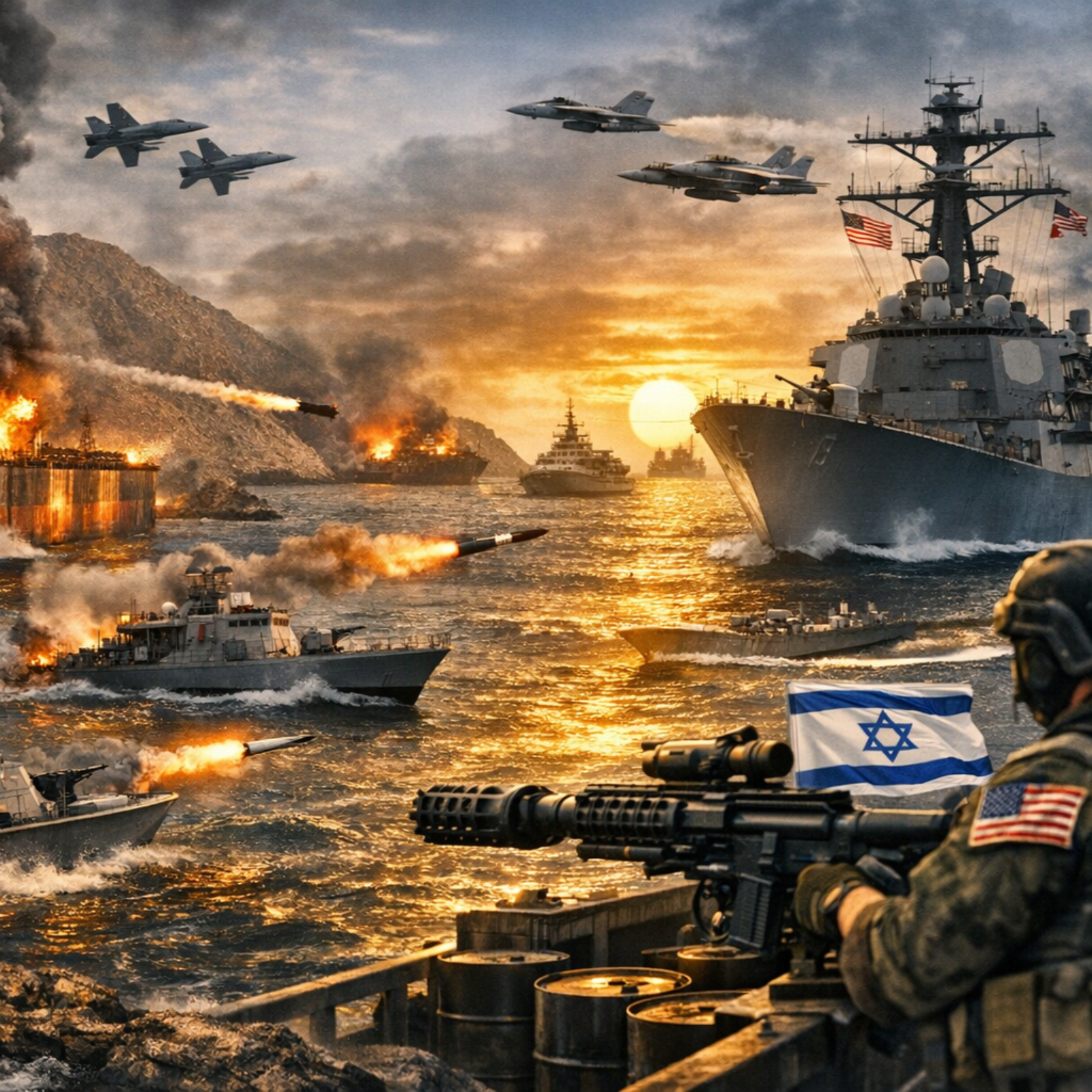
The 2026 Strait of Hormuz Crisis and Global Energy Disruption
May 200:44:57Tap to summarizeA sudden US‑Israeli air campaign against Iran ignites one of the most volatile flashpoints in modern history. In retaliation, Iran blockades the Strait of Hormuz — the world’s most critical energy corridor. Commercial vessels are attacked, maritime traffic grinds to a halt, and oil prices skyrocket overnight. Global supply chains fracture as jet fuel and fertilizer shortages ripple across continents. The death of Iran’s supreme leader deepens chaos, fueling nationalist fervor and military escalation. A fragile ceasefire emerges, but Tehran continues to restrict passage and impose tolls. International law is tested as the blockade violates freedom of navigation principles. Naval escorts and coalition patrols attempt to reopen the strait under constant threat. Diplomats scramble to contain the fallout while markets teeter on the edge of collapse. This episode dives into the mechanics of energy dependency, maritime law, and modern deterrence. How one narrow waterway became the choke point of global stability — and a warning for the future.
Transcribe →
The Rise of Sodium-Ion Batteries
Jan 17Tap to summarizeIn this episode of The Deep Dive, we explore the rise of sodium-ion batteries as a challenger to lithium-ion tech. Sodium’s abundance and low cost make it a promising candidate for sustainable energy storage. But technical hurdles remain—especially around energy density and long-term stability. We examine cutting-edge innovations like solid-state electrolytes and advanced cathode designs. These breakthroughs aim to boost safety and performance in harsh environments. The U.S. Department of Energy is pushing for cost reductions to enable grid-scale storage. Meanwhile, China and Europe are ramping up production for EVs and renewables. We unpack how sodium’s supply chain offers strategic advantages over lithium. From affordability to energy independence, the implications are global. Join us as we dive into the future of battery technology and what it means for the energy transition.
Transcribe →