← The Dylan Gemelli Podcast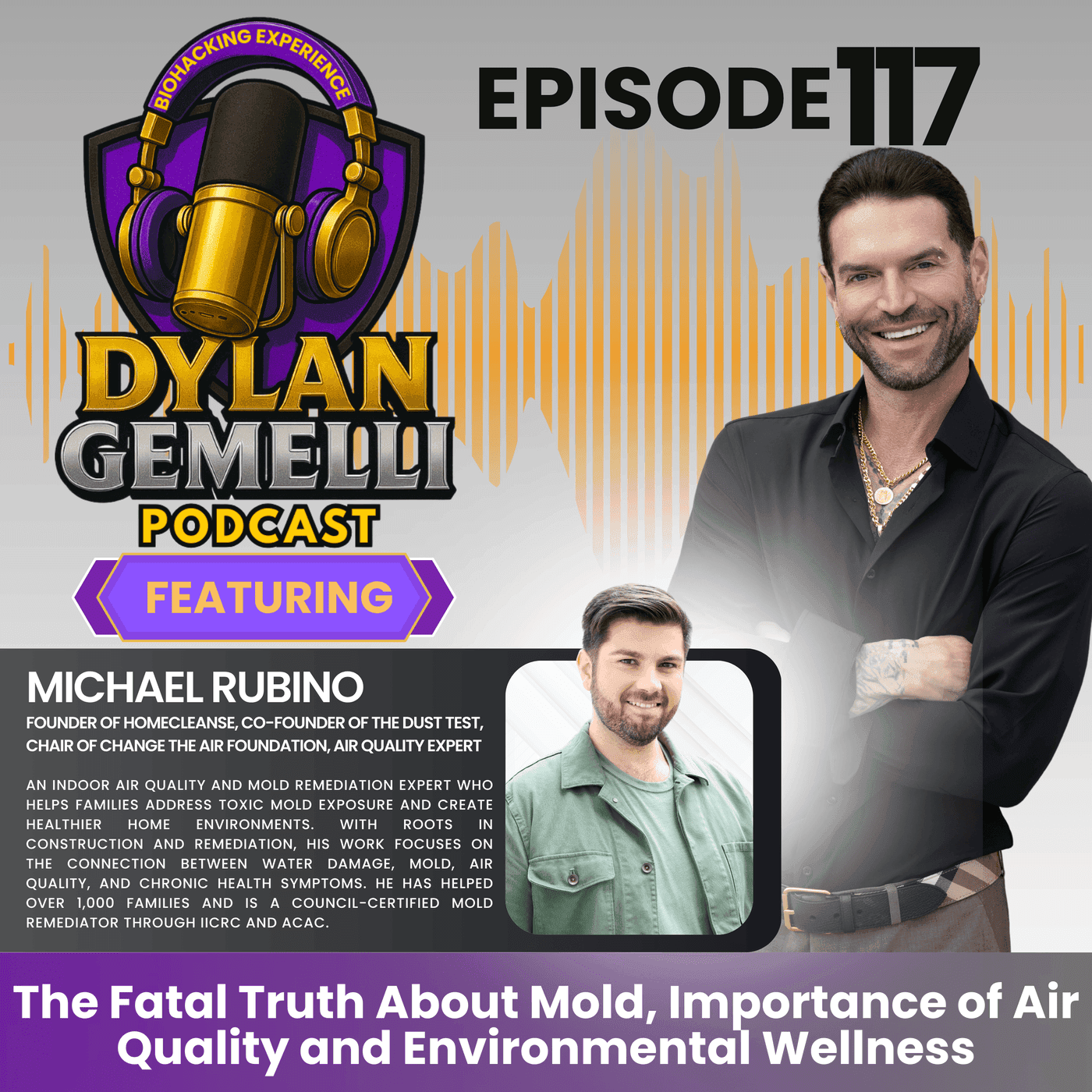
The Dylan Gemelli Podcast
Episode #117 Featuring Michael Rubino! Air Quality and Environmental Wellness, The fatal truth about mold, HVAC systems and indoor air quality, Home testing solutions and more!
01:02:25
Loading summary
Transcript123 lines
- [00:18]
Dylan Gemelli
Creatine, one of the most proven and
- [00:20]
studied compounds in existence, yet still one
- [00:23]
of the most confusing. Most people think creatine is only for muscle, but creatine is for energy. Not caffeine type energy. Actual cellular energy, the kind that your body uses for strength, focus and recovery. If your workouts feel flat, if your brain feels slower than it used to, and if your recovery is not where it should be, there's a high probability your energy system isn't supported. And creatine will help fix that. It essentially gives your body a reserve so when your demand spikes, you don't crash. But here's where most people mess this up. They grab the cheapest creatine they can find and assume it's all the same. But it's not. If it doesn't dissolve well, if it's not supported by the right cofactors, and if your body can't actually use it efficiently, you're wasting your time and money. And that's why I switched to Qualia Creatine. Plus, it's designed around how your body actually produces and uses energy, not just dumping in creatine and hoping for the best. Cleaner mix, better utilization, noticeable difference. If you're going to take creatine, take one that actually works with your body. Go to qualialife.comdylan for 50% off and use my code dylan for an additional 15% off. That's qualia life.com backslash dylan and use my code Dylan. Thank you to Qualia for sponsoring this episode.
- [01:38]
All right, everybody, welcome back to the Dylan Jamelli podcast. So my guest flew all the way in to see me from Tampa today and it's just, I swear to you, no matter how many people come and see me, I'm always just humbled and flattered that anybody even cares to fly to come and see me. I, I don't care how long I do this. It is, it is really, really something, man. And I just first, before we even get going, I appreciate it because I know the flights suck and dealing with the airports and they're long and so to the fact that you want to come see me, share what you learn with me, it is just greatly appreciated. Now I will say this. I've talked a lot of similar type topics in health and fitness and everything biohacking and I've covered a lot in all of these episodes, but YouTube some things a little bit different. So I was extra, extra looking forward to this today. So we're going to get into that. But my guest today is an air quality expert and he's an environmental wellness advocate. He's a founder, he's a speaker, he's a podcaster, he's an author, a father, a husband. I mean, he does it all. And, and I'm. I can't say enough about him, but he founded All American restoration in 2017, which ultimately became Home Cleanse, and I'm sure some of you have heard of that, but we're going to get into that. We're going to get into everything about air quality, things that I don't know, that I'm excited to learn about, and some things I do know that I think that we need to expound upon. So, my friends, it is with great pleasure that I introduce Michael Rubino.
- [03:07]
Michael Rubino
Thank you so much for having me. I really appreciate it. And by the way, I mean, the flight was very worth it to sit here with you today. You have an amazing platform. I love how much you educate people, and I think that's. It's a really important, you know, thing to do.
- [03:20]
Dylan Gemelli
I appreciate it, man, I really do. I. I try to bring people like you on here that already have a good audience that deserve more, and that can make a significant impact and difference in people's lives, because that's what it's all about. And that's why I think I connected with you right away when we talk, because I could tell right off the bat that that's what you're all about. And so we align quite well. And I'm excited to get into some of the things that you do now. Unfortunately, what you do is a big problem. And unfortunately not enough people talk about it or realize it.
- [03:55]
Michael Rubino
Yeah, it's actually a culmination of many different things. Starting off with, when I was a kid, I actually had asthma and I had no idea why I had asthma. I went to the doctor and they just said you had asthma. And they said I would probably have asthma for the rest of my life. And that was it. And I had an inhaler and I just kind of went about my day and I was really struggling to breathe. When I was 8, we moved from this crazy New York City apartment over to a single family home in New Jersey. And it was literally like date coincident, the inhaler was gone. I mean, I went to the doctor again and they were like, this is a miracle. I mean, it's unheard of. And so in hindsight, like, if we were to pull up a picture of Google Maps right now, and I gave you the address, 54 Oakville street in Staten Island, New York, and you took a look at where I was living. You might get an understanding of exactly where I'm going with this.
- [04:43]
Dylan Gemelli
I could picture it.
- [04:44]
Michael Rubino
I was for sure exposed to mold as a kid and you know, dealt with some health issues as a kid. And I didn't know it at the time, obviously the doctors didn't know at the time. None of us knew it. My parents didn't know at the time. But that obviously stuck with me as I started to reflect back on why am I here doing this work. But it was actually after Hurricane Sandy hit the Northeast, where I'm originally from, that I started to really do this work. I mean, I was interested in design, I was interested in music. I wasn't really interested in, you know, mold remediation or doing something from this perspective of cleaning homes the way I clean homes today. I stumbled upon it. My dad had a restoration contract, you know, contracting company since I'm 5 years old. So I've been around it my entire life. But it was after Hurricane Sandy hit the Northeast that I saw these pattern of people getting sick inside their homes. And it was, I mean, mesmerizing. I would go door to door, ring doorbells, be invited inside, and I would sit at the table and hear all these different stories of all these different health challenges that people were going through. And I, I didn't quite understand it. You know, I just, I was in my 20s, I didn't understand it at all. But I, but I understood that people were in pain and I believe them. One of the stories was so miraculous because this woman was, she had like EMF sensitivities. I couldn't bring a cell phone inside. I couldn't stand near her with anything that had any sort of radiation capabilities because her skin would actually burn. I sat at her kitchen table and she showed me Polaroid pictures of her skin, like beet red from just using a computer or being, you know, being around a microwave. I mean, and this is in my 20s, I didn't understand EMFs. I didn't, I just, I knew radiation obviously is not good. I, I was going to school, I understood that we, you know, set off bombs and that radioactive material. Not very good, right, But I didn't understand it from this. I mean, EMFs, typically when we're talking about cell phone radiation or things like that, these are very low level, normal levels of radiation that the average person can withstand. This person couldn't withstand it. And one of the things that she said was date coincident for her is this stuff started to happen to her after Hurricane Sandy, like, before that, she was like, I had a microwave. I used, you know, phones and computers. I didn't have to hardwire anything. And so, you know, that was one story. Another story. I'm dealing with an older woman who was like, hey, I. I live life very normally today. I'm. I have debilitating joint pain to the point where I'm. I need a walker to walk around. And, you know, she was probably in her 60s, but she was young. Like, I wouldn't consider someone in their 60s all of a sudden, you know, someone who's too old and should be dealing with debilitating joint pain. And she was showing me pictures from the year prior where she was, like, on cruises with her friends, no walker. All of a sudden, she's like, right after Hurricane Sandy, this still debilitating joint pain. All of these places, by the way, I found extraordinary levels of mold in them. I mean, extraordinary. All of these places had been quote unquote, remediated already, but yet there was still extraordinary levels of molt counts inside these walls. Pulling into the H vac system. It was in the H vac system. So when I looked at it from that perspective, I thought, wow, there's something here. And I think the thing that really crossed my mind wasn't just the fact that, okay, wait a second, we're getting sick from homes. That's. That's extraordinarily a new concept for me. But it was also this fact that. But wait a second, these houses were quote, unquote, remediated. Like, they looked totally fine from. From an just walking through, like, freshly painted walls. It looked like it was totally repaired, but yet behind those walls, there was carpets of black mold. In those H vac systems, there was extraordinary levels of mold. And all of that was dispersing throughout the house. And I started to say, well, how could this be? And it was through this journey, the stories started to repeat themselves over and over again, and I started to realize, we've got an epidemic here.
- [08:56]
Dylan Gemelli
My head's spinning because to see that for you, I'm thinking about what you encountered, where you're going, you're going through the process and going, wow, what, what is it? What is it from this hurricane that did this? Right? And it's also chilling to me because on my way here, I had a call with a cardiologist who was interested in coming on the show. And he. His whole thing was talking to me about mold on the phone. I had it on my speakerphone.
- [09:22]
Michael Rubino
Jack. Jack. Yeah, okay. Great guy. Yes.
- [09:25]
Dylan Gemelli
So, Jack Wolfson Yep. Yeah, I had a message room and it said, hey, have me on your podcast. I'm like, okay, you know, let's do a call. So my wife was listening to it. I'm looking at her and I'm going. And it's. You know, I've had a lot of discussions on mold man. He was quoting it to the Bible, which obviously hits me a certain way. And we'll get into that. Yeah, absolutely. He was talking about Moses, talking about it in Leviticus. So then now I'm thinking in my head, wow. We had a brand new house in Iowa. We had this crazy water issue where all of a sudden it was leaking out of the ceiling a couple years old, and before I know it, I've got this massive water issue in my basement. And I had to have Allstate come in and then do all these repairs. And then a couple years later, I find plaque in my arteries. I have an ejection fraction issue. And I'm wondering if there's a correlation now there in my mind. Not to go off topic. Sure. But then that brings up what Jack was talking about, about the heart and the correlation of everything with the mold. So we're going to have to talk about all that.
- [10:24]
Michael Rubino
Oh, yeah.
- [10:26]
Dylan Gemelli
Okay. So let's, let's talk about mold first.
- [10:29]
Michael Rubino
Sure.
- [10:29]
Dylan Gemelli
Okay. Let's give a nice synopsis here and understanding of what causes it and the dangers involved in it.
- [10:37]
Michael Rubino
So what causes mold is essentially water. You know, mold needs water, food, and certain conditions in order to grow. But essentially a lot of our homes are made out of food that mold can feed upon. So that's problem number one. Right. Problem number two is a lot of our homes aren't built properly, they're not maintained properly, and then when they do have problems, they're not remediated properly. This creates a pretty big recipe for disasters. Why? I think there's so many problems that we have today. And, you know, it just needs at least 60% relative humidity, which in most parts of the country you're going to get that a good chunk of the year. It needs some level of water activity depending on the type of mold. So if we have leaks coming into the building and materials get wet, we're very likely to have mold even if we don't see it on the surface. I'm giving you a good example. If I have a window that leaks, if it leaks behind the drywall and into the insulation, which is very common by the way, where it would typically leak, I might not notice it. But it. It's gonna stay wet for at least 24 to 48 hours. Because we're talking like basic third grade science at this point. We've got trapped moisture. If I take a wet sponge and I put it on the top of a counter for a second, I want you to visualize this. The area underneath that wet sponge is gonna stay wet far longer than if it was wet around the sponge, right? That's because moisture gets trapped. There's no airflow, so it just stays wet. We consider that trap moisture. When I have building materials sandwiched together, touching one another and they get wet, they're going to stay wet far longer because there's not enough air movement to help it dry. And so we're going to have when insulation gets wet, which most of our homes that have windows on those exterior walls, we're going to have insulation when that gets wet. Like a sponge in your wall that's holding onto that moisture, creating enough moisture and enough time for that mold to then grow all behind your wall and you don't even see it. So that is really part and parcel of the issue is many people have hidden problems. And they have no idea that these hidden problems are wreaking havoc inside these walls, which are affecting the quality of air that they're breathing. And the average person takes about 20,000 breaths per day. Or a great way to visualize that is you actually fill up in your lungs about 2, 500 gallons of air every day. That's about enough air to fill up a normal sized swimming pool. Just to get some perspective, right? So, you know, there's a lot. And if we have problems that we don't know about inside of our homes, unfortunately, statistically it's, it's many of these homes. The largest home survey ever done was in 1994 by John Spangler, was a joint project with the EPA and HUD. And they found that 50% of homes had a history of water damage. 50% of all the homes they went into had a history of water damage. 80% of those homes had visible signs of mold. Now, I can tell you, I go to a lot of homes all the time, especially people dealing with chronic and complex health issues. They want to know what they need to do to fix their homes. And they look totally fine. Like I have to like, really investigate to figure out what is happening behind these walls, behind ceilings. And I'm looking for the usual suspects of where water typically comes in. But when I say it's an epidemic, I mean it is an epidemic. And I think that it's easy to Become fearful of that. The problem is that I'm not trying to drive fear. I want to empower people. Because if you stick your head in the sand, which I feel like is what we've been doing as a society, we've been painting over it, putting bleach on it, just ignoring it all together, thinking it's not that big of a deal, well, then we're going to have this declining health issue that we have here today. So I think we can't stick our head in the sand anymore. We can't be fearful of it. We have to take action. Because if we don't take action, we're going to continue to be a victim of this. And I think that's not the position that we want to be in.
- [14:37]
Dylan Gemelli
Well, it's fear or awareness. How do you look at it? And people. People live in this, like, convoluted type of life where they just want everything to be one way. And because we were told this, and it's just a hell of a lot easier to listen to somebody say, this is it and that's it, as opposed to looking and really digging deep, it's easier to say something's idiopathic or that's just. That's just what happens as you age. Or that's just what happens. It's a hell of a lot easier to do that than to do what you do.
- [15:06]
Michael Rubino
That's right.
- [15:07]
Dylan Gemelli
I mean, nobody wants to be Sherlock Holmes, dude. I mean, that's just. They just don't, you know, and. But that's where the answers lie. We desperately need people like you because you actually find the problem as opposed to, well, that medication didn't work, so maybe this one will. So that one's affected me negatively. So let's put you on a hundred of them to rob Peter, to pay Paul, over and over and over and over and over till we just ruin your quality of life to keep you alive.
- [15:31]
Michael Rubino
Literally.
- [15:32]
Dylan Gemelli
Right. I mean, that's the process. Yeah. So let me ask you this. Is it more prevalent in, like, older homes, or is it potentially possible that newer homes can have this same sort of issue without you even knowing it? And could that be potentially how it was built, something that was done?
- [15:49]
Michael Rubino
Obviously, time is a factor.
- [15:51]
Dylan Gemelli
Sure.
- [15:52]
Michael Rubino
So older buildings obviously have more chance of having more problems.
- [15:57]
Dylan Gemelli
Right.
- [15:57]
Michael Rubino
Because if, you know, there's leaks over the years and they weren't fixed properly, the odds of them having some problems are going to be a little bit greater than a newer building. However, that being said, unfortunately, a lot of the newer buildings that we're building have their own set of issues. I'll give you an example. A lot of the homes back in the day, they were balloon framed. So they had gaps between the exterior wall and the interior walls. All these pipes and electrical wires would run through them and you would essentially have wall cavities that could travel, have air traveling from all the way up to the roof. Yep. It's all the way down to the crawl space, basement, what have you. We don't build homes like that anymore. There was an advantage to those homes and that was if water did come in, it really didn't impact the interior of the space.
- [16:45]
Dylan Gemelli
Right.
- [16:45]
Michael Rubino
Because it, it was probably going to come in and travel down to the crawl space. Now yes, one could argue that that can create mold and bacteria in the crawl space in the basement. So which obviously would end up impacting the air quality of the home. So. Yes, that's true, but what I mean by that is like we didn't have these, these you know, kind of trap moisture issues that we have today. But all these building materials sandwiched together being built on top of one another. Right. So there's that aspect. The other aspect of older homes is yet a lot more air exchange. They didn't really have insulation, they didn't have the modern H vac system. They were, they were designed to just have a little bit of temperature controls just based upon the way in the, in which the house was constructed with having a lot of airflow so that you didn't really need H Vac. Right. When we started converting into H Vac that was, that was problem number one. Because now we introduce temperature differentials. So that, that's where the first I would say domino that started to fall fell. Then when you get into this energy efficiency crisis, for those that don't know, basically in 70s Richard Nixon's president we had a global energy crisis. Because we had a global energy crisis, we started to push towards energy efficiency. We wanted to make things more efficient. Then it would be cheaper from an energy perspective to utilize and live in these homes and buildings. The big problem with that is in order to make homes more energy efficient, you basically take away the air exchange from outside to inside. You insulate the crap out of these homes, you seal the crap out of them so you don't lose any heating or cooling. Because again, this all goes back to the comfort and the, the modern H Vac system. All we're trying to do is make it cheaper to have more comfortable air. So we go through all these hoops to achieve that. The Problem is, is that when we went down that road, nobody thought about indoor air quality. I mean, it was just completely ignored. I would argue that it's still ignored today. And with that being said, what ends up happening is you've got these homes that are tighter and tighter and tighter. We're like in a snow globe. Yeah, that's the best way to describe it.
- [18:48]
Dylan Gemelli
I know.
- [18:49]
Michael Rubino
And we use chemicals in our house. You know, maybe not people like you and I, but the average person uses a lot of chemicals in the house. We have microplastics, you know, because our clothes are synthetic, we're shedding a lot of microplastics in the environment. We've got our own virus particles and bacteria particles that we produce as human beings because we are essentially gigantic human compost.
- [19:12]
Dylan Gemelli
Right, right.
- [19:13]
Michael Rubino
And you know, then we have problems like mold and bacteria because of water damage that enters our house. We've got microbial accumulation that occurs on the H Vac system. Because the way in which we've designed this beautiful thing to keep our house, you know, warm when we want it and cold when we want it, is it. It has an evaporative coil which constantly condensates. Right. So we talked about, what does mold need to grow? What does bacteria need to grow? Well, it needs moisture. Well, this is a source of moisture in your, in your H vac system. Yeah, right.
- [19:43]
Dylan Gemelli
Yeah.
- [19:44]
Michael Rubino
And so now as mold and bacteria get to it, which they're always getting to it unless you have a really high grade filter, but who knows about that? That's another thing we need awareness on. Right.
- [19:54]
Dylan Gemelli
That's another story.
- [19:55]
Michael Rubino
Yeah, I know. And so what happens is it starts to grow on the coil, essentially turning that into a mold factory, a bacteria factory. And that's another part of the issue. So going back, just rewinding a little bit, you know, I would argue that I think the actual modern home is worse off than the homes that we were building, you know, 50 years ago. And I think that's something that we, we want to take a look at now. It's not very expensive to. Course.
- [20:23]
Dylan Gemelli
Correct, Right.
- [20:24]
Michael Rubino
And I think, you know, a lot of the building, bio biologist communities, a lot of these really healthy building communities are doing a great job, starting to say, well, wait a second, we need air exchange, we need fresh air coming in. You know, they're starting to realize that we've gone a little bit far down this road. We might have created some problems that were not intentional, but just happened in the course of things. And so it's great, but it's Such a small microcosm of where it needs to be. And I think, you know, as we have these types of conversations and people start to think about this, a lot of change can, can happen because of that.
- [21:02]
Dylan Gemelli
See, I wasn't sure, but I had a feeling and that's why I asked you, because the obvious thought would be, I got a new home. I don't have to worry about that. That would be the obvious thought because when I was talking to you before and I told you my cat was sneezing, and, and it was just weird that she keeps sneezing. And I kept telling myself, but it's a new house, but it's a new house. But then I thought, man, they must have done something or whatever. And then what did you recommend me to do? Clean the ducks, Right.
- [21:26]
Michael Rubino
Yep.
- [21:27]
Dylan Gemelli
So why would somebody need to look at those? And how big of a problem is the duct itself in the house? Like, what would cause something like that in a brand new house for me, that it could potentially be dirty and need cleaned.
- [21:40]
Michael Rubino
Yeah. So, you know, kind of the secret I gave you was when most houses are being constructed, they're running the H vac system because they want to, you know, they, they want their workers to be comfortable.
- [21:51]
Dylan Gemelli
Sure.
- [21:51]
Michael Rubino
While they're working. No harm in that. But when you're running the H vac system while you're creating dust, all that dust gets into the H vac system and it becomes food for mold, it becomes food for bacteria, not to mention it just recirculates. And so if you think about your cat, your cat has a, you know, is very low to the ground. I mean, it's spending a lot of time walking around on the floor and horizontal surfaces. Where does our dust collect or dust collects on these horizontal surfaces? So when you talk about, like, how does indoor air quality affect our pets and our children, I would argue it affects them much more than it affects adults. And we're seeing how problematic it is for adults. Right. And so I think this is something that we want to be mindful of. And what's the solution for that? I said, you know, you should get your, your H Vac system cleaned.
- [22:40]
Dylan Gemelli
Yeah.
- [22:40]
Michael Rubino
Because all that dust that's been accumulating, that's still circulating around, you can get rid of that and problem solved, you know, and, and so it's, there's solutions to everything, and that's the beauty of it. But you have to know that there's a problem in the first place or you're not going to go and reach for a solution. Well, I, When I got off the
- [22:57]
Dylan Gemelli
phone with you, I told you I'm putting that up on my screen. And I didn't do it. And then we went for a walk last night and went to get the mail and I pulled those, like, monthly coupons out and freaking duck cleaning. I said it right on the countertop. I said, And I said, okay. He told me to do this and I didn't do it. This is the sign.
- [23:13]
Michael Rubino
There you go.
- [23:13]
Dylan Gemelli
So it's sitting right there for me to do it. How often should one take that route? Clean your ducks? Is that a once a year thing?
- [23:19]
Michael Rubino
Yeah, I would say it's a once a year thing. And, and I think timing also matters on that. I want to explain that a little bit, please. And I also want to talk about filtration. I think filtration is really important for the H VAC system. There's something called, called a MERV rating. I think we all have heard of hepa.
- [23:34]
Dylan Gemelli
Yeah.
- [23:35]
Michael Rubino
You know, but there's something called a MERV rating. And essentially the MERV rating is the higher the MERV rating, the smaller the particle could filter out at a specific efficiency. HEPA is essentially a 99.97% efficiency, and that's really what that means. And it gets to a certain particle at that efficiency, typically 0.3 microns. Right. However you want to look at it from this perspective of sometimes you have higher filtration than just like what the HEPA standard is, which is just one particular size at one particular efficiency. Sometimes you can actually get better than that. You can get better than HEPA at a pretty high efficiency rate. That's worth looking into and investing into because, you know, you're really getting a smaller particle from getting into the system, which is going to provide you more longevity and less maintenance costs. So you want to look at it from this perspective of maybe I can invest a little bit upfront and get a better filter, but actually I save
- [24:28]
Dylan Gemelli
more in the long run.
- [24:29]
Michael Rubino
And that's, that's sort of the strategy that I like to look at. Because if we have better filtration, we're going to be breathing better air. We're going to be having less dust in our house because it's going to, it's actually going to be sucking that dust up and trapping it in the filter. It's like almost like thinking about having an air purifier in your H VAC system. Well, if you think about what an air purifier is, it's just a motor and a filter.
- [24:51]
Dylan Gemelli
Right.
- [24:52]
Michael Rubino
Fancy piece of plastic, typically, but that's what it is. So it just draws air in, traps particles in the filter, blows cleaner air out at the top. So it's essentially cleaning the air so that your lungs aren't the ones doing that. But when you take it to this perspective of, like, with the H vac system, everybody should be cleaning their system and their ducts, even if they have good filtration at least once a year or every other year, depending on how good your filtration is. And the exact time that I want people to clean their H vac system is in the fall.
- [25:24]
Dylan Gemelli
Okay.
- [25:24]
Michael Rubino
And the reason being. It's a very simple reason. And, you know, people can argue with me all they want and just understand this one thing. The thought process that I have on this is in the wintertime, people are typically putting their heat on. Their heat is typically a dry heat produced by their H vac system. That dry heat can break apart the microbes that are growing on the coil, all right? Because they become brittle, they become smaller fragments, and they circulate around the house a lot easier. And it's past the filter already. Right. So whatever is past the filter, the filter's not gonna, unfortunately, do anything with. It's just. It's got free rein to kind of circulate across your house. And the reason that I. That I came up with this one, I. I've seen so many H vac systems get tested at thousands of H vac systems. But I've seen this firsthand, where I get the most calls, actually, over the wintertime, dealing with symptoms. And the reason is, it's very simple. In the summertime, you're outside a lot. It's nice out, you're getting dinner outside, you're not, you know, yes, the mold's probably starting to grow and the bacteria is probably starting to grow in the summertime, you know, but you're outside more, you're not experiencing it more. You got these nice, cool, breezy nights, you open the windows more, things like that, right. You just don't see it. Then in the wintertime, right. You get that dry heat, it starts breaking those. Those particles apart. Now all of a sudden, they're traveling through the ductwork. Think of it, the H vac system, like the lungs of the home. And now you're breathing that in. Now you're. You're inside more because it's cold. Nobody wants to go outside in the wintertime. Right. Serious. You live here unless you live here. Sure. Or where I live. Right. But, you know, the rest of the planet Typically is old and sheltered inside. They don't want to leave. And they're going from 90% indoors to maybe 99% indoors. And guess what? Right. They start to feel those effects.
- [27:24]
Dylan Gemelli
Right.
- [27:24]
Michael Rubino
And so if you do it in the fall, then you can remove all of those microbes and particles before you turn on the heat so that when you turn on that heat, there's nothing to get brittle and break apart and travel across the house. So I think the secret to that is get better filtration. Clean your system every fall and you'll avoid those. You know, I mean, think about the flu season. It's like every winter, right? Yeah. Well, if your immune system's weakened because you've got a ton of mold or bacteria in your environment, don't you think you're going to get sick more frequently from viruses and other things?
- [28:01]
Dylan Gemelli
More than likely, yeah. Okay, so I'm. I'm going to do a breakdown here, but for the. For in all serious now, for the people that live in places like here or Hawaii or whatever, does it matter the time of year for when they do the cleaning? Can they do it anytime, or do you still say fall?
- [28:15]
Michael Rubino
I would still say when the weather's getting cooler, you know, even if you don't have heat, you know, and you're not going to use heat, that's fine. I would still say when the weather's getting cooler because you're going to have a sort of. Sort of a reset.
- [28:26]
Dylan Gemelli
Yeah.
- [28:27]
Michael Rubino
Like, if you can do it after the humid season, I think you're going to provide a lot of value and longevity into how long that system stays clean.
- [28:35]
Dylan Gemelli
Okay, so let's do this then for everybody. Let's make it really simple and easy to the process on what you recommend. So we. We're going to clean the H Vac system.
- [28:43]
Michael Rubino
Yep.
- [28:43]
Dylan Gemelli
And is that also proportionate with the ducts that you were talking, or is that totally different? So H vac duct cleaning.
- [28:51]
Michael Rubino
Yeah. So they're. They're different pieces, but they're tied together. Right. So, like, if you. There's going to be a closet somewhere or a crawl space somewhere or an attic somewhere. Yeah. Where you're going to have an H Vac system. Right. And that's usually that. That big tin hunk of metal that you see somewhere. And it's usually got one or two lids that you could pull off and you could see the unit, and then it's got the ductwork that attaches to that.
- [29:15]
Dylan Gemelli
Sure.
- [29:15]
Michael Rubino
So that's where the motor is. That's where the Coil typically is that is blowing the air through the ducts that then you know, connect to the rooms in your house. So you want to find that hunk of metal because in there is the evaporative coil that you're going to want to clean for sure. That think of that as like the source of where it would grow. It doesn't mean that it can't grow in the ducts. It can, but it needs moisture. So it's going to grow either closer to the coil, like that main trunk line that that comes up and connects to that big hunk of metal, or there has to be something wrong with the duct somewhere where like maybe it's leaking, the air is leaking. And so you've got temperature differentials, hot air outside, cold air blowing through the duct and there's a split in the duct somewhere and so boom, it creates condensation and you start to get mold growth in there. If you don't have that problem though, then you're really just looking to clean the dust out inside the ductwork because within that dust you could have mold and bacteria, right?
- [30:14]
Dylan Gemelli
Coffee gives you a moment of energy.
- [30:16]
Nandica gives you momentum for life. Nandica is a longevity coffee alternative designed by Peak to support clean energy, focus, mood and cellular resilience through world class ingredients and an effortless daily ritual. It was created for people who think in decades, not hours. It delivers calm, sustained energy while supporting cellular resilience, immune balance and longevity aligned performance without the jitters, crashes or gut irritation of ordinary coffee. Peak takes the most powerful botanicals, minerals and vitamins from nature and elevates them with cutting edge extraction technology, creating supplements you'll actually take. It tastes like an artisanal coughing experience, but it's built like a longevity stack. Nandica has given me a consistent state of energy, laser focus and mental clarity along with a refreshing taste and luxury feel. It is my newest daily ritual. If you want the luxury upgrade version of a coffee alternative and you want it built for longevity, then this is it. Secure 20% off your order and begin your intentional wellness journey today@peaklife.com Dylan that's P I Q U life.com Dylan okay,
- [31:28]
so we got the as fact we got the ducks. Now we've brought up filtration. Okay, so here's the question in terms of filtration, like my house has, man, I don't even know seven, eight filters that they told me to change every 30 to to 60 days. Is that what you're talking about? Is there some sort of special filter with the H vac in particular in that area that you're talking about.
- [31:50]
Michael Rubino
I mean I have a special filter. But what you're talking about is true. You could, you probably have these filter grills throughout your house.
- [31:57]
Dylan Gemelli
Oh yeah.
- [31:57]
Michael Rubino
Everywhere that are in your ceilings and your walls, whatever.
- [31:59]
Dylan Gemelli
Require a big ass ladder and every. Yeah, yeah, my handyman to do it. Because I don't do that type of thing.
- [32:04]
Michael Rubino
Listen, listen, that's, that's one way to do it. You could just abandon all that and get a really good filter installed at the unit if you've got the room for it. And that would be much better quality. So think about it from this perspective. If I've got filter grills all over my house and I put filters in there, I'm really not going to be able to do better than a MERV 13 filter in there. And even that could be questionable. It's going to restrict a lot of airflow because you've, you're basically, you're, you're trying to suck air through a straw here. The ductwork is the straw, but you've got your hand partially covering it. Right. So you're restricting a lot of airflow. You're not going to be able to put like a MERV16 filter in this area throughout every return of your house or you're going to probably choke your system and then it's just gonna freeze. The coil will freeze. That'll be its own nightmare. Right, right. So you would benefit from installing something at the unit. Cause you can go way higher because it's obviously a built or a bigger chamber so you can disperse the airflow through it without having to worry about choking the system essentially. And you could actually benefit from getting a smaller particle removed from that. And then you nice thing is like if you went with a filter I like, you would change it every two to three years. That's how long it lasts. And then you would be able to ditch all those things and the ladders and just leave your ladders in your garage and not have to worry about it anymore.
- [33:24]
Dylan Gemelli
It, it is ridiculous how many there are. I, I remember when we were walking through because it's a new house and I was going, what? Like since when? You know what I mean? Like I'm used to like, because I lived in Iowa and it's like you change it very infrequently, you know, right downstairs with the heater and the, the air conditioners and that's it. But you know, here it's like you got two air conditioners and There are two different parts of the house that like our bedroom, functions separately than the rest of the house.
- [33:51]
Michael Rubino
Right.
- [33:52]
Dylan Gemelli
So many things there that I think people wouldn't be clueless about, that would never even think twice about, that are just wrecking health, just damaging lives. So when it comes to mold, and then I'm going to shift to like detection of mold, what do you recommended ways of going about that and what you exactly, exactly do? But can you talk about different problems that mold will cause a person, a child, a pet, like telltale signs, and then how bad it could potentially get?
- [34:23]
Michael Rubino
I want to say one thing really importantly first. Please, before I get into that, if we look at America and our systems, our government systems, they're all disjointed and discombobulated. The CDC is telling people to still use bleach. The EPA is telling people please don't use bleach. And all the different state department, health department websites are all saying different things. And so it makes it very difficult for people to wrap their head around what, what do I do?
- [34:51]
Dylan Gemelli
Right.
- [34:52]
Michael Rubino
And you know, I feel like today more than ever, we're starting to wake up like, hey, our government might be slow to regulate things for our, our benefit. And you know, there might be, there might be some problems there. Right, right. And the big thing about this is that unfortunately this science has been really slow to evolve mainly because the government hasn't been appropriating a whole lot of funds to study this subject. Started to sort of change after Covid. Right. We started to realize, wow, there's something that can travel through the air that could be smaller than what I can see, that could potentially harm me. Right. It was like sort of the first big idea in that direction. Now we're, we're appropriating more funds. Now we're starting to see things. We're starting, the research is starting to come out. I mean, there a lot of beneficial things happening. The NIH did an update, I think it was September of 2025. And it's not a com. It's not a complete list of the dangers of, of what mold can do, but it's a step in the right direction. See, previous to that, that paper, you know, really from a government perspective, the best data that we really had was mold causes asthma.
- [36:07]
Dylan Gemelli
Right.
- [36:08]
Michael Rubino
And that was sort of all they were willing to sort of say. Right. Even though there were so many medical journals and papers out there that were really talking about mycotoxins and the toxinic effects of those and how that's problematic, we know, or maybe, maybe we don't know, maybe we're finding this out right now for the first time on this podcast. But the FDA regulates or I don't know how they regulate this, but they know mycotoxins are, are bad and they're trying to regulate it in the food supply. I say try cuz I don't see how they could possibly enforce this in all, in all particular areas. But no, at least they know about it and they set some, some guidelines to prevent mycotoxins in our food supply as best as possible. We know it's a problem in coffee still. We know it's a problem in peanuts and peanut butter and nuts and things of that nature. But you know, we're there at least you know, have some different angles of which they've been working at it. But from an air quality perspective, it's like, you know, it was like completely missing the data on these government websites was. Even still to this day, it's, it's very disjointed, discombobulated. The NIH came out and said, hey, it can cause cancer. I mean, just the big C word is something that really nobody would have ever wanted to admit. Right? Right. Finally they're like, this can cause cancer. Now why do they, why do they come out and say that? Well, because we already had the, the evidence that mycotoxins can cause cancer. Mold produces mycotoxins. That's one of the big problems with regulating in our food supply. However, we haven't been talking about mycotoxin exposure from an air quality perspective in our homes because unfortunately, if we have mold in our walls and that mold is a mycotoxin producing mold, then there is a potential that it could produce mycotoxins and there is a potential that we could be exposed to that. Now, again, not to cause fear or panic, but we want to be able to control that and we want to have our mycotoxin exposure to be within normal ranges. We don't want to go out and have too much exposure. We want this to be something that we can be in control of. Well, how could we be in control of it if we haven't been given the information? So I was so appreciative and quite honestly, I was shocked when it first happened because I was like, you know, I've been, I've been fighting this for 13 years and you know, finally, you know, it kind of felt like the, the information was, was seeing the light of day in the name of being able to help people. Right. Because I'll tell you, over the past 14 years, if you wanted to know how many skeptics I've been in front of, I mean, quite a few. Because I would sit down at people's kitchen counters and being like, hey, based upon your levels, I think you should probably take some action. And it's like, well, is this illness really that or is it something else or. And I always said, you know what, you don't have to take my word for it, right? I want you to go leave your house and I want you to go away for the weekend. And if you notice you feel better when you're out of your house, then you feel worse when you're in your house and your symptoms flare up when you're in your house, you might want to start thinking that maybe the trigger is in your house, right? Maybe this is triggering your symptoms. Am I going to say it's causing your symptoms? Because causation and triggering and correlation, right? These are, these are words that I would, as someone who's not a doctor, it's not something I get into. But if you feel better outside your house and you come back into your house and you get triggered by these symptoms, well, then maybe you might want to do something with your house. You know, who would have thought, right? And that's sort of been the guiding light. But when this paper came out in September of 2025 and it said it can cause cancer, neurodegenerative disease, right? Neurodegenerative issues like brain fog, when it said that it can cause inflammation and asthma and it started to talk about the multi systemic issues that mold can have on the human body, that was a huge win.
- [40:10]
Dylan Gemelli
Yeah.
- [40:10]
Michael Rubino
And it was a huge win for the public because now they could do something about that. Right? And when the NIH comes out and says this now doctors who have been unsure of like, is this real? Is it not? Do I look at this or do I not now they have something that they can look at that's a credible body of information. I think that is so important. And know a colleague of mine, Brandon Chapo, he's a director of public policy for Change the Air Foundation. He was, he was telling me that he met with the CDC and the EPA recently about, you know, trying to get some change going on the websites because you know, that's where these people go for information. We've got to have good, accurate information. And you know, he called me all excited and was like, hey, you know, look, I, I don't know what they're going to do, but they did realize that their information is a bit archaic and they are looking into, you know, updating it and stuff like that. And I think to me that that's a, that's a really beautiful and powerful thing because, you know, it's, I think it's, it's one of those sad things that people rely so much on the government to be this maker of change. But when you understand how the government works is 20 years behind the change is pioneers and platforms like yours where people actually get to learn things because it's the people that care, that see things with their own eyes, that can observe, that say, there's a problem here. And it's that, that that really creates that change, not the government. Look what Elon Musk has done with SpaceX and all the technologies he's built. He has inspired change. The government didn't develop these rockets that could take off and land themselves back. The government didn't develop the electric vehicle. We cannot expect the government to innovate for us or to have our back. Especially when these massive companies, they pay millions of dollars to choose who they want to win these elections.
- [42:18]
Dylan Gemelli
It's rough and being dependent on people that, like you said, they've got three different websites with three different things. When it would take one call to an IT person to make a simple sentence change. I mean, seriously, it's it. They act like when you ask of something like that, like it is just the most difficult thing on the planet to make happen to, to change something factual. And that is the most disturbing thing that I can even imagine. That lack of care and the things that they actually worry about and talk about and bicker about amongst each other, they're not role models. They're not anything of any kind whatsoever that anybody should model their life. This is not a government attack. This is a fact. This is why I've done what I do. Because everybody's got a role. Your role clearly is what you're doing. It is helping people to see and realize an aspect of their lives that is detrimental, that you're trying to fix. My role is to get people like you in front of people and to be able to convey the message properly. Going back and forth with you and teaching and asking the right questions. And what's everybody's problem? What are they saying? That's the problem, not the personal attaching. What is the, what is the main problem? You know what the main problem is? Confusion. It's simple. It's confusion. The people that are actually asking genuine questions that aren't bitching and running their mouth online. They're confused.
- [43:39]
Michael Rubino
Oh yeah.
- [43:40]
Dylan Gemelli
And what's. What did you just say? The place where you. You're supposed to get your information. It's confusing. And then they turn everybody against each other and say you can't listen to this person or that person when you can't even update your website for 20 years.
- [43:52]
Michael Rubino
That's right.
- [43:53]
Dylan Gemelli
Who do you listen to then? I would listen to the guy like you that's in the trenches every single day and has spent their life's work doing it. So I just, I don't want to go off topic, but I want to spotlight that. So anybody that attacks, anybody that comes on here's credibility. Because we don't have 75 letters after our name that's bought and paid for. That doesn't mean anything because they're getting taught what they're. The people above them are telling them to teach and what they're paid to teach them. It's not the fault of the person in school. It's not the fault of the person that genuinely went to be a doctor to save lives. It's the school and the people they're learning from. So what you've done is so commendable because you do it every day and you talk with real people and you see it and you learn it. And that's what I want to get into next because I know how to lead into something. What you do. What exactly is the home cleanse, the dust kit, these tests? What is it that you actually do? And is it something that you feel like every single home should do at least once or what's. Just explain it not from this is my business and whatever. Like, for the perspective of actually what's the purpose and the reason for this and why is it imperative?
- [45:02]
Michael Rubino
So the purpose is to create an end to end solution to end the suffering of chronic illness created by poor indoor air quality. That's the purpose. It's a very simple purpose, and it's a what. The business offering has evolved over time because every time I would hit a wall in being able to help somebody, I realized that the wall was created by the word that you said earlier. Confusion. A lot of people are confused. I can sit down with you at your kitchen table and I can show you numbers on a page and I can show you how you should do something about that. And you could even go to the modern medicine's amazing, by the way, because we can actually correlate specific molds in a home and the specific toxins that those molds produce in Your body to show you, hey, you may want to take action. You still have to be the one to take the action. I can't force you to take action, but I want to educate you on taking action and taking the right action. And I think that's really important. One of the problems that we ran into is I would leave your kitchen counter and most people that call a few people and get some opinions, I think is a really important thing. However, in this industry, if you call three different people, you are going to get three wildly different opinions. And that is definitely part of the problem. I'll give you an example. You've got a leaking window. I'm going to tell you, hey, you got to open up around this window. We got to pull out that contaminated insulation, the contaminated drywall. We're going to have mold growing on the lumber behind it. We have to remove the mold from the lumber. Right? We have to see what. Why the window is leaking in the first place. That poor flashing, you know, something is occurring that's allowing the water to come in. We have to make sure that's corrected. Right. So it's. It's a bit of a elbow grease type process. There's no, unfortunately, magic solution. I'm going to tell you that. You're going to say, it makes sense. I'm going to tell you what I think it's going to cost. You're going to be like, okay, I think that makes sense. I'm going to leave. You're going to have somebody else come in. They're going to say, well, that guy's crazy. You don't have to do that. I got a fog. We could just fog it away, man. We could just for like a third of the price. We could just fog it away. And I'd say, you know, you could spend a third of that price, but you won't even get a third of the value. Because that mold is not going to just disappear. The conditions that allowed it to grow in the first place are still present. This fog is not perpetuating walls and insulation and removing and eradicating mold from those surfaces. It's not. This is a living organism. I just want you to think about, like, you've got weeds growing in your walls. You think spraying some weed killer on it's going to kill it? You think it's really going to take care of the problem or your weed's going to come right back? Raise your hand if you've used weed killer in the backyard and if the weeds came back. Come on, guys, this is not the solution. The solution is to remove it and solve the problem. But if you're a guy sitting at a kitchen counter and one guy's telling you it's 3x the price, another guy's telling you it's a third of the price, that's gonna cause confusion. And you know what that guy's gonna say? He's gonna tell you that guy, Michael Robino is trying to take advantage of you. Well, it's very easy for you to be convinced of that when you've got a solution that's a third of the price, except when it doesn't work. And then you call me back and you apologize and you say, I'm really sorry, I spent a third of that guy and he didn't work. But these situations happen all the time. And you've got all these different people trying to sell some product or solution, but they're missing the actual point of what we need to do. And it's to remove the issue, the source of the problem, and then correct it. Like we have to unfortunately do surgery in the home. You know, like you've got a bleeding artery. We, we can't just give you a pain pillar and just hope for the best. Like we've gotta fix it. Right? And so that's sort of the situation. So in realizing all of that, I realized a couple different things, which is why I started to evolve the end to end solution. So we've got the skepticism and the competitive nature of the industry itself on trying to sell their solution or product. You've got the other side of the issue as well, is the inspection side is absolutely terrible in terms of like having a standard. I'm going to explain why if I let somebody come into my house and do an inspection, more often than not they're going to rely on a technology called air sampling. Now, I'm not suggesting we throw the baby out with the bathwater here. I just want people to understand from a screening tool perspective, it's the worst screening tool you could possibly use. And it is used as a screening tool incorrectly all the time. I'll give you an example. They'll set up a tripod and there'll be a pump and there'll be a little air cassette on that pump. They'll usually do it in the center of a room. Let's just say the average size room is 10 by 10 with 8 foot ceilings. Would you agree with that?
- [50:06]
Dylan Gemelli
Yeah, pretty much.
- [50:07]
Michael Rubino
Yeah. So 10 by 10 room with eight foot ceilings. This machine collects 75 liters of air. Well, 75 liters of air pass through it. It collects the particles within that 75 liters of air. Particles of a very specific size because it has to fit inside the hole and it has to then get into the slide so it could be analyzed in a lab. Okay, with all that being said, 75 liters of air. Now, going back to that 10 by 10 room with eight foot ceilings, how many liters of air do you think are in there?
- [50:40]
Dylan Gemelli
No idea.
- [50:41]
Michael Rubino
I only know it because I looked it up. Over 22,000 liters of air. All right, now if you're listening to this, I want you to get out a calculator and I want you to do 75 divided by 22,000. It is less than 1%. So we are basically with that technology. And by the way, what a lot of these guys do, they charge you like 2,500 bucks. I'm going to tell you the business model. They do like four or five or six of these air samples across the house. Okay, maybe the bedroom, maybe, you know, the bathroom, the living room, wherever, you know, wherever. They, they just do this. A lot of them don't do a really good job inspecting. They just kind of set this up. It's, it's, it's profitable for them. That's why they do it.
- [51:28]
Dylan Gemelli
Of course.
- [51:28]
Michael Rubino
And air testing has been the gold standard for as long, as long as the technology really came out. And so what we're doing is we're basically taking a drop of water and analyzing one drop of water and then telling people, don't worry, the whole ocean is good. That's how we have to look at this. And so that became so freaking problematic for people. I would have people call me up and say, hey, I don't feel well. I know it's not mold though. I'm thinking maybe it's VOCS or some other things. Love, you know, would love a second opinion on this. And I'm like, oh, okay, yeah. So why do you think it's not mold? Just out of curiosity. Just. Cuz I always, I don't, I don't always think it's mold, by the way, but I'm just curious, why do you think it's not?
- [52:11]
Dylan Gemelli
Yeah, mold.
- [52:12]
Michael Rubino
Oh, because I did air testing. Okay, good. Can you send me those, that, that report? And I look at it and it's six air samples. I'm like, okay, you can see in the photograph, usually they'll take a picture of like where the, where the, the machine is, Right? Yeah, I see it's in the center of the room.
- [52:25]
Dylan Gemelli
Blah, Blah.
- [52:26]
Michael Rubino
There's no fans or anything like that. It's not like they're trying to stir up the air and then get it, get a sample. It's just ambient air sample. And I'll be like, okay, how big is that room? Oh, it's 22 by 10, you know, 22 by 12. Okay, good. So we've got like 40,000 liters of air inside that space and we've analyzed 75 of it. And we're saying the whole space is good. And they're like, well, that doesn't make sense. And I'm like, I know it doesn't make sense. And by the way, these reports say everything's perfect, the house is fine. So there was a technology, it was probably 2013 or 15, somewhere around there that I stumbled upon what's called an ERMI test. And an ERMI test is essentially, well, the ERMI stands for the Environmental Relative Moldiness Index. This test basically uses a technology called MSQ pcr. Similar to the PCR Covid times the NO swas. This isn't a no swab though. This is a dust collection sample. And just like pcr, if you don't know what it is, you basically can put something in it and then just match something. You have these primers that go into the machine that tell you, I don't know, you want to look for 36 different species of mold. You can put 36 different species of mold in there. Then you can take a cloth and then you can put the cloth in there. Basically, the dust from that cloth. If it has mold in it, you can match it with the primers that are there. That's really how it works. So if you wanted to check for Covid, you'd put Covid in it and you'd do a nose swab. Then you put that in there and see if there's Covid. If there's Covid, we've got a match. Totally different topic, and I don't even want to go there. But that's how the technology works. Whatever you put in, right, you can match. This is a DNA specific analysis, right? So I came across this technology and the inspectors I was working with at the time, they were using the technology and there were. When I looked at the numbers, it was very interesting because you would have these air tests that would tell you this, everything's normal, but then you would have like all these indicator molds. Indicator molds, by the way, they mean these molds that are typically more water reactive hydrophilic molds. These molds cannot Grow if the home is not water damaged. Like, you can't have them as sources in the environment. If the house is not water damage doesn't mean you can't carry it from outside to inside or something like that. Right. And you, if you saw one spore, you'd be like, okay, it could have came in from outside.
- [54:58]
Dylan Gemelli
Right.
- [54:58]
Michael Rubino
But if you start seeing thousands. Yeah, like, nah, there's a little more than, like, I track that in.
- [55:03]
Dylan Gemelli
Right.
- [55:03]
Michael Rubino
Should. We should probably look for a source. So we, so we developed a test called the dust test, which, by the way, all your listeners are going to get 20% off that test today. They're going to use code. Dylan? Yep. Thank you. And, and the reason that I developed this test, it ain't to make money. The margins on this test are absolute garbage. It ain't about making money on this test. This test is about giving people answers. And actually I, and I specifically created this test with the mindset of, I want this test in every doctor's office in America. Because for so many people, when it, when they go to their doctor and the doctor says, I think your house is part of the problem, you need to get your house checked. They look through Google, Chad, gbt, wherever they look at these days to find people. They find random people on the Internet. They call said random people on the Internet. They come in and they do those air samples in the center of the house, analyze less than 1% of the air quality across the entire house and tell people that everything's fine. And I got so sick of that. Not just because two, two reasons I got sick of it. One, because it created skepticism. Now people think it ain't mold anymore. I can go do my own, you know, go off and do something else. But when I started interviewing people and seeing how many people started to put their attention elsewhere, go full four years in a different direction still every day, taking 20,000 breaths per day in that house, getting sicker and sicker and sicker and have no idea why, because they already discounted the mold aspect or the house aspect. I've got a problem with that. Not only do I have a problem with that, but the fact that most people are spending money and they're going to three and four and five inspectors trying to look for answers and not getting any answers. I've got a problem with that too, because again, we, we now are spending resources on things and not getting answers. And so what's happening is we just keep getting sicker staying in the environment that's contributing to the illness or whatever. We're feeling. And, you know, I, I, I could confidently tell you, you could pick any autoimmune disease out there. I will tell you that they will have some level of sensitivity to mold or that mold will trigger some level of symptoms that they might experience with that autoimmune disease. I'm not going to sit here and say that I think mold causes those autoimmune diseases because I don't think we have enough information to be able to, to make quite that claim. But I'll tell you, if you have it, and then you live in a moldy home, you're not getting better. Right? It will, you will get these symptoms that will spike and trigger having these conditions. And I can confidently say that because the thousands of people from all walks of life, with all backgrounds, all different ages, dealing with all different autoimmune conditions, having the commonality of toxic levels of mold in their home, the mycotoxins they're breathing in, whatever it may be, the bacteria, the water damage, the VOCs, the chemicals they're breathing in, all of these things equate to. They feel terrible at home, they feel great when they leave. So why do we develop the dust test? Because the dust is almost like the DNA of the home. Look at it as a blood test of the home, however you want to look at it. But if I've got mold in the ceiling above me, if I've got mold behind a wall, if I've got mold in an H vac system, I might not be able to see it. It's going to be in my dust. Why is that? Because if you think about it from this perspective, if you ever sat near a window on a sunny day and you saw the ray of light refract off the dust, you're like, holy cow, my dust is everywhere. Are you getting that visual right now? Absolutely.
- [58:43]
Dylan Gemelli
All the time. I see that. And thankfully my wife's a daily cleaner, so it's gone very quick.
- [58:47]
Michael Rubino
Yeah.
- [58:48]
Dylan Gemelli
But yes, yes. And I know what you're talking about.
- [58:50]
Michael Rubino
So the microbes that are going to travel through the air, they're going to attach to the dust.
- [58:57]
Dylan Gemelli
Got it.
- [58:57]
Michael Rubino
And then they're going to become part of the dust. And so they're going to be on the services, they're going to be on the floor, and unfortunately, they're also going to be in the air. And you're gonna be breathing that in because it's unavoidable. We have to breathe. And dust is part of our, our environment. And it's gonna be more than Just dead hair and skin cells. It's gonna be the microbes in, in the environment. And so what we'd noticed over the years is the more microbes you have, the more sources of microbes that you have, the higher the levels are gonna be in the dust.
- [59:28]
Dylan Gemelli
Got it. Well, I'm gonna take this test.
- [59:31]
Michael Rubino
Oh, absolutely.
- [59:32]
Dylan Gemelli
Yeah. So. And it'll give a synopsis of a new home and what it looks like, and that'll give an indicator for people. So, dude, masterclass. Absolute masterclass. I can't tell you how appreciative I am. And appreciative that you took the time to break that down in all the ways that you did. And I'm excited to share this with everybody because I haven't dug into this anywhere to the extent or level that I should have. So you just gave me something extra. Now for the knowledge bank that I can start, you know, really relaying to people because it's, it's amazing to have a voice like yours. But then when I get the knowledge, then I can start to convey this more too and we can just work together to, to get the understanding and word out of these things that are ever present. So, man, the, the time flew and the conversation was amazing. So I, I appreciate it. Like you said, give the link. The code will be down there with my code Dylan, for the, the, the dust test. But just give the, the website for that and then where to follow you online.
- [60:29]
Michael Rubino
Yeah. So go to the dust test dot com. That's where you can use code Dylan. Get your 20% off. Just start there. That's the beginning of the journey. The test is 299 bucks. With that 20% off, you get a pretty steep discount.
- [60:42]
Dylan Gemelli
Yeah.
- [60:43]
Michael Rubino
And that, that just gives you the information to tell you what to do. Yeah. And we've got an end to end solution if you need it. Right. Just the point is you want to empower yourself with information because you can't fix problems if you don't know the problems exist. Right, Right. If you do need help further than that, you want to know what filters to buy cleaning products to use that are safer, alternative products that aren't chemical based, but that can get rid of things like mold and bacteria. You can go to homecleanse.com there's amazing stuff out there. That's where if you wanted to speak to someone live and get some expert opinions, that's the website to do it. And then if you're interested in change, you should go to changetheira foundation.org because that the three pillars of change. The Air foundation is education, policy reform and then research. So there's a lot of exciting things happening there. And if you want to follow up on some of the change and some of the work we've done with the MOLD act and military housing, please go on there. And if you want to follow me and you want to hear more about what I have to say on social media, please at Themichael Rubino, Sweet, man.
- [61:46]
Dylan Gemelli
Well, I appreciate everything, like I said, especially taking the time to come and see me and to get this information out. So, brother, truly appreciate it. You're doing great, great, great work. And I'm going to help you on this journey to educate. And I hope everybody really takes note and heart to what we discussed today. So that being said, stay tuned for plenty more to come. Dylan Gemelli signing off.
- [62:14]
Michael Rubino
Sam.