← The Dylan Gemelli Podcast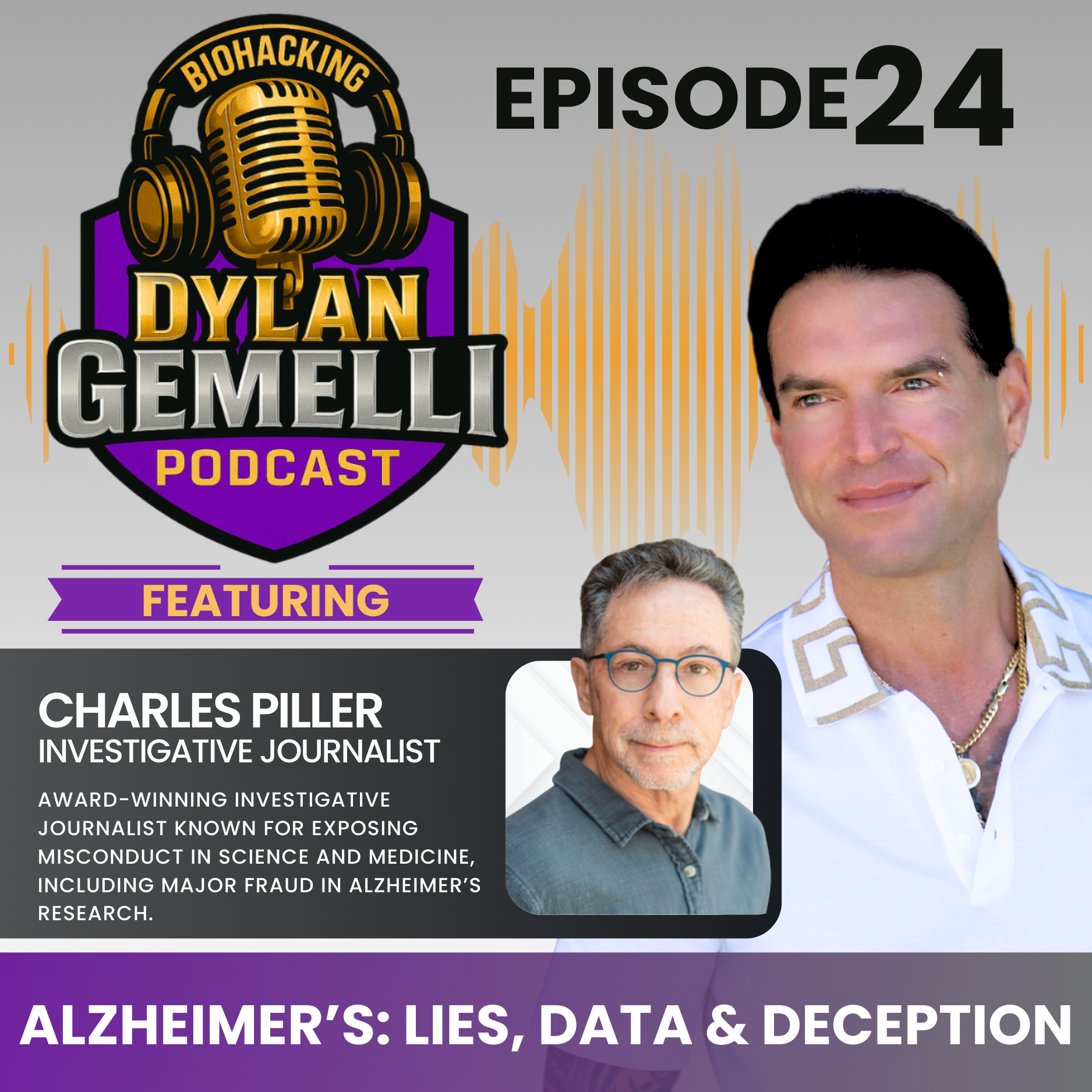
The Dylan Gemelli Podcast
Episode #24 with Investigative Journalist Charles Piller! Uncovering FRAUD in Alzheimers research, Intimate details of the scheme, the impact of doctored research, amyloid protein, investigative journalism, freedom of speech, censorship and more!
01:10:37
Loading summary
Transcript59 lines
- [00:16]
A
All right, everybody, welcome back to the Dylan Gemelli podcast. So strap up. We've got a great, great guest today. We're going to get really deep and insightful on a lot of different topics. Now. He is an investigative journalist for Science magazine, and his work has actually appeared in the Los Angeles Times, the New York Times, the Sacramento Bee, and other publications. He's been honored with many national journalism awards and is the author of Gene wars, the Fail Safe Society, and Doctored. He's reported on public health, biological warfare, infectious disease outbreaks, and other topics from the United States, Africa, Asia, Europe, and Central America. And his most recent book, Doctored Fraud, Arrogance and Tragedy, and the Quest to Cure Alzheimer's, is going to be a topic we really get into today. So I could go on and on, but we got to get into the conversation because time is limited. So everybody welcome.
- [01:09]
B
Charles Pillar, thanks so much for having. Great to have you. Appreciate it.
- [01:14]
A
Yes, absolutely. I appreciate you taking the time. I know you're busy, especially with the new book, and there's a lot of people wanting to interview you and get into the things that you have talked, talked about. And I'm really excited to learn about what you've done here. So let's start with this. What drove you to get into the topic of work that you do? You know, being investigative and looking for the things that. That you're digging into? What? Is there something in your life that triggered you to want to do that? And can you kind of get into that background?
- [01:46]
B
Sure. At the risk of dating myself, I am old enough to remember the Watergate scandal with Richard Nixon, and it really inspired a lot of young people. Of course, I was too young to be a reporter back then, but I remember being riveted by the revelations associated with that scandal and really inspired by the kind of intrepid legwork that has to go into undercover under. I'm sorry, uncovering the critical information that goes into helping people understand something from a factual and also a most credible perspective on important issues facing our society. And so, like so many young people, I was inspired by that. But it took some years to learn and to study and to understand where I might fit in in journalism and to try things. But yes, I was from a pretty young age interested in trying to become an investigative reporter. It's not that easy to do because it's a competitive field. There aren't that many jobs in investigative reporting. Unfortunately, there should be a lot more. But if you're deeply determined and want to put in the work, it can be done.
- [03:06]
A
Absolutely. So do you find that this type of work, you get a lot of pushback or a lot of people trying to, I don't know, sabotage your work, not lead you in the wrong directions? I mean, how difficult it is to really get into this and do it properly?
- [03:24]
B
Yeah, I mean, I think if you're doing this kind of work, you have to be prepared for threats and for the consequences of pissing off important people. To put it frankly, I'm working in an occupation where the articles that I write question and sometimes threaten the careers of people. In this particular case, associated with my book, doctored scientists who have apparently engaged in misconduct and misrepresentation of important studies. And when exposed, that's a very, very difficult thing for them. But it should be. Honestly, if people are engaging in misconduct or engaging in activities that appear to be misconduct, it needs to be explored. The public needs to know, because it can be very harmful to the pursuit of scientific knowledge and also eventually drug development. So we've all got a stake in it. And for me, the threats and the pushback and the kind of public claims about disputes about my work, that comes with territory. You got to be prepared to take it. You got to have a thick skin, and you got to be prepared to have good lawyers behind you sometimes, because anybody can sue for anything, even frivolously, and you just have to be ready for whatever comes.
- [04:48]
A
So what keeps you going? Like, what is it that keeps you going doing this? Because, I mean, you're talking about getting threats. You're talking about people that are, you know, swaying you off course, that are coming at you from all different angles. And I know that that can be extremely difficult. And a lot of people would just say, this is not worth it. This is not worth it at all. I mean, you must have some personal, you know, interest in this in your heart, aside from just. It can't just be money driven, because you could look at that and say, it's not worth it, you know, going through all of this.
- [05:19]
B
Yeah, well, I'm fortunate that I'm not suffering from lack of income, but I'm not getting rich either. You know, very few reporters really do get that rich, but, yes, for me, look, I mean, it may sound a little bit corny, but I'm really deeply committed to doing something beneficial with my work. That's always been my motivation. Back from, as I mentioned, inspiration. As a very young person associated with the Watergate scandal, what I want to do is expose things that can illuminate issues in a way that are helpful to the public that can advance these causes in a way that might put things a little bit better on track than they were before. Look, you have to be realistic. Being one person, no matter how influential some of my work might be, and fortunately, at times, it is influential. I think the book, for example, Doctored, has turned a lot of heads, and that's great, but you have to understand that the world's complicated. My goal really is to be one of the many people who's trying to do something beneficial in the world. And because I feel deeply about it, it also means that I really enjoy what I'm doing. I really enjoy digging. I really enjoy getting to the bottom of puzzles. And that's an integral part of being an investigative journalist, is figuring out how mysteries end, what the steps are to learn what the root causes of problems are, and how someone might try to correct them.
- [06:58]
A
So let me ask you this, and I think I know the answer, but I just want to hear what you have to say about it. During all of these investigations that you do and the digging and the learning, have you ever had anything, or do you ever get to the point where it's like, holy shit, like, what just happened here? Are you kind of at the point where you're kind of, like, jaded now? Where it's like. It's just something else? I just kind of expected this to happen. And you don't have to get into what it is if you don't want to share. But have you ever had those moments where you're like, oh, my gosh, like, really? Did this really happen, or did I just uncover this?
- [07:31]
B
Yeah, honestly, I've had that a number of times. And it's not with every story, because sometimes in this business, you drill a lot of holes, and some of them are dry holes, but when you. When you hit a gusher, you know, this is something potentially important and interesting. And that's really critical to remember because it doesn't do much good to do a lot of digging and find out information that is beneficial to the public if you can't make it something the public really is interested in and wants to learn about. And so what I look for, and as you say, the sort of most exciting moment, is when I have both an interesting story and compelling story of some importance, but also a compelling way to tell it. And that's usually through the eyes of the people who have lived it. And that's what I'm about. I'm about trying to find ways to tell stories that are interesting, that are compelling, that have a Kind of arc that anyone could read and understand and kind of understand the relevance of it to their own lives. And that involves, for example, really, really getting to know people and. Yeah, getting to. Getting them to trust you enough to tell their stories.
- [08:52]
A
Do you. I know you have to be careful when you take each particular subject or area that you're going. Does anything ever seem to hit you a little bit more personal or as any of the things that you've looked into, like, we'll just use the Alzheimer's, for example. Like, is there something that you've had in your family or something that a loved one had that you really wanted to get to the bottom to, or are these just things that you just say, you know what? I. I've. I've seen this. I see there's corruption here. I want to get behind and expose it. Is it kind of always like that to you? I'm just curious as to how you pick the areas that you're going to go and. And kind of dig into.
- [09:27]
B
Sure. It's a good question, Dylan. Honestly, it. It's mostly the latter. It's just things that. That I get clued into and become deeply interested in over the course of it. I have to say, the Alzheimer's situation is a little bit different for me. It is more personal in that, like millions of Americans, I have personally experienced Alzheimer's and Alzheimer's disease in my family. So my mom passed away a few years ago. She died with Alzheimer's disease and had terrible dementia towards the end of her life. My dad did not have Alzheimer's. He had a different dementia, one called Lewy Body Syndrome. It's something that is associated with Parkinson's disease. So, yes, for me, this book, this pursuit, this effort to try to expand knowledge about Alzheimer's disease is definitely personal for me and something that I feel that I owe to my family and to myself.
- [10:32]
A
Okay. Okay. Excellent. I kind of had a feeling that it was more the latter, but, you know, with stuff like this, a lot of times people get into that because of something personal, and then it leads into something else. That's why I was curious on that. Let's. Before I. Because I have questions about your books and other books before we get to the big dog that you just released. So what. What's your background? Like, did. What's your prior education or what did you study and how did that kind of shape what you do now?
- [11:02]
B
Well, my background initially was not in journalism. I studied psychology in school.
- [11:09]
A
Okay.
- [11:10]
B
And I very quickly realized that that was not going to be a profession for me that I was, you know, as much as I respect and honor people who want to have a one to one relationship with patients and clients and help them work through their issues, I realized that, that just, you know, that wasn't me, that wasn't my personality. And my grandfather was a quite accomplished psychology researcher back in the day and he in a way inspired me. But then I realized I had to be honest and true to my own interests and talents. And so what happened was out of college I went ahead and experimented with freelance writing. And in fact, one of the first big articles I ever did was something that really sparked my interest in investigative reporting. It had to do with, with a group of workers in Utah who were working in a lead smelting plant. So this is a processing plant for lead. And this group of workers were exposed to terrible toxic fumes. And the company that they were working for had been covering it up. And what I was able to do was to not just learn about some of the details of that toxic exposure, but, but to talk to some of the individual workers who were exposed. And this was quite a few years ago. There was no Internet and it was a bit of a challenge. And I used kind of a time honored old school method which was to call, it was from a small town in Utah where it's not that everybody knows everybody, but people are deeply connected to each other. And I made some random calls, looked up people in the phone book and started calling people and said, do you know someone who worked works at this plant? And within about three calls I had some key sources to understand the depth of the problem there. And that gave me the sort of the bug, if you will, to try to do more in investigator reporting. I worked for newspapers for a while, small, very small newspapers, and then moved on to magazines. And eventually I broke through to a big newspaper job at the Los Angeles Times where I did both reporting on news subjects and also a lot of investigative reporting. And really had the benefit of working with world class colleagues and editors who were able to help me hone my skills and be even more ambitious and try to do things that required the teams that a big news organization can provide. And that, that kind of got me on my way and I have never looked back from there.
- [13:59]
A
That's awesome. Well, you've had quite the road then in the journey, sounds like. So that's, that's great. And quite the background. What is right now you write for Science magazine. Can you kind of get into what that magazine discusses and what you kind of Contribute, Sure.
- [14:15]
B
Happy to do it. So Science Magazine is a scholarly journal which is one of the hundreds, thousands of academic journals out there in the world that publish these kind of honestly dense scientific articles with lots of references and a lot of technical terms. But it also has a journalism side of the magazine, so there's the scholarly article side and the journalism side. And of course, I work for the journalism side of the book book. And Science is one of the most important and prestigious scholarly journals in the world. And so the benefit as a journalist of working there on scientific subjects is that my stories have the opportunity to have a lot of influence because the journal is so well respected, so well edited, and there's a trust factor. The trust factor is that we know that if it's coming from this source, it's something that we know has been deeply researched and deeply reviewed by qualified people. And that I think is a leg up when you're talking about technical subjects that might challenge conventional wisdom about science, which is a lot of what I write about.
- [15:33]
A
That's great. That's great. And that's what science is. Learning it and questioning it and figuring out new methods and methodologies. And I love that you're on that side of it. And that's a great opportunity for you especially to continue to learn as you write, too. So. And it helps us all benefit from learning from what you've learned. So in that magazine, when you said there's a science side and a journalism side, is it covering, like, basic science topics? Like, are we getting into different aspects of science? Like, let's just say cellular health or biology? Is that kind of what it does? And then there's a journalism side where you're writing your kind of articles about different topics and questions.
- [16:10]
B
Yes. Yeah, that's. That's pretty accurate representation of it. Dylan. I would just say that the topics of Science Magazine are extremely broad, everything from astrophysics to, as you say, cellular biology or genetics. And the journalism side is equally broad. Now we have news reporters who cover events within the scientific community, new developments, important studies that might break new ground. And as you mentioned, science is an iterative process. It always is the next step in reaching a new plateau of knowledge. But it's almost never the final step of anything because there's always new knowledge to gain, and the scholarly journal tries to find those new things. And the journalism portion of the magazine writes about their meaning and significance. And what I do exclusively is write investigative articles that ask deep questions about the reliability of certain kinds of scientific studies and the veracity of them. And so it's very important for science to also self police. You can't have science be just accepting everything and not questioning anything. Science is all about questioning. And what I do is I take that to the next level. I dig deep and try to understand whether there are aspects of scientific research that require a second look for everyone's benefit.
- [17:42]
A
So admittedly, when I was studying everything about you and when we talked and everything I talked to you about before, I didn't really get into the Science magazine part of it or this aspect. And I'm smiling so big because the things you're saying are like step by step in line with how I function, belief and how I kind of conduct my life where everything is a question and trying to find a deeper root and meaning and taking what I have and then looking deeper into it and figuring out is there a better way? Is there something I'm missing? Is there? Because I do a lot of hormones and optimizations and things with the body and cellular health is why I brought that up, just because it came off the top of my head. But what you're talking about is so intriguing and so great to hear. So this publication is more speaking out and it's kind of more freedom talking and the things that we need to evolve as people and to grow instead of being forced on a one track mind or told that this is it and don't question the science type of deal basically then, is what you're saying?
- [18:40]
B
Yeah, I mean, I think, look, this is Science magazine. It's the bedrock of scientific research in many ways a bedrock. And it's very respected by scientists all over the world. And so that gives it a degree of credibility in the scientific community that is very important. Now by the same token, how that credibility is supported is to also be skeptical and question. And that's something that the journalism part of Science magazine does and I think does quite well. But also the scholarly part of the, of the journal does some good questioning as well. There are viewpoint pieces and opinion pieces that push people to think more deeply about certain subjects and also are willing to challenge authority when it seems beneficial.
- [19:35]
A
Let me ask you this. How often can we read your like, do you write monthly? Is it a monthly publication weekly? How, how often is this? Because I'm intrigued now. I want to start reading it every however often it comes out. And I'm sure a lot of people that are listening are going to want to take advantage of that.
- [19:50]
B
Yeah, well, Science comes out weekly. My articles are not by any stretch of the imagination in every issue. Because what I do usually takes months for every article to do the deep research and reporting and often data analysis that might be required to mount a really credible case. And whether you're talking about Alzheimer's research or I did a story a few years back on nutrition research, and whether you're talking about the kinds of deep questions that people have, or just wanting to understand a subject well enough to write about it in an authoritative way takes time. I'm a very fortunate journalist. Most journalists are on tight deadlines and do not have the luxury of having that time. But it's time that's required for certain kinds of stories. And like I say, I'm fortunate. But also it's a way in which the editors of the magazine, they understand if they want to contribute in this way, they have to be willing to allow me to take the time to do it. And so I'm very grateful to them for that and for their leadership in that respect.
- [21:07]
A
That's great. That's awesome. So let's take a look back at some of your older writings before we get into your newest book. So your first book was Gene wars, correct?
- [21:19]
B
That's right, yeah.
- [21:21]
A
Okay. What's that kind of about and the inspiration behind it?
- [21:25]
B
Well, so that was something. I, many years ago worked for a small newspaper that was published by the University of California, and I became interested in biological sciences. And I became interested also in this phenomenon of how genetic engineering was used in our culture and in the scientific community, because I think it's an important, amazing, powerful tool, and one that, like any tool, can be used for good or ill in society. And one of the really interesting things to me was this big question that goes with the question of how you use genetic engineering in warfare. Because at the time I was writing this book a long time ago, there was a considerable amount of concern about. There still is. But that was kind of in. At the ground floor level, you might say, when those concerns were just building on the possibility of biological warfare being affected by genetic manipulation in a way that might produce perhaps more harmful weapons. At the time, the United States had a. What they called a biological defense program, which was a robust, large program to examine whether they could develop remedies for imagined biological weapons that had been the product of genetic engineering by the country's adversaries. And of course, this is a very challenging realm of research, very dangerous realm of research because of the hazards associated with the possible biological weapons organisms. And so what was really interesting to me was this nuance in the picture. In other words, the difference between offensive research and defensive research in biological weapons studies is really one of intent. In other words, the processes of examining these organisms, exploring them, building defensive responses to them, understanding how they might be used. Offensive and defensive programs need to do the same kinds of things, and it's only the intent of the researchers that determines where things are at. And so, for me, as an investigative reporter, I wanted to know all I could know about how that worked and a lot of how I did that book was to both explore the history of that realm, but also to file a number of Freedom of Information act requests of the federal government in order to learn about the biological weapons defense program and to learn the degree to which it was involving what they called dual use experiments, dual use studies. And that means that they were equally applicable to offense and defense. It's just, again, a matter of the intent of the researchers. And to me, that was critical to help inform the public about the potential dangers of the use of genetic engineering in that realm. I think that's really what the goal of the book was. And for me, because it was a pretty technical subject, I felt strongly that I needed to get a collaborator who was himself a expert in this realm, someone who understood the new genetic technologies intimately from his own work. And I was fortunate to get a great scientist, a guy by the name of Keith Yamamoto, to work on the book as a co author. So that that was my first book and one that I felt broke some new ground in helping people understand that subject. And a lot of things have happened since then. It's still very much a subject of concern in defense circles, but I think, again, I kind of set some groundwork so that people can understand it better.
- [25:19]
A
And what year did that book come out?
- [25:21]
B
That was in 1988.
- [25:25]
A
Oh, wow. So that was way back. So you were way ahead. Yeah, yeah.
- [25:29]
B
That's great. Like I say on the ground floor on that one.
- [25:34]
A
So let me ask you this. You've written four books, correct? Three total. Three. Okay, so you've written three books. Which one did you find to be the most difficult for you in terms of gathering the information? Time consuming? What had the most for you to overcome?
- [25:53]
B
Well, I would say that my most recent book that was just published, doctored, to me, that was the most difficult and challenging. And the reason is that, forgive me, listeners, I flatter myself by saying I think I'm a better writer now than I was a long time ago when I worked on my earlier books. I hope that we all can improve in our craft over time.
- [26:20]
A
That's Right.
- [26:21]
B
One of the things that I set a goal for myself with this book was to tell it as a narrative with a clear story arc. And what I mean by that is that this is not a dry recitation of scientific concerns or findings from an investigation. What this book is about is telling a story. How were these problems in the world of Alzheimer's disease discovered? And the book describes a lot of apparently falsified research, doctored research in critical areas. And for me, the challenge was not just learning what those were, which was a big challenge in and of itself, and I'm happy to talk about how I went about doing that. But also critical was to find the right people to use as the storytellers, really to use their life experiences as a way of understanding the implications of this raft of apparently doctored research on the field and on the challenges and difficulties in finding effective remedies for this disease that's so critical for the United States and the world and also afflicts so many people and has such a massively difficult effect on their family members and caregivers.
- [27:46]
A
So as time has evolved and things have changed in our society and governments changed, leaders have changed, all of these things have changed. And you can have your opinion one way or another out there. Do you feel like it's become more difficult over time or before to speak your mind, to not be censored, to not be, you know, viewed upon, vilified? Do you think it's changed any differently over the time? And if it was worse in one era than the other, when was that? And why do you feel that that is?
- [28:19]
B
Well, I mean, I guess it depends in part on whether you're talking about reporters or the general public. But, you know, I can speak as a reporter. I was too young to be a reporter during the Nixon era, where he had created an enemies list of report, included many reporters, and he was someone who believed quite adamantly that the press was something to be reined in. Now, look, all presidential regimes, all administrations have had challenging relationships with the media at times. And the current one is no exception in that regard. I think this media environment's very, very different from the one that I grew up in, if you will, as a reporter. And the differences are, of course, exemplified by us having this conversation right now. Podcasts, social media, all kinds of new Internet related media, YouTube and TikTok have become critically important parts of the media ecosystem. And that's all pretty new. And it means that the conventional mainstream media has much less control over the way in which people think about the world and that, you know, there are both pros and cons associated with that. Now, for me, look, I work, have worked throughout my entire career in what you might call the mainstream media. And I respect the work ethic and the ethical posture and the professional approach of serious minded reporting, not to the exclusion of other people doing other things. But to me, that's pretty important for delivering the kind of reporting that I do. I need to have that professional backstop. I need to have the determination to double check, triple check every fact in every story and in my entire book. I spent months fact checking my book after it was written. That's just part of the process that you have to do if you want to deliver a product that is the maximum degree of credibility, especially if you're challenging people in important ways. Now, with regard to today's approach by I appreciate the question in part because I wanted to mention issues that I see related to the Trump administration right now. So let me take it on two levels. One is that there have been a lot of accusations by President Trump and others who are his supporters that there's a lot of what they call fake news in the mainstream media. I personally think that that's ill advised and misguided. I think it's improper for those kinds of accusations to be made as a general course of affairs. I think that the mainstream media, and by that I mean some of the big newspapers and many of the big TV broadcast, et cetera, work really hard on their credibility. No one's perfect, no one is without error. Every one of us is subject to that. But there's a high degree of professionalism there, I think, suggesting that it's false just because it may have an opinion that President Trump may disagree with. I think that's tremendously misguided. Now, I want to address, if I may, Dylan, just briefly, a kind of funny situation that I found myself in as a reporter in the last few weeks since my book has come out. So my book talks about challenging the poor performance, what I would call the poor performance of many of the institutional authorities of science in our country. And when I say the institutional authorities of science, I mean the journals like, including the one I work for, science, the universities who are gatekeepers of important knowledge in the world, the National Institutes of Health, which is the primary funder of biomedical and medical research in the country, and so very, very important for ensuring the quality of that work and that thinking, and the Food and Drug Administration, which is the entity that approves and sometimes disapproves new drugs for remedies or other kinds of remedies that people really are desiring for important diseases. So I think all four of those institutions, the journals, the universities, the funder and the regulator, have really made a lot of mistakes and have had grave weaknesses in their behavior. That has led to a lot of the problems of misconduct associated with the work that I've done for my book that relates to Alzheimer's disease and the deleterious effects on scientific thinking and on the development of remedies in that field. Now, because my book is so critical of them, and because there are real problems in the field of Alzheimer's disease, I think that it can be possible to mistake that kind of criticism for a general condemnation of those organizations. I believe that the journals, the universities, the funder, NIH and the regulator, fda, we are extremely fortunate in our country to have these entities who are so incredibly effective in so many ways. Delivering new knowledge, helping certify the benefits of certain drugs, and keeping others that may be suspect out of the approval process. Those are things that we should honor and appreciate. Doesn't mean they're perfect. It doesn't mean that we shouldn't expect them to up their game when they are doing things that are not beneficial, that are complacent, that allows improper or inadequate research to somehow gain ascendancy in a field in a way that is based at times, even to some degree, on fraud or misconduct. So I've been very critical of them. But there have been a couple of occasions where RFK Jr and Jay Bhattacharya, who is the new National Institutes of Health director, where they have referred to my reporting as a way of describing how critical they are of the research realm, particularly in Alzheimer's research. And it's an awkward position for me. For this reason, I believe that they're right to challenge some of that research, to call out some of the problems in it. And I wouldn't have written about it if I didn't believe it was important. Of course I think it's important, and I appreciate their interest in it. What I do not appreciate is the slash and burn approach to removing huge portions of Alzheimer's research and other forms of research from the NIH and from the capacity of FDA to evaluate new drugs for all their flaws. These agencies have done generally a very good job in many ways. Even though I'm very critical of them, I want to see them strengthened and not greatly and radically reduced. So I just want to make it clear that I think you can have a different position and still support some of what's going on and be critical of a lot of the other things that are happening with the new administration.
- [36:10]
A
Yeah, I mean, sometimes things just need fixed, not eradicated is basically what you're saying. Right.
- [36:17]
B
I mean, you have a way of capturing my long answer and a few key words. Dylan, thank you for doing that.
- [36:27]
A
No, I thoroughly agree with you. I mean, some things I would say maybe aren't as fixable as others, but yes, I mean, let's go in and find all of the problems, figure out what we got to do to make it right and fix it. I, I get that and I, I like that. I think that's important. You know, it's hard for. It's really hard for anybody to say because we're not in there and we don't see all the details and we don't know what's being hidden from us and what's not and what's factual and what's not. And everybody calls everybody a liar and throws stuff. So it's very. To ascertain what is what. But I, I'm with you. And, and hopefully you get some honesty in there, and that's that type of thinking. It can be done, and we can only pray for that. And, and I'm with you 100% and thoroughly agree. Let's. Let's switch course now and let's just get into the. The Alzheimer's book and. Because I know that this is a deeper dive and we got a lot of stuff to talk about in here, so first and foremost, just talk to me about the basis of this book and then we'll kind of get into the meats and bones of it and, you know, everything to do with it. But Doctored Fraud, Arrogance and Tragedy, That's a pretty heavy title and with good reason. What's the reasoning for the title and the whole basis behind the book?
- [37:40]
B
Sure. So perhaps it would be good if I went back to the beginning of how I started to do my reporting for this book and why. And it all began when I got connected with a young professor at Vanderbilt University, a guy by the name of Matthew Schrag, who was a guy who had been looking into a particular Alzheimer's drug called Simufilam from a company called Cassava Sciences. Now, that drug, crashed and burned, is no longer being even thought about as a possible remedy for Alzheimer's. It's a long story I tell in the book, but I'm going to pause away from that for now and talk about why that led to this bigger set of issues and that's because Schrag, who is himself a neuroscientist who researches in a lab some of the potential causes of Alzheimer's disease, and also somebody who treats Alzheimer's patients, because he's also a physician who is a neurologist who has patients who have the disease. And he had, over the many months, begun to hone his ability to see potential doctoring in scientific images. And what I mean by that is he could look at images, say, of brain tissue, magnifications of brain tissue, and be able to look at them and see the possibility that someone had used a program like Photoshop to move some things around or to obscure certain elements of the image or to copy elements and clone them within an image, all to accentuate a point that was being made for a scientific paper, but to do so improperly in a way that is essentially a kind of scientific cheating. And because he had developed a talent for seeing these things, from looking at this, initially looking at the science behind this drug, Simufilam, he was looking more broadly to expand his ability to do this. And he, in a way, kind of just by accident, ran across one of the seminal studies in the history of Alzheimer's disease. Now, this was a study done in 2006 at the University of Minnesota. And what this study did, if I could just use a few. A little bit of scientific explanation to bring this experiment to life for listeners a little bit, is that involved a group that was using genetically engineered mice to produce copious amounts of a protein that deposits in their brains. This protein is called amyloid. And it is thought by many, many, many people to be the linchpin of Alzheimer's disease. The thing that kicks off a series of biochemical effects in the brain that leads to cell death in the brain and ultimately to dementia. And so what he was doing when he kind of stumbled on the study and was looking at its images is that he realized that there were some big questions about whether these images were improperly changed. And so I remember the first conversation that Schrag and I had about the images in this seminal paper that had appeared in the journal Nature. Now, you remember I said that the journal I work for, Science, is one of the preeminent scientific journals. Nature also is kind of its counterpart. The Science and Nature are two journals that are often thought of in the same light as being the most important general science journals out there. And so to get an article into Nature means that you're really hitting something really important and potentially could have a lot of influence. And this study had enormous influence. It was one of the most cited and discussed studies in Alzheimer's disease for a very long time. And the way the experiment went was this. They extracted these proteins from the brains of these genetically engineered mice. They refined just one little segment of the protein, something they called amyloid beta 56, their star protein, they injected into rats. And rats began to show the apparent symptoms of memory loss that they compared to memory loss of Alzheimer's disease. So what you had was the first kind of cause, effect relationship of a particular substance towards Alzheimer's disease, albeit in animals, but still something that really inspired the science. Now, why was it so important? Why was it so pivotal? If you don't mind, Dylan, what I'd like to do is go back more than a hundred years to tell kind of the story of the disease. How did we get here? Why did this, why was this a meaningful part of the scientific picture? So the reason is that Alzheimer's disease was first described in 1906 by the German scientist Alzheimer, namesake of the disease. And it involved when he did an examination of brain tissue from one of his patients who had died with terrible dementia. And this brain tissue showed these two kinds of really obvious proteins. One was this amyloid protein that I mentioned before, the so called sticky plaques that listeners may be familiar with that are regarded as a classic sign of the disease. And another protein that it's called tau, which is called the tangles because it looks like kind of tangled string and it resides within the nerve cells of the brain. So this combination of plaques, tangles and dementia was defined and described as Alzheimer's disease. And so what happened for many decades after that was honestly not that much. And the reason it was not that much was that this disease is a disease of old people, basically, primarily old people. Very, very few people get it in their younger years. And consequently, because of simple demographics, for many decades after 1906, there weren't really that many people living into their 70s, 80s, 90s, and beginning to show the symptoms of dementia associated with Alzheimer's disease. So while it was a well known syndrome, it was not an important disease. But come the 50s, 60s, 70s, when gigantically important developments in medicine like vaccines, antibiotics, remedies for cancer, heart disease, diabetes, all of these things suddenly became prevalent in our medical practice and people began to understand better how to treat them and lifespans increased dramatically, consequently, we had a lot more old people. And those old people, unfortunately, many of them began to get dementia, dementia described as Alzheimer's disease. So suddenly Alzheimer's disease became A very important, very important kind of disease to study. And a lot of money went into it. A lot of ideas came out. And the prevalent idea, the idea that gained the most power in the field, that had the most currency among scientists and physicians and funders and journals, everybody, was something called the amyloid hypothesis. And as I said before, what this involves is the deposits of amyloid protein that build up in the brain, cause a cascade of. Of biochemical effects in the brain that eventually lead to dementia, cell death and the terrible symptoms of the disease. So this was really very widely accepted. And so what happened was they built a lot of new drugs around this idea, drugs that attack the amyloid plaques and try to remove them from the brain. And scientists and drug developers and pharma companies can be very clever. They were really good at doing this, really good at finding these compounds and these various biological drugs that could remove the amyloid plaques from the brain very effectively. The problem was they did not arrest or improve the dementia symptoms of the disease, so no one was getting better. And these drugs, many of them, had terrible side effects that could be extremely dangerous, sometimes lethal. And so because of this terrible combination of, you know, the effectiveness of removing the amyloids, but the ineffectiveness of benefiting patients, there was a lot of discouragement about the amyloid hypothesis. People began to say, is this really the right path we're walking down, or should we be pursuing other scientific avenues that might be more fruitful, more effective? And what happened was, right about this time, 2006, after a bunch of these failures in drug development, came this experiment out of the University of Minnesota that appeared in Nature magazine. And lo and behold, it instilled new hope, new understanding and new confidence in the proponents of the amylite hypothesis that, yes, we are on the right track, we haven't found the right substance yet that is going to be the cure or the substance that really hits its mark and starts to really arrest the symptoms of the disease. But we are going to get there because we know this experiment has, in a way, led the way. Now, it wasn't the only experiment like that. There were others as well. But this one was pivotal because it came at a critical time and it resulted in a gigantic, gigantic influence, gigantic influx of funding and interest in the field. So that's where we were that moment with Matthew Schrag, him thinking about the experiment and him seeing this might have been based on doctored images, that really caught my attention. We both, in a way, were kind of stunned because we realized, if true, if his concerns were well founded, then it might call into question a very important experiment that could cast doubt on this ongoing research associated with the amyloid hypothesis.
- [48:22]
A
Wow. So have you had any kind of attack on you over this or, like. Because I feel like if I had I not met you the way that I did, or have you brought to my attention, this is not something that I have heard about, and I try to stay up on all of my news and everything as much as I can. Now, granted, I don't see every little thing, but you would think that something like this would be far more discussed or mainstream. And I don't find personally that it is. Correct me if I'm missing something. Do you feel like it's not getting the attention it deserves? And what have you kind of had thrown your way after this came out and the book released, and you've done interviews now and been on major podcasts? Because I'm sure some of the podcasts you've been on, people are hearing this. And I'm going to make sure, like with mine, everybody hears it too. I mean, we're going to blast this out. So what are you running into and why is this not being talked about more?
- [49:13]
B
Well, I think increasingly it has been talked about. I think one of the pieces of evidence that is I mentioned earlier again, and I have very mixed feelings about this, is RFK Jr and Jay Bhattacharya both brought it up in their comments to Congress during their confirmation hearings. But I guess I would put it this way. When I originally wrote an article about this finding in Science magazine in 2020 22, there was a lot of uproar in the scientific community about it, a lot of concern about it. And there was a fair amount of coverage in the regular media, but not to the extent where it was like became household conversation, obviously, but it raised a lot of ruckus in the scientific community for sure. And so what's different now is that I've gone back and I've done years of research on Alzheimer's disease, on the amyloid hypothesis, and on the science behind all these things, and have found that the field more generally has been stricken by a large amount of unfortunately, apparently doctored research based on misconduct, where images that are central to the scientific findings in important experiments and in other kinds of experiments maybe aren't so important, but in a lot of important experiments had been changed improperly to reflect the experimental hypothesis of the person doing the work. And when you're changing your data to try to make it look better, you know that you're not proceeding in an honest way. And so, yes, there has been a lot of interest in the book, a lot of attention paid to it, because it is so important to the millions of Alzheimer's patients in our country and the many more millions of their loved ones and caregivers to have the most honest, effective ways of looking at the disease. And if there are problems in the way the thinking has gone, if there are cracks in the edifice, if you were of the institutional authorities of Alzheimer's disease and the. The most powerful forces, then we need to. For people to understand that better and understand the importance of it and the meaningfulness of it. It doesn't mean that nothing associated with the amyloid hypothesis is true and that nothing should be done about it, that no one should ever look at it or think about amyloid proteins. I think even the critics of the hypothesis believed that amyloid proteins have something to do with the disease, but maybe not everything to do with it the way it's been often described. And consequently, yes, there's been a lot of anger at the messenger, you might say me, in bringing this to light. But I think what's interesting is that the criticisms of the book, and there have been criticisms from scientists who are deeply committed to the amyloid hypothesis and whose careers and funding and reputations are built on examining, exploring and proving out that way of thinking about the disease. Of course they feel threatened. They've been antagonistic and critical of some of the findings of the book. But I should add that they haven't found anything in the book that's not true. What they have said is that they just see the situation differently and feel very strongly concerned that. And again, I'm going to get back very briefly to this question of the administration of this whole set of issues in Washington. But they feel concerned that my book might encourage people who are anti science from thinking, oh, well, because some science was improperly manipulated, all science is suspect. Let me address that directly if I could, Dylan, just for a moment.
- [53:11]
A
Yeah.
- [53:12]
B
I want to say that I believe that in every walk of life, a small percentage of people will cut corners or manipulate information or cheat or outright commit fraud. Why would Alzheimer's research be any different from people in finance or plumbers or even journalists who do engage in improper activities from time to time? We're all human beings, we both make mistakes, and there are a few among us who are willing to do things improperly. And so that does not mean the vast majority of research and Alzheimer's research can't be trusted. Of course it can be. It's the honest work of people who are deeply committed to finding the truth in these matters. Do they make mistakes sometimes? Sure, of course. All of us do. But I think we should understand that even though it's only a tiny percentage of research in the field that may have been based on doctored images or on other improper scientific approaches or on outright fraud, even though it's only perhaps a very small percentage of the overall body of research, even that small amount in certain locations in the thinking of the field can skew. Scientific thinking, can lead to dead ends, can waste important funding that we don't have nearly enough of, that we need desperately need to help patients by finding better approaches to finding a cure for the disease. And so it's that wasted thinking, it's that wasted funding and the tragedy of it that I think the field needs to take more seriously. Even though myself and I think everyone should understand that most scientists are honest. Even if they're pursuing things that don't ultimately pan out, they're trying their best.
- [55:13]
A
Do you feel optimistic that there's going to be some positive changes as a result of your work and your writing here in the future? Do you truly feel that way and do you see that coming?
- [55:25]
B
I do feel that way, Dylan. I feel optimistic for a couple of reasons. Well, first of all, I think over the last few years there's been a much greater effort to detect improper research, to find doctored images in scientific research. And I have to say that it's been stimulated by something that I think many listeners would maybe even be unsurprised by, a kind of crowdsourcing. So you have a small army of these people who call themselves image sleuths, and they are forensic image experts who know how to use software and who have a good eye for seeing when some improper duplication of an image or change in an image may have occurred, using software tools to examine it carefully. And until these folks entered the fray a few years back, you had enormous amount of complacency on the part of journals and other institutions who are again the gatekeepers of science and should be all over this. They should be vigilant about it, but unfortunately were very complacent and were not paying close attention and so much improper science slipped through. That's harder to do now because you've got thousands of eyes on it. People who are posting their images, some to social media and some to a website called Pub Peer that listeners may want to look up just for fun and take a look at it, looks at scientific studies and where perhaps mistakes or improper manipulation of images might have taken place. And it doesn't necessarily conclude that bad things have happened, but it asks questions. It shows the apparent flaws in the images. It requests that the scientists behind the work take a close look at it. And often it gives fodder for an examination by the journals that publish the work. So this is all for. This is one way in which I feel optimistic. It's forcing a greater concern about making science the most powerful, the most reliable it can be. And that's the forensic image sleuths. The other thing is I think that in as much as the amyloid hypothesis of Alzheimer's has been dominant for many, many years, has received the most attention in recent years, there have been a few other ideas that I think are potentially fruitful and interesting that I have my eye on. And I would certainly encourage people who are interested to think about and examine. And I can give a couple of examples of those. One is right now the kind of the GLP1 inhibitors. These are the drugs like Wegovy and others that have hit the world by storm of late. And whatever pros and cons there are of these things, they become very important drugs in our world. But one of the interesting things about it is that scientists have found that it's possible that they may have beneficial effects on early stage dementia. And as a result, they're being tested in people. I think within, probably by sometime early in 2026, just no more than about a year from now, we may know whether those hopes, the early evidence that we've seen with those drugs, might prove to be true and correct. And it might be an avenue that some patients might be able to travel to have a better, more hopeful experience with the progression of their disease. The other thing that I think people often forget about is that certain infections that seem like they're gone, like one example is herpes virus that people might get that causes cold sores but then goes away. And people think, okay, I'm done with that. But it can somehow sometimes, I should say, be a latent infection that hangs out in internal organs, including the brain, for many years, even decades, after the person has apparently gotten over the disease and gotten over the infection. And people are studying the effects of these latent infections on dementia. And it's possible that it could be a factor in Alzheimer's disease. And there's trials going on right now, again, that I think within a few years might have fruitful information that could prove beneficial in understanding the possibility that there's other avenues, maybe in concert with the amyloid hypothesis, or maybe separate from it, that could have a lot of impact in helping, if not cure people, at least helping the cognitive symptoms become less bad or be arrested in some way. Now, there's one other thing I wanted to mention, Dylan, and I know this is most certainly an interest of yours, which is prevention. And one of the things that I feel hopeful about is that it's becoming more known nationally and globally that we do have agency in our lives. Even when it comes to a dreaded disease like Alzheimer's that sometimes seems so mysterious. We know very well that there are certain things that are risk factors for the disease. Things like high blood pressure, high cholesterol, sedentary lifestyles where people don't get exercise or eating habits where people aren't getting the proper mix of nutrition and eating. Well, I guess what I'm trying to say is that living our best lives, aside from it being its own benefit, aside from it being something we might all want to do just for the sake of, again, having our best lives, it can also be a way of forestalling or lessening the effects of Alzheimer's disease late in life. Should we be one of the unlucky ones to get that disease as an older person? So I'm just encouraging people to think positively, to take precautions, to address risk factors, and to live your best lives for all kinds of reasons, including prevention.
- [61:47]
A
I'm going to offer you a little something here to try to contribute to your work. So I do. I've been studying peptides since before most people ever even knew they existed, because I'm from the bodybuilding space and they were sold as research chemicals for research purposes. So I'm just going to touch on a few findings that I have for you that are at least in development or being studied, and just kind of provide that to you really, really quickly so that, you know, just for general purposes, and I'm not saying these work or anything, this is just some basic facts that I have you brought up the GLP1s, which are a deep study of mine, as you can imagine, given the popularity and the amount of people, you know, wanting to use them. But in terms of Alzheimer's, that there is definite study and hope in terms of that benefit there. And it's just kind of been shown to protect brain cells from damage and improve cognitive function in Alzheimer's patients right now, still early on stages. But just a few quick tidbits like, so just some ways that, that they may function, various mechanisms of function for helping Alzheimer's patients. There's an inhibition of AB aggregation and that blocks formation of amyloid plaques like we've been discussing, and they prevent accumulation of toxic proteins in the brain. There's a reduction in neuroinflammation that goes on and they can modulate immune response and reduce inflammation in the brain of Alzheimer's patients. And then there's an improvement in cognitive functions as well. Now, I'm not sure if you've looked at any of these studies right now, but there's some MIT neuroscientists that kind of found a way to reverse neurodegeneration and other symptoms of Alzheimer's disease. Excuse me, by interfering with an enzyme that's typically overactive in the brains of Alzheimer's patients. And so they did this treatment on mice with a peptide and it blocks the hyperactive version of an enzyme called CDK5. And they found dramatic reductions in neurodegeneration and DNA damage in the brain. So these are just some things that I have on my end that I could hopefully contribute to people listening or throw in for you. I don't know a fraction of a fraction of a fraction of what you know. But I do know, you know, other aspects of like peptide study and things of that nature that I thought might be of interest to kind of share.
- [64:11]
B
So yeah, I really appreciate you mentioning that, Dylan. You know, one of the things that I've learned in looking first of all, I'm not an expert in every aspect of Alzheimer's disease. It's a vast field and what we need is creative thinking that supplements some of the more conventional studies to keep people moving and being broad minded about it. Now, you know, I just want to make it clear that while I'm not an expert in things like supplements and brain training and things like that, I'm not aware of anything like that that is either a preventive or a cure for the disease beyond what I've already said that I think generally taking care of risk factors is good for all of us, for whatever ails you, not just Alzheimer's disease. But I want to say that I appreciate what you're saying because I think creative thinking, innovative thinking is part of what's going to solve this problem ultimately. Yeah, it may be. And I think many scientists think that Alzheimer's is a multifactorial kind of disease. In other words, there might be a number of causes and it might require more than one approach to really arrest the symptoms of cognitive decline. And therefore some of the things you're saying like neuroinflammation There are many scientists in the field who believe that that may be one of the linchpins of both comprehending the origins of the disease and doing something useful for people that have it. So the short answer is yes, people should be looking at these things. I don't personally know the research you're talking about, so I don't have an opinion on it. But creative thinking is what we need.
- [65:58]
A
I agree. And I mean I, I'm a cellular health coach and things like that. And one thing that we learn in there is that all diseases start in the, in the cells. Somehow, some way it's damaged cells and inflammation. These things are like the causes of basically everything that goes wrong and, or gut health. But you know, that's neither here nor there. The point is, is things like inflammation, things like this, the preventative things that you talked about, there's multi methodologies to go about things to prevent things to be preventative early on as opposed to just kind of, you know, and I struggle this with a lot of my clients and people that I train. It's kind of just this carefree attitude and when you do that, you don't take the proper precautions and steps to take care of yourself prior and kind of educate yourself and know you're setting yourself up for failure, assuredly far earlier than you should. And so the hope is, is that with the education and the good explanation of everything that we can spread that word and help people to take better care themselves early on to be preventative and then do their due diligence in terms of their research and their understandings. And then, you know, you ultimately in life you make your own decisions. You know, we all do. We live, we live and die by what we do and we learn and hopefully we make those right decisions. But it's people like you that are a blessing that take the extra step and risk your own health. I mean really in terms of people threatening you, you risk your career, you put it on the line to help people and it's, we need more people like you. And that's why I want to showcase you and I'm appreciative of having the opportunity to speak with you because it's so commendable and people need to know more about you and who you are and what you do. So I just want to say thank you, you know, for all of us. It's appreciated.
- [67:39]
B
Oh, you're so kind to say that, Dylan. And I just want to say that I agree with you very much. We have to remember that we are the center of our own lives and we're the protagonist in our own stories. And it's up to us to think creatively and be thoughtful and to take care of ourselves. And I appreciate what you're doing towards that as well.
- [68:04]
A
Absolutely. Well, I want to say congratulations on your book and the success and you being put out there to discuss it. Where is the best place to buy your book?
- [68:15]
B
Well, it is available through every normal online source, of course, and through your local bookstore if people prefer to do it that way. I like to support local bookstores and you can find an enormous amount of information about the book if you want to hear what people are saying about it. There have been a lot of reviews, a lot of articles about it. Other other podcasts I encourage you to, if you're interested, beyond what we've talked about, there's other different specialty podcasts that have talked about it and those are all listed on my website. Very simple. Charlespiller1word.com.
- [68:52]
A
Excellent. And then what? And I'm going to list everything in the description. But do you are you responsive on social media? Like, where's a good place to follow you there?
- [69:01]
B
I'm on Bluesky and X and LinkedIn. And yes, I look at postings. If you, if you tag me, I'll see it at some point, depending on how busy that day is. But yes, and feel free to reach out. There's also my contact information is up on my website as well, so you don't have to scurry around to find it on those social media sites.
- [69:29]
A
Well, let me just say I encourage people to obviously check out this book, his newest book, Charles's newest book, but check out his older publications. There's great content. I'm going to look into the science magazine when we get off of here and check that out because I'm super intrigued by that. You know what's crazy, Charles? When I was in school, I despised science. It was my least favorite subject. It was the one thing that I hated. And now my whole life revolves around it. So it's funny how things change when we grow, but it's I'm really thankful that you brought that up because I'm going to check that out and start reading into that. And I look forward to reading more of your work and hopefully conversing more with you in the future on some things, too.
- [70:07]
B
Sounds terrific. Thanks again for all your interest and I've enjoyed talking about this with you, Dylan.
- [70:13]
A
I appreciate it and really thank you for your time. So that wraps up another great segment of the Dylan Gemelli podcast. Stay tuned for plenty more to come. Dylan Gemelli and Charles Piller signing off.