← The Dylan Gemelli Podcast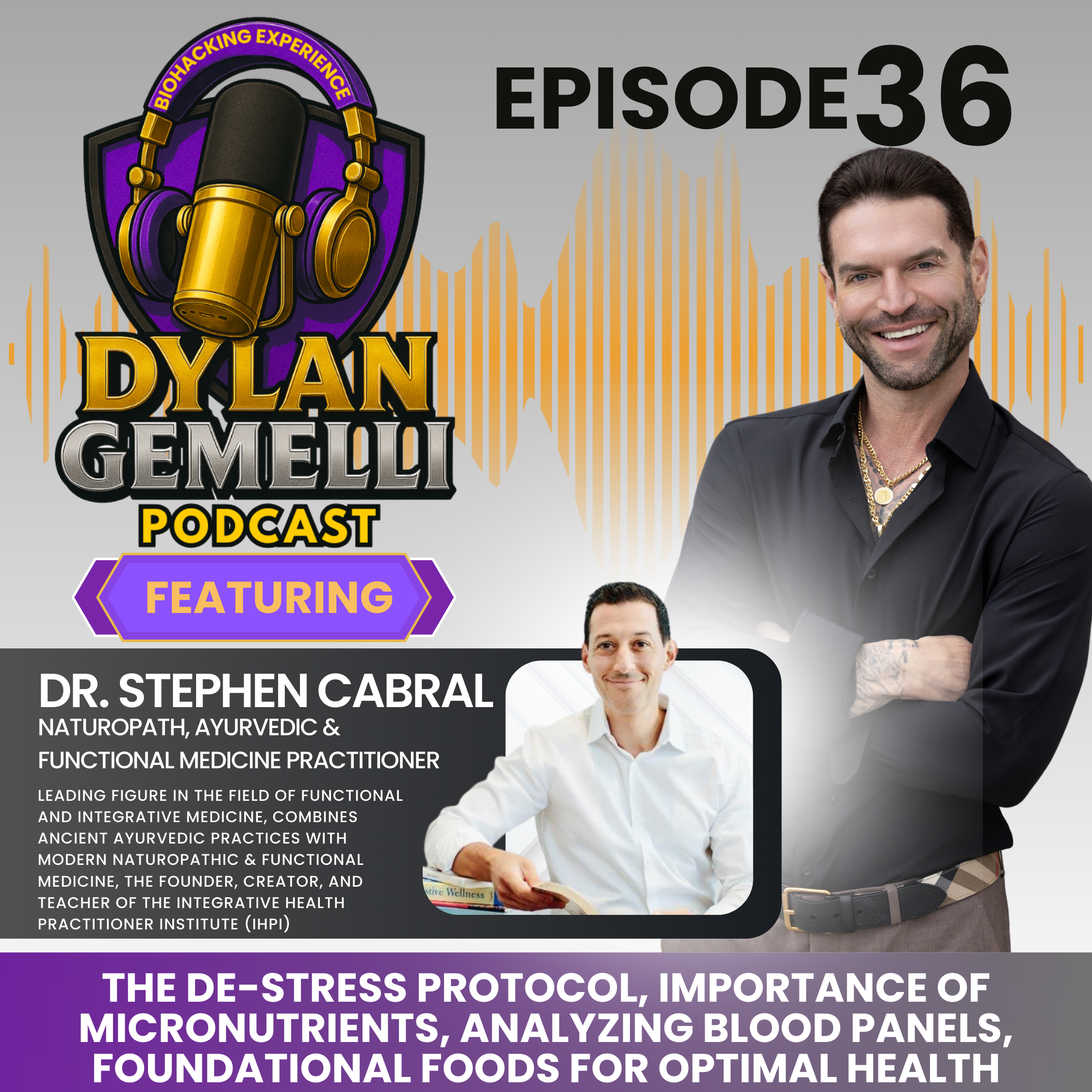
The Dylan Gemelli Podcast
Episode #37 Featuring Dr. Stephen Cabral! A journey into integrative health, the DESRESS Protocol, importance of micronutrients, how to analyze lab results, mercury and fish consumption, foundational foods for optimal health, and more!!
00:57:27
Loading summary
Transcript67 lines
- [00:00]
Dr. Stephen Cabral
Foreign.
- [00:16]
Dylan Gemelli
Everybody. Welcome back to the Dylan Gemelli podcast. Now my guest today is a true testament on why I feel so blessed and love what I get to do. Because he is an absolute genius. He is a board certified doctor of naturopathy. He's the founder of the Integrative Health Practitioner Institute which I am also taking the course in. He's the founder of Equal Life. He has an Amazon and international best selling book. This, my friends, is Dr. Stephen Cabral. Thank you doctor for being here today, man. I appreciate it.
- [00:46]
Dr. Stephen Cabral
Thanks so much for having me on. Appreciate you.
- [00:48]
Dylan Gemelli
Yes. So we have a ton to talk about. I want to take this limited time that we have and get every ounce of information out of you that I can today. First, let's kind of talk about ihpi Integrative Health Practitioner Institute, because I obviously started doing it. That's how I found you and met you. Can you just talk about why you started that and just kind of generally what that is all about?
- [01:11]
Dr. Stephen Cabral
Yeah, it's interesting. A lot of what I've ended up doing in my career was nothing that I set out or planned to do. So when I had my two practices in Boston. So basically I became a doctor of naturopathy in the first place because it took me 10 years to get well, from 17 years old to 27 years old. I went to about 25 to 30 different specialists in conventional medicine. And then I saw another 50 plus natural health doctors and they all had different pieces of the puzzle, but it never all fit together to get me well. I met my mentor, kind of shorten his 10 year story and I got well in six months. So sometimes you can be doing all the little things right, but not in the right order or put them together correctly. And once you do, you know, that's, that's where the healing begins. And you don't get better necessarily overnight if you have a lot of chronic disease like I did, like Addison's disease and type 2 diabetes and autoimmune issues as well. But the body can heal and it knows how to heal if you put it in that position. So I went back to school, got my doctoral degree. I opened up two different practices in Boston and functional medicine and integrative health and also body transformation. We did a lot of that with personal training, nutrition, et cetera. And then I said, this is Amazing, we're seeing 20,000 people per year. But I don't want to continue to open up more centers. I just want to teach. So I started a free podcast, the Cabral Concept. I wrote my book, the Rain Barrel Effect, it came out and then practitioners said, we want to do what you're doing. And so I said, great. And so it took me 18 months, but I put together the curriculum which became the Integrative Health Practitioner Institute. And so I would say that 50% of the people who join want to become the health coach in their own home. So they want to learn how to read their own at home lab testing, they want to help their kids, they want to help their parents, they want to help themselves. And then 50% of the people are actual practitioners from maybe their personal trainers, massage therapists, acupuncturist, chiropractors, et cetera, nurses. And they want to learn how to practice an integrative health approach that encompasses Ayurvedic medicine, traditional Chinese medicine, functional medicine. So basically we incorporate all the different forms of medicine so that when a wellness client comes to you, you don't have to make them fit into your particular dogma, rather that you can use all forms of healing in order to be able to help them.
- [03:21]
Dylan Gemelli
All right, so it's really adding that versatility to what they're doing and you can just kind of do it all. Yeah, I love that concept. And that's kind of like my reasoning behind it is because I have been, you know, kind of not singularly, but focused more on just health and wellness. So you've helped to expand what I'm studying now too. And that's why it's appealed to me so much. Will you talk about the different levels? Because obviously I'm going through separate levels right now of the course and everything and kind of why the focus is in the order that it is and what you obtain in each level because there is so much there and it's really interesting.
- [03:55]
Dr. Stephen Cabral
So our goal is always to create a bio individualized plan. That means that, you know, when we look in social media right now, everything seems to be black and white. You're either on the keto diet, carnivore diet, high carb diet, low carb diet, you're doing high intensity interval training, or you're just walking. It's like. But it's told that everybody should be doing this. So we say, you know what, there's a lot of great attributes to all sorts of different nutrition plans and exercise plans, but how do you know which one is right for you? And so in level one, we use something called the DE Stress protocol. And so this is exactly what I've used in my practice to see. We've seen over a quarter of a Million people. And we've run over half a million people labs. And so what we found is that if we can discern the information and find out what areas you need the most help in, then it doesn't have to be overwhelming. So we go through diet and exercise and stress reduction, toxin removal, rest, emotional based balance, scientifically backed supplements, and a success mindset. The success mindset is there because you can be given the best plan by any coach or practitioner you go to see. But if you're not able to follow through with it, unfortunately it's not going to work. So then what we do is for the distress protocol, we then teach people how to use it with clients because they can become a certified health coach or with themselves and family. And so that gives you the basis that we all need a foundational plan. But it's that last 20% that makes you unique to your situation at this time in the world and how that can change over time as well. So that's what we teach in level one and then level two is how to read at home, lab tests which look at urine sample, saliva sample, blood spot sample, everything but having to get a blood draw. Now I still believe in blood work. It's great to do with your PCP or on your own once a year and if you need to, maybe twice a year. But what we want to look at is the actual deeper underlying root cause that would then lead to a diagnosable disease in the first place. So it could be vitamin deficiencies, mineral deficiencies, high omega 6s, it could be low omega 3s, it could be food sensitivities, imbalanced cortisol, especially at night, not allowing you to sleep, forward levels of thyroid. So we look at everything from a really holistic perspective, taking everything into account, kind of call that the big five labs. And we teach that inside of level two. So level one, if you were to dedicate 30 minutes a day, you can get through it in 12 weeks. But you have lifetime access. So some people like to take longer. And if you dedicate that same amount of time for level two, you can go through level one and level two in about six months time. Probably the average is closer to eight months that people take to go through it. But again you have lifetime access. And then we hop on actual Zoom workshops twice a month minimum to be able to work through case studies and different questions that people may have.
- [06:30]
Dylan Gemelli
One of the things I'll say is that I guess if you're really interested in it and you get really intrigued, I, I know the importance of space in it out and comprehending and everything. But there's been a couple of times where it's like, you know, some people binge watch like a TV series. We'll all start, like going for an hour, two hours, and I'm like, okay, I better stop because it's going to be hard to retain all this and I have to go back and redo it. And I do it when I'm doing cardio. I do an hour and a half of cardio and I start listening to you and I just like. It's like, man, the time just flew by and I just keep going. So it's. I just want people to know how interesting and intriguing it is and some of the things you get into when you find it of so much interest it. The time flies. But you do want to absorb it and make sure that you're listening and going back over it. But, you know, one of the things that I would like to talk real quick about now is you were talking about the reading the labs. And so I have spent so many years coaching on hormone optimization and blood labs. But when you were talking about labs, when I was learning about the course, I was like, okay, I already know this. And then I realized I don't know any of this. And then when I took the test, I saw the test and I don't know how to read it. And I was, you know, I was a little taken aback. It's a little frustrating when you're used to doing everything. But then I thought, man, this is so interesting, so we could talk about it. Well, I've got you here if you would be willing to go over my results and kind of explain to everybody else and myself, because I don't understand some of them. And I thought it would be pretty sweet to kind of go over and just give people an idea of. Of some of the things that you look at of importance.
- [08:00]
Dr. Stephen Cabral
Yeah, absolutely. And so when we, when we teach these labs hormones is, is one of those labs, labs we call the stress mood metabolism test. And it goes through estrogen, progesterone, dhea, testosterone. And those are the free levels, which is nice. You get them from a saliva sample, but then it also goes through cortisol, which is really important because you can run cortisol on blood work, but you're never going to be able to get all four throughout the day. So that's important. And the lab that we're about to pull up right now is actually called the minerals and metals test. So the first one's saliva and A little blood spot has that test your thyroid. This one's actually a hair sample. And there's only two labs in the United States, so we, we use all CLIA certified labs. And so that means that these are actually following specific protocols and processes to get you a standardized result, which obviously you want a replicable result. That's what quality lab work is all about. So when we're looking at this, we actually want to understand the stress levels of an individual through their electrolyte balance, not necessarily their intake of calcium, magnesium, sodium, potassium, although that can play a role in it because it affects your autonomic nervous system. That we can talk about. But also we want to look at the other minerals that in the body. And these would be things like zinc and copper, selenium, chromium, phosphorus, and so much more. So what we can do is we can go through this step by step. If you'd like, you're pulling your electrolytes right now. And then we can also go over your other minerals. Yes, is your electrolytes. So it's interesting because I get to see we, we probably run about somewhere around a hundred thousand of these labs a year. And so when we look at this lab test, it's an interesting result because you have three out of four elevated. But honestly, for the majority of the time, we see calcium more elevated than magnesium, sodium or potassium. And that usually shows a greater stress on the autonomic nervous system. Now, I would love to have your hormone results, namely your cortisol plus dhea, because this could match up with someone that has a really strong constitution, which I'm sure that you do. You exercise, you're able to keep up with a busy schedule, all of those things. But it might be the upper side of your threshold right now. Meaning, like your nutrient intake may not match your output. Does that make sense?
- [10:10]
Dylan Gemelli
Yeah, a hundred percent.
- [10:11]
Dr. Stephen Cabral
And I'm not just talking about macros, I'm talking about micros. The micros. So macros, your are your carbs, fats and protein. But micros would be like your B vitamins and zinc and calcium, magnesium. Like you're just all the nutrients that make that machine run. And so we think about it, in daily life, we've got enough for, you know, just kind of bare necessity. But if you like to exercise, you need a little bit more. If you like to exercise a lot, well, you need a little bit more even than that, than micronutrients. If you like to sauna, if you like to cold plunge, if you like to do all these things. Well, you're pushing your physiology. And the more you push your physiology, the more reserves you need. And those reserves then power the chemistry of our body. So when I look at yours, I would say, okay, yeah, perfect person is a strong constitution. They're pushing it. They're almost a four high. But it looks like now their autonomic nervous system response is starting to be a little less strong. So they may not have the same energy reserve they used to maybe five years ago. So when they wake up in the morning, maybe they do need a little bit of caffeine or they look to do a cold plunge. They look to get themselves going rather than. Well, I should say not rather than. But maybe they are not recovering as hard as they are exercising. Does that make sense?
- [11:20]
Dylan Gemelli
Yeah, a hundred percent. I mean, and I can feel that some mornings. And that's why first thing now, I get up and I go right outside and walk and I get moving and going and get that cold air, whatever I need to kind of get myself going. But to your point, I do do, aside from three hours of training, between the hour and a half of cardio and then that hour and a half of strength training, I do do sauna or steam room. So I'm losing a lot. I'm trying to compensate all of my minerals like you're talking about and everything. And I'm sure I'm. As much as I've tried to start eating more, I'm still failing on terms of my output. And I know that even though I've increased so much. And that's why I was intrigued by what you're talking about, because I can see now what you're saying and it makes sense. So do you think that I need to take a closer look at like magnesium potassium intake and things like that, or is it calcium we're lacking or what were we looking at there?
- [12:11]
Dr. Stephen Cabral
So when we, when we look at that, and I know that it shows that magnesium, potassium and sodium are all elevated, but it's very close to what we call a 4 high. And a 4 high means elevated adrenal response, typically. So the HPA axis, so it's the hypothalamus, pituitary, adrenal axis. We kind of sometimes just say, well, this is adrenal base. And yes, it's adrenal based, but it's because the nervous system is pushing the adrenals to output more. So mineral corticoids would be something like norepinephrine, that, that in the US we kind of call that adrenaline. It gets the Body going, it's like, okay, what gives us adrenaline? Well hopping into cold plunge gives us adrenaline and sprints gives us adrenaline. So that gives us that or caffeine. But you know, how do we produce that naturally? So what I would say is it's actually kind of calming the HPA excess. And yes, magnesium does absolutely help with that, but so do other things such as L theanine and Ashwagandha and even rhodiola as an adaptogen phospholserine, especially at night. So what I would do is I would say okay, if Dylan wants to exercise for three hours a day, that's a lot, that means then I need to be recovering for about half of that time. So you know, for most individuals if they exercise for an hour, well they need about 30 minutes in a recovery based activity. And so you would actually need about more like 90 minutes. And I would also want to make sure that we turn off that autonomic nervous system which just simply means either fight or flight and rest and relax. And I'd want that to happen earlier in the evening so somewhere around like 5, 6, 7, 7 o' clock at the latest. So now the body can move to the parasympathetic nervous system and immediately make that shift to calming cortisol, calming all of the neurotransmitters, the excitatory ones like dopamine and norepinephrine and then you shift right to repair. Now at the same time I would want to up your mineral levels because you were low really across the board. And again I know that you have great nutrition, there's no doubt about that. So it just means that you're not getting that enough of the micronutrients your body needs. So I would use something like we use the daily activated multi or we use the daily nutritional support which is basically really low calorie, it's like a hundred calories in the daily nutritional support, 15 grams of plant based protein or the daily activated multi which has no calories but it's just nutrients. So it's like okay, eat a good diet but then you're burning so much, we get to keep more nutrients in. Especially if you're not trying to gain weight because we'd have to like double your nutrient intake which means we'd probably double your calories from really healthy food. And that would even then weigh more in your digestion. And if you're always pushing then your digestion can't be as strong because that's a parasympathetic nervous system activity. So you can kind of see it's like, it's this very delicate balance of customizing it for each person. Now, not everybody is going to need what you need because you kind of take it, I think, to that higher limit, like an athlete. But there's certainly all levels to this and everybody needs a portion of this.
- [14:55]
Dylan Gemelli
Yeah. And that's what I try to do because I do. I split the workout. So I do like, dude, like the cardio I did this morning, the hour and a half. Then I'll do like the podcast with you all rest, I'll do some computer work. Then I go to the gym at night and I'm eating, eating all the time in between to try to compensate. And I'll get into this with you when we start talking about diet because I was, I'm a nutritionist, yet I was starving myself with my own mental struggles, you know, with body, you know, imaging and everything, which we'll talk about. But I've fixed that now. So, you know, those have changed. But then I think, like what you said, I think one, the rest, two, the stress and three, the lack of the micros, which I haven't paid enough attention to. I wanted to ask you, because you brought the calcium up now, had found blessedly enough to find some calcification on my heart from an elevated lp, which means I have to be very careful on the calcium aspect of things in general. Thankfully, I found it early enough and addressed it. However, what I, I'm curious what you noticed there because I'm being very, very cognizant about that number and what I'm doing in terms of taking in too much.
- [15:56]
Dr. Stephen Cabral
Well, it's. And it's a good point. So, you know, and there are still a lot of PCPs that recommend calcium to their patients. Typically it's women and menopausal women as well, postmenopausal. And you know, that recommendation has been done away with for at least a decade in the research. If you are not recommending essentially a two to one ratio of calcium to magnesium and more specifically taking it with a daily activated multi or DNS that has K2 and vitamin D in order to make sure that calcium does not stay in the arteries but actually moves to the bones and muscles where it needs to be used for repair and act as in myosin, where the muscles actually contract and relax. So it's a good point that you bring up and actually for nobody do we recommend straight calcium and definitely not calcium carbonate as your form of calcium, which is just not going to be as easily absorbed. So we use a product called Cal Mag Complete, which is basically a two to one ratio of calcium to magnesium. Now for those people with calcification starting of the arteries. And you wouldn't see that on a test that we just ran, that would be more a calcium score test or we would look at an advanced lipid panel like you were just speaking about. But for those individuals, actually you have to really watch high levels of cortisol because when you increase HPA access activity, which there may be here, we'll, we'll run a hormone test and we see elevated levels of cortisol. Total Cortisol output above a 13 for the day. And again, you don't need to know what any of this really means right now. We do teach this in level 2. It actually means that you're most likely drawing calcium from the bones and pulling it into your blood.
- [17:28]
Dylan Gemelli
Right.
- [17:28]
Dr. Stephen Cabral
And that allows then actually for many different physiological processes. One is we can start to increase blood pressure. We can get ready for that fight or flight based response like it has benefits to it. But the problem is unless we calm that nervous system response and we have enough Magnesium Reserve and K2, we don't necessarily bring it back where it's supposed to be. So it's now in the bloodstream. So this goes also for people taking high levels of vitamin D without taking a magnesium and vitamin K product as well, that's going to draw calcium into the blood, which is not good either.
- [17:59]
Dylan Gemelli
One of the interesting things that I found because I monitor my blood panels every three months, which I know may be excessive, but I'm, I've become overly cautious and with all the coaching is generally speaking, my ranges are quite good even through a lot of the eating struggles I had had, aside from an elevated liver panel and ferritin which is completely crashed out and my iron levels are very stable and good. So I've been trying to decipher what exactly the cause of that is and I can't seem to find an answer on that particular aspect of it. So that's something I'm kind of working on. And there's always like anomalies on blood panels where something's just always off, you know, and no matter what you do and you rob Peter to pay Paul sometimes. And I've avoided taking a statin and used PCSK9 inhibitors for my particular issue. And I'm not a big fan or believer in a statin whatsoever. That's a different topic than we could talk about. But on terms of like iron levels, iron compared to ferritin. Ferritin's obviously an iron storage for anybody that doesn't understand that.
- [19:00]
Dr. Stephen Cabral
What.
- [19:00]
Dylan Gemelli
What would deplete the storage but still allow someone to have a very good and normal iron total.
- [19:06]
Dr. Stephen Cabral
Yeah, it's a great question. And the minerals and metals test that we use, that is not what you would look for your iron levels. We actually look at that to make sure that there isn't something called hemochromatosis, where the body has too high of a storage of iron, which just. It does happen. It happens in men and it happens in postmenopausal women. So it's important to look at that. But we don't use that as a. As a test for iron. Actually, we. And we write that the summary. But one of the issues that you could be dealing with that I see in my practice is that, and especially if you had elevated liver enzymes, is that the iron is not actually being converted and being able to be used in the red blood cells essentially as functional, usable iron. So if you have high total iron binding capacity or iron saturation rates, but you have low ferritin, we like to look at, well, what could the other causes be of this? And so we would actually look at, okay, is there low vitamin C, is there low methylated B vitamins such as B6, B9 and B12? Are there lower. Lower levels of magnesium and other cofactors that could bring it in? But sometimes it. So I always like to make sure that ferritin is at a solid level, like at least 40. But once it's there and males have higher levels of iron, really the best way to lower the levels of iron, which you might have done, just like, as a consequence of having your blood drawn every three months, that's the best way to get it out of your body, honestly, like, it's the number one way. So that's what I would do. I would literally give blood. Or have your blood panels run, if you want, every three months, like you do. I run mine every six months. So I understand when people do it quarterly, it's usually because they're. They're having to track something that's more diagnosable. And I get that as well. So there's a time and place for that. But annually, if everything's good, and then as you start to get older, I would certainly look at it every six months.
- [20:46]
Dylan Gemelli
90 and 70 were, you know, normally I'm always at 40, 50, and I had a fiber scan and it was clean and everything. So it's, it's one of those Things I'm playing with right now. I, I, I did have a question for you too. So I really started to eat a lot of fish right now. And like I said, I was living on vegetables, eggs and oatmeal for like eight years and peanut butter, like really bad. Really. You know, now it's, I, I did a complete 360 on everything. And it's like I went from 15 grams of fat a day to a hundred grams of fat a day. Calories like 1600-28. And I've noticed like more cut, more muscular, more energy. I mean, these are obvious, right? But I saw on this test my mercury was, which I expected. What let, so let's, I was curious about that because I, I hear a lot of people talk about mercury in general. A lot of people eat a lot of fish, you know, and I've researched which ones are higher in mercury or not. How dangerous is elevated mercury and is there certain things to avoid and you know, what's an excessive amount of seafood or fish to be consuming? Because I know it is, you know, pretty prevalent and it's something not discussed a ton that I think should have a little bit more focus.
- [21:56]
Dr. Stephen Cabral
Yeah. And that is the number one cause really of the elevated mercury. It could be environmental, it could be in some water, it could be in certain pharmaceutical interventions. But mainly fish, you know, is really the. I, mine was extremely elevated when I was in college and I ran the same exact test. I had no idea, but you know, I was lifting weights, trying to do natural bodybuilding, and every night before bed I had a bag of microwavable white minute rice and then a tender on top. And it was just kind of a poor college kid diet. And it worked. But I had elevated massive levels of mercury. And so it is the larger fish that we have to be the most worried about that is the tuna, the swordfish, even the larger Chilean sea bass, which, you know, a lot of people like to do. So those are ones to watch out for, for sure.
- [22:39]
Dylan Gemelli
I eat Chilean sea bass like every other day, and I can't eat it every day because it's so expensive. So I alternate with sockeye salmon or Chilean sea bass like every other day. And it's basically like a pound of each every day. So you think that the bass is where the mercury is coming from?
- [22:54]
Dr. Stephen Cabral
Unfortunately not from the salmon. So the best ones that you can eat that are high in omega 3s but low in mercury would be more of the salmon since it's, even though it does grow larger, it's a It's what they consider a vegetarian fish. It's not consuming other fish that are high in mercury. But then you have, you have anchovies, you have sardines, you have mackerel, you have wild trout. And you really do want to try to get the, this fish as wild as possible so that it has the Omega 3s that you're really looking to benefit from. But those are, those can be great choices and because when you eat a pound of it, that's when it can really start to build up.
- [23:25]
Dylan Gemelli
Okay, so how many days a week on something that has mercury and how, like, how dangerous or significant is an, like a more elevated mercury level?
- [23:33]
Dr. Stephen Cabral
So mercury is going to cause oxidative stress in the body. Okay. So that means it's causing inflammation in what it comes in contact with. And unfortunately it can be stored in the adipose tissue, the blood. It can be stored in the brain, which is also a fatty tissue. And so we want to try to avoid it as much as possible. We do a heavy metal detox with people that they're welcome to take a look at. It's pretty straightforward. But truthfully, you want to do it, but you also want to then be lowering that consumption. So when people are going through the heavy metal detox, which is eight weeks, it's not a tremendous thing to go through. But what you want to do is you want to eliminate or really lower those high mercury fish. And I have a whole podcast just kind of goes through them step by step slide. Then you really only want to have an honestly once to twice maximum per month. And so then there's mid level fish that have less mercury and then there's the low ones that you can eat on literally a daily or every other day basis. So it's really the higher mercury fish you're looking to watch out.
- [24:30]
Dylan Gemelli
Okay. All right, so I want to switch gears because there's some things that you've talked about that I really want to talk about with you. I was kind of talking to you about this beforehand, but one of the things I really, really want your thoughts on, I've seen you talk about low carb diets, ketogenic diets, and I am very curious because I, I am, I, I know everybody's different and I'm not super favorable to ketogenic diets because I don't feel like super, super low carb, that's that restricted is sustainable. But I do follow a lower carb diet, but I still eat them. And so that's what I found for me. And I've coached people that do really well with that and I've coached people that don't do really well with it and their bodies don't. I've seen you talk about low carb diets hurting metabolism, like longer term. Can you kind of get into your thought, A, do you think a low carb, how do you think a low carb diet is even sustainable? And B, what kind of metabolic effects do you find that it does have longer term?
- [25:26]
Dr. Stephen Cabral
Yeah. And so I was like to let people know I've no dog in the race, meaning like I don't to me don't really care what diet ends up being the best diet. But what I can tell you from the research is that your diet should at least closely assemble a Mediterranean diet. Now okay, it could be a lower carb Mediterranean diet, like without the starches. Right. So you don't need to eat bread and pasta to be a healthy individual. But you wanted to include the omega 3s, the fiber, those types of things. We could say, okay, there's a lower carb diet that's still getting 30 to 35 grams of fiber which is very anti inflammatory, good for the gut overall, feeds the gut bacteria. And I could talk about what happens on a keto diet to the gut microbiome as well and why some people actually get benefits from that in the beginning. But you want it to be brightly colored as well. So if you're not eating a lot of carbs, you might be missing out on the 7 to 9 servings and fruits and veggies every day that we want to get. So at the very like we do a low carb diet for 21 days to 28 days and then we start to ease the carbs back in because what we've seen by running tens of thousands of the stress minimum metabolism hormone test is that it mainly affects more women than it does men, but also men that are more on the leaner side to start. And we call that more of the ectomore for the vata body type versus the endomore or kapha body type. And I can get a little bit into it, but basically one type is more prone to weight gain, one time is more prone or type is more prone to weight loss, but they might still want to be leaner. And so what happens is the endomorph or kapha, they're going to convert their calories more to fat. You know, I know it doesn't make sense, but that's they're going to be slow burners and that's how they're going to burn through a lot of their fuel. They just. For an example, I have a client. He's 5 foot 8, he weighs 210 pounds and he's. But he's not an enormous guy. He's not. He has calves that are size of basketballs. Is a large individual, very thick joints. Okay, I'm five eight. I weigh about 167 pounds. Now I change my body up and down based on do I want to have more muscle, Less muscle, whatever it might be. But like, this is a more natural state for me, where a more natural state for him would be around £200, but he's just a larger individual. Now for him, he has half. He's got probably one third of the carbs in his diet that I have in mind. Now, we both aren't super low carb, but I need more to fuel my body and my life so that my cortisol levels don't go too high either. Because remember, carbs are the only thing that calms cortisol in the autonomic nervous system. And so it's important to look at how we're using those on our days. And I'll go back to your routine a little bit as well. If you're doing fasted cardio in the morning, you're. You are fully depleting then a lot of those reserves as well. And so now we're looking at. Oh, now micronutrients are even lower. Last thing I'll say on this, because I want to take a breath and you can kind of go back and forth where you want to take it. Low carb, higher protein and a good amount of fat is absolutely the best diet for body transformation. So I, I don't want to make any way, shape or form. It is. So if you want to get lean and you want to put on muscle and you want to get in the best shape of your life. Yes. Is that the best thing for health and longevity? Oh, and there's literally no ties to that in science. And I would say it's the reverse. And that is because we talk about mtor. We could talk. We could talk about however you want to take this. But you do certain things to transform your body, but not necessarily for your health and.
- [28:42]
Dylan Gemelli
Got it. Yep. And. And I totally agree. And that's why I'm kind of testing the waters, you know, right now with what's working for me personally. And I, I coach and I tested on so many different people. And I have done different breath analysis on some of the highest tech Machines, you can. I have a lumen where I monitor everything I've worn cg. Like I, I'm a data driven guy and I have been told to eat like 400 grams of carbs a day and 150 grams of fat and like 200 and some protein. I can't eat that much in a day obviously, but I'm, you know, I'm hovering barely a hundred grams of carbs right now and I probably should be double, if not triple that. And I'm just kind of working my way up and testing it. But I agree with you and I think that you feel a little bit more energy when you have more carbohydrate intake and maybe more like cognitive function or sharpness I believe. Personally, I think when you deplete it too much, it kind of zaps you eventually. I feel like that for me personally and a lot of people that I've dealt with. So when you were talking about the effect of low carb on metabolism, how are we seeing that longer term? Is it slowing metabolism down or. And why.
- [29:50]
Dr. Stephen Cabral
Yeah, so I'll, I'll give you an exact example that we see over and over in our. Yeah, again just like you, everything's data driven. It's. What do the labs say? How is this affecting this individual? So let's say a person goes on a ketogenic diet or higher protein diet, however they want to say, like a carnivore diet is not a ketogenic diet, although a lot of people make it out to be. It has way too much protein in order to be a fully, you know, keto based diet. Just because you don't spike blood sugar doesn't mean that you're necessarily producing the amount of ketones you want. Because protein can be converted fairly easily. It's not very difficult to a carbohydrate based source in your body. But anyway, I digress. So let's say though that you are low carb, which is typically sub 50 grams per day or for many on a keto based diet, sub 25 grams. So what you're often doing is you're also often skipping breakfast. Not everyone, but often. And when you're doing that, you are increasing what's called the cortisol awakening response or elevating stress on your body. So your body's saying, okay, we're starting to go through the day, but we don't have any fuel or you drop in blood sugar. When you drop in blood sugar, your body produces a glucocorticoid called cortisone. And it does that because its main job is literally just to break down stored glycogen in your liver and, or your muscle if it needs to. So it will actually break down muscle tissue if you've depleted your liver stores. So that's not ideal if you're trying to keep your muscle up, your muscle and your metabolism up. Right. So that's one factor for metabolism, but the bigger one is that a lot of people will still do a coffee in the morning, so they'll elevate their levels of stress in their body through caffeine. There's no food or fuel source to be able to bring down that cortisol. Telling your body that it's in a safe space, not a threatening space. Right. Not cold, blunt, caffeine, et cetera, and so, or exercise. And then so what happens is it goes back to that same process of having to produce cortisol for energy instead of getting the energy from fuel. So now we know that the HPA axis, that's the hypothalamus, pituitary adrenal axis, is on overdrive. So what happens though, in many susceptible women, about one out of five women and about one out of eight men will start to go chronically low in thyroid function. So what will happen is their TSH will start to climb above a 2. And I know a lot of PCPs will let it go to a 5, but above a 2 means non optimal thyroid. And then we'll actually see their free T, which is the most usable form of thyroid hormone, start to drop lower. And what that's showing us, because we know that as you increase norepinephrine, you start to block the conversion of T4, sorry, T4 to T3. And as you elevate what are called glucocorticoids, you can actually create something called reverse T3, which is an unusable form of free T3 thyroid.
- [32:26]
Dylan Gemelli
Right.
- [32:27]
Dr. Stephen Cabral
And you can see that very clearly because we see thsh continuing to climb that thyroid stimulating hormone, which is not thyroid, but it's the brain through the HPT axis telling you to produce more thyroid, yet you can't. It's being blocked because of this stress based process. And a low carb diet is a stressor on the body. Just like fasting. Fasting is not a bad thing. It's just when it's overdone for too long a period of time that it can then become more catabolic and actually lower metabolism.
- [32:54]
Dylan Gemelli
Interesting. Okay. Because I've noticed that on my panel the past two or three panels where all of a sudden my TSH is slowly tick, tick, tick, tick, and it never has. And my T3 is going down and never has. And I'm wondering if that's got something to do with the restriction on the carbohydrates, then that's the fasted cardio, which.
- [33:11]
Dr. Stephen Cabral
By the way, for individuals that need to lose like 30 plus pounds, I actually recommend fasted cardio. So it's all about the individual that we're talking about. But you're already lean, you're already in great shape. You're probably already more of a, you know, hard charger and you're already depleted. Like, you're already taking in 10, 20% less calories than you should. So for you, it's leading you to more of a depleted zone. Whereas someone who maybe hasn't done a lot of exercise before and they're 30, 50 plus pounds above weight, they can go for a fasted walk or a light fasted cardio, zone two, zone three, and it can be great for them. And then of course, until it's not right, until they've lost the weight and now they swing to the other side of the pendulum. So it's all about the individual. And the labs lead the way in that, in terms of that category. Yeah.
- [33:55]
Dylan Gemelli
See, I don't really love fasted cardio and I don't like, I'll do the walk in the morning, which is about mile and a half roughly fasted. But then I tend to have something before I do, like the big session of cardio, because I don't like fasted cardio. I guess personally, like all of the depletion becomes too much, you know, and I'm just starving when I'm done. So I don't love it. But I do wait for the coffee in the morning for about two hours after I get up. I don't, I don't believe in doing it right when you get up. I don't think that's a great plan of attack. But I, I was listening to you talk about this before and I was like, huh? Because there's just, there's so many different things in different aspects and people bring. This is why I love having guests like you and getting to talk to so many different people because, you know, you specialize in one area and you forget all of these other areas. And that's why I love where you focus on different, like these minerals and like, for instance, like I brought up again with the mercury, I, I've never looked at this stuff before and realizing the different effects it has. And how it can affect markers. There's a lot to learn, and that goes back to the class and why I love the class. So. Okay, I have a couple questions then in terms of what you were talking about with, like, detoxification, getting rid of toxins, et cetera. So real quick, too, I wanted to ask you when we're looking at carbohydrate intake and we're looking at net carbs, because I see different people with different things. When I figure net carbs, I take fiber out, and then I take out if it's like an added sugar, like erythritol allulose, whatever that. Is that how you determine your net carbs or what's your formula?
- [35:23]
Dr. Stephen Cabral
Yes, I, I would, I would say that you don't need to include fiber as part of your overall carbohydrate.
- [35:29]
Dylan Gemelli
Okay.
- [35:30]
Dr. Stephen Cabral
But just like you, you said some people do, some people don't. It's really tough to include. You know, if all you're eating is veggies, you're basically going to be, you know, very high in fiber, very low in carbs. That's for the, that's like the healthiest way to do low carb is that you still get your colorful veggies in there and then we actually move. Then the next thing would be some low glycemic berries, and it would kind of work up your. Your tolerance.
- [35:52]
Dylan Gemelli
Okay, got it. So I want to look at some of the things you were talking about then with like, detoxing. And I, I do want to talk about the liver. But real quick, one of the things I brought up to you before and one of the things that I've been talking about a lot is gut health. And it seems to me, and so many different of the most intelligent doctors that I could possibly have on this show, everything is centering around gut health. And I've, I mean, the past, my wife put me on this about, in 2012 about the gut health, and people weren't talking about it nearly as much back then. Why. When did you. What, what set it off for you? That it seems like everything revolves around our gut health? You know, what. What was like the light bulb for you that started that? And can you just kind of get into that a little bit? Because everybody's got a little bit different take on it, but it kind of seems to come around leaky gut or, you know, what's the cause of this and what, what was the light bulb for you?
- [36:42]
Dr. Stephen Cabral
Yeah, without. I mean, so everybody always throws around the stat that there's about 80% of the immune system in and around the. The gut, right? And the gut is about 26ft, give or take, from your, from your mouth, down your esophagus, into your stomach, into the first part of the small intestine. And small intestine essentially has three main parts to it, and your large intestine has remaining parts to it. And then it's out of your body. But that. So here's the interesting thing about it, and I'm not sure this part has been brought up on the show, but the. Your digestive system, your gut is meant to be inside of your body, like your skin is meant to be the outside of your body. So it's only meant to let the good stuff in. So when you then have candida overgrowth or bacterial overgrowth or food sensitivities or parasites or H. Pylori, there's basically only five main things that can go wrong with your gut. That's the nice thing is, like, we can figure this out. But then you get inflammation, which increases the intestinal permeability. Now, the permeability of the gut is a very fascinating thing because it's meant to be semi permeable. It's meant to let amino acids out from proteins and fatty acids from fats and essentially sugar from carbohydrates. And then all your nutrients, right? It's meant to allow that then into the bloodstream and it can be filtered by your liver, et cetera. So when we look at this, what happens is it just becomes more permeable. But now you're allowing bacteria or mycotoxins or other things to come into the bloodstream, and then that sets off an inflammatory reaction. Now that inflammation from the immune system then sets off our genetics, which is why, like, our genetics aren't. I kind of. I always thought they were, but they're really not. I had rheumatoid arthritis when I had 17. When I was 17, but then I stopped having it at 28. So like, well, I have still the same genetics. Why is that? I had type 2 diabetes. Well, there's like six people in my family. Those cousins that have diabetes, okay, I'm prone to it, I had it, but I don't have it anymore. You know, like my, my typical fasting is like a 72 to 75. So it's like, well, why don't I have it? So again, same genes. But what happens is it's the, it's the immune systems interpretation of the environment. And the environment can be inflammatory based on mainly our Gut now with other things, heavy metals like we spoke about, viruses, infections, and there's, there's a lot to worry about. But the gut is the main epicenter of what creates a lot of that inflammation. And we know that inflammation then is a precursor to most of the diseases.
- [38:57]
Dylan Gemelli
Right, okay. And when we're looking at inflammation, good testing for that, your recommendation, would it be like high sensitivities or high sensitivity C reactive protein? Is that a good way to kind of check your body for inflammation or what do you recommend?
- [39:09]
Dr. Stephen Cabral
Yeah, so there's, there's a bunch of different ways. I love the Omega 6 to Omega 3 test. It's an easy one you can do right at home with a finger stick when running your blood work. I like homocysteine, which is inflammation of essentially the heart arteries, and I like HSCRP that you just spoke about for overall acute based inflammation. The only issue with those is that they don't tell you where it's coming from.
- [39:29]
Dylan Gemelli
Right, right.
- [39:30]
Dr. Stephen Cabral
So that's the, the omega 6 to omega 3 does. So you want to kind of look at it holistically as we're talking about. And I would run gut testing. We mainly use a test, it's a urine lab we called the candida metabolic and vitamins test, also called an OAT test. And this then allows you to look for candida overgrowth, bacterial imbalances, your vitamin levels, even looks at your mitochondria and ketone markers. So it's a very fascinating lab to run. We've been running that now for about 15 years in our practice, so it's just good places to start. You can run your food sensitivity test from an IGG perspective. Some people do that, some people choose not to. It's really whatever the individual believes will help them to make the next right decision on their path to healing is, you know, kind of where you want to move to.
- [40:10]
Dylan Gemelli
Where do you recommend getting all of these tests? I mean, there's so many good ones that you just don't. You're not going to go to your doctor and get these recommended by normal doctor or anything like that? I mean, where, where, what do we do to, to go about this? What's the best method?
- [40:23]
Dr. Stephen Cabral
Yeah, so your, your doctor's not going to run these labs. They're going to run blood work and they're actually not going to run an extensive lab panel for blood. No, you have to go to a really good doctor to get that done or run it on your own. So, yeah, doctors are trained in a very specific way to work with 99 plus percent of the population. You run these very simple labs and if nothing's wrong in them, that means you're healthy, which we know is not kids. Right. It just means you're disease free at this moment. But even when I look at a lab and a doctor says it's fine, well, it might be 1/10 of a point from being out of range. Yeah, we wait then a year for that now to be another tenth of a point higher. Or do we start to work on it now? We start to work on it now. Right, that makes sense. But that's how allopathic medicine works. And I get it because you need to treat 330 million people in the United States one way and very simply. But for those people who want to take it to another level, there are also at home, functional medicine lab tests that you can run. Uh, we call them the big five. It just makes it simpler. And it goes through your vitamin levels, your mineral levels, your gut health, your food sensitivities, your inflammation levels and your hormones, your thyroid is included with all of that. Your vitamin D3. That's so important to look at too. So that's called the Big Five. You can find it@StevenCabal.com Big Five. That takes you over to Equal Life. That's my virtual functional medicine practice. Reship labs all over the world work with hundreds of thousands of people. But also you don't need to work with us. You can also work with an integrative health practitioner, a level two or greater. And what that does is they can work with you in person or virtually essentially anywhere in the world, and you can work with them. So I like to be the one to be able to get people access to it because you still need a doctor to sign off in these labs. But the nice thing is they're completely private as well. Doesn't get shared with your health insurance, doesn't get shared with your doctor unless you choose to. So it's you, it's Equal Life that's running the lab and then it's the third party lab itself. And we like it to be third party because we've had the option, or I should say the ability to actually create our own lab. And we wanted to keep it out, we wanted to keep it outside of us just for, I think, like, I think it's the right thing to do as you grow as a company as well, ethically, morally and having that kind of third party check. And it's really nice to, to be able to say these are all third Party.
- [42:24]
Dylan Gemelli
So somebody comes to buy those tests from you, for example, will they, if they want them evaluated by you, is that, is that, do you do that or do you have like a staff that does it or how does that work?
- [42:35]
Dr. Stephen Cabral
Yeah, so we have a, we have a whole team, which is. And they're an amazing team. On average, they have 10 years of experience. So they have a lot of experience for this team at Equal Life. But the other thing is that, so let's say that we, let's just say that we see a hundred thousand people a year. So for those a hundred thousand labs, it will review also on Mondays and Thursdays, any outliers that we haven't seen in the past that might. Okay, right. And so they're always able to get those results and case studies with me as needed. And same with the ihps. Again, I'm not a part of their practice. But we do those twice a month zoom calls and it's all anonymized. So they will never share someone's like actual name, but they'll screenshot the results and say, okay, these are the results.
- [43:15]
Dylan Gemelli
Right.
- [43:15]
Dr. Stephen Cabral
What are you seeing here that I'm not seeing? This is the plan that I developed. Where could it be improved? And so we do that as well. And I think that, you know, it's nice to have a bunch of different people on a team kind of looking over these labs, especially if there are outliers. But truthfully, we've seen most everybody thinks they have a unique case. I totally get it. But we've seen most cases.
- [43:35]
Dylan Gemelli
So then if somebody was to come buy your tests, you know, do all of these things, then they can get the guidance to what to do if something's wrong. Then also as part of what you do on your website, then it's the.
- [43:47]
Dr. Stephen Cabral
Biggest thing I hear. So I literally just got back from Miami yesterday. I was given a talk come to a private group on longevity, anti aging, the coming AI, all those different things and how we integrate that and really look at, you know, lab and data. And the number one thing I heard is like all of these people, they'd kind of done some of this. But where the big follow up was is that there wasn't a plan or protocol to follow the data and the results. Yeah, you get these results and you're like, oh no, I've got high mercury. This is really bad. It could lead to this, this and this. Like, okay, well that doesn't help people. So just the information alone is kind of dangerous. So what we say is it's no issue. There's no problem here. We can fix this. This is what we do. And here's your. We typically give people a three to six month plan. And so we say by the end of six months, most people are. Well, it usually happens in 12 to 16 weeks. But let's just say you're an outlier, that's okay. And so then what we do is we kind of walk them through step pattern because you also don't need to do everything at once if you have gut issues. For example, like we'll start with the function medicine detox, to open up the drainage and detox pathways like your liver that we're just talking about. Right. Because your liver has to filter. Your liver literally filters all of the blood in your body about every 10 minutes or so. And so, yes, it's doing its job and it's doing it every day. But sometimes we see those liver enzymes start to climb. We want to give it a little bit of a break. We just give it the nutrients it needs. Then we'll move into a gut based healing protocol. We call it the CBO protocol. If there's candida overgrowth or there's bacterial dysbiosis and then after that, and at the same time filling up the micronutrients that they might be missing, vitamins, minerals, omegas. And then after that we'll go to the heavy metal detox. And so it allows us to walk people through a very set plan where they know they don't have to do everything once they don't be overwhelmed and you know, it doesn't become their whole life. That's a big part of it too.
- [45:28]
Dylan Gemelli
Yeah, because you know this, a lot of places they want to sell you their blood work, they want you to go do all these tests and then it's like, okay. And then you're on your own. And it's. It can be more dangerous to get these results and not have any guidance and then go try to treat something and possibly make it worse or exacerbate the situation, which I see people do constantly, you know, because you and I both know there's a ton of bad info out there or people giving info that shouldn't be. So I would encourage everybody, if you're going to do these things to find somebody like Dr. Cabral or an IHPI that can guide you and help you. Don't try to just do this all on your own and wing it because it's not good at all. For me, I've been doing this 15, 20 years, just doing blood panels and everything I just did with you, I'm not going to go try to do on my own. No way. I don't care what I think. I know because I don't know this. So I think that's important for people to understand. And that's why I'm glad we're talking about this so that people can. Can hear it from, you know, people that kind of are in the know. Hey, don't do this on your own.
- [46:27]
Dr. Stephen Cabral
Okay.
- [46:27]
Dylan Gemelli
So one other thing that I wanted to ask you about was your book. So it's extremely popular. I was telling you before I got it sent, and my wife snagged it from me, so I haven't got to read it all yet because she's reading it. But can you talk about just the topic matters of the book? What, what motivated you to write it? And why do you think it's become so successful?
- [46:48]
Dr. Stephen Cabral
Yeah, that's a great question. So I had always planned to write what I had learned. Almost like a living memoir of wow, this was a long time for me to get well. And now I'm using it my own practice. And part of the story that I left out is that I'm very skeptical by nature because it did take me, you know, a long time to get well. So my internships I actually did overseas. I know I did a lot in the US I don't want to say that I did learn from a lot of many great doctors and mentors in the US but actually I went to Ayurveda clinics in India, in Sri Lanka, a traditional Chinese medicine hospital in China. I studied in the Netherlands. So my goal was to find the one natural health practice that, and lo and behold, which most people know, I didn't know back then, is that there is no one form of medicine that is the right fit for every individual. So that goes back to that integrative health approach. And I found that out on my first internship because I'm like, this is amazing. These people are getting well. I'm like, oh, but these people aren't getting. I'm like, that's not good either. So now how do we help them? And so that, that really was a just a big dogma change, that there is no silver bullet. And I get it. And like, that makes sense. And also, sometimes things take time. So we're talking about your red blood cells, right? Well, if there's a cell membrane issue, you know, too many, like sterols to Socra, fats, et cetera, that's going to take 12 to 12 to 16 weeks. It takes literally 90 to 120 days to turn over those red blood cells. We can't really make it happen faster and we also don't want to. So we have to understand that the body's going to heal in time and the more of a deeply setted disease, the longer it takes. Wait. In Boston, we, we ended up having great success, which I'm very fortunate blessed to have that. We were all word of mouth, lots of referrals. By 20, we were sold out for six months to eight months in advance. And so at that point, people came and they said, we need to franchise this. And I said no. I say, I just have no interest in that. Like it just no interest. So I said, let me just sit down, let me finish the book that I never finished. And what I did was I just open sourced that material. I do the same my podcast. So my goal is that I want to share with others exactly what we do. So the first half of that book is why we get sick, why we become overweight, why we become unwell, that that's it. It's. It goes through all of the top 10, essentially toxins I call them, but people don't always love that word. But they're starting to realize with microplastics and phthalates and parabens and EMFs and all these things, like, we live in a soup of toxicity. And so, yeah, that has to be part of our protocol. And so then the second half of the book is the de stress protocol that I just spoke about that we then go very in deep in depth on in ihpi, which is Integrated Health Practitioner Institute. So that's what the book's about again. Been fortunate that it's found that group of people that it's like, yeah, this is what I've been missing. Kind of like, here's how it starts. Here's where we end up throwing up that rain barrel right as we get. So the rain barrel, if people don't know, is on the side of many people's homes. They have gutters, and the gutters lead into a rain barrel, and the rain barrel then catches the water off the house, because if not, it would cause a mess on your lawn or your patio, whatever it might be. But we never watch as the rain starts to fill up that barrel and eventually the barrel then begins to overflow, same as the human body. So I didn't get sick until 17, but I had allergies as a kid. I had insomnia, I had food sensitivities, I Had hives like I had, I had semblances of symptoms that something wasn't quite right. I had my tonsils taken out like all sorts of different things. And then at 17 I wake up and all the lymph nodes in my body are swollen and my entire immune system shutting down. Okay, that's the rain barrel overflowing. But before that there was a lot going on. And so I want people to recognize the symptoms. But also once you get the disease, what we really need to do is begin to empty the rain barrel. And that is how we begin.
- [50:24]
Dylan Gemelli
I love it, I love it. I love the whole concept, man. It's amazing. I, I, it's everything you touch on, it's so precise and it's got, it all makes sense and ties in. And that's why I love everything that you've presented. I want to ask you one more thing while I've got you, because I've seen you talk about this and I know it's a broad question, but I would just, whatever you can provide on it real quick, just what's some of your top recommended foods that we should be consuming daily for just overall total health? And I know it's going to be a little different for everybody, but what, what's your kind of set base like? Okay, these are good. We should be having these every single day.
- [50:59]
Dr. Stephen Cabral
Yeah, no, it is, I mean it's a broad question, but people still need a foundation, right? So if you can customize it, great. Here's the thing. A lot of people go to the keto diet for two reasons. One, they have severe digestive issues and autoimmune issues. And so they have though the candida overgrowth or bacterial dysbiosis or parasites or H. Pylori or all of them that I was speaking about. And so what happens is when you cut out carbs, there's nothing for those bacteria to begin to ferment. So now you have this overgrowth that shrunk, you're like, wow, I feel better. Yes, if you never add in carbohydrates again. But also the mortality rate, the all cause mortality, especially cardiovascularly, is higher in those people on a very low carb diet. And again, people don't need to take my word for it. You can literally, you've got all the AI now in the world. You can literally say do low carb diets or keto diets increase all cause mortality and you can just go and do the research yourself again. I invite people to do that. But here, here's the issue Is that I understand. But they never fix the root cause. So if you start to eat carbs again, the autoimmune, the joint pain, the inflammation, all that comes back, not because carbs are bad, but because you have an imbalanced gut microbiome. So it's like, that's really important, that that's a message I try to get out. Okay, but overall, let's say that you're a balanced human for the most part. And you want to say, like, what can I do to eat the healthiest way possible? Instead of talking about like specific proteins, whether it should be plant based on plant based, et cetera, it's start with brass packs, like big rocks theory, right? It's like, how do you fill up a barrel the easiest way? Well, you've got big rocks, smaller rocks, pebbles, sand, okay? So you start with the bigger rocks. Like that's what really matters. So you want about half your body weight in ounces of water per day. So if you weigh 160 pounds, you want about, about 80 ounces of water per day. It's about 10 glasses of water. Just kind of brass tacks. Again, beginning for protein. You want about half your body weight in protein per day at a minimum. Now, some people may want more. If you exercise a lot, you break down muscle tissue, you're training for three hours a day, you're going to need more protein because you'll be more catabolic, but you want to stay about half of that, right? So people don't need a pound of protein per body weight if they don't exercise and they don't do anything, right? Like, what are you repairing? There's not a whole lot there to repair. And then. And again, I'm just giving foundational for customized approaches. You very well may need a pound of protein, you know, per gram per pound of body weight. So I am leaving that open to interpretation. And then you want about seven to nine servings of fruits and veggies every day. And those are brightly colored things. And you want to eat a rainbow because they're all literally different. The purples and blues, right, have those anthocyanins and all the great things from like wild blueberries, et cetera, and blackberries. And then we've got our reds and oranges and we've got our yellows. And so we want to eat a rainbow of colors. And we want to get 30 to 35 plus grams of fiber per day to sweep through those intestines. Now, fiber doesn't do well with some people. Again, I invite you to look at. What is the dysbiosis? What's the imbalance in the gut as to why you can't consume fiber, which would be readily available for all humans to be able to eat.
- [53:54]
Dylan Gemelli
Right.
- [53:55]
Dr. Stephen Cabral
And then healthy fats. So we can go back and forth on whether saturated fats are good for us or not good for us. I don't think that it's fat black and white. But also, nothing is more healthy for us than monounsaturated fats from olive oil and avocados. So if you're like, I don't know if I should or shouldn't eat polyunsaturated fats, saturated fats, okay, stick with mainly then macadamia nuts or olive oil or avocado. And there's no dispute on that that monounsaturated fats are really healthy for. So now you've got like, the beginning of a diet 12 to 16 hours a day and intermittent fast. I don't recommend skipping breakfast for most people. I think starting your intermittent fast a little bit earlier at night is always the way to go. So you can get. Most people in my practice do well with around 14 hours. They go six at night to eight in the morning. And it seems to be the sweet spot for like 80% of people. So anyway, those are the basics, the foundation I would give for almost every human alive.
- [54:43]
Dylan Gemelli
Excellent. I appreciate that. And I swear one of the biggest changes I made was having avocados daily. And I. That was like a big light bulb went off for me when I started doing that. It's been. And I can't go a day without them now. I don't care where I'm at, where I'm traveling, whatever. It's like we immediately go grab them. So that. Yeah, definitely. So I know we gotta wrap it up here. I could talk to you all day. Like, I feel like we just started talking. So can you tell everybody where to follow you and the best places to listen to you? And then I believe that you have a testing kind of kit offer for the audience today as well.
- [55:17]
Dr. Stephen Cabral
Yeah. So the. My main website is stephencabral.com. it's Stephen with a ph. And you'll be able to find my podcast, the Cabral concept there, the book, the Rain Barrel Effect. You'll. You'll be able to find everything right off the website. My. My social media, my Instagram is just my name. So that is. That's kind of the learning center, which I love. I love to lead with teaching as much as I can. So the Podcast or book might be a nice place to start. But if you'd like to run the same test that we went through today, which I can't recommend enough, we have a free and you just pay shipping offer. It's literally a 99 test for your audience. We're doing it just for shipping and handily. And that Steven cabral.com/dylan, there is a limited amount. I do have to say that. So if it does say sold out, you know, 10,000 people go to the website. We won't be able to do 10,000, but certainly we want to be able to introduce people to this thing we call integrative health and functional medicine. And, and I know that again, just like me, that a lot of people could get benefit from it.
- [56:07]
Dylan Gemelli
Well, that's a really, really gracious offer. And I'm speaking for everybody when I say thank you and really thank you for your time. I selfishly, I. This was phenomenal for me. And like I said, I could talk to you all day, but I'm sure everybody's going to greatly appreciate this and we'll make sure that everybody possible can watch this and get directed to you because I knew your knowledge base, but now after speaking with you, I'm even more just caught up in it. So thank you for your time and really thank you for all of your efforts. You can really tell the difference between people that are wise, that provide some help, but people that are wise, that really, really care. And I can tell by talking to you, and I'm very good with reading people, that you really, really, truly care and you go the extra mile. And I just want to point that out to Everybody. Thank you, Dr. Cabral. It's really appreciated.
- [56:53]
Dr. Stephen Cabral
Thank you, Dylan. Appreciate you and appreciate you and everything you do getting the message out and helping so many people with their. Not just their body, but also their mind as well. So thank you for that.
- [57:01]
Dylan Gemelli
Absolutely. All right, everybody. Well, that wraps up another great one here on the Dylan Gemelli podcast. Stay tuned for plenty more to come. Dylan Gemelli and Dr. Stephen Cabral signing off.
- [57:16]
Dr. Stephen Cabral
Sam.