← The Dylan Gemelli Podcast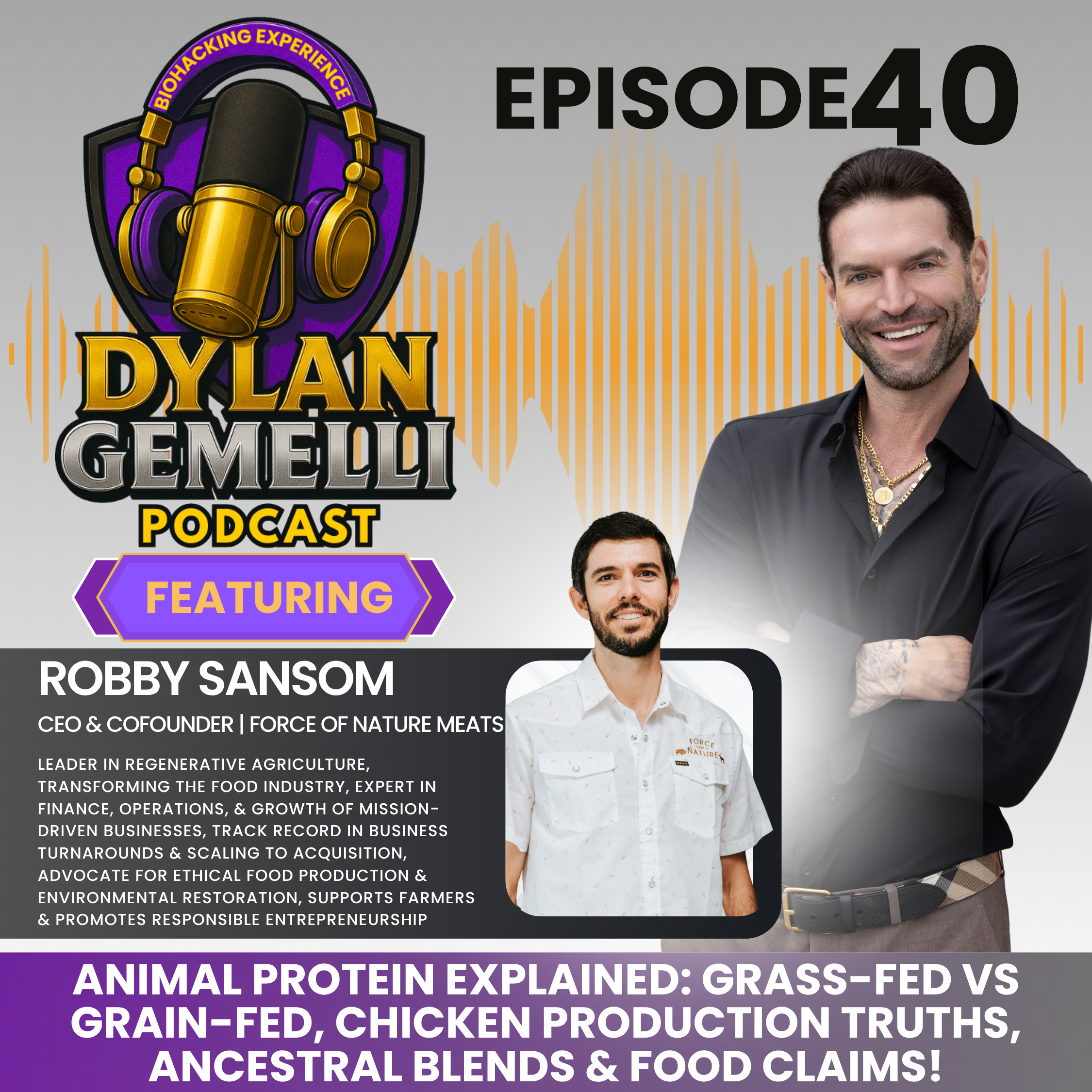
The Dylan Gemelli Podcast
Episode #40 Featuring Robby Sansom, CEO and Co Founder of Force of Nature Meats! The impact of Animal Protein, Grass Fed Vs. Grain Fed, The TRUTH about chicken production, Navigating Food Claims, Types of meats, Ancestral Blends Explained and more!
01:07:16
Loading summary
Transcript57 lines
- [00:00]
A
Foreign.
- [00:18]
B
Everybody. Welcome back to the Dylan Gemelli Podcast. Now today I have a very, very special guest who's had a major impact on my overall life and well being. And so I'm beyond excited to bring him in front of you. This is the CEO, owner and founder of Force of Nature Meets. This is Robby Sansom. Robby, thanks for joining me, man. I appreciate your time today.
- [00:41]
A
Thanks Dylan, Appreciate you having me on.
- [00:43]
B
Absolutely. I'm going to go really, really briefly just into how I found you and the impact you've had on me. And then I'm going to let you take over and just explain everything. And so basically I've kind of, as I explained to you, Robby, I've struggled with my eating most of my life, which is kind of wild considering I'm a nutritionist and an athlete and basically been starving myself for 15 years, going against the grain on everything I teach people to do, but fighting with this low fat and scared of eating certain foods and kind of succumbing to things that I don't even believe in. And finally I went into my wife one day and said, I'm done with this, I'm just gonna try this and, and do what I teach and what I know. And so I immediately, you know, went to adding tons of healthy fats into my diet and I said, you know what, I'm gonna start eating meat that I haven't eaten ground beef in 15 years. And long story short, I, I started with just like grass fed ground beef and then I found your products at Whole Foods and cause my wife had said, well, why don't you try some different stuff now? Try some bison or try something else. And that's when I found you. When I was looking for different types of meats. And now at this point I'm eating 110 more grams of fat than I was prior to and probably a thousand more calories. And I haven't been this cut up, shredded or felt so good since my twenties and my blood markers and everything that you would think would be so bad, you're eating this, you know, higher fats, these saturated fats and all of this animal proteins. And what I found is exactly what I already knew is how important they were and going with your products and seeing how well that you do them and how well they taste and that you market them and that you show your care and how you go about it. I had never had elk, venison, bison or anything of the sort my entire life. Not once, Never. Now I eat it daily. I eat half A pound to three quarters of a pound daily. And it's all force of nature. And that's why I sought you guys out to interview you and find you so I could talk about it and get your story and everything. So first, thank you because it's essentially saved my life finding your product in, in a sense because it's drastically improve my health and my, just my general state of well being. And then secondly, thank you for what you do for everybody because it's very impactful. So I just wanted to say that first before we kind of get into you and your company.
- [03:07]
A
I appreciate you saying that. I mean, obviously it's, it's, it's encouraging to hear a testimonial where we're making a difference. You know, it's, it's important for us. You know, the big part of the reason we're doing this is to improve the lives and well being of, of people and consumers. And we'll probably get into it, but you know, there's a lot of folks out there that are being underserved and misled by, by the industry and then, you know, some of the peripheral industries that have created some messaging and herded people down a path that has led them astray, you know, and you're not alone, which is why I'm grateful for you kind of coming out and not only reaching out to us, but telling your story. I mean, obviously, you know, there's been a war on animal proteins and we could get into why that might be and I could tip into conspiracies and a lot of different things, but it doesn't really matter why. What matters is, you know, if we're eliminating animal proteins in our diet, then we're eating more calories and more carbohydrates and are winding up more nutrient deficient in the, in the absence of that most critical legitimate nature's evolutionary superfood. And people that are deficient in eating enough meat tend to have a variety of issues that can be addressed from physical to mental to emotional to, you know, so many, so many other factors in life. And so I love getting the chance to talk about some of the mids, some of the misnomers, some of the latest and greatest learnings and really seeing it translate into benefits that people live and experience and their, and their health and wellness.
- [04:39]
B
I couldn't agree more. And, and I've made this such a passionate topic of discussion for me to convey to people now. And I, I mean, I even have gone so far as to switch from regular whey isolate to really only having beef protein isolate and beef collagen and things in my general, you know, normal protein routine that I do on top of my regular foods and supplementation. So I am a massive, massive believer in, in all of this. And so we're going to have a damn good conversation today about all of this.
- [05:09]
A
Did you tell me that at one point you were on, on the vegetarian plan or did I?
- [05:13]
B
You know, it would appear that way because I didn't eat meat for so long.
- [05:17]
A
It's not like I was. That's right.
- [05:19]
B
You know, don't want meat or anything. I'd have chicken here and there. But I was so consumed by just eating vegetables and oatmeal and eggs and like, I got into this, you know how it's hard once you get into a habit and couldn't break it and, and in my head was like, oh, if I eat this, I'm gonna gain all this weight or look bad or be unhealthy and all of this. But the thing was, is I was teaching my clients the polar opposite. So it just doesn't make any sense. You know, it's wild.
- [05:46]
A
There's that, there's that ingrained conditioning just based off of living in this society with what, with what gets beaten into us that I think, yeah, we'll get into some of that and how we can hopefully break some folks out of the pattern and be better, be better champions for themselves.
- [06:02]
B
You know how scared I was like when I was like, okay, I'm just going to have like cooking butter now and you know, good grass fed butter and I'm gonna, you know, have these fats every day and I was eating like 15 grams of fat a day and I'm up to about 125 now. And I had net felt this good and I don't know how long because in my 20s I was partying. So I can't even say I felt this good in my 20s.
- [06:22]
A
You know, like it's, it's amazing.
- [06:24]
B
So let's get into first a little bit about your backstory with the company and just kind of what you even did before you started the company and why you decided to go the route that you've gone.
- [06:36]
A
Yeah, well, my co founders and force of nature, Katie and Taylor, you know, the three of us initially joined forces, you know, prior to this one with a company called Epic Provisions. And the roots of that company were actually in a. It started that started as, as a vegan energy bar. And that story arc probably isn't very different from what we were Just kind of touching on, on with yours. Right. I mean, certainly back in the, in the early 2000s and early teens, it was, hey, like there's a conversation that's, that's amplifying and crescendoing in the market that says, you know, animals are bad and vegan and vegetarian diets are good, and if you want to live a healthy life yourself and you want to feel good about the impact you're having on the environment and for the welfare of, of animals and other creatures on the earth, there's only one answer, and that's vegan and vegetarianism and any animal livestock production is evil and awful in every imaginable way. And you get this inflated set of dogmatic justifications for those arguments which are, you know, largely disproven, debunked. And now I consider them myths that we're having to address. But look, those are not the wrong reasons to try to pursue in what you do and consume. It's important that you have values. I agree that we want to eat healthy and be healthy and live healthy and have a positive impact on the world around us for our choices, especially on food producing communities, especially on the animals and the other creatures that exist on the planet, especially on the wild places that we love and cherish and want to see thrive for future generations. Absolutely. And so that same ethos and idealism translated into what became epic when those realities kind of collided. And we recognize that that diet and those programs and those offerings weren't serving our health like we had intended, weren't delivering on the promises for the environment and welfare. That journey was a long and interesting one which eventually led to, you know, that company, we sold it and then we took that same mission and set of values and ideals and evolved it into force of nature where we could impact animal agriculture and make those necessary improvements more broadly. Yeah, you know, I think a different way of looking at and saying that is there was a period of time where plant based agriculture was given a free pass. And animal agriculture, the worst example of animal agriculture was, was correctly identified as challenging and problematic and in need of change. But it was also incorrect to assign that reality to all of animal agriculture. And I think what we're doing, the force of nature, is saying agriculture is broken. Plant based agriculture and its worst instance, which is the predominant instance, is just as bad as the worst case of animal agriculture, which is the most predominant instance. And we need to create transparency and awareness into both of those things, educate consumers so they can be better advocates for themselves, and then offer up paths and products that, that better deliver on what consumers are looking for and introduce solutions. And we always say replacing a vicious system with a virtuous one. So that's kind of a little bit of how we, we got from where we were to where we're going today.
- [09:48]
B
So you have some pretty nice product selection. Kind of talk about why you picked the certain products that you have and if you have had any struggles like with your shipping or because I know they're frozen and how you go about it and how you've kind of grown from where you're talking about where you started to now where you've become. Because it's, you know, I see it in many, many places now and like that, like the good health food stores here where I live, it's fresh time, but I believe it's probably sprouts and other locations and then obviously whole foods. And so how was that like a challenge for you to get into those places? And you know, what's it been like the journey here?
- [10:28]
A
It's a great question. You know, again, this is the extension of something we've been working on. We had been working on for over a decade prior to starting this company. And I think one of the realizations that we had was, or a few of the realizations that we had actually were that we could build these systems, we could scale impact on, on the front line, on the land, but we could create products that was remarkable and could deliver on all the things consumers were already looking for. But consumers weren't keyed in. They weren't aware, they weren't, they didn't know what was going on, how they were being deceived and fooled and what better options might be out there. So we were like, okay, we gotta create a company that we can actually scale demand and by doing, you know, and doing it simply by, by creating, like I said, awareness of these key issues and then access to an alternative that better delivers on what, what consumers are already looking for. Now how do you do that from ground zero when you're entering into a commodity category with some massive players that is at the intersection of Big Food, Big Ag, Big Chemical, Big Pharma, Big Petroleum, and Big Healthcare. Those are not, those are not small complexes with, with a passive interest in, in fighting for maintaining status quo. You know, they're aggressively out there trying to continue to perpetuate the incentives that improve their financial outcomes at the expense of so many other stakeholders from, from human health to the impact on land of the future and, and so on and so forth. So for us, there was, you know, kind of a phased strategy. Yes. We started by introducing things that were both incremental to the category. So you saw, you see some of the exotics that you noted, you the, the innovative and novel and disruptive things WE did by incorporating organ meats into, to the ground meat product in our, and what we would call our ancestral blends. We didn't just do those things because they're cool and good for you. And you know, the year we launched the company was the first year that the generation being born had a shorter life expectancy than their parents. That was certainly part of it. But we also knew that in a comma, in a category that had long thrived on the commodity mindset, which is price above all else at the expense of all else. And in that race to the bottom, you pursue cheapness by trading off value. So we knew we had to put something on the shelf at a price point that would work so we could get an initial foothold for the series of moves that we needed to make, make to follow. If all we did was launch with the most expensive beef on the shelf, we would never get a start. We never cracked that first door. But by putting products in the market that didn't necessarily have a cheapness mindset or that didn't necessarily exist, it was incremental, it was new. We could get bit of space so that we could prove that consumers cared about this stuff, that there was opportunity and interest, and we could establish the brand, the reputation, create some loyal consumers, and then begin to introduce more things outside of the freezer section into the fresh section where there's less shelf life and a little more challenge from an operating perspective, more traditional proteins where we can really disrupt supply chains and drive change and mission at scale. And you do these things phased over time, where we're biting off pieces in a methodical way to build towards a company that can ultimately have a massive impact directly and more importantly, indirectly. I mean, we're talking about meat industry. This is multiples of hundreds of billions of dollars. It's a massive industry. And if we can impact 1% of it is the rip is the ripple effect that we could impact 10% of it? I hope so. You know, I want to be a part of something that drives change and meaningful positive outcomes far beyond our own size and scale and creates a rising tide that lifts all boats for other good actors, whether they be farmers or ranchers or brands that are out there trying to justify doing things differently and better in the force of headwinds that are maintained by these large industry incumbents, again, trying to hold us all down.
- [14:25]
B
I love it, man. I absolutely love it. Thanks for the explanation. Will you quickly tell everybody? Because I didn't notice at first when I first started and I've switched completely all to the ancestral now. So everything I have is ancestral because of the added, you know, benefits there. Would you just kind of tell. Tell people what that means and what's in there that's extra that differentiates it just from the regular, like regular venison or ancestral venison. Regular bison versus ancestral bison. What's the difference? And why. Why is it such a good option?
- [14:55]
A
So just, you know, to clarifying that distinction, we have ground beef, we have ground bison, we have ground chicken, ground Venice. You know, we have a lot of ground meats. These are common, popular. They're necessarily common because you get more ground, you know, trim that turns into ground products and any other cut off the animal. So you have to move a lot of ground items. That's why we create burgers and sausage and all these different things. And that's familiar. We also created what we call our ancestral blend line, where we coined the term ancestral blend. It's not we were the first people to incorporate organs in, but we were the first people to brand it in a comfortable way and mainstream it at scale. And so we take generally kind of the natural fall off of the animal, meaning about as much heart and about as much liver as you'll get from an animal. We incorporate into about that much ground ground on the animal. And so you end up with about, you know, between, depending on the. On the protein line, somewhere between 5 and 10% Organ Meats Incorporated into the packaged product. Now, there's a few reasons for that. One, there's, you know, you only get 10 or 20 pounds of organs for every, you know, two or 300 pounds of ground meat. And also there's the, you know, the fact that the modern palate isn't one that celebrates organ meats or at least is intimidated by them, even if they would otherwise like them. We've lost touch with that evolutionary reality that both ourselves and our animal ancestors would have first sought these cuts because they're the most nutrient dense and valuable. That's why we call it our ancestral blend, because our ancestors knew this fundamental truth. And so what do you get? Well, you get a product that consumers are familiar with that tastes just like what they've always known and can be used in every familiar way. From a cooking perspective, you can treat this ground meat just like Any other ground meat. But it has the added benefit and boost of these. Of these organs in it, which are superfoods. They are massively dense. And those priority micronutrients of need, like iron, zinc, folate, vitamin A, calcium, B12. I mean, there's just a laundry list of things where they're the most dense. I mean, it takes like, 11 calories of liver to deliver on what a full pound of chicken or 1100 calories of chicken would take to deliver on. On. On some of those that are critical nutrients. So a little bit as we have incorporated into these blends, goes a very long way. And net. Net. As a. From a palate and. And eating experience perspective, you. You won't really know the difference. So, yeah, I'm like you. I eat a lot of the. The ancestral blends because, like, why would I not take the boost on all of that added benefit? There's no downside.
- [17:23]
B
You know, if you would've told me, like, a year ago, I would've been eating, like, organs like liver, heart, and things like that, I would've looked at you like you had lost your mind. And I'm telling you, when I was, I. I remember going in there one day, and I. I hadn't really paid attention, and I said, what is that? And I looked and I saw it said liver and heart. And I was like in the mode where I'm just, like, gonna try anything and everything. And so I had it. And I was like, I couldn't believe how great it tasted. So you know what I did then? I made one of my meals, and I said, you know what? I'm gonna cook the regular one first and I'm gonna cook the ancestral one after and see which one I like better or if they're the same. Any difference whatsoever? And I'll be honest with you. I don't know if it's because I started eating the ancestral one or not, but I preferred that one over the regular one all day. And now I only buy the ancestral one. Generally. I bought the regular venison when it had a nice sale the other day. But generally speaking, I actually think it tastes better just. Just me personally. And like you said, for that added boost, I'm taking that all day long, realizing and understanding what you get from it.
- [18:24]
A
So.
- [18:24]
B
Doesn't intimidate me. I shouldn't intimidate anybody. I would at least say try it.
- [18:28]
A
You know, I think if you have a refined palette, you may be able to know it. But when we rolled it out, my litmus test was, I Made the hamburgers for, you know, my five to nine year old nieces and nephews and lightly seasoned the hamburgers with salt and pepper and then told them, oh no, I forgot all of the condiments. So here's a hamburger steak. What do you think? And didn't tell em there was organs in it. And they were like, oh, this is really good. We like it. And so I knew, you know, the kids would eat it. Mm. It was the right blend. And then, you know, and again, kind of going back to the, you know, some of the benefits, you know, we're on, we're on the cusp of doing tons of nutritional research and so learning more about, you know, not just the macros and micros, but all of the phytonutrients and the carotenoids and polyphenols and all of these other elements and the CoQ10s and things that, that you'll get in increased levels from these organ meats. But, but a guy named Ty Beal did a study called Priority Micronutrients. I kind of listed off what those, what some of those were, but the reality is most of the world, including the developed world, is deficient in those micronutrients. And if you look at the foods that are most densely packed with those specific nutrients of need, takes 11 grams of liver to get a third of the daily allowance versus 1100 gram calories of chicken. It would take 1800 calories of nuts, 2,400 calories of refined grains. Even some of the other things that we consider like healthy, like quinoa, still 800 calories. So I mean, it is red meat, it is organs and it is bivalves that are packed with these bivalves like oysters, mussels, hams. These are the absolute superfoods. Even eggs are on that list. You know, it takes 281 calories of eggs versus 275 calories of just beef. So, you know, again, like, that's a dense superfood, but, you know, nothing compares to like liver, heart, spleen, these, these organs. And so if we can incorporate those in, again, it only takes a small dose. It's such a massive benefit to consumers. We're really proud to be doing that and, and rolling. Not just those. We are talking about like roughly 1 pound ground meat bricks that are branded in the store. But we're, we're putting ancestral blends into other products as well, like sausages and some other really cool stuff coming out. We actually have a line of meatballs that's already Out. So for the parents that are convenience minded and you want something that you can just you know, take out of the freezer and heat up in a couple minutes and serve to your kids and make your kids happy. You know, again this, this is part of the creating awareness and access. We gotta make it easy consumers to be able to, to action and you know, supporting a better system and better serving themselves and, and their goals and, and wellness.
- [21:01]
B
Would you talk about. Because you know, this is something where some of us like in that are, that just know might take it for granted but a lot of people don't know what is the difference between grass fed and grain fed? And why is grass fed so like popular or kind of pushed in the health space so much more. A lot of people don't. They'll take the option, they'll go, I'll just take the cheaper one. Not really understanding the difference. Can you just touch on the main difference there and why grass fed is so superior to the like grain fed or other way that the, the cows are raised and fed?
- [21:36]
A
Yeah, I mean this is, you know, getting into conversations around claims and standards and regulatory and you know, all of these things is. It can be really complex and convoluted. I'm hopeful that we'll get into that and be able to, and be able to, to be justify and break down some of the misconceptions. But specific to what I would consider to be, I'm gonna, I'm gonna answer the question slightly differently than grass fed. And I'm gonna say, you know, the standard that force of nature has for sourcing versus a more conventional system, you know, cause the more conventional system is gonna be grain fed and there's gonna be a few other considerations. And then what we're doing is not just 100% grass fed, but it's pasture raised. There's a bunch of other things that I think consumers kind of commonly bundle together because it's hard and, and, and we're trying to simplify something that's complex and in doing so that some things are lost. So when you look at you know, where, where typically meat is coming from and again it varies by chicken versus pork versus versus beef. But we're looking at largely industrialized systems. You know, back into the, the turn of the last century with the green revolution, we were trying to look at how do we create more food, more abundance and do it as cheap as possible, not recognizing which we now have the benefit of 75 years later looking back, what are all the trade offs that we're Going to make, and the externalities and the, the decline in components. So we succeeded at industrializing animal production, treating chickens like widgets and, and the same thing with, with pork and cows and trying to control and dominate our will onto these things to get them to express, you know, within the case of chicken, very large breasts and white feathers in the case of beef, making them docile and produce a lot of intermuscular fat, which, mind you, is a sign of chronic disease. And, and ultimately to get really big really fast on really cheap diets of corn and soy, which we overproduce and sell into the market at less than the cost of production very often because we have a farm bill that supports our capacity to do that. So all in all, we've geared everything towards some of those attributes and the, and the result is, you know, sick, sedentary, unhealthy animals and unhealthy environments becoming the foundation of our food system. And when you look at what that actually conveys, you know, we can talk about the health consequences, we can talk about the environmental consequences, we can talk about the welfare consequences, and they're. They're obviously awful. There's so many other things that are indirectly and indirectly spitting off, you know, challenges to our pollinators and soil and dead zones and oceans and, you know, weather pattern issues. Too much rain leading to flood, not enough rain leading to drought. I mean, there's just a myriad of global catastrophes taking place because of how and why and what we've done to agriculture to produce food. Again, when you get down into these systems, you are left with animals that are fed basically corn and soy. Very limited diet. So if you think about, like, what is conventional health guidance to humans, it's like, eat colors, eat a variety. You are what you eat. You, you know, all of these things that we, that we don't take as even remotely questionable, they're obvious. Like, we need a lot of different things from a lot of different places to round out a good healthy diet. Well, cattle aren't getting that. You know, again, they are sick, they are sedentary, they are oftentimes exhibiting characteristics of chronic disease and comorbidities at the time that they're going to become our food. You know, not to mention oxidative stress and, you know, all of the other negative energy and mental and all of the stuff that, you know, would come from being probably tortured your entire life. Like, that is, that's a system that is failing those animals, making them unhealthy and, and then creating, you know, taking an unhealthy product and turning it into food for us. Then you look at, you juxtapose that with the systems that we're supporting, which I would call, you know, the claims that you might see associated with that were 100% grass fed, pasture raised, regenerative. Again, these are all technical things that individually are probably short of a, of a desire. But really what we're trying to do is create systems that mirror nature. Nature, animals being healthy, having a symbiotic relationship with the land, eating the diets they evolved to lead to eat, having a keystone relationship where they're imparting critical ecosystem services and part of a healthy, thriving, functioning ecosystem, that being the foundation of our food system where you are what you eat. And they could be eating 60, 70 different varieties of plants in a pasture at any given time of the year and upcycling all of the, of the positive nutrient and benefit and good energy from that. A guy named Stefan Van Vliet did a study and showed that there's two, three times more phytonutrients in the meat of pasture raised animals than in conventional animals. You're getting less oxidative stress, all of those nutrients are passing through anti inflammation, anti cancer, anti aging. I mean, it's like a new frontier of understanding nutrition. All of that is coming through in animals that are actually healthy, that are actually thriving, that are actually having positive impacts on a broader constituency and stakeholders around them. So these are really the two systems that we're comparing when we say what does one look like versus the other and the why again, healthier for the consumer, healthier for the land, healthier for the animal, healthier for farmers, and ultimately, as I noted before, replacing a vicious system with a virtuous one. One is racing us towards a cliff and one is course correcting where we're actually healing, addressing and mitigating all of these challenges that we need to overcome in order to make sure that there's hope and prosperity in the future for, for all of those stakeholders.
- [27:02]
B
So you're focused so much on all the different aspects of being the healthiest as possible and the people that are worried about the animals being mistreated and how cruel you guys take it to the max. Step to animals are living a healthy and happy life on top of the way that you feed them and everything else. Correct?
- [27:18]
A
Yeah, it's pretty difficult. I mean, our first core value is feed others as you wish to be fed. Yeah. And we started this as a passion project. So it's hard for us to leave meat on the bone. When it comes to the things that we do and, and, and what we pursue to drive change, we have to recognize we can't let perfection be the enemy of progress. We're not perfect, but we're trying harder than, than, than most to do things at a real monumental scale. So you know, for example, our process, you know, again we can juxtapi, juxtapose that with maybe some well intentioned alternative. There are a lot of companies or brands out there that look for ingredients by, they go to, they look for the claims, is it grass fed, is it whatever? And then they, they collect affidavits and somebody just signs a piece of paper saying I do this. And you just hope they're not crossing their fingers when they send over the affidavit and that you're getting what you expect. And that's kind of it. That's like, that's largely how the systems operate. For us that's the starting point. But we have our own protocol which lists from feed to living conditions to how the animals are treated to what they are treated with from a healthcare perspective to how long they travel and the logistics and all of the steps along the way what is and isn't allowed within our, within our system. And then we go and visit and we meet the people, we see the animals, we get an understanding of their why are they telling us what they want, what we want to hear or is this an extension of who they are and what they believe in? And it's a partnership of like minded and values appropriate parties. Then we do monthly calls, then we do annual reviews and we're trying to figure out where to raise the bar and how we can improve and what's going on with them and their team and, and the impact they're having on their community. So everything we do, we take above and beyond and go farther. I mean look at, look, look at poultry. You know one of the top things that people look for is an antibiotic free claim and chicken. And if you look at the USDA, at least 20% of the poultry in the market that's labeled antibiotic free contains antibiotic residue. And for folks that don't know antibiotic residue in the meat conveys to you and has some similar form and properties of taking antibiotics. I mean if you want to avoid the perpetual or the over overuse of antibiotics in yourself or in the system, I'll take your, the benefit of the doubt and I'll take your word for it isn't good enough. So for us we send samples from Every production run off the labs to confirm there aren't antibiotics and bad actors. I mean, every step of the way, we're trying to introduce more rigor and more diligence to ensure that not only are we raising the bar and what's happening on the land, but we're raising the bar for consumers and what they're getting and how they can have trust and faith and confidence that the brand and the products they're getting from Force of Nature are the best.
- [29:54]
B
Excellent, man, excellent. Great explanation. I appreciate the breakdown, and I'm sure a lot of people will as well. Okay, so I. I want to get into some of the things that you said you were hoping to get into. Just some myths and things of that nature. But I do have another question for you about some of the different options that you have. Like, you know, the more exotic meats, like you said, like elk, for example. My first question is, do those become difficult to source? And, you know, because it's just not something that you see commonly. I just don't see elk everywhere. It's not very easy to find. Bison is kind of hit and miss. You see some, but not like a ton of. Are those scarce? Are they hard to find? Are they hard to source? Like, what's the whole drill when it comes to the more exotic choices that you have? And why? Why the ones that you picked?
- [30:41]
A
Great questions. A handful of reasons. First, I'll start off a brief history lesson. Cows and the domesticated pigs that we see today and the chickens that we see today aren't necessarily natural creatures. The cow of today, and it's not similar from dogs. You know, dogs are the descendants of wolves and other. And other wild dogs like, like pugs didn't evolve in nature. Hairless cats didn't evolve in nature. These are domesticated animals that through selective breeding, we've changed the biology and the characteristics of. And that's exactly what, you know, these East Asian jungle fowl that turned into chicken, or these European aryks that turned into cows, or these pigs, you know, that turned into what we consider pigs of today. So we bred them for certain, you know, characteristics. Bison, we're the largest herd of megafauna since the last ice age on this planet, roaming from Mexico to Canada. And bison are bison. There's some nuance to that, but, you know, they're a wild animal. They were hunted to near extinction a few hundred years ago and then slowly brought back. And their numbers are somewhere between, you know, 250,000 to half a million animals. And they're really exclusive to, to the United States and Canada. That's their, that's where they always would have ranged. So they're a pretty, they're pretty interesting and unique in that capacity. And there is a relatively decent sized supply chain built up for them. I mean again, nothing compares to chicken or beef. But where the, you know, there's 9 billion chicken slaughtered every year to about 50 to 60,000 bison or 32 million or so head of cattle in the U. And this is all in the U.S. so you know, we're talking really small supply chains but really, really cool, really cool animals and programs. And in terms of what they, what they mean, it's the national mammal, what they represent in terms of. There are human populations that for millennia followed herds of bison around.
- [32:32]
B
Right, right.
- [32:33]
A
Sustain themselves or megafauna on all continents. If you look at Africa and even Europe and else and Asia and elsewhere. As far as the wild boar as an example, those are all truly wild, captured and largely in Texas. And it's a, it's an invasive species. It wreaks havoc on environment and ecosystem. And around the time we first introduced that program, the ag commissioner in the state of Texas had said, hey, I have an idea. Wild pigs are a problem. They cause hundreds of millions of dollars in damage to agriculture crops. So we're going to mass poison through chemical warfare the landscape of Texas by putting this blood thinner out called warfarin and hope that we don't have this negative cascade run awry of animals then eating the, the, the, the pork. I mean it's just like, it's just a horrible solution. And we're like, well look, these, these pigs don't deserve to suffer. They're a problem. Maybe we can find a system, a commercial system where we can help mitigate the impact they're having, reduce the numbers and they taste really good. And they're really, they're actually healthy animals. Not coming out of struggling six system systems, but are thriving wild and really tasty. So that was kind of just a really unique and interesting program. The, the venison and elk are a little different. Those are farmed programs not dissimilar from bison. Bison aren't running, running wild. These are farmers and ranchers that, that are raising these animals and again to our standards and to our protocols. And the venison and elk are no different. It's, we can't actually in the United States go out and catch and sell wild venison and elk as, as one might traditionally think, but we can create farming systems for them. Not dissimilar from what is done with bison. And, and then you know, when you look at the type of farming and the practices that have been championed historically and, and what, and where the incentives lay to cut corners that we don't want to cut, there's not a lot of options for finding those animals in the US So we actually partner with farms in New Zealand for the, for the venison and elk specifically and they're doing some really cool things and have built some programs over the years that make them, you know, one of the best purveyors of elk and venison and in the world and is why we chose them because you know, first and foremost, I think putting the best products in the market and aligning our values with our producers and ultimately serving consumers, what they're looking for is priority number one. And those are some of the best folks out there doing it with those two proteins. But again, we're looking at, you know, between wild boar and venison and elk, we're looking at, you know, less than 10% single digit percentages of what we do as a business overall. The overwhelming majority of what we do today day is beef and bison. And then you know, obviously with the, with the recent relaunch of chicken that we're really excited about what that program is doing that will become a, a significant part of our business in the future.
- [35:18]
B
Was going to ask you, but you answered what was your top selling or your most popular? I will tell you this every time I, I, me and my wife laugh because she'll go, is that your favorite today? Because when I switch like I'll have bison, I'll go, man, I think this is my favorite. And then I'll do the venison. I will say I think the elk is my favorite. Honestly. I think if I had to pick one, if you said you can only have one of these forever, that's probably the one that I would go with. There's just something about it. It's just a little different the way it tastes but, but that's personally my favorite one. Do you get feedback from anybody on like what their favorite exotic may be or is it just kind of. Everybody's different?
- [35:57]
A
I think everybody's a little different. You know, I also think that we're not part of this big reductionist, commodity homogenized system. So you're going to get some terroir, you know, seasonality, regionality. And we're sourcing beef from hundreds of different farms and you know, some from Australia, but mostly from the United States all over the place all year round. So you're going to get some variety in there. And that is like, for some reason we try to homogenize that out and animal protein, but we celebrate it and everything else from wine to, to whiskey to olive oil to vinegar and so on. I think I love the ancestral bison because that's like as historically accurate, honest and evolutionarily consistent as as you're gonna get from a, a protein that was designed through millions of years of evolution to sustain humans. But I think from like a comparison standpoint, I think, you know, the wild boar and pork that we offer because of these programs is exponentially better than the conventional stuff you get on the shelf. And the chicken as well. If you taste, you go to the store and you buy whatever version of ground chicken you may have historically bought and you compare it to this like it is. There's no comparison. I mean, the animals, they're healthier, they're older, they're fed a better diet, they're a better breed, they're living in better conditions, they're living a more natural lifestyle. All of that imparts into the quality not only of the nutrition, but the flavor. I mean, it's. Look, here's what, here's what we know and how and why our palate and taste buds evolve. Like things that taste good are generally good for us. Unless of course, they've been engineered to hack that fundamental reality. You know, like hyper processed foods are engineered to short circuit what we evolved to do to understand the things that are good for us taste good. But generally, if we can take that malicious behavior out of the equation and we look at whole foods, the better they taste, the better they are for us. And I don't think that the items that we're offering there are any exception to that. I mean, you like the nutrition is palpably present in there empirically in the testing and in, in the experience of the consumer who gets to enjoy them.
- [38:05]
B
Would you do this? Because it may seem obvious, but it may not to some. Could you just quickly say, so what is venison? What is bore, what is elk and what is bison? And just kind of give an example of what these animals are because like, venison's deer, basically, correct.
- [38:21]
A
Yeah, venison is, is deer. There's a class of animals that all, you know, technically venison is, is deer and elk and antelope and a number of, a number of different ruminants that are browsers that are, they're called cervids. They got hooved Anyway, point being, yeah, they're typically what you would think of here stateside as, as deer from venison, elk, you know, the big horned animals that are the big, the big brothers of venison, not to be confused with the even bigger brother and the moose, but. And then yeah, wild boar are, you know, effectively domesticated pigs that are gotten into the wild. And because there's no natural predators for them and because they're incredibly intelligent and incredibly resilient and can be nocturnal and have very short gestation periods and are fertile at a very young age, they've become a major nuisance not just to industry, as I noted with agriculture, but also to wildlife. You know, they ground nesting birds and sensitive waterway riparian areas and you know, devastating habitat habitat and out competing native and indigenous animals. So there's a lot of reasons why, why they're a challenge. But again, they're basically domesticated pigs gone wild.
- [39:36]
B
All right, so I want to talk to you about the chicken real quick. So I've always struggled. I've actually kind of stopped eating chicken because I just found the way that it's fed and produced and the more that I've learned, I've been really turned off by it. And I used to. That was one of the meats that I did actually used to eat a little bit. But I really have kind of stopped until I saw guys you were coming out with it. And so it gave me a little bit of new hope. I learned some things about just verbiage is out there like air chilled or organic and how little that actually truly meant in terms of how it was done and made. Tell me why yours is different and why it's so much factually superior than the way that it's generally sold. What is your methodology on how you produce it and why is it different than something that we generally see? Because I know it's more expensive the way that you're doing it. I have no doubt that the career.
- [40:27]
A
It'S quite a bit more expensive. Yeah, I always, I always say that. You know, just for, for reference, today we eat about 86% of the red meat that we, you know, that we did a generation and a half ago. We've actually significantly declined our red meat consumption and we eat about 350% of the chicken that we did. Really, we've almost quadrupled on a per capita basis our, our consumption of chicken. And again, when you look at industrialization, the reason that is is because the chickens took well to industrialization. They have smaller lifespan, they can they breed, can selectively breed traits and attributes into them more rapidly through that because of that short life cycle. There's a lot of reasons, you know, they can be confined and, you know, 50,000 animals in a small barn where you curate and only feed them cheap corn and soy laced in agriculture chemicals and create this synthetic environment and, you know, basically control it through, you know, human engineering and a domination mindset to turn a chicken into a widget. And we've produced these birds that have lost some of the evolutionary like biological imperatives that I call them. Like they won't often evade predation. They won't, they can't or won't breed. They are very, they're biological feed conversion machines. They sit at a trough and they don't do anything but eat as much as possible in order to grow really big breasts because that's what the industry wants to sell. And oftentimes it comes at the expense of the development of their immune system, their organ systems, their bone and skeletal structures, where at the time of harvest many of them can't even walk to water or feed at that point. And if they were to continue on that, that path, they would just die of natural causes. So there's a, there's actually a gene that's been bred into that bird not just to make them, you know, select to make them white. So we can't see the little tiny feathers. So folks won't know that they're, they had feathers on em at one point. But there's a gene that's like, you know, akin to dwarfism, that makes them get, you know, it's like gigantism. It makes them get really big really fast. And it's a terminal gene, but we bred that in in order to make them grow. And then even if you look at the most recent data, folks, you know, just for reference on how perverted this industry is, you know, if people are noticing, you know, avian influenza, bird flu is, is making the news and the impact that it's having on, on supplies of eggs or chicken or other things like that. Well, they don't, what people don't realize is like, there's only a few, two or three big breeders out there that make all the eggs that produce all of the chickens. And they're always tinkering with the biology and the genome of these animals. And we made a little oopsie a couple years ago and all of a sudden all of the chickens that are being produced are a little less fertile and the survivability of the chicks are a Little less viable. How crazy is that to think about, you know, like, we made it, we made a tweak in a, in a lab somewhere and this living sentient being is made a little less healthy. And again, like, I don't know all the science, I don't know all the details. I think it's coming out and emerging. But something about things that are more detached from a biological reality that, you know, whether it's in their genes, in their lifestyle, in their raising conditions and feed, or on and on are probably, there's probably some unknown unknowns in there that, that we're trading off. So anyway, we eat a lot more chicken than we used to. The part of the reason is a marketing campaign to suggest that this product that we can control much more easily and want to offer you more of is better for you, which it's not. Is better for the environment, which it's not. Is better for the animal. It's definitely not. So all of the promises, not unlike, not dissimilar from the vegan diet, well meaning, well framed, seemingly worthy values to want to promote are offered as components or promises with them that they're offering you that they're falling short of. They're just not. Red meat is way healthier. We just talked about that. The rumina animal is, is actually keystone in ecosystems. It's to important, important plane systems. And so much of our native wild places evolved symbiotically with these animals to live. Humans evolved chasing herds of megafauna. Humans did not evolve chasing herds of chickens around. All of these different things are going on there. So I always say, you know, here I am launching chicken and then railing on chicken. I'm doing that because I always say people should eat less chicken and pay more for it. I think there's a time and place for chicken. I think it can be a part of a diet. And there's sometimes we want to enjoy a recipe or the experience or the flavor of chicken. That's great. In the 1600s, it would have been seen as a sign of affluence. And even I think it was, was it FDR and the Depression that said, you know, I aspire for a chicken in every pot as a sign of abundance and prosperity to be pursued, because that's what we would have had, a few chickens and a lot of other stuff. And I think that's, that's where it should be in our diet. It's just been commodified and cheapened to where, you know, we can offer it as much as we do it's becomes the cheap protein instead of the expensive protein. And it's been marketed in a campaign to again convince people that it, that it offers these benefits that it doesn't. And as a girl, dad, I'm particularly sensitive to the fact that women have been driven towards eating poultry and staying away of red meat for some reason which I don't fully understand, but it is definitely underserving them. Again, I just listed off those priority micronutrient. Micronutrients. Those are particularly deficient in women.
- [45:48]
B
Yeah.
- [45:49]
A
And, and the thing that, you know, like if you grew up with an experience that many others have and not everybody, but certainly many where you go to a restaurant and a guy gets a steak and a girl gets a salad and maybe puts a little bit of chicken on it, the girl should get the steak.
- [46:01]
B
Right, right.
- [46:03]
A
That's the food you need. But here we are, you know, we slaughter 9 billion of chicken chickens a year in the United States. It's becoming the most popular protein more than red meat. I want to re champion red meat. I want it back in the corner. We've been working on that for years. But I can't change the fact that there's momentum behind chicken. What I can do is say, hey, you know what? I can't. I'm not going to stop that. But I'm going to do exactly what we've done everywhere else with meat and in agriculture and create transparency. And we're going to talk about the problems of chicken. We're going to talk about the animals and the farmers and the nutrition and the laws, lifestyle and all of those things that affect the people on, on farm, the consumers at the other end of the in the equation. And we're going to create a system that actually delivers on the values that consumers are looking for and is a better chicken. And we can't do that if we're not, if we're not in the game. We don't have a player on the field. We can't change the score. And so we're launching into it so that we can course correct that just like we're doing with Thief.
- [46:58]
B
Excellent, man. It gave me a little bit of hope when I saw that you first were advertising that. It's coming out and I have some here that I'm thawing out that I'm ready to try. So I'm really looking forward to it and I appreciate the innovation and the actual care that you have. So I know we wanted to get into some of the myths and we're kind of getting towards the End. So let's cover those that you've had to deal with or overcome or things that have become more prevalently discussed or hyped or misled, whatever term you want to use. Because I see it daily, I battle it daily. I'm sure not as much as you, but I'm very curious. Let's kind of spitball back and forth here what you're dealing with and what you see and kind of debunk some of these so called myths.
- [47:38]
A
I probably just for the sake of time, I, you know, I think I'll probably want to touch on two topics. One is cost and price and one is claims. And give somebody, give folks a call to action to better understand what, how to navigate this environment. You know, the ideal is, hey, let's have some third party, some government agencies and maybe some third parties help consumers make better choices and we'll, we'll come up with claims and regulate them and audit them to ensure that what is marketed is legitimate and do some of the work for the consumer so they don't have to be experts in everything and they can delegate that trust to us. That sounds good and that is well meaning, there's no doubt about it. But like many things that are based on good intentions, the ultimate outcome isn't always as desired. And that leaves us to an environment, leads us to an environment where things like natural, which should be the most fundamentally obvious claim in the world. None of us, no consumer, no person listening to this or neighbor needs to, needs to be told, hey, what does natural mean? It's like I know what natural means. I walk outside and I see it in the birds, I see it in the, in the squirrels, I go to the beach and I see the dolphins and like I know what natural is. It's like as close to source and again that biological reality and that evolutionary existence sense, but bureaucratic technical language does not mean the same as common language. And in, and in the world that we're in, natural just means it's been minimally adulterated after it's been slaughtered. Again, all the things we talked about with chicken, what the genes are, what it was fed, how it lived, what it was raised, it just means it's been minimally processed, whatever you want to define that. And so we've co opted and hijacked to misrepresent to us what these underlying products actually stand for. And then it becomes for profit enterprises to jockey for position and who has the best claim and which claim represents. And even you asked me the question, what is grass fed versus Versus not. It's like grass fed just means an animal was fed, you know, had access to eating grass, or cow particularly had access to eating grass at one point in its life. It doesn't mean it didn't eat grains. It didn't mean, it doesn't mean it was finished on grass, doesn't mean it was raised in pasture. It doesn't mean it wasn't given hormones or vaccines. It just means it ate grass. And so you take these very complex, complex systems and realities that are again, the food that we serve ourselves, the fuel for our life, longevity and health. We're approaching it with the most reductionist mindset. When we come to claims being the end all be all. I think they have a role. I think the claims that I like to look for in my beef, for example, would be 100% grass fed, pasture raised, regenerative, the welfare standard. But again, like that's only in a pinch.
- [50:23]
B
Got it.
- [50:24]
A
That's only, that's only if I'm traveling and I'm gonna wait and there's just no option to understand where my food's coming from. I'll give you an example. If I was to bring you to, you know, my co founders, Katie and Taylor, they have a ranch called Rome Ranch. We kind of consider that our, our home farm. If I was to take you there and if I was to put two products in front of you, excuse me. And I was to say, like, hey, this one, this turkey is organic and this turkey does not have an organic claim. But the one that doesn't have the organic claim is like 30% more expensive and you don't know anything else about them. You're going to buy the organic turkey. That's what we're trained and conditioned to do and think we're going to feel really good about it. Now take a step back from claims that organic turkey came from a factory, that if you walked inside the door you'd probably get sick. You would definitely need potentially a respirator. The animals would be suffering, the diets would all be corn and soy that are organic. It would be awful. The one that's not labeled organic, you go to my, my, my co founder's ranch and you see these turkeys where there's wild turkeys volunteering in, they're running around next to the bison. Yes, they're eating chemical free feed, but they're not. But they're living like turkeys and playing a role in having an impact on the environment. Now I put the plate back in front of you. You choose the Turkeys that represent what you think is, you know, truly the most natural, most evolutionary, consistent, most aspirational, highest value, and you don't bat an eye. You know in your heart and soul fundamentally, without a doubt what the right choice is for you. You don't see that in claims, they shield that. And so many claims are deceiving. Think about a vegetarian fed claim for pork and poultry, right? These are, these are omnivores. You get a vegetarian fed claim as if you've confined them their entire life inside of a building and prevented them from being able to exhibit their behavior, to go forage for a diverse diet. And you curate their diet exclusively of grains to ensure that you can make a vegetarian fed claim. But we're conditioned to think vegetarian fed is better so we can put it on the pack as a positive attribute that will drive purchase behavior, when in reality it should drive consumers to see a red flag. So I think it's very important for people to recognize that there is a time and place for claims. But no single claim tells the whole story. Claims add cost and confusion at the end of the day, to the extent it's possible for you forming a relationship with your food. If it's a brand like Force of Nature, go to our website, look at our blog, look at our Instagram. We're not going to put a claim on a packet and then hide. We're going to be outspoken, screaming from the rooftops, trying to convey how we differentiate ourselves because we're so proud of what we're doing. Want you to see that fundamental truth and connection connect with us. Don't buy from Force of Nature. That's great too. Go to the farmer's market, talk to a farmer, understand them, what they're going through, what they're doing, how they're raising food. Like those are the people that are going to be serving you, not serving themselves. By shielding the reality of what's going on in the system behind them, behind some claim that they can technically, through a bureaucracy, get away with promoting, even though it are underdelivers on what the consumer expectation is. So that's about as brief as I can be to just warn consumers that claims aren't everything. Do I buy organic? Yes, of course. I think it's an important milestone in the evolution and the moot and the movement to create more and better food and systems. But I look for organic in addition to a bunch of other things. I want my food to be chemical free. I want it to be healthy. I want that. I want the farmers to be Served well in the animals and the ecosystems. And I want the most nutrient dense and healthiest food with the most presence of those good things and the absence of the metals and the toxins and the ag chemicals and all the rest of it. So there's so much more that we should be aware of and empowered. And if we put all of our faith and trust and delegate everything that's the cornerstone of our health to claims, we will be underserved and it will fail us in the end. So that's my caution on claims. I'll pause there if you have a question or I'll transition over to some commentary around price and the cost of food.
- [54:19]
B
Food? No, I mean I. It's just like with eggs and everything else that you get confused by what's cage free and what's this and what's that and it's very deceiving. That's why when you look at labels for natural flavors and every point you brought up is well received and totally understood. And I appreciate the breakdown in terms of the meats and everything for other people to start looking for. I've done deep studies and discussions on the eggs aspect because I'm very troubled by it and I know the importance of pasture raised and so I really appreciate the, the meat breakdown because that clears up a lot of things, especially just because it says grass fed for example. So that's appreciated, man. The, the deeper dive into it truly.
- [54:56]
A
Yeah, the cage free, free range pastured on the poultry front, there's a, I, I could spend an hour talking about that. It's one example of, of many where, you know, you just have to, I love to say, assume positive intent and, and, and give the most generous interpretation in life. But unfortunately when it comes to claims, you know, I think that you need to approach them with skepticism and, and regardless of what the claims claim is, you know, going one layer deeper and doing a little bit of research to prove that it's delivering what you are looking for is going to be the, is going to be the path forward. And yes, there are some like basic fundamental claims that like are the starting point but not the destination on the true cost of food. You know, I do think it's just an important note for people to recognize because you know, we talked about like our chicken is expensive, you know, our beef is expensive relative to the industry. But what is the industry but something that has traded off value for cheapness.
- [55:44]
B
This.
- [55:45]
A
So one, I think we, you know, we got to understand like what value is represented in and better products and what, and what, what is the actual cost of those cheaper items? And we've talked about, you know, you're getting a nutritionally inferior product as you go to the most commodity, cheaper item. They're certainly imparting, whether it be antibiotics or agriculture chemicals laced on the food that they're fed, whether it be the health of those animals. And then you got the externalities, the future costs, the hidden cost of food, and the future environmental impact, your own future health impact, the impact on, you know, I think now reports are that like 70% of pollinators are dying this year in the United States because of how we raise food and the dead zones and oceans and the loss of soil and food security and food stability and all this kind of stuff. There's a real tangible cost to each of us, individually and collectively. I think the cost of presentable, preventable disease in the United States is, is over $3 trillion, which comes out to like some absurd amount, like hundreds of dollars onto everybody's weekly grocery bill if you were to actually be paying the true cost of the consequences of your food and your daily purchases. So, like, I think there's like a, a real understanding that needs to take place there. But I think at the end of the day, most folks have, like, there's a number in your bank account and either goes in or it goes out. And, and like, I also think on the actual cost, that premium meat is far less expensive than people recognize. And there's a few examples that I'll give for that. If you look at, you know, where's the cheapest stuff in the grocery store? It's at the checkout aisle. I know it's the cheapest stuff and it's, and it's strategically the cheapest stuff because it's there for you to make an impulse purchase. You'll look at it, the price tag's small, it's inexpensive. You'll throw it in the cart and add one little, one last little bit to your total bill as you're, as you're walking out of the store. Well, if you look at the price per ounce of, of what our super premium beef goes for, it's like 75 cents an ounce. If you look at what the price per ounce of a Hershey's bar is, it's like $1.24 an ounce. Sheesh. You know, Lay's potato ruffles, potato chips are like a $14 an ounce. All of the, of the cheap hyper processed chips, all of the little candies, they're all more expensive on a price per ounce than the most expensive meat in the store that you could literally live on, that offers that will make you healthier, that gives you all the food and the things that you need juxtaposed with these cheap items that actually cost more and also will make you unhealthy and sick and lead to other consequences that should, should add to the equation. So it is actually cheaper to buy meat now. Not even to mention the fact that when it comes to feeding a family, okay, you can with one pound of meat. We'll call that like I got, I got some math broken out here. Okay. So like I do, I like the ancestral blend. You and I talked about that. And I eat more than most. You know, a four ounce serving of meat as a standard serving gives you, you know, between 20 and 30 grams of protein and all of this incredible stuff. I'm a guy, I'm active. I'm gonna probably eat half a pound. I just, it is like hand and I like it. So I'm gonna be fair in how I attribute these costs. I'm gonna say I'm gonna eat half a pound. So like half a brick. Half a pound of our ancestral blend is $5.50. And I'm gonna take some organic stir fry vegetables that are frozen because I'm gonna make this meal real fast because that needs to be convenient and easy for me. So I'm gonna take some frozen veggies and some ancestral blend and I'm gonna throw em in a skillet and 15 minutes later I'm gonna have a meal. So 550 for half a brick, $75 for half of a bag of organic veggies. All in. I'm at $7.25 for like an insanely healthy nutrient dense meal. And technically that's two servings for $7.20. Five cents. But I'm gonna eat two servings, 50 grams of protein in there, all the macros and micros that I need. I got leftovers. If I go to 7 11, I'm like 229 for Doritos or Fritos. You know, I can get two quarter pound disgusting things off of that roller, whatever those may be for $3.50. I'm being healthy. I'll get a turkey club for $5 and 50 cents. You get a Big Gulp for a dollar 69, maybe an energy drink for three bucks. You're somewhere between 7:50 and $11 for a lunch at a convenience store. That, that is more expensive to the penny, but far less nutrient dense, far less healthy, far less Good for you and appropriate. The same thing goes for going to Chick Fil A, getting a club sandwich for 1029 or go to a knee burger chain and get a value meal for 10 to 12 bucks. Like we are conditioned to think that if you go to the back of the store and in the perimeter and you buy the expensive, high quality, pasture raised, grass fed, regenerative, high welfare, good for you meat. Oh, that's expensive. It's not. It is cheaper than the things that we call cheap, whether that be fast food or convenience store food or candy and chips and crap. And don't even, that doesn't even get into the fact that we pay absurd amounts of money for bottled water for.
- [60:40]
B
Right.
- [60:40]
A
Designer coffees, $30 a pound for almonds. You know, the list just goes on and on and on and on and on about the things that we don't bat an eye at painting Crazy, crazy money for. When again, the foundation of our plate meat, the cornerstone of our diet and our health, we have somehow this, this inflated expectation that it should be monumentally cheaper than everything else. And especially when you consider that it came from a living sentient being. Why would we want to cheat in that? Like that is where we should be investing our dollars. That is where we've lost our way kind of going back to the conditioning and the, you know, the herd mentality of how we've been direct directed. In the US the average person spends 8% of their income on food. And most other developed nations, including in Europe, that number would be closer to 15 to 20%. Like they know where they should be investing their dollars. And if you look at the fact that we're number one in obesity, number one in diabetes, number one in people with the most comorbidities at any single time, we're taking money away from, from the thing that we should be investing it in on and doing it for the wrong reasons. So I would say that our meat is valuable. I would say that it's actually cheaper than you realize. And it's not just us, again, it is the other. It's the farmers, the ranchers, the brands that are like force of nature that are bringing this higher attribute, that's more premium trying to break the chains of the conventional commodity system and raise the bar for everybody, those are the folks that we should be happy to support. And if, and if it's the cost of that that concerns you or the confusion over the claims like, like follow us at force of nature. Let us, don't buy from us. Just, just listen to our, our stories, read the blogs, follow on Instagram, educate yourself and empower yourselves to make whatever choice is best for you. It's not for me to tell you what to do or believe. I just want to connect you to the information so you can make better choices for the self, for yourself. I think more than not, consumers are going to recognize that what we are offering and what we would consider to be allies in the space are offering are the choices they want to be making and the, the systems and companies they want to be supporting.
- [62:42]
B
Man. Well said. Well said. I appreciate all the info and the insight and really appreciate what you do. I, you know, to be transparent, I've had the opportunity to meet, you know, several of the people on your staff and I was just blown away by how good of people they were and, and how polite and how knowledgeable and friendly and caring and like listening to the things that I had to say and, and giving me feedback and you know, people with different sets of knowledge that you have. You put together a really strong, tight knit like family type business, which is what I'm personally really drawn to. I have a really good sense of reading that because I've dealt with so many businesses and companies over the years. I've talked to so many like CEOs and your approach and your kindness and the respectability that you have, it goes without saying, it's, it's far superior than impressive. Doesn't give you anywhere near the accolade and what you're doing with how you run your company and the structure and the care, it's, it's, it's really refreshing, man. I have to tell you, it really is and I'm just thankful to have met you, to found your company and to be able to kind of spotlight you to other people. To, to see and understand what it's like when you work with somebody, talk with somebody or, or buy from somebody that actually cares. So I just wanted to throw that out there, the appreciation and the well deserved accolades.
- [64:03]
A
Thanks man. I appreciate that. I am, I'm really proud of our team. Everybody that's here really wants to be here. Folks aren't just doing it for the job and we are, we are just a group of people trying to, trying to be passionate about making a difference in this space. And so I appreciate you noticing that and sharing it. And again, thanks for giving me the opportunity to answer these questions and hopefully reach some folks with some messaging that'll serve them in a positive way and help them make better choices and find, if not needed, find themselves on a path like, like yours, where they can be looking back in a few months or years and, and really celebrating the, the change that they're palpably noticing in their life. Can't do that without you. And thanks for the opportunity.
- [64:44]
B
Absolutely, man. So you mentioned your Instagram to follow there and we have the Force of Nature website. What other places can people buy from you? Like in the stores I mentioned, Whole Foods Sprouts, Fresh Time here in the Midwest. Are there any other stores that you're in or any other ways to follow you you and learn about you?
- [65:03]
A
Yeah, the website's forceofnature.com and we got a blog. I'd encourage you to follow that. You know, Instagram is at Force of Nature. We're putting some really cool videos on, on YouTube. But as far as re retail, as you noted, we have a store finder on our webpage so you can go in and you can see all of the places we're located and specifically which products are there. But we're in over 5,000 stores across the country, so wherever you are, we're not far. And, and further, we actually have a pretty broad set of products on our website and we do direct to consumer. So if you go to our website and find something that's not available near you in a store you want to try, you can, you can put in an order and we'll, we'll deliver it to your door. Yeah, those would probably be the best places, I'd say, to figure out where, where to get us and what we have. But yeah, again, I, you know, I just can't emphasize enough that whether or not you, you buy from Force of Nature specifically or, or somebody that we're working with or that's doing similar things in your area, you know, every, every purchase matters. This isn't, you're voting and sending signals into a system for change. And you can either be part of the solution or part of the problem. We can't abstain. We can't just say, I don't like my candidates. I'm not voting. We vote every time we make a purchase. And so I hope that we can help connect you to, you know, finding the path that that leads you to better answer that call and align with, with your values. And if, again, if it's not us, I hope we can tell you a story and educate and help you get some perspective on what's going on with your food and your agriculture systems more broadly and get you on a path that serves you. That's our real objective. Understanding that in an industry this big, there's more than enough to go around. And ultimately, we just want empowered consumers. Drive and change.
- [66:44]
B
Awesome, man. Well, like I said, I appreciate your time, but I also appreciate what you've done for me and so many other people. So thank you again and stay tuned for plenty more to come. Everybody, Dylan Gemelli and Robby Sansome signing off.
- [66:59]
A
Thank you.