← The Dylan Gemelli Podcast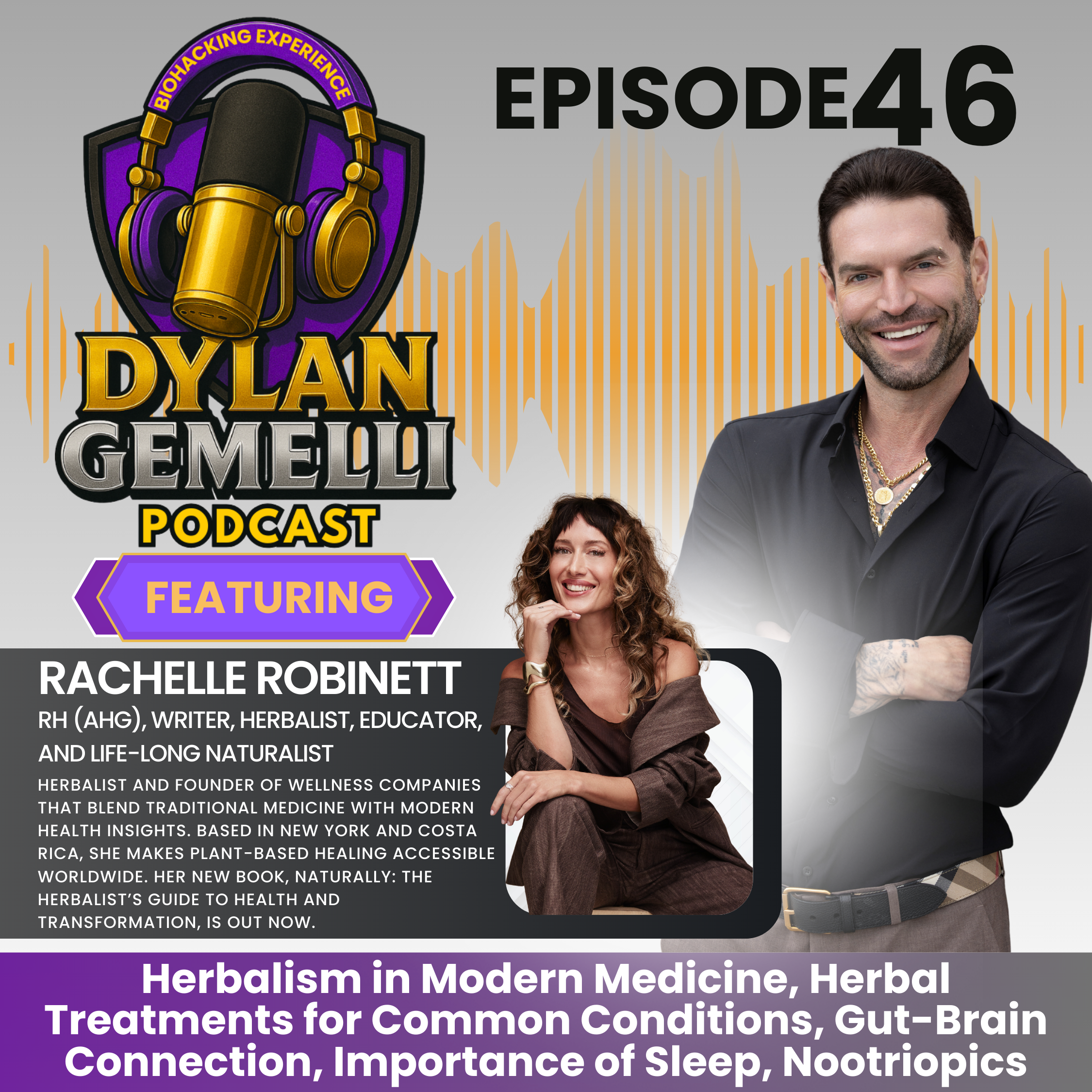
The Dylan Gemelli Podcast
Episode #46 Featuring Rachelle Robinett! The HERBALISM EPISODE! The role of herbalism in modern medicine, Common conditions treated with herbs, Liver Health and Supplements, Sleep Importance, Gut-Brain Connection, Thoughts on nootropics and more!
00:55:50
Loading summary
Transcript75 lines
- [00:00]
A
Foreign.
- [00:17]
B
Today's episode is sponsored by my good friends at Timeline. Timeline is now offering the world's first ever longevity gummies, powered by Might appear. You've heard me talk about the importance of cellular health and our mitochondria, which is why I have time. As my favorite and most trusted sponsor. These are the only clinically proven urolithin a gummies for strength and healthy aging. We may be living longer lifespans, but are we truly living better lives? What if the key is not just adding years to your life, but life to your years? This all starts at the cellular level. As we age, our mitochondrial health starts to decline. And one of the keys to living longer and healthier is keeping our mitochondria healthy and strong and might appear targets. This for us. Take control of your health now and live the life that you not only desire, but you also deserve. As a gift to all my listeners, you can save 20% off today by going to timeline.combackslash Dylan to get started. That's timeline.combackslash Dylan. I assure you your cells will thank you. All right everybody, welcome back to the Dylan Gelli podcast. Well, my guest today is on quite a roll right now. She has been all over the place on podcasts. She has a brand new book. It's called Naturally the Herbalist Guide to Health and Transformation. So she's a writer, she's an herbalist, she's an educator and she's a lifelong naturalist. She's the founder of multidisciplinary companies dedicated to the art and science of natural wellness. She combines traditional medicine and current health insight with an understanding of individual behavior modification. And she's provided accessible plant based healing to countless people. I can go on and on. I've had a pleasure of talking with my guest many times. Unfortunately, some of those were our lack of being able to record. But we are here to persevere and bring you this episode. So none other than Rochelle Robinette. Welcome.
- [02:21]
A
Rachelle, thank you so much. I'm thrilled to be here. I love energy.
- [02:27]
B
Well, thank you so much for going through everything that we've had to go through here. I had to reschedule schedule. We had some technical issues. But we will get this out. We are both boundary determined. So. Awesome. Well, like I said, you have a lot going on. A lot of people want to get you on their shows and talk to you and get your insights. You have a big book coming out so we're going to cover all of that and what's been going on. But you know, I said from the start, you're an herbalist. That's what you're known for. And so I think let's just start with this, because I don't know that when you hear that term that it fully resonates exactly what it is. I think people could miscontrue very miscontrue very easily what it is. So explain what it is and what drew you to that kind of work.
- [03:14]
A
Yeah, absolutely. It's a great, great question. And there are lots of misconceptions about what herbalism is. You know, herbalism, if, if someone's heard of herbalism, if they're familiar with it. Generally the idea is herbalism is the use of plants as medicine. And that is accurate. It is that. But herbalism is also far, far more holistic than that. It is the use of all sorts of natural ingredients to improve our lives broadly. It also includes nutrition, fitness, mental health, community, our spiritual practice, or our, you know, seeking purpose in our lives. It's really a medicine that looks at every individual as an individual and says, how can I improve their lives naturally? And that is why I love herbalism. I have studied so many different specialties in the health and wellness world over the course of my life. And when I re encountered herbalism and I realized that it encompasses so much, I mean, to me, modern herbalism is very similar to functional medicine. You know, urbanists can read labs, they'll look at your blood work, and they'll recommend certain herbs for this or that. So when I realized that it was that holistic and personalized and natural, I was like, that's. That's it. That's what I'm doing. That's who I am already. That's what I'm already practicing and living is what I want to do for the next, you know, decade plus is how long I've been banana.
- [04:46]
B
Okay. I've got a lot of ways that I want to go with this and, and you know, we're going to cover them all. And trust me, when I start going, everything will come out. I want to say, though, that we are so in line. I'm a big believer in natural healing and remedies, and I'm not. And we're going to get into this in terms of conventional medicine because you brought it up in relation and thoughts and everything. And I'm not anti, you know, traditional medicine by any stretch, but I'm also very aware of the misuse and the over prescribing and the look at treating instead of preventing. And I am a big person that speaks out against that. And I'm not saying that you have to do that, But I'm curious as to your thoughts that may or may not align with what I'm saying. Do you feel that there is an over and or misuse of conventional medicine where there could be more of a, at least at the very minimum, acceptance of other methods? And I think you and I could both go on and on about there being several instances where it's a better option. But let's just start with that. Do you think that there's. There should be more acceptance and, or tolerance amongst the big mainstream?
- [05:56]
A
Yes, please. Yes, absolutely. Acceptance, awareness, practice, education. Let's have medical professionals educated in, or at least have access to herbalists who are educated in these natural remedies. They can be used. Herbalism can be used preventatively. Herbalism can be used in the place of many, many over the counter or prescription medications. It can be used concurrently with medical treatments and it can be used after the fact. So the two, in my mind, the two can coexist. And the use of herbalism often lessens the need for sort of western medical treatments, if you will. The more we're using it preventatively, the more, the more we realize that it's an option. When we have an ache, a pain, a headache, insomnia, whatever it is, we can use herbs to treat those things. And like I said, we can, you know, done with professionals. It can be used concurrently with even treatments like chemotherapy or post surgery and these sorts of things. So yes is the short answer. Absolutely. Please, let's grow awareness and, and practice and understanding. And I think one other point there is the current medical system is training us, has trained us to treat symptoms as opposed to causes, and herbalism treats causes. Herbalism can also treat symptoms. But so much of the work of this practice is let's understand the cause of the symptom and we'll treat it naturally. And that is the way, as you well know, to long term true healing as opposed to just, you know, symptom satisfaction after symptom satisfaction, band aid.
- [07:40]
B
There's a lot of demonization and total lack of awareness when it comes to a lot of these different alternative options. I've seen it time and time again. And when, when somebody gets so defensive or so angry as opposed to breaking down explanations, It's a real, real big red flag to me. And it, I'm not saying that they're all bad people. I'm saying some may have even been brainwashed that way or by their schooling or things like that. But I want to ask you this because I think a lot of people aren't aware a lot of these western medications are derived from herbs anyway. And I'll bring up a statin, for example, which is basically coming from red yeast rice. Right. I mean, there's other things, obviously, but that's. They're derivatives of natural herbs. And I think that people don't have any clue about that at all. So touch on that, how prevalent that is and how people could go straight to the herbs and cut out all the other BS that's being put into these medications.
- [08:38]
A
Yeah, it's very true. I think the statistic is something like 80% of the current pharmaceuticals are, you know, in the market are, were originally derived from plants. And that also applies to a lot of supplements that we take that are not herbs. You know, those are often isolated compounds, you know, vitamin C or this or that, that come from whole plants or whole herbs. And when I say herb, when herbalists say herb, you know, we might mean food, we might mean plant, we might mean mushroom. You know, it's medicinal ingredients from nature. And yeah, I mean, when we take them in that whole form and it can be a concentrated extract, but it's still a full spectrum extract. It still contains this sort of full fingerprint, if you will, of that natural origin, not only do we get the benefit that we're looking for, the effect that we're looking for, but we get all of these residual benefits and they're all positive as opposed to all the negative side effects that so often come with our prescription medication.
- [09:42]
B
So, so for, for me, and I'll relate it to what you do and then you tell me how you do this. So I do a lot of coaching on peptides. I used to do coaching on steroids and different other supplements and things like that. And so we always look for synergies, you know, synergistic benefits between 3, 4 different compounds or whatnot. And there's some things that clearly don't mix well and some that do. Do you analyze and look at that often? And are there like books or things people can look at? You know how if you go to a. Oh, there's certain websites where they have interaction charts that say you're taking two or three medications and you look it up and it's like, oh, don't take it with this or that or there. Is there a resource for herbs that people can go and do that with? And are there any that you think are very important that people should take a look at that? You know, that You've come across that are kind of like staple synergistic, you know, taken together, type of benefit that people should really be aware of.
- [10:36]
A
Yeah, that's such a fascinating question. So synergy definitely exists in, in herbalism, of course, and I think it exists in a few different ways. So one common example of a sort of synergy is that combination of, of turmeric and black pepper. Right. Black pepper is a bioenhancer and it's helping us absorb the curcumin and the turmeric. There are other ingredients in herbalism that are also bioenhancers that enhance the absorption of these ingredients. Licorice is a very common one. So if you start to sort of look at the formulas, the ingredients in, you know, blends of herbs, licorice is very common and it's often in there for that purpose. Synergy exists in, I mean, it is widespread both between herbs and then to my previous point, within a single herb. Right. Which is why we don't necessarily want to break it down. And if we do want to break it down and isolate something, you know, to have a higher concentration of it, we usually want that recombined with the whole plant. So for example, curcumin extract recombined with turmeric. In terms of a resource for herbal synergies, that is not something that I have seen. I mean, I have studied this in my, in my work, of course, with teachers and that sort of thing. I did, I did create a, A, a variation of that, a version of that in my book. So in the back of my, there's a very large table that lists all of the herbs I've mentioned in the book and others and the best formats to take them in. And then the last column is, by the way, this combines well with this herb, or this does not combine well with this herb, or watch out if you're taking this medication. So there's a little bit of that synergy notes in those synergy notes in that table. But in terms of a master synergy specific resource, I love that idea. And I haven't seen it and I haven't seen something like what I created, which is why I created that, you know. Yeah, yeah.
- [12:34]
B
So a lot of times that's what I look for, like resources and things that could offer the potential benefit of maximum knowledge enhancement and curiosities and things like that. And so those are things to look at. So maybe I spark you an idea.
- [12:48]
A
Yeah. And, you know, it, it makes me think that, you know, if you're, if you're inclined to, you know, study herbs and. And medicine and. And supplements and all these things at that level. You know, I love the science of herbs. There's a lot of science in my book. I think it's really important for people to know that yes, there. There's history and tradition in herbalism, but there's a lot of scientific validation as well. And many of those studies, not all of them, but many of them will include information like that, you know, this herb combined. Well, combined with this herb is, you know, is showing greater efficacy or you're seeing that synergy there. But I mean, that, that's. That's a lot of deep reading.
- [13:30]
B
Oh, yeah.
- [13:31]
A
On a quick reference guide, but sometimes you'll see it there. And of course, the herbalists throughout the years have all written about traditional formulas and those. Those formulas are based on, you know, synergy.
- [13:42]
B
So I work with, you know, several companies that have me come in and help them in terms of their selling points and features. And so I always bring up how Amazon will have thing on the bottom of the page that says people often buy this when they buy that. And so then I immediately think with an herb, it would be so helpful if you had a list of, you know, two, three things that generally go extremely well together. And, you know, it would help people to combine the right things that they need throughout the day that go well with each other.
- [14:12]
A
That. Okay, so that raises a very important point, and that is that herbs, historically, globally, traditionally, forever, have been used almost always in combinations, not as single. Concept of a single. Yeah, you know it. So the concept of a single is this modern western idea, primarily. So if you're buying herbal products from. And that can be. It could be loose leaf tea, tinctures, capsules, powders, whatever it is from producers, companies or herbalists who are. Who know what they're doing. Those blends will have been created with that synergy in mind. So the. The work is often done for us, especially for people who don't want to do that work. You just need to. You need to source good products, and then you will. You'll be consuming that. That intelligence, essentially.
- [15:07]
B
And that. That's where I look at. And even if it's minimal, it doesn't have to be five, six, seven things that are detoxes or whatever. So. So NAC and, you know, goes well with having milk thistle involved with it. Correct. You know, and CoQ10 and red yeast rice are often combined together in a. In a supplement or a product. Because if you're taking a statin it can lower your CoQ10 and so you have to supplement extra. So they kind of go hand in hand. So the, I feel like the higher level, higher end companies, they do this and they put certain things together that they realize you're going to need for. Whether they serve the purpose of one filling in for one that may deep, you know, take away from one or that they like D3K2 they really have a purpose of being ran together. Right. And so that's kind of the stuff I look for. So I'm curious is as an herbalist. Well, one, do you have your own product line and two, if not, do you advise people to kind of look for those type of things?
- [16:02]
A
Yeah. So I've had many products over the years. Now I do have a line of herbal gummies and they were formulated by me. So they were certainly formulated with that concept in mind with synergy and some other I guess insights involved in, in those blends and. But other than that I don't sell products anymore. I just like to guide, I like to educate people, you know, in terms of how to navigate the market. There's so there's so much and of course there's, there's too much, but there's a lot of high quality, really brilliantly blended herbal formulas on the market. I, you know, and I love to see herbs combined with amino acids or whatever it is. Like there's there are a couple companies that I really love that have been doing herbal formulas for years, but the ingredients are not entirely herbal, you know, and to me that is this, that perfect combination is really, I mean not even necessarily perfect. It's very exciting because taking this, you know, modern health science, these more recent discoveries about, you know, supplements or ingredients that are beneficial for us and combining with these traditional, you know, maybe thousands of year old herbal recipes and you have this, this blend in a, you know, in a capsule. I love, I love to see that, you know. So yeah, I definitely look for that. And again, we need to source high quality products and then there's a lot of exciting work being done.
- [17:24]
B
Sweet. So I, I want to touch on a little bit of background information with you, but I will tell you I. We're going to transition after that into I want to give you instances of like liver or kidney and we're going to talk about your recommendations or what you look at. I know this can be dependent on the circumstance, but we'll kind of get into that and I'm curious as your thoughts on that and the treatments. But I first I, I Do want to talk about, let's say someone's listening to this or someone's read your book, or someone's just fascinated with herbs in general and they want to pursue, you know, what you're doing. First of all, how does one actually become an herbalist? And when you do, what are your kind of career path options with that?
- [18:08]
A
Yeah, great question. So, I mean, the very first line in my book is we are all herbalists because I like people to know that we all used to be, you know, in terms of our lineages, our path. It is something that used to be a way of life. It wasn't a specialty, it wasn't a. It didn't require an expert. It was the way we lived. We lived in combination with these plants, with nature. We evolved with them. Animals do the same thing. So someone can be or become an herbalist, you know, simply by practicing this. But I understand that the question is more about how to become a professional herbalist, if you will. And in that case, it requires study. And that can be a multi year college type experience. That can be mentorships with other herbalists. There are many, many herbal schools all over the world. I like to point people to the American Herbalists Guild, which is the. The largest sort of centralizing and governing body for herbalists and herbalism in the US and that has a. They have a great roster of schools and teachers that are, well, credentialed. And so for ex, my credentials are R H A H G, which is registered herbalist with the American Herbalist Guild. So I studied and practiced for many, many, many years and then applied for those credentials with that organization. There are a lot of different paths to becoming an herbalist. But if you want credentialed herbalism and professional study, then it usually requires just going to school for it. And once one is a practicing herbalist, there are so many paths available. And sometimes I think I've explored all of them. You, you may have a private practice, you may have a product line, you may have a cafe apothecary. You may do retail, e commerce, you may do content and media. You may consult with companies behind the scenes. You may teach classes, workshops, work as an educator. Those are all things that I've done in my career. You may work at an organization or a CPG company that needs an herbalist, you know, to support with messaging and communication or formulation of the product. You could write. I mean, you can do with it whatever you want, you know, professionally. Well, not whatever you want, but, you.
- [20:33]
B
Know, yeah, no, whatever.
- [20:35]
A
It's in line with. But I will say it's generally also. Well, it's typically the path of an entrepreneur as well. And I think that's one thing that there's a lot of challenge with for herbalists. Being an herbalist also requires you to be an entrepreneur generally.
- [20:49]
B
So would someone come to you as they would come to a doctor, like a naturopathic doctor or doctor with a private practice, and you would be able to run blood work, give recommendations, do all of that type of thing, or how does that work?
- [21:01]
A
Pretty generally, yes. So I can't request labs, but I can refer them to someone who can request labs. So they can have that done with like a PCP or something like that. And then I can look at those. I can read those labs. You know, not every herbal ice necessarily does, but many of them these days do. So my private practice looks a lot like a functional healthcare practitioner's would. And I happen to understand herbs deeply, in addition to vitamins, supplements, and this sort of thing. But throughout my book and throughout my practice, I'm definitely recommending dietary changes, movement, you know, adjustments, lifestyle changes. So if somebody, you know, comes to me and doesn't feel well, and their diet doesn't look good, their sleep's not good, they're not moving enough, I might not recommend any herbs until we take care of those, you know, aspects first. And any herbalist would be the same. You know, that's the part about herbalism that is widely misunderstood, Is that you're going to go to an herbalist and you're going to get herbs, and that's the thing. But they're gonna take you in, look at you as a whole, whole person and say, where do we start? And it may have nothing to do with herbs. It might. Sometimes it resembles, like, traditional psychotherapy. It's like, let's talk about why you're making these decisions. You know, that you. You know, you. That you know are not good for you and that you don't want to be doing, you know, So a lot of the work is talk therapy as well.
- [22:27]
B
I'm gonna put you on the spot here. And that's the. The beauty of what I do is we don't script, or we. We talk before we don't script. I just get to know people. And so that's what I. And I go with, where it flows. So I'm not going to ask you anything crazy, But I do, I do wonder, can you think of one or two or any circumstances where most people wouldn't think that an herb was able to fix it or treat it, or one that kind of shocked you even that it worked so well? Are there any circumstances like that that you've encountered over the years that you've either personally seen, seen, or, I mean, done yourself or others that you've seen colleagues or others do?
- [23:05]
A
That's a fun question.
- [23:07]
B
And see, it's kind of tough what you're not prepared for.
- [23:10]
A
I like. I love challenge. That's. That's, you know, I. Nothing is coming to mind as shocking. But I will say that, you know, over the course of my career doing this, it might be because I'm no longer surprised to see these things work, these change. You know, they, they, they. At this point, you know, to me, it's. It's not surprising that, of course, like, the herb works. Of course, the, you know, the. The holistic adjustment we made to somebody's life works. I've seen incredible, like, full life transformations over and over again, and they might have started with somebody just making a cup of tea each day, and it leads to, like. It leads to a total life transformation. I can't count the number of times I've seen that. So I am often. I often feel humbled. I often feel almost reverent. I often feel like a medium for this. I mean, herbalism is. Herbalism is not mine. You know, this is a. This is an ancient medicinal system that's been used around the world for, you know, as long as our species has been around. And I think that, you know, so it doesn't shock me to see it do those things, but it does move me. It does move me. Of course, there are a couple examples of herbs that I think work really well for everyone who takes them. And that's always lovely to see. You know, they come back and they're like, it did all the things you said it was going to do. But I think what's even more powerful is that, you know, and I'm very much a philosophical herbalist. I like to teach people how to think. I like people to approach herbalism as a sort of layer in their lifestyle that has the power to transform their health as opposed to, like, another supplement in the stack. It can be a supplement in the stack, but it's a much, much bigger thing than that. And that, to me, is where the most. The most power exists in herbalism. You know, I think people, of course, we want remedies for our headaches and our insomnia, but we want to be vital. We want to feel great, we want to be alive, you know, and it Offers that because it's so, it is so, um, comprehensive. So. Good question. Shocked. Maybe I'm desensitized, but so, okay, we're.
- [25:29]
B
Looking at, you know, different sorts of herbs. And when I coach people on compounds and like bodybuilders, I am always looking for something that has versatility, that can do multi things, multifaceted benefits. Yes. I get these people that just want a bulk, I just want to cut, I just want to do this. But most people have a wide variety of things they're trying to address or they would love to be taking something that's, you know, helping them in multi situational ways. So are there any herbs that come to mind to you that do a lot of multifunctional things for people that can offer a number of benefits for several different problems or just for overall quality of life?
- [26:14]
A
Actually, one that comes to mind immediately you mentioned already and that's milk thistle. I love milk thistle because as we know, you know, it's supporting liver function, regeneration of the liver, the sorts of things, but it's because of its action on the liver, it's also improving hormone balance in the body. And that, I mean that manifests in so many different symptoms for people. So in all the hormone balance, you know, situations I've ever encountered, I've always recommended milk thistle in addition to, I mean, probably lots of fiber and water and we could talk about that as well. But it's this, it's this overlooked aspect of hormone balance, you know, the liver's role in our, in hormone balance. So I love milk thistle for that. I think turmeric is incredible, you know, anti inflammatory, supportive of the gut health. One of my favorite benefits of, of turmeric is the fact that it reduces inflammation in the brain. And you see that results in an improvement in mental health conditions, depression, anxiety, brain fog, you know, these sorts of things. Like that's one of my top five. Both of those are in my top five. Those herbs are phenomenal. There's an herb for women that is very, very effective. And when you asked if there was anything that shocked me, this is the one that, that almost made it there because it is just so consistently reliable. And that is Vitex, Vitex or chasteberry. And this one helps to balance estrogen, progesterone, lh. It's a, it's an herb that can be used at any age, any, I mean any age post puberty. And you see it reduce all sorts of symptoms of pms. So skin issues, mood swings, headaches, pain, you know, however, that Shows up for somebody, this herb seems to make it just disappear. And that one, again, impressively. Impressively reliable for myself and all my. All my clients who've used it. It's a greater. Yeah, so.
- [28:22]
B
So you said that will help with LH and fsh. Did I catch that right?
- [28:27]
A
I was saying progesterone and estrogen balance. Lh. Yeah, it's a. What am I. What's. It's even working on? Neurotransmitter. I think it might be dope and dopaminergic, I remember quite offhand. But it's an impressive. Impressive. Very easy to work with.
- [28:41]
B
Awesome. Okay, so I'm not super familiar with that one. And if it's having those sort of benefits, that would be something ideal for a man too, with testosterone issues or hypogonadal issues, then, wouldn't it? Would it not?
- [28:54]
A
Possibly. Yeah. I've only used it in. In women, but it's. It. I'm looking at my note on it now. It's supporting the pituitary gland. Oh, yeah. Especially if there's estrogen dominance.
- [29:04]
B
Yeah, I'm gonna. I'm gonna look into that a little more because, you know, like, I've been around this so long, and testosterone boosters, they all beat around the bush with the same damn formula. And it's. One's got one thing a little bit more than the other, but it's generally 98% all the same stuff. And it's like, well, it works. So. So it does the trick maybe a far better for a woman than a man, especially a man that's suffering hypogonadoly. So these are things that I. It's nice if I can converse with you on, because I can learn a little bit about some herbs I may be missing that could be utilized in a multitude of ways. So that would be tremendous and I appreciate the insight there. So here's what I would like to ask you then. What are some of the most. And we'll start with the liver, because I already know that's one of them. But then I want to expound upon that. What are some of the most widely used conditions that people are a little bit more herb dependent on? You know, like, people tend to always want to detox the liver. And is there another organ or some sort of aspect I'm missing, like the kidneys or, you know, male libido, mental fog, brain fog? What are some conditions that you run into the most? And then after you tell me, then let's expound a little bit onto some of those conditions, especially the liver.
- [30:16]
A
Absolutely, absolutely. Yeah. So, number one, stress and anxiety. As, as one word in my practice, it was just that. Was it stress and anxiety? I have that also. Brain health, I kind of put that in one bucket. You know, brain fog, lack of focus, lack of motivation, which is not always a brain health issue. Gut health, I think would, I mean, I would even thump gut health up to number two. You know, the, the number of people who are suffering from some degree of microbiome IMB every single day at this point is tremendous. And, you know, thyroid issues used to be a really common, common complaint in my practice. I mean, I stopped seeing clients a couple of years ago, but I feel like that's not something I see as much anymore. Now perhaps hormone balance has kind of overtaken that in terms of the, maybe the dialogue in the, in the wellness industry in general. Not that the conditions are. Not that there are any less of them, but autoimmune, of course, libido is always, always a hot topic. Something that's risen for me, you know, has been which I, I combine, you know, libido or aphrodisiac, herbs and the alternatives to alcohol. So people seeking states of pleasure or state change, wanting to feel good, wanting to be, you know, in the mood a little bit more, more naturally. And that to me is also where we can talk about antidepressants as well. That's all kind of generally like in the book. I have that all in the same chapter because I think the aphrodisiacs, the antidepressants, these state changers that give us this lift are all generally related. What else? Detoxification, certainly. Oh, sleep, of course. Farther down the list you get, you know, performance enhancement and the other two things. But yeah, those are the main ones. I mean, I had a series of, of classes and they were just specifically dedicated to those issues because I saw them over and over and over again. And I just started to require clients to like, wash the classes first so we could get the groundwork covered before we dug in more, more deeply in their conditions.
- [32:23]
B
So, well, we could turn this into like an orated ebook if I wanted to go all day with each condition that I want to talk about. But I'm going to pick what I think are the most. I don't want to say the most important. Let's say the most prevalently used and, or misunderstood. Let's. Let's call it that. So I'm going to tell you what I think and then we'll go with the flow on a Couple of these. And I, I'm really, really curious as to your thoughts on some of the questions I have here that I think. And it's because it's, it's a personal thing, but also because I deal with so many different people on a daily basis and I know the things that are discussed and go around. So let's dive into liver first because I feel like, and maybe it's because of the world I come from in fitness, but I feel like the liver is one of the most widely used for supplements to try to correct cleansing and fix different aspects of liver problems. And I think a lot of people have liver problems and it's not just fatty liver or alcohol induced. There's a lot of things that contribute to liver issues. There's a ton. And I don't think people know, you know, what those are or why. I have a couple that come to mind. I want you to tell me how prevalent the problem is. I want you to tell me if the ones I mention are good and what, what other ones are good and what kind of synergistic blend you maybe look at or recommend. And if there's a lot of bullshit products. How so? Okay, so I'm looking at knack. I'm looking at milk thistle. I'm looking at tud, I'm looking at Hawthorne berry as the four that I know in my world are the most widely looked at, viewed and used for these kind of conditions. I'm wondering how you feel about that. Do you think you need all of those? Do they work well together? And, and also when you're seeing these type of conditions, what is your recommendation on a good detoxification?
- [34:02]
A
Yeah, I mean, I love those. I think those are, I think those are excellent. I would vote for licorice.
- [34:09]
B
Okay.
- [34:09]
A
Functions similarly to milk thistle. You're getting a detoxification support, hepato protective as well. So you're getting this, this protection or regeneration as well for the liver. Schisandra does that as well. And you know, there's a category of herbs, herbal bitters are very helpful for liver function. They're, they're, they're working primarily in the digestive tract. But obviously, you know, the liver is detoxifying. We need to ensure that the digestive tract and motility is all working well as well, or we're, you know, short circuiting the whole process. So bitters can be great for detoxification sort of on a daily basis. It's less of an intense cleanse, if you will. I mean, turmeric is another great Herb for the liver I like. I'm going to list a couple and then I'll back up and give you a little bit more of my approach here. I think that these bitter roots, dandelion root, burdock root, gentian root, again, these are bitters and they're hepatics. Right? They're hepatic herbs. They, they are, again, something that can be used on a daily basis to help support liver function and the digestive processes in terms of detoxification. And I do. I have a chapter dedicated to this in the book. I like to recommend that people first, and I'm sure you do this as well. I recommend that people first consider all the inputs and reducing as many of those as possible. Right. Otherwise known as retreating. You know, we can, we can go on a retreat, but we can also sort of simulate a retreat in our lives because our liver is. Unless impaired, our liver is detoxifying all the time and doesn't generally need to be encouraged to do a better job. What needs to happen, in my experience, is we need to give it less work to do. Right, right. So I like to consider what's being put into the body and the life first and see what we can take out of it to put less stress, less demand on the liver and then also look, you know, on the other side at gut health and motility and, you know, the whole digestive system to make sure that we're detoxifying in that direction as well. Often I see a hyper focus on liver function, you know, and a disregard for what happens before and after that liver function.
- [36:31]
B
Right.
- [36:32]
A
So to me, that's very important. And always, you know, I always try to approach it holistically and make sure that, again, this is a simple thing, but somebody's also supplementing with fiber and drinking lots of water, you know, and ensuring that their gut is healed and functioning well. And sometimes that alone can be what's needed to improve the detoxification processes in the body. I mean, of course, it depends on, you know, if somebody just came out of surgery or they've been on medication or something like that, then they, you know, we do need to do more of a liver cleanse. But I think there's a. Yeah, I said it. I think I often see a hyper focus on liver function. So I like to back up a little bit and look at the whole whole picture.
- [37:12]
B
Thank you for the breakdown on that. I'm curious. I was, I was looking at gut as the second one, but when you brought up sleep, I was like, no, no, no, no, that the one. Because I see so many people that all the. The talk is I need as much melatonin as I can to sleep. Like, oh, boy. So you know what? I'm not a sleep expert. I have my own sleep issues, like I'm sure a lot of people do. And I have those wandering thoughts that never stop, you know, and because of work and things that are coming up. But let's talk about supplements. And I feel like people tend to become a little bit too dependent or reliant for that on sleep. Tell me if that's accurate and tell me, you know, is melatonin the end all be all for sleep? Or if not, what is some of the other herbs that we're missing out on and recommendations that you may have?
- [38:04]
A
Yeah, melatonin is. I mean, melatonin is cool. Melatonin is actually, you know, one of my favorite herbal teachers. He's been doing this for decades, he said, and he wrote. He literally wrote the book on adaptogens. Adaptogens or herbs that help with our stress resilience. He said that. And this was a couple years ago, so I'm not sure where it's at now. But melatonin is in the running to be one of the first non herbs to be considered an adaptogen, which is. Which is fascinating. And there, obviously, as you know, there are so many other benefits of melatonin that are really interesting. That said, not everyone does well with it, of course, so I think for people who tolerate it well, it's great. If it doesn't work for somebody, there are, you know, a hundred other options that could all be herbs and could also be supplements. You know, there's a. There's a line in the book where I mentioned that, you know, our inability to sleep is not a lack of. It's not a lack of sedatives. You know, it's sort of like our. Our inability to, like, you know, have energy during the day. Like, our lack of energy is not from a caffeine deficiency.
- [39:11]
B
You sure about that?
- [39:12]
A
You know, so everything we do, not everything, but most of what we do from the moment we wake up in the morning is going to affect how we sleep at night. So, you know, it's really helpful again, to look at the whole picture and the whole day, the whole person, and not wait until it's bedtime. And there's. What. What herb can I take to knock me out now? Of course, there are some that can knock you out, and I'll share those. I'll share my favorites. It may be that we start using ashwagandha, which is a calming adaptogenic herb that helps balance cortis all levels and improves our resilience to stress. Maybe that we start using that during the day and that results in our having better sleep. We drink less caffeine and we use more herbs that give us energy without being caffeinated. There are so many ways about it. Or we use herbs instead of alcohol that improves our sleep. That said, there are. There's a whole category of herbs called sedatives. Most of us are very familiar, bad term. And these generally work on the nervous system. Sometimes they also work on the musculoskeletal system. Some are heavier than others in terms of their sedative quality. For ruminating. For rumination, which I share, the herb that we recommend for that is passion flower.
- [40:21]
B
Okay.
- [40:21]
A
That one is actually specifically indicated for rumination. If somebody has physical restlessness, restless leg syndrome, or ticks and putches, or, you know, tossing and turning, then you can use an herb called skull cap, which is specifically indicated for that kind of constitution. Valerian, very well known sedative, herbal generally doesn't work as well on its own as it does in a blend with other herbs. Hops, beautiful sedative herb Jujube is another. You can use chamomile, great for digestion. Also a mild sedative. Lavender, less of a sedative, but very calming. California poppy, another sedative. Catnip, another sedative. So we could do a blend of three or four of these. Any of these sedative herbs will work to help not only help someone fall asleep more quickly, so decrease latency, improve deep sleep, you know, and keep somebody sleeping, you know, throughout the night. They can also be used to treat panic attacks.
- [41:24]
B
Yeah.
- [41:24]
A
So we want to calm down quickly. Right. A lot of these are. These are. They have that action as well or that, that benefit. And then I really like to use amino acids in the evenings or in the afternoons and evenings to help with sleep too. So, for example, five HTP or GABA or L Theanine or tryptophan, my favorites, not all together, but depending on, you know, the constitution of the person. Those are some of my favorite, like additions with sedative herbs. And a lot of products combine, you know, combine those. I have a. There's a sublingual that I really like that's like gaba, L Theanine and valerian, perhaps like that.
- [42:02]
B
Yeah. L. Theanine is very, very popular. So, you know, looking over all of that, do you think that people become Too dependent on those or what's your feeling on that first for their sleep And I. Do you think some of that's just mental? Like they think they need it over time and they kind of induce it under themselves?
- [42:25]
A
Yeah, I mean that's a great question. I think it depends on what the ingredient is and it also depends on somebody's preference for being free or not of some kind of supplement in their life. So if I'm using valerian and hops and California poppy and passion flower or whatever to sleep every night, I personally am not at all concerned by, you know, by a quote unquote dependency on that because I'm getting so many benefits and literally no negative side effects of these ingredients except for that psychological, you know, that sort of, that knowledge that I might be dependent on them. But it's, you're essentially, you know, it's like we're eating our vegetables, we're drinking our herbs before bed. Like there's no negative benefit, there's no negative effect to that. But I, I am personally someone who doesn't like to be dependent on anything. So I like to break habits even when they're good habits just to, you know, to be free of it and kind of check in and that sort of thing. So I think it depends on the person and what they're using to sleep. If it's, if it's herbal and it's high quality and it works and they're getting great sleep with it and they're not concerned about being dependent on it, you know, maybe on it in a year or something, you know, so a hundred percent.
- [43:52]
B
Oh, here, I want your thoughts on this topic. What about nootropics? Is that something that you like, dislike that you're familiar and versed with and. Because it's, it's definitely become a lot more prevalently discussed and hotter topic. I don't know, the past two, three years and in my world, especially in something, you know, it went from really kind of non existent to gamers using it, now every, the bodybuilders looking at how it's helping them and now it's like everybody. So you know what, what's your feeling on those first and foremost?
- [44:24]
A
Yeah, well, I love nootropics. I'm partial to herbal nootropics.
- [44:29]
B
Sure.
- [44:30]
A
I love them again, I have a chapter dedicated to it. I think they're, I think they're fantastic. But I think it depends on the ingredient. And with nootropics you definitely get, you know, we have herbs that are classified as nootropics but lots of other, you know, supplements and ingredients are as well. So it sort of depends on the nootropic in terms of my personal preference for it. But I think they're great and I think a lot of people need them. And if we're using, again, high quality products and they work well for us, and especially if that means we can drink less caffeine or something like that, then fantastic. So generally I'm a fan. Yeah.
- [45:07]
B
Okay, sweet. All right, so one more that I want to touch on because this has become, I think, probably the biggest, I don't want to use the term craze, but most widely discussed and actually more understood that it's one of the main causes of our illnesses or diseases. I'll argue, obviously I, I will argue cells and cellular, you know, dysfunction and is where the majority of our diseases and sickness and illness come from. But then gut is the one that everybody talks about. Now. I've interviewed Dr. Gundry multiple times, spoken with him in private. I mean, he's one of the kings of discussing that. And I've learned a truckload from him. Dr. Y. I've taken her class, discussed a lot of, of gut repair and health. And you know, I knew of it, but never to the extent of what I do now. And I feel like it's really being, and rightfully so discussed and noted that this is a major cause of many different health issues or the origination of many. Do you agree with that? And if so, what are some of the best herbs that you've found or come across to help with a leaky gut issue, for example?
- [46:15]
A
Yeah, I do agree with it. I do. Certainly. I think that the connection that this, this central, you know, axis of our health tends to be our gut and its connection to our brain. It's, it's proximity to our immune system. It's total interconnected with interconnectedness with our nervous system. Yes, I agree. Coupled with the standard American diet and you know, lack of fiber. To say it for the third or fourth time on this episode. I'm a big fan of fiber. I think it's, I think it's a massive issue. Yeah, certainly. And in terms of healing the gut, you know, obviously we're starting with food. Nutrition is, is first, second, third, fourth and fifth. And there are so many ways that herbs can support. So that category I mentioned previously of, you know, bitter herbs help improve our digestive processes. We, we taste bitterness, we have bitter receptors on our tongue, but we have them throughout our body. So we, we, you know, sense that presence of bitterness. And our digestive processes become sort of prime to digest and absorb and eliminate better. There are herbs that can help to heal the mucous membranes in the digestive tract. You know, think about sort of slippery, slimy ingredients like chia flax, marshmallow root, slippery elm. There are ingredients like calendula and plantain. Many of these can be used topically as well, because, you know, the skin is not so much different, of course, Than the mucous membranes on the inside of our, you know, systems, our digestive tract. So those can help to heal those. I mean, you can use ingredients like licorice and turmeric and some that we've mentioned before that reduce inflammation in that system. Yeah, there's. There are so many ways to go about it. Those are some that come to mind. Um, and when I do, you know, I've done. I done. I've done a lot of gut healing protocols for people. Usually they come from a sort of an overuse or a chronic use of antibiotics, and people come to me and need a gut healing protocol. So, you know, that generally includes probiotics and prebiotics and fiber and herbal bitters. Rarely am I using digestive enzymes, because the herbal bitters are sort of serving that purpose. Dietary changes, you know, removing food allergies or, you know, food allergies or foods we're allergic to and sticking with it. I mean, gut healing can take quite a long time. I think people are not. Not aware of that as well.
- [48:50]
B
That's the thing. And. And that's one of the things that I think people need to understand. And a lot of this is a marathon, not a sprint. I think a lot of people, they want results and seconds and overnight. And it's hard because we all want instant gratification and instant everything. And that's just not. Yeah, it's just not how life generally works. So. Okay, well, your book just came out, and so let's give a little synopsis of what it's about and what the motivation was behind said book that is becoming so popular.
- [49:22]
A
Yeah. Thank you. Naturally, the herbalist guide to health and transformation is. It is a book for anyone who is interested in better health naturally. And of course, it is all about herbalism, but it also includes every single chapter, includes this whole holistic perspective that I keep mentioning, which is, you know, how to improve our health naturally, not just using herbs as medicine. There's an introduction to what herbalism is, why it matters for modern lives, how it can work in today's world, why it's still, you know relevant and, and scientifically valid and those sorts of things. There's all this sort of setup and explanation of the terminology or you know, the, the Herbalism 101. And then each chapter is dedicated to a category of herbs and herbal categories. Categories correspond to systems in the body. So look at the nervous system and herbs for the nervous system, stress, herbs for stress, many of the things we've talked about today, gut sleep, detoxification, food, pain. The last chapter is about transformation and entheogens or psychedelics, how we can use these plants to create fairly drastic changes in our lives if we like. And I talk about specific herbs and how to use them. I give case studies for how I've treated clients in the past. And I also step back and kind of explore the concepts that are related to these systems. For example, the nervous system is very much about listening. So I, I look at the role of listening to our bodies, listening to, to this, what the symptoms are saying and how that can lead to better health long term. So it really runs the gamut. And it's written to be a pleasure to read. It is not a textbook. It is meant to be enjoyable, exciting, attaining, obviously highly educational. And then in the back we have recipe, big herb use table and all of the studies that are referenced in the book. And there are a lot.
- [51:24]
B
How long did it take you to write this book?
- [51:28]
A
Well, the full process from start to finish finish was exactly two years. I wrote for eight months straight basically and then it went through some rounds of edits. So I'll want it, you know, about nine months. So it's definitely my child. But yeah, I wrote pretty, pretty seriously for about eight months.
- [51:49]
B
And this is your first book, right?
- [51:51]
A
It is my first book.
- [51:52]
B
Okay, so what's the future then? Going through this process, seeing quick results with it and the whole process and now looking back on it. Is that something else you're going to do? And if not, what's your plans moving forward?
- [52:07]
A
Well, I will say that it was more than mildly traumatic, but I definitely going to do it again. I've actually, from the time I was a child I wanted to write and I write all the time. So my future is more books. Trauma or no, no trauma. So I've got to start on book number two now and hopefully that's the way it goes. But yeah, it's my, it's my true love writing.
- [52:34]
B
That's awesome. So what else do you offer now to people that are. Do you have any services or anything else that you do at this point or is it just kind of be the, the book, the book life from here on out.
- [52:45]
A
Yeah. I personally am not available for clients or services anymore. But I have, I mean a decade plus of resources on the website. We do a weekly, sometimes more, more than once a week newsletter that's full of herbal information. I produce a lot of content and media. Yeah. And I consult with a lot of companies so I'm kind of behind the scenes of things. But I definitely phased out my sort of one to one and kind of public access around the time that I started writing this book. Just, just recognizing that, you know, there's only so much time in a day. There's only so much time in a life. So.
- [53:25]
B
I know, I know more than anyone, trust me. I, I get the daily discussion on how I take on too much and it's a daily damn discussion in my house. So I get it. I totally get it. There's not enough passion flower on this earth. Okay, well, I, I love this. I, I am so intrigued by all of this because it's been a big part of my life and I. We share so many of the same beliefs on this and you know, it's, it's nice when I get to talk with people and share this kind of information and put it out in front of people to just get the different insight. Look, everybody's different on what they want and that's fine. But it's good to have the knowledge, it's good to understand and it's good to know that there's several options and alternative methodologies and thoughts out there that don't have to be just squashed because, you know, somebody's got a ton of money and doesn't want anybody to impede upon that because they're. Billion and trillion dollars isn't enough. It needs to be more than that. So you know, and I don't care who that pisses off. It's a fact. And I appreciate your openness and your willingness to talk and I also appreciate, you know, what drives you and why and what you're doing because it's a big benefit to everybody. And I, I take it upon myself to get people like yourself out there to give a different outlook and understanding on things. And so it's appreciated.
- [54:37]
A
I'm very grateful. Thank you so much.
- [54:39]
B
Awesome. Well, tell people, and I'll link all of this in the description as well as usual. But tell people where the best places to buy your book and the best places to you.
- [54:49]
A
Yeah, so my book is, is available wherever books are sold, audiobook or physical Digital, published by Penguin. You can find it also on my website, Rochelle Robinette.com I'm also on Instagram Rel. And the book is everywhere there. But, you know, Amazon, your local bookseller, wherever, US and UK right now. And those are, those are the places to find me.
- [55:11]
B
Awesome. Well, we made it. No recording issues. And this damn thing better turn out. If it doesn't download properly, I will do it again. No, I, I thoroughly enjoyed this. There was, you know, for whatever reason, but it worked out extremely well. And I really appreciate it. And I know this is going to be a hit. So thank you, Rochelle and everybody. Stay tuned for plenty more to come. Dylan Gemelli and Rochelle Robinette signing off.
- [55:40]
A
Sam.