
Podcast
The Forgotten Exodus
Hosted by American Jewish Committee (AJC) · EN
The multi-award-winning, chart-topping Jewish podcast, The Forgotten Exodus, is back for season two.
The world has overlooked an important episode in modern history: the 800,000 Jews who left or were driven from their homes in the Middle East and North Africa in the mid-20th century to forge new lives for themselves and future generations.
The Forgotten Exodus, a limited podcast series by American Jewish Committee (AJC), explores the important lessons we can learn from this pivotal moment and the little-known Jewish heritage of the Middle East and North Africa. As Jews around the world confront rising antisemitism, hear five new stories of Mizrahi and Sephardi courage, perseverance, and resilience from this transformative and tumultuous period of history for the Jewish people. The world has ignored them. We will not.
10episodes
Episodes
Newest firstAll episodes
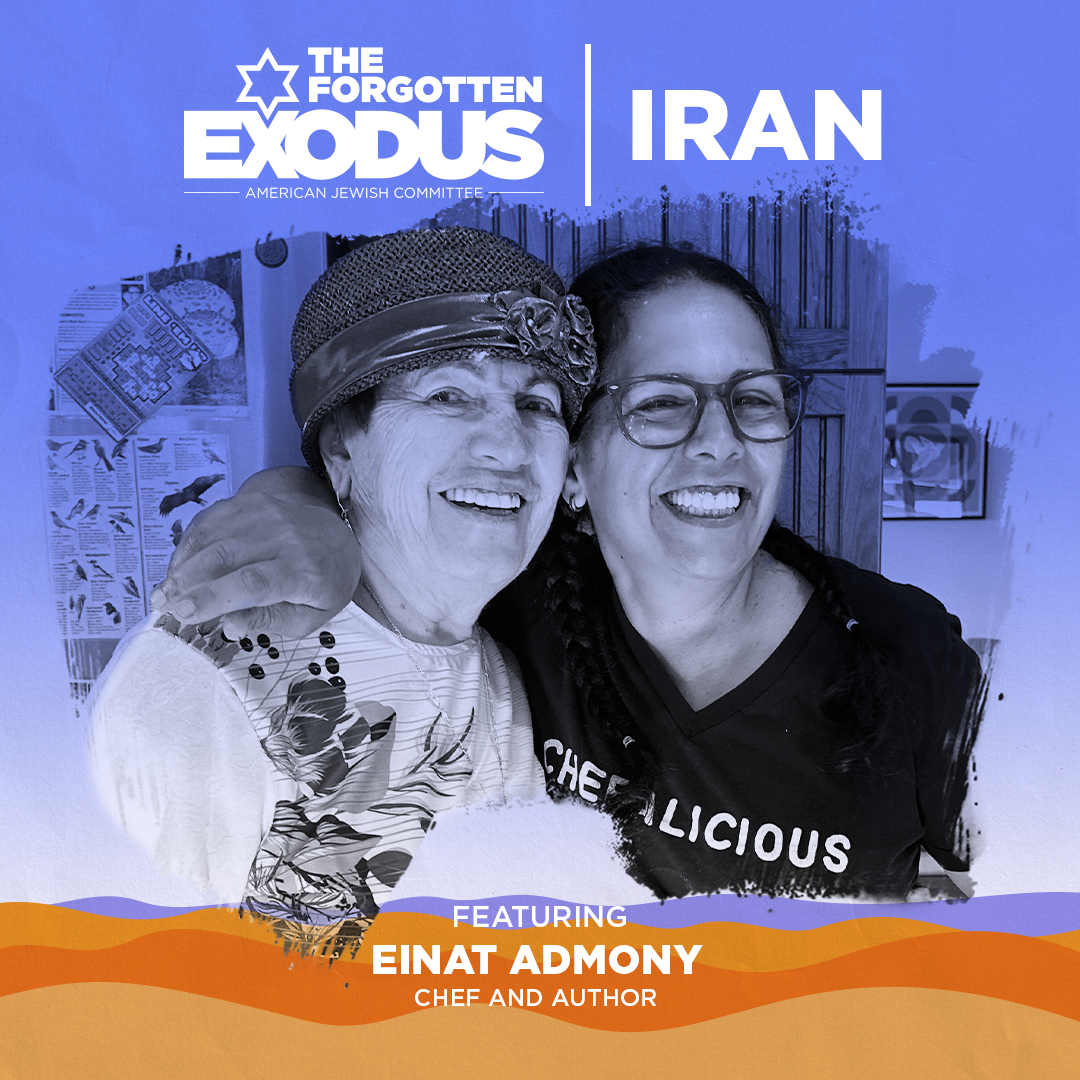
Iran
Oct 2, 202400:40:49Tap to summarize"I never thought there's antisemitism. It's something from the past, for my grandparents, for my mom a little, but it's not something in my generation, or my kids' generation. It's done . . . apparently, not." Einat Admony is a chef, cookbook author, comedian, and social media star who grew up in Bnei Brak, Israel. With parents from Iran and Yemen, Einat spent her childhood in the kitchens of Mizrahi, Sephardi, and Ashkenazi neighbors. Learn about her family's deep-rooted Jewish heritage in Iran and the broader Middle East. Along with her mother Ziona's journey from Iran to Israel in 1948, Einat discusses the antisemitism she's dealt with online and on the streets in the past year. Hear her stories of Jewish-Muslim coexistence in Iran and memories of spices and perfumes that inspire Einat's dishes. Her cookbooks Balaboosta and Shuk, along with her Manhattan restaurant Balaboosta, reflect a blend of tradition and innovation. "You could not have Judaism today, if it were not for the Jews of Iran," says Houman Sarshar, an independent scholar and director of publications at the Center for Iranian Jewish Oral History in Los Angeles. Sarshar highlights the historical relationship between Iran and Israel, noting that Iran was the second Muslim-majority country to recognize Israel post-1948. The conversation also touches on the challenges faced by Jews in Iran, their cultural integration, and the impact of the 1979 Islamic Revolution. —- Show notes: How much do you know about Jewish history in the Middle East? Take our quiz. Sign up to receive podcast updates. Learn more about the series. Song credits: Pond5: "Desert Caravans": Publisher: Pond5 Publishing Beta (BMI), Composer: Tiemur Zarobov (BMI), IPI#1098108837 "Suspense Middle East" Publisher: Victor Romanov, Composer: Victor Romanov; Item ID: 196056047 ___ Episode Transcript: EINAT ADMONY: I've been in Israel a few months ago. It's like you always feel loved, you always feel supported. It's still home. It's always going to be my home. MANYA BRACHEAR PASHMAN: The world has overlooked an important episode in modern history: the 800,000 Jews who left or were driven from their homes in the Middle East and North Africa in the mid-20th century. Welcome to the second season of The Forgotten Exodus, brought to you by American Jewish Committee. This series explores that pivotal moment in history and the little-known Jewish heritage of Iran and Arab nations. As Jews around the world confront violent antisemitism and Israelis face daily attacks by terrorists on multiple fronts, our second season explores how Jews have lived throughout the region for generations despite hardship, hostility, and hatred, then sought safety and new possibilities in their ancestral homeland. I'm your host, Manya Brachear Pashman. Join us as we explore untold family histories and personal stories of courage, perseverance, and resilience from this transformative and tumultuous period of history for the Jewish people and the Middle East. The world has ignored these voices. We will not. This is The Forgotten Exodus. Today's episode: Leaving Iran. MANYA: Whether she's deviling eggs soaked in beet juice, simmering Oxtail in shawarma spices, or sprinkling za'atar on pastry dough, chef Einat Admony is honoring her family's Middle Eastern heritage. Both the places where they have lived for generations, as well as the place they have and will always call home: Israel. EINAT/Clip: Start with brushing the puff pastry with olive oil and za'atar. Have some feta all around and shredded mozzarella. Take the other sheet and just cut it to one inch strips. Now we're going to twist. Need to be careful. Now we're just gonna brush the top with the mix of oil and za'atar. Get it some shiny and glazy. This is ready for the oven. Bake at 400 until it's golden. That's it super easy, just sprinkle some za'atar and eat. MANYA: For the chef, author, reality TV star, and comedian, food reflects the Zionist roots that have been a constant for Einat, the self-made balaboosta, who is largely credited with introducing Israeli cuisine to the U.S. That love for Israel goes back generations, long before the modern state existed, when her maternal ancestors lived in the land, that until 1935 was known as Persia, but is now known as Iran. Her own mother Ziona, the third of seven siblings, was even named for the destination where Einat's grandparents aspired to one day raise their family. Returning home to the land of Zion from which Jews had been exiled centuries earlier was always the goal. When you ask her why, Einat laughs in disbelief. EINAT: Why? Why? That's homeland. I think a lot of Jewish people for hundreds of years was, that's in every prayer, it's in every Shabbat dinner evening. MANYA: The hatred directed toward Israel by Iran's regime in the form of the deadly attacks on Israel by Iran-backed terrorist groups and the Islamic Republic of Iran itself make it hard to believe that Iran was once a place where Jews and the Zionist movement thrived. But in fact, Iran's history includes periods when the wide-open roads between Iran and Israel ran two ways and the countries not only lived in harmony but worked in close partnership. Iran was the second Muslim-majority country after Turkey to recognize the modern state of Israel after its formation in 1948, and the two established diplomatic ties. Regular flights ran between Tehran's Mehrabad International Airport and Tel Aviv's Ben Gurion airport. SARSHAR: We cannot overlook the fact that since October 29, 539 BCE the Jewish community of Iran remains to this day the largest community of Jews anywhere in the Middle East outside the state of Israel. To this day. You could not have Judaism today, if it were not for the Jews of Iran. MANYA: Houman Sarshar is an independent scholar and director of publications at the Center for Iranian Jewish Oral History in Los Angeles. He has edited a number of books, including Esther's Children: A Portrait of Iranian Jews. SARSHAR: The history of the Jews in Iran begins about 2,700 years ago, when the first community of known Jews was taken to Iran. They are commonly believed to be one of the 10 Lost Tribes. And then when we fast forward to when Nebuchadnezzar came and destroyed the temple in Jerusalem and took Jews into captivity. Some years after that at 539 BCE on October 29, 539 BCE, to be exact, Cyrus the Great, the founder of the Achaemenid dynasty, liberated Babylon and gave Jews the permission to go back to Israel and rebuild the Second Temple. MANYA: Cyrus the Great – a Persian emperor particularly renowned among contemporary scholars for the respect he showed toward peoples' customs and religions in the lands that he conquered. According to the Book of Ezra in the Hebrew Bible, Cyrus even paid for the restoration of the Jewish temple in Jerusalem. SARSHAR: This is known as the Second Temple period in Jewish history, and under the Achaemenid dynasty, Jews participated in every level of society. And a few centuries forward, around the 5th Century, we know the Jews continue to live with many freedoms, because that is the era when the Babylonian Talmud was originally produced in Iran by Rav Ashi. So, you know, there was a thriving rabbanut (rabbanite) in Iran who had the freedom and the luxury and the time to be able to produce such an important document as the Talmud, which has become the cornerstone of all jurisprudence that we know, Western law, and everything. MANYA: The advent and arrival of Islam in Iran in the 7th Century CE changed circumstances somewhat. As was the case across the Middle East, all non-Muslims became dhimmis – residents who paid a special tax and lived under certain restrictions. The situation for Jews worsened in the 16th Century when the Safavid dynasty made the Shiite creed the dominant form of Islam in Iran. Fatwas made life for all non-Shiites quite difficult. SARSHAR: And for reasons that are still open to discussion, all of these restrictions were most vehemently imposed on the Jews of Iran. And because of these restrictions, all non-Shiites were considered religiously impure. And this religious impurity, kind of like the concept of the untouchable sect in India, they were considered pollutive. MANYA: Jews could not look Muslims in the eye. They were placed in ghettos called mahaleh where they could not leave on rainy days for fear the water that splattered on them could contaminate the water supply. They wore yellow stars and special shoes to distinguish them from the rest of the population. They were not allowed to purchase property from Muslims or build homes with walls that were higher than those of their Muslim neighbors. SARSHAR: They could not, for example, participate in the trade of edible goods because, you know, fruits and vegetables and meats carried this pollution. So Muslims could no longer consume the foods that were touched by Jews. And as a resu...
Transcribe →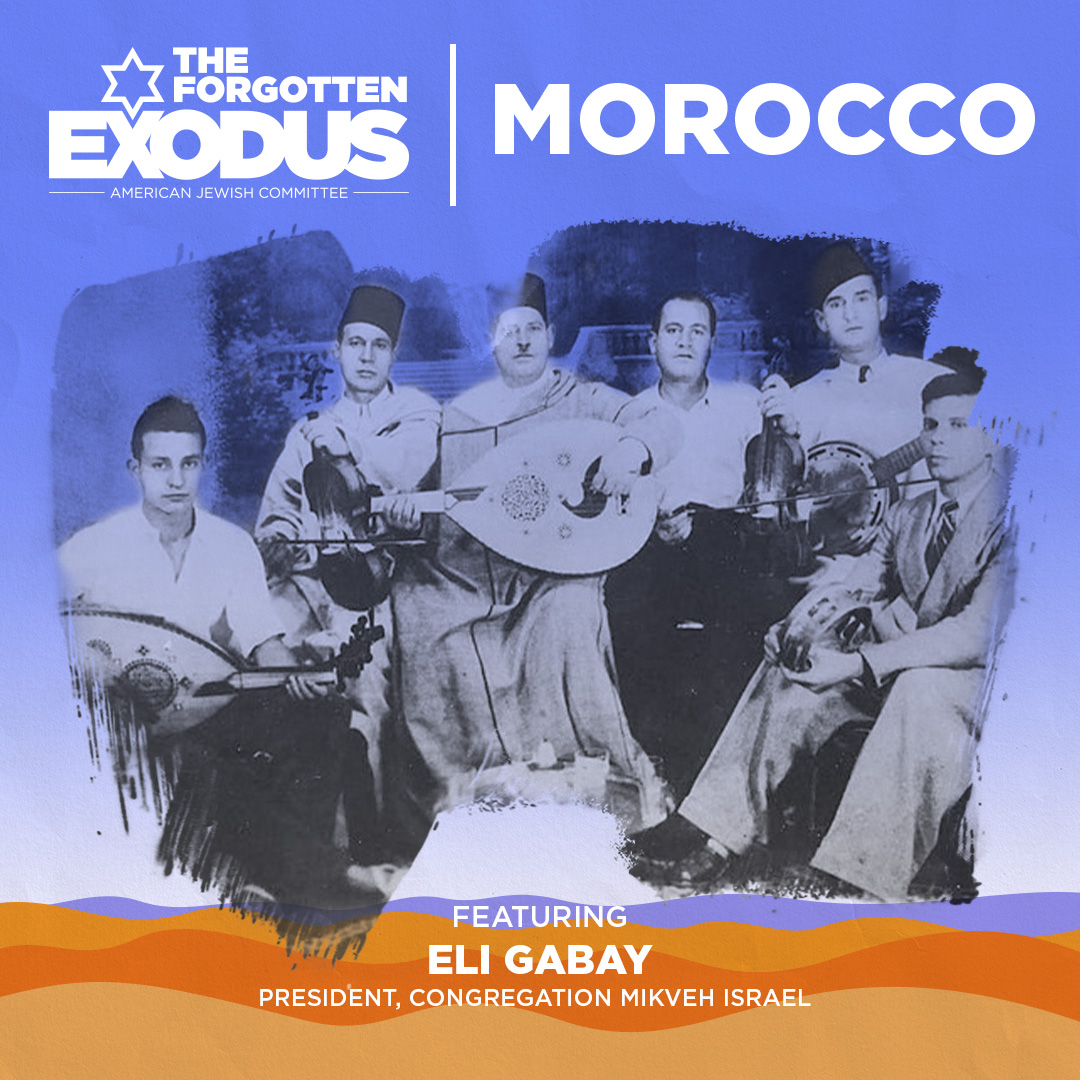
Morocco
Sep 24, 202400:37:45Tap to summarize"Today's Morocco is a prime example of what a great peaceful coexistence and international cooperation can be with an Arab country." Eli Gabay, an Israeli-born lawyer and current president of the oldest continuously active synagogue in the United States, comes from a distinguished family of Jewish leaders who have fostered Jewish communities across Morocco, Israel, and the U.S. Now residing in Philadelphia, Eli and his mother, Rachel, share their deeply personal story of migration from Morocco to Israel, reflecting on the resilience of their family and the significance of preserving Jewish traditions. The Gabay family's commitment to justice and heritage is deeply rooted. Eli, in his legal career, worked with Israel's Ministry of Justice, where he notably helped prosecute John Ivan Demjanjuk, a Cleveland auto worker accused of being the notorious Nazi death camp guard, "Ivan the Terrible." Jessica Marglin, Professor of Religion, Law, and History at the University of Southern California, offers expert insights into the Jewish exodus from Morocco. She explores the enduring relationship between Morocco's Jewish community and the monarchy, and how this connection sets Morocco apart from its neighboring countries. —- Show notes: How much do you know about Jewish history in the Middle East? Take our quiz. Sign up to receive podcast updates. Learn more about the series. Song credits: Pond5: "Desert Caravans": Publisher: Pond5 Publishing Beta (BMI), Composer: Tiemur Zarobov (BMI), IPI#1098108837 "Suspense Middle East" Publisher: Victor Romanov, Composer: Victor Romanov; Item ID: 196056047 ___ Episode Transcript: ELI GABAY: Standing in court and saying 'on behalf of the State of Israel' were the proudest words of my life. It was very meaningful to serve as a prosecutor. It was very meaningful to serve in the IDF. These were highlights in my life, because they represented my core identity: as a Jew, as a Sephardic Jew, as an Israeli Sephardic Jew. These are the tenets of my life. MANYA BRACHEAR PASHMAN: The world has overlooked an important episode in modern history: the 800,000 Jews who left or were driven from their homes in the Middle East and North Africa in the mid-20th century. Welcome to the second season of The Forgotten Exodus, brought to you by American Jewish Committee. This series explores that pivotal moment in history and the little-known Jewish heritage of Iran and Arab nations. As Jews around the world confront violent antisemitism and Israelis face daily attacks by terrorists on multiple fronts, our second season explores how Jews have lived throughout the region for generations – despite hardship, hostility, and hatred–then sought safety and new possibilities in their ancestral homeland. I'm your host, Manya Brachear Pashman. Join us as we explore untold family histories and personal stories of courage, perseverance, and resilience from this transformative and tumultuous period of history for the Jewish people and the Middle East. The world has ignored these voices. We will not. This is The Forgotten Exodus. Today's episode: leaving Morocco. MANYA: There are three places Eli Gabay calls home: Philadelphia, the city where he has raised his children; Morocco, the land where his parents Rachel and Amram were born and his ancestors lived for generations; and Israel, his birthplace and original ancestral homeland. Eli has been on a quest to honor all those identities since he left Israel at the age of 12. ELI: On my father's side, they were all rabbis. On my mother's side, they were all businesspeople who headed synagogues. And so, my grandfather had a synagogue, and my other grandfather had a synagogue. When they transplanted to Israel, they reopened these synagogues in the transition camp in Be'er Sheva. Both families had a synagogue of their own. MANYA: For the past five years, Eli has served as president of his synagogue--the historic Congregation Mikveh Israel, America's oldest continuous synagogue, founded in Philadelphia in 1740. Descended from a long line of rabbis going back generations, Eli is a litigation attorney, the managing partner of a law firm, a former prosecutor, and, though it might seem odd, the Honorary Consul of the Republic of Nicaragua in Philadelphia. But the professional role that has brought him the most acclaim was his time in the 1980s, working for Israel's Ministry of Justice, decades after the Holocaust, still trying to hold its perpetrators accountable. CLIP - 'THE DEVIL NEXT DOOR' TRAILER: Charges were filed today against John Demjanjuk, the 66-year-old Ukrainian native, who's accused of being a Nazi death camp guard named Ivan the Terrible. The crimes he was accused of… MANYA: We'll tell you more about that later. But first, we take you to the Jerusalem Israeli Gift Shop in northeast Philadelphia, a little slice of Israel on the corner of Castor Avenue and Chandler Street. [shofar sounds] Every day, amid the menorahs and shofars, frames and mezuzahs, Eli's 84-year-old mother Rachel Gabay, the family matriarch and owner of thisJudaica shop, is transported back to the place where she grew up: Israel. ELI: My father was a teacher all his life, and my mother [shofar sounds] runs a Jewish Judaica store that sells shofars, you can hear in the background. RACHEL: It's my baby. The store here became my baby. CUSTOMER: You're not going to remember this, but you sold us our ketubah 24 years ago. RACHEL: Yeah. How are you, dear? ELI: Nice. CUSTOMER: We're shopping for someone else's wedding now. RACHEL: Oh, very nice… For who? CUSTOMER: A friend of ours, Moshe, who is getting married and we wanted to get him a mezuzah. MANYA: For Rachel, Israel represents the safety, security, and future her parents sought for her when in 1947 they placed her on a boat to sail away from Morocco. By then, Casablanca had become a difficult place to be Jewish. Israel offered a place to belong. And for that, she will always be grateful. RACHEL: To be a Jew, to be very good… ELI: Proud. RACHEL: Proud. I have a country, and I am somebody. ELI: My father's family comes from the High Atlas Mountains, from a small village called Aslim.The family arrived in that area sometime in 1780 or so. There were certain events that went on in Morocco that caused Jews from the periphery and from smaller cities to move to Casablanca. Both my parents were born in Morocco in Casablanca. Both families arrived in Casablanca in the early 30s, mid 30s. MANYA: Today, the port city of Casablanca is home to several synagogues and about 2,000 Jews, the largest community of Morocco. The Museum of Moroccan Judaism in suburban Casablanca, the first museum on Judaism in the Arab world, stands as a symbol of the lasting Jewish legacy in Morocco. Indeed, there's been a Jewish presence in what is considered modern-day Morocco for some 2,000 years, dating back to the early days of the establishment of Roman control. Morocco was home to thousands of Jews, many of whom lived in special quarters called "Mellah," or Jewish ghetto. Mellahs were common in cities across Morocco. JESSICA: Morocco was one of the few places in the Islamic world where there emerged the tradition of a distinctive Jewish quarter that had its own walls and was closed with its own gates. MANYA: Jessica Marglin is a professor of religion, law, and history at the University of Southern California. Her research focuses on the history of Jews and Muslims in North Africa and the Mediterranean. JESSICA: There's a bit of a debate. Were these quarters there to control Jews and force them to all live in one spot and was it a sort of form of basically repression? Or was it a way to protect them? The first mellah, the one in Fez is right next to the palace. And so there was a sense that the Jews would be closer to the Sultan or the Sultan's representative, and thus more easily protectable. It could be interpreted as a bad thing. And some Jews did see it as an unfair restriction. But I would say that most Jews didn't question the idea that Jews would live together. And that was sort of seen as natural and desirable. And there was a certain kind of autonomous jurisdiction to the mellah, too. Because Jews had their own courts. They had their own butchers. They had their own ovens. Butchers and ovens would have been kosher. They could sell wine in the mellah. They could do all these things that were particular to them. And that's where all the synagogues were. And that's where the Jewish cemetery was, right? It was really like a little Jewish city, sort of within the city. MANYA: Unlike other parts of the Middle East and North Africa where pogroms and expulsions, especially after the creation of the state of Israel, caused hundreds of thousan...
Transcribe →
Yemen: Live Recording with Adiel Cohen – Part 2
Sep 16, 202400:19:26Tap to summarize"When we show the world that we're not what they say about us, that we're not white colonizers, that we're actually an indigenous tribe of people that was kicked out of their homeland . . . the only argument I can think about to put against the story is 'you're lying.' . . . If they accuse you of lying when you tell your family story, they lost." Last week's episode featuring Adiel Cohen—Jewish activist, social media influencer, and Israel Defense Forces reservist—received heartfelt feedback. In part two of this conversation, Adiel joins us live from the AJC Global Forum 2024 in Washington, D.C., where listeners had the chance to ask their questions directly. Adiel discusses a plethora of topics, including his social media activism and how Israeli society today reflects the story of Jews returning to their ancestral homeland after over 2,000 years in the diaspora, refuting the false narrative that Jews are white settler colonialists. If you haven't heard The Forgotten Exodus: Yemen: Live Recording with Adiel Cohen – Part 1, listen now. —--- How much do you know about Jewish history in the Middle East? Take our short quiz! Sign up to receive podcast updates here. Learn more about the series here: The Forgotten Exodus: Yemen: Live Recording with Adiel Cohen – Part 1 The Forgotten Exodus: Yemen, with Israeli Olympian Shahar Tzubari Song credits: Pond5: "Desert Caravans": Publisher: Pond5 Publishing Beta (BMI), Composer: Tiemur Zarobov (BMI), IPI#1098108837 "Meditative Middle Eastern Flute": Publisher: N/A; Composer: DANIELYAN ASHOT MAKICHEVICH (IPI NAME #00855552512) "Suspense Middle East" Publisher: Victor Romanov, Composer: Victor Romanov; Item ID: 196056047 —-- Episode Transcript: Adiel Cohen: When we show the world that we're not what they say about us, that we're not white colonizers, that we're actually an indigenous tribe of people that was kicked out of their homeland and spread throughout the diaspora for 2000 years . . . they can try to argue with that. But at the end of the day, the facts are on our side. Manya Brachear Pashman: The world has overlooked an important episode in modern history: the 800,000 Jews who left or were driven from their homes in the Middle East and North Africa in the mid-20th century. Welcome to the second season of The Forgotten Exodus, brought to you by American Jewish Committee. This series explores that pivotal moment in history and the little-known Jewish heritage of Iran and Arab nations. As Jews around the world confront violent antisemitism and Israelis face daily attacks by terrorists on multiple fronts, our second season explores how Jews have lived throughout the region for generations–despite hardship, hostility, and hatred–then sought safety and new possibilities in their ancestral homeland. I'm your host, Manya Brachear Pashman:. Join us as we explore untold family histories and personal stories of courage, perseverance, and resilience from this transformative period of history for the Jewish people and the Middle East. The world has ignored these voices. We will not. This is The Forgotten Exodus. There has been moving and frankly overwhelming feedback from listeners of our second season, especially last week's live interview with digital influencer Adiel Cohen: about his family's journey from Yemen. If you didn't listen last week, be sure to go back and tune in. Then you'll know why there's been such a demand to release the second part of that interview – a question and answer session. Why are we sharing this? It's a sampling of the conversations these episodes have generated in homes across the nation and around the world, inspired by this series. What would you ask our guests? Here's what a handful asked Adiel when he joined us at AJC Global Forum 2024 in Washington D.C. Today's episode: Leaving Yemen, Part 2. Thank you for this conversation, Adiel. But now I'd like to turn to our audience and give them an opportunity to ask what's on their minds. If you have a question, please raise your hand, someone will bring you a microphone. Be sure to state your name, where you're from, and keeping with the spirit of the event, tell us where your family is from going back generations. Audience Member/Carole Weintraub: Hi, thank you for coming. My name is Carole Weintraub. I'm from Philadelphia. And depending on the week, my family was either from Poland, Ukraine, or Russia – the borders changed all the time. Adiel Cohen: Oh wow, ok. Carole Weintraub: Take your pick. My question's kind of a fun question. You mentioned some dishes that your grandmom would make. You gave us the names, but I never heard of them, and could you describe them? Adiel Cohen: Yes. So the main food that we eat, I would say it's like the equivalent to matzo ball soup. That's like the default dish for holidays, for day-to-day. It's Yemenite soup. It's just called Yemenite soup. It's very simple. It's a soup made with a lot of spices, I think. Kumkum and hell. It can be vegetable, chicken, or beef based, with a side of either potato or pumpkin inside the soup. It's very good, very healthy. We eat it, especially in winter, every Shabbat. Like it cleans your entire system, all the spices. Some breads that we have that are also very common. Lachuch or lachoh, you know, in the Yemenite pronunciation, it's a flatbread similar to pancake. It's kind of like a pancake, only fried on one side with holes, yeah. And the other side, the top side becomes full of bubbles that turn into holes. So it's fluffy, like very, very soft, very good to eat with dips or with soup. We also have saluf, which is just a regular pita, it's a flatbread. Zalabiyeh, which is kind of like the, in Yemen they used to eat it during Shavuot and in Israel, now we eat it a lot in Hanukkah, because it's fried. It's kind of like a flatbread donut. I don't know how else to explain it. Right. It's kind of like sufganiyah but made flat, like a pita. There's so much more wow, I'm starting to salivate here. Manya Brachear Pashman: If you don't mind me just interjecting with one of my own questions, and that is, do you encourage people to make these recipes, to try out different parts of your culture or do you feel a little bit of or maybe fear appropriation of your culture? Like what is… Adiel Cohen: No, not at all. Go look up Yemenite soup recipe on Google. It's all there in English. And it's delicious. It's healthy. Do it, really. Manya Brachear Pashman: Do you try other Jewish cultures in fact? Adiel Cohen: Kubbeh must be one of my favorite foods that is not Yemenite. It's Iraqi-Jewish. My hometown, Ramat Gan, is the capital of Iraqi Jews and Israel. Every time I say that I'm from Ramat Gan, people ask me 'Oh, you're Iraqi?' I'm like, no, no, Yemenite. So kubbeh, sabich. Sabich, that's the best food, I think, Israel has to offer. Also Iraqi Jewish. I feel bad that I don't have anything good to say about Ashkenazi foods. I tried matzo ball soup for the first time. I'm sorry. My sister, she married an Ashkenazi Jew from Monsey – can't get any more Ashkenazi than that. And this was actually my first time trying and getting a taste of Ashkenazi culture and cuisine. Can't say that it, like, blew me off. Manya Brachear Pashman: Alright, next question. Audience Member/Amy Albertson: Hi, Adiel. Adiel Cohen: Hi, Amy. Amy Albertson: My name is Amy Albertson. I personally am from California and my family's from Russia, Poland, and China. And my question for you is, as a fellow social media creator, especially during times like this, I get asked a lot about racism in Israel since Americans are obsessed with racism. And they always want to point out how the Teimanim, the Yemenites, the Ethiopians, the other what Americans like to say not white Jews are discriminated against and have been discriminated against since the establishment of Israel. Obviously, we can't deny that there is racism. However, I would like to know your perspective obviously as a Yemenite Jew living in Israel and also the good and the bad, where you find that things are hopefully better than they were in the past in Israel, and also where you think that Israeli society still has to improve when it comes to things like...
Transcribe →
Yemen: Live Recording with Adiel Cohen – Part 1
Sep 9, 202400:30:27Tap to summarize"We can't expect people to stand up for us against antisemitism if they don't know who we are. And we can't expect them to know who we are if we're not there to tell our story." Adiel Cohen: Jewish activist, social media influencer, and Israel Defense Forces reservist, has a passion for storytelling – especially that of his beloved grandmother, Savta Sarah. She fled Yemen under harrowing circumstances to come to Israel in the mid-20th century. At just 12 years old, she left the only home she'd ever known, braving dangerous terrain, bandits, and gangs – to reach safety in Israel. Recorded live at AJC Global Forum 2024 in Washington, D.C., this conversation explores the vibrant life of Yemenite Jews and the scarred history of Jewish persecution in the country. In a candid conversation, Adiel reflects on his advocacy, both online and off, and emphasizes the importance of sharing diverse Jewish stories. —- Show notes: Sign up to receive podcast updates here. Learn more about the series here. Song credits: Pond5: "Desert Caravans": Publisher: Pond5 Publishing Beta (BMI), Composer: Tiemur Zarobov (BMI), IPI#1098108837 "Meditative Middle Eastern Flute": Publisher: N/A; Composer: DANIELYAN ASHOT MAKICHEVICH (IPI NAME #00855552512) "Suspense Middle East" Publisher: Victor Romanov, Composer: Victor Romanov; Item ID: 196056047 ___ Episode Transcript: Adiel Cohen: Because they dare to fight back, they knew that they're no longer safe, because God forbid Jews resist to oppression and to violence. And the same night, my grandma told me that her father gave her a pair of earrings, silver earrings, and he told her, 'Sarah, take these pair of earrings and keep them safe. That's the only thing that you can take with you to Eretz Yisrael.' Manya Brachear Pashman: The world has overlooked an important episode in modern history: the 800,000 Jews who left or were driven from their homes in the Middle East and North Africa in the mid-20th century. Welcome to the second season of The Forgotten Exodus, brought to you by American Jewish Committee. This series explores that pivotal moment in history and the little-known Jewish heritage of Iran and Arab nations. As Jews around the world confront violent antisemitism and Israelis face daily attacks by terrorists on multiple fronts, our second season explores how Jews have lived throughout the region for generations despite hardship, hostility, and hatred, then sought safety and new possibilities in their ancestral homeland. I'm your host, Manya Brachear Pashman. Join us as we explore untold family histories and personal stories of courage, perseverance, and resilience from this transformative and tumultuous period of history for the Jewish people and the Middle East. The world has ignored these voices. We will not. This is The Forgotten Exodus. Today's episode: leaving Yemen. _ On the night of October 7, while Hamas terrorists were still on their murderous rampage through Israel, 26-year-old Adiel Cohen was drafted to serve in a reserve artillery corps unit and rocket division of the Israeli Defense Forces. He went directly to a base near one of Israel's borders to start working on his unit's vehicles and tools. But that is not the only battlefront on which Adiel has been serving. Adiel is a content creator on social media, creating Instagram posts and TikTok videos to counter the antisemitism and anti-Israel messages proliferating online. One way Adiel dispels some of these misconceptions is by sharing his own family's story. Adiel's grandparents on both sides were in that group of 800,000 Jews who fled Arab lands and started life anew in Israel. In 1950, they fled Yemen, making their way to Israel to help build a Jewish state. Today's special episode of The Forgotten Exodus presents an exclusive interview with Adiel, recorded in front of a live audience at the AJC Global Forum 2024 in Washington D.C. Adiel, you heard stories from your Savta Sarah who passed away only a few months ago. She was your paternal grandmother. Could you please share that side of your family story in Yemen? Adiel Cohen: Of course. So first of all, I want to thank you all for coming and listening to my story. It's my first time in this type of AJC event, especially on that scale. It's very exciting to me, and it's amazing to see this beautiful display of Jewish solidarity and strength. So I'm very, very honored to be here. Thank you. So the history of the Jewish community in Yemen dates back for as long as the Israelite Kingdom existed. It dates back all the way to King Shlomo (Solomon) and the First Temple when we had trade with the kingdom of Sh'va (Sheba), at the time that ruled Ethiopia and Yemen. And for my family, as far as we can tell, we go back all the way to that era. I do know that I have one ancestor somewhere along the line 15 generations ago from the Jewish community of Iraq that migrated into Yemen. But my ancestry for the most part is in Yemen, Yemenite Jewish. I did a DNA test. The results were nothing too revolutionary, aside from 1% Nigerian. But yeah, it just came out Yemenite Jewish. And they spent pretty much the entire diaspora in Yemen until 1950. Manya Brachear Pashman: And your grandfather was a jeweler, right? A silversmith? Adiel Cohen: He was. So fun fact: the work of silver and crafts made of silver, was a profession only done by Jews in Yemen. So you can imagine how impactful it was for the economy in Yemen. And you know, a lot of people say that Jews, like, control the economy and all these, you know, stereotypes that we know. In Yemen, we really drove a big part of the economy, because of the professions that we did that were pretty much only Jews doing them. So he used to do silver work and jewelry. He did both the traditional Yemenite jewelry which is made of thin silver wires, creating these beautiful patterns. And not just jewelry, but also Judaica, candlesticks, and all these ritual tools like the can for the b'samim (ritual spices), for the Havdalah. Beautiful, beautiful art, passed from his father and then his father, all the way, thousands of years as far as we can tell. And nowadays, my uncle, my father's brother, is preserving this tradition. He has a gallery in Tzfat, if you're ever planning to go there. Now, it's not really a good time, but definitely hit me up, and I'll send you his way. Very proud of that tradition. Definitely. Manya Brachear Pashman: That's lovely. Were they city folk? Or did they live in a more agricultural area? Adiel Cohen: They were fully city folks. They lived in Sanaa, the capital, both sides of my family. It's interesting, not a lot of people know, but there's a lot of nuance in the Yemenite Jewish community. So Yemen is a pretty big country and pretty diverse. You've got mountains and green terraces and agriculture, but you also have very, very dry desert, and you have port cities. So every Jewish community in Yemen was very unique in its culture and its essence in their professions. And in Sanaa specifically, they were more into spirituality and humanities. They were intellectuals and thinkers, a lot of philosophy, a lot of the Jewish philosophy and poetry in Yemen came from Sanaa. And this is where both sides of my family come from. Manya Brachear Pashman: Did they live in harmony with their neighbors in Sanaa for most of that time? Adiel Cohen: Yeah, so the relations between Jews and Arabs in Yemen vary. It was a roller coaster for the most part of history, and it really depended on the king and the leadership at every single time. And there were times of great coexistence and flourishing and times where, you know, you could see Jewish poetry and literature and just like in Spain, like what we hear in Spain. But there were also times of great conflict and oppression and violence. One instance that I can point out to was in the 1600s, in 1679, it was an event called the Mawza Exile. Not a lot of people know about it, which is a shame, because it is the single most traumatic event in the history of our community. It lasted one year, and during this year, the king decided that all the Jews in Yemen should be expelled to the desert. And the desert in Yemen is very, very harsh – wild animals, climate, lack of food, soil that cannot be cultivated. And of course, this also came with burning of books and literatures and archives. Yemenite Jews, up until then, kept archives of their family trees and scriptures and poetry. We don't have a lot of it left before the 1600s, because of this event. Two-thirds of the community perished during that year, there was no one to fill the jobs that Jews used to do. And at some point, the king allowed Jews to come back to their homes and live in their own ghettos. That was from the 1600s till 1950 with Operation Magic Carpet. But in the more moder...
Transcribe →
Syria
Sep 3, 202400:34:24Tap to summarize"It's quite clear to me that he was trying to recreate the hillside of Haifa with the gardens... It comes from somebody being ripped out from their home." Syrian Jewish Playwright Oren Safdie, son of world-renowned architect Moshe Safdie, who designed Habitat 67 along with much of modern Jerusalem, knows loss, regret, and longing. Oren and his father explore their Syrian heritage and their connection to the Jewish state that has developed since Moshe's father left Aleppo, Syria and moved, in the mid-20th century, to what is modern-day Israel. Oren also knows that being Jewish is about stepping up. Describing his frustrations with modern anti-Israel sentiments and protests that harken back to 1943, Oren is passionately combating anti-Israel propaganda in theater and academia. Abraham Marcus, Associate Professor Emeritus at University of Texas at Austin, joins the conversation with historical insights into Jewish life in Syria dating back to Roman times. —- Show notes: Sign up to receive podcast updates here. Learn more about the series here. Song credits: Al Fadimem, Bir Demet Yasemen, Fidayda; all by Turku, Nomads of the Silk Road Aleppo Bakkashah Pond5: "Desert Caravans": Publisher: Pond5 Publishing Beta (BMI), Composer: Tiemur Zarobov (BMI), IPI#1098108837 "Oud Nation": Publisher: Pond5 Publishing Beta (BMI); Composer: Haygaz Yossoulkanian (BMI), IPI#1001905418 "Arabic (Middle Eastern Music)": Publisher: Pond5 Publishing Beta (BMI), Composer: Andrei Skliarov, Item ID #152407112 "Fields Of Elysium"; Publisher: Mysterylab Music; Composer: Mott Jordan; ID#79549862 "Middle Eastern Dawn": Publisher: Victor Romanov, Composer: Victor Romanov; Item ID #202256497 "Ney Flute Melody 01": Publisher: Ramazan Yuksel; Composer: Ramazan Yuksel; P.R.O. Track: BMI 00712367557 "Uruk": Publisher: Pond5 Publishing Beta (BMI); Composer: Marcus Bressler; Item ID: 45886699 "Suspense Middle East" Publisher: Victor Romanov, Composer: Victor Romanov; Item ID: 196056047 ___ Episode Transcript: OREN SAFDIE: I've sort of wanted to shine a light on North American Jews being hypercritical of Israel. Because I've spent a lot of time in Israel. And I know what it is. It's not a simple thing. And I think it's very easy for Americans in the comfort of their little brownstones in Brooklyn, and houses in Cambridge to criticize, but these people that live in Israel are really standing the line for them. MANYA BRACHEAR PASHMAN: The world has overlooked an important episode in modern history: the 800,000 Jews who left or were driven from their homes in the Middle East and North Africa in the mid-20th century. Welcome to the second season of The Forgotten Exodus, brought to you by American Jewish Committee. This series explores that pivotal moment in history and the little-known Jewish heritage of Iran and Arab nations. As Jews around the world confront violent antisemitism and Israelis face daily attacks by terrorists on multiple fronts, our second season explores how Jews have lived throughout the region for generations despite hardship, hostility, and hatred, then sought safety and new possibilities in their ancestral homeland. I'm your host, Manya Brachear Pashman. Join us as we explore untold family histories and personal stories of courage, perseverance, and resilience from this transformative and tumultuous period of history for the Jewish people and the Middle East. The world has ignored these voices. We will not. This is The Forgotten Exodus. Today's episode: leaving Aleppo. MANYA: Playwright and screenwriter Oren Safdie has had just about enough of the anti-Israel sentiments on stage and screen. And what irks him the most is when it comes from Jewish artists and celebrities who have never spent time in the Middle East's one and only democracy. Remember film director Jonathan Glazer's speech at the 2024 Academy Awards? JONATHAN GLAZER: Right now, we stand here as men who refute their Jewishness and the Holocaust being hijacked by an occupation which has led to conflict for so many innocent people. Whether the victims of October the … [APPLAUSE] MANYA: Yeah, Oren didn't much appreciate his own Jewishness being hijacked in that moment. Drawing a moral equivalence between the Nazi regime and Israel never really sits well with him. OREN: I do feel like they're very selective in their criticism of Israel. You know, it's very easy to say, 'Oh, well, they didn't do that. They don't do this.' But it's a complicated situation. And to simplify it, is just to me beyond, especially if you're not somebody who has spent a lot of time in Israel. MANYA: Oren Safdie has penned more than two dozen scripts for stages and screens around the world. His latest film, Lunch Hour, starring Alan Cumming, is filming in Minnesota. Meanwhile, The Man Who Saved the Internet with A Sunflower, another script he co-wrote, is on the festival circuit. And his latest play Survival of the Unfit, made its North American debut in the Berkshires this summer, is headed to Broadway. And by the way, since an early age, Oren Safdie has spent quite a bit of time in Israel. His father Moshe Safdie is the legendary architect behind much of modern Jerusalem, Ben-Gurion International Airport, and the Yad Vashem Holocaust History Museum. Oren's grandfather, Leon, emigrated from Syria. OREN: I'm sort of a synthesis of the two main parts that established Israel because my mother came from Poland, escaped the Holocaust. And my father's family came from Syria. So, I'm a half breed. I've never been asked about my Sephardic side, even though that was really the dominant side that I grew up with. Because my mother's family was quite small. I grew up in Montreal, it was much more in the Syrian tradition for holidays, food, everything like that. My grandfather was from Aleppo, Syria, and my grandmother was from Manchester, England, but originally from Aleppo. Her family came to Manchester, but two generations before, had been from Aleppo. So, they're both Halabi Jews. MANYA: Halabi refers to a diverse group of Jews from Aleppo, one of the oldest continuously inhabited cities in the world that has gone by several names. The oldest? Haleb. Halabi Jews include Mizrahi Jews -- the name for Jews who call the Middle East or North Africa home; and Sephardi Jews, who fled to the region after being expelled from Spain in the 15th Century. Jews are believed to have been in what is now Syria since the time of King David and certainly since early Roman times. ABRAHAM MARCUS: It's a community that starts, as far as we can record, in the Greco-Roman period. And we see the arrival of Islam. So the Jews were really the indigenous people when Arabs arrived. MANYA: Abraham Marcus, born to parents from Aleppo, is an internationally renowned authority on the city. He served as director of the Center for Middle Eastern Studies at the University of Texas at Austin. For the past 16 years, he has been working on a book about the history of Aleppo's Jews that goes well beyond what has been previously published. As part of his research, he examined thousands of documents from the Syrian national archive and the Ottoman archive in Istanbul. He also did extensive fieldwork on the ground in Aleppo, documenting the synagogues, cemeteries, residential districts, and workplaces. MARCUS: One of the synagogues, the famous ancient synagogue of Aleppo, which dates to the 5th Century, meaning it predates the arrival of Arabs. It is a remarkable structure. Unfortunately, what is left of it now is really a skeleton. MANYA: Abraham is referring to the Great Synagogue or Central Synagogue of Aleppo, which functioned as the main house of worship for the Syrian Jewish community for more than 1,600 years. For 600 of those years, its catacombs safeguarded a medieval manuscript believed to be the oldest, most complete, most accurate text of the Hebrew Bible, known as the Aleppo Codex. The codex was used by Maimonides as a reference for his magnum opus, the Mishneh Torah, or Jewish religious legal code. In the 7th Century, Aleppo was conquered by Arab Muslims and a Great Mosque was built. For the next four centuries, the Byzantine Empire, Crusaders, and various Muslim rulers fought to gain control of Aleppo and the surrounding region. A savage Mongol invasion, a bout of the Black Death and another invasion took its toll on the city, and its Jews. For most of this time, Muslim rulers treated them as dhimmis, or second-class citizens. MARCUS:...
Transcribe →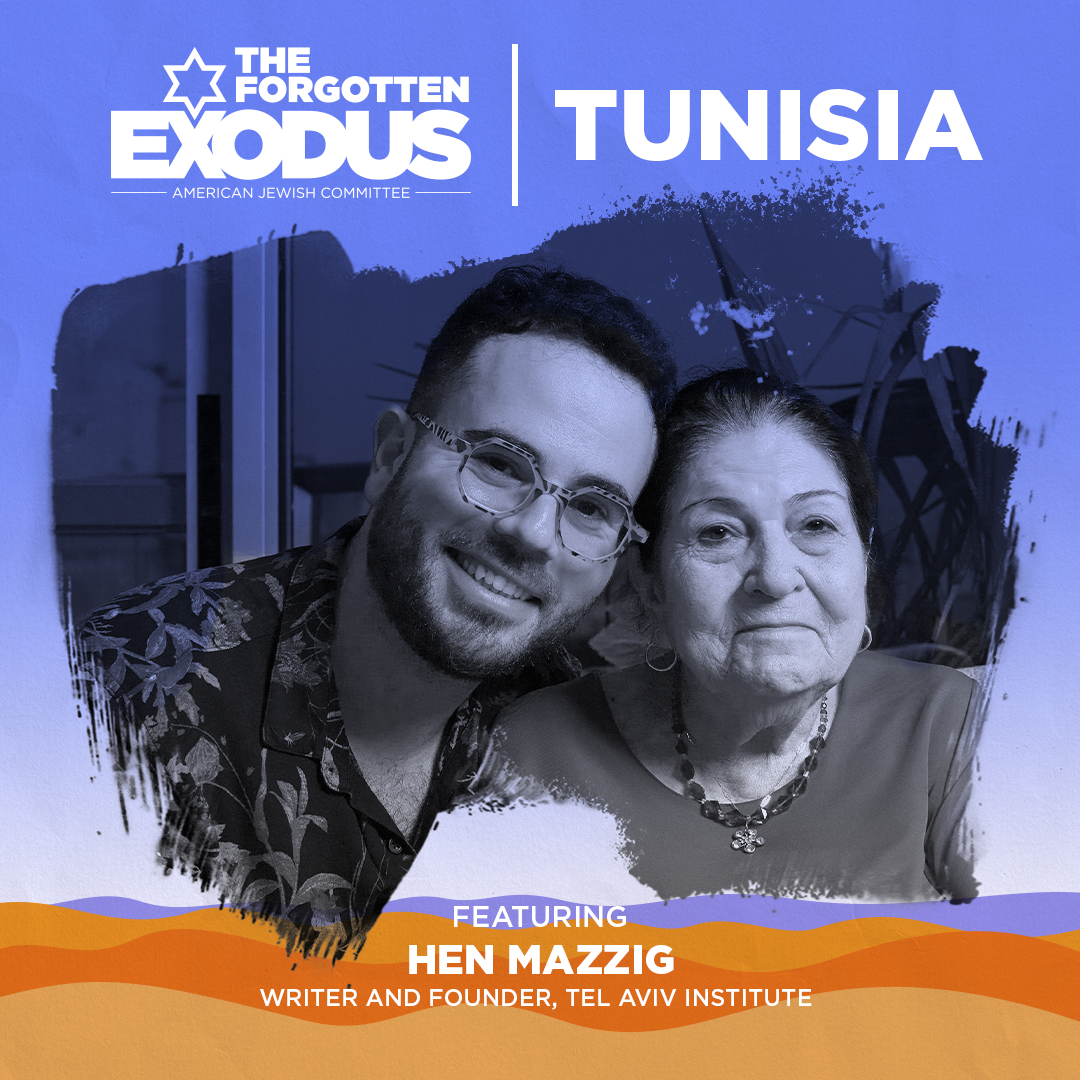
Tunisia
Aug 26, 202400:31:58Tap to summarize"In the Israeli DNA and the Jewish DNA, we have to fight to be who we are. In every generation, empires and big forces tried to erase us . . . I know what it is to be rejected for several parts of my identity... I'm fighting for my ancestors, but I'm also fighting for our future generation." Hen Mazzig, a writer, digital creator, and founder of the Tel Aviv Institute, shares his powerful journey as a proud Israeli, LGBTQ+, and Mizrahi Jew, in the premiere episode of the second season of the award-winning podcast, The Forgotten Exodus. Hen delves into his family's deep roots in Tunisia, their harrowing experiences during the Nazi occupation, and their eventual escape to Israel. Discover the rich history of Tunisia's ancient Amazigh Jewish community, the impact of French colonial and Arab nationalist movements on Jews in North Africa, and the cultural identity that Hen passionately preserves today. Joining the conversation is historian Lucette Valensi, an expert on Tunisian Jewish culture, who provides scholarly insights into the longstanding presence of Jews in Tunisia, from antiquity to their exodus in the mid-20th century. ___ Show notes: Sign up to receive podcast updates here. Learn more about the series here. Song credits: "Penceresi Yola Karsi" -- by Turku, Nomads of the Silk Road Pond5: "Desert Caravans": Publisher: Pond5 Publishing Beta (BMI), Composer: Tiemur Zarobov (BMI), IPI#1098108837 "Sentimental Oud Middle Eastern": Publisher: Pond5 Publishing Beta (BMI), Composer: Sotirios Bakas (BMI), IPI#797324989. "Meditative Middle Eastern Flute": Publisher: Pond5 Publishing Beta (BMI), Composer: Danielyan Ashot Makichevich (BMI), IPI Name #00855552512, United States BMI "Tunisia Eastern": Publisher: Edi Surya Nurrohim, Composer: Edi Surya Nurrohim, Item ID#155836469. "At The Rabbi's Table": Publisher: Pond5 Publishing Beta (BMI), Composer: Fazio Giulio (IPI/CAE# 00198377019). "Fields Of Elysium"; Publisher: Mysterylab Music; Composer: Mott Jordan; ID#79549862 "Frontiers": Publisher: Pond5 Publishing Beta (BMI); Composer: Pete Checkley (BMI), IPI#380407375 "Hatikvah (National Anthem Of Israel)"; Composer: Eli Sibony; ID#122561081 "Tunisian Pot Dance (Short)": Publisher: Pond5 Publishing Beta (BMI); Composer: kesokid, ID #97451515 "Middle East Ident"; Publisher: Pond5 Publishing Alpha (ASCAP); Composer: Alon Marcus (ACUM), IPI#776550702 "Adventures in the East": Publisher: Pond5 Publishing Beta (BMI) Composer: Petar Milinkovic (BMI), IPI#00738313833. ___ Episode Transcript: HEN MAZZIG: They took whatever they had left and they got on a boat. And my grandmother told me this story before she passed away on how they were on this boat coming to Israel. And they were so happy, and they were crying because they felt that finally after generations upon generations of oppression they are going to come to a place where they are going to be protected, and that she was coming home. MANYA BRACHEAR PASHMAN: The world has overlooked an important episode in modern history: the 800,000 Jews who left or were driven from their homes in the Middle East and North Africa in the mid-20th century. Welcome to the second season of The Forgotten Exodus, brought to you by American Jewish Committee. This series explores that pivotal moment in history and the little-known Jewish heritage of Iran and Arab nations. As Jews around the world confront violent antisemitism and Israelis face daily attacks by terrorists on multiple fronts, our second season explores how Jews have lived throughout the region for generations–despite hardship, hostility, and hatred–then sought safety and new possibilities in their ancestral homeland. I'm your host, Manya Brachear Pashman. Join us as we explore untold family histories and personal stories of courage, perseverance, and resilience from this transformative and tumultuous period of history for the Jewish people and the Middle East. The world has ignored these voices. We will not. This is The Forgotten Exodus. Today's episode: leaving Tunisia. __ [Tel Aviv Pride video] MANYA BRACHEAR PASHMAN: Every June, Hen Mazzig, who splits his time between London and Tel Aviv, heads to Israel to show his Pride. His Israeli pride. His LGBTQ+ pride. And his Mizrahi Jewish pride. For that one week, all of those identities coalesce. And while other cities around the world have transformed Pride into a June version of the Macy's Thanksgiving Day Parade, Israel is home to one of the few vibrant LGBTQ communities in the Middle East. Tel Aviv keeps it real. HEN: For me, Pride in Israel, in Tel Aviv, it still has this element of fighting for something. And that it's important for all of us to show up and to come out to the Pride Parade because if we're not going to be there, there's some people with agendas to erase us and we can't let them do it. MANYA: This year, the Tel Aviv Pride rally was a more somber affair as participants demanded freedom for the more than 100 hostages still held in Gaza since October 7th. On that day, Hamas terrorists bent on erasing Jews from the Middle East went on a murderous rampage, killing more than 1,200, kidnapping 250 others, and unleashing what has become a 7-front war on Israel. HEN: In the Israeli DNA and the Jewish DNA we have to fight to be who we are. In every generation, empires and big forces tried to erase us, and we had to fight. And the LGBTQ+ community also knows very well how hard it is. I know what it is to be rejected for several parts of my identity. And I don't want anyone to go through that. I don't want my children to go through that. I'm fighting for my ancestors, but I'm also fighting for our future generation. MANYA: Hen Mazzig is an international speaker, writer, and digital influencer. In 2022, he founded the Tel Aviv Institute, a social media laboratory that tackles antisemitism online. He's also a second-generation Israeli, whose maternal grandparents fled Iraq, while his father's parents fled Tunisia – roots that echo in the family name: Mazzig. HEN: The last name Mazzig never made sense, because in Israel a lot of the last names have meaning in Hebrew. So I remember one of my teachers in school was saying that Mazzig sounds like mozeg, which means pouring in Hebrew. Maybe your ancestors were running a bar or something? Clearly, this teacher did not have knowledge of the Amazigh people. Which, later on I learned, several of those tribes, those Amazigh tribes, were Jewish or practiced Judaism, and that there was 5,000 Jews that came from Tunisia that were holding both identities of being Jewish and Amazigh. And today, they have last names like Mazzig, and Amzaleg, Mizzoug. There's several of those last names in Israel today. And they are the descendants of those Jewish communities that have lived in the Atlas Mountains. MANYA: The Atlas Mountains. A 1,500-mile chain of magnificent peaks and treacherous terrain that stretch across Algeria, Morocco, and Tunisia, separating the Sahara from the Mediterranean and Atlantic coastline. It's where the nomadic Amazigh have called home for thousands of years. The Amazigh trace their origins to at least 2,000 BCE in western North Africa. They speak the language of Tamazight and rely on cattle and agriculture as their main sources of income. But textiles too. In fact, you've probably heard of the Amazigh or own a rug woven by them. A Berber rug. HEN: Amazigh, which are also called Berbers. But they're rejecting this term because of the association with barbarians, which was the title that European colonialists when they came to North Africa gave them. There's beautiful folklore about Jewish leaders within the Amazigh people. One story that I really connected to was the story of Queen Dihya that was also known as El-Kahina, which in Arabic means the Kohen, the priest, and she was known as this leader of the Amazigh tribes, and she was Jewish. Her derrogaters were calling her a Jewish witch, because they said that she had the power to foresee the future. And her roots were apparently connected to Queen Sheba and her arrival from Israel back to Africa. And she was the descendant of Queen Sheba. And that's how she led the Amazigh people. And the stories that I read about her, I just felt so connected. How she had this long, black, curly hair that ...
Transcribe →
The Forgotten Exodus, Season 2: The Untold Stories of Jews from the Middle East and North Africa
Aug 22, 202400:01:31Tap to summarizeThe multi-award-winning, chart-topping Jewish podcast, The Forgotten Exodus, is back for season two. The world has overlooked an important episode in modern history: the 800,000 Jews who left or were driven from their homes in the Middle East and North Africa in the mid-20th century to forge new lives for themselves and future generations. The Forgotten Exodus, a limited podcast series by American Jewish Committee (AJC), explores the critical lessons we can learn from this pivotal moment and the little-known Jewish heritage of the Middle East and North Africa. As Jews around the world confront rising antisemitism, hear five new stories of Mizrahi and Sephardi courage, perseverance, and resilience from this transformative and tumultuous period of history for the Jewish people. The world has ignored them. We will not. Season 2 premieres August 26, 2024. New episodes will be released weekly. Subscribe wherever you listen to your favorite podcasts. ___ Show Notes: AJC.org/Podcasts Theme song credit: Pond5; Composer: Mayson; ID#279780040 Transcript: MANYA BRACHEAR PASHMAN: The world has forgotten them, but we will not: the 800,000 Jews who left or were driven from their homes in the Middle East and North Africa in the mid-20th century. American Jewish Committee presents the second season of its award-winning podcast, The Forgotten Exodus. As Jews around the world confront antisemitism, this season explores how Jews lived among their Arab neighbors until they no longer safely could. HEN MAZZIG: They completely destroyed the Tunis Jewish quarter and my family decided to leave. MANYA: Others sought new paths, only to discover the homes they left behind did not always welcome them back. When countries turned hostile toward Jews, many sought refuge in Israel, to their ancestral homeland. HEN: And they took whatever they had left. And they got on a boat coming to Israel. To a place where they are going to be protected. MANYA: Whether they landed in Israel or elsewhere in the diaspora, these Jews forged new lives for themselves and future generations. Join Hen Mazzig, Adiel Cohen, and others as we remember The Forgotten Exodus.
Transcribe →
Vote for The Forgotten Exodus at the Webby Awards
Apr 17, 202300:01:34Tap to summarizeThe Forgotten Exodus has been nominated for a Webby Award, also known as "the Internet's highest honor" — but we need your help to win! Click here to vote for The Forgotten Exodus for "Best Limited Podcast Series." It takes less than a minute. Voting ends at 11:59 p.m. PDT on April 20, 2023. The Forgotten Exodus is the first-ever narrative podcast series devoted exclusively to the fascinating and often-overlooked history of Mizrahi and Sephardic Jewry from Arab countries and Iran. Created by American Jewish Committee (AJC), the series debuted as the top-ranked Jewish podcast in America last August. Please make sure that these fascinating and impactful stories reach an even wider audience. Vote for the series now. ____ Show notes: Pond5: "Arabic (Middle Eastern Music)"; Composer: Andrei Skliarov; Item ID # 152407112 Vote now: AJC.org/Webby Listen to "The Forgotten Exodus": AJC.org/ForgottenExodus
Transcribe →
Iran
Sep 6, 202200:37:01Tap to summarizeHome to one of the world's oldest Jewish communities, the story of Jews in Iran has been one of prosperity and suffering through the millennia. During the mid-20th century, when Jews were being driven from their homes in Arab lands, Iran assisted Jewish refugees in providing safe passage to Israel. Under the Shah, Israel was an important economic and political ally. Yet that all swiftly changed in the 1979 Iranian Revolution, which ushered in Islamic rule, while chants of "Death to Israel" and "Death to America" rang out from the streets of Tehran. Author, journalist, and poet Roya Hakakian shares her personal story of growing up Jewish in Iran during the reign of the Shah and then Ayatollah Khomeini, which she wrote about in her memoir Journey From the Land of No. Joining Hakakian is Dr. Saba Soomekh, a professor of world religions and Middle Eastern history who wrote From the Shahs to Los Angeles: Three Generations of Iranian Jewish Women between Religion and Culture. She also serves as associate director of AJC Los Angeles, home to America's largest concentration of Persian Jewish immigrants. In this sixth and final episode of the season, the Hakakian family's saga captures the common thread that has run throughout this series – when the history of an uprooted community is left untold, it can become vulnerable to others' narratives and assumptions, or become lost forever and forgotten. How do you leave behind a beloved homeland, safeguard its Jewish legacy, and figure out where you belong? ___ Show notes: Sign up to receive podcast updates here. Learn more about the series here. Song credits: Chag Purim · The Jewish Guitar Project Hevenu Shalom · Violin Heart Pond5: "Desert Caravans": Publisher: Pond5 Publishing Beta (BMI), Composer: Tiemur Zarobov (BMI), IPI#1098108837 "Oud Nation": Publisher: Pond5 Publishing Beta (BMI); Composer: Haygaz Yossoulkanian (BMI), IPI#1001905418 "Persian": Publisher: STUDEO88; Composer: Siddhartha Sharma "Meditative Middle Eastern Flute": Publisher: N/; Composer: DANIELYAN ASHOT MAKICHEVICH (IPI NAME #00855552512), UNITED STATES BMI Zarobov (BMI), IPI#1098108837 "Sentimental Oud Middle Eastern": Publisher: Pond5 Publishing Beta (BMI), Composer: Sotirios Bakas (BMI), IPI#797324989. "Frontiers": Publisher: Pond5 Publishing Beta (BMI); Composer: Pete Checkley (BMI), IPI#380407375 "Persian Investigative Mystery": Publisher: Pond5 Publishing Beta (BMI); Composer: Peter Cole (BMI), IPI#679735384 "Persian Wind": Publisher: Pond5 Publishing Sigma (SESAC); Composer: Abbas Premjee (SESAC), IPI#572363837 "Modern Middle Eastern Underscore": Publisher: All Pro Audio LLC (611803484); Composer: Alan T Fagan (347654928) "Persian Fantasy Tavern": Publisher: N/A; Composer: John Hoge "Adventures in the East": Publisher: Pond5 Publishing Beta (BMI) Composer: Petar Milinkovic (BMI), IPI#00738313833. ___ Episode Transcript: ROYA HAKAKIAN: In 1984, when my mother and I left and my father was left alone in Iran, that was yet another major dramatic and traumatic separation. When I look back at the events of 1979, I think, people constantly think about the revolution having, in some ways, blown up Tehran, but it also blew up families. And my own family was among them. MANYA BRACHEAR PASHMAN: The world has overlooked an important episode in modern history: the 800,000 Jews who left or were driven from their homes in Arab nations and Iran in the mid-20th century. This series, brought to you by American Jewish Committee, explores that pivotal moment in Jewish history and the rich Jewish heritage of Iran and Arab nations as some begin to build relations with Israel. I'm your host, Manya Brachear Pashman. Join us as we explore family histories and personal stories of courage, perseverance, and resilience. This is The Forgotten Exodus. Today's episode: Leaving Iran MANYA: Outside Israel, Iran has the largest Jewish population in the Middle East. Yes, the Islamic Republic of Iran. In 2022. Though there is no official census, experts estimate about 10,000 Jews now live in the region previously known as Persia. But since the 1979 Iranian Revolution, Jews in Iran don't advertise their Jewish identity. They adhere to Iran's morality code: women stay veiled from head to toe and men and women who aren't married or related stay apart in public. They don't express support for Israel, they don't ask questions, and they don't disagree with the regime. One might ask, with all these don'ts, is this a way of living a Jewish life? Or a way to live – period? For author, journalist, and poet Roya Hakakian and her family, the answer was ultimately no. Roya has devoted her life to being a fact-finder and truth-teller. A former associate producer at the CBS news show 60 Minutes and a Guggenheim Fellow, Roya has written two volumes of poetry in Persian and three books of nonfiction in English, the first of which was published in 2004 – Journey From the Land of No, a memoir about her charmed childhood and accursed adolescence growing up Jewish in Iran under two different regimes. ROYA: It was hugely important for me to create an account that could be relied on as a historic document. And I did my best through being very, very careful about gathering, interviewing, talking to, observing facts, evidence, documents from everyone, including my most immediate members of my family, to do what we, both as reporters, but also as Jews, are called to do, which is to bear witness. No seemed to be the backdrop of life for women, especially of religious minorities, and, in my own case, Jewish background, and so I thought, what better way to name the book than to call it as what my experience had been, which was the constant nos that I heard. So, Land of No was Iran. MANYA: As a journalist, as a Jew, as a daughter of Iran, Roya will not accept no for an answer. After publishing her memoir, she went on to write Assassins of the Turquoise Palace, a meticulously reported book about a widely underreported incident. In 1992 at a Berlin restaurant, a terrorist attack by the Iranian proxy Hezbollah targeted and killed four Iranian-Kurdish exiles. The book highlighted Iran's enormous global footprint made possible by its terror proxies who don't let international borders get in the way of silencing Iran's critics. Roya also co-founded the Iran Human Rights Documentation Center, an independent non-profit that reports on Iran's human rights abuses. Her work has not prompted Ayatollah Khameini to publicly issue a fatwa against her – like the murder order against Salman Rushdie issued by his predecessor. But in 2019, one of her teenage sons answered a knock at the door. It was the FBI, warning her that she was in the crosshairs of the Iranian regime's operatives in America. Most recently, Roya wrote A Beginner's Guide to America: For the Immigrant and the Curious about the emotional roller coaster of arriving in America while still missing a beloved homeland, especially one where their community has endured for thousands of years. ROYA: I felt very strongly that one stays in one's homeland, that you don't just simply take off when things go wrong, that you stick around and try to figure a way through a bad situation. We came to the point where staying didn't seem like it would lead to any sort of real life and leaving was the only option. MANYA: The story of Jews in Iran, often referred to as Persia until 1935, is a millennia-long tale. A saga of suffering, repression, and persecution, peppered with brief moments of relief or at least relative peace – as long as everyone plays by the rules of the regime. SABA SOOMEKH: The history of Jews in Iran goes back to around 2,700 years ago. And a lot of people assume that Jews came to Iran, well at that time, it was called the Persian Empire, in 586 BCE, with the Babylonian exile. But Jews actually came a lot earlier, we're thinking 721-722 BCE with the Assyrian exile which makes us one of the oldest Jewish communities. MANYA: That's Dr. Saba Soomekh, a professor of world religions and Middle Eastern history and the author of From the Shahs to Los Angeles: Three Generations of Iranian Jewish Women between Religion and Culture. She also serves as associate director of American Jewish Committee in Los Angeles, home to America's largest concentration of Persian Jewish immigrants. Saba's parents fled Iran in 1978, shortly before the revolution, when Saba and her sister were toddlers. She has devoted her career to preserving Iranian Jewish history. Saba said Zoroastrian rulers until the 7th Century Common Era vacillated between tolerance and persecution of Jews. For example, according to the biblical account in the Book of Ezra, Cyrus the Great freed the Jews from Babylonian rule, granted all of t...
Transcribe →
Sudan
Aug 29, 202200:35:18Tap to summarizeFinancier, philanthropist, and longtime president of the World Sephardi Federation Nessim Gaon was proud of the Sudanese birthright that made him part of a long lineage of Jews from Arab lands. However, with growing antisemitism in Sudan, he also believed Israel offered the only safe haven for Jews around the world and devoted his life to constantly improving the Zionist project. Gaon's oldest grandchild, Dr. Alexandra Herzog, deputy director of Contemporary Jewish Life for American Jewish Committee, shares the story of her grandfather's flight from Sudan, his quest for equality in Israel, and his pursuit of peace between the Jewish state and Arab nations that led to the historic 1979 accord between Israel and Egypt. Along with Dr. Herzog, oral historian Daisy Abboudi describes great changes in Sudan that take place during the late 19th and early 20th centuries, which saw the country emerge from a period of Islamic extremism to a land of possibilities for Jewish pioneers. However, this brief window of openness closes once again as Gaon's cousins, Diana Krief and Flore Eleini, describe how following Israel's victory in the 1967 Six-Day War, Sudan once again became a terrifying place to be a Jew. ___ Show notes: Sign up to receive podcast updates here. Learn more about the series here. Song credits: Saza Niye Glemedin; Penceresi Yola Karsi: all by Turku, Nomads of the Silk Road Pond5: "Desert Caravans": Publisher: Pond5 Publishing Beta (BMI), Composer: Tiemur Zarobov (BMI), IPI#1098108837 "Hatikvah (National Anthem Of Israel, Electric Guitar)"; Composer: Composer: Eli Sibony; ID#122561081 "Frontiers": Publisher: Pond5 Publishing Beta (BMI); Composer: Pete Checkley (BMI), IPI#380407375 "Adventures in the East": Publisher: Pond5 Publishing Beta (BMI) Composer: Petar Milinkovic (BMI), IPI#00738313833. "A Middle East Lament": Publisher: Pond5 Publishing Alpha (ASCAP); Composer: Dan Cullen (PRS), IPI#551977321 "Mystic Anatolia": Publisher: Pond5 Publishing Alpha (ASCAP); Composer: Okan Akdeniz (MSG), IPI#37747892568 "Modern Middle Eastern Underscore": Publisher: All Pro Audio LLC (611803484); Composer: Alan T Fagan (347654928) "Fields Of Elysium"; Publisher: Mysterylab Music; Composer: Mott Jordan; ID#79549862 ___ Episode Transcript: ALEXANDRA HERZOG: Oftentimes, I asked him, would you want to go visit Sudan? If you could, would you? And you know, he would tell me, 'Well, I have this image in my head. And I want to keep it that way.' And I think that it was so loaded for him in terms of memories, in terms of, you know, vibrancy of life and I think he wanted to keep it as this frozen image. MANYA BRACHEAR PASHMAN: The world has overlooked an important episode in modern history: the 800,000 Jews who left or were driven from their homes in Arab nations and Iran in the mid-20th century. This series, brought to you by American Jewish Committee, explores that pivotal moment in Jewish history and the rich Jewish heritage of Iran and Arab nations as some begin to build relations with Israel. I'm your host, Manya Brachear Pashman. Join us as we explore family histories and personal stories of courage, perseverance, and resilience. This is The Forgotten Exodus. Today's episode: Leaving Sudan MANYA: When Diana Krief and her 95-year-old mother Flore Eleini look back on their family's life in Sudan, they conjure dark memories. Flore remembers enjoying afternoon tea outside with her mother-in-law when soldiers armed with bayonets stormed the garden. FLORE ELEINI: Life was normal, life was good. And then, little by little. it deteriorated. We were the very, very last Jews to stay in the Sudan. And then, after the Six Day War, of course, they came, you know, in the street, they were shouting, kill, kill, kill, kill the Jews, kill, kill, kill the Jews. And one day, I thought it was our end. MANYA: Her daughter Diana remembers soldiers raiding their house and posters of decapitated Jews outside their home. DIANA KRIEF: It's actually by others that I came to know that I was Jewish, that I was a Jew, you know, born in a Jewish family. They used to come in front of the house with posters of Jews in the Mediterranean Sea with their heads cut off, and blood everywhere. That's the first time I had actually seen the land of Israel. I didn't know that we had a land before. And it was "itbah" the whole time. And even when we would put the radio on, they would sing"itbah itbah al yahud." That means "slaughter, slaughter the Jews". And this always stayed in my memory. MANYA: In 1968, Flore and Diana were among the last Jews to flee Khartoum, the capital city of Sudan. They followed a path to Geneva blazed by Flore's cousin, Nessim Gaon, a financier and philanthropist born and raised in Sudan who had moved from Khartoum to Switzerland a decade earlier. Gaon, who died in May 2022 at the age of 100, was a legend in modern Jewish history. As a longtime president of the World Sephardi Federation, he worked to raise the profile of Sephardic Jews around the world and level the playing field for them in Israel – where Arabic speaking Mizrahi and Sephardi Jews were often looked down upon. On the contrary, Gaon believed they offered Israel a gift – a link between the Jewish state and their former homes in the Arab world. Gaon himself offered a shining example. He persuaded his dear friend, Israeli Prime Minister Menachem Begin to meet with Egyptian President Anwar el-Sadat, which led to the historic 1979 accord between Israel and Egypt – the first peace treaty between Israel and an Arab nation. ALEXANDRA: For him when Israel was built, it really was like a miracle. He really, truly believed in the possibilities that Israel could offer. He also realized that Sephardic Jews could play a role in creating a bridge between Israel and the Arab countries, and that they would be able to help in creating peace or at least creating dialogue between some of those countries. And that's really what he did in his conversations with Anwar el-Sadat and Menachem Begin. MANYA: That's Gaon's oldest grandchild, Dr. Alexandra Herzog, who now serves as the deputy director of Contemporary Jewish Life for American Jewish Committee. As her last name indicates, her mother Marguerite, Gaon's daughter, married into the Herzog dynasty. Alexandra's paternal grandfather was former Israeli president Chaim Herzog, and her uncle Isaac Herzog, is the Israeli president today. But in addition to that proud legacy, Alexandra is especially proud of the impact her maternal grandfather made in helping Sephardi and Mizrahi Jews – a slight majority of Israel's Jewish population, but a significant majority of its Jewish poor – thrive, succeed, and lead in the Jewish state. Gaon was the driving force behind Project Renewal, an initiative launched in the 1970s to rehabilitate some of Israel's most distressed neighborhoods and improve education and social services there. He developed a bar mitzvah program that provided the education, ceremony, and gifts for thousands of underprivileged boys. And tens of thousands of young Sephardi leaders from impoverished neighborhoods received university scholarships. ALEXANDRA: A lot of the people who came out of this program are actually mayors or members of the Knesset – important people in Israel who actually have, as a ripple effect, a strong impact on the lives of other people as well. MANYA: The history of Sudan's once tiny and tight-knit Jewish community is limited to the late 19th and early 20th centuries – a brief window when it was safe to be Jewish in that Northeast African country. But the Sudanese diaspora's connection to that country runs unusually deep. Sudan, Egypt's neighbor to the south, was much more than a waystation during the age of migration. It was a land of possibilities. Even if their forefathers spent centuries elsewhere, their descendants today often identify with the fleeting generations spent in Sudan. DAISY ABBOUDI: If you speak to people who were there, and you say, where are you from, they will say, Sudan, in a very proud, but definitive way. MANYA: That's Daisy Abboudi, a London-based oral historian of Sudanese Jewish history, who began her career by interviewing her own grandparents. DAISY: Sudanese is very much part of their identity and their descendants kind of focus on Sudan. And I know, there's this kind of phenomena from around the Middle East – a kind of nostalgia of looking back. There's kind of an inherited nostalgia that exists as well. But it's particularly strong in Sudan for a country where people didn't have thousands of years of roots. And I'm kind of always wondering, why? Why has it got this pull? MANYA: The reason could be embedded in the history of Sudan and the pioneering spirit of the Jews who landed in this rustic pocket of Northeast Africa, where the Blue and White Nile Rivers converged, the constellations shone brightly in the night sky, and the scent of jasmine and gardenia floated in the air. In the early 19th century, Sudanese and Egyptian residents lived under Ottoman rule. Jews in Egypt – and the few there might have been in Sudan – faced harsh taxes. But tha...
Transcribe →