Podcast
The Great Moon Hoax of 1835
Hosted by Quiet.Please · EN
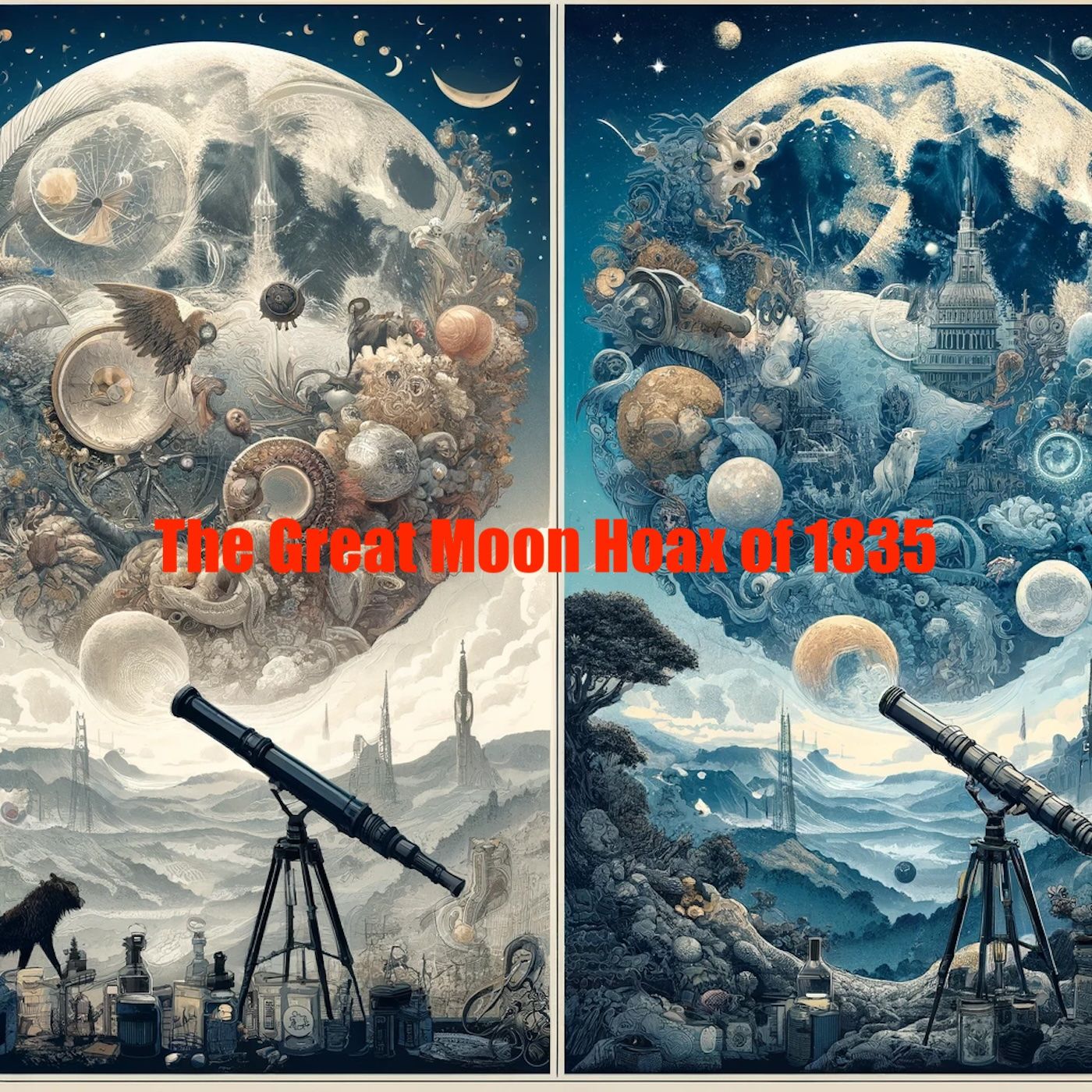
The Great Moon Hoax of 1835 stands as one of the most remarkable instances of media deception in history. This series of six articles, published in the New York Sun newspaper between August 25 and August 31, 1835, captivated the public's imagination with tales of fantastic lunar discoveries allegedly made by renowned British astronomer Sir John Herschel. The articles, which claimed to be reprinted from the Edinburgh Journal of Science, described a wealth of life on the Moon, including unicorns, bipedal beavers, and bat-like humanoids. Despite the outlandish nature of these claims, the hoax gained significant traction, drawing in readers and showcasing the power of sensationalistic journalism in the 19th century.
At the heart of the Great Moon Hoax was Richard Adams Locke, a journalist working for the New York Sun. Locke, who had a background in science and technology, recognized the public's fascination with astronomical discoveries and saw an opportunity to boost the newspaper's circulation. He drew inspiration from genuine scientific advancements of the era, such as the construction of large telescopes and the ongoing debate about the possibility of life on other worlds. By weaving these elements into a compelling narrative, Locke created a hoax that would capture the attention of readers across the United States and beyond.
The first article in the series, published on August 25, 1835, bore the headline "Great Astronomical Discoveries Lately Made by Sir John Herschel, L.L.D. F.R.S. &c. at the Cape of Good Hope." It claimed that Herschel had developed a powerful new telescope capable of observing the lunar surface in unprecedented detail. The article described the telescope as having a lens measuring 24 feet in diameter and a magnifying power of 42,000 times – a feat that would have been impossible to achieve with the technology available at the time.
Subsequent articles in the series built upon this foundation, providing increasingly elaborate descriptions of the supposed discoveries made by Herschel and his team. The stories painted a picture of a lunar landscape teeming with life, featuring vast forests, expansive plains, and shimmering bodies of water. The most captivating aspects of the hoax, however, were the descriptions of the various creatures that allegedly inhabited the Moon.
Locke's vivid prose brought to life a menagerie of lunar animals, including unicorns, horned bears, miniature reindeer, and a species of goat-like creatures that roamed the hills and crags of the Moon. However, it was the mention of intelligent life on the Moon that truly captured the public's imagination. The articles described a race of bat-like humanoids, which Locke termed "Vespertilio-homo," living in temples made of sapphire and communicating through a form of spoken language. These creatures were said to have human-like faces, yellowish skin, and membranous wings, and their description was so detailed that many readers beli...
At the heart of the Great Moon Hoax was Richard Adams Locke, a journalist working for the New York Sun. Locke, who had a background in science and technology, recognized the public's fascination with astronomical discoveries and saw an opportunity to boost the newspaper's circulation. He drew inspiration from genuine scientific advancements of the era, such as the construction of large telescopes and the ongoing debate about the possibility of life on other worlds. By weaving these elements into a compelling narrative, Locke created a hoax that would capture the attention of readers across the United States and beyond.
The first article in the series, published on August 25, 1835, bore the headline "Great Astronomical Discoveries Lately Made by Sir John Herschel, L.L.D. F.R.S. &c. at the Cape of Good Hope." It claimed that Herschel had developed a powerful new telescope capable of observing the lunar surface in unprecedented detail. The article described the telescope as having a lens measuring 24 feet in diameter and a magnifying power of 42,000 times – a feat that would have been impossible to achieve with the technology available at the time.
Subsequent articles in the series built upon this foundation, providing increasingly elaborate descriptions of the supposed discoveries made by Herschel and his team. The stories painted a picture of a lunar landscape teeming with life, featuring vast forests, expansive plains, and shimmering bodies of water. The most captivating aspects of the hoax, however, were the descriptions of the various creatures that allegedly inhabited the Moon.
Locke's vivid prose brought to life a menagerie of lunar animals, including unicorns, horned bears, miniature reindeer, and a species of goat-like creatures that roamed the hills and crags of the Moon. However, it was the mention of intelligent life on the Moon that truly captured the public's imagination. The articles described a race of bat-like humanoids, which Locke termed "Vespertilio-homo," living in temples made of sapphire and communicating through a form of spoken language. These creatures were said to have human-like faces, yellowish skin, and membranous wings, and their description was so detailed that many readers beli...
1episodes
Episodes
Newest first