
Podcast
The Italian Renaissance Podcast
Hosted by Lawrence Gianangeli · EN
The Italian Renaissance Podcast takes you on an exciting journey into fifteenth and sixteenth century Italy, stepping beyond the bounds of general overviews of historical themes of the Renaissance, and diving deeply into interpreting how we understand the period today. Each episode provides an analysis of cultural giants, stories of drama and violence, masterworks of literature, but most importantly, the art.
These discussions are curated for not only the adept history lover, but also the general audience, as an engaging and digestible source of information for those interested in enhancing their own understanding of Western history.
Follow us on Instagram for images and updates: @italian_renaissance_podcast
20episodes
Episodes
Newest firstAll episodes

Ep. 76: Michelangelo and the Sistine Ceiling
1w ago00:27:22Tap to summarizeMichelangelo's Sistine Chapel ceiling is one of the defining masterpieces of the Italian Renaissance, but its creation was equally defined by friction as much as genius. This episode follows Michelangelo's turbulent relationship with Pope Julius II, from the abrupt cancellation of the pope's monumental tomb commission to the unlikely assignment of painting the chapel's vast ceiling. We explore how Michelangelo transformed the project into an ambitious visual narrative and testament of divinely inspired artistic genius.We examine how his revolutionary approach to anatomy, composition, and artistic invention, exemplified in The Creation of Adam, forever changed the course of Renaissance painting. Follow/Watch/Learn: https://linktr.ee/italian_renaissance_podcastWorks Discussed: Michelangelo, Pietà, 1499 https://en.wikipedia.org/wiki/Piet%C3%A0_(Michelangelo)Michelangelo, Tomb of Pope Julius II (unfinished), 1505-1545 https://www.wga.hu/html_m/m/michelan/1sculptu/giulio_2/giulio2.htmlMichelangelo, Sistine Chapel Ceiling, 1508-1512 https://www.museivaticani.va/content/museivaticani/en/collezioni/musei/cappella-sistina/volta.htmlThe Florentine Renaissance CourseSupport the show
Transcribe →
Ep. 75: Pope Sixtus IV and the Sistine Chapel
3w ago00:27:05Tap to summarizeBefore the era of the High Renaissance, Pope Sixtus IV commissioned one of the most ambitious artistic projects of the Roman Quattrocento, the Sistine Chapel. In this episode, we explore the chapel's original decoration and the remarkable group of artists, including Botticelli, Perugino, Ghirlandaio, Signorelli, and Roselli, who transformed its walls into a monumental visual narrative in line with the symbolic force of the papacy. We begin by examining Pope Sixtus IV, his political ambitions, and his vision of the Sistine Chapel as a new Temple of Solomon and a powerful symbol of papal authority. From there, we analyze some of the cycle's greatest surviving frescoes, including Botticelli's Punishment of Korah, Perugino's Delivery of the Keys to Saint Peter, Signorelli's Death and Testament of Moses, and Cosimo Roselli's underrated Last Supper. Together, these masterpieces reveal how art, theology, and politics combined to create one of the defining monuments of the Renaissance and laid the foundation for Michelangelo's later masterpiece upon the chapel ceiling. Support/Watch/Follow/Learn: https://linktr.ee/italian_renaissance_podcastWorks Discussed: Sandro Botticelli, The Punishment of Korah, 1481-82 https://www.wga.hu/html_m/b/botticel/4sistina/punishme/korah.htmlLuca Signorelli and Biagio d'Antonio, Testament and Death of Moses, 1481-82 https://www.wga.hu/html_m/s/signorel/sistina/moses.htmlPietro Perugino, Delivery of the Keys to Saint Peter, 1481-82 https://www.wga.hu/html_m/p/perugino/sistina/keys.htmlCosimo Rosselli, Last Supper, 1481-82 https://en.wikipedia.org/wiki/Last_Supper_(Rosselli)The Florentine Renaissance CourseSupport the show
Transcribe →
Ep. 74: Renaissance Rome - The Bessarion Chapel
Jun 2900:28:16Tap to summarizeBefore the triumphs of Michelangelo and Raphael transformed Rome during the High Renaissance, the foundations of the Roman Humanism were laid by remarkable scholars, patrons, and artists whose stories are often overlooked. In this episode, we explore the extraordinary patronage of Cardinal Basilios Bessarion, the Byzantine humanist whose vision helped bridge the intellectual worlds of East and West following the fall of Constantinople.Through the remarkable frescoes of the Bessarion Chapel, painted by the Roman artist Antoniazzo Romano, we uncover how theology, diplomacy, classical learning, and artistic innovation converged in fifteenth-century Rome. From Greek philosophy and manuscript collecting to the visual synthesis of Byzantine and Italian artistic traditions, this episode reveals how one cardinal's ambitious patronage helped shape the cultural landscape that would eventually give rise to the High Renaissance.Works Discussed: Antoniazzo Romano, Bessarion Chapel, 1463-1467, Santi XII Apostoli, Rome https://www.churches-of-rome.info/CoR_Info/SA-040/ChapBessarion.htmlAntoniazzo Romano, Madonna of Cardinal Bessarion, 1467 Support/Watch/Learn: https://linktr.ee/italian_renaissance_podcastThe Florentine Renaissance CourseSupport the show
Transcribe →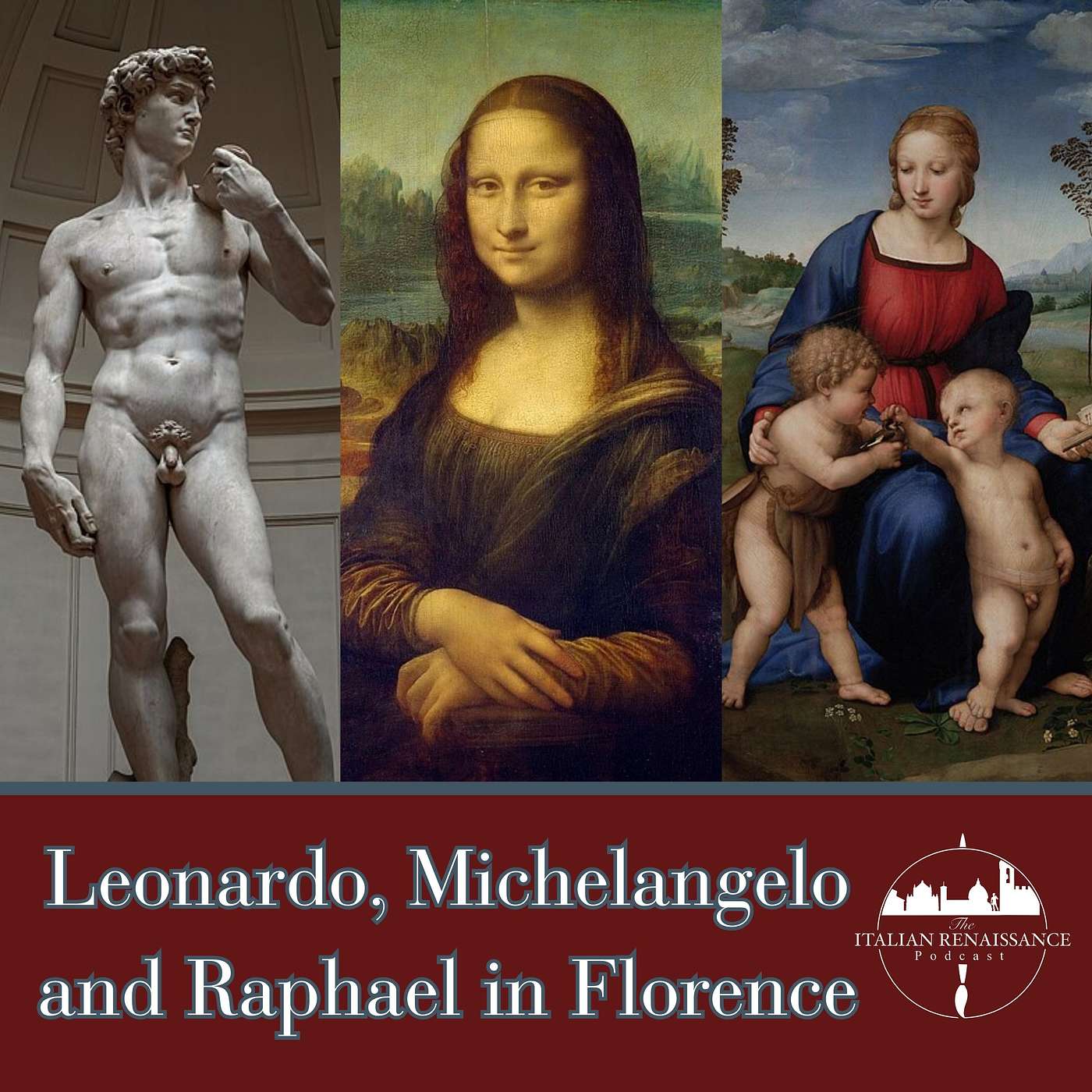
Ep. 73: Leonardo, Michelangelo, and Raphael in Florence
Jun 1500:26:54Tap to summarizeRaphael’s years in Florence (c. 1504–1508) placed him at the center of one of the most extraordinary moments in Renaissance art, where he encountered both Leonardo da Vinci and Michelangelo at the height of their powers. Under the Soderini Republic, Florence became a stage for artistic innovation, marked by Michelangelo’s David, Leonardo’s Mona Lisa, and the unrealized battle frescoes commissioned for the Palazzo Vecchio.This episode explores how Raphael absorbed and transformed the lessons of these two rival masters. From Leonardo, he adopted naturalism, portrait composition, and sfumato; from Michelangelo, monumental form, line, and color. Yet Raphael forged a distinctive style defined by harmony, clarity, and balance, culminating in works such as the Maddalena Doni portraits and the Madonna of the Goldfinch before his departure to Rome under the patronage of Pope Julius II.Watch/Support/Learn: https://linktr.ee/italian_renaissance_podcastWorks Discussed: Michelangelo, David, 1501-1504 https://www.galleriaaccademiafirenze.it/opere/david-michelangelo/Leonardo da Vinci, Mona Lisa, 1503-19 https://collections.louvre.fr/en/ark:/53355/cl010062370Leonardo da Vinci, The Battle of Anghiari, unfinished, lost. Michelangelo, The Battle of Cascina, unfinished. Raphael, Portraits of Agnolo and Maddalena Doni, 1504-07 https://www.uffizi.it/en/artworks/portraits-doni-raffaelloRaphael, Madonna of the Goldfinch, 1506 https://www.uffizi.it/en/artworks/mary-christ-and-the-young-john-the-baptist-known-as-the-madonna-of-the-goldfinchThe Florentine Renaissance CourseSupport the show
Transcribe →
Ep. 72: The Book of the Courtier
Jun 100:25:43Tap to summarizeThis episode explores the courtly culture of Renaissance Urbino through Baldassare Castiglione’s landmark Book of the Courtier (1528), one of the most influential literary works of the Renaissance. After considering Giovanni Santi’s Cronaca rimata and its celebration of Urbino’s artistic world, the discussion turns to Castiglione’s vision of the ideal courtier, shaped by his experiences in the courts of Milan, Mantua, and Urbino under Guidobaldo da Montefeltro.Through a series of lively dialogues set in the Ducal Palace, Castiglione examines the qualities expected of the perfect courtier: elegance, wit, athleticism, eloquence, moral virtue, and the effortless display of mastery. Through this text, the episode also explores Renaissance attitudes toward humor, language, and the ideals around women of the court.Support/Watch/Follow/Learn: https://linktr.ee/italian_renaissance_podcastThe Florentine Renaissance CourseSupport the show
Transcribe →
Ep. 71: Federico da Montefeltro and Urbino feat. Prof. Linda Reynolds
May 1800:35:42Tap to summarizeArt Historian Linda Reynolds joins me to discuss the history of the court of Duke Federico da Montefeltro. Ruling over Urbino, the Montefeltro court was among the most important centers in Renaissance Italy. Professor Reynolds first explains how a simple mercenary like Federico was able to rise to the status of Duke. From there, she dives into the Duke's patronage of the arts, looking primary at the architecture of his palace in Urbino and his painters, Piero della Francesca and Justus van Ghent. Works Discussed: Luciano Laurana, Palazzo Ducale, Urbino, second phase 1464-72 https://commons.wikimedia.org/wiki/Palazzo_ducale_di_UrbinoThe Ideal City, 1480's https://commons.wikimedia.org/wiki/Category:Ideal_City_-_formerly_attributed_to_Luciano_Laurana_-_Galleria_Nazionale_delle_Marche,_UrbinoPiero della Francesca, Double Portrait of Duke Federico da Montefeltro and Battista Sforza, 1473-75 https://www.uffizi.it/opere/i-duchi-di-urbino-federico-da-montefeltro-e-battista-sforzaJustus van Ghent, Portrait of Federico da Montefeltro with His Son Guidobaldo, ca. 1475 https://en.wikipedia.org/wiki/Portrait_of_Federico_da_Montefeltro_with_His_Son_GuidobaldoSupport/Watch/Follow: https://linktr.ee/italian_renaissance_podcastThe Florentine Renaissance CourseSupport the show
Transcribe →
Ep. 70: Perugino and Raphael - The Marriage of the Virgin
May 400:21:56Tap to summarizeThis episode examines how artistic influence and innovation intersect in the work of Perugino and Raphael, using their two Marriage of the Virgin paintings as a lens. It explores the defining qualities of Perugino’s calm, orderly style alongside Raphael’s more dynamic and spatially refined approach. Set against the cultural importance of the subject in Renaissance Perugia, the comparison reveals how shared compositions can yield very different visual experiences. Ultimately, the discussion highlights a pivotal artistic moment: the transformation of a master’s visual language into something more expressive, marking Raphael’s emergence as one of the most compelling and influential painters of the Renaissance. Works Discussed: Perugino, Marriage of the Virgin, 1500-1504 https://mba.caen.fr/en/oeuvre/le-mariage-de-la-viergeRaphael, Marriage of the Virgin, 1504 https://pinacotecabrera.org/en/collezioni/collezione-on-line/the-marriage-of-the-virgin/More on Perugino and Raphael in our online course: https://www.udemy.com/course/the-florentine-renaissance/?referralCode=FF28E9B6B8BB41DD78AFSupport/Follow/Watch: https://linktr.ee/italian_renaissance_podcastSupport the show
Transcribe →
Ep. 69: Perugia and Perugino
Apr 2000:26:32Tap to summarizeThis episode explores how Perugia functioned as a dynamic center of Renaissance art and how Perugino emerged as its most influential painter. It considers the city’s political, religious, and economic structures as active forces shaping artistic production, while examining how workshop practices, patronage, and regional identity intersected with broader Florentine influences.At the heart of the discussion is Perugino’s distinctive style—marked by clarity, harmony, and compositional balance—and the role his workshop played in spreading that visual language across central Italy. The episode ultimately frames Perugia not as a peripheral center, but as a key contributor to the artistic networks that helped define the transition toward the High Renaissance.Works Discussed: Perugino, Adoration of the Magi, 1470's https://en.wikipedia.org/wiki/Adoration_of_the_Magi_(Perugino,_Perugia)Perugino, Apollo and Daphnis, 1475-1500 https://collections.louvre.fr/ark:/53355/cl010064934Perugino, Decemviri Altarpiece, 1495/96 https://www.museivaticani.va/content/museivaticani/en/collezioni/musei/la-pinacoteca/sala-vii---secolo-xv-xvi/perugino--la-madonna-col-bambino-e-i-ss--lorenzo--ludovico-di-to.htmlFollow/Support/Watch: https://linktr.ee/italian_renaissance_podcastThe Florentine Renaissance CourseSupport the show
Transcribe →
Michelangelo Reimagined: Justin Garascia on his New Play: Mikey!
Apr 600:20:21Tap to summarizeMichelangelo takes to the stage, and playwright and actor Justin Garascia joins us to discuss his dynamic reimagining of the early life of Michelangelo. Set in Renaissance Italy, MIKEY! unfolds as a gothic, queer fever dream, moving between the sculpting of David and the painting of the Sistine Chapel ceiling. As Michelangelo reflects on the life that brought him to this moment, he wrestles with how he wants to be remembered — as a sculptor, not a painter.Through a reimagined history, the play asks: what if there was a secret relationship at the House of Medici that shaped the artist’s emotional life and propelled the work we still revere over 500 years later?Crowd Fund: https://fundraising.fracturedatlas.org/mikey-a-new-play/campaigns/f6cecfad-a8b2-4ca1-a00f-b50d6d6e053dShow Dates:Tue, May 19 at 7 PMTue, May 26 at 7 PMThu, May 28 at 7 PMSat, May 30 at 3 PMSun, May 31 at 7 PMTickets on Sale Now: https://thetanknyc.org/calendar-1/2026/5/19/mikeyFollow along: @mikeytheplay and @justingarascia (Instagram)Support/Watch/Follow The Italian Renaissance Podcast: https://linktr.ee/italian_renaissance_podcastSupport the show
Transcribe →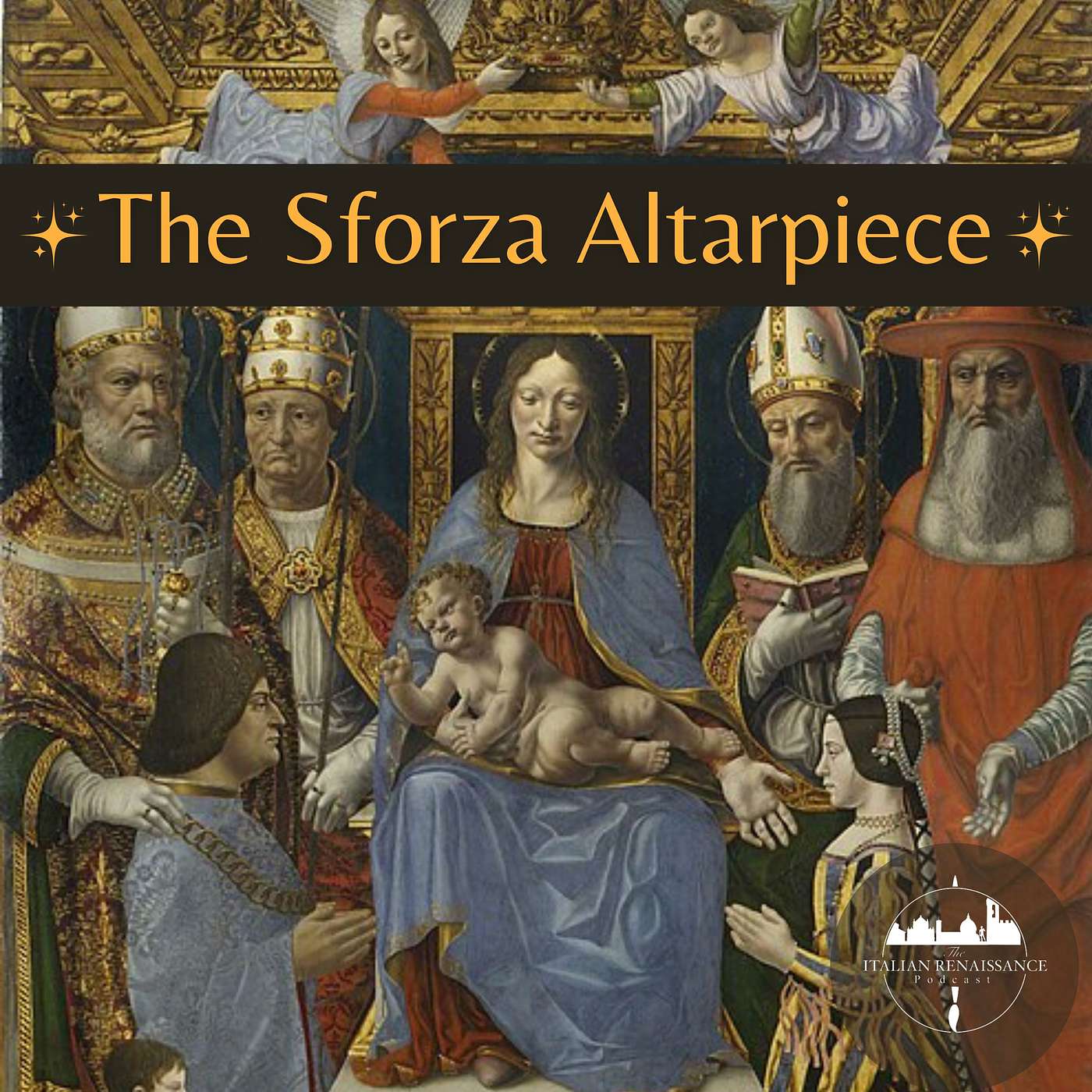
Ep. 67: The Sforza Altarpiece
Dec 800:26:26Tap to summarizeThe Sforza Altarpiece (Pala Sforzesca) is among the single most important works of art commissioned by Ludovico il Moro. Through this painting, we can trace both the heavy religious history of Milan and the dynastic ambitions of the Sforza court. By investigating this painting, we can further understand the atmosphere leading to the decline of Sforza power. Additionally, this painting shows the dramatic influence of the convergence of styles in Milan, from Leonardo da Vinci to the Flemish masters. With this comes the complicated attribution of the work, which until very recently, had remained unknown. Work Discussed: Giovanni Angelo Mirofoli (Master of the Sforza Altarpiece), Madonna Enthroned with Child, the Doctors of the Church and the Family of Ludovico il Moro (Sforza Altarpiece), 1495 https://pinacotecabrera.org/collezioni/collezione-on-line/madonna-in-trono-con-il-bambino-i-dottori-della-chiesa-e-la-famiglia-di-ludovico-il-moro-pala-sforzesca/Support/Watch/Follow: https://linktr.ee/italian_renaissance_podcastThe Florentine Renaissance CourseSupport the show
Transcribe →