← The Naval Aviation Ready Room Podcast with Legends and Leaders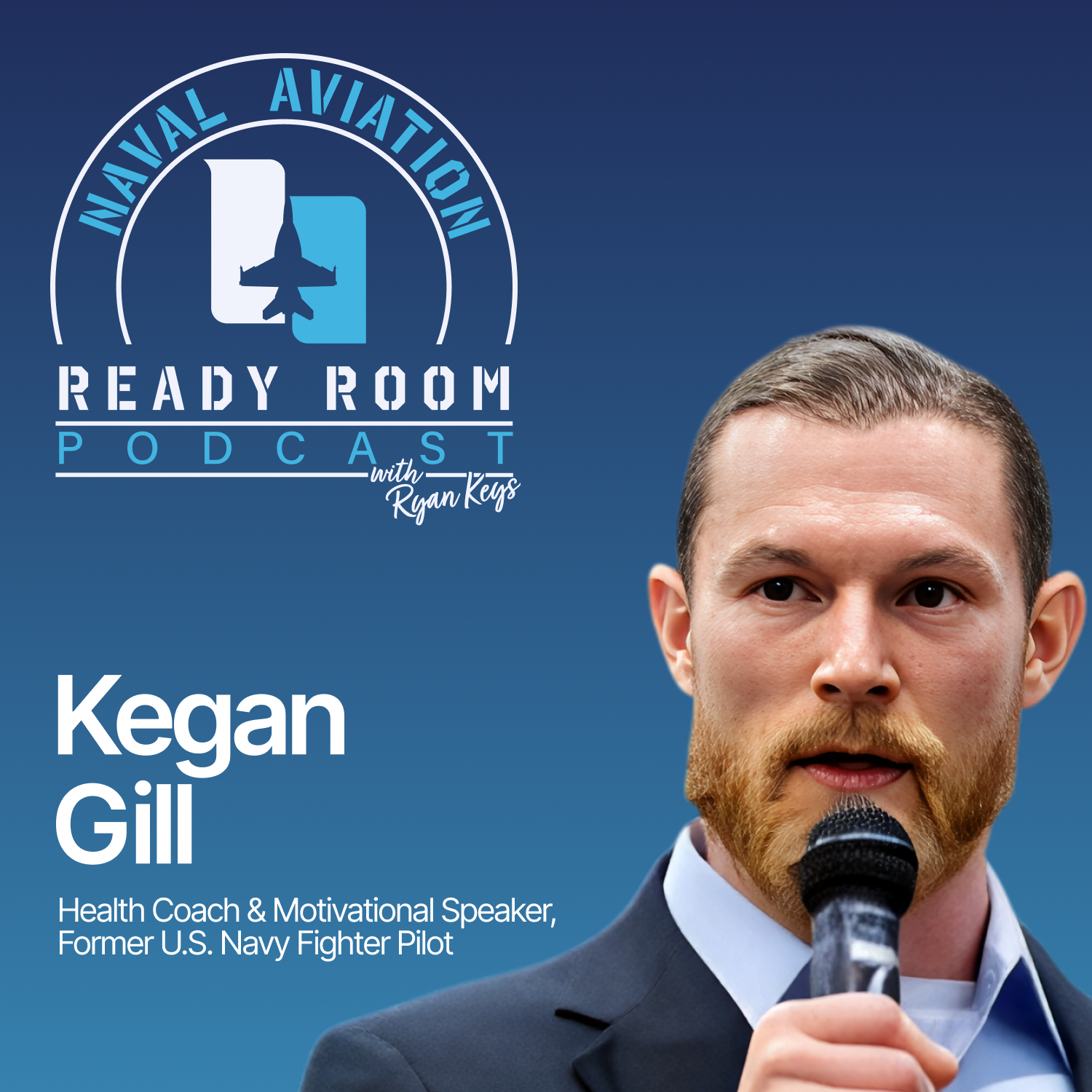
The Naval Aviation Ready Room Podcast with Legends and Leaders
700 MPH Survival: Kegan Gill’s Record-Breaking Navy Ejection
00:27:03
Loading summary
Transcript48 lines
- [00:00]
A
I yanked the ejection handle between my legs and you can look at the chart. The region in which I ejected should not have been survivable, but I did not have any choice. It was either pull the ejection handle or instant death two seconds later. Welcome to the Naval Aviation Ready Room
- [00:20]
B
Podcast where the stories, leadership and leading edge technology of naval aviation come alive. Hosted by retired Navy Captain Ryan Keyes, this podcast takes you beyond mere museum artifacts and as he delves into the personal stories, pivotal decisions, and state of
- [00:35]
A
the art hardware that define the world's
- [00:37]
B
most prolific aviation force. Today's episode takes us into the intersection of naval aviation, human resilience, and the evolving conversation around mental health and performance in high pressure environments. Joining us in the Ready Room is Kegan Gill, a former US Navy fighter pilot, author and performance coach whose story pushes the boundaries of what human body and mind can endure and overcome. During a training mission In January of 2014, Kagan was forced to eject from his F18 Echo Super Hornet at nearly 700 miles per hour, the fastest survived ejection in naval aviation history. The injuries he sustained were catastrophic and his recovery journey would span years of physical rehabilitation, mental health challenges, and ultimately transformation. Today, Kegan channels those experiences into his work as a health and mindfulness coach, helping veterans, first responders, and high performance professionals navigate trauma, build resilience, and perform at their best under pressure. Through his work with organizations like Open Water, Sharp Performance and Warriorside, he is helping reshape how we approach mental health in the military and first responder communities. Kegan, welcome to the Radio Room.
- [01:48]
A
Thank you so much for having me.
- [01:49]
B
Yes, I do like to go over with the guests on kind of how we met and connected and I'll tell you, it's one of those little things where somehow you popped up on my LinkedIn feed and I just happened to see that you're a former aviator and I was like, oh, this guy's story is. I looked into it, you were kind enough to accept my connection, and then we started messaging that way. And once I got to know your story, I knew in a split second that we needed to have you on the podcast because your story is so incredible. As I was saying earlier, I told my wife last night, you know, know, no offense to any previous guests, but this is one of the most I've been excited for this one since we started talking and set this up because I can't wait to hear about it because it is kind of close to my heart too. Because you're in VFA143, the puking dogs in CAG7. I did two tours in CAG7 and HS5. And then the squadron that was there to assist in Your rescue was HS11 dragon slayers, which I was the former commanding officer of. I left the command of the squadron in October of 2013, when your rescue is in January 2014. And I had many friends still in the squadron at that time. So that is fantastic. But I'll stop there. And I just want you to kind of go back in time. I want you to tell me about your life growing up around the Great Lakes and kiteboarding.
- [03:02]
A
Yeah, you know, I was probably one of the more unlikely candidates to actually go into naval aviation. You know, I was kind of a wildling growing up. You know, I love being out in the woods, climbing trees. The woods in Northern Michigan. You can go down in the fall and you can grab salmon out of the creek with your bare hands. I like to hunt and fish, but yeah, I was just kind of a kid who didn't belong in a classroom. I knew I hated filling out Scantron sheets. I hated being under fluorescent lighting, stuck at a desk all day. And so what do you do when you're that kind of person and you got to go make a living and become a grown up at some point? And there was a small community college where I grew up in Traverse City, Michigan, that had a aviation program. And so I thought, well, that sounds kind of cool. I had gotten to go up on a small little Discovery flight when I was a kid where I just got to go up in a little Cessna 152, basically a flying lawnmower for those that are unfamiliar and go fly over all the Great Lakes in the summertime. And it was absolutely stunning, gorgeous, beautiful. And I was like, I think I could see myself doing something like this. And I kind of caught the bug, the flying bug at that point. And that stuck with me all the way until I graduated high school. And again, I was kind of lost. I didn't know exactly what I wanted to do, but I remember that flight. And I thought this would be something fun to do, at least pursue for a bit and see how it goes. And so I was working as a waiter at night at a little Italian joint. And then I was going to community college during the day to earn my associate's degree and started getting flight time. And by the time I was a junior in college, I had become a certified flight instructor. And so I. I'd be flight instructing during the week while doing my college classes to Finish my bachelor's degree through a remote program. And then on the weekends I was instructing kiteboarding, which was something that I had gotten into in college after my friend had won some free kiteboarding lessons at our local kiteboarding school and invited me to join them. And so I ended up being an instructor for that, which getting drug around under the water in Lake Michigan by these big powerful kites before they had a lot of the depower and safety features in the early days of kiteboarding actually ended up being some pretty good training for later in the road, being tangled in lines and pulled underwater. And I became very comfortable in that environment actually through the early days of kiteboarding. But fast forward a bit. I had become a flight instructor. And then while I was still finishing up my four year degree, I ended up being hired by a small business to be their company pilot, which was an absolute awesome job right out of college.
- [05:30]
B
That's rare.
- [05:31]
A
Yeah, it was actually. One of my flight students was actually a former Navy vet. He had been a forensic accountant back in the Vietnam era. So I don't know if you've ever seen the movie the Accountant with Ben Affleck where he's like this kind of superhuman accountant, super brilliant. That's basically this guy, this man I worked for was the real version of that. He had been shot in Vietnam when he would be basically taken into a bunker after it had been captured by the special forces of the. Capturing the Viet Cong bunkers underground. And. And they would bring this guy in, and his name is Larry, and he would go in and he would go through all their financial information. He could learn a language in like a week. And then he had a photographic memory so he could look at all their financial records and then he could recreate and figure out where they were getting their funding, where they were getting their equipment, where they were getting their weapons, and then go back to the CIA and debrief these facts. And one time he was on one of those missions and was shot in the back several times. Survived. Went on to earn something like four different PhDs. Like, as far as academic brilliance, this guy is unreal. I had never met somebody like him. But I was fortunate to get to be his flight instructor when he decided to pursue aviation. And as he pursued it, he realized that it would be great to have his own pilot to kind of help continue to instruct him as he wanted to be able to pilot his own aircraft eventually. And so I got a great gig right out of college. Most of the guys at that time, it was right after the stock market had crashed in 2008 and guys were lucky to get a flying job at the regional airlines. Making 15 grand a year. It was rough. These guys were living in these bunk houses where they'd cycle in and out of it with a bunch of other dudes making no money just to get flight hours and being stuck in that for years. So to step right into a pretty nice gig wearing Bose noise canceling headphones, glass avionics, integrated autopilots in 2008, that's really good. I was really fortunate. And so I enjoyed flying all over the country. A lot of single pilot time, a lot of lessons learned the hard way in the icing conditions in Northern Michigan, having some hairy situations with that thunderstorms, you know, weather patterns. But just being out in the real world and learning how to be a real life pilot and make my own decisions was an incredible opportunity and experience. I got to go to all these big corporate headquarters, Microsoft and Google and Yahoo and, and all these big places. As the man I was working for, Larry was a privacy research and consultant. And so he helped these big companies develop their privacy policies. And in that world, we'd go out to these big fancy dinners on regular, drinking really nice wine, eating the best food I had ever had in my life. And I'm basically fresh out of college, still wet behind my ears, getting this incredible experience. And it was good living. But after a year of doing it, I kind of found that I was just getting bored and wondering, maybe there's something more in my life. And I had a friend that I was a flight instructor with, and he was actually applying to go into Navy Officer Candidate School for a pilot position. And he started kind of telling me what he was doing. I was like, wait a minute, you mean like the Blue Angels? Because the Blue Angels would actually come perform every few years up in Northern Michigan where I grew up. And I remember seeing them and always thinking, like, you got to just be like a superhuman to do that. And I never put two and two together that it's actually just real people that do that job. But my friend kind of filled me in, like, no, hey, there's a way that you could do that. And so I put in a package to ocs. And before I knew it, I gotten picked up and was headed to Officer Candidate School at Newport, Rhode island to get yelled at by some Marine Corps drill instructors. And I actually really enjoyed it. I really enjoyed the physicality of it. I enjoyed the challenge of it, I enjoyed the struggle of it. And I really started to See that I could thrive in that kind of environment and ended up going to Pensacola to do aviation pre flight indoctrination. The ground school continued through the training program. All of our water survival training out in the ocean was actually canceled because of the Horizon oil spill.
- [09:27]
B
Oh, no way. Really?
- [09:29]
A
Yeah. So I missed out on open water survival training which would actually come in handy later in my career. We did do quite a bit in the pool, but I'm not sure it was quite the same experience. After that I headed to Corpus Christi, Texas where I was in VT28, the Rangers and learned to fly the T34 Charlie Turbo mentors. I don't know if that's what you flew when you went through.
- [09:51]
B
I did. I went through flight school in 1996, got winged in 97, so I wasn't a T28 guy. But then they probably changed to T6s shortly after your time after you left.
- [10:02]
A
Yeah, it was maybe within they were starting to spool them up. They were building the facilities for them when I was going through and I think within a few years of me gone through they had switched over to the Texans but completed primary flight training. I think my previous flight instruction or experience definitely having the stick and rudder abilities and being able to talk on the radio was beneficial. But there was also the downside of that is I had to relearn to do a lot the Navy way. And there was, I think, a little bit of abrasiveness with the instructors because they knew I had a lot of flight time and so they were pretty hard on me. And some of them, I think just straight up didn't like me because I was a good stick. But I ended up performing well in that and selected the Tailhook Pipeline out of primary flight training. So I headed to Kingsville, Texas to train in the T45 goshawk.
- [10:51]
B
What squadron were you in there?
- [10:52]
A
I was in VT22, the Golden Eagles and started to learn how to fly what they called the clown jet. You know, I've never heard it called that. Yeah, yeah. You know, they paint it orange and white and when you're a low time pilot trying to learn how to fly a jet aircraft, it's a bit of a circus. A lot can go wrong and things happen very quickly. And it wasn't uncommon to see a circus in the sky around Kingsville, Texas, which is probably why we were in Kingsville. Not a lot to run into.
- [11:17]
B
That's right the way out there. Don't worry about them. They're doing crazy stuff.
- [11:21]
A
And there wasn't much to get in trouble with a bunch of young aspiring naval aviators. There weren't a whole lot of venues to choose from at night when you weren't flying to get into much trouble.
- [11:29]
B
Yeah, yeah, I've never been to Kingsville. I've been to Corpus a couple of times, but never out to Kingsville. I mean, it's not that far away from Corpus, is it?
- [11:38]
A
It's about 50 miles. So yeah, we go to Corpus a lot of time to find a little bit of civilization, you know. But yeah, completed the intermediate training. After intermediate training you go through a very extensive review process, like a big interview with a board of other naval aviators that are instructors in the squadron. And they kind of get to determine your fate based on, you know, your performance thus far, your grades, your personality. And they try to really see if you're going to be a good fit for which community. Because at that point you could still either go the E2C2 pipeline, so flying the carrier born prop aircraft, or potentially something with a pointy nose, or at that point there were still Prowlers, I believe that were just about phased out. But basically you got the tactical pipeline with the F18 Charlie, the Legacy Hornet, the F18 Super Hornets, the EA18 Growlers. And at that point there's still a couple Prowler spots people were getting. And then the other pipeline was the E2C2 pipeline. But you knew you were going to be flying on and off aircraft carrier. And I ended up through that review process, ended up selecting the tactical training and continued for another several months in Kingsville learning some basic tactics with air to ground fundamentals of bombing, close air support, little bit of air to air intercept, some basic dogfighting and bfm. And then at the end, kind of the final test was going to the aircraft carrier and learning to land that thing during the day in decent conditions, which the first time you're out there because it's so dangerous, you are solo in the aircraft, you don't have an instructor to kill along with you.
- [13:09]
B
Oh yeah. I mean that was when we would do as a helicopter squadron, you know, we would go out and support training CQ on the aircraft carrier. So they bring the orange and white, the T45s out and I mean, dude, you really watch them closely a lot. Not a lot. I mean a lot more mishaps for the T45 around the boat than normally the FRS or a fleet squadron. But did you know that they're eliminating that now that they are not doing CQ quals in the vts anymore before wings that just came out recently because of the capabilities with the ship combined with the Super Hornet and all the. Well, all the aircraft now is that they call it magic carpet, essentially.
- [13:51]
A
Yeah. I was actually part of the test program for magic carpet when I was recovering. Yeah.
- [13:56]
B
It's almost like a tractor beam.
- [13:57]
A
Oh, it's so easy. I mean, you could put a kid in there and after just showing them the buttons, anybody could land on the aircraft carrier with that system. It's unreal. It takes something that's probably the most challenging aspect of naval aviation in the fighter community, and it becomes as easy as parking your car in the garage.
- [14:14]
B
Yeah, and that's one of the issues because. Because one of the things was, is when they replaced the T45, they want to have an aircraft that's cheaper. Right. That isn't beefed up to have to go to the boat. That's one of them. But then what's interesting. Sorry, getting into a rabbit hole here. But like the E2 guys, they don't have magic carpet.
- [14:30]
A
No. That is the hardest aircraft to land
- [14:32]
B
on the fricking boat. Exactly. So seems like there was a little disconnect there in that decision making process.
- [14:37]
A
This guy's like, what about us?
- [14:39]
B
Exactly.
- [14:40]
A
They get to be the real stick and rudder cowboys still then.
- [14:43]
B
Oh, yeah. I mean, like I said, I'm not a fixed wing guy or anything like that. I know plenty, though. Lots of friends. And I'll tell you, man, E2 and the Prowler, by far the two hardest aircraft to land on the back of the ship. Modern day, I will say. So you got to select strike fighter, and next thing you know, you're headed off to the frs.
- [15:00]
A
Yeah, Made it through that training, which was pretty intense. You know, as soon as you get to that tactical part of the training, it's like, all right, we're here to prepare you for what the fleet's going to be like and what the rag is going to be like. And it's very low tolerance for mistakes. Everything has to be pristine from even. Just the way I had to set up my briefing room and have the garbage emptied and. And write very, very nicely on the whiteboard. Like, everything just became like extreme precision. Even in something as simple as how you write on a whiteboard and set up a briefing room. But, you know, I caught on and was fortunate to wing out of Kingsville in May of 2012. And then you get your wings on your chest and you're like, hey, I'm a big kid now. And Then you head to the F18 training squadron. You're like, oh, wait a second. I'm just a little tiny baby that just got my foot in the door of what this is really going to be. But I remember walking into The Hangars at VFA106 in Virginia beach for the first time and seeing the Hornets and Super Hornets sitting in there, and it was just so surreal. Like, I can't believe that me, this little community college kid, is going to go fly. That aircraft was really incredible. And I'd imagine, like stepping up to the 60s for the first time when you get to go fly and be like, holy crap.
- [16:10]
B
Powerful, A lot more power. It sounds great. You know, so much different. Yeah. I did want to ask you, what aircraft did you fly when you were flying for Larry?
- [16:18]
A
I flew the Mooney Acclaim, which is basically a souped up little general aviation Ferrari.
- [16:24]
B
I'll look that up. I've never heard of it.
- [16:26]
A
It was a really fun aircraft. It's actually based off the P51 Mustang airframe. So it's a real sporty, high performance little guy. But he had it decked out with all the nicest avionics and leather seats, and it felt like you're crawling into a Ferrari or something.
- [16:41]
B
Man, what a great way to begin your aviation career. Like I said, it's almost like you're meant to go strike fighter. I mean, I mean, think about that. The experience and the flight hours that you got flying, that definitely set you up for success in flight school to be able to. You were probably at the top of your class, I would think, when you got to select pipelines out of primary and then to go strike fighter. So, man, that's awesome. What a great way to set yourself up.
- [17:05]
A
Yeah. And also I got to be the aerobatics instructor for the college when I was flight instructing because I was the smallest flight instructor. And all we had for our aircraft was a 152 aerobat. So a fully aerobatic Cessna 152. And so it had like zero room for other people and so that they could fit other full size adults into there with me because I was like the most phenomenal guy there for the job. But they're like, basically, you're the smallest dude, and so we can send anybody up with you. So sometimes it pays to be small.
- [17:37]
B
Yeah, that's right. Oh, man, that's so funny. But, dude, look at that. You jumped all over that. You exploited that to your advantage, which is great.
- [17:49]
A
Yeah, things just lined up.
- [17:51]
B
Yeah. I mean, dude, fate, right? So let's fast forward a little bit then. So let's, let's jump to. Because I do want to get to what post mishap life and what you're doing now because I think that is maybe even more important. I mean that was. The mishap was what got you where you are. And maybe that was again, fate for you to put you where you are, to be the person that you are, to be able to do this. So let's say you ended up going to VFA143 Puking Dogs Classic squadron that's been around for I don't even know how long. So we'll have to check my history on that.
- [18:22]
A
I think at least the 1950s.
- [18:24]
B
Yeah. Long, long time, but well known squadrons. So let's just go kind of lead them to that.
- [18:29]
A
Yeah. So went through the reg in F18, which was the most grueling year of flight training I've ever experienced. Absolutely brutal. But selected the Super Hornets out of there and headed to the Puking Dogs, which as you said, it was just a legendary squadron with a lot of history. So super proud to get that opportunity. And we were stationed out of Virginia beach, so I didn't have to move, which was also nice, and jumped right into the Fleet squadron as these guys were getting back from a back to back deployment. So a pretty salty, experienced group of guys, but just like a really welcoming group initially. Like they give you the hard time because you're the new guy. And these guys all just getting back from two combat tours were happy to give us some when we showed up, but at the same time you could tell like, hey, we actually want you to be here and you've gone through a lot to earn this opportunity and we know you wouldn't be here if you weren't meant to be. And so I put on my big ears and shut my mouth and I just kind of did my job. And I highly recommend that tactic for most anybody going into a new squadron in the Navy is just do your work, work hard and shut up. Like it's pretty easy if you go that way.
- [19:39]
B
Yeah. Just don't make it hard on yourself. Right.
- [19:42]
A
Yeah. You have to have the humility that you don't know anything yet. Again, like when I showed up with my wings at the rag thinking I knew something and nope. And then you show up at the Fleet squad and realize you still don't know much anything. You're still just a little tiny. You're like a little baby that can now walk. But you got a long ways to go, to grow and to be what you can become in that world. And so just working my ass off, long days. And I'd been in my squadron for just shy of a year as January 2014 approached. And on this day, January 15, 2014, started off just like another day in the squadron. And it became a day that was going to completely redefine my life without my knowledge. I showed up in the ready room that morning and it just seemed like a normal day at the squadron. My buddy was at the squadron duty desk, fisty. He had put up as a joke on the whiteboard behind him all the airspace that we were going to utilize that day out in the whiskey 72 over the Atlantic Ocean. And he used the shark tracker app on his phone to put all these positions of actual tag sharks. And so he was joking with me right before this flight, like, hey, today would be a terrible day to eject.
- [20:48]
B
No, he did not say that.
- [20:50]
A
Yeah, we were joking about it, of course. You know the morbid sense of humor that comes in naval aviation, you know, you got to laugh at it or you're going to cry and you can't do your job then. So that's it. It's going to be below freezing air temperatures, we've got some swell from the wind, you've got 37 degree Fahrenheit, ocean water at the nearby buoy because we had a really cold winter and that Chesapeake Bay water was washing down into the Atlantic and it was frigid. And then on top of it all, there's a 16 foot, 3500 pound white shark named Mary Lee directly underneath your airspace. And so we're kind of having a laugh about that Mary Lee, you remember that? Yeah, me and Mary Lee are close now. And then as also as I'm walking out of the ready room after my brief to go on this flight, one of the more senior pilots in the squadron, call sign Basil, who was, I think he was the senior Jo at this point, I pointed to another whiteboard we had in the ready room, which was all the new guys and all our potential call signs. And at this point I had like four or five newer guys in the squadron that had joined after me. So I wasn't the FNG anymore, but I just hadn't done anything to really stand out. And as Basil pointed out, you just haven't done anything dumb enough yet to earn a call sign. And all the other guys on the whiteboard, a lot of them already had call signs, they had laundry list of choices. And someone put up like One or two throwaway options up underneath mine, just so it had something. So I'm kind of walking on this flight with both of those two things kind of in the back of my mind and get out to the aircraft, fly out to the area. We do some air to air refueling initially off of one of our squadron's tanker jets just for proficiency and to test this pod that had just come out of maintenance. And all that went smoothly. And so with the extra fuel and airspace, my flight lead and I broke off and set up to do some bfm, some dog fighting, which is probably the epitome of what people think when they think fighter pilot. And we have a lot of other mission subsets. But this was my absolute favorite thing that I got to do in that jet was really bend the aircraft around. You know, you're playing four dimensional chest at high speed while performing a very high intensity workout. You're flying the complex aircraft, you're operating weapon systems, defensive systems. There's just so much going on. It can be a real helmet fire, but I absolutely love the challenge of it. And, and we had done several rounds of fighting until we hit joker fuel. So we knew that we had just enough fuel to maybe get one short round as we kind of exited the airspace. And in that, my flight lead set us up a bit lower and faster than his standard. Again, didn't really seem like a big deal. We were just leaning forward to get out a little bit more training in the time we had. And he called the fights on. And so we pitched our aircraft in at each other. And as we came to that merge, I was already partially inverted and partially nose low. So I opted to just roll the jet fully inverted and pull down towards the oce in a big split s maneuver. And normally the Super Hornet could do that maneuver in about 5,000ft or less airspace at normal air speeds. However, I didn't realize how fast I had gotten in that merge because of our setup being quite a bit lower and faster than typical. And so as I pulled the jet inverted, not really thinking about it, just kind of doing that quick math. I got plenty of space. I got over 5,000ft, plus I got a little bit of room above the hard deck at 5,000ft. So I'm good to go as I maneuver. And as I hit about bullseye nose low in the aircraft, I hit what's called the G bucket and the Super Hornet. And so the aircraft had been programmed on the previous flight that there were stores on the wings like it was carrying bombs that weren't Actually there. And so the jet basically protected itself by preventing a minor overstress that it perceived as I hit transonic. So right before you break the speed of sound, that parasitic drag is extremely strong. And so the aircraft limits how many GS you can pull in that region with stores on the wings to prevent any sort of overstress. But in doing so, it reduced how many G's I could pull. And the way I figured this all out, I didn't understand all that in the few seconds in the moment, but I had the stick in my lap. I'm pulling seven and a half GS. I could feel my body weighing 1600 plus pounds, just my head in my helmet. With the Jamix helmet weighing about 20 pounds. If I'm standing on the deck at 1g now, it's like having 150 pounds of weight on the head and I'm craning my neck to keep sight of the other aircraft. So you can feel all that. And all of a sudden, as I've got my eyes out trying to keep sight so I don't lose the fight, I just feel the jet settle and all that G force ease. And it was like going around a sharp corner in a sports car and having the steering wheel kick back halfway. Only instead of skidding off the road, I was stuck in a dive at the ocean. And just a few seconds, I could hear the radar altimeter going off. Altitude, altitude. And very quickly after that, the jipwiz, or ground Proximity Warning system going off, yelling, pull up. Pull up. And instinctively, I pulled the throttles to idle. I put out the speed brake in a desperate attempt to slow down, but it was just too little, too late. And very quickly, I could see the ocean rushing up at me in two seconds from impact in a 51 degrees, very steep dive, traveling at 695 miles per hour, which was 0.95 indicated Mach, so 95% the speed of sound at almost sea level. I yanked the ejection handle between my legs and you can look at the chart in the natops. And the region in which I ejected should not have been survivable. But I did not have any choice, nor did I have time to look on that chart before I made that decision. But it was either pull the ejection handle or instant death two seconds later. So that two seconds before impact, I pulled the handle. And
- [26:21]
B
the force Kegan is about to describe is almost beyond human comprehension. What happened to his body in those next few seconds changed the course of naval aviation and his life forever. You've heard how he survived the fastest ejection in history, but you haven't heard about the battle that came next, the grueling fight to keep his wings, a harrowing journey through mental health struggles, and finally, the ultimate Phoenix revival that redefined his purpose. Don't be the last to hear how the story ends. To make sure you're notified the second it's live, follow us on Apple and Spotify or subscribe and hit the Bell on YouTube. By following now, you will get part two delivered to your device. On May 26, we will see you back in the ready room.