← The Naval Aviation Ready Room Podcast with Ryan Keys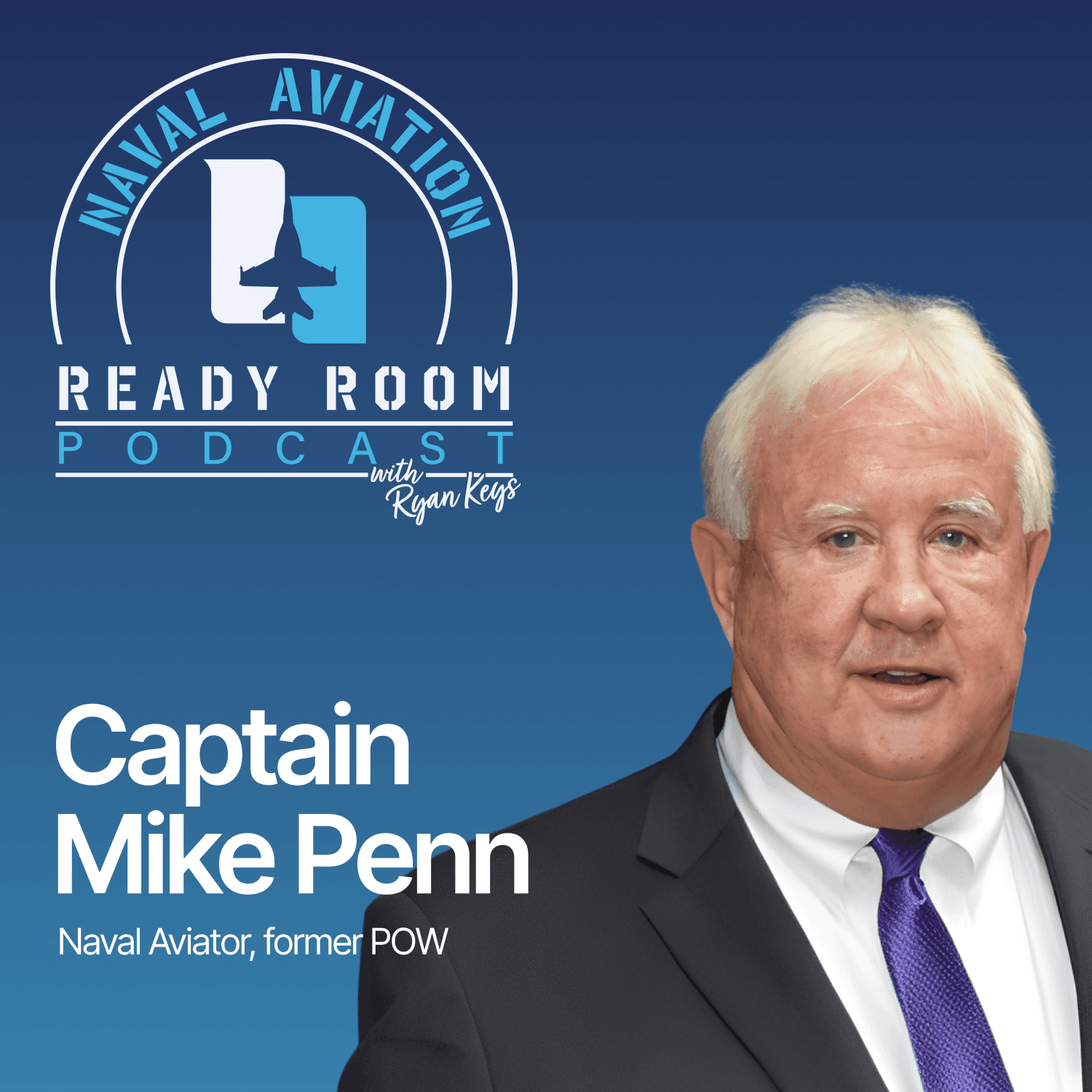
The Naval Aviation Ready Room Podcast with Ryan Keys
When Survival Becomes a Choice: Leadership Forged in Captivity | Mike Penn
01:02:39
In this episode of The Naval Aviation Ready Room Podcast, host Ryan Keys speaks with Captain Mike Penn, USN (Ret.), a Vietnam War naval aviator, former prisoner of war, airline captain, and chief pilot whose life was defined by a single decision made under extreme adversity: to live. Shot down over North Vietnam in 1972, Penn survived an ejection that defied physics, endured capture and imprisonment, and returned with a renewed sense of purpose that shaped decades of service to others.
Loading summary
Transcript310 lines
- [00:00]
A
I was hurt real bad. I got sick. I got malaria. I had an infected cut on my right side of my neck that I got when I got captured. About the third day, I woke up with mosquito bites all over my body, every square inch. My eyes were swollen shut and I got depressed. I really did and darn near lost hope.
- [00:23]
B
Welcome to the Naval Aviation Ready Room podcast where the stories, leadership and leading edge technology of naval aviation come alive. Hosted by retired Navy Captain Ryan Keyes, this podcast takes you beyond mere museum artifacts as he delves into the personal stories, pivotal decisions and state of the art hardware that define the world's most prolific aviation Force. On August 6, 1972, Lieutenant Junior Grade Mike Penn was 26 years old flying combat missions over North Vietnam after dozens of sorties off the USS Midway. Moments after releasing ordnance, a surface to air missile struck his A7 Corsair. He ejected into hostile territory, was captured, and spent the next months as a prisoner of war in Hanoi. In this episode, we'll explore what it means to lead when your cockpit becomes your battlefield and survival becomes your mission. Our guest is Mike Penn, call sign pig, naval aviator, former POW and later a 30 year airline captain. Actually, I think it's 40 year airline captain pretty much comes close to that. Czech airman and chief pilot with Southwest Airlines. From the skies over Vietnam to the flight decks of commercial aviation, his journey embodies resilience, integrity, and the quiet strength of leadership forged through adversity. Mike Penn, welcome to the Ready Room. It's an honor to have you aboard today.
- [01:38]
A
Thanks for having me, Ryan.
- [01:39]
B
Yeah, just a quick background. I met Mike here back on September 18th. On September 18th, Thursday night, we were doing a ribbon cutting ceremony for the Return with Honor Vietnam POW exhibit here at the museum. And I got to meet you there. And this is the small world of naval aviation. So I'm talking to you and your wife, introduce one another, talk to one another, find out you're a Southwest pilot. And then I said, who are you based out of? It's like I was based out of Houston. I said, oh, no way. Really? My academy roommate, hal Snap, former P3 pilot, got out of the Navy, joined Southwest Airlines and was based out of Houston forever. Well, it turns out you were the chief pilot in Houston. And you know Hal.
- [02:22]
A
Sure, yeah.
- [02:23]
B
And so I took a picture of us and I sent it to Hal and he was floored that we actually got to meet.
- [02:29]
A
I'm bet he was.
- [02:30]
B
Yeah, I know, it was great. It was so good. But he said, the reason you were there though, that night was for the Return with Honor exhibit. And then the next day we did the full blown official commemoration opening ceremony for here in the Blue Angel Atrium at the Naval Aviation Museum. And throughout my time in Naval aviation, when I was growing up, I read a lot about the POW experience. My father was a enlisted Marine rifleman in Vietnam. Did his year over there, Purple Heart winner and came back. But he really kind of ingrained in me. You know, he came back as a proud Marine from Vietnam when that kind of wasn't happening at the time. He was in there in 66, 67 timeframe. So a little different, you know, as time went on. So again, I read a lot about Jim Stockdale, a lot of the POWs that were there, and the opportunity to meet someone like yourself who has been through that. And like I said, we've had Charlie Plum on here as well. To meet all of you who were able to survive and to return with honor is such an honor for me. So I can't tell you how thankful I am that you were willing to come on and talk to us and share your story inside the Naval Aviation Ready Room podcast for Naval aviators and their fans. So thank you very much just for coming here.
- [03:42]
A
It's a pleasure. You are glad to be here. Thanks.
- [03:44]
B
And you came because we talked about this with Charlie, is you come here every year to go to the Robert E. Mitchell center for POW Studies to have essentially a medical exam kind of done. But when I interviewed Dr. Albano also has been on the podcast. What's interesting is the level of resiliency that you all were able to achieve through your time there and what you went through. Can you kind of talk about that real quick on how it was that you were not only able to, I don't say thrive, you survived, but how were you able to do that for you, Mike Penn, personally, For me, Mike
- [04:21]
A
Penn, I learned it real early, Ryan. I was hurt real bad. I got sick, I got malaria. I had an infected cut on my right side of my neck that I got when I got captured. And I was a hurting puppy. About the third day, I woke up with mosquito bites all over my body, every square inch. My eyes were swollen shut and I got depressed. I really did and darn near lost hope. And what I've learned is when you lose hope, it's pretty much it. And fortunately I got moved out of one room into Heartbreak Hotel, which the superb model of it that I cannot believe how great they did a job on that thing. And once I got into Heartbreak, I was at the last room on the left, right across from me was a Air Force captain, real skinny guy, Kevin Chaney. He got really sick of watching me push food out the door, not eat it. So one day, after he figured out who I was, he said, hey, I'm starving over here, and I'm sick and tired of watching you push that food back. You better eat it. You're going to die, dude. And all of a sudden, just the way he said that. And then something my granddad said to me before I went to war, he said, never give up. And next thing I know, I said, okay, you have to make a decision for me whether you want to live or die. Once that decision is made, which that day I made the decision, I think I want to live. I'm not giving up. Once you make that decision, the conditions around you become acceptable and they become normal for me. And as a result of that, one of our guys said it really, really bad. In that environment, you're not nearly as tough as you thought you were, but you're much more resilient than you ever thought you could be. And that comes from getting out of that, making that decision to live, accepting your conditions, making it normal, and going from there. And then once you get in a room with other guys, it feels like the war's over. And then that increases that acceptance rate and that resilience rate about a hundredfold.
- [06:17]
B
That's an interesting point you bring up. I hadn't really thought about that before, the difference between toughness and resiliency. And so I'm just trying to kind of think of it right now. Toughness, to me means that you can go in to a cell and be tortured for hours on end, and maybe you can withstand it that day, and you're tough that day, but can you do it multiple days and for a long time when you don't know, when you don't, it's going to end.
- [06:43]
A
Yeah, that was the worst part of the whole thing, is not knowing what's coming up next. I mean, this sounds stupid, but you literally can get pts from the guards walking down the hall jingling keys. So, I mean, as stupid as that may sound, I hear keys jingling right now, and I kind of jump a little bit. And the big thing was the B52s dropping bombs all night long. We were in the big room with 37 guys. December 18th, the Christmas bombing started. It began right after dark, and we could hear the low level jets. I think every F111 and A6 we had came over and started Dropping bombs on Hanoi. And then when they left, bombs started hitting again. And we pretty much had an idea what that was, the B52s. But when we saw the first one get shot down, we knew exactly what it was. And there were several shot down that night.
- [07:33]
B
I remember seeing that B2s got shot. This is Operation Linebacker.
- [07:36]
A
That was, it started December 18, 1972. And they just would light up the sky. But they dropped. Each one had, I don't know, 80 or 500 pound bombs and non stop concussion. All night long, bombs dropping. And we were happy because we knew that once that started, hey, this war is going to be over soon because they can't take it. The funny part of it, it's funny now and then, but this is like three in the morning, you know, we're still awake. Parts of the ceiling of the room in the Hilton where we were was fallen in, but just because of the concussion, they knew where we were. We knew that.
- [08:11]
B
I was going to ask you, you think they purposely did not drop near you?
- [08:14]
A
No. And when we got our first B52 crewman, he gave us some information, we went, I wish you hadn't told us that. It was an offset bombing thing. They actually use the radio antenna at the Hilton for an offset point.
- [08:27]
B
Oh, don't bomb on that point. Right.
- [08:29]
A
If you forget to hit the offset button, you're going to bomb that point. So. Oh, Mike, I wish you hadn't told us that. But the funny part was all these bombs going off, right? We're all walking around, all 37 of us in that room, laughing our butts off. And the reason we're laughing is we can't stop shaking. You know, your subconscious mind thinks you're gonna die and it's digging through everything possible to try to keep you alive. And we couldn't stop. You know, we'd slap each other, hit each other on the back trying to stop. And we couldn't stop shaking. And we didn't stop until the bombing stopped. Pretty phenomenal.
- [09:04]
B
We're all 37 in that cell. Was that a lot? Was that the biggest cell of that many people in one place?
- [09:10]
A
Yeah. Inside the Hilton complex, when you first get captured, they put you in room 18, which is about a 15 by 15 square room with a big meat hook hanging over the top. That's where they tortured the old guys a lot. And then you're there for about 10 or 12 days, then they move you into heartbreak, into the seven by seven cell. Well, you know exactly what that looks like. And then after they get all they think you can get out of here or whatever. Whenever they're done with you, they put you in the big room. And it's about a 75 by 35 room. And sleeping on concrete the whole time. And there were several of those. Room three, room four were full of those guys. And each of us had that many. Admiral Stockdale, John McCain, Robbie Reisner, all of those. They were down at the very end. And we were never able to see those guys face to face. We communicate with them with hand signals and notes and stuff like that, but we never got to see him.
- [10:05]
B
Not until you guys actually walked out of the prison.
- [10:08]
A
Yeah. Wow. Exactly. Right.
- [10:09]
B
Okay.
- [10:10]
A
Actually, I didn't get to meet John McCain till the White House.
- [10:13]
B
No.
- [10:13]
A
Getting.
- [10:13]
B
Really?
- [10:14]
A
Yeah. President Nixon, shortly after the war ended, he had us all up at the White House. All of us. Opened up the entire White House. We could go wherever we wanted. And we're standing, man.
- [10:24]
B
I don't think you're a security risk.
- [10:26]
A
We're in a security risk. And me and a couple Air Force guys that I was there to help with were, we're in the Lincoln Bedroom and just shooting a bull. Next thing you know, dressing room door, President Nixon walks out. We're all going, Mr. President, we're so sorry. Goes, no, man, help yourself. Go around anywhere you want. Just glad to have you. It was pretty cool. Yeah, I bet.
- [10:46]
B
Can you talk me through the actual shoot down, parachute down to the ground and how you were recovered and brought to the Hilton?
- [10:53]
A
I can, yeah. In fact, that's chapter one of my book.
- [10:56]
B
Yeah. And that just came out a couple months ago. A month ago.
- [10:59]
A
It came out October 2nd on Amazon.
- [11:01]
B
Yeah, I read some of the reviews this morning and I want to get that and read that myself. That sounds incredible.
- [11:07]
A
Well, this is going to be yours. I'm going to sign it for you. Well, thanks.
- [11:10]
B
I appreciate that.
- [11:11]
A
Oh, absolutely. All right. Basically, what we decided to do, we put all of chapter one on my website. So if you go to the website, OpenCourage US, chapter one's there. And it starts out here I am on the Midway, 100%, the A7P408 engines roaming like crazy. I get fired off the cat. We do our mission and I'll talk you through it here. And then it ends up with me in a pair of pajamas in Hanoi Hilton. That's all in the first chapter. What happened on the mission, Ryan? I'm doing Iron Hand. That's where two of us go ahead of the strike group. Two of us down south to Us up north with Shrike missiles and basically we're doing with SAM sites. We get them to shoot at us so we can fire the strikes back at their site. Our strikes will home in on their radar and hopefully they'll keep an on and we'll blow it up. But if they don't, we get them to turn the radar off. That means they can't target guys in the strike group that are right behind us. Alpha strike 35 airplanes coming in all at once. We got in, dodged some missiles, shot some missiles. Strike group got in, got off. Last airplane called feet wet. When they did, we turned back toward the beach and started heading. Well right after that they shot three missiles from behind. So a SAM missile, you have to dog fight it just like you do another jet. And so you have to turn into it, catch it, visually push the nose over. Initially they come up. When you push the nose over, if it comes back down and heads at you, it's got your name on it. So then you just build up speed, wait till it gets about 3/4 of a mile away. You do a high G roll into it. It's doing Mach 4 so it can't handle a turn and it'll use look up and it'll blow up. Proximity fuse lights it off as close as possible. Then you push the nose over and look for the next one. Look for the next one because they're coming. Well, what happened when I pushed the nose over, they'd shot three more from behind us even after we turned around. And of course you can't see them, you can't dodge them. And it hit right behind my airplane. And of course the engine quit immediately and cockpit started filling up with smoke. I turned toward the beach and trying to maybe I could make the water. And I looked over here, here's another missile coming at me. So I took the stick, tried to turn into it. It was frozen solid, hydraulic system gone, stick wouldn't even move. And I'm going, I'm going to die. This thing's going to hit me. Maybe I'd have jump out. All these stupid things running through my mind. No, if I do that, it's going to guide on the parachute, so I can't. Next thing I know, it goes zooming right by me about 10ft. And it didn't blow up, fuse didn't work. And that happened on one of my other missions too. It went right between two of us and the fuse didn't work. We never saw that one. So airplane went out of control, I'm upside down. Rapidly approaching 500 knots.
- [13:55]
B
What's the ejection envelope on an A7?
- [13:57]
A
Well, it's a lot less than 500 knots. Yeah, I figured the seat and the chute are not supposed to work at that speed. It should have broken my neck, but it's the most violent thing I've ever been through. It felt like just somersault, somersault run at full speed against a brick wall. And worse than that, Next thing I know, I'm in the chute and I'm going, man, I can't believe I lived through this. Really, it's what I thought. And it was real quiet for about five seconds, and then bullets started ripping through my parachute.
- [14:25]
B
What altitude were you at? Do you remember when you ejected?
- [14:28]
A
I was probably. Well, I know. Yeah, I saw 3,500ft when I pulled the face curtain, and then nothing happened. And then I pulled it again. So they told me if I'd have waited another quarter of a second, I wouldn't have made it. So anyway, the thing that saved me was I was close to the ground when the chute opened. So even though they were shooting at me coming down the chute, I hit the ground. So I was in the chute. A very small.
- [14:54]
B
Yeah, if you were hanging higher and floating down a little more, they would have the bead on you and you probably would have been killed that way.
- [15:00]
A
Absolutely. I landed in about a foot of water and some tall grass. And then the bullets started hitting right around the parachute. So I popped the chute real quick and crawled away as quick as I could. And then I probably got 50ft away, and they were still shooting at the parachute because they couldn't see me. Pulled out my radio and called my buddy Ray and said, hey, Ray, I'm alive. I'm on the ground. There's a million of them down here. And then I said, I gotta go. And the reason I said, I gotta go, all of us guys in the squadron, almost all of us, we carried a little plastic baby bottle full of water in our G suit pocket. All the guys I'd talked to in combat that ejected, they said the first thing that happens, you get incredibly thirsty. So. And I was. I was in shock. I was incredibly thirsty. So I downed all that water in about a half a second. And then I was getting ready to pick the radio back up again, and they came from behind, hit me in the back of the head with rifle.
- [15:56]
B
Man, they were right there.
- [15:57]
A
They were right there. There were a million of them down there. Yeah.
- [15:59]
B
Do you know how close you were? To feet wet, about eight miles, no time at all on a jet.
- [16:04]
A
Yeah, I was about 8,000ft when I got hit. And so the glide ratio, wasn't that going to be that good. Even if I. It could have glided, I wouldn't have made it. Ryan, I'm turning this off. Apologize.
- [16:17]
B
So you had a lot of circumstances to allow you to live through that. Did you look at that when you became a prisoner, to say, when you were trying to build that hope and decide between living and dying, did you ever reflect on that to say, wow, there was a lot of stuff that had to happen to keep me alive, therefore, that's a reason for me to want to choose that, or do you even reflect on that?
- [16:41]
A
That is a great question, Ryan. I'm glad you asked. I didn't reflect on that until that day. I made the decision to live. And what I realized is I could have been a direct hit and I'd have been dead, but it wasn't. The missile that went right by my head should have blown up, but it didn't. The ejection seat shouldn't have functioned at that speed. The chute should have been torn to shreds. It should have broken my neck. I should have got shot in the parachute. I should have got shot on the ground. When I got captured, there was a guy that ran to me, brought down a knife, and cut my neck open. So that's about eight right there. Probably a six, seven minute period. And I'm still here. And once I made that decision to live that day, I'm going, you know what? Reflecting on that, I'm here for a reason. I just got to figure out what it is.
- [17:30]
B
That's very moving, for sure. I do want to sidebar real quick, though. Your wingman, he made it back okay?
- [17:37]
A
Oh, yeah. Ray stuck around. And the other guy, Ken, that was flying the other iron hand, the skipper radioed him. He very experienced guy. He had 400 missions before we ever went on cruise. And our skipper radioed KT and said, hey, go see if you can find Pig. So the guy was flying with Ray, just. I told him, I said, get out of here. There's a million of them. And he knew it. It was such a heavily defended area. Then KT came out. He was something. I was flying with KT the day that missile went right between us and didn't blow up. Loved flying with that guy. He was amazing. But he looked around and of course he. He saw the wreckage, but he could see he was getting shot at like crazy. And he knew There was no way to rescue me, bottom line.
- [18:17]
B
So up until then, had anyone, any of the men been lost from that squadron during that deployment?
- [18:23]
A
Yes, sir. First month we were there, our ops officer, Al Nichols, got shot down right around Da Nang in that area just north of Da Nang. And he ejected safely and made it to the Hilton.
- [18:34]
B
No kidding.
- [18:35]
A
He did, actually. Ended up being roommates with him and had 37 men room that were there.
- [18:40]
B
He was the operations officer.
- [18:41]
A
You said he was the ops officer? Yeah, yeah.
- [18:43]
B
Hey, what's up, opso? How you doing?
- [18:44]
A
Yeah, we were the only two in the squadron that were pow. We lost four more guys. Two of them were my roommates and the other two guys were lieutenant commanders, all dear friends of mine. We lost four of those guys. So, you know, we had 18 pilots and six of us got.
- [18:59]
B
Wow, a third of the squadron.
- [19:01]
A
Third of the squadron, yeah.
- [19:02]
B
Was that normal during that time? I can't remember what the rate was.
- [19:06]
A
I think the Oriskany was the other carrier that one of the squadrons that he rescued took a pretty big hit, but we did. And another guy that was on the midway with me, he got shot down before I did. He was flying a photo F8. And the F4 guy flying his escort just saw his airplane blow up. Shoot, never saw anything. And we thought he was dead. And when I was talking to Kevin, the guy across me wearing heartbreak, he said, hey, Gordy, Page is down there in room two. I went, hey, Gordy, it's Pig. Hey, Pig. I said, damn, we all thought you were dead. I went, oh, I shouldn't have said that. What had happened? He got a direct hit and he was ejected from his F8. He never pulled a handle. It just somehow initiated the ejection sequence and blew him out of the jet. And basically unheard, except the whites of his eyes were solid red for about three months because of all the negative gifts that he went through. But he was okay other than that. Wow.
- [20:04]
B
So you said you got hit. So what kind of injury did you sustain from the ejection other than, like I said, getting stabbed and then getting hit in the back of the head with a rifle. But pretty significant injuries. But from the ejection itself, people know, you know, break arms, femurs, shoulders. Were you intact?
- [20:21]
A
Tore up my left knee because the wind blast 500 knots. My right arm is as high as I can raise it for that reason right there. And it crushed three of my lower vertebrae in my back. Reason it did. You know, I'm like this, so I'm kind Of floating. Not floating, but my weight is off the seat. And when the seat fire had crushed through the vertebrae and actually bent my spine. Ryan, my spine goes up like this because of that. And they told me when I got back, hey, when you get to be about 55, 60 years old, one of your hips is going to go out because they got to compensate for that spine being bad. Sure enough, my left hip went out.
- [20:58]
B
Is that right? Got a replacement there.
- [21:00]
A
I got a new one of those. Yes, sir. But that was it. Except for that guy trying to cut my head off when I got captured.
- [21:07]
B
So I think from every POW that you read about or heard from, none of those injuries are looked after medically by the Vietnamese. Once you get there, you're tossed into the cell. They don't triage you put bandages on or take. Do anything. I mean, maybe they do some sort of surgeries on people who maybe need it, but I think. I don't. I don't think they care for you all that much.
- [21:27]
A
One of the guy pack, you saw him at the Friday ceremony. Jack Inch. Remember Jack?
- [21:32]
B
Yes. His thumb.
- [21:33]
A
Well, his call sign was Fingers. The reason is his thumb was just hanging off. He was an F4 back sear. Had his hand up here where the sand went off. Shrapnel almost cut his thumb off. Well, the doctor said, come in here, we fix you up. Took out a meat cleaver, chopped his thumb off. That was a medical treatment. So we changed his call sign from two gun to fingers.
- [21:53]
B
Oh, is that. Yeah, I didn't know it had changed because of that. Oh, that's good. Oh, man.
- [21:58]
A
Well, we gave him the call sign a two gun when we were in the Hilton there. Great story in the book about Jack.
- [22:03]
B
Okay, I'll have to read about that then.
- [22:05]
A
Yeah, you'll love that one. Okay, great.
- [22:07]
B
So later on. So this is 1972 now, but when you got there, you were still brought into a cell and tortured, which as time went on, it's like they. I was under the impression that that had started to back off.
- [22:20]
A
It did. It did a lot. When they released all Those guys in 1970, they released nine POWs. Only one of them had the authority to come home. The rest of them defied orders. And the reason that one guy was authorized to come home, it was a seaman named Doug Hector. I've met him at Bono.
- [22:39]
B
Yeah, I met him at Sears school.
- [22:41]
A
Yes, sir. He memorized all the names and they said, okay, you're going home, because DOD needs to know those names. So they released them. And when he came back, of course, they all talked, told about all the torture that those guys that were there, the old guys, we called them fogs, friendly old guys, and we were the fngs, the friendly new guys. And, well, those guys went through holy hell. And because of the stories Those guys in 1970 told North Vietnam said, well, we better slack off. We're really looking bad. So by the time we started getting shot down, I mean, when I was captured, before they ever took me into room 18, my arms were tied behind my back, and they threw a rope over a thing and pulled my arms up and said, you got bad stuff ahead of you. You better talk. We're going to break your arms and all that. I was still in shock. I was hurt. I really didn't care. I really didn't. And then when I got into room 18, they stuck a gun in my mouth and stuff like that, and we got beat up. But we went through nothing compared to all those guys that spent years over there.
- [23:45]
B
Well, you went through something, though.
- [23:46]
A
Yeah, they went through something. Absolutely.
- [23:48]
B
Well, you did, too.
- [23:49]
A
When I started public speaking, I came back and I said, look, I'm not going to get paid for this, because those guys that spent years over there, they deserve it. I don't. Well, when it came time for. People told me I need to start speaking. I said, the only way I'm going to do this, I'm going to call Charlie and I'm going to call Jerry out in Hawaii and ask for their permission. If they say it's okay, I'll do it. If not, I called both of them, and both of them almost said the exact same thing. Get your butt out there and talk. People need to hear the story, especially young people. So I did.
- [24:21]
B
So that was the impetus behind the book then.
- [24:24]
A
Oh, no.
- [24:24]
B
Oh, no.
- [24:25]
A
Okay, I'll tell you that story later.
- [24:27]
B
Oh, yeah. So, like I said, shut down, spent time there. Released later in 1972, correct?
- [24:33]
A
73.
- [24:34]
B
Oh, 73. And then you. You actually stayed on active duty and went on to keep on flying.
- [24:40]
A
I did one quick story, if I may. The day we got released is we had two news correspondents come into our room. One was a guy named Steve Bell. The other was a guy named Walter Cronkite. And they had cigarettes in their hands because they told a North Vietnamese, hey, let us go in there and give these guys some cigarettes. So they told us, guys, take these cigarettes. This is the only way we get in the room. But really want you to know that there's a 141 waiting for you. You're going to be out of this place in about three hours.
- [25:08]
B
That's how you found out.
- [25:09]
A
That's how we found out. By those two guys. Anyway, they gave us the clothes. We put the clothes on, got on the bus, went to Gilam Airport, walked up and I shook the. Saluted and shook the admiral's hand. And we all had escorts to take us up to the 141. Ryan. I never allowed myself to cry the whole time I was there. I was afraid if I did, I'd lose it. So I just didn't. Went to the back of the 141 before I walked up the ramp. All those people up there, flight nurses, guys, crew members, our guys that are already up there, they were all clapping. I love it. I just love it.
- [25:45]
B
Happens here all the time.
- [25:46]
A
I know it.
- [25:46]
B
Yeah, it's great.
- [25:47]
A
You're lucky to hear it. Oh, yeah. They're all clapping. Huge American flag draped over and God Bless America playing. Soon as I heard that man, tears just started blowing out. My beyond belief that it was all that time finally letting go.
- [26:01]
B
I can't imagine you holding that in for that long.
- [26:06]
A
I was truly afraid I'd lose it if I started crying.
- [26:09]
B
Yeah. And wouldn't be able to come back from that.
- [26:12]
A
Yeah. Really. That's what I thought.
- [26:13]
B
What a wonderful day though, right?
- [26:15]
A
Oh, it was awesome. It was unbelievable. We got to Clark Air Force based in the Philippines and we stayed there three days. And we got physicals, treatment, whatever we needed. And we got brand new uniforms, tailor made for us there, blues, khakis, everything. The whole thing they made for us. And then we went through debriefings, top secret debriefings and everything and all that. And I don't think any of us slept for three days. We tried to sleep, number one. Couldn't sleep in a bed at all. The sleep we got were on the floor, all of us.
- [26:44]
B
That's real. Yeah, people did that.
- [26:45]
A
We slept on concrete over there and the guys that's been over there for years. When I got home back to California, took me about a little over a month to be able to sleep in bed again. We had those guys that spent a long time, took them a long time to sleep in bed again. Just what you get used to. You get used to anything. It's amazing. That's how to accept it, right? Did you accept it? And it just becomes normal after a while.
- [27:08]
B
Camera where I just heard this from, but it was if someone was in prison and they essentially said, well, we're going to be released, but I know we're going to be released by Christmas. Everyone said we're going to be released by Christmas. And then Christmas comes and goes and you aren't released. That destroys you even more than not knowing when you're going to be released. And people who would do that would essentially self destruct almost after that and could not live with that.
- [27:37]
A
You're exactly right. As a matter of fact, that happened to us. The war ended. We knew that they had to read the peace agreement to us. So we knew that starting two weeks from that day, the first group of POWs would be going home. And then two weeks after that another group. And we came home in the order that we got there. Those were the rules. That's what we did. And I can't remember if it was the third. I think it was the third group that the 141 and the C130 didn't show up that day. And we're going, oh, this is not good. And then the guards started really treating us bad and we had, oh, this is not good at all.
- [28:13]
B
You're gonna be the last ones.
- [28:15]
A
Yeah. And then a week later the 141 and the C130 showed up. Basically that release was delayed a week. I didn't find out why until I was at the White House later on. And I'll tell you, we were all invited to the White House. They had a huge dinner on the East Lawn with big things set up and it was a buffet style. So I'm standing in line and talking to an Air Force guy in front of me. He goes like that. And I turned around, it was Dr. Kissinger right behind me in line. So I turned around, introduced myself, talked to him, met him, his wife And I said, Dr. Kissinger, I'd love to ask you one question if you don't mind. He says, sure, go ahead. I said that delay of release, obviously the talks had broken down and it got delayed for a week. How did you get that to happen a week later? He said that was easy. The President told me to tell him if they didn't let those guys back in a week, he's going to bomb Hanoi into oblivion.
- [29:14]
B
No kidding.
- [29:15]
A
Yeah, that's how it happened. Wow. It was bombed into oblivion even before that.
- [29:19]
B
Even more.
- [29:20]
A
It was Ryan. I mean from the bus ride from the Hilton out to Gillon Airport, I don't think there was a 500 pound bomb crater everywhere you looked and buildings were just gone. That's why the war in guarantee it.
- [29:32]
B
That's A great story. So let's go back. So released now. Make your way back to. I didn't know this for. Are you from California?
- [29:39]
A
No, I was based there at Lamore.
- [29:41]
B
Oh, okay. So we come back and then how does that work? The Navy obviously wants to do an assessment, mental, psychiatric assessment on you to make sure you're still compatible with service, I assume. And you're like, I still want to fly. And so lo and behold, they're like, sure, here. Go fly now. And you passed the flight physical and you went and started flying again.
- [30:00]
A
Actually, it didn't quite happen that way. That's the way it was supposed to have happened. When I got back, I flew into Sacramento, and then I was assigned to Oakland Naval Hospital. Bev Alvarez was there with me at the same time. All of us that were in California were there, and we stayed at the BOQ at Alameda. And we basically went through the same thing we did with Clark and expanded events there and a lot of pr. We did news things for local San Francisco stations and stuff. And I was there about 10 days, and my skipper called me from Fallon, Nevada. They had the air wing there. And he said, how you feeling, pig? I went, great. Skipper said, you want to come fly? I said, today? He said, no, but I'll send a T28 with flag gear for you tomorrow if you can do it. I went, yes, sir. I didn't ask anybody. I just went out to Alameda, jumped in the back of the T28. He flew me to Fallon. I jumped in an A7. We did a section takeoff, went out and dropped some practice bombs, did some dog fighting, came back, and the Admiral was there. And I augmented into the regular Navy that day. So the Air Force guys, they had to go through a whole program in San Antonio of getting recall. A lot of the Navy guys did.
- [31:14]
B
Yeah, Dr. Albano, tell me all about that. And guys didn't want to come back and fly in the Air Force, or it was more of a no rather than a yes, yes, sir.
- [31:22]
A
Correct. I cannot believe that I was instantly qualified just because of the leadership qualities of my skipper, because he hung it out for me, you know, if anything had happened.
- [31:31]
B
Very much so. Who was flying that guy during the mishap? Oh, the one who was just a big POW for the last year.
- [31:36]
A
If anything would have happened. He trusted me. He just trusted me, you know, and we had a ball.
- [31:42]
B
So how long had it been from your shoot down? So you got inside the A7 in Fallon?
- [31:48]
A
About nine months.
- [31:48]
B
No kidding.
- [31:49]
A
Yeah. You know, I had so much time in the. Well, I didn't have that much then, but it was just. It came back to me easy. Wasn't a big deal. Really wasn't.
- [31:57]
B
One question I forgot to ask you. What number combat mission was it you got shut down on?
- [32:01]
A
I think it was 75.
- [32:03]
B
Oh, so you've done quite a bit.
- [32:04]
A
Yeah, I'd be honest with you. I lost count.
- [32:06]
B
But it wasn't the first.
- [32:07]
A
Oh, no, no, no. I counted about the first 10, I think, because the first 10, every time I saw Sam, I get. You get a little nervous when you first fly in combat, because we saw a lot of them and a lot
- [32:21]
B
of AAA every mission.
- [32:22]
A
Just about every mission. Because we were all up north. That's all I did, except for the first one. First one was down south, where I almost ran to a bunch of helicopters.
- [32:30]
B
Must have been flying low.
- [32:31]
A
Well, here's what happened.
- [32:32]
B
Army helicopters, I assume.
- [32:33]
A
Huey, Cobras, Yeah.
- [32:35]
B
Okay.
- [32:35]
A
What had happened when we first got over there, we went from Alameda straight to Yankee Station. We didn't stop. And they thought, well, let's let these guys fly one mission down south with a fac. So we did, and we caught a fac. We were down just around Saigon somewhere, and Lock, I think it was. And he had a target, so he fired some Willie Pete down there, and he said, okay, bomb that. So we did. And then after, we pulled off another ground fac, saying, hey, champs, you still here? Yes, sir. I've got troops in contact. You got guns? Yes, sir. He said, I'm 10 clicks south of where you were. Can you come now? Absolutely. So we went down there, and he shot another white phosphorus rocket. And he said, okay, the good guys are two clicks east of that. Don't drop any bombs east of that. And right there, where that white phosphorus is, those are the bad guys. The Marines are getting overrun. We need your guns. Neil. We went down to about 30ft and gunned them. And when I pulled off target, I'm doing, like 400 something. I pulled off target. Ryan. Here were about six or seven Huey Cobras. I don't know how I didn't hit them.
- [33:44]
B
Do you in front or how'd you come when you were coming in like this? Were they going this way? You're going beak to beak.
- [33:48]
A
I'm pulling off. They're coming this way. And I think I went under one and over another one. I just almost closed my eyes because I thought I was gonna. I thought I was gonna hit one of them.
- [33:57]
B
Now there's another reason right there. That's number nine?
- [34:01]
A
Yes, sir.
- [34:02]
B
Oh, my goodness. Well, up close and personal with the Hilo guy, you know, it's all good. Oh, boy. Okay, so we talked about combat mission. So you come back. So now you're flying back again back in the States. Are you with a squadron again? So the war is ending now. So you're not going to go back and deploy anymore?
- [34:19]
A
No, the war is over.
- [34:20]
B
So then what was the plan for you after that? What was your mindset?
- [34:23]
A
The Navy and Air Force and Marine Corps, they gave us all whatever orders we wanted. We had guys that went to medical school, law school, wherever they wanted. Several guys, they went to Monterey just to go to Monterey.
- [34:36]
B
And not a bad place to be.
- [34:38]
A
Not bad place to be. And I said, I want to fly F4s in Miramar. And my skipper told me, don't do it, pig, don't do it. You'll regret it. Well, of course, I thought I knew more than he did, which I didn't. Obviously. Went down to Miramar, flew F4s.
- [34:52]
B
Did you really went from attack to fighter?
- [34:54]
A
I did. And back then that didn't happen. I was an lso, but I wasn't fully qualified. I had about a week to go to get fully qualified. Day and night, everything in the air wing, but I wasn't fully qualified. When I got to Miramar, I was going to be an instructor in the F4 rag down there, of course, had to get checked out. And my plan was to go on the first ship Debt wave Some RPs, day and night, get qualified, then I'm done. There'll be a rag lso, you're focused. That was a great plan. But the ops officer in that squadron, he was upset because I got the orders that his buddy was supposed to get. So he got a hold of the air pack lso, and they found some op nav regulation that said if I wasn't a fully qualified lso, I could not waive RAG students. And then he did made a couple other rules on me that I went, oh, this ain't good. Fortunately, my skipper was down there undergoing CAG training because to fly the F4, he was going to be CAG on the Midway. So I called him one night and I said, scuba, earlier, do you mind if I kind of a little chat? He says, yeah, matter of fact, you guys come over to have dinner with us tonight and we'll talk. So we did. And I said, sir, you were right. I want to go back to Lamar. And he said, okay, what squadron you want to go to? And I told him one of the F4 skippers with us on the Midway was now a detailer at the Bureau. John Disher. He was an admiral. In fact, I think you might have come down here at one time. Lou called John that night, and the next day I had a set of words. It happened that quick. And I'd gone to the squadron and my skipper at bf121 comes there and he goes, pick, what is this? I didn't know what it was.
- [36:36]
B
Yeah, I haven't seen him. I don't know.
- [36:37]
A
I don't know. Skipper, what is it? He goes, you got orders? Back to more. I went, wow. And he said, why? And I told him, I said, that guy, you did me wrong. And anyway, he ended up doing some other things wrong and he got relieved. But anyway, I sold my house.
- [36:52]
B
Is that right?
- [36:52]
A
Well, that's another story, man. I built a brand new home in San Diego.
- [36:56]
B
Oh, do you still have it?
- [36:57]
A
I wish. Yeah.
- [37:00]
B
I'll get in on that, too.
- [37:02]
A
I wish.
- [37:02]
B
Yeah.
- [37:03]
A
No kidding. Oh, brand new home, five bedroom, $35,000. Oh, my goodness. Sold it a year later, less than a year later, doubling my money. I thought I was a real estate tycoon. Yeah, yeah.
- [37:17]
B
Man, if you only had it now.
- [37:18]
A
I know, but I got back to Lamore and I was an instructor in the A7 rack.
- [37:22]
B
Okay, so. Good question. Where'd you live when you were stationed at Lemoore?
- [37:25]
A
Where did I live? I lived in Lamore. Had a house. Built a brand new house in Lamore.
- [37:30]
B
My mom and dad both grew up in Visalia.
- [37:32]
A
No kid.
- [37:32]
B
Yeah.
- [37:32]
A
Went through a lot to eat dinner. That was the big city.
- [37:35]
B
It was the big city. That's right. Bakersfield's a little too far. Fresno's a little too far. Viselia Tulare. Like right there.
- [37:40]
A
Yeah. If I say it was good. Damn good restaurant, restaurants and stuff.
- [37:43]
B
Yeah. We would go there throughout my childhood and visit our families that were all down there stuff. Family there. Actually, my father's buried there.
- [37:49]
A
Oh, wow. I'll be doing. Yeah.
- [37:51]
B
So. So time at the frs, being an instructor pilot. And then how long was that?
- [37:56]
A
I went there in 70. Well, it was right at the end of 74 and stayed there till the end of 75. I was only there about a year and then I got orders back to VA25. Another fleet squadron tour. Because my first one was cut short, they decided to give me another one. Oh, that's. And okay. Okay.
- [38:16]
B
So I was gonna. So I was gonna ask. That's so funny, because, like, yeah, we didn't get enough out of you, so we're gonna get some more sea time pretty much out of you. That was pretty much the way I so, so Navy. But I wanted to ask you. So when you got to the frs, people had to have looked at you in a certain way?
- [38:31]
A
Yeah, they did. I tell you what was funny. When I was down at Miramar, they looked at me really funny. I'm a lieutenant JG in Miramar still.
- [38:38]
B
You haven't promoted to lieutenant?
- [38:39]
A
Well, one time. The time wasn't up yet.
- [38:42]
B
They didn't like, meritoriously promote you from being a pow?
- [38:45]
A
Not at all. Well, see, I got my wings ported to V56. I was an ensign. So when I was a Miramar, I'm a jg and I got five rows of combat medals up here. I'm the only one. And they're looking at like, who the heck are you?
- [38:59]
B
The word on the street, I'm sure it was, it's Mike Penn.
- [39:01]
A
Well, they figured it out pretty quick. But you ought to see him stare at me when I first got there, like, who are you?
- [39:07]
B
I mean, I. I can imagine the instructor bonds were kind of. But like, the students, like, I gotta go fly with this guy who just spent all this time in the prison. But you were probably Santa Claus though, weren't you? Were you, Were you Santa Claus as an instructor? You're.
- [39:21]
A
Oh, yeah, yeah.
- [39:22]
B
I'm sure everyone, like, flew with you. I was like, oh, man, he was the greatest ever.
- [39:25]
A
Yeah. Actually, I really didn't know. I'd never been an instructor before. And I asked my buddies, I said, how do you know when to give a guy down? They go, oh, you'll know. And they were right.
- [39:36]
B
That's a great point.
- [39:37]
A
They were so right.
- [39:38]
B
Yeah, it was pretty apparent.
- [39:39]
A
Oh, yeah, big time.
- [39:41]
B
I only gave one down my whole time as an instructor. But it was warranted.
- [39:44]
A
I was given an atop checkride to this guy, you know, and I'm flying his wing and we're doing a approach into El Toro toward the mountain in the goo. And on the missed approach, you got to hit a three mile arc. Are you going to hit the mountain? And we briefed all that. And it's right after, basically, you raise the gear, it's time to start your turn. He kept going straight, and he kept going straight. And I finally got on the radio, I said, turn left now, turn left now. And he didn't. Well, finally I said it was an overcast, low overcast type thing. I just popped up through the overcast I went, this guy's gonna hit the mountain. Well, I'm not going with him. Well, he turned just in. I don't know. He must have got from here to that wall and. But he came back and I said, okay, I got the lead back to Lamore. Boom. Okay, now I got it.
- [40:30]
B
You got your one done?
- [40:31]
A
Yes, sir. Wow.
- [40:32]
B
Okay, so back to the fleet again. And then what conspired at that point? Back, like I said, deploying again. The war was over.
- [40:40]
A
We do made another cruise on the Ranger. Nine month cruise on the Ranger. So I was gone when both of my boys learned how to walk. I was on cruise both those times. So that's comes with the Navy. It's where it goes.
- [40:52]
B
Yeah. Fortunately, both my sons were born. I was actually home. So I was very, very fortunate because I know so many people could not do that. And then you said, finished that tour, then decided, I'm going to move on to do the reserve thing now.
- [41:04]
A
Well, what happened was during that tour, we got back from cruise, and one of my best friends I was instructors with in the Moore was on Blue Angels. He was a narrator, and he flew number seven jet in one day and visited. And he says, big, I think you need to come do this. And I said, how did you know? I mean, that's what I want to do more than anything in the world, was be on the team. So I started playing around with him, going to air shows, which is what you do. You just go to air shows. Me and a buddy of mine, Mike Nord, flew together to a bunch of air shows to get to know the guys and the selection process. I made it down. There was three of us, and they were picking two, and I didn't make it.
- [41:44]
B
And they're flying A4s at the time.
- [41:45]
A
They're flying A4s. Wow.
- [41:46]
B
Were the other guys A4 pilots?
- [41:49]
A
No, none of them were. And the number three pilot was a guy I was instructor with in Narag, Don Simmons. And anyway, I met a guy named Alison Snaros. He was a solo pilot and got to be really good friends with him. Just kind of hit it off, you know. And anyway, if I didn't make the team, I'd already decided, I'm getting out of the Navy. Had I made the team, I'd have stayed in it for a career. I just stayed in. But I got out, and Al had gotten out before me, helped me get a job with Continental Airlines, which worked out pretty good because about a year and a half later, I met my wife. She was a flight attendant. So Got a wife and a daughter out of the deal. So it turned out pretty good.
- [42:26]
B
Yeah, that's pretty good, I'd say.
- [42:28]
A
And then when Continental started going down the tubes, I quit a year early and went to Southwest because I kind of saw the writing on the wall. Well, Al waited till the bankruptcy, so when it went bankrupt, I helped him get a job with Southwest. So turned out pretty good. The sad part about the Blue angel deal was my buddy Niall, who had flown back to say, hey, you need to get on the team. He wanted to be after his. The narrator gets three years, you talk the first year, and you get two years flying. Well, he wanted to be a solar pilot, so he was number six all by himself out in El Centro during winter training, and he was doing a loop and flew on the ground. Killed himself.
- [43:05]
B
No kidding.
- [43:05]
A
Yeah, it broke my heart. It's a great guy, man.
- [43:07]
B
It's tough.
- [43:08]
A
Yeah, it was. But anyway, got out, got a wife and anyway, made it to Southwest. Yeah.
- [43:13]
B
So before, I do want to just touch on your time there at Southwest, because you were on the ground floor of Southwest, but is there anything else besides the question I'm supposed to ask you? What's the real reason you wrote the book? If you want to wait to answer that, that's fine. Was there anything else you wanted to cover there in the book before we kind of move on?
- [43:31]
A
Well, the book was written about hope, and I'll tell you about that in a minute. But an event occurred, and the reason is, is because I'd almost lost hope. When I was in Vietnam, I wanted to fly jets in the Navy when I was 16 years old. That's. There was a solo pilot there that I had signed an autograph for me. Then I went back the next year when he was a lead solo pilot, and he signed it again. And whether he did or not, he said he remembered me and Ryan. He said, you're the young man from last year. You want to be a Navy jet pilot real bad. Don't you know? Yes, or I do. Will he sign the thing? And he said, you never give up and you're going to make it. I'm going to see you in the fleet. So that's what lit my fire. And I had. I flunked out of college twice. And, well, I thought I was going to be a rock star. So I was playing a rugby, Literally,
- [44:20]
B
a rock star, like in a band.
- [44:21]
A
We had our own TV show in Fort Worth on Channel 11 in Fort Worth. And one of the greatest stories in the book, we had our Very first guest, this is live tv, was Jerry Lee Lewis. And wait till you read the story in the book. It'll blow you away. It's worth buying a book just to read that story. And anyway, so did that for two years in college and worked out great. And then the guy that was the lead singer and guitar player, Warner Brothers, found out about us. They all had went to California. I had to stay in college and take a full load or I'd get drafted. So I went, oh, no, this is not good. So I found out that I could be a police officer in Fort Worth. They'd pay for my college. So me and my best friend went down there and the chief police said, you guys are big guys. I'll let you be full time police officers. I'll let you work 3 to 11. You don't have to rotate shifts. I'll pay for your college. Cool. So I worked full time, three years, three to 11, as a police officer, taking 16 hours a semester in college. It was difficult and I'd flunked out twice.
- [45:26]
B
Say, how do you do that?
- [45:27]
A
I had to beg for forgiveness and beg to get back in school because I wanted to fly to the Navy anyway, you know, and that was my total goal. That's all I wanted to do and overcame a lot of other things and in order to achieve that goal. So I never lost hope. Almost did several times, but again, the big one was in prison when if you lose hope, you're done. And then later on we did the. Basically the same thing of hope and courage. And I realized if I don't lose hope, that will give me the courage to never give up. And that's exactly the way it worked. And a couple more things in there, but I'd rather you read them out of the book. Everybody else, I could tell the stories, but they're so great. There was a bunch of them.
- [46:10]
B
So Southwest Airlines, I don't know much of the history about it other than my parents actually loved flying it. And it was kind of the first kind of low cost carrier that was around. But it started in Dallas. Correct. That's where it was founded. That's where their headquarters is right now. When you joined, how many pilots did they have?
- [46:28]
A
When I got there, we had 300 pilots.
- [46:30]
B
I think now you're at about 12,000.
- [46:32]
A
12,000. We only base was in Dallas. We had 300 pilots, about 500 flight attendants. We all flew together all the time. Everybody knew everybody. Herb Kelleher, the gentleman that started the company, one of the greatest leaders I've Ever seen. And my old commanding officer that I named my second son after. That's what a great. He's the guy that went out and let me fly an A7 on his wing.
- [46:55]
B
No kidding. He did that?
- [46:56]
A
He did. His name was Luchadam. Remember that solo pilot when I was 16 years old. Chatham. Same guy.
- [47:03]
B
No, it's not.
- [47:04]
A
Oh, yeah.
- [47:04]
B
He ended up being your co. My CEO.
- [47:07]
A
That's something.
- [47:08]
B
That's wild.
- [47:08]
A
I know. Anyway, Luchadam and Herb Kelleher were the two greatest leaders I've ever seen. And I asked them both at two different times, what's the secret to being the great leader that you are? Because they're the kind of guys that would say, follow me. And you just do it without question. You know those guys? And both of them said the exact same answer. Three reasons. Take care of your people. Take care of your people. Take care of your people. Both of them said that. And that's what they did. Right. We didn't make a lot of money back then. We made a lot more than the Navy guys did. That's why we got a house. But he said, I want you to come to work. I want you to have a warrior spirit, a servant's heart, and have fun. And he let us have fun. Oh, God, it was great. And he had no ego, Ryan. And he demanded that we all call him Herb, not Mr. Kelleher. Yes, sir. And he'd get on the airplane. He'd be going from Dallas to Oak City, some short flight or whatever. He'd get back there and pass out peanuts and serve drinks and all that kind of stuff, and he had your back. He started that airline for his people. That was the big difference, he figured. He had this great idea that if you treated his people really, really well and made them happy, they'd show up on that airplane happy, and they treat those passengers good. Passengers come back and fly. It was that simple.
- [48:29]
B
You're right. That is the formula to success. I mean, it truly is. I mean, that's way in the service corporations, whatever it is. And you do see that when you do fly Southwest, you do feel like the employees there are happy to be there and they love what they do, versus some other ones that aren't necessarily like that at all.
- [48:49]
A
Yeah. Plus he came out with this great idea. We're not going to give you a retirement program. I will give you a matching 401k. So it's going to be your money in case of a bankruptcy. You're not going to lose it like all the other airlines did. It's a 401. It's yours and I'll match it 100%.
- [49:04]
B
All the pensions that went bye bye
- [49:06]
A
with all the bankruptcies, plus we had a profit sharing program in addition to 401. So a percentage of the company's profits at the end of the year, we get a cut on 10, 12%. And it was an unbelievable great deal.
- [49:21]
B
So what year was that you joined Southwest?
- [49:23]
A
82. 82, yes, sir.
- [49:24]
B
And then started spreading out. So were you guys flying the 737 then?
- [49:29]
A
That's always.
- [49:30]
B
Yeah, I know. So even back then it was all.
- [49:32]
A
It was a 737.
- [49:33]
B
Because that's one of the unique things about Southwest. Right. If people don't kind of know that compared to the other major airlines, you only fly one make and model, multiple series of them, which obviously has lots of advantages to it for the pilots and for the maintenance side, which drives up revenue incredibly. You just have to be a little bit lucky sometimes, though, since you are kind of stovepiped into one aircraft. But for Southwest, it has worked out completely.
- [50:01]
A
Oh, big time. When I got there, we only had the 200. And about two years later we got our first 300 and then we got the 500 after that, then the 7, and now we got the 800. Never believe that that little company that I started with would be flying to Jamaica, you know, all these international places.
- [50:19]
B
Never dreamed it down to Mexico.
- [50:21]
A
Now everywhere.
- [50:22]
B
I mean, Hal does turns out of Houston to like Mexico and back a couple times a day and then he's done after that. So that's not too bad.
- [50:30]
A
It was a great deal. It really was.
- [50:32]
B
So how long did it. First officer for how long? And then how long did it take you to make captain?
- [50:35]
A
Well, when I first got there, it was only taking about two and a half years to upgrade to captain.
- [50:39]
B
Because you're expanding so much, I assume.
- [50:41]
A
Growing? Expanding so fast. Yes, sir. But we bought an airline, bought Musair, and we had to integrate those people. Instead of two and a half years, it cost me almost five years to make captain. But still, today's timing, that was pretty. Still pretty quick.
- [50:56]
B
And then who else did Southwest buy not that long ago, like 10 years ago, who was that?
- [51:00]
A
We bought used. We bought AirTran.
- [51:03]
B
AirTran, that's what it is. AirTran.
- [51:05]
A
Yeah.
- [51:05]
B
Okay. And brought all those pilots in too. Right. And all their routes and everything.
- [51:10]
A
Yeah. And after, actually, before AirTran, we bought Morris Air out of the West Salt Lake City. So we bought three airlines.
- [51:17]
B
Bottom line, that'll Cause for quick expansion.
- [51:20]
A
Quick expansion. Lots of problems because you're having to integrate seniority lists, and it got done. But you never are able to do that without some kind of difficulty.
- [51:29]
B
And even just like pilot procedures and techniques, and I'm sure with flight attendants on how they do their job now, you're having to bring them in to a. Possibly a totally different culture.
- [51:37]
A
Absolutely, yeah. Culture is everything.
- [51:39]
B
It is, yeah. For sure. And I'm sure you saw that in Vietnam.
- [51:44]
A
We did, yeah.
- [51:45]
B
Because you had those guys who were dedicated and to their country and still love their country, and I'm sure there were some that were not while they were there. Like those eight that came home that time. Right?
- [51:56]
A
Yep. You got it. Couldn't have said it better.
- [51:58]
B
Yeah. So fast forward again. You're captain, and then when do you become a chief pilot? And how is it that you become a chief pilot? It's just, you're like, hey, who wants me a chief pilot today? And you raise your hand, hey, I'll be a chief pilot. I've had enough flying. Or how does. I've never spoken to a chief pilot before. So how does that work?
- [52:14]
A
Pretty simple, actually. The guy that wrote the forward to this book, Forward, By Chuck Sly McGill, Lieutenant Colonel, United States Marine Corps, retired. Chuck was our chief pilot in Houston, and I'd flown with him a lot when he was the first officer, and he was one of the greatest guys. You talk about a leader, it's the troops come first. He's all about the people taking care of your people. Just a great guy. Well, I got to be pretty good friends with him because he and I flew a lot. He had just taken over. He was the new chief pilot in Houston, had just taken over, and he was sitting in his office trying to figure out who he's going to hire to come into work in the office with him. I walked by the door, he said, hey, Mike, come here, will you? Sure. Walk down. He says, is there any way in hell that you would come work in the office as an assistant chief pilot? And I said, chuck, anybody else asked me that question, my answer would be, oh, hell no. For you, yeah, I'll do it. That was it.
- [53:15]
B
That was the whole job interview right there.
- [53:17]
A
That was it. And next thing you know, I went to Dallas, got checked out as a check pilot, and came back down, and I'm an assistant chief pilot. About a year later, a little over a year later, Chuck got promoted to Dallas, and he picked me to be the chief pilot. There were two Chuck and two assistants, and he Picked me to be the chief. So that was it.
- [53:37]
B
What year was that?
- [53:38]
A
That was in 04, 2004.
- [53:40]
B
And then when did you retire from Southwest?
- [53:42]
A
I quit flying in 06, two years later.
- [53:44]
B
Oh, is that right?
- [53:45]
A
Yeah. In fact, that was the question I asked him. I said, chuck, look, I only got two years in the office. He goes, I don't care. Said, you're going to make a difference in two years. And I think I did. Not just for the chief pilot thing, but I was running the HIMSS program and for Southwest in Houston. So I was able to. Well, this is in the book, too. But I ended up with a pretty serious drinking problem. I lost both my parents and just a lot of things. Ptsd, all the other things. And my wife had just about in all the fun she could stand. We went down to San Diego to pick up my son. He was coming out on the Kitty Hawk. He was a AE and F18 squadron.
- [54:23]
B
No way. Really?
- [54:24]
A
Yeah. And anyway, we spent some time. I drove him back to Lamour. We were on our way back down to lax, and my wife said, hey, I got this place up near Malibu I want to show you. Okay. Drove up. Okay, what are we doing? She pops the trunk, goes back, throws my suitcase out and said, I have a room for you in that place right there for 30 days. If you don't say, you stay there, you're never going to see me or your daughter again.
- [54:47]
B
Oh, my gosh.
- [54:48]
A
Yeah. Pretty gutsy move. And that's what it took, basically, for me to. Well, I spent five days trying to figure out how I was going to get out of that place. Honestly, it was just.
- [54:57]
B
I don't belong here in denial.
- [54:59]
A
Total, total denial. I don't have a problem. I don't know what you're talking about. Well, fortunately, I had a counselor, Ryan. It was a big guy, bigger than me, former Marine. And we were in this group. And he'd heard just about all he wanted to hear out of me. Right in front of everybody. I made some smart comment. He actually put his hands through me against the wall, and he said, Mike, you're 51 years old. Your way of doing things got you into a treatment center. Why don't you shut up and let us tell you about a better way of life? And, oh, by the way, do you remember how you felt when your dad stuck a gun in his mouth and killed himself? Do you want your kids to feel the same way when you do it? Brian? My knees almost buckled when he said that. It was like a light bulb turned on. But, yeah, you're right. I've never been more humbled in my life than I was, which is what it takes. You got to go. Okay, I give up. I can't do this anymore. I need some help. And that was the day. Sure glad I did. That was 28 years ago.
- [55:58]
B
No kidding.
- [55:59]
A
Yeah. Oh, it all to my wife. No way I'd have done it on my own. No way. Wow.
- [56:04]
B
Yeah, man, that's heavy.
- [56:05]
A
That was. I'm. I get emotional telling the story, but I remember it just like as yesterday. But that was the turning point, and you have to have a turning point, and you've got to lose it or think you're going to lose it or feel like you're going to lose it to be able to go. Okay, I give up.
- [56:20]
B
So what is the real reason why you wrote the book?
- [56:23]
A
Thanks for asking. I appreciate that. About four years ago, four of us were hired by the Army. Aberdeen Proving Grounds, Maryland. Yes, sir. To do a program for a bunch of army guys. And they wanted a member from each branch of the service. Well, my buddy Frank, who owns American Speakers Bureau in Florida, he's a Force Recon Marine. He was over there the same time I was. And he told me, by the way, if I was about 12 miles south of where we were, he could have rescued me because that was what he did. Oh, wow.
- [56:57]
B
Okay.
- [56:58]
A
He rescued people up north that far? Anyway, Frank was a Marine. I was a Navy guy. We had an Air Force guy who was an astronaut, Rick Serfwas. And the army guy, Rocky Blair.
- [57:10]
B
The Rocky Blair?
- [57:11]
A
The Rocky Blair? Rocky was in the army, got drafted when he was with the Pittsburgh Steelers.
- [57:17]
B
I didn't know that.
- [57:17]
A
He got drafted, went to Vietnam. He almost got his foot blown off with a grenade and had to recuperate a lot. They told him he never play football again. The owner of the Steelers kept him on while he was rehabbing. He came back and back to the team. He kept him on the practice squad and while he was rehabbing. And his story is phenomenal.
- [57:37]
B
I've never heard that about him. I just remember not liking him because he played for the Steelers and we were Raiders fans.
- [57:43]
A
So.
- [57:43]
B
Yeah, okay, I'll have to look that up.
- [57:45]
A
Rocky was a wonderful guy. I had to spend three days with him or two and a half days. At dinner one night, I'm sitting by him and I said, rocky, I gotta ask you one question. I'm dying, too. Sure. I said, terry Bradshaw, as dumb as everybody says he was, Ben. Rocky says, oh, no, man. He knew the whole Playbook. I went, really? He goes, yeah, we only had four plays. Yeah, that was his answer. Anyway, so we did the presentation. I was the last guy to speak, and we all did about 40, 40 or 50 minute presentation. And of course, mine included open courage and how it affects your life and so on and so forth. And anyway, we got done. We were talking to people, visiting and signing stuff, and I saw a young enlisted guy in fatigues about 20ft away, and people started walking away. He actually approached me and said, captain Penn, can I talk to you in private, please? I went, oh, absolutely. So he gets over and we walk about 20 or 30ft away, and he said, sir, I just wanted you to know that this morning when I woke up, I spent a few minutes thinking and I made the decision that tonight I'm going to kill myself because I can't live anymore. But after your presentation today about hope, I realize how powerful that is, that I can't lose that. And it will actually give me the courage to never give up. Captain Penn, I don't know how I could thank you. You saved my life. I said, son, you just did. That's why I wrote the book.
- [59:14]
B
Wow.
- [59:14]
A
Honestly, that's why I wrote the book. Said, I gotta put that word. If that book will say one lie. Enough said.
- [59:20]
B
It's done its job.
- [59:22]
A
Yeah.
- [59:22]
B
I'll be honest. I think this is one of the most impactful interviews that we have done here. I know we haven't done many, but I cannot thank you enough for kind of bearing your soul. I'll be honest with you, with us here in the ready room.
- [59:35]
A
You're most welcome. Thanks for inviting me.
- [59:37]
B
Yeah, no, this has been a great pleasure.
- [59:39]
A
I'm lucky I can talk about it. As you well know, Charlie's one of the few guys that can travel all over there and talk about it, so he's unbelievable. But a lot of guys can't. A lot of guys can't do. Their PTSD is too great, the trauma is too great, but I'm glad I can.
- [59:53]
B
Is there anything else you want to close with? Over to you, sir.
- [59:57]
A
Back when jumped out of the jet, almost got killed a bunch of times. And I'm going, man, I'm lucky. And then I was in that treatment center and that Marine pushed me up against the wall. And I finally realized this is probably the reason I'm still here, because if I get well, I can help a bunch of people. And then I went to Southwest and I got to be that Hems deal there, and I was able to help a lot of guys. And I still run an aftercare type program every Saturday morning at a hospital.
- [60:26]
B
No kidding.
- [60:27]
A
Yeah, I was there about two years and there was a doctor, an MD. He was an MD and a PhD in charge of the narcotics unit and to help people. And he ran a little deal every Saturday morning. And when you go through him's program in the airlines, you're off work about a year, six months to a year, and you have to attend meetings and aftercare once a week. That's where I went to aftercare. Well, Saturday morning he called me one night and he said, mike, I'm having serious surgery tomorrow morning. If I don't make it, you got to promise me to keep this group going. I said, Dr. Bao, I'm no doctor. He says, I don't care. They will listen to you. That's what he said. He died and I've been running that program for 26 years. Every Saturday morning. We've helped a few people, I would say. So yeah, that'd go. You got it.
- [61:13]
B
Yeah. Thank you. My goodness. Sir. Well, thank you for joining us on this flight through history and innovation here at the Ready Room. We hope today's episode has inspired our viewers and our listeners with your incredible story. It's not just about naval aviation. I mean, this is truly a story about life and overcoming adversity and hope and courage for sure. But if you are watching or listening, you had the chance to come to Pensacola to visit the museum. Please come down and do that or find us on naval aviation museum.org as well and visit our online store. But sir, thank you again. It's been a pleasure. Hopefully I'll see you then maybe tomorrow or on Friday with the Blue Angels practice. Hopefully on Friday, but if not again, it's been fantastic. So thanks.
- [61:54]
A
Thanks for having me, Ryan. Pleasure.
- [61:57]
B
Thank you for joining us on this flight through history and innovation here at the Ready Room. We hope today's episode inspired you with new insights and the incredible stories that make naval aviation so extraordinary. If you enjoyed the journey, be sure to subscribe, leave a review and share the podcast with your network. It helps us reach more listeners like you. Don't forget to visit the National Naval Aviation museum in Pensacola, Florida, or explore our online resources at navigation navalaviationmuseum.org to dive deeper into the stories we've shared. Follow us on social media for updates, behind the scenes content, and a sneak peek at upcoming episodes. Until next time, thanks for listening to Ready Room. See you on the next flight.