← The Parent Chat with Dylan Dreyer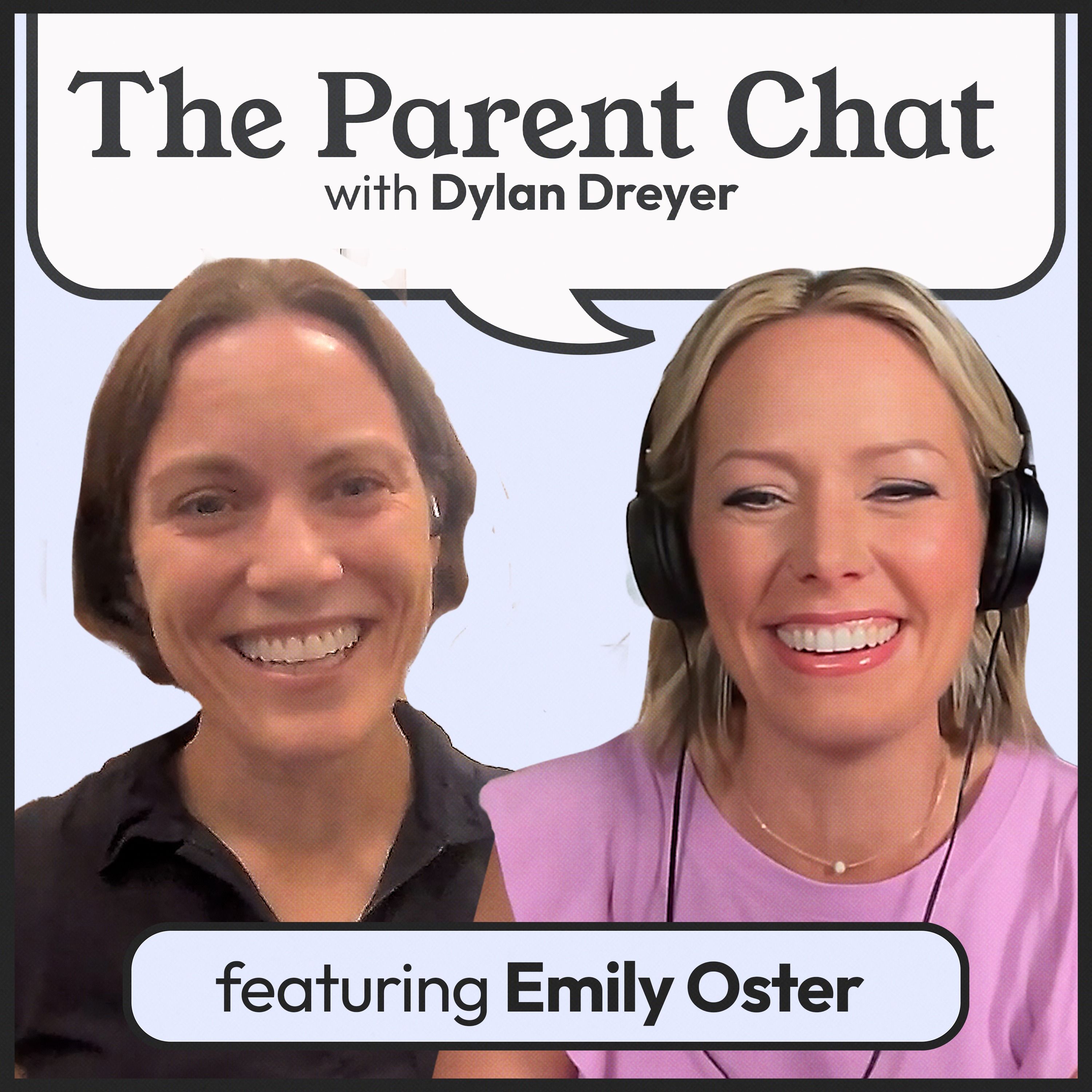
The Parent Chat with Dylan Dreyer
Picky Eaters, Bed Sharing, and Screen Time Limits: Emily Oster Answers the Questions You're Googling
00:29:22
Ever Googled your child's symptoms at 2 a.m. and ended up more anxious than when you started? You're not alone — and Brown University economist and author Emily Oster has made it her mission to replace parenting panic with actual data. In this episode of The Parent Chat, Dylan Dreyer sits down with Oster to tackle the questions that keep parents up at night: How much screen time is really too much? What do you do about a picky eater? Does it actually matter if your child sleeps in your own bed? And what does the evidence really say about breastfeeding, drinking during pregnancy, and skipping that Sunday morning birthday party? Emily also gets candid about her own parenting fails — including the fact that she knows exactly what consistency does for children’s behavior, and still can't always pull it off. Follow us at @TodayParents and @DylanDreyerNBC for more TODAY parenting content.
Loading summary
Transcript129 lines
- [00:00]
Liberty Mutual Spokesperson
Are you looking for the best deal on a new home? Discover the Dr. Horton home of the Week. With new construction homes now selling in ellensburg from the mid-3002, Dr. Horton has the right home at the best value for you, offering one and two story homes near Central Washington University. Your new home is within reach. So what are you waiting for? Learn more about the Dr. Horton Home of the Week, visit drhorton.com and schedule a tour today. Dr. Horton, America's builder and equal housing opportunity builder. And Doug, there's nowhere I wouldn't go to help someone customize and save on car insurance with Liberty Mutual. Even if it means sitting front row at a comedy show.
- [00:42]
Emily Oster
Hey, everyone, check out this guy and his bird. What is this your first date?
- [00:46]
Liberty Mutual Spokesperson
Oh, no. We help people customize and save on car insurance with Liberty Mutual together. We're married. Me to a human, him to a bird.
- [00:52]
Emily Oster
Yeah, the bird looks out of your league.
- [00:54]
Liberty Mutual Spokesperson
Anyways, get a quote@libertymutual.com or with your local agent. Liberty, Liberty, Liberty, Liberty.
- [01:08]
Dylan Dreyer
How are you as a parent with your kids, I mean, being, you know, bolstering all this information?
- [01:13]
Emily Oster
I'm the best. No, I'm just kidding. I'm just kidding.
- [01:17]
Dylan Dreyer
I know your kids don't get to go to birthday parties, but still. Hi everyone. Thanks so much for tuning into another episode. So how many times have you actually googled something just because you're sitting there, you're wondering if you're doing something the right way or if that thing is supposed to look that way. I mean, there's so many different things you can Google, especially as a parent. I mean, what is the Internet going to tell you? You start reading all these different chat groups and these Reddit things and there's this and there's that, and sometimes you just need good, solid information, you know, and this is why I am so excited to welcome my guest today, Emily Oster. She is an economics professor at Brow University and she has written a data driven book to answer these burning questions. It's called Expecting Better, which became a New York Times bestseller. She followed it up with more books, some for toddler aged kids, some to answer questions about school aged kids. And she also has two kids of her own. And a little fun fact, her husband is also an economics professor. So I cannot wait to talk to my guest today. Please welcome Emily Ost. First of all, thank you so much for hanging out with us today.
- [02:36]
Emily Oster
I'm so excited to be here. Thanks for having me.
- [02:39]
Dylan Dreyer
This is so great. I mean, I was that typical first time mom where I would just Google absolutely everything. But I love your method of. All right, here's information based on data. Why do you think that gives you such a better answer than just, you know, whoever's posting on these message boards
- [02:59]
Emily Oster
we're Googling, it helps you understand your decisions. You know, that was why I got into this, because I got pregnant and I got told a lot of rules and it felt very difficult to navigate, like, which of these things should I listen to and which should I. Should I not? Because no one ever explained why. And I think that the data is a way into an explanation of, you know, why might you want to do this thing or not do this?
- [03:21]
Dylan Dreyer
Did you ever think it would get contentious or have so many opinions on the data that you're just trying to provide?
- [03:30]
Emily Oster
I probably under anticipated how much blowback or how much contentiousness there would be about a lot of this, because I really see a lot of what I do. As, you know, I'm not telling you what to do. I'm not telling you whether you should breastfeed your kid or not. Frankly, that's not really any of my business. What I want to tell you is here's what the evidence says about the benefits, here's what the evidence doesn't say about the benefits, and let you make the choice. And I think when you frame it like that, it's like, who could be mad? And yet many people are. And so that. That is always a little surprising to me because I think, well, can we just talk about, you know, can we. Do you disagree with my read of the data? Like, do you have a different paper? Like, let's engage on this detailed point of econometrics and people are not. People don't want to engage on detailed econometrics as much as I want to.
- [04:18]
Dylan Dreyer
Hmm. One thing that I thought was so interesting just reading an article was just the whole topic of having a drink while you're pregnant. And you made such a good point point when you said, well, if you're told you can't do anything, that's impossible to do. So if you're told you can't smoke, you can't drink, you can't eat lunch meat, you can't do this, you can't do that. One of those things is most likely going to happen. We don't want it to be smoking because we know that smoking is bad. Could it be drinking? If you have a glass of wine, it could be drinking. And now you're vilified for saying you should drink while you're Pregnant. I mean, because that's. That's not what you're saying.
- [04:59]
Emily Oster
It's not what I'm saying. Yeah. And it isn't what I said in the books. I sort of tried to walk through, like, what, you know, you're being told not to do this. And in fact, I think what's really tricky. There is about 40% of OBs in the US tell their patients it's okay to have the occasional drink. And so then people are faced with like, But I thought it was. No, I thought it was like, this is where I really. You need to understand why. And walking through the data and explaining to people, you know, here's what we see about occasional light drinking in pregnancy. We don't see the kind of negative impact that we see on heavy drinking. And so, you know, reasonable people may. May decide to have an occasional drink during pregnancy, given that evidence. And many people will decide not to. And both of those choices are reasonable choices. But then people do come back and say, you know, well, you're saying everybody has to drink, or why are so
- [05:50]
Dylan Dreyer
just like, I'm not saying that.
- [05:51]
Emily Oster
Definitely not what I'm saying. And I think, you know, the Internet is such a funny and in some ways problematic place in terms of how. How does something that's. I feel like is so nu and sort of centered then get turned into these extremes?
- [06:05]
Dylan Dreyer
You know, I remember when I was pregnant choosing not to drink. I see someone out at an event having a drink, also pregnant. There's that thought in your head where it's like, well, I wouldn't do that, but to each his own, right? Like, so be it. The problem with the Internet is that everybody then can say every little thought on their mind.
- [06:27]
Emily Oster
And because I think that attitude you describe, which is like, to each his own, is not very prevalent in pregnancy and parenting. Because I think we all want our choices to be so right that they're, like, right for everyone else. So you, you know, another way for you to engage with that interaction is to be like, well, I'm like, I'm obviously the better parent here. My choice is right, and that person's making the wrong choice. And, like, maybe I'll go up and speak to her about it. Of course you wouldn't do that in person, but on the Internet, you would have no problem. Not you. But exactly one would have no problem being, you know, commenting, this person's a bad par.
- [06:59]
Dylan Dreyer
I also think part of the thing is I'm almost secretly mad at myself. Cause I'm like, man, I'm being Such a stickler with the drinking. She's just having a small glass of wine and having a good time. I wish I could do that. So instead of actually doing that, I'm just gonna get mad at the situation instead. So there's 100%, there's all of that. Do you find that you're drawn to finding data and you know, trying to answer questions about the age your kids are now and care less about, you know, the pregnancy stuff and the breastfeeding stuff? Like all the stuff that happens happened before.
- [07:32]
Emily Oster
I think that there's a perspective that comes from having an older kid that allows one to like dial down some of the anxiety that I remember from pregnancy. But now when I look back on, it's like, I can't believe I was so worried about, I was so worried about that. The problem with older kids as a person who is obsessed with data, is that there is much less data and the data is much less easy to learn from because kids differ quite a lot. And I find that this stage of parenting is very rewarding and it's very fun, but it's also much harder and far less formulaic. It's like way more thinking honestly about how like to not mess up than, than it did when they were little.
- [08:16]
Dylan Dreyer
It's an interesting point you make because I think back to my first son when I was breastfeeding and struggling, struggling, struggling at breastfeeding. I just didn't produce enough googling all the time. You know, like, should I keep trying this? What, what happens to his mental state if I don't breastfeed him? What should I do? So I struggled for a full year, pumping all the time just to try to like increase every, you know, production and all that kind of stuff. Then the second child, their same issue, you know, couldn't provide, had to supplement, which I felt so guilty about. And then with the third kid, I'm like, I made it to eight months and I hit eight months. I'm like, I just, I can't do it anymore. And at this point, my oldest is five. I'm like, I don't really see a difference between the five year old and the three year old. Like, I don't know what breastfeeding did, I don't know what formula did. And I look back now and I'm like, why did I kill myself?
- [09:06]
Emily Oster
Totally. I have this mental image with my daughter where I also had a lot of supply issues and she wouldn't latch of like walking around the hallway at some hotel when she must have been like six Weeks old. I don't know why we were at this wedding and, like, walking around and, like, bouncing. Because the only way she would latch on is if you're just bouncing. Bounce and bounce. When I look back on that, I just want to be like, hey, stop it. Don't. Just like, you're. You're rooting that, like, this is not helping. You're not going to look back in 14 years and be like, boy, I'm glad she got those two ounces of breast milk after I bounced her for nine hours in the hallway. You know, the marriage.
- [09:43]
Dylan Dreyer
Terrible gas, but.
- [09:45]
Emily Oster
Right, exactly. So I really, you know, I think that there are those moments that I think many of us look back on and say, boy, I wish I had given myself a break. Yeah, I wish I'd give myself a break.
- [09:55]
Dylan Dreyer
One thing that got a lot of feedback was this. Birthday parties on Sunday mornings that you don't want to bring your kids to.
- [10:03]
Emily Oster
The birthday party is Sunday morning, which is a time that, like, we like to go hiking or do other stuff together. It's just. No.
- [10:09]
Dylan Dreyer
Can I just start by saying. I couldn't agree more there. The last thing I want to do on a Sunday morning is go to a birthday party to a kid that my son is maybe half friends with. I mean, if it's a dear friend of his and he genuinely wants to go to the birthday party, I will gladly take you to the birthday party whenever it is. But if it's so and so from your class that I have to remind you who that person even is because you're three, I'm sorry, but I'm just going to say no. And I don't really think the parent of the kid's party will even care that I'm there.
- [10:44]
Emily Oster
Yes. I felt so just to be there. There are so much to unpack about birthday party gate. And I felt, you know, what I had said was actually in the service of a much broader point, which is that I think that we probably don't spend enough time thinking about how we want to spend our time on the weekends when we have kids. And often people tell me, oh, I wake up Sunday morning, Saturday morning. I can't believe how many activities, like, I don't want to do any of these activities. Why are we doing this? Sort of trying to be clear to people like, hey, if you want to avoid that, you need to kind of be deliberate upfront and think about what are the guidelines that we're gonna have. And for our family, Sunday mornings are intended as family time and just like, sort of stepping back to like what the Internet's like, you know, really this statement was there's a two and a half hour period on Sunday mornings in which I might not have my child attend a birthday party. That's it. That's like, God forbid. And people were like, the, the sort of moment that I realized how much feedback people get about their parenting is somebody wrote a newspaper column about how like, this was like a terrible thing. And it ends with this like amazing set of quotes that's like, there is a loneliness epidemic. You know, children grow up, spouses age, everyone dies. And so you should go to the birthday party. And it's like now preserving the two and a half hours on Sunday mornings is the cause of the loneliness epidemic. And everyone's gonna d. It's like, listen guys, can we right size the. But I realized, of course I don't care what people. I'm like, you have enough security about this and not care too much. But I think part of what I realized is this is a lot of the feedback people are getting either on the Internet or even from people in their circles is sort of this feeling of like even something as milquetoast as like I might say no to a birthday party is sort of like, well, why don't you love the community? Your kids are going to hate you and everyone dies. And it's like, ah, we're putting so much pressure on people.
- [12:41]
Dylan Dreyer
Yeah.
- [12:41]
Emily Oster
A few weeks after this, my son did go to a birthday party. It was on a Saturday afternoon. And when we went, he was like, do you wanna take a picture of you like dropping me at the birthday party so people know that like you let people go to birthday parties? I was like, I don't wanna do that. But thank you for asking.
- [12:56]
Dylan Dreyer
You do wanna clarify you're not anti birthday party?
- [12:59]
Emily Oster
I'm not anti birthday party. I will be delighted for my kid to attend your child's birthday party, but probably not on Sunday morning.
- [13:05]
Dylan Dreyer
All right. Makes me feel a little bit better. Stay with us. We'll be right back after the break.
- [13:22]
Liberty Mutual Spokesperson
Are you looking for the best deal on a new home? Discover the Dr. Horton home of the week. With new construction homes now selling in ellensburg from the mid-3002, Dr. Horton has the right home at the best value for you. Offering one and two story homes near central Washington University. Your new home is within reach. So what are you waiting for? Learn more about the Dr. Horton Home of the Week. Visit Dr. Horton.com and schedule a tour today. Dr. Horton, America's builder and equal housing opportunity Builder. And Doug, there's nowhere I wouldn't go to help someone customize and save on car insurance with Liberty Mutual. Even if it means sitting front row at a comedy show.
- [14:04]
Emily Oster
Hey everyone, check out this guy in his Bert. What is this your first date?
- [14:08]
Liberty Mutual Spokesperson
Oh, no. We help people customize and save on car insurance with Liberty Mutual together. We're married. Me to a human, him to a bird.
- [14:15]
Emily Oster
Yeah, the bird looks out of your league.
- [14:16]
Liberty Mutual Spokesperson
Anyways, get a'@libertymutual.com or with your local agent.
- [14:19]
Dylan Dreyer
Liberty, Liberty. Liberty.
- [14:21]
Liberty Mutual Spokesperson
Liberty.
- [14:23]
Dylan Dreyer
This is a Monday.com ad, the same
- [14:25]
Emily Oster
Monday.com helping people worldwide, getting work done faster and better.
- [14:29]
Dylan Dreyer
The Same Monday. Com designed for every team and every industry. The same Monday.com with built in AI
- [14:37]
Emily Oster
scaling your work from day one.
- [14:39]
Dylan Dreyer
The same Monday.com that your team will actually love. Using the same Monday.com with an easy and intuitive setup.
- [14:47]
Emily Oster
Go to Monday.com and try it for free. Yes, the same Monday.com.
- [14:58]
Dylan Dreyer
Have you changed the way you parent after you discover something in your research?
- [15:05]
Emily Oster
Sometimes, yeah. I mean I think that when my kids were little and I wrote crib sheet, we changed the way we disciplined to some extent. I spent a bunch of time thinking about evidence based discipline for the book and my older child didn't need any, didn't need any discipline. You just sort of told her not to difference between like first like I was like, don't touch the stove. And she was like, okay, I'll never touch the stove ever again. You know, and my son like, you're like don't touch the stove. And he was like, ah, touch the stove. So, so I was writing that book like right at a point in which we were like, okay, we gotta try something different. Cause this just like explaining like you're a 45 year old isn't working as well as it was. And so that was a place where we sort of adopted this kind of pretty standard, like 1, 2, 3, magic timeout kind of approach as a result of having done a bunch of research.
- [15:53]
Dylan Dreyer
How does it work with screen time? I know I tend not to give my kids screen time. I think I have the original version of the iPad, so they don't, they don't even know how good that doesn't.
- [16:03]
Emily Oster
That barely works. That barely works. I think the easiest way for to think about screen time is to think about what it's substituting for rather than thinking of it as good or bad. You might say, you know, we have in our household worked out a way that we like screen time works for us right there's an angle on trying to change the dynamic, which is much less about, you know, screens are bad and much more about. There's another thing we'd rather be doing. So let's make sure we don't spend all our time on the phones. So we can also, you know, go swimming with grandpa or whatever is the activity you want to.
- [16:33]
Dylan Dreyer
That's a good way to look at it. Is there a topic that comes up most often that people reach out to?
- [16:39]
Emily Oster
Sleep. Nutrition and screens are people's main. Those are, like, for, like, little kid stuff. I mean, with pregnancy, it's much more varied because people's experiences there, I think, are more varied. But with little kids, it's really like, they don't sleep, they don't poop in the potty. That's like a big one. I'm worried about things, about screenshots and they won't eat anything.
- [17:03]
Dylan Dreyer
If you could just tell parents, like, just wait a couple years and this, like, all these worries will go away. Like, they will sleep, they will eat better.
- [17:12]
Emily Oster
I think it's not that helpful to be, like, wait for two years. Like, I don't need to know that, like, when they're 20, it will be fixed. Like, I need you to help me fix it. I think then, you know, sometimes there are things we can help fix. I think the other piece is just people almost always want some acknowledgement that what they're experiencing is normal. So around picky eating, like, there's this moment for many parents around like, 18 months to 2, where all of a sudden your kid just stops eating everything. Yeah. And people like, oh, my gosh, my kid isn't eating anymore. Like, what did I do wrong? And, like, why? You know, and just acknowledging, like, that's extremely common. It's just like, my kid is just like all the other kids. And, you know, here are some strategies that I can have to try to, like, make it better.
- [17:48]
Dylan Dreyer
Is there evidence that kids, like, need to eat all those peas on their plate and they're going to be so much more healthy going forward or no, and you shouldn't.
- [18:00]
Emily Oster
Actually, the one sort of piece of advice about picky eating is that actually it's not a good idea. Go for, like, you know, if you eat all the peas, you can get ice cream, because that generates, like, negative association. With peas. There is better data around what's called, like, an autonomy supportive approach. Like, you might like peas. They're like small Brussels sprouts. Not that they like Brussels sprouts, but, you know, if they're they to like brussels sprouts. But no, they're. Most people sort of worry a lot that their kids are like vitamin deficient. But you need to eat a very, very limited diet to be vitamin deficient. You know, if your kid eats one ketchup packe every day, they have enough vitamin C to not have scurvy. So, you know, most people are doing fine on, on vitamins. And you know, it's a good idea to keep trying to encourage new foods with more fiber and take advantage of that moment that they want to eat like three pints of, you know, raspberries. That's.
- [18:54]
Dylan Dreyer
Although raspberries are so expensive.
- [18:56]
Emily Oster
When I know I was going to say like, maybe the point where they want to eat like a bunch of apples or something. Raspberries, maybe. Hold it.
- [19:02]
Dylan Dreyer
When my kids are on a raspberry kick, I'm like, dang it, this is gonna.
- [19:05]
Emily Oster
I know. So berries are. And they go bad. Very. Whatever. Okay, so it's. It's a good idea to continue to encourage vegetables, but it's also worth saying, like, your kid is not gonna get scurvy if they are a picky vegetable eater.
- [19:17]
Dylan Dreyer
You mentioned you get a lot of sleep questions?
- [19:19]
Emily Oster
Yes.
- [19:20]
Dylan Dreyer
I don't know how it happened. And they. My kids were okay sleepers, but the idea of can we have a sleepover tonight? Has turned into like once a week they're asking like all of them to pile into my bed and we read books together and we have a nice, nice little like sleepover. Like, how important is it to make sure kids sleep in their own bed versus that like snuggle that they want?
- [19:43]
Emily Oster
This is 100% up to whether it is something that works for you. I mean, my friend wrote to me the other day and was like, I sleep every night in the bed with my 6 year old. She's split up from her husband. She's like, when I have her, we sleep together in the bed every night. I love it. It's incredibly important to me. Is it okay? Absolutely. Like, that's something you like. It works for you. You guys are getting enough sleep.
- [20:02]
Dylan Dreyer
Perfect. How are you as a parent with your kids, I mean, being, you know, bolstering all this information?
- [20:08]
Emily Oster
The best. No, I'm just kidding.
- [20:10]
Dylan Dreyer
I'm just kidding. I know your kids don't get to go to birthday parties, but still, right? Cause I feel like you have, I mean, it seems like you have the answers for everything just because you have the data for so many different topics. I mean, how does that come into play within your own House, this is not very helpful.
- [20:29]
Emily Oster
You know, your children are not responsive to being told that your mom's a parenting expert. You know, look, I mean, I think a lot about my parenting, and I think the places where I think I do well is, like, my husband and I have thought a lot about how to do things together and how to, like, craft a life that we are really happy with the structure of it and with how things work. And then there are places where, like, I think I could do better. You know, perhaps the most salient of which is, like, I spend an awful lot of time explaining to people how important consumer consistency is, which it really is. Like, when you think about discipline or routine or whatever, like, kids really respond to, like, a consistent set of boundaries. And that's, you know, the cornerstone of finding any discipline, your behavior routine is to say, like, consistently, you know, what to expect every single time. If you say it's like five minutes of television, you. You hold the line at the five minutes of television. And this is both very important, very evidence based, and also very difficult. And it is the thing in my parenting that I have the hardest time with. I have, like, I'm very. I have a very hard time. Like, my husband's a. Like, he's much better at, like, this stuff, and I'm sort of like.
- [21:37]
Dylan Dreyer
I mean, that's fascinating, the fact that, you know what the data says you should do, but you still choose not to do it. I mean, that says a lot about parenting.
- [21:47]
Emily Oster
Totally.
- [21:47]
Dylan Dreyer
I mean, I think back when my friend was trying to get her kids out of her room, and she was up all night, and she was, you know, every time I talked to her, she was so tired because she was up all night trying to do this. And I'm like, why don't you just let them come into your bed? You know? And she's like, I don't want to. I don't want them in my bed.
- [22:04]
Emily Oster
It's an investment.
- [22:04]
Dylan Dreyer
They're so cute and they're so snuggly. And I mean, my.
- [22:07]
Emily Oster
I don't think you want to. I don't think you are in a position to enforce this change. That's what I'm getting from this conversation. Your kids are staying in your bed.
- [22:14]
Dylan Dreyer
Especially because my youngest, he has learned to manipulate me. And he comes in and he's. And I hear his little pitter patter, and I'm like, ugh, here we go. And the first thing he says is, I love you, mommy. And I was like, oh, buddy. He's like, good night. And he, like, pretends like he's walking away, but he knows, like, he just said exactly what I want to get him into my bed. I'm also a.
- [22:38]
Emily Oster
One of my kids will. Some. My younger kid will sometimes, like, wake me up for a hug in the middle of the night. And it's like, I. It will sort of happen for a while and then it will stop. And I know, like, I know I could shut it down, but it's, like, so nice. He wants a hug, you know?
- [22:50]
Dylan Dreyer
Right.
- [22:51]
Emily Oster
Okay.
- [22:51]
Dylan Dreyer
Again. Cause, like, he doesn't want that forever.
- [22:54]
Emily Oster
It's not gonna happen forever.
- [22:56]
Dylan Dreyer
Would you say at times you could be. I mean, I am. I can be a pushover of a mom just because I love when they give me love and just, like, I'll just melt onto the floor and let them just.
- [23:09]
Emily Oster
Yes, I am sometimes. I am sometimes a pushover. My husband, if he were here, he would say it's more than sometimes. Like, I hold the line some of the time, but I am the more easily manipulable parent that is.
- [23:21]
Dylan Dreyer
Sure. Yeah. When you try to find some space for yourself, try to, you know, find time for yourself. What. What do you do?
- [23:28]
Emily Oster
So I really like to run. This is, like, my main hobby. And I gotten much better at saying, like, that's important to me. And I will prioritize it. Like, I do not have to run 20 miles. Nothing bad will happen if I don't run 20 miles. Except, like, I will perform worse in the marathon than I want, and that's the only. But, like, I care about that. And to sort of say, like, I'm going to prioritize this, and for whatever reason that activity, I have sort of. Of been able to say, like, this is important enough to me that I'm willing to, you know, sacrifice some family time or just tell you, like, I'm not going to be like, you need to get yourself to school. A thing which my children are entirely capable of doing but would prefer not to do. And just like, I'm sorry, I'm not going to be here because I am going to be running.
- [24:11]
Dylan Dreyer
Yeah.
- [24:12]
Emily Oster
And then that, for me, it has been my. Some. One of my kids will be like. Like, you know, one time he told me, he was like, you love running more than you love me, which is like such a, you know, child. And I was like, that's not true in the aggregate, but tomorrow morning it's more important to me. And like, you know, that's like, they really. They know how to, like, pull on you. But for me, that's the that is something where I've been willing to find the time.
- [24:38]
Dylan Dreyer
We put out a call to TODAY viewers for some questions. So I just want to read this one question to you. What's one thing you wish parents would stop focusing on and where should they put their energy instead to raise kind, confident and courageous children?
- [24:52]
Emily Oster
I think there's far too much focus on very small things and you know, whether that's, you know, rotating the toys or, you know, making sure that some of it's about stuff like do you have the right stuff? Most of which doesn't matter at all. I think people don't hear enough that they should prioritize their relationships. And I. That's not a thing that is about what you're doing to your kids, but it is in fact quite important for like how happy your family is and like what you are modeling for them in the long term. And I do think people could hear a little bit more like spending some time on your relationship, even when your kids are little, is actually an investment in them and in your family that we are probably missing. Hmm.
- [25:40]
Dylan Dreyer
And you know, for people watching who are divorced or separated, like, what's the best way to model still that relationship for kids?
- [25:49]
Emily Oster
Yeah, I think there. So we know from the data on, on divorce that, you know, the, the relationship that you maintain with your ex spouse is in it. Some ways you want to prioritize the same things, which is like not showing conflict, working together on, you know, having a consistent set of expectations for your kids. It's, it's many of the same things that we would prioritize in, in marriage is kind of not having the kids be exposed to the conflict and making sure that they know what to expect. Particularly difficult with two different households.
- [26:18]
Dylan Dreyer
Right. So you mentioned to not focus so much on the small things, but what are some examples of the bigger things that you should put more of your focus into?
- [26:27]
Emily Oster
So one of the things that gets said a lot is that, you know, the, the things that happen to kids in the first three years are really important and that the first three years are really important. And that's true. And when we, when we say that out of sort of from research, what we mean or what researchers mean there is that the, it's really important for kids to have enough to eat, a safe place to sleep, someone who is like loving and paying attention to them. And if I was going to add like one thing on top of that, I would say reading to your kids is one of the few kind of evidence based developmental interventions that matters
- [27:03]
Dylan Dreyer
more of the parent chat after the break. On Etsy, you can find your favorite person a gift as special as they are. Like a custom leather camera strap to make to celebrate your photography obsessed friend. For special birthday gifts that say I get you shop the Etsy app. A text says, you're on my mind. A bouquet from 1-800-FLowers says, you're my everything. Heartfelt moments belong in the real world,
- [27:32]
Emily Oster
not just your phone.
- [27:33]
Dylan Dreyer
For 50 years, 1-800-Flowers has helped millions
- [27:36]
Emily Oster
of people make memories that'll last a
- [27:37]
Dylan Dreyer
lifetime with gifts they'll cherish forever. Their expertly curated arrangements and gift baskets shipped nationwide with a 100% satisfaction guaranteed.
- [27:46]
Emily Oster
Don't wait for the next big moment.
- [27:47]
Dylan Dreyer
Make it when you visit 1-800-flowers.com sxm today, that's 1-800-flowers.
- [27:53]
Emily Oster
Com sxm.
- [27:54]
Liberty Mutual Spokesperson
Close your eyes. Listen to Monday.com feel the sensation of an AI work platform so flexible and intuitive it feels like it was built just for you. Now open your eyes, go to Monday.com, start for free, and finally, breathe.
- [28:16]
Dylan Dreyer
So your kids are a little older than mine. What is a piece of advice you would give to me? Something that I shouldn't stress over right now or shouldn't worry about right now when it comes to having those younger
- [28:28]
Emily Oster
kids, how often they bathe. A lot of kids don't like to bathe. I mean, this is a thing people worry. My kid doesn't like a bath. They're dirty. It's a terrible experience. Eventually they'll hit puberty and it will be important for them to bathe because they smell. They don't really need to take a bath that often. And it's maybe not the hill you want to die on.
- [28:48]
Dylan Dreyer
I'm so happy to hear you say that because I have a neighbor who every day at the end of the day, they're like, okay, we're going to go take a shower. And I'm like, I wasn't planning on giving my kids a shower today or yesterday or tomorrow. Like, I just don't think bathing is that important.
- [29:06]
Emily Oster
Agreed. Yeah. Great. It's just not that important. And don't worry about it.
- [29:10]
Dylan Dreyer
Awesome. That just took such a load off.
- [29:12]
Emily Oster
So thank you and I will clarify. My children bathe themselves every day now because they are older.
- [29:18]
Dylan Dreyer
Yes.
- [29:19]
Emily Oster
But they did not when they were little.
- [29:20]
Dylan Dreyer
Yes. That's so good to know. And it takes a load off of me. So thank you for that. How are you as a mom to a sick child?
- [29:27]
Emily Oster
Terrible.
- [29:28]
Dylan Dreyer
I find that I'm a terrible mom when it comes I just, I don't, I don't care that much. Not me. Like, if there was something really wrong, I would, you know, I go into mom mode. But I'm not very sympathetic when my kids are not.
- [29:39]
Emily Oster
No, I am not sympathetic. I am more sympathetic than my mother whose view was like, take a shower, eat something, and then maybe we'll discuss whether you have to go to school. I'd be like, my fever's 103. It'd be like, well, try the shower option. You know, it's like I'm like a little more sympathetic. We do follow the school rules about, about fever. But I'm not, I'm not like the, the smushy, the smushy sick parent.
- [30:01]
Dylan Dreyer
My mom would say to me, she's like, well, you can stay home, but I'm not taking care of you. Okay.
- [30:06]
Emily Oster
It's like, that's like, well, stay home by yourself. Well, I guess I'll go to school.
- [30:12]
Dylan Dreyer
They've started saying they have a belly ache because they know, you know, they'll either I'll give them a hug or they don't have to finish their dinner or. But this has just been the running thing where it's like they walk into my room, my belly hurts. My belly and I, I don't even give it a second thought. I'm like, you're fine. Go to bed, close your eyes, like breathe a few times and I'm. I'm sure you'll fall asleep.
- [30:29]
Emily Oster
Sleep.
- [30:30]
Dylan Dreyer
Yeah, Like I just, I don't know how to be more sympathetic when I just feel like they're faking it half the time.
- [30:35]
Emily Oster
Right? Totally. Stomach aches are like a classic faker.
- [30:38]
Dylan Dreyer
Yeah. You can't prove it.
- [30:40]
Emily Oster
Yeah, exactly.
- [30:42]
Dylan Dreyer
It's like you might, I don't know. Do you want to go?
- [30:44]
Emily Oster
I like the idea of just breathing deeply. That is a piece of advice I give frequently. People like, I can't fall asleep. I'm like, your body knows when you can. When you need to fall asleep. Just breathe. Just breathe in and out.
- [30:54]
Dylan Dreyer
I even last said it said, I'll do one with you. I'm like, okay, ready?
- [30:57]
Emily Oster
In.
- [30:58]
Dylan Dreyer
Okay, go to bed. This has been such an eye opening conversation. I mean, just so real too. I feel like I could just chit chat with you. But thank you so much. This has been so awesome just to chat with you.
- [31:11]
Emily Oster
Thank you so much for having me.
- [31:14]
Dylan Dreyer
Well, that's going to do it for this episode. Thanks so much for watching. I'm so curious and want to hear from you. What do you think of Emily's answers and do you have any questions that you want some data driven answers to? I think my biggest takeaway from this episode is to not sweat the small stuff. As I grow with my kids and as they get older, I think back and man, there was so much. I was just concerned about so much. I googled so much, I searched so much. You know, what is the best this? What is the best that? What is the best bottle? Should I use plastic bottles? Should I use glass bottles? Just so many questions and I look back and I'm like who cares? Did it really matter? I don't think so. So let's just be kind to each other and figure this all out together. Don't forget to like and subscribe. We are going to drop a new episode every week and you can always message me. Dylan Dreyer, NBC and be sure to follow tday parents for more content. Bye bye. This episode was produced by Ann Legamayo. Rachel Paula Abramson is our parenting reporter. Our senior producer is Tyree no. It was edited by Ali Strain. Our audio engineer is Joe Plord. Our head of audio production is Jessica Fenton. Ashley Domagola is our production manager. Sadie Bass is our supervising producer. Ariana Davis is the executive editor of the Today show and Ashley Kodiani is the vice president of content strategy. I'm Dylan Dreier and this has been the Parent Chat, a production of the Today Show. See you next week. Looking for a gift to make Mom's Day? Shop Etsy for all her favorites, like personalized jewelry and accessories or even custom stained glass artwork she'll truly love. We can't count the ways your mom means the world to you, but you can count on Etsy to help you find a gift that will make her feel seen. Celebrate the heart of the family with Mother's Day gifts on Etsy. Celebrate being human.