← The Southern Tea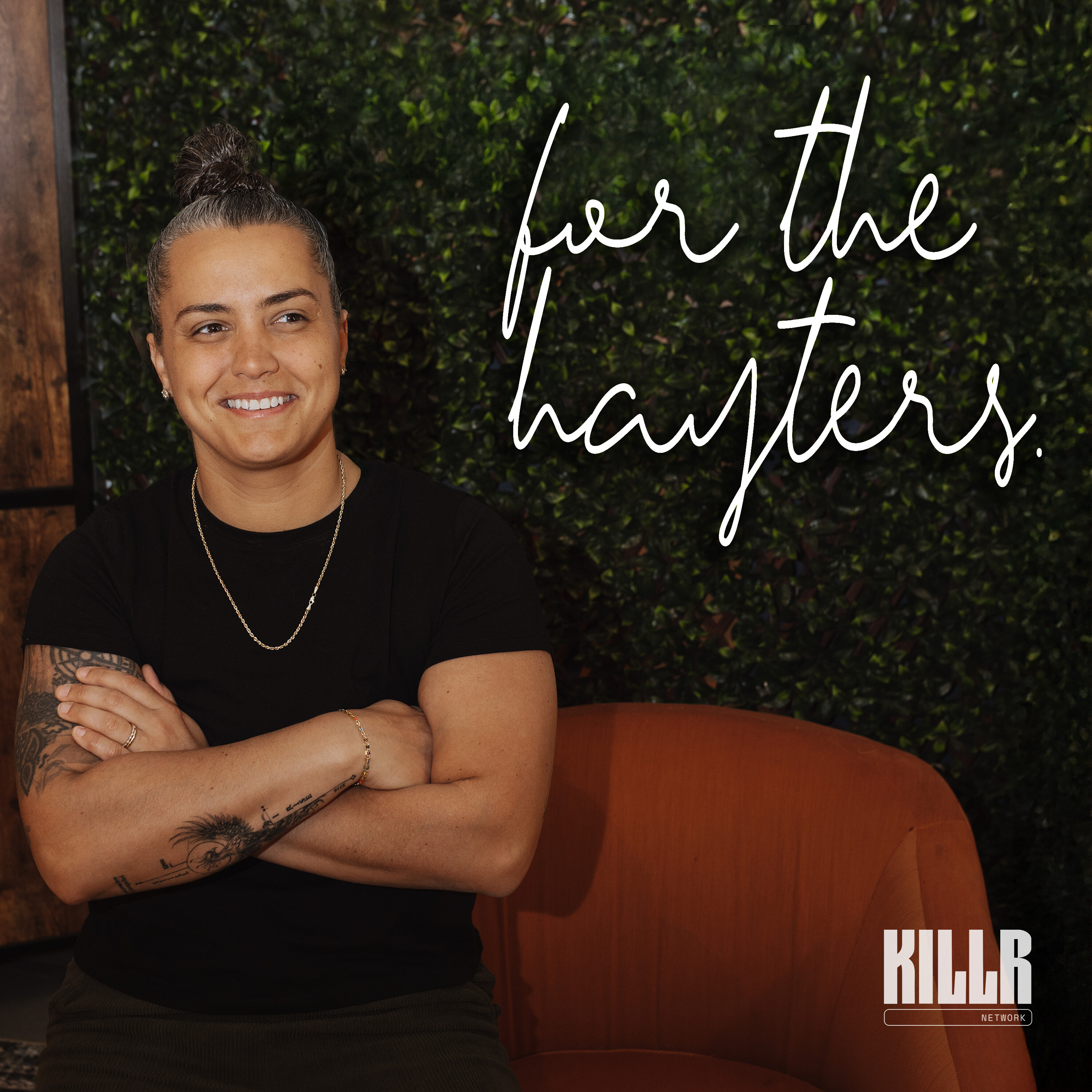
Loading summary
Transcript34 lines
- [00:00]
Kale
All right, guys, it's Kale. I know that you met me at 17 on TV, but you never got to see the 16 years before that. So I sat down with my best friend Becky on her podcast for the Haters to talk about the first part of my life. The full episode is out now, so go follow and subscribe for the Haters on any podcast, app, Apple, Spotify, or wherever else you get your pods.
- [00:20]
Becky
Welcome back to for the Haters podcast. Most people met Kayl when she was 16 and pregnant on a TV show in front of millions. I met her later, and somewhere in the middle of all the chaos, she became one of my closest friends. But here's what I realized sitting across from her for this conversation. The world has been watching Kale for half her life, and it never got the beginning. The cameras showed up at 16. Everything that built her, every apartment, every promise, every person who was supposed to stay and didn't. All of these happen before they ever started rolling. We talked for over two hours, and there's no honest way to fit her story into one episode. So this is part one, the story before anyone was watching. This is her story. So are you ready to dive? To dive deep?
- [01:25]
Kale
Dive in head first. I'm so nervous.
- [01:30]
Becky
With more than 10 years of friendship, I thought I knew her story. I also knew the headlines. Everybody knows the headlines. But there's a difference between knowing what happened to someone and knowing what it was like to be her while it happened. So we started at the very beginning, before the shows, before the babies, back when she was a kid whose whole world had to fit into a moving box. And I'll be honest, I was nervous for this one. More nervous than I've been in a long time. Because there's a strange thing about sitting across from somebody you love with the intention of having a conversation you've never had before, questions you've never asked, conversations that were just left unsaid. But today was different. So I asked, how many times do
- [02:29]
Interviewer/Host
you feel like you moved around as a kid?
- [02:31]
Kale
As a kid, I'd say at least 20.
- [02:34]
Interviewer/Host
Wow.
- [02:34]
Kale
Minimum. Wow. Yeah.
- [02:36]
Interviewer/Host
Were you just bouncing between houses and renting?
- [02:39]
Kale
And my mom never owned a property as far as I can remember, so it was always apartment. I first remember a trailer where I was like, really foggy memories in a trailer. And then from there it was like my mom's partner's house. So we would move in with them, and then when they broke up, we got an apartment, and then we'd move in with somebody else. And so it Was kind of like
- [03:04]
Becky
that for most people when they reach back for their earliest memory. Land on something soft, a kitchen, a song, somebody taking care of them. Kale reached back and landed somewhere else.
- [03:22]
Kale
The most vivid memories I have that were super early on were around like the kindergarten, first grade age where my mom would get really, really. Can I cuss on this?
- [03:33]
Interviewer/Host
Yeah.
- [03:34]
Kale
Okay. My mom would get really up and she would pretend to be the Wicked Witch of the west from the. What is her device. And so that was like her alter ego while she was up. And so like I have very vivid memories of the exact house of where we lived when she would do this. And it would, it would freak me the out. So I would just run down the hall, close her bedroom door and lock it because it had a phone in there in case I needed to call my grandma.
- [03:58]
Interviewer/Host
Do you feel like you have a weird connection to the wizard of Oz
- [04:00]
Kale
now because of it? Yeah, I have a really weird, like. I don't want to say triggered. I don't think I'm triggered when I see like the, the green witch. But like it definitely gives me a weird feeling.
- [04:09]
Becky
Something to listen for as she talks about her. Most of the time it's my mom. The word really never went anywhere. But every so often mid sentence, her mother stops being mom and becomes Susie. First name. The way that you'd talk about a roommate or somebody you used to know. They haven't spoken in years. And I think the whole distance lives inside that flicker. And underneath all of it sits the fact that floored me when I asked where the drinking actually started. It started before Kale existed. The first time Susie ever got sober as an adult was the nine months she was pregnant with her daughter. Nine months. That's the record.
- [05:07]
Kale
My mom, it's always like surreal to talk about her because when she's sober, she's so fun and like so full of life. But those, those time frames were so short lived that I think that's what kind of kept me hanging on. She would go on, she. My mom when I was a kid. I don't know how she is now, but when my mom was. When I was a kid, my mom was very. Would go on benders. So it would be like she'd be sober for five days and then she'd disappear for five days and then she'd be back and she'd be sober for three days and then she'd be gone for four days. From what I remember, I. She would typically drop me off at a friend's house and then not pick me up for several days. And I think that was, like, a common thing in our town. Like, people knew that. But a couple years ago, I had someone from my childhood reach out and tell me she's an older woman who. She said she used to sew my mom's cheerleading uniforms when my mom was in high school. So she's really familiar with our family. And she wrote to me on Facebook and she told me to call her. And so I called her and was, like, asking her a lot of questions. Like, she knew my mom before I ever existed. So, like, what was my mom like? And she told me that the trailer that I lived in, she. My mom would leave me in the crib, and my mom would leave the house and go get up, and I would be screaming. I'd wake up in the middle of the night screaming, crying. So the neighbor would crawl through the window to get me and then would call the police. The police would bring her back and just leave her there.
- [06:33]
Becky
Here's something I didn't fully understand about her until this conversation. Kale doesn't file her memories by how old she was. She files them by address. 20 some places before she was done growing up. And she can still pull the street number out of thin air. Most of us measure childhood in years. Kale measures her and moves in packed boxes and new schools and learning over and over how to start from scratch. When home keeps changing. You stop counting time, you start counting places.
- [07:17]
Kale
I remember my mom and who I thought was her first husband after my dad. His name was Frank. When Frank and my mom split, I was around 7, and we moved into this apartment in Honesdale. It was literally up the street from the house that we lived in with Frank. And I remember calling my grandma, like, please come pick me up. Mom's up. Like, I don't. Like, what am I supposed to do? Kind of deal. And I think that was around the time where I was like, this isn't. Like, I don't think people call their Grant. Like, I had every bar memorized, their phone number. I knew, like, what people she was hanging out with. Like, you don't know those kinds of things as a kid, you know? And so I think also distinctly remember that same apartment. I would look out the window. It was 1225 West street, that apartment in Honesdale. And I would look out the window because mom hadn't come home for, like, three, four days. So I'm like, is she going to be home in time to see me before school? Or, like, is she okay? Am I going to get a call that she's dead. I think that was around the time where it was like, I don't think other families live like this.
- [08:19]
Interviewer/Host
Yeah. Do those feelings feel unsafe? Because I. When I think about it, if this is all, you know, your version of unsafe is probably so skewed from someone else's. Right. Your threshold of safety is so different. Like, at what moment do you feel unsafe? Do you feel unsafe by yourself? Do you feel unsafe when she's there?
- [08:41]
Kale
I think I felt more unsafe when she was home because it was. What is the word? Not tumultuous. It was like unpredictable. So it's like I wanted to make sure she was okay. I wanted to know she was okay and I wanted her to be home, but I didn't necessarily feel safe with her there either.
- [08:55]
Interviewer/Host
Yeah.
- [08:55]
Kale
So it was, it was definitely a weird. Especially when I think back now as a mom, like, that's not. That's so up.
- [09:03]
Interviewer/Host
Was the unsafety from your fear of what's happening to her or was it. Did you feel unsafe yourself?
- [09:11]
Kale
No, I think it was my uncertainty of what was happening to her. Like, looking back, like, what's gonna happen to her? Like, I didn't think, oh, we're both gonna die in this car. It's like, my mom's gonna die, you know?
- [09:21]
Interviewer/Host
Yeah.
- [09:22]
Kale
But sometimes I thought that that would be easier for me if she just died. Yeah. And I know that sounds really up, but it was like the constant uncertainty of like, is she gonna come home? Is she okay? Is she gonna get killed? Is she. Could she meet somebody who does something to her? So for the longest time, I'm like, it would actually be easier to get this phone call and never have to worry again than to constantly live like this.
- [09:44]
Becky
I need to stay there for a minute. Because it would be easy to hear that and flinch. A kid deciding her mom's death would be easier. But listen to what she's actually describing. She wasn't wishing for a death. She was wishing for an ending. Any ending. Grief comes once and tells you what it is. Uncertainty moves in, sleeps in the next room and asks the same question every single night. Is she okay? Is she coming home? Is tonight the night the phone rings and there was no one to hand that worry to. No dad, no siblings. The person that she was laying awake worrying about was the only person she had an 8 year old running the math on which kind of pain would cost her less. And in that same apartment on west street, nobody was. Was watching the door.
- [10:57]
Podcast Host/Announcer
I don't.
- [10:57]
Kale
I didn't think I was going to cry already.
- [11:01]
Becky
And that's a little taste of for the Haters. I hope you guys enjoyed this preview, and if Kale's story hit you the way it hit me, you're going to want to hear the whole thing. To listen to the full episode, head on over to for the Haters. Wherever you get your podcast, make sure to follow along so you never miss a story. There are so many stories to catch.
- [11:23]
Podcast Host/Announcer
You're listening to this podcast, so I know you've got a curious mind. Here's a helpful fact you might not know yet. Drivers who switch and save with Progressive save over $900 on average. Pop over to progressive.com, answer some questions and you'll get a quick quote with discounts that are easy to come by. In fact, 99% of their auto customers earn at least one discount. Visit progressive.com and see if you can enjoy a little cash back. Progressive Casualty Insurance Company and affiliates national average 12 month savings of $946 by new customers surveyed who saved with Progressive between June 2024 and May 2025. Potential savings will vary.
- [12:02]
Sponsor Announcer
Support for this podcast comes from Progressive, America's number one motorcycle insurer. Did you know? Writers who switch and save with Progressive save nearly $200 per year. That's a whole new pair of writing gloves and more. Quote today Progressive Casualty Insurance Company and affiliates national average 12 month savings of $197 by new customers surveyed who saved with Progressive between October 2024 and September 2025. Potential savings will.