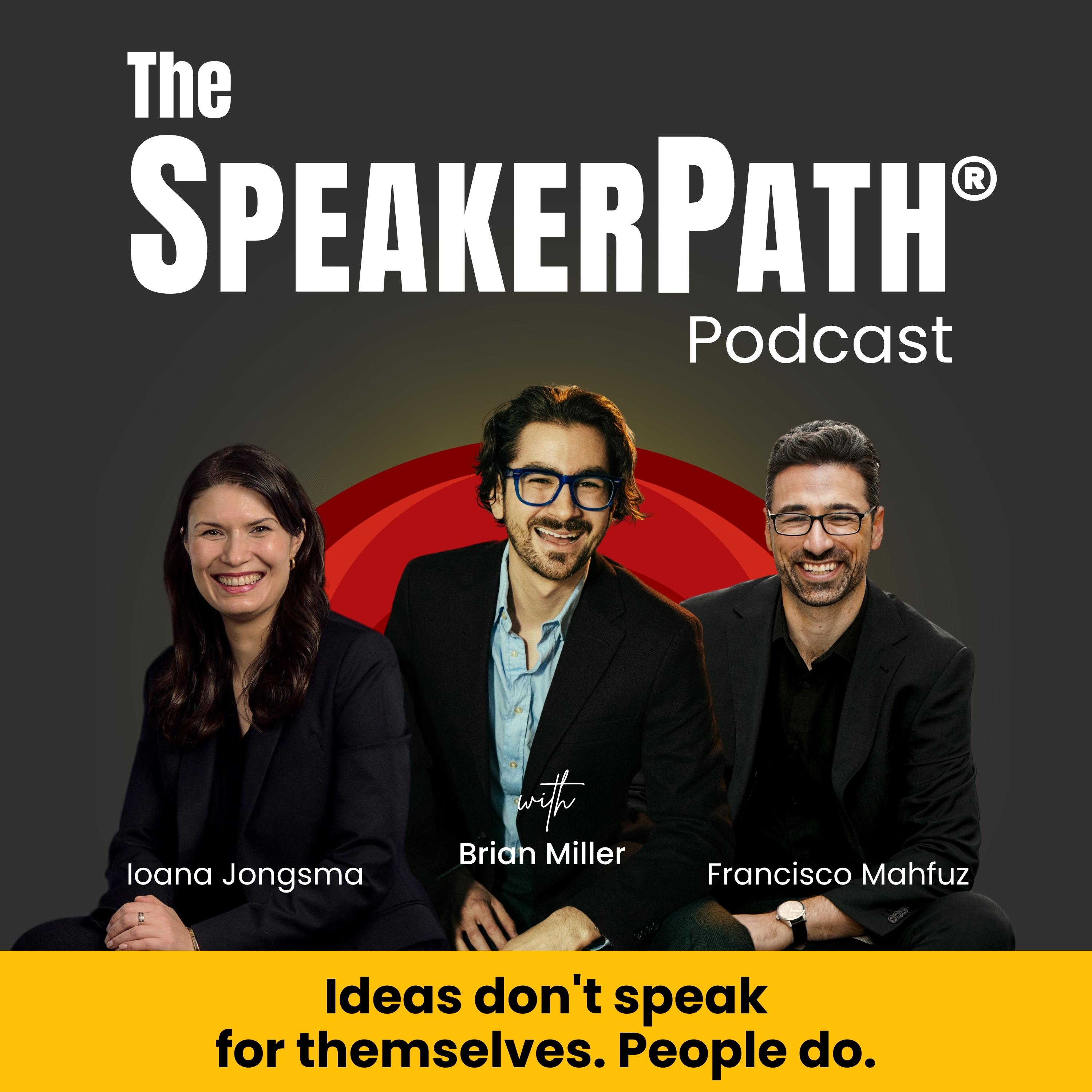
Podcast
The SpeakerPath®
Hosted by Brian Miller · EN
Discover the art and business of professional speaking. Your host is Brian Miller, a former magician turned international keynote speaker and award winning speechwriter, who now runs Clarity Up, a message design firm that teaches experts how to explain their big ideas to the rest of us. Joining Brian is his team of world class consultants, including Francisco Mahfuz, a storytelling specialist, and Ioana (Jo) Jongsma, a presence and performance coach. Together, they'll explore the vast and nebulous world of professional speaking, both on and off stage.
10episodes
Episodes
Newest firstAll episodes
Episode 17: Are You Making These 4 Storytelling Mistakes?
Jan 2600:41:59Tap to summarizeIn this episode of The SpeakerPath® Podcast, Jo Jongsma sits down with storytelling expert Francisco Mahfuz to double click on 4 frequent storytelling mistakes almost all speakers make.Spoiler: most “stories” are not even stories at all!Watch this episode to understand why so many keynotes and presentations fall flat, and how just a few simple shifts can make your stories much more effective.The 4 most common mistakes Francisco highlights are:Trying to tell a story about a whole period of your life instead of one momentSharing only the external problem, not the emotional stakesUsing either too many or too few detailsEnding with “That’s why you should…” (a guaranteed way to lose the audience)You will also learn:Why “Let me tell you a story…” instantly kills impactHow to avoid the “story weirdo” voiceThe difference between storytelling on stage vs. in conversationWhy business speakers over-explain context to prove credibility (and how to fix it)The power of dialogue to express emotion without naming the emotionThe Speaker Path® Podcast is produced by Clarity Up LLC, a boutique message design firm that teaches smart people how to explain their big ideas to the rest of us.Connect with our experts:• Ioana (Jo) Jongsma ( linkedin.com/in/ioana-jongsma/ )• Francisco Mahfuz ( https://www.linkedin.com/in/fmahfuz/ )🔗 LinksWatch Full Episode on YouTube: https://youtu.be/zwyC5phGPC0Work with Us: https://www.clarityupconsulting.com/Join The SpeakerPath Community: https://thespeakerpath.com/Explore the podcast: https://thespeakerpathpodcast.com/
Transcribe →Episode 16: 5 Stress Management Secrets Pro Speakers Know
Jan 1200:17:35Tap to summarizeWe think stress management is something speakers do only once they step on stage. But pros start dealing with it weeks, if not months before their keynote.In this solo episode of The SpeakerPath® Podcast, our Presence and Performance specialist, Ioana (Jo) Jongsma, explores one of the most practical behavioral tools for reducing public-speaking stress: David Rock’s SCARF model.Originally designed for workplace leadership, SCARF turns out to be a powerful framework for communication and speaking. It highlights the five universal social needs that shape how safe or threatened we feel in any social interaction.In this episode, you’ll learn:The 5 psychological needs all humans share:Status - our need to feel important and valuedCertainty - our need to know what is going to happenAutonomy - our need to feel in control of what is happeningRelatedness - our need to feel familiar with what is happeningFairness - our need for a just exchangeThe behaviors that professional speakers engage in days, weeks and months in advance, to ensure their SCARF needs are met.The Speaker Path® Podcast is produced by Clarity Up LLC, a boutique message design firm that teaches smart people how to explain their big ideas to the rest of us.Connect with Jo:• Ioana (Jo) Jongsma ( linkedin.com/in/ioana-jongsma/ )🔗 LinksWork with Us: https://www.clarityupconsulting.com/Join The SpeakerPath Community: https://thespeakerpath.com/Explore the podcast: https://thespeakerpathpodcast.com/
Transcribe →Episode 15: What You Need To Know To Be A Successful Keynote Speaker In 2026
Dec 2900:45:29Tap to summarizeIn this year-end episode of The Speaker Path, Brian Miller, Ioana (Jo) Jongsma, and Francisco Mahfuz unpack the most important industry trends shaping the speaking world in 2026, and what they mean for professional speakers.Drawing on recent reports from AAE Speakers Bureau, Freeman, and Skift Meetings, the conversation reveals a striking disconnect between what event planners believe creates peak moments and what attendees actually remember.Key Takeaways: 1. The “peak moment” gap~78% of event planners believe attendees experience a peak momentOnly ~40% of attendees report actually having one Planners believe peak moments come from:Keynote speechesOpening and closing galas / celebrationsSurprise or “wow” elements tied to theme or location Attendees report peak moments coming from:Relationship-building with vendors and peersReal conversations and networking 2. AI content is becoming an “authenticity red flag”Audiences disapprove of AI-written content in live settings“AI-free” is emerging as an authenticity marker (similar to organic or handcrafted) 3. Event planners are younger, newer, and overwhelmedMany planners are early-career or newly assignedSpeakers who are easy to work with and proactive gain an advantage 4. Budget pressure is reshaping speaker selectionRising event costs (venues, production, services) are pushing organizers away from expensive “big name” speakers and toward proven value, flexibility, and multi-format usefulness. 5. Micro-events are explodingSmaller, curated events (≈10-100 people) are increasing, and changing the speaker’s role.These require facilitation,real time interaction, and intentional experience design.Read the industry reports here: https://drive.google.com/drive/folders/1tuMFmJ3a87GV6NHMWCCI_iZWRy0x7lrX?usp=drive_linkWatch the Episode 15: https://youtu.be/d1HPKu6lH-YThe Speaker Path® Podcast is produced by Clarity Up LLC, a boutique message design firm that teaches smart people how to explain their big ideas to the rest of us.Connect with our experts:Brian Miller ( https://www.linkedin.com/in/brianmillerspeaks/ )Ioana (Jo) Jongsma ( linkedin.com/in/ioana-jongsma/ )Francisco Mahfuz ( https://www.linkedin.com/in/fmahfuz/ )🔗 LinksWork with Us: https://www.clarityupconsulting.com/Join The SpeakerPath Community: https://thespeakerpath.com/
Transcribe →Episode 14: How To Create Real Change From The Stage
Dec 1500:14:46Tap to summarizeMost speakers try to change their audience by offering tips, tricks, hacks, and tactics. But tactics rarely create lasting change. Paradigm shifts do.In this episode, Brian Miller shares the single biggest insight that transformed his 15-year speaking career: a lesson he received from Seth Godin. This approach applies to every expert, speaker, and leader who wants to have real impact on a stage.In this episode, you’ll learn:Why solutions-focused speaking often fails to create meaningful changeHow one sentence from Seth Godin completely reframed Brian’s approach to business and speakingThe difference between keynote speeches and workshops (and why mixing them kills your impact)What a paradigm shift sounds like and how to craft oneHow cross-disciplinary insights (like Brian’s from magic) make your ideas stickWhy the size of the paradigm shift often determines the size of a speaker’s paycheck🔗 LinksWork with Us: https://www.clarityupconsulting.com/ Join The SpeakerPath Community: https://thespeakerpath.com/ YouTube Episode: https://youtu.be/LfH_p5bB8Rw
Transcribe →Episode 13: How To Tell (And Find!) Great Stories
Dec 100:26:48Tap to summarizeThe real storytelling problem most speakers have is not “how do I tell a story?” but “where do I find one?” In this episode of The Speaker Path® Podcast, Jo Jongsma invites story expert Francisco Mahfuz to break down what a story actually is (hint: not a string of events!), why “tell me a story” instantly freezes your brain, and how to use simple prompts like first / last / worst / best to surface stories you already have but don’t recognise as stories. We look at why everyday frustrations, small imperfections, and throwaway kid quotes are often better material than dramatic Everest-style adventures – and how to start capturing those moments so you always have the right story for your next talk, pitch or TEDx-style talk.You’ll learn:What a story really is in a professional context: a real-life example that makes a point.Why “tell me a story” creates instant performance anxiety, and what to ask yourself instead.The biggest obstacle most speakers face: not telling stories, but finding them.How to use the “First, Last, Worst, Best” method to uncover powerful origin stories and client stories.Why the best speaking stories are usually pebbles in the shoe, not Mount Everest – small, relatable moments from everyday life.How to turn annoyances, awkward interactions, and imperfections into highly relatable material.The simple checklist for crafting a story that worksWhy you must “find the story first” before worrying about structure, frameworks, or delivery.A simple daily habit to build your story bank.The Speaker Path® Podcast is produced by Clarity Up LLC, a boutique message design firm that teaches smart people how to explain their big ideas to the rest of us.Connect with our experts: • Ioana (Jo) Jongsma ( https://www.linkedin.com/in/ioana-jongsma/ ) • Francisco Mahfuz ( https://www.linkedin.com/in/fmahfuz/ )🔗 LinksWork with Us: https://www.clarityupconsulting.com/Join The SpeakerPath Community: https://thespeakerpath.com/
Transcribe →Episode 12: Speaker Coaches React: Esther Perel, Robert Waldinger, and Marilyn York
Nov 1700:48:28Tap to summarizeWhy do some viral TED/TEDx stories hook us instantly while others stall in the first minute?In this episode, speaker coaches Ioana (Jo) Jongsma and Francisco Mahfuz react to three viral TED/TEDx talks—Esther Perel, Robert Waldinger, and Marilyn York—showing what hooks, what drags, and how to fix it. You’ll get practical moves to open strong (or set the premise first), tighten pacing, and turn research into human stories with dialogue, specifics, and metaphor.You will learn:How dialogue and specific scenes boost attention and recallThe fast way to cut a story by 30 seconds or moreTurning research into narrative, conflict, and characterThe connecting line that links a personal story to your premiseWhen a sharp metaphor can carry the pointWatch the clips featured in this episode:Marilyn York — What Representing Men in Divorce Taught Me About Fatherhood. Esther Perel — Rethinking infidelity … a talk for anyone who has ever loved. Robert Waldinger — What makes a good life? Lessons from the longest study on happiness.🎥 Watch this episode on YouTube: https://youtu.be/uC24Gt4uzes🎙 The SpeakerPath Podcast is from Clarity Up, a boutique message design firm that teaches smart people how to explain their big ideas to the rest of us.Connect with our hosts:Ioana (Jo) Jongsma: https://www.linkedin.com/in/ioana-jongsma/Francisco Mahfuz: https://www.linkedin.com/in/fmahfuz
Transcribe →Episode 11: How We Survived Our Biggest Speaking Flops
Nov 300:38:13Tap to summarizeFailure happens on stage and off.In this roundtable, Brian Miller, Ioana (Jo) Jongsma, and Francisco Mahfuz share their most painful speaking fails from a joke that died in the opening line, to a mass walk-out mid-talk, to offending a client with a poorly framed stat, and the exact fixes they use today. You’ll get practical tools to prevent repeats, recover in the moment, and turn misses into material.What you’ll learn: Why opening with humor often backfires (and how to signal it so it lands)Where to test new material (hint: never first or last)How to use stakes and statistics without triggering guilt or defensivenessReading the room: audience, culture, and context cues to adjust on the flyThe “great talk, no bookings” trap and how to set success metrics upfrontSimple recovery lines and pivots when the room goes cold (or leaves)🎙 The SpeakerPath® Podcast is from Clarity Up, a boutique message design firm that teaches smart people how to explain their big ideas to the rest of us.Connect with our hosts:Brian Miller, Founder & Principal Messaging Consultant:https://linkedin.com/in/brianmillerspeaksIoana (Jo) Jongsma, Presence & Performance Coach: https://www.linkedin.com/in/ioana-jongsma/Francisco Mahfuz, Story Specialist & Lead Consultant: https://www.linkedin.com/in/fmahfuz
Transcribe →Episode 10: Speaker Coaches React: Joe Risser, Jess Ekstrom, and Valorie Kondos Field
Oct 2001:01:21Tap to summarizeWhat makes a killer opening line and why do even great speakers lose us in the first minute?In this episode of The SpeakerPath Podcast, Brian Miller and Jo Jongsma react to three real TED and TEDx openings. From a dramatic “plank” intro to a story about ice cream, to a world-class coach redefining success, they break down what works, what doesn’t, and why your very first sentence might decide whether the audience stays with you.Watch the clips featured in this episode:Joe Risser, MD, MPH talk: https://www.youtube.com/watch?v=rNxC16mlO60Jess Ekstrom talk: https://www.youtube.com/watch?v=MT2q1YKZQPE&tValorie Kondos Field talk: https://www.youtube.com/watch?v=JJyeKiT8g4g&What you'll learn:Why the first line of your talk matters mostJoe Risser’s “plank” opening: performance vs. presenceWhat loses engagement after a strong startJess Ekstrom’s ice cream story: conversational but powerfulMissed callbacks, stakes, and open loopsValorie Kondos Field: credibility, authority, and the spoiler problemKey takeaways: how to earn attention without losing connection🎥 Watch this episode on YouTube: https://youtu.be/i9InDjL6GsU🎙 The SpeakerPath® Podcast is from Clarity Up, a boutique message design firm that teaches smart people how to explain their big ideas to the rest of us. Visit https://clarityupconsulting.com to learn how to speak like you, but better.Connect with our hosts:Brian Miller: https://linkedin.com/in/brianmillerspeaksIoana (Jo) Jongsma: https://www.linkedin.com/in/ioana-jongsma/
Transcribe →Episode 9: Speaker Coaches React: Scott Galloway, Josh Radnor, Codie Sanchez
Oct 600:16:27Tap to summarizeWhat can you learn from watching famous speakers even if you don’t like their style?In Episode 9 of The SpeakerPath Podcast, Brian Miller and Jo Jongsma sit down to watch and react to clips from Josh Radnor, Codie Sanchez, and Scott Galloway. From polished actors to business leaders, they unpack the choices each speaker makes in front of an audience, the strengths, the flaws, and the lessons that matter for anyone preparing their next talk.Full episode: https://youtu.be/Rt5hTFK7ajcWatch the clips featured in this episode:Josh Radnor Talk – https://youtu.be/Jr7MkrHDGt0?si=NYHP24sM5KLOzr7T Codie Sanchez Interview – https://youtu.be/N6LjeRSDXdU?si=L8ES7YiewYk77l9l Scott Galloway Talk – https://youtu.be/qEJ4hkpQW8E?si=XAKTr-d5NBKk_57t You’ll learn:Why even seasoned performers show nerves on stage (and how they handle it)The power of posture, gesture, and voice in shaping presenceHow warmth (or the choice to withhold it) changes audience connectionWhy clarity of speech is as important as confidenceHow to separate what makes someone famous from what makes them effective🎙 The SpeakerPath® Podcast is from Clarity Up, a boutique message design firm that teaches smart people how to explain their big ideas to the rest of us. Visit https://clarityupconsulting.com to learn how to speak like you, but better.Connect with our hosts:Brian MillerIoana (Jo) Jongsma
Transcribe →Episode 8: How Speakers Can Prepare For Panels and Fireside Chats
Sep 2200:40:31Tap to summarizeWinging it doesn’t work.Panels and fireside chats may feel like casual conversations, but when you’re on stage with a mic, the audience deserves more than whatever comes to mind.In Episode 8 of The SpeakerPath Podcast, Brian Miller and Jo Jongsma break down how to prepare for these formats using core messaging. They explain why “speaking from the heart” only works if you’ve rehearsed your message, how to adapt your talking points for short time slots, and how to make every answer clip-worthy for the audience in the room and the replay.What you’ll learn:Why panels and firesides are harder than they lookThe difference between sounding rehearsed and being well-preparedHow to define your premise and make it relevant to any audienceWhy every answer should be short enough to stand alone, but expandable when neededA practical editing process to refine your answers from ten minutes down to one sentence Tricks to stay authentic while keeping structure🎙 The SpeakerPath® Podcast is from Clarity Up, a boutique message design firm that teaches smart people how to explain their big ideas to the rest of us.Connect with our hosts:Brian MillerIoana (Jo) Jongsma
Transcribe →