← The Ultimate Human with Gary Brecka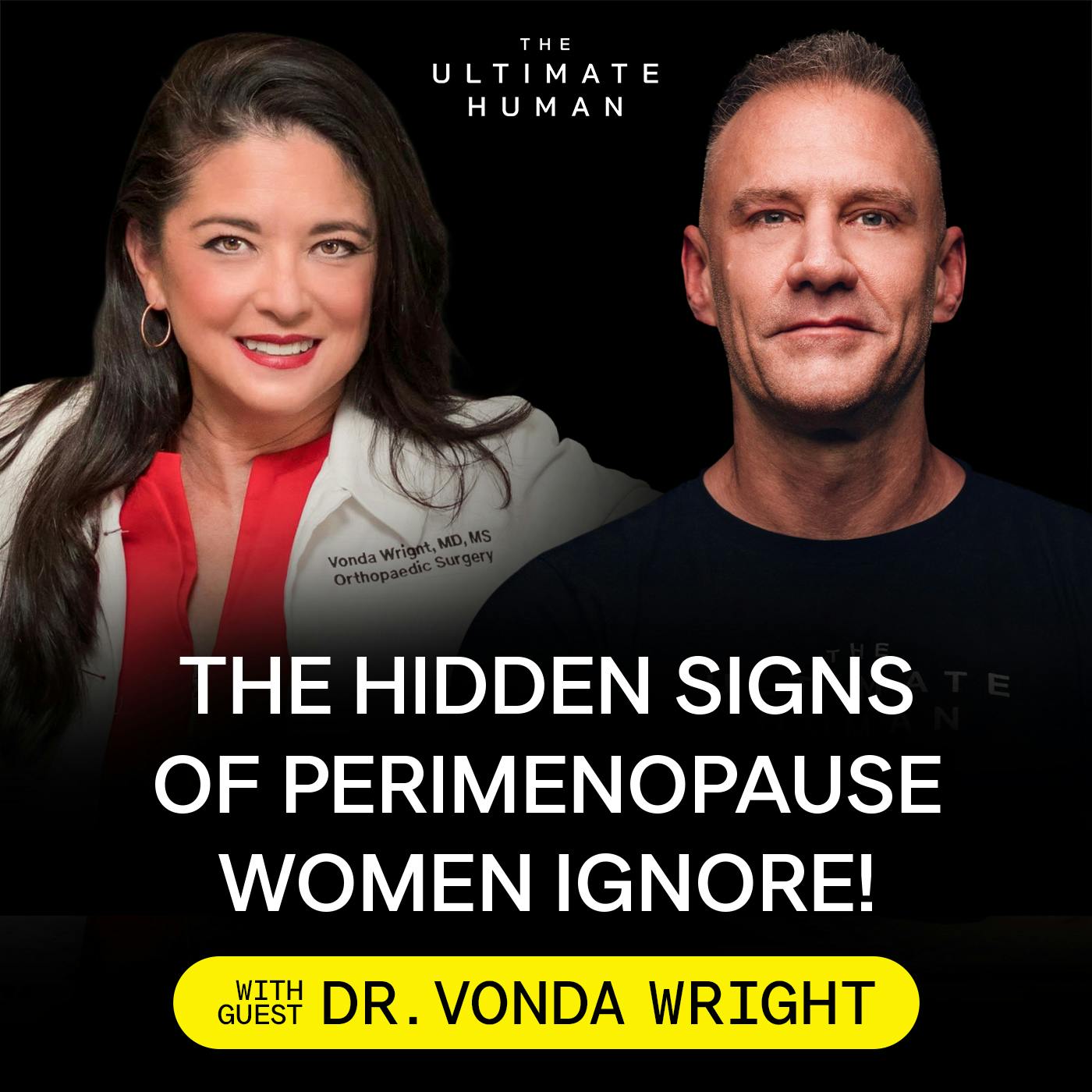
The Ultimate Human with Gary Brecka
215. Dr. Vonda Wright: On Menopause, Women’s Hormone Therapy, and Perimenopause Symptoms
01:03:01
Loading summary
Transcript212 lines
- [00:00]
Dr. Vonda Wright
You can decrease the odds by 60% of the following diseases by starting hormones earlier in perimenopause, stroke, cardiovascular disease, heart attack, brain death and osteoporosis.
- [00:13]
Gary Brecket
There is a temporal disconnect here that I will worry about that when I need to worry about it. Starting earlier is really. Prevention is the best medicine.
- [00:21]
Dr. Vonda Wright
Listen, I can help anybody, 50, 60, 70 year olds. But if you truly want to get in front of prevention, the critical decade, people 35 to 45 need to wake up. It is time to get your health standards together. Not something weird that we do for six weeks. It's just how we live.
- [00:38]
Gary Brecket
But I think this is just such a powerful message that you don't have to suffer to be natural. As a woman, you should be in a position to thrive all the way through your 50s, 60s, 70s.
- [00:48]
Dr. Vonda Wright
Listen to me, Gary. How passionate I get. It is a war cry, a mantra to me that I am going to save the health of the women coming.
- [00:55]
Gary Brecket
After me, having had such an intimate experience with it and how it revolutionized my wife in such a short period of time. How soon can a woman reasonably start hormone therapy, estrogen, pregnenolone supplementation?
- [01:08]
Dr. Vonda Wright
If we're truly interested, Gary, in preventive health for women.
- [01:22]
Gary Brecket
Ultimate Human hey guys, welcome back to the Ultimate Human podcast. I'm your host, human biologist Gary Brecket, where we go down the road of everything, anti aging, biohacking, long longevity and everything in between. And today is a really special, special session because we're coming to you live from Riyadh, Saudi Arabia, with my guest that I am so excited to have on. I don't say this very often. You can go back and look at all my podcasts. I am a big fan of your work and so is my wife. She was super excited about this podcast. She's starving, so she's eating right now and then she's going to come sit in with us. But welcome to the podcast, Dr. Vonda Wright.
- [02:02]
Dr. Vonda Wright
Thank you so much for having me.
- [02:03]
Gary Brecket
And I'm going to take it easy on you today because it's 3:30 in the morning, our time.
- [02:07]
Dr. Vonda Wright
That's right.
- [02:08]
Gary Brecket
You're from Orlando, I came from Miami. So we're on the same time zone. And I just checked the time like, okay, it's 3:30 in the morning. I don't think I've ever done a podcast at 3:30 in the morning. But you're holding up pretty well.
- [02:19]
Dr. Vonda Wright
I'm doing great. And how ironic that we're practically neighbors in the United States and we've flown 5,000 miles to sit across from each other.
- [02:26]
Gary Brecket
I was talking to the team about that this morning. I'm like, why is it that we're landing so many of these guests and we're halfway around the world? You know, But I'm glad that we got a chance to do this. You know what I love about your work, I mean, you're, you're a board certified orthopedic surgeon, clearly qualified. But what I love about your work is you're, you have this very back to the basics approach and you're not afraid to talk about weightlifting for women, diet, sleep, you know, exercise, mobility, those things that we have big data on that we really just can't overlook.
- [03:00]
Dr. Vonda Wright
Yes.
- [03:01]
Gary Brecket
You know, I think in this space that you and I are both in, you know, the biohacking longevity space, whatever you want to call it, so often people are looking for that magic pill.
- [03:10]
Dr. Vonda Wright
Yes.
- [03:10]
Gary Brecket
Like, is it nad, is it nmn, is it this special type of resveratrol? You know, what is the secret to life extension? And the truth is there's some of the basics that you just can't get around.
- [03:21]
Dr. Vonda Wright
Well, you know what's interesting as a practicing surgeon, people come to me and what they're asking me for are all the gadgets, the longevity things, the evidence influenced things. But they come to me in what I call fine. Their health is, how are you today? I'm fine with that. I'm just tired and fine. And so I think, having taken care of nearly 100,000 people in my career, I've come to understand that if I take you from fine to doing all the things that we know work and have known work, the things you've just mentioned, and we optimize your health, then I can apply the same things I apply to pro athletes and executives because I'm a sports surgeon. Right. So my whole career has been optimizing performance in the performers. Then I can apply to you those principles. And then when you are at peak performance, of course, then I'm gonna reach into the longevity world and do all the secret sauce things that we're just discover. But I tend not to want to jump to this until we're optimized, because I feel like we're skipping steps.
- [04:37]
Gary Brecket
I agree with that. And in your experience, where are the vast majority of people getting it wrong when they say that they're fine? Usually what they'll do is they'll just chalk it up to a consequence of aging or a consequence of their environment or their stress or their spouse or their kids or their career. But I found that it's usually not any of those things. You know, it's usually the absence of a lot of the basics. But where do you find that the vast majority, men and women that are coming to you that say they're fine, what are they getting wrong?
- [05:06]
Dr. Vonda Wright
I think they feel good enough today. Right. They're able to get up and just go through their daily routine with their health and their future as an afterthought. Somehow we've prioritized the carpool or the next meeting or the, the next deal as from a temporal perspective, like today, more important. But there's this concept in banking I learned from the bankers. It's called temporal disconnect. And in the banking and finance world, it means that on average they can't get anybody to save $10 for their future. Right, Right. Well, from a health perspective, if we're feeling fine today, it's good enough today. We can't bank the health for the future. So what I try to do is help people identify what it's gonna take to feel amazing today, not just fine. I want you to feel vibrant today because that, my friend, is addictive. That is what people will come back to. Not some remote promise of 150 years which we'll probably get to based on science and, and all the things we're learning. But if I can make you feel optimized today, that is why you'll come back.
- [06:26]
Gary Brecket
That's amazing. And where do you start with them? I mean, do you do. Because I think this whole term lifestyle medicine is, is a term that I've really fallen in love with. Because rarely if you've ever gone to see a physician do they ask you anything about your lifestyle. I mean, you have hypertension, you have poor sleep, you have weight gain, water retention, brain f. Have all these consequences going on and no one ever says, well, are you sleeping? Yeah. How are you sleeping? Or what are you eating on a daily day? You know, walk me through your day. You know, are you moving other than to just get in the car and the kids to school or to get between your home and your office? And so where do you start with them? How does that assessment look for you?
- [07:09]
Dr. Vonda Wright
In my own practice, whether honestly it's, I have separated out my time, whether it's my orthopedic practice, and I'll give you an example, or whether it's my midlife menopause or my precision longevity practice. We always assess where you are now. So I'll give you an orthopedic example of taking care of the whole person. And we can go into why many doctors can't do the whole person approach if you want to. And it doesn't have to be due with our desire. It frankly has to do with time.
- [07:41]
Gary Brecket
But time and compensation.
- [07:42]
Dr. Vonda Wright
Time and compensation, if we're honest about it. So if a woman comes to me and she has the dreaded frozen shoulder, which means, oh my gosh, my wife had that.
- [07:52]
Gary Brecket
So I want to go down this rabbit hole. Awful.
- [07:55]
Dr. Vonda Wright
So what happens in frozen shoulder? It's an inflammatory response to midlife or inflammation, obviously, because it also happens in people with diabetes. But how it presents is out of nowhere. Gary. Nothing happened. You did not bang your shoulder into the door, you did not work out hard, you have quick onset of excruciating pain, unbelievable, unrelenting, and you cannot sleep. And then with very short amount of time, you can't move your arm.
- [08:25]
Gary Brecket
Right.
- [08:26]
Dr. Vonda Wright
It's this motion people come in with.
- [08:28]
Gary Brecket
That's exactly what happened to my wife. I mean, exactly what happened to your.
- [08:31]
Dr. Vonda Wright
Life in a quick amount of time. So when a person comes into my orthopedic clinic and I know, I read a 46 year old woman, shoulder pain, almost without pause, I know what's going on. So I'll go in the room and I'll say, how can I help you today? But I do not focus on the shoulder. First we talk about the fact that she's 47 or 46 and how are you sleeping and what else are you feeling? And because I am interested in helping her identify that she is in this critical time period of her life when her ovaries are stopping their production of estrogen and things are changing, if I were to do the typical thing, which is just say, oh, your shoulder's not moving, you've obviously got a frozen shoulder, let me give you an injection, send you to therapy, blah, blah, blah, I miss the whole picture and I'm not taking care of the whole person. And so for me, my style of orthopedic surgery is taking care of the whole person. So we're talking about how the fact they're not sleeping, they're anxious, they've never been anxious, but all of a sudden they feel different. And within five minutes, Gary, of starting a whole person approach to the frozen shoulder. These women are crying in my office. And it's not because I'm the meanest doctor they've ever seen. It's because finally, finally they feel heard and seen. And it's so hard and almost without almost to a woman, Gary. And men say this to Me too, because I take care of both men and women. But people will say to me, but you know what? I have a very high pain tolerance. Because there seems to be some badge of honor that is handed out on the. Oh, I've got a. They say I have a very high pain tolerance. And I thought, I could do this. I didn't want to come. But the reality is people wait and wait and wait and suffer when we could have intervened really early. And so I think that's why, coming in with a frozen shoulder, treating someone like a whole person and not a body part, they are quickly telling me about how they really feel and crying sometimes.
- [10:52]
Gary Brecket
Yeah, no, that was my wife.
- [10:54]
Dr. Vonda Wright
I feel like that is the way people deserve to be treated as not a sum of body parts, whether it's your liver, your pancreas, or your heart or your shoulder. Does that make sense?
- [11:04]
Gary Brecket
You know, it was interesting because I was not. I wasn't aware of the relationship between menopause and frozen shoulder. And so we sent her for an mri and she had adhesive capsulitis. And of course, the first thing that that orthopedic did was say, well, we can do manipulation under anesthesia. I can break up all these.
- [11:21]
Dr. Vonda Wright
Yeah, but you don't need to do that.
- [11:23]
Gary Brecket
I know. Thank God we didn't.
- [11:24]
Dr. Vonda Wright
Okay.
- [11:25]
Gary Brecket
And I, you know, we did. We decided to go down the road of. Of taking a deep dive into the hormones. We did a Dutch test, and. Which I'm sure you're familiar with. But what was fascinating about this test was it just showed the complete collapse of not just the hormones, but also some of their precursors. Pregnenolone was zeroed out. Her cortisol was completely floored out, so it wasn't rising in the morning at all. In fact, her melatonin was off the charts in the morning. So she was waking up with a high amount of melatonin and virtually no cortisol response. She had no pregnenolone, so aldosterone, cortisol were all off because of that. And. And so we began to go down the. The course hormone road, which. Which I will tell you, was life changing for us. Within weeks, her shoulders started to thaw, and it's completely thawed now.
- [12:22]
Dr. Vonda Wright
Yes.
- [12:22]
Gary Brecket
I mean, she can.
- [12:23]
Dr. Vonda Wright
Should we talk about that?
- [12:25]
Gary Brecket
I definitely want to talk about that. If nothing else, I'll just keep this podcast for my wife because she'll. She'll appreciate it. I'll get brownie points with Sage. But yeah, and. And. And you and I talked about it beforehand. I want to Go down this road for sure, because there's so many women listening to this and I think there's a understanding of that time frame.
- [12:43]
Dr. Vonda Wright
I want people to understand the biology of what's going on. Yeah.
- [12:47]
Gary Brecket
And also maybe we can talk a little bit about dispelling some of the myths of the link between estrogen and breast cancer. Oh, let's do a lot of fear around that. One of the things that we discussed before the camera st started rolling was I found those studies too, and actually followed the very same study that linked breast estrogen at the time to breast cancer, decoupled it and fell in the polar opposite camp that there was actually a reduction. And I think there's a lot of women listening to this and a lot of husbands that are curious about this too. For their wives. Is the hormone therapy a viable option? If you know me, you know I'm a huge believer in the benefits of hydrogen water. H2TAB delivers cost effective portable tablets that generate ultra clean molecular hydrogen at 12 parts per one of the highest concentrations on the market. With over 1300 published studies showing benefits of oxidative stress, energy recovery, brain function, and so much more, taking charge of your health has never been easier or more cost effective. Just drop a tablet in water, let it dissolve and drink it back. It's less than a dollar a day, science backed, and part of my daily routine. I never travel without this and it is my favorite biohack. Visit drinkh2tab.com that's drinkh2tab.com and upgrade your hydration today. Now let's get back to the ultimate human podcast.
- [14:18]
Dr. Vonda Wright
Well, let's. Do you mind if we start back at why this even happens? Why does this even happen? So I think the fascinating, almost legendary thing that happens when you birth a female baby, a baby with XX chromosomes, is housed within her eggs, her ovary, her ovaries are all the eggs she will ever have. More than two. Fascinating. Isn't that fascinating?
- [14:43]
Gary Brecket
It is still fascinating.
- [14:44]
Dr. Vonda Wright
So the legacy of your entire family exists within the ovaries of these baby girls that we have. Right. So it's the natural history of ovarian life that you know. And to contrast it, the analogous structure in an XY person, a male, is testicles. But you build 1500 sperm a day or a minute. It's rapid. Right. A female child is born with all the eggs. The natural history is that by puberty we've lost a large percent of those. And then what we are designed to do, which we don't always do, is every month, cyclically as hormones predictably rise and fall, we use and exhaust a percentage. But here is why midlife is so profound for women and so different between men and women. Because it is wrong to say that the physiology of men or women are the same. My own data show down to the stem cell level that they're different. So by the time a woman reaches 35 to 40, you start to not feel like you've always felt. Because we have less than 1% of our eggs left. Estrogen, by and large, a very tiny percent, is made in the adrenals. But most of a woman's estrogen is made in the follicle or the eggshell of an egg. So when you have so few, you're just not producing the same level, healthy levels you've always produced. And the reason that's important, and if there's one of several things I want your audience to walk away with, is estrogen, progesterone and testosterone are not sex hormones. They are hormones. Just like thyroid hormone or any hormones our body makes. They're not specifically sex hormones. There are estrogen receptors, alpha and beta, on every tissue of the body. So imagine every tissue in the body becomes rapidly starved of one of its key ligands, of one of its key signaling pathways. For all the good things such that we know from the work of Lisa Moscone and Robbie Brinton that without estrogen, your brain not only starves, but changes its chemistry. The heart, without the influence of estrogen, has 30 to 40% more microvascular disease. And I'm an orthopedic surgeon. Let's talk about bone. We will lose 20% of our bone density in the time between perimenopause and menopause. Wow. These are profound, profound biologic changes. So we started this conversation talking about frozen shoulder. Why do people walk in so inflamed? Why are women so inflamed in midlife? It's because estrogen is a profound anti inflammatory. So when women walk into my office bringing it back and we take the time to listen, how are you sleeping? What's your brain doing? How do you feel in general? And they say, I don't feel like myself anymore. From a human biology standpoint, it makes so much sense. If every tissue in your body is affected, it makes sense that we should be having longer conversations about the restoration of the most natural way of living, which is with estrogen. It's not a byproduct, it's not something we should suffer through. If we're truly interested, Gary, in preventive health for Women, we must talk about estrogen and we must talk about it earlier. Because my generation of women, I'm a generation Xer, you know, baby boomers have lost out because of this study. X ers are not sitting down. We are going to change the future so that millennials and my 17 year old daughter, my 18 year old daughter will never starve our brains, we'll never have 60% more microvascular disease in our hearts. We'll not lose our bone density so that we end up frail. It's almost. Listen to me, Gary. How passionate I get. It is a war cry, a mantra to me that I am going to save the health of women coming after me.
- [19:11]
Gary Brecket
And it's so astounding because I think it starts a lot earlier than now that I've been. I, I'm, I went through it with, with my wife. So I'm way more familiar now than I was before. And what seemed like this rapid collapse, I mean the, the, the frozen shoulder was the peak where we're like, okay, we are going to come to a full stop and we're going to fix this. But when we started backing things up, just like what you're talking about, the brain fog, mood numbness, loss of libido, short term, I don't want to say short term memory issues, because that sounds too.
- [19:48]
Dr. Vonda Wright
But no, I lost my nouns.
- [19:50]
Gary Brecket
Yes, exactly. That's what I mean.
- [19:52]
Dr. Vonda Wright
I lost my nose.
- [19:53]
Gary Brecket
I like to mention Alzheimer's. It's, it's just like fumbling a little bit like the words that, you know, she would say, it's just right on the top.
- [20:00]
Dr. Vonda Wright
It's right here.
- [20:01]
Gary Brecket
It's right here and I can't get it out. You know, I, you know, childhood best friends that I haven't talked to in a while and I would be talking about a story with them and then their name would escape me. And you know, so she was like. And my wife is on her game. I mean, we built a business together. She's very detail oriented. She's a list taker. She's, she's very structural about the way that she goes about her day. Extremely organized. And then all at one time. Yeah, just unraveled. And, and it was astounding to me how fast the genie went back in the bottle.
- [20:33]
Dr. Vonda Wright
Oh yeah.
- [20:34]
Gary Brecket
Once we addressed it, like, I mean, I've got to say, you know, women, if you're listening and you're suffering from this, you know, get a really good hormone test. Go see a practitioner that understands this because it was life changing and I.
- [20:47]
Dr. Vonda Wright
Want women to be literate themselves. I think gone are the days, long gone are the days. Maybe when I started practicing medicine, we were still in it, but gone are the days when a person can just blindly take advice. I encourage all people, men and women, to become experts in their own health, to become literate citizen scientists. That's right. To understand so that they can make the best choices for themselves and to do it early. Right. To your point, we think perimenopause can, which is the time when we have so few eggs, can start in their 35. Who would suspect while we're still having children? But many women we understand now, including myself. I had my last child when I was 40. Go right from post partum to perimenopause and wow. But I don't. I'm going to say this now because we're going to unpack it, but I want women listening to understand that it's. You can feel better again. I mean, I, I, in a silly way say I went from menopause misery to midlife mastery. I have mastered this. Yeah, I am back in a way. I like that. Yeah, I am back in a way.
- [22:01]
Gary Brecket
That I always, I get 15% of it because you said it on my podcast. But that's.
- [22:07]
Dr. Vonda Wright
Listen to you.
- [22:07]
Gary Brecket
Menopause misery to midlife mastery. I love it.
- [22:10]
Dr. Vonda Wright
Yeah. Yeah.
- [22:11]
Gary Brecket
And so these, these women that are listening now, 35, 37, 40, because I think we have mistakenly put menopause much further into our future. And we think I'll start worrying about that in my late 40s, maybe even my early 50s, and I'll just address it then. And these subtle changes that are sort of stacking on top of each other, you know, I liken it to tearing pages out of a phone book. Right. They're not, it's, it's not like you all of a sudden go off a cliff. It's just, you know, I can't find my keys in my wallet and then.
- [22:45]
Dr. Vonda Wright
I don't feel like myself, feel like myself.
- [22:48]
Gary Brecket
And kind of, you know, libido sort of starts to leave the building and, and I notice too, like a little bit of flattening of the mood. Not like a flat affect, but I mean, mood numbness. Right. The peaks and valleys wasn't like running around just always and, but like the elation, the passion, the arousal, the joy, you know, that's sort of flattened out too. And I think the sad thing is that a lot of these are consequences or scenarios that women can push through, they can live with. It doesn't drive them to the er. Right, right. It's not taking you to the urgent care. And so these pages keep coming out of the phone book. Right. And pretty soon you're an inch through. I'm dating both of us, by the way, because we both know what a phone book is. Yes.
- [23:33]
Dr. Vonda Wright
The Yellow Pages.
- [23:33]
Gary Brecket
The millennials are like, yeah, we don't know what the yellow Pages are, but. And then all of a sudden, it's to the point where it can be disrupting relationships, it could be disrupting career completely.
- [23:46]
Dr. Vonda Wright
Well, you've brought that up a couple times, and I think it's so critical. And I love that we're recruiting male experts into this conversation, because several studies have been done that show that up to 70% of all midlife marriages that end a divorce, at least partly, can be attributed to a lack of understanding about these changes. Because if a man doesn't understand that, it's not that his spouse doesn't care for him anymore, it's all these biological things going on, and she doesn't want to talk about it, and he just assumes that it's a caring issue. I mean, so if we could save marriages that have gone on for 20, 30, 45 years, for sure, that are ending in midlife, that's work worth doing. Even as an aside, I totally agree with you.
- [24:36]
Gary Brecket
You know, and I think very often we. We attach love and attraction to arousal and libido, and they're very different things. You can be deeply in love with your spouse, you can be very attracted to your spouse, but you don't have arousal or libido because of these changes going on. And it doesn't mean that you're now disinterested in your spouse or you're any less attracted them or love them any less. But I think because we lump all of those together, we think very often if libido and arousal leave the marriage or they are less frequent, that that all of a sudden means my spouse doesn't love me anymore, they're not attracted to me anymore.
- [25:13]
Dr. Vonda Wright
You know, but when you think about it biologically, you know, people at the forefront of sexual health, like Kelly Casperson and Rachel Rubin, talk about estrogen, progesterone, and testosterone not as systemic hormones, which they are obviously, but almost as neurotrophic hormones. Right. I mean, libido comes from the brain. I mean, I'm not an expert at this. It happens in the brain first, then it happens physiologically. But it's an interesting point you make that, that these relationship type changes that happen because of physiology are actually attitudinal they're psychological, their brain functions. And so to call these hormones to recognize that they're neurotrophic hormones working in the brain makes so much sense.
- [26:12]
Gary Brecket
If you want protein to build lean muscle, but without the caloric impact or need to cut, you need perfect amino. It's pure essential amino acids, the building blocks of proteins in a precise form and ratio that allows for near 100% utilization in building lean muscle and no caloric impact. So we build protein six times as much as whey, but without the excess body fat we normally get during bulking. This is the new era of protein supplementation, and it's real. If you want to build lean muscle without having to cut, you need perfect amino. Now let's get back to the ultimate human podcast. I've been deep down the rabbit hole of it. I mean, you know, fascinated by. Because I'm a human biologist, and I really believe that physiology is where the answer lies. And very often when you just deprive the body of certain raw material.
- [27:03]
Dr. Vonda Wright
Right. This is a raw material.
- [27:06]
Gary Brecket
Yeah. A primary messenger, you get the expression of that disease. You know, you're. You're an orthopedic. I mean, we. I spoke recently at a conference for osteostrong, which is a.
- [27:16]
Dr. Vonda Wright
Yes, I know.
- [27:17]
Gary Brecket
You know, bone density machines that actually, you know, load the bones for bone density. It was fascinating to me how many folks that were there, you know, still were under the auspice that bones were made of calcium, and bones are calcium combined with phosphorus and. Which makes hydroxyapatite. But in order for these to combine, you need these 12 minerals. And. And so deficiencies in these nutrients have consequences in brittle bones. And it's not just the absence of the load. It's also the absence of the mineral requirements to assemble the bone. And for women, when you think of emotion, it's like, well, how do you assemble emotion? Well, I mean, just like you said, your hormones are signaling molecules. And so when your emotions are off and your mood is off, you're not developing a mental disorder, a mood disorder, or emotional illness. You know, you're missing raw materials.
- [28:13]
Dr. Vonda Wright
You're missing raw materials. That's right. Yeah. It's very analogous to bone.
- [28:16]
Gary Brecket
Yeah. And so putting them back can be just phenomenal. So when you do this assessment with. With a woman, even in perimenopause, which I'm really glad that you pointed out could happen in the 30s, because I don't think most women in their 30s are even thinking about this. I love the fact that you talk about Bone density in the 30s, too. You're like, hey, you better get busy now. So you don't have osteopenia.
- [28:35]
Dr. Vonda Wright
Yeah. Osteoporosis is not it. Man is a disease that manifests in old age, but it begins in your teen years.
- [28:43]
Gary Brecket
Yeah. So, you know, I had two grandmothers that had fractured hips.
- [28:49]
Dr. Vonda Wright
Yes.
- [28:49]
Gary Brecket
I was lucky enough to be alive and have a great grandmother for a while, but also my grandmother. What was fascinating to me, and people should really listen to this, is that in both cases of their hip fractures, we found out that their hip fractured and then they fell.
- [29:09]
Dr. Vonda Wright
Yes.
- [29:09]
Gary Brecket
They didn't fall and break their hip.
- [29:11]
Dr. Vonda Wright
That's right.
- [29:12]
Gary Brecket
My. My grandmother was actually at the. At a sink washing dishes.
- [29:18]
Dr. Vonda Wright
So common.
- [29:19]
Gary Brecket
And her femoral neck broke.
- [29:20]
Dr. Vonda Wright
Yes.
- [29:20]
Gary Brecket
And. And she fell. And they said, oh, grandma fell and broke her hip. And then we found out from the ortho.
- [29:26]
Dr. Vonda Wright
No, actually, it broke and then she fell.
- [29:28]
Gary Brecket
Broke, and then she fell. I remember when I was in the mortality space. Now, we didn't.
- [29:33]
Dr. Vonda Wright
With insurance.
- [29:34]
Gary Brecket
No, this. With insurance that. You know, this hip fracture, we called it a triad of death because it was a very quick acceleration to the grave. And I think I realize now that it wasn't the actual fracture that accelerated to grave. It was just the representation. The skeletal system cannot even support its own weight.
- [29:52]
Dr. Vonda Wright
Yes.
- [29:52]
Gary Brecket
Right. I understand. If you fall down a flight steps.
- [29:56]
Dr. Vonda Wright
And you get traumatic. Is very different than a traumatic. Right.
- [30:00]
Gary Brecket
So I'd love to unpack that too. Let's talk about bones, because, you know, there's gotta be connection between this hormonal depletion, you know, perimenopause and loss of bone density, because men don't suffer the same consequences until much later.
- [30:15]
Dr. Vonda Wright
Much later. I mean, 2 million men in the United States have osteoporosis. But to your point, we'll just do men first. Men.
- [30:22]
Gary Brecket
Yeah, let's get us out of the way.
- [30:23]
Dr. Vonda Wright
Yeah, let's get the men out of the way. Because of the way testosterone interacts with the bone. I mean, men will see osteoporosis at 50 if you have a metabolic disease, and after 70, almost 80 from true osteoporosis. And then men have a 30% and women have a 30% chance of dying in the first year. And we'll talk about the cause of the triad that you're talking about. And then if you do survive it 50% of the time, you'll never be independent again. But the reality is, bone health, as I've alluded to, begins in our teenage years. And so, as I talk about this globally. I want people to understand that it's almost a harbinger of total health. Meaning because bones are a primary organ, we think of them, if we think of them at all. Gary Often we don't, unless we're at fashion week and we're thinking about our cheekbones and our collarbones.
- [31:18]
Gary Brecket
Most of those are covered in filler by the time you're 50. So there you go.
- [31:22]
Dr. Vonda Wright
The reality is bone is structural. Without bone, muscle, which we're all love muscle these days, is just a heaping pile of, of metabolic tissue. Without bone that gives us human form. Right. But bone, not just structural. You alluded to the fact it's a storehouse of many minerals in our body that the body just takes out of like a cupboard. That's the point.
- [31:48]
Gary Brecket
We buffer the ph of the blood from it.
- [31:50]
Dr. Vonda Wright
That's right. Every day we withdraw minerals from the bone. That's its job. In the long bones and the pelvis, we make all the hematopoietic cells our body needs. Red blood cells, white blood cells, the platelets with the stem cells with the spleen. So it's, it's an incubator, it is a storehouse, it is structural. But here's what I love to tell people. It is an endocrine organ producing multiple hormones that travel to different parts. It is the master communicator of your body. So I'll give you a couple examples. The bone creates a hormone called or a substance called osteocalcin. Osteocalcin will go to the brain and help your brain make neuroderived brain derived neurotrophic factor to build a better brain. Yeah, it coordinates with your pancreas and muscle for glucose and insulin regulation. If you're a man, osteocalcin from your bone goes to the testes to help make testosterone. And there are mind, there are bone, gut axis, there's a bone brain axis. So when you, it puts a whole new light on bone. And why it's important because it is the body's master communicator. And why wouldn't it be if I were designing a human? We have bone from the top of our heads to the bottom of our pinky toe. Why don't I make that the highway of communication? So that sets the stage for why it's so important to build a lot of bone. We build peak bone mass by the between 15 and about 25. So not because I'm a bone doctor, I get bone densities or REM scans on every person and Gary, I find very, very young women with low bone density. And it's because several things I think women are still dying under the thought that we have to be this big.
- [33:51]
Gary Brecket
Right.
- [33:51]
Dr. Vonda Wright
We can't take up space, we can't eat, can't take up space, and we can't. Right. And so, as a result, many women do not have regular cyclical periods, which is critical for building better bone. Or maybe, you know, we 54 years into Title IX, which equalized sports in the United States, and maybe we're just working out and burning 10,000 calories a day. And like so many teams I've taken care of replenish with gummy worms. Never going to be enough. Right. Or maybe the third reason young women are not building enough bone is they're too sedentary. It's an epidemic around the world, sedentary living. So we have this young population of women not peaking out their bone density, and then we move into. There's this term running around social media called the matri essence, the time when we're fertile and deciding to have children. Right. Well, it's very unknown that during pregnancy, it takes about 500 milligrams of calcium A day to build a baby. And if we're not eating enough calcium, we're going to take it from our bones. The body will prioritize the baby.
- [34:59]
Gary Brecket
That's a relationship. Yeah.
- [35:00]
Dr. Vonda Wright
Yes. And so there is an entity called the osteoporosis of pregnancy that results in vertebral fractures. Wow. Isn't that amazing?
- [35:09]
Gary Brecket
Wow.
- [35:10]
Dr. Vonda Wright
Our body is designed, after we give birth, to replenish our bones, but only if we eat. Only if we're not trying to lose the £40 we gain. Right. And starving ourselves. And then if we choose to breastfeed, and I'm a big fan of breastfeeding. I don't want any of your audience to think I'm not. It takes calcium to build milk for your baby. So there's this time in midlife, in early, you know, young womanhood, when we're still taking from our bones. If we then replete our bones, great many women do not. Because then this is what happens, Gary, in perimenopause, when estrogen is walking out the door and she's not saying goodbye, she's just leaving.
- [35:53]
Gary Brecket
She didn't say goodbye in our case.
- [35:55]
Dr. Vonda Wright
Yeah, right. She's gone. That happened to me. Like, gone. Estrogen is critical for controlling the homeostasis of bone. So bone biology. I know I'm not teaching you, but to your audience, the osteopathic osteoclast, the cell that resorbs bone, is controlled by estrogen. Because it is. I like to think of it as a wild child. It's gonna eat bone. That's all it does. It's gonna take what the body needs. Coming behind it is the osteoblast, which rebuilds the potholes of bone. When we have estrogen, our body loves homeostasis. It's gonna keep these two cell types working in harmony. But without our estrogen, the osteoclast gets ahead. And we have more bone breakdown than we have bone building to the tune of 20%. In the perimenopausal years, we triple our bone loss. Both men and women will lose bone over time. But without estrogen, women triple it. So that if you.
- [36:56]
Gary Brecket
Why I hear you preaching to women in their 30s so often.
- [36:58]
Dr. Vonda Wright
Oh, my gosh, it's the critical decade. It is if we're truly interested in prevention. Gary, listen, I can help anybody, 50, 60, 70 year olds. But if you truly want to get in front of prevention, the critical decade, people 35 to 45 need to wake up. It is time to get your health standards together, make this lifestyle that you and I talk about, the standard. Not something weird that we do for six weeks.
- [37:28]
Gary Brecket
Right?
- [37:28]
Dr. Vonda Wright
How we live, it's just how we live.
- [37:31]
Gary Brecket
What does a healthy bone lifestyle look like for men and women?
- [37:34]
Dr. Vonda Wright
Yeah, for men and women. We have to eat enough protein. Bones are 50% protein. We have to be concerned with calcium and minerals from our diet. I think it's hard to get enough. You talk about this all the time, micronutrients. Because our soil is depleted. But I still would rather you get most of your calcium from your food. And it's not that hard. I mean, a cup of Yogurt has about 300 milligrams. You just have to be conscientious about it. So calcium and protein from our food, micronutrient supplementation. Most of us need that because of the depletion of our soil, number one. Number two, we must get in a habit of lifting weights. Our bones must be loaded. Bones must take the biomechanical impact of loading. I like to pound my hand, the biomechanical of loading, turn it into biochemical signals to build better bone. Because think, I don't know if you've ever had a cast, but if I put someone in a cast, not only do their muscles atrophy, right? You physically get a stronger, a littler limb. But if you look on an X ray, you'll have the Osteopenia of disuse. Bones actually stop investing in that bone.
- [38:56]
Gary Brecket
It is amazing how efficient the body is. Like when you ignore it, it just forgets all that.
- [39:02]
Dr. Vonda Wright
Must not be important.
- [39:03]
Gary Brecket
Yeah.
- [39:03]
Dr. Vonda Wright
So it takes fast, it takes great nutrition. It takes impact exercise. Not only from lifting weights to build muscle which pull on the bone. But I am trying to introduce the world back to jump.
- [39:19]
Gary Brecket
Yeah, I've heard you talk about an 8 inch.
- [39:21]
Dr. Vonda Wright
8 inch box jump. It does. Because walking gives you about 1.5 times body weight of impact. Running only about 2.5. We need 3 to 4 times body weight to stimulate our bones for impact. You get that from really short jumps. People get a little intimidated. I box jump with a 24 inch boxes because I do it all the time. You don't have to. But most adults don't do two things anymore. We don't sprint.
- [39:52]
Gary Brecket
Very true.
- [39:52]
Dr. Vonda Wright
And we don't jump. But we're capable of it. It's just we stop playing. Our foundational motion patterns are playing. Think of our children. They've got it right. Jumping and playing. So food, lifting weights, jumping. Here's one that people don't talk about, but I talk about all the time, is balance and foot speed. Because you may have strong bones, you may jump around, but unless you can balance, I know you're gonna fall over.
- [40:24]
Gary Brecket
You know, it's so frustrating that you say that because I was actually watching one of your videos one time and you were talking about balancing on one foot while you're brushing your teeth. So then I started.
- [40:35]
Dr. Vonda Wright
You tried it?
- [40:36]
Gary Brecket
I tried it and I was like, damn, this is harder than I thought it was. I was. And you made it look so easy. And then you did like a candlestick pose or something and. But it's so true, you know, we, we. I read a statistic. I don't. It wasn't a clinical study, so don't quote me on this, but it said that after the age of 30, less than 5% of adults will ever sprint again.
- [41:00]
Dr. Vonda Wright
Yes, I've read that somewhere.
- [41:01]
Gary Brecket
So for the rest of your life you don't break out into a dead sprint. I found that fascinating.
- [41:08]
Dr. Vonda Wright
And it's not because we're incapable.
- [41:10]
Gary Brecket
Right.
- [41:10]
Dr. Vonda Wright
It's just because we stop doing it. Right? Yeah. You're told you're completely capable of sprinting? Yeah, I mean, yeah.
- [41:17]
Gary Brecket
Yeah. So. So these kinds of things are so good for us. I mean, our auxiliary muscles of respiration, you know, exercising our diaphragm, getting air down into the lobes of our lungs. Oh, just. Absolutely. So I Actually, I read that, and I immediately started sprinting again. But. And I hadn't gone my whole lifetime without sprinting. But I think that is so too, because, you know, I. I have a saying that aging is the aggressive pursuit of comfort. And the reason why I coined that term is because most of us are aggressively just seeking comfort. You know, grandma, you shouldn't go outside, it's too hot. You shouldn't go outside, it's too cold. Just lay down, relax, just eat at the first pang of hunger. Right, sure. And it sort of destroys our natural defense mechanisms. You know, if we don't load our bones, they really don't strengthen.
- [42:04]
Dr. Vonda Wright
They do not.
- [42:05]
Gary Brecket
If you don't tear your muscles, they don't grow. Right. If you don't challenge the immune system, it weakens. So for women that are listening to this, especially women in their 30s or at any age, adding into their regimen things like jumping, maybe they're not in condition or don't like sprinting for whatever. Whatever reason, but, you know, jumping impact. I. I also read a study that the. The. The bone density was the highest in gymnasts.
- [42:35]
Dr. Vonda Wright
They are. That's worked out of University of Wisconsin, Madison.
- [42:39]
Gary Brecket
Okay, I forgot where I read it.
- [42:40]
Dr. Vonda Wright
By one of my.
- [42:41]
Gary Brecket
And it must have to do with the.
- [42:42]
Dr. Vonda Wright
The impact of all collegiate athletes. The gymnasts have the best bones. And it makes sense, right?
- [42:48]
Gary Brecket
Yeah, it makes sense once you understand that.
- [42:50]
Dr. Vonda Wright
Yeah. We did a study years ago in master's age athletes, Those that are 50 and above competing in the National Senior Games. And the first study we did just observed who had the. Can you. The question was, can you preserve bone density over the lifespan? And even those athletes in their 80s had good bone density, which was remarkable. So we dug deeper and asked the question, well, which athletes? And of course, we knew the answer would be the impact athletes, but we documented that the jumping, the volleyball, the basketball, the jumping type sports, because of the impact, had much better bone density than, say, bowling or. Or the walking, which is a sport in the National Senior Games. Yeah, but the swimmers.
- [43:35]
Gary Brecket
So is cornhole, you know, but the.
- [43:37]
Dr. Vonda Wright
Swimmers had less good bonuses. So, I mean, we know the answers, but like in so many things in life, we know what to do. Gary. Yeah, we just don't do it.
- [43:46]
Gary Brecket
We just don't do it.
- [43:47]
Dr. Vonda Wright
We don't. We're not willing to invest in ourselves, and then suddenly a light bulb goes off. But that's why I think you and I agree, and I say this all the time, aging is not an inevitable decline from vitality to frailty. We stop being able to work hard because we simply have stopped working hard. Yeah.
- [44:05]
Gary Brecket
You know, Peter Attia talks about the hundred year decathlon, you know, about how you need to prepare today for what you want to be able to do when, when you're age 100. And I think that theory would you call temporal disconnect. I'm going to steal that one from you, by the way. You're going to see it start appearing on the discoloration.
- [44:24]
Dr. Vonda Wright
It came from me, people. Okay.
- [44:28]
Gary Brecket
You know, because you're right, it, there is a temporal disconnect here that I will worry about that when I need to worry about it. Yeah. And when people are getting more woke to their wellness and they're becoming citizen scientists, like you said. And so starting earlier is really, prevention is the best medicine. I, I definitely want to close the loop on, on female hormone therapy though, because having had such a, an intimate experience with it and how it revolutionized my wife in such a short period of time and knowing the number of friends that she has that are her age that are either still suffering or just haven't haven't figured it out. And, and my female audience, you're a fan of hormone replacement therapy.
- [45:14]
Dr. Vonda Wright
Yes.
- [45:15]
Gary Brecket
And testing for the hormones. And how soon can can a woman reasonably start hormone therapy, Estrogen, pregnant alone, supplementation.
- [45:24]
Dr. Vonda Wright
I want to premise this entire conversation with the thought that women are sentient beings with agency to choose. So I demand not that every woman go on hormones, although if I were the queen of the world, every woman would go on hormones and go on them early. But every woman is sentient and has agency to choose. But you must choose out of facts, not fear. You can't glom onto some cultural mantra and go with that. You must be more curious and must be wiser in the decisions. Cause it's your body. So that's my disclaimer number one. Some women come to me and say, well, I wanna do it naturally. I don't wanna put artificial things in my body. To which I say, what? Let's unpack that statement. Because I hear it dozens of times.
- [46:22]
Gary Brecket
A day, miserable and natural. You know, miserable.
- [46:24]
Dr. Vonda Wright
Well, what's more natural than giving your body the building blocks it's always has had? You have always had estrogen, progesterone and testosterone. That is the natural state. What's not natural is not having them. So then the next thing people say to me is, yeah, but you know, I'm not a pill person. I don't want to take pills. I'm going to eat some soybeans and some yams.
- [46:49]
Gary Brecket
There you go.
- [46:50]
Dr. Vonda Wright
Okay, we'll do that. But do you know where body identical estradiol comes from? It is a plant based harvesting of the hormone your body makes. You cannot. So what's more natural than taking the hormone your body makes? That's natural. Not eating yams and soybeans to try to get at what your body makes anyway. Oh, and by the way, we harvest estradiol, the molecule which is the body identical hormone. It's the same molecule. There's only, you know, body bioidentical is a marketing term. But when we say body identical estradiol is a chemical structure. We're not making this stuff up, right? Nature made this stuff, right? Creation made this stuff up.
- [47:40]
Gary Brecket
I was fascinated when I found out it came from yams too.
- [47:42]
Dr. Vonda Wright
Yeah, right. So, okay, estradiol, your body's. There are three or four kinds of estrogen, but this is the main one to restore to your body. If you have a uterus, you must protect the endometrium with micronized progesterone. Not artificial progesterone, micronized progesterone. And then testosterone is a female hormone. It's a hormone. Men and women have it.
- [48:12]
Gary Brecket
Let me tell you something. Everything came back with her.
- [48:16]
Dr. Vonda Wright
This right here.
- [48:17]
Gary Brecket
Not to get too personal, but things got a lot better around the hormones.
- [48:19]
Dr. Vonda Wright
No. And I always talk about my own hormone journey. These three systemic hormones is where we start, but that's not where we end. To prevent the genitourinary syndrome of menopause, which is vaginal atrophy, the loss of sensation in our perineum, the loss of tissue, our labia will reabsorb. And yes, I'm so glad you said that. 80% of all women suffer from incontinence. Nobody talks about it.
- [48:50]
Gary Brecket
Nobody talks about it.
- [48:51]
Dr. Vonda Wright
Vaginal estrogen, which is safe for every person, including people who have breast cancer. That's the fourth component. That is the fourth component. And then, you know, frankly, I'm as vain as they come. We lose 30% of the collagen in our face as estrogen walks out the door. Micro doses of estrogen on the face can restore the collagen build to an extent so much better than superficial things we pat on. So facial estrogen, vaginal estrogen, estradiol, progesterone, testosterone is the complementary, that gives our body back the building blocks that it needs. And how early can we start? You can start in perimenopause, which can, in some women can start at 35. The average age of perimenopause is 45. But we do not have to start. We do not have to wait until menopause at 51 or 52. We can start much earlier. And the opposition to that, that I hear all the time is, why are you gonna start a young woman on hormones? Blah, blah, blah.
- [50:05]
Gary Brecket
She needs to.
- [50:05]
Dr. Vonda Wright
Yeah, but let's think about that. There are generations of women who've been put on birth control pills, which I'm not opposed to. However, it's synthetic. It is not natural. Those are artificial types of estrogen at 10 times the dose of menopause hormone therapy. So in menopause hormone therapy, we're giving.
- [50:30]
Gary Brecket
You at 14 years old, too.
- [50:32]
Dr. Vonda Wright
15, 16 years old for decades. Right, right. So we're taking body identical hormones in very low doses. It is not an argument when people bring up to me. Yeah, but why are you giving hormones to young women? Well, you're giving birth control to young women, which is ten times the dose. We do it for decades and decades, starting at teenagers, much lower ages. Right. And I don't want people to think from this conversation, I'm opposed to birth control. I am not. But I want people to be more curious and just don't slam on a mantra they hear somewhere that, oh, hormones. Well, you're taking them anyway.
- [51:10]
Gary Brecket
Yeah.
- [51:11]
Dr. Vonda Wright
So let's think this through a little bit, because if I can. Gary, there's new data that I'm gonna present at this conference that is was presented at Zenos.
- [51:20]
Gary Brecket
That was Saudi Arabia.
- [51:21]
Dr. Vonda Wright
In Saudi Arabia. Well, it's being currently, as we speak, presented at the menopause meeting in Orlando. That's going on this week. New data in 120 million women. It's a retrospective analysis of a vast database.
- [51:38]
Gary Brecket
120 million.
- [51:39]
Dr. Vonda Wright
120 million. This is a vast study that shows that you can decrease the odds by 60% of the following diseases by starting hormones earlier in perimenopause, stroke, cardiovascular disease, heart attack, brain death, and osteoporosis. Going back to the astonishing ability of early hormone decision making and truly being preventive disease modalities.
- [52:17]
Gary Brecket
Let me tell you about something that's been a total game changer for my sleep and my stress levels. BiOptimizer's magnesium breakthrough. Here's the thing most people don't know. Regular magnesium supplements only give you one or two forms, but your body actually needs seven different forms to function properly. That's why you might be taking magnesium and still feel tired or stressed or having trouble sleeping. Magnesium Breakthrough is the only supplement that combines all seven bioavailable forms in just a single capsule. Within just a few days, I noticed I was falling asleep faster, staying asleep longer, and waking up actually more refreshed. Plus, my post workout muscle recovery has been incredible. If you're ready to finally get the deep restorative sleep you deserve and feel more relaxed during the day, head to buyoptimizers.com and use the code ultimate to save on magnesium breakthrough. True. Trust me, your body will thank you. Now let's get back to the ultimate human podcast. Wow, that is astounding. You know, there was a very similar mantra with men. And, and I think with men it's a little bit different. You know, starting testosterone too early can.
- [53:19]
Dr. Vonda Wright
Be, you know, it suppresses.
- [53:21]
Gary Brecket
Yeah, suppresses. And you. And, and you also have a few other arrows in the quiver to try to raise testicular production of, of testosterone more naturopathically. But in 2018, the American Journal of Urology updated their clinical guidelines on testosterone therapy. I found it fascinating. In fact, if you go to that study, American Journal of Urology, and you put in American Journal of Urology testosterone, you scroll down to section 13, you'll start to read there on guidelines that clinicians should use to inform testosterone deficient patients. Now, it also talks about women in this too, and dispelling the myth that it was linked to prostate cancer, dispelling the myth that it was increasing the risk of cardiovascular disease, dispelling the myth that it, if you had prostate cancer, that it increased the incidence of prostate cancer. But yet so many. Now that was 2018, so I realize why that one's holding on a little bit. But I think there is a fear around hormone replacement therapy because of some of these studies that came out early on. It's like we talked about the war on saturated fat.
- [54:31]
Dr. Vonda Wright
Yeah.
- [54:32]
Gary Brecket
That was in the 90s.
- [54:33]
Dr. Vonda Wright
Yeah.
- [54:33]
Gary Brecket
And people still think that rib eyes are deadly. And so we just need to be eating highly processed foods. And, and, you know, sugar is not the enemy. Saturated fat is, you know, the enemy. We know that to not be true. Now, thankfully, we're about to update our nutritional guidelines. You know, health and human services is. But, but I think this is just such a, such a powerful message and such a great message that you don't have to suffer to be natural. You know, you should be as a woman, you should be in a position to thrive all the way through your 50s, 60s, 70s. We have the technology now. The science is there. These are safe, these are effective. There are physicians that understand what, what they're doing. I think it's Becoming a lot mainstream.
- [55:19]
Dr. Vonda Wright
I hope so.
- [55:20]
Gary Brecket
You know, we. We were really blessed to have a Anobi Gyn as our clinic director. Her name is Dr. Carrie Sarda. She delivered 9,000 babies. She's an absolute phenom of a woman, especially when it comes to female hormone therapy. And she was preaching the same thing years ago and getting a lot of flack from her colleagues that she wanted to start women on these hormones. And to your point, estrogen is like, you know, if you had to pick something sinister to really mess with a woman, it would be estrogen because it's like skin elasticity, mood, memory, emotion, sleep, energy and libido.
- [56:04]
Dr. Vonda Wright
Yes.
- [56:05]
Gary Brecket
You know, all of these things. Just like that one thing, if I just wanted to have one dial to mess up as much stuff as I could, it would be that estrogen dial. And, you know, it's especially the E2 dial. But so I'm so glad that you clarified that for us and came full circle because so many people have become citizen scientists now. Thankfully, there's great thought leaders out there like you that are teaching women, and men for that matter.
- [56:34]
Dr. Vonda Wright
Yes.
- [56:35]
Gary Brecket
That you need to take your health care choices into your own hands right now. And there are lifestyle changes. We used to. We used to call modifiable risk factors in the insurance space. And modifiable risk factors were, okay, this person has. Their BMI is too high, they're morbidly obese, they're heavily sedentary, they're smoking. Modifiable risk factors were, what if they change these. But the sad truth is the vast majority of people don't.
- [57:05]
Dr. Vonda Wright
Well, and that continues today. I mean, I think that as a population, it would seem, you know, if I believe my social media, because I tend to click on the healthy things, I would believe that people are really making big steps. And I think that there are a lot of big steps. But I don't have to tell you, with your history in the insurance business, that 70% of people in the U.S. many people across the world are fine. They're living in fine. They're good today until we know. The research shows that health span ends about 63. Life expectancy for men in the United states is about 76. For women, 79 in Australia. We were talking about Australia. It's 85. They're doing something better. I love Australia.
- [57:54]
Gary Brecket
We were actually just talking about how much we both love Australia. You know, I just had a tour there, and people are amazing.
- [57:59]
Dr. Vonda Wright
They are.
- [58:00]
Gary Brecket
Food is really good.
- [58:01]
Dr. Vonda Wright
Food is great. They're outside. I love, love Australia. But their life expectancy is 85. But we're in the Middle east right now, and on average, the life expectancy is like the United States, 79. So the question becomes, I believe we are moving the needle. I believe people are becoming the CMOs of their own health. But at a population level, I think it takes the kind of effort that you've described to me in Dubai and what they're doing here in the kingdom, because still, 70% of people do not invest every day in their health and mobility. They're just living fine, doing whatever it takes to carpool, get home. And it's going to take one by one countrywide change.
- [58:46]
Gary Brecket
Yeah, I agree. Well, it's happening. I chair the MAHA action, which is supporting Bobby's. Bobby Kennedy's agenda to make some changes in Health and Human Services and cdc, the fda. And there's a lot of flack and a lot of pushback on that, too. And it is not a political agenda by any means. It's an agenda about recapturing the health of America. Because no parent is excited to hear that for the first time in modern history, our children have a shorter life expectancy than we do. That, to me, is mind numbing. With all that we have access to and that we spend $5 trillion a year on health care, our children should all be living a lot longer than we are.
- [59:33]
Dr. Vonda Wright
And yet I think the primary driver of children's health is parent health.
- [59:39]
Gary Brecket
I agree with that. And. And they're in the parent influence, so this is fascinating. So my audience loves you.
- [59:50]
Dr. Vonda Wright
Thanks, guys.
- [59:51]
Gary Brecket
But for those that are new to you, where. Where can my audience find you?
- [59:55]
Dr. Vonda Wright
I love that you've asked. So every day, please talk about your new book. Yes, every day I educate on Instagram. I want you to go and follow me and. But 90 seconds is never going to be enough.
- [60:04]
Gary Brecket
Well, that's where I started doing the candlestick and brushing my teeth on one leg. And that was very frustrating. I'll be honest with you. Try brushing your teeth on one leg. She does it on her video. So that's it.
- [60:16]
Dr. Vonda Wright
But I've written a new book. It's called Unbreakable. And it's, you know, the title, Unbreakable is a nod to the fact that I'm a bone doctor. But what it really is, my wife's.
- [60:24]
Gary Brecket
Reading it right now.
- [60:25]
Dr. Vonda Wright
Oh, that's wonderful.
- [60:25]
Gary Brecket
It's on our nightstand.
- [60:26]
Dr. Vonda Wright
It is a mindset approach to aging with power. It is a physical approach to aging with power. And I do end the book by examining where are we going? What Are the peak performance things we can do? And what are the emerging longevity technology that after we've optimized our health, implemented the peak performance I do for athletes, where can we go into the future? Because longevity science is changing. So it's called Unbreakable. It's a. Thankfully. I'm so thankful. It's a New York Times and London Times bestseller. Thank you.
- [61:00]
Gary Brecket
Awesome. Very nice job. Yeah. And it deserves to be. And they can find you on Instagram too. And I wind down all of my podcasts by asking my guests the same question. So there's no right or wrong answer to this question, but what does it mean to you to be an ultimate human?
- [61:17]
Dr. Vonda Wright
To be ultimately human to me means to not only. I've got so many answers. Ultimately human to me means that I get to do what I want to do when I want to do it, uninhibited by mental and physical constraints. To be ultimately human takes a daily investment in myself and in not in a selfish mantra. But this vessel is worth caring for.
- [61:52]
Gary Brecket
It is. Yeah. And I think you were so spot on to point out that so many people are living in fine.
- [62:00]
Dr. Vonda Wright
Yes.
- [62:00]
Gary Brecket
You know, they're walking around at a 6, they're like, I can deal with this. Because it's not a two when they could be walking around at a nine or a ten.
- [62:10]
Dr. Vonda Wright
That's right.
- [62:11]
Gary Brecket
So, Dr. Wright, thank you so much for your time. Today we're going to go into my VIP room because the VIPs are community that I'm building of like minded people and they, they're the only ones that I let know who's coming on the podcast first. Oh, so they have some, they have some questions for you. I let them ask the guests questions directly so they have some great questions for you. But for the rest of you guys, please check out Dr. Vonda Wright. She is an absolute pioneer, not just in women's health, bone health, men's health, I think, gives very practical advice, unencumbered advice, with real statistics and science to back it up. Please read her book, especially if you're a woman. My wife is partially part of the way through the book now, so we're big fans. And until next time, that's just science.