← The Ultimate Human with Gary Brecka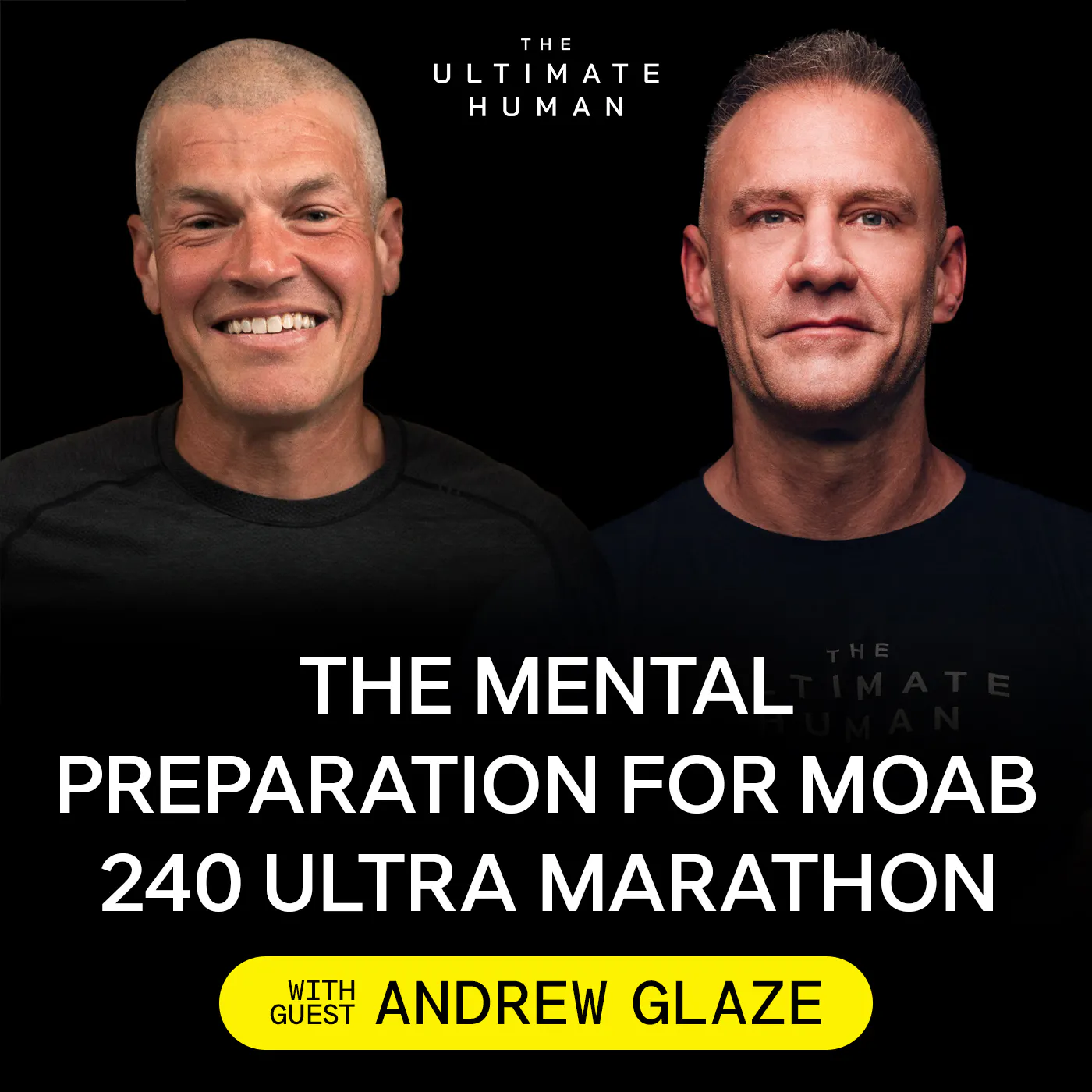
The Ultimate Human with Gary Brecka
237. Andrew Glaze: On The Mental Health Benefits of Running 100 Miles Weekly
01:28:33
Loading summary
Transcript640 lines
- [00:00]
A
Probably about 12 years ago, I was a firefighter at the time. I was dealing with PTSD issues like that. So I kept trying to push myself harder and harder to deal with that because my initial thing was, oh, if you feel weird in your brain, just exercise.
- [00:14]
B
You look at the incidents of suicide and police officers and firefighters and our first responders, it's significantly higher than it is the general population.
- [00:23]
A
I had to start doing a little bit more to get that to calm down. And that led to the ultra running.
- [00:29]
B
Because of the amount of pain and soreness and your brain really telling you to stop, that you actually feel the most alive in those moments and, you know, there's no PTSD creeping in.
- [00:40]
A
You need to train your brain to be able to handle a lot of very tough situations. And what better way to do that than in an ultra marathon if you.
- [00:47]
B
Put that much wear and tear on your body. I gotta get into what you're doing to biohack yourself.
- [00:52]
A
So I found that in order to not get injured, it's best to.
- [01:03]
B
Ultimate Human. Hey, guys, welcome back to the Ultimate Human podcast. I'm your host, human biologist Gary Brecker, where we go down the road of everything, anti aging, biohacking, longevity, and everything in between. And this is definitely another one of those everything in between podcasts. I don't, I don't know if I would call it anti aging, biohacking or longevity, but long runs for sure. But our guest today, Andy Glaze, is arguably the most inspiring, you know, ultra endurance athlete in, in the world. He's inspired my team, he's inspired my son, who is now also becoming an ultra endurance athlete. And I'm glad that you guys had a few minutes to, to meet. But Andy, welcome to the Ultimate Human podcast.
- [01:48]
A
Thank you so much for having me. This is amazing.
- [01:50]
B
Yeah, yeah, it's, it's a real pleasure. You know, I, I, I have to admit, you know, I wasn't someone that was following your journey and, and the staff came to me one day, you know, my podcast team, and you know that because I'm always impressed by ordinary people that do extraordinary things, and I'm even more impressed by people that do extraordinary things over a prolonged period of time. Like, I, you know, I remember that old show, the One hit Wonders, you know, like everybody can make a hit once, you know, one time. And what I remember was I'd heard David Goggins talk about this Moab race, you know, the Moab 240.
- [02:28]
A
Yes.
- [02:29]
B
You know, so many times about how his feet fractured and he Taped them together. And I was watching him on podcast. Gosh, this is so brutal. I've run one marathon in my life. And. And. And they talked to me about your story, how you had, you know, tried to do this race, you know, twice and couldn't finish it, and you had finally completed it. And they started showing me some of the videos, you know, of your journey along the way and how authentic and just visceral and very, very transparent and real you were. And I was like, dude, this guy is a special human being. We gotta get him on. I appreciate it on the podcast, but. But you weren't always that way. No. And you solved some kind of problem in your life, and running became your outlet. Do you mind giving us a little background on that?
- [03:18]
A
Yeah. I mean, so when I was in my 20s, I was super anxious, really quite depressed and.
- [03:26]
B
In your 20s? Yeah.
- [03:27]
A
And this. I wasn't doing anything. You know, I was very inactive. I was overweight, smoking a lot of pot, drinking a lot of alcohol, all the kind of things you do in your 20s. And one of my friends said, hey, you know, maybe you should try working out. It might. It might. Well, this is before the Internet. This is before the Internet, before podcast, before, you know, before anything. You know, this was like, 25 years ago. So there wasn't a lot of information on how to solve, like, problems. You know, if you went to a doctor and said, hey, I'm depressed, or like, oh, here's some Zoloft or here's some Wellbutrin or something like that. And I. I wasn't really into doing that. So I started working out and I started feeling better and I wanted to learn more. So I went to a community college class to learn more, because, again, back then you had to have actually go to, like, school to learn about Googling, anything. Yeah. So I took an exercise science class, and in that class, I had run a mile and a half, and that sort of started it all for me. And I really just never had that anxiety and depression problem again. Once I started working out, once I started losing the weight, once I stopped, you know, using drugs as a crutch to, you know, mask the problems that I was having. Yeah. And.
- [04:50]
B
But when did it morph into the ultra endurance? I mean, I think there's a lot of people watching this podcast that have run a half marathon. Run a marathon. I mean, I've run a marathon. I've done sprint tries and half iron.
- [05:01]
A
But that was probably ultra endurance is a whole different.
- [05:04]
B
Yeah, it is.
- [05:05]
A
It's quite different. And I mean, it. I. I think that that happened probably about 12 years ago. And I, you know, I was a firefighter at the time, and I was dealing with, you know, PTSD issues like that. And so I kept trying to, like, push myself harder and harder to try to. To deal with that, because, you know, my initial thing was, oh, if you feel weird in your brain, just exercise. You know, that's what I taught myself. So, you know, when. When the pts. Yeah, well, when the PTSD started, you know, that's a weird form of, like, brain activity. And so I had to start doing a little bit more to get that. To calm down. And that led to me doing all sorts of other things like triathlons and obstacle course racing and all that. And then that sort of led to the ultra running, which has now become, like, everything I do pretty much.
- [06:00]
B
Yeah. And I really want to unpack that, but, you know, I think we throw this term PTSD around so, so often. I. I just want to drill in on that for a minute because, you know, we know our veterans get ptsd and we know firefighters and police officers have high incidence of. Of ptsd, and we all know that it must be related to traumatic events, you know, stress, being overworked. I mean, honestly, I don't know how some people wake up. So I have so much respect for law enforcement and walk out their front door not knowing whether or not they're going to exchange their life for a perfect stranger.
- [06:32]
A
Right?
- [06:32]
B
And I might exchange my life for my children, but can't think of a perfect stranger that I would exchange my life for. And. And at least this thing that we call ptsd. But when you say ptsd, like, what are you referring to?
- [06:47]
A
Like, I mean, Russian for me. For me personally, you know, you see a lot of, like, terrible things. Being a firefighter. Like, I mean, the worst things you can possibly imagine, from, you know, children being hurt or killed to suicides, horrible car accidents, on and on and on, and those stack in your brain. And over time, occasionally you'll get triggered and you'll start thinking about them, and it just throws off your. Your whole nervous system. It's. It's hard. It's hard because everyone has, like, different symptoms, but for me, like, I'll get really bad insomnia, and, like, my heart rate will get, like, kind of high, and I'll just, like, I won't be able to relax, and I will try to, like, tell myself it's okay, but, like, I just. My body will not, like, shut off, and it's. It's it's, it's. It's a really terrible feeling, but I know everybody has different, different feelings like that. Also, like, you mix that with not sleeping a lot because a lot of times at the fire station, you know, we'll go several days with very minimal sleep. I work a 48 hour shift, so if we're up all night both nights, sometimes I'll come home with maybe, you know, an hour or two of sleep over two days. You mix that with some PTSD symptoms and you start kind of feeling, you start having thoughts in your head that, you know, aren't okay, you know.
- [08:13]
B
Right.
- [08:13]
A
And like, at least I have the, the knowledge to know. Andy, you're just, you're experiencing this. These aren't normal thoughts. This is because you haven't had enough sleep. You're having these symptoms. But what a lot of firefighters, police and military do is they go, oh, well, I'm gonna go mix drugs and alcohol into that to make me feel better temporarily. And then that's, you know, a cocktail that's really hard to diffuse. And luckily I've, I haven't had that issue because I don't drink or do drugs, but I see it a lot and it, and it's, it's, it's not such a good thing. So. Yeah, I mean, that, that's it for me, but it's, it's, it's, it's. I think it's so different for everyone. It's hard to like, put a finger on it and say, this is it.
- [09:00]
B
Yeah.
- [09:01]
A
And so when you can't, like put a finger on it and say this is it, the, the medical field has a hard time dealing with it.
- [09:09]
B
Right.
- [09:09]
A
You know, and then they, they just want to solve it by you, you take this pill and then you're okay. And that's not always the case. You know, I think there's, there's other solutions. But.
- [09:21]
B
And you've talked about how, you know, you're in a very masculine industry and, and career.
- [09:26]
A
Yes.
- [09:27]
B
And so it's not like really the social norm to be talking about your feelings and like, hey guys, I couldn't sleep last night. I was all night. My heart was pounding.
- [09:36]
A
Exactly.
- [09:37]
B
And like, oh, brother, you know, suck it up, you know, off kind of attitude. And, and if you look at the incidence of suicide and police officers and firefighters and our first responders, it significantly higher than it is in the general population.
- [09:54]
A
It is.
- [09:55]
B
And so we can draw a clear line between their careers and the experiencing this ptsd. And I think, like you say it's different for everyone. Anxiousness, anxiety, rapid heart rate, not sleeping. And then you're staying in that stressful career and then when you're not talking about it or you don't feel, feel like you can talk about it, then, you know, the, the worst of decisions.
- [10:16]
A
Happen and you really never know what's going to trigger it. Like it's, it's silly, but like when we get a call, all the lights in the station go on and there's like a tone, you know, and it's like, it's kind of like a dog whistle, you know, or like you kind.
- [10:29]
B
Of like that though. You like it's go time.
- [10:31]
A
Yeah, it's great. But like Pavlovian theory, right? So it's like if I'm at home and I'm like taking a nap or something and all the lights come on or like a bright light hits my face, I wake up and I like think I'm getting a call, my heart rate goes up, my adrenaline spikes, you know, and so weird things like that can kind of set it off too. Or if like a specific tone hits my ears, I immediately go into like a different zone. So you just, you just never know. I mean, seeing a picture or you're watching a movie and something happens in the movie and you think back, oh, I actually saw that in real life. And like then you start thinking about all the, and you don't want to think about it. You've, you know, you thought you've decompressed it and it's, it's gone, but it's still there.
- [11:11]
B
Yeah, I don't think that we're ever prepared to see other human beings in that state, you know, and if you have any amount of empathy at all, you can't just block that out. You know, you're helping somebody that's in pain or in a high level distress or in a life threatening situation. You're right there at that moment with people in the most trying time of their life. So that's, that's gotta leave a real imprint and those can come back into your conscience.
- [11:40]
A
Yeah.
- [11:40]
B
And kind of influence how you feel. I've heard you talk about how, you know, when you got into distance racing, and I want to unpack that too, but when you got into distance racing and, you know, it was getting into the pain cave, you know, miles 50 to 85. And if you just started thinking that, miles 50 to 85, that's nuts. That's even you rubbed two marathons, you know, because of the amount of pain and soreness and your brain really telling you to stop, that you actually feel the most alive in those moments. Right. And you know, there's no PTSD creeping in.
- [12:17]
A
Yeah. I mean, the brain goes real quiet when it comes to the PTSD symptoms in that because you're really just trying to stay alive. And when you're just trying to stay alive, all the other thoughts and everything kind of like, go away. You don't. And likewise, you also don't think about work. You don't think about anything you don't really want to think about because you're just like, I got to like, keep moving forward. I got to feed myself. I got to make sure I'm taking enough water, electrolytes, trying to live.
- [12:41]
B
I'm trying to stay alive here.
- [12:42]
A
Exactly, exactly.
- [12:43]
B
So.
- [12:44]
A
But it's also what I like most about that time is there's no way to shortcut to get there. There's no cheat code, there's no hack. Like, the only way to get to mile 80 is through 80 miles of hard work. And I mean, that's what we're doing. If we're running 100 miles or whatever it is, like we're, we're trying to do something really, really difficult. And so when you get there and you're in the pain cave and everything feels like it's, you know, you got to quit and, or whatever, it's like, that's, that's why we're here. We're here to be in this, this moment when it really, really sucks. Yeah. And then we have to push through and get to that finish line.
- [13:22]
B
So. And is that the addiction, for lack of better words, of these ultra distance races because you, you can't get that much gratification or maybe you can. Yeah. Because I, I've done not those kinds of races, but I mean, I, I, I love the feeling of finishing. You know, a half ironman or marathon for me was a huge deal and I was in a great deal of pain. I cannot imagine if I was three marathons in the amount of pain.
- [13:52]
A
I think, you know, you're, I'm trying to build like a brain that's like really mentally tough. And I think that the brain inherently is sort of lazy and wants to take it easy. And if you don't constantly remind it that, that it can go further than it thinks it can, that it forgets. And so maybe the addiction is just like that mental training where you're always trying to get yourself into a better spot. So when you get into tough spots in life, you can like, Overcome. Because the race is very controlled, you know, I mean, yeah, something bad, unless.
- [14:27]
B
You'Re intentionally putting yourself in that.
- [14:28]
A
It's an intentional thing. Right. So it's like. And at any moment you really could stop it if you needed to. And so that's like a safety net. But in life there's not really a safety net. Right. So. But you need to train your brain to be able to like, handle a lot of very tough situations. And what better way to do that than in an ultramarathon?
- [14:50]
B
That's so crazy. And, you know, I want to congratulate you on crossing an insane threshold. 300 days.
- [14:58]
A
300.
- [14:58]
B
300 weeks. Sorry. Of 100 mile weeks.
- [15:01]
A
Yeah.
- [15:02]
B
That is mind numbing. So that means. And was there ever a week off?
- [15:05]
A
No, no, it's constant.
- [15:07]
B
Every 300 consecutive weeks of running 100 miles.
- [15:10]
A
And most of them were way more than 100 miles. So I think we're at like, I don't even know, 60, 000 miles in the last six years or something. No, that can't be right. But it's, it's a lot.
- [15:20]
B
Yeah.
- [15:20]
A
60, 000 miles in the last 10 years, so.
- [15:22]
B
Wow.
- [15:23]
A
Yeah.
- [15:23]
B
I mean, you put that much wear and tear on your body. I mean, I gotta get into your, your, what you're doing to biohack yourself.
- [15:30]
A
Right, right.
- [15:31]
B
I mean, because you're not a robot, man. You've got knees and hips and ankles like all the rest of us.
- [15:36]
A
Yeah. I mean, you know, I, I think like, you know, I do. Not as much as you do. When I, when I saw all the things you have, I'm like, this is like my dream man cave.
- [15:46]
B
Yeah.
- [15:47]
A
But you know, the usual like sauna and cold plunge. I have a small red light like bed that I use mostly on my feet just because, you know, you got to keep the feet pretty healthy. Yeah. I take a lot of supplements. Like, a lot of supplements. And I eat a lot of food because. Well, you know.
- [16:07]
B
But you're vegan too.
- [16:08]
A
I am vegan. But, um, just in general, like, you gotta feed your body so that you don't get injured. Like a lot of people will like not feed themselves enough and then they'll get like bone injuries or, you know, tendon injuries. And I think a lot of it is just they're, they're operating at a calorie deficit and then they're doing these hard things and if you don't keep your bones and tendons and muscles strong, then they, you know, things happen to them.
- [16:31]
B
Yeah.
- [16:32]
A
So. And then you Know, I'm constantly experimenting with things. You know, I'm like, well, let's see if this works or let's see if that works. And you know, we were talking earlier, like, I've been experimenting with like ketone iq, like trying to like, see if that will like make give me an edge, you know, or like I'm going to try this, this product and see, like, will this give me an edge? And if I feel like it does and I incorporate it and if it doesn't, then I don't. Yeah, but you have to like, you got to try a lot of things on your own self.
- [17:03]
B
Yeah. You know, I just did the great world race with my son and I ran a few halves in one full and he ran all seven marathons, but by the third or fourth race in, he couldn't tolerate any of those gels anymore. He was just literally shutting his gut down. You know, I think you could get through a marathon on just about anything, you know, once. But, but when you're stacking them and certainly when you're doing an ultra 100 miles or more, your body actually needs real, real food.
- [17:35]
A
Right? It does.
- [17:36]
B
And you told me you've gotten sick of just about every product that's out there.
- [17:40]
A
It's tough on your mouth too. Like all those gels and stuff, they like, you'll start getting like sores in your mouth and stuff just from how like acidic and everything they are. It's, it's, it's rough.
- [17:51]
B
So how do you, how do you take in that you've trained your body to eat while you're, while you're running.
- [17:56]
A
Right.
- [17:56]
B
And so you can actually eat a vegan taco while you're.
- [18:00]
A
I, I, yeah, like an aid station. I'll have like, like two burgers, which, how many calories is a burger? Like a lot. And then I'll just start running and like my stomach like handles and these.
- [18:10]
B
Are, these are like soy patties or something. Yeah.
- [18:14]
A
Bean. Or like the guard, like the garden patties, like all vegetables or whatever it is.
- [18:18]
B
Yeah, yeah.
- [18:19]
A
Whatever they have at the aid station.
- [18:20]
B
I don't smash that much food and still run. And your body will process it.
- [18:23]
A
It will. Yeah.
- [18:24]
B
Wow.
- [18:25]
A
Just, you know, you go a little slower the first mile. Yeah, you're definitely not like, you know, running a six minute mile with two burgers in your stomach. But yeah, I mean, I, I've literally trained my, my body to be able to take solid food in and it, it works really well. I love avocado too. During the race that's yeah.
- [18:41]
B
You had one when you got here.
- [18:42]
A
That is my favorite. If I could have avocado the whole race, that. That I would do.
- [18:47]
B
It's nature's perfect fat. But. Yeah.
- [18:49]
A
Yeah.
- [18:50]
B
I want to unpack your supplement routine a little bit if you. Because, you know, clearly training is one thing, but we're. We. We only can perform to the extent that we're recovered. And, you know, real performance happens when you recover. I mean, just like, you know, muscles are not built in the gym, they're built when they repair themselves. And for you, stacking on that volume of training, I'm actually kind of surprised that all you do is sauna and cold plunge and a little bit of red light. That's. First of all, that's phenomenal.
- [19:21]
A
Yeah.
- [19:21]
B
I would have you on so much stuff.
- [19:23]
A
Yeah, yeah.
- [19:23]
B
But clearly you're doing very well on your own, so you're sort of blowing my theory of recovery. But. But what is it? What does a supplement stack look like to you?
- [19:33]
A
Well, so I. I don't have any mixes, so it's all like, single pill, single, you know, so I. So I know exactly what I'm taking. But let's see.
- [19:42]
B
We got. We got 90 minutes.
- [19:43]
A
Yeah.
- [19:44]
B
See if I can remember.
- [19:45]
A
I was like. I saw. I take, like, flaxseed oil. I take, like, an algae oil. So. So it has, like, the DHA and EPA in it. I take. I take a little bit of iron. I take zinc. I take magnesium. At night, I take D3 and K2, which is, for some reason, I've had, like, deficiencies in that, which is weird because I'm in the sun all the time.
- [20:13]
B
Yeah. Yeah, you're pretty.
- [20:14]
A
But. Yeah, but. Well, that's just because I did 300 miles in a week.
- [20:17]
B
But, yeah, yeah, yeah. Literally this week, he did 300 miles. Like, I was in the, like, 50 every day.
- [20:24]
A
Yeah. Yeah.
- [20:25]
B
So six days.
- [20:26]
A
What else? I take a garlic oil. I take. I like. I like alpha GPC when I need to use my brain.
- [20:34]
B
And these are on the daily.
- [20:36]
A
Yeah, yeah. Every day, pretty much. Yeah. I know. There's more. I'm sure. I take. Oh, I take. I take AG1. Not sponsored. But, like, I do take it every morning just in case. I'm like, you missed anything.
- [20:49]
B
I'm like, I might as well.
- [20:50]
A
Might as well throw it in the mix.
- [20:51]
B
Yeah. Your body's burning just about everything.
- [20:53]
A
Yeah. I don't want to get, like, deficiencies in anything. So I'm like, you know, and I do get regular blood work just to kind of test my levels. I take, I take a B complex just because I'm vegan and like, you know, we don't get all the.
- [21:06]
B
And B12.
- [21:07]
A
That's probably the B. Yeah, B12 in there. And there's probably more, but those are the ones I can remember. Right. Right now.
- [21:15]
B
No, that's awesome, man. Yeah. And, and, and when you're fueling during these distances, you're, you're, you're eating whole food mostly.
- [21:22]
A
I mean, I, you know, sometimes I'll do gels and stuff. It really depends on the race. Really, really hot races. I have a hard time taking in solid food while I'm running. So in between aid stations, basically how these ultras are set up is you run from like say you have 300 miles. You run maybe 20 miles. You come to an aid station and they'll have water and food there. And when I'm there, I can eat like a burger or burrito or whatever and drink water and then I have to run another 20 miles. Well, if it's really hot, it's hard for me to then like eat solid food. Yeah, I'll eat some sort of gel or something. But like, like you said earlier, I, I've gotten sick of everything. So I just am always changing. Like there's no like brand loyalty. Yeah, it's like this week it's never second. Last week it was spring. The week before it was, you know, Ju chews. You know, I mean, it's just like whatever. My, my stomach will take that time and then I get to the next aid station, I eat something solid again.
- [22:23]
B
If you know me, you know, I'm a huge believer in the benefits of hydrogen water. H2TAB delivers cost effective portable tablets that generate ultra clean molecular hydrogen at 12 parts per million or one of the highest concentrations on the market. With over 1300 published studies showing benefits of oxidative stress, energy recovery, brain function, and so much more. Taking charge of your health has never been easier or more cost effective. Just drop a tablet in water, let it dissolve and drink it back. It's less than a dollar a day, science backed and part of my daily routine. I never travel without this and it is my favorite biohack. Visit drinkh2tab.com that's drinkh2tab.com and upgrade your hydration today. Now let's get back to the ultimate human podcast. I really want to unpack this MOAB240 because, you know, David Goggins obviously sensationalized this race. I think with his, you know, his infamous fractured feet. Taping his feet.
- [23:26]
A
Yeah.
- [23:27]
B
And just the mental fortitude that he used to go through it. I mean that's got to be a very daunting looking at the number of people that have been injured doing it and looking at the number of people that can even finish it versus start it. And some very qualified people have attempted that race.
- [23:40]
A
Yes.
- [23:40]
B
And, and, and failed multiple times.
- [23:42]
A
Including.
- [23:43]
B
Including yourself. Including Gandhi.
- [23:44]
A
Yeah, he, he, he failed I think the second or the first time and then came back and, and crushed it. That second place.
- [23:49]
B
Yeah, that's pretty, pretty significant. But you know, mentally preparing for that race and a lot of people don't know what it is. So I'd love if you would unpack what the race is and like what kind of terrain it is and, and you know what it entails. I know it's 240 miles. Is it consistent? How long does it take? You know, Are you running all day, all night and all day again? Because I think that.
- [24:14]
A
Yeah, I mean. So that race is a 240 mile circle around Moab, Utah, which is pretty remote Utah.
- [24:21]
B
But who came up with this dude?
- [24:22]
A
Some sick Candace who's like an amazing. She has all the like 200 mile races. She's pretty amazing. But yeah, like it's, it's a 240 mile loop. It goes through all the most beautiful areas of Moab, which is also. You have arches and all these other national parks around there. It's. I always tell people it's probably like one of the top three most beautiful places I've raced and I've really. Yeah, I've raced from Europe to China. Like, it's really pretty if you like desert landscapes.
- [24:51]
B
And does that matter when you're racing?
- [24:52]
A
I think so. It's, it's nice to, to look around and see some really beautiful terrain, you know, and you have two giant mountains. You have to climb one at like mile like 120 and then another and another and I think mile 175, you go up like 10,000, 11,000ft from sea level. Well, not sea level but like, you know, I mean you're probably like 5,000. Have to go up to 10,000. It's a big climb though. And like one of them is like 26 miles. So it's climbing well. Have you going up and over this mountain. So I mean it's, it's, you're out there for a long time and then the rest is a lot of desert running, slick rock, just things that are hard on the feet.
- [25:37]
B
Yeah.
- [25:38]
A
And this year we had 150 year storm. So it poured rain almost the entire race. And so the previous years, which I had not been successful, we'd be running up like a dry riverbed. Well, this year it was a full river. So I have video of myself going up and you know, I have water, you know, shin deep and having to go like two miles up a river because there's nowhere else to go. So.
- [26:03]
B
Right.
- [26:03]
A
I have to deal with a lot.
- [26:04]
B
Of footage because there's just the terrain.
- [26:05]
A
On the inside and like weird stuff on the side because it's raining.
- [26:09]
B
So you used to stay on the rock bed.
- [26:11]
A
Yeah, yeah.
- [26:11]
B
And, and it's running against you.
- [26:13]
A
Yeah, it's running against you.
- [26:15]
B
That is so brutal.
- [26:16]
A
And you know, one of the worst things about running in the rain is wet feet. Right. All the issues with wet feet. So then you have to deal with all the foot issues and all that. It's a very, very difficult race. But yeah.
- [26:32]
B
And, and, and when you first set out to do it, I mean, you trained for it.
- [26:38]
A
Oh yeah. I mean a lot.
- [26:40]
B
How do you train for a 240 mile race? I mean, how many miles can you put on?
- [26:45]
A
Well, you run a lot of hundred mile races.
- [26:46]
B
You do?
- [26:47]
A
Yeah, I, I've run, you know, every year I run a lot of 100 mile races to get ready for, for like 200 mile races. I mean, and then it's a lot of logistics with like you have drop bags. You have to like think about in the future. Like, okay, when I get to mile 150, what am I going to need? Oh, I'm going to need to put new socks on and clean my feet and you know, I'm going to need this food or this, you know, all these things. And you have to, you know, prep mentally. I mean, it's, it's like I have pictures of myself with like 20 drop bags on the ground with like all this stuff. And I mean it takes me weeks to get ready for a race. Oh yeah. And then it took me 90 something hours. So I was almost, you know, four days so out there.
- [27:31]
B
And did you sleep at all?
- [27:32]
A
I did sleep a little bit. Yeah. Yeah.
- [27:35]
B
Because I really want to unpack that. I mean, 240 miles, I mean how, how much distance can a human being cover in a 24 hour period?
- [27:44]
A
Most people can, I mean, I don't know about most people, but we try to.
- [27:48]
B
100 miles.
- [27:49]
A
Yeah. In 100 mile you should be able to. A lot of people can cover 100 miles in 24 hours in a 200 mile race maybe 80 miles, maybe some somewhere around that. I mean it just depends if you're faster or slower. The really fast people will do it under, under 24, but for sleep, like the first year that I failed, I made it 200 miles and I was climbing up, yeah, 200 miles. I was climbing, basically a tree had fallen down and I was going around the tree and I fell asleep while I was moving and fell backwards through the tree and like off a cliff and landed on my back.
- [28:25]
B
Oh, and so you fell asleep.
- [28:27]
A
Yeah, yeah. Which, which does, which does happen quite a bit in 200 mile races if you don't, if you don't give yourself insane. Right. So in, in always trying to get better. Right. You're always trying to improve yourself. This year I had a much better sleep strategy where I, I would sleep from like 3am to 6am so that like I would wake up right as the sun was rising. And so you would get that boost, you'd get, you get the three hours of sleep which was key. And then, and then the boost of the sun hitting your eyes. And like this worked really well for me. I actually took no naps the whole race and I was only, only slept for like those hours in the, in the middle of the night. So that's a strategy I'm probably going to use for future 2002.
- [29:13]
B
So how far did you go before you actually went to sleep?
- [29:16]
A
Well, I skipped the first night. So the second night when you say.
- [29:20]
B
Skipped you, you started.
- [29:21]
A
Well, the race starts at noon, so. Yeah, I ran all night and then went, went to bed at like 3am so what is that, like the following day? The following day.
- [29:30]
B
And you're running the entire time.
- [29:31]
A
Right. So 30 something hours, I think, before I slept.
- [29:35]
B
Wow.
- [29:35]
A
I've done quite a few races where I've gone 51 hours without sleep.
- [29:39]
B
51 hours?
- [29:39]
A
Yeah. That's probably my, that's my threshold.
- [29:42]
B
And I mean at that point you're hallucinating.
- [29:45]
A
Oh yeah. You're, you're like you're in a cartoon. Yeah, it's, it's, you're in a lot.
- [29:50]
B
Of pain in your, in lot of car. That's just got to be such a weird place. I, I, I've only had that happen once at the only marathon that I ran in Cartagena. And not even nearly to that extent, but just between the heat and the dehydration and the pain that I was in, I did start to kind of hallucinate a little bit.
- [30:10]
A
Yeah.
- [30:10]
B
And, and the pathway that we were running on at One time, I felt like I was going downhill. It was perfectly flat. And then another point, I felt like I was running uphill, and it looked uphill. And I was telling myself, this is level. My brain was like, this is uphill. It looked like it was climbing in front of me. And I've heard other people talk about that hallucination. The water was kind of weird. But what are the hallucinations like? I mean, if you've. If you go 51 hours, I mean, it can be what starts happening in your brain.
- [30:41]
A
It can be a lot of things.
- [30:42]
B
For the people that haven't drawn.
- [30:43]
A
For me, I mean, a lot of times the ground looks very different, you know, like the rocks or whatever you're seeing. I think during Moab, I shot a video where the. We were running on a road, and the whole road looked like those little troll dolls. And so I was like, hey, does everybody see all the troll dolls? And, like, I was just seeing, like, I was running on troll dolls. Like, I don't. I don't even know what a troll doll really is, but that's what I was seeing. And say, one time at a race, like, I saw these robot dogs, and I, like, went up and wanted to start playing with them, and it was a guy sleeping and, like, a black.
- [31:20]
B
Yeah.
- [31:20]
A
And so, like, I woke him up, and then he was like, what are you doing? And I was like, the dogs turned into this guy. And I was like, I'm sorry. I need to sleep. And I just kept, you know, wow.
- [31:31]
B
Was he in the race, at least?
- [31:32]
A
He was in the race. Knew he had, like, a black. Like, I don't know if he was in a black bivy sack or something that he was sleeping in on the side of the trail. But I was convinced it was these robot dogs. And I thought in my. In my stupor, like, hey, it would be a good idea to play with these things.
- [31:47]
B
I'd want to play with the robot dog, too. But you never reasoned yourself, just randomly, there's a robot dog at, you know, mile 120.
- [31:56]
A
Right, right. Yeah. Yeah. Well, you're so out of it at that point that. And then, you know, what will happen is you'll. You'll go to sleep, your brain will reset, and then normally you'll be okay for a little while. And then when you start seeing stuff again, you're like, all right, it's probably time for another nap, you know, because things are getting a little squirrely. It always gets more squirrely at night than it does during the day. Yeah. Just because you know your vision gets weird when you're just staring at headlamp light.
- [32:21]
B
Yeah. For so long, bouncing like that.
- [32:24]
A
It's just like the shadows dancing everywhere.
- [32:26]
B
Driving five hours in the mountains when you're, when your headlights are low and you can't see the whole road in front of you and you know, it's twisty and turning and, and, and you're sitting in, you know, behind the wheel of a car. I've had that those times just driving from Denver to our place in Gunnison. It's five hour drive.
- [32:44]
A
Yeah.
- [32:44]
B
Some of those country roads have no lights.
- [32:47]
A
Right.
- [32:47]
B
Only have the beam in front of you and it starts to weird you out.
- [32:50]
A
Yeah.
- [32:51]
B
Like artificial light ship over.
- [32:52]
A
It's like.
- [32:53]
B
Yeah.
- [32:53]
A
I get so sick of it. By the end of the night. Like all I want is the sun to come up so I can start seeing real light again. Yeah.
- [32:59]
B
Yeah. That's constant on light and, and if you got that hat on, then it's also kind of, I mean that, that, that headband on, it's also kind of bouncing.
- [33:07]
A
I've been using a waist light and it's, it's a lot better.
- [33:10]
B
Oh.
- [33:11]
A
Because it doesn't throw like shadows the same way. It, you know, it's just a side hack that I've, I've learned over time that the waist light looks, it looks weird, but it works better.
- [33:21]
B
Yeah. I'll remember that if you ever do it 240 miles. So, you know, here you are. You, you obviously you prepared for this thing in, in your first race. You're going around this tree and you're hallucinating and you fall backwards and you just happen to be on a hill, I guess.
- [33:38]
A
Yeah.
- [33:38]
B
And did you injure yourself?
- [33:40]
A
Yeah, I hurt my back pretty well and then I had to, I had to go like another five miles or something to get to the aid station.
- [33:46]
B
Oh.
- [33:46]
A
And it took, I think it took.
- [33:48]
B
Like seven hours to go five miles.
- [33:50]
A
Yeah. Because there's no, I mean, there are.
- [33:52]
B
Other racers out there.
- [33:53]
A
I had a, I had a guy with me that was pacing me. One thing about these races is you can, you can get people that will come out and run alongside you, like your friends or whatever. And, and normally they, you know, they can do a good job of like keeping you alert and talking and. Because they're not, they're not out of it. Yeah.
- [34:11]
B
Yeah.
- [34:11]
A
They're only 30 miles in or whatever instead of 100 or I was 200 miles in. So he was able to like. Because when I fell all the branches broke and Then they all landed on me, and then I landed on these rocks. So he was able to, like, get me up and everything. And at first I thought I would be okay, but what happened is I'd landed on my back and it started to swell. And so after time, like, I couldn't throw my leg because you know how your leg is then attached to your lower back. I got to the aid station. I still had, like, 35 miles to go, and I was just like, I can't go 35 miles like this. It was. I was in seventh place. It was like I was having the best race.
- [34:48]
B
Oh.
- [34:48]
A
And then. Yeah, and then it was like. And then I wasn't. So that was a hard one to walk away from.
- [34:53]
B
I'd rather have that happen in mile two. Right.
- [34:56]
A
Exactly. 200 mile. But then I was like, oh, I did the Moab 200, you know.
- [35:00]
B
Yeah, yeah, yeah. So into a positive.
- [35:02]
A
Yeah.
- [35:03]
B
So. So you pack it up in this race is only once a year.
- [35:06]
A
Yeah, it's only once a year, too.
- [35:08]
B
So for you was. I mean, there's a PTSD trigger.
- [35:12]
A
Yeah, this is. It was the worst. And then I came back the next year, and I got heat stroke where my body stopped sweating and cold. Yeah. And, like, I ran out of water, and I was, like, all by myself and like, basically almost died. Like, I'm a paramedic. So, like, I started to know the symptoms. I started to get altered. They. And I got to the aid station, and they had to pack me with ice to, like, like, cool my core body temperature down. And then I couldn't recover after that. So you couldn't. No.
- [35:43]
B
I mean, how did you get to the aid station when it. When it first started?
- [35:45]
A
I mean. Yeah, I just kept moving because there's nothing I could. No cell signal I had. You know, I just literally, I got into. I started thinking about my family, started thinking about my kids. Like, I race again. Yeah. Well, I'm not going to die out there. You know, you start having that talk with yourself, because when you stop sweating, you just get so hot, you know, and then your core body temperature gets hot, and, you know, you start cooking.
- [36:09]
B
Your brain and you out in the sun at this.
- [36:11]
A
Yeah, it's just full sun, no shade. There was no shade for me to hide in or anything.
- [36:15]
B
Oh.
- [36:16]
A
So, yeah, it got really scary. And then. Yeah. So that was like the second dnf, which was supposed to be my, you know, redemption, was that. That was only 85 miles.
- [36:26]
B
Only 85 miles.
- [36:28]
A
Well, and I run hot race. I live in Southern California, it's hot. Where I live, I run hot races all the time. So I was just like super frustrated with myself. Like, why is my body doing this to me? But you did it and you just, you know, sometimes your body just fails.
- [36:43]
B
So mile 85 and you, you, you have this heat stroke and you don't have any water. And you know, there are other areas where you might have been able to get into water. Right.
- [36:52]
A
Yeah.
- [36:53]
B
And cool yourself down.
- [36:53]
A
Right.
- [36:54]
B
Which might have turned things around.
- [36:56]
A
It would have. But there was no, nothing on this section. It was just desert. Which is funny because that's the, the same area was the area that was the river this year.
- [37:06]
B
Wow.
- [37:06]
A
So, you know, it just shows you like the difference in, you know, one year it was super hot, the next year it's a river.
- [37:12]
B
Yeah.
- [37:12]
A
You know, so.
- [37:13]
B
Yeah. Well, I mean, you know, if it.
- [37:16]
A
Had been the river, maybe river, I'd been great.
- [37:19]
B
Yeah.
- [37:19]
A
Just lay down.
- [37:20]
B
But you can't come back after he. No, no, I mean, I've, I've actually seen that people get catatonic. I mean.
- [37:25]
A
Oh yeah.
- [37:26]
B
It can be really, well, life threatening.
- [37:28]
A
And then you're, you have, you're susceptible to get it again, you know, so if I had continued on, you know, then I'm in the sun again for how long? Like, I can't. You couldn't risk that.
- [37:36]
B
Yeah. So. So you pack it up, you go home again.
- [37:41]
A
Yes.
- [37:42]
B
And was that more defeating than the first time?
- [37:46]
A
Oh, it was. Especially because I know 85 sounds a lot to you, but 85 to me is not significant. So I was extremely time wise.
- [37:54]
B
How, how far is 85 miles into?
- [37:58]
A
I mean, I was maybe like 24 hours or something. Maybe a day.
- [38:01]
B
Okay.
- [38:02]
A
So I mean, literally nothing for me. And so I was extremely frustrated with not only my body, but like, you know, myself, cuz.
- [38:10]
B
Yeah.
- [38:10]
A
You know, I really wanted to complete it that year. So. Yeah.
- [38:15]
B
And so now you pack it up, you go home. Year two, your redemption year. Now, is your family at these races? Like, are they.
- [38:22]
A
No, I mean, sometimes like my wife.
- [38:24]
B
Like go knock your socks off, Andy.
- [38:26]
A
Yeah. My wife will go to like a race if it's in like a beautiful air. Like I go to Europe every year and race and then Shamany. Have you ever, have you ever been to the Alps? And so she loves the Swiss Alps. Yeah, it's, it's French, Swiss and Italian Alps. I rent racing. And she'll come to that, you know, but like. Yeah, the middle of Utah desert. Like, no, she's not, not, not Coming to that. So it's like, I love you, but.
- [38:49]
B
I'm not sitting in a tent for. Yeah, three days waiting on you.
- [38:52]
A
Well, and my kids, you know, they have so many activities and so it's like, it's hard to pause everything so dad can go race, you know. Yeah. Cuz then they're going to miss out on all their, you know.
- [39:03]
B
Yeah. So you go, you, you, you go back home. Two failed attempts, heat stroke, back injury. Thankfully you didn't injure yourself. More serious. And was it the third year did you go three times in a row?
- [39:18]
A
Three times in a row. Yeah. Just.
- [39:20]
B
Okay.
- [39:20]
A
I just kept, kept coming back. So. Yeah, this year, this year I got a team behind me. I had two guys, we got a camper van and I, you know, took it super, super seriously.
- [39:33]
B
And so you actually got the nap in that major luxury and because it poured rain.
- [39:37]
A
So it was like I was in there just like with a blanket on me, all comfortable just hearing the rain just on the, on the van. It was nice. Yeah.
- [39:45]
B
And how many hours would you sleep?
- [39:47]
A
I mean it was like three hour. I give myself a three hour break. You know, you don't.
- [39:51]
B
Why not sleep more? Because it's only going to extend your time. But you still finish.
- [39:55]
A
Yeah, I think, I mean really trying. People think, they think that like because you're doing something really physically hard that, that you have the ability then sleep for a long time. But what you find is that your body is so sore and so in so much pain that like the natural pain and soreness wakes you up. So I would go to sleep and sleep as much as I could, but when my body would wake me up, that is when I would start, start going again. So you don't.
- [40:23]
B
And you got to wake up in just immense pain.
- [40:26]
A
Yeah.
- [40:26]
B
And then you stiffen up. So it's like workout. You always, you lay down and you're nice and tired and you're like, oh, this feels so good.
- [40:34]
A
And then the first half mile you kind of have to do like a walk trot.
- [40:37]
B
Yeah.
- [40:38]
A
You know, because you're just so stiff and then you know, motions, the lotion you start, it starts lubricating and then you can start moving again. But yeah, it's, it's a little. Especially when it's cold and raining. One of the nights, the last night we, we got there at like 10 o' clock and I think I slept till midnight and we got out, you know, pitch black. Obviously it's super cold and it's just pouring rain and we have your Team.
- [41:01]
B
Running this with you?
- [41:02]
A
One of my team members. Yeah.
- [41:03]
B
The whole thing.
- [41:04]
A
Well, we. We switched back and forth.
- [41:06]
B
Right.
- [41:06]
A
But one of the guys did 120 miles with me.
- [41:08]
B
Wow.
- [41:09]
A
So, yeah, he did. He. I told him I was gonna get him a belt.
- [41:12]
B
Solid.
- [41:12]
A
That said the MOAB120.
- [41:14]
B
Yeah.
- [41:15]
A
So. But yeah, he. We had to go up this, you know, mountain. It's pouring rain and. Yeah. To get out of the van. The warm van. And it's freezing cold and raining again. These are the mental toughness lessons that you're teaching your brain to do. Like, you don't want to do it. You want to just stay in that warm van, but you force yourself out, and then you start moving, and then. Then you get miserable again.
- [41:37]
B
So how many times did you sleep in that 240 miles?
- [41:41]
A
I slept three times, I think for a total of seven hours. Wow. Out of 90. 98 or something.
- [41:50]
B
Yeah.
- [41:50]
A
Yeah.
- [41:51]
B
And now I. Do you see a lot of other racers on this or at that point. When you get over 100 miles, I imagine people are really spread out.
- [41:59]
A
It's what you do is you see them at the aid stations because everyone's like, vans and crew and everything are there. So you'll see them.
- [42:06]
B
How do people know where to go? Well, so you get lost in this.
- [42:10]
A
They do put flags on some of the course, but you really have to have it. A map on your phone or. I have it on my watch. They. They provide you a file that you could upload your watch, and then I just put it in there, and it tells me where to go.
- [42:24]
B
Okay.
- [42:24]
A
Yeah. Otherwise. Yeah, there's no. You would get lost.
- [42:27]
B
And. And that's pretty accurate. And within. Just super, super accurate.
- [42:30]
A
Yeah, yeah.
- [42:31]
B
So you know right where you're at.
- [42:32]
A
Exactly. So you got to keep this charged and everything.
- [42:34]
B
Yeah, yeah, yeah.
- [42:35]
A
But, yeah, then I have a backup on my phone. So if this were to die or break or something like that, then I have it on my phone as well.
- [42:41]
B
And where's your phone during this time?
- [42:43]
A
It's just like, I have a pouch right here, and I just keep it right there because that's what I use to film all my videos and everything. So I have to have it accessible. Yeah, yeah, exactly. But, you know, it's hard to film anything when it's pouring rain.
- [42:56]
B
Yeah, yeah, exactly.
- [42:57]
A
Touchscreen phones don't like. Don't like the rain.
- [43:00]
B
Yeah, no, they definitely don't. So, you know, you. You slept three times. You had a whole team behind you. You brought a van. Super smart. And you Know, at some point you had to realize, I think I'm really going to finish this thing.
- [43:13]
A
Yeah, yeah, it was. Well, I mean, you get down and you have like a three mile section along the river where you're running to the finish line. There's no more obstacles, you're just on like a bike trail. So there's no more rocks, there's no more anything and you're just like, you're just cruising. I had my pacer with me. Cody, he was running and the other guy, he parked the van and then ran to me. So we were all running together.
- [43:38]
B
That's so cool.
- [43:39]
A
You know, and that's where I like.
- [43:40]
B
Are these guys you trained with too?
- [43:41]
A
No, they actually, they live in Ohio and they're just friends from ultra running and they flew out to just do this with me.
- [43:48]
B
That's so cool.
- [43:49]
A
Yeah, yeah. So, and then that's, you know, that's when the video where I get so emotional. I'm like literally almost at the finish and realize, yeah, I'm going to, I'm going to do this, I'm going to finish this race.
- [44:00]
B
Yeah.
- [44:00]
A
So, yeah.
- [44:01]
B
And, and you know, the moment you came across that finish line is what was that like?
- [44:07]
A
I mean, it was literally, yeah, the best feeling ever. Just a really sense of accomplishment and just I was proud of myself. You know, I felt I overcame some really. First of all, the race was super hard that year and I overcame a lot, but just not giving up, continuing. Like I said in the video, like failing forward, you know, you fail and you just keep trying to do better and better and better until you get to that, that point. And, and that's what life's really about, you know, is just continuing to try to improve yourself, get better, give yourself grace. You know, you're going to make mistakes, things are going to go wrong, things aren't always going to work out and not beating yourself up, but just trying to get better so that it doesn't happen again. And so it was a, you know, a culmination of three years of hard work to get to that finish line. So it felt pretty, pretty, pretty dang good.
- [45:00]
B
Yeah. I think a lot of people looking from the outside in have got to be thinking, what is this guy running from? Or what is he running towards?
- [45:07]
A
Yeah.
- [45:10]
B
How would you answer that?
- [45:11]
A
Well, I mean, I always tell people I love running and so on. On a very fundamental level, I just really enjoy it, you know, I mean, people love to do lots of things. Yeah, whatever. Pickleball. I mean, some people like to watch TV Right. I mean, at some. I just really love to run, so I get an incredible amount of joy doing this. And then obviously, social media has become, like, a huge part of my life, and being able to inspire people and change people's lives through my videos has been really rewarding for me.
- [45:47]
B
Yeah.
- [45:48]
A
I got into the fire service as a secondary career because I wanted to help people and I wanted to make a difference. And now I have this, like, third sort of career where I'm able to help people internationally on, like, a huge scale. Millions of people. Just because I like. Because I like to run.
- [46:07]
B
Yeah.
- [46:08]
A
You know, like, and, you know, I, like, I'm an old guy that likes to run, and yet I reach millions of people every month. And it's. It's a really great feeling.
- [46:17]
B
No, that's a. That's an. That's an amazing feeling, just knowing that you're. You're doing this for something more than yourself, you know? You know that you're inspiring other people. When you're out in the public, I mean, do you. Are. You often stopped, like, oh, my God, Andy.
- [46:31]
A
Yeah, it's.
- [46:31]
B
It's.
- [46:31]
A
Yeah. I mean, just in the airport, I think I took five selfies. Just really. Well. Yeah. Literally just walking to my plane, you know, so it's. And every. It's. It's weird, too. Like, internationally. Like, I was running in Venice and it was like somebody stopped me. Oh. You know, it's like. So I have, like, a huge following all over the world. And it's. I love it, though. I love my fans, and I'm not one of those people. I will stop and take a picture even mid race. Like, I don't care. Like, I'll stop and take a picture with you. I'll have a chat with you, whatever. Like, I really, you know, I want to connect with people. I want to, you know, meet them and, you know, hear their story.
- [47:07]
B
Well, it's a blessing to be in the kind of condition that you're in, to be able to do what you love to do. And I think when you realize and you accept that with some humility, you're so thankful for it. Then when other people appreciate it, you appreciate them, too. I get the same thing. And it's. I always stop and try to be intentional with people. Right. And really, really lock in, listen to their question or. Or really think, tell them that I'm really thankful that they actually stopped me. And it took a minute to say what it was. It's a great life. Yeah. No, it's. It's an Amazing feeling. You, it's you, you get addicted to that too because you're like, wow, my message is really resonating. I always send those to the team and I'm like, this is you guys, not me. You know that this message is really out there.
- [47:48]
A
Reserve leadership right there.
- [47:50]
B
Yeah, yeah. What are the top three reasons why I prefer a vertical cold plunge versus a lay down tub? Well, I've used both. When you're in a vertical position, your body naturally regulates your breathing better. So if you're holding on to sides and you're in a vertical position, you can just focus on your breath work and you can stay calm. A lot of people feel more calm when they're in a vertical position than when they're laying down in the water and think they might slip under the water. So when you're vertical plunging, you're fully immersed faster, you can focus on recovery, inflammation reduction, and you're not struggling to just stay in a lie down position. Your body floats in an awkward way sometimes. So it's just a more efficient, comfortable experience. In my opinion. It takes up way less space too. It has a smaller footprint. So you can put these on your patio, your garage, your bathroom, your locker room, you can really, really put it anywhere. I've got one on my balcony. I've got two in my bathroom. So this is why cold life is my favorite cold punch on the market. So click the link below and you can order yours today. Make sure you get the ultimate human version. Now let's get back to the ultimate human podcast. Stacking this with, you know, firefighters career is an odd career from an hour standpoint and a demand standpoint because number one, no two days are the same, right? And you don't know if you're going to go to the fire station and lay around for two days or you're going to go to the fire station and you're just, you're not going to sleep. You're going to be up for 48 hours and it's going to be balls out and you're going to have more, let's call them triggering events where you're seeing these, you know, meeting these people at really difficult times in their life. How is it that you maintain consistency? Because, you know, I, I talk about this all the time as the most important thing. You know, I talk about the weight loss journey with Jelly Roll and, and how first goal was just walk to the mailbox, walk the second mailbox and then eventually get up to 10,000 steps. But the most important thing was every day we're doing something. And when you're preparing for something like the Moab 240, and I want to hear what else is on your list because I'm just fascinated by. Because that's going to be really cool. But when you're repairing, preparing for that, I mean, you have, you can't really take a lot of time off.
- [49:50]
A
No. In fact, before Moab, I worked eight days straight, like, because that was during fire season and there's like these big fires. And so literally, I worked eight days straight, got off, went home, packed my car and drove to Moab.
- [50:05]
B
Oh, my God.
- [50:06]
A
So I don't even know how many days, eight days straight. Is it's like 100, what, 160? Is it 172? I don't know. It's a lot. It's a lot of hours straight to be at the fire station. So. Yeah, I mean, it's not ideal, I can tell you that much.
- [50:18]
B
Yeah, yeah, no, that. It's not ideal. That's what my lawyer would call suboptimal.
- [50:23]
A
Yeah. People like, they'll say subopt stuff like, oh, this person beats you. And I'm like, well, they're not racing the same race I'm racing because, you know, I was just at the fire station for eight days straight, you know, so it's like, we're just not the same. I'm competing against myself.
- [50:37]
B
Yeah.
- [50:38]
A
But I, I've been doing it for so long. I've made it work.
- [50:43]
B
But was, what does a typical day look like? I mean, get up, run 50 miles? I mean. What?
- [50:49]
A
No, I mean, like, if I'm home.
- [50:51]
B
Break it up and.
- [50:51]
A
Yeah. So I found that in order to not get injured because. Right. We're always. Everyone's worried about overuse injuries. It's best to like break your mileages up into two, two runs a day. So if you're gonna do 20 miles, it's better to run 10 and 10 or 13 and 7 or something like that rather than run just straight 20 miles. So I normally run twice a day. I try to get my longer run done in the morning because that's like when my kids are at school and all that stuff, then I have the afternoon to spend with them. And then I'll run again at night, like right before dinner, I'll go get like a quick 5 miler or whatever. But that's, I mean, that's my day normally. But at the firehouse, it's always. I mean, I still try to get two runs in a day because we're Allowed to work out, and we're encouraged to work out, but, you know, it just does.
- [51:39]
B
How do you. How do you get that kind of mileage? And you just get on a treadmill or.
- [51:42]
A
No, I run little loops around the fire station.
- [51:44]
B
Really?
- [51:45]
A
Yeah.
- [51:46]
B
Like, literally out in the parking lot.
- [51:47]
A
Well, not around the parking lot, but, like, we're in a city block, so I'll just kind of, like, run around.
- [51:52]
B
And around because you can't be too far and give you the call.
- [51:54]
A
I have to be very close, and I have to run with, like, you know, well, your radio, I guess. Yeah. All that sort of stuff. So if you get dispatched, I have to go back. It's a little different now because I'm a chief, whereas when I was like. Because now I have my own vehicle and. And I'm. I'm responding in a different manner. But, yeah, I mean, I. I've done this my whole career, so. But, yeah, radio, I. My phone and just, you know, loops around the firehouse. Wow. Yeah. Which again, builds mental toughness because it's real boring.
- [52:22]
B
Yeah.
- [52:22]
A
You know, there's a lot of podcasts listening and a lot of. Yeah, a lot of books on tape, like, or not I'm dating myself. Books on what? Audible. Whatever you call them now.
- [52:32]
B
Yeah, audiobooks.
- [52:33]
A
Yeah, I.
- [52:34]
B
Hey, I remember books on tape, man. I remember mixtapes. I'm gonna stick with my finger in there and trying to rewind or putting a pencil in and trying to rewind the.
- [52:42]
A
You make a girl a mixtape, you know, as like a present, you know? Yeah, yeah, Listen to my mixtape. Then it was a mix cd. Yeah, yeah, yeah.
- [52:50]
B
And you could hear that. The recorder shutting off and turning back on, and it never really now sounded very good at all. But, you know, have. Have any of the guys in the firehouse. Because I imagine, you know, you've been at the firehouse for a long time. I mean, you probably know some of these guys really, really well, right? They're like your brothers. Have you flicked that switch in anyone else? Has anyone else gotten inspired and said, I want to run a half marathon. I have a. I want to try to run a marathon?
- [53:14]
A
Yeah, I have a few that have run half marathon.
- [53:16]
B
Or they just like, Andy's crazy.
- [53:18]
A
Well, I mean, they do say that, too. Yeah, no, I. I have a. Like, I work for the city of Laverne, and so I say Laverne Fire Running Club. And occasionally the guys will join me. Yeah. But, yeah, I have one guy that ran an ultra with me.
- [53:31]
B
Really? 400.
- [53:32]
A
No, he ran a 50k.
- [53:33]
B
Okay.
- [53:34]
A
I ran the hundred, but he was there.
- [53:36]
B
Yeah.
- [53:36]
A
And then on this week, 300 that I just did, one of the guys showed up and did the first day of 50 miles, so. And that was his first time running, I think, even past a marathon.
- [53:46]
B
Really?
- [53:46]
A
Yeah. So a lot of guys have done half marathons. A couple have done full. I've run a full marathon with a couple of the guys. So. Yeah. And. And a lot of times guys will like, we'll show up early before like a shift and we'll run together. So. But yeah, I mean, running still not a huge thing in the fire service. They're more into like lifting heavy weights.
- [54:06]
B
Right.
- [54:06]
A
And doing that sort of thing. So.
- [54:08]
B
Yeah. Yeah. Because that at least ends in, in an hour. Yeah.
- [54:12]
A
They want the big muscles and all and all that sort of stuff.
- [54:14]
B
Yeah. So you split it into two runs. You're running on your shifts, and then you're, you're, you're managing your family. This is the thing that I find really fascinating. Your father, your husband, your battalion chief, and you're this incredible ultra distance athlete. And how do you keep the motivation to keep. Because even if you love running, Right. You can experience the joy of your craft in 20 miles a day.
- [54:42]
A
Yeah.
- [54:43]
B
Or maybe not. Maybe not. Maybe you have to get into some of these insane distances.
- [54:47]
A
It's just, I mean, I mean, I keep myself motivated.
- [54:53]
B
Are you setting it? Is it because you set a new goal? Like it's this race or this. I want, I want to run in this area of the world. I want to see. I mean, I don't know how much further you push it than 240 mile race.
- [55:04]
A
Right. Is there something 300 this year? Okay, I'm doing a 300 next year.
- [55:10]
B
Are you really? What's a three? What's the name of that?
- [55:12]
A
It's called the Air Arizona Monster. And it goes from basically Phoenix.
- [55:15]
B
I feel like people are just making up now.
- [55:17]
A
Yeah, it was a hard. It goes from Phoenix to the like, basically the Mexico border, like all, all the way down through Arizona. Wow. One time I ran 100 mile race, got on a plane, flew to Arizona and ran a 250 mile race the next day.
- [55:34]
B
No.
- [55:34]
A
So, yeah, that was 350 miles in one week. So you can always, you can always. I mean, there's, there's always crazier people. Yeah, there's crazier people than me. You know, there's like, I seem crazy to people, but then in, in my community, there's way crazier people, right? Oh, yeah. Yeah. There's yeah, I'm, I'm, I wouldn't say mild, but there's, there's definitely people that are doing crazier things.
- [55:58]
B
Wow. I mean, is there anything beyond 300?
- [56:00]
A
Well, I mean, like, I'm doing a race on New Year's Eve where we run from New Year's Eve into New Year's Day. But that race has a six day event, so it's. How far can you run in six days? And it's a mile and a half loop.
- [56:13]
B
Oh, no.
- [56:14]
A
Yeah. So how many times can you run around a mile and a half loop in six days?
- [56:18]
B
And what do you get for that? Like, nothing.
- [56:19]
A
You get a little, little piece of wood thing that says that you completed it. Nothing.
- [56:25]
B
That seems so, I mean, underwhelming.
- [56:30]
A
A lot of times you could just get a belt.
- [56:32]
B
I wanna, I wanna Range Rover.
- [56:33]
A
Yeah.
- [56:35]
B
For real.
- [56:36]
A
Like, one of the hardest RA world is in, is in the Alps, which I was like, in Europe. And like at the end you get a vest. That's what you get. Like a, just a, like a cheap vest. And I'm like, oh, I live in California. This isn't gonna really do much for me. But okay. So, I mean, you just, it's, it's all about personal satisfaction and accomplishment. You can't, you can't do things for trinkets.
- [56:58]
B
Yeah. And other people.
- [56:59]
A
Yeah.
- [57:00]
B
But what is your favorite part about it? Is it, I mean, are you seeing the world? Are, is it just this constant mental edge that you're, you're, you're, you're doing this for yourself to really see? Like, where does that mental boundary?
- [57:13]
A
For me, I mean, I, I like the new challenges. I like the dynamic aspect. Like, you know, MOAB one year, super hot Moab next year, all rain. I mean, there's changes, so I like that. But I do like the community a lot. I like, I like meeting people. I like running with a lot of.
- [57:30]
B
The same kind of moving around some of the same.
- [57:32]
A
But like, you get a lot of first timers and you just get. I meet a lot of really cool people. Like, you know, I was literally for my, one of my runs, a guy showed up and he, he works at Space X and he designs the solar panels for the satellites. I mean, it was just a cool conversation. Yeah. You just never know. I've met like orthopedic surgeons and, you know, really start talking to them about like, well, are my knees going to be okay? And he's like, unless you fall, your knees are going to be just fine. Really? Well, yeah, Most, most knee issues are from trauma, you know, or like stepping off a curb. Wrong. Or like something like that. I mean, so they're not actually repetitive.
- [58:09]
B
No, I mean, the body can take it.
- [58:11]
A
Huh. Not only does it take it, but it actually strengthens the cartilage and then ends up building more. And there's a bunch of like, new studies. If you do it the correct way, you know, if, if you go from doing nothing to going, oh, I'm gonna go run 100 miles tomorrow, then you, you might have some knee problems.
- [58:26]
B
Right.
- [58:27]
A
If you slowly build over, you know, a decade. Yeah. You're probably.
- [58:31]
B
It is astounding to me how just fascinating the human body is.
- [58:35]
A
Yeah.
- [58:36]
B
You know, I mean, it truly is that we can, you can actually strengthen it by putting that kind of repetitive use on.
- [58:43]
A
I, I think I have about a hundred thousand miles on my knees. Wow. Somewhere around there, which is.
- [58:48]
B
And no knee pain.
- [58:49]
A
I have literally no knee pain.
- [58:50]
B
You know, it's back, shoulder maybe.
- [58:53]
A
You know, it's like. No, I mean, you know, people in.
- [58:55]
B
The audience want you.
- [58:56]
A
Yeah. The ankles get a little. Yeah, I know they do. I know I have a lot of haters.
- [58:59]
B
Yeah.
- [59:00]
A
Yeah.
- [59:00]
B
I mean, I kind of hate you, dude, because I did it 5k of the earth.
- [59:03]
A
Well, you know, but again, if you're not doing it a lot and you go out and do it, you know, like anything, like your muscles adapt faster than your tendons, Right. So I mean, if you go out and do something where your muscles can handle it but your tendons can't, then you're going to get a little pain, you know, but over time that works out. Unless you're like bone on bone already. Yeah.
- [59:24]
B
You know, but nothing advanced like stem cells, exosomes.
- [59:27]
A
I haven't done any of that yet. I, I have friends that do it. You know, I'm sure at some point I will, like, look, look into it like, because I, you know, I tell everyone, look, the body only goes in one direction, right. So at some point you're gonna have to like, start taking evasive action. But you know, as of now, like, the body is holding up, so I'm, you know, I'm, I'm doing what I can do. But. Yeah, and I've been lucky where I haven't had anything really significant injury wise, where I need to go get like stem cells or anything like that. But it's always on, you know, I have a lot of friends that do it. I know where to go, you know, all the things, but just haven't needed it. Yet, Knock on wood.
- [60:07]
B
But I'll knock for you, too.
- [60:09]
A
Thank you.
- [60:10]
B
Yeah.
- [60:10]
A
Yeah. I know it'll happen eventually.
- [60:12]
B
Yeah. I mean, you were really inspiring to my. My son. I mean, you guys had a few minutes in the kitchen here. He's. He's running his first 100 mile race.
- [60:18]
A
Yeah.
- [60:18]
B
In January, which I might join. Yeah, you might join. I said I'll bring it to a US UFC fight. Now you got pro if. I think the race is on the 21st and the fights are on the 24th. So. Yeah, he's doing his first a hundred mile race. I'm really. I'm really proud of him because he's been militant and dedicated to. To training for this race, and he's doing it with Kyle Forgard from the Nelk Boys, which I also find incredibly inspiring because, you know, those guys had the big YouTube reputation for, you know, partying and.
- [60:52]
A
Yeah.
- [60:52]
B
And, you know, sending it.
- [60:54]
A
Yeah.
- [60:54]
B
And. And. But, you know, at heart, they're really good people, and they've. They built an incredible. They're some of the smartest young businessmen that I've ever met. And they're really. It's really. They're a great circle for my son to be in because, like, they're. They're like young overachievers. And. And the fact that now Kyle's locked in on his health journey and, you know, reached out to Cole and ran his first marathon, and then now is running a 100 mile race, I mean, I. I really think those are incredible goals for them, and I think it's going to have a majorly positive impact.
- [61:29]
A
Well, one cool thing is that the health journey and, like, being healthy and fit is now becoming like everyone else used to. They used to, oh, I'm partying. I'm doing all this. And now it's, like, cool to.
- [61:40]
B
Yeah.
- [61:41]
A
To be healthy and to, like, be able to, like, run 100 miles.
- [61:43]
B
Yeah. Yeah, we see that shift here in Miami. Like, I was reading a stat about alcohol, and in. In the younger generation, I think it was the age 36 and under. It's down like 34. 36. Right. Which is. I mean, that's a third less. That's craz in 2024. And they say 2025 is going to be even lower. And I see it here, too. There are these events, like coffee and chill, where, you know, they're on. They're on Sunday mornings from 9am to noon, but they sort of look like every other south beach pool party rager, but instead of your calling card being the car you pull up in or your Richard Melee. It's your physique and there's no alcohol and there's no drugs. There's a DJ and there's coffee and there's cold punches and it's. And it's just a really cool environment and my kids go to those all the time and we're big supporters of it because I just think that that trend, I think the pandemic did us all a big favor.
- [62:32]
A
It did. On that level. Yeah.
- [62:33]
B
Yeah, on that level. I mean, in a lot of ways. And you were in California, so it sort of extra sucked.
- [62:40]
A
Yeah, it was a little rough.
- [62:41]
B
Yeah, it sucks.
- [62:43]
A
We survived, but it was rough.
- [62:44]
B
But you know, it's an awesome trend to see and I think it allows for better connection. I mean, if you've been in the pain cave with somebody on a distance race like that, I mean there's. That's a real moment that you're not going to share with that very few people.
- [63:02]
A
Yeah.
- [63:02]
B
You know, experience that.
- [63:04]
A
Yeah, I, I did a race with Kara. Nate. Nate is. They're like huge on YouTube. They have like four and a half million subs and they travel the world. And he raced this race with me.
- [63:15]
B
And we did Ultra.
- [63:16]
A
No, he's just gotten into it.
- [63:18]
B
No. Okay.
- [63:18]
A
You know, it's like now that, you know they're so big, he can do whatever he wants. And like he said he's like, I'm gonna start.
- [63:23]
B
Good for him to do that though. I mean, there's a lot worse things he could do.
- [63:26]
A
And so we did like 30 very hard miles together. And at the end he was like, man, I know you better than I know like some of my best friends. And I'm really, I'm like, yeah, because like you just talk and you just, you get to know someone and when you're really stripped down, when the onions peeled all the way back, you can really get into somebody's like core being and who they are as a person. So some of my best friends I've met suffering at ultras, you know, and they live all over the world.
- [63:51]
B
Wow.
- [63:51]
A
But.
- [63:52]
B
And are you surprised at your body's ability to recover after some of these races? I mean, have you ever felt really, really broken after a race? Like we, we might have pushed that one a little too far.
- [64:04]
A
Feel really broken after every race, really? Oh yeah. I mean, I feel broken after this 300 mile week.
- [64:09]
B
Like two 300 mile week. And you're going to run a 50k with my son tomorrow. He's actually really excited about It.
- [64:14]
A
Yeah, no, it'll be fun. Yeah. I mean. Mean, yeah. I normally feel pretty broken, but, like, if I just do my recovery protocols and do everything that I, you know, know, I need to do, then I. I bounce back. But it's definitely. As I get older, it's definitely getting slower. Yeah, it's. When I was younger, I definitely noticed that I bounced back faster, but, yeah.
- [64:34]
B
You know, now you can cover the distance. It's just the recovery.
- [64:38]
A
Yeah. Yeah. So I. You know, I try not to have the races too close together, but I also really like to race, so. Yeah, it doesn't always work out. Sometimes I just go into a race at 60 or 80 instead of 100. But, yeah, it's. Again, it's me against me. So, you know, it's just.
- [64:54]
B
It's just you're not really what it. What you would call a fierce competitor. You're not out there to just crush somebody else to set a PR to.
- [65:03]
A
Yeah.
- [65:03]
B
Or. Or is that a component of it, too? Like, not.
- [65:05]
A
Not really.
- [65:06]
B
Nemesis?
- [65:07]
A
No. No, I don't. No, not word.
- [65:09]
B
Nemesis.
- [65:11]
A
Yeah, maybe. I mean, when I. When I was younger, yeah, I was, like, more of a competitor, and, you know, I'd win a couple races here and there, but now it's, you know, with the family and the job, especially since I promoted to battalion chief, had a lot less time to train. It's just more or less just me against myself and, like, going out and meeting people and inspiring people and doing all that. But, you know, when I was single and I was younger, like, yeah, it was more about being competitive, but not. Not at this point in my life. Like, you know, I just have too much going on to. I. I know what I would need to do to get competitive, and I just. I don't have that time, and I don't want to. It's not even that I don't want the time or I don't have the time. I don't want to put that time into that box because, you know, I want to spend time with my family, and I want to spend time, you know, doing well in my job and all those things, and something would suffer if I really had to, like, move that. Yeah. Move it and become competitive again.
- [66:09]
B
Yeah.
- [66:10]
A
So it's. It's not worth it to me. I'd rather just be, you know, like, you know, balanced then. Yeah. You know, if you're gonna win, there's not a lot of balance. Right. You have to, like, focus on that.
- [66:22]
B
Oh, yeah. That's a whole different level. And I'm sure there's levels to the game you're in, too. I mean.
- [66:26]
A
Yeah.
- [66:27]
B
You know, like when I watch that Moab 240 last time, the kid that won, when. When I. When you looked at the map, like, the. The distance that he was ahead.
- [66:36]
A
Yeah.
- [66:37]
B
Of the second place. Yeah. It was Killian. Insane.
- [66:40]
A
Killian Korth is his name, and he is an incredible athlete. Yeah. He's.
- [66:44]
B
What makes him so gifted, is he?
- [66:46]
A
Well, I mean, he's just. Well, he's really talented, physical, physically, but, like, he has failed a bunch and has figured out what he needs to do to not fail, so. And. And he's talented and young and. How old is he? I think he's 30. Okay, so. And he lives in the mountains, so he's got altitude. Yeah, he's got a lot of things going for him, but, I mean, he's just. He's got talent, you know, Talent. And he's physically, really fit, so. Yeah.
- [67:17]
B
Hey, guys, let me tell you about one of my favorite new hydration drinks. Now, this is for distance athletes, hits cardio exercisers, people that sweat a lot or exercise intensely. An A game is a hydration drink. It has eight essential vitamins. It has all of the electrolytes, the entire suite of B vitamins. Before you freak out and read that as 21 grams of sugar, which it does. The sugar is coming from natural cane sugar and honey, my preferred mechanisms for getting glucose into the blood during intense exercise. It also has natural flavors, but these natural flavors don't come from bacterial fermentation. They actually come from real citrus fruits, and the color is from vegetable juice, not artificial dyes. So next time you're looking for a great hydration drink and you're exercising intensely, AAME is your choice. Now let's get back to the ultimate human podcast. It almost seems like a lot more thankless than a lot of sports, because I don't think the. The ultra sports really get the attention they deserve. Maybe because it's hard to be a spectator, Right. I mean, you know, a lot of these other sports don't require a fraction of the. The dedication and the consistency and the mental grind. Right. I mean, if you're a professional athlete and you're playing most sanctioned sports, they have a beginning and an end that most people can survive, right?
- [68:35]
A
Yeah.
- [68:35]
B
And you can go really, really hard during that. It's like when. When I was training for. Again, not comparing it at all to what you were doing. When I was training for Half Ironman, I would do as many sprint tries as I could. Yeah, because I could just really lay it down and I could really go hard and I could, I could focus on the, the transition, you know, between the bike and the run and the swim. And I, I really did, you know, like it. But it's, it seems like a lot, but it, but it ended in an hour.
- [69:06]
A
Yeah.
- [69:06]
B
An hour and five minutes. And you can do anything for an hour and five minutes?
- [69:09]
A
You pretty much can. Yeah, yeah, yeah.
- [69:11]
B
But you can't do anything for 51 hours. No. Right. That's got to be. What percentage of that is mental?
- [69:19]
A
I mean, he is very mentally strong, for sure. But you also really have to have a game plan and know exactly what you need because nutrition and all those things play such a huge factor in ultra running. You know, if the car doesn't have fuel, it doesn't move.
- [69:35]
B
Right.
- [69:35]
A
And so you have to be able to like, take on a lot of fuel and keep yourself going in this delicate balance of all these factors. Like, he had to go through the same mud I did. He had to go through the same rain. You know, I mean, I still don't know how he did it that fast. I'm like, yeah, I'm crawling on my hands and knees up a mountain because it's like this and it's all mud and I'm like, how is he doing this faster?
- [70:00]
B
Right.
- [70:00]
A
You know, how is he doing this faster? Yeah, because it's like, I mean, every time I take a step, you'd slip back. So you literally had to get on your hands and knees and, and climb up the mountain. I mean, wow. It was, it was wild.
- [70:13]
B
That is so wild. So what is the next big flag for you?
- [70:19]
A
Well, I, So I have a couple hundred mile races and then I'm gonna do that.
- [70:23]
B
You just throw those out. Like, that's not a big deal. It's like I, I, you know, I did do a 5k today, but I, and I will throw that out. And I did a 5k, but you throw the 5k out. Like, I mean, you throw out 100 mile race.
- [70:35]
A
Those are kind of like my training runs. But yeah, yeah, I'm insane. I'm going to like, I have three kind of back to back. I'm doing the Arizona Monster 300. Then I'm gonna do Cocodona 250 like a couple weeks later. And then I'm flying out to the UK and I'm doing this race called the spine, which is 200. Yeah, the spine. It's 268 miles and it goes from like England to Scotland, but there's only five aid stations and you can have no support. So, like, the first. The first aid stations at mile 45, the next one's at 110. And it just like. Oh, it's a very, very difficult race. So. Wow.
- [71:15]
B
Those are kind of like carrying its stuff with you.
- [71:17]
A
Got to carry a ton of stuff. Yeah. But you're also going through little villages, and you can stop and like, you know, get food at the village if, like, they have, like, a little store, a little restaurant.
- [71:28]
B
Wow.
- [71:29]
A
So.
- [71:29]
B
Yeah, so that would be the longest one you've done 268 because.
- [71:32]
A
Well, 300, but yeah, 268. I mean, it's. It's gonna be. It's gonna be long. That's be my longest one. I do, like, unsupported.
- [71:40]
B
And. And how long will a race like that take you?
- [71:44]
A
Hopefully under 100 hours. Hopefully.
- [71:47]
B
Yeah.
- [71:47]
A
You know, I don't know, because you're going through all these bogs and I haven't ever run in England, so it'll be like a. Wow. It'll be an interesting experience. On what kind of trails and mountains and, you know, all that sort of terrain.
- [72:00]
B
A race that they. That's regularly done.
- [72:02]
A
Yeah, every year. And the crazy thing is, is they have a winter version. Oh, where you do it in the winter? In the snow? No, I swear. And also, this race is not marked or anything, so it's kind of like you have to navigate by yourself.
- [72:16]
B
They give you the map.
- [72:17]
A
The map. But, like, you know, as far as finding a trail, it's not always super evident.
- [72:22]
B
Wow. So imagine people will run something like that.
- [72:24]
A
I think they allow 150.
- [72:27]
B
Wow.
- [72:27]
A
Yeah.
- [72:28]
B
I'm surprised they could get to 150. Oh, it's.
- [72:30]
A
It's sold out in, like, like, like eight minutes. No. Yeah. Yeah. I, I. Only two Americans got in. Me and another guy.
- [72:38]
B
Really? Yeah, it's.
- [72:39]
A
It's. I mean, these races, like, you think, like, nobody want to do them, but they. There's lotteries to get into them. They're very, very hard to get into. Even Moab, you have to win a lottery to get in.
- [72:50]
B
Really?
- [72:51]
A
Yeah, yeah.
- [72:52]
B
And. And in order to qualify for the lottery, do you have to have some kind of pedigree or.
- [72:57]
A
Some of them do some of that. Yeah.
- [72:59]
B
The.
- [73:00]
A
The race Cocodona, they don't have a lottery, but they have a wait list, and there's like 700 people on the wait list to run it. And it's a 250mile race.
- [73:08]
B
That's Insane.
- [73:09]
A
I mean. Yeah, yeah, it's. It is insane.
- [73:12]
B
Because, you know, Because, I mean, I guess to find a place where they mapped out a course, we can safely do this. And sometimes you're not even safely doing it. Right, right. I mean, they're shutting down traffic for 200 miles, that's for sure.
- [73:22]
A
No, you have to cross roads and do all sorts of stuff. Yeah, yeah.
- [73:25]
B
Do you know anybody that's done this racing, which.
- [73:28]
A
Which in this fine one? Yeah, I know the guy that got. He. An American that got second place, who's a really talented runner. But because I have such a lot of international fans, I've. I've had a lot of people reach out to me and, like, give me. Give me notes, so I at least won't be going into it blind.
- [73:47]
B
Yeah. What would you say is either the race or just the accomplishment that you're most proud of? You have so many of these under your belt right now.
- [73:58]
A
Yeah.
- [73:59]
B
What one stands out for?
- [74:01]
A
I mean, my first hundred miler, I always is like, you know, I trained really, really hard for it.
- [74:06]
B
Yeah. My son's next month.
- [74:07]
A
Yeah. I mean, it's. I spent. Because I didn't, you know, this back then. 100 milers, nobody really knew about them or they knew about them, and it wasn't as big a thing. And so I. I really spent, like, a good year and a half doing the smaller distances, just training in the mountains and getting ready for it. And it's a really hard race. I got sub 24, which is really hard to do in this race. They give you a solid silver belt buckle.
- [74:31]
B
If you do.
- [74:32]
A
If you do sub 24 in the vest. Yeah. And the wood, it's actually worth the wood trinket. Yeah.
- [74:37]
B
You can at least melt it down.
- [74:38]
A
I can melt it down. Especially silver's, like, really high right now. It might be worth 50.
- [74:42]
B
I would do that one every year, man.
- [74:44]
A
Yeah. So. But, yeah, getting that, that, that, that and crossing that finish line was. That was. I was so proud to do that. That was a really good one. And, you know, and then obviously I loved it so much, I just kept going. So now it's been over 10 years of doing 100 milers.
- [75:01]
B
Is your family really supportive or.
- [75:04]
A
Yeah.
- [75:04]
B
Are they kind of waiting for this habit to pass?
- [75:06]
A
No, no. I mean, they know dad's crazy, and, you know, I mean, my son runs with me. My wife, she'll go through bouts where she'll run a little bit with me. She's done a couple marathons with me.
- [75:17]
B
Okay.
- [75:17]
A
Yeah. So. But like, right now she's on.
- [75:19]
B
That's legit, by the way. Marathons.
- [75:22]
A
You know, she did a 50k too. She did a 50k?
- [75:24]
B
Really?
- [75:25]
A
Yeah, six hour 50k.
- [75:26]
B
So, dude, I don't know a lot of women that have done 6 hour 50.
- [75:30]
A
Yeah. So she's, you know, it's good. But my, my other two daughters, they're not runners. But, you know, I don't, I don't push my kids to do anything they don't want to do.
- [75:39]
B
Right.
- [75:39]
A
Like, my one daughter's really into horses. She's like competitive barrel racer. Awesome. She doesn't want to run. Like, I don't want you to run. Ride your horse, you know, and yeah, my other daughter's really into cheer and dance. Awesome. Do that, do that really well. And, you know, but my son. Yeah, we did a marathon together this year, which was cool. I mean, kind of like you talking about, you know, your son and the experience you guys had. It's fun stuff with your, with your kids. Yeah, a little bit.
- [76:08]
B
You, you've, you've talked in the past about your, your inspiration coming from your, your late father's memory.
- [76:14]
A
Yeah.
- [76:14]
B
And was he an inspiring figure for you because he did something in this space, or was he inspiring to you?
- [76:23]
A
He was inspiring because he taught me the, like, the value of, like, hard work. And he was, he was a very, very hard worker. And like, and he, and he taught me the power of, like, positivity. And you know, at the time, when you're young, you don't always understand the lessons that your, your parents teach you. But, you know, in reflection, I think back and I'm like, oh, yeah. He was trying to show me to do that mental shift in my brain where I was always looking for the positive. And so, you know, in reflection, it's like he taught me to work hard and that nothing would be given to me unless I worked hard for it and that, you know, positivity wins.
- [77:10]
B
So he was a positive guy.
- [77:11]
A
He was, he was, he was very positive. Yeah, I mean, he was. You know, life is filled with negativity, but you always have to kind of like shift it and try to find that, like, positive angle. If you, if you focus on negativity, it'll be negative.
- [77:23]
B
Yeah.
- [77:24]
A
You know, if, you know, if you think about it in a positive way, your brain really creates what it wants. If you live in negativity, you're gonna have a negative life.
- [77:33]
B
Yeah.
- [77:33]
A
You know, if you live in positivity, you're gonna have a better life.
- [77:35]
B
Yeah. We really do our own reality. And you know what's interesting is my wife and I are having this conversation the other day as I look back on some of the most. What I would consider to be the most traumatic things that happened in our business or even in our. Even in our marriage. And they turned out to be turning points that led to great things. And so now I can actually look back on them as little blessings. I go, you know what? If this person hadn't stolen from me. Right. And completely tried to screw me over.
- [78:05]
A
Yeah.
- [78:06]
B
And I had to fire her. I. I would have never actually gone in this direction. I would have never brought this person onto my team, which actually took us to the next level, you know, 100%. There's so many of those points, and you can focus all your vitriol on what this person did to you or that person did to you or, you know, the. The. The moments where. Where. Where you failed or you can go. That's actually what led to this decision. I mean, most of the time when your back's against the wall, you make the best. You know, you make some really ingenious decisions that lead to good things.
- [78:35]
A
Why is it that there's all these people in business that are, like, you know, so unscrupulous, you know? Yeah, it's.
- [78:40]
B
It is so true, man. I've had a few of them pass through my doors, but again, you know, as I look back on it and these skirmishes I had with really narcissistic people that had really ill intentions, you know, when I finally uncovered it for me, it was difficult because I was just like, wow, why? I really liked you, and I thought I gave you a real pathway to succeed, and I thought that we really were trying to do something special, but you had completely ulterior motives. But once you close that door, an entirely new chapter opens. I don't think my platform would be anywhere near the size and impact it is now if I still had this person along the ride.
- [79:24]
A
100.
- [79:25]
B
So that. So it's really a blessing.
- [79:27]
A
Yeah.
- [79:27]
B
That they revealed their true colors. And that's just a personal journey of mine. But I. But I. You know, there's those moments where I look back and I think, man, all of those times that I thought, how could this happen? Why did this happen? You know, how did I let this person into my life? And then you realize letting them go made you make choices.
- [79:47]
A
Another door opened, and then now. Now you're in a way better room.
- [79:50]
B
Yeah. So you've got to be at least keeping check on some of Your biomarkers?
- [79:58]
A
Yes.
- [79:59]
B
In your body?
- [79:59]
A
I do quite a bit.
- [80:00]
B
Okay. Okay. So I, I'd love to unpack that for a minute. Just, you know. Do you get regular blood work done? I mean, do you mind asking me?
- [80:07]
A
Yeah.
- [80:07]
B
Are you on trt?
- [80:08]
A
No, I'm not on that. I mean I take, I do take like a supplement, kind of like, like a lot stuff in it. It's like a mixture and boost the saucer. Yeah. To help a little bit. I, I get regular blood work done and it's, I can do it through my doctor and then once a year we do it through the fire service, like through our, like our department, like pay store. Yeah. Well, it pays to have us run through like a test. It's really cool actually. We do like push ups and run on a treadmill and do with the 12 lead attached to us and like grip strength and we blow into one of those tubes to see what our lung capacity is and do all the things. And we've been doing it every year so you can like track it all. You know, it gives you your like biological age and then you're, you know.
- [80:54]
B
Yeah.
- [80:55]
A
So. And which is cool to offer to the fire service because then we can see where we're going. But yeah, I, I do, I have gotten regular blood work since I've been doing this for a while just because I'm always a little nervous, like what are my levels at? And, and I also like, I don't, I don't really like looking at it and going, oh, okay, well I'm normal. Because if I'm normal, then I'm normal compared to who?
- [81:19]
B
Yeah.
- [81:20]
A
This. The average population human. And it's like I'm not getting a C. Yeah.
- [81:24]
B
I'm not really solid 70.
- [81:26]
A
Yeah. So I have to have a lot of talks with my doctor about. Look, I'm not, I don't want my numbers to be like the normal number. I need to like have them be where, where they should call functional. Yeah. For like an, yeah. For an athlete. So. But I don't, I don't have them all memorized or anything.
- [81:44]
B
Yeah.
- [81:45]
A
But yes, I, I do, I do track it. And you know, occasionally I find like the biggest thing that changes after races and stuff is like. And also just like not sleeping well at work is just. I do get like fluctuations in testosterone and then I also like, I get fluctuations in what's the. Less like CRT Reactive protein. Yeah.
- [82:06]
B
Crp.
- [82:07]
A
Oh, crp.
- [82:08]
B
Yeah, yeah, yeah.
- [82:08]
A
I get, I get like high levels of that at time, which I assume.
- [82:11]
B
Is because it's a non specific marker of inflammation. But that makes a lot of sense.
- [82:14]
A
Yeah, I get like, so that'll, that'll normally be pretty high and then yeah.
- [82:19]
B
I'm like, normally be pretty high. Yeah.
- [82:21]
A
I'm like, well, yeah, but beyond that, like everything tends to be okay. I, I, I follow you a lot and I'm like, I always am. Like, I need to just make sure, I need to get like everything done. Yeah. You know, so it's definitely on my list to do sometimes I, I'm like, do I really want to know all the, you know, the amount of waste.
- [82:41]
B
That you're eliminating though? Meaning like, like not just stool and urine, but like, you know, sweat, you're circulating your lymphatic fluid. I mean those are, those are life extenders.
- [82:50]
A
Yeah.
- [82:51]
B
So it's perfectly normal for your creatinine break, break down a muscle, you know, byproduct of muscle breakdown or C reactive protein to be elevated certainly after a race because it's a non specific marker of inflammation. But if you had a long recovery period and they were still very elevated, that's a different story. But I, I, I was just curious if you were checking in because I mean, don't take this the wrong way, but it's, I, I find what you're doing is foundationally basic for like the achievements that you're doing. You know, I mean, I, I know people that are professional athletes that are not exerting themselves the way that you are and biohacking everything. And I'm always fascinated by that.
- [83:29]
A
Yeah.
- [83:30]
B
Because, you know, it's a, it's a less is more philosophy. I mean, you're checking in on your, your biomarkers, you're obviously doing the training, you're eating very, very clean and you're supplementing, which I think at that level you have to be supplementing. Maybe we'll throw a hydrogen water into your.
- [83:46]
A
Yes.
- [83:47]
B
Yeah. Into your quiver. I mean that's a, that, that would be a big one that I would, I would suggest. But I mean, I, I, I'm, I'm really sort of shocked is not the right word, but I'm surprised at the, you know, the, the level or the lack of like really intense biohacking that you're doing. It's pretty phenomenal.
- [84:06]
A
Well, I believe it's, if I could do it, I would do it. You know, it's like, you know, it's.
- [84:10]
B
Also a lot more time hyperbarics, like therapy.
- [84:13]
A
It's also like access, you know, it's access, it's I'm doing what I can do based on my financial status and like, where I'm at in life. And, you know, I live in Redlands, California, which is not the, you know, the Mecca of biohacking, you know, area. You know, I don't live in L. A. You know, like, I have friends that live in L. A and they can go to all these different, I, I don't even know all the acronyms, but all the things they can get done to them. And, and I don't really have access to that. So I do what I can with what I have and the time I have. But believe me, walking around and seeing what you have, yeah, I, I would do it all day, you know, you know, if, if I could, you know, because I would love to, you know, recover better, recover faster, live longer. All the things like where you're going.
- [85:04]
B
To live a long time.
- [85:05]
A
Yeah.
- [85:05]
B
I mean, what condition you're in.
- [85:06]
A
And yeah, I like your positive outlet.
- [85:08]
B
And I think a lot of it has to do with, you know, you're hitting all the big areas that nobody talks about. The sense of community, sense of purpose, finding some meaning in your life. And you're, you're, you're finding a lot of meaning, just not just in your family and your work. Your work's got to be rewarding as much as it is stressful because there are other times that you probably save, Save lives.
- [85:26]
A
Yeah.
- [85:26]
B
And so, I mean, there's nothing more rewarding than that. And now you have this social media outlet that's it, allowing you to impact more lives. Hopefully, hopefully you're finding a way to monetize that.
- [85:35]
A
I'm just, just starting. Okay. I like not to self promote too much, but I wrote a book.
- [85:40]
B
Oh, you did?
- [85:41]
A
Yeah, yeah.
- [85:41]
B
No, that's great. I'm gonna link the book in. Yeah.
- [85:43]
A
Yeah. So like we just, just pre release now and then.
- [85:46]
B
What's the name of the book?
- [85:47]
A
Smile. You're doing it wrong. Oh, that's like my tagline, you know, that's the thing I say all the time. But yeah, it'll get released next year. And so that's sort of like my first, like I wrote the book and then I realized how expensive it is to write a book. So I was like, I was like, well, I'm gonna have to start monetizing my social media a little bit. So I've started taking a few sponsorships here and there.
- [86:08]
B
Yeah.
- [86:08]
A
Yeah.
- [86:09]
B
Well, I'd love to link the book and, and drive people to read it. How does my audience that Want to find you, find you.
- [86:16]
A
So on Instagram, I'm am glaze. Like, am glaze. And on TikTok, I'm glaze runs. YouTube. I'm glaze runs. And Strava, I'm Andrew Glaze.
- [86:27]
B
Okay. Is I. I have a group of a community that I'm building called my VIP community. And so when. When the podcast ends, we're going to go into this room with my VIPs. They've. They're the ones that I let know who's coming on the podcast. Yeah, diamond, they've got some questions for you. A lot of big fans in here. Some of these are really, really great questions. And if you're interested in becoming a VIP, you can go over to theultimatehuman.com VIP and you can sign up to be one of my VIPs. We do private podcasts. I do live Q&As. You can ask my AI anything. You can literally feed it your labs. You can feed it your genetic test. If you have questions about supplements, you can do it there, too. But, Andrew, I wind down all my podcasts by asking my guests the same question. And if you've seen my podcast, you might know this question's coming. There's no right or wrong answer to it, but what does it mean to you to be an ultimate human? Because you are definitely an ultimate human.
- [87:21]
A
You know, I think making the world a better place than. Than you, like, when you leave it, you're making it a better place before you leave. Like, I think the ultimate human contributes selfishly to society to make society better. And whatever that means to you, I think that's. That's the ultimate human is. Is. Is helping people and making the world a better place.
- [87:45]
B
Well, Andy, I think you're doing all those things. I mean, I just know from the people in my inner circle that you've inspired on my team, and they see a lot of inspirational people, and you've been a big inspiration to my son, and I'm really deeply appreciative of that on his. On his journey, you know, to become an ultimate, you know, an ultra marathoner. So I appreciate that.
- [88:09]
A
You know, I try hard.
- [88:10]
B
That's a personal. That's a personal way that you've, you know, personally touched my life. But thank you for coming on the Ultimate Human podcast. I hope we'll have you back. I want to have you back after the 300 mile and the 268 mile spine race, because I'm just so fascinated by this.
- [88:25]
A
That will be interesting, but I appreciate you, brother.
- [88:27]
B
Thanks for coming on the Ultimate Human. And until next time, that's just science.