← This Guy Sucked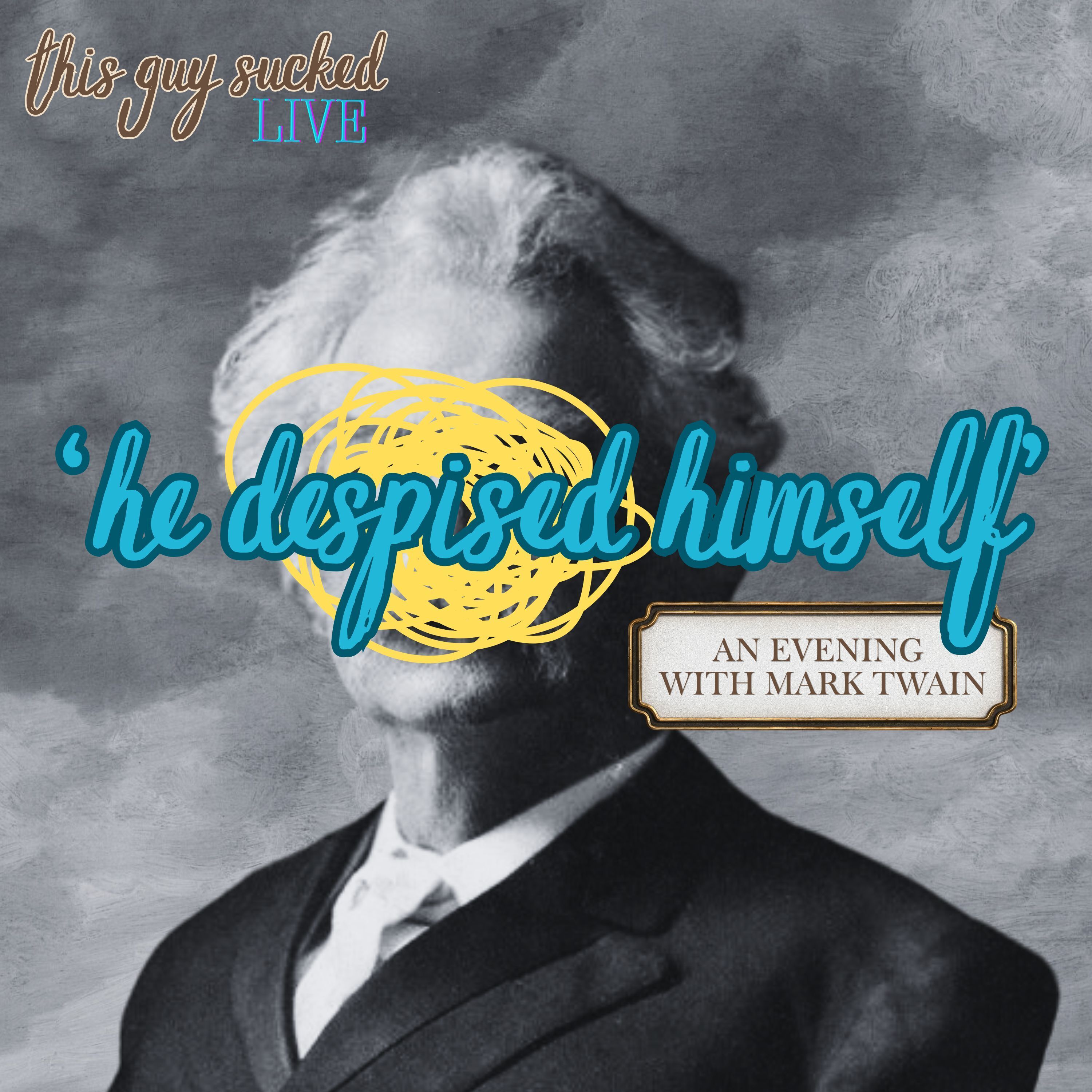
Loading summary
Transcript71 lines
- [00:00]
A
Hi there, it's Claire. If you're hearing me, that means you're listening to the free preview of one of our Patreon episodes. We switch off every week between free and Patreon exclusive episodes. So if you'd like to hear the rest of this conversation, head over to patreon.com thisguysucked and join our honorary Haters Club. Good morning, afternoon, evening, night, wherever you are. And it's 1pm on Tuesday, May 7th for me. And that date matters because we did a live show last night. It was at the Mark Twain House and Museum in Hartford, and it was part of a collaborative podcast recording event with the American Vandal. I was joined by Matt Sebold, professor of Mark Twain Studies at Elmira College and the host of American Vandal, and Aaron Bartram, a historian and the museum's Associate Director of education, to discuss whether or not and in which ways Mark Twain and his legacy may or may not have sucked. The first few minutes of the recording where I basically gave our audience the information I just gave you right now, got a little cut off. But that's showbiz, baby. Thank you to everyone who came out. And for those of you who aren't on the Eastern seaboard or couldn't come by, please sit back, relax and enjoy the show. About two minutes in.
- [01:32]
B
Prep that I had to do is a one page bullet pointed biography and Matt and Erin are going to be the Mark Twain experts. Excellent for me. But that does mean that there is almost a 100% chance that I will learn as much as you, the audience are while doing this. We're splitting the show up into three parts. Part Part 1 what's the deal with Mark Twain? Part 2 Did he suck? Question Mark. Part 3 How do we get better at teaching and thinking about Mark Twain? But first, I warned them about this. I want to start with a little warm up, a little mini game that we have played at a previous live show. But this one is the Mark Twain version and I'm calling it what was that Guy talking About? In this I will give you a quote from Mark Twain and I did double check that these are real quotes, not ones who are misattributed to him, which I will ask about later as well. And I have redacted a word from them. They're all about things he doesn't like and we'll see if you can come up with what he is talking about. First quote, I haven't any right to criticize blank and I don't do it except when I Hate them. Authors close. It's books. Oh,
- [02:54]
C
starting a big swing right out.
- [02:57]
B
Next one. Every time I read blank, I want to dig her up and beat her over the skull with her own shin.
- [03:04]
C
Bones, you don't have to hand. I mean, it's Jane Austen.
- [03:07]
B
Yes, it's Jane Austen. And he's specifically saying Pride and Prejudice makes him want to do this. I thought that was a little bit of a gimmick because it's kind of known.
- [03:14]
C
Yeah.
- [03:15]
B
To me, a blank is the very climax and capstone of the absurd, the fantastic, the unjustifiable. I hate the very name of Blank. Same word both times.
- [03:29]
C
I did so much thought before this about people and things that he hates, and I'm now overwhelmed with options.
- [03:36]
B
I can give you this one if you want.
- [03:37]
D
It's not Cooper.
- [03:38]
B
It's not Cooper. It's opera.
- [03:42]
C
There's so many. I put an opera quote in the pre show email. It wasn't that one.
- [03:46]
B
He has so much on how much
- [03:49]
C
he hates opera, and yet he kept going.
- [03:51]
B
Well, sure. What else is there to do in the 19th century? Next quote. It could probably be shown by facts and figures that there is no distinctly native American criminal class. Except Blank.
- [04:07]
D
Congressman.
- [04:08]
B
Yeah, exactly right. We've got a couple more. The blank is a curiosity to me. It is such a pretentious affair and yet so slow, so sleepy, Such an insipid mess of inspiration. It is chloroform in print.
- [04:24]
C
It is an opera again. Is it?
- [04:25]
B
Okay.
- [04:31]
C
So slow, so sleepy.
- [04:33]
A
Mm.
- [04:33]
B
Chloroform imprint.
- [04:34]
D
Is it Henry James?
- [04:36]
B
It's not. It's the Book of Mormon.
- [04:39]
D
Yeah.
- [04:42]
B
You know, I recently was accused on an episode of being too nice to Mormons, so I figured I'd let Mark Twain do it for me. Next one. I thoroughly disapprove of Blank. I consider them unwise, and I know they are dangerous. Also sinful.
- [04:58]
C
Is it going to be something super nice and good like teachers or nuns?
- [05:03]
B
No. Although that would be very apropos. It's duels, which. Okay, unwise, sure. But he adds, if a man should challenge me now, I would go to that man and take him kindly and forgivingly by the hand and lead him to a quiet, retired spot and kill
- [05:18]
C
him and kill him.
- [05:21]
B
And my final, final one. I thought this was fitting for what we're moving into. I lay awake all last night aggravating myself with the prospect of seeing blank, for I do loathe the very sight of it.
- [05:35]
C
Hartford. No, it's not Hartford.
- [05:40]
D
I do recognize this one. But I Am not placing it.
- [05:45]
B
It is his own pen name.
- [05:47]
C
He said.
- [05:47]
B
My hated nom de plume. So going from this idea that the show is based around, which is that Mark Twain is actually sort of the patron saint of HA and we are actually honoring his wishes by doing this and continuing in his tradition, I thought that would be a good place to start in terms of thinking about the fact that he also did not like himself or did not like a version of himself, which we will get into. My first question for you in the what's the deal with Mark Twain? Section is for listeners. I'm sure a lot of people in the audience will already know quite a lot about Mark Twain. We've got Twainiacs. Is that what they're called? Yeah, Twainiacs. Hey, it's like kind of a. That's kind of a gimme too. We've got people who know about him. But for people who don't and are listening to this, what would you say are kind of the basic biographic facts, slash the things people need to know in order to enter this conversation.
- [06:46]
D
So I usually like to narrate his short bio as maybe the first cultural celebrity in American history, that prior to his lifetime and indeed his adulthood, anybody who could claim national or international fame had something to do with the state. A head of state, a member of the military. Right. Somebody who had an attachment to the institutions of power. Right. And when we birth a mass media essentially simultaneous to Samuel Clemens in 1835 with the dawn of the penny press, we make possible a cultural celebrity. And Twain is one of the first ones, and perhaps the most celebrated one of the 19th century, who has the benefit of a very unusually long life for his era. And he's able to play to media in many, many ways as a journalist, as a stand up comic or humorous lecturer, as he would have been called at the time, then only much later in life as a novelist. What he is now known for especially isn't something he starts doing until his 30s, but continues to be fascinated by all forms of media, especially print media, but really all forms of media, and is able to marshal his way into the imagination of the American populace in a way through a path that nobody had really taken before.
- [08:34]
B
What do you think is sort of.
- [08:36]
C
So I think this will kind of help clarify the disciplinary perspectives we come from. He's a man named Samuel Langhorne Clemens.
- [08:44]
B
Aha.
- [08:45]
C
He's born in 1835 and dies in 1910. And I think if he just lived 10 years longer, he could have gotten us from the birth of the telegraph through radio. But he didn't. That's the mass media one that I think of.
- [08:57]
A
He had to do the comet thing.
- [08:58]
C
Yeah. To me, he's a man who has a family and then has another family. He is from Missouri and he is from everywhere. And then he is from Hartford. He spent 17 years here. But he is a person who creates a myth in his own lifetime. And then he dies. And we are living with the kind of legend that our own culture has created, which at times has nary to do with him. He is perceived to be a person who speaks in quotes. He's almost seen as sort of a sage, a person who kind of lives outside of time. But for us here, sort of in this home. My office is in his old servants quarters. It's a guy who lived here and lived in time and lived from. Lived into modernity in a really notable way. 1835 and 1910 are really different moments in a lot of ways. And that groundedness is always really important for us because we've been talking about it a little bit. Given some other things. If he's just the text, why do so many people want to come here and be in the space? He's also a guy and like he's a real. That guy sometimes. So I absolutely sign on to everything that you say. And then also likewise. Yeah, you know.
- [10:30]
D
Yeah. I mean, I think as somebody who lives and works in Elmira Twain, the study where Huck Finn was written and where many of his novels and travel writings were composed sits like 50ft from my office. And so that that kind of material connection, I think informs how both Aaron and I see him. Right through that association with particular spaces and practices.
- [10:59]
C
Yeah. Elmira always drives home. He wrote the stuff here, he did the editing work here. And we all know that's harder. Maybe he could have done a little more.
- [11:09]
B
For the people on the stage, we know what the editing means for the process. It is interesting that the tension emerges a little bit. We're going to fight it out at the end of this. Q and A is actually everyone gets boxing gloves between the lit scholars and the historians. But one of the things I wanted to talk about that we mentioned before we came out here is that beyond just approaching him from different angles disciplinarily, you also came to him from different directions in the first place. And I think it's very interesting to think about the way that how we understand historical figures or literary figures or whoever often is a product of how we first encounter them and how. Where and how we first learn about them. So I was hoping you could tell me a little bit about how you first came into the world of Mark Twain. Slash Sam Clemens.
- [12:05]
D
Yeah. I think one of the things that I have come to recognize in my now more than a decade with Mark Twain attached to my name in a job title is that my path to him was a very conventional one. I saw how Holbrooke perform in the late 1980s, and I don't remember much of anything about that performance except that he was playing a character named Mark Twain. Right. And that it was the most riotous laughter that I had yet encountered as a child. Like many people of my generation and for several generations prior, I was assigned to read Huckleberry Finn three times before I was a sophomore in college, and so had this kind of constant reinforcement of Twain as this important author, and then went to College in St. Louis and took a full semester seminar that was nothing. But Mark Twain taught by a professor who hailed from Hannibal, Missouri. And so it wasn't until I, you know, and I didn't think of myself as somebody who was going to graduate school to, you know, to think and write and become a Twain scholar, but now recognize that that was, you know, a very common trajectory of interest in Twain. And once I became a Twain scholar, which was really because I got the job at the center for Mark Twain Studies. Right. I had written a chapter on Twain in my dissertation. I had published a couple articles about Twain. But to me, Twain was a media theorist and a political economist. And I had chosen him specifically for that reason, because what interested me as a graduate student was the economic and media history of the United States, particularly in the 19th century. That's how I came to Twain as a scholar. But now looking back, I realize that he was there for me at many stages before that, waiting to be adopted.
- [14:22]
C
And you really hit on something that is a bright dividing line that has only really emerged in the last year with Richard Thomas Revival. Do you have an attachment to Hal Holbrook, or do you have no idea who that is? Because there's a real line. Did you get shown this? Did you see it? And did you not? And I don't want to not say anything. Matt and I are different ages. Neither of us are what we would consider young people. But my first Mark Twain was Wishbone. First episode is Tom Sawyer, and he does Prince and the Pauper as well. My arrival here and with Twain is sort of circumst, extremely circuitous, as direct as yours seems to be in retrospect. My first reading of Mark Twain was when my English teacher assigned Huck Finn to be read over the summer so he didn't have to tackle it. Which was only really clear to me in retrospect.
- [15:15]
B
We all do this.
- [15:15]
C
It's really quite clear that he wanted to have said that. He taught it. He's dead too. So I can libel him.
- [15:24]
B
Well, you can't libel him, actually.
- [15:26]
C
True enough. I can't libel him. He's dead. And then I have a degree in history and music. I got a PhD in 19th century US history. My focus was really on women and religion and ideas in the 19th century with a subspecialty in comparative colonialism. So my Mark Twain was reading him as a historical source, Reading him his Hawaii notes, things like that. Reading him as a historian reads him, which is a different kind of a thing. And then how I ended up here is a thing that many of your listeners will be aware of. The utter collapse of the academic job market.
- [16:05]
B
Sure. We can't go a single episode without that.
- [16:08]
C
That's why we're all here and sort of to be here. It was very interesting to me right away. Like, this is not a person I approach with the same disciplinary toolkit that you do. And that I think really informs a lot of the ways that I think about him. Like when I listen to you or when I read your stuff, I draw on tons of it. But I'm also like, oh, that's not really ever the question I'd ask or the way I'd say it. And every four years we have a big conference in Elmira. It's really notable that Elmira is this place associated with him.
- [16:42]
B
It's.
- [16:42]
C
Cause that's where the family he married into is from. And it sort of offends me a little bit when I'm there and it's his name. And I'm like, the Langdons built this town. Get out of here. But his name's on everything. When you're up there. It's Twain conference. And there are moments where people are like, did you know he had three kids? Yeah, I did. But seeing him as a person first and coming to the literature has been a really interesting thing because I think my tendency has been to seek out some of the sort of smaller pieces, commentary. The first thing I did was read his letters. And it's. Both of them are ways in. They're just really different ways in. And I think they really inform what we think about this person or what comes to mind when we think about what's good and bad about them.
- [17:32]
A
I love the idea of someone saying did you know he had three children? And you saying well he actually had
- [17:37]
C
four first of all.
- [17:38]
B
And second of all, yes, because I hang out in their house every day.
- [17:42]
C
If I didn't at this point, I should be fired.
- [17:49]
A
Thanks for listening to this preview of a Patreon exclusive episode. To subscribe and listen to it in full, head over to patreon.com thisguysucked Insurance
- [18:00]
E
isn't one size fits all. That's why customers have enjoyed Progressives name your price tool for years now. With the name your price tool, you tell them what you want to pay and they'll show you options that fit your budget. So whether you're picking out your first policy or just looking for something that works better for you and your family and they make it easy to see your options. Visit progressive.com find a rate that works for you with the Name your price tool Progressive Casualty Insurance Company and Affiliates Price and coverage match limited by state law.
- [18:32]
C
Book a loved by guest property with VRBO and you get a top rated
- [18:35]
D
vacation rental that's loved for all the right reasons.
- [18:38]
C
Ugh.
- [18:38]
F
I love my VRBO for the location.
- [18:40]
D
Good reason.
- [18:41]
B
Oh and for the pool cause pools are cool.
- [18:43]
C
I feel the love. Book a VRBO that's loved by guests.
- [18:46]
B
If you know you vrbove so you're
- [18:48]
F
running out of closet space. The good news? You don't need to stop shopping. You just need to start selling with the RealReal. The RealReal is the world's largest and most trusted resource for authenticated luxury resale. Whether it's that mini bag that can't even fit your phone or those boots you never fully broke in, the RealReal handles everything from photography and copywriting to shipping and pricing. So you can just sit back, get paid and make room for things that actually feel like you. And with 10,000 plus new arrivals every single day from top designers like Prada, Celine, Louis Vuitton and Louisville offer up to 90% off retail, you're bound to find something perfectly on brand to fill that extra closet space with. Plus, this may only you can get an extra $200 to shop when you sell for the first time. Make room for what feels like you. Go to therealreal.com to start selling and get your extra $200 to keep shopping@therealrail.com that's therealreal.com terms apply.