Loading summary
Transcript67 lines
- [00:00]
Dr. Claire Aubin
Hi there, it's Claire. If you're hearing me, that means you're listening to the free preview of one of our Patreon episodes. We switch off every week between free and Patreon exclusive episodes. So if you'd like to hear the rest of this conversation, head over to patreon.com thisguysucked and join our honorary haters club. A list of sensitive themes and topics included in this episode can be found in the episode description. Welcome to this Guy Sucked, the show where we prove that it's never too late to have haters and you can't libel the dead. I'm your host, Dr. Claire Aubin, and I'm a historian, writer, and most importantly, obviously certified hater. On this show, we talk about people from throughout history with legacies that need a little updating. Whether it's because of their politics, their. Their behavior, or their impact on society and culture, these guys actually kind of sucked. And we bring in a new scholar every week to tell us why. With me today is Gautham Rao, who is an associate professor of history at American university in Washington D.C. where I just was and where we just met in person on a very sweaty 90 degree day for a conference, which is hellish. He is a legal historian. He's the editor in chief of Law and History Review and the author of Tell Me if this is Right or Wrong. Two books. First book, National Duties. Is that right?
- [01:35]
Gautham Rao
That is right.
- [01:35]
Dr. Claire Aubin
Okay. First book, National Duties, Custom Houses and the Making of the American State and the brand new just out White Power Policing American Slavery, which I have an advanced copy of that I devoured. Shout out to Sonja Bonchek at UNC Press for being an absolute legend and sending me just a huge package of books that included this one. And welcome to the show.
- [01:58]
Gautham Rao
Thank you and thank you for having me.
- [02:00]
Dr. Claire Aubin
So we always start with a little bit of like a patter question where I ask something that may or may not even be relevant. But I've tried to pick one that is relevant for this today. As a fellow legal historian. Ish. As I said in the pre show, I don't fully know where I stand anymore. How do you explain to people what you do and what legal history is as a sort of field.
- [02:24]
Gautham Rao
So legal history is one of these terms that it used to be a bad word, I think, in history circles because it was viewed as the. The niche property of fancy law professors. I think we're writing about the Supreme Court and my favorite adjective to describe old legal history is dusty because it seemed to Just be the hagiographies of justices and coming out of law school libraries and. Which are love. And I don't mean to besmirch them, but. But I think what I do and what you do and other legal historians do is we are really interested in conflict ultimately. And, you know, laws have a way of really dividing opinion, you know, especially the ones that we tend to study. They can be really divisive along ideological lines or along personal lines or religious belief and things like that. And so, you know, we're really interested, I think, in why people so rile up about these laws and what the riling up tends to look like and what kind of effects it might have. Things like public opinion. And, you know, I think that you can look at any major event in American history and find these stories about laws pushing people into action or people pushing the law into the action. So, you know, it's. It's an academic field. Yes. But I think more and more, you know, especially the times we live in now where we see, you know, certain presidential administrations making people very upset all the time.
- [04:02]
Dr. Claire Aubin
Sure. Certain ones.
- [04:03]
Gautham Rao
Yeah. Yeah. Those are all laws. Right. And. Well, pretend laws sometimes.
- [04:07]
Dr. Claire Aubin
Yeah. Pause.
- [04:10]
Gautham Rao
So, yeah, I think that's. That's kind of a short version of what legal history is.
- [04:15]
Dr. Claire Aubin
I think I would also add, and this is very much true of your book, that there's not. Or your recent book, probably the first one, too, that it's not just like, let's talk about how the law is formulated and who's in charge of it and who makes it, but, like, what are the effects that laws have in the world? How are they taken up? How do people actually experience them in daily life? That seems to me the move in legal history now that it's not just about, like, talking about the spaces from which they emerge, but, like, the world that they emerge into and that emerges from them as well. And you also do something interesting here, which is you're not just talking about the law itself or sets of laws themselves, but, like, how people actively enforce some or not others and who they're enforced against and who they're not enforced against. And that there's, like, law is this thing that actually shapes history immensely. And that sounds obvious to some people, but, like, one of the things I think a lot about in my own work that I think happens pretty amazingly in this book is I think there's a need for historians to do more like interrogation of the obvious, to sort of say, well, just because you think it's obvious that this thing happened we actually do need to explain how and why. Just because, you know, this happened, it doesn't mean that, like, that everything is a natural consequence of everything else that we have to explain it. Actually.
- [05:43]
Gautham Rao
Yeah. You know, I'll tell you a story here is that one of my advisors when I was an undergraduate was a scholar named Peter Novik, and he's written these very influential books. But he told me this story that he was on a train going from D.C. to New York, York, the day that John F. Kennedy was. Was killed and was shot. Rather, he said, everyone, this is the 60s, right? So everyone had like transistor radios and stuff, and they were listening on the radio very intently. But it was kind of a dispassionate moment where everyone was just in shock a bit and looking around. And the minute they arrived at Penn Station, they saw everyone was crying and everyone got off the train and started crying. I think that oftentimes when we see big legal decisions come down today, where we all kind of turn to the constitutional law experts to tell us, should we be really upset by this, or is this okay, or is this good? In the rare occasion these days, then you'll see a flurry of social media posts like, this is why this is the death of democracy. And so there's a lag always. And I'm really interested in that, where people are searching for meaning in different kinds of ways, even in our own time. So you're absolutely right about how the law is working or how we're trying to figure it out, how people try to contest it. Lawyers notoriously. Right. Trying to find ways around stuff. So, sure, yeah.
- [07:07]
Dr. Claire Aubin
I think there's also something to the idea that often, and this is not bad, but often historians are so caught up in the why. Especially now, I think there's this movement where we're all just trying to figure out why does this thing happen and what is the animating force and the motivation. And that's wonderful. But I am also still very taken with what I see, and I see myself as this, with how historians, like, people are like, okay, the why is important and is part of this, but we also need to explain the how. Like, how does this happen? Like, through what mechanisms do things happen? The why is necessary to explaining a lot of these things. But, like, often people will sort of be like, well, someone did this because they were racist.
- [07:56]
Gautham Rao
Yeah, sure.
- [07:58]
Dr. Claire Aubin
But the thing we actually have to undo or are capable of undoing often is how they did the thing that was bad, you know?
- [08:06]
Gautham Rao
Yeah. At risk of turning this into, like, A graduate history seminar. I think the why thing, you know, why people do stuff, is oftentimes like the how is what's possible. And so you have to sort of calibrate that. Right. When people are making decisions, they're doing it based on what is possible. So that's why I think it is important to understand how stuff works, as I put it in my. To my students all the time.
- [08:34]
Dr. Claire Aubin
Yeah, totally. I mean, it's just. It's funny because I remember when I was first doing my dissertation, my PhD dissertation, there was this sort of, like, thing where I was being pushed to, like, move really just towards the why. Aren't you mostly curious about the Cold War when you're talking about Nazis moving to the US And I would say yeah, but actually, nobody has paused, I think, and sufficiently explain. Well, this is how they actually do it. Everyone is so obsessed with talking about how the Cold War pushes them to do it. I need to explain, like, what boats do they come over on?
- [09:09]
Gautham Rao
Yeah.
- [09:10]
Dr. Claire Aubin
Are they, for example, in camps with Holocaust survivors at the same time? Like, displaced person camp, things like that, where I'm sort of like, we actually. This does matter that, like, the how, you're right, is the possible thing. And often I think now it gets skipped a little bit because it's in academic circles, because it's, like, not as in vogue as it once was to, like, actually just explain stuff, if that makes sense. Maybe this is my own bugbear, but
- [09:36]
Gautham Rao
no, no, I think you're. You're onto something. Someone should write a book about that.
- [09:40]
Dr. Claire Aubin
Someone should write books about these things. We should probably move to the point of the episode. And I hope this has. Actually, I was gonna say I hope this has made students want to go. Students, listeners want to go to grad school. But I actually still don't know if I. If I recommend that or not to people. Just keep listening to podcasts and maybe you'll get there.
- [10:01]
Gautham Rao
Yes.
- [10:02]
Dr. Claire Aubin
Who did you want to come here and talk to me about?
- [10:04]
Gautham Rao
We are going to talk about someone who sucked.
- [10:07]
Dr. Claire Aubin
Awesome.
- [10:09]
Gautham Rao
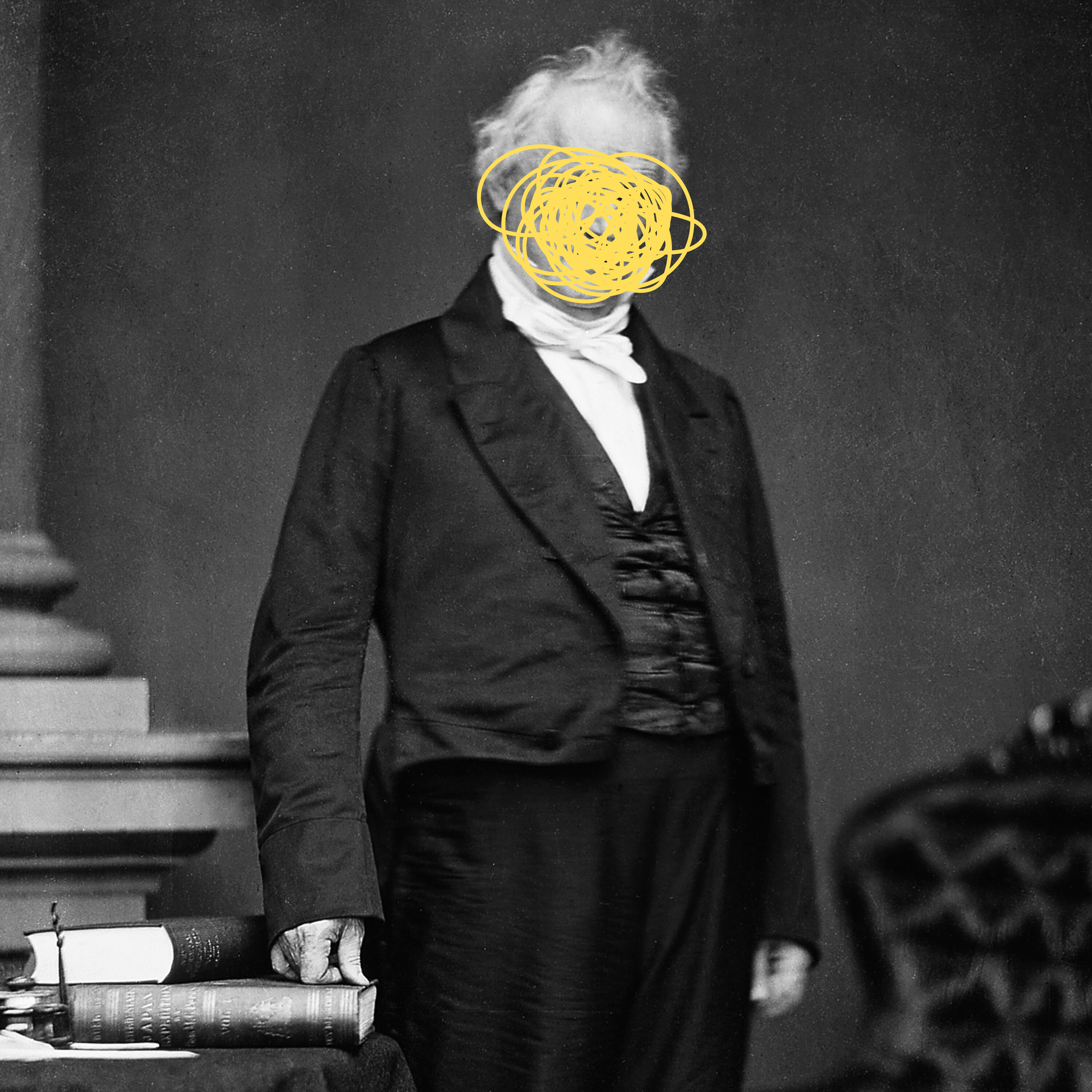
And that is the 15th president of the United States, James Buchanan Jr.
- [10:17]
Dr. Claire Aubin
So I was saying this before we started, but Gotham has the dubious honor of doing the first president episode. We did our live show that was on President's where Buchanan was mentioned, but this is the first episode we've had that's just straight up on a guy on the president.
- [10:36]
Gautham Rao
Yeah. I was not privy to the presidents episode, but I will throw this out there as a table setter that I think that Buchanan was known as Widely hailed as the worst of presence for a long time, and only very recently has that come into question.
- [10:57]
Dr. Claire Aubin
Yeah, I think in that episode I mention that. So neither Nikki or Kevin choose Buchanan as their guy when they're sort of doing it. And they both said, because he's too easy.
- [11:09]
Progressive Insurance Announcer
Yes.
- [11:10]
Dr. Claire Aubin
Like, he's. Everybody says he's the worst one. But I'm also realizing, and I said this to you when I was in D.C. that people say that. But I don't think more recent generations, like, certainly in my schooling, know why or know that much about Buchanan. Like, I think that that's sort of a thing that people who know about presidents think, but people who don't know about presidents maybe aren't aware of how shitty this guy is.
- [11:37]
Gautham Rao
Yeah, well, we're gonna. We're gonna take care of that. I think perfect will be the definitive word here.
- [11:44]
Dr. Claire Aubin
Can you tell me a little bit biographically about him, the thing that makes him terrible or the. Things will emerge, I think, pretty ra. Rapidly. But can you give us some background on Buchanan?
- [11:57]
Gautham Rao
Yeah, so I will. You know, I'll give you another table setter. And the way I like to think about Buchanan is I'm a food person, right. And I love food when I. I tend to think in culinary terms frequently, and I like to sort of think about presidencies or policies as dishes, you know. And so, for instance, you know, you could choose a Supreme Court justice with. With flairy takes and come up with a nice, you know, spicy dish or something. Buchanan. I would say if I had to devise a dish for Buchanan, it would be unseasoned dough that you just have to eat uncooked. Just raw dough and not cookie dough.
- [12:42]
Shannon Maldonado
Okay.
- [12:43]
Gautham Rao
Just, yeah, boring old dough. And so that, you know, you'll see why we get there shortly. But a very important fact about him is that he was born in the 1790s. He's born in, I believe, 1791, and that he is going to become president in the late 1850s. And so he's already getting on in the years, and that is not going to serve him too well, I think. So he is a Pennsylvanian by birth, and that will become salient when we talk about the politics of it a little bit. He is a lawyer by training. He goes to Dickinson College, which is an otherwise amazing place. I don't know if they really advertise his alumni status.
- [13:31]
Dr. Claire Aubin
Sure.
- [13:32]
Gautham Rao
He is a Dickinson alum. You know, he has a kind of checkered story in politics where he starts off as a Federalist and then not for the last time in his career, decides that the public opinion is going in another direction and then decides to become something else and ends up aligning
- [13:51]
Dr. Claire Aubin
with Andrew Jackson, a man with backbone. I'm hearing.
- [13:55]
Gautham Rao
Remember the DOE that I mentioned earlier? The doe, once again, it's going to keep coming back, but just very pliable until he chooses exactly the wrong issue to not be pliable about. So, yeah, he sees himself as a Jacksonian. He is prominent enough in Pennsylvania politics because he'd won an election in the House as a Federalist. And so. But he has this switch where he becomes a Democrat and becomes a kind of significant figure in Democratic politics in Pennsylvania. And so Andrew Jackson is now stuck with him. And I say that because this is one of two times in his career where he is going to be sent away, sent very far away from the locus of power, because I think he was kind of annoying. I think maybe that's part of it. So Andrew Jackson, as president, has to figure out what to do with this Buchanan, and he sends him to Russia.
- [14:51]
Dr. Claire Aubin
To be fair, I also had a Russia arc in my life. And I will say, you don't want to go there.
- [14:58]
Gautham Rao
Yeah. Claire, I will tell you this, is that your Russia arc happened in a far more friendly, kind of infrastructural state than Russia. Sure. In 1832 was.
- [15:10]
Dr. Claire Aubin
Yeah.
- [15:11]
Gautham Rao
I'm imagining a bit more bleak.
- [15:13]
Dr. Claire Aubin
Yeah. I feel like it was pretty bad. That being said, I went there and there were immediately sanctions on Russia right after I arrived. And so there were literally old women fighting over bananas in the supermarket. It was not the best of times for me to have studied abroad.
- [15:26]
Gautham Rao
That doesn't sound great. Admittedly. You and Buchanan could probably commiserated about this because he thought, I don't want
- [15:33]
Dr. Claire Aubin
anything in common with this man.
- [15:36]
Gautham Rao
He very much understood it to be the exile. And he is. He's there for over a decade, which is, again, I don't think it's an accident that he's just there. And you can imagine that they're checking in on him and saying, you know, everything good over there? And he's like. I guess they're like, okay, yeah, everything good. No, keep an eye on.
- [15:57]
Shannon Maldonado
That sucks.
- [16:00]
Gautham Rao
So finally, he. His bona fides as the minister to Russia are rewarded when another, I think horrifically bad President, James Polk, comes into office and he is appointed Secretary of State. So that's kind of a high point, I think, for his career. But, you know, I mentioned the. The other exile is that in 1845, he's Secretary of State. But when Franklin Pierce is president in the 1850s, early 1850s, he again sends Buchanan away under. You know, the rationale is, here's a seasoned foreign policy man and we'll send him out. But he goes off to. To the United Kingdom where, you know, he's dealing with some stuff, but it's not exactly a high importance position.
- [16:46]
Dr. Claire Aubin
Can I just say, the next place I moved to after Russia was the U.K. no. James Buchanan. No.
- [16:55]
Gautham Rao
Yeah. This is the Buchanan Arc you took here.
- [16:58]
Dr. Claire Aubin
My wario.
- [17:00]
Gautham Rao
I'm a warrior. I'm gonna win. They're calling it the Buchanan Arc. Yes.
- [17:05]
Dr. Claire Aubin
Yeah. Only me and him, honestly.
- [17:09]
Gautham Rao
Yeah. Well, if you've been to London, you'll know there are many people who have made that move from Moscow to London in particular. But sure.
- [17:16]
Dr. Claire Aubin
Yeah.
- [17:17]
Gautham Rao
All right. So then he's back in the US and he runs one of the strangest Campaigns for President, 1856, where he doesn't really do anything. It's just, you know, we have a derogatory term for presidential campaigns that are run out of the White House. They used to be called Rose Garden campaigns. Now that there's no more Rose Garden, I don't know what we're going to call them.
- [17:39]
Dr. Claire Aubin
Oh, yeah, yeah.
- [17:40]
Gautham Rao
Another Trump legacy here.
- [17:42]
Dr. Claire Aubin
The UFC. Freedom 250 octagon campaigns.
- [17:45]
Gautham Rao
The Octagon, yeah. Steel Cage Campaign. Who knows?
- [17:49]
Dr. Claire Aubin
Horrifying.
- [17:50]
Gautham Rao
Yes. But he basically writes letters and uses his influence within the party to secure the nomination as the Democratic Party's nominee for. For president. And he wins, which leads us into his presidency. But there's one more important fact to point out here with his biographical background, which is this is hard to address because you have to be very careful about playing into some of the less savory parts of American kind of political commentary. Right. But he has this really close friendship with a senator named William Rufus King. And later on, I think even during his own time there, there's some. Some teasing going on about how close they are, because Buchanan and King are both bachelors and they live in the same boarding house in Washington, and they're very, very tight. They're inseparable. And so there are rumors, you know, calling King Buchanan's better half, for instance, and there are attempts to claim that King is like the effeminate half of this relationship. And later on in the 80s and 1980s, there's a sort of brief moment where people are saying, Buchanan is the first gay president. So, you know, I think that's all, like I said, a little unsavory, more than a little. There's a historian I should mention, Thomas, I think it's pronounced Balsersky. He has written about this and this is where I'm deriving my knowledge from his very good book. But you know, his conclusion is essentially like male friendship in the early 19th century was a very different kind of thing than it is today. And their friendship, while very close, was not atypical of how men might associate then. So I did want to address that. There are others who have studied friendship in this time period. And you know my friends. Cassie Good, she's one who's written about this in terms of friendship in general in the early period. And then Rachel Sheldon, whose knowledge of the Dred Scott case and other things I'll be drawing on later. She has written about boarding house culture in D.C. and anyway, so this is a long way of saying that first gay president claim is probably not accurate, but he was a bachelor, which I think it ends up being very significant and also is on in the years. And so both of these things are going to become very, very relevant in his political time.
- [20:28]
Dr. Claire Aubin
Thanks for listening to this preview of a Patreon exclusive episode. To subscribe and listen to it in full, head over to patreon.com thisguysucked why
- [20:39]
Progressive Insurance Announcer
does progressive work hard for truckers? Because truckers unite the world. They unite kids with their first drum sets and parents with earplugs. But truckers can't do this if they're not on the road. That's why Progressive has over 360 heavy truck employees to help truckers stay on time and on track. Quote Truck Insurance today in as little as eight minutes at progressive commercial.com progressive casualty insurance company and affiliates insurance isn't one size fits all. That's why customers have enjoyed Progressive's name your price tool for years now. With the name your price tool, you tell them what you want to pay and they'll show you options that fit your budget. So whether you're picking out your first policy or just looking for something that works better for you and your family, they make it easy. To see your options, visit progressive.com find a rate that works for you with the name your price tool Progressive Casualty Insurance Company and Affiliates Price and Coverage
- [21:33]
Shannon Maldonado
match limited by state law My name is Shannon Maldonado. I'm the founder of yowie, a gift shop. From the lens of artists and handmade objects, I chose Shopify because when I was testing other platforms, it was definitely one of the most user friendly. It was important to me to think about where we would be in the future. Future. All of the tools for reading your sales, like planning inventory, they're just right there on your dashboard. For anyone starting a small business, the biggest thing I can tell you, it doesn't have to be perfect. Shopify can help you build upon it. Start your free trial on shopify.com.