Loading summary
Transcript121 lines
- [00:00]
Claire Aubin
A list of sensitive themes and topics included in this episode can be found in the episode description. Welcome to this Guy Sucked, the show, where we prove that it's never too late to have haters and you can't libel the dead. I'm your host, Claire Aubin, and I'm a historian, writer, and most importantly, certified hater. On this show, we talk about people from throughout history with legacies that need a little updating. Whether it's because of their politics, their behavior, or their impact on society and culture. Maybe these guys actually kind of sucked. And we bring in a new scholar every week to tell us why. With me today is Katherine Fletcher, who is a professor at Manchester Metropolitan University specializing in Renaissance and Early modern Italian history. She's written several books on related subjects, including the Beauty and the An Alternative History of the Italian Renaissance, the Black Prince of Florence, and the Roads to A Journey into Europe's Past. But more importantly, she has a very cool new book out called the Firearm Revolution from Renaissance Italy to the European Empires. And I'm very sorry for how Americans say Renaissance, which is not how you say Renaissance, but welcome to the show.
- [01:26]
Katherine Fletcher
Thank you, Claire. It's lovely to be here.
- [01:28]
Claire Aubin
This is a question that I am certain you've gotten before and are probably tired of hearing, so please indulge me. You say in the book, particularly in the acknowledgments of the book, which are my favorite parts of any book, that you learned to shoot for it. Are you a good shot now?
- [01:46]
Katherine Fletcher
So I managed to hit some clay pigeons. They were the easier sort of clay pigeons that you learn to do. You know, the ones that go quite slowly and, like, make a nice arc up into the air. And I could hit a good few of those by the time I finished my first shooting lesson.
- [02:03]
Claire Aubin
Okay.
- [02:04]
Katherine Fletcher
It was good fun. And also it gave me an understanding of why people get a kick out of going shooting, which I don't really think I had entirely appreciated before because it is very satisfying when you hit one, I'm sure.
- [02:16]
Claire Aubin
Yeah. I mean, my first encounter with shooting, and sorry to everyone who's not American. Listening to this, because this sounds wild to people who aren't American, is in high school also. Sorry to my mom and dad, but in high school, in my, like, sort of senior year of high school, I had a boyfriend who would, like. He and his friends would, like, go out shooting all the time in the woods. And so we would go and shoot in the woods. And it's quite a different experience, I think, than, like, clay pigeon shooting being like 18. And having access to a gun is not great.
- [02:51]
Katherine Fletcher
Yeah. You cannot just take a gun and go out shooting in the woods. In the UK in general, you know, everything is very structured and very, very highly regul. So, yeah, that is not a legal experience that we could easily have over here.
- [03:06]
Claire Aubin
Yeah. And to be clear, I'm not condoning this or recommending this to anyone. I was just a feral Oregonian child. This is not, again, not what I'm saying anyone should be doing. It is just what I did. But I would not say I'm a good shot out of that. You know, I would actually also, maybe for the purposes of anyone listening, I'm a great shot. I'm amazing, actually.
- [03:30]
Katherine Fletcher
Yeah, yeah. Possible like six sniper quality shooter. And anyone coming your way to criticize your choice of haters, you know, beware, Beware of me.
- [03:44]
Claire Aubin
We should probably talk about the person slash group of people. I mean, when we first talked about doing this episode, you had a sort of group that you were interested in talking about. But I'm curious to see if that has evolved into a singular person that you want to focus on or. Or not, maybe so.
- [04:02]
Katherine Fletcher
Well, obviously my book is called the Firearm Revolution. And so it's an object centered book rather than a person centered book because it's about the gun and how lots and lots of different people responded to guns. But within that, I do have one particular case study of an individual who is a guy called Giovanni Batista Portulaga, who was around in the 1540s and 1550s in northern Italy. And he was an arms dealer. In effect, he's probably one of the first well documented arms dealers in Europe that we can find. And so although, you know, is he as an individual, like a really personally bad person? Well, we can get onto that. But he's a sort of representative of this type of the arms dealer, who is a somewhat new figure, I think, around this scene, the international broker who is fixing up deals between different states and facilitating them. So I want to talk about him as an example and as a person whose life gives us a window on the arms industry at a really pivotal time of its development. Another person who I might have talked about, but I can't really talk about because we don't have the sources, is Bartolomeo Beretta, who in 1526 was documented as a representative of the Beretta arms producing company, who of course still exists today. But unfortunately for Bartolomeo, we have literally one line of evidence about his existence at that point. So we don't really have Material to do a whole episode. Whereas for Portulaga, we have an awful lot more to dig into to find out about all this world. So I'm going to settle on him.
- [05:53]
Claire Aubin
Sure.
- [05:53]
Katherine Fletcher
As our case study for today.
- [05:55]
Claire Aubin
He can be a case study amongst a group. There are lots of times where we've said, all right, we're talking about this broader group. So the example is the Orientalists episode where we say we're talking about a group, but we're going to use one or two people as sort of exemplars within this group. And so it makes sense. Even someone like Beretta, for example, who has, I said this continuously operating business that is one of the oldest continuously operating businesses in the world, actually. So you would think there would be a lot of historical interest in him. There is a one paragraph Wikipedia page about him. So I can see how that would make it difficult to really do an hour of talking about him.
- [06:35]
Katherine Fletcher
Yeah, we have this like one transaction where he's selling gun barrels to the Venetian state.
- [06:40]
Claire Aubin
Yeah.
- [06:40]
Katherine Fletcher
And then he doesn't turn up in anything else that I'm reading, which is not really a surprise because the evidence is very, very patchy. And this was a huge jigsaw puzzle type of a project to put together.
- [06:51]
Claire Aubin
Sure.
- [06:51]
Katherine Fletcher
But it's just to some extent the luck of what happens to survive when you're going back 500 years.
- [06:58]
Claire Aubin
So if I'm trying to create a context for people who are interested in learning about this group or these individuals, what are the things that you think people already know or may know going into thinking about Renaissance 16th century Italian arms dealing?
- [07:16]
Katherine Fletcher
Okay. So first of all, like a popular reference point in this period in terms of a person would be Machiavelli. And so Machiavelli is around at this time, is around recommending in 1506 the creation of a Florentine militia. And it's in this period that these militias start being equipped with guns for the first time. So small arms, portable guns, we're in this transition from cannon to guns, as, you know, important weapons on the battlefield. It's around 1503 that we get the first battle in which small arms are a decisive military technology. And also at that time we start therefore to get the growth of a small arms industry. And the area that I'm looking at for my case study is in northern Italy. It's near a town called Brescia. It's kind of closer to Milan than to Venice. But at the point that we're talking about, it was ruled by the city state of Venice. It's one of two really major gun producing areas in Europe. The other one is in southern Germany. And what's interesting is they're both south still really important arms industry areas in Europe to this day. And so this Gardone, Val Trompia, this small valley town outside of Brescia, you can take the bus up there, you go up the valley into sort of this very dramatic foothills of the Alps area with these sort of wooded valleys and a river coming down the middle. And all these arms factories and shops are sitting there in the valley. So that's a part of the context shifting military technologies, states trying to respond to those. And then these particular places, Venice, the sort of Overlord city, Brescia, the local town, and then Gardone, the actual arms producing area, are where we're looking at for this story.
- [09:07]
Claire Aubin
When we think about an arms producing area or the kinds of arms being produced, it's not just firearms, right? Like they're also producing other weapons, swords, armor, et cetera, at the same time. So it's not like there is this sort of cottage fire arms only industry. That was that, right? Am I right? Please tell me.
- [09:25]
Katherine Fletcher
No, in fact, they are producing a lot of things because this is a mining area. It has really good iron ore. It has a particular type of ore that apparently works really well for gun production. So they do become a really major gun export area across the whole of the continent. So Gardona guns end up in England by the 1540s around. Exactly around this time, to the point that they're doing so many international exports, they have an export licensing system.
- [09:56]
Sponsor Voice 1
Okay.
- [09:57]
Katherine Fletcher
So the local authorities are running. So this is big business. And there are only a limited number of places that can do this. Because you need the raw materials.
- [10:07]
Claire Aubin
Sure.
- [10:07]
Katherine Fletcher
You need the iron ore, you need the wood to create charcoal to smelt the iron ore. And then you need something to power your mills. So in this case, it's the river that comes down through Gardone and that is powering all these water mills that drive giant hammers to hammer out sheets of metal that are then rolled up into gun barrels. So it's not something you can do absolutely everywhere, but it is very much part of a larger piece of arms and armor production that goes beyond just guns on their own.
- [10:40]
Claire Aubin
At what point do guns become the thing that people are manufacturing or become sort of such a major export? If they're in a place where there are already other weapons or other forms of arm being manufactured? When do firearms become the thing?
- [10:58]
Katherine Fletcher
So already in, already in the first decade of the 16th century, the Venetian authorities are getting really nervous about master gun makers from this valley leaving and going to other places. And they're actually trying to restrict emigration. And this is something that Venice does a lot. They also do it for their glass making industry. And they say basically you guys are not allowed to leave now, you just can't leave. We're not going to let other Italian rulers headhunt you to set up their own arms factories. You've got to stay where you are. So they really try and preserve this technology and preserve a bit of a monopoly on this technology in the Italian states. It doesn't work in the long term. Some of these guys get headhunted and they go off and they set up in Florence or Milan or wherever. But the Venetians are clearly working very hard to discourage people from leaving their prize arms production center because this is something that's very valuable to them as a state. And it's very valuable as well in terms of exports to be able to, you know, you're getting foreign currency in to your economy. There is other spin off industries that they have. So they actually give tax breaks to people who are producing other parts for guns beyond the barrels to try and incentivize all the production of every part of the gun to stay within their territory. So lots of really interesting maneuvers on the part of the government to try and make this industry work for them.
- [12:30]
Claire Aubin
I mean, so I work on a certain type of 20th century immigration and so I think pretty regularly and pretty consistently about immigration and immigration restrictions. Most often in the periods that I'm looking at immigration and restrictions around immigration are more like to encourage people from certain industries to go to a place that has a lack of them. I have very infrequently, if ever heard of a place saying actually someone's status as a certain type of worker is a reason they cannot immigrate, if that makes sense.
- [13:08]
Katherine Fletcher
Yeah, they really don't want them to leave. I mean, early on they are also trying to bring in workers from South Germany because the German industry is a little bit ahead of the game in terms of particularly particular types of gun production. So you get an import, an attempted import of German experts. But yeah, they really don't want their top people sneaking off somewhere else and setting up. So there's a bit of a stick in a sense of saying, you know, there's a law that says you can't go without permission. There's also a carrot in terms there are quite a lot of tax privileges for these People in this particular area, they don't have to do the same level of militia drill that everybody else has to do. They have these very various exemptions. They're quite good at saying, we want our ancient privileges not to pay tax on this thing. And without actually spelling out, if the ancient privilege isn't preserved, they're going to leave. That's clearly the subtext. Like, you can't afford to tax us too heavily because we will then just go off and work for the Duke of Florence or the Duke of Milan or somebody else. And so there's a lot of negotiation already going on between this. This developing arms industry, who know the power that they've got in relation to the government, which really wants their products, and the government saying, yeah, we need to keep these guys on side. And then they do that through restrictions and through privileges. But it's very interesting how much power they get to exercise.
- [14:38]
Claire Aubin
Yeah, I think it's funny to say, actually we don't want to be part of these militia exercises. We only make the guns that the militias are using.
- [14:47]
Katherine Fletcher
They funny, like, because it's not quite that. It's not just we only make the guns, it's like we make the guns and we're so good at using them that we don't need to do your boring routine militia exercises, because, like, we are frankly, top gun users. And there is actually quite a lot of concern about the people in Gardone being a bit trigger happy. There's a very funny account from the 1550s of one of the Venetian officials in Brescia writing back, saying, one, he's very concerned that they are buying into this new Protestant type of religious radicalism, because this is the period of the Reformation. And so these. These people are a bit Protestant and they're all going about with guns. Even the women. The women have got two guns each, like, one in their hand and one at their belt. They've got wheel locks, which is a particular type of gun that the government gets very concerned about because it can be concealed. I mean, clearly these women are not concealing their wheel locks. They're going about very openly saying, nobody's going to stop me, but. But, yeah, that sort of attitude of, yeah, we absolutely know what we're doing with this technology. We are good at it, we are going to show off with it and also, like, come and have a go if you think you're hard enough type of approach, I think is very much what we're hearing.
- [16:03]
Claire Aubin
It sounds like northern Italy is the Texas of Europe at this moment, basically. Where everyone's like, look, what are you going to do? All the women have not one, but two guns. We have not figured out, you know, concealed carry permits at this point or regulations around this crazy time to be there, though.
- [16:26]
Katherine Fletcher
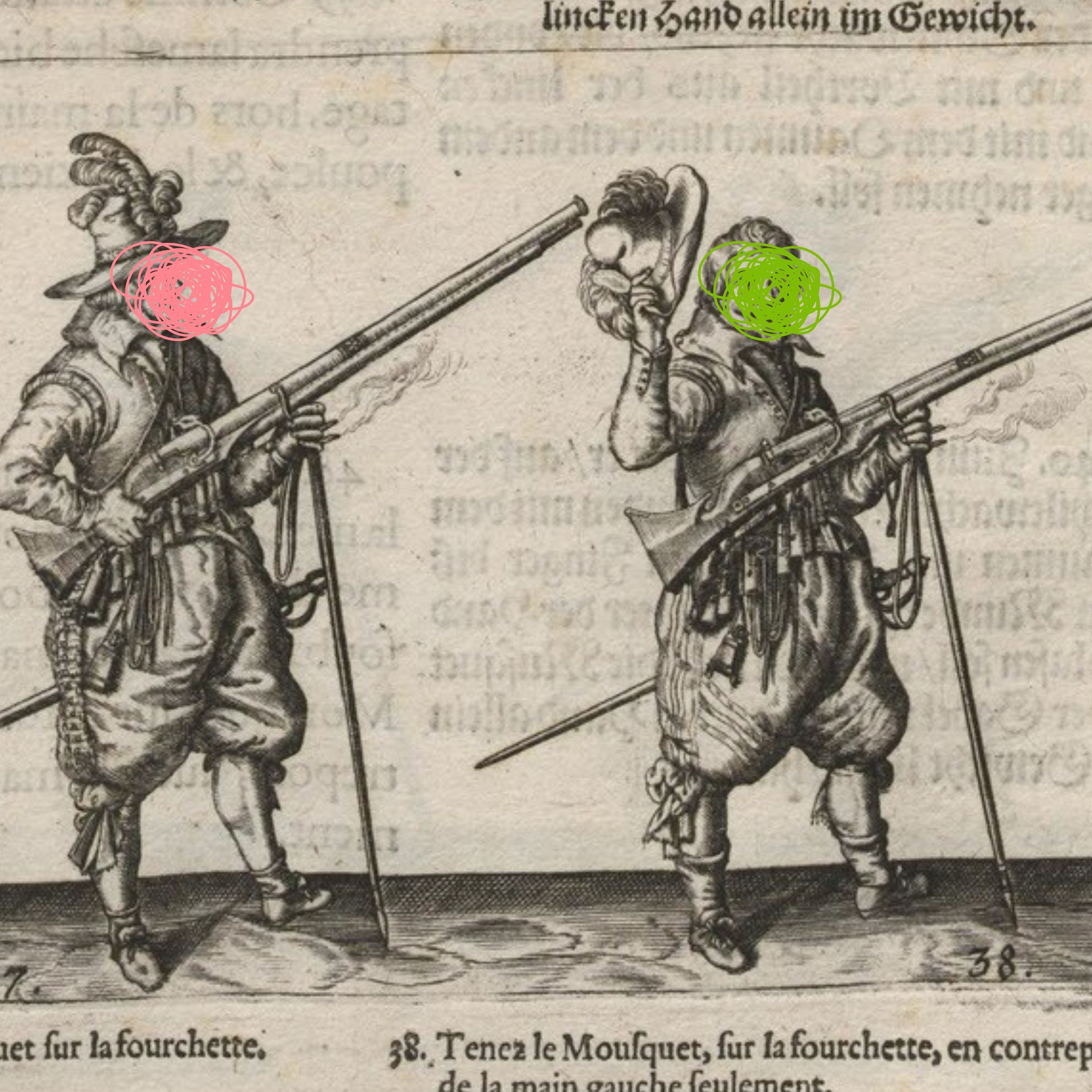
Yeah. And they try and have some regulation. I mean, the governments across the Italian states repeatedly trying to limit who can have a wheel lock because they're very concerned about people having these concealed weapons. So just to explain the difference with a wheel lock, as opposed to the previous type of gun, which is the matchlock. With the matchlock, it works by having a piece of cord which you light, it smoulders and you sort of clip it into the top of the gun. When you pull the trigger, the match cord sparks the gunpowder. But clearly you can't conceal a lighted smouldering cord in your pocket.
- [17:00]
Claire Aubin
Sure.
- [17:00]
Katherine Fletcher
Whereas you can conceal a wheel lock which has a sort of spring powered wheel that you wind up and then when you pull a trigger, the wheel spins. You have a stone that kind of rubs against each other to create a spark. And so you've got the possibility of concealed carry. And so there's particular concern about who's got wheel locks. The fact that too many ordinary people have got wheel locks at these things getting all over the place. And really your shepherds and cowherds and such like have no business having these wheel locks, which either shouldn't exist at all or should only be strictly for elite bodyguards and people who really need them for, I don't know, cavalry warfare and such like.
- [17:42]
Claire Aubin
Yeah.
- [17:44]
Katherine Fletcher
All these arguments about what happens when these guns spill out of the military context into the civilian context are already very live in the 16th century.
- [17:58]
Claire Aubin
Hi there, it's Claire. The episode you're currently listening to is free for everybody, but the next one won't be because we're trying to make this show independently and sustainably. We switch off between free weeks and Patreon weeks. So if you're a fan of good, accurate public history made by actual experts, consider supporting our Patreon. It's only one tier, which means everyone who subscribes gets access to the same perks across the board. For the price of a pair of socks, you'll get access to a new episode every week instead of just the bi weekly free ones. And they'll all be ad free for you. You'll also get access to the full episode archive, bonus content, early access to merch, and lots of other fun Patreon exclusives to sweeten the deal, just head over to patreon.com thisguysucked or follow the link in the episode description to sign up. Yeah, you do a really admirable job in your book of explaining that gun control and gun regulation have coexisted alongside guns since kind of the invention of guns or since the proliferation of guns has been always a concern.
- [19:00]
Katherine Fletcher
Yeah, pretty much.
- [19:01]
Claire Aubin
I mean, even when you, in the book, when you talk about the matchlock to wheel lock transition, one of the things that you explain that I found very interesting because I guess I hadn't really considered this, it being such a feature of life here. Now one of the major concerns is that now you can assassinate people with guns. Like you can conceal a gun and assassinate someone, which was not like long distance assassinations without things like arrows were not like that easy to undertake previously.
- [19:31]
Katherine Fletcher
Yeah, like a gun is much more reliably lethal than a long distance arrow shot. It's like, you know, you can do some damage with an arrow arrow, you might kill somebody, but the chances of getting away with it and doing a lot of damage are that much lower. Whereas, yeah, the prospect of being able to shoot somebody from a distance and have that time to make your escape before people really realise where exactly the shot came from and what you're doing, you can be out of there. And so there was a lot of nervousness about that risk and just about, I think the risk that this would aggravate already existing feuds and vendettas that. That were quite a strong element of Italian society already at this point. So we see guns starting to crop up in all sorts of different criminal contexts. You know, sometimes they're just being used to go and shoot up the front of the house of somebody who's insulted you.
- [20:26]
Claire Aubin
They still do that today, to be clear. People still do that now.
- [20:32]
Katherine Fletcher
Yeah.
- [20:33]
Claire Aubin
I mean, I've seen you talk about this online, but is it a frustration of yours when you're thinking and teaching and talking, talking about this to remind people that regulation and regulating guns has been a concern of states where guns exist for hundreds of years? It has always been a concern.
- [20:52]
Katherine Fletcher
Yeah. I think a lot of people don't realize that one, that guns are as old as they are in that they were around 500 years ago. They coexist with some of the famous names of the Italian Renaissance. They coexist with, you know, the Tudors in England. Henry VIII took shooting lessons, but they're not very much part of the vis culture of that period. And they're not necessarily something that you would routinely see if you go and watch a film about what's happening in the 16th century. So people are surprised that they're already about. And then when you say yes. And there was gun control legislation from very early on to try and restrict which type of guns people could have or where they could have them. It's rarely an outright ban. It's all about questions around should we allow certain types of gun in the city, in certain types of building? What type of gun should people be allowed to have out in the countryside? They're generally a lot more liberal about. They're more liberal about people being allowed to use guns when they're travelling. For example, travelling is perceived to be dangerous. You might be attacked by bandits. So fair enough, you want your outriders to be armed with guns, that's not a problem. And they even develop this, this check system, like a coat check at the gates to these cities. So when you're coming into the city, if you've got a gun that's illegal inside the city, you just check it at the gate and you take your ticket and when you go back out of the city, you can get your gun back. So it's like the level of organization and attention to detail around what to do with this technology that was perceived obviously to have military advantages, but also to be quite socially risky in terms of public order and the possibility of it being used in riots and rebellions and so on. You know, they are giving a decent amount of thought to it doesn't always work. These are pretty weak states that struggle to enforce the laws that they make. But they've got the idea that in theory they would like to do this regulation.
- [22:53]
Claire Aubin
I mean, I think it's also interesting we talked about this in our previous arms dealing episode and we will in just one second get to the problem. But in our previous arms dealing episode with Drew McKevitt, we talk about the modern gun lobby as it currently exists, who have really benefited, I think, from this sort of historical retconning about a sort of lawless, gun happy past where there was no regulation before. And then all of a sudden the regulation of guns and gun control is like this modern invention, this like brand new thing and that we have to return to the past when that didn't happen. And that's just, just not real. You know, like over and over again
- [23:36]
Katherine Fletcher
it's proven, no, it's not real. There are lots of examples of guns being regulated in particular ways and you know, we can see those in all sorts of different historical periods and yeah, for sure, a little bit further on from where I am in the 17th century. You get a stronger idea of an association of guns and rights. We don't really have rights discoursed yet in the 16th century. So when people are talking about, about being allowed to carry weapons, they talk about it in terms of a privilege that fits their social status or their occupation or whatever. But yeah, the regulation was there very early on with the presence of the technology, and people fought to get rid of it and argued to get rid of it. But that was a live argument, you know, 500 years ago, not something that
- [24:22]
Claire Aubin
is brand new and that, you know, modern lefties are trying to.
- [24:29]
Katherine Fletcher
No, no, it was very. I mean, it was actually, it was very much a state thing. I mean, in fact, sometime in the interesting example in Florence where the more republican faction in Florence which opposes the establishment of a Medici duchy, says that it's the duchy, the government taking away our guns is a problem because this is stopping us from rebelling for a more. It's not really a more democratic sort of government. It's still a very closed and limited sort of government, but a somewhat. A broader based government that they would have liked rather. Rather than simply the Medici dukes ruling for themselves in a hereditary duchy. So they see that this is the sort of tyranny of the government using gun control against rebellion. So that also is already around at that point, that type of argument that this is a gun control is a thing that the bad tyrannical government is doing against rebels. You know, so all these different elements that you can hear in modern day arguments around guns and not just in the U.S. actually, I mean, around the world you get very interesting parallels. You get a lot of places where people don't want to give up their guns post conflict because they're genuinely concerned about conflict starting up again. And that was certainly a concern that I find, you know, 500 years ago, people who don't want to give up their guns for reasons around honor and masculinity.
- [25:55]
Claire Aubin
Sure.
- [25:56]
Katherine Fletcher
Because there's a sense of pride in being a gun owner and that gets very tied into personal identity in a patriarchal society. And you can absolutely see that in modern analyses and various different places of why people want to keep their guns. So, yeah, all sorts of ways that we can see that today's debates linking into very historical contexts.
- [26:18]
Claire Aubin
That is actually maybe a good way for us to segue into why, what the problem is with people like Portulaga or if there is a problem, you know, tbd. But what do you see as being a potential reason for them sucking or for there being some. What's your Beef, basically, I think this
- [26:40]
Katherine Fletcher
is an example of how somebody almost like accidentally falls into being the guy who sucked, because he is generally trying to do the right thing for his family, and he is trying to put himself in a position and in a social network that will advance his family's interests. And that's absolutely the sort of thing that. That people do all the time. Sure. And yet, in this case, we're here in the middle of the 16th century in Brescia. He was born around 1492, so he's quite, you know, he's in his 50s, 60s, by the time that we're talking about him. He's held some prominent city offices. His family are on the list of people who are officially allowed to be on the city council in Brescia. So they have this sort of patrician status. So he's doing very nicely for himself. And what he wants to do is to make sure that carries on for his sons, of which he has several, including one who is named after Scipione, who's like, you know, named after the great Roman general Scipio Africanus. You know, you want your son to be a great military commander. And he does actually appear to go on and do this. So this is the picture that we've got. I came across Portulago, like, somewhat through a series of archival serendipity, where I, first of all, I found documents in Rome which are actually not about him personally, but about his purchaser. There's somebody who called Camillo Orsini, who's buying arms and armour from him, or at least via his broking, because he's not actually directly selling the arms himself. So if I had Orsini's records in Rome, I then realized when I got to Brescia that we could see the Portulaga correspondence that linked back to what Orsini was doing. And then, oh, there was a COVID lockdown in between. So in between finding those first two documents, I had about two years where I could look at anything to follow this up. And eventually I got back to Brescia and I worked through and I found Portulaca's account books. And I thought, I wonder if there's something in here that would tell me about the gun. And so I leafed through about 300 pages of Portulaga and his family buying stuff for the household until I found some guns. So we have these arms deal. What's fascinating to me about this particular historical source is that they're basically lists of things that the Portulaga family are buying, selling, giving Commissioning. So they give us a really good window on how setting up arms deals fits into a routine, noble lifestyle. And how easy it must have been for somebody who's in that city where we happen to have the growth of this arms industry nearby, to think there are some opportunities for me to make connections here that could be useful for me, that could be useful for the family. And you can read out of this list of accounts how he is networking with potential buyers, with potential sellers and with the people who are going to have to approve the export license. And you can see how he's going in every different direction to pull this role as arms broker together and make these transactions work. And you could absolutely not legally operate today like he does. Because this is a lot about giving people gifts.
- [30:15]
Claire Aubin
Yeah.
- [30:16]
Katherine Fletcher
And you say this.
- [30:18]
Claire Aubin
Yeah, yeah.
- [30:19]
Katherine Fletcher
You know, we. A lot of what he does is he basically gives presents to people who are potentially going to be buying arms in this area and to people who are potentially going to be selling arms and to members of the Venetian ruling councils. And these presents, the presents are quite interesting. I mean, they've got, you know, he sends his son with a gift of gilded swords to give to the sons of his potential buyer, Camillo Orsini, who's a really prominent mercenary commander in this period. He gives the Orsini family more direct gifts, like his gift of linen. Here's some armour for your horse. He's also keeping up with the Duke of Ferrara, because you don't just want to have like one set of contacts only.
- [31:07]
Claire Aubin
Sure he is.
- [31:08]
Katherine Fletcher
He's liaising and he has this lovely. There's a lovely letter. We don't have a lot of letters from him. There's a Lovely letter in 1553 where he's writing to this big commander to say, I have jollied along the arms bosses as much as I could to try and help fix up this big purchase of arms that Orsini is trying to make. So he is, you know, got a finger in all these different pies. He is tied in with the. The aristocracy in the gun making area. The local lord from Gardone, who is, you know, alongside all the masters of gun making, we've still got a fairly traditional feudal type nobility. And we could also see what he's getting out of this activity, which isn't straightforward. So he's not making cash directly for himself, so far as I can tell. If he is, it's not going directly into the account book. We do have to have a question about, are there backhanders, are there things like, oh, I got a big ruby ring, which would be a gift that you just wore and might not be recorded in the books that we've got. We do know that he got a loan of 427 gold scudi for his son, for his son to go off and raise some cavalry as part of getting a very nice military. Military contract himself to run a private military company of cavalry. So maybe he's got a title. Possibly. That was not something I could verify. It's mentioned in a secondary source, possibly got the title of Lateran count from the Pope. Very nice.
- [32:44]
Claire Aubin
Sure.
- [32:45]
Katherine Fletcher
Sometimes associated with holding an office at the Vatican that would bring you additional income. And the other thing I found really fascinating about Portulaga operating as an arms broker in this context is we can also see in these books that he is part of an Italian Renaissance humanist culture. So he goes and he buys copies of Virgil, the Roman poet, published by Aldus Manutius, who's very, very famous sort of Renaissance period Venetian publisher, for his sons. So they are in this world of classical poetry. Actually, one of the sons gets. Gets his portrait painted in Roman style armour, no gun in sight in the portrait. We don't show off the gun dealing in the portraits. We're going to be all in proper Renaissance, classical style. But this is one of the contradictions of the Renaissance that on the one hand you have this harking back to classical imagery, classical ideas, and on the other hand you have these very modern technologies like. Like the firearm.
- [33:49]
Claire Aubin
I think you've also proven something that I said in an episode I recently recorded, which will have come out before this one with Peter Mancall, where I said a thing that a lot of people do not understand about what being a historian is and doing archival research is, is that a lot of your job. So much more of your job than they imagine is not reading letters and diaries. And it's looking at receipts. Yes. It's looking at ledgers, it's looking at she chip manifests, things that basically tell you nothing. Well, that seem on the face of it to tell you nothing other than money in, money out, item here, item there, but from which you can build a whole world or can attempt to build or recreate a whole understanding of the world. But it's really only interesting if you're the kind of person who enjoys figuring everything out of very little information.
- [34:45]
Katherine Fletcher
Yeah, you know, I was lucky in a way because the. These books are hundreds of pages long, so there's a very rich range of source material to try and put this all in context, we have lots of names of different artisans in Brescia who are doing the sword making and so on. We have the first reference to Gardone, specifically to the gun making area is when a guy called Luca Vito Ditor from Gardone Val Trompia turns up to pawn an arquebus, which is a type of gun, and presumably borrow some money of Fortunaga. Which opens up a whole other set of questions about is there other money lending going on? And different types of social relationship. But I think this set of books really helped me understand how in practice guns could fit into somebody's life and social circle. Because, you know, people are not always as reflective as you would like historically.
- [35:39]
Claire Aubin
Sure.
- [35:40]
Katherine Fletcher
They don't. Particularly in this period. They are not writing diaries that say, let me write a big sort of discussion of how I feel about guns. We get very little of that.
- [35:50]
Claire Aubin
Yeah. And then I met him where he
- [35:52]
Katherine Fletcher
gave me the whole this is what happened and this is how we did it. People don't record those day to day transactions very much in diaries or anything like that at this point. So you rely on applying imagination to these types of accounts and saying, what can we see going on within this quite dry set of records? And I think we can see quite a lot and we can see how easy it is for guns to move in as a new technology and get normalized within these very routine social networks that would have been pretty similar in the way they looked before guns and will continue to function in similar ways for quite a long time under that old regime in Europe of, you know, aristocratic social networks being very central. But yeah, I think it just shows us something about how guns became ordinary and got adopted and assimilated into a society that didn't have them. And I think in terms of understanding not just guns, but any new technology, thinking about how does society take it on, how does it become ordinary? Is, you know, I think that's a really important historical question. It's important question today with all the new technologies that we've seen in our lifetimes. And it was an important question then to think about how do people go from this is a slightly weird new thing that we're not very sure about to this is just normal.
- [37:29]
Claire Aubin
And also how things like that get sort of slotted into the economy alongside all of these other normal daily transactions that a person might have. Much so that it just becomes a feature of life in the uk. So we have listeners like here in the US and in the UK and like all over. But one of the strangest things. And please permit me this short digression, but one of the strangest things I found about moving to the UK was that they didn't have apps like you have in the US for things like Venmo, which is this app where when you. And, sorry, for American listeners who obviously know about this, but when you buy something, somewhat like if you go to dinner with your friends or something, or if you buy something off Facebook Marketplace or something like that, they can just send you the money. And usually they can attach a little message to it that says, like, this is what this is for. I bought a chair or for sushi or whatever. And for a very long time, it was public, so you could see anyone's Venmo transactions. And it was also the way that people would, like, discover that someone was dating that they hadn't announced yet because
- [38:32]
Katherine Fletcher
they'd be paying for dates.
- [38:34]
Claire Aubin
Or a way that you could, like, find out, oh, I didn't realize these people were friends or that they knew each other, or, oh, maybe this person might have actually bought drugs from that person. You know, like, it was this thing where, like, you could see people's, like, transactions, and now you can make it private. But I think a lot about, like, that is the closest version we have of these sort of, like, ledgers where you can extrapolate relationships from them, where you, for example, could come across a transaction that happens between two people that you had no idea even knew each other until that moment, and then say, okay, well, clearly there is some relationship here because he's essentially lending him money. So they know each other in some capacity. And there's no other way to encounter that other than through looking at things like this or to see, oh, guns are just a normal thing that you would exchange with a person that you knew, you know?
- [39:25]
Katherine Fletcher
Yeah. And particularly when people are living in the same place and interacting with each other, there's no reason for them to write a letter to make an order for something that they're getting from a distance. So we rely on having these transactions that show that he was asking the guy on the corner of the main piazza to make a sword or whatever it happens to be. Without that, you don't get much sense of, you know, how life went on. And I think, you know, over the past couple of decades, historians have really used these types of swords to understand the sort of material culture of everyday life in all sorts of interesting ways. Days. And it's funny because one of the books that I was reading on the background to Brescia and Gun Production basically said, oh, look, there just aren't the sources to do this for the 16th century. And I think that was probably genuinely believed in the 1980s when that was published. But of course we keep inventing new techniques for how to extract evidence and how to think about the sources that we have in different ways. And so I have some background in doing that type of work and in working with account books for the Medici court, but also previously when I was working on diplomacy, working on accounts there. So it wasn't a complete surprise to me to think when I got to this topic that maybe somebody's account books might turn out to be useful. And I guessed right. So that was. Yeah, clearly they are really. Yeah, yeah, clearly. Clearly they are. We can see all sorts of fascinating little details inside.
- [40:57]
Claire Aubin
So is part of the issue of Portulaga that he. It's not even necessarily that like he is the guy that normalizes guns or spreads guns, but that he is, as was the case with someone like Samuel Cummings, who I said was in the Dream of Kevin episode, that he is a domino, an early domino in a long term series of dominoes that will fall and lead kind of to where we are now. And so we can't place it all on him, but just that he's an interesting figure to think through for understanding this.
- [41:31]
Katherine Fletcher
He's a really interesting figure to think through and to try and understand this process by which lots and lots of people at different social levels got drawn into the idea that the gun industry was an ordinary sort of industry. And I think it's probably worth saying at this point that not everybody thought the gun industry was just fine. And okay, there were a lot of people who thought gunpowder weapons were the devil's work, that they were diabolical, they were ungallant, they were unchivalrous. There was a lot of hostility towards firearms in general, whether large cannon or small portable guns. It's not the case. There's a generalized cultural acceptance, but through people like Portulaga, we can see how perhaps some of the social pressures and the way that social networks start to adapt in multiple ways to guns being an ordinary type of object, which, because the government wants to have them for its military, which is, you know, broadly speaking, considered one of the more acceptable uses of firearms, they start to get out in other places too, and they proliferate. And then there's a question of, you know, sales to civilians, how that broad picture develops. And Portulaga shows a part of that process of normalization. And it's interesting though, to see the things that one of the things he doesn't do, he never personally buys and sells. He's not trading himself because trade in general, not just of guns but of anything, is not considered a suitable occupation for a nobleman. Sure, yeah, so he facilitates these social networks, but he doesn't do the buying and selling directly. That won't come come until very, very much later in terms of, you know, what you can do when you're part of the European nobility.
- [43:31]
Claire Aubin
Hi, it's Claire here with my normal mid roll shout out to tell you about other multitude shows that I think you might be interested in if you like this one because presumably you're a smart person. So this week I want to talk to you about Pale Blue Pod. If you, like me, are overwhelmed by the great and terrible of the universe, but also kind of want to understand it, possibly befriend it, or at least be less scared of it, this show is for you. You might know her from her wonderful TGS episode on ancient Greek astronomer Ptolemy. But on pale blue pod, Dr. Moya McTeer and her best friend Con Star sit down each week to demystify space one topic at a time. They do it with open eyes, open arms and open mouths from so much laughing and jaw dropping shopping. Obviously by the end of every episode the cosmos feels somewhat less scary and a lot more fun, I promise. And this is as a lifelong scared of the Cosmos type person. New episodes of Pale Blue Pod come out every Monday, wherever you get your podcasts. So like the app you're currently using, go give it a listen. If nothing else, this podcast proves basically every episode that some historical figures could probably have used a psychiatrist, even just for a little visit. Luckily for you, now we have Talkiatry. If you've been stuck on a six month wait list for a psychiatrist or are bouncing between online mental health sites trying to find medication support, Talkiatry was built for you. It's virtual psychiatry that actually fits your life and your insurance. Talkiatry is a 100% online psychiatry practice that provides comprehensive evaluation, diagnoses and ongoing medication management for conditions like anxiety, depression, ptsd, insomnia, and more. Unlike therapy only apps, Talky is psychiatry. That means you're seeing a medical provider who can diagnose mental health conditions and prescribe medication when it's appropriate. All of their 600 plus clinicians are in network with major insurers, so you can use your existing insurance. Instead of paying monthly subscriptions or out of network fees. You'll meet with an experienced licensed psychiatrist who takes the time to understand what's going on, builds a personalized treatment plan and can prescribe medication when it's right for you. Your care stays consistent and evidence based. More than 300,000 patients have already found high quality psychiatric care through Talkiatry. Head to tochiatry.com TGS and complete the short assessment to get matched with an IN network psychiatrist in just a few minutes. That's talkgyatry.com TGS to get matched in minutes.
- [46:11]
Sponsor Voice 1
Support for this podcast comes from Progressive, America's number one motorcycle insurer. Did you know? Writers who switch and save with Progressive save nearly $200 per year. That's a whole new pair of writing gloves and more Quote today Progressive Casualty Insurance Company and affiliates national average 12 month savings of $197 by new customer surveys who saved with Progressive between October 2024 and September 2025. Potential savings will vary.
- [46:43]
Sponsor Voice 2
You're listening to this podcast, so I know you've got a curious mind. Here's a helpful fact you might not know yet. Drivers who switch and save with Progressive save over $900 on average. Pop over to progressive.com, answer some questions and you'll get a quick quote with discounts that are easy to come up by. In fact, 99% of their auto customers earn at least one discount. Visit progressive.com and see if you can enjoy a little cash back. Progressive Casualty Insurance Company and affiliates national average 12 month savings of $946 by new customers surveyed who saved with Progressive between June 2024 and May 2025. Potential savings will vary Then.
- [47:29]
Claire Aubin
From the reading the book and then research I did for this, it seems like there are also moments where large bodies like the church or other government, state governments are saying you have to stop selling guns to certain kinds of people. You can't sell them to the Ottomans for example, or you can't. You know, the church was saying to non Christians, you should not be selling these guns to groups that we do not agree with. And nevertheless, gun sales sort of proliferate, sort of regardless of attempts at boundaries around this. Is that right?
- [48:01]
Katherine Fletcher
Yeah, there are lots of attempts. Have a formalised export licensing system so that guns only go to states that are considered friendly. And that can be a sort of prohibition on the grounds of guns should only go to Christian states. It can be a prohibition on the grounds that they can't go to anybody who's potentially going to fight us in the next period. But there are lots of loopholes. So there are lots of loopholes through, for example private Sales to merchants. Merchants. So they already allow a little bit of a gray market to develop. And it's really, really hard to keep a lid on where your guns are actually ending up. Once you allow merchants to make purchases and then export them initially into a friendly state because you don't know where they're going next. And that process, and that process again is one that happens today. So you have these guns that are moving eventually to places where you've got an export ban, but because they go via an intermediate state or they go in pieces, or they go in different consignments via several other states first before they end up in the place where they're not meant to end up, that's how people get around the regulations in the present. And although it's very hard to track a transaction like that in the past because we don't have any of the tracking mechanisms that now exist, it seems to be very plausible that that's what's happening happening. 500 years ago, to some extent, the Ottoman Empire would not have needed smuggled guns from Europe because they had perfectly good gun industry themselves. There isn't that pressure. Where we see interesting issues of who is being armed is particularly in some of the newly colonized areas. So in West Africa, for example, you have situations where the Portuguese, for example, say that only Portuguese people can have guns and then well make an exception for our local allies. So we're going to give them guns and then maybe the local ally changes over time. So actually lots of people have got guns and quite quickly knowledge of how to repair guns and their knowledge of how to make guns expands and you get proliferation. You no longer have a meaningful control over who has guns and who doesn't. So this is all part of the way that gun technology spreads around the world.
- [50:31]
Claire Aubin
It also actually fits with something. I was talking recently to another historian at Yale with me and she is currently working on a book about guns in post conflict areas or conflict ridden areas at the moment, like presently. And she was talking about the fact that cartel guns in Mexico, for example, obviously there are bans on weapons manufacturers selling like cartels, like they can't do that. And the way that the cartels get guns is by sending people across the border from Mexico into the southern US and the southwestern US buying guns at places like Walmart, like just normal gun selling locations in the US businesses and then just taking them back to Mexico. They don't need manufacturers to send guns to them to buy, they just walk to the US and get them.
- [51:27]
Katherine Fletcher
This reminds me of the Time that I. About 10 years ago, I did a few talks in Texas and I had to drive from Houston to Austin and I stopped on the way to get a coffee at the service station and there were guns behind the counter. Like, I could have just got a gun with my coffee. Yeah, I think that sort of moment really, as I was just starting to think about working on this topic, so that really brought home to me just how. How easy it is in certain places.
- [51:56]
Claire Aubin
Oh, yeah.
- [51:56]
Katherine Fletcher
Your hands on a gun. And, you know, I think going back to somewhere like Brescia, it was clearly very easy to get your hands on a gun if you wanted one.
- [52:05]
Claire Aubin
Yeah.
- [52:05]
Katherine Fletcher
Not necessarily the most sophisticated or advanced type of gun, but these things were very widely accessible. And one of the documents that I particularly enjoyed reading in the course of the research for this book is a treatise from probably around the 1570s or 80s where. Where this particular guy says, look, we need to sort out this major problem that we've got where every sort of low shepherd or cowherd in the countryside is going around with a wheel lock over his shoulder and nobody is safe anymore because all these guys have got guns. And on one hand you'd see, you might think, well, that's a kind of reasonable point to make. But. But there's clearly a very strong element of class snobbery, I was going to say, because he does not sort of think necessarily that there should be a ban on the elite bodyguards or whoever having these type of guns. It's. The problem is that the ordinary guy has got it and he could easily turn to banditry and go and start robbing you. And of course, we. We do see plenty of examples of the use of firearms in crime at this point. But that tension around gun control and exemptions from gun control and who should be allowed guns is again, a very live debate.
- [53:18]
Claire Aubin
Yeah. To go to your coffee and gun point, I will also add one of my best friends who definitely listens to the show and I have brought up several times. We went to college together, to undergrad together, and there was a very memorable time where we went to this outdoors store and we ended up both buying Tasers, which are not guns, obviously, but buying tasers at this outdoor. We're like 18, maybe, maybe 19. Did not get ID'd, did not. There was like, they just. Just said, here you go, here's your weapon. And because we had been like, well, we're. It's not super safe. We walk home alone at night all the time. Everyone's always saying it's so Dangerous for us, et cetera, et cetera. We'll buy Tasers, pink Tasers. I will add. Maybe I'll put the photo somewhere. We had. We both had pink Tasers, but like, it was just like we walked into a store to buy like workout clothes and left with Tasers. And that was just our experience.
- [54:12]
Katherine Fletcher
That is a very funny scene. I don't know if you've ever seen the film with, which is Directed by Steve McQueen. You know that scene where Elizabeth Devicki, she has to get. She gets the job on behalf of the widow's gang of going to the gunfare and buying a whole bunch of Glocks for them to do this heist. And then she's got to navigate and she gets like, helped out by this real like, gun type woman with her kid in tow who is going to advise her on how to like buy all these guns. I think it might be. That's. That is an incredible scene for just sort of conveying some of the strangeness to me of that culture.
- [54:52]
Claire Aubin
The worst part about this, and sorry to everyone, I don't even know what happened to the Taser. I don't know where it is. I don't have it anymore. I moved to the uk, I certainly didn't bring it there. I have no idea what happened to it. And I don't know if she has hers either. But it was a very. Like some guy we walked up and we said, yes, sir, I would like one pink Taser. And he said, said, here you go, little lady, basically. And then that was just fine. And again, these aren't guns. But like, there is a laissez faire approach to weaponry that I think has come out of this sort of like, well, why doesn't everybody just have these? If that's like, if we can make them at speed and volume, at quantity, why don't we just. Whatever you want. And it turns into these very ridiculous scenes, like buying a coffee at a gas station and there's, you know, you could tack on a gun.
- [55:42]
Katherine Fletcher
I could tack on a gun. And just. I really doubt that these guys were going to ID me. If I could say, like, I have one of your Texas guns. They look kind of cute. I'm a foreign truck.
- [55:51]
Claire Aubin
One of your finest guns.
- [55:53]
Katherine Fletcher
Texas gun. Yeah. I mean, I was also still a little jetliked at this point. So it made the whole thing feel that much weirder as I was a
- [56:03]
Claire Aubin
little hallucinatory, A little.
- [56:05]
Katherine Fletcher
A little like, is this kind of really happening to me? Am I still okay to Drive. And I was driving also driving this car that was very enormous to me because I'm a European person. So even sure the smallest car that I could hire was this enormous car by our standards. So just this combination of events, like, still really sticks in my mind.
- [56:28]
Claire Aubin
You had a real Texas experience. The first time I ever went to Texas with my partner who was born there, and his family still lives there within five minutes of being. And he's from like, Texas, Texas. Like, not a big city. He's from, like, real stereotypical cowboy part of Texas. The first five minutes of being at his family home, he and his brother were shooting guns. Five minutes in, like, it was like they just said, okay, and now this is what we do. And I was really taken aback by the whole experience because there was just no preamble to it. All of a sudden everyone was shooting and I was like, this is Texas.
- [57:04]
Katherine Fletcher
The other place I have heard that kind of story about, actually from friends over here is Pakistan, where it's quite common for people to have like, Kalashnikov in the backyard and just. Just like let it off when it's somebody's birthday. Just like, you know, go off and like, having a bit of party or just like do a bit of shooting into the air. And it's like, okay, yeah, this is kind of cool, but it's not very culturally normal to me as a British person who has, you know, lived in the UK and Italy and that's it in the course of my life. Yeah.
- [57:35]
Claire Aubin
I mean, in this context, it was like his grandpa was like, ah. And that's my. It's huge, this gun. He's like, this is my enormous pellet gun that I use for when birds bother me outside. And it was just there just in case of an a bird emergency or whatever. And I was like, whoa, this is. I'm from Oregon. I am from the West. This is a different level. Like, I have just talked about buying a taser at 18 and shooting. And like, this was. I was like, texas is a different. And this, in my mind is what Venice in the 1550s is like.
- [58:11]
Katherine Fletcher
I mean, it has northern Italy in this period, in the late. In this sort of post conflict period and into the 17th century. I mean, does have a real reputation for having a problem with violence and having a problem with banditry. And you have a lot of demobilized soldiers without much to do. You have a large supply of weapons. Because. Because there was a war on and people haven't given them up. And people have been reluctant to give them up. Why Would you? If you are concerned that there might be yet another foreign invasion or the next door state is going to invade potentially. One of the other things that comes out of this argument about who should have guns and where is a proposal for international gun regulations, which is quite astonishing. They said the person who is criticizing cowherds and shepherds having guns, that also writes that the only way this is ever going to get sorted out is if all of the princes of Italy together agree a ban. Because there's no point in one state banning them because people will just go to the next door state and then they will be able to get guns and bring them over the border. So they all have to get together and do international diplomacy. And it's kind of astonishing because it took until I think it's 2014, before there was actually an international small arms proliferation treaty. Whoa. People were talking about it in the 1570s, 400 years, it's like 440 years it took for this thing to actually happen. And it's. So that's so much the case with a lot of what I'm reading is that the ideas that are eventually enacted in very different contexts, context, centuries later, have already been floated in some form, perhaps not in a completely identifiable form. But you know, the idea is that there are problems around the arms industry or export arrangements or international sort of transit of weapons. Those are things that people knew from the start about guns. They just weren't really in a position where they had states that could, could enforce the sort of things they were talking about. Very, very, very much smaller states than we are used to even in any part of the world today. And yeah, it's just, it's so fascinating to me that you can know what is possible for a very long time and yet still decide, or perhaps not so much decide, but just default to not doing it because it feels kind of difficult. And it takes very dramatic social change to persuade people to do something differently.
- [60:51]
Claire Aubin
One of the things that you mentioned in your book and that we talked about just for a second before we started the episode is that often, or not often, but sometimes states require these sort of like horrifying, shocking things to happen. And then they say that dramatic thing has happened and therefore now this dramatic social change can occur as a result or as a consequence of it. So you talk about Dunblane in Scotland and how then the UK said, oh, okay, no more guns. Like we're regulating guns as a result of this. It is interesting that that takes that long to happen even there. And I mean, obviously I'M in the US where it's not happening at all, basically, like there are dramatic things happen every day here and nothing gets done at all.
- [61:32]
Katherine Fletcher
Well, I think the other thing that's interesting is that in previous moments, and there's a big kind of research project going on currently about gun control and gun laws more generally in Europe in the 20th century, is that both the First World War and the Second World War were moments when afterwards there was such a feeling of we don't really want to do fighting with guns anymore, that there was an appetite for relatively more disarmament and increased gun control. And I think that's also interesting and that's a different type of shock moment from an individual massacre. But of course that because there wasn't the war in the same way on a large land scale in the US as there was in continental Europe, that idea about, okay, we've had enough of this type of war on the continent, we are going to accept a level of disarmament. There wasn't that equivalent process. So I think that also feeds into a big cultural difference with the wider picture in Europe. And I think one thing in the contemporary world that I think will be very interesting over here is how those dynamics might or might not play out around any frozen border between Ukraine and Russia if we get to the point of a ceasefire. Because I could well sympathise with people along a border who might be rather reluctant to feel that they don't have a means of defending defence. And I think this stuff, especially if it's not an agreed border, if there's still risk of conflict, how do you deal with that sort of post conflict environment and being in a state of conflict in Europe at the moment. I think these questions about arms and rearmament and potentially what individuals might do in terms of a future potential war, are current in a way that they haven't been current for much of my lifetime. Because almost as long as I can remember, people were talking about ending the Cold War. And then the Cold War actually ended and then there was a big peace dividend and so on. And it feels like we're not in that place anymore. And so all those discussions about more money for the arms industry, spending on rearmament, we've got to be able to defend ourselves, have got a life to them that actually is going in quite the opposite direction from the way that it had been going for a lot of the past sort of 20 or 30 years, where we're saying it's great that we don't have to put so much into the arms industry anymore. Because we can all agree to be at peace.
- [64:09]
Claire Aubin
I think that's absolutely right. The last thing I wanted to cover is something that we alluded to earlier, but I wanted to make sure that we talked about it. Cause I think it's actually very important to the book that there is a cartoonish idea of the arms dealer, like this sort of individual, villainous gu. That exists, but the people that you talk about don't fit this archetype and still suck in a different way.
- [64:37]
Katherine Fletcher
When I was just really beginning the initial research for this book, I was watching the Night Manager on tv. And I don't know if you know, the Night Manager, season one. The bad guy is the international arms dealer, Richard Roper, as played by Hugh Laurie. And he. He is the worst man in the world. And this sort of phrase about him gets repeated and repeated. I actually ended up writing a chapter called the Worst Business in the World, question mark. All about the historiography of the arms industry and how often the arms industry and arms dealers in particular, dealers even more so than the industry, get written up as these uniquely bad, immoral sort of people. And I think think what I wanted to do in the book was try and show somebody who was not necessarily a terrible, immoral individual who was just prepared to sell arms to anybody he could, but somebody who found himself in a place with a set of economic opportunities that made sense for him, that made sense for his family, and who is perhaps much more representative of the way that. That quite ordinary, unexceptional people can get caught up in a trade that is extremely problematic. If you think about the nature of the things that they are selling and the fact that the goods they are selling are intended to kill people, or at the very least, to threaten to kill people. I don't see how that can not be problematic. At has a piece of work to do. But on the other hand, it doesn't have to be done by the ultimate bad guys. It can be a quite mundane sort of activity that fits in between everything else you're doing in your account books, like, you know, buying some fabric for next season's clothes or buying some tablecloths or some towels or getting some books in or. Or, you know, paying for somebody to repair something on the house. And the very ordinariness of what goes on in between the arms deals in Portulaga's accounts, I think says something about the way that maybe we should stop thinking about this only as the sort of glamorous, evil, you know, figures who are the Hollywood sort of stereotype of the absence of actually your real life arms dealer is probably not that person. They are much more ordinary. They have a family, they want to have a nice house, they want to sort of do well for themselves and retire comfortably. And this is just an opportunity that society as it currently is presents to them.
- [67:30]
Claire Aubin
I mean, yeah, that's. The book that I have coming out next year is about Nazis in America, like as immigrants to America. And I, I say a similar thing about them because they mostly actually do not lead these sort of like movie villain, mustache twirling cartoon lives. They lead these very, very normal lives in the U.S. they also are not wildly preoccupied with having been a concentration camp card or anything. They just kind of like live in the U.S. they're your neighbor, they work in a factory, they whatever. And what I've tried to get across and what I think comes across here is that like actually the mundanity of it should also be profoundly disturbing. Like that should be a profoundly disturbing thing to encounter that it being mundane because of the social circumstances that enable it. Those circumstances are what should be disturbing to us to some extent.
- [68:24]
Katherine Fletcher
Yes, exactly. And I think that's not necessarily that. One of the few people who picks up on any of this in a very critical and interesting way in this period is actually Leonardo da Vinci. Oh yes, we need to talk about Leonardo's writings. I want to mention Leonardo, please, because I think this is kind of fascinating because it's so rare to get philosophical musings on weapons at this point. And we get them in like Leonardo's writings are quite weird because often they're just like little notes that he makes in between all these sketches in his notebook, so they're never published or put together. And he writes a prophecy called of metals, which I'll just read it. It says these shall come forth out of dark and gloomy caves that which will put the whole human race in great anxiety, peril and death. To many that follow it after many sorrows it will give delight. But whosoever does not side with it will die in want and misfortune. And the interesting thing about this prophecy is it could be about money or it could be about weapons, because both money and weapons are made out of metals. And some of the other sort of prophecies talk about them in parallel because money and guns, you know, share this origin that's sort of subterranean and alludes to the underworld and so forth. But I think, I think it's so interesting that again you can see a sort of critique that Links the financial elements of society and the arms that are produced in society in parallel in a way that pre figures modern critiques around what you might call a military industrial complex which sort of sit there in these manuscripts, scripts and don't really go anywhere. Like quite a lot of Leonardo's thinking in the period. So I find that absolutely fascinating that it's possible for somebody in that period to have those ideas and to start thinking in that way about what metal does and the different things that human beings can do with metal that are problematic for society. But as with many of the things that are proposed to deal with guns and their challenges for society more generally, Leonardo's thought doesn't really go anywhere beyond being recorded, you know, in his private writings.
- [70:58]
Claire Aubin
It does also prove a thesis that we are just constantly coming back to on the show, which is that there are always people at the time who are alive at the same time as the people we're talking about saying, hold on. There's always someone saying, I'm a little worried about this actually. Actually. So the idea that like things were just sort of business as usual, everyone was fine, everything was good, nobody had any critiques and that we're applying our modern understanding of something backwards is just not borne out because there are people like Leonardo da Vinci who are being like, I think we should pump the brakes on this a little bit because I'm feeling worried about where it's going.
- [71:38]
Katherine Fletcher
Yeah. And he was also designing weapons at this point. So he is famous, just a sternal critic. He is somebody who sketches multi barrel guns, who sketches a wheel lock, who is interested in and being commissioned to work on this stuff. So he is not an outsider to war or weaponry. Quite the opposite. He is making his career to some extent by pitching himself to people like the Duke of Milan as a great military engineer who can achieve all sorts of wonders for him him in terms of his armed forces. And at the same time he can be very aware that that career and that type of work is not unproblematic.
- [72:24]
Claire Aubin
I mean, yeah, yes, yeah, yes, that is it.
- [72:29]
Katherine Fletcher
Yes. Yeah, that's it.
- [72:31]
Claire Aubin
Like the people are already at the moment being. And it also proves that we know now that there are people who work in industries that they feel a lot of sort of guilt or shame or question about and still continue to do so anyways. And that is also a long term problem that people have said, I don't know if what I'm doing is actually going to be good.
- [72:51]
Katherine Fletcher
But yeah, you know, and someone like Leonardo probably ends up being able to escape having to do that because he has this great reputation as an artist and therefore he can get patrons who are going to basically let him do what he likes. But you know, we're not all Leonardo da Vinci.
- [73:10]
Claire Aubin
No.
- [73:11]
Katherine Fletcher
And so how do you deal with that? And actually what I think is interesting as well for, you know, people who are working in those industries is the cases where people in those industries have sort of said, okay, let's think about what else we might be able to do. And that was a big part of the discussion in the 70s, 80s also with, you know, changes post Cold War. You have to say to people, look, if you're going to stop working in an arms factory, it would be good for governments to think about alternative options. But at the moment, you know, we're not going in that direction. We're actually talking about can we build a bigger defence industry in the uk. It's very much the rhetoric of the government at the moment and very much the rhetoric of the US government also saying to the European governments, you guys have got to do more on this front, take a bigger responsibility for NATO. And so the pressure now for the arms industry is towards expansion.
- [74:04]
Claire Aubin
Not a super positive note for us to end on quite depressing actually, but I mean, unfortunately we do have to end somewhere. But I hope that this makes people think a little bit about the arguments that are presented to them and the echoes that they have with arguments that we have been having for hundreds of years, but also with some of the, a historicity of some of the things that are being being said. Like hopefully someone will listen to this and think, okay, actually what the gun lobby or the weapons industry right now is telling you about this being a, you know, gun control being a modern concern or about weapons manufacturing being bad being sort of a new thing that people are thinking. Hopefully this will kind of give people, not to use a terrible metaphor, but give them ammunition for, for being able to say, well actually no, this is what you're saying is totally ahistorical, that this is a long term thing that people have been considering since guns became a normalized part of society, which was earlier than you imagine that being the case. Anyways, thank you so, so much for coming on to the show and thank you for letting me read this book. It's so good and it really has proven to me. I said this online just before we started recording. But like this the best part of my job and of making this show is that I get an excuse to read about things like this which I otherwise would not have a real excuse for because it's so far outside of what I work on. So thank you so much for writing it and for being here to talk with me.
- [75:42]
Katherine Fletcher
Well, you're welcome.
- [75:43]
Claire Aubin
Thank you for listeners, Katherine can be found on bluesky@catherinefletcher.info which I believe is also your website.
- [75:50]
Katherine Fletcher
It is, yeah.
- [75:50]
Claire Aubin
And you can get yourself a copy of the file Firearm Revolution at the link in our episode description should you want it. Which you should want it. Thanks for tuning in to this episode of this Guy Sucked. A member of the Multitude Podcast Collective. This episode was hosted by me, Claire Aubin, featuring special guest Katherine Fletcher, and edited by the Rootin Tootin Julia Sheffini. All of our theme music was written and produced by fastest pianist in the West Marshall Dean Williams. If you'd like to support the show and get access to all episodes, including two extra episodes per month and access to our full archive of episodes, you can subscribe on Apple Podcasts or to our patreon@patreon.com this guy sucked. You can also always support TGS by giving us a five star rating or a review, preferably a good one. Wherever you're listening to the show right now or just telling a friend or two or ten to check the show show out. That would make me really happy. See you next week.
- [77:07]
Sponsor Voice 2
This episode is brought to you by Progressive Insurance. Do you ever think about switching insurance companies to see if you could save some cash? Progressive makes it easy to see if you could save when you bundle your home and auto policies. Try it@progressive.com Progressive Casualty Insurance Company and affiliates. Potential savings will vary. Not available in all states.
- [77:28]
Claire Aubin
I'm Kiana and I leveled up my business with Shopify. Once I figured out that Shopify was a thing, I never turned back. I can create a site with my eyes closed. Shopify thinks ahead of us, you know. And it thinks about the customer more than anything. Every day I'm thinking about some other new business, but Shopify is doing it to me because it's so easy to use. It's like I can't stop. I'm addicted.
- [77:54]
Sponsor Voice 1
Start your free trial@shopify.com this podcast is sponsored by Talkspace. Last year I went through many different life changes. I needed to take a pause and examine how I was feeling in the inside to better show up for the ones who need me to be my best version of myself. When you're navigating life's changes, Talkspace can help. TalkSpace is the number one rated online therapy bringing you professional support from licensed therapists and psychiatry providers that you can access anytime, anywhere. Living a busy life, navigating a long distance relationship, becoming a first stepfather, Talkspace made all of those journeys possible. I could speak with my therapist in the office. I could speak with my therapist in the comfort of my home. I was never alone. Talkspace works with most major insurers and most insured members have a $0 copay. No insurance, no problem. Now get $80 off your first month with promo code SPACE80 when you go to talkspace.com match with a licensed therapist today at talkspace.com save $80 with code SPACE80@talkspace.com.