Loading summary
Transcript81 lines
- [00:01]
Indeed Advertisement
As humans, we're naturally driven by the search for better. But when it comes to hiring, the best way to search for a candidate isn't to search at all. Don't search Match with Indeed When I was looking to hire someone, it was so slow and overwhelming. I wish I had used Indeed. If you need to hire, you need Indeed. Indeed is your matching and hiring platform with over 350 million global monthly visitors, according to Indeed Data, and a matching engine that helps you find quality candidates fast. Ditch the busy work. Use Indeed for scheduling, screening and messaging so you can connect with candidates faster. And Indeed doesn't just help you hire faster. 93% of employers agree Indeed delivers the highest quality matches compared to other job sites, according to a recent Indeed survey. And listeners of this show will get a $75 sponsored job credit to get your jobs more visibility@ Indeed.com podcast that's Indeed.com podcast. Terms and conditions apply.
- [01:00]
Melody Fowler
The third day all of a sudden.
- [01:01]
It all made sense to me. The lights, the shadows, and I never do anything small. I'm a compulsive person. So I was just churning out all kinds of paintings. You can see on my website. I have tons and tons of paintings, then it'll switch and then like I've been in a rating phase right now. So last year I painted one picture and I haven't done any this year.
- [01:22]
So it just depends on the mood.
- [01:23]
Or what's going on in my life at the time.
- [01:29]
Renita Hora
Welcome to the Tru Fiction, a podcast series that explores the origins of fiction. Every week we begin with an interview nonfiction, followed by a creative piece, fiction inspired by something from the interview. The idea is to demonstrate, of course, that fiction is born out of our life experiences. Now, here's your host, storyteller, author, public speaker, health and wellness expert, Renita Hora.
- [01:59]
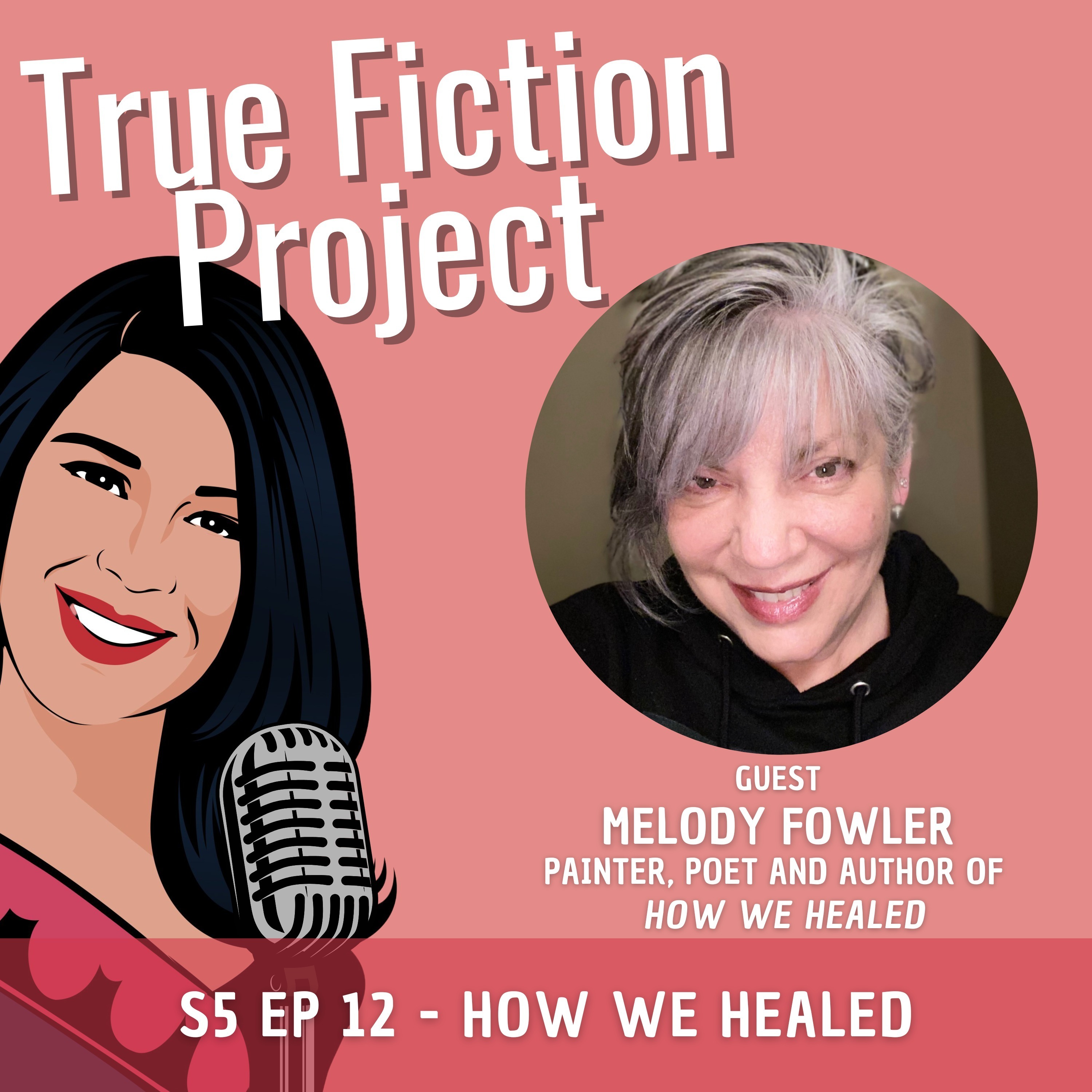
Welcome to the True Fiction Project. I'm your host, Renita Khora. This is your place for stories, and today I have with me a very versatile storyteller. Melody Fowler is from Vancouver, Canada, and she retired after decades of working for the government. And she writes stories, books, poetry. You know, I'm going to let her speak in her own words. Hi Melody, and welcome to the True Fiction Project.
- [02:29]
Melody Fowler
Thanks for having me.
- [02:30]
Renita Hora
Renita, correct me if I'm wrong, you started off as a poet, is that right?
- [02:34]
Melody Fowler
I did, yes.
- [02:35]
I started writing poetry when I was very young, probably 11 or 12 years old.
- [02:39]
Renita Hora
But you've been working for the government for years.
- [02:42]
Melody Fowler
So have you been. That's a whole nother story.
- [02:46]
Renita Hora
Another okay, so no poetry While you're working for the government, or is that poetic justice or.
- [02:53]
Melody Fowler
No, as a writer, I always continued to write through the years, but I just got cut short because when I told the adults in my life that I wanted to be a journalist, they told me that I would starve. So you think, well, I need to value your opinion. You're someone who cares about me. And so I got the good job and suffered for it for decades. But I'm happy to come out on the other side of it. If you're a writer that doesn't magically go away, you can put yourself in the box of working for the government. It doesn't mean you're not going to want to write. So I found different ways to let that out. We had an in house magazine there and I was the editor and did articles for that. So at least I had an outlet for it. So that's what happened.
- [03:44]
Renita Hora
That's what happened. It's very interesting though, because it sounds like you started off wanting to be a journalist and not that working for the government is an alternative to journalism. I'm not saying that. But is that the kind of journalism that you wanted to do? To cover social, political issues and things that affect society?
- [04:08]
Melody Fowler
I think more like I, I really enjoy traveling and so I think I wanted to be more of a travel journalist, sort of enjoy the things that I love most. Right.
- [04:19]
Traveling and writing. That was the whole plan.
- [04:21]
Renita Hora
Traveling and writing. Though, not a travel writer, but you know, you're also. Okay, so you're non fiction, fiction, in house, editorial for your government position. You've been a poet, you've been a painter. So my gosh, you are a very creative person. What of those would you say is your primary go to creative skill? If, or am I even allowed to ask that?
- [04:46]
Melody Fowler
It, it depends.
- [04:48]
It depends on where I'm at. It kind of moves around like a couple of years ago, especially once I finished writing my current novel.
- [04:56]
You're spent, right?
- [04:57]
You're like, I, I don't, I can't write another word. But I need to do something to let out my creativity. So that's why I started painting. I hadn't even known that it was a skill that I had. And then, and of course coupled with the pandemic, probably the first day I painted, it was not the best.
- [05:16]
Next day I got a little better.
- [05:17]
And then there's something that happened the third day. All of a sudden it all made sense to me. The lights, the shadows. And I never do anything small. I'm a compulsive person. So I was just churning out all kinds of paintings. You can see on my website, I have tons and tons of painting, then it'll switch and then, like, I've been in a rating phase right now. So last year I painted one picture and I haven't done any this year.
- [05:42]
So it just depends on the mood.
- [05:44]
Or what's going on in my life at the time.
- [05:46]
Renita Hora
Yeah, yeah, yeah, yeah. No, I can completely resonate this. Completely resonates. So I know what it feels to get into that compulsive phase and just to go all in and immerse yourself. So you mentioned your current novel. Is that the one you're going to read from today?
- [06:02]
Melody Fowler
It is, it is.
- [06:03]
How we Healed.
- [06:04]
Renita Hora
Yeah, How We Healed. So tell us a little bit about that. What is how we Healed about? Genre story, storyline, and how did you get to it or how did it come to you?
- [06:16]
Melody Fowler
Sure. It's historical fiction. It's based on my husband's grandmother. And so originally I wanted to do a biography because often at family events I would find myself sitting with her and she'd be telling me the stories of her life and she'd tell me how important it was and how she wanted people to know these things. So I kind of, you know, got in my mind that this is what I would do.
- [06:38]
But, you know, as time went by.
- [06:40]
And she got older and her hearing wasn't great and she lived in Chicago and then ultimately she passed on when she was 97. And so I thought, ah, I feel like I made this promise that I want to make good on. And so I thought, well, I can take the lessons that she wanted and just make it the fictional version of her life. So there's an element of truth. The lessons are hers. Personality traits are definitely hers. The main character is Drunetta and Eric's grandmother's name was Lucinda. So it is all about Lucinda. And so it was fun, though, because then I could take a lot of creative license and just have fun with it. Right. And not worry about legalities and stuff, because it was a fictional story. Right. That's how that happened. And my husband is listed as my co author because it was very important that I keep it authentic and have the right vernacular. And I've been to Mississippi, but I certainly haven't lived there. And so I wanted to make sure that it was true and it had that authentic feel. So everything went through him. He helped me polish anything that wasn't quite on point. He did think it was funny, though, because he said, you've Been in this family for 33 years. Why would you not trust yourself? I said, I think it's important that it's your family.
- [08:00]
Renita Hora
Yeah, good on you. I so respect that. Because even if it's fiction, true to the storyline, because you know where it came from. But I want to talk about the genre for a second. Historical fiction, as opposed to biography or memoir history of any sort. You mentioned legalities and you mentioned creative license and having fun with it, and I completely understand the two. But so often when you write a memoir, it could be positioned as historical fiction or it could be a memoir. And what is the reason, beyond having fun creatively, which is a very good reason to identify it as historical fiction rather than memoir? The reason I ask is because many publishers will say, oh, we really prefer the true story. The history that has more legs.
- [08:54]
Melody Fowler
It's got quite a range. It literally goes from when she's 16 in 1930 all the way until Obama is elected the first time. So for me, that's why it was historical, because there were many, many huge things that happened during her lifetime that I wanted to place in the story because they had affected her personally and the world, and so that's why I went that way.
- [09:20]
Renita Hora
But then when you write a story like this and it spans so many decades of her life, let's say, are you. And it's fiction. Because now it's fiction. Are you crafting the story in accordance with a fictional structure, a plot, hero's journey, save the cap, beginning, middle, end? Or is it more like a memoir of her life? Does my question make sense?
- [09:47]
Melody Fowler
I think of it as.
- [09:48]
It was a journey. Right. Actually, the very first draft, I'd actually called it the Journey because it's such a mix of both, Honestly, it's such a combination. Because, like I said, there are parts.
- [10:01]
Of the story that are true. Definitely all the historical events.
- [10:04]
Right. But for her, too, like things that actually happened.
- [10:08]
Renita Hora
I have to chuckle because I had a very first draft of a story which was also called the Journey.
- [10:13]
Melody Fowler
Oh, really? Oh, it's had, like, several titles. I was actually. I was going to call it Sisters, but then of course, Tyler Perry had a show and I went, oh, well, that takes that away.
- [10:27]
Renita Hora
You know, I'm sure, you know, you find there are as many words as there might be in the English language. There are so few words available.
- [10:37]
Melody Fowler
Right. You know, that, you know, you. Oh, no, that's already gone. I know.
- [10:40]
Renita Hora
It's okay. So with what you're gonna read today, give us the backstory to that, you know, Set it up for us. Tell us how that particular anecdote or incident or opening, whatever it is, came to be.
- [10:56]
Melody Fowler
Okay, so the portion that I'm reading, it takes place in 1950. So at the time she is with her husband in the storyline, it kind of jumps back and forth because at the very opening of the book, she's leaving her husband. So at this time, she's still with her husband and she is waiting for him to come home. He's quite a drinker. And so there's a storm outside, and it's what's going on in her head as she waits, listening to this storm.
- [11:23]
Renita Hora
And before you read, a basic question, but an important one. Of course, you knew this woman. You had several conversations with her. You were obviously drawn to her stories. But why do you feel, as the storyteller, as the author, they are important to bring to the world?
- [11:42]
Melody Fowler
They were important because the relationships that she formed, like with her family and friends and stuff that she learned personally, is something that we can all relate to. We have our own view of a situation, and sometimes it takes some time to see it from somebody else's point of view and see them differently and realize that you're looking at them from your point. Point, you know, like not. Not holistic.
- [12:06]
Renita Hora
Through a different lens. Yeah.
- [12:08]
Melody Fowler
You know, and so as we mature, we see that sometimes we've made it all about us and it isn't. So that's where it came from.
- [12:18]
Renita Hora
That's lovely, because I think relationships, and interpreting relationships is so universal. That applies to every single one of us, whoever we are, wherever we're from, whatever age we've lived in.
- [12:30]
Melody Fowler
Yep.
- [12:30]
None of us are perfectly good or perfectly bad. And I always say this too.
- [12:35]
Anytime you hear any kind of story, right.
- [12:37]
If there's two sides, the truth is.
- [12:38]
Somewhere in the middle.
- [12:39]
Renita Hora
The truth is somewhere in the middle. Absolutely. Okay, so before we segue into your reading, let our listeners and viewers and readers know where we can find your work.
- [12:51]
Melody Fowler
Okay. Well, it's pretty much available anywhere you can get at Barnes and Noble, Amazon. I distribute with Draft 2 Digital, so they're like, worldwide, so there's lots of. In the Europe as well. If you go to my website, Melody Fellow, there's lots of links, so you can see where anything is available. Both poetry and the novel.
- [13:11]
Renita Hora
Amazing. Well, Melody, thank you so much. Now you, before we let you go, I know that you have something extra special for our paid subscribers today. So would you like to let us know what that is? Sure.
- [13:24]
Melody Fowler
I can read a piece from Life Lyrics that's my book of poetry. I like to only market it under the audiobook actually, because I didn't have.
- [13:33]
The best deal when I did this.
- [13:35]
Book back in 2011 and so when I found out that I had retained the audio rights, I just re released audio in November of 2023.
- [13:45]
Renita Hora
Okay, so paid subscribers and free subscribers as well. I hope you are listening because this is only available to you if you hit that paid subscriber button. If you haven't done so already, please do. Melody, it's been such a pleasure to have you. Thank you so much for joining us today.
- [14:03]
Melody Fowler
Thank you.
- [14:04]
Renita Hora
This is the True Fiction Project and I am your host, Renita Hora.
- [14:11]
Indeed Advertisement
As humans, we're naturally driven by the search for better, but when it comes to hiring, the best way to search for a candidate isn't to search at all. Don't search Match with Indeed. When I was looking to hire someone, it was so slow and overwhelming. I wish I had used Indeed. If you need to hire, you need Indeed. Indeed is your matching and hiring platform with over 350 million global monthly visitors, according to Indeed Data, and a matching engine that helps you find quality candidates fast. Ditch the busywork. Use Indeed for scheduling, screening and messaging so you can connect with candidates faster. And Indeed doesn't just help you hire faster. 93% of employers agree Indeed delivers the highest quality matches compared to other job sites, according to a recent Indeed survey, and listeners of this show will get a $75 sponsored job credit to get your jobs more visibility@ Indeed.com podcast. That's Indeed.com podcast. Terms and conditions apply.
- [15:11]
Renita Hora
And now to the premise of the True Fiction Project, which of course is to create fiction out of nonfiction.
- [15:30]
Melody Fowler
Chapter 22 the Storm November 24, 1950.
- [15:35]
The wind was blowing hard enough to rattle the windows. The violent air twisted and screeched its way through the nooks and crannies of the house, exaggerating all the squeaks and rattles that did not bother me in.
- [15:46]
The light of day.
- [15:47]
I tried to peer outside, but it was so dense I could only see shadows and the trees eerily swaying and bending. I sat with a blanket around my shoulders at the kitchen table, my Bible open front of me, not for reading, but for comfort. The children were tucked snugly in their beds and sleeping soundly. The lights flickered and I pulled the blanket tighter around my shoulders.
- [16:09]
I wanted to lay my head back.
- [16:10]
Down, but fear kept me from closing my eyes. It was nearly midnight and Abraham was not home. The storm was building and I knew soon the electricity would be knocked out.
- [16:20]
I prayed the thunder and lightning would.
- [16:22]
Not wake the children. I heard a dog barking in the distance. He may have been reacting to the storm, but I hope the animal was sounding the alert that my husband had finally found his way home. I could not know, sitting alone as the lights made their final selection and left me in the darkness, that this was to be a historic storm, one that would affect 22 of these United States. But a feeling in the pit of my stomach told me that this was more than just a typical storm. Later I learned this was the Great Appalachian storm of 1950, a cyclone storm that moved through the eastern United States, carrying with its winds heavy rain and blizzard conditions along the western slopes of the mountain chain. But right now, now all I knew for sure was I was alone, with only my faith and a wool blanket to keep me safe and warm. I felt my strength and my faith were being tested. Growing up, I had experienced my share of storms and plenty of standing water would follow after it passed over. It was one of those things that never got easier with time and experience. We were prepared as we could be with kerosene lanterns, homemade preserves, and every other thing possible we had canned or cured. Still, there was a worry. What if it wasn't enough? I hoped we and the house were strong enough to withstand another storm. I lit my candle and secured it in the bottom of the tin. I paced the floor. My thought was if I kept moving, my fear could not paralyze me. I tried to keep my steps ahead of my imagination because it was threatening to get away from me. I heard the rumble of thunder and began to count to estimate how close the lightning was. One Mississippi to Mississippi. The count ended there. A flash of lightning followed and I heard the crack of what sounded like a tree branch falling. I threw back the dreams and another flash lit up the sky, making the trees look ghostly. Like the monsters in my childhood nightmares, I tried in vain not to think of all the worst things that could possibly happen. Fear had me in its icy grip. I imagined the lightning would ignite a fire and take out the whole community.
- [18:19]
Each image I conjured had two things in common.
- [18:22]
They were graphic and gruesome.
- [18:38]
Renita Hora
Here at the True Fiction Project we are always looking for great stories that make for compelling fiction. So if you have a great story or know somebody who does, or if you are a writer who would like to contribute, then please do get in touch with us@renita.com contact.
- [19:00]
Thank you for listening to the True Fiction Project with Renita Hora. Be sure to subscribe to the newsletter to receive more inspiring stories showing how fiction is born from our everyday experiences. For more information, visit www.TrueFictionProject.com.
- [19:24]
Indeed Advertisement
As humans, we're naturally driven by the search for better. But when it comes to hiring, the best way to search for a candidate isn't to search at all. Don't search Match with Indeed When I was looking to hire someone, it was so slow and overwhelming. I wish I had used Indeed. If you need to hire, you need Indeed. Indeed is your matching and hiring platform with over 350 million global monthly visitors, according to Indeed Data, and a matching engine that helps you find quality candidates fast. Ditch the busy work. Use Indeed for scheduling, screening and messaging so you can connect with candidates faster. And Indeed doesn't just help you hire faster. 93% of employers agree Indeed delivers the highest quality matches compared to other job sites, according to a recent Indeed survey, and listeners of this show will get a $75 sponsored job credit to get your jobs more visibility@ Indeed.com podcast that's Indeed.com podcast. Terms and conditions apply.