Loading summary
Transcript35 lines
- [00:00]
Granger Representative
This is the story of the one. He's responsible for keeping a leading health care facility clean and safe. And he trusts Granger's high quality H vac cleaning and safety products combined with their world class supply chain to consistently deliver, ensuring he's covered inside and out so he can focus on keeping his facility clean to help protect the health of everyone inside. Call 1-800-granger clickranger.com or just stop by Granger for the ones who get it done.
- [00:30]
Renita Hora
So I have to ask you, clearly you have been attracted to this genre for a long time, maybe all your life, right? So would it be correct or fair for me to say that you are definitely an author who stays in your lane and does not cross genre?
- [00:47]
Aaron Ryan
Yeah, I talk to a lot of authors and when they say historical fiction or romance or westerns, it's just there you go. See that don't have. It's not hardwired into me. What is hardwired is like an obsession with things that don't exist but are so scientifically creative and like, ooh, what if they did? Welcome to the True Fiction Project, a podcast series that explores the origins of fiction. Every week we begin with an interview, nonfiction, followed by a creative piece, fiction inspired by something from the interview. The idea is to demonstrate, of course, that fiction is born out of our life experiences. Now here's your host, storyteller, author, public speaker, health and wellness expert, Renita Hora.
- [01:41]
Renita Hora
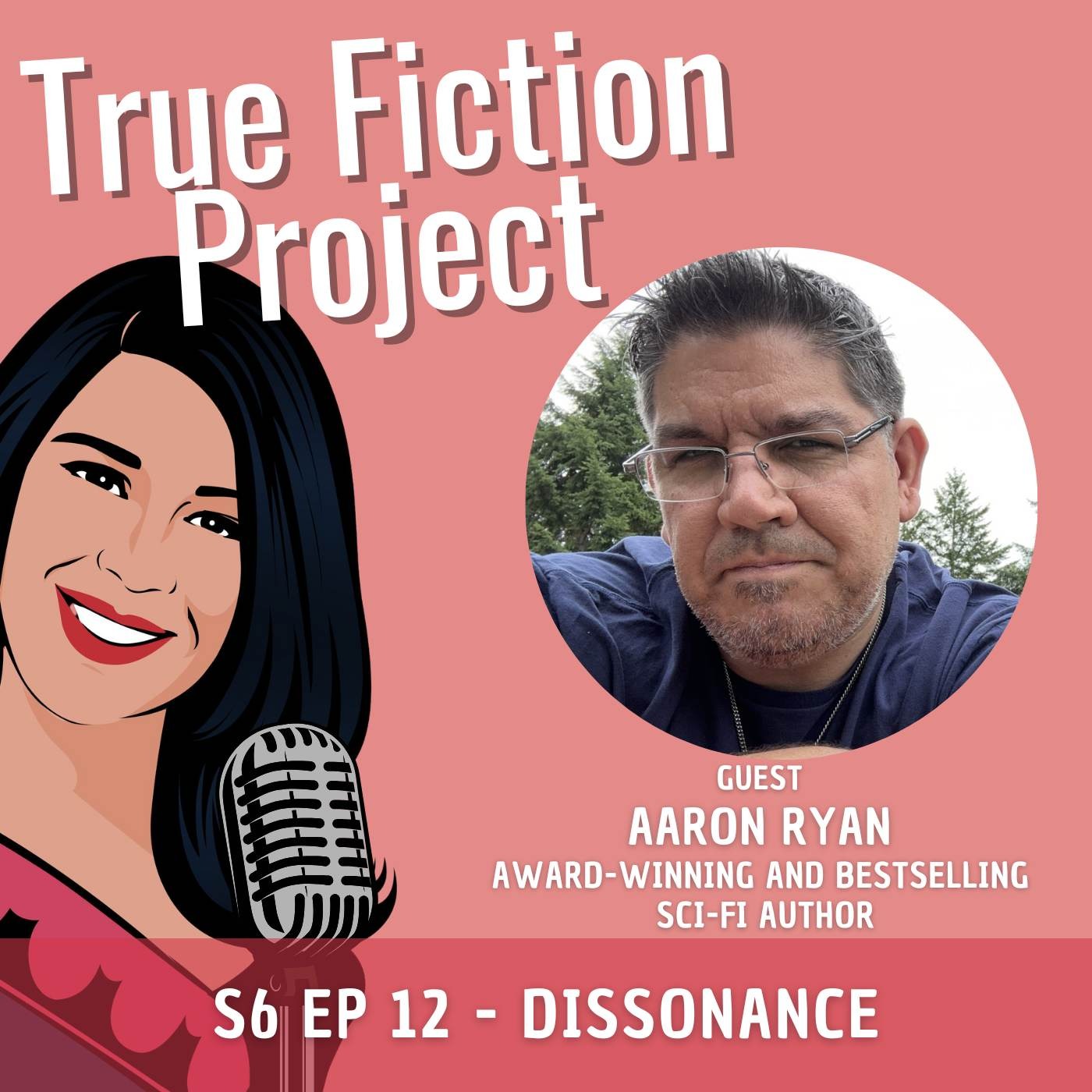
Welcome back to the True Fiction Project. I am your host, Rinita Hora. And dissonance is a word, a noun, that really wreaks havoc in my life and maybe in that of everybody else's. And I would love to introduce my next guest, Aaron Ryan. He is the author of the Dissonance Quadrilogy. And to find out what that is, let's get straight into it. Hi Aaron. Welcome to the True Fiction Project.
- [02:11]
Aaron Ryan
Thank you so much for having me. I appreciate it.
- [02:13]
Renita Hora
Absolutely. Thank you for being on the show. And I have to ask you right up front, Dissonance, is that a quadrilogy or a trilogy?
- [02:21]
Aaron Ryan
Well, it's actually, so I want to say it's both and neither. It's essentially it's a four book series that I originally wrote as a trilogy. I had not really planned to go back. I'd ended the trilogy and then I realized there's still so much more story to tell. So I went back and I wrote a prequel and then the prequel actually is now book one of this quadrilogy. However, I have been pointed out by other authors that it's actually more appropriately called a tetralogy. Whatever. I prefer the word quadrilogy.
- [02:50]
Renita Hora
Is the tetralogy the same thing as a quadrilogy?
- [02:53]
Aaron Ryan
Well, it's more. Quadrilogy is a noun used to describe four movies. And tetralogy is used more appropriately to describe four books.
- [03:01]
Renita Hora
Okay, well, I learned a little something today. So you write sci fi thriller. You are influenced heavily by JRR Tolkien, but also others. You like Suzanne Collins and Stephen King. Who doesn't like Stephen King? Tell our audiences a little bit about your influences and why you sort of zone into this particular genre.
- [03:27]
Aaron Ryan
Yeah, well, I mean, I don't know if you can see this, but my necklace has my family names engraved on it. It is not, in fact the one ring. So if I put my finger in here. See, I haven't disappeared. Massive, massive Lord of the Rings fan. Probably the biggest Rings geek there ever was. I love Lord of the Rings. I'm more visually inspired than I am literarily inspired, so more inspired by movies than books. And on that note, you've got things like Aliens, which is, you know, the number one movie of all time. 1986, James Cameron with Sigourney Weaver. Loved that movie. We had just finished watching I Am Legend. And I love the overgrown, unmaintenanced, unmanaged world that's just become so catastrophically unmaintained with weeds growing six feet tall. That visually was a big inspiration for the world building that I had to conduct for dissonance. Lord of the Rings is fantasy, of course, but he's the quintessential fantasy writer, Tolkien. I'm reading a lot of Marie Lu, James Sa Corey, a lot of different Aliens books. You know, they're not Alan Dean Foster, but they're other sub genre writers. And I just, I could go on and on.
- [04:36]
Renita Hora
Yeah. So I have to ask you, clearly you have been attracted to this genre for a long time, maybe all your life. Right. So would it be correct or fair for me to say that you are definitely an author who stays in your lane and does not cross genre?
- [04:53]
Aaron Ryan
Yeah, I talk to a lot of authors and when they say historical fiction or romance or westerns, it's just, there you go. See that don't have. It's not hardwired into me. What is hardwired is like an obsession with things that don't exist but are so scientifically creative and like, ooh, what if they did?
- [05:12]
Renita Hora
Yeah.
- [05:13]
Aaron Ryan
Aliens has always captivated me. So, yeah, I knew that Aliens were going to make a foray into my.
- [05:18]
Renita Hora
Book series all Right, Okay. So it's more about what captivates you rather than your interests sort of, you know, delving into different things. What do you think about authors who write in different genres? Because this is a widely contested thing and we've talked about it before on this show and elsewhere, you know, agents. And agents especially, not even publishers, but agents will tell you, stay in your lane, just, you know, become the expert in comedy, in romance and whatever. And then there are authors who will just completely disregard that. Clearly not you. So hence would like your opinion on this.
- [05:55]
Aaron Ryan
Well, adapt and overcome. I mean, that's a tried and true adage, if you can do that. It's also adapt or die is another kind of more ominous version or itineration of that one. If you can adapt and overcome and switch lanes, more power to you. Right now I'm writing a sci fi thriller that has nothing to do with aliens, for example. It's more thriller than it is sci fi. And so that's a little bit of a, like a sub deviation on my part. But man, if you can do that and if you have the ability to switch those gears and cross over. For me, it feels more like bowling accidentally and throwing my ball into the other lane on accident. If I try that, I don't have the mastery of it yet.
- [06:34]
Renita Hora
Okay, well, good to hear. So dissonance. I want to hear more about dissonance, specifically how you got there, what inspired it, what's the backstory?
- [06:44]
Aaron Ryan
So I explained to you, so I am a musician and I'm a speaker or a singer rather. And so I produce some albums and you know, I'm very familiar with the term dissonance. My wife is a psychologist or psychology major. Cognitive dissonance. You know, she's very familiar with that. We've had discussions to that effect. I wanted to write something that was a full on novel that was loaded with thematic depth. And if you look at the COVID which I've since redone. So these are a little obsolete right now. Dissonance means lack of harmony. It means, you know, competing frequencies or tones or whatever. Competition. They're not getting along. The alien invasion in my series happens in 2026. This is set in 2042, 16 years after this invasion was. We're still not getting along as humans. Granted, we don't get along with aliens, we just don't. We're not compatible. But the sad truth of this, in this subtext that appears in greater detail as you progress through the series, is that humans still, after 16 years of alien occupation, still jockeying for power, still taking advantage of others to make sure that we survive ourselves. Still competing and distrusting. And why can't we just kick these aliens to the curb? Because we're still living in dissonance together. So it's a double entendre. It also has to do. If you see the audio waves in the background here of the creature. We have discovered an alien technology that actually came with them that we've been able to weaponize and create super high frequencies that are dissonant with each other. So maybe it's a triple entendre and there's the dissonance element in there. I just wanted to write a really dang good story and I did. I'm very proud of it.
- [08:26]
Renita Hora
Well, it sounds like a really damn good story. I can't wait to read it. And I have to say, by the way, as a historical fiction writer, I don't know about the triple entendre part of it, but definitely about the double entendre. That sounds like our lives. Historical fiction. The dissonance today, because we haven't learned from 16 or 1600 years ago.
- [08:48]
Aaron Ryan
Yeah, it's a little bit of a referendum on our current state, isn't it?
- [08:51]
Renita Hora
Yes.
- [08:52]
Aaron Ryan
I didn't interpret that way, but appearing.
- [08:54]
Renita Hora
To be permanent, but yes. So that is interesting. Do you. I mean, this is. I know, two different media. But do you use music in your stories? Cause you're also an audio guy, a voice actor, a storyteller. So do you mix it up?
- [09:10]
Aaron Ryan
Well, to some extent. There's a musicality that I think you have to employ. But I am a very musical and very visual driven guy. So, for example, the best way to answer that is there's a scene that happens in dissonance Vol. 2, reckoning that is an action sequence. They're under attack by the aliens, they're in tanks and they are having to scramble. And what I'm hearing in my head is the soundtrack Feudal Escape by James Horner from the movie Aliens. And it was playing well, in fact. In fact, it wasn't playing, but as I was writing, I'm going, ooh, I put that soundtrack on and oh, did it fuel some amazing writing of this incredible action sequence. Hearing this, you know, these big toms and horns and everything. Just such an adrenaline laden track. So, yeah, I think that helps the musicality side of things when you write. Yeah.
- [10:04]
Renita Hora
So tell us a little bit then, Aaron, about what you're going to read for us today. Which part of the dissonance tetralogy or quadrilogy?
- [10:13]
Aaron Ryan
It's from Quadratetralology. Yeah, let's just coin a new word. So what I'm going to read from is what was essentially the first volume in the trilogy, which became a quadrilogy. So now it's the second volume when you factor in the prequel. But this is Dissonance Volume, Volume one Reality, preceded by Dissonance Volume Zero Revelation. Basically, it's the protagonist's name is Sergeant Cameron Shipley in Dissonance Volume one Reality, and he returns to his blockade. It's where we're living underground 16 years after these aliens invaded and we're surviving, eking out an existence in the shadows. He and his brother, Wyatt Ruddy Shipley have just returned from a recon mission and he's having a flashback to when the aliens arrived. That attack actually happens in the prequel Dissonance Volume Zero Revelation. So he's remembering things that happened then. But I'm going to read from his flashback of when it actually happened. This one, I'm very excited and proud to say, is currently being adapted to screen as a screenplay for pitching to Netflix, Apple tv, Paramount Prime Video. I am not excited at all. I mean, I can care less. No, I am so, so stoked about that. And so stay tuned. You can find out more@dissonancetheseries.com or getthesebooks.com.
- [11:32]
Renita Hora
Okay, before we switch over to the read, Aaron, let our listeners know where they can find your work, your website, socials, wherever you are, whatever you'd like to say.
- [11:42]
Aaron Ryan
The easiest way to remember, it's dissonancetheseries.com, but if you actually go to getthesebooks.com that is my custom domain that will take you to dissonancetheseries.com we actually have that in vinyl lettering on the back of our cars. Getthesebooks.com will take you there. Or author Aaron Rock ryan.com we'll take you there.
- [12:02]
Renita Hora
Aaron. Thank you so much for joining us today on the True Fiction Project. I cannot wait to listen to your piece. That's Aaron Ryan, our guest today, writer of the Dissonance Quadrilogy here on the True Fiction Project, and I'm your host, Renita Hora.
- [12:19]
Granger Representative
Finding great candidates to hire can be like, well, trying to find a needle in a haystack. Sure, you can post your job to some job board, but then all you can do is hope the right person comes along. Which is why you should try ZipRecruiter for free at ZipRecruiter.com Zip ZipRecruiter doesn't depend on candidates finding you, it finds them for you. Its powerful technology identifies people with the right experience and actively invites them to apply to your job. You get qualified candidates fast. So while other companies might deliver a lot of hay, ZipRecruiter finds you what you're looking for. The needle in the Haystack.
- [12:56]
Aaron Ryan
See why 4 out of 5 employers who post a job on ZipRecruiter get a quality candidate within the first day. ZipRecruiter the smartest way to hire. And right now you can try ZipRecruiter for free. That's right, free at ZipRecruiter.com Zip that's ZipRecruiter.com Zip ZipRecruiter.com Zip.
- [13:21]
Renita Hora
And now to the premise of the True Fiction Project, which of course is to create fiction out of non fiction.
- [13:40]
Aaron Ryan
I remember when the Gorgons first arrived in 2026. Admittedly, we were all enthralled. I was too. Sis was especially enthralled. Somebody in Guatemala spotted the first one, if I remember correctly. It just came drifting down straight out of the sky near sunset. So humanoid and yet enshrouded in mist. They had angelic qualities to them. Some of us wondered if they were messengers from God. Their bodies were cloaked in that bluish green vapor. It was really creepy. But for whatever reason, it's the creepy things that draw us in the most. We just can't look away. Like a moth to a flame. Then there was another. And another. And five more. And then more. And then 20 more. 50, 400 more kept coming, just slowing down to a geostationary orbit 50ft above the ground. All over the Earth, the dogs were perpetually screaming and howling. Some of their ears were reportedly even bleeding. They were running mad, whining, cowering in terror, fleeing to dark corners with their tails between their legs. I was only seven then. Ruddy was just three. Sissy was six. But I remember it all in the 16 years since then. They laid waste to pretty much everything. Except the blockades, of course. Oh, they knew where we all were, and they didn't like it when we ventured out for any reason. They got especially hot if they saw any of us heading in any direction that even remotely resembled going toward a coastline. No matter the continent, they wanted us pigeonholed far inland. We could never figure out why some straggled around by day still, but all we knew concretely was that they mostly reappeared every evening near dusk, where they all largely disappeared to during the day. No one ever really knew. Apparently they didn't like sunlight. And they would almost entirely vanish for a month on end during the summertime. When it got into the high 80s and 90s, those were our reprieves. It was times like that that we actually praised all the ozoners that went before us. Inconsiderate humans with their carbon emissions, fossil fuels, aerosols and CFCs. They didn't know it, but they were actually helping us. Warming up the planet, Making the atmosphere hotter and hotter, more inhospitable to not just us, but them as well. I heard recently that a team of guys actually wrangled a Gorgon in the heat of summer while wearing some kind of protective eye shields. And they stripped it down. It just flailed, writhed and screamed as it baked in the hot summer sun. Sizzled and smoked even. Apparently they had some vampiric traits too. Never found out any more about it because you can't trust all stories. And I for one don't plan to wrangle any Gorgon to see if it tries to suck blood as well. I remember the first time I saw one for myself. Back then, they weren't really evil to behold. They just had this sort of ethereal quality to them, angelic almost. And they just sat there or floated there and hummed. We tried to make contact with with them, of course, but they never moved. For three months they just stayed there as more and more of them slowly floated down, taking up positions. We were all so uneasy. What the hell were they? Why were they here? Where did they come from? What did they want? All those questions piling up stunk more than the mound, frankly. But then we got our answers. Sure enough, whether through some kind of telepathy or some primitive form of timing, they all began to move. One by one they clicked on like a countdown had finished or a switch had been flipped. And that's when they started hunting us down. Nothing we did mattered. Hiding was of little use. Shooting at them only made them move angrier and they'd get faster. And that high pitched shriek and dropped jaw thing. Lord, I remember a man kept shooting and shooting at one perched on the corner of a pretty tall building. I think he had a sniper rifle. But with each shot, the Gorgon hurtled faster and faster downward until both it and the man disappeared in a thunderous cataclysm of concrete and dust. The Gorgon was the only one that came out of that pit a little fatter than it had been before it had smashed down. There were thousands of them in the air, swooping in all directions Airplanes were overwhelmed and thrown out of the sky. It was pandemonium. To the power of frenzy. To the power of chaos. The Earth was upended on that day and in the days following. The military had no time to mobilize. These things were everywhere. And those poor souls who had to man helicopter gunships, they didn't stand a chance. And then the news once reported that a swarm of them passed, passed, mind you, an F35 jet on patrol. Frozen pilots plunged into the sea, the ground, the history books. All our hopes went up in blazes of glory. There were so many jets and commercial airliners at the bottom of the ocean now. Each nation responded in whatever way they felt they should. There was no consensus in the United nations because there was never time or safety in order to mobilize a gathering. And many world leaders were already filling the bellies of the Gorgons anyway. North Korea shot missiles in vain. Thankfully, their nukes were intercepted before they killed us all off while trying to mount a meager but impotent counterattack. Iran was the same. The saddest part of it was that the Gaza war, just a few years prior, had happened. The Israelis and Palestinians had never quite afforded each other full truce. They would throw one another at a Gorgon if it meant they would escape with their lives. Traps were sent by one side or the other to lure in Gorgons and devour whole households of their enemies. Despicable. Same with Ukraine and Russia. People desperate to sabotage their fellow humans just to get a few paces ahead. But the Gorgons were faster than all of us. The subject of nukes was never off the table. There was just no one who could get them mobilized. And where were they even supposed to detonate one? The chances of the entire human race getting wiped out by friendly fire were all too high.
- [19:42]
Renita Hora
Here at the True Fiction Project, we're always looking for great stories that make for compelling fiction. So if you have a great story or know someone who does, or if you're a writer who'd like to be featured on the show, then please do get in touch with us at renita.com forward/contact. And if you haven't signed up for our newsletter, then you can do so by visiting substack.com forward/@rinitahora, all spelled out one word. That's substack.com forward slash, e, e, n, I, T, A, H, O R A. I'll be offering paid subscribers something a little extra special each time, including a video version of this podcast.