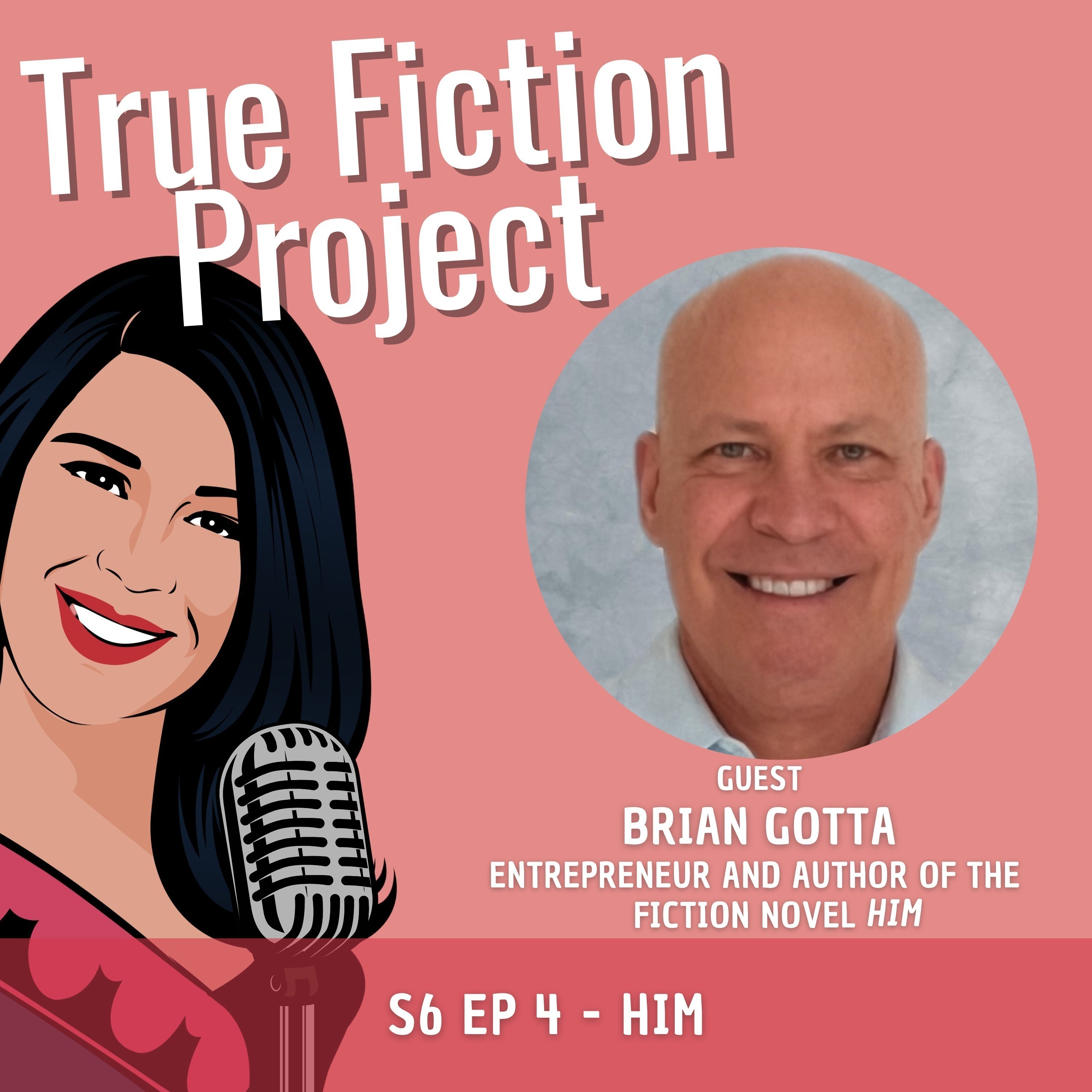
Loading summary
Transcript33 lines
- [00:00]
Brian Ga
Anybody who's either thinking, oh, he's written seven books, he must be, you know, just rolling in royalties. Or anybody who's about to write a book who thinks, you know, if I write a book, maybe this will happen to me. I mean, the reality is it's a very hard road. There's a lot of competition. And that is the reality. It's probably not going to be something that you do to make millions and millions of dollars and be on the Today show. Welcome to the True Fiction Project, a podcast series that explores the origins of fiction. Every week, we begin with an interview. Nonfiction. Followed by a creative piece, fiction inspired by something from the interview. The idea is to demonstrate, of course, that fiction is born out of our life experiences. Now, here's your host, storyteller, author, public speaker, health and wellness expert, Renita Hora.
- [00:59]
Renita Hora
Welcome to the True Fiction Project. I am your host, Rinita Hora. And I have with me today a very special guest who, like myself, has delved into nonfiction as well as fiction. This is Brian Ga. He is an author and an entrepreneur based in San Diego, California, and he has written four youth sports sports novels. This is a new one for me, so I'm dying to ask him about it. And then we will also talk about his first piece of adult fiction called him. Hi, Brian. Welcome to the True Fiction Project.
- [01:38]
Brian Ga
Hi, Renita. Thanks for having me. I'm really happy to be here.
- [01:40]
Renita Hora
Me, too. Likewise. So four youth sports novels. Novels? Oh, no, not novels. Those were nonfiction, right?
- [01:51]
Brian Ga
None of the four youth sports books were novels. I've written two other nonfiction books in addition to those. Those were how we got introduced. So just to give you a real quick recap, I started my career in sales out of college and then became a sales manager. As I was teaching salespeople techniques, I was thinking, you know, I should journal these. And as I began journaling them, I started thinking, yeah, maybe these would be a book. So at nights, evenings, I would write a few thousand words, and before I knew it, I had what I thought was a pretty good book. I came up with a title called congratulations, you're a millionaire. And I began submitting it to publishers around the country and found a publisher in Pennsylvania that conventionally published the book. And that was my first actual published work. Congratulations, you're a millionaire. Then, as I was raising my kids and coaching them in all of their sports, I wanted to read to them, of course, when they were 6, 7, 8, 9, 10 years old and they were interested in sports. And I had been a big fan when I was a child of an author named Matt Christopher and he wrote youth sports novels. They were little, many adventures about middle aged school children who were playing sports. And so I would check out some of those books from the library and come home and read them. And as I was reading them, I thought, these are still very wonderful books, but they're, they're dated. And I thought, you know, surely somebody could update these and put them in more modern vernacular and make them more appealing to a modern audience. So I said, why don't I try it? And I wrote my first youth sports novel, the Season's not over, and then wrote three more after that. And those were my four youth sports novels.
- [03:44]
Renita Hora
Just amazing. You are so prolific. There is so much, you know that you're doing. And correct me if I'm wrong, because I am sort of guilty of writing non fiction myself. You know, you called it that. And I found because I was also in the working world, also in sales, marketing, entrepreneurship, different things along the way. And oftentimes in my case I'd be giving presentations and what was once my cheat sheet then became my books, especially my nonfiction books. And I have a hunch that it might be somewhat similar for you.
- [04:21]
Brian Ga
Exactly the same process. That's exactly what happened is I was doing presentations in front of groups and afterwards people would come up to me and say, oh, that was fantastic. I'd never heard that before. I learned so much. And I thought to myself, well, I mean, if these people are learning so much, maybe I should, instead of it being in front of 30 or 40 or 50 people, maybe I can make it a way that hundreds of thousands of people could benefit from this information. And that's where the original book Congratulations, you're a Millionaire came in.
- [04:50]
Renita Hora
Does that make you a millionaire? Will that make all of us millionaires?
- [04:54]
Brian Ga
Well, you have to read the book to find out.
- [04:56]
Renita Hora
Absolutely. And we will have links in the show notes, by the way, for those of you who are listening and watching and want to be a millionaire. But coming to your sports novels for a second, this is middle grade and you said that what you found in libraries or bookshops was outdated. What was dated vernacular. Okay, I get that, but sports, I mean, I'm naive here cause I'm not a sports person. But you know, if you're playing baseball today, isn't it the same as baseball before and baseball in the future?
- [05:28]
Brian Ga
Absolutely. And those Matt Christopher novels are still wonderful reads for youth children. I can remember distinctly one of the things that kind of put the light bulb on over my Head was I was reading one of the books to my son and there was a passage about some children who were riding a dune buggy. And when I was a little kid, dune buggies were a thing but my kids didn't know what a dune buggy was. And so it just, to me it seemed like, you know, that was one of those things that could be updated in terms of more modern phraseology, technology. There's no technology in the Matt Christopher books written in the 1960s. Now a book could have more, more of a modern feel for a, a child. And so that's what I attempted to do with my sports novels.
- [06:14]
Renita Hora
Got it, got it. And These are what, 30,000 words or something like that?
- [06:20]
Brian Ga
Roughly 30 to 40,000. All the sports novels are. Yes.
- [06:23]
Renita Hora
Middle grade, Very middle grade. Do you with those stories, did you go and sort of promote those in schools or directly to the audience? Was it different than what you did with your non fiction work previous to that?
- [06:36]
Brian Ga
Well, it was different because those were not conventionally published. Those I self published. And one of the reasons was, and this goes back to your question about congratulations, you're a millionaire. Did it make me a millionaire? I think all authors or all beginning authors feel like if I write a book I'm going to be rich and famous. It's going to take off, it's going to be on the, you know, people are going to know about me and, and especially if you get it conventionally published. So the reality is unless you're publish published by the two or three big ones, that's not going to happen. And so I was fortunate to be conventionally published by a small publishing house, as I said in Pennsylvania. But then after they did the editing and they printed the book and sent me my author copies, I guess I had naively kind of thought I could put my hands back and just let sales roll in. And then they explained to me the hard truth that most authors find out, which is, well, you still have to do the market marketing. You still have to be the one that goes out there and promotes the book. And so what made me a little disillusioned with that was I was thinking to myself, so in exchange for you editing the book and printing it, I still have to do all the work, but you get the lion's share of the royalties. And so what I said to myself going forward was if I'm going to do all the promoting and all the hard work after writing it, I might as well keep the revenue as well. And so I self published those new sports novels. So it wasn't a case where I had a big firm or a big marketing agency behind me promoting them. And I published those novels. This was back in the late 90s, early 2000s initially. And then after I wrote him, I discovered Amazon and KDP and realized, you know, I can rebrand these books with new covers. And I basically re released them all last year, and now they're essentially fresh with new covers and. And new promotion behind them.
- [08:39]
Renita Hora
Excellent. Excellent. And you find that that's a worthwhile effort, meaning to take full control. You're an entrepreneur, after all.
- [08:45]
Brian Ga
Well, and that's just like with you. Sales and marketing is my niche. That's how I have been able to support my family throughout the years. So I look at this just as another product that I can sell. And so that's what my main focus is with my books now, is getting out there to bookstores, getting out there to book reviewers, getting out there to everybody who might have some interest. And this is where you and I have come into contact so that people will be aware of these books. And it's a challenge. But again, anybody who's watching this who's either thinking, oh, he's written seven books. He must be, you know, just rolling in royalties, or anybody who's about to write a book who thinks, you know, if I write a book, maybe this will happen to me. I mean, the reality is, again, it's. It's a very hard road. There's a lot of competition. I've talked to several publishers who said if you sell 2,000 copies of your book, you're doing great. And that is the reality. It's probably not going to be something that you do to make millions and millions of dollars and beyond the Today show, but being interviewed by Renita is just as good as the Today show.
- [09:52]
Renita Hora
Oh, of course. Hey, this is the Today with that matters. You know, this is the Tomorrow show. Exactly. This is the Tomorrow. This is the in the Moment Show. That's great, Brian. Really, really wonderful to hear about your success and the hard work that you put into it. I know it all too well. I've got a book that's releasing in a few days, and I feel like all I'm doing is guerrilla marketing. I mean, I. I know I speak for all of us. We all have to go through this. So tell us about Him. Him is your first work of adult fiction. What is it about? What led to it? What's the true life inspiration behind it?
- [10:32]
Brian Ga
I appreciate the question. In my office, I've got a whiteboard, and this Is again, maybe something for those of you who are, who are out there watching this, who are thinking, you know, how do I even get over the initial obstacle of getting started? And I'm a big believer in the subconscious. And I made up my mind a couple years ago, said, you know, I still haven't written a novel. I still haven't written an adult fiction novel, written as children novels, but I never written anything for adults. And up on my whiteboard in my office, I wrote the word novel. In between many of the other tasks and goals and aspirations I had, one of them I wrote was novel. And so without me even realizing it, every day I was looking at that, every day I was looking at what do I have to do, what's ahead, what are my plans? And I would just keep reinforcing subconsciously. Novel, novel. So I think that that helps, that that was on my mind, that I was going to write a novel. And so it was kind of like having kindling that just needed a spark to light it. One day I got an email from a colleague of mine who's an older retired gentleman and he lives alone. He said, I'm not going to be on our conference call today because I'm going to adopt my new best friend. And the poignancy of that just hit me. If he hadn't said best friend, if he had just said I'm going to adopt a dog or something like that, it probably wouldn't even have registered. But the fact that he said, I'm not going to be on our conference call today because I'm going to go adopt my new best friend. And again, an older man, lives alone, retired, and the idea completely formulated right there at the moment. And I had the idea from beginning to end at that moment what I was going to write.
- [12:17]
Renita Hora
And there you go. Well, I cannot wait to hear the read. And we're going to segue into that very, very soon. Before we do though, you are going to read something for our paid subscription audiences. What might that be? Let's just give them a little bit of a heads up so that they, they know to go to the paid subscription section or subscribe.
- [12:39]
Brian Ga
Yeah, I'd be happy to read from one of my youth sports novels. I could also read from the non fiction book, but I think the youth sports novels might have the broadest reach. So I'd be happy to read from one of those when we get to that point.
- [12:52]
Renita Hora
Okay, well great. So if you're not a paid subscriber already, please make sure that you hit that paid subscription button, because that's the only way you're going to get to hear Brian read from one of his youth sports novels.
- [13:04]
Brian Ga
Totally worth it. Totally worth it.
- [13:06]
Renita Hora
Totally worth it. Absolutely. Absolutely. Brian, before we segue into your reading, let our audiences know where they can find you, your website, socials, whatever you would like to share.
- [13:17]
Brian Ga
Books by God.com is my website and all the books are on Amazon. It's very easy. If you go onto Amazon and type in my name, you'll see all the books. And again, you can go to books by God.com and see my daily blog and that type of thing too.
- [13:33]
Renita Hora
Wonderful. And of course we're going to have links to all of that in the show notes, so definitely make sure to check.
- [13:40]
Brian Ga
Okay. And just to set the stage for those who aren't aware, him is a book told from the point of view of a dog who has found himself in a shelter with a lot of other dogs he doesn't know, and he's hoping to escape and find his caretaker, who he's had an idyllic life with.
- [14:02]
Renita Hora
And now to the premise of the True Fiction project, which of course is to create fiction out of non fiction.
- [14:23]
Brian Ga
I can barely remember his smell anymore. When I used to be able to pick his voice out of a pack. Now I hear voices everywhere that sound like they might be him. I have to get out and find him before he gives up and stops looking or forgets what I smell like. I know it would be difficult when the other walkers take me out. They never let go of my leash and they're big and strong, so I don't believe I can lunge it out of their hands. My best chance was going to be if Zoe brought me out again and decided to lie in the grass. Let me walk around. I had many walks that were not with her. I used those to look around and figure where I would run if I got the chance. If a person took me out when it was raining, I got excited, hoping we would go on a long rain walk like I used to with him. But as soon as I went potty, they pulled me back to my house, rubbed a blanket quickly across my fur, and left. The air was cold and I was wet. It is not fun to have wet fur when the air is cold. But I've learned that no matter how wet my fur gets, it always dries. When I heard my door open and it was her, I was crazy happy. I ran around her seat, jumped up on her. She said, no jumping. I barked and whined and wiggled and wagged I'm sure she thought it was because I was happy to see her. Really, it was because I was about to escape. It might have been partly because I was happy to see her, too. She took me out and was making sounds, and as we walked, little did she know this would be the last time she would see me. I would miss her. But once I found him, I would forget all about this place. Like I forgot bad dreams when I wake and know he's asleep in his bed. Actually, I would probably still remember her, but everything else could go away. Then out of the corner of my eye, I saw it. The moon. What was it doing up there next to the sun? Well, for one thing, it was looking right at me. I bumped into her leg because I was looking up instead of where I was going. She said, ding ding, scout. Every step we took, the moon followed us, staring at me. This might affect my strategy. I hadn't planned on the moon hindering my escape. I stayed right next to her where I knew I was safe. She said, ding ding scout. Every step we took took. I was looking at that round menace. Its expression never changed. In order to never look away. She gazed up to the sky and put her hand above her eyes. Then she looked down at me. Oh, Scout, she said, ding ding mo. Come here, you little baby. She knelt and squeezed me with her arms. Scout, ding ding moan. That's what the woman who walks with bear said. I stood next to her. She unclipped my leash and let it fall in the grass. She laid herself down on her back, closing her eyes, letting the sun warm her face. I think the moon is cold and the sun is warm. And if it's a contest between the two, the warm wins. I was free. It would be so easy to run and run. I did not know which direction to go, but was sure if I got outside and barked a few times, he would find me like he did. But I was lost. But I did imagine being out there alone, not knowing which way to go, and the moon watching you. That's exactly what the moon wants. I stayed by her side, and the next thing I knew, I was lying next to her on the grass, forgetting about my worries and only listening to her breathing. She put her hand in my fur and stroked back and forth. With the sun warming me, I almost felt like I was back in the big yard. When I looked up again. Again the moon was running away. Okay, Scout. Ding ding, she said. She picked up my leash. I looked past her. If I bolted now, she would never catch me. I heard the clip of the leash. When I got back to my house, after she had bent over, wiggled both my ears with her small hands, and pushed her lips deep into the fur above my eyes, I asked myself why I hadn't gone when I had the chance. The only answer I could come up with was that she trusted me. When someone trusts you, if you run away, no one can ever trust you again. And when someone trusts you, you should trust them back. It wasn't because I was afraid of the moon.
- [18:41]
Renita Hora
Amazing, Brian. And for dog lovers, that one is just a go to I've got my little puppy sitting here in the room with me. I'm trying to keep him away from the wires as we've been talking. Brian, it was a pleasure to have you on the Tru Fiction Project. Thank you so much for joining us today.
- [18:58]
Brian Ga
Thank you for having me. I enjoyed it.
- [18:59]
Renita Hora
This is the True Fiction Project. I am your host, Renita Hora. Here at the True Fiction Project, we're always looking for great stories that make for compelling fiction. So if you have a great story, you know someone who does, or if you're a writer who'd like to be featured on the show, then please do get in touch with us@renita.com contact and if you haven't signed up for our newsletter, then you can do so by visiting substack.com forward/@rinitahora all spelled out one word that's subscribed. Substack.com I T A H O R A I'll be offering paid subscribers something a little extra special each time, including a video version of this podcast.
- [20:00]
C
You set the gold standard for your business. Your website should do the same. WIX puts you at the helm so you can enjoy the creative freedom of designing your site just the way you want. Want someone to bounce your ideas off? Talk with AI to create a beautiful site together, generate on brand content, images, media and simply change or fine tune any of it along the way. Whatever your business, manage it from one place and tie it all together with a personalized domain name. Gear up for success with a brand that says you best. You can do it yourself on wix.