Loading summary
Transcript54 lines
- [00:01]
Dutch Vet
Time is precious and so are our pets. So time with our pets is extra precious. That's why we started Dutch. Dutch provides 24,7 access to licensed vets with unlimited virtual visits and follow ups for up to five pets. You can message a vet at any time and schedule a video visit the same day. Our vets can even prescribe medication for many ailments and shipping is always free. With Dutch, you'll get more time with your pets and year round peace of mind when it comes to their vet care.
- [00:30]
Laila Khan Furniturewalla
My father just didn't want to be regular. He was barely 14 or 15. His father had just passed away. He came to this city from Bangalore with no money, just dreams in his eyes and a fabulous swagger and style. He was a self made man. He wanted to introduce something new. A lot of discipline comes from when you make your life yourself. So that I think discipline brings you hunger and that hones your skills and brings out the best. Along with life circumstances. It's the combination of everything that brings out the perfection.
- [01:15]
Renita Hora
Welcome to the True Fiction Project, a podcast series that explores the origins of fiction. Every week we begin with an interview nonfiction followed by a creative piece, fiction inspired by something from the interview. The idea is to demonstrate of course, that fiction is born out of our life experiences. Now here's your host, storyteller, author, public speaker, health and wellness expert, Renita Hora.
- [01:46]
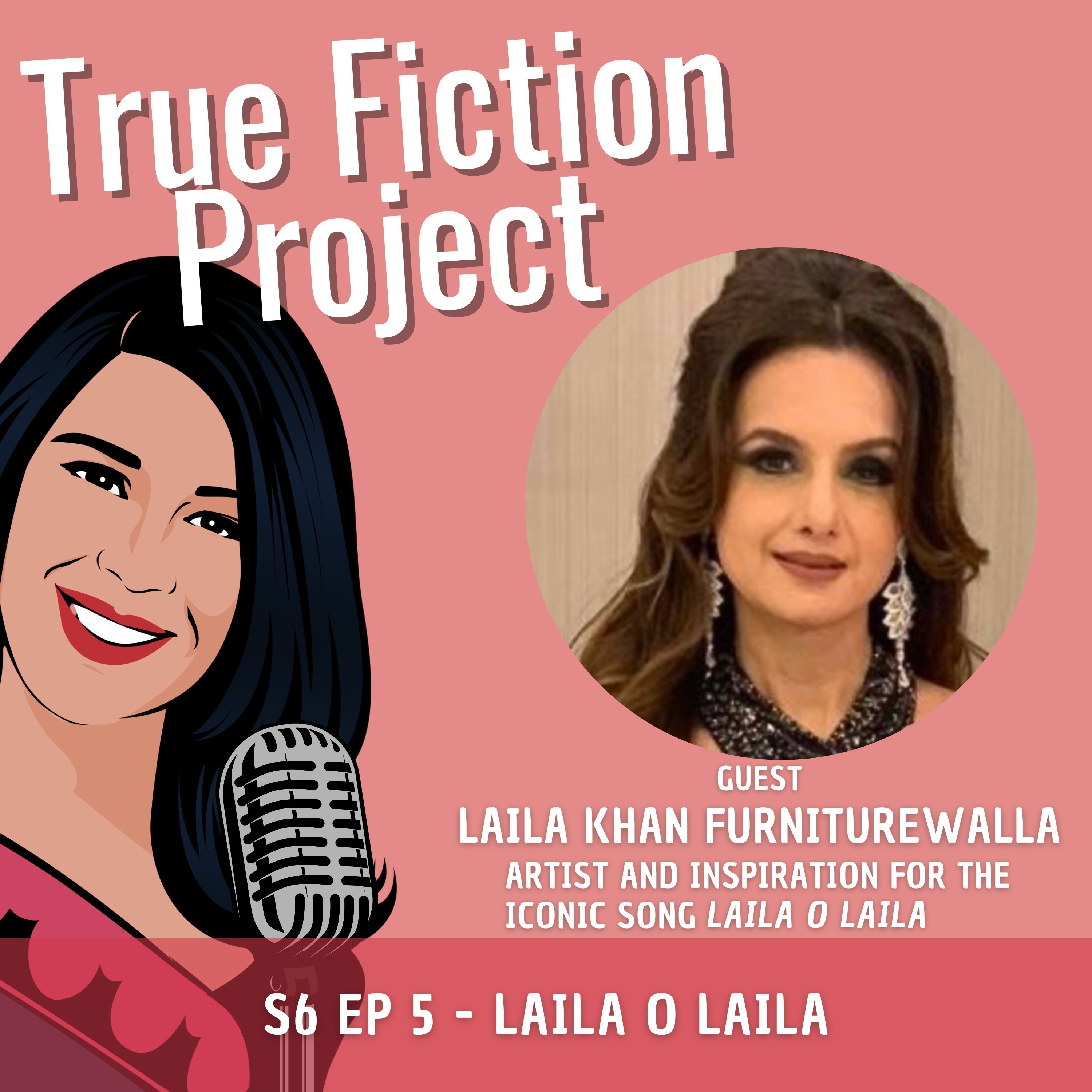
Welcome to the True Fiction Project. I. I am your host, Renita Hora. Now for those of you who are regular listeners, you know how much I love music, all types of music, but especially the music that hails from home. So I'm very thrilled to introduce today's guest because she is going to bring, amongst other things, a story about a piece of music that I. I would argue was an anthem for people of my generation in India. My guest today is Laila Khan. Furniturewalla. Hi Laila. Welcome to the True Fiction Project.
- [02:28]
Laila Khan Furniturewalla
Hi Rinita. Thank you so much for having me here. It's a pleasure and a delight and I look forward to speaking with you now.
- [02:38]
Renita Hora
It is a delight to have you on the show and first off, I have to introduce you the artist to our listeners. Laila is a Mumbai based artist. Laila, tell us about the kind of art you bring to your following.
- [02:54]
Laila Khan Furniturewalla
Presently, I'm working with different mediums. I work in mixed media on canvas. I began as a figurative artist and then I went on to the face as the inspiration. And now I'm. I think I've evolved more towards saying things in a simpler way. Ganesh Our elephant God is a very big inspiration for my work because I find his form very powerful. And I'm also inspired by the face. These elements appear in my work presently and digitally you can do anything. But I try and bring a three dimensional aspect to my work. So it's almost like sculpture on canvas because I like to multi layer and bring out those nuances and textures.
- [03:48]
Renita Hora
It's very interesting indeed because what I have seen of your work is very distinct. Black with gold leaf. And, well, not just black, but I think that's a predominant color with gold leaf. And the figures of Ganesh, very, very prominent. So when you talk about formlessness, that's immediately where my mind went, was I was thinking about Ganesh. And I'd love to ask you why the elephant God has been such an inspiration for you, so important for you, and why we see this in your art.
- [04:26]
Laila Khan Furniturewalla
I've been very fascinated that not only in India, but you go anywhere in the world that this deity is revered amongst non Hindus as well. I love to have a statue or a photograph of Ganesh as a symbol of new beginnings, boons, prosperity, good luck, whatever you may have it. He's omnipresent and very ubiquitous. I found that very fascinating. I found his form very fascinating and I found it a point. I found it mystical. And it's my search. The work is kind of like laboring to that search and for the divine. And, you know, spirituality and divinity is different things to different people, and it's very subjective. Hence my Ganesh comes out in more an abstract way because divinity is abstract and you may see it and you may not, but maybe this is where the feeling comes through. So that. That is what. Because I like to build half the bridge and the other half is up to the viewer.
- [05:38]
Renita Hora
Mm, fascinating indeed. So, Laila, you come from a family of artists. I mean, you're an artist yourself, but you really come from a family of artists. And of course, I'm specifically thinking about your father. But before I say anything else, I'd love to hear it in your own words. Tell us about him. Tell us about the art that you have grown up with.
- [06:03]
Laila Khan Furniturewalla
Well, my father was a very, very interesting. And you know, I had a very unconventional upbringing and he was a fascinating man. Very, very ahead of his time.
- [06:13]
Renita Hora
Tell us his name for listeners who are not familiar.
- [06:18]
Laila Khan Furniturewalla
Yeah, his name is Firoz Khan. And unfortunately he's no more with us. But his work lives to tell a very fascinating story of what he did in his life. And I think that's a test of True art, it outlives time and you may pass, but the work lives on. You know, he was a filmmaker and an actor, a writer. He used to be even involved with the lyrics of his songs, which are very poetic. They were very intrinsic parts of his office movies. So, yes, these were the inspirations in my life. And he loved art and was very critical about my work.
- [07:01]
Renita Hora
That's interesting to hear. So Firoz Khan for listeners, if I may add. I mean, here Laila is being very modest. He was a legend. He was one of India's legends from time immemorial, I would say filmmaker, actor, writer, lyricist, as you say, very involved in all aspects of his films. And really, I mean, some of his films are Zoo, Safar, Nagin, Kurbani. I mean, they're synonymous with the film industry of India way before we ever called it Bollywood. Am I right? Is that accurate?
- [07:40]
Laila Khan Furniturewalla
Absolutely. Absolutely. Absolutely.
- [07:43]
Renita Hora
I'm curious as to what you say about him being very critical of your art. Tell us about that.
- [07:50]
Laila Khan Furniturewalla
Well, just because I was his daughter and I produced a work of art didn't mean he had to like it. You know, he approached it very, very objectively. And there were some works of mine he loved and there were some he didn't. And. And. But he was keen to see what I did. He would tell me that I would like one of the works. So that, to me was the hugest compliment. He's not about to hang anything in his house which he doesn't like. We spoke on various topics besides art, and he loved poetry, literature. He was aesthetically very inclined. He loved to be surrounded by intellectuals, artists, all kinds of people from all walks of life. That's why our home has a lot of sculpture and art. It's an important part of our life.
- [08:38]
Renita Hora
Now, I have to ask you, did you at any point in your childhood years or growing up, want to be a performer or a filmmaker like him instead? Not, I wouldn't say instead of being a visual artist. Perhaps it was too early for you to think about what kind of artist you might be one day. But did you ever want to be a performer or a filmmaker? Or did you just always veer directly to the kind of art you produce today?
- [09:05]
Laila Khan Furniturewalla
Well, I guess I was surrounded by that. And I received many offers to act in movies. It was a very natural progression as I grew. But, yes, I did. My father was very modern, but he was very protective about me. And I think he, you know, wanted me. You know, at that time, it wasn't as, you know, the girls were not as Free to do whatever they wanted. And so it wasn't so encouraged, I'd be honest. So then I just delved deeply into my work. There was no one else that was adding or subtracting. It was just about my control with my work, which I enjoyed. I enjoyed the solitariness. I found that I could spend hours by myself working. So I felt I was in the right space. So we. We left the acting to the boys in our family. Actually, none of the women in our family have got into movies.
- [09:58]
Renita Hora
It's interesting, though, as you say it, because for people who live especially outside of India, when they think about Bollywood and they think about, you know, the industry and the films and what has come out of Bollywood and continues to today, I mean, it's synonymous with so many amazing actresses that it's perhaps sometimes not what one would expect to hear, that women were not encouraged to be part of the film industry. And I completely understand because I grew up in, you know, the same generation that you did. So. I know. Explain that for our listeners. And especially coming from a film family, why would, you know, a film family themselves not encourage girls or women to be part of that?
- [10:44]
Laila Khan Furniturewalla
Because, you know, at that time, this was in the 90s or the early 2000s, I didn't know. I think especially amongst Muslim families, the women were very sheltered and protected. And I think this whole phenomenon of women from film families entering movies happened soon after. You know, it happened a little later. It was still very much a profession for the male to get into and not the female. And I guess if I really wanted to, I would have, you know, obviously I didn't really want to, otherwise one just does what one wants to do and goes into that direction. But I played another part in the family. So I got very into my work very early. I went to the Slade School of Fine Art in London soon after college and to do a course because I wanted to study from. From the nude, from life. I was very much into figurative painting and drawing. And then soon after, I went to St Martin's in London again because I wanted to do creative expression in painting. I mean, it's a fabulous profession. I love film, I love performances, I love what goes into it. I love watching it. So that's very much a part of our lives here too.
- [12:02]
Renita Hora
Yes, indeed. And I love how you say that you had a different role in the family. Having said that, I do know that you were also an inspiration for your dad and his art. You brought to me a fascinating story about an iconic song that, as I said, in the opening, I would argue, is an anthem for our generation. Lela Olela, right?
- [12:31]
Laila Khan Furniturewalla
Yes.
- [12:32]
Renita Hora
Yes. That song was named after you, made for you, inspired by you. Tell us in your own words. I was riveted.
- [12:39]
Laila Khan Furniturewalla
Yes. I feel so happy that, you know, my father's words in regard to that song came true. So here it where it started around eight or nine. And I came home one day and he was involved in making Khorbani. And he was so passionate about this movie. He had his last shirt in it and he named me. He loved the name Leila. And he came home and he said, I think around my birthday and in his own swag, you know, he goes, hey, baby, I've got something for you, a gift. And I was, you know, he was my hero. So I was so excited, I remember, and wondering what this was. I knew he was involved with making his music at that time, composing and writing. And so he had come back from the studio, actually. But he said, I have a rough track of a song I'd like you to hear, and it was Leila Olela. And he said, this song is after you and it's been inspired by my love for you. I loved it. And it was so. Even at that time, even in, you know, that's what he said. He said, even if you hear a song in a rough version and even if you hear it soft and if you like it, that means this song is going to be something. And he said, mark my words, this song is going to be a hit. He said, a hit. He said, how big a hit? Time will tell. And the film released in 1980. And so we are 44 years down that road. And it plays today everywhere.
- [14:11]
Renita Hora
People.
- [14:11]
Laila Khan Furniturewalla
Other makers have remixed it. There are many remixed versions, but I would like to proudly say that none of them can touch what he did. As far as this song goes, none of them, none of the remixes matched to what the original song was. And that is art.
- [14:30]
Renita Hora
I would absolutely agree with that 100%. And in lieu of the fiction portion of today's episode, we're actually going to listen to that original piece. So I'm really excited because it's one of my favorite songs ever. And I know when I say that, I speak for not even thousands or hundreds of thousands, but millions of people.
- [14:50]
Laila Khan Furniturewalla
Thank you, Renita. That's.
- [14:52]
Renita Hora
No, thank you. Thank you. But. And I must ask you, because I remember asking you after you shared this story with me that day. The song is Leila or Leila, but your name is Laila and your father named you and you said that he named you Leila. So tell us how that evolved and changed.
- [15:15]
Laila Khan Furniturewalla
Yeah, well, some people called me Laila. Some people called me Laila. In fact, he started calling me Laila later. And so it's stuck. Yeah, so it stuck. But people call me Laila today. And I'm. I'm good with that, you know, anything. It's a name, it can be called.
- [15:32]
Renita Hora
Is there a difference between Laila and Laila? I mean, just the pronunciation.
- [15:37]
Laila Khan Furniturewalla
Well, the Arabic, just a pronunciation, but the Arabic, it's from an Arabic word called Lael. So that is pronounced Lael, it's not Lai, you know, so. And my name is actually spelled L, E, I, L A, which is Lela. But this name, it can be spelled differently, you know, in different ways. And Qurbani was a movie which had many, many firsts. I just wanted to add this. He brought in the whole genre of disco with his music. With Nazir Hassan, he was very particular about sound and with, you know, certain sound of a voice. So he double tracked her voice for the song. And he's the one who brought in all these dancers for all the picturization. He flew down these absolutely fantastic dancers from London, I remember at that time. And you know, today's films still use a lot of the same. You know, they choreographed it very similarly. Something he did with these dancers in the 70s, which is 43 years ago. There were many, many, many firsts with him and his movies.
- [16:42]
Renita Hora
Indeed. And sort of the two women I can think of who skyrocketed to fame with that film. One, of course, was Zeena Taman, who is another just legendary, legendary actress and really sort of the defining role. I think her defining role was in Kurbani. Again, she's been in many things, but, you know, you always associate her with Kurbani, that wonderful film. And the other, as you say, Nazia Hassan, who I think, correct me if I'm wrong, up until that time sort of came out of nowhere. She was in London and between your father, Firoz Khan and Bidu, they just literally plucked her from nowhere. Tell us that story if you can. You know, any bits and pieces that you could share.
- [17:28]
Laila Khan Furniturewalla
Yeah, she was barely 15 and she was a Pakistani. She was not even singing at that time. I think he just must have heard her somewhere and he liked the quality of her voice and he got her down and along with Bidu, you know, they. But I, like I said earlier, they had to double track her voice because he was very clear about the certain quality he wanted. And he always Wanted something different. My father just didn't want to be regular. He wanted to introduce something new. I think all artists like to do that. And this is something I get, you know, I feel I get from him. Because in my work I. I always have evolved. It's not something I do very consciously, but it's just. It comes out, you know, that I want to. Because if you see my work right from 96 until now, you'll see how my work has evolved over the years. And there's always something new. I want to say he always wanted to do things his way, in his style.
- [18:33]
Renita Hora
And this drive for perfection. Where would you say that came from? Do you know?
- [18:40]
Laila Khan Furniturewalla
Are you aware he was a very meticulous man, Very aesthetically sound, very artistic with all the artistic chaos in his head. But very methodical, you know. He was a self made man. A lot of discipline comes from when you make your life yourself. Because he came to Bombay when He was barely 14 or 15. He was fatherless. His father had just passed away. He came to this city from Bangalore with no money, just dreams in his eyes and a fabulous swagger and style. And I remember he used to hustle with snooker. He was a very good snooker player. He loved his snooker. And so that would make the rent, you know. So these are some things, you know, so that I think discipline brings you hunger and that hones your skills and brings out the best along with life circumstances. It's the combination of everything that brings out the perfection.
- [19:42]
Renita Hora
Absolutely fantastic. Well, Laila, it has been such a pleasure to have you on the show today. Before we wrap up, let our listeners know where they can find your work, any links you want to give us online or any other tips about upcoming exhibitions or anything you'd like to tell us.
- [20:04]
Laila Khan Furniturewalla
Sure, Vinita. Well, you can see my work on my website@www.alila khan.com and also on my Insta page. Laila Khan underscore. I'm working towards my solo show. You can see the details in regard to that on my website or on my Insta page and would love your comments and would love some feedback. I have an email on my website which you can connect with me directly and I will definitely respond.
- [20:40]
Renita Hora
Wonderful. We're definitely going to add all of the links in our show notes and stay in touch. Let us know when your show happens and we will do some social media and publicity around that too.
- [20:53]
Laila Khan Furniturewalla
Thank you so much.
- [20:54]
Renita Hora
Thank you so much for being our guest today on the True Fiction project and good luck with your wonderful art.
- [21:03]
Laila Khan Furniturewalla
Thank you, Renita.
- [21:04]
Renita Hora
That was Laila Khan Furniturewalla she is a Mumbai based artist, comes from a performing art family, the daughter of Firoz Khan who created this song Lela Olela inspired by his little girl. And for our listeners who are not familiar with that particular song, we have a treat. Here it is.
- [21:30]
Metro Ad
This season a new hot deal has arrived at Metro. $25 a line for four lines. With all the data you need and four free Samsung Galaxy A15.5G phones, getting Metro's best deals is easy. No ID required, no activation fees. Get a new number or keep your own. It's up to you. That's four lines for $25 a line plus four free phones. Visit a store or go online today only at Metro by T Mobile when.
- [21:55]
Laila Khan Furniturewalla
You join Metro plus Tax for a limited time and subject to change max one offer per account.
- [22:33]
Renita Hora
SA.
- [25:07]
True Fiction Project Team
Nadiki.
- [25:32]
Dutch Vet
Leila.
- [25:58]
Laila Khan Furniturewalla
Milana.
- [26:32]
True Fiction Project Team
Here at the True Fiction Project, we're always looking for great stories that make for compelling fiction. So if you have a great story or know someone who does, or if.
- [26:41]
Renita Hora
You'Re a writer who'd like to be.
- [26:43]
True Fiction Project Team
Featured on the show, then please do get in touch with us at runita.com forward/contact and if you haven't signed up for our newsletter, then you can do so by visiting substack.com/rinitahora all spelled out one word. That's substack.com/e e n I T A H O R a I'll be offering paid subscribers something a little extra special each time in pack, including a video version of this podcast.
- [27:22]
Shopify Ad
Shopify is a global commerce platform that helps you sell at every stage of your business and sell more with less effort. Thanks to the Shopify Magic, your AI powered all star. Sign up for a $1 per month trial period at shopify.comredcircle all lowercase go to shopify.com Red Circle now to grow your business no matter what stage you're in. Shopify. Com redcircle.