Loading summary
Transcript65 lines
- [00:00]
Weight Watchers Narrator
This is the new Weight Watchers built for real life and real results no matter what mode you're in. Maddie went all in for her big day and lost 33 pounds. Emily lost 85 pounds and hit her goal while still living her life.
- [00:14]
Jennifer Wright
Weight Watchers gave me the tools and I feel amazing.
- [00:18]
Weight Watchers Narrator
Join the millions of members and lose weight with the number one doctor recommended weight loss program. Lose more@weightwatchers.com at six months, participants in
- [00:27]
Jennifer Wright
the clinical trial of Weight Watchers program
- [00:28]
Weight Watchers Narrator
lost an average of £12.
- [00:30]
Jennifer Wright
Women around the turn of the century, especially wealthy women, they were pretty much bred just to become wives, you know, to marry the right person and do the right thing. But Kathleen, she suddenly starts to crave more. She wants purpose, she has passion. She wants to do things with her life and really that finds her at odds with her father and again, not giving too much away. But there is an explosive falling out between the two of them and she ends up fleeing just as fall far as she can get until she runs out of money and ends up in Galveston.
- [01:04]
True Fiction Project Intro/Outro
Welcome to the True Fiction Project, a podcast series that explores the origins of fiction. Every week we begin with an interview, nonfiction, followed by a creative piece, fiction inspired by something from the interview. The idea is to demonstrate, of course, that fiction is born out of our life experiences. Now here's your host, storyteller, author, public speaker, health and wellness expert, Renita Hora.
- [01:34]
Renita Hora
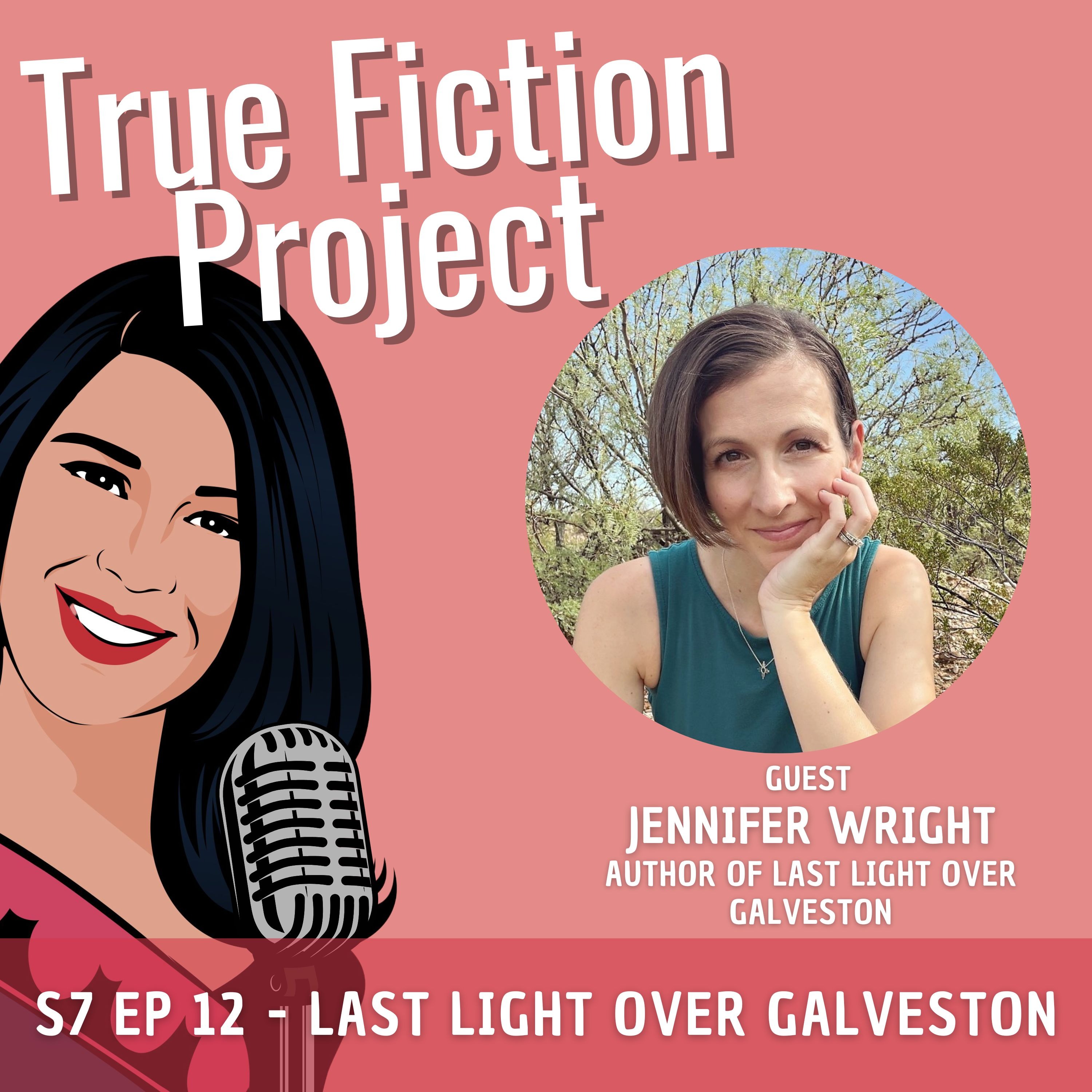
Welcome back to the True Fiction Project. I am your happy host, Renita Hora. And thrilled to welcome to today's show Jennifer Wright, who has been writing since she was in middle school. She is a born and bred Hoosier, which apparently means that you are from Indiana. Now, this was new to me. I'm learning every day, at every moment. Jennifer tells me that she was swept off her feet by an Air Force pilot, which to me sounds like a hallmark romance sort of something that I'm very into these days, really researching. And she is an award winning author, multiple award winning, multiple books. This is her third book that we're going to be talking about today. It has just been released and it is called the Last Light over Galveston. So hi, Jennifer, and welcome to the True Fiction Project.
- [02:32]
Jennifer Wright
Hello. Thank you so much for having me. I'm thrilled to be here and I
- [02:36]
Renita Hora
am thrilled to have you here. So Hoosier, did I get the pronunciation right?
- [02:42]
Jennifer Wright
Yes, you nailed it. Okay.
- [02:44]
Renita Hora
Because I was looking at it and thinking, oh, gosh, you know I'm going to sound terrible if I botch that. But your personal story, we have to start with That, I mean, like I said, to me it sounds like a Hallmark romance. Is that true?
- [02:59]
Jennifer Wright
Maybe a little bit, yes. I grew up wanting to be a news reporter, actually, and so went all through my education. That was the goal. That was the end goal in mind. Got my master's degree in journalism, started working a job at our local NPR station as well as at the local paper. And I thought, oh, I hate this. Went through all of those years of education and I just, I hated it. And so there was a little bit of, what am I going to do now? My whole life plan is just, you know, thrown to the wind. And then in swoops, this guy in an airplane to whisk me away. And we got married and moved overseas and lived there for five years. And it's just been a constant whirlwind since.
- [03:42]
Renita Hora
So my goodness, my goodness. I just. While I was eating breakfast, I was looking at an Instagram post by Katherine Heigl and she's posting about all these romantasy books. And that sounds like a perfect romantasy to me, much more than what happens in my real life. So you are a multiple award winning author. Tell us about some of your previous work, the awards, the books. Is there a particular genre that you're writing?
- [04:14]
Jennifer Wright
I definitely, I lean more towards historical fiction. You know, it's funny that my life, you think it's a romance because I really veer away from romance. I do not really include that in my books. There's sometimes a little bit of an aspect of it, but I. I seek to tell grittier, more realistic historical fiction. And I tend to, with my books, focus on one large historical event and then imagine what it was like to live through that. For example, this book, Galveston Imagining the Galveston Hurricane. My previous book come down somewhere centered around the Trinity test, which was the testing of the atomic bomb in New Mexico. So I love to focus on a historical event and then dig deeper and again, just imagine what it was like to actually live through that.
- [05:00]
Renita Hora
So I am so excited to unpack that with you. I am also a writer of historical fiction and my approach is very similar. It's about the event. And then dig deeper to imagine the lives of your fictional characters. Were they placed in that setting? So what made you pick these specific events and why did you decide to go the way of historical fiction rather than history? I can guess, but I'd rather hear it from your point of view.
- [05:31]
Jennifer Wright
Yes, obviously I love history and my background is in journalism and so I dealt so much with the factual sides of things. But then Coming in contact with so many people, I was surprised how many people hate history. They find it boring and they're just not interested in it. And I just thought, well, that's because you're not seeing the human side of it. You're not getting that empathy. You're not really understanding what it was like to live through there. And I just found such a power in fiction to be able to convey the facts of history, but really draw people in and let them experience that human side, which I think opens up an aspect of history that so many people are either not understanding or they just miss completely when they're dealing with either dry text or some kind of journalistic piece of an article.
- [06:19]
Renita Hora
Absolutely. Absolutely. So in order to grip them, hook them, thrill them. Oh, my gosh, some of these words sound so sensational. And I know that that is not the aim here. But as you write, or before you write or as you write, thinking of a particular genre, like this is going to be a historical thriller or historical mystery. I know you're not doing romance, but are you thinking along those lines specifically or combining genres?
- [06:52]
Jennifer Wright
Not necessarily. I think I just go into it again with a certain historical event in mind, and then I try to imagine what type of thing would go along with that. So, for example, you know, I look at Last Light over Galveston, and I look at what happened there. Obviously it's a hurricane. It's washing away the destruction. And to me, that just kind of led to, what would that be like to have your foundation swept out from underneath you? Not just in a literal sense, but what about in a spiritual sense, in an emotional sense? So that leads to the human part of the story, and that's what I try to weave together. So I look for that underlying theme of the disaster and try to take that to another level.
- [07:33]
Renita Hora
I love it. I love it because stories are all about human connection, and it's the emotion of the characters and what they're going through that we as readers and audiences really connect with. So let's look at Last Flight over Galveston. What happens? I mean, we know that the hurricane happens and houses are taken away, but you've given us a hint. Spiritually, emotionally, how does that affect your characters? What happens?
- [07:59]
Jennifer Wright
Well, I don't want to give too much away because I do want people to read the book, but I will say it centers around a young woman named Kathleen who's been raised in a very wealthy, well to do family in upstate New York. Her father is a prominent businessman, hobnobs with the Roosevelts. That sort of thing, and she just suddenly starts to long for more. She longs for more, a purpose. Because, you know, women around the turn of the century, especially wealthy women, they were pretty much bred just to become wives, you know, to marry the right person and do the right thing. But Kathleen, she suddenly starts to crave more. She wants purpose. She has passion. She wants to do things with her life. And really, that finds her at odds with her father. And again, not giving too much away, but there is an explosive falling out between the two of them, and she ends up fleeing just as far as she can get until she runs out of money and ends up in Galveston. So we find her in Galveston, trying to pick up the pieces, trying to figure out, now, what am I going to do with my life? While still fearing that her father's men will find her and bring her back to this life that she doesn't want to return to. And as she's trying to figure all of this stuff out now, there's a monster hurricane that's bearing down down on the island. And how is she going to survive? Does she want to survive? And what is that going to look like, not just physically to survive this hurricane, but to come out of it on the other side, emotionally and spiritually? How do you recover from that?
- [09:26]
Renita Hora
Kathleen story sounds so eerily similar to mine. I kid you not. Was she a real person or was she entirely a fictional character?
- [09:36]
Jennifer Wright
She was entirely a fictional character. Just meant as a way to, again, showcase the human side of these events.
- [09:44]
Renita Hora
Okay, and how did you go about sinking yourself, immersing yourself in what happened in Galveston to discover this story?
- [09:56]
Jennifer Wright
Yeah, I was fortunate enough to. Galveston was the first major natural disaster that was basically covered in real time. You had reporters swarming to the island and just constantly shooting off telegraph, shooting off newspaper articles. So people were witnessing this almost firsthand all the way across the country. And I was fortunate enough to come across a collection of these articles that gave these firsthand accounts of what these people went through. And that was invaluable to me to be able to put myself in their shoes, see what they see, felt what they felt. And I incorporated many of the things that I learned from these old newspaper articles into the story.
- [10:35]
Renita Hora
Interesting. What was the time period when exactly it happened?
- [10:38]
Jennifer Wright
1900. September of 1900. So 125 years ago next month.
- [10:43]
Renita Hora
And what is it about that time period, notwithstanding? I don't know exactly the time period of your other books, your other stories, but what is it about that time period that interests you? Or is it not the time period. It's the Galveston incident.
- [11:00]
Jennifer Wright
It really was the Galveston incident. I have always refused to allow myself to be pigeonholed into one time period. I wrote a book about the Dust bowl. Then I wrote a book about World War II. Now I've gone back to 1900. I don't want to just write about the same thing over and over again. And some authors do, and that's great. But I tend to get bored very easily. I have adhd, and so I'm a little all over the place. And so I need to be able to find something that piques my interest no matter what time period it is. I mean, I would be willing all to write all the way up to the 1980s if there was something that really interests me, or I would go all the way back to the 1700s. It's all about the incident at hand for me, less about the time period.
- [11:42]
Renita Hora
Yeah, I was at Willamette Writers Conference just a couple of weeks ago, and as a child of the 80s, and we were discussing on one of the panels, young adult, different genre, I was kind of shocked, mortified, and then somewhat pleased to learn that the 1980s are considered historical fiction.
- [12:02]
Jennifer Wright
I've been Child of the 80s as well, and I actually find the 1980s fascinating to read about. Not because it makes me feel old, because it does, but when you're a child during that period, I feel like there was so much going on in the world and historically that I just wasn't aware of because I was a child. So it's really interesting for me to go back and read books set during that time period, because I'm like, oh, I was alive and I had no idea that was going on. So it's actually, maybe it's a little bit of a badge of honor that now we're in the historical fiction era.
- [12:31]
Renita Hora
So this brings me to my next question. Jennifer, writing about the 1980s would be a whole lot different to writing about World War II, World War 1900. Well, we know that people weren't alive in 1900. Is there a difference, do you think, in terms of what the audience perceives, the 1980s or recent historical fiction written during a time when they were alive
- [13:00]
Jennifer Wright
versus not, I do up to a certain point. But I also feel like no matter how if you're writing about the 1980s or you're writing about the 1900s, there is a tendency for us to glamorize the past. And I think even if you've lived through it like I lived through the 80s, but I think back and I thought the 80s were just so much better. They were so much better. And they had the cool music and this was going on. And this was going on. And so it's different to write about that when people, you could be writing about something that was very tough that maybe showcases that the 80s weren't that wonderful. And I think readers might balk against that a little bit because there's that nostalgia for a time period that they lived through. Thankfully, 1900, no one's alive who lived through that. So I don't have to deal with those expectations.
- [13:54]
Renita Hora
Right. So gives so much more license to your creative flow in a sense.
- [14:00]
Jennifer Wright
Yes.
- [14:00]
Renita Hora
Right.
- [14:00]
Jennifer Wright
Yes, for sure. Yes.
- [14:02]
Renita Hora
How old are your characters, Kathleen, specifically in this story?
- [14:08]
Jennifer Wright
Kathleen is just around 20 years old. Okay.
- [14:12]
Renita Hora
So I am very curious in that case. 20, just past 19 in. Were this a contemporary novel, we would say this is either young adult or new adult, which is obviously not the case. What would you say? I mean, to me it's like if you look at the age of the character and set it back 100 years ago. I mean, a 19 or a 20 year old or a 21 year old still, still is going to behave the way, you know, 19 or 20 or 21 year olds behave today, but in a different context. Yet publishers and editors will tell us differently. No. So I'd love to hear your perspective.
- [14:49]
Jennifer Wright
I think when you categorize books like that, I do think it limits a little bit because example myself, I tend to shy away from YA books. They're just not my cup of tea. I don't read a lot of them, but. And a lot of the times it's just putting that label on it. Just putting that label on it. I'm like, I'm in my early 40s, I have nothing in common with this 18, 19, you know, year old protagonist. So I'm not going to read that at all. And so whereas if a book is not labeled that way and I pick it up and the protagonist happens to be 18, 19, 20, I have no problem reading it. So I think it's really interesting to label or market books a certain way. Whereas I hope that my books just appeal to everybody. You know, it doesn't matter if you're 14 or it doesn't matter if you're 80. I hope it doesn't matter what age the protagonist is. And I think that we're really limiting our readership if we label books the way that we do.
- [15:47]
Renita Hora
Fantastic. Great. I love hearing that.
- [15:50]
Jennifer Wright
And one thing I do.
- [15:51]
Renita Hora
Yeah, Seriously, such a point of contention I think for us all. One thing I do want to ask you about is voice. Your voice as the narrator and the voice of the characters, specifically voice in the sense of. Aside from the overall voice of the narrator, perhaps speaking today and looking back versus living at the time and. And knowing that language was different or speaking style was different. How do you tackle that?
- [16:22]
Jennifer Wright
That is honestly one of the hardest parts, because obviously we're modern people. We speak in a modern way. And that is something that my. I am so thankful for my editor because there will be instances as she's going through my manuscript, she's like, that's a little too modern. People back then would not have said something like, there was one instance where a character asked another one, are you okay? And that to us, that sounds normal. Correct. But she's like, that's not something they would have said in 1900. It would have been, are you well? Are you all right? They would not have asked, are you okay? That's just not how they spoke to each other. So I do my best to try to stay faithful to that time period, but that's where we just. We gotta rely on those editors who help us catch us when we slip into that modern voice. Yeah.
- [17:09]
Renita Hora
What would we do without the editors? I really think the editors are what make the book.
- [17:13]
Jennifer Wright
Oh, for sure. 100% for sure.
- [17:16]
Renita Hora
How long did it take you to write this particular book?
- [17:19]
Jennifer Wright
This book was actually written very quickly. Normally it takes me around 18 months or so when you include the researching, because I do about six months of researching before I ever, ever start writing a story. But this was one. I was on a deadline and I had to come up with a story. And so this. I did about three months of research and this book was written. Three months. Amazing. Total. Yeah. And that's why it's funny, because I read back over it and I'm like, I don't remember writing that. All right. That's pretty good for not remember writing it. Like, it was in a deadline crunch that I wrote this book. Yeah.
- [17:53]
Renita Hora
So deadline means you. This book was commissioned.
- [17:57]
Jennifer Wright
Yes, I was under contract for this book. Yeah.
- [18:00]
Renita Hora
Fantastic. All right. So I know you are going to be reading us a short excerpt from the book. And can you tell us a little bit about it? Sort of lead up to it so we know what we are in for.
- [18:14]
Jennifer Wright
So I'm going to read you just a little bit of the prologue where we are opening on Kathleen as she has just arrived in Galveston. And you get a little bit of a sense of something happened to lead her there. But I'm hoping the mystery is there and it's going to entice you to read a little bit more and figure out just what happened to lead her to this present moment.
- [18:37]
Renita Hora
Amazing. All right, we are all ears. I cannot wait to delve into Kathleen's story.
- [18:44]
Jennifer Wright
So we are starting in the prologue and this is May 1900.
- [18:48]
Shopify Advertiser
You didn't start a business just to keep the lights on. You're here to sell more today than yesterday. You're here to win. Lucky for you, Shopify built the best converting checkout on the planet, like the just one tapping ridiculously fast acting sky high sales stacking champion at checkouts. That's the good stuff right there. So if your business is in it to win it, win with Shopify. Start your free trial today@shopify.com win.
- [19:20]
Renita Hora
And now to the premise of the True Fiction project, which of course is to create fiction out of nonfiction.
- [19:39]
Jennifer Wright
I walked until I could go no farther, until open water was all I could see. It was the end of the road for sure, possibly the end of the world for me. They were one and the same. Standing on the rocky sand, I watched angry waves roar ashore through flashes of lightning. The air was snapping thick with salt and electricity as warm rivulets of rain streamed down my face. Or were those tears? It was impossible to tell. The thunder rolling across the Gulf of Mexico could just have easily been the sound of my bones rattling inside this lifeless cage. Miles and miles of train tracks, chosen at random but always going south, going west, going away, had brought me here. It was as far as I could go, and it still wasn't far enough. He would find me. White foam nudged the toe of my boot, soiling the edge of a dress already grimy from weeks of wear. When the wave retreated, it tugged the warm weather beckoning me. I could do it. Just keep going. A few more steps and it would all be over. The end of the road, but in an entirely different way. Another swell, stronger this time. My nerves tingled as electricity raced through the water towards shore, searching for me. Numb fingers found the strap of my bag, the one I'd brought from a street vendor outside the train station in Lexington, and I took a step back out of the water. This bag and what was in it was the reason I wouldn't, the reason I couldn't, and the reason I wanted to.
- [21:04]
Renita Hora
Amazing. Thank you so much, Jennifer. That is just wonderful. I can't wait to delve into the book for real. Tell us a little bit more about where it's available, where we can get it where we can find you your socials or website or anything you'd like to say.
- [21:23]
Jennifer Wright
So the book is available anywhere you like to buy books, Amazon, Barnes and Noble. As always, I encourage people to peruse their independent bookstores because I guarantee you if they don't have it, they'll order it for you. But obviously the big retailers, it's there too. And you can find me online. I'm on Instagram enright82 or on Facebook
- [21:42]
Renita Hora
Enferrite Lit Jennifer, thank you so much for being a guest on the True Fiction Project today. I wish you much success and like I said, I can't wait to get into it.
- [21:54]
Jennifer Wright
Thank you so much for having me. This was wonderful.
- [21:57]
Renita Hora
That was Jennifer Wright. She is the author of the Last Light Over Galveston which is out in bookstores, so dive in and get your copy. And I am Renita Hora, your host for the True Fiction Project. Thank you for joining us here at the True Fiction Project. We are always looking for great stories that make for compelling fiction. So if you have a great story or know somebody who does, or if you are a writer who would like to contribute, then please do get in touch with us@renita.com contact
- [22:38]
True Fiction Project Intro/Outro
thank you for listening to the True Fiction Project with Ranita. Be sure to subscribe to the newsletter to receive more inspiring stories showing how fiction is born from our everyday experiences. For more information, visit www.TrueFictionProject.com.
- [23:01]
Weight Watchers Narrator
This is the story of the One As a procurement manager for a hospital system, she keeps every facility in her network stocked and ready to that's why she counts on Grainger to be her single source for thousands of products from disinfectants to lighting, air filters, and more. And with fast, dependable delivery, Grainger helps her keep every facility stocked, safe and running smoothly. Call 1-800-GRAINGER clickranger.com or just stop by Granger for the ones who get it done.