Loading summary
Transcript75 lines
- [00:00]
Narrator
This summer experience one of the greatest stories ever told. Homer's the Odyssey, a new audiobook narrated in the voice of Sir Michael Caine. Only on 11 reader. Long before the world had maps, the greatest warriors of Greece sailed across the sea to a city called Troy. This is the story of one of those soldiers. His name is Odysseus, king of a small rocky island called Ithaca. When our story begins, he has been gone from home for nearly 20 years. His wife, Penelope, waits in their palace surrounded by suitors. His son Telemachus, born just before the war, has grown into a young man who has never met his father. And the captive Odysseus longs only to see his home again. With that, we present Homer's the Odyssey. Before you see the film, hear the full audiobook, available for free exclusively on 11 reader. Get the 11 reader app today.
- [01:00]
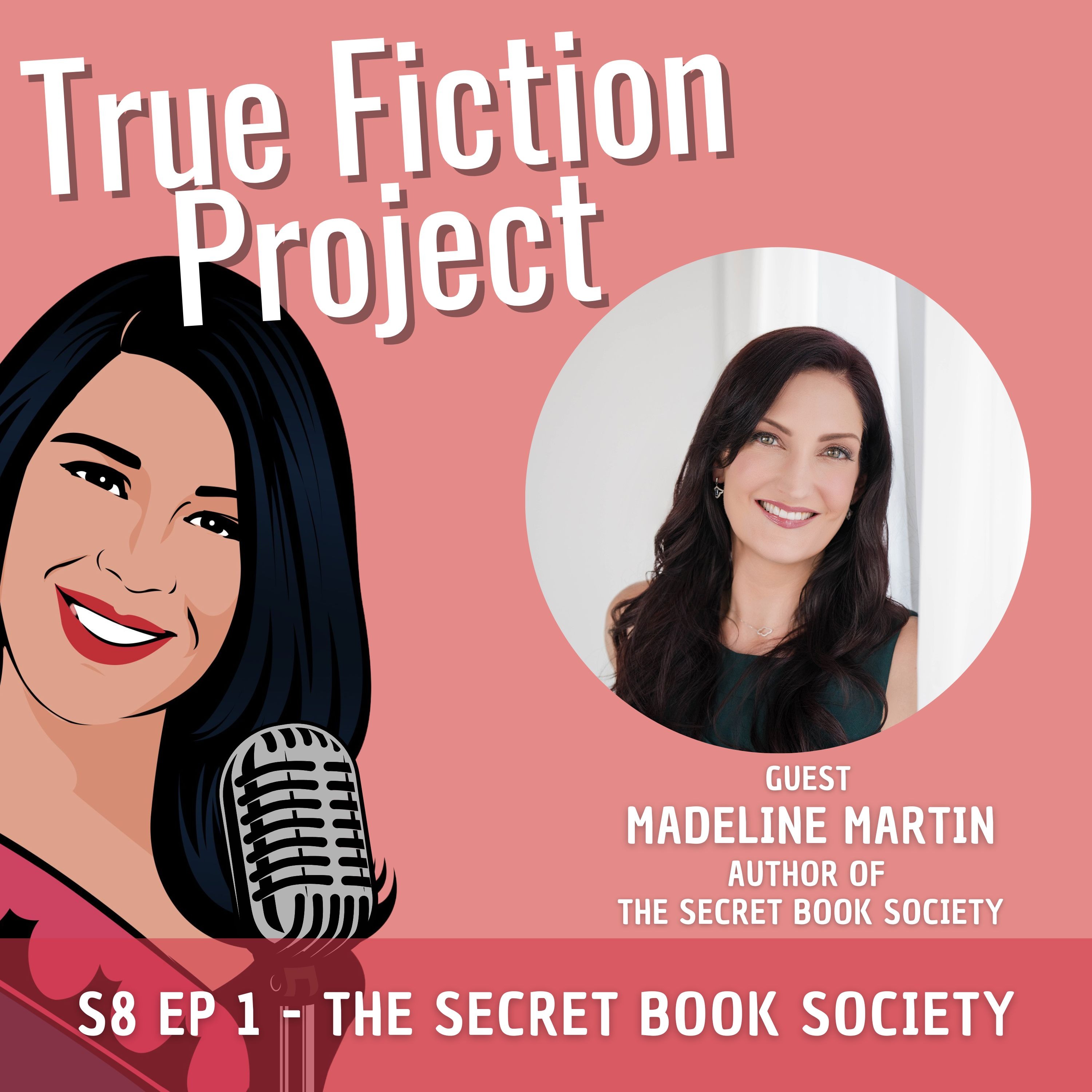
Madeline Martin
So the Secret Book Society is about an enigmatic countess who has been widowed three times. And yes, there's definitely some gossip going on about that. She finds out that women are having their reading materials restricted. And in the Victorian era, they really didn't want women reading books. They felt like it took them away from being wives and mothers. It gave them these opinions that made them contrary to their husbands, fathers and sons. And they felt that women were a little bit too frail and couldn't handle the excitement that a novel took them on.
- [01:33]
Renita Hora
Welcome to the True Fiction Project, a podcast series that explores the origins of fiction. Every week we begin with an interview nonfiction followed by a creative piece, fiction inspired by something from the interview. The idea is to demonstrate, of course, that fiction is born out of our life experiences. Now here's your host, storyteller, author, public speaker, health and wellness expert, Renita Hora.
- [02:03]
Welcome to the True Fiction Project. I am your host, Renita Ahura, and absolutely excited to welcome to the show today Madeline Martin. She is a fellow writer of historical fiction based in Florida and a New York Times Times best selling author of many books. Hi, Madeline. Welcome to the show.
- [02:26]
Madeline Martin
Hey, Renita. Thank you so much for having me. I've been looking forward to it and
- [02:31]
Renita Hora
I have been looking forward to speaking with you and vicariously living the life of sunny Florida, which is where you are.
- [02:41]
Madeline Martin
It's really hot right now, so I don't know. Yeah, it's probably better where you're at right now. Okay.
- [02:47]
Renita Hora
I'm from Mumbai, so there's no amount of heat that is enough for me. I know I sound like a complete wimp when I say that, but it's true.
- [02:54]
Madeline Martin
I get that.
- [02:55]
Renita Hora
So, Madeline, tell Us. How many books have you written?
- [02:59]
Madeline Martin
So I've written over 40 books. I was writing historical romance before, and so I have over 35 historical romances ranging from Medieval to Regency. And now I'm writing historical fiction. So I have four historical fiction that have been published in World War II and this next one that we'll be talking about is Victorian.
- [03:18]
Renita Hora
So I have so many questions and I'm just gonna shoot out two or
- [03:23]
Madeline Martin
three because go for it.
- [03:25]
Renita Hora
Take us through the gamut. What got you started? How long have you been writing and what led you from historical romance to historical fiction? You know, what was that progression like?
- [03:37]
Madeline Martin
So I think I've always kind of written. My mom saved like every school accolade that I ever had since the dawn of time. I don't know why, but, but so in the mix of like a spelling test from the first grade, I had little chapters here and there that I had written and books that I had plotted out. I even had like a hardcover book that I made myself with like material and cardboard and like illustrated it myself when I was like in the fifth grade. So I think I've always kind of had that like, love for wanting to write books. And when I was on maternity leave with my first daughter, who is now 19, I read Outlander and I really liked sort of that dichotomy between, you know, that brawny Scotsman and the feisty Sassenach. And I thought, oh, this sounds like such a fun kind of dynamic to really explore and, and do a romance with. So that's how I started writing. My first romance was that sort of Scottish and English pairing. And I was worth a small press. And then I was with Harlequin Historical and then I was doing independent publishing. But for that I was having to put out a book like every other month. So I was working a full time job as a business analyst and writing like six to eight books a year, which was a lot. And I knew that I really did want to kind of delve into historical fiction because that was kind of first love as a reader. When I look back at what book I fell in love with the most, it was the Little House in the Big woods series by Laura Ingalls Wilder. And I just read that series over and over again. And so I've always wanted to delve into historical fiction. But as you know, it's daunting, right? Thinking about all of that research and all those little details that you have to get right. And so I ended up getting laid off from my job, which is horrible to say, but it was a relief because I was exhausted from writing so much and working so much. That's when I finally had the opportunity to sink my teeth into the research and write the Last Bookshop in London. And for me, that kind of made me realize that not only am I a history nerd, I'm also a research nerd as well. And I have just loved writing historical fiction. So I've been writing for over 20 years and I've been writing full time now for over five years and it really is just a dream come true.
- [05:47]
Renita Hora
Amazing. So let's go back a bit. You mentioned that you were writing working with Harlequin and another publisher. I forget the name. But then you were also self publishing or working with independent publishers and had to churn out a book a month. Those your books? Other books. Tell us about that.
- [06:07]
Madeline Martin
Those were my books. So I was with Harlequin Historical and then I started doing self publishing. And with self publishing, you really do have to do like a book every month or two with historical fiction to really make sure that you're staying on top of the. I'm just really being relevant. And so, yeah, so I was working full time and I was writing six to eight books a year for three to four years. And I mean, there was no such thing as a sick day. And the kids, I have two daughters, they were in everything. So I liked to joke that I was a full time author, a full time mom, and a full time business analyst. And now I like to joke that I'm a full time mom with this little writing gig on the side, which my kids are like.
- [06:46]
Sponsor/Advertisement Voice
Yeah.
- [06:47]
Madeline Martin
So yeah, it was pretty wild. And you know, the thing is, when I got laid off from work, we had just moved and I finally had my own office. Before that, I had really just been kind of in the middle of the living room. And nothing says please don't disturb moms on deadline like working in the middle of the living room. So when I got laid off, I thought, this is going to be amazing. I'm going to have the house to myself. It's going to be quiet. After like 15 years of writing, I'm finally going to just get to do this full time. And that was February 2020. The pandemic happened like three weeks later and I was robbed.
- [07:18]
Renita Hora
Oh my goodness.
- [07:19]
Madeline Martin
Everybody was home. Yeah. And my husband still actually hasn't even left. He was warned that I'm doing this interview and he's not allowed to come downstairs.
- [07:28]
Renita Hora
Yeah, I know how that world works. I find myself in it all the Time dog. Don't bark. Shh.
- [07:35]
Madeline Martin
Exactly. I have a cat that is sitting right now very quietly and I hope that he stays quiet.
- [07:41]
Renita Hora
But tell me, so you were already published by Harlequin. You're already working with Harlequin. What made you then go into self publishing and why? Tell us why in self publishing you have to put out a book a month to stay relevant.
- [07:53]
Madeline Martin
Well, with self publishing there is more money to be made and that was a big influencer for me because I didn't want to keep working basically three jobs forever. I really just was getting exhausted. And so that's why I decided to do it. And I did everything myself. I mean, I didn't make the COVID I found somebody who would do the COVID for me and I hired an editor and a copy editor. But then I was the one who formatted it, I uploaded it, I did all the paperwork and everything to put them through all the different vendors. I was the one who wrote all the blurbs. Like, you know, all of that stuff, it was, it all on me. So it was definitely a wild ride for sure. And it was. I can't say that I personally enjoyed writing the books that quickly. Now that I'm writing historical fiction, I get to really take my time and I write one book a year and personally I really enjoy that. So I'm grateful to have the opportunity to kind of get to slow down a little bit and just like really let myself be immersed in the world that I'm writing.
- [08:52]
Renita Hora
So those were historical romance, not historical fiction, is that correct?
- [08:56]
Madeline Martin
And that's correct.
- [08:57]
Renita Hora
Again to that question of why do you need to publish one a month to stay relevant?
- [09:02]
Madeline Martin
So it's basically that is an industry where there's a lot of books constantly being published, especially because a lot of historical fiction authors are independently published. And a lot of these authors are absolutely prolific. And so if they're putting out a book every month and you're only putting out a book every six months, readers are always going to go to the people who, because these readers are voracious, I mean, they can easily read a romance in a day, if not two romances in a day. I mean, I'm telling you they are voracious. And so if they're having somebody who is coming out every single month, those are the authors that are, they're seeing regularly. And if an author is releasing every six months or every year, they're seeing them so infrequently they don't remember those authors names. Does that make sense?
- [09:47]
Renita Hora
It makes perfect sense. But I'm imagining, correct me if I'm wrong, that these are not gonna be long, long novels. Is that right?
- [09:56]
Madeline Martin
I was probably doing about 70 to 90,000 words.
- [10:01]
Renita Hora
Wow, that's a full novel.
- [10:03]
Madeline Martin
Yeah.
- [10:05]
Renita Hora
My goodness. I cannot even begin to imagine what that is like. I mean, deep respect. Deep respect.
- [10:12]
Madeline Martin
Thank you. I will say it was sort of training for me because I like to try to take as much time as I can with my research, and then I love to write a book very quickly. For me, I feel like it's like if you're really immersed in a book that you're reading and you read it over the weekend, you can recall every tiny little detail about that story. But if you take 6 months to read a book, you might not remember all the fine details. So I generally actually try to write my books in about a month. So I like that I can take like 10 months to really absorb all the research and go on trips and get all that firsthand information and then flesh it all out fully and then just completely write it in a month.
- [10:50]
Renita Hora
Amazing. So what made you switch? When did you switch? And then you switched genre at the same time, Is that correct?
- [10:57]
Madeline Martin
So I started with a small press. I did six books with a small press, and then I ended up going to Harlequin Historical. And then that's when I started doing Self Pub. But with Self Pub, that was still historical romance. So now I'm with Hanover Square Press, who is under Harlequin, who's under HarperCollins. You know how it all kind of. It all stacks. And with that, now I'm traditionally published, and that is all of my historical fiction.
- [11:24]
Renita Hora
So your new book, the Secret Book Society, that is historical fiction, is that correct?
- [11:31]
Madeline Martin
That's correct. It's a Victorian era.
- [11:33]
Renita Hora
Victorian era. And it's not the first in the series. So it's not a standalone, or correct
- [11:38]
Madeline Martin
me if I'm wrong, it is a standalone. It is a standalone.
- [11:39]
Renita Hora
Yeah.
- [11:39]
Madeline Martin
All my historical fiction are all standalone.
- [11:42]
Renita Hora
Okay, so tell us about this book. Yeah, it sounds fascinating. I love books about books and book societies and book book background.
- [11:50]
Madeline Martin
So I have a. I do too. So the Secret Book Society is about an enigmatic countess who has been widowed three times. And yes, there's definitely some gossip going on about that. She finds out that women are having their reading materials restricted. And in the Victorian era, they really didn't want women reading books. They felt like it took them away from being wives and mothers. It gave them these opinions that made them contrary to their husband, fathers and sons, and they felt that women were a little bit too frail and couldn't handle the excitement that a novel took them on. And so she brings these women into her home under the auspices of this banal womanly tea. But really it's very subversive, where they're starting to read books by female authors like the Brontes and Jane Austen ones, where these characters really have these emotional depths and where they're allowed to have feelings without being called hysterical. And all of these women think one another are perfect, and. But as they all start to peel away the layers, they realize that they're real people underneath, and they start. It's like a very Women Supporting Other Women book. And I got to just sort of put in there everything that I love about the Victorian time period. There's hat pin fighting, there's a seance, there's hair jewelry. And I actually incorporate floriography, which is the language of flowers, throughout the entire book. So every plant or flower that is mentioned has been done with purpose. So if readers want to go on a scavenger hunt through the book, as they're reading it, they can find why each flower or plant was placed there, and if not, they can also just enjoy the story.
- [13:19]
Renita Hora
Oh, I'm going to delve into that one immediately. That sounds fascinating. What is? I have to ask. A hat pin fight?
- [13:26]
Narrator
Yes.
- [13:27]
Madeline Martin
So hat pin fighting is basically a woman's sort of opportunity to defend herself. So they would wear these very elaborate hats, and they had these, like, hat pins that were about 1 inch long, usually with a very decorative end, but a very sharp, pointy other end. And they learned that they could use this to defend themselves. So not only did they have it readily available whenever they needed it because a lady always hard had her hat on, but they also actually ended up coming up with techniques that they could use to effectively use it. Almost like a rapier. And so that's hat pin fighting. I read about it ages ago, and I've actually wanted to put it into a book for, like, over a decade. And so when I found out I was going to have the opportunity to write about Victorian era, I thought, oh, I have to put in hat pin fighting.
- [14:12]
Renita Hora
I want to do that now in today's show.
- [14:14]
Madeline Martin
I know. I do, too.
- [14:16]
Renita Hora
So I have to ask. A lot of the historical fiction out there in America in the market is Regency Victorian. I mean, all these different sort of sub genres, if you will, and I would love to ask your perspective as to why is it a desired set of genres for women or readers to read, or what do you think accounts for so many books in these specific time periods.
- [14:46]
Madeline Martin
I think that a lot of it has to do with sort of that very almost restricted etiquette that people had to operate within the bounds of. It just makes you want to unfurl a little bit and kind of push against those bonds and see how far you can go. I feel like it's a great opportunity to be a little bit more subversive, to kind of push the envelope a little bit and see what you can get away with, I think.
- [15:10]
Renita Hora
Interesting. Okay.
- [15:11]
Madeline Martin
Like a challenge accepted to all the rules.
- [15:14]
Renita Hora
Challenge accepted to all the rules. Okay. I know you're going to read something from your book. Do you want to contextualize it for us? What are we in for?
- [15:24]
Madeline Martin
Yes. So one of the inspirations for this particular book is an anti Cinderella story that I read while I was doing my research. And it basically involved a man having an affair with his woman's niece, with his wife's niece. And of course, she did not like that. And so to get her out of the way, he simply had her sent to a lunatics asylum. And while she's in the carriage on the way to this asylum, she sees a boy on the street, and she throws him some money. And she says, tell my friends I'm being taken. And he said, well, how will they know I'm being honest? And so, quick thinking. She takes off her boot and she chucks it out the window. And he goes to the friend's house with this boot and says, your friend has been taken. And they're able to enlist a solicitor who specializes in women who are wrongfully committed to lunatic asylums, and they're able to free her. So that is the very real historical context that helped to inspire this book. So. And now we'll get into the prologue that technically starts two months before the actual book really begins.
- [16:25]
Renita Hora
All eras,
- [16:29]
Narrator
long before the world had maps, the greatest warriors of Greece sailed to a city called Troy. This is the story of Odysseus, a man held captive, longing only to see his home again. When our story begins, he has been gone from home for nearly 20 years. With that, we present the greatest adventure story ever told, Homer's the Odyssey. Listen to the audiobook narrated by Sir Michael Caine and available for free exclusively on 11 reader.
- [16:59]
Renita Hora
And now to the premise of the True Fiction project, which, of course, is to create fiction out of nonfiction.
- [17:17]
Madeline Martin
June, 1895. Clara Chambers, the Countess of Duxbury, entered her drawing room and considered the urchin who demanded to be seen at once. His urgency was evident in the tap of his scuffed shoe upon the lush green and gold Brussels weave carpet. There was a leanness to the boy's cheek, cheeks with skeletal hollows visible beneath his collarbones, though his face and hands were clean and his cap appeared to be new. My lady, your friend has been taken. A missing front tooth showed when he spoke, one that likely wouldn't grow back due to his age. He extended his hands and her gaze fell on the item. He offered recognition, crushed the breath from her. A single black kid leather boot with detailed rose embroidery stitched alongside the lacings. She knew that, but boot and she knew its wearer. Taken where? Lady Duxbury demanded. Levenal Lunatic Asylum. He shoved the hair out of his eyes with a jerk of his head, revealing an earnest brown gaze. She called out as her carriage passed, asking me to tell you she was being took there and gave me your house number. She tossed me this boot out the window so you'd know I was being truthful. Panicit. Lady Duxbury. The asylum. This was her fault. Everything had gone wrong. What began with innocent intent had been manipulated into something ugly, Something dangerous. She pulled in a fortifying breath and accepted the boot, the haft light in her hands despite the weight settling across her shoulders. You'll help? The boy's brows pinched. I know her. I didn't see her face, but I'd recognize that boot anywhere. His tone was soft, burdened with the sorrow that tugged at the fresh wound at Lady Duxbury's chest. Could she help?
- [19:00]
Renita Hora
Oh my goodness. Okay, so I can see how you sort of cut paste that real life anecdote or real story into your fiction. Amazing. Yeah, I can't wait.
- [19:11]
Madeline Martin
Thank you.
- [19:12]
Renita Hora
I can't wait to get into it. All right, Madeline, do let us know where we can find the book website, socials, appearances, anything that you would like to share.
- [19:24]
Madeline Martin
Oh thank you. So my website is madelinemartin.com and my book is going to be wherever you love to get your books at. In fact, the audiobook is read way better than I was able to read it by the incomparable Saskia Marleveld, who is my favorite all time narrator. And if anybody ever wants any signed books, you can always support my local independent bookstore, San Marco Books and more, which is on my website as well.
- [19:50]
Sponsor/Advertisement Voice
Yeah, thank you.
- [19:51]
Madeline Martin
And I'm always doing events so I keep my events page updated regularly so just check and see if I'm near you.
- [19:57]
Renita Hora
That's fantastic. It's so important to support our local indie bookstores. I mean that's what sort of keeps everything going. So thank you for that.
- [20:06]
Madeline Martin
Absolutely.
- [20:08]
Renita Hora
And events. Yes. I can't wait. And when you are in California, you're going to have to. We're going to have to get together.
- [20:15]
Madeline Martin
That would be so much fun. I would love that.
- [20:17]
Renita Hora
Thank you so much. Madeline. Madeline, it has been a pleasure to have you on the True Fiction Project.
- [20:22]
Madeline Martin
Thank you so much for having me. I really appreciate it.
- [20:25]
Renita Hora
That is Madeline Martin. She is a New York Times best selling author talking about her most recent book, the Secret Book Society. And I am your host, Rinita Hora. This is the True Fiction Project. Here at the True Fiction Project we are all always looking for great stories that make for compelling fiction. So if you have a great story or know somebody who does, or if you are a writer who would like to contribute, then please do get in touch with us@renita.com contact
- [21:04]
thank you for listening to the True Fiction Project with Renita Hora. Be sure to subscribe to the newsletter to receive more inspiring stories stories showing how fiction is born from our everyday experiences. For more information, visit www.TrueFictionProject.com.
- [21:27]
Sponsor/Advertisement Voice
Fair warning. Bring a Minky Couture blanket home and it may instantly become the most wanted seat in the house. That's the magic of Minky Couture. Minky Couture created the original soft minky blanket trusted for premium quality and custom styles. One touch and movie nights, naps and cold mornings suddenly revolve around who got to it first. Shop now@minkycouture.com that's Minky M I N K Y Couture C O U t u r e.com go to minkycouture.com and get your Minky Couture blanket now before everyone in your house claims it is theirs.