← Unashamed with the Robertson Family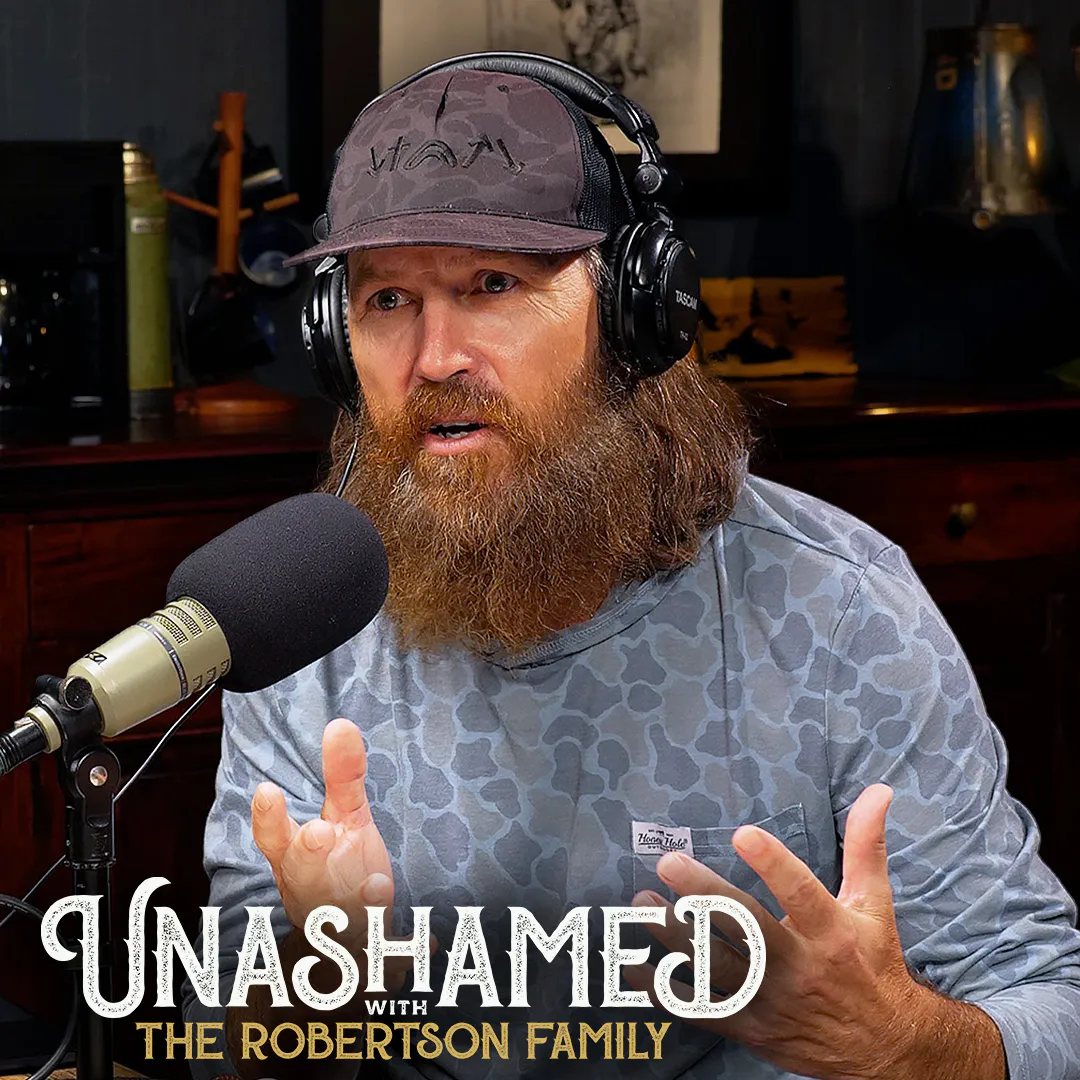
Unashamed with the Robertson Family
Ep 1138 | Jase Reveals Why Jesus’ Name Was Edited Out of ‘Duck Dynasty’ but He Was Still There
00:57:14
Loading summary
Transcript183 lines
- [00:02]
Jase Robertson
I am unashamed. What about you?
- [00:07]
Phil Robertson
Welcome back to Unashamed. We just. The episode, the last podcast you just watched or watched this week, we just finished recording it, so we're all still kind of, like, blown away.
- [00:21]
Zach Dasher
Oh, Blake is a man.
- [00:23]
Phil Robertson
What a. What a. What a powerful story. And. But, you know, it's not easy for people to be, you know, super raw and super real, you know, in front of other people they hadn't met before, even the people you respect and all that. It's not easy to do that. We tend to kind of want to compose ourselves and present the best version of ourselves. So that's what impacted me about his. His story and his willingness to come talk to us on the podcast because, you know, obviously, you know, our family had a. Had a. You know, we played a role in his. In this story. But just to be that raw, that was amazing. I was. I was moved.
- [01:01]
Jase Robertson
I think he's new.
- [01:02]
Phil Robertson
We were hugging and high fiving, by the way, after it was all over and just saying, you know, we got a new best friend.
- [01:07]
Jase Robertson
He's new in the faith. And I think you see that. Which I've said this before about my dad, which I really, I think was a catalyst to me eventually, you know, opening up to Jesus for myself was that thrill of being rescued by Jesus. You see it in new Christians all over the place. What happens is then they kind of get. What is the word? Denominationalized. Yeah, I was trying to do a Zach word, you know, and it's like, what happened? What happened? Why? And you know what I mean? It's. Once that wears off, it shouldn't wear off.
- [01:55]
Phil Robertson
Yeah, it should never wear off.
- [01:56]
Zach Dasher
Now.
- [01:56]
Jase Robertson
I think my dad was known for putting that into practice, which is why I think it's not just about punching the ticket. It's about what God has called you to do.
- [02:10]
Zach Dasher
Well, you get into a sect, you get sectarian. Sect.
- [02:14]
Phil Robertson
Remember?
- [02:15]
Zach Dasher
Because everybody wants to know who you with. And one of my favorite Phil stories was when we were. Where were you at? I think it was CPAC maybe. And they got up there, he had brought his cardiologist with him. Greg Samponero. Yeah, Is the guy's name.
- [02:33]
Phil Robertson
Still is our cardiologist.
- [02:34]
Zach Dasher
Still is the cardiologist.
- [02:35]
Phil Robertson
He's our family cardiologist.
- [02:36]
Zach Dasher
Yeah. And Phil gets up, and his opening line, I think I can't remember where it was at. Was a big crowd. No, I see pack, and he goes, 2016, you say, Phil, who you be with?
- [02:50]
Phil Robertson
And he had on that old Browning shirt and just the tattered pants and the torn up Bible. It was just like.
- [02:57]
Zach Dasher
But the question was, who you be.
- [02:59]
Phil Robertson
With, who you be with?
- [03:00]
Zach Dasher
He said, I be with the Father, the Son, the Spirit, and Sampagnaro. Everybody's like, what?
- [03:09]
Phil Robertson
So the next day on the Internet, it was like, who is Sampanero?
- [03:12]
Zach Dasher
Who is Sampanero?
- [03:13]
Jase Robertson
He's a heart doctor.
- [03:15]
Zach Dasher
But I mean, what group are you with? I mean, what's your sect? I mean, I think that to your point, it's like, no, Bill was great about. No, I'm pretty much going to stick with the Father, Son, and the Holy Spirit. That's who I'm with. And we're not going to try to attach too much.
- [03:29]
Phil Robertson
Well, he was there to receive the Breitbart Award, which is an award they give to unique people who are willing to stand on conservative principle. What was funny to me was he got his Bible out, did a whole thing on STDs and all these other things. And I'm looking around at all the young Republicans with their little bow ties on, and they look like they were shell shocked.
- [03:51]
Zach Dasher
Oh, no. What he said was. He said one out of three. One out of three, after he listened.
- [03:56]
Phil Robertson
Would develop a sexually trans.
- [03:59]
Zach Dasher
But the money line was, look to your left, look to your right. One of you's got was like a moment of whoa.
- [04:10]
Jase Robertson
Okay.
- [04:11]
Phil Robertson
It was just silence. But it was so. It was delicious. Silence is what it goes. It was an election year, so all these people running for President in 2016 were walking around with their little entourages, and everybody's got their little stump speeches ready. And then dad just blasted out of the water. It was so classic dad. And the guy was sitting next to me, leaned over and said, you, dad looks like he just walked off the pages of the Old Testament.
- [04:39]
Jase Robertson
That's a good line. Well, speaking of Blake, on this being thrilling, I think, you know how people. What I said, they kind of denominationalize. Everything is. They'll say, well, you know, there's two. Two ways for us to, you know, reenact the death, burial, and resurrection. And Zach probably knows all the Christianese words for it. But, you know, you have baptism because you reenact Jesus, death, burial, and resurrection. And you have the Lord's Supper.
- [05:10]
Zach Dasher
Yeah.
- [05:11]
Jase Robertson
You know, by taking the bread, you think about Jesus death.
- [05:16]
Phil Robertson
You memorialize and remember what he did.
- [05:18]
Jase Robertson
You remember it, but you got to remember Jesus leading up to his death, burial, and resurrection. He was constantly saying, I mean, where we're at in John 12, he's forecasting his death, burial, and resurrection. And the implications of that. But, you know, when we get to John 17, in his prayer for his disciples, he makes this verse that we call a verse. But he's saying in verse 18, as you sent me into the world, I have sent them into the world. And even in Blake's, I guess we can call it a testimony there, he brought up that Luke 15 and he got moved. Cause he was like, well, I'm the one sheep. And I remember having that same thought. And my point is, there should be a third leg to that saying. Okay, you reenact Jesus, death, burial, and resurrection and baptism, you take the Lord's Supper, but every time you proclaim Jesus and someone responds, you're literally reliving the death, burial, and resurrection, not only in your own conversion.
- [06:28]
Zach Dasher
That's a great point.
- [06:29]
Jase Robertson
And I'm like, why is that never mentioned? Because that's our mission.
- [06:33]
Zach Dasher
It's in Revelation 12:11.
- [06:36]
Jase Robertson
Well, in Luke 15, just think about it. Why is he telling this story about the lost sheep? It all started because the Pharisees looked over there and said, well, look at who this guy's eating with. Tax collectors and sinners. Why is he doing that? They're not in the special club. Because in the denominational world, how much is that prevalent? The reason we have thousands of denominations, because everybody wants to think, well, we're the ones that got it figured out. We're in the special club. And here's Jesus with the riff raff. I mean, and we all think that you pass people on the side of the road, especially late at night, and you're like, well, they're up to no good. Well, this is the kind of people Jesus is hanging out with. And he tells those three stories. And that one is about the sheep. That's why he's eating with the riffraff. And that's why this becomes thrilling every time I see someone give their life to Jesus. It's just thrilling to me. I've said many times, I like when they have baptisms and all. I think there should be a standing ovation because heaven's rejoicing. Why are we just like. I mean, of all things we should be doing, yawning is not one of them.
- [07:55]
Phil Robertson
I will say, Jason, at our church, it is a celebration.
- [07:58]
Jase Robertson
It is. I wasn't. I know they got that on straight, but it should be people hollering.
- [08:04]
Phil Robertson
And when I tell Zach this weekend, I mean, this weekend, which I've talked about on a couple of podcasts ago, some people totally submitted to Christ, and I got to be a Part of witnessing that. And it is, it's. It's the kind of addiction we talked about a lot about addiction with Blake. It's the addiction you want to have, the addiction to change lives. That. I mean, when you see that and we witness stories that we just heard from him, that's what's addictive to me. Like, I can't get enough of that. That's something.
- [08:33]
Zach Dasher
Well, to your point, like Jesus, I think hearing that testimony, it does disarm the enemy and the accuser. And that Revelation 12 passage actually says that the two ways that we overcome him is by the blood of the Lamb and the word of our testimony. And I think it's because when we are reliving that out like that, Romans 6, I think one of the things.
- [09:01]
Phil Robertson
That'S why the blood of the Lamb is first, by the way, not the other way around.
- [09:05]
Zach Dasher
You don't have a testimony, you don't.
- [09:06]
Phil Robertson
Have a testimony without the blood of the Lamb.
- [09:08]
Zach Dasher
But it's like a symbiotic relationship in.
- [09:10]
Jase Robertson
The blood of the Lamb without the resurrection. What do you got?
- [09:13]
Zach Dasher
Yeah, but I thought, you know, Romans 6 passage is so key. When we used to read that, you know, and we would make it only about baptism. But if you read the language of Romans 6, that is not a one time event. No, this is like the actual point is sanctification and ongoing to live a. You're raised to live a new life.
- [09:33]
Jase Robertson
Colossians 2, Colossians 3, same.
- [09:35]
Phil Robertson
In fact, he uses, Paul uses a very graphic term to describe it. He says, we become enslaved, but this time to righteousness. In other words, we are so beholden to it because, you know, the last part of that Revelation 12:11 says, and we don't love this life so much that we would shrink back from anything, including death itself. And I did find it interesting, Jason, and I know you're going to go here in John 12, that the pivotal moment that Blake described was when he was ready to take his physical life to suicide. And then he said the words he said was. But that became the moment I finally submitted to Christ, which in essence, he did die that day. He did start that process.
- [10:22]
Zach Dasher
That's a hard thing to say. I know Jay said it, but I thought it was really good. Because there is even in the worst thing imaginable, you think about, I have to die. Well, yeah, you kind of do, but you gotta understand what that means. And I think Phil in the movie the Blind, they asked that question. He said, phil, you gotta die. You gotta get to the end of yourself. And that was like, you gotta quit touching stuff. I mean, that's what he told him. Everything I touch has turned to dirt. And Bill's like, well, you know what I'd do if everything I touch turned to dirt?
- [10:59]
Phil Robertson
Quit touching stuff.
- [10:59]
Zach Dasher
I quit touching stuff. But the question is, how do I do that? Well, you got to die and be born again.
- [11:06]
Phil Robertson
And then he proves that when he says the line I said in the last podcast, that man is dead.
- [11:11]
Zach Dasher
That man is gone. We're getting healthy on this show, and if you're looking to do something better for your health, I want you to look no further than one of our partners here, Kimchi Won from Brightcore Nutrition. Kimchi Won delivers all the powerful fermented nutrition of Kimchi in an easy to take capsule, giving your gut over 900 unique probiotic strains to support healthy digestion and overall health. All health begins in your gut. This is true. So when you give your body the right fermented superfood, you can support your immune system, improve digestion, and even boost the appearance of your skin, your hair, and your nails. Kimchi has also been shown to help reduce the risk of obesity and support a slimmer waist. Kimchi one is all natural, non gmo, made right here in the US and crafted by Bright Core Nutrition, a company committed to health, integrity, and American values. One of the things I'm trying to really fight in my own health is inflammation and irritation in the gut. And I take Chimp Shoot 1 and it has drastically reduced my gut inflammation. A big fan of this product. I take it every day. It's part of my routine when I take my supplements in the morning. So today you can take advantage of an exclusive offer. It's 25% off with code unashamed when you visit mybrightcore.com unashamed or you can call my friends at Brightcor at 888-404-9677 for up to 50% off plus free shipping. And trust me, these guys want to talk to you. Their knowledgeable team will help you decide if Kimchi one is right for you. So, yeah, just give them a call. That's 888-404-9677 or visit mybrightcord.com unashamed.
- [12:51]
Jase Robertson
Well, and I think as a new Christian, which is what led after the podcast of me and Blake exchanging numbers, because I said, look, you got to make the connection to what the Bible is saying. And he was like, well, I. I was like, how do you do your Bible study? He's like, well, I'm just Googling it. And I thought. And I said, well, how's that working for you? And he said, very confusing because. Because we're brand new. It's all the denomination and one thing, somebody saying one thing. And it's just overwhelming. But I brought. I brought up the fact. I said, but here's what I found fascinating about the conversation. I had just read Colossians 3 that says, since you died with Christ, what was the exact verse I read? I can't remember now, Colossians 3, it says, when he said, since then you have been raised with Christ, verse one. But then he says verse three. For you died and your life is now hidden in Christ. And so I said, but then right after that, you talked about the most vulnerable time of your life when you were thinking about taking your own life. I said, but you didn't make the connection with that Bible verse. These people, they didn't die physically right here. But he's saying you died with Christ. And I said, making that connection. And the reason I was saying that, I didn't share this, but I'll share this with y' all, because my son has said this in public before. When he was a teenager, you know, he just struggling. He was not doing good, as we all, when we go through our teenage.
- [14:36]
Phil Robertson
Years, which, by the way, he talked about this on I Am Second when he did his I Am Second deal he did.
- [14:43]
Jase Robertson
And well, you know, it's very difficult to have a conversation with your kid. And he's saying, you know, dad, I'm having suicidal thoughts. Well, I took the same conversation we just had, and I said, look, that you're close to understanding. I viewed it. I didn't take the negative approach. Now, I did make one comment about it saying that God doesn't like quitters. He doesn't like quitters. The struggle. There's glory in the struggle. So. So that was how I addressed that. But I also said, it's your inner being saying, I gotta die. And I said, that's a good thing in Christ. And so I went through the gospel again, which I know he had heard many times. But in that moment of vulnerability, it's like a light bulb went on. And the reason I bring it up, because years later he came back to me and said, remember that time, you know, when I brought up I was having suicidal thoughts? He's like, that was your advice. Was the best advice that I've ever gotten. Which it wasn't my advice. I just. I knew those scriptures were there and I knew what he was thinking. His heart was saying it was dark. And he was saying, if I could just start over, you know, I need to be done with this life. And it's something that Jesus specifically talks about in John 12, which I wanted to get into it in the last podcast, but I thought, if we do that, we're going to get burned down.
- [16:20]
Zach Dasher
There was a. In my opinion, in the last podcast, there was a moment that I thought was, you made a point, that we kind of. You made the point. But it was kind of. We didn't sit in it enough, in my opinion, because it was really good. He had made the point about Duck Dynasty being such a pivotal thing in his life, and it created in him a curiosity for the kingdom. And he's like, man, I wouldn't be here without that show. And as he was saying it, at first, I was thinking. I was kind of thinking what you were thinking. It wasn't like a Christian show. I mean, Jesus was. I mean, there was a prayer, but, you know, I mean, like, it wasn't like an explicit.
- [16:56]
Jase Robertson
Yeah, what I told you after the podcast, which is the reason I started reading scriptures to him about we're hidden in Christ. And. And because he. He had an idea of the show that was not really true. He said y' all were talking about Jesus and being unashamed. Well, we weren't doing that on the show.
- [17:17]
Phil Robertson
That all happened after the show.
- [17:18]
Jase Robertson
The prayer was. Was right. There was a prayer at the end. And that was the most moving because when we did talk about Jesus in the filming of Duck Dynasty, that was edited out.
- [17:30]
Phil Robertson
Right.
- [17:30]
Jase Robertson
So Jesus is never mentioned outside of in Jesus name. And so. But I think that's ironic because in his mind. So what was the draw? And I. And I told him after the podcast, I said, the draw was Christ living in us, but that was hidden. You just saw it and made that right. Conclusion. Oh, they're all about Jesus. I thought, that's fascinating.
- [18:00]
Phil Robertson
But if you go back and watch the show, I don't know if when was the last time y' all watched episodes, but I watched some recently. Jesus is all over it, but not mentioned by name because he lived in us. Because when I listen to, like, Willie's voiceovers right before the prayer, they're about forgiveness. They're about being there for one another. They're about family that sticks together. I mean, when I listen now to the words that were just kind of the, like little. What did we learn from this episode? Talks. It was Jesus was all over. It was just the hidden treasure of what he did. When Christ is in us, you see it.
- [18:35]
Zach Dasher
It's not to diminish what he experienced from the show. That was a real thing that did minister to him. And this doesn't. By the way, this doesn't mean that we don't actually teach doctrine and go to the Bible.
- [18:46]
Jase Robertson
We do.
- [18:46]
Zach Dasher
But the point that you're making is what he was tasting and what he was experiencing. It was hidden. I mean, it was certainly hidden, but it was there, which. That's the point you mentioned in Colossians. I wanted to read the verse. I don't remember if you read this or not. I think you referenced it. Colossians 1:27 says to them, God chose to make known how great among the Gentiles are the riches of the glory of this mystery or of this secret. So whatever the thing is, he's going to tell us what this mystery is, which is Christ in you, the hope of glory.
- [19:22]
Jase Robertson
Yes.
- [19:22]
Zach Dasher
That's the intangible thing that I think this is every bit as powerful, like that manifestation of the Holy Spirit in the bodies of believers. And I don't need to be necessarily giving you a dissertation on substitutionary penal atonement or eschatology or whatever big word I want to use. When you're in the Presence. You walked in this building today, and the I Am Second folks are out there, and they just met Blake, and they're literally, like, having a prayer session.
- [19:54]
Jase Robertson
They were all around him, which now, look at it from my perspective. I don't know who Blake is. I walked in, there's a circus equipment everywhere. There's a group of people praying very emotionally. I just assumed, oh, one of their crew members, because most crew members in any production have a lot of tattoos like Blake. And I thought, oh, the only difference is he works out.
- [20:20]
Phil Robertson
Yeah, I should say, Maddie, you wouldn't believe the tattoos.
- [20:23]
Jase Robertson
Yeah. So we're. And so I just assumed he was with that crew. Well, then he walked in and I thought, wasn't this something. One of their crew. He just wants to listen to the podcast. And then the next thing you know, he's sitting over here beside me, and I'm like, oh, what happened out there? And he's like, man, we just got to talk. And next thing I know, they said.
- [20:43]
Phil Robertson
I thought they were. I knew who he was because I looked him up, but I thought they were interviewing him, but they weren't. They were just talking. And then I saw the prayer as well.
- [20:51]
Zach Dasher
Well, don't. You know, like, when you get around some people and even in, like, the Christian circles like this will happen. And you'll. And you're like, we're having a great conversation. Everything's great. We move on. We do. We do our thing and leave. Then sometimes you meet people and you just know. There's just something. There's like, man, this is real. The Spirit's present. God's like, you just know. And I think it's like. And I think that is one of the most powerful. Nothing has to be said. I'm not saying. See, when you say this, people say, well, are you saying that you don't ever preach the gospel?
- [21:27]
Jase Robertson
No.
- [21:27]
Zach Dasher
You preach the Gospels, too. But. But it is true that there is a powerful, tangible expression of the Holy Spirit living in people that you can't put into words. It is a secret. It is a mystery.
- [21:39]
Phil Robertson
And I like that idea of continuation. I want to go back because I had a thought. When you said that you told Reid about the idea of God not liking quitters. It made me think of rahab in Genesis 16. You remember, she's out, and she's been cast out by Sarah, and she's got her little son there, Ishmael, and she's wondering what's going to happen to her, and she's basically giving up. And the angel of the Lord showed up and said, God has heard your suffering. Now go back and suffer some more. That was what he told her. And so what he was saying was, is, I hear you, but you're still working through a process that I've laid out for you. And so I just like that analogy.
- [22:22]
Jase Robertson
It takes years to, you know, look, our childhood was pretty traumatizing, but it took me years to be thankful for that whole mess. I'm thankful for it now because to me, God became real in Jesus in the transformation of lives and the struggle of trying to do it God's way. I'm talking about just living life and making a living and all the problems of the growing pains from the lack of parental supervision when we were young, that whole struggle.
- [22:59]
Zach Dasher
It just.
- [23:00]
Jase Robertson
It took me a while to grow in Christ, to realize, okay, this is. This is the hand we're dealt in life. God is present amidst his enemies. I mean, and he works it out through that.
- [23:18]
Zach Dasher
Well, this has got to be the hottest summer on record, at least from my perspective. I don't know about you guys. How are things down in your neck of the woods?
- [23:24]
Jase Robertson
Summers in Louisiana are always hot.
- [23:27]
Phil Robertson
Yeah. Down here at the Southern layer, Yesterday it was 99. Feels like 111. So, you know, for the Gulf coast, super hot.
- [23:35]
Zach Dasher
Well, my AC went out and the only saving grace in my home right now is my Cozy Earth sheets. Because even with the summer heat, even with the AC going out, or at least I'm staying cool all night long with Cozy Earth because they have bamboo sheets. They're temperature regulating and guaranteed to give you a comfortable night's sleep. They naturally wick away heat and moisture, so I literally sleep several degrees cooler, which is a total game changer. Oh, and these sheets are also guaranteed for 10 years. You could even try cozy their sheets risk free for 100 nights. We all use Cozy Earth, bamboo sheets and pajamas out. You've got a set of the same pajamas I got, I believe, right?
- [24:13]
Phil Robertson
I love them. They're fantastic.
- [24:14]
Jase Robertson
My wife's been shopping at Cozy Earth for years and she loves to get the entire family various products from pajamas to sheets.
- [24:24]
Zach Dasher
The sheets feel amazing. What I love about them is they're super soft. You have them at your house every time I stay there. That's why I like staying there. These got to be the best sheets I've ever slept on in my life. So you guys can head over to cozyearth.com you can use our code unashamed. You'll get 40% off. And if you get a post purchase survey, make sure you tell them that you heard about Cozy Earth right here. That would really help out our podcast. That's cozyearth.com code unashamed for 40% off. Because your bed should be more than just a place to sleep. It should be your happy place. Cozy Earth makes that possible.
- [24:59]
Jase Robertson
And I also wanted to say the whole reason I was kind of pushing back with scripture and because when Blake was saying that the evil one uses even success as a temptation, I'm like, this is not about me. This is not about us. I mean, we've done over a thousand podcasts and we tell stories and personal. And we, you know, we, we tell jokes and. But it's not about us. I mean, at the end of the day, all those things are useful to show that Christ is in us. I mean, we like to have a good time, you know, and we have struggle, but it always comes back to that. But you're drawing the world to you. So how are we going to do that? I'm fine with, you know. Yeah, whatever that is. In, in his case, this Blake saw the worst of the worst. I mean, yeah, literal war. People trying to kill each other and then war.
- [25:54]
Phil Robertson
When he got here. When he turns, he's a SWAT officer, you know, in a. In a gang ridden, terrible situation. I mean, he's.
- [26:03]
Jase Robertson
I mean, do you realize how far that cheap that God had to go to put on his shoulder and bring him out of the way?
- [26:12]
Phil Robertson
But didn't you think about it when Jesus said, you know, no one's going to take my life, I came here to give it. I mean, I just, I couldn't help but think back to that. And even.
- [26:21]
Jase Robertson
I'm glad you keep coming back to that, because I, I think it's such a unlocking mechanism to understanding why God came in Jesus. Because when you think about it, what sin does, you know, we only tend to talk about one aspect of it from an individual. Oh, well, God came down because I had sins and he wants me to be legally correct before him. And. But I think it's deeper than that. I think it started in the beginning, of course, but it's like, look what they've done. I mean, look at, look at this. It's underestimated how we all contribute by our sins to make this world as bad as it is. And he just said, I'm going to redeem you. And the plan, looking at it through that vein, I mean, of all the things he could have said to do about it, he's just like, I'm coming, I'm coming down there.
- [27:22]
Zach Dasher
But what a. But what a word for, like, when you're in that, that suffering. Right. Because you mentioned the Hagar situation. God's like, I see your suffering. Now go suffer some more. You know, why, why is the suffering necessary? And that's really the point of how John 12 ends. Jesus basically saying, look, if, if a grain of wheat falls to the ground, how does he say it? He says, if a grain of wheat. Truly, I say to you.
- [27:52]
Jase Robertson
Yeah, let's read this and unsight before.
- [27:54]
Phil Robertson
You, before you say that before you leave the Hagar. Since you brought her back up. 13 years went by from that first conversation with the angel of the Lord. She's pregnant. She has this son. She has him. Thirteen more years of suffering at the hands of Sarah. And that whole story.
- [28:10]
Zach Dasher
Yeah.
- [28:11]
Phil Robertson
And then guess what? She winds up right back out in the wilderness, same spring, now without water.
- [28:16]
Zach Dasher
Yeah.
- [28:16]
Phil Robertson
Thinking she's about to die. And God says, no, there's water. And she opened her eyes and she saw a spring, a well, and God saw her through the suffering. And Ishmael got blessings, but she couldn't.
- [28:27]
Zach Dasher
See the water until she got the blessings.
- [28:30]
Phil Robertson
Exactly.
- [28:30]
Zach Dasher
And I think that's the passage here is in John 12. I'll start with John 12:20, because it has everything to do with what we're talking about, with this idea of death. Now, among those who went up to worship at the feast were some Greeks. So these came to Philip, who was from Bethsaida in Galilee, and asked him, sir, we wish to see Jesus. Philip went and told Andrew. Andrew and Philip went and told Jesus.
- [28:58]
Phil Robertson
Because they had the Greek names, by the way. And this is a huge thing that these Greeks showed up. This is that picture that Jesus death is for more than just the Jews.
- [29:06]
Zach Dasher
It's very provocative.
- [29:07]
Phil Robertson
Yeah.
- [29:08]
Zach Dasher
This is the idea of the nations coming, right? And Jesus answered them. The hour has come for the Son of man. The Daniel 7 reference to be glorified. And here's his case. Truly, I say to you, unless a grain of wheat falls into the earth and dies, it remains alone. So you think about a grain of wheat sitting on a stalk. If it just stays there, it's by itself. It is what it is. But if it dies, it bears much fruit. So death is essential in the production of the fruit.
- [29:40]
Phil Robertson
Correct.
- [29:41]
Zach Dasher
Whoever loves his life loses it. And whoever hates his life in this world will keep it for eternal life. That's the fruit that he's talking about. If anyone serves me, he must follow me. And where I am, therefore, will be my servant. Also, if anyone serves me, the Father will honor him. I mean, that's a pretty powerful statement. But he gives us an actual picture of a plant and how plant life works as a way to understand this.
- [30:09]
Jase Robertson
All right, I want to introduce something. This. This is going to be a little deep, but I think it's needed here. It's very confusing, especially for a new Christian to understand. In the English language, we have one word for love, but in the Greek language, there's four. Are y' all familiar with that? Yeah, we're very familiar. So you got agape, which is. I guess if you were going to rank them, would be the best, because.
- [30:39]
Phil Robertson
It'S used the most in the New Testament. It's the idea of sacrificial love.
- [30:44]
Jase Robertson
Unconditional, unconditional, selfless. All right, so then you have philea. Yeah, philea, which is the word used here in John 12. Cause this is a riddle that Jesus uses. The man who loves his life, we'll lose it. So immediately I realize in the context of him saying him, predicting his death, because he says, if a kernel of wheat falls to the ground and dies, it remains only a single seed. But if it dies, it produces many seeds. So he's like, this is a good thing that I'm fixed to Die. So then he makes that applicable to us. When he says, the man who loves his life will lose it, kind of like we died with Christ, I immediately start thinking, oh, this is the death in Christ because of his death. Which was what? Agape love.
- [31:44]
Phil Robertson
Right. And by the way, just to help your explanation, Jason, if agape is sacrificial love, if it's unconditional love, phileia would therefore be conditional love in the sense that this could be among family. In other words, you have your children, they're your children. Therefore I love you different than I do somebody else. That's why we get the word brotherly love from here, because it is conditional in the philea sense. You love this life, you love this, you love that.
- [32:11]
Jase Robertson
And it doesn't negate it.
- [32:13]
Phil Robertson
It's still a good word.
- [32:14]
Jase Robertson
The other two, real quick, Eros is like romantic love, sensual, sexual. Yeah. And then storage is familial love. Like in the family. It's kind of like a mom looking at a toddler and not really having to say anything. But there's just. There's a love that is discussed. So the reason I'm bringing this up. So like in John 11, remember when we talked about this, oh, groundbreaking thing, we had these, this. We've missed the love aspect of why Jesus came. So just to give you, for instance. And the reason this becomes confusing. So like in John 11, 3, when it says, so the sisters sent word to Jesus, Lord, the one you love is sick. Well, that's the brotherly love. But when he said in 11, 5, Jesus loved Martha and her sister and Lazarus, that's the agape love. So I'm just saying that to say. I think that's one aspect, but I said all that. So when you say whoever loves his life will lose it. So that's kind of that friendship, that what we call it. What was the Greek word for it? Phileia. Yeah, philea, which is where they get Philadelphia, city of brotherly love. But by the way, that's also used in the negative when it says when Judas kissed Jesus with that word kiss. You know what it is? Same word.
- [33:49]
Phil Robertson
Yeah.
- [33:50]
Jase Robertson
It's an outward. I think that's fascinating.
- [33:52]
Zach Dasher
He loved him, but they didn't love him.
- [33:54]
Jase Robertson
Well, you can. You can fake it, you know.
- [33:57]
Phil Robertson
Exactly.
- [33:57]
Jase Robertson
I mean, I think that's really fascinating. So then the second part of the riddle, which is why I said this is so confusing because hate has a different meaning in the Greek and the Hebrew than what we think when you think hate. And that's why people get confused Think about the Luke. Where's that at 14, where it says.
- [34:20]
Phil Robertson
Unless you hate your family, your brothers.
- [34:22]
Jase Robertson
Yeah. Hate your family. Well, wait a minute.
- [34:25]
Zach Dasher
You're like, jesus wants me to hate my family.
- [34:28]
Jase Robertson
We translated that. The whole point of me.
- [34:31]
Phil Robertson
Because hate has one meaning to us.
- [34:34]
Jase Robertson
You know what it means? It's like rage. So hate in Greek. I pulled this up and look, this is not Bible, but so here's what I wanted to do. So it has a different meaning. And basically you can google this, but it is to reject, avoid. That's how it is translated.
- [35:05]
Zach Dasher
Have you ever heard heard the old phrase, if it ain't broke, don't fix it?
- [35:08]
Phil Robertson
Zach, I use that phrase all the time.
- [35:11]
Zach Dasher
Well, that's great advice for most things, but not so much for your cell phone because over time your, your battery life will fade on your cell phone. The processor can't keep up and maybe it's fallen in the toilet one too many times. But now, thanks to Pure Talk, your cell phone is actually something you can replace without feeling guilty. So when you switch to Pure Talk this month, they're going to give you a free Samsung Galaxy A36 phone with a $35 qualifying plan. Just 35 bucks a month for talk, text and data and you get the free Samsung phone with scratch resistant gorilla glass and a battery that lasts all day. And here's the thing, it's all on America's most dependable 5G network. I'm on PureTalk and I can tell you the coverage is second to none. People ask me all the time, did you really use Pure Talk? Yes, I do. Look, supporting companies like Pure Talk is a good thing because you cutting your cell phone bill in half. And they win by hiring more Americans and helping more veterans. I made the switch to Pure Talk. It was super easy in less than 10 minutes. And I love these guys because they're helping to support veterans, which is something that we believe in. They donated $50,000 to provide scholarships to support veteran learning trades after they get out of active duty. They're also helping to eliminate veteran debt and raising donations to end veteran suicide. Make the switch today in as little as 10 minutes. Go to PureTalk.com Unashamed to get your free phone today. Again, that's PureTalk.com Unashamed to switch to my wireless company, America's wireless company, PureTalk.
- [36:48]
Jase Robertson
But in context of what we're reading, whoever hates his life in this world will keep it for eternal life. Which kind of goes in with that suicide theme where, you know, because people, they hate Their life. So they. They want to kill themselves, you know, so. Well, you know, he's not talking about that because he's all about life. It's so. So what's he talking about? So we want to avoid it. We want to reject it. What I found fascinating about this, very fascinating. I didn't read this out of a book. I just went down the. The Greek and Hebrew rabbit holes for trying to define this. Because I think when people read verses like in Romans 9, where it says, where God says, jacob I loved and Esau I hated people like what? And so then all kind of poor doctrines come from that because they're like, they're using the English definition of hate and say, well, God must have hated him from the start. Miss the whole point. They miss what the word means. And so I want to read this. This is fascinating. So in the Hebrew language, I'm going to put my Zach hat on. Where their language developed was from something called pictographic meaning. So it's like the original Hebrew language came from a language that used pictures, pictures to depict a meaning. And so I want to read this to. You'll find this fascinating. And this is an AI overview. So, but if you just Google it from a religious standpoint, because I did, because I didn't want to be giving you something, and I get it wrong. But all scholars agree with what I'm fixed to read. So the Hebrew word often translated as hate is sane, and it tells you how to pronounce it. However, the ancient pictographic meaning of the word differs from the modern English understanding of hate, which is what we're talking about, which typically implies emotional fury or rage. That's what we think of. And hate in biblical Hebrew saying often means to reject, avoid, or turn away from, rather than to desire harm upon someone. So here's the point. Don't get lost in my reading this next paragraph. The ancient pictographic letters for hate, saying, came from a thorn and a seed. So that was the picture that produced the Hebrew word for it. Well, think about that. Ooh. I mean, when I read, I thought, wait a minute, there's something here. It's unfortunate that no scholar has done a deep dive that I could find about this, because what is the context of this? Jesus said, unless a kernel, a seed of wheat. Well, now, in the definition of hate from the Hebrew, the foundation of the language, you have a picture of a seed with thorns on it. Well, you know what you want to do to that? Avoid it, because it has thorns all over it. You don't want to reach down and grab it and plant it because it has thorns on it. So that is the picture of it. But I want to keep reading. Just as one turns to avoid being pricked by a thorn implies turning away from someone or something. For example, when the Bible states that God hated Esau, it doesn't necessarily mean that God desired Esau's destruction. Instead, it signifies that God did not choose Esau, but rather Jacob. Similarly, when Jesus instructs his disciples to hate their families, there's the Luke 14. It means that they should choose him over their families if necessitates distancing themselves from them. So I want to read this last paragraph. Therefore, the picture image associated with the Hebrew word hate saying can be visualized as a thorn and a seed representing the idea of turning away or rejecting asking something. The visual helps to understand that the biblical Hebrew concept of hate is more about distance and avoidance than about destructive anger.
- [41:18]
Zach Dasher
I'd like to insert something here on the Romans 9 passage, because I think it will serve the point. Well, what you see in Romans 9 is he's not even talking about the individuals of Jacob and Esau. So when he quotes that, he's quoting Malachi, Chapter one, verse two and three, where it says, jacob, I've loved, Esau I've hated. But if you read the whole prophecy from Malachi, he's clearly talking about eschatology. He's clearly talking about the nation of Israel. And then the way you would, that's how you would understand Jacob. Jacob is Israel and then Esau is Edom. And we also know that because he Sundays, before the two were born and had done anything good or bad, it was written, the older will serve the younger. Jacob loved Esau hated it. Well, the older will serve the younger is a quote from Genesis 25. And it says the actual quote in the Old Testament is when he says, two nations are in your womb, two peoples are in your womb. So it's about nations, Edom and Israel.
- [42:26]
Phil Robertson
And Edom really is representative of everybody but Israel.
- [42:29]
Zach Dasher
Yes. And then when you go back and if you go do a proper exegesis of the Old Testament to understand the nation of Edom versus the nation of Israel, you actually see that God did just that. He withdrew from Edom. But there were some reasons behind that, by the way. But the whole purpose of it, the whole purpose of Romans 9, by the way, is that God is bringing the nations back in. And you see that even in Malachi with the quote that Jacob loved Esau have hated. Listen to this. In the same exact chapter, just a few verses down, it says, for from the rising of the sun to its setting, my name will be great among the nations. In every place, incense will be offered to my name, and a pure offering for my name will be great among the nations, says the Lord of hosts. So when he says, jacob, I love that Esau I have hated, he tells you what his goal in that is in verse five, just two verses later, when he says, you, eyes shall see this, and you shall say, great is the Lord beyond the borders of Israel. And so I think to your point, Jay, it's like when he says he hated Esau, he's just. He's pointing to what he's ultimately doing. He's withdrawing from Edom. He's elevating Israel to bring the gospel to the nations eventually. But that is the ultimate point.
- [43:50]
Phil Robertson
Yeah. Because it brings forth the Son.
- [43:52]
Zach Dasher
Yeah.
- [43:53]
Jase Robertson
Well, you're going to see the same thing. I started to go here, but it's the next chapter in John 13, when he gets to Judas, you see the same concept. So remind me when we get there. Because he's like, he knew from the beginning which one was going to betray. And he said, but God has given me these. And he uses the word, I chose them. But then later on, in predicting Judas betraying him, he's like, because he rejected me. So it's like, well, which is it? Did he reject you because you didn't choose him, or did he not be chosen because of his rejection? So I think when you understand the definition of hate and love and the different aspects that's being used in love, because John 13 starts off with the agape love. But we'll get to that. What I wanted to say was the whole. The whole key to this, what I thought was fascinating about the thorns and the seed, it made me go back to in creation, where God gives them all the seed bearing thistle. Well, then when they sinned, well, then the thorns came up. And I'm like, well, what did they put on Jesus's head when he was crucified? You know, what did his enemies put? A crown of thorns, you know, and it just really made me realize why he said this illustration about his death where he said, unless a seed of wheat falls to the ground and dies, you know, and then. Then when he really is a seed of wow, look. When he makes it practical, and he's like, unless you hate your life. Well, understanding what he meant by that with this seedy thought thorn, you need to avoid that. I'm saving you from That, I don't.
- [45:46]
Phil Robertson
Know, he really in essence becomes both of those for us.
- [45:50]
Zach Dasher
He becomes seed on thorn. Well, think about Isaiah 6, that passage.
- [45:54]
Phil Robertson
In Isaiah 6, which, which is quoted Isaiah 6 in this text, by the way.
- [45:59]
Zach Dasher
Oh, good point.
- [45:59]
Phil Robertson
Yeah.
- [46:00]
Zach Dasher
And if you read Isaiah 6, what he, what the. The passage of Isaiah 6 is, essentially, we're about to go scorched earth. We're going to burn it down to the ground, and you're going to look out Israel and there won't be a shrub, there won't be a tree. You won't. I mean, it will be burned to the ground and all you will see is desolation. And the very end of it, it says, but there will be this one thing left remaining, which is a stump. And out of that stump there's a holy seed. And from that, that's where everything is going to come from, that holy seed. This is a very interesting time for business. Tariff and trade policies are very dynamic. Supply chains are being squeezed, cash flow can be tighter than ever, and your business might not be able to adapt in real time. And if you can't, you're in a world of hurt. What you need is total visibility, from global shipments to tariff impacts to real time cash flow. And that's where NetSuite by Oracle, which is your AI powered business management suite, which is trusted by over 41,000 businesses, comes in. Jase, you are a owner of Oracle, correct? You have their stock?
- [47:11]
Jase Robertson
I do. I have owned shares in Oracle for years. Full transparency.
- [47:16]
Zach Dasher
NetSuite by Oracle is the number one cloud ERP for many reasons. It brings accounting, financial management, inventory, HR, all into one suite. You have one source of truth, giving you the visibility control that you need to make money. Quick decisions. With real time forecasting, you're peering into the future with actionable data. And with AI embedded throughout, you can automate a lot of those everyday tasks, letting your team stay strategic. Netsuite helps you know what's stuck, what's what it's going to cost you, and then how to pivot fast. It's one system, full control. Tame the chaos with netsuite.
- [47:49]
Phil Robertson
You know, if we had known about this at Duck Commander, we probably would have been able to grow the business so much faster and more efficiently than we did.
- [47:55]
Zach Dasher
Yeah, no question about it. So if your revenues are at least in the seven figures, download the free ebook Navigating Global Trade. Three insights for leaders@netuite.com Unashamed. That's netsuite.com Unashamed. I think that's the Idea of even the parable of Sower. It's like, what kind of soil do you have to have to receive and produce the fruit? Which is. This is about fruit here. You're going to produce much fruit to produce 30, 60 and 100 fold. The kind of soil you need is scorched earth soil, which is exactly where Blake got in that car when he slammed his head up against that steering wheel and he was. It was scorched earth. There was nothing left except for a holy. And that's where suicide comes in, is when you get to that end and you don't recognize the stump. Where there's a holy seed, there's a sprout, there's Jesus, he's right there. But if you can turn your eyes to Jesus in that moment, that's where it begins.
- [48:59]
Phil Robertson
So you know the pictogram I got when you were reading that, Jay, the description Mayhaw tree. I thought about, you know, Mayhaw produces, in our opinion, the best fruit for the best jelly in the world. It's delicious, it's wonderful, it's a blessing. But it comes from a tree that's the gnarliest, ugliest, thorn ridden tree in the swamp. I mean, it's one you don't want to mess with. And yet it produces this. You think about both those in that that you see, one you try to avoid. How many times have we tried to avoid the thorns on a Mayhow tree, Jase? And you're trying to pick up that fruit. And I've always thought, you know, I assumed the Almighty was trying to provide that fruit for what goes through the swamp. And so he didn't want something crawling up there, eating it before it got ready. But I thought, here we come along, picking it up off the ground, avoiding the thorn, but going for the seed.
- [49:49]
Jase Robertson
I mean, Al, I thought the same thing because it just made this paragraph come to life. When I went through that Hebrew structure of that word, I was like, okay, it makes sense because. And what do we turn the fruit into? Something that we think's the best thing in life, which is.
- [50:08]
Phil Robertson
And then we share with everybody we know.
- [50:09]
Jase Robertson
Transformation.
- [50:10]
Phil Robertson
Shane and Shane show up with us.
- [50:12]
Jase Robertson
I wanted.
- [50:13]
Zach Dasher
Although theirs was cut with cranberry juice. Now that's an imposter. What they did was.
- [50:20]
Jase Robertson
The Judas Kiss.
- [50:21]
Phil Robertson
Yeah, yeah.
- [50:21]
Jase Robertson
It's love. That's, that's they need to return. But what I wanted to. I wanted to go down a rabbit hole about the world. But we can get to that later. Because when it says this part, because that's another tricky Word in the Bible is the word world.
- [50:38]
Phil Robertson
Because that means a lot of different things.
- [50:39]
Jase Robertson
A lot of different things. So we'll do that at a later date. But I did want to bring this one thing up, because I think we.
- [50:46]
Phil Robertson
Can only take one rabbit hole per podcast.
- [50:49]
Zach Dasher
Well, this is right in the text.
- [50:51]
Phil Robertson
I mean, it is.
- [50:51]
Jase Robertson
Well, this is the hate thing again. So you know what it made me realize is a verse that I've read hundreds of times and thought, huh? And it's the. In Proverbs.
- [51:04]
Phil Robertson
Oh, no, I don't have it here.
- [51:06]
Jase Robertson
Oh, here it is. Proverbs 6, 16 through 19. There are seven things that God hates. Well, I've always thought, well, I'm pretty sure he hates more than 17. Why these seven? Yeah, but it makes sense when you realize the word, what it really means. To avoid and reject and why. But look, in the vein of what's it. What it is transformed into, just like he did. He gave you two. The little riddle is two things that happen and, you know, one to avoid and one to embrace. And basically love and hate. So. So I just wanted to read it. It says there are seven things that God hates. A proud look, a lying tongue, hands that shed innocent blood, a heart that devises wickedness, plans, feet that are swift to evil, a false witness who lies, and 1. Here's why I wanted to read this one. Who sows discord among brothers. You have that little seed analogy. It's not by accident now, because I realize what the word hate means. That's why he said that. So it's the. The seeds you sow. But just think about those seven things. I mean, you can just start picking them off one by one. This refer. A proud look. This refers to arrogance, haughtiness, placing oneself above others, and even God. That's thorny.
- [52:37]
Zach Dasher
Yeah, it's.
- [52:39]
Jase Robertson
It's a relationship killer. You know, a lying tongue, same thing. It's how it affects all relationship Look, Hands that shed innocent blood. Blood. This is a direct violation of, you know, not only of God being about life, but it refers. You know, you're taking the life. Well, that's the ultimate relationship.
- [53:00]
Zach Dasher
I got. I have to. I have to insert this, because this is. This is gold. This is what I'm about to say is gold.
- [53:06]
Phil Robertson
Your gold.
- [53:07]
Zach Dasher
Your gold. Because I want to take it back to the very beginning, because here's how the thing started. So what you just read was incredible. Truly, truly. I say to you, unless a grain of wheat falls into the earth and dies, it remains alone. If you're going to Understand this passage. You got to understand what that means, because the next question is why? What's. What's wrong with being alone? Well then, now you got to turn back to Genesis.
- [53:33]
Jase Robertson
It is not good for man to be alone.
- [53:37]
Zach Dasher
So that's it. I mean, like you think, why? Why? What's going on here? What we're dying to, what we're hating is a self centered, self centric, me, humanistic. I'm hating being alone. And what I'm saying when I hate my own life, what I'm hating is aloneness. I want to avoid loneliness and instead I want to be connected with someone else. Why? Because I was made in the image of a triune God who is not one person, but three persons. The reason why it's not good for man to be alone is because God's not alone in his very nature. That's why. When you say, when you get back to the love part of all this, what do you mean? What does love even mean? Love, by its very definition requires more than one person. You have to have a lover, and you have to have one that is beloved. And then also, even beyond that, there has to be an expression of that consummation of love, which is the tri. That is, that is God. So first John 4. 8. God is love. And so the reason why we're dying to self is we're dying to the things that would isolate us, that would prevent us from living in our true, undefiled nature, which is relational.
- [54:54]
Phil Robertson
So it's amazing because Blake talked about that moment where he realized he hated his life and what? He got a call from some person named Kyle saying, what? You're not alone. When Chad Robichaux sat here and told us that he was sitting in a safe room with a gun drawn and pictures spread around him, he got a knock on the door from his wife, whom he was separated from, to realize what? I'm not alone.
- [55:16]
Zach Dasher
I'm not alone.
- [55:17]
Phil Robertson
I'm not alone. And then they both turned to Christ, which is amazing, by the way.
- [55:22]
Zach Dasher
That's the fruit. Because it's about fruit. How does fruit come? Fruit can only come from the Holy Spirit. What does that mean? What does that. Well, God's got to move in. And if God lives in me, I'm never, ever, ever alone. And that's where the fruit comes from. We don't produce it. He produces it by living and being.
- [55:37]
Jase Robertson
I told you this rabbit hole was epic.
- [55:39]
Zach Dasher
That was good. I don't care who you are. If you don't like that, I ain't get we got. I mean, that was.
- [55:44]
Jase Robertson
Well, and I think it helps you understand when you read the word love and hate. It gives you a better understanding of what we're talking about.
- [55:51]
Phil Robertson
Good. Good stuff. All right, we'll see you next time. Unashamed. Thanks for listening to the Unashamed podcast. Help us out by leaving a rating and review on Apple Podcast. And don't miss an episode by subscribing on YouTube. And be sure to click the little bell and choose all notifications to watch every episode.