← Unashamed with the Robertson Family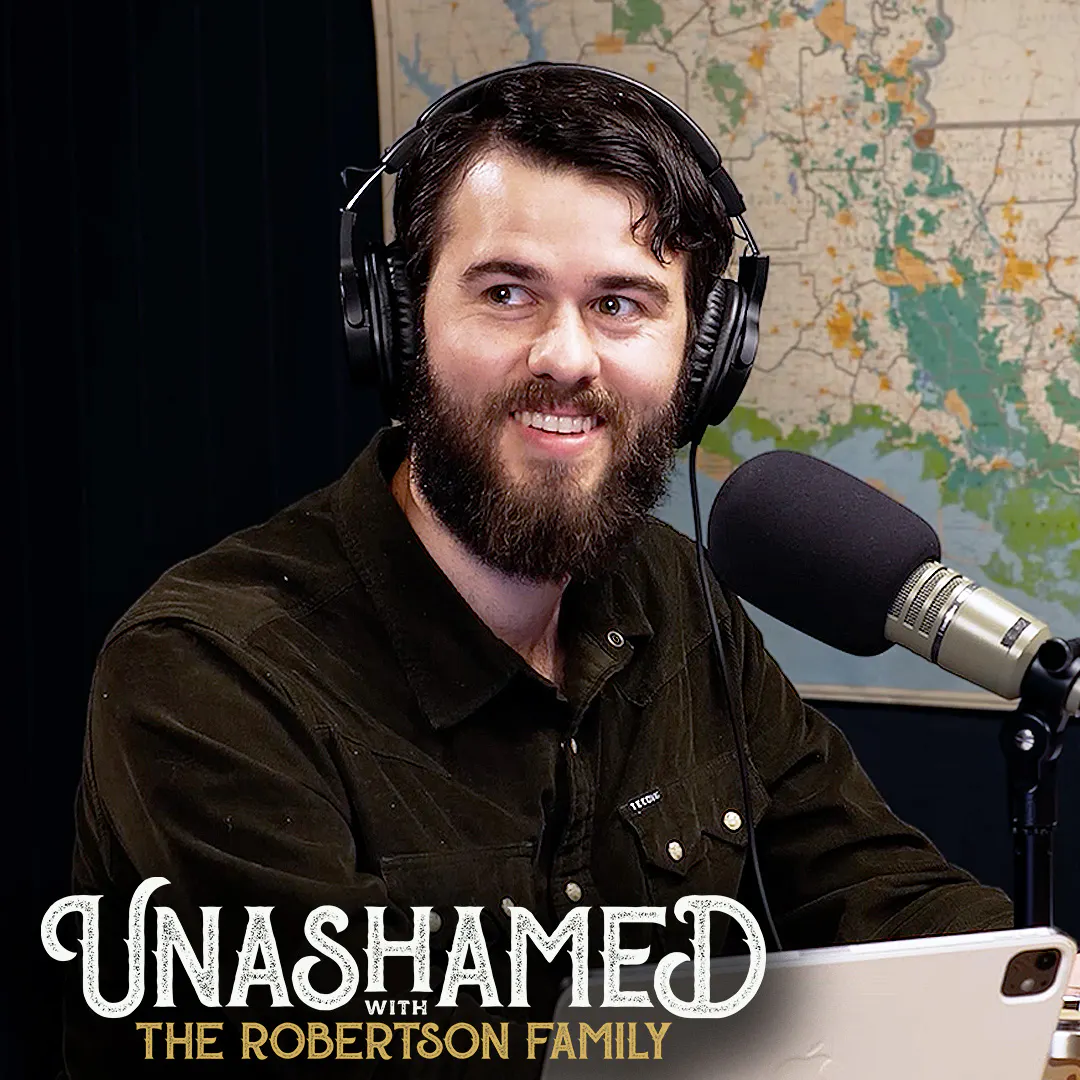
Unashamed with the Robertson Family
Ep 1289 | John Luke Robertson Celebrates His New Twin Daughters!
00:50:20
Loading summary
Transcript121 lines
- [00:02]
Zach
I am unashamed. What about you? Welcome back to the Unashamed podcast. We're back at it our Friday. We said we left the episode before last, saying if. If we come back, then we have, you know, we're going to continue. So Hillsdale has decided to continue this journey. I will give a little caveat this morning. You might hear some construction noises in the background, but you got to be patient with us because we. You guys got hammered by the storm down there. And apparently Sadie's studio flooded, which is right next door. So they're doing, I guess, roof work. What's going on over there?
- [00:39]
Chris
Yeah, they're replacing the roof of the whole building.
- [00:42]
Zach
Yeah.
- [00:42]
Mary Kate
I love the thing that has to do with Sadie's podcast. I think it's just a building.
- [00:47]
Zach
No, it wasn't her podcast, but her studio.
- [00:49]
John Luke
We're just saying when something happens to Sadie, everything comes to a screen, but
- [00:54]
Chris
the noise is not coming from my office. Also flooded. They didn't care one bit.
- [01:01]
John Luke
Well, good news, Maddie. Maddie has sent a message to the foreman. Yeah. So, yeah, I'm expecting everything to come to a screeching hall just any second.
- [01:10]
Zach
But to your point out, if the unashamed studio was falling in, I do think that they might drag their feet a little longer.
- [01:17]
John Luke
I don't know if the other. We would be going from the side of the road. We're all going to be a mile
- [01:24]
Chris
back out at the layer.
- [01:25]
John Luke
Exactly. We'll be back at the layer.
- [01:27]
Chris
Yeah.
- [01:27]
Zach
So as they say, pardon our progress if you hear the noise. And then we also got big news. Papa over there, tell us what went down in your world.
- [01:36]
John Luke
Wait a minute. You got to set it up better than that. I mean, what. What. What has happened is John Luke is now the most prolific man around this table. He has the most because you adopted number five. But he. This man has five children. I mean, I'm impressed. Are you not impressed, Chris? It's very impressive, Bond.
- [01:55]
Zach
Five children.
- [01:57]
Mary Kate
When I met you, you. You had no kids.
- [01:59]
Chris
Zero.
- [02:00]
Mary Kate
Now you're at five.
- [02:01]
Chris
Yeah.
- [02:01]
Mary Kate
And we're at three. So now we have eight kids.
- [02:03]
John Luke
That's amazing.
- [02:04]
Chris
That's actually crazy. Crazy. Yeah. Four kids.
- [02:09]
John Luke
So you're a weekend, right? Is it a week ago today?
- [02:12]
Chris
A week today?
- [02:12]
John Luke
Yeah, yeah, yeah. So about that. And he's here. He's doing the podcast. That's what's. We had punted, right? We had Christian.
- [02:20]
Mary Kate
And I was like, you did not punt. You told me the day of. The day of the twins bird. You said, hey, if you can. If you see Luke tonight? Ask him about the podcast. I was like, I cannot ask him about the podcast.
- [02:30]
John Luke
In to do the Heavy Lifted. I was like, just. Just float the idea. You never know.
- [02:34]
Chris
He.
- [02:34]
John Luke
But by a week away, he may be ready to get out.
- [02:37]
Mary Kate
But it was more so for Mary Kate Sink and not John Lu.
- [02:39]
Chris
No. And I was. If I'm not like, yeah, good luck, Mary Kate. See you later. Going back to work.
- [02:45]
John Luke
Well, I know that I'm taking the
- [02:47]
Chris
full week, but this. We worked it out, so my mom's there watching them. Yeah, it was awesome. Twins is. I mean, the birth was. I'll let Mary Kate tell the story when she's ready, but suffice to say, it was rougher than a single one. But they both came out healthy. It was awesome. And then we went home at the normal time, which is weird for twins.
- [03:11]
John Luke
It really is. And that was a blessing.
- [03:13]
Chris
Yeah.
- [03:14]
Zach
Labor is not.
- [03:15]
John Luke
And see it. Yeah.
- [03:17]
Zach
Yeah. I was thinking of Phil. He said, well, I won't say what Phil told me it looked like, but it's not for consumption on this podcast. Maybe I should say what he used to tell me about before. Before Jill had a baby. I. I Should I say this? I don't know. I'll say, if we end up cutting this, then that'll be, you know, you guys can decide if we should cut it or not. But when. When we were pregnant with our first child, Layla, and Jill was about to get ready to go into labor, and Phil was, you know, obviously, he's looking at Jill. She's nine months pregnant. And he was, oh, it's a brutal process, son. It's like, it looks like somebody's gutting a deer. And of course, Jill's like, that's not the thing you want to hear before.
- [04:00]
John Luke
Thanks for the encouragement. Yeah, yeah.
- [04:02]
Zach
Thanks for the encouragement, though. He says, like, gutting a deer. He said, it's a brutal process. You can't unsee it. Zach. He's telling me that Jill's, like, right there.
- [04:11]
John Luke
Dad had a way of. It was his is his way of doing small talk with women. But I finally just said, dad, it's probably better if you just nod and give a thumbs up. Just walk on by.
- [04:24]
Chris
The nurse told me in the hospital. She was like, are you gonna be okay? Are you gonna make it? And I was like, yeah, I think I can. I think I can do it. She said, we had a dad pass out yesterday in the room. We had to, like, drag him off to the. To the corner. And that is the truth. If you Are a man about to watch. Do not think, oh yeah, I can handle it. Like I've seen. If you haven't seen stuff that you cannot handle, it is not.
- [04:51]
Mary Kate
I was a head above the curtain guy.
- [04:54]
Chris
Yeah. Yeah.
- [04:55]
Zach
You didn't get it. You didn't see the whole. I saw the whole process. And, and I will tell you this.
- [04:59]
John Luke
I'm still of the error. I was the city in the waiting room guy.
- [05:03]
Zach
Yeah. You sure you did. That's back in the old days.
- [05:06]
John Luke
I wasn't even, they didn't even let me in, which was a, you know, I can't believe.
- [05:10]
Zach
Wait, no, it's not a blessing. I'll tell you why. Because when I was there for all of the birth, every birth of our kids, the first four, we were there right after Ruth was born. I literally came in right, right after she was born. But it was a, it was the strangest moment of I'm watching the whole thing unfold and, and this particular with the first one because you, you just have no, you can't anticipate what you're about to see. And I went from like I'm going to pass out. I had that feeling like this is like I, I, I cannot watch this. It's. It was too gruesome. I to like the most spiritual moment like I've ever like to see a like life come into the world. And it was, it was a weird, like I was like I'm about to pass out. I'm about to go down. And then boom. And then you're like, wow. I mean it really is like you see the whole process of life immerse. I was glad that I sat in on it because it really was such a spiritual experience.
- [06:05]
John Luke
Well, I saw Jay Stone balling like a baby come when he came out when Carly was first born and I was like, well, that's something about. There's a miracle right there.
- [06:14]
Zach
Oh yeah.
- [06:15]
John Luke
Both the miracle of birth earth and the fact that you can make J. Stone cry about anything. Right. Was pretty good.
- [06:21]
Zach
Well, it's interesting because if you think about. By the way, this is unashamed for Hillsdale. You can go to unashamed for hillsdale.com Sign up for the course we're doing Ancient Christianity. I'm really excited about this one. Just to hear and learn about the the history of our faith is and that it is really.
- [06:37]
John Luke
Well, actually the cold open Zach was is the perfect lead in to our first topic about this because I love what the was it Dr. Arne said at the beginning in the intro of this course, that Christianity is a strange religion. And mainly because, I mean, you think about it, what we believe is, is that the creator of the cosmos chose to come to earth and do what we just described, come through a woman birthed to become one of us. And just think about that. I mean, no other religion of all time would ever have come up with this. That's why we know it's true. Because who would make this up? Right? I mean, it's so incredible that Jesus came as a baby, even in a miraculous way. But I love that they were talking about many miraculous births throughout history that kind of kept this dream alive of Messiah. It is pretty unique and interesting. And anytime I go and speak now at a pro life event that's using my opening line, it was like, if you're wondering whether we're on the right side in the pro life debate, our creator decided to come here through the womb of a woman. And it was a very unplanned pregnancy, at least from her perspective. And she was a teenager and she was unmarried. So if you're wondering if you're doing the right thing in this pregnancy resource center by helping these young women who are coming in, that's how Jesus came here in that exact same situation. So we're doing the right thing by protecting life.
- [08:16]
Chris
That's what I thought, too. Listening to this episode. One thing I'd never thought about in the Bible, to use Zach's word, one motif I'd missed is that birth motif of how it was an unusual birth all the way from Adam. I mean, even you. You can call Adam. He actually doesn't say that. I just thought this. You can call Adam like a kind of a miraculous birth, Adam and Eve, like creating them from the ground. But then you've got. You've got Abraham, you've got Sarah, you've got birth order mixed up. You've got who Joseph was, you know, another wife. You've got wives from prostitutes. You got all these things all the way up to Mary, which was like the ultimate miraculous birth. And that seems like something God is very. He likes. Is that like humble circumstance birth?
- [09:12]
John Luke
Yeah. And then planned.
- [09:13]
Chris
Yeah.
- [09:13]
John Luke
Idea. And even John the Baptist. Right. Right before.
- [09:16]
Chris
Right.
- [09:17]
John Luke
Same situation.
- [09:19]
Zach
On our part.
- [09:20]
John Luke
Unplanned on our part.
- [09:21]
Zach
Right. On Christ, on. On the part of the father. I mean, he planned the whole thing. Yeah. It's interesting because when we, you know, I was thinking the same thing out of. And we did not plan that. By the way, the cold open. It just happened to be that John Luke just had Twins. And, and it is, I mean, it's the process of that is painful. So you kind of. I was thinking all the way back to the fall, you know, when God said at the curse, I'm going to greatly increase your pain and labor to the woman and to the man, he said, you know, I'm going to. The ground will be cursed. You'll work it, but it will produce thorns and thistles for you, but you're going to work it by the sweat of your brow. But some of what's going to pop up is going to be, you know, cabriar patch. And then obviously, he, he gave the curse to Satan. But when he made the prophecy to Satan, if you remember, he said that from the woman, there's going to be a child that will be born, and his heel will crush your head. You'll. You'll bruise his heel, but he will crush your head in the process. Speaking of the crucifixion and the resurrection of Christ, that would come through the seed, literally the seed of Adam and Eve. Out of that lineage, Mary came. And then the Holy Spirit impregnated Mary with, with the Christ. And so, you know, when you get to the story of Christianity, you know, it is. I, I, he used a couple terms that I wanted to unpack. I want to say this too, you know, if you're. Because we, Some people listen to the podcast, like, man, this is like the CS Lewis got kind of heavy. You know, I mean, and I read some of the comments earlier. This is heavy. It is heavy, but that doesn't mean that we shouldn't lean into it. And so some of the terminology you may not be familiar with, but lean into the discussion because you're going to really find that a lot of encouragement from this. But there were two words that he used I wanted to talk about when it came to God, transcendent and then imminent. And I don't know if y' all picked up on those words or not, but it, they seem to be contradictory. Right?
- [11:17]
John Luke
Yeah.
- [11:17]
Zach
And the idea of transcendent is that God is. So far, it just means that God is so. Other than he's so beyond us that he's like, no, you can't even approach Him. He's. He's just, he's out there. He's beyond above. He transcends whatever plane we're on. And then imminent is right here, right now, right right next to me. Like. And these two things seem to be in contrast with one another, but in Christ, we find that fulfillment. And I don't Know if that hit you guys when he was talking about that at all. Did y' all have any thoughts on kind of that, those two competing ideas and how Christ fulfills that or links that?
- [11:54]
John Luke
Yeah, I thought it was spot on. And it also goes right after that, he talked about the tension that's always there between humanity and God. And same thing. I mean, it's the same idea. There's a tension. The idea, how is God everywhere and how is he here? But the same tension is there in our relationship with God. This idea that there's love and he loves us and we love him, but then there's rebellion, and you don't act like you love him, you don't act like you love your brother. All the stuff we've been talking about in one John. And so I think those two go together. That's the idea. Because God created us in his image. And sin came in and obviously threw everything off and off kilter, which is the whole idea about Jesus coming to begin with was that he would then recreate that garden. And I love that you read that, Zach, because in that moment, you think about it from God's perspective of being outside of time and space, and yet in our time and space at the same time, that when he said that to Satan, this, it was going to be 2,000 years before it happened. But he said it in the moment like it was going to be one of Eve's kids. You know, I mean, it's like, yeah, it seems so sudden, and yet 2000 years are going to go by before Jesus shows up, you know, and now 2,000 more years have come by since he was here, and yet we still see his purpose in coming. So I just. I think that is the tension for any of us is to understand the bigness of God and yet the warmth of God. You know, every time I get on an airplane, I just flew and did an event that we have this moment. And I always feel like when I'm, you know, another 35,000ft higher, I'm just a little bit closer in some way. And so I just. I love having that conversation with God and feel like he's right there talking and with me. And then at other times, you feel distant. So I love the tension that's always there with that idea. It was really good.
- [13:49]
Mary Kate
I thought it was cool how we started the lecture kind of talking about the audacious claim of what the Old Testament and the New Testament makes. Because I feel like sometimes, especially as much as we talk about the Bible, as much as we're Kind of ingrained in it. I think sometimes you can lose sight of truly how audacious of a claim it is of what God through Jesus did. And I thought. I thought him setting up that framework was really cool because then he goes on to talk about Judea, you know, Judaism and then Greek philosophy and all these things. But that idea of the monotheism and how audacious of a claim that really is. I thought. I thought it was cool how he set up the lecture going that way.
- [14:26]
Zach
Well, we kind of all testify to that. I mean, you think about. You mentioned that that time gap of four or five, probably what, four or 5,000 years between Adam and the coming of the Christ. But that was a development of human history. Even in Judaism, you see kind of this, but you see it not. Not just in. Well, I say Judaism may back up. In pre Judaism, you see that before, you know, there were any nations, you see the default posture of man is to see God as transcendent, correctly see God as. He's. He's out. He's up there. And so in the. The. The story that pops in my mind is Genesis 11. When they build the Tower of Babel, they're like, we're gonna. We're gonna build our way up to the God. You know, we're gonna. We're gonna climb our way, we're gonna make a ladder, we're gonna climb up the ladder. That's like the idea that you see God as transcendent. And then so what they're thinking is, we got to go up there and get to him. And that really was pretty much the view of all world religions from really the. The corruption of man is that we're going to work our way and we're going to go up to God. And so God was way up there. And, and to the, you know, Dr. Calvert's point, you know, the. The. The shocking claim, the audacious claim of the Old New Testament is that the God of the universe, who spoke the universe into existence, that God now incarnates, and that. That's the word. That's the link between the transcendent and the imminent. What links? That is the incarnation of Christ. And so when you think about the word incarnate, that word Karn. Carnal, you know, carnivore.
- [16:11]
Chris
Right.
- [16:11]
Zach
What's. What's. What pops in your mind? Meat.
- [16:13]
John Luke
Flesh.
- [16:14]
Zach
Meat. Yeah. I mean, God came and put himself into the physical meat of a human being. And. And it's just like what. I mean, it really is like one of the most. Is not one. It is the shocking central truth of Christianity is that God put on a human body the fullness of deity, to quote from Scripture, was pleased to dwell in a body in bodily form. That's the central teaching and that is really the birth, pun intended of the Christian faith.
- [16:46]
John Luke
Well, And I thought Dr. Cower did a good job of contrasting that to Greek religion as well as Roman, that that's the one thing they would never believe. Like there were tenets that they had about their philosophy that helped create the, the opportunity for Christianity. But, but they could never go there because the one thing God's never going to do is he's never going to take on flesh because flesh is bad, right? Because it's all about the mind. It's all about the intelligence. And so they, that's why it was so hard for them to, to get that. Don't forget to sign up and take the course with us for free@unashamedforhillsdale.com I wanted to read. He read it in the lecture, but I wanted to read it again here because it's so central to our faith and to this whole discussion. But in John 1:1:4, John laid it out this way. In the beginning was the Word, and the Word was with God, and the Word was God. He was with God. In the beginning, through him all things were made. Without him, nothing was made that has been made. In him was life, and that life was the light of men. The light shines in the darkness, and the darkness has not understood it. And then down in verse 14, the word became flesh incarnate, as Zach said, and made his dwelling among us. We have seen his glory, the glory of the one and only who came from the Father, full of grace and truth. And so that central core is everything about our faith, but it's also everything that contrasts us and makes us different from every other religion in the world. And even today, to this day, all these thousand, two thousand years later, the contrast of religion is that, is that our Savior, our prophet, our king, whatever name you want to give him, whatever title, he is one of us, and he is one of us for eternity, and he is glorified. So it is powerful, it is unique, but it also speaks to what people need. You know, I mean, it's a felt need of humanity to have a savior who understands us. That's what makes us different. That's what makes it different.
- [18:56]
Mary Kate
Yeah, I thought it was interesting too, because he was talking about the Greeks and the Romans and how, you know, they were all, you know, polytheism but he was saying they were all super religious. And I was kind of thinking about that compared to now, because now if, you know, the way we evangelize and share the gospel, most of the time it's. People don't believe in a God. But then it was. They all believed in God. So it was just trying to convince them that there was one God, which is the monotheism. But I was just thinking about that when he was saying no, Everyone then was religious, whether Greeks or Romans or whoever. Like they. They believed in many gods. And I was thinking about that compared to today, to where most people are, either they either believe, you know, in a God or they're just atheists.
- [19:42]
John Luke
What was the thing, Zach? He talked about the. And they kept a fire burning in their home.
- [19:48]
Zach
Yeah, the constant fire.
- [19:49]
Chris
Yeah.
- [19:49]
John Luke
What was that? Do you know what that was about? He didn't explain it, but I, I didn't. I'd never heard that before. Was that some sort of. That's to sacrifice, right?
- [19:58]
Zach
I mean, constant sacrifice. To constantly be giving up sacrifices to the gods. You know, what, what. And what Judaism brought to the table was that the, The Greco Roman world, you know, according to Dr. Calvert, had no concept of. Of a monotheistic God. They worship the gods. I mean, think about Zeus and Apollos and all the Greek mythology, but not just, I mean, all the pagan religions. It's the gods. It's the gods. Judaism had the long history of the. The idea that God is one, you know, the Lord, your God, is one God. And so. But the, but the Greco Roman world had. They had what I would call general revelation. You know, and the, The Jewish culture and Judaism brought really specific revelation from the Torah and from the Old Testament that we now, as a, you know, the precursor to the New Testament. But the Greco Roman world, they were accessing things about God through just general revelation, like Aristotle, you know, his unmovable object observation, you know, that was not something that was revealed to him in a scripture. You know, he had no clue of the Jews or certainly Christianity, because Christ hadn't occurred yet. But he. He, through mathematics and through logic and through the Logos, through reasoning, he was able to observe the universe. And he was able to say, wait, objects are moving. Why are they moving? Well, something else that was moving bumped into it and made it move. Or what made that object move? Well, another. Something else that was moving bumped into that. And he was just using kind of like really mathematics. And he determined there's got to be some object that doesn't move that makes all the other Objects move. Well, that's like right in line with the. With the Bible. You know, Genesis, chapter one, God created the earth. And Dr. Calvert mentioned this ex nihilo out of nothing. That's that causation argument that nothing exists and then everything begins to exist in an instant. And we say that because of the Bible. Aristotle did not have the Bible, but came to the same conclusion based on logic and mathematics. So you bring these two together in this time that Christ came. And then you see the emergence of Christianity really in this incarnation moment of Christ arriving in the form of a baby.
- [22:21]
Mary Kate
I need to confess something real quick. I must have not paid attention to history in high school. I did not know Aristotle and Alexander the Great were both before Jesus. I thought they were like, way after.
- [22:35]
Zach
Yeah, they were before.
- [22:36]
Mary Kate
Yeah. I mean, is that like a common. I do not know the Alex. Or that. That Aristotle was like a couple hundred years before Jesus was even born? Yeah, common knowledge it is if you pay attention. I was watching the lecture and I was like, bc. I was like, Aristotle. It was like.
- [22:57]
John Luke
I was like, mind blown. The Greeks were before the Romans.
- [23:03]
Mary Kate
That was my history lesson confession. So I'm learning a lot from this, from this course.
- [23:09]
John Luke
Chris is like the true blue college student. It's like, wow, now I'm like, now I did it to both.
- [23:16]
Mary Kate
And I was like, Alexander the Great was BC too.
- [23:18]
John Luke
I was.
- [23:19]
Mary Kate
I thought it was. I thought they like got it wrong or something.
- [23:22]
Chris
Oh, that's so funny. Yeah, they. Yeah, just a little more into the Greek and Roman religious beliefs and why Christianity is different. I thought this was so. It was so good to make that contrast of Jesus coming down as a baby and how that was hard to grasp because he was fully God and also vulnerable. Because the Greeks and the Romans also had. You call it miraculous birth. Like they had the demigods, they had Hercules and Achilles and all the different people from the gods coming down. But in all of those instances, it was a sneaky rape essentially of Zeus to whatever the woman was. And then that child grew up to be a terrible person. I mean, their whole thing was that they were good at killing other things in basically every circumstance, or they turned into monsters or whatever. And then the contrast that with Christianity is you had that same thing. You had the Son of God. And when the Greeks heard that they were like. Or the Romans heard that they were like, oh, yeah, son of God. We got tons of sons of God. Same thing. But then the early Christians could say, no, it wasn't a carnal sexual act that produced this. It was a spiritual birth. It was a spiritual act that of love. And this child was not just God, but fully God, who then grew up to sacrifice himself for everyone else. And that is radically different than what they had. It was similar, but so different.
- [25:02]
John Luke
And you're right, because they took the same thing and then applied it to even the emperors, which he talks about that in the lecture with Caesar Augustus. And the idea that then everyone after was always like, oh, yeah, this is a.
- [25:16]
Zach
This is.
- [25:16]
John Luke
He's a God. You know. And so it was easy to apply that to just anybody, I think, Zach, and you do a good job of this. I think in Acts 17 is probably the clearest picture we see in the Scripture, at least.
- [25:31]
Zach
Did I mention that already or did you just come up with that? Because I was just thinking that.
- [25:34]
John Luke
No, you haven't. You didn't. But I thought where our minds think alike, because I think this was. That's the time when you see these sort of a clash of Greek thinking and. And I think. And. And. And you can talk about it, Zach, because you do a better job with it than me. But I think that Paul, like, when he first starts in, they're loving it. When he's talking about this idea of the. Of the vastness of God, they're like, oh, yeah, yeah, yeah. Now we're scratching the itch here because that's Aristotle, that's us. And everything's going great till he gets to the resurrection. Yeah, it's like, yeah, it records stop. Because it's a. What? I mean, why would you want that? We need to get rid of these bodies. We don't need to come back, you know, because that's the last thing you want. And so I think it's interesting you see that picture. Paul was brilliant because he knew exactly how to lure him into the conversation. But at some point we got to talk about Jesus, and that's when he went to the resurrection. So tell a little bit about that kind of what that speech was about, because I think it's very powerful.
- [26:36]
Zach
You know, what's interesting about it is that when you think about where he was at, right? He said, he's in. And we've been there. It's in Athens. And that place where he was. Where Paul was interacting with the Greco Roman world, it was actually the exact same place that Aristotle would have been. I mean, obviously he existed before Paul, but he lived before Paul. But it was the Areopagus, where the Greco Roman elites, the philosophers would go to discuss all the latest ideas. This was like the, the center of their intellectual expression in the community and in, in Roman, Greco, Roman life. And so Aristotle would have hung out there. Plato, if Socrates is a real figure, Socrates, we can talk about that later. But this is where they, this, these are where these ideas would have emerged from. Even like, you know, Aristotle's causation argument. I imagine that he presented this in the same place. And now all of a sudden you got the Apostle Paul, who had a very unique role in the unfolding of the Christian faith, in that he was called to bring the gospel to the gentile world. Even though he was actually the Jew of all Jews. This guy was incubated in the Torah. He was the Pharisee of all Pharisees, but he also happened to be a Roman citizen. So he also knew kind of the Roman philosophies as well. And when he goes into this space, he, he, he, he merges the two together. You know, he says, you know, I noticed you guys have all these statues and all these gods, you know, lowercase G, these gods you're worshiping. I noticed a statue that said to an unknown God. And he's like, that's the one I want to tell you about, is the one you don't know. And then he gives them the Gospel of Christ. And, and the idea that God actually became human and incarnated. And so it's interesting because one of the things that is brought out in this course is that this word Logos, which is a Greek word, and in Greek it means reason or rational thought. But the professor, you know, Professor Calvert, also says it implies a force that brings reason into and unifies the cosmos. So I think this is important because when you get to that John, one passage that you mentioned earlier, that in the beginning was the Word, the word was with God. All things were made through him. The Greek word there is Logos. That's the word that the Apostle John uses to describe who Christ is, the Logos. And so this is a little interesting fact. It wasn't in the course, but it's actually true. In the first century, they had these. They were called Targamist. And what they would do, their function was to take the. Essentially the teaching of the Torah, translate it into the common language of the day, which was, I think, Aramaic. And then they would basically teach the Torah to people in that way. And the word that they used for what they called the second Yahweh was the word Logos. Because they had figured this out. The Jews had figured. They're reading the Scripture and they're like, there seems to Be like Yahweh. But then there's this other weird thing going on that's called the word of Yahweh. And they seem to be maybe different. They didn't quite, couldn't quite figure it out, right? They could, they. They were like dancing around, you know, the Trinity, but they couldn't quite figure it out. So they, the word that they actually use for, for the word of Yahweh was Logos. And so when, when you, when, when they got into the, the. I'm sorry, what I'm trying to say here. Cut this part. So what happened here is that the Greek philosophy actually gave these, these Targumists the language to start to explain out who God actually was. And so you see that starting to emerge even in Judaism in the first century. I know that's heavy, but it's like, but, but it's important. And Paul would have understood a lot of this. And then when Paul comes, he's bringing the full revelation of Christ into the discussion. And that was really when Christianity started to expand outside of just Judaism, but into the Greco Roman world.
- [30:54]
John Luke
There's a passage, I can't recall exactly where it is. I think it's in Galatians where it says the time had fully come and then this happened. And the idea was it wasn't accidental. And they make a good point of that to show the idea of how it took the common language of the Greeks, along with the commonality of the Roman Empire for this to happen in that moment, for Christianity to explode the way it did to. To have its beginning and it start. And so this, you know, this wasn't. God obviously knew that, and that's exactly why he came during this, this era. And this time it would be much harder and you'd think it'd be easier because the Internet now, but, but really not, because we now we have more borders than ever, more countries than ever, you know, more people that are unaware of what goes on. Me think about what's happening in some country in Africa, right? We have no idea. Yeah, we don't know what's going on and they really don't know. They know more about us than we know about them, but I mean, there's a lot more isolation because the world's so much bigger now. I mean, you'd think it would be easier, but it's not. It's difficult. I mean, here we are trying to like, get the message out as much as we can, and it's hard to do in, in the first century when this happened, it went everywhere. Almost at the same time, and it exploded. And so it really was interesting to be able to look back and see about why God did it the way he did it. We want you to sign up and take this course with us for free@unashamedforhillsdale.com.
- [32:22]
Zach
yeah, we're doing. I mean, let me say this real quick too, because I know this is a lot of heavy material, but we're doing ancient Christianity. And one thing, one of the things we're going to do, by the way, I did. I meant to say this earlier. We want you guys to finish the course. Like, if you. And if you finish the course, what we're going to do is we are actually going to have a drawing if you finish the course. And we're going to invite. We're going to invite two people and a guest that we're gonna. You guys will be invited to actually sit in on a podcast that we record on the Unashamed podcast. You guys can, like, sit in. We don't have, like a really studio audience, but how many chairs are. Are there out in front of you? You're looking at.
- [32:58]
John Luke
There's about five or six, and we
- [33:01]
Zach
can bring in a few more. So, like, if. If you want to sit in and watch this record, you got to finish the course with us. I know it's. I know it's kind of. You gotta, like, kind of push through it on some of this stuff, because these terms are terms maybe we're not used to, but I think it'll give us a good understanding and a deeper appreciation for our faith. But, but this. This idea of the Greeks, one of the things that they brought in was a. It was a philosophy called Platonism. And, you know, think about Plato and what was the contribution of Platonism to Christianity? You know, Platonism really prepared the world. And this first episode or this first lecture talks about this Platonism. It does stand in con. It is. There are some contradictions between Platonism and Christianity. Mainly that the world. A Platonist would see the world as bad. The material world is bad. God is transcendent. He's. Other than. That part we agree with. We don't agree that the world is inherently bad, though. And the other thing is they didn't have an idea and could not comprehend, like a personal God. Yeah, it was an impersonal force. Yeah, other than. But impersonal. But it did at least prepare the way for the idea that there is some transcendent God. The part that Platonism could not accept was that God would become man, which is the central teaching of the Christian faith is the Incarnation. But, but I am, I think we should be appreciative at least of the contribution because it did provide. We're, you know, we're, we're basically Greeks. We're not Greeks, but I mean, in the Bible we're Gentiles, you know, and it was this philosophy that Judaism could come into and the full revelation of Christ could come into, and then, oh, then we can begin to see this thing like unfolding. You know what I mean?
- [34:54]
Mary Kate
Yeah, yeah, that was what he said. He said the Platonists could not accept the idea of a transcendent God becoming a man. And then the Stoics could not accept the idea of a God who would love, cry and be able to die on a cross.
- [35:05]
John Luke
Yeah, the emotion aspect was a problem, but you're right, the Trinity ideas there also, just from a practical point of view, Zack, you think about Western civilization, you think about the Greeks and the Romans. I mean, our whole system of governance, everything is linked back to a lot of the beliefs and systems that were there. They're different, but it was there. And even the idea of under Roman rule, the idea of freedom of religion, which is still something that we believe strongly in America as well, even outside of Christianity. And that's another thing that was Talked about by Dr. Calvert in the lecture was the idea that, that allowed Christianity to move was because of this idea that you were free to do that and talk about it and have these open ideas. So I think that part was kind of. I hadn't thought about it that much until they brought that out about the idea about how Western civilization ideas have opened the door for us to be able to thrive in our Christian faith, which was something I thought was very powerful. I loved it. I hadn't thought about it.
- [36:13]
Chris
I was thinking about it just in a backing up view of this whole lesson in ancient Christianity, because in one sense I thought, you know, like, why does this matter to us today? You know, and why does really history matter? And I think that's kind of the question. And I think that what, how this kind of helps me in my day to day and looking at the news is seeing how God acted from the very beginning up until now informs me on how what God is currently doing in the world at large. And what my response to that is, you know, think about age of Christianity. I had this kind of thought while listening to this is we're, we are Christians, we call ourselves Christians, but our religion didn't start 2,000 years ago. It started in the beginning of time, beginning of humanity. Of humanity. When God said, you know, when God created humans, whenever that happened and we started worshiping him, that is our religion. Like, we're Christians, but we're also God followers from way before. And God did different things all over the world, all the way up to Christ, who kind of threw a curveball and changed everything. And then we call ourselves Christians because we follow him. But now God is still doing things in the world. And seeing God working through, knowing that God works through humble Berts, and knowing that God works through fishermen and priests and in the wilderness and all of these things keys me into what are the things I need to be paying attention to today.
- [38:01]
John Luke
Such a smart point. Because you think about it, it does. Christianity then has its roots in Judaism, but then we have roots beyond Judaism. Because when you go back to Abraham and Sarah and the garden, I mean, that was predating Judaism. So, I mean, literally, it goes back to just a relationship idea. And I love that one of the lines that he said, I wrote it down because it was profound. He said the fall of Eden was not a tragedy. It was just the beginning of the whole story. And I thought, man, I've always looked at it as a huge tragedy. Like, oh, it's terrible. They were in this garden. They had this perfect situation. But from our perspective, that's just when the story begins with the fall, you know, and how was there. And I thought that was really rich because that helped me to understand that, look, this thing, it is ancient. But you're right, Luke. It's also so relevant because God is still working. We still have questions. We still face the same struggles. You know, we're still trying to fight death, even though we know we've conquered it because of the resurrection. Man, I'm still not ready to jump in the hole in the ground. Right. And so all the same things are still there that we still.
- [39:10]
Zach
That's a good way of saying it, though, the story. Because it's like, if you. I think I used to view it as the garden was like the mess up. Like God had a plan.
- [39:19]
Chris
Yeah.
- [39:20]
Zach
Oh, man, I really missed.
- [39:21]
John Luke
I didn't plan.
- [39:22]
Zach
Okay, start over. Let's do now. Now. Let's do the, you know, let's do it over again. Oh, then the flood happens. God messes up again. Okay, let's start over. I flooded the earth, killed everybody. Saved eight people. Okay, Tower of Babel. And I've always Judah's God continuing to mess up until finally he figures it out. And then Jesus came, and every and Everything was replaced. And it's not really the. It's not that. It is a story, and it's not a story in the sense of like a fairy tale. I don't mean it like that. It is the story. What's your story? What's the story of humanity? What's the story of the world? So we're actually entering into a story. And I love that language about story, because when we say religion, it is a religion. But the problem is that in modern translation, that just means one among many, right? Well, there's a lot of religions. This is my personal faith. This is what I kind of hold on to personally, but it's just my private belief. It's not actually true. This is true for me. That's not the story of Christianity. The story of Christianity is. This is objectively true. This is the story of all of humanity. And it hit me, you know, the kids are on tour right now with Larry Fleet, and. And I went to one of their shows in Atlanta this weekend, and. And they. They have a moment in the show, which I hadn't seen their set yet, so I was a little bit like, I'm just out there, I'm watching, and they're doing. It's like country music songs and like folk music. And. And Max introduced this one song, and he said, you know, we're. We're storytellers is what we are at heart. We just. We're just telling you guys stories. And of course, everybody. They're all screaming us. He said, but I want to tell you, this next song is about the story, the true story of all of existence and why we're here. I mean, this is. If you don't miss anything. If you miss anything, don't miss this. And then they sang the song just three. It's just three verses. Were you there when they crucified my Lord? In the next verse, Were you there when he was buried in the tomb? And then the third one. Were you. Were you there when they. When he. When they. When he rose up from the grave? And, man, it was like a moment of just. I mean, everybody in that place was just like, in reverent awe of this moment. Because what it did, it took that secular sacred divide and it just. Just. And that moment says, nope, He. He entered into history. And I love. And that. It was so powerful. I think it was powerful moment because, like. And that's why I love this course on ancient history, ancient Christianity, man. This isn't like, here's the history of Christianity as if it's One of many. No, this. What we're talking about here and what this course is, and I think what Dr. Calvert is doing such a great job in is he's actually anchoring the story of humanity. And he's. And he's. He's. He's walking us through how this. How this anchors into the very foundation of reality. Who is God, Yahweh, the triune God. This is more than just a fairy tale. This is a true story. So I love that language, I thought was so good.
- [42:28]
John Luke
Yeah, it was great. And yeah, that's, you know, it's kind of our approach to when we go and speak, because we go and speak in different settings. We were just at a marriage event this last weekend. But sometimes it's other things that we're doing, raising funds for something. But we always. The way we put it, Zach, is. Lisa and I, we say that the story of Christ, when that intersected our story, our life, when that intersection happened, then there was this change and then this transformation that's still going on to this day. And so again, that's the backdrop and the impact that it has on us as well. Be sure. Be sure and sign up and take the course with us for free@unashamedforhillsdale.com well, think about this.
- [43:15]
Zach
So when Christ shows up on the scene and going back to the Greco Roman world, I mean, they really did have a very. They had a strong divide between the secular and then the sacred it or the transcendent and the imminent. Like, what was here was this was all the. Caesar Augustus and all you had, whoever was the ruling power, you said Alexander the Great, like it was. And then they had the Gods up there. And so think about this, though. This was just hit me in the course of just kind of the comparison of Caesar Augustus to Christ to Jesus Christ. I mean, Christ enters into human history. God enters into human history. And the birth of Christ was in such a humble way, particularly as you Compare it. And Dr. Calvert does this. He compares that to. To Caesar Augustus. I mean, Caesar Augustus. I wrote this down. The two things that. That he referred to himself. One was he called himself the first citizen, which was a nod to the old. Yeah, the princep. Yeah, that was the term and it was. And that just means a first citizen as a nod to the old republican citizenship. Right. So he's kind of like, I'm just one of the guys here, right?
- [44:29]
John Luke
I'm just one of y'.
- [44:30]
Chris
All.
- [44:31]
Zach
But then he also refers to himself as the chief priest of the Roman. I mean, Caesar Augustus Is like self establishing himself is like, I'm the guy. And then crisis comes in through this manger, born in a manger to this essentially a peasant. And you have these two figures here that, that two men who claim divinity. And one ended up, we end up, we end up seeing which one actually was the one that we're still talking about.
- [44:58]
Mary Kate
Yeah, well, it says the Romans believed Caesar Augustus to be the son of God, the bringer of good news and the savior of all his people. So it really is this. Yeah, it's this direct parallelism completely contrasting from. Yeah, from Jesus's birth, the way he lived his life. Yeah, he had that, that inscription which I was kind of confused on. He said they found that in Turkey. And the inscription that was on something. But yeah, it was using the word, you know, gospel. I can't remember if it said you on Gallion, but it was the, the, the good tidings part where Caesar Augustus was.
- [45:38]
John Luke
Yes. Not the gospel.
- [45:39]
Mary Kate
He had his own gospel. Which is interesting because, you know, they say that's why a lot of the language in the New Testament, especially written in Greek, a lot of it is kind of playing off of what things like that were happening at this time. They're like, well, you, you have a gospel. Let me tell you what the actual gospel is. And that's why they're kind of using, using words like that to contrast Jesus. But yeah, I, I didn't really fully know that the Romans believed him to be all those things I knew they believed him to be, you know, like, like he, he have, he has the gospel, the good news, but the idea of being the son of God and actually a savior to the people.
- [46:14]
John Luke
Well, and it carried on because remember they said it went to what, 284 AD. So this idea was that now this is the, the whoever the emperor of Rome is, that's the son of God. That's the gospel we adhere to until you get into Constantine there, I guess, who finally submitted his own life to Christ. So yeah, it's interesting that that became the thing for them was what, what was, what he brought out that I had never thought about was that Jesus though had the pedigree because he would have been an aristocrat had he been a known Jewish because of his pedigree. You read the lineage in Matthew 1 and Luke 3 and you see that Jesus had the pedigree all the way back to be the guy in terms of the Jewish faith. And yet it was so humble, even the leaders of the day had no idea who he was. They didn't even know where he was from. They were like, Nazareth. What good comes out of there? They didn't even know he was born in Bethlehem. They didn't know any of the things. Ideas about Jesus. He came so humbly and so quietly that. And for 30 years he was nowhere. And then all of a sudden he shows up and he's everywhere. And so I just. I think it's brilliant, obviously, the way God did it through Christ, and it was such the opposite. It's such a good contrast. To see if we were humans and trying to make up our gods, we see how we do it. We'd come up with a Caesar Augustus. That's the way we would do it. But with God, it was like, no. The opposite of everything you think is what it is.
- [47:43]
Zach
We, We. Yeah, because we went to Rome. Al me and you went to Rome with Phil. We filmed there for, I don't know, a week or so.
- [47:49]
John Luke
About a week. Yeah.
- [47:51]
Zach
Yeah. We saw the Roman Coliseum. We filmed outside of the Roman college, and we did all the. The gardens newers. We did the whole tour. And. And I remember one of the guys we were with, I think I've said this before on the podcast, after surveying the ruins of the Roman Empire. This is not Rome in its heyday. This is the ruins of the Roman Empire. And you try to transport yourself back, you know, 2,000 years ago, and you think it was so impressive. I mean, their, their architecture is so impressive. Like, I mean, even by today's standards, you're like, how do they do this without cranes and modern engine engineering and, and bulldozers and all the things. And you look at what they built, and then you imagine somebody coming in from a mud hut in Africa. They're coming in from Africa and they walk in to the Roman Empire and they're looking around and they say, caesar Augustus is God. Yeah, okay, I can see how they would believe it. Right, exactly. And so in that time period, like, I think his claim probably was believable by a lot of people. And then you got this guy named Jesus who shows up in a manger, and you're like, nothing good comes out of Nazareth. I mean, to your point, the contrast of those two stories, this guy should win every time. But in the end, the Roman Empire fell and Christianity has exploded. I got a book behind me by Tom. I forgot the guy's name, Dominion. And you read the impact of Christianity on the Western, on the world since the time of Christ. It is undeniable that Christ won. So I know we're out of time there. But Christ won and Christ reigns, and I'm just thankful that we could be a part of it. So if you guys want to go sign up, it's unashamedforhillsdale.com we are in the course Ancient Christianity. Let's do this together. Let's let's learn about our faith and the history of our faith together. Unashamed for hillsdale.com join us every Friday for Unashamed Academy, powered by Hillsdale College. Make sure to go to unashamedforhillsdale.com and sign up. It's no cost to at you. That's unashamed for hillsdale.com and don't miss an episode of the Unashamed podcast by subscribing on YouTube. And be sure to click the little bell and choose all notifications to watch every episode.