
Podcast
Uncanny Japan
Hosted by SpectreVision Radio · EN
Uncanny Japan is a podcast about all the more obscure corners of old Japan, from strange superstitions, cultural curiosities, to creepy creatures. Here you can discover all the lesser known gems that author Thersa Matsuura digs up while doing research for her writing. Every episode is uniquely soothing, brought to life by immersive sound design or relaxing binaural soundscapes (ocean waves, autumn crickets, rice field frogs) all recorded right here in Japan.
Thersa Matsuura is a writer, folklorist, and graduate of the Clarion West workshop. Drawing on her over thirty-five years of living in Japan, she is the author of The Book of Japanese Folklore. Her horror short story collection (The Carp-Faced Boy and Other Tales) was nominated for a Bram Stoker Award. Her forthcoming works include the Yokai Oracle Deck (Fall, 2025) and Legends of Japanese Mythology (Eyes Wide Editions, 2026).
SpectreVision Radio is a bespoke podcast network at the intersection between the arts and the uncanny, featuring a tapestry of shows exploring the anomalous, the luminous, and the numinous. We’re a community for creators and fans vibrating around common curiosities, shared interests and persistent passions.
spectrevisionradio.com
linktr.ee/spectrevision
22episodes
Episodes
Newest firstAll episodes
Creepy Story Time: "By the Japanese Sea" -- Lafcadio Hearn
2w ago00:43:41Tap to summarizeOn the final days of Obon, fishermen along Japan’s western coast once believed the sea belonged to the dead. In this episode, I read Lafcadio Hearn’s eerie and beautiful essay “By the Japanese Sea.” Along the journey, we encounter drowned spirits rising from the waves, cats carried aboard fishing boats to ward off ghosts, delicate straw vessels made for lost souls, and a haunted futon whispering in the voices of two freezing children. This reading originally appeared as one of the bedtime stories shared with Uncanny Japan Patreon supporters. Learn more about your ad choices. Visit megaphone.fm/adchoices
Transcribe →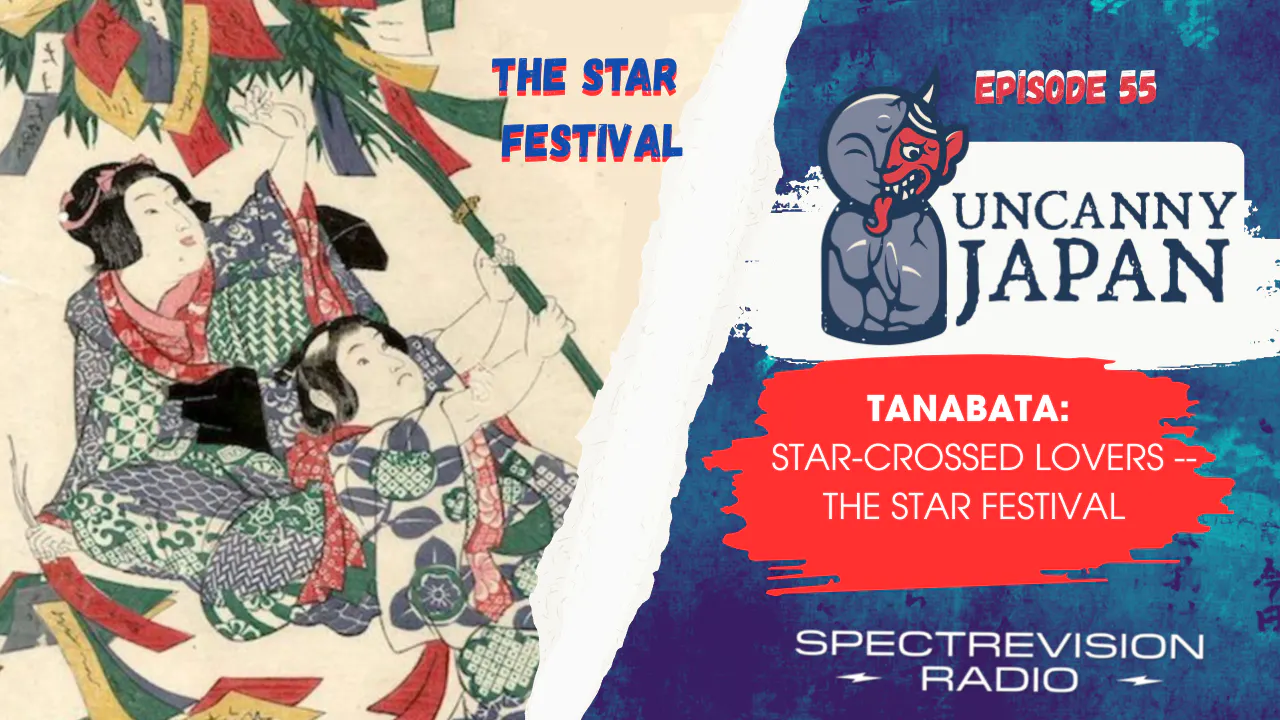
Tanabata: Star-Crossed Lovers (Ep.55) -- From the Vault
4w ago00:19:25Tap to summarizeA short Tanabata tale from the Uncanny Vault: Orihime the weaving princess, Hikoboshi the cowherd, and the river of stars that keeps them apart. On the seventh night of the seventh month, wishes are written on colorful strips of paper, tied to bamboo, and sent into the summer sky. Learn more about your ad choices. Visit megaphone.fm/adchoices
Transcribe →Childhood Incantations: Engacho, Pain Magic, & Severed Pinkies! (Ep. 194)
4w ago00:29:11Tap to summarizeTwo little boys find a dead bird on a mountain path. One accidentally touches it with his shoe, and suddenly the invisible contagion begins. Fingers cross. A circle is made. A hand chops through it. “Engacho!” In this episode of Uncanny Japan, we explore the everyday magic words and protective spells of childhood in Japan. There’s engacho, used to cut away contamination, bad luck, and all things spiritually “yucky.” There’s kuwabara kuwabara, a charm against thunder and lightning. Tsuru kame tsuru kame cancels out bad omens, while yubikiri genman turns a pinky promise into something surprisingly violent. And finally, chichin pui pui makes pain fly away. Part playground game, part folk magic, part tiny exorcism, these little phrases show how children turn fear, disgust, pain, danger, and promises into ritual. Learn more about your ad choices. Visit megaphone.fm/adchoices
Transcribe →Utsuro-Bune: The Hollow Ship Revisited (Ep. 193)
Jun 1700:15:56Tap to summarizeIn 1803, fishermen on Japan’s Hitachi coast spotted something round and unfamiliar drifting offshore. They hauled the hollow vessel onto the beach—and discovered a mysterious young woman inside. Step into the story as one of those fishermen. Examine the vessel’s clouded windows and iron-plated hull, hear the woman speak in a language no one understands, and watch as she fiercely protects a box she refuses to surrender. Who was she, what was hidden inside—and why did the villagers send her back out to sea? Learn more about your ad choices. Visit megaphone.fm/adchoices
Transcribe →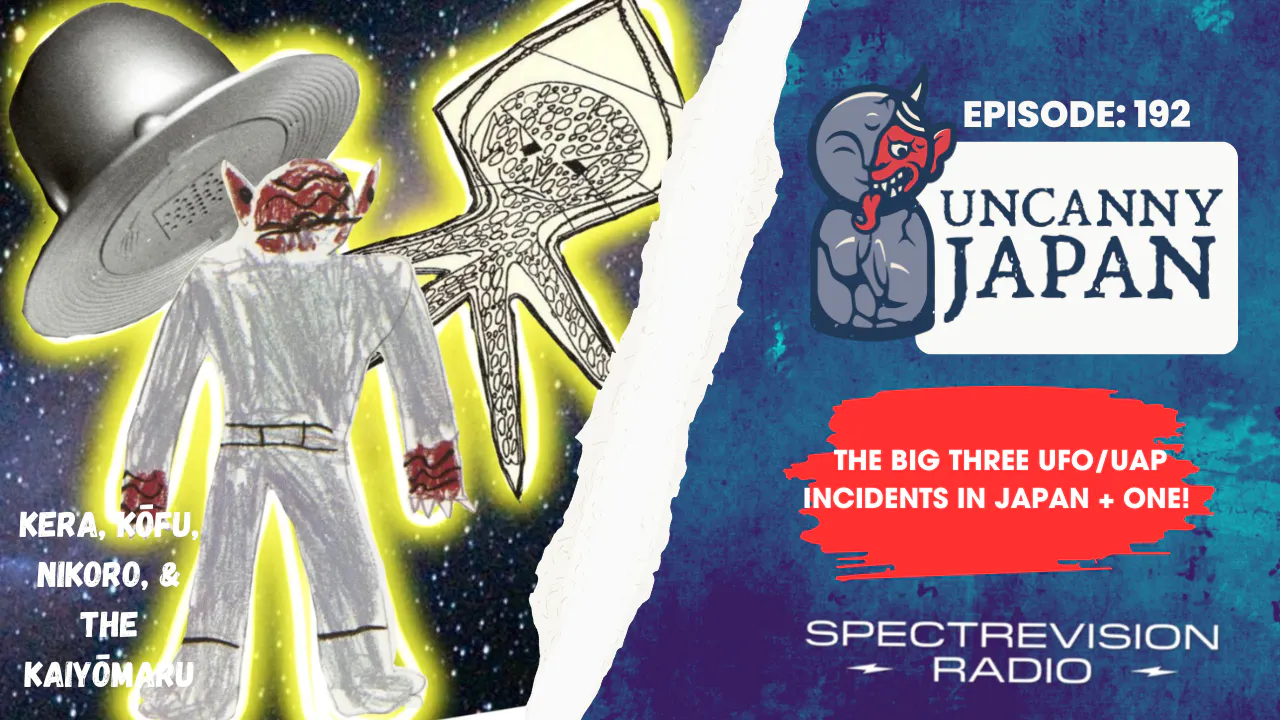
The Big Three UFO/UAP Incidents in Japan + One! (Ep. 192)
Jun 1400:29:47Tap to summarizeJapan’s 1970s UFO boom gave us some wonderfully strange cases: children capturing a tiny hat-shaped UFO in Kōchi, two boys encountering wrinkled aliens in a Yamanashi vineyard, and a Hokkaidō farmer who claimed repeated abductions, spoon-bending powers, and telepathic contact with beings from the Samon Call Galactic Planetary Federation. In this episode, we look at Japan’s “Big Three” UFO incidents — Kera, Kōfu, and Nikoro — plus one especially intriguing 1980s case involving the Kaiyō Maru, a government research vessel whose crew recorded strange lights and radar-only objects moving at impossible speeds. Learn more about your ad choices. Visit megaphone.fm/adchoices
Transcribe →The Ghost-Playing Actor Who Became a REAL Vengeful Ghost: Kohada Koheiji (Ep. 191)
Jun 100:30:56Tap to summarizeNot all Japanese revenge ghosts are wronged women. Meet Kohada Koheiji: a failed Edo-period actor who became famous for playing ghosts, only to be murdered, drowned, and returned as the very thing he once performed. In this episode, we explore the tangled history of the “real” Koheiji, Santō Kyōden’s gruesome tale, Nanboku’s kabuki adaptation, strange actor superstitions, severed fingers, rotten revenge, and one very silly sushi pun. Learn more about your ad choices. Visit megaphone.fm/adchoices
Transcribe →
All That Flows: Benzaiten, White Snakes, and Human-Headed Serpents
May 1800:22:30Tap to summarizeIn this episode of Uncanny Japan, we follow Benzaiten — also known as Benten — from her origins as Saraswati to her place among Japan’s Seven Lucky Gods. Along the way: Enoshima’s five-headed dragon, white snakes as divine messengers, snake-skin wallets, house snakes, and Ugajin, the wonderfully strange human-headed snake deity linked to rice, water, fertility, fortune, and wealth. Learn more about your ad choices. Visit megaphone.fm/adchoices
Transcribe →
Everyone Has a Throat Buddha / What is it and Why? -- Nodohotoke & Story Time: "The Buddha Bone" (Ep. 189)
May 400:32:51Tap to summarizeHave you ever heard of the nodo-hotoke, or “throat Buddha”? In everyday Japanese, it usually refers to the Adam’s apple. But after death, especially in the context of cremation, the nodo-hotoke becomes something else entirely, the actual seat of your soul. In this episode of Uncanny Japan, I talk about the fascinating and beautiful funeral custom of gathering bones after cremation, using long chopsticks to place them into the urn from feet to head, with the nodo-hotoke placed last. I’ll also touch on the taboo against passing food from chopsticks to chopsticks, the role of the crematorium attendant, and the belief that this Buddha-shaped bone can be connected to the soul, the life lived, or rebirth into the Pure Land. After that, I read my dark story “The Buddha Bone,” originally published in Weird Horror Issue 7 by Undertow Publications. I also explain a couple of story-context words: hifuki-take, a bamboo tube used to blow into and stoke a fire, and hyottoko, the puckered-mouth comic figure associated with fire-blowing imagery. Content warning: this episode discusses death, cremation, funerary ritual, and contains a dark fictional story on those themes. Learn more about your ad choices. Visit megaphone.fm/adchoices
Transcribe →
Ofuda & Omamori: Lucky Talismans & Charms
Apr 2100:29:21Tap to summarizeAfter exploring animal spirit possession last episode, Thersa turns to the Japanese ways of staying safe, getting a little lucky, and maybe even finding love through ofuda and omamori, talismans and charms filled with divine power and everyday hope. With birdsong in the background and stories woven throughout, the episode ends on a quietly unsettling note that has ushi no koku mairi (cursing your enemies) vibes. Learn more about your ad choices. Visit megaphone.fm/adchoices
Transcribe →
Tsukimono: Possessed by an Animal (Ep. 187)
Apr 700:31:03Tap to summarizeWhat is tsukimono? In Japanese culture, it’s the unsettling idea of possession—when a human or animal spirit attaches itself to you and usually does harm. In this episode of Uncanny Japan, I explore animal possession: foxes, dogs, snakes, and even horses that cling to people for reasons both known and unknowable. What causes it? How can you tell if someone is possessed? And what happens when superstition crosses into real-world harm? I talk about real eerie (and sometimes silly) historical accounts to my own deeply personal experience. I also look at the strange, the supernatural, and the very human consequences of this fascinating belief. Perfect for listening while relaxing, walking, or drifting off to sleep. Learn more about your ad choices. Visit megaphone.fm/adchoices
Transcribe →