Podcast
Unfiltered Media
Hosted by Justin Lebbon & Ian Whittaker · EN
A senior, data-driven podcast on media, advertising and ad-tech — TV, streaming, ad-spend and the markets behind them. Hosted by Justin Lebbon and Ian Whittaker.
13episodes
Episodes
Newest firstAll episodes
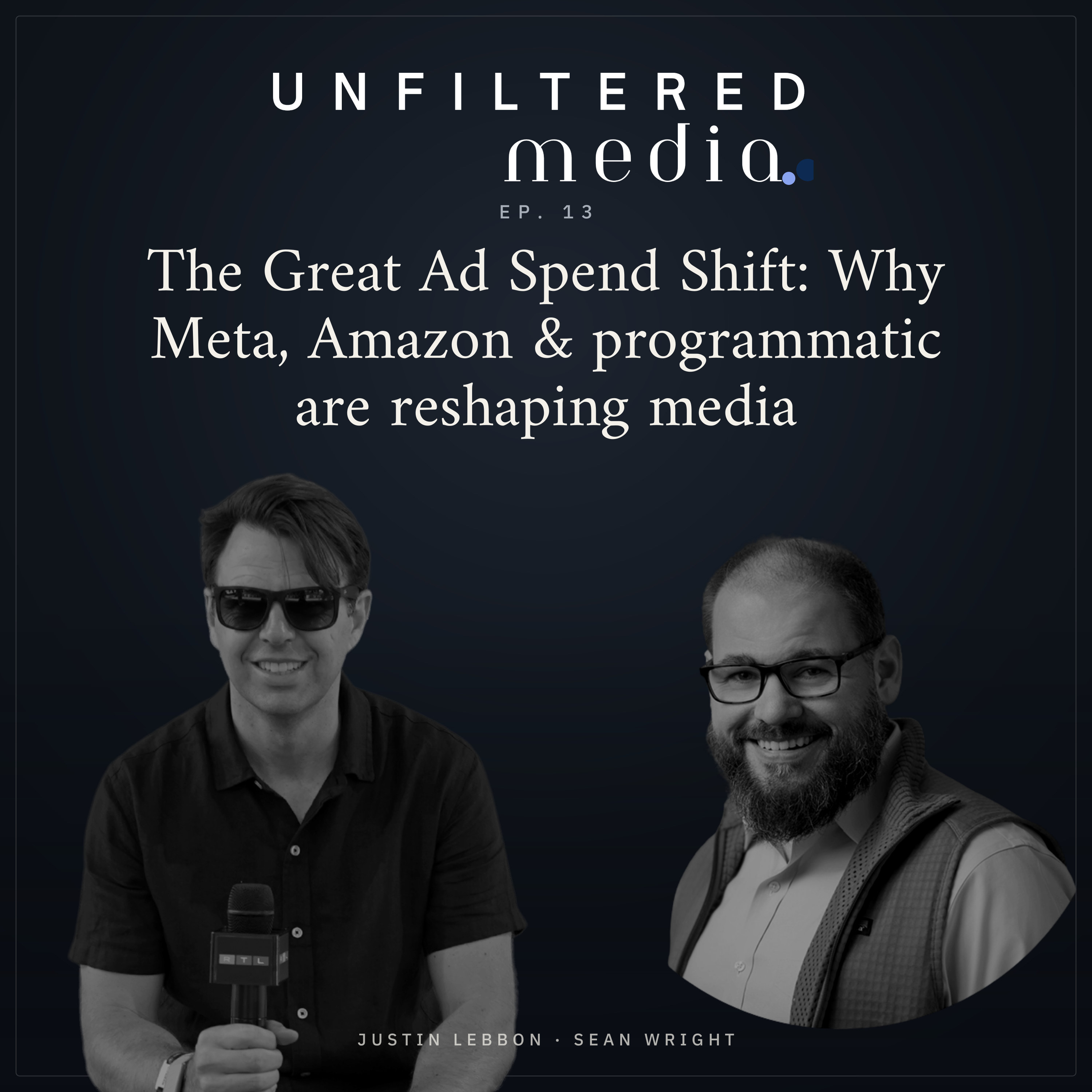
The Great Ad Spend Shift: Why Meta, Amazon & programmatic are reshaping media
May 600:37:09Tap to summarizeThis week Ian's away, so Justin Lebbon is joined by Sean Wright, chief insights and analytics officer at Guideline, for a data-led tour of where brand budgets are actually flowing. The conversation moves from Meta's scandal-proof growth to the heating DSP wars and the awkward economics of shifting money out of linear and into streaming. Meta keeps powering through: Scandals tracked back to 2009 show little impact — revenue up ~21% on average in the quarter after, with agency ad spend holding around 17%.A slowdown that isn't about morals: Wright's hypothesis is that Meta's "AI everything" tools are driving up costs and underdelivering ROAS for sophisticated brands, while SMBs love the point-click simplicity.The top-three squeeze: Of every £3 spent, two go to the major platforms, leaving thousands of publishers fighting for scraps.DSP wars: Four players (Google/DV360, Trade Desk, Yahoo, Amazon) now hold ~85% share, up from ~75%. Amazon has jumped from under 10% to just under 20% in ~18 months; long-tail DSPs (MIQ, StackAdapt, etc.) are losing ground.Trade Desk feud: Leaked Holdco memos and public sparring over take rates and transparency — but Guideline's Q1 data shows Trade Desk roughly holding, with ~13% global growth versus low single digits in the US.Streaming vs linear: Consumption hasn't left linear at the rate dollars did. Only ~25c of every US linear dollar lands back on streaming (~15p in the UK, ~20c CAD in Canada), partly due to streaming CPMs pricing 5x above cheap linear.Pricing nuance: The big three are near line-priced globally, while UK streaming looks underpriced versus US/Canada equivalents — an opportunity to grow rates or stay ultra-competitive.OTT in freefall: Video/OTT CPMs have fallen almost 40% in 18 months, driven by an influx of ad inventory, programmatic shift, and Amazon's low-price entry — with FAST/BVOD around 85% transacted programmatically. Key takeaways Meta's scandals — tracked since 2009 — have barely dented growth: ~21% average revenue rise in the quarter after, agency spend holding ~17%.The recent slowdown likely stems from Meta's AI tools raising costs without delivering ROAS for sophisticated brands, even as SMBs embrace the simplicity.Four DSPs now control ~85% of market share; Amazon surged from under 10% to nearly 20% in about 18 months while long-tail DSPs lose ground.Despite leaked Holdco memos and public sparring, Trade Desk is roughly holding — ~13% global growth but only low single digits in the US.Streaming isn't replacing linear dollars: only ~25c of every US linear dollar returns to streaming, partly because streaming CPMs run ~5x cheap linear.Video/OTT CPMs have dropped nearly 40% in 18 months as inventory floods in and buying shifts programmatic — UK streaming remains notably underpriced versus US/Canada.
Transcribe →Meta, Google, Amazon all post Q1 results - Analysis and market reaction
Apr 3000:18:17Tap to summarizeAfter a week's break, the hosts return for results season and find the big platforms posting a spectacular year — alongside eye-watering AI investment that the markets, for now, are happy to wave through. Ian walks through the numbers and the Wall Street reaction; Justin presses on what it all means for the advertising and media industry. In this episode: Alphabet's results: Search ad revenues up 19% year on year (vs 17% the prior year), YouTube up 11%, total ad growth 13%, and cloud revenues up a "massive" 63%. Far from cannibalising search, there's a case AI is accelerating it.The cloud CapEx story: AI investment is now showing up in cloud growth across the board — Google Cloud +63%, AWS +28% (its fastest growth in 15 quarters), Azure +40%.Regional splits: US ad growth up 23% (vs 17% prior year), EMEA at 12%, APAC at 22% — an unusually wide US/EMEA gap worth watching.YouTube vs Search: Once the faster-growing engine, YouTube has now trended below search for several quarters.~$200bn in AI spend — and markets didn't blink: Investors don't punish spending per se; they punish spending without a visible return. Diversified revenue streams (Alphabet, Amazon, Microsoft) buy more tolerance.Meta's single pillar: Growth around 23%, but advertising is ~90–98% of revenue, leaving it more exposed. Q2 guidance — possibly deliberately conservative — weighed on the share price and reflected a deeper concern about reliance on one engine.How Meta is growing: Pricing up ~12% and impressions up ~19%, fuelled by more (AI-driven) content. WhatsApp scaling from ~1m to ~10m conversations a week.Where the growth really comes from: SMBs (≈85% of the market) and likely Chinese advertisers. Large advertisers are decelerating — guideline data cited shows US Meta growth falling from 27% ('23–'24) to 14% ('24–'25), UK 15% to 10%, Canada ~10% to 4.5%.Is the money leaving? Probably at the margins — but not obviously to traditional media. More likely diversified to other online platforms like TikTok (a Bloomberg report cited ~60% revenue growth expected for 2025).The measurement angle: Advertisers running geo-testing and switching off spend to test incrementality — echoing Google's Latin America episode. A friendly disagreement on whether moral/regulatory pressure (EU breach claims) is pushing brands to dig deeper.Amazon: Advertising up 22% ex-currency, AWS accelerating to nearly 30%. The hosts argue advertising and AWS — not retail — drive the profit. Roughly ~$200bn annualised AI spend; shares up ~4% post-close.Coming up: Guests in the next few weeks, including Guideline, plus a proper measurement discussion. As always: this is most definitely not investment advice. Key takeaways AI hasn't hurt Google search — it may be helping: search ad revenue accelerated to +19% YoY, with cloud up 63%.Markets tolerate huge AI CapEx (~$200bn at both Alphabet and Amazon annualised) when growth visibly follows the spend.Meta's vulnerability isn't its growth (~23%) but its reliance on one engine — advertising at ~90–98% of revenue.Meta's growth is increasingly powered by SMBs and likely Chinese advertisers; large-advertiser growth is decelerating across the US, UK and Canada.Spend leaving Meta isn't obviously returning to traditional media — TikTok and other online platforms are the more likely beneficiaries.Advertisers are increasingly using geo-testing and switch-offs to prove incrementality, with moral/regulatory pressure prompting deeper scrutiny.
Transcribe →NBCU attacks Nielsen; Retail Media's growth; What Havas/Publicis Q1 results say
Apr 1600:27:25Tap to summarizeThis week on Unfiltered, Justin Lebbon and Ian Whittaker dig into three of the spiciest stories in B2B media. They start with NBCU's unusually pointed attack on Nielsen — not on methodology, but on the claim that its measurement is devaluing media companies and impacting shareholder value. They then reframe retail media's surge toward $190bn as a capital-markets story driven by high-margin promises to investors, before closing on Havas and Publicis Q1 results and why North America remains the growth engine. Highlights NBCU vs Nielsen: Why the line of attack has shifted from measurement methodology to shareholder loss, SEC sensitivity, and the litigious nature of US class actions.The power of "the gauge": How a simple, trusted chart shapes how CEOs, CFOs and CMOs allocate spend — and the YouTube "is it TV?" parallel.Retail media as a capital-markets story: Walmart's high-margin (70–80%) ad revenues, the rerating logic, and the promises retail CEOs and CFOs now have to keep.Incrementality warning: The risk of siloed, closed-loop ROI that simply discounts to existing buyers — and the "vicious circle" of diverting brand budgets into retail media.Two universes for agencies: Publicis (~4.7%) and Havas growth led by North America; AsiaPac and China strength; share prices lagging amid AI concerns.The case for agencies: Healthy ~14% margins, the danger of self-commoditization on price, and how AI plus a renewed focus on knowledge and creative could lift margins. Key takeaways NBCU's attack on Nielsen targets shareholder value, not just methodology — a potentially powerful weapon given US litigation and SEC sensitivity around perceived share-price impact.'The gauge' matters because CEOs and CFOs trust a simple chart, and their view of the media landscape filters down into how CMOs allocate spend.Retail media (heading to ~$190bn by 2026) is best understood as a capital-markets story: ultra-high-margin (70–80%) revenue that drove rerating promises retailers must now keep.Diverting brand budgets into retail media risks a vicious circle — weakening the brand makes advertisers more reliant on retail media to get noticed.Brands should demand proof of incrementality rather than accept closed-loop ROI that discounts to buyers who would have purchased anyway.Publicis (~4.7%) and Havas show solid organic growth led by North America, but share prices lag on AI-driven worries about the agency business model.
Transcribe →