Podcast
Unfiltered Media
Hosted by Justin Lebbon & Ian Whittaker · EN
A senior, data-driven podcast on media, advertising and ad-tech — TV, streaming, ad-spend and the markets behind them. Hosted by Justin Lebbon and Ian Whittaker.
12episodes
Episodes
Newest firstAll episodes
The Politics Episode: Paramount/WBD stalls, AI's charm offensive and Burnham's UK
2w ago00:24:58Tap to summarizeIn the "politics episode", Justin Lebbon and Ian Whittaker unpack the collision of politics and dealmaking across US and UK media — from the court-halted Paramount/Warner Bros Discovery merger to the AI charm offensive from Silicon Valley and a change of prime minister in Britain. Paramount/WBD on pause: A Northern District of California judge granted a temporary restraining order; Paramount agreed not to close until the court rules on the states' claims or 06/01/2027, whichever comes first.A political fight: 12 Democrat attorneys general, led by California and New York, plus the Writers' Guild, are lined up against the deal — even as the US administration and European Commission have cleared it.Follow the spread: With a $31 bid and WBD trading around $25.60, the market is pricing in a real chance the deal collapses; one commentator put it at 60%. Paramount's own shares are down ~20% in a month.The Ellison tech angle: Whittaker argues the deal's most interesting dimension is technological — the Ellisons potentially reshaping the combined content library into something more Netflix-like.AI as a vote issue: Why Musk and Zuckerberg are publicly championing AI — jobs fears and data-centre backlash are turning big tech into a political liability ahead of the US midterms.UK under Burnham: DSIT abolished and its responsibilities split; a cabinet-level AI minister (Kanishka Devayan) installed; expect more skepticism of Silicon Valley but subtler moves than Starmer's proposed social ban.ITV/Sky and Paramount at the CMA: Whittaker expects the ITV/Sky deal to proceed, wary of a "Project Kangaroo mark two", and doubts the UK would move to block Paramount without political cover from elsewhere. Key takeaways Paramount has agreed to pause its WBD takeover until courts rule on the states' claims or 06/01/2027; a trial date hasn't been set for this year.The opposition is heavily political — 12 Democrat AGs led by California and New York, plus the Writers' Guild — despite US and EU clearance.The gap between the $31 bid and WBD's ~$25.60 share price signals the market sees a meaningful chance the deal fails; Paramount stock is down ~20% in a month.Whittaker sees the deal's real prize as technological: the Ellisons using their tech background to transform the combined content library.Musk and Zuckerberg's pro-AI messaging is a bid to get ahead of AI becoming a genuine political liability over jobs and data centres ahead of the midterms.A Burnham UK government is expected to be more skeptical of big tech but subtler than Starmer, with DSIT abolished and a new cabinet-level AI minister; the ITV/Sky deal is still expected to clear the CMA.
Transcribe →Summer Summary - Q2 updates: Google, Netflix, Comcast and AI Investment
3w ago00:23:29Tap to summarizeA short summer catch-up as the hosts sift through Q2 earnings across the media and tech landscape and ask a sharper question: with AI CapEx climbing quarter after quarter, when do investors start demanding proof of delivery? Alphabet's strong numbers, weaker shares: Cloud revenue up over 60%, search up 17%, YouTube ad revenue up 13% — yet the stock fell as CapEx guidance was raised again (to $195–205bn for 2026), pushing quarterly free cash flow negative.CapEx now looks like a telco: At roughly 40–42% of annualised revenue, tech-platform spend increasingly resembles a utility, not a software business.China as the wildcard: New Chinese AI models are prompting investors to ask who really has the better AI investment strategy.Comcast and Peacock: Peacock profitable for the first time since launch, ad revenue up ~70%, subscribers up 17% to 48m — and now accounting for ~33% of NBCU ad revenue (up from ~25%), partly reflecting a ~10% drop in traditional pay-TV subscribers.The strategic question for Peacock: Profitability achieved — so what's next? Just another streamer, or a super-aggregator play?Agencies: Publicis (~5%) outpacing Havas (~3%) and the ~2% HoldCo average, with growth still concentrated in the US while Europe stays broadly flat.Macro backdrop: War and oil back above $100 create uncertainty, but limited impact on Western ad spend so far; China's structural GDP slowdown is the bigger concern. Key takeaways Alphabet delivered strong Q2 numbers but shares fell as raised AI CapEx guidance ($195–205bn for 2026) turned quarterly free cash flow negative.Tech-platform CapEx at ~40–42% of revenue now resembles a telco or utility rather than a software business, and investors want proof of delivery.Comcast's Peacock hit profitability for the first time since launch, with ad revenue up ~70% and now ~33% of NBCU ad revenue.Peacock is capturing cord-cutters but not fully recovering lost linear revenue — and its long-term strategic role remains unclear.Agency growth stays concentrated in the US; Publicis (~5%) is outperforming Havas (~3%) and the ~2% holding-company average, while Europe is broadly flat.War and $100 oil have had limited effect on Western ad spend; China's structural slowdown is the more meaningful worry for advertisers.
Transcribe →Market reaction to Sky ITV Deal; NBCU/Comcast; Future consolidation
4w ago00:29:20Tap to summarizeA flurry of media M&A gives Justin Lebbon and Ian Whittaker plenty to chew on: the agreed (but not yet regulator-approved) Sky–ITV deal, the strategic Comcast/NBCUniversal split, and the wider European wave of broadcaster consolidation. The pair argue that scale matters — but that collaboration and smarter positioning matter more, using Norway and the out-of-home sector as evidence. Sky–ITV: terms agreed, regulators next. The deal covers ITV's distribution arm, not the studios business. Whittaker expects clearance, possibly with conditions such as Sky divesting third-party ad-sales agreements.Defining the market is the fight. Sky will argue the combined entity is only ~7% of total UK ad spend; the regulatory debate hinges on whether online players count as competitors.Regulators think differently now. With Project Kangaroo cited as a cautionary tale, and broadcasters increasingly framed as national infrastructure, Whittaker suspects deals blocked years ago (e.g. TF1/M6) might fare better today.UK ad market concentration. Lebbon notes Amazon, Meta and Google take around 75% of UK media spend — higher than the US or the global ~50% average — underlining the structural pressure driving consolidation.Europe is consolidating into duopolies: RTL/ProSiebenSat.1 in Germany, Mediaset/Atresmedia in Spain, plus DPG and RTL/Sky Deutschland moves.ITV Studios' future. With Sky sitting inside NBCUniversal post-split, an eventual studios acquisition becomes a "possibility, not a probability." As a listed content asset, how investors rate it will be a bellwether for the whole content space.Why Comcast split. Largely share-price driven: markets dislike unwieldy conglomerates and prefer laser-focused entities. Sky's relative importance rises within NBCU, and Europe becomes a bigger focus.Diversification and local scale. NBCU leaning on brand assets (e.g. BravoCon) beyond "spots and dots"; TV players buying into out-of-home and radio; Seven in Australia combining sales forces; the "SuperJiks" local tie-ups.The Norway lesson. Broadcasters aligned strategically, ditched the victim narrative and sold the positives of TV — collaborating on data, measurement and messaging to take share back from social.What's next on the pod: a rebranded site and newsletter, more Cannes interviews (Rita Ferro, Mark Marshall, James Rooke), and deep dives on radio and on the "Wild West" of unmeasured creator marketing. Key takeaways The Sky–ITV terms are agreed but not yet cleared; Whittaker expects approval, possibly with conditions around Sky's third-party ad-sales agreements.The regulatory battle turns on market definition — Sky will argue the combined business is only ~7% of total UK ad spend once online players are counted.Amazon, Meta and Google take roughly 75% of UK media spend, higher than the US or the ~50% global average, driving broadcaster consolidation.European TV is coalescing into duopolies (Germany, Spain, Italy, France), with regulators now weighing structural decline and national-interest arguments.Comcast's NBCU split is largely share-price driven: markets reward focused entities over sprawling conglomerates, and Sky becomes more central within NBCU.Norway's turnaround came from collaborating on data and messaging and selling the positives of TV rather than playing the victim.
Transcribe →Rita Ferro on Disney’s advertising strategy and competing with Big Tech
Jul 1000:29:15Tap to summarizeJustin Lebbon sits down with Rita Ferro, president of global advertising for the Walt Disney Company, for a candid conversation about the most competitive ad landscape she's seen in nearly three decades at the company. Compete on value, not price. Ferro argues Disney doesn't have to chase the platforms diving on price because its inventory is largely sold out, anchored in premium storytelling, live events and a privacy-compliant ID graph.The "messy middle." She frames the mid-market — advertisers ranked roughly 101 to 1,000, worth about half the market — as Disney's big growth engine, served by some 1,200 agencies and hungry for self-service and automation tools.HoldCo dependence is shrinking. Disney's holding-company business is up 10–12% this year and roughly 25% off its level five years ago, as automation, direct brand deals and mid-market grow.Live and fandom drive revenue, not just audiences. From College GameDay to the Super Bowl and Grammys, Ferro details in-content integrations, social extensions and a Santa Monica takeover week around Super Bowl weekend.Super Bowl pricing up again. Prices are rising another 20% next year, with demand far outstripping a finite supply of units.AI in the ad stack. Ferro sees AI cutting the "hands on keyboard" burden of impression-level trading, powering real-time optimisation, and a forthcoming creative tool for mid-market marketers — while human oversight stays central to IP and storytelling.International reality. Europe is 14 different Disney+ markets, not one; new markets need automated tools because sales teams can't be staffed at launch. Key takeaways Disney says it competes on value rather than price, and is largely sold out across platforms thanks to premium content, live events and its first-party ID graph.The mid-market tier (advertisers ~101–1,000, ~50% of the market) is Disney's key growth engine, requiring self-service tools and new ways to service ~1,200 agencies.Holding-company business is declining — however it's 10–12% up this year BUT about 25% below its level five years ago — as automation, direct deals and mid-market rise.Live drives revenue as much as audience, via in-content integrations and social/fandom extensions across TV, TikTok and Disney's own platforms.Super Bowl ad prices are rising again, with demand far exceeding a finite unit supply; Disney is building incremental inventory across its ecosystem.AI is being applied to system automation, real-time campaign optimisation, algorithms and a new creative tool for mid-market advertisers, with humans still verifying content and IP.
Transcribe →NBCUniversal's Marshall: Universal Ads, BravoCon & the Measurement Mess
Jul 200:20:21Tap to summarizeMark Marshall, chairman of global advertising and partnerships at NBCUniversal, joins Justin Lebbon to unpack how premium video competes for spend against social and short-form platforms — and why data, not just content, is now the battleground. Key takeaways NBCUniversal is betting that data (Performance Insights Hub) plus premium content is the only way to compete with social and short-form platforms.The Hub combines linear and digital on one plan with reach, frequency and first/third-party KPIs; it rolls out in Q4 and, via FreeWheel, is intended to become an industry-wide standard.Universal Ads, aimed at digital-first advertisers moving up from search and social, now generates tens of millions per quarter after 18 months from a zero base.Diversification is essential: BravoCon (30,000 tickets, sold out in 90 seconds) and the LA28 sponsorship-plus-media partnership are meaningful new revenue streams.Marshall argues advertisers moved to CTV too quickly — ~40% of US budget has shifted while ~89% of impressions still run on linear.The US measurement 'crisis' — including Nielsen's Gauge report — confuses the market; Marshall's answer is real first-party data agreed across the industry.
Transcribe →Analysing SpaceX, Roku/Fox deal, Revenue urgency for AI
Jun 1700:21:17Tap to summarizeIn this pre-Cannes episode of Unfiltered, Justin Lebbon and Ian Whittaker unpack a dramatic week of M&A and IPO activity. They examine what SpaceX's elevated valuation means for funding the AI and space "twin bets", why the public markets impose a discipline private players escape, and how that pressure could see AI giants come hunting for media's advertising revenues. They then turn to Fox's roughly $22bn acquisition of Roku, the market's sceptical reaction, and the wider wave of US-led media consolidation. Highlights: SpaceX's valuation as a "virtuous circle": a high price justifies and fuels large-scale investment — and works in reverse if the price falls.Musk's super-voting B shares mean investors effectively cede control and ride his coattails.The combined SpaceX/OpenAI/Anthropic valuation sits north of $3.5tn — and to justify it, these companies must take revenue from somewhere, with advertising the obvious first target.Why incumbent media firms are "trapped": shareholders punish the big investments needed to fight back (the ITV digital-rollout share-price drop as precedent).Is this "performative capitalism"? Ian pushes back — he sees Musk as epitomising "dream big", with the US having outsourced much of its space policy to SpaceX.Fox isn't buying shows — it's buying the home screen and the interface between viewers and ad revenue, plus a sports negotiating "choke point".The market's 15%+ share-price fall signals fears of overpayment, execution risk and debt; the deal is cash-and-stock (~$14bn cash of ~$22bn, ~$96/share).A wave of US consolidation — Paramount/WBD, Disney/Hulu, Fox/Roku — versus a slower-moving Europe (Sky/ITV, RTL/Sky Deutschland), with many sellers quietly seeking an exit. Key takeaways SpaceX's elevated valuation is itself the funding mechanism — a virtuous circle where a high price makes large-scale investment look positive, and a falling price reverses it.Musk's super-voting shares mean investors are betting on the man and ceding control, with no real voice in the decisions.To justify combined valuations above $3.5tn, AI giants must grab revenue from elsewhere — and media advertising, a proven trillion-dollar model, is the first logical target.Incumbent media companies are trapped: the investment needed to respond hits cash flows and spooks shareholders, as ITV's digital-rollout share-price fall showed.Fox's Roku deal buys the home screen and the viewer-to-ad interface, not content — but a 15%+ share-price drop signals the market thinks Fox overpaid and is pricing execution risk and debt.US media is consolidating fast (Paramount/WBD, Disney/Hulu, Fox/Roku) while Europe moves slower, with many sellers quietly looking for an exit.
Transcribe →AI, Agility & Growth: The new agency playbook
Jun 1100:35:40Tap to summarizeAfter 25 years in media — including a stint as CEO of PhD UK — Ali Reed made the jump from the holding-company world to independent agency Brainlabs. In this candid conversation with Justin Lebbon and Ian Whittaker, she explains why legacy structures, short-term KPIs and "shuffling spreadsheets" pushed her out, and how indies are building AI-native capabilities without decades of technical debt to retrofit. Highlights: Why she left the holdco: Personal sacrifice (cancelled holidays, weekly commute from Malta) plus a professional frustration that real influence over the work had been replaced by "managing different parts of the system."The indie advantage: No legacy infrastructure to retrofit, fewer layers of approval and politics, and the freedom to build AI capabilities cleanly. Brainlabs has partnered with Claude and Notion at enterprise level and published over 700 skills across its ~1,100-person global team in a few months.Cortex and Cortex Labs: A centralised shared tech platform plus a decentralised mode where account directors and practitioners — not just the dev team — build and ship bespoke client tools in days.AI as force multiplier, not headcount cut: Brainlabs frames AI as a route to "more for the same," not "more for less." Examples include "Ralph," a growth agent that helps smaller pitches over the line, and "Proteus," a creative variation tool that helped deliver 3x revenue on Meta for one client.Brand vs. performance: Reed argues brand building isn't dead, but agencies have different "superpowers" — and clients need braver operating models that let an innovation/test-and-learn partner work alongside a stable global agency of record.The platform threat: With most new media spend flowing to a handful of platforms (much of it direct), Reed says agencies add value through creative quality, first-party signals, early product access and accumulated test-and-learn muscle memory.Her pitch question: Instead of asking agencies why they're great, she'd ask what they'd regret if they didn't win — a test of honesty over hyperbole. Key takeaways Reed left a holdco CEO role partly because real influence over the work had given way to 'shuffling spreadsheets' and managing the system rather than improving client outcomes.Independent agencies can build AI-native capabilities cleanly, without retrofitting onto decades of technical debt across acquired businesses.Brainlabs frames AI as a force multiplier for more output, clients and revenue — not a tool for cutting headcount; it wants clients who want 'more for the same,' not 'more for less.'Decentralised tooling (Cortex Labs) lets practitioners closest to the client problem build and ship bespoke tools in days, on the principle that 'innovation happens at the edge.'As platforms automate the buying layer, performance is won or lost at the creative and first-party data layers — and on speed to market.Clients should embrace braver operating models, letting an agile test-and-learn partner incubate ideas that a larger agency then scales, rather than choosing either/or.
Transcribe →How industry incentives, trading and measurement shape media quality and why it matters
Jun 800:33:05Tap to summarizeUnfiltered returns from a spell on the sidelines with guest Erez Levin — speaker, writer and co-author of a major new paper on media quality — alongside hosts Justin Lebbon and Ian Whittaker. The conversation opens on the state of the ad market and a strong earnings backdrop, then digs into the core question: in a world of unlimited impressions, how do you know what you're buying, and why does quality matter? Highlights: A two-tier ad market. Ian on the macro: 85%+ of S&P 500 companies beating earnings estimates, blended q1 growth pushing nearly 30% — the strongest quarter in around five years. Traditional advertisers growing mid-single digits, with the SME market still driving the platforms.The consumer signal is mixed. Weak US consumer confidence, but PepsiCo cutting prices up to 15% and McDonald's flagging pushback — yet recession fears have repeatedly failed to materialise across 2024, '25 and '26.The "quality trifecta." Erez frames marketing effectiveness as media quality, creative quality and audience/data quality — with the paper focused on media quality specifically.Quality is a range, not a binary. Why Erez prefers "quality" to "premium," built around attention (prominence of placement) and context (user receptiveness — e.g. a McDonald's ad before vs. after dinner).The race to the bottom. Billions going to muted videos in the bottom corner labelled as "in stream" ads, bought at the same price as full-screen sound-on inventory because buyers don't check.Finance vs. marketing. How marketing trained finance teams to expect ever-lower CPMs — and why that metric is now used against marketing's own case. Cost is not what matters; value is.Clock science vs. cloud science. Erez on treating marketing as deterministic when it's probabilistic, the move from multi-touch attribution toward econometrics and experimentation, and the death of the cookie-era illusion.Beyond averages. YouTube as the case study — the top 5% as high quality as the best TV, but "the exception, not the rule." The fix: pricing on a few qualitative dimensions (time of day, channel/show, geo) rather than channel-level averages.Transparency vs. quality. They're different things — high quality media can be opaque — but buyers increasingly need to validate what they're paying for.Will the big three move? Justin presses on three platforms taking ~90% of new spend with little incentive to change. Erez: only their incentives will move them; build a parallel quality path for the enterprise buyers who care. Key takeaways All impressions are not created equal — the paper's first principle and the foundation for assessing media quality.Quality isn't binary or the same as 'premium'; it's a range driven by attention (placement prominence) and context (user receptiveness).Buyers routinely overpay, paying the same CPM for muted, bottom-corner 'in stream' video as for full-screen sound-on ads — and often don't check.Marketing trained finance teams to chase ever-lower CPMs, and that metric is now used against marketing; the fix is to argue value over cost and account for long-term brand building.Channel-level averages hide huge quality variance (e.g. YouTube's top 5% vs. the rest); price on a few qualitative dimensions like time of day, show type and geo instead.The big three platforms won't move first — only enough buyer dollars demanding quality will change their incentives, so build a parallel quality path for enterprise marketers.
Transcribe →The Great Ad Tech Squeeze: Platforms dominate tech, kickbacks and consolidation
May 2300:20:23Tap to summarizeIn this episode of Unfiltered, Justin Lebbon and Ian Whittaker examine whether ad tech is facing its reckoning. From a finance lens, Ian explains why the market has turned skeptical on the sector — and why the biggest platforms, not the independent DSPs, increasingly hold the power. The Trade Desk's fall: Decent Q1 numbers, yet the stock is down ~70% over the period — a story of collapsing multiples, perceived risk, and doubts about future growth.Platforms own the pipes: Amazon and Google are taking DSP share while smaller players get squeezed; a handful of companies control up to 90% of new media spend.The Standard Oil parallel: Ian argues dominance comes not from sheer size but from controlling the choke points — just as Rockefeller controlled the route to market via railroad deals.Differentiation survives: Players with proprietary data and strong client relationships can defend value; commodity middlemen sitting in the gap are most at risk.Agencies move back in: As TV money shifts online, proprietary trading and rebates prop up agency margins — but the deeper problem is that media buying and planning is now priced as a commodity.AI as the efficiency tool: It has the potential to overturn ad tech economics, driving fewer steps, lower cost and pressure on fees.What premium publishers must do: Simplify processes, push money toward working media, and build or white-label their own controlled solutions to protect CPMs. Key takeaways The Trade Desk's ~70% share-price decline is driven less by weak numbers than by collapsing multiples, higher perceived risk, and lost faith in future growth.Amazon and Google are taking DSP share and squeezing smaller players, who lack the scale and balance sheets to compete.Ad tech's power dynamic mirrors Standard Oil: control of the choke points, not sheer size, is what matters.Ad tech players with proprietary data or strong client relationships can defend their value; commodity middlemen are most exposed to consolidation.Agency margins increasingly rely on proprietary trading and rebates because core media buying and planning is now priced as a commodity.Premium publishers should simplify their processes and build or white-label controlled solutions to keep money flowing to working media and protect CPMs.
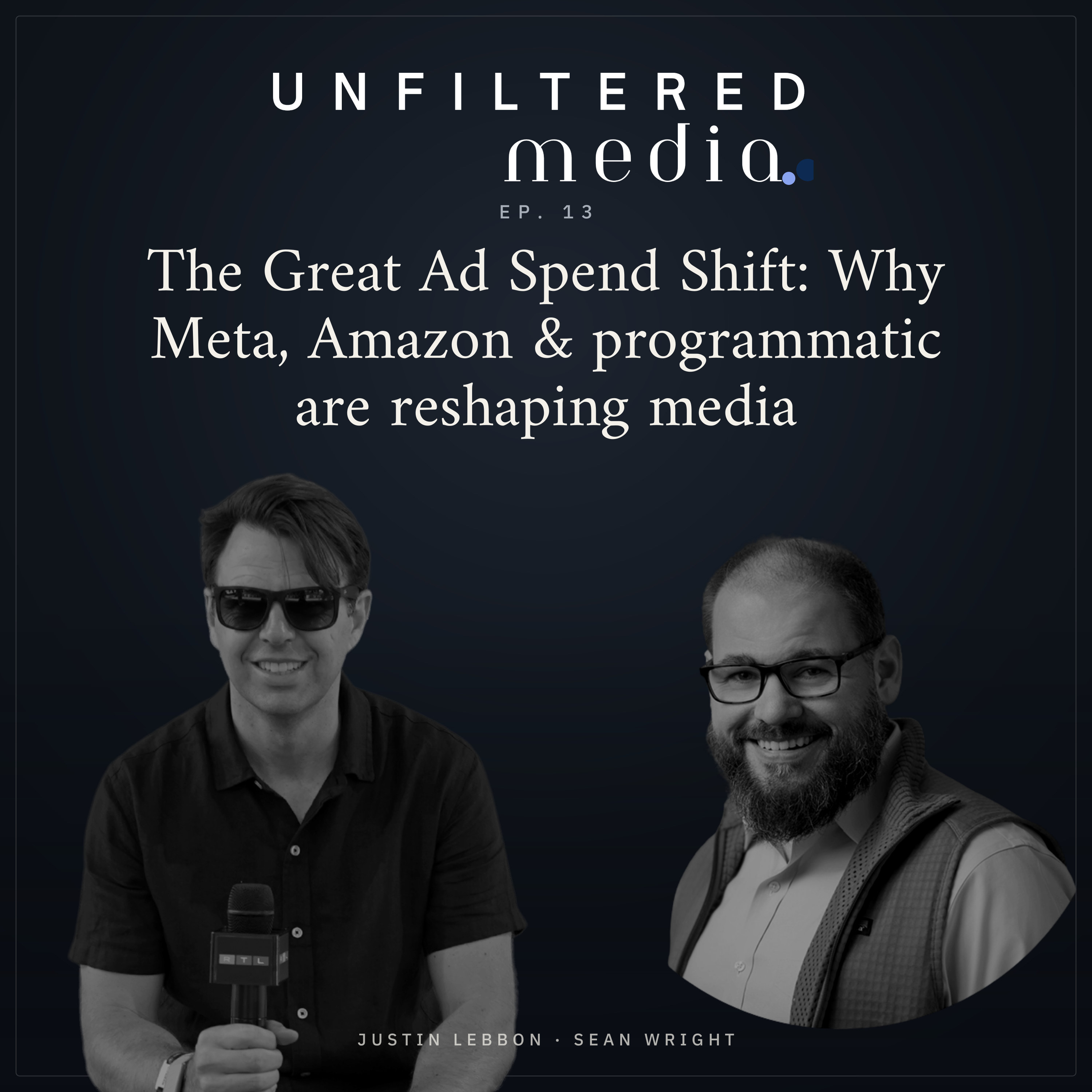
Transcribe →The Great Ad Spend Shift: Why Meta, Amazon & programmatic are reshaping media
May 600:37:09Tap to summarizeThis week Ian's away, so Justin Lebbon is joined by Sean Wright, chief insights and analytics officer at Guideline, for a data-led tour of where brand budgets are actually flowing. The conversation moves from Meta's scandal-proof growth to the heating DSP wars and the awkward economics of shifting money out of linear and into streaming. Meta keeps powering through: Scandals tracked back to 2009 show little impact — revenue up ~21% on average in the quarter after, with agency ad spend holding around 17%.A slowdown that isn't about morals: Wright's hypothesis is that Meta's "AI everything" tools are driving up costs and underdelivering ROAS for sophisticated brands, while SMBs love the point-click simplicity.The top-three squeeze: Of every £3 spent, two go to the major platforms, leaving thousands of publishers fighting for scraps.DSP wars: Four players (Google/DV360, Trade Desk, Yahoo, Amazon) now hold ~85% share, up from ~75%. Amazon has jumped from under 10% to just under 20% in ~18 months; long-tail DSPs (MIQ, StackAdapt, etc.) are losing ground.Trade Desk feud: Leaked Holdco memos and public sparring over take rates and transparency — but Guideline's Q1 data shows Trade Desk roughly holding, with ~13% global growth versus low single digits in the US.Streaming vs linear: Consumption hasn't left linear at the rate dollars did. Only ~25c of every US linear dollar lands back on streaming (~15p in the UK, ~20c CAD in Canada), partly due to streaming CPMs pricing 5x above cheap linear.Pricing nuance: The big three are near line-priced globally, while UK streaming looks underpriced versus US/Canada equivalents — an opportunity to grow rates or stay ultra-competitive.OTT in freefall: Video/OTT CPMs have fallen almost 40% in 18 months, driven by an influx of ad inventory, programmatic shift, and Amazon's low-price entry — with FAST/BVOD around 85% transacted programmatically. Key takeaways Meta's scandals — tracked since 2009 — have barely dented growth: ~21% average revenue rise in the quarter after, agency spend holding ~17%.The recent slowdown likely stems from Meta's AI tools raising costs without delivering ROAS for sophisticated brands, even as SMBs embrace the simplicity.Four DSPs now control ~85% of market share; Amazon surged from under 10% to nearly 20% in about 18 months while long-tail DSPs lose ground.Despite leaked Holdco memos and public sparring, Trade Desk is roughly holding — ~13% global growth but only low single digits in the US.Streaming isn't replacing linear dollars: only ~25c of every US linear dollar returns to streaming, partly because streaming CPMs run ~5x cheap linear.Video/OTT CPMs have dropped nearly 40% in 18 months as inventory floods in and buying shifts programmatic — UK streaming remains notably underpriced versus US/Canada.
Transcribe →