
Podcast
Who Arted: Weekly Art History for All Ages
Hosted by Kyle Wood · EN
Who Arted is art history and art education for everyone. While most art history podcasts focus on the traditional "fine art" we see in museums around the world, Who ARTed celebrates art in all of its forms and in terms anyone can understand. Each episode tells the story of a different artist and artwork including the traditional big names like Leonardo da Vinci, Pablo Picasso and Andy Warhol along with lesser-known artists working in such diverse media as video game design, dance, the culinary arts, and more. Who Arted is written and produced by an art teacher with the goal of creating a classroom resource that makes art history fun and accessible to everyone. Whether you are cramming for your AP Art History exam, trying to learn a few facts so you can sound smart at fashionable dinner parties, or just looking to hear something with a more positive tone, we’ve got you covered with episodes every Monday and Friday.
65episodes
Episodes
Newest firstAll episodes

Artist Interview Emil Wilson | The Nightingales
2w ago00:43:51Tap to summarizeMy guest this week is Emil Wilson, the author and illustrator behind the new graphic novel, The Nightingales. Wilson started his career in advertising before attending art school in his fifties, spurred by the sudden loss of a friend that motivated him to finally take a leap of faith and pursue his true creative passions. We dive into the moving, true story of compassion from 1985 that inspired the book, and he gives us a fantastic behind-the-scenes look at his unique, layered watercolor process. We also chat about why he deliberately avoided reading other comics so he could cultivate his own intimate, authentic, sketchbook-style aesthetic. Find Emil Wilson online: Emil’s website: https://emilwilsonart.com/ Book link: https://www.amazon.com/Nightingales-Emil-Wilson/dp/1668217775 Listen Ad-Free on Patreon. For just $3 per month, you can get ad-free versions of Fun Facts Daily, Who ARTed and Art Smart. Head over to https://www.patreon.com/cw/FunFactsDailyPod if you are interested. Check out my other podcasts Fun Facts Daily | Art Smart | Rainbow Puppy Science Lab Who ARTed is an Airwave Media Podcast. If you are interested in advertising on this or any other Airwave Media show, email: advertising@airwavemedia.com Learn more about your ad choices. Visit megaphone.fm/adchoices
Transcribe →
Francisco Goya | The Third of May 1808 (encore)
2w ago00:16:48Tap to summarizeFrancisco Goya (1746-1828) is one of Spain's most important and complex artists. His career bridged the gap between the Old Masters and the modern era. He found success as a court painter for the Spanish monarchy, creating bright, lively tapestry designs for the royal palaces. However, a devastating illness in 1792 that left him completely deaf marked a profound turning point. His art took on a darker, more critical tone, evident in his series of satirical etchings, Los Caprichos, which targeted the follies of Spanish society. The horrors he witnessed during Napoleon's invasion of Spain (1808-1814) were unflinchingly documented in his print series, The Disasters of War. In his final years in Spain, Goya painted his most enigmatic and disturbing works, the "Black Paintings," directly onto the walls of his country home, creating private, nightmarish visions like Saturn Devouring His Son. The Third of May 1808, painted in 1814, is a monumental and revolutionary depiction of war. Breaking from centuries of tradition that glorified battle, Goya focuses on the brutal, systematized execution of captured Spanish civilians by a faceless French firing squad. The painting's power comes from its raw emotion, its dramatic use of light to illuminate the victims, and its central, Christ-like figure whose gesture of martyrdom has become a universal symbol of protest. As one of the first truly modern paintings, The Third of May 1808 stripped war of its romance and its influence resonates through the history of art, most notably in works by Édouard Manet and Pablo Picasso's famous anti-war mural, Guernica. Related episodes: Édouard Manet Pablo Picasso Auguste Rodin Check out my other podcasts Fun Facts Daily | Art Smart | Rainbow Puppy Science Lab Who ARTed is an Airwave Media Podcast. If you are interested in advertising on this or any other Airwave Media show, email: advertising@airwavemedia.com Learn more about your ad choices. Visit megaphone.fm/adchoices
Transcribe →
Neil Harbisson | Cyborg Artist (encore)
3w ago00:09:06Tap to summarizeNeil Harbisson is a contemporary artist who hears colors. He deliberately chose to hear colors and to make that happen, he underwent surgery which has caused him to become the first person ever to be issued a government ID recognizing him as a cyborg. Harbisson has a condition known as achromatopsia. For him and others with complete achromatopsia, all three types of cones in the retina are nonfunctional. He sees using only his rods meaning there is no color in his vision. It is a relatively rare condition affecting only about one in every 30,000 people. The thing that is even more rare though is Harbisson’s management of the condition. First off, you might expect someone with this condition not to gravitate toward the arts, but while color is one of the elements of art, it is not required. Art is about human expression and creativity. Harbisson found a very creative means of enhancing his senses. Neil Harbisson has an antenna. Basically, there is a camera at the end of the antenna. A digital camera detects light and stores it as electrical signals. Inside the antenna, the colors are translated into sound. Different hues or colors are converted to different sound frequencies. It is actually attuned to even detect light that is invisible in the infrared and ultraviolet spectra. Related Episodes: Who ARTed | Wassily Kandinsky Art Smart | Photography I am taking some time off to rest over the summer. I will be putting encore presentations of previous episodes to make it easy for those who subscribe to the feed to discover or rediscover some great artists/works. I will be back with new episodes right around back to school season. Listen Ad-Free on Patreon. For just $3 per month, you can get ad-free versions of Fun Facts Daily, Who ARTed and Art Smart. Head over to https://www.patreon.com/cw/FunFactsDailyPod if you are interested. Check out my other podcasts Fun Facts Daily | Art Smart | Rainbow Puppy Science Lab Who ARTed is an Airwave Media Podcast. If you are interested in advertising on this or any other Airwave Media show, email: advertising@airwavemedia.com Learn more about your ad choices. Visit megaphone.fm/adchoices
Transcribe →
David Hockney | A Bigger Splash (encore)
3w ago00:16:29Tap to summarizeExplore the life and work of David Hockney, one of the most influential British artists of the 20th and 21st centuries. Born in Yorkshire in 1937, Hockney's rebellious spirit and prodigious talent were evident from his early days at the Royal College of Art. His move to Los Angeles in 1964 marked a pivotal moment, as he swapped the grey skies of England for the bright, constant sunlight of California. This new environment inspired his most iconic motifs, including pristine swimming pools, modernist architecture, and a vibrant, flat style perfectly captured with new acrylic paints. Hockney became celebrated for his psychologically rich double portraits, his innovative photographic collages known as "joiners," and in later years, a passionate return to painting the English landscape of his youth. A deep dive into Hockney's 1967 masterpiece, A Bigger Splash, reveals his genius for capturing time, motion, and atmosphere. The large 8 foot by 8 foot painting juxtaposes a serene, California setting with the chaotic, fleeting explosion of water from an unseen diver. While often associated with Pop Art, Hockney's work is deeply personal, celebrating the joy of looking and challenging the conventions of perception. From paintbrushes to the iPad, Hockney has remained a relentless innovator, solidifying his status as a modern master. I am taking some time off to rest over the summer. I will be putting encore presentations of previous episodes to make it easy for those who subscribe to the feed to discover or rediscover some great artists/works. I will be back with new episodes right around back to school season. Check out my other podcasts Fun Facts Daily | Art Smart | Rainbow Puppy Science Lab Who ARTed is an Airwave Media Podcast. If you are interested in advertising on this or any other Airwave Media show, email: advertising@airwavemedia.com Learn more about your ad choices. Visit megaphone.fm/adchoices
Transcribe →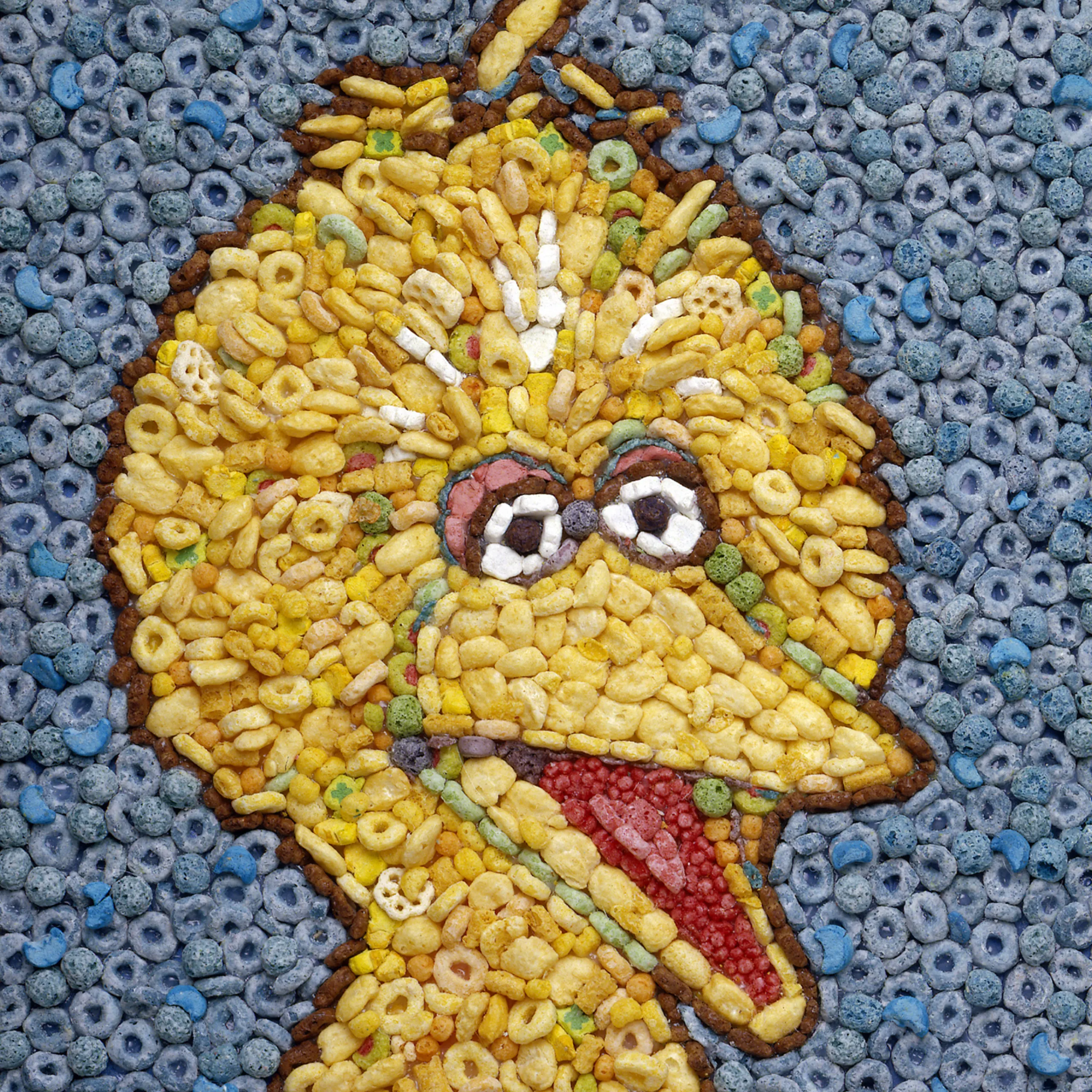
5 Artists Who Take Playing with Their Food to a Whole New Level (encore)
4w ago00:09:40Tap to summarizeToday I thought it would be fun to switch things up a little bit. Instead of focusing on just one artist and artwork, I’ve got 5 artists who work with food in ways most people would never consider. Jason Mecier creates mosaic portraits of celebrities using their favorite snacks, vices, and trash, making him a prominent figure in "junk art." Vik Muniz recreates famous paintings on a large scale using discarded materials, including garbage and chocolate syrup. Conrad Engelhardt crafts pointillist-style mosaics using wine corks, capitalizing on the various wine stains as his color palette. Jim Bachor fills city potholes with custom-made glass and marble tile mosaics, creating unexpected street art. Finally, Kristen Cumings uses thousands of Jelly Belly jelly beans to create vibrant mosaic masterpieces, including portraits and recreations of famous artworks. Cover art for this episode was Big Bird (breakfast cereal) by Jason Mecier. Image courtesy of the artist. I am taking some time off to rest over the summer. I will be putting encore presentations of previous episodes to make it easy for those who subscribe to the feed to discover or rediscover some great artists/works. I will be back with new episodes right around back to school season. Check out my other podcasts Fun Facts Daily | Art Smart | Rainbow Puppy Science Lab Who ARTed is an Airwave Media Podcast. If you are interested in advertising on this or any other Airwave Media show, email: advertising@airwavemedia.com Learn more about your ad choices. Visit megaphone.fm/adchoices
Transcribe →
TLDR Illuminated Manuscripts (encore)
4w ago00:12:09Tap to summarizeIlluminated manuscripts are the stunning, handcrafted books of the medieval world, created through a meticulous process in monastery workshops known as scriptoria. Scribes would copy text onto processed animal skin, or vellum, while artists known as illuminators added intricate illustrations and shimmering gold leaf. The term 'illuminated' comes from this dazzling use of gold and silver, which made the pages glitter like sacred objects. While gold provided the glimmer, the most precious material was often the brilliant blue pigment ultramarine, ground from lapis lazuli imported from Afghanistan. In addition to the sacred text, the margins of these books often contained whimsical and bizarre doodles, known as marginalia, featuring everything from knights battling snails to musical monkeys. A pinnacle of this art form is the Book of Kells, a masterpiece of Insular art created by Celtic monks around 800 CE. It is celebrated for its dense, complex Celtic knotwork and vibrant illustrations, most famously on its renowned Chi-Rho page (Folio 34r), a dizzying and meditative work of art that transforms the name of Christ into a sacred image filled with hidden figures and profound symbolism. I am taking some time off to rest over the summer. I will be putting encore presentations of previous episodes to make it easy for those who subscribe to the feed to discover or rediscover some great artists/works. I will be back with new episodes right around back to school season. Check out my other podcasts Fun Facts Daily | Art Smart | Rainbow Puppy Science Lab Who ARTed is an Airwave Media Podcast. If you are interested in advertising on this or any other Airwave Media show, email: advertising@airwavemedia.com Learn more about your ad choices. Visit megaphone.fm/adchoices
Transcribe →
Joan Miró | The Farm (encore)
Jul 1300:10:22Tap to summarizeJoan Miró, a renowned Spanish painter, sculptor, and ceramicist, was born in Barcelona on April 20, 1893. Initially steered towards business, Miró's true passion was art. He studied at Barcelona's La Llotja School of Fine Arts and later the Escola d'Art. A period of illness led him to Mont-roig del Camp, a pivotal experience that solidified his commitment to painting and connection to nature. Miró absorbed influences from Fauvism and Cubism, joining the Courbet Group. In 1920, he moved to Paris, befriending Picasso and experiencing poverty, which fueled his art. His work The Farm marked a shift away from realism, and he later embraced Surrealism, developing a unique symbolic language. I am taking some time off to rest over the summer. I will be putting encore presentations of previous episodes to make it easy for those who subscribe to the feed to discover or rediscover some great artists/works. I will be back with new episodes right around back to school season. Listen Ad-Free on Patreon. For just $3 per month, you can get ad-free versions of Fun Facts Daily, Who ARTed and Art Smart. Head over to https://www.patreon.com/cw/FunFactsDailyPod if you are interested. Check out my other podcasts Fun Facts Daily | Art Smart | Rainbow Puppy Science Lab Who ARTed is an Airwave Media Podcast. If you are interested in advertising on this or any other Airwave Media show, email: advertising@airwavemedia.com Learn more about your ad choices. Visit megaphone.fm/adchoices
Transcribe →
Alfred Stieglitz | The Steerage (encore)
Jul 1000:11:10Tap to summarizeI am taking some time off to rest over the summer. I will be putting encore presentations of previous episodes to make it easy for those who subscribe to the feed to discover or rediscover some great artists/works. I will be back with new episodes right around back to school season. Alfred Stieglitz is considered by many to be the father of modern photography. He looked at the camera as not simply a tool to document the world, but an artistic medium. His photograph The Steerage from 1907 is possibly his most famous work. As he set out on a European vacation, Alfred and his family were in first class, but he did not feel comfortable. He went out onto the deck and looked down at the people on the lower deck, the steerage. He said he wished he could mingle with them and he was struck by the lines and shapes on the ship as well as on the people's clothing. Everything about the scene laid out before him felt like a modern artwork and he sought to create a photograph using those lines and shapes to express his feeling in the moment. He ran back to his room and got his camera but only had one glass plate, one shot to capture the scene. Listen Ad-Free on Patreon. For just $3 per month, you can get ad-free versions of Fun Facts Daily, Who ARTed and Art Smart. Head over to https://www.patreon.com/cw/FunFactsDailyPod if you are interested. Check out my other podcasts Fun Facts Daily | Art Smart | Rainbow Puppy Science Lab Who ARTed is an Airwave Media Podcast. If you are interested in advertising on this or any other Airwave Media show, email: advertising@airwavemedia.com Learn more about your ad choices. Visit megaphone.fm/adchoices
Transcribe →
Possibilities
Jul 600:41:35Tap to summarizePossibilities is a groundbreaking documentary that explores the enduring legacy of Helen Keller and the contemporary experiences of individuals who are blind, deafblind, or have low vision. My guest this week is Tony Stevens, one of the producers of the film and Assistant Vice President of Communications at the American Foundation for the Blind (AFB). The film bridges historical achievements with modern accessibility advocacy. It captures the everyday lives of 33 diverse people challenging pervasive misconceptions about visual impairment. The narrative grounds Keller's monumental impact such as her travels to 39 countries as a goodwill ambassador and receiving an honorary doctorate from Harvard, in the present-day realities of the disability rights movement. The film pioneers an innovative, highly inclusive approach to cinematic storytelling by fully integrating open audio description for all audiences. Rather than treating accessibility as a post-production afterthought, the production team incorporated it early in the process to craft a universally shared viewing experience. The audio description, voiced by narrator Satana Howery, deliberately breaks the fourth wall to transform a traditionally functional accessibility feature into a vital, artistic storytelling element. On June 27, 2026, Helen Keller’s 146th birthday, AFB’s award-winning documentary Possibilities made its global streaming debut. Start watching today by searching for Possibilities on Apple TV, Prime Video, Tubi, Biblio+, and Kanopy Listen Ad-Free on Patreon. For just $3 per month, you can get ad-free versions of Fun Facts Daily, Who ARTed and Art Smart. Head over to https://www.patreon.com/cw/FunFactsDailyPod if you are interested. Check out my other podcasts Fun Facts Daily | Art Smart | Rainbow Puppy Science Lab Who ARTed is an Airwave Media Podcast. If you are interested in advertising on this or any other Airwave Media show, email: advertising@airwavemedia.com Learn more about your ad choices. Visit megaphone.fm/adchoices
Transcribe →
Claes Oldenburg (encore)
Jul 300:08:16Tap to summarizeClaes Oldenburg (1929-2022), the Swedish-born American sculptor, wasn't your typical artist. He wasn't interested in grand figures or historical scenes. Instead, he found inspiration in the most unexpected places: the everyday objects that cluttered our lives. His art, a blend of Pop Art and gigantic whimsy, continues to transform cityscapes around the world. I am taking some time off to rest over the summer. I will be putting encore presentations of previous episodes to make it easy for those who subscribe to the feed to discover or rediscover some great artists/works. I will be back with new episodes right around back to school season. Related Episodes: Andy Warhol Roy Lichtenstein Yayoi Kusama Listen Ad-Free on Patreon. For just $3 per month, you can get ad-free versions of Fun Facts Daily, Who ARTed and Art Smart. Head over to https://www.patreon.com/cw/FunFactsDailyPod if you are interested. Learn more about your ad choices. Visit megaphone.fm/adchoices
Transcribe →