Podcast
Write of Passage by Vanessa Riley
Hosted by Vanessa Riley · EN
Join bestselling author Vanessa Riley as she delves into untold histories, reflects on current events through a historical lens, shares behind-the-scenes writing insights, and offers exclusive updates on her groundbreaking novels.
vanessariley.substack.com
vanessariley.substack.com
41episodes
Episodes
Newest firstAll episodes
Done Is Better Than Finished
1w ago00:12:05Tap to summarizeWriters, stop trying to finish your book. Just Stop. Let me explain how trying to finish might be killing your writerly mojo.Done Is Better Than FinishedI had a couple of conversations this week with writing colleagues. Some are on deadline, working hard to finish their books. Others have ideas they love but are still figuring out how to begin.These groups may seem as though they are in very different places, but they share one problem:They do not have a completed manuscript.They may have a few sentences here, a couple of chapters there, or even a detailed outline. But an outline is not a manuscript. A collection of scenes is not a manuscript. A beautiful opening chapter is not a manuscript.I’ve stopped asking if you’re finished.Finished is a state that is almost impossible to achieve. Even after a book has been edited, copyedited, proofread, printed, and placed on a shelf, most writers can still find something they would tweak.A sentence could be sharper. A description could be richer. A scene could move faster.Instead of asking whether a book is finished, I prefer to ask:Am I done?Or, more accurately:Am I done with this phase?When I begin writing a book, I do a lot of upfront research. I explore the history. I gather enough information to understand the world and begin imagining what is possible. I collect facts, consider characters, and think about where the story might go.At some point, I will probably create an outline, because I need a place to put all those facts and ideas swirling around in my head.But eventually, I have to stop preparing to write and start writing.Then I go for broke.I write until I reach the end.I do not encourage writers to revise while trying to complete a first draft. I know some people can write and revise at the same time. I am not one who can do that, and I’m not here to criticize anyone’s process. But sometimes we have to stop polishing and simply push through.We have to reach the end so we can see the journey our cursor, pencil, or keyboard has taken.Then we can go back and fix it.During a first draft, I may leave pieces of research unfinished. In any particular scene, I may not know what a character is wearing or the color of the walls of a setting. In the earliest version of a book, you barely see any color mentioned at all.There is no point in spending three hours researching a dress for a scene that may not survive the next draft.At the first and second passes, I do not even know whether the scene is going to stay.I’ve learned that my job is not to get everything right.My job is to get everything written down.Someone once said that you cannot edit a blank page. That person was extremely wise and painfully correct.I need words, at least a third of the word count before I think about revising any words.I need all the scenes before evaluating which scenes stay, get cut or need revisingYou need to see your characters moving through the full story before you can fully understand their motivations, goals, and conflicts. Now I do a lot of pre-work and spend a lot of time in each character’s head. But sometimes it’s not working, and it’s hard to know that unless you see a completed arc.A full understanding of the story your telling comes at the end of writing and you’re in the editing stage.So first, you have to be done.In writerly settings, there’s such a thing as pantsing a book, which literally means sitting at the seat of your pants and writing, whatever comes to your head. That’s the anathema to plotting. Plotting requires foreknowledge, knowing every character, every circumstance, every scene, every turning point until you get to the end. It’s structured.I use a hybrid method—a little bit of pantsing and a whole lot of plotting. Plantsing marries thetwo approaches and together we reach the end.That is the goal.Get done.I had a conversation with a friend about the current state of publishing. They were wondering whether they should focus on independent publishing or continue looking for a traditional deal.I told them the truth: it is rough out here.Writers have to work harder. We have to work harder to bring our books into the zeitgeist. We have to help readers discover them, understand them, and care about them.That work exists whether you are traditionally published or independently published.It is wise to understand publishing trends. It is important to pay attention to changes in the industry and the politics that affect a writer’s livelihood.But none of that matters very much when you don’t have a completed book.Suppose everything magically and deliciously aligned tomorrow. Suppose the perfect agent, editor, or opportunity appeared.Would you be ready?Could you send the manuscript right now?Right this minute?If not, sit down and knuckle down.Do not worry about making every sentence perfect. Once you are done with this version, you can go back. You can edit. You can move scenes, change characters, strengthen motivations, and deepen the research.On Sunday, I reached the end of my current work at about 90,000 words. This is the second pass. The first finished at 34,000.This 90k version is closer to a finished vision. Because I reached the end, I have a better understanding of how the story should flow. I know more about what is important. I can see what’s working, what’s missing, and what needs to change.Those are decisions I couldn’t make when I was still staring at an incomplete manuscript.I needed to be done.So look at the place where you are stuck.Are you trying to jump too many steps? Are you revising chapter one for the fifteenth time because you are actually afraid to write chapter two? Are you focusing so much on the destination that you have stopped moving through the journey?The journey matters.And your story matters because you matter.Before the summer ends: Turn off the distractions. Skip the unnecessary research. Put placeholders in the manuscript. Let the sentences be ugly. Let the scenes be imperfect.You will have time to fix later.You will have time for feedback later.You will have time for the second pass, the third pass, and the opinions of trusted readers later.But first, you need something to be done.So get to the end.Let’s get that dream book done.This week’s book list includes:Bird by Bird by Anne Lamott — A beloved guide that reminds writers to embrace imperfect first drafts because you can’t revise what you haven’t written.The War of Art by Steven Pressfield — Explores the internal resistance that keeps creators from finishing their work and offers a mindset for overcoming it.On Writing: A Memoir of the Craft by Stephen King — Part memoir and part writing guide, it emphasizes discipline, persistence, and completing the first draft before polishing it.Check out my latest “done” release: A Deal at Dawn – Katherine’s lies have been exposed, but the duke has a plan.And it’s still Pirate Season. Check out the women pirates in Fire Sword and Sea.Get these books from The Book Worm Bookstore. They have a few signed copies of Fire Sword and Sea and A Deal at Dawn.You can also try one of my partners in the fight, bookstores large and small, who are in the trenches with me.You can find my notes on Substack or on my website, VanessaRiley.com, under the podcast link in the About tab.Hey. Let’s keep rising and creating together. I need you. That is the truth. Like, share, subscribe, and stay connected to Write of Passage.Thank you for being here.I want you to come again. This is Vanessa Riley. <br/...
Transcribe →
55% Gone. Now What?
2w ago00:11:09Tap to summarizeCongratulations. You’re still here. More than half the year is behind you, and that alone is worth celebrating. But it’s time to kick things into gear. Let’s stop surviving…and start thriving.55% Gone. Now What?More than 200 days out of 365, 55% of the year is done. Scratched them off the calendar.Every December, I start thinking about New Year’s resolutions. By the time January 1 rolls around, I’ve got my list together. I tell myself I’m going to be bold, audacious, and dream out loud. This is the year. These are the goals.Then the middle of July arrives.And with it comes a stark realization that wakes me out of my dream state. Over 55% of the year is gone. More than 200 days have passed. And if I’m being honest, of all my big, hairy, audacious goals…I’ve accomplished one.I’ve survived.Now don’t get me wrong. Sometimes survival is the victory.So today, I want to do three things.First, I want to congratulate you for making it this far.We’re often too hard on ourselves. Sometimes just getting out of bed in your right mind is an accomplishment. If you’re awake and listening to this podcast, congratulations. You’re a survivor.But survivors want to become thrivers.And to thrive, we can’t sit still.So I’m giving you permission to go back and look at that list you made for 2026. Instead of staring at everything you haven’t done, narrow the list down to one more thing. Pick one goal you want to accomplish in this latter half of the year.Then go after it.“But Vanessa, how do I do that?”First: Reconnect with Your WhyBefore diving back into your list, check in with your why. What’s your raison d’être? What is the thing you believe you’re meant to do on this earth?Now, depending on the season of life you’re in, that answer may change. That’s okay.But right now, where’s your head? Where’s your heart?Take a moment to realign. Choose a goal that matches your personal values and your interests.Some of us still have corporate day jobs. Some of us signed contracts that sounded great at the time. Some of us are out of contract and still wondering, What the hell happened?I’m just going to chalk this year up to the fact that we’re living in strange times.Sometimes you’ve got to put your head down and focus, focus, focus on what’s important.Your why is important.And you’re going to use that energy to accomplish your one thing before this year is over.Psychologists Kennon Sheldon and Andrew Elliot, who developed the Self-Concordance Model, found that people pursuing goals aligned with their personal values put forth more sustained effort and are more likely to achieve those goals.Second: Maybe Your Goal Was Too BigMy mama used to say, “Your eyes are bigger than your stomach.”Sometimes our egos are bigger than reality.We only have so many hours in a day. I’ve tested this. It really is twenty-four hours. And somewhere in there you’re going to need to sleep…and yes, use the restroom.You cannot do everything.So take that big goal and break it into smaller pieces. Reward yourself every time you get to check something off the list.For the writers in the house, don’t make the goal, “Finish my novel.”Make the goal, “Write 300 words today without stopping.”Will you have to do that more than once?Absolutely.But novels aren’t written in giant leaps. They’re written through consistent effort.For the savers in the house, maybe the goal isn’t having $5,000 saved by the end of the year.Maybe it’s saving $25 a week.Maybe it’s skipping one unnecessary Amazon purchase every week.I’m not here to judge.I’m just here to say: break the goal into pieces.Researchers Teresa Amabile and Steven Kramer, in The Progress Principle, found that making meaningful progress on small tasks is one of the strongest drivers of motivation, engagement, and satisfaction.Small wins matter.Third: Stop Waiting to Feel Like ItNow this one is going to hurt some folks.Stick to “doing.”I have a lot of friends who are mood writers. They’ll only write when they’re “feeling it.”The same thing happens with people who want to cook instead of eating out. Or exercise consistently. They’re waiting for the mood to strike.Moods are tricky things.Sure, there are days I write better when I’m angry.Or after I’ve had a delicious caramel torte.But I can’t wait for the vibe to be right.A blank page can’t be edited.Genius—true genius—happens during the editing process.Now, for that magical one percent who can spit out a perfectly textured paragraph on the first try…All I’ve got to say is:“Jesus wept.” (John 11:35.) That is the shortest paragraph and complete statement in the Bible.The rest of us need a plan.Psychologist Peter Gollwitzer’s research on implementation intentions found that people who decide in advance when, where, and how they’re going to act are significantly more likely to accomplish their goals.In other words, don’t just hope you’ll do it.Schedule it.Win the Rest of the YearDo these three things, and you’ll already be ahead of the game.Reconnect with your why.Break the goal into smaller pieces.Stop waiting for the perfect mood and make a plan.This last half of the year can still be productive.You can still accomplish what you desperately want.And if you don’t know what that desperate thing is…Go back to step one.Why?Why?Why?We’ve already made it this far.We can make it to the end.Hang in there.Make the plan.Start implementing.And go win the rest of the year.This week’s book list.Atomic Habits by James Clear — A practical guide to building better habits through small, consistent changes that compound into remarkable results.The Progress Principle by Teresa Amabile and Steven Kramer — Drawing on years of research, the authors show how making meaningful progress on small daily tasks is one of the strongest drivers of motivation and success.The ONE Thing by Gary Keller and Jay Papasan — A productivity classic that argues extraordinary results come from identifying and relentlessly focusing on the single most important task.And if you want to see where my vibe has been for the past two and a half years, check out: A Deal at Dawn – Katherine’s lies have been exposed, but the duke has a plan.And it’s still Pirate Season. Check out the women pirates in Fire Sword and Sea.Get these books from The Book Worm Bookstore . They have a few signed copies of Fire Sword and Sea and A Deal at Dawn.You can also try one of my partners in the fight, bookstores large and small, who are in the trenches with me.You can find my notes on Substack or on my website, VanessaRiley.com, under the podcast link in the About tab.Hey. Let’s keep rising and creating together. I need you. That is the truth. Like, share, subscribe, and stay connected to Write of Passage.Thank you for being here.I want you to come again. This is Vanessa Riley. This is a public episode. If you'd like to discuss this with other subscribers or get access to bonus episodes, visit vanessariley.substack.com/subscribe
Transcribe →
Who Told You That Was True?
3w ago00:17:25Tap to summarizeIf Walter Cronkite, Edward R. Murrow, Gwen Ifill, Peter Jennings, or even Barbara Walters came back today and started doing the news, would you believe them? If you had to stop and think about your answer, you’re not alone—and that’s exactly the problem.According to Gallup’s October 2025 report on Media Use and Evaluation, only 28 percent of Americans say they have a “great deal” or a “fair amount” of trust that a report on the news is accurate and fair. That is the lowest level Gallup has ever recorded.In their tracking, they’ve shown a massive decline from 68 percent in the 1970s in Americans’ trust in news on television, in newspapers, or on the radio. That’s over 40 percent loss of confidence in 5 decades.Those numbers should frighten us.Recently, I asked a twenty-one-year-old college student where she gets her news. Her answer was funny, honest, and revealing:“Basically, it’s kind of crazy that I’ll learn about very important things on TikTok or some other goofy social media platform before an actual news source. Then I go to an actual reputable news source to find out if it’s true or not. Shout-out to NPR. I like to tune in to that radio now. That’s my new news source because the other ones stress me out.”I do not want to date myself, but I remember when there was a man named Walter Cronkite on the evening news. He spoke with a serious voice, and people believed that what he said had been checked and checked again. Viewers trusted him to tell them about the assassination of President John F. Kennedy. They trusted him to tell them about the war in Vietnam and the first human steps on the moon.I’m not quite old enough to have watched all of that live. Thank you, YouTube, for the things I’ve missed. Still, those recordings remind me that there was once a widespread belief that when we saw something on the news, we were seeing something true.Of course, television news was never perfect. There were ridiculous moments, too. Geraldo Rivera once opened Al Capone’s supposed secret vault on live television, promising the possibility of buried treasure, bodies, or historical secrets. After all that anticipation, the vault contained almost nothing.We have also spent decades wondering whether missing labor leader Jimmy Hoffa was buried beneath some stadium, driveway, or patch of concrete. Even MythBusters got involved in the search.The news has always contained spectacle. But spectacle used to be easier to recognize.Now, spectacle often arrives dressed in a nice suit, a sweet smile, and banter. This is called reporting.I do not know what we are going to do. We are headed toward no longer trusting the news. I find it incredible that journalists and political insiders sometimes save damaging information for books that will be published months or years later. These revelations may involve conversations with politicians that could have changed the outcome of an election, influenced an investigation, or helped the public understand a crisis while it was actually unfolding.But instead of reporting the information when it mattered, someone sat on it until the book release. News reporting seems to be about clicks and money—again, spectacle.People say journalism is dead. I don’t want to think this.. But much of what is on TV is people catering to an agenda and not telling the truth.And I am not so altruistic. Money has to be made. The station, equipment, and reporting all cost money. Frivolous lawsuits have shut down or targeted journalists.In this world of spectacle, some pander to an audience of one person: the autocrat, the executive, the politician, the billionaire, or the power broker whom the journalist believes has the ability to grant access, influence, protection, or money.Many news organizations have disappointed me. They’ll spend days analyzing one president’s poor debate performance while ignoring another politician’s slurred speech, confused statements, or obvious lies. They’ll hold one person to a nearly impossible standards while lowering those same standards for someone else. Right Jake?There seems to be no floor to depravity, no ceiling to the hysteria. I still have beef with a network that swore they had some tax returns of a very powerful man, teased it all day, then when it aired, only had the first two pages, the summary pages, which shed very little detail. You knew that, Rachel. But I digress.Who are we supposed to trust in this society?I tell people all the time that they should journal, especially women. A journal is personal. It should be original and not filtered through an AI program. Your journal should contain your words, your observations, and what you believe is happening in the world around you.That record will become even more important as professional truth-tellers become spectacle peddlers. I’m also not willing to pay per click for somebody’s opinion disguised as reporting. There are publications I still support. I pay for a subscription to The New York Times. I have subscriptions to all the old goodies like https://www.britishnewspaperarchive.co.uk/ and Newspapers.com. Yes, there are biases in these places, but for the moment, they are anchored in truth or at least in true sources.At the same time, I sometimes find myself watching TikTok updates from Aaron Parnas. I trust this person, who looks like an ordinary guy living next door. He and Under the Desk News seem more trustworthy than highly produced studio broadcasts.I know how strange that sounds. I’m a fact finder. A Cronkite lover.Yet my experience reflects the larger change in how people receive information.According to the Reuters Institute’s 2025 Digital News Report, audiences are increasingly getting news from social media, video platforms, podcasts, and online personalities. Approximately 36 percent of respondents use Facebook for news each week, while 30 percent use YouTube, 19 percent use Instagram, 19 percent use WhatsApp, 16 percent use TikTok, and 12 percent use X.While this is disappointing, this fragmentation creates opportunity. More voices can participate.But fragmentation also creates danger.Algorithms can be manipulated. Platforms can elevate certain stories and bury others. Political forces, corporations, governments, and wealthy individuals may be able to prevent audiences from seeing factual information. They can hide it. And like many major broadcasters, they don’t feel the need to prove that a source is truthful.I do not have the answers to fix this. This essay is ringing the alarm bell.New media sources have stepped into this gap. You can jump in too, but I expect you to present facts. I expect you to investigate competing claims. I expect you to show us when someone is lying.I do not want journalists to “both-sides” every issue, unless it is pointing out right and wrong.So where do we go from here?I do not know, but maybe we approach this like I approach historical fiction.First, look for evidence, not just assertions. Good reporting cites documents, interviews, data, recordings, or firsthand observations.Second, compare multiple reputable outlets. When a major story is accurate, several independent news organizations will usually report the same essential facts.Third, check the original source whenever possible. Read the court filing, scientific paper, government report, earnings statement, transcript, or complete speech. Secondary reporting can misunderstand, simplify too much, or omit important context.Finally, look for bias. Examine the bias of the reporter and the publication, but do not stop there. Consider the broader political and financial situation. Who benefits from this version of the story? Who benefits from the lie? Who gains power if the public becomes confused, exhausted, or unable to distinguish truth from propaganda?And then examine your own bias. Hey we are all guilty of wanting shortcuts or not watching “the news.”We can no longer consume the news passively. Unfortunately, every citizen must become a researcher, comparing accounts, tracing claims to their sources, and preserving personal records of what we witness.That is exhausting. It’s unfair. A functioning democracy should not require every person to become a full-time fact-checker.But when trust disappears, verification becomes an act of survival.Can I believe my lying eyes?Maybe. Maybe not, not immediately.But I can look again. I can search for evidence. I can compare sources and document what I see. And I can refuse to accept lowering standards when it comes to the news. And I can place my views where they count, on sources that tell the truth.It’s my job, your job, to keep your eyes clear and wide open. Find the facts. Defend the truth and democracy and encourage the truth-tellers. Their jobs and our lives are on the line.This week’s booklist focuses on truthful references:The Death of Truth by Michiko Kakutani – Explores how misinformation, relativism, and the erosion of shared facts have undermined public trust in institutions and each other.Calling B******t: The Art of Skepticism in a Data-Driven World by Carl T. Bergstrom and Je...
Transcribe →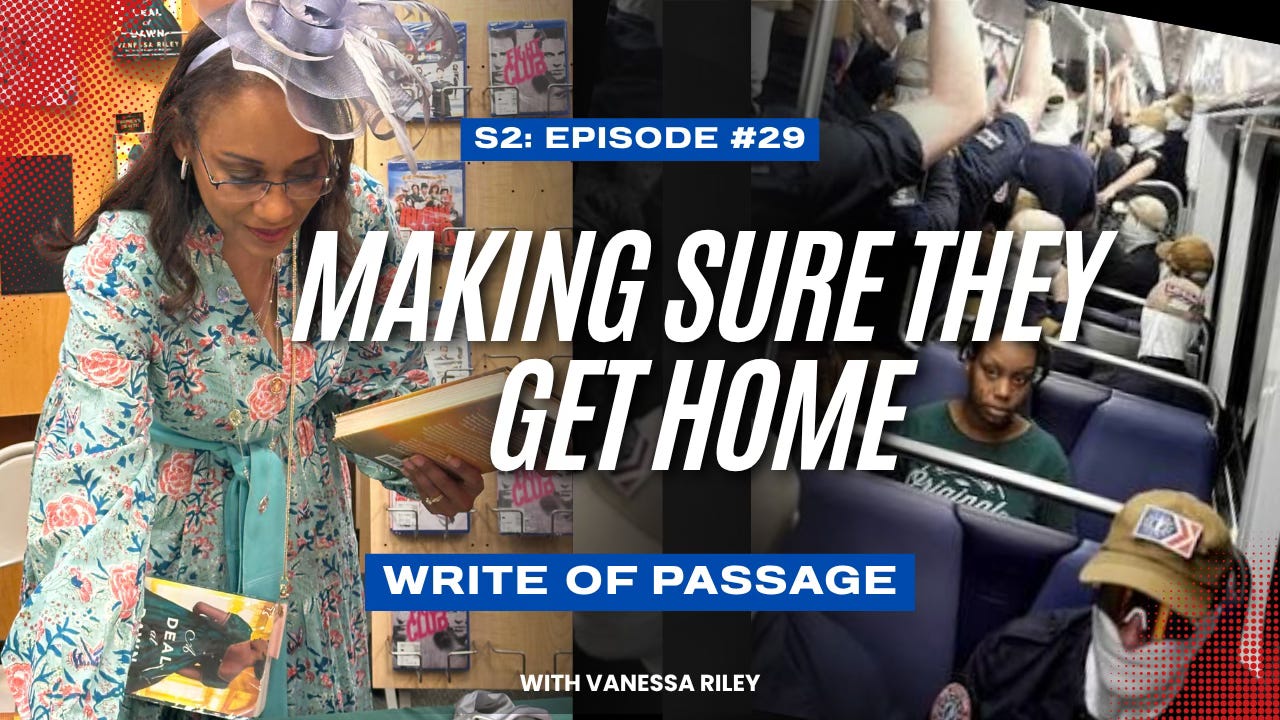
Making Sure They Get Home
4w ago00:11:46Tap to summarizeI don’t think Southern hospitality is just about sweet tea. I think it’s making sure everyone has a good time and gets home alive.Southern hospitality is supposed to mean something.Growing up, the Fourth of July meant my mother’s barbecue. It wasn’t just dinner. It became the neighborhood gathering, the family reunion you didn’t know you were having. Friends drifted in. A few cousins or uncles might show. No one brought anything because even Mama had already made it with at least three different options. You came because my mother cooked, and everyone knew that meant you were going to leave full, laughing. You were going to have a good time.That was Southern hospitality on a 4th of July Weekend. It was exciting, even before the fireworks.But this Fourth of July felt different.I don’t know many people who gathered with neighbors. Most stayed home. Even the celebrations in Washington, D.C. looked very quiet, quieter than I expected for America’s 250th birthday. Across the country, storms interrupted festivities, forcing some families to seek shelter—even inside the African American History Museum. Others didn’t feel the hospitality as they rode on buses with White Supremacists and Reuters photographers. I’d like to think that the photographers would’ve been neighborly and helped out, but they had a duty, I suppose, to capture the mask-wearing marchers.Sometimes hospitality means making a safe environment. No one should be fearful on the 4th of July.Again. This 4th felt different.No amount of BBQ or sweet tea can make up for fear or anguish. What happened to checking on your neighbors, making sure everyone has a ride, or that they make it home to call their mother?I thought about how my mother always wanted to know where I was, who I was with, and who the adults were. At the time, it felt overprotective.Now it feels like another expression of hospitality.Real hospitality isn’t simply welcoming people in.It’s making sure they get home.There are families who will never forget this holiday weekend because someone they loved didn’t make it home. My heart especially goes out to the family of Nolan Wells, a young Black man who went to celebrate with friends and never came home. Amid the unimaginable grief, his mother publicly thanked the volunteers, the United Cajun Navy, local law enforcement, and neighbors who searched alongside her.That, too, is Southern hospitality, showing up when someone else is hurting.On Sunday, the 5th, I had the opportunity to be hospitable to my readers at a release party to celebrate the of A Deal at Dawn. II held a tea party.What better way to celebrate a Regency romance?Picture tablecloths, teacups, ceramic platters, cookies, flowers, and just enough balloons to make a corner of Barnes & Noble feel less like a bookstore and more like someone’s parlor. We were tucked into the music section, and honestly, what could be more neighborly than books and music sharing the same space?Of course, I have a terrible habit of never doing anything halfway.I love to cook. Left to my own devices, every gathering becomes a catered affair. But Barnes & Noble has a café, which meant there were limits on bringing in outside food.Reality met Southern determination.I had to get creative.Normally, my backup plan is Cheryl’s Cookies. I always keep a stash in the freezer for emergencies. They’re delicious, dependable, and have rescued me on more than one gathering.But this wasn’t an emergency.This was a celebration.I kept thinking about the afternoon my daughter and I spent at the Russian Tea Room in New York. The tiny pastries. The beautiful presentation. The sense that every bite had been chosen with care.If I couldn’t recreate that menu, I could recreate the feeling.Every Southern tea needs cake.So I invented tea cake cupcakes.The recipe grew out of the world of A Deal at Dawn. While writing the novel, I kept returning to preserved fruits and candies. In eighteenth-century Saint Petersburg, oranges were rare luxuries. When people had them, they treasured them, preserving every bit they could in marmalades and jams.That became my inspiration.I took my favorite pound cake recipe, whipped the butter until it was impossibly light, folded in rich orange marmalade, and added buttermilk because Southern baking practically demands it. The result tasted like sunshine tucked inside a cupcake.Maybe it was over the top.But it was neighborly.That’s what Southern cooks do.I get it from my mother.I get it from the soil and the air that she raised me in.I want to feed people.I want them to slow down.I want them to feel safe.I want them to feel seen.As joyful as Sunday was, the weekend as whole kept reminding me why those things matter. I’m often asked which book signing has been my favorite. Every signing is my favorite.Whether one person comes or a hundred, someone has carved out space in their day to spend time with me and my stories. They’ve read my books, shared them with friends, recommended them to libraries, and welcomed my characters into their lives.That’s hospitality, too. The best kind.So thank you to everyone who joined me for tea, who picked up A Deal at Dawn, who recommended it to a friend or a book club, or who simply stopped by to say hello.Southern hospitality isn’t just about the food. It’s the vibe and feeling safe. It’s about making people feel nurtured and nourished—in body, in spirit, and in hope. And that they make it home alive.This week’s book list includes:The Cooking Gene by Michael W. TwittyA remarkable exploration of Southern food, family, ancestry, and the complicated history behind what ends up on our tables.High on the Hog by Jessica B. HarrisPart history, part celebration, this book traces the influence of African American cooks and traditions on American cuisine. The TV documentary of the same title, adapted by Stephen Satterfield, expands on Harris’s research by traveling to locations in West Africa and the United States to explore how African culinary traditions have shaped American food.An Infinite Love Story by Chanel ClaytonI hope you’ll join me tonight, July 7, at Eagle Eye Book Shop in Decatur, Georgia, where I’ll be in conversation with my friend Chanel Clayton to celebrate the release of her stunning new novel.This page-turner follows Vivian Mitchell, the wife of an astronaut, as she navigates the uncertainty and anxiety of waiting for her husband to return home from what is supposed to be his final mission. It’s a moving story about love, resilience, and hope. Since she’s visiting Georgia, let’s show her some Southern hospitality—the good kind.A Deal at Dawn by Vanessa Riley — Jahleel and Katherine embrace devastating, unexpected turns, make difficult choices, and discover that the life they need is nothing they planned for.Get these books from Eagle Eye Book Shop. They still have a few signed copies of Fire Sword and Sea.You can also try one of my partners in the fight, bookstores large and small, who are in the trenches with me.You can find my notes on Substack or on my website, VanessaRiley.com, under the podcast link in the About tab.Let’s keep rising and creating together. I need you. Like, share, subscribe, and stay connected to Write of Passage.It’s the neighborly thing to do. Thank you for being here.I want you to come again. This is Vanessa Riley. This is a public episode. If you'd like to discuss this with other subscribers or get access to bonus episodes, visit vanessariley.substack.com/subscribe
Transcribe →
Access Isn’t Permission
Jun 3000:15:38Tap to summarizeHere’s a dangerous lie the internet tells us: if information is public, it’s fair game. If I have to do a little hunting, a little scraping to get it—well, that just shows how clever I am.If I told you that this can be harmful. And that some of us don’t know that this invasion of privacy can erode trust forever—would you still do it? We are one like away from being unforgiven.Access Isn’t PermissionWhat is unforgivable?That sounds like a grand philosophical question. And I’m not asking this in the courtroom or commandment sense but in the everyday ways we treat each other. What crosses that simple line of right and slightly harmless wrong?Is it oversharing? Gossip? A tidbit of seductive knowledge that you found that no one else has publicly announced?Does this secret knowledge make you feel powerful?Before we go there, I need to define two words that have become part of our modern vocabulary.The first is parasocial.A parasocial relationship is a one-sided relationship where an audience member feels a deep connection to a public figure. That audience member or voyeur doesn’t actually know the public person personally, but they are invested. I’m guilty of this. I take it personally when people condemn Meghan Markle, the Duchess of Sussex, for breathing. When herAs Ever debuted, it sold out in 5 minutes. I was part of that shopping fest.A parasocial relationship is not inherently unhealthy. More and more it’s part of being an artist. Brands and publishers want that vibe to push sales. Readers want to feel like they know an author. It means so much when our words have entertained them on lonely nights and comforted them through grief.The second word is never good, doxxing. Doxxing is the act of publicly revealing someone’s private, identifying information without their consent. Often, doxxing will mean someone has published home addresses, phone numbers, places of work, or more.Recently, my friend, bestselling romance author Kennedy Ryan, appeared on a podcast with Jenna Bush, and during a lighthearted conversation about pen names, Kennedy shared that she originally adopted a pseudonym to protect her professional career and now continues to use it to protect her peace.Her peace. Catch that part.Not because she was hiding. Not because she was ashamed.Because she wanted boundaries. She deserves boundaries so she can keep a piece of herself and her life for herself.Soon afterward, the internet sleuths, parasocial avengers, began circulating her legal name in posts and threads online. Some have actually argued that releasing a legal name isn’t really doxxing because her legal name had been publicly discoverable for years.I’m sorry…Since when did intent or access excuse the action?If someone tells you, “This is private. This is how I protect myself and my family,” and you decide to broadcast that information anyway, what exactly are you accomplishing? Congrats! You’re smart. You can scrape metadata and websites. Feel good.Maybe placate your conscience because you didn’t post her home address.Hey, you didn’t hack a bank account. So clearly you are different. You’re in a category above criminals.Just because you didn’t intend harm, that doesn’t mean you didn’t cause harm. You ignored a clearly stated boundary. That’s the part our conscience should struggle with.Is it an unforgivable offense? That’s not for me to decide.What does this violation do? Hopefully, no legal harm, but you’ve made everyone on the receiving side of a fandom or readership more cautious and potentially more closed off.If you go to threads, you can see this in real time.One person wrote: “One day, in the very near future, y’all are going to lose all access to your favorite authors.”Another author wrote about feeling so violated “after her government name was shared,” that she endured harassment, stalking, and cyber abuse so severe she nearly abandoned writing forever.Another creator, from the gaming community, described having her address and phone number spread online, receiving death threats, and watching her mother become a target of harassment. It took years of therapy before she felt safe again.All of these are different situations.Different levels of harm.Yet, they all share a common thread: Someone else decided that another person’s boundaries didn’t matter.As authors, we want readers to love our books.We want to meet you. We want to laugh with you at signings, hug you at festivals, celebrate release days together. We want to feel close.But there is a distinct difference between closeness and entitlement.Writing is my profession. It is also one of the most personal things I do. Every novel asks me to hand over pieces of myself.My fears.My questions.My hopes.And sometimes my grief.Whether you’re a novelist, painter, musician, actor, graphics designer, or sculptor—every work of art contains something deeply personal. You struggle and learn—really learn—to release it into the world and let others enjoy it and make it their own.That is so hard and it its one of the hardest lessons every artist faces.Some will love your work.Some will misunderstand your work.Some will hate it.But that is the rite of passage from creator to consumer.But art isn’t ownership.It does not extend to the artist’s private life.Many of us create because we’ve built spaces where we feel safe.Some write with music.Some light candles.Some write only before sunrise.For me, I close the office door.Outside that room, life can be chaotic.Inside it, new worlds are born.That space only exists because it feels protected.With protection comes access and the willingness to share.Earlier this year, I did a tour for Fire Sword and Sea, packing in a month’s worth of travel into one week. I did it. Shared behind-the-scenes content. Met people from all over. I financed this tour from my pocket. I did it because I wanted you to meet me and this powerful story of adventure and bucking norms.If an author doesn’t feel safe, we make different choices. When our relationship to readers changes, we all lose. I saw Kenedy when she came to Atlanta. It was the last stop on her multi-week tour. She signed hundred and hundreds of books. Took group selfies. And then personally hugged and greeted local authors and superfans. I don’t think she’d been in her own bed in a month.If she doesn’t feel safe, she’s not going to stretch herself, no matter how much she wants the next book to touch you.We all lose.Today marks the release of A Deal at Dawn. It’s my thirtieth book.Thirty. Thirty pieces of my heart.Thirty moments where I sat alone with imaginary people, crafting and shaping their story until it was ready to hand it over to you.This entire series has explored difficult questions, and it comes to a head in A Deal at Dawn.What does love look like when someone lives with a chronic, debilitating illness like sickle cell disease?How do families navigate chronic illness?How do communities care for one another?And for the lovers, what happens when tomorrow isn’t promised?These aren’t abstract ideas for me. People in my own family have lived with sickle cell disease. Some have died from it. And from interacting with you, I’ve found similar stories. I was able to use the dedication to honor them.From the bits of information, you may recognize these stories. Don’t dox. Pray for cures. Make donations to:AMERICAN SICKLE CELL ANEMIA ASSOCIATIONST. JUDE CHILDREN’S RESEARCH HOSPITAL- SICKLE CELL DISEASE TREATMENT SICKLE CELL DISEASE ASSOCIATION OF AMERICA, INC.For me, writing these books is never simply about entertainment.It’s remembrance.It’s advocacy.It’s love, unwavering, unearned, forever love.And Jahleel and Katherine’s story asks one more question. Are there things that are truly unforgivable? Katherne was going to let Jahleel die, never knowing the truth. How do you make up for that?Romance promises a happily-ever-after.Real life doesn’t always offer one.So we have to hold on to now, be happy for now, and hope now lasts forever.As someone who is thrilled by what we have going on, for you showing up here every week to Write of Passage, I want to say thank you. Thank you for the love and respect.This week’s book list is very simple.Get Kennedy Ryan’s Score. It’s her latest, and it’s so good. There are signed copies at Eagle Eye Books.You can also get A Deal at Dawn from Eagle Eye, The New Romantics Bookstore, call <a target="_blank" href="https://www.montgomeryandtaggert.com/preorders?utm_source=ig&utm_medium=social&utm_content=link_in_bio&fbclid=PAZnRzaASwGKBleHRuA2FlbQIxMQBzcnRjBmFwcF9pZA8xMjQwMjQ1NzQyODc0...
Transcribe →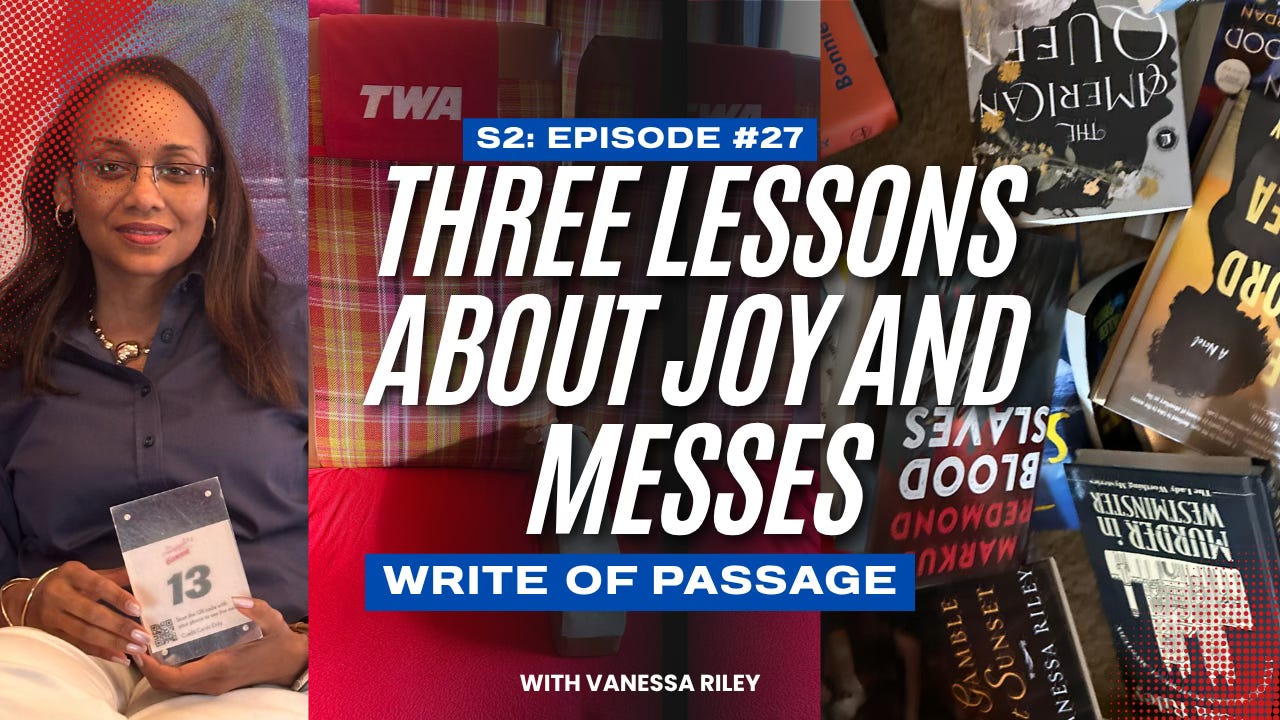
Three Lessons About Joy and Messes
Jun 2300:11:09Tap to summarizeWhat if the best thing that happened to you this week was the thing you didn’t want?A canceled flight. A collapsed bookcase. An unexpected lesson about time. Today, I’m sharing three lessons about joy, messes, and the surprising gifts hidden inside life’s interruptions.Three Lessons About Joy and MessesThree things happened within roughly the same stretch of time.The first was an incredible weekend in Nantucket with my daughter. It was the ultimate girls’ trip—great food, great company, wonderful conversations, and the chance to explore museums, historical sites, and a place filled with stories. We laughed, wandered, and simply enjoyed being together. It was intentional time. Planned time. Chosen time.The second thing was completely unexpected.Mr. Weather decided we weren’t leaving when we thought we would. A canceled flight forced us to stay overnight, which led us to spend a day at the TWA Hotel at JFK Airport. And honestly? It was magical.Expensive, yes—but magical.We wandered through the restored 1960s hair salon, explored the airplane turned cocktail lounge, and admired the sweeping curves of the architecture. The rounded concrete forms and futuristic design made it feel as if we had stepped back into another era. Watching my daughter’s eyes light up was perhaps the best part. As a budding architect, she noticed every detail, every design choice, every intentional curve and angle. What could have been an inconvenience became an adventure.And then there was the third thing.A bookcase that had been warning me for months that it was in trouble finally gave up the fight. It crashed. Spectacularly.Books everywhere.Hundreds of them.The floor disappeared beneath a sea of hardcovers, paperbacks, research materials, and treasures collected over years.Unlike Nantucket, this wasn’t something I wanted to do.Unlike the weather delay, it wasn’t unexpected.It was something I knew needed attention and chose to ignore.The pile demanded my time.Now what do all three experiences have in common.Time.One was time I deliberately chose.One was time unexpectedly given.And one was time owed but thought the problem could wait.Life is always moving forward, and sometimes we get to decide exactly how we’ll spend our time. Other times, circumstances decide for us. Some things arrive as gifts. Some arrive as burdens. And then we get those as warnings of a future time sink that we ignore.But what if we approached all of it with the same attitude?What if every moment became an opportunity for exploration?What can we learn?What can we share?What joy can come from it?Finding joy in Nantucket wasn’t difficult. Being with my daughter was a joy. Every conversation, every laugh, every walk through a museum or hanging with other writers reminded me how precious shared experiences can be.Finding joy in an unexpected airport hotel stay wasn’t difficult either. Adventure often hides inside inconvenience if we’re willing to look for it.The fallen bookcase, however, required a different kind of joy.Because when I looked at that mess, I realized I had choices.I could pile the books in a corner and move on.Or I could use the moment as an opportunity.Maybe it’s time to redesign my office.Maybe it’s time to give everything a permanent home.Maybe it’s time to display the objects that inspire me every day when I sit down to work.And what about that desk?It’s too big.It’s cluttered.It’s become claustrophobic.Maybe it’s time for that to go too.My workspace should reflect who I’ve become.Writing is not a hobby for me.For some people, it may be. But for me, it’s work. It’s my livelihood. It’s bread and butter. Its purpose and profession wrapped together.My office should reflect the writer I’ve become, not the writer I used to be.That means making hard choices.Some books will stay.The research books? They’re never leaving. Those are tools of the trade. They need to be dusted, organized, protected, and placed where I can easily access them.But do I need multiple copies of the same book?Probably not.Some of my collection will find new homes in Little Free Libraries across Atlanta, where they’ll continue their journey with new readers.Collectors understand this struggle. We love our treasures. But sometimes holding on to everything prevents us from making room for what’s next.And that’s really the lesson.Somewhere between the planned retreat, the canceled flight, and the collapsed bookcase, I found a reminder that peace isn’t found only in perfect circumstances.Sometimes peace is released in how we respond.There’s wisdom hidden in delays.And we should find gratitude in survivable messes.Life is made up of choices.The expected and unexpected.The joyful and the inconvenient.The burdensome and the beautiful.Every moment asks something of us. The question is whether we are listening.This week’s book list:The Midnight Library by Matt HaigA beautiful meditation on choices, alternate paths, regret, and learning to appreciate the life you’re actually living.The Storied Life of A.J. Fikry by Gabrielle Zevin (author of Tomorrow, and Tomorrow, and Tomorrow)A bookseller’s carefully ordered life is repeatedly interrupted by unexpected events that ultimately transform him.Silver Sparrow by Tayari Jones (author of American Marriage and recent hit, Kin)This novel is about the lives we plan, the lives we inherit, and the consequences of choices made long before we understand them.And since it’s still Obama week, The Light We Carry by Michelle ObamaThis book delves into finding steadiness amid uncertainty. Get caught in a discussion about resilience, adaptation, and discovering purpose during unexpected transitions.A Deal at Dawn by Vanessa Riley — Jahleel and Katherine embrace devastating, unexpected turns, make difficult choices, and discover that the life they need is nothing they planned for. Let the games begin. Releases June 30th. Preorder and ask for it at your library.Get these books from The Book Cellar, in Conyers, GA. They still have a few signed copies of Fire Sword and Sea.You can also try one of my partners in the fight, bookstores large and small, who are in the trenches with me.You can find my notes on Substack or on my website, VanessaRiley.com, under the podcast link in the About tab.Let’s keep rising and creating together. I need you. Like, share, subscribe, and stay connected to Write of Passage.Thank you for being here.I want you to come again. This is Vanessa Riley. This is a public episode. If you'd like to discuss this with other subscribers or get access to bonus episodes, visit vanessariley.substack.com/subscribe
Transcribe →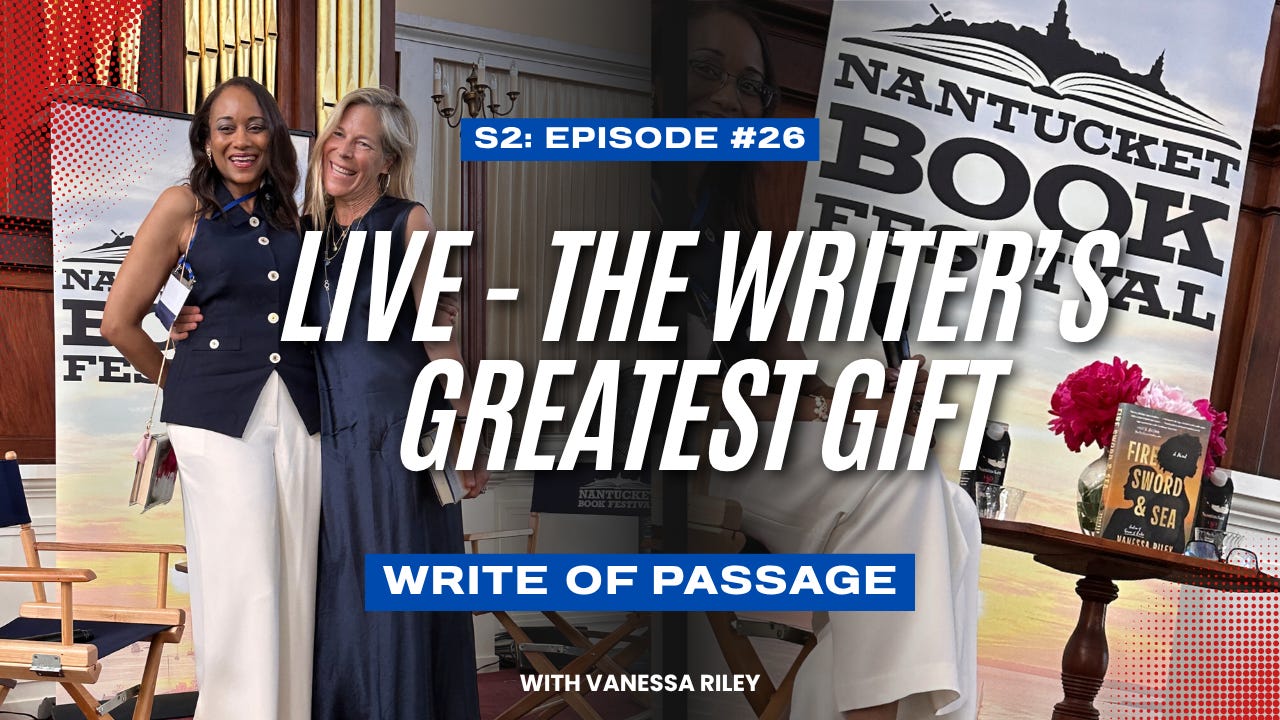
The Writer’s Greatest Gift
Jun 1600:21:16Tap to summarizeHello, friends. I’m Vanessa Riley, and this week I’m coming to you from beautiful Nantucket. Join me for this conversation with bestselling author Dawn Tripp at the Nantucket Book Festival. Our conversation, two fellow storytellers, we talk about the magic behind Fire Sword and Sea. Welcome to our talkVanessa and Dawn TrippHello, friends. I’m Vanessa Riley, coming to you from beautiful Nantucket. Join me as I explore the Nantucket Book Festival, meet fellow storytellers, and share the magic behind Fire Sword and Sea. Welcome to the journey.Please come back next week for more Write of Passage! This is a public episode. If you'd like to discuss this with other subscribers or get access to bonus episodes, visit vanessariley.substack.com/subscribe
Transcribe →
Everybody Loves Justice Until It Costs Something
Jun 900:18:38Tap to summarizeIn a world where silence is profitable and outrage is performative, character still matters. Today I’m asking you a simple question with complicated consequences: Shall you take a stand, or stay seated?Take a Stand or Take a SeatI was watching The New York Times interview with Scott Pelley when the reporter asked him to respond to a statement celebrating his firing from 60 Minutes.The president called him “stiff” and part of a “gang of stupid, crooked people that don’t care about the country.”Pelley’s response is both tactful and visceral. He didn’t seem to care about being fired for his beliefs. He didn’t seem concerned about answering to power. He stood up right and got fired, when so many others might have said nothing, kept their seats, and protected their paychecks.I get it.It’s tough out here.According to Stanford’s 2026 AI Index Report, 90% of companies using AI-assisted applicant evaluations retain candidate scores for up to 330 days. That means one bad assessment, one poorly matched resume, or one automated rejection can effectively lock you out of opportunities for nearly a year. AI adoption is growing faster than ever. Yet brave researchers buck the trends and report inconsistencies and limitations in these systems. But that doesn’t help if you’re caught in that 330-day lockout.So yes, I understand why people say nothing and cling to their jobs.But if an environment demands that you surrender your values to keep your position, it might be worth considering an exit strategy.Quiet quit.Update your résumé.Find another lane.Because an environment with no morals will eventually consume yours.Back to Scott.Accused of being crooked and seditious, he swallows and carefully chooses his words. There’s still more to lose because leadership is being weaponized.I remember a time when, regardless of party, there was at least an expectation that the occupants of the highest offices in the land would demonstrate empathy and respect for all Americans. Those days feel very far away.So hearing a journalist described as a “stiff” who “doesn’t care about the country” because he asked difficult questions- well, let’s just call it disappointing.Watching a news veteran like Scott Pelley visibly choke up when responding to the accusation was moving.In his interview, Pelley reminded viewers that while he never served in uniform, he spent years reporting from war zones.“I’ve been in combat for this country in Afghanistan and Iraq. I’ve spent nights in foxholes. You become a journalist because you love the First Amendment. There is no democracy without journalism.”Scott is someone who stood up and risked his life in pursuit of truth.It reminds me of people throughout history who believed in something enough to sacrifice for it.People who risked financial ruin. People who lost family members. People who gave up comfort, status, and sometimes their lives for truth or some big principle.In an age where everything feels transactional, people like Pelley or Ida B Wells show us that there are things worth fighting for.The current political and cultural climate sharply reveals the difference between true allyship and performative allyship.Sitting back, waiting for things to change, costs women—particularly Black women and women of color.But Vanessa, I’m scared.I get it. Some things are triggering. I understand that. Everyone must have their own standards and beliefs. But don’t expect others to help you when you are the one in the line of fire.For me, I believe in the dignity of the human experience. You see my pen write this experience in a Fire Sword and Sea. In the beginning, Jacquotte is a passionate screw-up, but she finds her calling, rises to her feet, and becomes a captain leading an integrated crew of men and women.I believe laughter is still the best medicine. You see that in A Deal at Dawn when enemies-to-lovers laugh about old times while dealing with the enemy, chronic illness.I believe hard work matters.I believe prayer matters.And I still believe that when you focus, work, and persist, you can move closer to the desires of your heart.But what troubles me is how often public virtue has become performance.In 2020 people in publishing sat at home posting black squares. These posts on Instagram cost them nothing. And when many of their Black and brown colleagues were fired in 22-24, they didn’t post anything.A black square requires no sacrifice. No difficult conversations. No risk. No courage at all.There’s nothing wrong with capitalism. Nothing wrong with protecting your peace and your pockets. Just don’t confuse me by making me think you care. I’d respect you more if you were openly scheming aka JR Ewing of Dallas not that backstabbing Iago from Othello. Please don’t be the deceiving Uriah Heep from David Copperfield—humble while plotting my doom.I don’t need that kind of disappointment and heartache in my life.But this is America.Companies can hire and fire people for many reasons. In most places, employment remains largely at-will.If there was a legal way to know the workplace is amoral, doesn’t like to hire women, is loath to put a Black woman in charge—I’d like to know. Is that a Reddit or Threads feed?If you have preferences or prejudices, own it. Trust me. We expect you to stay in your seat, way over there.In a matter, I truly want to call, “ You don’t want us, so leave us alone,”There’s a lawsuit filed by Colorado dermatologist Dr. Travis Morrell and the advocacy group, Do No Harm, against Find A Black Doctor, a directory created to help patients locate Black physicians. The lawsuit argues that restricting listings to Black doctors constitutes discrimination.The irony is hard to ignore.Black Americans make up only a small percentage of physicians nationwide. Patients often seek doctors who understand their cultural experiences:John Hopkins has found:Black patients are much more likely than white patients to discover language in those records that indicates they are not believed by their physicians. - What in the DEI?So let me get this straight. Instead of building new resources or even working to dismantle disparities, you’d rather dismantle a system trying to fix it. Dr. Morrell be honest.Black people constitute 4% of Colorado. Perhaps this doctor and his conservative group should spend more on advertising to reach that 4% or I don’t know…post some research to show how your treatments benefit Black skin. But you can’t because all skin matters, even if some hydrate and respond differently.The question isn’t really lotion. It’s access.Deep down, it’s ownership.Who gets to create community spaces? Who plans where the number of tables and where the seats go?And who gets to benefit from the dollars at those tables?Meanwhile, small farmers continue to discover what happens when their voting preferences have real-world consequences.The current administration has issued federal cuts reducing funding for local food purchasing programs that used small farms to service schools and food banks. Farmers like Iowan Anna Pesek have warned that losing this funding hurts already razor-thin margins and weakens local food economies.At the same time, Congress has advanced proposals to reduce WIC funding by $200 million. According to the Center on Budget and Policy Priorities, those cuts could reduce fruit and vegetable benefits by more than $141 million for approximately 5.4 million women and children.Actions have consequences.Votes have consequences.Policies have consequences.Character has consequences.Demonizing programs that helped the elderly, moms, and children now hurts small farms. Generational legacies are being lost. These are consequences.I care about lost legacies. It hurts a lot of tables. Farms collapsing is a recipe for humanitarian and economic disasters.So what are you saying, Vanessa. Well, have a seat.I need you to think about what you stand for. I want you to think long and hard about it.Make up your mind with facts, not social media or even online essays like this.I spend a fair amount of time on social media. Social media can be fun, informative, a start point.But it is first and foremost a commerce lane. For authors, we use it to scream, stand up for causes and especially, marketing.Most writers would gladly choose a quiet afternoon...
Transcribe →
Move That Dang Rock
Jun 200:12:01Tap to summarizeWhat’s holding you back?Is it what they did? Is it some failing from years ago? Or is it what somebody said that shook you?I am a cross between the “name it and claim it” generation and the put-a-root-and-an-evil-eye-on-it people. But somewhere between faith and magic, between action and waiting, there’s something we are doing wrong.Move That Dang Rock: What’s Really Holding You Back?This weekend, I found myself in a room with thousands of Black women readers. The ladies had traveled across the country to buy books from Black authors, meet their favorite writers, and celebrate stories that center Black love, Black joy, and Black hope.It was the second Black Romance Book Fest.What amazes me most is that this gathering started as the dream of one indie author, Lauren Lacey. She imagined a place that would become a pilgrimage site for readers seeking stories where melanated heroes and heroines got happy endings.The publishing industry told her it couldn’t be done.Some said no one would come.Others suggested this was a pipe dream. Still others questioned if this market existed.Many stayed quiet, sneering that she’d soon learn that Black readers didn’t matter enough to build something big.Lauren didn’t listen.She didn’t waste her energy arguing with people who couldn’t see her vision. She didn’t spend years waiting for permission. She simply started building.Today, the Black Romance Book Fest is one of the largest gatherings of Black readers in the country. Thousands of readers fill these rooms. Authors sold books. Friendships were formed or renewed. Community became stronger.All because one person refused to let doubt become destiny.Now, some people might ask, “Why create something separate? Aren’t there already plenty of book festivals?”Let me explain it this way.Have you ever ordered a burger and specifically asked for no onions and no pickles?The waiter brings out lunch, but the pickle and onions are still there.You’re hungry, so you try to make it work, ripping off the pickle and onions. The burger is good. The meat is flavorful. The cheese is perfect, but the juice of the pickle, the tang of the onion are still there. Every few bites, you hit a pickle. The taste of onion coats the tongue. You spend the whole meal navigating around something that wasn’t made with you in mind.That’s what many spaces can feel like.There are wonderful book events all over the country, and I love attending them. I love meeting all readers. I love introducing people to stories about powerful women and expansive histories.But at Black Romance Book Fest, I don’t have to navigate around the pickles.I don’t have to explain myself.I don’t have to wonder if I belong.I can simply exist.I can let my hair down. I code-switch for fun, not survival.I am fully seen.And that kind of belonging matters.One thing I love about the Laurens of the world. They don’t understand the word “impossible.”Tell them something has never been done, and they immediately start figuring out how to do it.They challenge systems.They move fast.They focus. They win.Can you focus? Are you so accustomed to disappointment that you can’t imagine success?Are you frozen by a past failure? Are you haunted by a dream that didn’t work out the first time?Have you convinced yourself that your best efforts will never be enough?Are you quietly quitting on yourself?Maybe you’ve wanted to write a book for years and just couldn’t pull it together.I meet people all the time who tell me they want to write a book. Then I see them years later, and they still want to write a book.Wanting is not writing.One hundred words a day—about ten sentences—creates more than 30,000 words in a year. That’s a novella.The problem isn’t always talent.Sometimes the problem is fear, fear wrapped up in perfectionism.What’s the rock sitting in the middle of your path? What’s the thing you’ve been walking around, staring at, complaining about, but never moved?Are you waiting for the perfect moment?Sometimes the problem is us.In my life, I’ve let fear silence me.I’ve kept my head down when I should have spoken up. I’ve worried about criticism instead of focusing on purpose.But there comes a point when you have to rise.There comes a point when you have to look fear in the eye and move anyway.And if you fail? At least you failed swinging.So here are three questions to ask yourself when you’re trying to figure out what’s holding you back.First: What do I truly want?· Not what other people want for me.· Not what looks practical.· What do I actually want?Second: What am I afraid of?· Failure?· Success?· Criticism?· Disappointment?Name it, but don’t claim it.Third: What’s one thing I can do today? Just one thing.Not next year.Not someday.Today.Dreams aren’t built in giant leaps but by daily steps taken. So start, start today.Along the way, encourage somebody else.Support people who are trying.Celebrate effort.Point out what’s working instead of what’s broken.The world has enough critics.What it needs are builders and encouragers.What it needs are people willing to help move boulders—not just out of their own path, but out of their neighbor’s path too.Because when readers gather, when artists create, when dreamers build, when communities support one another, those rocks begin to shake. They rattle and fall.So, I’ll ask you one more time.What’s holding you back?Take the time today to name it, then work, work until the rock moves.This week’s reading list includes:Year of Yes by Shonda Rhimes — About overcoming fear, embracing opportunities, and saying yes to the life you actually want.Professional Troublemaker by Luvvie Ajayi Jones — A great guide to speaking up, taking risks, and refusing to be silenced by fear.On the fiction front:The Vanishing Half by Brit Bennett — A story of identity, ambition, and the choices we make when pursuing the lives we want, regardless of the cost.The Other Princess by Denny S. Bryce — A princess challenges a queen’s expectations and follows her heart, risking everything for love and self-determination.If you’re ready to raise a sword and gain a new destiny, consider purchasing Fire Sword and Sea, my latest release.Or if you are in need of laughs and inclusivity and to see the real good guys win, preorder or review at NetGalley, and request at your local library, A Deal at Dawn. Step into a cliffhanger, where the Duke of Torrance is dying to finally be a father to his daughter, but he must deal with the girl’s mother, the woman who humbled him and broke his heart.Get these books from The Book Cellar. They still have a few signed copies of Fire Sword and Sea.You can also try one of my partners in the fight, bookstores large and small, who are in the trenches with me.You can find my notes on Substack or on my website, VanessaRiley.com, under the podcast link in the About tab.Hey. Let’s keep rising and creating together. I need you. Like, share, subscribe, and stay connected to Write of Passage.Thank you for being here.I want you to come again. This is Vanessa Riley. This is a public episode. If you'd like to discuss this with other subscribers or get access to bonus episodes, visit vanessariley.substack.com/subscribe
Transcribe →
Sorry for Slavery. Checks for Criminals.
May 2600:15:02Tap to summarizeWhile criminals get rich, a holy man said sorry. - The pope apologized for the Catholic Church’s role in slavery. Five hundred and seventy-four years after popes authorized the enslavement of Africans, the Vatican finally admits its complicity.So I’m asking. What does an apology mean when violent offenders and felons get reparations? I’m thinking this might be the first receipt in a long-overdue accounting.Today, Pope Leo XIV used his first encyclical, Magnifica Humanitas — “Magnificent Humanity” — to apologize for the Catholic Church’s role in legitimizing slavery.I don’t know if y’all understand how big of a deal that is.According to the Associated Press, this is the first time a pope has publicly acknowledged and apologized for the role that past popes themselves played in giving European sovereigns authority to subjugate and enslave non-Christians.That is huge.But at the same time?It is still just words.So today, I’m going to give you a little history — and some math.In every book I write that involves the Caribbean, one of the most disconcerting things I find is that the Catholic Church was complicit in the moral sin of enslavement.I am a woman of faith (or, as Ellen, my daughter, says, Non-denominational with Baptist leanings).My faith grounds me. It’s my identity. It has sustained me in some of my darkest hours.But when I do research and see enslaved people working in horrible conditions for priests, ministers, missionaries, and all the Catholic orders, I have to sit with that contradiction.Can you imagine spreading the good news of a Savior while returning to camp to beat and punish someone because the law said you were allowed to own them? Can you imagine preaching salvation while denying someone else’s humanity?Today I ask: what matters more — the apology, or the 574-year delay?In 1452, Pope Nicholas V issued Dum Diversas, authorizing the Portuguese crown to conquer, subjugate, and enslave non-Christians in Africa. The AP reports that this gave permission to “reduce their persons to perpetual slavery.”That was 574 years ago.Five hundred and seventy-four years is a long time to wait for someone to say, “We were wrong.” So yes, give some credit to Pope Leo.He’s American. He is from Chicago. His family tree includes both enslaved people and enslavers. Maybe all of that matters. Maybe that’s why he could step up and say wrong is wrong, even if his own hands were never on the master’s whip.That means something.But it does not mean everything.Because apologies without repair are just public relations.So let’s talk numbers.In 1838, the Maryland Province of the Society of Jesus — the Jesuits — sold 272 enslaved people to two Louisiana planters for $115,000.That gives us a benchmark:$115,000 divided by 272 people equals $422.79 per enslaved person in 1838 dollars.Historian Andrew Dial estimates that they held more than 20,000 people in bondage by the mid-eighteenth century.So let’s calculate from there.If 20,000 enslaved people were valued at the Georgetown benchmark:20,000 × $422.79 = $8.46 million in 1838 dollars. $296–338 millionBut Jesuits are just one order of the Catholic Church, if you add the Franciscans, Dominicans, Capuchins, missions, universities, and the plantation systems throughout Brazil, Haiti, Cuba, Louisiana, and the French Caribbean, you can increase that number to 100,000 - 400,000 enslaved people.The value rises from $296 Million to as high as $5 billion in today’s dollars.That is the math.Now let’s widen the lens.The Trans-Atlantic Slave Trade Database estimates about 12.5 million Africans were transported across the Atlantic slave trade.Using the same Georgetown benchmark:12.5 million × $422.79 = $5.285 billion in 1838 dollars.In today’s dollars, that is roughly: $185 billion to $211 billion.And that is still only the body-price.· Not labor.· Not land.· Not sugar.· Not cotton.· Not tobacco.· Not banks.· Not insurance.· Not universities.· Not inherited wealth.· Not compound interest.· Just the sale value of humans.Well, Vanessa, I’m not Catholic. I figured you’d remember that. Let’s bring this home to the United States.Historians generally estimate that about 388,000 Africans were directly imported into what became the United States. By 1860, the enslaved population had grown to nearly 4 million people through forced reproduction and hereditary slavery.Using the Georgetown benchmark:4,000,000 × $422.79 = $1.691 billion in 1838 dollars.Converted today: $59 billion to $68 billion.Now, if you divided that across roughly 49 million Black Americans today, that would be about: $1,200 to $1,388 per person.And somebody will say, “See, that’s not that much. Get over it.”They would be right about the number, because it is too small. It only values enslaved people as property. It does not include what was stolen from them and their descendants.It does not include:* 250 years of unpaid labor,* lost wages,* stolen inheritance,* land theft,* banking and insurance profits,* cotton, tobacco, and sugar profits,* Jim Crow,* poll taxes,* redlining,* burned Black business districts,* medical experimentation,* biased healthcare,* or the generational trauma that shows up in Black bodies today.* Excuse me while I take my blood pressure medicine.* Le Sigh.All of this moves the numbers from billions to trillions. Wage-based models alone calculate unpaid labor plus interest at $19.1 trillion.So now we’re talking about $466K per descendant of US Chattel slavery.Congress is not about to cut anybody but a blood relative of the president or a convicted J6 criminal a check for $466,000. It would be nice, but I’d not bet on fairness or wholeness.And speaking of blood pressure, the National Institutes of Health shows Black Americans are still affected by structural racism and intergenerational trauma, which leads to Hypertension. Heart disease and higher rates of maternal and infant mortality.That sounds like payable damages to me. Any trial lawyers listening?All of this is to say that if the federal government can create a $1.776 billion “Anti-Weaponization Fund” to compensate people who claim they were harmed by government power, then maybe we should ask: what do we call slavery, Jim Crow, redlining, poll taxes, eminent domain seizures, and violence directed at Black families— but being harmed by government power?The Justice Department will issue formal apologies and monetary relief to people who suffered improper government action from their criminal activities, but not to people harmed by the government’s racial biased policies .Remember slavery was encoded in laws, directed by government actions in Black Codes, Jim Crow, and redlining.Remember poll taxes were legalAnd today, eminent domain is still being used to strip Black families of land.If America has suddenly discovered that formal apologies and monetary relief are appropriate to repair harm done by the government, I have a list.It’s not as long as 574 years, but it begins with an apology.I thank Pope Leo. This is a start. It’s not the end. Truth cracks open the door.Because good people ask forgiveness for their sins.And we need to figure out how to stop bad ones from getting paid for theirs.And if you’re feeling generous, you can always subscribe. Very generous, consider becoming a paid subscriber. Extremely beneficial, patron level -- Checks can be made payable to Vanessa Riley, in care of Gallium Optronics, LLC.This week’s reading list includes:The 272 - Rachel L. SwarnsA modern account of the Jesuit sale of 272 enslaved people that helped stabilize Georgetown University financially.The Half Has Never Been Told- Edward E. BaptistIllustrates the economic arguments showing slavery as foundational to American capitalism.The Color of Law - Richard RothsteinShows how redlining and segregation were legally engineered by government policy.If you’re mad enough to raise a sword and consider purchasing Fire Sword and Sea, my latest release.Or if you are in need of laughs and inclusivity and to see the guys win, preorder or review at NetGalley, or request at your local library, A Deal at Dawn. Step into a cliffhanger, where the Duke of Torrance is dying to finally be a father to his daughter, but he must deal with the girl’s mother, the woman who humbled him and broke his heart.Get these books from Resist Booksellers . They still have a few signed copies of Fire Sword and Sea.You can also try one of my partners in the fight, bookstores large and small, who are in the trenches with me.</st...
Transcribe →