← You're Dead to Me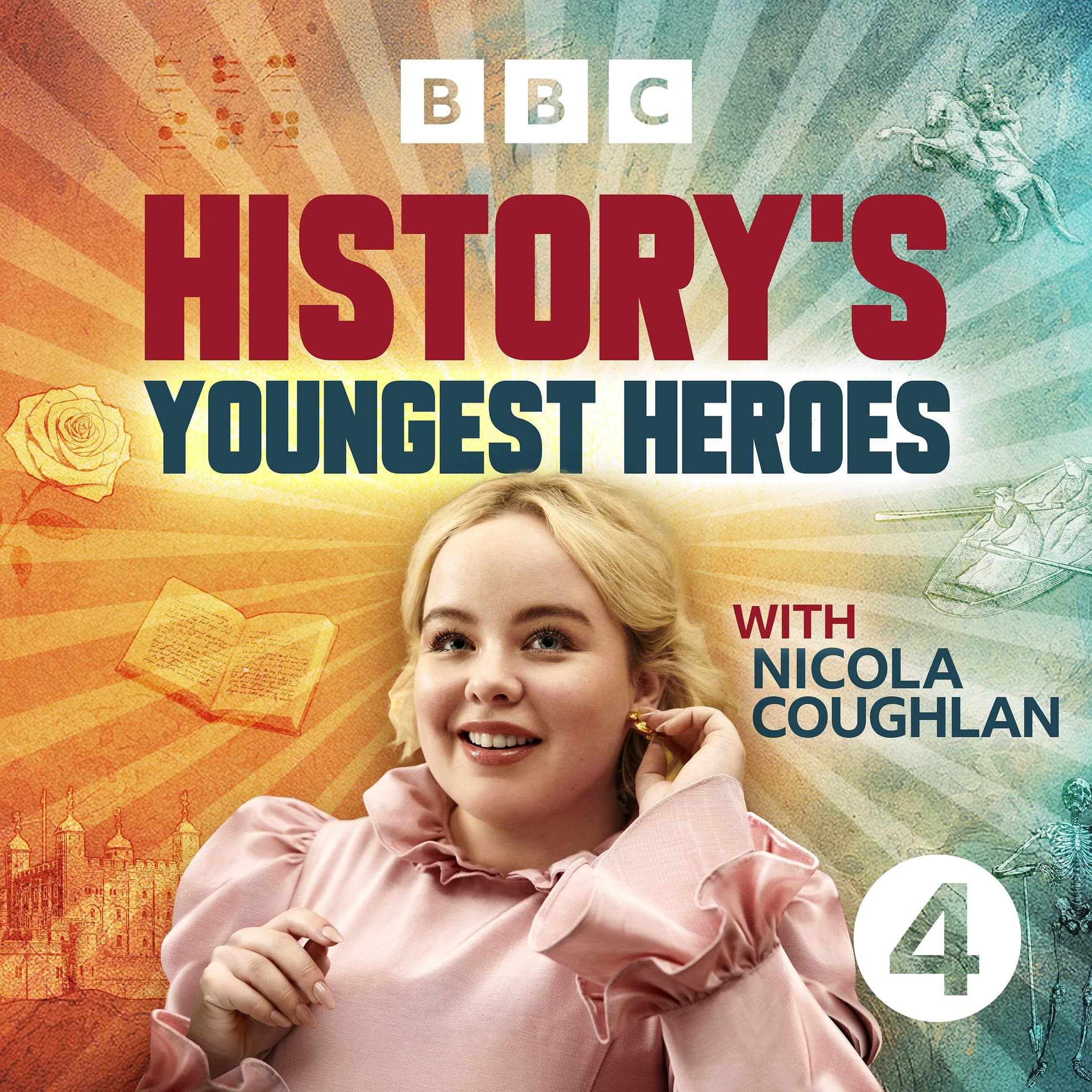
You're Dead to Me
Introducing History's Youngest Heroes
00:10:13
Nicola Coughlan shines a light on extraordinary young people from across history.
Loading summary
Transcript62 lines
- [00:00]
Host 1
This BBC podcast is supported by ads outside the uk.
- [00:07]
Advertiser 1
Looking for excitement? Chumba Casino is here. Play anytime, Play anywhere. Play on the train, Play at the store. Play at home. Play when you're bored. Play today for your chance to win and get daily bonuses when you log in. So what are you waiting for? Don't delay. Chumba Casino is free to play. Experience social gameplay like never before. Go to Chumba Casino right now to play hundreds of games, including online slots, bingo, Slingo and more. Live the Chumba life at Chumba. Casin casino.com VGW Group no purchase necessary. Void bro prohibited by law. See terms and conditions 18 all right, we're all set for the party. I've trimmed the tree, hung the mistletoe, and paired all those weird shaped knives and forks with the appropriate cheeses. And I plugged in the Partisan Partisan. It's a home cocktail maker that makes over 60 premium cocktails, plus a whole lot of seasonal favorites too. I just got it for 50 off, so how about a Cosmopolitan or a Mistletoe margarita?
- [00:57]
Nicola Coughlan
I'm thirsty.
- [00:58]
Advertiser 1
Watch. I just pop in a capsule, choose my strength and wow, it's beginning to feel more seasonal in here already. If your holiday party doesn't have a bartender, then you become the bartender. Unless you've got a Bartesian, because Bartesian crafts every cocktail perfectly in as little as 30 seconds. And I just got it for $50 off.
- [01:17]
Nicola Coughlan
Tis the season to be jollier.
- [01:21]
Host 1
Add some holiday flavor to every celebration.
- [01:23]
Nicola Coughlan
With the sleek, sophisticated home cocktail maker Bartisian.
- [01:28]
Host 1
Get $50 off any cocktail maker@bartisian.com cocktail that's B A R T E S I A N dot com cocktail.
- [01:39]
Nicola Coughlan
Hi, it's Nicola Coughlan. I'm dropping into this feed to tell you about History's Youngest Heroes, a new podcast for BBC Radio 4. In this series, you'll hear stories about rebellion, risk and the radical power of youth. Over the next 10 minutes, you'll hear a preview from episode one.
- [02:02]
News Anchor
The South African black nationalist leader Mr. Nelson Mandela is to be freed from prison tomorrow. The announcement was made by President F.W. de Klerk at a news conference in Cape Town three hours ago.
- [02:14]
Host 1
Well, I'm a South African. I was 19 years old on the day that he was released.
- [02:21]
Nicola Coughlan
Professor Jenny Steinberg teaches African Studies at Yale University. He remembers that day in February 1990 when Nelson Mandela walked free from prison.
- [02:30]
Host 1
A day after he's released, he came home to Soweto, which had been where he lived 27 years earlier. And I was one of hundreds of Thousands of people on the streets of Soweto there to get a glimpse of him, to celebrate perhaps the most extraordinary day in my country's history. So he has been with me as he's been with every South African ever since. Always had a place in our hearts, sometimes in complicated ways.
- [02:57]
Nicola Coughlan
We may remember Mandela as a dignified elderly man who spent 27 years imprisoned by the apartheid regime in South Africa. After he was released, he negotiated an end to racial segregation in his country and became its first black president. But Mandela's political career began decades before, when he was a young student. In the summer of 1952, Bergalia Bam was 19 years old. Like all black people in South Africa, she lived under the restrictions of apartheid.
- [03:31]
Bergalia Bam
And I remember the evening prayer as I was preparing to go to school, a boarding school. My father says we will not see the freedom during our lifetime, but I pray to God that the generations to come and our children will see the freedom.
- [03:59]
Nicola Coughlan
Four years earlier, the South African National Party brought in the apartheid system, meaning separateness. Apartheid enshrined racial segregation in law. It privileged those who were defined as white and instituted political and economic discrimination against those who were defined as Indian, Coloured, meaning multiracial or black. In the early 50s, the young African National Congress activist Nelson Mandela led the Defiance Campaign, protesting against these laws.
- [04:30]
Bergalia Bam
I was part of a group that was supporting the Defiance Campaign. The Defiance Campaign was an action of defiance, absolutely the word to defy the laws of apartheid.
- [04:48]
Nicola Coughlan
Under apartheid, schools were segregated along racial lines. Black students were given a much more limited syllabus than white students.
- [04:56]
Bergalia Bam
We had many strikes. I was part of one of the many big strikes myself at that time. And that was the time that was the atmosphere of the young people.
- [05:08]
Nicola Coughlan
Mandela's campaign focused on peaceful action.
- [05:12]
Bergalia Bam
A station, train station. Instead of being on the side of the black people only, we were now going to stand also on the side of the white people. We were going to go to cafeterias where you couldn't go to buy something in a cafeteria. No. Now we're going to do that.
- [05:33]
Nicola Coughlan
With the Defiance Campaign, Mandela inspired vast numbers of people and learned the sacrifices it took to be a freedom fighter. He described his own life as a long walk to freedom. His activism as a young man would put him on a path to being hailed as one of the greatest heroes in world history. Later in life, Bam worked closely with Mandela.
- [05:56]
Bergalia Bam
And I often say to myself, mandela, he was the chosen one. He was not the only one. Clever and bold, as Mandela would say all the time, I'm no angel, you Know, he liked that I'm not an angel. I'm just any person. That the time had come for us as a people to have a liberator.
- [06:25]
Nicola Coughlan
Holy Shasha. Mandela was born in 1918 in the countryside of the Eastern Cape. When he was eight, his primary school teacher gave him an English name, Nelson.
- [06:37]
Host 1
His father was a minor aristocrat in the Tembu aristocracy.
- [06:41]
Nicola Coughlan
Yet his was not a luxurious life.
- [06:44]
Host 1
There was no electricity, there was no running water. He lived in a hut with no furniture. None of his older brothers or sisters had been to school or were literate.
- [06:54]
Nicola Coughlan
When Mandela was 12, his father died of lung disease.
- [06:58]
Host 1
His mother shipped him off to a place he'd never been before, to people he'd never met before. And it was to the king of the Tembu. As a foster child, essentially.
- [07:10]
Nicola Coughlan
From now, his guardian would be Jongintaba Dalanjebo, regent of the Tembu Kingdom. Mandela would live in the great place, a compound of traditional huts and western houses. After he moved there, he rarely saw his mother.
- [07:26]
Host 1
He remembers thinking that everybody around was better than him, that he was out of place, that he didn't belong there. He wet his bed at the age of 12. It was really a terrible transition, but in a way a really important one, because as an outsider to the aristocracy, he learned to play the aristocrat as something that you learn and will and perform.
- [07:48]
Nicola Coughlan
Mandela lived in the shadow of the Boulder boys.
- [07:51]
Host 1
He was in a way, a very innocent, very naive boy, very respectful of the adult world, not really a rebel.
- [07:58]
Nicola Coughlan
White settlement in South Africa began in the 17th century. The first settlers were Dutch. Later the British arrived.
- [08:06]
Host 1
It was the discovery of diamonds in 1867 and then gold in 1886, which suddenly made South Africa enormously wealthy and prosperous. The capital that built the gold mines was mainly British capital. And the great fault line in South African politics was between English speaking and Afrikaans, Afrikaans being the nation that grew out of the Dutch settlers.
- [08:28]
Nicola Coughlan
In his late teens, Mandela was sent to an all black boarding school. The school aimed to turn out what Mandela himself described as black Englishmen through the enforcement of Victorian values. Students were put on a diet of bread, maize, starch and water. Mandela credited this with developing his self discipline and with teaching him to eat whatever was put in front of him. Two years later, he enrolled at Fort Hare, a small prestigious university for black Africans. He arrived full of hope, a strikingly handsome 21 year old wearing a wristwatch and a fresh pinstriped suit.
- [09:05]
Host 1
What he was going to become was a court interpreter, and that may sound Quite humble to us. But in that world, it was very high. To be a court interpreter was to, you know, be fluent both in English and in Xhosa, and to be the interface between white power and black people, it was a very elevated role. To be a young black man and to turn up at university at all, put you in the very, very top echelons of the black elite. By his own recollections, he wasn't particularly political there. You know, the Second World War began while he was at Fort Hare, and he was very much on the British side. And when one of his fellow students said, well, I hope the British lose the war because if they lose the war, they may also lose their empire, he absolutely shocked to his core. He didn't believe that such a thought was possible.
- [09:55]
Nicola Coughlan
During his second year at Fort Hare, a student protest broke out over the quality of the food and the treatment of a canteen worker.
- [10:02]
Host 1
And he happened to be elected to the students representative council. And the council had to decide whether to resign in protest over the food. And the rest of the council all capitulated.
- [10:14]
Nicola Coughlan
Mandela disagreed with the council. He backed the protesters. For that, he was suspended.
- [10:21]
Host 1
He was young. He didn't really know what he was getting into. And suddenly he'd been expelled from this wonderful elite institution. He was confused. He wasn't quite sure what to do next. And in fact, he almost certainly would have simply gone back to university the next year and apologized and would have been readmitted if something else hadn't happened.
- [10:39]
Nicola Coughlan
Mandela arrived back home to find his guardian, Jangantaba, furious with him.
- [10:44]
Host 1
But he'd also arranged a marriage for Mandela and for his own son, who. Who was a close friend and cousin of Mandela's.
- [10:52]
Nicola Coughlan
Neither Mandela nor Jantaba's son, justice, wanted this. Together, they hatched a plan to run away.
- [10:59]
Host 1
They secretly sold several head of Mandela's guardian's cattle and used that money to flee and to go to Johannesburg.
- [11:07]
Nicola Coughlan
This wasn't easy. Black men had to carry passes, and a journey like this required authorization from the district chief magistrate. Mandela asked the magistrate to sign his pass.
- [11:20]
Host 1
And the magistrate got on the phone to the king. And the king absolutely lost his temper, said, these boys are trying to escape from me. They've stolen my cattle. You must immediately arrest them. And when the magistrate put down the phone, Mandela, who'd I think done one or two law classes, said, well, hold on. You can't arrest us because the king has lost his temper. We haven't broken a law.
- [11:46]
Nicola Coughlan
That was a clip from history's youngest heroes subscribe to the full series on BBC Sounds.
- [11:57]
News Anchor
Yoga is more than just exercise. It's the spiritual practice that millions swear by. And in 2017, Miranda, a university tutor from London, joins a yoga school that promises profound transformation.
- [12:12]
Miranda
It felt a really safe and welcoming space. After the yoga classes, I felt amazing.
- [12:18]
News Anchor
But soon that calm, welcoming atmosphere leads to something far darker. A journey that leads to allegations of grooming, trafficking and exploitation across international borders.
- [12:32]
Miranda
I don't have my passport. I don't have my phone. I don't have my bank cards. I have nothing. The passport being taken, the being in.
- [12:40]
News Anchor
A house and not feeling like they can leave. World of Secrets is where untold stories are unveiled and hidden realities are exposed. In this new series, we're confronting the dark side of the wellness industry, where the hope of a spiritual breakthrough gives way to disturbing accusations. You just get sucked in so gradually and it's done so skillfully that you don't realize.
- [13:07]
Miranda
And it's like this secret that's there. I wanted to believe that, you know, that whatever they were doing, even if it seemed gross to me, was for some spiritual reason that I couldn't understand.
- [13:25]
News Anchor
Revealing the hidden secrets of a global yoga network.
- [13:29]
Miranda
I feel that I have no other choice. The only thing I can do is to speak about this and to put my reputation and everything else on the line. I want truth and justice and for other people to not be hurt, for things to be different in the future.
- [13:52]
News Anchor
To bring it into the light and almost alchemize some of that evil stuff that went on and take back the power. World of secrets. Season 6 the Bad Guru Listen wherever you get your podcasts.
- [14:18]
Advertiser 1
How to have fun anytime, anywhere. Step 1 Go to chumbacasino.com chumbacasino.com Got it. Step 2 Collect your welcome bonus.
- [14:28]
Nicola Coughlan
Come to papa.
- [14:29]
Advertiser 1
Welcome bonus. Step 3 Play hundreds of casino style games for free. That's a lot of games all for free. Step 4 Unleash your excitement.
- [14:36]
Host 1
Woo Woo.
- [14:37]
Advertiser 1
Chi Chi Chi Chi. Chumba Chumba Casino has been delivering thrills for over a decade. So claim your free welcome bonus now and live the chumba life. Visit chumbacino.com no purchase necessary. Void but prohibited by law. See terms and conditions 18 +.