Podcast
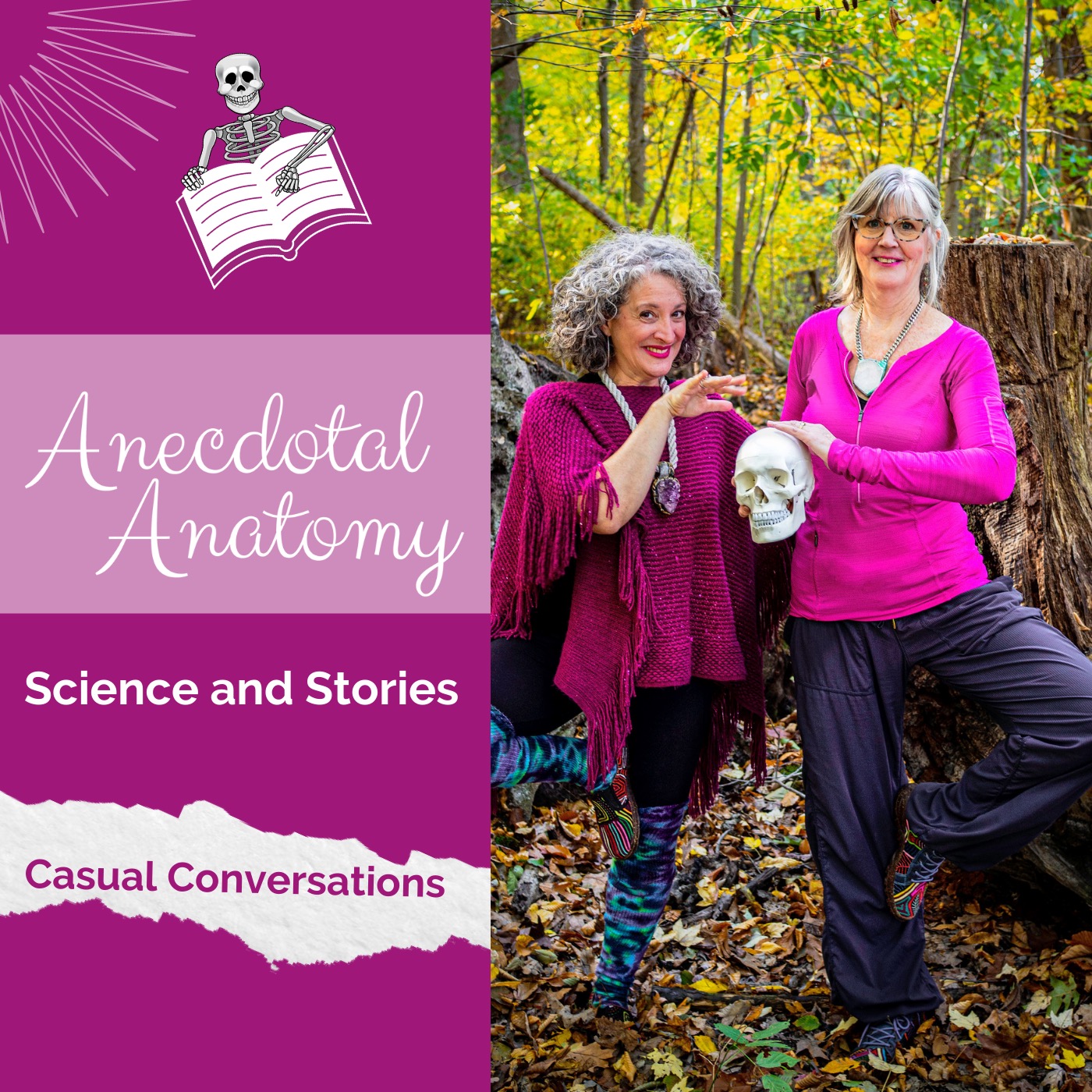
Anecdotal Anatomy
Hosted by Theresa Tobin Macy & Sherry Sadoff Hanck · EN
Anecdotal Anatomy - Science & Stories, is a series of casual conversations about what it is to live in a body. Expect storytelling & science as well as practices designed to deepen the mind-body connection.
10episodes
Episodes
Newest firstAll episodes

In the End, Bliss
Aug 24, 202300:48:03Tap to summarizeOnce upon a time, in bucolic Bucks County, PA, two yoga educators put their hearts and minds together to tell the epic tales our bodies tell. Their mission was simple, to reveal the stories our bodies hold and tell in service of linking the individual to the collective.It began with the idea of teaching anatomy by attributing character traits and storylines to our systems, bones, muscles, tendons, ligaments, and any other aspects of our gross anatomy. It was to learn the functions, movements, and systems of the body through storytelling. Interestingly enough, what actually unfolded started with the body, but rather than telling the stories that would increase scientific knowledge of the skeleton and other tangibles, what came up more often were the stories held and told from the body (using the Koshas/layers including: food body, energy and breath body, thoughts and emotions, wisdom, and bliss).This final episode is not meant to imply the conversations are complete, only that the podcast conversations have come to a stopping point.In this episode, Sherry & Theresa say farewell (Until next time) and offer their loyal listeners a couple of guided practices to punctuate this ending (and maybe glimpse bliss). They will also be available (FREE) in the Anecdotal Anatomy website store.It was a deliberate choice to end on E88. The number itself is infinity, it is abundance and alignment. While the podcast is ending, Anecdotal Anatomy in Action is continuing with newfound momentum and joy. If you enjoy this podcast, please stay tuned for information on our LIVE seasonal events! Please join The List so you can stay informed and in touch! And now a personal note: We are incredibly grateful for every drop of support we have received during these pasta 88 weeks! When we think of you, we feel we know you, even though we cannot see you. Thank you!Until next time...Thank you to our amazing team! Please visit their links for more information! This has been a most excellent collaboration!Our Amazing Team:Judith George - Editor (video & audio)Keith Kenny - MusicCindy Fatsis - Photography
Transcribe →
Sounds Like Wisdom
Aug 17, 202301:02:56Tap to summarizeYou know you’ve changed when what once made you mad now makes you laugh. (Tony Gaskins)That sounds like wisdom. Perspective often yields to wisdom which is why we assume it comes with age. In this, our penultimate episode, we revisit Vijnanamayakosha - the wisdom sheath, which includes intellect and intuition. While this is not a new topic for discussion, but it is spoken about and explored in a different way.The wisdom of experience is the best teacher. We can fill our cups with data-driven knowledge, but without the nuance of story and context, often we're left with dry dates and numbers. Minus any part, it may touch the intellect but will rarely stir the soul.Wisdom shows up sometimes when we are trying to form the right response in the moment, knowing there is no one-size-fits-all. Wisdom in the skillful reading of any room. One person may need to hear something that would make another person roll her eyes. Reading the room is where wisdom and compassion meet. Being present is a window into wisdom and intuition. The times when we're gazing through that window and still miss the mark, wisdom clears the way for resolution. Wisdom also asks, how can I best serve you? Or just guides deep listening. While the Koshas (Vijnanamaya, the fourth of five) are depicted having a certain order, it can be illuminating to explore them in different ways. Observing your thoughts as a means to discover the origin story of back pain, for example. Or using breath practices to activate the parasympathetic nervous system as a way to work with discursive and anxious thoughts.There are many subtle body anatomy maps to study and play with, including the koshas and chakras, among many.Working with secondary awareness, also referred to as the awareness of awareness, gives us an in-the-moment opportunity to make the choice to interrupt an unproductive pattern. It is the wisdom of growth.On the road to growth and self-discovery, we are often presented with a variety of teachings, lineages, and practices; wisdom allows us to discern what works best for us without getting lost in the din. There are myriad practices available for exploration, something for everyone. We don’t always know why we end up where we are, but when it resonates, we know. Over time, we get to look back and understand the wisdom of the journey through the perspective of a wider lens.Theresa shared a definition she recalled from her time on this path, “Wisdom is the ability to perceive the unintended consequences of both actions and inactions.” This provides for reality that not making a choice is making a choice. It’s not always what we choose to do, but what we choose not to do. It’s the choice that allows us to interrupt patterns AND there are consequences to both.Wisdom is knowing what you don't know or even that you don't know. Wisdom may arrive in the form of trust. When we have faith in the messages we receive and the circumstances we are in, we cultivate the ground for wisdom.Sherry reads a story about a Zen Master (link below). It not only speaks to knowing when enough is enough, it reveals how we must empty our cups to receive teachings, that if we arrive full with what we know, our opinions, and stories, there won't be space for learning. That's wisdom.NOTE: For those who felt left hanging after Sherry referenced Surya (Sun) and were wondering about its counterpart (which fizzled in the conversation) - Chandra (moon).Sources and mentions from the show:Zen Master Story with the TeacupJust for Us – Alex EdelmanYardley Eye CareGISH(WHES)***Our Amazing Team:Judith George - Editor (video & audio)Keith Kenny - MusicCindy Fatsis - Photography
Transcribe →
The Mind of Play
Aug 10, 202301:01:52Tap to summarizeThis episode looks at play through the lens of Manomayakosha, the mental/emotional sheath (see Koshas, Season 1). Slipping into a playful mindset is beneficial in many ways.Enhances creativityReduces stressImproves problem-solving skillsIncreases resilienceStrengthens social bondsBoosts self-confidenceElevates moodEnhances cognitive functionHelps with emotional regulationIncreases optimismTheresa and Sherry share stories of how play has shown up in their lives, from jobs to grandkids. They explore the value of play through storytelling, song, and poetry, and its capacity for healing. They also touch on the shadow side of play, including being overly competitive.Ultimately, they agree that a playful mindset is essential for optimal growth, connection, and overall wellness.***Sources & Mentions from the Show:Wetlands, NYC - Environmental Rock-n-Roll Nightclub (closed 2001)Kids' Music RoundCortina InstituteBone Dance - Hannah Montana songBackgammonJengaAnatomy Trains Tom MyersPsoas - a/k/a Theresa's favorite muscle (because it's the filet mignon of the cow)Robert Schleip***Our Amazing Team:Judith George - Editor (video & audio)Keith Kenny - MusicCindy Fatsis - Photography
Transcribe →
Mmmmmm....
Aug 3, 202300:55:59Tap to summarizeHere we are at episode 85, only three more to follow before we wrap up these conversations.We are sad to announce that the CAMP experience we lovingly curated was ultimately canceled (so please do not see this as an invitation to come to CAMP this summer, rather an invitation to see the magic in your life and add a dash of play to your daily doings).These final show notes will reflect the casual nature of our conversations (no more time-stamped synopses).At the time of recording, we were still moving fully forward with CAMP, sharing the M inspiration, including Mindfulness, Magic, and Movement, while examining them through the lens of Pranamayakosha (the energy sheath). In these practices we see the energy as riding the breath. There is immense power of breath in the creation and direction of energy.Pranayama is the term for breathing practices in Yoga. Certain breath practices can influence the parasympathetic nervous system, promoting calm and restoration, while others can amp us up when necessary. Both are valuable and accessible through the breath.It may seem counter-intuitive to have to learn to breathe, but since the breath is the one aspect of the autonomic nervous system that can also be directed on purpose, it holds a lot of power.We talk about different practices including open-eyed mindfulness meditation, closing eyes for a different experience of accessing one's energetic body, and Theresa's Sit Spot practice among others.There's so much packed into this episode, going back to our origin stories (some only accessed through old journals). We discussed the power of words and Theresa mentioned that the word Spelling has the word SPELL right there!Sherry started to share a story about a spell she used when she met her husband. She shared one ritual (putting his name in a bowl of sugar) and how he called as soon as the match went out - what she forgot to mention was that she lit the match while speaking words given to her by a friend, a spell of sorts. The words ended, the match went out, her future husband called in that very moment!We both walked down memory lane, to the best of our recollections.In the end, we conclude with the potent reminder of of the gift of life and the abundance of magical energy around and within us. Have a listen!***Mentions from the show:Nadi ShodhanaReverse BreathingMindfulness Meditation Instruction - eyes openTED Talk - How I made friends with reality - Emily Levine ***Our Amazing Team:Judith George - Editor (video & audio)Keith Kenny - MusicCindy Fatsis - Photography
Transcribe →
A is for All Good Things!
Jul 27, 202300:58:59Tap to summarizeOn today's episode, we announced that our final podcast will be E88. We still have a few more things to discuss in our weekly casual conversation, but we also feel it coming to its natural conclusion.Anecdotal Anatomy (the podcast) will be now be Anecdotal Anatomy in Action (seasonal signature programs - mostly live, some virtual).Our next program is CAMP (8/4 &5), a place for women to gather, play, practice, laugh, and generally just BE. We are using these final episodes to end as we began, using the Koshas as a model for looking at the various aspects and pillars of CAMP through the layers of our being. If you're local to Bucks County, PA and would like to join the fun, click any CAMP you see in these Show Notes.This episode touches on the A in cAmp which stands for Awareness, Alignment, and Anecdotes, as seen through Anamayakosha (the Food Body).In a nutshell, this conversation is about the awareness of the physical body, its alignment and the stories it holds and tells.***Here is a very brief breakdown, time-stamped summary:00:00:45 Announcement of wrapping up the podcast.00:01:24 Koshas are our jam. 00:01:30 Plans for the final five episodes.00:01:44 Join us on this journey!00:02:28 CAMP, the koshas and practices, as well as details for signing up.00:04:23 Upcoming programs00:04:44 And today we're going back to Anamayakosha 00:05:02 The A in camp is about Alignment. Awareness, and Anecdotes.00:06:33 Food/Body relationship00:07:23 Value of the all the Koshas.00:08:11 Koshas as inspiration for our programs00:08:36 Awareness00:09:48 Digestion as a system, as well as a metaphor for taking in information.00:10:06 Reference to Shauna Ahern, guest from first season who wrote the book, Gluten-Free Girl – How I Found the Food that Loves Me Back…& How You Can Too.00:10:42 Shauna’s story through Sherry’s best recollection.00:11:47 Body’s direct reaction to food.00:12:13 Oreos!00:12:54 Not a diet, more feeling your best.00:13:03 Practices we offer increase our ability to more deeply know ourselves.00:13:19 Finding the whispers in their edges to deepen awareness.00:14:02 Body stories00:15:30 Body awareness00:15:50 Alignment00:16:40 John Sarno (see sources below) and talk therapy for back pain.00:17:50 Sherry’s story of patterns of her back pain.00:19:02 Accessing the koshas to help alleviate discomfort.00:19:30 We have many tools for healing, emotional and/or muscular-skeletal.00:20:17 Theresa’s story of what many of her clients say about their pain. 00:20:41 Soft tissue as a character in this story.00:22:00 awareness is the key that unlocks every door.00:22:05 Body worker = Energy worker00:22:36 The intersection of the physical body and the energy field.00:22:59 Reminder that one cannot touch without being touched back. 00:24:00 There’s story of being at a massage training00:25:30 What happens when we minimize the power of the left brain.00:26:03 Layers of language.00:26:42 Is awareness necessary for things to work?00:27:02 Secondary awareness, awareness of our awareness.00:28:00 What is inner transformation?00:28:15 Transformation is change. 00:29:00 If we're unaware, do we still benefit from the choices we make? 00:29:11 How our instincts speak to us.00:29:27 Animals know their instinct. 00:29:51 Brain rationalizes our instincts instead of trusting them.00:30:30 Tapping instincts and senses by mindfully spending time in nature.00:31:22 Theresa’s story of being nose-blind in the Pine Barrens.00:32:38 Seva’s (Theresa’s dog) senses/instincts. 00:33:01 Our senses and our instincts, like the Kosha's are intertwined.00:33:12 Luna’s story (Sherry’s dog)00:33:35 Instincts and senses and being nose blind. Is it safe?00:35:05 Dog’s body language.00:35:18 Amy McCaa (Lead the Way Dog Training) from Season 100:36:33 The nature of consciousness and awareness. Animals and instinct. 00:37:00 Awareness, alignment, and the stories our bodies hold and tell.00:38:16 Understanding how my body is communicating.00:39:41 Greater awareness for internal landscape of my physical body. 00:39:55 Awareness helping us move forward. 00:40:04 Sherry’s Rainbow story about smelling the rain coming.00:40:57 Nature and the physical body00:41:07 Theresa’s Outdoor Leadership Training story00:42:06 Our breath in connection to what the trees. 00:42:30 Greenland doesn't have any trees.00:44:02 Without trees where does the oxygen come from?00:44:07 Other sources of oxygen?00:44:15 CAMP is again at Snipes Farm. Nature walk and Fox Walk.00:44:36 Here's a little story and anecdotal, well it's it's true. It's still a story. 00:45:09 Messages from the physical body00:46:00 Community that feels safe enough to be vulnerable 00:46:30 Being present for the unexpected00:47:00 Tapping into the resonances of our instincts and senses in the body.00:47:30 Our stories are not always clear. 00:47:51 Stories people tell while on the massage table.00:48:14 Possible origin stories for trauma in the body.00:48:39 Compensatory patterns00:50:49 A story of manifestation of a story in the body.00:52:17 Theresa’s “skin” stories.00:52:43 Re-writing the story.00:53:10 It doesn’t take much to inspire transformation, sometimes just the right words.00:53:41 Meeting challenges as vehicles for transformation.00:54:30 Redefining transformation 00:54:55 Widening the lens.00:55:08 Examining the timeline of our own origin and growth stories.00:55:50 Sherry’s takeaway transformation - from passive aggressive to direct communications. Sometimes transformation is subtle and cumulative. 00:56:54 Sometimes we need an “Acme” safe to fall on us (via cartoon world) 00:57:11 Stick with us for the Kosha Countdown. Pranayamakosha next week.00:57:45 Be a transformer. 00:57:58 Until next time!***Sources & Snippets from the Show:Book: gluten-free girl: How I found the Food that Loves Me Back...and How You Can TooJohn Sarno (Dr. Sarno is no longer here, but this is his process - along with testimonials)Koshas - this is one of countless sources for study on the Koshas.Greenland - no trees! Okay, there used to be some trees and now there are some shrubs. This is one of a n...
Transcribe →
Transformation through Creativity and Community
Jul 20, 202300:53:13Tap to summarizeThis week, Theresa & Sherry explore the transformational journey that happens when we connect through creativity, community and communication. This journey is different for each traveler.Focusing on their on live programs and events, this episode is the first in the acronym breakdown of CAMP, an immersive adult camp coming up in August.The C in CAMP is for Creativity, Community, Communication and, of course, Connection. This episode explores these various C-energies in the context of inner transformation.The key moments in this episode are:00:00:00 - Introduction00:01:43 - Importance of Communication00:04:41 - Pebbles on the Path00:09:43 - The Seed of Transformation00:12:38 - Building Community00:14:59 - The Importance of Listening in Communication00:16:12 - The Chakra System and Communication00:17:56 - Awareness and Patterns in Communication00:19:48 - Transformation and the Importance of Small Changes00:21:53 - Finding Communities and Discovering What We Love00:29:07 - Workshop with Julia Cameron and Sonia Choquette 00:31:27 - The Importance of Nurturing Creativity00:33:37 - The Elements of Transformation00:38:37 - The Power of Community and Reflection00:41:49 - The Joy and Power of Play00:45:11 - "Introduction: Everything We Talk About"00:46:04 - "Reading Each Other and the Unseen Audience"00:47:40 - "The Creative Process and Collaboration"00:48:59 - "The Role of Communication, Community, and Creativity"00:52:18 - "Gratitude and Playfulness in Transformation"Episode Goodie Bag:CAMP information and registrationJulia Cameron - The Artist's WaySonia Choquette - The Psychic PathwayOur Amazing Team:Judith George - Editor (video & audio)Keith Kenny - MusicCindy Fatsis - Photography
Transcribe →
a guru by any other name...
Jul 13, 202301:03:31Tap to summarizeThis episode on acknowledging and honoring our teachers was poetically recorded on Guru Purinima (a Hindu, Buddhist celebration of teachers - it honors the day the first guru was born - click link for more information).This personal episode has the hosts reaching back for memories of primary and secondary teachers, as well as their own identification as teachers. Both agree that their students often show up as teachers. In the world of reflection, everything has the capacity of being a teacher, if we pay attention.Timestamped summary of this episode:00:00:00 - The Teacher-Student DynamicsThe hosts discuss the flip-flop of teacher and student roles and how learning can come from unexpected sources, such as animals.00:03:24 - Lessons from AnimalsThe hosts talk about the lessons we can learn from animals and how observing them can provide valuable insights.00:05:02 - The Once and Future KingThe hosts discuss the book "The Once and Future King" and how it explores the concept of transformation and learning through different perspectives.00:07:34 - Critical Thinking and LearningThe hosts share their experiences with education and how critical thinking and curiosity are important for true learning.00:10:05 - Impact of TeachersThe hosts reflect on the impact of teachers on their learning journey and how teachers can either foster or hinder a student's progress.00:15:12 - The Importance of Teaching and Absorbing InformationThe hosts discuss the importance of teaching in fully absorbing and understanding information. They mention that there is data suggesting that we absorb different amounts of information through hearing, reading, and seeing. They also share their personal experiences of how teaching has helped them gain a clearer focus on yoga philosophy and other aspects of their practice.00:16:14 - Seeing Classrooms as a Circle of LearningThe hosts talk about their perspective on classrooms and teaching. They view all classrooms as a circle and see themselves as arcs within that circle. They mention how Sean Corn's statement about having the capacity to communicate information in a way that people can best receive it resonated with them. They emphasize the importance of communication, humor, and personal anecdotes in teaching.00:17:36 - Learning from StudentsThe hosts share an example of how they learned from a student during a yoga class. The student expressed reluctance to perform a cleansing breath because she felt it would be wasting her prana. This perspective made the hosts reconsider their teaching approach and they adjusted it to encourage mindfulness and directing the breath and energy towards someone who could benefit from it. They highlight the importance of listening to and learning from students.00:20:27 - Transforming Teaching ApproachOne of the hosts reflects on a teaching experience where none of the students did the assigned reading. Initially, they reacted with frustration and employed a punishment-like approach. However, they realized their mistake and transformed the situation into a positive teaching moment by having students teach00:29:59 - Mr. Woodley's IntuitionThe narrator reflects on their experience with Mr. Woodley, a coach who showed understanding and support during their nose job. Mr. Woodley recommended the narrator for Honors English and expressed belief in their potential.00:31:13 - Mr. G and ExistentialismThe narrator shares their experience in Honors English with Mr. G, who taught existentialism. Despite struggling academically, the narrator felt seen and understood by Mr. G, who gave them an A and acknowledged their unique contribution to the class.00:33:56 - Mrs. Tobin and Creative ExpressionThe narrator recalls a challenging teacher, Mrs. Tobin, who criticized their creative doodles and discouraged their individuality. The narrator stood up for themselves, but it was clear that Mrs. Tobin was not a good fit as a mentor.00:34:09 - Mimi, a Teacher and ThinkerThe narrator highlights their student-turned-mentor relationship with Mimi, a brilliant thinker and fellow learner. They continue to inspire each other and engage in thought-provoking conversations, exploring different perspectives and embracing intellectual curiosity.00:37:34 - The Generosity of TeachingThe narrator reflects on the role of a teacher and emphasizes the importance of being a learner oneself. They acknowledge the need for a two-way flow of information and the transformative power of teaching students to complete and finish tasks, beyond just following a curriculum.00:43:47 - Embracing the UnknownThe hosts discuss how their experiences have taught them how to handle the unknown. They emphasize the importance of taking action and just "doing it" in order to learn and grow.00:44:41 - Lessons from "To Sir, with Love"The hosts mention the movie "To Sir, with Love" and discuss how the main character taught his students valuable lessons about healthy eating and self-respect. They highlight the power of teaching and the impact it can have on others.00:46:32 - The Soft Learning of MassageThe hosts share a personal story about receiving a card from a massage student expressing gratitude and referencing the movie "To Sir, with Love." They discuss the importance of recognizing and owning one's strengths as a teacher.00:49:04 - Honoring TeachersThe hosts explore different ways to honor teachers, including expressing gratitude and incorporating their teachings into daily life. They emphasize the role of awareness in recognizing and embracing the lessons taught by various teachers.00:54:39 - The Resonance of TeachingsThe hosts reflect on how certain teachings may not resonate immediately but can still have a lasting impact. They discuss the subtlety of resonance and how awareness plays a key role in recognizing and experiencing it.00:59:09 - Learning to FeelThe speaker shares her experience of learning to feel and how challenging it was to move out of her head and into an embodied sense. She emphasizes the importance of being able to feel and land in the senses, particularly the sense of touch.00:59:44 - Getting Out of Your HeadThe speaker recounts a story about how she was able to get out of her head and into a more creative and receptive state while massaging someone. Despite initially feeling frustrated by the person singing, it ultimately helped her shift her focus and connect with her body.01:00:35 - Curiosity and ResistanceThe speaker reflects on how curiosity drives her to understand things she doesn't like or understand. She also recognizes that resistance is a valuable learning opportunity.01:01:17 - Event AnnouncementThe hosts announce an upcoming event called "The Radiant Self: Illuminating the Koshas for Inner Transformation." They provide details about the date, time, and location, and express their excitement for the event. SEE BELOW & CLICK TO FIND OUT MORE AND TO REGISTER!01:01:46 - Call to ActionThe hosts encourage listeners to sign up for their newsletter and attend their upcoming events. They emphasize the importance of self-discovery and invite listeners to engage with them on their Facebook page or via email.And then some (this is where you get a little bit more)...If you're local, join us for RADIANT SELF - Illuminating the Koshas for Inner Transformation -- a mini retreat at Flower of Life Yoga in Morrisville, Pa - Saturday, 7.15.23 from 11:30am-3:30pm. Check out this link for more information and to sign up!Tias Little - Yoga of the Subtle Body (book)Meaningful Mentors - a love letter to amazing teachers - Sherry Sadoff Hanck on SubstackOnce & Future King - T.H. WhiteCORRECTION: During her story about reading King Arthur fiction, Sherry referred to the “Cromwell” books when she meant, Bernard CORNWELL.Our Amazing Team:Judith George - Editor (video & audio)Keith Kenny - MusicCindy Fatsis - Photography
Transcribe →
Kick the Can - a story of vitality
Jul 6, 202300:56:24Tap to summarizeAging is a gift, unique to each person's unfolding. This week, we talk about aging in an empowering way and without judgement. We talk about cultivating vitality rather than chasing youth.Vitality feels like youth in the body's ability to be agile and strong, while operating from the aggregated wisdom of each era.The key moments in this episode are:00:00:00 - Feeling the Shift at 2500:03:18 - Being Present for Participants00:04:37 - Birthdays and Aging00:10:02 - The Perception of Age00:11:51 - Embracing Change00:14:05 - The Importance of Working on Major Goals and Life Purpose00:15:34 - Overidentification with Body and Embracing Change00:16:51 - The External Mirror Reflection and Self-Care00:19:30 - Embracing the Cycles of Life and Change00:21:58 - Challenging Cultural Norms and Subjective Age00:29:05 - The Relationship Between Dairy and Bone Health00:30:14 - The Holistic View of the Body00:32:39 - Mindset and Aging00:33:44 - Honoring Wisdom and Elders00:34:58 - Cultivating a Positive Mindset and Healing00:45:17 - The Importance of Memory and Mental Exercise00:47:30 - Social Engagement for Staying Young00:49:20 - Exploring the Difference in Longevity00:49:52 - The Power of Words and Self-Perception00:52:04 - Rewriting Stories and Embracing Vitality***Kick the Can excerpt and commentary (spoiler alert)***Our Amazing Team:Judith George - Editor (video & audio)Keith Kenny - MusicCindy Fatsis - Photography
Transcribe →
Bippity Boppity Boo - The Art of Magic & Play
Jun 29, 202300:52:10Tap to summarizeJoin Anecdotal Anatomy for an episode that explores the art of magic and play. Discover the power of imagination, the benefits of a playful mindset, and the secrets of real magic, while ditching any notion of “magical thinking,” in service of something deeper.The Importance of Play Play doesn't just signify frolicking about without any tasks at hand, but it's a gateway that unlocks the sheer joy of being in the moment, being one with your surroundings, expressing the unexpressed, and just giving in to the child within. The Benefits of PlayThe liberating feeling of play has an ample range of benefits – it boosts creativity, resilience to stress, injects an excitement to live, and helps us appreciate beauty in the most underrated aspects of life. Believing play to be centric to wholistic wellness, Anecdotal Anatomy encourages its Keystone Community to integrate playful practices in every offer it puts forth. Theresa and Sherry eloquently explain how play not only assists in improving creativity and the sense of humor but also maintains a gentle balance between the mind and body. When in a playful mindset, magic can be found anywhere and everywhere. Such instances of recognition remind us all of our inner vital sparkle. Play can have a big role in leading to self-transformation and a sense of deep gratitude. Who wouldn’t want to view life through a dynamic, playful kaleidoscope?***The key moments in this episode are:00:00:00 Introduction00:06:24 Magic and Transformation00:10:12 Everyday Magic00:11:45 The Importance of Play 00:13:37 Creating Illusions00:15:11 Reality and Imagination00:18:36 Perception and Mindset00:21:48 Play Personalities00:25:06 Creation and Energy00:28:51 Archetypes and Avatars00:30:32 Inhibitions in Finding Your Voice00:33:30 The Power of Group Activities00:36:03 Real Magic vs. Magical Thinking00:39:20 Misdirection and the Senses in Magic00:44:43 Magic in Everyday Life00:45:57 The Power of Belief00:47:07 The Benefits of Play00:48:39 Keystone Community Event00:50:21 Holistic Wellness***Sources:Peter Himmelman Official WebsitePeter Himmelman Substack***Our Amazing Team:Judith George - Editor (video & audio)Keith Kenny - MusicCindy Fatsis - Photography
Transcribe →
The Anatomy of Slowing Down
Jun 22, 202301:01:55Tap to summarizeThis episode is the second in our two-part series on slowing down. Last week we talked about the ART of slowing down, today is more about the ANATOMY of slowing down (parasympathetic nervous system and vagus nerve). We have dedicated this month to slowing down, including these two episodes, a free 90-minute DYE (Discover Your Excellence: The Art of Slowing Down) and a two-day retreat designed around slowing down, resetting, and re-storying. We do not declare that we have fully embodied this pace, but that we are in a daily practice to explore all the benefits that result from slowing down.Instead of providing the time-stamped synopsis of the episode you will find some takeaways from the episode that were originally procured through ChatGPT. We expounded on these topics, using them as springboards, but wanted you to have the source material.The vagus nerve plays a significant role in soothing and calming us by activating the parasympathetic nervous system, which is responsible for the body's relaxation response. Here are a few ways in which the vagus nerve contributes to soothing and relaxation:Regulating heart rate: The vagus nerve helps regulate heart rate by decreasing the heart's electrical activity. This leads to a slower heart rate, promoting a sense of calmness and relaxation.Reducing stress hormone production: Activation of the vagus nerve helps inhibit the release of stress hormones, such as cortisol. This reduces the body's stress response and promotes a state of relaxation.Enhancing digestion: The vagus nerve stimulates digestive processes by increasing stomach acid secretion, promoting smooth muscle contractions in the digestive tract, and facilitating the release of digestive enzymes. Proper digestion is important for overall well-being and can contribute to a sense of comfort and relaxation.Decreasing inflammation: The vagus nerve has anti-inflammatory effects, helping to regulate the body's immune response. By reducing inflammation, the vagus nerve promotes a sense of calmness and well-being.Stimulating the release of oxytocin: The vagus nerve is involved in the release of oxytocin, a hormone known as the "bonding hormone" or "love hormone." Oxytocin promotes feelings of relaxation, trust, and social connection, contributing to a soothing effect.Activating the "rest and digest" response: The vagus nerve is a key component of the parasympathetic nervous system, which is responsible for the "rest and digest" response. When the vagus nerve is activated, it helps shift the body from a state of stress (sympathetic dominance) to a state of relaxation and restoration (parasympathetic activation).Overall, the vagus nerve acts as a calming influence on the body by modulating various physiological functions. By engaging in activities that stimulate the vagus nerve, such as deep breathing, meditation, or social connection, we can enhance its soothing effects and promote a state of relaxation.Slowing down and practicing relaxation techniques can have several benefits on our nervous system. While I don't have access to the internet to provide specific sources, I can certainly list 10 common benefits of slowing down that are often mentioned in scientific literature and popular health sources. Please note that these benefits are general and may vary from person to person:Reduced stress: Slowing down activates the relaxation response, helping to decrease stress levels and promote a sense of calmness.Improved sleep quality: Relaxation techniques can help regulate the sleep-wake cycle and promote better quality sleep.Enhanced mental clarity: By slowing down, you allow your mind to rest and recharge, leading to improved focus and mental clarity.Increased self-awareness: Slowing down allows you to tune in to your thoughts, emotions, and physical sensations, fostering greater self-awareness.Lower blood pressure: Relaxation techniques, such as deep breathing or meditation, have been shown to help lower blood pressure and reduce the risk of cardiovascular problems.Boosted immune function: Chronic stress weakens the immune system, while relaxation techniques have been associated with improved immune function.Improved digestion: Slowing down can promote better digestion by reducing stress-related gastrointestinal symptoms and allowing the body to properly process food.Reduced muscle tension: Relaxation techniques like progressive muscle relaxation or stretching can help alleviate muscle tension and promote relaxation throughout the body.Increased resilience: Regular practice of relaxation techniques can help build resilience and improve your ability to cope with stressful situations.Enhanced overall well-being: By slowing down and taking care of your nervous system, you can experience a greater sense of well-being and contentment.While I cannot provide specific sources, you can find scientific studies and articles related to these benefits by searching on reputable medical and scientific databases such as PubMed, Google Scholar, or academic journals in the fields of psychology, neuroscience, and stress research.10 ways the vagus nerve can put us into our parasympathetic nervous systemThe vagus nerve plays a crucial role in activating the parasympathetic nervous system, also known as the "rest and digest" response. Here are ten ways in which the vagus nerve can help put us into our parasympathetic state:Deep diaphragmatic breathing: Engaging in slow, deep breaths stimulates the vagus nerve, leading to a relaxation response and activation of the parasympathetic system.Meditation: Practicing mindfulness and meditation techniques have been shown to increase vagal activity, promoting a shift towards the parasympathetic state.Cold exposure: Cold showers or immersing the face in cold water can stimulate the vagus nerve, activating the parasympathetic system.Singing or chanting: Vocal exercises that involve controlled exhaling, such as singing or chanting, can stimulate the vagus nerve and promote relaxation.Yoga: Certain yoga poses, such as forward bends, twists, and inversions, can stimulate the vagus nerve and help activate the parasympathetic system.Massage therapy: Gentle, relaxing massage techniques have been found to stimulate the vagus nerve and promote parasympathetic activation.Acupuncture: Studies suggest that acupuncture can increase vagal activity and induce a parasympathetic response.Laughter: Genuine laughter stimulates the vagus nerve and triggers a cascade of parasympathetic responses, leading to relaxation.Practicing gratitude: Expressing gratitude and engaging in positive emotions can enhance vagal activity and shift the nervous system towards the parasympathetic state.Social connection: Engaging in meaningful social interactions, such as spending time with loved ones or participating in group activities, activates the vagus nerve and promotes parasympathetic activation.It's important to note that while these techniques have been associated with vagal activation and parasympathetic response, individual responses may vary. It's always best to find what works best for you and consult with healthcare professionals or experts in specific techniques for personalized guidance.Mentioned in the Show:Wim Hof MethodOur Amazing Team:Judith George - Editor (video & audio)Keith Kenny - MusicCindy Fatsis - Photography
Transcribe →