
Podcast
Be a Cactus Podcast
Hosted by Victoria Waddle · EN
24episodes
Episodes
Newest firstAll episodes
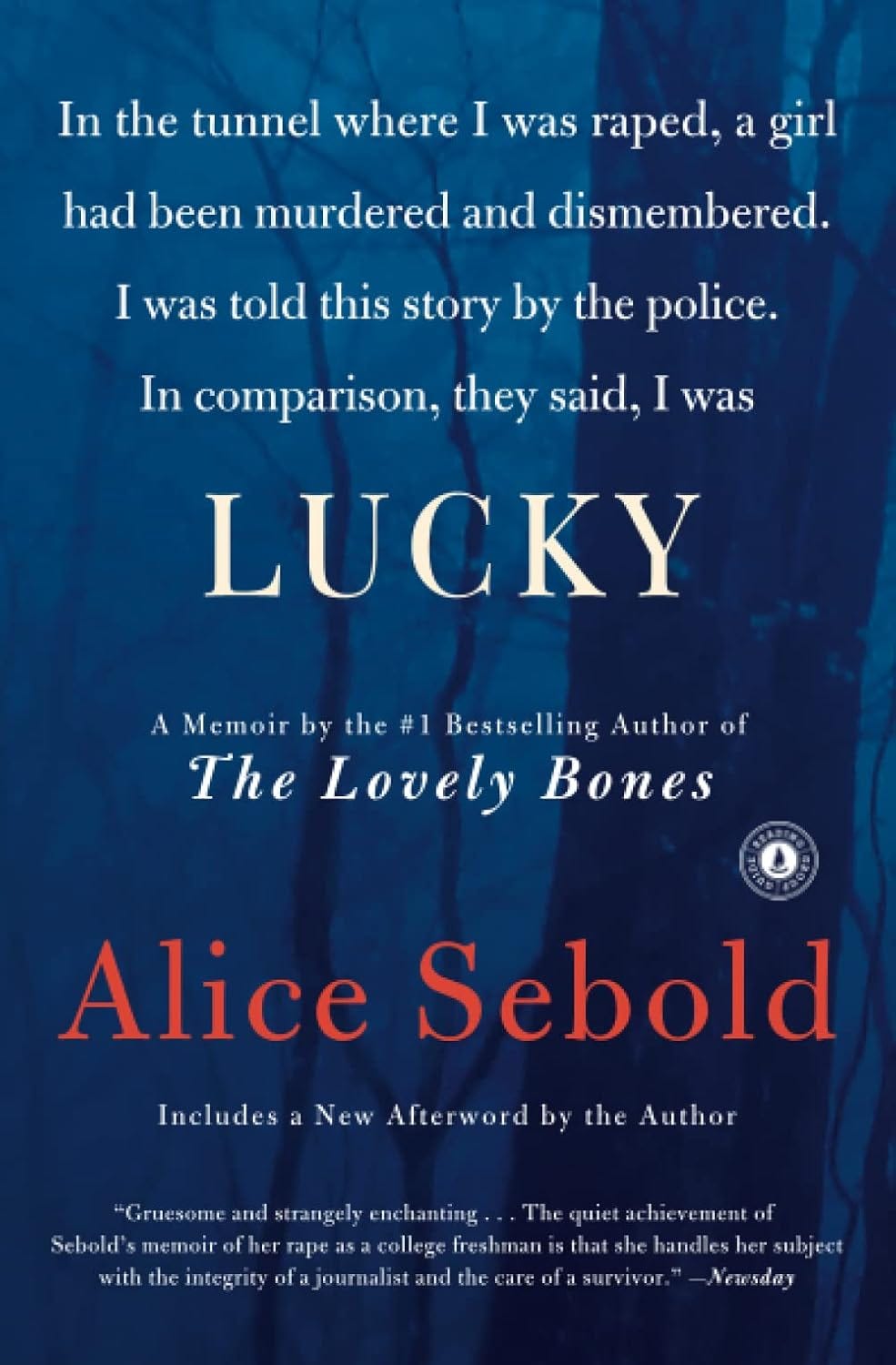
Lucky by Alice Sebold Removed for Wrong Reason. Last Night at the Telegraph Club: Banning the Perfect YA Novel
4w ago00:30:19Tap to summarizeHello Friends,Today, I’d like to discuss a few banned and often challenged books: Last Night at the Telegraph Club by Malinda Lo, a YA multiple award winner and Lucky by Alice Sebold, which should be withdrawn from libraries, but not for the reasons it is being banned.Before we dive into these books, I want to note that this week Utah banned another book in all of its public schools: Stephen King’s Different Seasons which contains four novellas, two of which were adapted for the films The Shawshank Redemption and Stand By Me.Anyone who has read “The Body” or seen Stand By Me will understand why schools were using the collection in the classroom. It’s quite possible that this was the only story in the collection that was assigned. And now the students have lost access to studying it.When such works are removed, it’s unclear that the goal is to protect the teens or tweens. What is clear is that relatable stories are disappearing from the curriculum.Last Night at the Telegraph Club by Malinda LoOver the past few years, I have been discussing banned books most of which were published a decade or more ago. I thought it would be fun to read a more recent one and see what the issues are. I recently picked up Last Night at the Telegraph Club by Malinda Lo because it is so highly regarded and so often vilified. I wanted to know why.Last Night at the Telegraph Club won the National Book Award for Young People’s Literature (2021), the Stonewall Book Award, the Asian/Pacific American Award for Literature, a Michael L. Printz Honor, and was a Los Angeles Times Book Prize finalist. Wow. And so deserving.Lily Hu is a Chinese American teen living in San Francisco’s Chinatown in the 1950s. While she deals with prejudice because of her race, her family is also afraid of the McCarthy-era milieu in which all people of Chinese heritage are suspected of having Communist sympathies. In fact, Lily’s father, a doctor, has been targeted by the FBI for not naming one of his patients as a Communist and his citizenship papers have been confiscated.As a rising high school senior, Lily is awakening to her sexuality and thrills to an ad for a performance by Tommy Andrews, a male impersonator, at the Telegraph Club. She later learns that a classmate—smart and kind Kath Miller—has been to the lesbian night club. The two strike up a friendship over their common academic interests and later become romantically involved. They sneak out of their houses a few times to go to the Telegraph Club late at night. Eventually, the club is raided and Lily must decide whether to tell her parents the truth and support Kath, or live a lie.I’m sure the reason Telegraph Club is so often censored is that, at one point, the two girls have a sexual encounter that is briefly described. It’s a natural development of their relationship and only a few paragraphs of the entire novel, which is full of: great character development; a keen perception of the racial prejudice and Communist hysteria of the 1950s; and a very moving first-love story.After reading Telegraph Club, it’s hard to say how sorry I am that this novel is so often banned. It’s not only a great book, but its emotional pull will benefit all readers. I want to say that it’s very dear, but I’m not sure that conveys my sense of the book. The main characters are sweet, kind to one another, and fumbling through adolescence in the most real way. We love them and root for their happiness. All of which is to say that the novel has an uncommon tenderness. It’s just nuts to keep this excellent work of YA fiction away from teens.Thanks for reading Be a Cactus! Subscribe for free to receive new posts and support my work.Utah Banning of Alice Sebold’s Lucky.Apparently, Utah’s school districts are working backward in time to ban books. The recently banned Lucky by Alice Sebold was published way back in 1999. It’s the author’s story about an extremely violent rape and what followed—the arrest and conviction of a Black man for the assault. While the rape in fact did happen, the man convicted was innocent. This was only proven long after the memoir was published, long after Sebold became a bestselling author with her novel The Lovely Bones. When the alleged rapist was exonerated, the publisher, Scribner, pulled the memoir from distribution.Back in the day, I used to ‘booktalk’ Lucky to high school classes who came in looking for memoirs. I also posted a review on School Library Lady, discussing why I thought the book was a good choice for high school students. Once the convicted man was exonerated, I removed the review from public view. So the banning of the book in all public schools in Utah (along with 36 other titles) has me thinking about how book curation and weeding in school libraries actually works.Librarians remove books all the time. Otherwise, there would be no room for new ones. Common reasons for removal are the physical condition of the book (falling apart), lack of interest as shown by checkout stats, and outdated information. The outdated information usually pertains to the sciences (Someday, man will go to the moon!), but it can also be that the information in the book proves to be incorrect.The easiest example I can give of books with bad info, one that everyone will understand, is memoirs and biographies by or about Lance Armstrong. Think of it—in my high school library, we had LOTS of Lance. Since our population included ESL students, we had biographies beginning at the third grade reading level and going through adult level. Lots of companies that published books specifically for schools sold Lance. He was included in all sorts of series—American heroes, top athletes, role models for our time, etc. And again, these were written at various reading and lexile levels. We talked these books up; they circulated well. And then we had to weed them all. Our role model into the recycle bin.Lucky is a book with the same fate. Not because Sebold was a liar as was Armstrong—her story of being raped at knifepoint and beaten and the aftermath is true and horrifying. But the book is inaccurate because it tells us that the rapist was caught and imprisoned. So it belongs in the recycle bin. Even though Utah schools had the book in the last 25 years, if it was still in the collection, I’d be surprised. Maybe the schools don’t have a level of staffing that allows time for weeding. (This is a very common problem and was true of my job as a teacher librarian.)The story surrounding Sebold’s rape and the conviction and later exoneration of Anthony Broadwater, is tragic. Broadwater was wrongfully imprisoned for 16 years and spent 22 years as a registered sexual offender. There are so many missteps and genuinely bad police work.If read together, two articles give us a solid overview of the situation. One was published in the New Yorker in May 2023 “The Tortured Bond of Alice Sebold and the Man Wrongfully Convicted of Her Rape” by Rachel Aviv. A second came out a few weeks ago (June 30, 2026), That Guy is Still Out There by Joaquin Sapien in ProPublica.The New Yorker article may be password protected (no gift link available to me, sorry.) The ProPublica article is free to all readers. They are pretty long, but I highly recommend reading them. Meanwhile, below I paraphrase and quote from each. These are only a few of the points the articles make, but they will give you a sense of what happened.From the New Yorker* During a police lineup, Sebold identified a different man—not Broadwater. After signing a form that confirmed her decision, she felt a wave of nausea. She sensed that she’d made the wrong choice.* The assistant district attorney, Gail Uebelhoer, was a thirty-one-year-old pregnant woman whom Sebold saw as a role model, her guide through a court system dominated by men. Considering the terrible track record of the Syracuse (New York) PD in solving rape crimes, Uebelhoer was looking for a win and for a chance to help a young girl. She told Sebold that the reason she’d picked the young man in the lineup was that Broadwater had asked “an almost identical-looking friend from jail to stand in the No. 5 spot and stare at her, to scare and fluster her. (In fact, Broadwater was not friends with the man in the No. 5 spot, and they did not look the same.)”* On the stand in a grand jury trial, Sebold said she wasn’t sure she picked the right man.* Police and prosecutors pushed forward with the charges against Broadwater anyway, and Sebold ultimately identified him as her attacker in the 1982 trial.* Broadwater was convicted primarily based on Sebold’s testimony and microscopic hair analysis. The hair analysis was a forensic technique that the U.S. Department of Justice later debunked as “junk science.”* Following tireless efforts by his lawyers and the discovery of serious prosecutorial flaws, Broadwater...
Transcribe →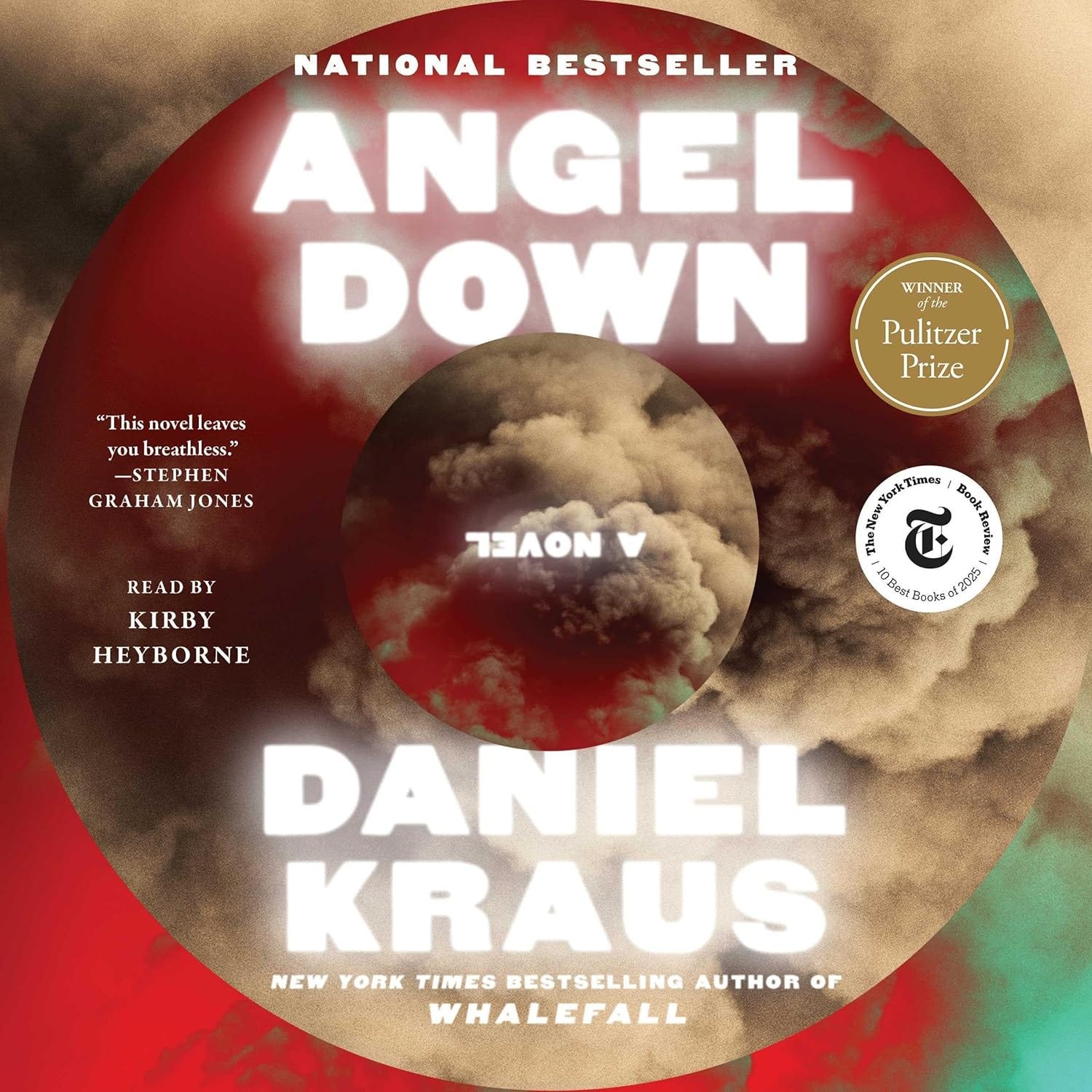
The Fiction of Pulitzer Prize Winner Daniel Kraus.
May 3100:22:01Tap to summarizeHello Friends,While this is not our “Library and Banned Books News” week, (that’s next week), I do want to mention that the Knox County, TN schools reversed the banning of Alex Haley’s Roots. And that was because of community and national blow back. Fighting back matters! Good job, book ‘freadom’ fighters!I had another cataract surgery last week, and wasn’t seeing clearly again, so I had the chance to listen to several audiobooks. One of them was Daniel Kraus’s Pulitzer Prize winning novel Angel Down. I read some remarks about the book questioning whether the Pulitzer committee was biased toward experimental work. Apparently, some critics found all the finalists to be similar in their approach. I don’t know—I haven’t read most of the books up for the award. However, Angel Down is unusual (I wouldn’t go so far as to say experimental) in that it is a single sentence. But, at least in audiobook form, it flows well. Pauses can be felt; there are chapter breaks (each starts with the word “and”).Thanks for reading Be a Cactus! Subscribe for free to receive new posts and support my work.Angel DownAngel is easy to follow and reminded me—in form, not in content— of the Academy Award winning film 1917 (Directed by Sam Mendes) which feels like it was filmed in one continuous shot. I haven’t read any interviews with Kraus, so I don’t know whether he was influenced by the film.Angel is the story of a group of five American soldiers trying to stay alive during the Meuse-Argonne offensive of World War I. A weird lamentation is coming from the No Man’s Land between them and the Germans. The pitch and endlessness of the cry is driving the men mad. Their commanding officer—Major General Reis, a very bad guy—commands them to take care of the man, who is probably caught in barbed wire. He means they are to kill the sufferer.No one wants to risk their life in No Man’s Land. Private Cyril Bagger, a con man and draft dodger who only landed in the war because he was caught in an illegal scheme, knows he can con his way out of being chosen for the risky mission. However, when the task falls to a teenage soldier named Arno, a mere boy who lied about his age in order to join the army, Bagger decides to accompany him. He has a soft spot for the poor kid after reading “The Son of Tarzan” to him. For a while, he believes he can make sure that Arno makes it home alive.When the two venture out to find the suffering soldier, they are surprised to find instead what they think is an angel, a woman who is unable to walk but who emanates a beam of heavenly light. It seems she protects them as they rescue her. But once they arrive back with the others, the angel brings out both the worst impulses of each of them as well as their illusory dreams. Bagger and Arno make it their mission to protect the angel and deliver her to safety.The story is full of vivid descriptions of the gore and horror of war—severed limbs, erupting guts, rotting teeth, pus and infections, burnt flesh—one atop the other, giving the reader a sense of the futility and darkness of the enterprise.As a high school teacher librarian, I read many YA books that I would later ‘book talk’ to students. The way the horror and gore were described in Angel were familiar to me. Is this the Daniel Kraus who wrote YA novels that I used to book talk? I checked—and yes, he is the same man.This Pulitzer winning novel has much in common with two novels I read for book talks—Rotters and Scowler. Perhaps this will lead some readers to think ‘how did Angel win the Pulitzer, then?’ But maybe another way to look at it is that some YA books are very good, and Kraus’s are among them. Maybe he was building the skills that landed that Pulitzer.If you enjoy horror, you might enjoy those novels. You could recommend them to teens you know. Teens could impress their teachers with the fact that they’ve read books by Kraus. Here are some thoughts I had when I read the YA books.ScowlerMy thoughts in October 2013:Scowler is a great October read, one in a YA branch of the true horror family. So—this is NOT your love triangle with some supernatural creatures thrown in ala Twilight and its progeny.Scowler is Dark.Scowler is Disturbing.After nine years in prison, a psychopath returns to the family farm with one thing on his mind—revenge against his son, now nineteen years old, for having him locked up all those years ago. That father, Marvin Burke, has escaped when meteorites fall throughout the county. One hits the prison and chaos ensues. Though Burke is supposed to be in a more distant lock-up, another escaped prisoner comes to the farm and warns Ry that his father is out for his blood.Ry had bested his father nine years earlier after climbing through a window and discovering his mother locked in her room, unable to flee. Her immobility is due to the twisted torture that her husband had devised for her in response to the fact that she has secretly done work to support the failing farm. (I can’t tell you—don’t want to kill the creep factor when you read it.)Though the family—Ry, his mom and his little sister Sarah—nearly escape, Marvin Burke catches them. It is up to ten-year-old Ry to be a decoy, to risk himself through a freezing night. He has no jacket, none of the right clothing, in fact. No light. No nothing, except three toys that fall from his pockets. As his mental state breaks under pressure of his father stalking him in order to murder him, these toys come to life and direct him through his living hell.One of Ry’s toys—Scowler—is an old cast-off, homemade from pipes, husks and shells. Hideously ugly.It may prove his salvation more than once.High school housekeeping: I think any teen might enjoy Scowler for a Halloween fright. Though there are several flashbacks, it takes place over a few days, just before the meteorite hits and then just after. Here, the reader finds himself in the mind of a sadistic psychopath as well as in the mind of his son, who, having suffered beyond ordinary human endurance, may well become a psychopath himself. The language is colorful, so if cursing offends you, you might take a pass. But this gives a sense of reality both to the brother-sister relationship and to the dire situation of the family. It’s a book of average length and average difficulty that will give you a taste of what adult horror fans read in the lengthier works of Stephen King, Dean Koontz, and their ilk.RottersMy thoughts in June 2013:Such a weird story! The combination of bullying and horror story compelled me to finish the book, and I think it will appeal to anyone who likes really quirky stuff.Joey Crouch has lived with his mother all of his life in Chicago. They don’t go out much and he’s never been over the Illinois state line. But when his mother is hit by a bus and killed, Joey is removed to a small town in Iowa to live with a father he’s never known.Things are very bad from the start. Ken Harnett, Joey’s dad, doesn’t bother to pick him up at the depot. He immediately leaves the house upon Joey’s arrival and doesn’t return for three days. Meanwhile, Joey sleeps on the floor, has nothing to eat and notices a strange, nasty odor in the shack that he can’t identify.Dressed poorly, hungry and stinking, Joey immediately becomes a target of bullying in his new high school—not only by jocks but by a sadistic biology teacher as well, one who daily makes Joey stand in front of the class and then uses him to point out body parts and their functions. (Just a note here from the teacher in me: I had a hard time believing that any teacher anywhere could get away with treating a student the way Joey was treated—but if one tried, I would hope that someone in the class would speak up and tell outsiders.)The situation only gets worse when we discover what that terrific stink is: Ken is a modern-day grave robber. With nothing to lose at school, Joey decides to learn the trade, and we enter the bizarre brotherhood of this underworld. They are criminals with a strange code of honor, and the one of them who has broken the code is terrorizing all the others. He may have the power to use Joey to get at the whole group.Rotters are people—because all people will die, and then they will rot if they are not cremated. The descriptions of grave robbing, of disintegrating corpses, are the stuff of nightmares. (So beware.) Yet the story is oddly original and well-written. There are a lot of interesting facts about the history of grave robbing and the ‘resurrection men’ who dug up corpses for scientists and professors to use in study. (Remember Jerry Cruncher in Charles Dickens’ A Tale of Two Cities?) When Joey has been bullied beyond endurance and he seeks revenge—well, imagine what a grave robber could do.Reading15 Essential Works of American Literature from Publishers WeeklyThe most vital books published in the U.S. since 1776 as voted on by critics.Of these 15 books, I’ve read 13. Which of them have you read?AI and Writing Awards<a target="_blank" href="https://www.theguardian.com/books/2026/may/19/commonwealth-short-story-prize-winner-doubts-ai-artificial-intelligence?CMP=fb_gu&utm_medium=Social&utm_source=Facebook&fbcli...
Transcribe →
Books! Magdalene Laundries, A World Appears by Michael Pollan, Here’s to you Jesusa! …
May 1700:18:42Tap to summarizeHello Friends,I hope you are feeling and doing well. I have several bookish things going on lately that I hope you’ll find interesting. But first, because life is rough, here’s something I found very hopeful on Reasons to Be Cheerful.Endangered Butterflies Are Thriving Behind BarsIn the tender, methodical work of rescuing an imperiled butterfly species, incarcerated women are finding a sense of purpose.My pandemic pups turned six years old.Hard to believe, but here they are thriving, and this is another thing that soothes these challenging days. I was moving into a period of despair when they came into my life and helped me rally. I wrote about it in my chapbook The Mortality of Dogs and Humans. I promised on my ‘About’ page to post about the dogs once in a while, so here are a few nap time photos.On Mother’s Day night, I decided to watch The Maltese Falcon because, somehow, I’d neither seen it nor read the book. This post from DocTalk, Allan N Schwartz PhD steered me to it: As a retired psychotherapist and psychoanalyst, I cannot help but view this film through the lens of symbolism and human motivation. The black bird itself, the Maltese Falcon, is not merely an object. It becomes almost mythical. Everyone in the story is obsessed with possessing it. Men and women lie, betray, manipulate, and kill in pursuit of it. Yet what fascinates me most is that the falcon has power not because of what it truly is, but because of what people imagine it to be.That is one of the great truths about human psychology.People often chase symbols rather than realities.BooksI had the chance to talk to Marla Miller about how my work as a teacher and librarian influenced my novel Keep Sweet. So much depends on what happens away from the desk!Sci-Fi Authors and Latino/Latine WritersI’m reading speculative fiction for a special (extra) issue of the Inlandia Journal right now. Submissions are open through May 31. (Side note: Submissions are also open through June 14 for their Eliud Martínez Prize. If you are a Latine writer seeking publication of a full-length manuscript [150-300 pages], have a look.)Review of Scouts’ HonorAnd I wrote a book review for the teen issue of Inlandia, “A Vow to Hide the Truth,” about Scouts’ Honor by Carlos Cortés. In general, the teen issue is all teens except the managing editor—the readers, the editors, the submitters/writers/artists. If you know a teen writer, have them look for the next submission period next winter.Thanks for reading Be a Cactus! Subscribe for free to receive new posts and support my work.Books on My TBR ListHow the Fanatical Legion of Mary Secreted Young Girls Away to Toil in Ireland’s Magdalene LaundriesLOUISE BRANGAN ON THE GIRLS WHO DISAPPEARED IN 20TH-CENTURY IRELANDExcerpted from The Fallen: The Lost Girls of Ireland’s Magdalene Laundries and a Legacy of Silence by Louise BranganI read the above linked excerpt on LitHub, and now I need to read the book. Or at least listen to the audiobook. Claire Keegan’s Small Things Like These was my introduction to the Magdalene Laundries. The power of this slim book/novella cannot be overstated. If you haven’t read it, you must. It’s the best thing I’ve read in the last several years.I’ve been checking out some recent ‘Best Of’ lists. I’m always hoping that I’ve read many of the books, maybe because it’ll make me feel like I have fine sensibilities. But honestly, there are many excellent books that critics, cuddled up in their sleeping bags in the Big Five tent, are wholly unaware of.25 Books That Capture This American Moment Time MagazineOf these, one that I haven’t read and look forward to is The Parable of the Sower by Octavia E. Butler. I read and enjoyed (so to speak—I mean I found it powerful) her novel Kindred.100 Best Novels The GuardianThe Guardian is posting “a countdown of the greatest literature ever published in English, as voted for by authors, critics and academics worldwide.” They add 20 books per week. So far they have posted 100-61. Another 20 will post on Thursday. No unexpected titles, but I have to say, I’m surprised that Pedro Páramo is only # 96. I think it might belong in the top 50.What I’m ReadingI just finished Michael Pollan’s A World Appears, a nonfiction exploration of consciousness. I thought my kids might also want to read it, but they have a point: the final outcome of all books about consciousness is that we don’t understand it. Nevertheless, Pollan’s exploration is very interesting and wide-ranging. He interviews many scientists, philosophers, writers, and spiritual seekers and also incorporates his own experiences with consciousness-altering psychedelics.“When neuroscientists began studying consciousness in the early 1990s, they sought to explain how and why three pounds of spongy gray matter could generate a subjective point of view—assuming that the brain is the source of our perceived reality. Pollan takes us to the cutting edge of the field, where scientists are entertaining more radical (and less materialist) theories of consciousness. He introduces us to “plant neurobiologists” searching for the first flicker of consciousness in plants, scientists striving to engineer feelings into AI, and psychologists and novelists seeking to capture the felt experience of our slippery stream of consciousness.”I also just finished Here’s to You, Jesusa! which is a translation of the testimonial novel Hasta no verte Jesús Mío by Elena Poniatowska. The original Spanish was published in 1969. I was interested in reading Jesusa because I’m trying to get a sense of Mexico during the Cristero Wars. (Research for my own writing.) I can’t say it helped me much, but it is a strange book with a frustrating protagonist who is nonetheless admirable for her insights into politics and her ability to survive a variety of hells, including desperate poverty. If you want to read about a woman who fought in the Mexican Revolution and also survived the Cristero Wars, this is it.“Jesusa is a tough, fiery character based on a real working-class Mexican woman whose life spanned some of the seminal events of early twentieth-century Mexican history. Having joined a cavalry unit during the Mexican Revolution, she finds herself at the Revolution’s end in Mexico City, far from her native Oaxaca, abandoned by her husband and working menial jobs. So begins Jesusa’s long history of encounters with the police and struggles against authority. Mystical yet practical, undaunted by hardship, Jesusa faces the obstacles in her path with gritty determination.”Although No Way Home by T. C. Boyle is very good, I stopped reading it because I had to finish my library books and return them. I hope to get back to No Way soon.What are you reading? Anything you’d like to recommend?Please like and share. Thanks! I hope you have a good week. This is a public episode. If you would like to discuss this with other subscribers or get access to bonus episodes, visit victoriawaddle.substack.com
Transcribe →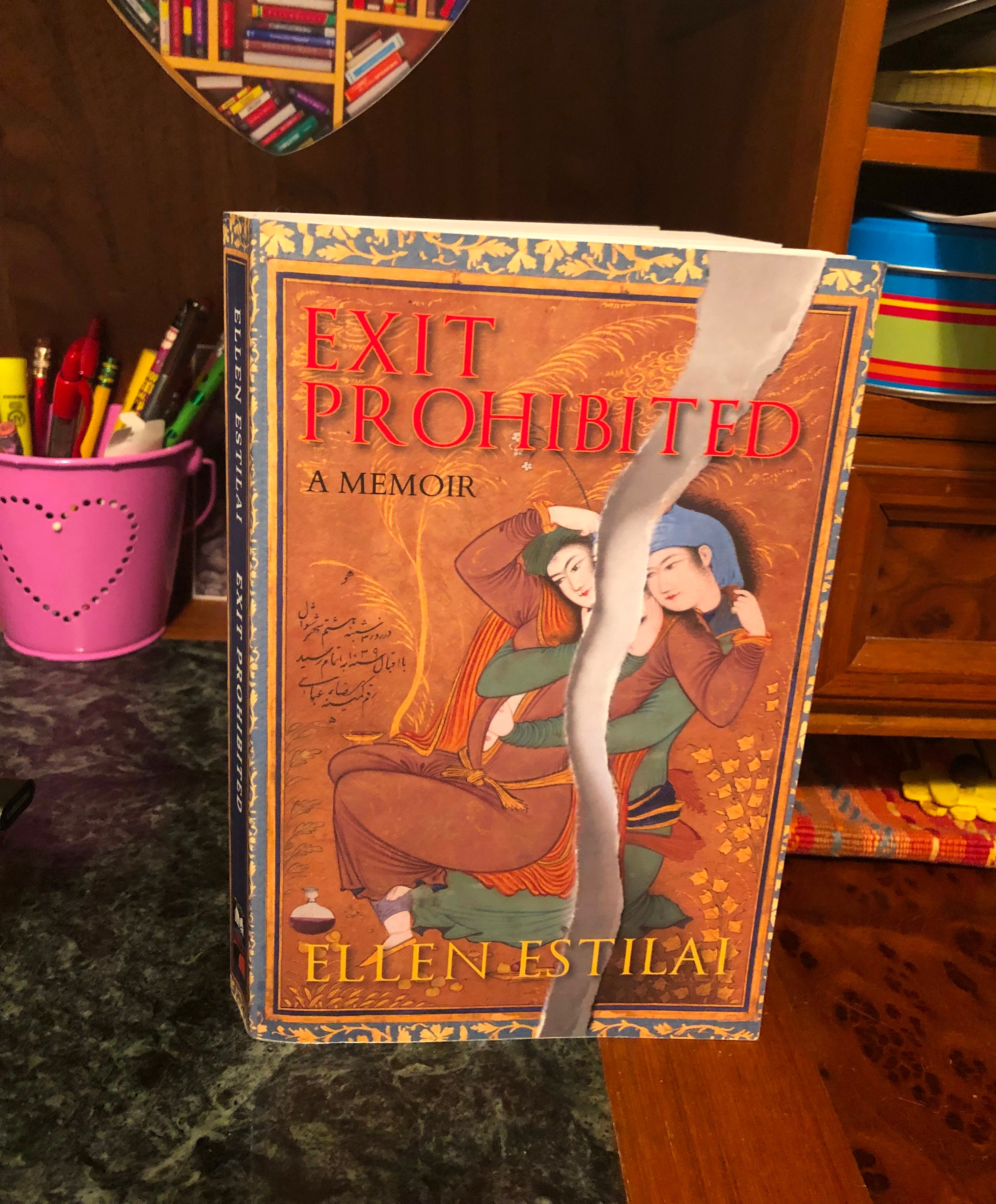
Iran and Exit Prohibited; AI-Generated Writing; Cesar Chavez Fallout
Mar 2200:26:35Tap to summarizeHello Friends,There are some things I wanted to discuss about this crazy week, so I’ll put off the final discussion of Enshittification. Next week we’re starting the new schedule of alternating the “Library and Banned Books News” with these review posts rather than having both within one week. So—next Sunday is about libraries and censorship.¡Sí, se puede! Yes, we can!I read in two newspapers that California is changing its Cesar Chavez holiday to “Farmworker Day/El Día del Campesino.” I’m glad my state is continuing with the honor. I’m over being heartbroken over the loss of idols. I think it’s best to celebrate ideas and movements that have helped people rather than any particular man. If you need some helpful reading on the Chavez abuse news, these may be useful:This guest post on the Contrarian by Maria Cardona.Let us be absolutely clear: none of these horrific revelations erase the very real gains made in farmworkers’ rights through years of grueling, backbreaking organizing. Those victories belong to an entire movement. Yes, Chávez was a leader — but so much of the unacknowledged credit belongs to Dolores Huerta and to the women who powered that movement from behind the curtain.And this:However, the farmworkers movement is not defined by an individual — and never has been. As Speaker Emerita Nancy Pelosi noted, “A movement is about the people — not any one person — and its strength lies in the values it upholds. We can honor the farmworker movement — and the generations who sacrificed to build it — while also confronting painful truths. No legacy is above accountability.” While we are shaken to our core, we continue to honor the tens of thousands of farm labor activists.Anne Lamott gives us hope, as always.Thanks for reading Be a Cactus! Subscribe for free to receive new posts and support my work.And here’s some good news from this week’s Reasons to be Cheerful because it’s important to remember that everyday people work to correct past mistakes, even devastating ones.The Native Seed Farm Safeguarding California’s FutureAt Heritage Growers, every acre is being cultivated to repair ecosystems and help the Golden State meet its ambitious conservation goals.California is widely recognized as one of the world’s most important biodiversity hotspots, supporting thousands of endemic plant and animal species, more than any other US state. However, California’s Biodiversity Initiative notes that its wetlands, riparian woodlands and forests have “suffered extensive losses,” with “an estimated 80–90 percent” of its biologically diverse landscapes altered or lost in the past 150 years. Development, agriculture, invasive species, climate change and increasingly intense wildfires are among the culprits. Reestablishing native vegetation is crucial to reversing those trends.Right after I posted Friday’s “Library and Banned Books News,” the librarian in Rutherford, TN said she will not move those 190 YA (mostly LGBTQIA) books out of the teen section because it violates the First Amendment Rights of the teens. We’ll see what ensues, but it’s a reminder that good people are out there fighting.Iran and Its PeopleI read a couple of articles this week about the choices Iranians are now having to make.Iranians Weigh Tough Choice: Stay or Flee from the LA TimesWhat the War Has Done to Iranians from the New YorkerAnd one closer and more personal, a text convo between the New Yorker Journalist Cora Engelbrecht and “Hadi” in Tehran. There’s Hadi’s early sense of hope about the war, the fulfillment of a lifelong wish for the death of the Supreme Leader, Ayatollah Ali Khamenei, which later turns to despair when the regime itself stays in place. I’m not sure whether you can access the article if you’re not a subscriber, but it’s very worthwhile. Here.“As for me, my situation is clear,” he added. “I want to remain close to what’s happening. I’m staying here in the middle of the war until the very end, until my home, what I consider my home, is taken away from me.”After reading these, I thought of a wonderful memoir about Iranian culture and history, about leaving Iran after the 1979-80 revolution. Exit Prohibited deals with the same question: should we stay or should we go? I know the author, Ellen Estilai, through the Inlandia Institute, a literary nonprofit.Opening the Door on Iranian CultureExit Prohibited by Ellen EstilaiAt the end of July 1980, Ellen Estilai, her husband, and their two daughters are leaving Iran. The decision isn’t easy. Ellen met and married her husband, Ali, in Davis, California, a decade earlier when they both attended university. Ali always planned to return to his homeland after earning his PhD in genetics. As a “first student,” his foreign education was paid for by the Iranian government on the promise to return and with his father’s house as collateral. After Ali graduates, Ellen goes with him, later giving birth to their children. Though she plans to spend her life in Iran, the 1979 revolution and its repressions make staying impossible. And while all four members of the family have permission to leave, Ali is detained at the airport. His passport is confiscated, and he is told he’s on the mamnou’ol khorudj — exit prohibited — list.Ellen and her daughters take off for Switzerland with plans to continue on to the United States. But they’ve no idea when they will see Ali again. She wonders: “Who would want to prevent Ali from leaving Iran? Which officious bureaucrat, which backbiting colleague, which sly neighbor could have written the letter or made the phone call? And just what is Ali being accused of? Having an American wife? Not being Islamic enough? Working on saffron?”The author moves from these thoughts to an examination of her life in Iran. Though hijab is not required under the shah’s rule, many Iranian women continue to wear headscarves, knee-length coats with long sleeves, and pants underneath. Those that don’t are eyed suspiciously as too westernized. As one of them, and a foreigner to boot, the author is sometimes distrusted. Yet she immerses herself in the culture and learns Persian. Her in-laws are a large, happy group who welcome her without hesitation. Their open-heartedness and gatherings, “a celebration of connectedness, of old roots and new growth,” satisfy a need that is not met in her small family of origin. Unlike her mother’s anxiety over hosting gatherings or guests, Iranians believe that a guest is God’s gift.Life in Iran is far different from what the author is used to. With few convenience foods available, she finds herself cooking much of the day. Itinerant street vendors call through the neighborhood selling coats and pants, watermelon, crystal dishes, and more. Though she is not convalescing, Ellen feels like Jimmy Stewart’s character in Rear Window. As she watches the drama in the courtyard and on the balconies, she discovers a good deal about her neighbors’ lives.The author also learns cultural norms. Taarof is the necessary offering of compliments and ceremonial courtesies (“these endless streams of pleasantries took so much valuable time”). The fatalistic worldview that everyone has their own ghesmat (kismet) prevails. Nonetheless, this view allows for a tradition of warding off the evil eye by preparing hot coals in a brazier and tossing in esfand (wild rye) seeds. And, of course, there is the ever-present samovar because tea is a part of all interactions, business or pleasure.Ali lands his dream position as a professor in the Biology Department at the University of Tehran. He secures funds to create a new department, the Department of Cellular and Molecular Biology, and to purchase new equipment. Though his hopes of improving Iranian education appear to be coming true, some people are envious of him.Meanwhile, Ellen completes her education in English Language and Literature and begins working at the new Tehran Museum of Contemporary Art as Manager of Education. The author’s discussion of the museum — architecturally, it’s ...
Transcribe →
Enshittification Part 2, Plus 2 Good Novels
Mar 1500:25:33Tap to summarizeHello Friends,While the frightening and exhausting aspects of life seem to overtake us, let’s not forget that good people do good work and we should keep up with that, too. Remember, every Sunday, Jess Craven posts lots of good things happening. Here’s a little thanks I got for giving blood in 2025. That felt good. Although I am still mostly reading research books for a novel I’m working on, I’ve had a chance to listen to a few wonderful novels. I finished A Complicated Kindness by Miriam Toews. It’s that story of Nomi Nickel, whose life in the Mennonite colony of East Village, Manitoba is without fun and without prospects (unless slaughtering chickens as a job counts). Both her sister and her mother were excommunicated and left three years earlier. Full of grief for her missing family members, Nomi breaks all the rules, numbs herself to pain, and longs for escape.I also listened to Whose Names are Unknown by Sanora Babb thanks to a recommendation by Beth Peyton. It’s a realistic look at farmworkers’ lives in the Great Depression. The characters in this novel flee the Dust Bowl and find an equally difficult situation on California. While the novel I’m working on has characters coming from Mexico during the same time period, they share some of the same issues with an abusive labor system. Sadly for Babb, her book was scheduled to be published, but just before, John Steinbeck’s Grapes of Wrath launched and was a runaway best seller. Babb’s book was finally published in 2004.Enshittification Part TwoFor Part One, check last week’s post.Let’s look at Cory Doctorow’s discussion of how we ended up in the internet platform mess. There are obvious issues with companies that can act as monopolies with no serious oversight (lax government regulation). But additionally, various companies figured out how to override the interoperability of computers at the same time that their work force became less valuable to them.Thanks for reading Be a Cactus! Subscribe for free to receive new posts and support my work.Getting Past the Interoperability of ComputersPretty much every computer in existence is capable of running every computer program that people know how to write. This has been beneficial to industries and customers with computer technology becoming faster. Computer chips also became faster and cheaper. Great stuff until companies started planting chips in everything including your car, your thermostat, your medical implant, even in the ink that goes into your printer. Suddenly, they can control your options in relation to that product. An example: You can’t buy a third-party ink cartridge that’s safe for an HP printer because it has a computer chip installed that will only read its own cartridges. Doctorow says that this allows HP to charge $10,000 a gallon for ink. While this sounds like hyperbole, he appears to be serious about that cost.Changes in the Work ForceWhen companies like Google and Facebook were new, tech workers had a lot of power because if they quit, they could easily find a job elsewhere. This is no longer true. These workers had a sense of mission and were spending all of their time at work, dedicating their lives to companies whose mottos were “Don’t be evil” (Google) and “Connect every person in the world” (Facebook). Today workers don’t feel any sense of ownership over the products. They are more likely to feel betrayed.Enough Money to Acquire EverythingThe root of the problem goes back further than these companies to the 1970s when Democrats and Republicans both declined to enforce antitrust laws. (Joe Biden embraced the ‘consumer welfare standards theory’ of antitrust law, but then he was out of office.) Unregulated, companies like Amazon are able to create monopolies in many areas. For example, diapers.com was an e-commerce leader. To put them out of business, Amazon sold diapers significantly below cost, losing $200 million over a single month on these products. Diapers.com went bankrupt. Amazon picked it up and then shut it down. So now they exercise a great deal of control over the diaper market. This takeover also sent a message to companies: if Amazon makes you an offer, you have to sell or else you’ll go broke.While Google has only made one great product (a search engine), they have been able to acquire many other people’s inventions. So Google Docs, Google Maps, their navigation system, their satellite images, their server management, and their customer service were all other people’s or other companies’ inventions that Google bought and integrated into their own company.Enshittifying That One Great ProductThe great product that Google created, its search engine, has been enshittified.According to Google internal documents displayed by lawyer Megan Gray in the Google DOJ trial in October 2023, Google uses a semantics-matching technology to invisibly append brand names to queries. An example Doctorow gives is a search for kids’ snow pants. The customer query is “kids’ snow pants.” Google would add the words “North Face,” unseen by the customer. Ads for North Face come up first. North Face pays Google a lot of money to have their ads triggered when their name is searched. Google gets paid. “Depending on your point of view, this is either merely very sleazy, or it’s actual fraud.” (79) Google claims that this is not true and that Gray misunderstood what was going on; however, they refused to explain themselves any further.Google also makes a lot of money by selling its search engines to other companies. This matters if you are an Apple user who believes you are not being tracked when you use Apple products. If you search using Safari, you’re actually using Google search. “Google has a non-consensual dossier on the behavior, social ties, purchases, economic status, employment history, and physical location of virtually every Internet user.” (81-82) Google gets $20 billion a year for this service.“It turned out that ‘If you are not paying for the product, you’re the product’ was wishful thinking. It is true to say, ‘Even if you pay for the product, you’re the product if the company can get away with treating you as the product. ‘” (83)There’s no end to bad actors running similar scams. Apple requires app makers to exclusively process payments through Apple’s system which takes a 30 percent commission on every purchase. (To place this in context, that’s ten times as high as the fees credit card companies charge merchants, which are already “sky-high.”) (84)Adobe planned to train AI on the work people create on it until creators rebelled en masse and moved to smaller company’s products.“The ability of purveyors of cloud-based products to alter their terms, prices, and features at will enables one of the most beloved Enshittification tactics of tech business leaders: bait and switch.” (100)Use an App; Do as You PleaseThe most common tactic tech companies use to flout regulation is to break the law with an app, and then insist that the law hasn’t been broken at all, because the crime was committed with an app. (111)One of the best examples would be Uber’s argument that it’s not an employer because it directs workers with an app. Companies can also say that they’re not committing wage theft if they do it with an app. Again Uber is an example with their algorithmic wage discrimination. When they offer jobs to all the drivers in the neighborhood, they calculate a different wage for each driver based on the driver’s recent behavior.Uber can raise the cost of a taxi for riders if their phones are about to run out of batteries. That’s called twiddling, the process of changing the price (recommendation weights, search rankings, etc.) through automated or semi-automated means. Like ‘We’ll just twiddle all of these knobs in order to make more money.’ Offline companies can’t do these kinds of things. Doctorow imagines a gas station owner seeing someone leaving a vehicle that’s stranded in the snow and coming toward the station to get some snow chains. He doesn’t have the opportunity to change the prices on all of those before the customer walks through the door. In digital business, they can change everything all the time instantly and do that based on their surveillance data and other information.Amazon takes the app scam to a whole other level. Since it uses delivery service partner (DSP) companies for its vans, it has fired the companies when their drivers unionize. If those workers were employees of Amazon that would be illegal, but Amazon can claim that it exerts control over the drivers through an app. So it’s an intermediary.Amazon surveils delivery drivers with sensors in the vans that record the traffic around a vehicle. Inside the van cameras monitor the drivers down to the motion of their eyeballs and mouth. So if they’re singing along with the radio, Amazon can tell them they’re not paying attention to driving. They tell the drivers what route to drive and set crazy quotas for deliveries. Since they demand the dismissal of drivers who don’t live up to the standards it sets, Amazon drivers end up urinating in bottles. The fix? They get in trouble if they come back to the depot with bottles full of urine, so they throw them out the window and then you have roads leading to Amazon depots that are littered with sealed bottles of human urine.Twisting Intellectual Property LawWhen big tech companies say it’s impossible to run code of your choosing on their computers, what they’re really ...
Transcribe →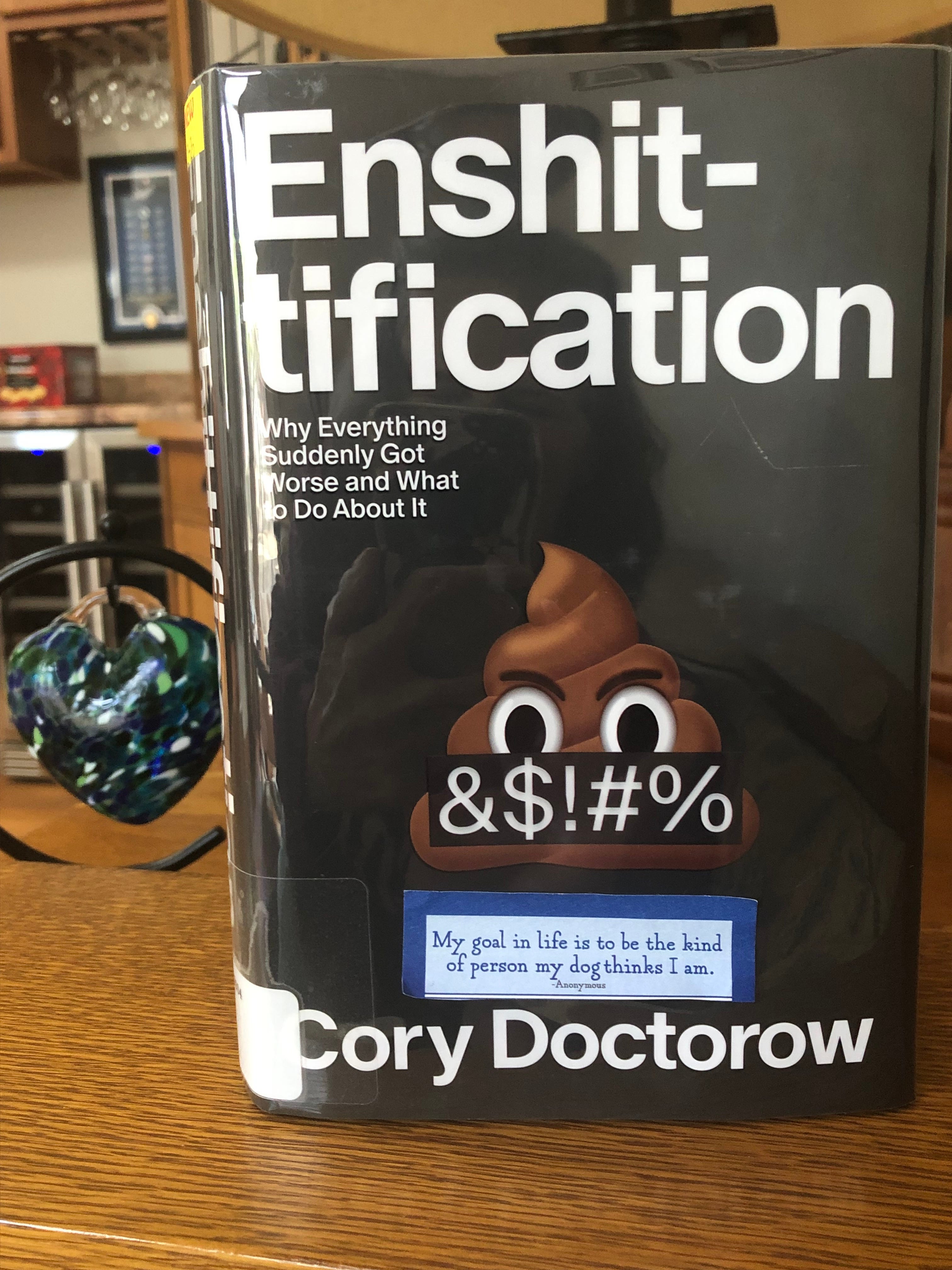
Enshittification by Cory Doctorow
Mar 800:22:38Tap to summarizeHello Friends,Tonight, I’m picking the winners for the book giveaway and will be sending the books out ASAP (hopefully tomorrow). Thanks to those who participated.Today, I’m discussing Enshittification by Cory Doctorow and then following up with some links for writers. This is a ‘Part One’ because there are many issues Doctorow illuminates, and then he concludes with some ideas for changing online culture. These deserve a discussion as well.Also—I mentioned this in Friday’s “Library and Banned Books News,” but if you only read Sunday’s book discussions: I will be changing the schedule in a week or two so that there is only one post per week, on Sunday. The Library/Banned Books News will alternate with the book discussions. Two reasons for this:* I feel the world is just so much right now and people are dealing with an onslaught of information.* I want more time to work on a novel that I have finally started! (Yay!)Enshittification: Why Everything Suddenly Got Worse and What to Do About It by Cory DoctorowI’d like to explore Enshittification in depth because I think the story it tells is important for all of us. There may be three parts to the discussion (not sure). I encourage you to get your hands on the book ASAP and read along. If you want to borrow it from the library, it probably has a hold list, so put your name in now. 😊“You Are Not Just an Ambulatory Wallet”“It’s not just you. The Internet is getting worse, fast. The services we rely on, that we once loved? They’re all turning into piles of s**t, all at once. Worse, the digital is merging with the physical, which means that the same forces that are wrecking our platforms are also wrecking our homes and our cars, the places where we work and shop. The world is increasingly made up of computers we put our bodies into, and computers we put into our bodies. And these computers suck.” (3)Doctorow notes that he is an Internet activist who’s been working for digital human rights for decades. He calls our era the Enshittocene, which has been caused by specific policy decisions at ‘middlemen’ platforms that connect business customers to end users or connect workers with their customers. Some of the bad actors he discusses are eBay, Amazon, Apple, Microsoft, Uber, Google (connects publishers and advertisers to searchers) and Facebook (connects people who want to socialize rather than search).So, what is enshittification?Doctorow names it in four steps:* First, platforms are good to their users.* Then they use their users to make things better for their business customers.* Next, they abuse those business customers to clawback all the value for themselves.* Finally, they have become a giant pile of s**t. Why Do We Stick Around if the Platform is So Bad?There’s a cost for leaving these spaces even though it’s become a hassle to be there. For example, if you leave Facebook, it’s likely the people you hang out with will not be available to you on another platform—it’s hard to get other people to switch. So when Facebook realized that it could make money from advertisers and publishers, they did so by spying on the users and then using an algorithm to target advertising based on what the users were interested in. Eventually, Facebook stopped being good for business customers as well by increasing the price of targeted ads and, at the same time, not showing the ads to the users that the advertisers had selected.Thanks for reading Be a Cactus! Subscribe for free to receive new posts and support my work.Is It Truly Evil?All the platforms discussed have engaged in downright evil behavior, but Amazon is among the most egregious in that their policies affect everyone, including people who have never used their platform. Let’s look at their story. Other platforms are variations on the Amazon theme.Amazon also started out as good for users. It had a lot of investors with a lot of money which it used to subsidize goods (sometimes selling them below cost) and shipping. It had a generous ‘no questions asked, postage paid’ return policy.Early on, Amazon couldn’t lock people into using it the way Facebook could. So it came up with the idea of Prime membership, which creates lock-in because customers are paying for shipping a year in advance. Quite the incentive to shop on Amazon. In addition when you buy audiobooks, movies, and most e-books and e-magazines from Amazon, you’re permanently locked into Amazon‘s platform because the projects are sold with digital rights management. There’s a form of encryption that will force you to view or to listen to those products using apps that Amazon controls. If you leave Amazon and delete those apps, you lose all the media you’ve bought from their platform—an incredibly high cost of switching.Amazon was good to its business customers until it wasn’t. Because Amazon tracks so many users and people stop there for almost anything, Amazon has been able to extract higher discounts from the merchants who sell there. This brings in more users, which, again, makes the platform even more indispensable for the merchants. They have to go there—allowing Amazon to keep requiring deeper discounts, and on and on.It finally comes to stage three, the pile of s**t stage: Amazon using tactics to shift value from the business customers to itself. It started tracking merchants’ best-selling items and cloning them and, at the same time, moving the original seller’s items far down on the search results. The original product doesn’t show when a person searches for it specifically. It shows the Amazon clone instead. Amazon also charges merchants a lot of junk fees that are pitched as optional, but in effect, they’re mandatory. Prime is an example. If a merchant doesn’t include prime shipping, then people won’t pick them. They are pushed so far down in the search results that they’re basically nonexistent. Yet another thing merchants must do: Use fulfillment by Amazon, a service where the merchant sends items to Amazon’s warehouse, where they’re packed and then delivered. It’s more expensive than comparable or even superior shipping services from other shipping companies, but if a merchant ships through a third-party company, then it gets dropped down in the search and ceases to exist. Amazon is gouging its merchants so much that it pays nothing to ship its own goods (which compete directly with those merchants’ goods).All this turns into higher prices for customers. Merchants pay Amazon “through the nose.” Amazon junk fees add up to 45 to 51 percent of what it earns on the platform. So merchants raise prices on their products, not just for Amazon customers, but as a whole. For reasons that are unclear to me (seem like a loophole and a cheat at the same time), this is necessary for Amazon to stay clear of the US Federal Trade Commission’s antitrust lawsuit against them. So, we’re all paying the ‘Amazon tax’ no matter where we shop.Doctorow makes similar enshittification arguments for Apple, for its iPhone, and for Twitter. (However, many people were able to leave Twitter when Musk came along and turned into the Nazi platform it is.) Enshittification is well worth reading to see how Apple and Google are in cahoots. (Don’t believe Apple when they say they are not tracking you.) But, wait! There’s more!How Did We Get HereDoctorow shows why this Enshittocene spread so far and so fast by looking at the world that companies operate in.Any company would want to charge as much as possible for goods and services while they spend as little as possible, paying the lowest possible wages, giving customers the lowest quality products, and selling them with the highest prices. What stops them is if workers could quit over low pay; if their suppliers would stop shipping products when their invoices are unpaid; and if the customers would turn away because of the high prices. But our enshittifiers are effectively monopolies, so the markets and the competition to stop them don’t exist. Add to this that they’re not regulated by the government.Part Two will discuss how all this happened: how competition, regulation, interoperability of computers, and worker power all slipped away. Meanwhile, repeat reminder: I recommend you get your hands on the book. If you want to borrow it from the library, it probably has a hold list, so put your name in ASAP.A Few Links of Interest for WritersWhat is AI Voice?Authors and Money (or Lack Thereof)Authors Hoping to be Published This is a public episode. If you would like to discuss this with other subscribers or get access to bonus episodes, visit victoriawaddle.substack.com
Transcribe →
Book Giveaway and Gratitude
Mar 100:13:30Tap to summarizeHello Friends,I decided to celebrate, dive into gratitude, and relax this weekend rather than write an essay. And read a bit of a book about Mexicans in the 1920s fleeing the Cristero War as research from the novel I’m just starting.I want to celebrate that we here on Be a Cactus are now a group of over 500 subscribers, a thing I am very grateful for! So—I’m having a book giveaway for U.S. subscribers. (I once gave away a book that went to Europe, and I paid $38 for the shipping. Yikes!)I’d like to send out two copies each of Acts of Contrition and Keep Sweet along with fabric bookmarks that I handmade. Read the descriptions below, and if you are interested, click the link to message me, indicating which book you would prefer. If there are more than two people who are interested for either, I’ll put names in a hat and draw.Keep Sweet (Crossover Novel)Thanks for reading Be a Cactus! Subscribe for free to receive new posts and support my work.Acts of Contrition (Feminist Literary Short Fiction)The women in Acts of Contrition face society’s devaluation, from parents, from elders, from all who assume authority over them. They battle oppressions as simple as gender stereotyping, as complex as prerequisites to friendship or love. Some can look back and laugh, some find luck in their escape from harm, some engineer their own good fortune, all the while riding a wave of dark humor. What all the characters come to understand is that silence places them at greater risk than speaking out. They progress toward freedom through the telling of their stories.GratitudeIt’s great seeing books of poetry coming from friends I’ve met through various literary organizations and writers support groups. I truly loved Here to Be Remade by Lavina Blossom (Bamboo Dart Press), who is also an artist. Just arrived is Anna Gasaway’s My Mother’s Husbands from Finishing Line Press.I’m also grateful for lifelong friends. One sent me a ‘blind date with a book’ surprise this week. The wrapping was so beautiful, I waited a day to open it. Part of my relaxing this weekend will be doing literary word searches. (I think I’ll start with Margaret Atwood.) Thanks, Kathy!A deeper dive into The Little Magazine for those interested:The Little Magazine That Defied American CensorshipMargaret Anderson’s Little Review fought to bring the great works of modernist literature to the United States.WritersWriters, did you read this? If not, you should.Thank you for reading, for being here, and for subscribing! Jo Scott-Coe Jo’s Substack Mary Camarillo Life With Riley This is a public episode. If you would like to discuss this with other subscribers or get access to bonus episodes, visit victoriawaddle.substack.com
Transcribe →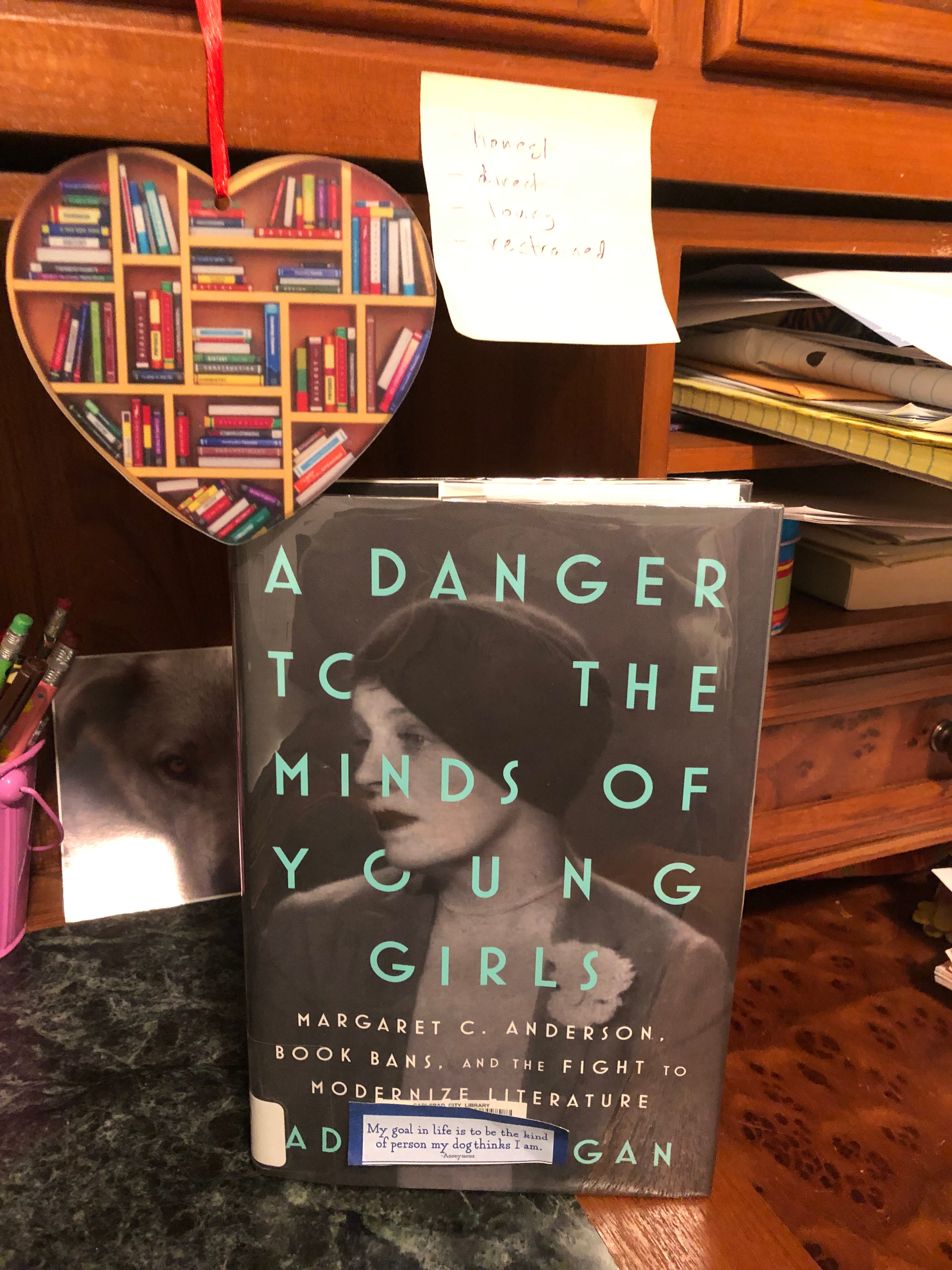
A Danger to the Minds of Young Girls
Feb 2200:24:21Tap to summarizeStruggle is a never-ending process. Freedom is never really won, you earn it and win it in every generation.— Coretta Scott KingHello Friends,I hope you have been enjoying the Olympics. We had a birthday celebration this weekend, and I got to try a Himalayan restaurant (Indian, Nepali, and Tibetan food) and have ultra-chocolatey cake (recipe below). I’m also happy that my vision has cleared up a bit. Today I want to chat up A Danger to the Minds of Young Girls: Margaret C. Anderson, Book Bans, and the Fight to Modernize Literature by Adam Morgan. After that I have a little on the new author scam industry, abetted by AI, which allows the scammers to act like they’ve read books they know nothing about.A Danger to the Minds of Young Girls“The Red Scare made Americans paranoid that anyone they passed on the street could be a bomb-wielding anarchist, and Comstock and Sumner’s book-banning campaigns stoked fear that reading modern fiction and poetry could turn young women into disease-ridden lesbians and prostitutes.” (3)On October 4, 1920, Margaret Anderson was arrested and charged with publishing a ‘filthy, indecent, and disgusting’ work of fiction—an excerpt from James Joyce’s Ulysses—in The Little Review and distributing copies through the Post Office Department in violation of the 1873 Comstock Act. A Danger to the Minds of Young Girls is the story of what led to this incident and what followed.Anderson was born in Indianapolis to an affluent and conventional family that included a depressed father, a controlling mother, and two sisters who shared some of her adventures. In 1908, she headed to Chicago, which was in artistic and literary bloom. At the time, Anderson was supported by her parents, who sent her sister to live with her in an effort to keep her on the safe side of societal norms.Margaret worked at various journals, increasingly more prestigious, eventually landing at The Dial, the most influential literary magazine of the time. There, she held various positions and learned many of the practical aspects of publishing a magazine. She met the “most prolific artists and writers” and by 1913 was gathering support to launch The Little Review. She did so in 1914. Though she was unable to pay contributors, she published many great writers because “[m]ost … magazines and publishers that could afford to pay poets and writers in those days were not—yet!—interested in the bizarre, mystifying, sexually explicit, or politically radical writing Margaret would champion in The Little Review.” (38) The list of contributors include the literary rockstars of the period. Conrad Aiken, Amy Lowell, and Sherwood Anderson were early contributors.In a stroke of luck, in 1916-17 Ezra Pound, who had previously been published in The Little Review, petitioned Anderson to publish him and T. S. Eliot in each issue, James Joyce when he liked, and Wyndham Lewis if he “comes back from the war” (93)—all writers “too odd and obscene to be published in major magazines that paid contributors.” (94)Pound wanted a guarantee of 5,000 words per issue and eight issues per year. If he could get this, art collector, patron of the avant-garde, and lawyer John Quinn, would pay the authors. (They needed a source of income.)The deal was made and began in April 1917. In 1918, The Little Review started to publish sections of Ulysses serially. By 1919, it was being censored—copies were held at the post office and later burned—and by 1920, Anderson and her co-publisher and life partner, Jane Heap, were on trial. This period contains the heart of A Danger, which includes long quotes from the published sections of Ulysses which were deemed obscene, as well as what Anderson and Heap self-censored in an effort to continue the serialization.Thanks for reading Be a Cactus! Subscribe for free to receive new posts and support my work.Supporter of the avant-garde, lawyer John Quinn (mentioned above as the one who paid Little Review contributors Pound, Joyce, Eliot, and Lewis) ended up representing Anderson and Heap at their trial. While he was on the cutting edge in art and literature, he was socially conservative—it may be more true to say homophobic and racist. He, therefore, resented working for Anderson and Heap as he didn’t approve of their relationship. In truth, he hoped to have the case dropped if the women agreed to stop publishing Ulysses. He believed this would help sales of the novel when it was published because Little Review readers would want to finish it.Over the life of the magazine, Anderson’s choices sometimes threatened its existence through the loss of her patrons. Her support of the anarchist Emma Goldman was especially controversial among her early donors and subscribers. In 1914, Anderson’s father died at the Central Indiana Hospital for the Insane in Indianapolis of a hemorrhagic stroke caused by a ruptured blood vessel in the brain. His death ended Anderson’s parental support. Her mother, whose conventional morality was ruffled by everything Margaret did, cut her off when she refused to abandon the magazine. They never saw one another again.Anderson is courageously undeterred. I feel that her early (extreme) privilege was necessary to her undaunted sense of the importance of her work. Still, she proves stalwart. Out of money and evicted from their apartment after expressing support of Emma Goldman, she and Heap create an encampment on a Lake Michigan beach north of Chicago. Later, they break into a house in California. When they learn the owner is the local sheriff, they convince him to rent it to them.In fact, much of what takes place in Danger feels like the story of another world, both the weirdness and the luck. At times, Anderson and Heap live in French castles. When Anderson’s sister divorces, she and Heap adopt her children only to later leave them in Paris with Gertrude Stein and Alice B. Toklas, who then adopt them. (Wouldn’t you love to read the biography of those boys?) Unbelievably, Anderson, an accomplished pianist, gets the Mason & Hamlin Company to give her a new piano in exchange for free advertising each time she moves into a place where she has room for one (by my count, four pianos).Anderson and Heap published their last issue in 1929. Ulysses would be published as a complete novel in Paris by Sylvia Beach, who didn’t fare much better than Anderson for all her support of Joyce.In her introduction to the 1972 edition, Flanner describes the process by which “Ulysses,” …. was brought about:Ulysses was the paying investment of his lifetime after years of penury, Sylvia said, while hardly acknowledging the fact that the publishing costs almost wiped out her Shakespeare and Company. The peak of his prosperity came in 1932 with the news of his sale of the book to Random House in New York for a forty-five-thousand-dollar advance, which, she confessed, he failed to announce to her and of which, as was later known, he never even offered her a penny. “I understood from the first that, working with or for Mr. Joyce, the pleasure was mine—an infinite pleasure: the profits were for him.”( Janet Flanner, introduction to “Paris was Yesterday,” quoted in “By way of Books and Their Makers: Sylvia Beach and James Joyce” by Macy Halford, March 5, 2010, “The New Yorker.”)After they end publication of The Little Review, Anderson and Heap both join a cultish group of followers of George Ivanovich Gurdieff.“By following him, his students could evolve their minds into something semi-divine—and if enough human beings did the same thing, their collective consciousness could prevent the destruction of the universe.” (190)After a serious car accident, “Gurdjieff spent most of his time writing and dictating a manuscript that would become Beelzebub’s Tales to his Grandson, an allegorical representation of his trackpads that reads like a Byzantine science fiction novel.” (192)It’s a strange turn in their previously admirable lives.A Danger includes a good deal of background for each major character or influence that we meet. We learn what William Carlos Williams wore and that Ezra Pound was engaged to Hilda Doolittle twice. While the lives of literary superstars might interest English majors, I think some readers will find the book a bit saggy and off point in these interjections.We also get the background of the many women that Anderson and Heap conduct affairs with and of those they partner with after their breakup. (Opera singer Georgette Leblanc is Anderson’s second significant love, and they remain together until Leblanc succumbs to cancer.) So many people circle one another in a dance of changing partners that it’s hard to keep them straight, and I’m not sure they all contribute to the story.Ultimately, though, Anderson’s life is worth the tale. Wild and wonderful as it is, it makes a good read and adds to the literary history of Chicago of the first quarter of the 20th century.I had requests for strawberry shortcake for the last two birthdays. This time, there was no special request, so I felt like going back to an old favorite—Hershey’s Cocoa Cake. This is super easy to make. I plan to make a slightly more complex chocolate cake for St. Patrick’s Day (Guinness stout, coffee, ganache filling ...
Transcribe →
Making Meaning with Your Story; Some Good Books
Feb 1500:28:22Tap to summarizeHello Friends,Here’s another set of quotes from Sojourners I thought you’d like:There is no fear in love, but perfect love casts out fear; for fear has to do with punishment, and whoever fears has not reached perfection in love.- 1 John 4:18may the tide / that is entering even now / the lip of our understanding / carry you out / beyond the face of fear- Lucille Clifton, “blessing the boats”And another I read on John Fugelsang (adjacent to fear, I think—kind of a ‘do the right thing even if you’re afraid’ quote.):Temporary power is never worth permanent disgrace. —John FugelsangSpeaking of perfect love, I hope you had a happy Valentine’s/Galentine’s/ Palentine’s Day yesterday.I’m a bit down that I can’t see well in my left eye four weeks after surgery, but am still hopeful that I’m not in the 5% of people who have no improvement. To chipper myself up, I thought I’d try something different today and see if you’re up for a challenge and then follow that with some good news.The ChallengeI’ve been thinking a lot about how I wish I had better known some of my friends and family who’ve died. And now I can’t ask them anything. This feeling has helped me to understand what I’d like to do that will leave a sort of personal record for loved ones when I am dead.I periodically write a ‘literary journeys’ article for the So Cal News Group newspapers. I wrote this for last Sunday. Have a read and see if you’d like to try it.Make your family’s life story meaningful for future generationsI haven’t made New Year’s resolutions for many years for the same reason most people stop doing so. My follow-through is pretty bad, so I end up feeling worse than when I started.If you’re like me and already feeling bad about a lack of progress on your literary resolutions for 2026 or even about not making a resolution, I have a challenge for you. You don’t need to read 100 books this year or write a novel draft in three months. Instead, kickstart your creativity with something that will be a gift to your most important readers — your family. Explore your life story in a way that will be meaningful for the next generation. In a way that will be meaningful for you.In the last five years, which have been full of loss for me, I’ve come to realize the importance of family stories. My parents, brother, half-sister, lifelong friend, two sisters-in-law and others close to me are gone. I’ve realized that I know almost nothing about my parents’ childhoods, about their early years, their hopes and dreams. They were not ones to write letters or have a video recorder. They didn’t leave a record for us to look back on. My brother died far too young, but I have a single voice message he left me, wishing me a happy birthday. I keep it to play periodically. To hear his voice.I happen to have made one recording of my parents’ voices about five years before they died. I’d received a recorder-microphone as a gift so that I could quickly save my thoughts and ideas for the stories I would write. On a whim, I decided to bring it to my parents’ house one evening along with dinner. After we ate, my husband took to the kitchen to wash the dishes, and I started asking questions. One of my dad’s funniest and most moving stories was about his grandmother’s dog, who waited for him at the bus stop each day after school. I forgot about the recording, but after my parents had died, I happened upon it in my computer files. I was excited to play it, but was unable to hear anything. However, I could see that something was there. I sent a copy to my son, who realized the loud noise of the pots and pans clanging in the kitchen at the beginning of the recording had set the sound range. He removed it, and my parents’ voices came to life. I was reduced to a puddle of wonder and tears. I emailed it to my siblings. One of my sisters started to listen to it while driving, but was so emotionally overwhelmed that she had to pull over.Thanks for reading Be a Cactus! Subscribe for free to receive new posts and support my work.So, here’s what I’m hoping you will do: if your parents are still alive, ask them the following questions. And then answer these questions for yourself, both in writing and in a recording. When you or your family are ready, listen and read.These questions are a bit different from the usual writing prompts, but I think they can open the door to related memories and to buried emotions, hopes and dreams.* Who is the bravest person you’ve known? Not someone you’ve read about or can find in the history books. Someone in your life: a friend, relative, coworker, etc.* Who was your best childhood friend?* Did you have your own bedroom growing up or did you share with a sibling? Describe your room. (This can lead to interesting reflections on sibling relationships.)* Describe your favorite childhood hideaway. Why did you go there? What did you do there?* Discuss your childhood pets.* Think of a time when you did something you shouldn’t have done. Describe how it made you feel.* Have you ever needed stitches, broken a bone, or been hospitalized?* Who was your favorite relative?* Who was your most interesting neighbor?* What was your most beloved toy?* What was your mother’s favorite perfume? Does it trigger any memories?* How did you spend holidays with your extended family?* Describe a time when something went completely wrong while your family was traveling.* What was the best home you lived in growing up? Why?* What major world events do you remember from your childhood and young adult years?* Describe your earliest jobs. What did you do? What was the environment like? What were your coworkers like?When we talk about the ordinary events of our childhoods, we illuminate how full of possibility and imagination we have always been. Be known to your loved ones. It’s a gift.Authors Connect with Me, Their ReaderI mentioned recently that I’m writing thank you notes to authors. Two YA authors have emailed me responses that were very kind— Chris Crutcher said he admires people who had a career in public education. That made me want to go back a grab something he wrote. I found a short story as a stand alone audiobook for a series called “Guys Read” edited by John Scieszka. The story is “The Meat Grinder.” The publisher’s description is: If Devin Mack can’t actually fight his father, he’s going to fight everyone he can find on the football field.This doesn’t do it justice. The abused Devin Mack, who has been in and out of foster care, is actually forced into high school football and just wants out. He’s small and no athlete. But a star player wants him to believe in himself and works to make that happen. It’s a fun story, not least because of Devin’s voice. A great story for teens, including those who find sports humiliating. Also—a great story for writers who want to see how character voice is done!I also wrote an email to Jonathan Maberry, who is a NYTimes bestselling writer of horror. He has a YA series entitled Rot & Ruin that I used to booktalk to our students. (I wrote a bit about it here.) It’s creative and creepy. I told him how much the students liked his books. He wrote back a thank you and mentioned that Rot & Ruin is in development for a film. He said that his middle school librarian “absolutely changed the course” of his life. (Yay, librarians!)I mentioned last week that my friends and I had seen George Saunders on his book tour. In Story Club with George Saunders he had told the story of his dog, Guin, being very sick. It was an ongoing issue that we clubbers were following. Apparently, she had a UTI and, now treated, is doing much better. But I was moved by the story and took a copy of The Mortality of Dogs and Humans to him as well as a bookmark I’d made for him from fabric with a dog print. He saw my name on the book and said, “Is this you? I feel like I know you.” (Because I comment on the stories etc.—I am an active member.) That made me smile.So—if you’re feeling blue, why not write a little note to an author whose work you appreciate? They are often kind and respond.What I’m ReadingI’m reading some good books and will discuss them soon. I finished A Danger to the Minds of Young Girls by Adam Morgan. It’s about Margaret Anderson as the creator of the literary journal The Little Review, which serially published sections of James Joyce’s Ulysses until Anderson and her partner (Jane Heap) were arrested and charged with mailing obscene literature. I will probably discuss it next week.I’m in the middle of Enshittification by Cory Doctorow. I know some tech companies are led by horrible people doing horrible things, but I didn’t realize how horrible they actually are. Doctorow is good at explaining the who, what, and why. But I’m getting a little down and looking forward to the last section of the book where he will discuss what we’re supposed to do about it.Here’s ...
Transcribe →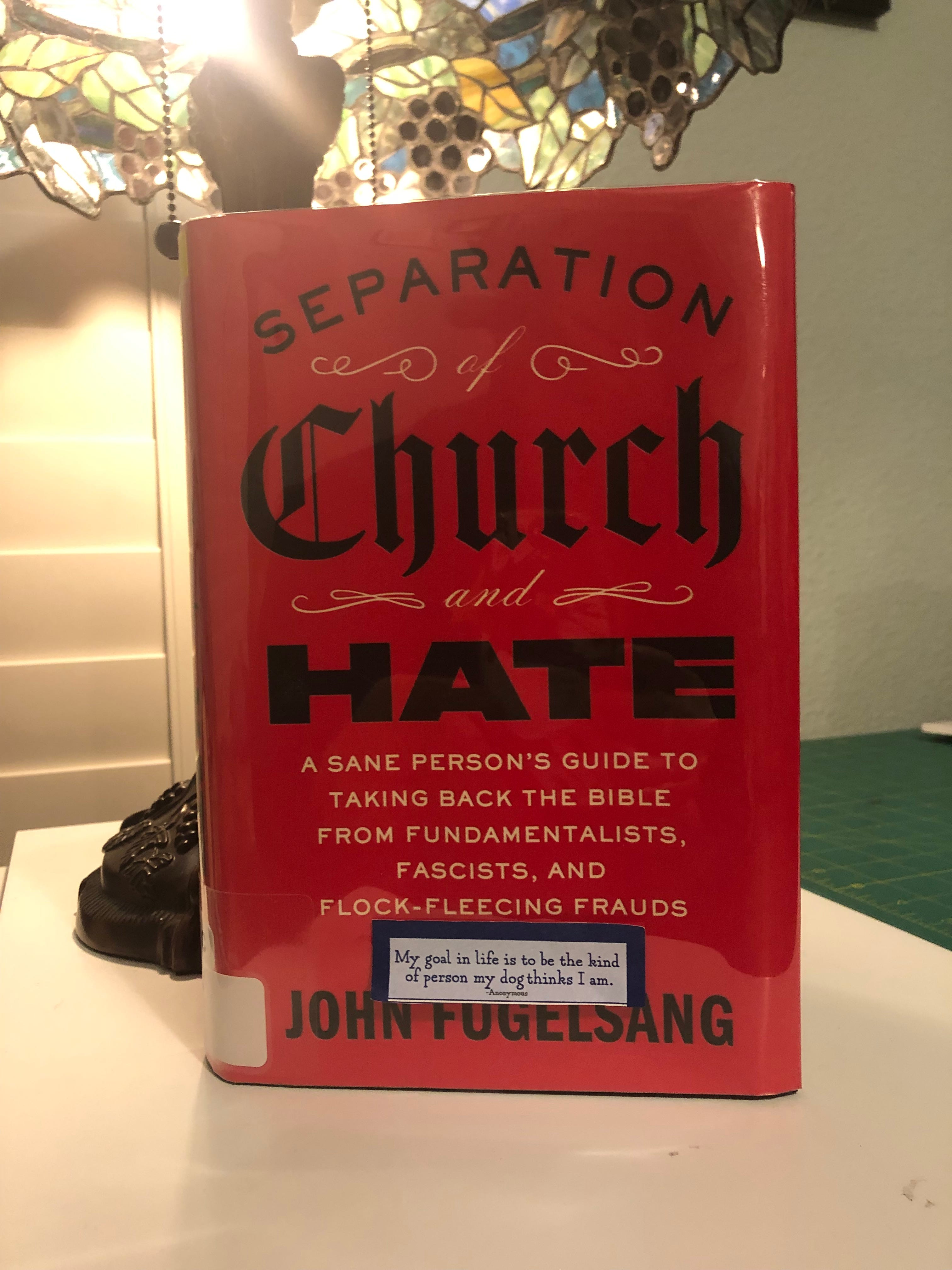
Separation of Church and Hate by John Fugelsang
Feb 100:24:23Tap to summarizeHello Friends,I’m writing this a bit early because I’m going out of town, first, to attend the life celebration of a friend’s mother, and then to go with my friends to hear George Saunders in Santa Cruz as he tours for his new novel Vigil. I confess: my husband wanted the audiobook, so I listened to Vigil the day it launched. My friends and I will be getting signed copies at the event, and then we’ll read and talk about it together. Lovely.I’ve wanted to discuss Separation of Church and Hate by John Fugelsang for a while. If you enjoy Be a Cactus, please click the heart and/or comment. It helps others to find us. Okay, here we go!Separation of Church and Hate: A Sane Person’s Guide to Taking Back the Bible from Fundamentalists, Fascists, and Flock-Fleecing Frauds by John Fugelsang“The primary driver of most global conflict, oppression of women, suppression of science, persecution of gay people, and abuse of power is not religion. It’s the extreme fundamentalist wings of all the world’s religions that provide this drama for the rest of humanity.” (6)“Paul’s a bit edgier than Jesus in ways that make him more attractive to a certain kind of right-wing believer. While the gospel teachings emphasize love, compassion, and inclusivity, Paul’s personal opinions about women and sexuality just couldn’t help but bleed through his writings. Which means that over the last two thousand years, many Christians have been taught to prioritize certain passages from Paul’s letters that suit their personal biases over Jesus’s irritating orders to love everyone.” (46)The inside book jacket of Separation claims that “the son of a former Catholic nun and a [former] Franciscan brother delivers a deeply irreverent and Biblically correct takedown of far-right Christian hatred.” I found the bits of humor less irreverent than refreshing. Generally, the book is a defense of Jesus’s ministry. Fugelsang takes down Christian Nationalist and fundamental evangelists’ arguments one after another, showing that they are not based on the words or actions of Jesus, but simply self-serving baloney. He reminds us that context matters—and he gives that context.“He was the most famous innocent brown skin man ever to be wrongly executed by the state, and he was deliberately killed in the most painful and humiliating of ways.” (21)Separation is for anyone who wants to debate far-right Christians on the hot-button topics of the day. This includes anyone from true believers to atheists. (You don’t have to believe in a God to prove that what Christian nationalists say about him is not based on the text of the New Testament.) Fugelsang includes many chapter titles that begin with “Thou Shalt Not” and include: Take All This Too Literally; Hate Feminists; Hate the Gays; Hate People Who Have Abortions; Hate “Illegals”; Hate on Poor People; Kill People Who Kill People to Prove that Killing People is Wrong; Hate Gun Control or Worship Warrior Bro-Dude Jesus; Hate Jews, Muslims, or Even Atheists; Be, or Defend, a White Supremacist.“Jesus, disdained wealth, and earthly power, and challenged traditional laws of his own faith. He rejected earthly materialism, renounced the idea of revenge, and commanded us to welcome the stranger.I know, right? Just like Donald Trump.” (23)What Fugelsang tells us will be familiar to people with knowledge of the Bible. I was raised as a Catholic, as was Fugelsang—though his family was far more liberal than mine. His parents “tried to raise us to be progressive, free-thinking, sexually-repressed Catholics” 😂 Of his father, Fugelsang says, “His overall parenting strategy was to guarantee that I’d be way too liberal to ever fit in with the Christians and far too Christian to ever blend in with the liberals. And almost every therapist I’ve ever been able to afford has agreed that his plan worked perfectly.” In general, mid-to-late-twentieth century Catholics were never encouraged to read scripture. Specific Bible stories are on rotation in the Mass, each week delivering something from the Old Testament, something from the Gospels, and something from the Epistles (letters, New Testament, but not the Gospels). However, many Bible stories are left out of the rotation—perhaps because they are too dull, too crude, or too sexually explicit for the listeners (yes, really).When I was a teen, I decided to read the Bible. Later, I also took a ‘Bible as Literature’ class in college, which covered only a portion of the text. However, from these studies and from the weekly readings in church, I knew the stories that Fugelsang addresses and why far-right Christianity has them wrong. For example, when someone tells me things like the story of Sodom and Gomorrah is about the evils of homosexuality, I know it’s about accepting the stranger. But I would never be able to quote chapter and verse to prove it. In fact, in most cases, I couldn’t even tell you which book of the Bible they are in. For that, you need someone like Monte Mader, who can quote anything in the Bible from memory and tear any Christian Nationalist argument to pieces.This is also what Fugelsang offers his reader. He reminds us that Jesus brings about a New Covenant through his life, teachings, death, and resurrection, fulfilling and superseding the Abrahamic Covenant. This means Fugelsang is not worried about previous guidance. “With this New Covenant, the emphasis shifts to love, grace, and compassion (John 13:34).” (40)Fugelsang points out what should be obvious to those who have read the New Testament—that the apostle Paul is Jesus’s PR man and was dispensing advice in letters as he tried to keep the early church together. Some of his advice contradicts the word of Jesus and many Christians have based their tenets on it. Yes, Paul is why so many of us are so screwed up. (The Sermon on the Mount/the Beatitudes play pretty big in Separation.) But in Paul’s defense, he was just writing letters to various Christian enclaves and communities (and these letters sometimes contradict one another—women can lead, no women need to be quiet in public, etc.). He didn’t know they would be gathered together and included in the canon. The main point: stop taking Paul’s advice over Jesus’s commands. “If Jesus was the game-changing rock star, Paul was his hardworking, deeply uptight, conservative PR guy.” (43)“Now remember, Paul also ordered slaves to be obedient to their masters. Most of us would disregard that admonition as coming from a flawed man from an archaic era, right? Take note of anyone who thinks Paul’s order for women to submit shouldn’t be weighed in a similar context. Paul is not, in fact, Jesus.” (99)Separation is organized by discussions of popular fundamentalist arguments and the words of Jesus that dismantle them. So: There is the claim of the far-right and the scripture it is based on; then there is the actual context of that scripture. (This is very helpful if you want to back up your arguments.)Beyond all this, it’s nice to read and be reminded of what Jesus was actually like. It is, dare I say, refreshing? “I was taught…that Christianity was about the things Jesus prioritized: Service to others. Forgiveness. Caring for the poor, the sick, the stranger, the prisoner. Fighting injustice with nonviolence, like Dr. King and Gandhi. Standing up for the less fortunate, like Dorothy Day and Catholic Charities. Love. Empathy. Compassion.” (3)“And if there’s one thing the Bible shows us, it’s that authoritarian government, aligned with some extreme conservative religious fundamentalists, literally killed Jesus.” (9)Thanks for reading Be a Cactus! Subscribe for free to receive new posts and support my work.Some Interesting Discussions in Separation of Church and Hate that will upset the fundamentalist apple cart:Jesus and WomenThere’s a discussion of how women kept Jesus’s ministry afloat financially.* “We know that Mary Magdalene, along with Martha and Mary, the sisters of Lazarus, were fellow travelers. To a sane person in the twenty-first century it might seem obvious that there were actually fifteen apostles, at least.* “Wrong, says the church. Those women might have always been with JC and the twelve, but they didn’t have full apostle passes. They just followed Jesus from gig to gig, working the merch tables like it was a boy band tour. The church continues to treat these women as secondary figures rather than leaders.” (105)* “All four Gospel writers specifically cite Jesus rejecting the accepted cultural norms and treating women with respect. Not only did he break rabbinic laws of his day by teaching and talking to women, but he allowed women to touch him—including those considered ‘unclean’ by the culture at large.* He begins in the Sermon on the Mount, Matthew 5:28, by essentially telling men, “Stop looking at her like that.”* “You have heard it said, ‘You shall not commit adultery.’ But I tell you that anyone who looks at a woman lustfully has already committed adultery with her in his heart.’* This could be the first recorded biblical utterance of ‘Eyes up here, buddy.’ Jesus’s admonition to not look on women lustfully is not anti-sex—it’s anti-sexual harassment.” (90-91)Abortion* Fugelsang argues that the Bible never forbids it and Jesus never mentions it. “Again, nobody’s saying Jesu...
Transcribe →