Podcast
Be a Cactus Podcast
Hosted by Victoria Waddle · EN
24episodes
Episodes
Newest firstAll episodes
Nobody’s Girl: A Memoir of Surviving Abuse
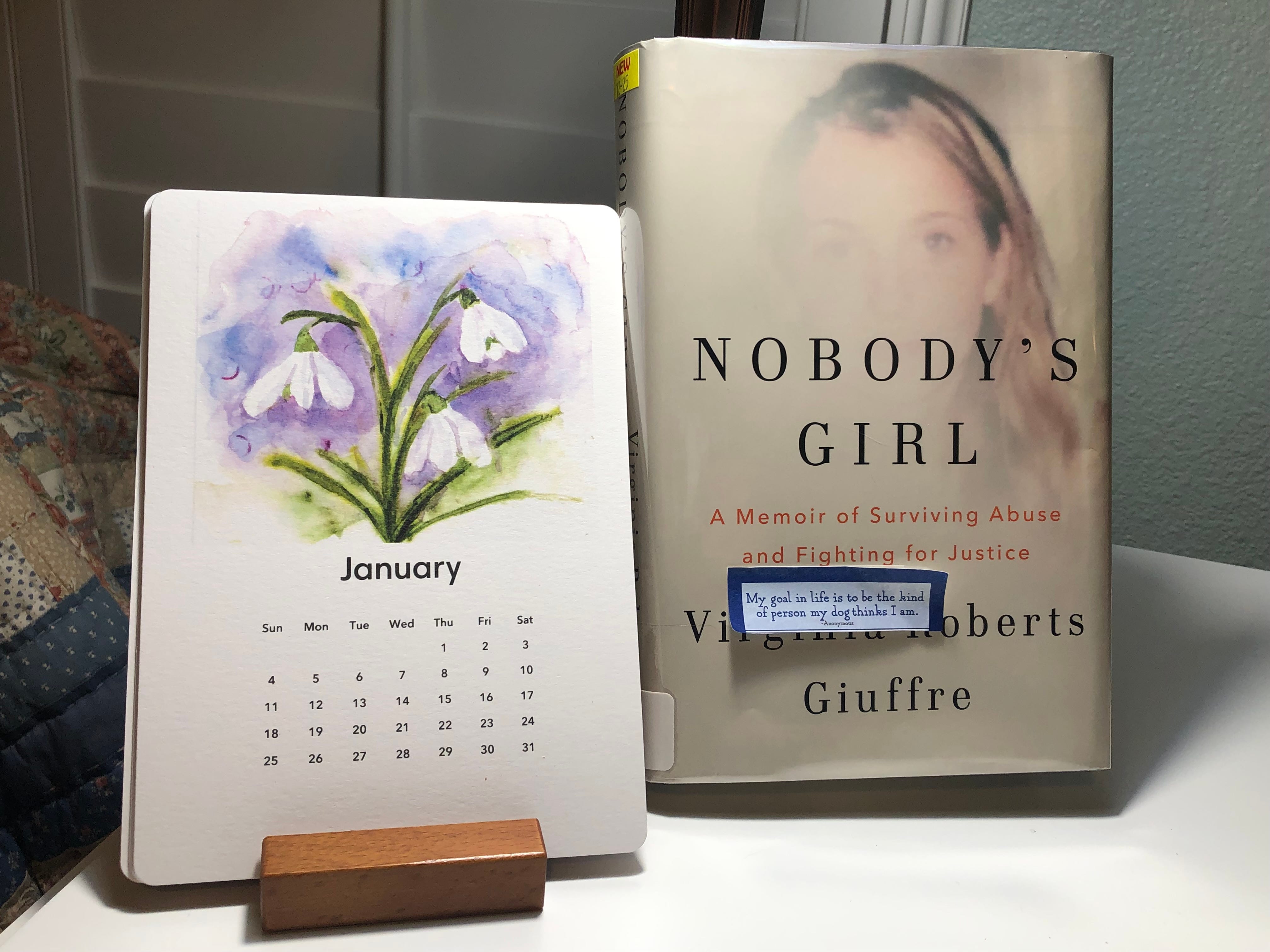
Jan 400:20:12Tap to summarizeSo let us not grow weary in doing what is right, for we will reap at harvest time, if we do not give up. - Galatians 6:9“Not everything that is faced can be changed, but nothing can be changed until it is faced,” —James Baldwin“People can cry much easier than they can change.” —James BaldwinHello Friends,I missed posting last Sunday because I was sick for a week over the holidays. I have a lot to catch up on, but have been feeling down and not exactly hopping to it, as they say. I’m missing those in my generation who have died—my brother, my lifelong friend, my sisters-in-law, and others. I miss my parents and their generation as well, but their exit feels more natural. With others, I have the irrational desire to call them and say, “Okay, that’s enough of missing you. You need to get back here right now!” Do you feel this way about loved ones who are gone too soon?Friday, I was thinking about the three quotes above. I’d like to believe the first, am more inclined to believe the second, and worry about the third. All this was on my mind before the Venezuela debacle.I was planning to post some gift links to things you might enjoy, but this Venezuela invasion made me think that a discussion of Nobody’s Girl —which I’d planned for next week—connects to the news right now. I know that the invasion is about so much more than the Epstein files (Heather Cox Richardson has a great assessment in this video showing the move toward ‘spheres of influence’ a la Putin). But Epstein is a piece. Pulitzer Prize winner Ann Telnaes points to it:So—I’m going to put the book discussion first. I’m certain you know there are triggering events in the memoir. I need to include some of that here. Links to 2025 round-ups follow, in case you are up for that, too.Thanks for reading Be a Cactus! Subscribe for free to receive new posts and support my work.“I mean, seriously: Where are those videotapes the FBI confiscated from Epstein’s house? And why haven’t they led to the prosecution of any more abusers?” (366)From Publishers Marketplace’s Publishers Lunch newsletter on December 17, 2025:Nobody’s Girl’ Sells 1 Million CopiesVirginia Roberts Giuffre’s NOBODY’S GIRL, her posthumous memoir of sexual abuse and trafficking by Jeffrey Epstein, has sold 1 million copies around the world ….“This is a bittersweet moment for us,” Giuffre’s family said in a statement. “We are enormously proud of our sister, and the impact she continues to have on the world. We’re also filled with so much sorrow that she couldn’t be here to witness the impact of her words.…”Giuffre died by suicide in April. Before publication, Giuffre’s family asked for revisions to the manuscript to reflect the author’s relationship with her husband, who she accused of abuse and from whom she was getting divorced.Nobody’s Girl: A Memoir of Surviving Abuse and Fighting for Justice by Virginia Roberts Giuffre“Today I know that Epstein liked to tell friends that women were merely ‘a life support system for a vagina.’ I didn’t know that then.” (140)Nobody’s Girl begins with a note from Giuffre’s collaborator, Amy Wallace. She lets the reader know that Giuffre had called her early in 2025 to tell her that her husband, Robbie, had assaulted her during an argument. She also mentions that Robbie was arrested in 2015—ten years prior to the publication of the book—after assaulting her. This is the edit that Giuffre’s family asked for. Throughout the book, Giuffre only has positive things to say about her husband. He appears as a rescuing hero.Those frontloaded facts about the two assaults change the way the reader sees the couple’s relationship, the way we engage with the entire text. Between this and the knowledge that Giuffre died by suicide in April 2025, we read under a black cloud.It isn’t just the sections on being trafficked by Epstein that are a rough go. Giuffre was abused from childhood, starting with her father, who began molesting her when she was only seven years old, letting her know that if she told anyone, he would kill her younger brother and bury him in the woods. A pedophile neighbor, who seems to have an understanding with her father, also rapes her repeatedly. She finds some solace in caring for and riding horses.When, as a mere child, Giuffre has repeated UTIs and can’t hold her urine at school, she sees a doctor who tells her mother that her hymen is broken. Her mother replies that she rides horses.Giuffre shares that she believes her mother knew early on what was happening to her but didn’t want to face the truth. Decades later, when she tried to address the issue, her mother would tell her that she couldn’t bear to hear about it.“But if I was going to finally call Dad out, I wanted to make sure at least my uncles and aunts could hear. ‘This guy has been fucking me for years, since I was a little kid,’ I yelled in their direction, ‘and no one‘s done shit about it.’ I wish I could say they all stood up then to form a protective barrier around me. But they didn’t move. So after a startled silence, Dad grabbed me by my neck with one hand and punched me in the face with the other. Then he shoved me into the borrowed camper where we’d all been sleeping and continued beating me until my lips were split open, and one of my eyes was swollen shut.… The next morning I woke up thinking that since I’d finally revealed my father‘s abuse out loud, something would have to change. Maybe, at the very least, someone would acknowledge what I’ve been through. Instead, before we left to drive back to Florida, the entire extended family acted as if nothing had happened.” (47)Giuffre’s trajectory is textbook abused-kid stuff: she begins starving herself, drinking and doing drugs, and acting out. She’s sent to a reform camp for juvenile delinquents, Growing Together, where kids supervised and restrained the ‘newcomers’ in what Giuffre describes as a Lord of the Flies atmosphere of hazing, physical, and sexual abuse.Her ‘reform’ program includes such helpful exercises as being forced to stand in front of a mirror and hurl insults at herself. She runs away repeatedly. After being raped and nearly killed by a man who picked up Giuffre after asking her if she needed a lift, she escapes from a seedy motel room and is back on the street, afraid he will come back and find her (he has a gun). A limo stops and an old man with a young girl tells her he will help. She’s picked up by modeling agent Ron Eppinger, who rapes her, keeps her, calls her ‘baby’ and asks to be called ‘daddy.’ He trafficks her to a man in his fifties.She thinks this is what all men do—this is what life is. And who wouldn’t, in her shoes? She accepts it.“I didn’t know then what a therapist would tell me a decade later: that when children are abused by people they love, as I had been by my father, they start to believe that love and pain, love and betrayal, love and violation all go together. I didn’t know that abuse victims struggle to see red flags because they become desensitized to inappropriate behavior.” (74)Not long after an FBI raid leads to the arrest of the fifty-something ‘boyfriend,’ her father, who was a groundskeeper at Mar-a-Lago, helps her get a job as a locker room attendant at the spa.One not-very-busy day, she sits at the reception desk reading an anatomy book. Her dream is to become a masseuse, and thereby escape the trap of her life. She’s studying. In walks Ghislaine Maxwell (who had seen her walking and targeted her). She chats Giuffre up, tells her she knows a man who wants a massage therapist to travel with him and is willing to train her. Excited, the sixteen-year-old gets her dad to give her a ride to Epstein’s pink mansion.Maxwell thrives in the same swamp as Epstein. She, too, is an apex predator, convincing countless girls that she can be the caring mother they never had. She often participates with Epstein in raping and abusing victims.“From the start, they manipulated me into participating in behaviors that ate away at me, eroding my ability to comprehend reality and preventing me from defending myself. From the start, I was groomed to be complicit in my own devastation. Of all the terrible wounds they inflicted, that forced complicity was the most destructive.” (75)Like Giuffre’s father. Epstein threatens to harm her little brother. “‘We know where your brother goes to school. … You must never tell a soul what goes on in this house.’” (83) He and Maxwell sometimes take Giuffre on outings, just as parents would do, buy her little gifts, have her hair done and her teeth whitened, all of which make the abuse more confusing to her. She takes up to eight Xanax a day to cope.The book continues with a detailed account of Giuffre’s abuse and trafficking by Epstein and Maxwell, in various countries, to academics from prestigious universities and to powerful and famous people, including Prince Andrew. Giuffre endures sadism. She is one in a ...
Transcribe →
Who are We, Anyway? What are We Reading?
Dec 1400:22:00Tap to summarizeI had finished writing this post but hadn’t gotten a chance to record it yet when I heard the news that people were shot, injured, and killed at Brown University. Thoughts and prayers, yes, but without systemic change, our “unthinkable nightmare” will continue to be routine.Fear is inevitable, I have to accept that, but I cannot allow it to paralyze me. - Isabel AllendeHello Friends,I don’t know what to think this holiday season when I see Santa dressed in camouflage, looking happy to go to war. Hasn’t this year been hard enough? Who thinks this is fun?Esperanza Rising by Pam Muñoz RyanImmigrants have been on my mind both because of what is happening to them under the Trump administration and because I hope to write a novel with IRL elements of some relatives. This week, while I was baking a lot of cookies, I decided to listen to a children’s audiobook because I wanted to see how the migrant child’s POV was handled. Here’s a little summary from a banned books poster on the Intercultural Research Development Association website.Esperanza Rising by Pam Muñoz RyanThe novel focuses on Esperanza, the only daughter of wealthy Mexican parents, and follows the events that occur after her father’s murder. It is a story of love, loss, and hope, set in Mexico during the 1930s, just after the Mexican Revolution. Grade level: 5-6.Actually, a lot of the book takes place in Southern California after Esperanza and her mom are forced to flee Mexico and their privileged lives there. They become farm workers. And that’s why I was interested in the novel.Esperanza has been withdrawn from schools in various states and districts. I’d say I can’t imagine why, except that I can. What I mean is, there is no good reason for the bans. No foul language, no sexual content (not even ‘clean’ romance), no violence, nothing age inappropriate. But, like most banned books, it empathizes with ‘the other.’ The migrant farm workers. It also discusses unions and strikes in a simple way. It looks at racial and cultural prejudice. On the whole, it’s a very good novel that helps pre-teens understand desperate people in the Great Depression and what it is like to work on a vast agribusiness farm. The only fault I found in it—this is a spoiler, but I can’t imagine you are going to read a book for ten and eleven-year-olds—is that a teenage friend of Esperanza’s somehow goes all the way back to Aguascalientes in Central Mexico (over 1,600 miles one way) and retrieves Esperanza’s grandmother (abuela) and returns with her to Kern County, CA. I wanted to know how in the world he achieved that, but there are no details. I think even a ten-year-old might question it. However, on the whole, it’s a wonderful book for kids. So if you’re looking for a gift book, thumbs up. (If you’re looking for a teen/YA gift book, consider mine, Keep Sweet.)Digression: I’m thinking about my sentence “Esperanza has been withdrawn from schools in various states and districts.” In Spanish, esperanza is hope. So, yeah. And while you might not think of a book being removed from a school district as a ban, the book is banned from that district. It doesn’t have to be a national ban to use the word. In addition, in Utah, if a book is banned in three districts, then it is removed from all public schools, AND they didn’t allow students to bring copies of those banned books on campus to read until advocacy groups pressured them into changing the rules. Big bans! It’s like they can’t tell the difference between reading and smoking weed. Between bringing your favorite book to campus and bringing a bottle of Jack Daniel’s. * Catholics in power in the Trump administration and the Supreme Court ignore Catholic leadership from the Pope on down about the treatment of immigrants (fun fact—61% of those deported are also Catholic).Stop in the Name of God by Charlie KirkA book I’m not going to read is Charlie Kirk’s Stop in the Name of God: Why Honoring the Sabbath Will Transform Your Life. Apparently, it is a big bestseller. In his Book Club newsletter, Ron Charles discusses it, and I thought you might be interested in what he has to say. While he points out the lack of editing resulting in many errors such as having the exact same, word-for-word, sentence on consecutive pages (Donald Trump is a co-publisher, so …), he also gives Kirk credit for pointing out that people need down time as part of a spiritual practice.[M]uch of this posthumously published book is committed to theological arguments, devotional reflections and practical advice on reclaiming the Sabbath to restore spiritual balance in a culture overstimulated by technology and consumerism. … But “Stop” is also a strange, uneven volume that sometimes gets lost in the wilderness.His grasp of world history and religious history is spotty; his philosophical analysis displays the rigor of a late-night bull session after the pizza has grown cold. False choices, straw man arguments, cosmic leaps — it’s a Macy’s parade of inflated fallacies. When he speaks from the heart about the blessings of setting aside a day every week, he can be genuinely moving; when he tries to make a case for Intelligent Design, he should be moving on.Thanks for reading Be a Cactus! Subscribe for free to receive new posts and support my work.Awake by Jen HatmakerWikipedia describes Jen Hatmaker as an American author, speaker, blogger, and television presenter. Apparently she is very well known in the evangelical/conservative Christian world, which canceled her (literally—her publisher stopped publishing her books) when she came out as supportive of the LGBTQ+ community. According to Hatmaker herself, she was also canceled when she got a divorce in 2020 after discovering her husband’s affair. I guess that can happen twice.I put Awake on hold at the library because I read something about it which gave me the idea that it discussed purity culture in the evangelical space. I don’t follow evangelical celebrities, so I didn’t know any of the above background on Hatmaker. This put me at a disadvantage in reading the memoir.The first 100 pages make the assumption that the reader knows who Hatmaker is and what she’s done. She starts with waking from a dead sleep to hear her husband talking on the phone to his lover, saying he can’t quit her. So, a compelling beginning. But then she talks about being the wife of a pastor of a small church. When she then mentions calling her personal assistant to ask her to make some travel arrangements, I thought, ‘How does a pastor’s wife—of a very small church, that is—have the money for a personal assistant?’ And, yes, I had similar questions throughout those 100 pages.Hatmaker gets through her trauma with some very good friends, ones who seem to have a lot of money and can offer her cool getaways. They are also handy. At one point, a group of them rebuild her porch and decorate it beautifully. While these women are generally in the Christian community, some of them are also pretty New Agey. They do things like sage her house to get rid of the bad vibes from the broken marriage.While Hatmaker continues to be a believer, she decides to leave her church and hasn’t joined another. She does write a bit about the purity culture—she married as a teen who was still in college, partly so she could have sanctioned sex. Mostly she goes from that first moment when she awakens to her husband’s betrayal to the moment when she is awakened to her authority over herself and her responsibility for her own life. This well-worn trope is nice—the reader is glad for her—but this wasn’t the book I was looking for.* On church, purity, and sexual abuse: I read that victims of the Catholic clergy in the New Orleans Archdiocese are to receive $230 million.AdventAs I think of the theme of being awake, I realize I have sort of been sleeping through the season of Advent, which saddens me because I appreciate the sense of renewal it brings when I pay attention. My son introduced the Episcopal Book of Common Prayer to me, and I like how there is a prayer in there for just about everything. Last week, someone asked me to pray for their ill/injured dog. Yes, I found a good one specifically for that. For Advent, there are prayers for being in the presence of grace and love (for Christians, in the person of Jesus).Rather than take myself to task, as I write this, I figure I have two weeks left of the traditional Advent season, and I don’t want it to be a Santa in camouflage holiday. So I’m tuning in to what can be meaningful for me. Here’s something I loved:<a target="_blank" href="https://open.substack.com/pu...
Transcribe →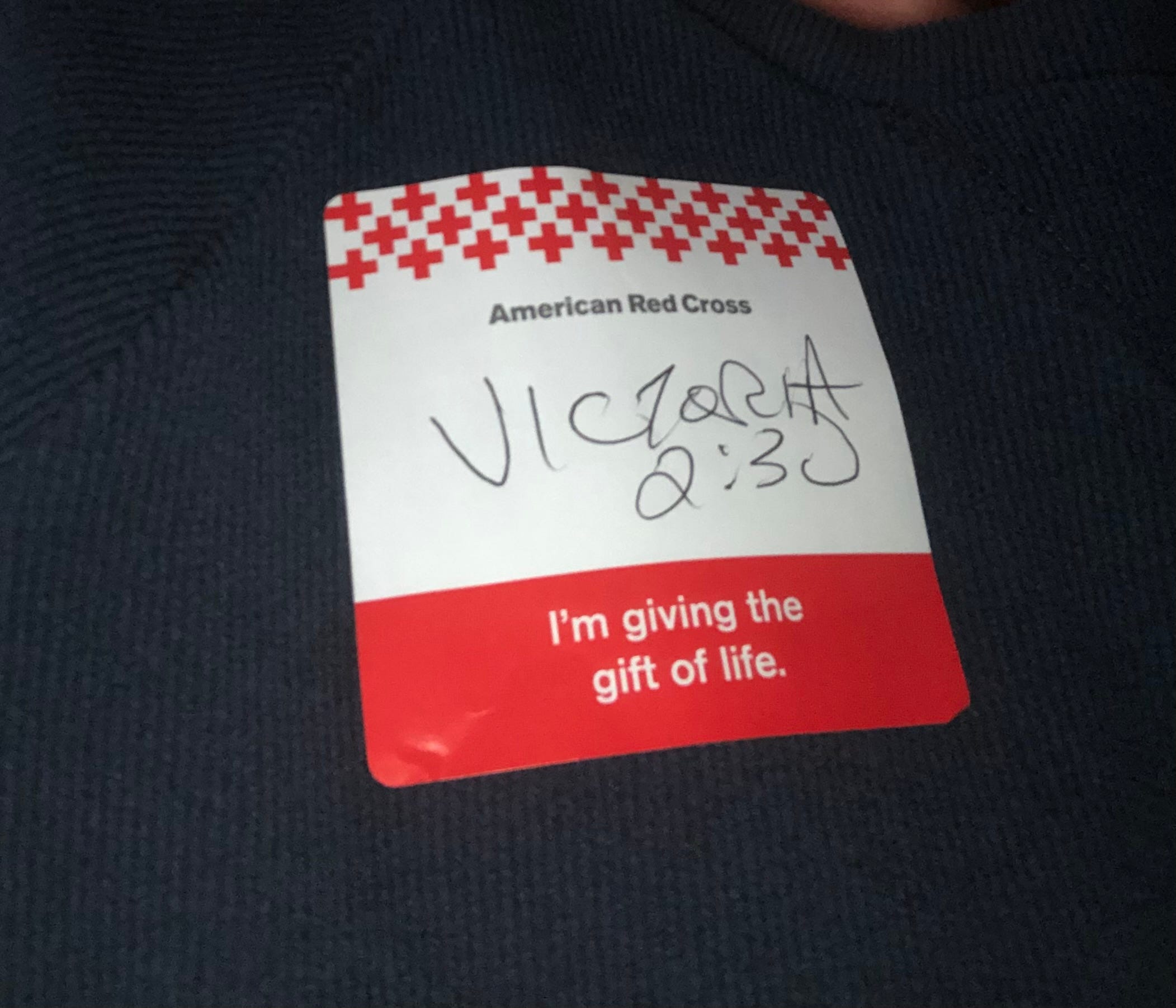
Gift Ideas for Book Lovers And Do-Gooders!
Dec 700:25:15Tap to summarizeHello Friends,Everyone I know is focused on giving right now, which is pretty nice. However, I found myself getting stressed out on ‘Giving Tuesday’ because there were innumerable worthy groups I wanted to contribute to. I did manage many by carrying over to Wednesday. One thing I don’t like is when I donate to a charity, and they send me an email the next day saying something like ‘There’s still time to donate!’— making me look back because I think I must have screwed up.My latest blood donation was in November. They gave me these crazy PAC-MAN socks. Thanksgiving time seems to be sock time for the Red Cross. (Last year it was socks with the TV sitcom Friends theme.) If you’re in the middle of deciding what to give to which charities, giving blood is one of the nice things to do. 😊Gifts for Book Lovers/Gifts that Do GoodNovel TeasA friend gave this tea to me as part of a book launch gift when Keep Sweet came out. It’s fun for book lovers and authors. The tea itself is good enough (though not great) and each bag tag has a quote related to books.Good StoreEveryone I know in the teen/YA book sphere loves John and Hank Green. Their books are lovely. I booktalked them frequently and got high school nonreaders to give reading a try! Most teen readers love, love their books. They’ve made a lot of money on their work, and decided it was enough (in itself, a wonderful and wild decision when we think of the rapacious billionaires running our country). Now, they are working to make the world a better place. Through the Good Store, you can support maternal health in Sierra Leone, fight to end tuberculosis, and to save coral reefs.* 100% of the profits from Sun Basin Soap and the Awesome Socks Club go to Partners In Health—specifically to support the construction of the Maternal Center of Excellence in Sierra Leone.* 100% of the profits from Keats & Co go to Partners In Health to support their Tuberculosis Project in Lesotho. Tuberculosis is the world’s deadliest infectious disease—yet it is entirely preventable.* 100% of profits from EcoGeek purchases go to the Coral Reef Alliance—specifically the Maui Watershed Restoration project.I have been drinking the Keats & Co. teas (after John Keats, English Romantic era poet who died of TB), especially the Earl Grey. They are so good! Great quality, yummy. For the holidays, I added the purchase of teas, coffee, and wacky socks for friends and family.Also—If you have friends who haven’t read Everything is Tuberculosis, that would also be a nice gift. I discussed it here:More BooksFor all book lovers, here’s a reality check my friend Laura shared with me. If book titles were honest. Enjoy! Thanks for reading Be a Cactus! Subscribe for free to receive new posts and support my work.Indie PressesI’ve often mentioned that it’s lovely to buy small press books. Here’s a list from LitHub that you might use to select gift books that you might not otherwise be aware of: 100 Notable Small Press Books of 2025.And—a quick self-promo here—my books are from very small presses. Keep Sweet is for people fourteen years and up. (Topics are for mature readers.) Teens work to escape from a patriarchal cult. Timely.Elizabeth, the protagonist in “Keep Sweet,” Victoria Waddle’s latest release, is fourteen years old and living in a rural “Community” with her parents, three sister wives, and 16 siblings under the thumb of a “prophet” who controls everything, from their pets and candy consumption, to who they will marry and have children with. When he decides Elizabeth will marry her cousin, Elizabeth’s future seems doomed. But when she turns to the “helper” inside her and recognizes the power of her own intuition, she starts asking questions and finds her own voice. — Cati PorterBook ExchangeSomething I think is fun is to add a book I’ve read to the gifts I am giving family and friends. This is especially true if what they want is a donation to a worthy cause. I make the donation, but it’s fun to open something, right? I take books from my shelf that I believe they will like and wrap them up. Right now, I’m looking at some of my family book club books. I have more than one copy of some of those, basically new. I want to give two of my friends the same title so we can all talk about it later.If you are horrified that I give away lots of books, let me justify it through my library training. At work, I had to remove thousands of books—yes thousands. They became too worn or out-of-date; as science advanced, the material became misleading (‘We’ll go to the moon someday!’ ‘AIDS is a 100% death sentence’); people lost interest in the topic (a pop star, etc.). There are so many reasons to remove books and make way for new ones. So—I try to do that in my own life as well.Sacrament by Susan StraightI mentioned last week that I was reading this. It’s an especially good choice for Southern California readers and nurses anywhere, but the family love and friendships will appeal to just about any reader.The American RevolutionIf you or loved ones have been watching The American Revolution on PBS, you might want to get the companion book. ( I have it on my wishlist for Santa.) The series includes information that isn’t in many sources on the Revolutionary War, particularly the role of American Indians on both sides.I’m thinking there are other good books on the topic, which should be of peak interest right now with the coming of the 250th anniversary of the Declaration of Independence. Here is an article excerpted from a new book, so you can see if you like it, and two books I enjoyed when they were published. There will be renewed interest in them now. They, too, include information about the war that I had never learned before.Declaring Independence: Why 1776 Matters by Edward J. LarsonGive Me Independence: On 1776, the Pivotal Year For What Would Become America from LitHubEDWARD J. LARSON CONSIDERS THE IMPACT AND LEGACY OF THE AMERICAN REVOLUTIONARY CAUSEFrom Declaring Independence: Why 1776 Matters by Edward J. Larson1776 by David McCulloughAs a book about a momentous period of history, 1776 is short—under 300 pages excluding the endnotes. Its brevity is part of its success—it’s a tightly woven story of the trials and triumphs of George Washington and the Continental Army. The reader meets many players in the American Revolution from both sides of ‘the pond.’ David McCullough has won both the Pulitzer Prize and the National Book Award; his writing skills shine here.Previously, I had only read of King George III as a madman, and was surprised to find him pretty reasonable in this account. I learned why the leaders of the British Army and Navy made some costly decisions that, on the surface, appear blundering and foolish, but on closer examination, had merit. I understood why Washington ‘crossing the Delaware’ is so famous an event. I even learned about William Lee, the enslaved man who served with Washington, always by his side and in the thick of things.Though the success of the American Revolution depended on many people—and they are given credit here—George Washington is the star of the book. He takes the most ragtag, miserable group of diseased, undisciplined men, who several times flee from battle (you won’t read that in your history book!), and wins a war for independence. Success didn’t follow a straight line, and many important battles were lost along the way, causing Washington to despair and his second in command (Charles Lee) to privately question Washington’s ability to lead.1776 began so badly for Washington that he wrote to Joseph Reed (an adjunct general):“I have often thought how much happier I should have been if, instead of accepting of a command under such circumstances, I had taken my musket upon my shoulders and entered the ranks, or, if I could have justified the measure to posterity, and my own conscience, had retired to the back country, and lived in a wigwam.”Reed, along with Charles Lee, came to criticize Washington for indecision—which was, as 1776 shows, a valid criticism. But Lee is the worst sort of backstabber. In an encounter that seems like it should have come from a fictional tale of intrigue, Lee wrote a letter to Reed about Washington:“[I] lament with you that fatal indecision of mind which in war is a much greater disqualification than stupidity or even want of personal courage. Accident may put a decisive blunder in the right, but eternal defeat and miscarriage must attend the men of the best parts if cursed with indecision.”This letter was accidentally delivered to ...
Transcribe →
Personal Curriculums, Farmworkers, and “Sacrament”
Nov 3000:20:40Tap to summarizeHello Friends,I hope you’ve had a long weekend full of gratitude and blessings. My husband and I did a lot of cooking and housecleaning. Holidays make me feel my age. For years, I would never leave dirty dishes from holiday cooking on the counters/in the sink overnight. I couldn’t stand the idea of waking up and having to deal with the mess. Now I can’t stand dealing with the mess on the day of the cooking and company. It has to wait for the following morning.To deal with holiday stress, I think it’s fun to read advice columns in the newspaper. People have wacky issues, and that provides a little laugh and helps put things in perspective. My favorite this year was a man whose adult child has a father-in-law who refuses to trim his nose hairs even though the hairy-nose-man’s wife and child asked him to. The writer finds this so gross that it’s hard to be at the holiday table with the hairy-nose-man and wants to check out for that reason. You know, you read things like that and think ‘Really? That’s your holiday issue?’ But also, ‘Yeah, I wouldn’t want to deal with that.’ It could make your own family feel pretty normal.My Personal CurriculumI just learned that ‘personal curriculums’ are a thing. I happen to be working through one myself right now. I’m learning about California during the Great Depression and particularly about migrant farmworkers in the state. I want to know more for a novel I’d like to write. I thought I’d get through the books faster—I thought I’d be done by Dec. 1. But I have been caught up in other things and reading very slowly.Here are some library books I have on loan.Endangered Dreams: The Great Depression in California by Kevin StarrChasing the Harvest: Migrant Workers in California Agriculture, edited by Gabriel Thompson (interviews are more contemporary rather than from the Great Depression)Factories in the Field: The Story of Migratory Farm Labor in California by Carey McWilliamsColossus: Hoover Dam and the Making of the American Century by Michael HiltzikPicturing a Nation: The Great Depression’s Finest Photographers Introduce America to Itself by Martin W. SandlerI’m also taking a look at California and public projects at the time. Once I get through these books, I want to read about the building of the Golden Gate Bridge.Factories in the Field was published in 1939 and is a great book for those seeking information on migrant farm work and agribusiness in California from 1900-1939. “This book was the first broad exposé of the social and environmental damage inflicted by the growth of corporate agriculture.”Here’s a poem that serves as the book’s epigraph.“The Nomad Harvesters” by Marie De L. WelchThe nomads had been the followers of the flocks and herds,Or the wilder men, the hunters, the raiders.The harvesters had been the men of homes.But ours is a land of nomad harvesters.They till no ground, take no rest, are hooked nowhere.Travel with the warmth, rest in the warmth never;Pick lettuce in the green season in the flats by the sea.Lean, follow the ripening, homeless, send the harvest home;Pick cherries in the amber valleys in the tenderest summer.Rest nowhere, share in no harvest;Pick grapes in the red vineyards in the low blue hills.Camp in the ditches at the edge of beauty.They are a great band, they move in thousands;Move and pause and move on.They turn to the ripening, follow the peaks of seasons,Gather the fruit and leave it and move on.Ours is a land of nomad harvesters,Men of no root, no ground, no house, no rest;They follow the ripening, gather the ripeness,Rest never, ripen never,Move and pause and move on.Are you working on a personal curriculum? What is it? Why are you interested in the subject?Sacrament by Susan StraightRecently I mentioned four books I’d bought at Warwick’s Bookstore in San Diego. Since I’m working on reading the California books, those others mostly have to wait. However, I did begin Susan Straight’s Sacrament with high hopes of being well into it by November 19. I intended to go out to Riverside that day, have dinner with a friend, and then we were going to attend an Inlandia sponsored event featuring Straight discussing the novel. I’d actually bought the audiobook and began to listen to it. And then I’d bought the hardback at Warwick’s because the event was at a cultural center, and I didn’t know if the book was being sold there.The best laid plans and all that. My sister had an emergency that day. She happened to be in Palm Springs, so my other sister and I drove out there and stayed for a few days to visit her in the hospital.Straight is the star writer of the Inland Empire, narrating the diverse lives and landscapes of inland Southern California. Perhaps I can see her somewhere else soon. Meanwhile, I am enjoying Sacrament. There are some characters whom I met in Straight’s last novel, Mecca. I really like the character Johnny Frias, a motorcycle CHP member who grew up as a cowboy/rancher. However, the novel is centered on new characters, four nurses in San Bernardino, California during the Covid pandemic. They are in the thick of it—removed from their families and living in trailers so that they don’t risk infecting their loved ones. Dealing with dying patients and work that never ends as well as the loneliness of missing their families. So far, very good stuff.Thanks for reading Be a Cactus! Subscribe for free to receive new posts and support my work.Best Books of the Year—the Lists are Coming Out!One of the reasons I like checking end-of-the-year book lists is to see how many favorites I happen to have read. Have you read some of these ‘bests’? Did you love them as much as the critics did?* The New York Public Library has 50 best adult books, 50 best teen books, and 125 best children’s book at this link.* Here’s a gift link to the New York Times 100 Notable Books of 2025.* Here’s NPR’s “Books We Love” for 2025 (384!). Click on the individual book covers for more information.* Publishers Weekly lists and briefly comments on the National Book Award winners here.For writers, Brecht De Poortere now has his 2025 list of top ranked literary magazines here. You can start your submission wish list. His process: “I use major awards and anthologies to rank more than 750 magazines publishing literary fiction, non-fiction and poetry. I also include information on: reading periods, cost of submission, restrictions, word counts, pay, location and journal website.”If you are writing and also submitting, then you will be receiving rejections. More and more, literary journals seem to be trying to soften the blow. Which is an admirable effort. And while saying things like, “This isn’t a reflection of the story’s worth” is okay—the story might not be worthy, but the reason for rejection is often that it doesn’t match the editors’ tastes—here’s A Thing Lit Mag Rejections Shouldn’t Say:“We encourage you to keep writing and creating. The world needs it, and you.”I got this message this week. Please. Just. Stop.As to keeping the arts alive in the U.S., I thought Ron Charles’ comments in his Book Club newsletter were spot on. It’s a mistake to depend on wealthy patrons, who will (and do, and always have) expect[ed] praise of themselves, and a pass on accountability for their behavior.“But now President Trump is dismantling the National Endowment for the Arts, the National Endowment for the Humanities, the Corporation for Public Broadcasting and the Institute of Museum and Library Services. As a consequence, America will slip further back into that clammy system of pleading and patronage.I know…. These reflections sound so naive I should be writing them with a stubby crayon. But it’s possible to imagine a country in which writers, artists, librarians and museum directors don’t have to wheedle for money from wealthy pedophiles, tobacco executives, OxyContin pushers or reality TV stars moonlighting as tyrants.It’s possible, really. As someone might have told Jeffrey Epstein, ‘The Brain — is wider than the Sky.’”You may recognize that as Emily Dickinson—and you’re right!The Brain—is wider than the Sky—For—put them side by side—The one the other will containWith ease—and you—beside—The Brain is deeper than the sea—For—hold them—Blue to Blue—The one the other will absorb—As sponges—Buckets—do—The Brain ...
Transcribe →
Undivided, Cherished Belonging
Dec 22, 202400:27:15Tap to summarizeHi Friends,I see that Hanukkah begins on Christmas Day and this has led me to wonder about whether movie theater ticket sales on December 25 will significantly drop. I’m thinking about pointless stuff because it’s Friday as I work on this Sunday post, and I want my mind off the drama of a possible government shutdown. [I thought I typed ‘shutdown,’ but that autocorrected to ‘s**t down’—I’ll just leave that there.] I don’t want to think of an unelected shadow president. Not at least until after the new year.I mentioned previously that I understand why people who have had traumatic spiritual experiences have become atheists. This is not a thing I worry about because I don’t believe in a hell or any sort or eternal punishment (I don’t believe in reincarnation until we get it right, etc.). But I also know people who want to be empowered by taking back their spiritual lives and beliefs from the abusers. And since this is the week of Christmas, I want to share two books about people whose faith is centered in love and reconciliation. Today, I finished reading one and listening to the other. They reminded me of Charles Dickens’s A Christmas Carol when the ghost of Marley admonishes Scrooge: “Mankind was my business!”Cherished BelongingA bit of background on Gregory Boyle and Tattoos on the Heart:Father Gregory Boyle is the Los Angeles Jesuit priest who founded Homeboy Industries and Homegirl Café. He received the Medal of Freedom this year. He has also received the California Peace Prize and been inducted into the California Hall of Fame. Back in 2010, I was so taken by his first book, Tattoos on the Heart, that I bought copies for my relatives for Christmas and wrote this review:Their motto: Nothing stops a bullet like a job.Father Boyle—“G-dog” as he is known by his homies—acts in a way that is very much centered in his faith (Catholicism) as a Christian, but is also so unusual that his story makes a startling read. And here’s why: he believes that every individual has equal value in society. And unlike most of us, he doesn’t just say it. He truly believes it. For Father Greg, there are no throw-away people. He never stops caring—and so the subtitle of this book—The Power of Boundless Compassion—is apt. When I say that his compassion is amazing, I know that the word ‘amazing’ is so overused that you may not understand what I mean. But I think it is the right word—I’m filled with wonder at the life of this man.Father Greg’s stories of gang bangers leaves us to wonder—Am I really a good person or have I just been sheltered from the things that would make me bad? When you read what many of the ‘homies’ in this book have gone through, you’ll wonder how they ever made it out to a normal, productive life. And you will wonder at the life of ‘G-dog’—who, in the twenty-five or so years that he has been working with LA gang members, has helped so many out of the gang life only to bury them later, when they are shot in drive-bys or targeted. Father Greg has buried almost 200 gang or former gang members. And yet, he keeps the faith.Father Greg tells the reader that centering one’s life on love will get a person through the worst. Gangsters often tell him that they don’t want people to ‘mistake their kindness for weakness.’ But as Boyle shows, “sooner or later, we all discover that kindness is the only strength there is.”Even with boundless love, a person needs a real sense of humor to find joy in this life, and Father Greg has it. Many of his anecdotes about dealing with young men and women are really funny. My favorite is when he writes about gangsters reading aloud and replacing words they don’t know with words they do. Thus in Bible passages referring to the ‘Gentiles,’ they use the word ‘genitals.’ Father Greg says this really livens up the public readings!Yes, you will laugh—and you’ll cry, quite a bit. But do read this book. It will remind you that saints have a beginning as real human being.The Healing Power of Love in Divided TimesCherished Belonging is Father Greg’s fourth book. Again, he looks at how love (“Cherishing is love fully engaged. Cherishing is tenderness in action.”) is our job, how it is active, and how it resolves troubles. And again, I am amazed at his capacity for cherishing, his ability to walk the walk of genuine Christian calling. What I mean is that I only dream of being so fully accepting of others. Like many people, I’ve sometimes felt that unconditional love is beyond human capacity. But no—Father Greg’s life and work disprove that. He doesn’t see anyone as ‘the other’ and everyone involved in Homeboy Industries learns that lesson. Former gang rivals who once might have wanted to shoot one another on the street now work side by side.If it feels like people in the U.S. have forgotten the roots of Christianity, Father Greg’s worldview is an antidote for the Christian nationalism blues. This also means that many purported people of faith will not agree with the “two unwavering principles” of Homeboy Industries:* Everyone is unshakably good (no exceptions)* We belong to each other (no exceptions)He repeatedly makes the point that God’s power lies not in rescuing us, but in loving us. While he refers to Jesus often, he also sometimes uses the pronoun ‘She’ in reference to God and chides the Church for continuing “to prevent women from full inclusion.” He seems to have no concern with upsetting religious literalists:At a house where I was leading a weekend retreat, the first reading was a story of Abraham and Isaac. It begins, “God put Abraham to the test.” I opened my homily by telling the congregation that life provides us with endless “tests,” but not once has the God of love ever thrown one our way. Not ever. “And besides,” I told them, “any father who hears God tell him to kill his son is mentally ill.” They applauded, which surprised me. I proceeded, then, to preach on the transfiguration.If conservatives really want to feel outrage, they will find their dose in reading about Father Greg’s defense of the Sisters of Perpetual Indulgence—all gay men who sometimes dress in “mock wimples worn by nuns in 1954”—for their “considerable service and charitable works.”Boyle’s God is the God of second chances (and third and fourth…). Reading about his metaphysics made me think of the idea of ‘turning the other cheek’—that this might not mean what I’ve always thought it meant (be a punching bag) but rather is just another way of saying forgive seven x seventy times. But there is an important progress to this that doesn’t include allowing people to take advantage of others. For example, at Homeboy, if people test positive for drugs or have other relapses, they are sent out and told, “Come back to us when you’re ready [sober, etc.].” This understanding of human relationships extends to all people. Of Donald Trump, Father Greg says that no mentally well person would be that malignant narcissist and sociopath, so we have to feel for him in his mental illness. But he also notes that a person that ill should not be handed the Presidency of the United States. (Oops!)Father Greg’s writing style is epigrammatic. It reminds me of Ralph Waldo Emerson in that you can pull quotes, sentences from within the same paragraph, that encapsulate different ideas. (“People don’t become homeless because they run out of money…They become homeless because they run out of relationships.”) As in past books, Father Greg tells anecdotes about the former gang members who have been helped at Homeboy. There are some “I’m not crying, you’re crying” moments once again, but there are some laugh out loud stories as well. When Father Greg went to Washington D.C. to receive the Medal of Freedom this year:A homie sends me a congratulatory text: “I heard you got a presidential pardon … or some s**t like that.” A home girl, Ivy, stands in for me at a luncheon talk at which she says, “Father Greg couldn’t be here today because he’s at the White House being knighted.”If you love language, you’ll enjoy some of the words Homeboy workers make up to suit the circumstance. A few favorites:”I feel belongance.”When Steve Avalon’s encounters a homie who manipulates, he calls him a “shenanigizer.”UndividedI listened to Undivided: The Quest for Racial Solidarity in an American Church by Hahrie Han. If you read my earlier post about the book Circle of Hope, you know that I was wondering if a church that engages in work to bridge racial divides—one that openly discusses racism and the question of how the church can make racial equality part of their mission—can survive. The Circle of Hope did not. Though leaders came apart over their differences, they continued to do good work elsewhere.I was intrigued by the publisher’s blurb that suggested the megachurch Crossroads had succeeded in combating racial injustice and managed to hold together.Crossroads is a racially mixed but majority white evangelical megachurch in Cincinnati. In 2016, it was a critical force in helping to pass a ballot initiative for universal preschool, providing early childhood education for the poorest, mostly Black, constituents. Author and political scientist Hahrie Han investigates how this happened in an area that voted for Donald Trump in 2016.Han finds that Crossroads Pastor Chuck Mingo begins the work of combating racial injus...
Transcribe →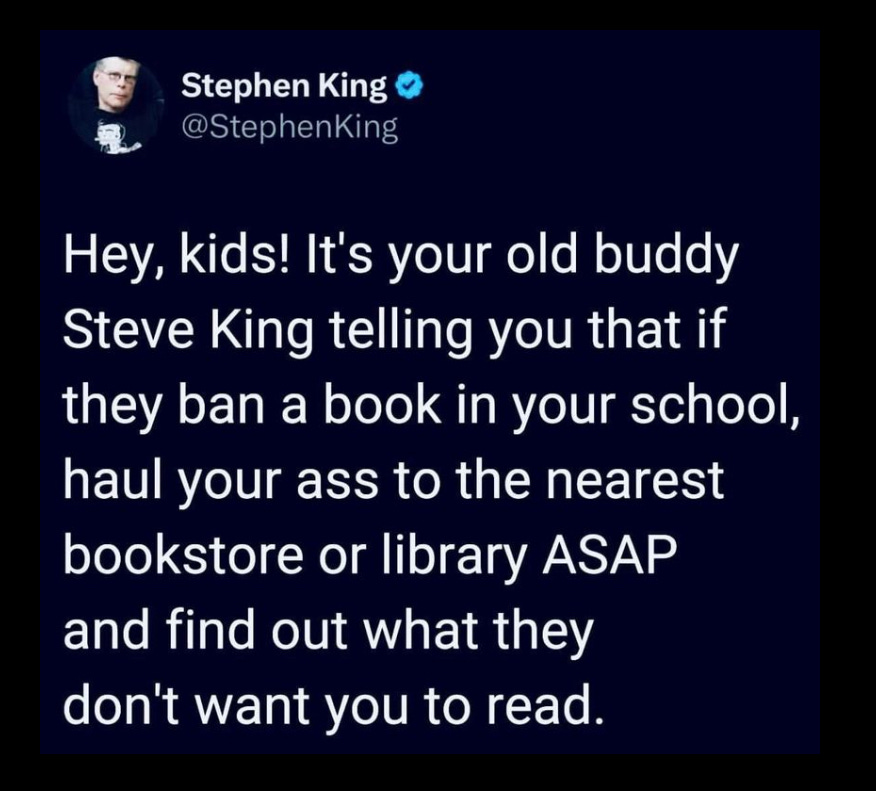
Stephen King is Not Coming to Save Us
Dec 15, 202400:24:51Tap to summarize“Let them buy books” is not the answerBecause I’m a retired high school librarian, well-meaning social media acquaintances often share a quote from Stephen King: “Hey kids! This is your old friend Steve King telling you that if they ban a book in your school, haul your ass to the nearest bookstore or library ASAP and find out what they don’t want you to read.”Their posts are followed in the comment section by expressions of solidarity against book bans, accusations of making porn available to kids, and snarky comments on King (‘Your books were better as movies!’). What I don’t see is a discussion of the school library or its purpose.This saddens me. Too many well-meaning people suggest the solution to book bans in school libraries is to remove those libraries from the conversation. To do so shows disdain for its mission of serving all students.What’s the mission?I worked at Title I schools throughout my 35-year career as a public educator. The high school where I spent most of my time as a teacher librarian has a total minority enrollment of 96% and 84% of its students are economically disadvantaged. Most receive free breakfast and lunch. The staff runs clothes closets and a weekend backpack program, sending kids home with snacks and meals for their families to eat when school is not in session. They have a Thanksgiving dinner giveaway for the neediest and sponsor a Christmas gift drive. Teachers purchase graduation gowns for needy seniors.While it’s hard for people removed from poverty to imagine, there are kids with no access to the public library, nevermind money to buy books. Parents work night and day. Public libraries may not be within walking distance; public transportation can range from abysmal to nonexistent. If these kids, years earlier, lost a library book, the resulting fine would include the cost of the book plus processing. Food insecure parents can’t prioritize paying that fine. The child is banned from checking out any more books. For so many reasons, kids need access to the full range of books their school libraries provide.Let’s choose to accept itSo the fight for challenged books to remain in the school library is essential. As banned or removed titles have come up in news stories over the past few years, I haven’t needed to rely on memory to tell me why I selected them for my libraries. I regularly ‘booktalked’ them to classes. To prepare for these talks, I read the books and then wrote reviews. I decided to create a blog, School Library Lady, and post those reviews. This was primarily an organizational tool for me—by tagging each post with keywords, I could pull up any subject a teacher wanted discussed.With titles I’d booktalked now so frequently censored, I look back at what I wrote because these essays show—in real time, without revision—my purpose in, and justification for, purchasing those books. Here on Substack, I the hope that giving people a window into a school librarian’s thought process will create understanding. I’ve featured older books like Speak by Laurie Halse Anderson, still being removed after 25 years, to show how important it is to allow books that depict sexual assault. I include evidence of readers confirming that this novel saved their lives. I look at more recent books as well. Since Ta-Nehisi Coates’ latest book The Message includes a piece on the banning of his book Between the World and Me, I look back at my thoughts from 2016, at why I bought it, and why I was promoting it to students.For each book I discuss, there are common justifications for its inclusion in the school library. Often, for nonfiction, it covers important aspects of American history. For all genres, it supports the school’s mission of providing for the needs of every student; it lets students know they are not alone in their traumas and tragedies; and it engenders empathy for others. Such parameters are what we should all be discussing when we’re deciding whether a book belongs in the school library. In the only place where a student might find it.We should never succumb to book removal with the excuse that kids will find the book elsewhere.Part 2: Library book challenge and ban newsFriends, I was going to link to some mainstream religion and cult stuff this week because I’m down to the last 24 hours of checking copy edits on my upcoming novel (Keep Sweet) and am in that mode. But—there’s a lot going on in the book censorship arena! So, let’s focus on that. I’m going to start with a great Substack to follow for those worried about book censorship (in schools or public libraries) in their state. I’m following with some end-of-the-year lists and then leaving other topics for last. However, all are worthy of your consideration. I hope you have the chance to view each one.Well Sourced from Kelly Jensen is a great Substack for those interested in the freedom to read. It’s particularly vital for those living in states where book banning is an issue. Jensen follows bills that come before state legislatures, so you can be aware of what’s happening and contact your representatives to oppose laws that would cancel books and criminalize librarians for having those books in the collection. She also lets you know if an anti-book-ban bill is up for a vote, so you can call your representative and express support for it. Here’s this week’s post:The 11 Most Banned Books of the 2023-2024 School Year from PEN AmericaI’m guessing you are familiar with many of these titles. Details on each are in the linked article.* Nineteen Minutes, by Jodi Picoult, 98 bans* Looking for Alaska, by John Green, 97 bans (I discussed on Substack here.)* The Perks of Being a Wallflower, by Stephen Chbosky, 85 bans* Sold, by Patricia McCormick, 85 bans* Thirteen Reasons Why, by Jay Asher, 76 bans* Crank (Crank Series), by Ellen Hopkins, 76 bans* Identical, by Ellen Hopkins, 74 bans* The Kite Runner, by Khaled Hosseini, 73 bans* The Handmaid’s Tale, by Margaret Atwood, 67 bans* Water for Elephants, by Sara Gruen, 66 bans* Tricks, by Ellen Hopkins, 66 bansMore Books Banned in 50 or More School Districts in the 2023-2024 School Year* A Court of Thorns and Roses by Sarah J. Maas (I discussed this title in a Substack post here.)* Empire of Storms by Sarah J. Maas* A Court of Mist and Fury by Sarah J. Maas* A Court of Wings and Ruin by Sarah J. Maas* The Absolutely True Diary of a Part-Time Indian by Sherman Alexie* The Bluest Eye by Toni Morrison* The Color Purple by Alice Walker* A Court of Frost and Starlight by Sarah J. MaasThe Most Popular Banned Books in Florida from Electric Lit.’Most popular’ doesn’t mean ‘most frequently banned.’Conceived and supported by Paul English and Joyce Linehan, in partnership with Bookshop.org and Electric Literature, Banned Books USA made over 900 banned and challenged titles available to all Florida residents. Anyone living in Florida could order a banned book for the cost of shipping via the Banned Books USA website, and as a result, nearly 1000 books were mailed to individuals from Pensacola to Key West.Here are the most requested:* Pride: The Story of Harvey Milk and the Rainbow Flag by Rob Sanders (Banned in the Palm Beach County School District)* Anne Frank’s Diary: The Graphic Adaptation by Ari Folman (Banned in the Palm Beach County School District)* Beloved by Toni Morrison (Banned in the Escambia County School District)* The ABCs of Black History by Rio Cortez (Banned in the Miami-Dade School District School)* The 1619 Project: A New Origin Story created by Nikole Hannah-Jones (Banned in the Escambia County School District)* The Hill We Climb: An Inaugural Poem for the Country by Amanda Gorman (Banned in the Miami-Dade School District)* <a target="_blank" href="https://bookshop.org/a/269...
Transcribe →
Grief in Drabbles (and a Poem)
Dec 8, 202400:18:01Tap to summarizeHello Friends,I’ve realized that I tend to riff in the audio version/voiceover. If you want a few sidebars about the banned books, that where they are. 😊 On the anniversary of my mother’s deathIf you read Be a Cactus last week, you know that it was the first anniversary of my brother's death and that today is the fourth anniversary of my mother's death. To state the obvious, the holidays have a different atmosphere than they used to.On this anniversary, I’ll be helping a friend with a garage sale at her mom’s house. I’m heading out her way a few days early to sort and label things along with two other friends who are coming from the Bay Area. The mom who owns the home recently moved to nursing care after falling and breaking her femur. So—sorting out parents’ stuff is on my mind.Since my parents died, months apart in 2020, I’ve been writing a lot about them. Creative nonfiction, mostly. I wrote an essay, published on HuffPost, about their obsession with sexual purity for my sisters and me. It went viral in many places. I’ve also tried to write to understand and empathize with my mother. That work has been of less interest to publishers (“Loved this, but it’s not quite a fit. Please send us more of your work!”) A thing I learned: it’s hard to write about your mother.I have some longer unpublished essays about caring for my parents during the pandemic and about my mother’s pride in her Irish background. I decided to go another direction and write about her in drabbles—that is, in (exactly) 100-word stories.A person can’t be condensed into such a short form, but it has helped me to think about the forces that shaped my mom. I could only look at one aspect of her at a time, so these drabbles are named after parts of her body—her teeth, her ankles, her tongue. Then I tried to write one about the tiny orange tree we bought to commemorate her. It’s a bit of a mess for only 100 words. What I want to say there may not fit the micro-form. Finally, I took the drabble “My Mother’s Tongue” and converted it into a poem, which is a bit longer, about 115 words. But I think I like it better. To be sure, poetry is not my forte, but some friends who are poets helped me with the line breaks.So, Mom, here’s for you.Three Meditations on the Death of My Mother During a PandemicMy Mother’s TeethWere a full plate of false, which she hid, being but thirty. Her secret discovered when, brushing in the shower, she dropped them, chipping the right front incisor. A backhanded gift of realism. Mother of five, measuring herself against conventional beauty standards, she daily lowered her bucket of desire into a well of shame.Decades on, suffering from dementia, she is a pandemic convict, I her voluntary cellmate. Awaiting the advent of order, I urge her to finish her lunch. She removes her teeth at the table, wedging her fingernail between molars, flicking a bit of lettuce in my direction.My Mother’s AnklesForced offices of intimacy now bind us, though you never desired touch. You accept me scrubbing your back, trimming your toenails. Bending to dry your feet, I note your swollen ankles, comprehend their meaning, having been through this with my in-laws. Your heart is failing. Tucking you in for the night, I raise your feet on pillows. I place a hand over your ankle, gauging.“You’re warm,” you say. “That feels good.” Your words an invitation to rest a second hand on your other ankle. I’ll remain here, a sentinel at the foot of your bed, awaiting your imminent sleep.The poem after the drabble “My Mother’s Tongue”Mother TongueWhere did your consciousness go? I call youfrom every corner of the room. Some daysyou identify me. My daughter.I can see this is a win for you, but the homecare nurse presses. What’s her name?You pull many from memory, none of them mine.Rosemary is a favorite. Finally it is simplyyou watching me watching you, suspiciousof my presence. Wheredid your consciousness go? I imagine ithanging out at a single’s bar, bourbon and cigarette, waitingstill, for the right man to deliver youfrom the reality of five childrenin seven years. But you receivea more practical Eucharist, your own bodyplaced on your tongue, swallowed.Here’s the one that isn’t working out. Feel free to make suggestions. (Actually, feel free to make suggestions about any of these.)The GroveorThe TransplantIn a sibling group text about my move, Lee, agricultural water manager, advises starting over. “Digging up citrus is a BAD plan. The rootstock of modern hybrid trees sustain damage. Transplanted, it won’t do well.”“She’s trying to save the tree she planted when mom died,” Lisa answers.“It’ll live,” Lee says, “just stunted.”“Can it bear fruit?” I ask. “I don’t need big.”“Stunted trees bear the sweetest fruit. All the energy goes into fewer pieces. When we grew up, our stunted navel nearest Center Drive? Best fruit ever.”“You're right,” John jumps in. “Best oranges I’ve ever had.”Part 2: Library and book ban newsThere was a lot of book news this week; these are some of the stories important to me. And they only go through Wednesday since I have been gone the rest of the week to help a friend.How To Explain Book Bans to Those Who Want to Understand from Book RiotI’ve shared this before, but it’s important and will be new to our newer subscribers.Here are several talking points you can and should use with the people in your life who may otherwise not understand the complexity and seriousness of book bans happening in school and public libraries. It will not include everything, nor can it. Instead, this is meant to be for people who are eager to listen and learn but may be overwhelmed with where to even begin.Texas State Board of Education proposes taking over school library book ratings. Here's why from the Austin American-StatesmanThe proposal would give the elected education board significant power over determining what’s appropriate for public school libraries and would mirror legislation that has been filed by Rep. Jared Patterson, R-Frisco, who in 2023 authored the Reader Act, a law that placed the burden of rating books on vendors and has been on hold over litigation.A process of rating books that children are reading in schools is best fit for the state board, said board member Tom Maynard, R-Florence.…If passed, HB 183 would largely rewrite a section of the 2023 Reader Act that has been under litigation since July 2023. Patterson's 2023 Reader Act requires book vendors that sell to school libraries to rate their material for either sexual relevance or sexual explicitness.Book vendors — including Austin’s BookPeople — and library associations sued the state over the law, insisting it was overly burdensome to businesses.…Member Rebecca Bell-Metereau, D-San Marcos, worried that the task of wading through every possible book review request that could come before the state board from across Texas could be insurmountable.“This would be a herculean task to read and rate all of these books,” Bell-Metereau said. “That just seems insane to me.”Maynard also suggested local school boards would welcome the state board taking decisions about the appropriateness of library books out of their hands.“They don't like having protesters in front of their building,” Maynard said. “For us, it's business as usual.”First list of banned books in Knox County Schools released, schools have until winter break to remove them from WBIR 10 News.The list was sent out to teachers and contains 48 books that are scheduled for removal from Knox County Tennessee public school libraries:* Me, Earl & The Dying Girl by Jesse Andrews* The Absolutely True Diary of a Part-Time Indian by Sherman Alexie* Go Ask Alice by Anonymous* Chopsticks by Jessica Anthony* 13 Reasons Why by Jay Asher* Girls on the Verge by Sharon Biggs Waller* There's Going to Be a Baby by John Burningham* Draw Me A Star by Eric Carle* Perks of Being a Wallflower by Stephen Chbosky* Just Listen by Sarah Dessen* A Stolen Life by Jaycee Duggar* The Carnival of Bray by JessieAnn Foley* In A Glass Grimmly by Adam Gimwitz* Lighter Than My Shadow by Katie Green* Water for Elephants by Sara Gruen* Locke and Key: Alpha and Om...
Transcribe →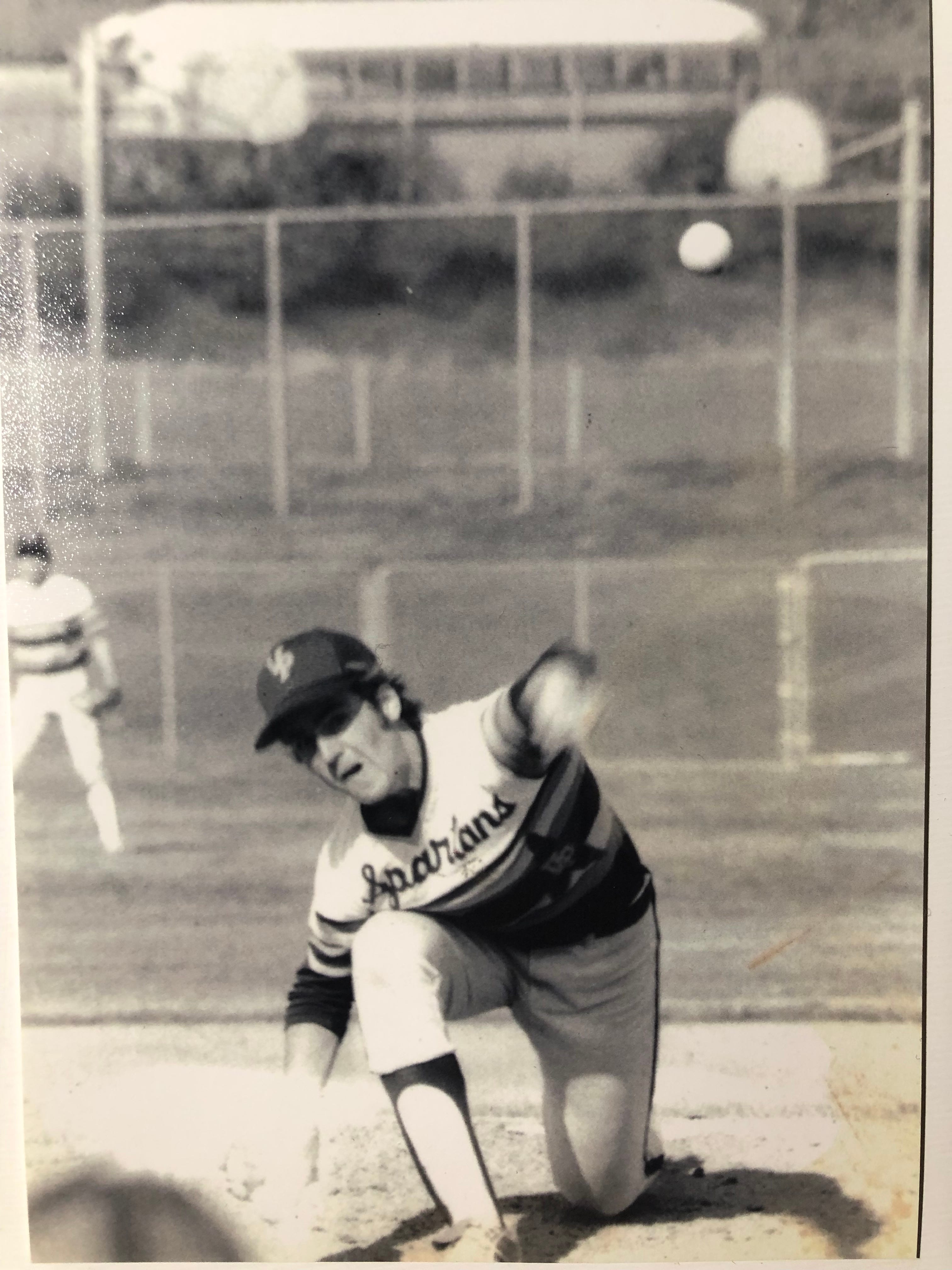
Gratitude and Other People’s Money
Dec 1, 202400:16:10Tap to summarizeJohnNovember 29, the day after Thanksgiving Day, was the first anniversary of my brother John’s death. Normally, I write my Substacks on Friday and record them on Saturday to have them ready for early Sunday morning. That was my plan, but God laughed, I suppose.All week, I’d had vivid dreams of my brother and my mother—the anniversary of her death is next Sunday. Some of the dreams were full of grief; others pleasant imagining of a continued life together. I texted with my siblings as we shared our feelings. On Friday, I talked with one of my sisters, who called to check in with me.Since I wasn’t having any success writing about John, I decided to work on some sewing projects while I considered his life. I’m making some small tote bags with inner and outer pockets and fun details as ‘thank yous’ for people who are blurbing my upcoming book. But I kept making unforced errors. Things I could fix, but it was frustrating. I don’t have a pattern (except the one in my head), but all of the ten pieces are rectangles of various sizes, easy to cut, easy to sew. I’ve done this sort of thing before and know the order of the steps. Yet, I kept dropping a step here or there and moving to the next one before realizing my mistake and having to backtrack.I stopped. Better just to think about John. I’ve written an essay about him that’s out on submission in an anthology on sibling loss. One thing that didn’t fit in that essay was something John used to say, something our brother Lee reminded us of: It’s OPM, so let’s enjoy it.OPM: Other People’s MoneyOPM is Other People’s Money. John would say it about winning when he gambled. He liked to play blackjack. He won frequently—Far more often than chance would indicate. I believe he could count cards. And when he did win and other people were with him, he had them join in the fun of spending. He was someone who treated windfalls the way they should be treated.On a weeklong water skiing trip to Lake Mead, he won in Las Vegas and treated all week for food and drinks. On another trip to Vegas, he missed a meet up with my sisters. Everyone wondered what had happened to him and got the Tropicana Hotel employees to open his door. He hadn’t slept in his room. He’d been winning and stayed at the tables. He apologized and gave a thousand dollars to each of the people waiting for him. Because—OPM. Why not?Since the anniversary of John’s death will always be close to Thanksgiving, I’ll concentrate on his generosity to enjoy his memory. He was openhanded in other, more conventional ways, too, though those don’t make good family stories. Thinking of his life serves as a reminder that windfalls aren’t to be hoarded. When something positive, unexpected and unearned, comes along, let’s share.This is a favorite photo of John, pitching for his high school baseball team, the Villa Park Spartans. I’m pretty sure it was taken by someone on the high school yearbook staff. I love that you can see the ball flying through the air, on its way to the batter.What I’m readingI finally finished Shadows of Carcosa: Tales of Cosmic HorrorSome of the stories were so-so despite their famous authors. The ones that had the creepy atmosphere I was looking for: “The House of Sounds” by M.P. Shiel; “The White People” by Arthur Machen; “The Willows” by Algernon Blackwood; and “Seaton’s Aunt” by Walter de la Mare. I was surprised not to have had much reaction to the H.P. Lovecraft story “The Colour Out of Space.” And I felt kind of stupid for not enjoying the Henry James story “ The Jolly Corner.” When I read James in college and grad school, I found everything brilliant. And later “The Turn of the Screw” had that creepy vibe and the psychological depth. So—I’m not sure if I’ve just lost my sense of enjoyment in a deep, difficult story or if “The Jolly Corner” isn’t as good as the other works by James that I’d read. I found the Edgar Allan Poe story “ MS. Found in a Bottle” meh. The other stories I liked, but they didn’t have the atmosphere I was hoping for.I started “The Oceans of Cruelty: Twenty-Five Tales of a Corpse Spirit: A Retelling” by Douglas J. Penick (based on twenty-five ancient tales from India). It’s not what I expected. More about it when I finish.I listened to a book about being a guest on podcasts. Then I thought about how I’d bought the audiobook James by Percival Everett many weeks ago. Later, it won the National Book Award. And isn’t Everett sharing his talent a windfall for readers? I needed to listen to it and forget my unrelenting worries about social media and how bad I am at it.James lived up to all the hype. I think it’s a better experience if the reader is familiar with The Adventures of Huckleberry Finn and can recall the plot. I taught it more than once to eleventh graders, the year for American literature. Huck is a great book for about two-thirds and then falls apart in the last third. Having Tom Sawyer in there just messes up everything. He should have been left to the children’s books, and I was glad to see that James gives him short shrift. And has a better ending, in both the sense of fitting with the rest of the book and in the sense of dealing with the issue of slavery. James feels like it took the story and got it right, including a big surprise that was quite fitting. So—like everyone else in the literary universe—I highly recommend it.Gratitude for resources against book bansBook Rationales from the National Council of Teachers of EnglishThe NCTE has rationales for 1300 books, searchable by title or by grade level. It also has position statements on Supporting teachers and students in discussing complex topics and educators’ right and responsibilities to engage in antiracist teaching.Library book challenge and ban news‘Literally heartbreaking as a librarian’ 150 titles pulled from Rutherford County school libraries From the Tennessee LookoutPublic school officials have asked Tenn. attorney general’s office for guidance on how to implement new school book law, calling it vaguely worded150 book titles had to be removed from the shelves – or tracked down and taken from kids who had borrowed them.Immediately.“Librarians had to drop everything they were doing: no more checking books in and out, no answering questions or assisting with research, not able to do the jobs they love to do. Some even had to shut down their library for the day,” said Elizabeth Shepherd, librarian at the Discovery School in Murfreesboro who described the frantic text message exchanges among fellow librarians that ensued.…The books were removed without formal review by school board members, librarians, teachers or parents less than 24 hours after an emailed request to Rutherford County Director of Schools James Sullivan from a school board member.….“Public Chapter 782 is the source of this chaos and confusion for school librarians in Tennessee, as it creates a way for unchallenged books to be removed from the shelves, does not take into account the age or maturity level of the student, and it encourages self-censorship,” the Tennessee Association of School Librarians said in a statement.The association said the law has put educators in the position of deciding on whether books meet new “legal standards that have not been adequately explained by the State of Tennessee in the form of guidance.” …In the meantime, some school districts have begun to proactively remove books that could violate the new law, relying largely on a single website created by a Florida resident and former member of the conservative parents’ rights group, Moms for Liberty, that rates books on their sexual content, violence and explicit language.AND TANGO MAKES THREE Authors Seek Settlement in Escambia County School Lawsuit from Book RiotThis week … the Selendy Gay attorneys working on behalf of Parnell and Richardson have filed a motion for a summary judgement to U.S. District Judge Allen Winsor. The motion would allow Winsor to make a decision on the case without it having to go to trial, and in this case, the attorneys filed the motion based on two significant pieces of evidence that have emerged: first, the educational value of And Tango Makes Three and the lack of evidence proving that the book is harmful in the educational system and second, the personal anti-LGBTQ+ beliefs of the school board members as revealed by destroyed evidence uncovered during seven months of discovery.Summary judgements can be requested after the discovery phase of a lawsuit. The discovery phase is when allegations are investigated and evidence is obtained to support the claims made in the dispute. A motion for a summary judgment comes when a party believes there is no dispute of material fact and that there are no questions to dispute their belief in material fact.In other words, the plaintiffs believe evidence is crystal clear that the district removed And Tango Makes Three based on their own personal b...
Transcribe →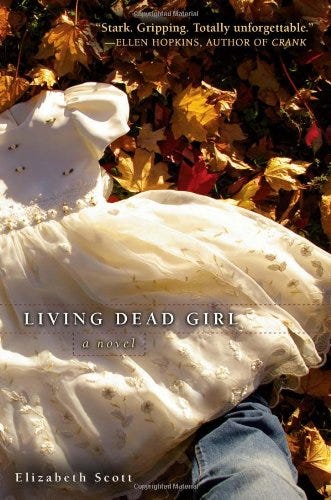
Living Dead Girl: On My Book Talk List
Nov 24, 202400:17:09Tap to summarizeLiving Dead Girl While I normally save all the book challenge and ban news for a Part 2 each week, I want to bring forward this one news item. When I read it, I thought, “I know that book” because I had read it and book talked it to classes. It’s been a minute, so, as I often do, I went back to my School Library Lady blog to see if I’d written anything about it in the past.Here’s a link to the article that caught my attention:Utah just banned a 14th book from public schools. Here’s what it’s about. From the Salt Lake TribuneThis time it’s “Living Dead Girl,” by Elizabeth Scott, which follows the story of Alice who — after being kidnapped as a child — endures years of abuse and manipulation while struggling to find hope and a way to escape.Here’s a clip of the author, Elizabeth Scott, in 2008, defending Living Dead Girl as a book for teens.Young Adult Novelist Elizabeth Scott Discusses Her Latest Book, Living Dead GirlMy TakeHere’s what I wrote in 2012 when I first read it to see if I wanted recommend it to teens during book talks. This is an honest look before any thought of its being banned or of any of today’s politics of censorship.Deeply disturbing, Living Dead Girl was a novel I couldn’t put down. It’s a quick read—under two hours, but the impact lasts (and maybe the bad dreams do, too).Alice is a girl who was abducted at age ten while on a class field trip to an aquarium. She is now fifteen, still living with her abductor, and looking back over events of their five years together. Although there is no explicit description, Alice is clearly sexually abused on a regular basis. Her abductor, Ray, likes little girls, and attempts to keep her very young looking through waxing and limited food intake as well as drugs that hold off puberty.However, Alice is growing and Ray is tired of her. He tells Alice he wants her help inducting a new little girl into his warped world, where the child will be beaten into mind control (brain washing) and forced to obey Ray’s every command, just as Alice was. Alice hopes that having another girl will give her a break from the constant abuse. But she then realizes that Ray intends to kill her and dispose of her body once the new girl is captured.From what I’ve read of real abductions, such as that of Elizabeth Smart, the details of this novel ring true. One of the most difficult parts of the book is how no one in Alice’s world recognizes that she is being held hostage. They believe that Ray is her father and home teaching her although he goes to work and locks her in the house. She is unkempt, even dirty. She is too young to have all that waxing without parental permission, but the salon owner never asks for it and doesn’t wonder why she is there.The thought that we don’t really see things that happen around us (as is true in the last book I reviewed, The Rules of Survival) is as disturbing as the horrific situation of these kids. Maybe reading these novels will help us to be more aware.It struck me that things that have been on my mind this week converged in that 2012 review. I mention above that Living Dead Girl reminded me of the real life Elizabeth Smart. In 2002, Smart, age 14, was abducted from her bedroom at knifepoint by a ‘lone wolf’ fundamentalist Mormon, who told her she was his plural wife. He raped her daily for the nine months she was held captive. During those nine months, there were a few times when people saw her and suspected she was the kidnapped girl. But when they asked her if she was okay, being afraid of her captor and his capacity for violence (he’d told her he’d kill her whole family), she said yes. This week, I created a ‘recommended reading list’ of books on Christian patriarchal cults and included Under the Banner of Heaven by Jon Krakauer. In Banner, Krakauer discusses Elizabeth Smart while bringing home an important point: a teen girl who believes she has no authority over herself is left open to danger from malevolent adults. (I’ll be posting the annotated reading list as the publication of my novel Keep Sweet approaches.) I also mentioned above having just read The Rules of Survival. A question I asked in the 2012 review of Rules: ‘What if you had a mother so unhinged that she would accuse an innocent person of abusing her kids?’ I happened to be thinking about that this week because Susan Smith, who drowned her two sons by driving her car into a lake in 1994, was just denied parole. Immediately following the murders, she told law enforcement she had been carjacked by a Black man.The Nighttime BrainI awoke in the middle of the night last night thinking about the opening chapter of Living Dead Girl, which came back to me. About how clever the predator was at getting Alice to believe he was an employee of the aquarium and that he was directing her back to her classmates rather than into a life of abuse. I felt sorrow over the vast width and depth of children’s vulnerability.There, too, in the middle of the night, I remembered an incident that took place years ago. I was in Carlsbad, CA to run the San Diego Marathon. My aunt was in CA, visiting from Pennsylvania. She and my parents came to the marathon to cheer me on. Since we were close by, my husband, kids, and I went to Legoland the following day. My mom came, too.We were in the middle of our theme park outing, deciding on what to do next, when I saw a small boy, about 4-5 years old, wailing. People were passing him in all directions. I went to him, knelt on one knee, and asked if he was lost. He was. Through his tears, he told me that he would never see his parents again because they had been separated. His misunderstanding of his situation surprised me. He was wildly distraught over the ‘forever’ loss of his family.I told him that his parents were looking for him right then, at that moment. And that Legoland has a place where lost children meet up with lost parents. So all we needed to do was to find an employee to direct us to that spot and then wait for his parents to show up if they weren’t already there. He stopped crying and trusted me completely.I told my mom I would take the boy to the park employees. She was hesitant. What if someone thought I was kidnapping the child? Maybe I’d be arrested. “If I leave him, someone could kidnap him,” I said. Now, to be fair, my mom was at the beginning of her long dementia journey. But I, too, had thought of this scenario. As I walked away with the boy, I hoped his mom wouldn’t come running up and punch me in the face. Fortunately, I was able to hand him off safely.The incident only lasted fifteen minutes or so. I know it popped into my insomnia-addled brain both because of how distraught and how trusting that boy was. Granted, I was the type of person children are told to go to when lost—a mom with kids. But I think he would have believed anyone who bothered to stop and console him. Because he was so small and so vulnerable. We need to stop worrying about teen books like Living Dead Girl that have no history of hurting anyone but only show that evil exists. Instead, we need to work harder against the things that do harm kids. When I see predators being nominated for top government positions, it reminds me that we don't do a great job at that. Part 2: Library and book challenge/ban newsI’ve mentioned the Utah statewide book bans in past posts, but FYI refresher: these are the other 13 banned titles:* “Blankets” by Craig Thompson.* “A Court of Frost and Starlight” by Sarah J. Maas.* “A Court of Mist and Fury” by Sarah J. Maas.* “A Court of Silver Flames” by Sarah J. Maas.* “A Court of Thorns and Roses” by Sarah J. Maas.* “A Court of Wings and Ruin” by Sarah J. Maas.* “Empire of Storms” by Sarah J. Maas.* “Fallout” by Ellen Hopkins.* “Forever” by Judy Blume.* “Milk and Honey” by Rupi Kaur.* “Oryx & Crake” by Margaret Atwood.* “Tilt” by Ellen Hopkins.* “What Girls Are Made Of” by Elana K. Arnold.When I first saw this list, I decided to read a Sarah J. Maas novel, A Court of Thorns and Roses, to find out why her work took up almost half of the list. I discussed Thorns in this post.Corpus Christi Libraries Don’t Know What to Do With Teenagers from Book RiotThe newest developments are that they are considering a new “parent/guardian must be present” library card, which would block these minors from accessing self-checkouts and wo...
Transcribe →
Publishing with She Writes Press
Nov 17, 202400:37:00Tap to summarizeHello Friends!Several kind people reached out to me this past week with messages of good will. Thank you! I think the ‘endless’ headache has finally departed. I have a lot of important info this week, so if your reading time is limited, don’t forget that you can listen to the audio! Part 1 is about hybrid publishing. If you are a reader but not a writer looking to publish a book, feel free to go to Part 2 on book ban news and cults.One aspect of Be a Cactus is looking at small press publication. I’ve talked about some small presses I like and what the experience of publishing with small presses has been like for me. I haven’t yet discussed hybrid publishing because I have no experience with it. But I've been thinking about it recently as a possible pathway to publication for my future work.As often happens, when I think about something, I start to see information about it. One of the things I read on Substack was Brooke Warner’s post “Debut Fiction: Does Age Matter?” If you haven’t read it, do. While admitting to unicorns (Lessons in Chemistry was written by Bonnie Garmus, who turned 65 just before the book debuted), Warner shows how unlikely it is for an author to debut with a traditionally published book if she is 45 or older. She concludes “I would argue that making it past the gate requires a mix of the following: hard work; talent; and (by and large) being under 50.”Warner is the publisher of She Writes (for women authors) and SparkPress, both hybrid presses. Much of the fiction she publishes are “beautiful books” by women over 50. “It's freeing to make decisions based on the quality of an author’s writing alone, and not to be burdened by what the marketing department requires—star quality, that “it” factor, or that potential hypervisibility that acquiring editors are hoping for when they sign debut fiction authors. This is the reality of the modern publishing world.”She Writes Press was the first hybrid publisher to be named Independent Publisher of the Year (2019). Their explanation of their model:Unlike self-publishing platforms that publish whatever comes through regardless of quality, SWP is a curated press that works with authors to ensure that their books will be well-received in the marketplace. Unlike publishing houses, which buy the majority stake in your book but often don’t deliver when it comes to providing the editorial and marketing help you need, SWP gives authors an experienced editorial and production team, while allowing them to retain full ownership of their project and earnings.As it happens, I know someone who has been published by She Writes Press. Mary Camarillo is the author of The Lockhart Women (2021) and Those People Behind Us (2023). I thought it would be fun—and educational— to hear from someone who has experience with them. I interviewed Mary by email.Mary, thanks for being willing to share with Be a Cactus subscribers! I enjoyed the Southern California vibe and settings of your books. However, the issues in each are universal or, in the case of politics, at least national. Would you like to describe a bit about your books? What was the pitch you used when you queried She Writes?Both of my novels are set in the city where I live, Huntington Beach, California, although I tweaked the name to “Wellington Beach” in my second novel. My stories are about the Southern California that I know, that doesn’t include celebrities or extraordinary wealth. My characters work at the post office, the gym, or the real estate office. They shop at Target and think a night out at The Cheesesteak Factory is pretty special. They don’t own ocean front property but they do enjoy living ocean-adjacent. My characters are often described as not all that likable. I agree but I also argue that they are very human and I hope that my readers find something familiar and something to root for.For my first novel, The Lockhart Women, I submitted the first 50 pages of the novel to She Writes Press and was accepted as a Tier 1 author, which meant they believed my novel was ready to go. I also had to provide chapter summaries. I was pretty thrilled to be accepted. I’d been querying agents for this novel for more than a year. Some agents never responded. Some rejected me immediately. Some wanted to read more pages, said they liked my voice and my work, but they didn’t believe they could sell the novel.In hindsight, I understand why. Books are expensive to print and distribute. Publishers want a guarantee on their investment. And as Brook Warner pointed out in her post “Does Age Matter,” I’m an older author (72 now) with no platform or celebrity. But I’m also stubborn. I really wanted this book out in the world. I find it incredibly sad when other authors tell me they’ve gone through a similar process and just put the book in a drawer and given up.She Writes touts the fact that their books can get professional or traditional reviews, which is not the case for self-published books. As a former librarian, I know that library book selection depends on professional reviews. I used to use Booklist, Library Journal, School Library Journal and Kirkus. (I took Kirkus with a grain of salt. They could be unnecessarily derogatory.) I think these four are pretty standard. Were your books reviewed in trade publications and, if so, did any of the four I’ve listed include your work?She Writes Books are eligible for reviews but it is up to the author or their publicist to submit the book for review. I submitted both of my books to Kirkus for review, somewhat nervously because I’d heard about how snarky they can be. It’s also expensive, around $500, although they offer discounts occasionally. I didn’t get a starred review, but I did get pull quotes that I was able to use as blurbs and for publicity. Unlike self-published books and books from small indie presses, She Writes has a distribution channel through Simon and Schuster. This is vital to having books land in bookstores and libraries. Have you seen your novels in either of those places? Have you been able to have book events (such as a book launch, reading and signing) in either? Do you feel that you have a relationship with local book providers that you wouldn’t have had if you’d self-published?She Writes Press recently switched to distribution through Simon and Schuster. The transition has been very rocky so far. They are working to resolve the problems, but even though there is plenty of inventory in the warehouses, my books are not currently available through all the channels. I’m frustrated. Prior to the switch, She Writes Press used Ingram, which meant that our books were available at all the usual online sources as well as in libraries and in bookstores. I anticipate that this will eventually be the case with Simon and Schuster. My local Huntington Beach library carries both of my novels. I’ve also seen them on the shelves of local bookstores like LibroMobile in Santa Ana, Vroman’s in Pasadena, Arvida Books in Tustin, and Barnes and Noble in Huntington Beach.I did both of my book launches at LibroMobile and I’ve had book events at my local Barnes and Noble and at Bel Canto Books in Long Beach. I also did a really fun book tour for my second novel through California with stops at The Book Jewel in Los Angeles, The Bookworm in Camarillo, The Book Loft in Solvang, Books Inc. in Campbell, Ruby’s Books in Folsom, and East Village Bookstore in Sacramento. We made a great road trip out of it, visiting friends and family, and taking in some concerts and museums.I made a point of establishing relationships with local book providers before my books were published which helped in getting my books on their shelves. Even if a book is distributed by Ingram or Simon and Schuster, there are still some bookstores (like Book Soup in Hollywood) that prefer that the author consign the books. I’ve experimented with that. Consigning is more work but still doable and is also an option for self-published authors.She Writes has an in-house marketing and publicity team (through SparkPoint Studio’s publicity company, BookSparks) that SWP authors can choose to utilize. What does it mean to ‘choose to utilize’ their marketing? Is there an extra fee? If you used their marketing, what did they do for you? She Writes Press strongly encourages authors to hire a publicist and they provide a list of suggested publicists. I used the in–house BookSparks for my first novel. They were expensive three years ago and I’m sure the prices have increased. Three years ago, BookSparks offered packages ranging from $5,000 to $20,000.I chose the $15,000 package. It included pitches for reviews and interviews in traditional print and online media, including major newspapers, magazines, radio, and TV. Thanks to BookSparks, I was mentioned in the Hollywood Reporter. BookSparks also pitched a few essays of mine and placed a few in small online publications.I knew absolutely nothing about publicity when I first published. I didn’t even know what to ask or expect from a publicist. I learned a lot with my first book and realized that much of what BookSparks was able to do for me I could have done for myself. I consider the funds I spent on BookSparks as a crash course in publicity. I’m not ...
Transcribe →