Podcast
Inevitable
Hosted by an MCJ podcast · EN
Join Cody Simms each week as he engages with experts across disciplines to explore innovations driving the transition of energy and industry. Inevitable is an MCJ podcast. This show was formerly known as 'My Climate Journey.'
62episodes
Episodes
Newest firstAll episodes

Underground Nuclear Reactors? Inside Deep Fission’s Energy Solution
Apr 10, 202500:36:21Summary readyLiz Muller is the CEO and Co-founder of Deep Fission, a company pioneering a new approach to the traditional light-water nuclear reactor. Rather than using concrete and constructed containment, Deep Fission places the reactor one mile underground, fundamentally changing the design paradigm.Liz was on the show over five years ago when she was building a company focused on storing nuclear waste deep underground—a related concept. Now, she’s back with a fresh vision and a new venture. Deep Fission recently raised a pre-seed round led by Eight VC, and we wanted to catch up with her to hear how the idea came together and how she’s approaching the challenge this time around.In this episode, we cover: [1:37] Liz’s previous venture: Deep Isolation and lessons learned[4:19] The origin story of Deep Fission and the core insight that sparked it[9:37] Cost comparison between underground and traditional above-ground nuclear reactors[12:17] Deep Fission’s modular, scalable reactor design[19:10] Plans for maintenance, refueling, and long-term waste disposal[22:25] Regulatory engagement with the NRC and path to licensing[23:24] Initial commercial partnership with Endeavor Data Centers[25:07] Advantages of Deep Fission’s approach vs. traditional nuclear plants[28:23] Funding milestones and capital raised to date[29:10] Liz’s vision for the future of nuclear energy[35:03] Who Deep Fission wants to hear from—and how you can helpEpisode recorded on March 27, 2025 (Published on April 10, 2025) Enjoyed this episode? Please leave us a review! Share feedback or suggest future topics and guests at info@mcj.vc.Connect with MCJ:Cody Simms on LinkedInVisit mcj.vcSubscribe to the MCJ Newsletter*Editing and post-production work for this episode was provided by The Podcast Consultant
Summary
Building a Real-Time Wildfire Alert Platform with Watch Duty
Apr 3, 202501:06:25Summary readyJohn Mills is the Co-Founder and CEO of Watch Duty, the leading app for real-time wildfire alerts in the U.S.In this episode of Inevitable, John shares how Watch Duty became a vital public safety tool—rising to #1 in the App Store during the recent Palisades and Eaton fires in Los Angeles. As a 501(c)(3) nonprofit, Watch Duty delivers live updates on fire spread, evacuations, and recovery efforts. While historically funded by donations and memberships, the platform now also offers a pro version for first responders, utilities, and emergency managers.John discusses his vision for building a mission-driven tech company that serves the public while scaling to meet growing demand in an increasingly wildfire-prone world.In this episode, we cover: [4:00] Introduction to Watch Duty [07:39] Gaining trust and overcoming initial resistance from fire departments[09:06] How first responders are using Watch Duty [09:57] Inside the “war room” during the Palisades Fire response[13:24] How Watch Duty reporters gather and vet real-time radio traffic[17:28] Nuance and restraint in sharing emergency information [20:50] The origin story of Watch Duty [21:11] John’s journey from Silicon Valley to off-grid life and nonprofit founder[36:44] Operating as a nonprofit and scaling into new disaster zones[52:58] Why private innovation is outpacing government tech [57:22] Advice for founders building in disaster response and recovery [01:00:12] Final thoughts on mission, trust, and what’s next for Watch DutyEpisode recorded on March 12, 2025 (Published on April 3, 2025) Enjoyed this episode? Please leave us a review! Share feedback or suggest future topics and guests at info@mcj.vc.Connect with MCJ:Cody Simms on LinkedInVisit mcj.vcSubscribe to the MCJ Newsletter*Editing and post-production work for this episode was provided by The Podcast Consultant
Summary
Securing the Energy Grid from Cyber Threats with Xage Security
Mar 27, 202500:38:31Summary readyRoman Arutyunov is the Co-founder and SVP of Products at Xage Security, a Series B startup focused on protecting critical infrastructure—including energy systems—from cyber threats. Xage is backed by investors like Chevron Technology Ventures, Aramco, Piva Capital, Valor Equity Partners, and Overture.Cybersecurity is a growing concern as our energy systems become more distributed, electrified, and digitally connected. We spoke with Roman about the vulnerabilities in today’s infrastructure, the motivations behind cyberattacks, and how the rise of AI is changing the cybersecurity landscape.In this episode, we cover: [2:11] Introduction to Xage Security[3:12] Cybersecurity 101: Ransomware, nation-state threats, and attacker motivations[7:10] Operational tech (OT) vs. information tech (IT)[13:29] Xage’s Zero Trust security approach[15:45] Customer segments and differing security challenges[20:47] Navigating regulations vs. fast deployment timelines[23:40] How AI is shaping both threats and defenses[28:00] When multifactor authentication becomes a vulnerability[31:59] Real-world cyberattacks on energy systems[34:10] Xage’s funding history and growth trajectoryEpisode recorded on Feb 20, 2025 (Published on Mar 26, 2025) Enjoyed this episode? Please leave us a review! Share feedback or suggest future topics and guests at info@mcj.vc.Connect with MCJ:Cody Simms on LinkedInVisit mcj.vcSubscribe to the MCJ Newsletter*Editing and post-production work for this episode was provided by The Podcast Consultant
Summary
Mike Schroepfer: Lessons from Scaling Meta to Investing in the Energy Transition
Mar 20, 202501:01:45Summary readyMike Schroepfer is Partner at Gigascale, a venture firm he founded and self-funded to back startups building venture-scale businesses with the potential for outsized climate impact. Previously, Mike served as CTO at Meta (Facebook’s parent company) from 2013 to 2022, having originally joined in 2008 as VP of Engineering.In this episode, Mike and Cody discuss his career journey, key lessons learned, and their shared counterpoint to the often-repeated myth that "America doesn’t build hard things." They also dive into AI, energy’s role in its advancement, and the work Mike and his team are doing at Gigascale.Mike has been a longtime supporter of MCJ, and we’re honored to count him among our investors. It’s inspiring to see a technologist of his caliber not only invest in climate solutions but also roll up his sleeves to help founders tackle hard problems and build the future.In this episode, we cover: [2:08] Mike’s early career working on video software [5:28] Fundraising challenges and lessons from the dot-com crash [10:12] Working at Sun, Mozilla, and joining Facebook in 2008[13:16] Risks and opportunities of early Facebook[15:40] Managing large engineering teams and the value of humility[18:30] The era of building hard things in the U.S.[21:25] AI and energy innovation: compute, chips, and power[27:49] How scale brings down cost curve and modularized technology [32:01] How he thinks about software-based opportunities [37:40] Shrep’s pivot to climate tech after Meta[41:04] The talent interest evolution in climate [43:33] Gigascale’s investment thesis[49:49] Gigascale’s approach to identifying sectors[51:37] Storytelling and marketing in climate tech[54:10] Gigascales talent efforts for its portfolio Episode recorded on Mar 4, 2025 (Published on Mar 20, 2025) Enjoyed this episode? Please leave us a review! Share feedback or suggest future topics and guests at info@mcj.vc.Connect with MCJ:Cody Simms on LinkedInVisit mcj.vcSubscribe to the MCJ Newsletter*Editing and post-production work for this episode was provided by The Podcast Consultant
Summary
Accelerating Data Center and Renewable Energy Siting with Paces
Mar 13, 202500:49:09Summary readyJames McWalter is the CEO and co-founder of Paces, an AI-powered software platform that helps clean energy project developers identify and evaluate the best sites for new projects. Paces streamlines the process by integrating interconnection, environmental, zoning, and legal data on land parcels—key factors developers must navigate when selecting viable locations. MCJ is proud to be an investor in Paces through our venture funds.In renewable project development, one of the biggest challenges is quickly pinpointing sites with the highest likelihood of reaching operation efficiently. As James explains, this process depends on multiple factors: the capacity of the local grid, whether upgrades are needed to connect a project, the feasibility of permitting, and more. And as we discuss, the recent AI-driven data center boom is intensifying the urgency and complexity of each of these considerations.Paces’ platform is being used by both clean energy developers and data center developers who need to get projects built as quickly, cost-effectively, and cleanly as possible. A few months ago, Paces co-authored a white paper with Scale Microgrids and Stripe Climate titled Fast, Scalable, Clean, and Cheap Enough: How Off-Grid Solar Microgrids Can Power the AI Race—a report that sparked a lot of conversation. In it, they explore whether the forecasted energy demands of AI can be met with off-grid, behind-the-meter projects.Oh, and James also hosts his own podcast, Build Repeat, where he interviews project developers and others actively building and deploying clean energy solutions.With all that said, James and I dive into his background, the origins of Paces, and much more in this episode.In this episode, we cover: [2:48] Introduction to Paces and James’ background[6:26] The origin story of Paces and how James met his co-founder, Charles[9:24] Key challenges faced by clean energy project developers[11:45] Permitting bottlenecks and delays[14:57] The growing challenge of decreasing grid capacity[16:01] How Paces’ software addresses site selection challenges[19:11] The role of NIMBY opposition in the permitting process[22:42] How developers leverage Paces' platform[24:51] Paces’ customer segmentation and user types[28:08] How Paces supports data center development[30:16] Insights from Paces’ white paper on off-grid solutions for AI-driven data centers (available at offgridai.us)[38:49] The feasibility of achieving 100% renewable energy for data centers[46:10] Paces’ fundraising to date and the types of partners they’re looking forEpisode recorded on Feb 19, 2025 (Published on March 6, 2025) Enjoyed this episode? Please leave us a review! Share feedback or suggest future topics and guests at info@mcj.vc.Connect with MCJ:Cody Simms on LinkedInVisit mcj.vcSubscribe to the MCJ Newsletter*Editing and post-production work for this episode was provided by The Podcast Consultant
Summary
Building the EV Charging Network: Lessons from Former EVgo CEO Cathy Zoi
Mar 6, 202500:46:46Summary readyCathy Zoi is a clean energy veteran with a career spanning leadership roles across government, industry, and investment. Most recently, she served as CEO of EVgo from 2017 to 2023, taking the company public in 2020. EVgo is now one of the largest EV charging networks in the United States.Today, Cathy is deeply engaged in the energy and climate space. She serves on the board of directors for Con Edison, the major investor-owned utility serving the New York City metro area. She’s also on the board of Apax, a British investment firm, and sits on the investment advisory committee for EQT, a Swedish global investment organization that recently acquired Scale Microgrids. Additionally, she’s a board member at SPAN, an MCJ portfolio company, and at Soil Organic.Cathy’s career started at the Environmental Protection Agency, followed by roles in the White House during the Clinton-Gore administration and the Department of Energy under Obama. She’s worked at Silver Lake, founded a division of SunEdison focused on emerging markets, and helped lay the groundwork for Odyssey Energy Solutions, another MCJ portfolio company. Throughout our conversation, we explore her fascinating career journey, the lessons she’s learned along the way, and her perspective on the future of clean energy.In this episode, we cover: [3:01] Cathy’s early career at the EPA and the launch of Energy Star[9:15] Commercializing GHG reducers in Australia[11:59] Working with Al Gore’s Alliance for Climate Protection[14:42] Serving as acting undersecretary in the Obama administration[18:06] Advisory roles on investment platforms[23:22] Experience at SunEdison and founding Odyssey Energy[27:29] Financial discipline and capital deployment at EVgo[32:06] The future of the EV charging business[36:14] Evolution of pricing models[39:18] Board work at Con Ed and risk management[43:19] What excites her most, including beneficial electrificationEpisode recorded on Feb 25, 2025 (Published on March 13, 2025) Enjoyed this episode? Please leave us a review! Share feedback or suggest future topics and guests at info@mcj.vc.Connect with MCJ:Cody Simms on LinkedInVisit mcj.vcSubscribe to the MCJ Newsletter*Editing and post-production work for this episode was provided by The Podcast Consultant
Summary
Why Wildfire Insurance is Broken—And How Stand is Fixing It
Feb 27, 202500:44:06Tap to summarizeDan Preston is the co-founder and CEO of Stand, a brand-new startup property insurer providing homeowners insurance for climate-exposed properties. They’re launching with a go-to-market focus on higher-end properties in California—homes that are otherwise unable to obtain affordable rates or any coverage at all due to wildfire risk.Stand claims that their differentiation, as Dan will explain in depth, comes from how they assess fire risk at the individual property level and help homeowners take proactive steps to mitigate those risks as part of the underwriting process.Dan is a seasoned entrepreneur with a win under his belt in InsurTech. He was previously the CEO of Metromile, which went public on the NASDAQ in 2020 via a SPAC merger and was later acquired by NextGen insurance company Lemonade in 2022.Stand recently raised a $30 million Series A, co-led by Inspired Capital and Lowercarbon, and came out of stealth at the end of 2024 to begin underwriting properties.Insurance risk is being priced and managed in ways that no longer match today’s realities, and we loved hearing from Dan about how Stand is tackling the challenge.In this episode, we cover: [3:49] Dan’s background in computer science and machine learning[7:00] The catalyst for starting Stand[9:22] How insurance companies typically evaluate risk[11:05] Challenges in measuring wildfire risk[17:32] Managing fire-prone communities and the importance of collective resilience[20:53] The role of private firefighters in insurance[22:08] Stand’s mission and focus on climate-exposed properties[26:53] Progress since launch and early traction[27:39] Stand’s product, technology, and risk modeling approach[33:18] Why legacy insurers have struggled to adapt to wildfire risk[38:35] What "perils" mean in insurance and why they matter[41:47] Stand’s $30M Series A funding and future plansEpisode recorded on Feb 11, 2025 (Published on Feb 20, 2025) Enjoyed this episode? Please leave us a review! Share feedback or suggest future topics and guests at info@mcj.vc.Connect with MCJ:Cody Simms on LinkedInVisit mcj.vcSubscribe to the MCJ Newsletter*Editing and post-production work for this episode was provided by The Podcast Consultant
Transcribe →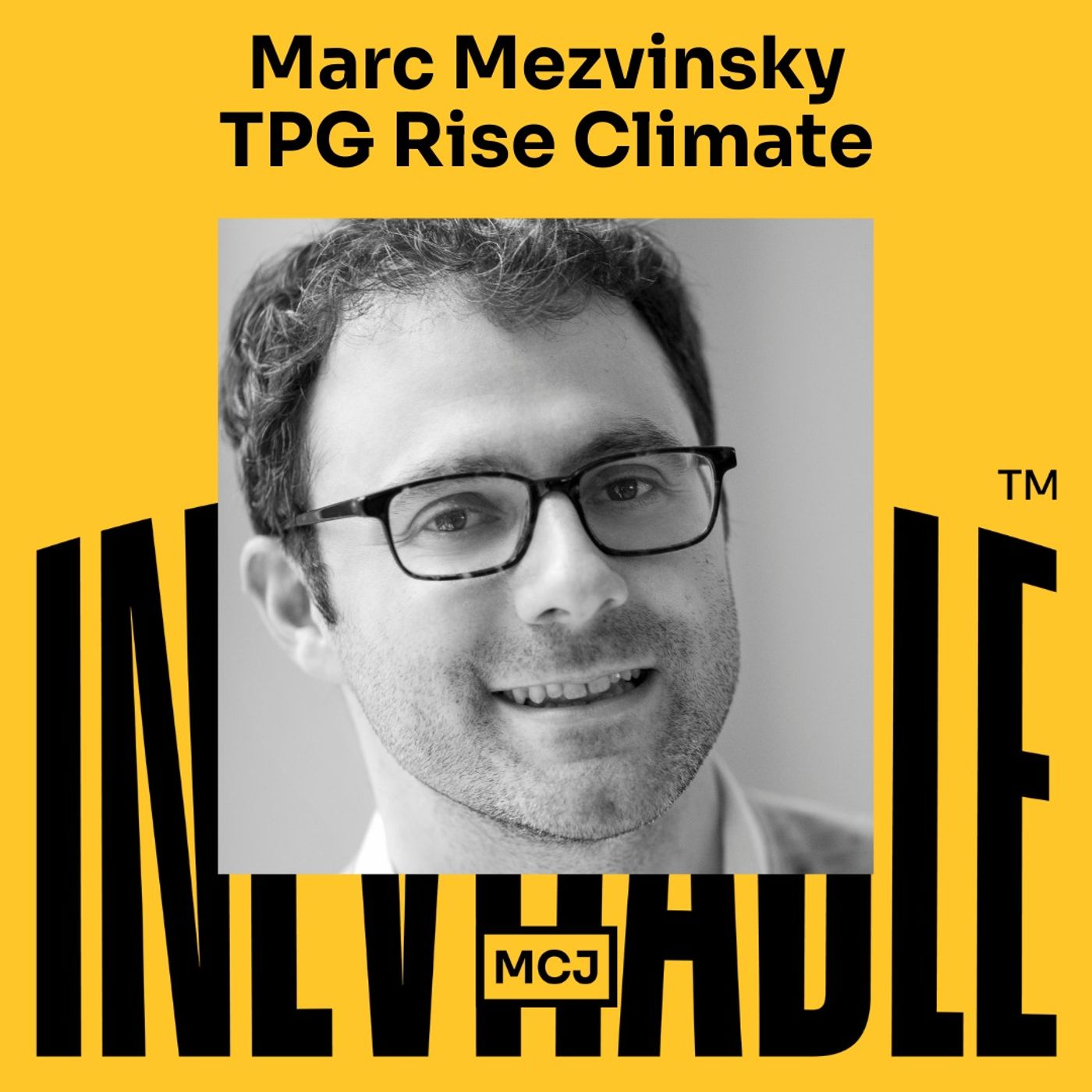
Marc Mezvinsky on TPG Rise Climate’s $7B Fund & Impact
Feb 20, 202500:48:17Tap to summarizeMarc Mezvinsky is a partner at TPG Rise Climate. TPG Rise Climate is among the largest pools of capital ever raised with a dedicated focus on climate tech. They announced a debut fund in 2021 at over $7 billion—and another very large fund currently in the works. Rise Climate is part of the broader TPG Rise platform, the impact arm of the publicly traded private equity firm TPG, which manages more than $220 billion in assets.Marc and I discuss his background and career path in finance across various asset classes, including private equity, venture capital at Social Capital, investment banking at Goldman Sachs, and hedge fund management, in addition to his work in climate tech.Of note, Marc has a fascinating personal history as the son of two former U.S. House Representatives and as the son-in-law of former U.S. President Bill Clinton and former U.S. Secretary of State Hillary Clinton—he is married to Chelsea Clinton.We also discuss how Marc approaches capital deployment at TPG Rise Climate, how he thinks about impact in his work, and how TPG Rise Climate evaluates impact relative to market-rate returns.In this episode, we cover: [3:04] An overview of TPG Rise Climate[8:34] The fund’s investment approach[11:12] TPC Rise Climate’s impact mandate[16:16] Marc’s background and path into finance[26:16] His exposure to policymaking and its impact on his work[38:10] Areas Marc and TPG Rise are exploring[44:07] Headwinds and tailwinds on Marc’s radarEpisode recorded on Jan 23, 2025 (Published on Feb 27, 2025) Enjoyed this episode? Please leave us a review! Share feedback or suggest future topics and guests at info@mcj.vc.Connect with MCJ:Cody Simms on LinkedInVisit mcj.vcSubscribe to the MCJ Newsletter*Editing and post-production work for this episode was provided by The Podcast Consultant
Transcribe →
How LineVision is Boosting Transmission Grid Capacity Without New Power Lines
Feb 13, 202500:39:38Tap to summarizeHudson Gilmer is the co-founder and CEO of LineVision. LineVision is a Series C-stage startup helping utilities monitor and increase the capacity of the vast network of transmission lines that serve as the vascular system of the U.S. electric grid. The U.S. transmission grid spans 600,000 to 700,000 circuit miles of high-voltage lines, connecting energy generation with consumption and delivering power across the country. This infrastructure typically lasts for decades, yet much of it was built before the advent of sophisticated software-based monitoring or persistent connectivity.LineVision provides a non-contact sensor and software system that detects issues with transmission lines and enables grid operators to safely increase their capacity—critical in an increasingly electrified world where grid constraints limit power delivery and building new transmission lines is a slow, multi-year process.We explore all this and more in our conversation with Hudson.In this episode, we cover: [2:06] An overview of transmission as one of the backbones of infrastructure in the US[7:00] LineVision’s focus on high-voltage, long distance lines [8:53] Hudon’s background and LineVision’s origin story[12:41] LineVision’s customers and who they work with[14:33] An overview of LineVision’s product [19:31] How seasonality plays into transmission capacity [22:53] The lifespan of typical transmission lines [25:10] The future of transmission line monitoring [28:11] LineVision’s funding to date [31:05] How LineVision’s business could be applied in the future[33:30] How monitoring facilitated grid security[35:42] LineVision’s new customersEpisode recorded on Jan 30, 2025 (Published on Feb 13, 2025) Enjoyed this episode? Please leave us a review! Share feedback or suggest future topics and guests at info@mcj.vc.Connect with MCJ:Cody Simms on LinkedInVisit mcj.vcSubscribe to the MCJ Newsletter*Editing and post-production work for this episode was provided by The Podcast Consultant
Transcribe →
Structured Capital 101: Keyframe’s Approach to Climate Finance
Feb 6, 202500:40:12Tap to summarizeJohn Rappaport is the Chief Investment Officer at Keyframe Capital, a special situations fund manager. They help management teams solve complex asset and corporate financing requirements. In finance speak, this is often referred to as structured capital—the process of separating a company's capital structure into layers, enabling each layer to be fit for an investor seeking that specific risk-return profile.As John shares, structured capital can often be a good fit for companies in the energy transition, as those in renewable energy and adjacent categories often have high upfront capital costs and a relatively low cost of ongoing production.John has spent much of his career in financial roles within the energy and transportation sectors. Prior to founding Keyframe in 2020, he joined Cyrus Capital Partners in 2008, and before that, he worked for Sankaty Advisors, a division of Bain Capital. He has lectured on structured capital and economics at Yale University and sits on the boards of many companies in the energy transition space, including Wonder Capital, Utility Data, and Sealed, among others.So, let's dive into the wonky but important world of structured capital.In this episode, we cover: [1:57] Overview of Keyframe Capital[2:52] The origin of Keyframe and a story about Terawatt Infrastructure[11:25] Understanding structured capital[17:01] Examples of structured capital: Infrastructure as a service[21:10] Keyframe’s thesis-driven approach[25:56] The data center financing challenge[31:02] When and how founders should engage with structured capital providers[35:48] Keyframe’s current focus areasEpisode recorded on Jan 21, 2025 (Published on Feb 6, 2025) Enjoyed this episode? Please leave us a review! Share feedback or suggest future topics and guests at info@mcj.vc.Connect with MCJ:Cody Simms on LinkedInVisit mcj.vcSubscribe to the MCJ Newsletter*Editing and post-production work for this episode was provided by The Podcast Consultant
Transcribe →