← Mayim Bialik's Breakdown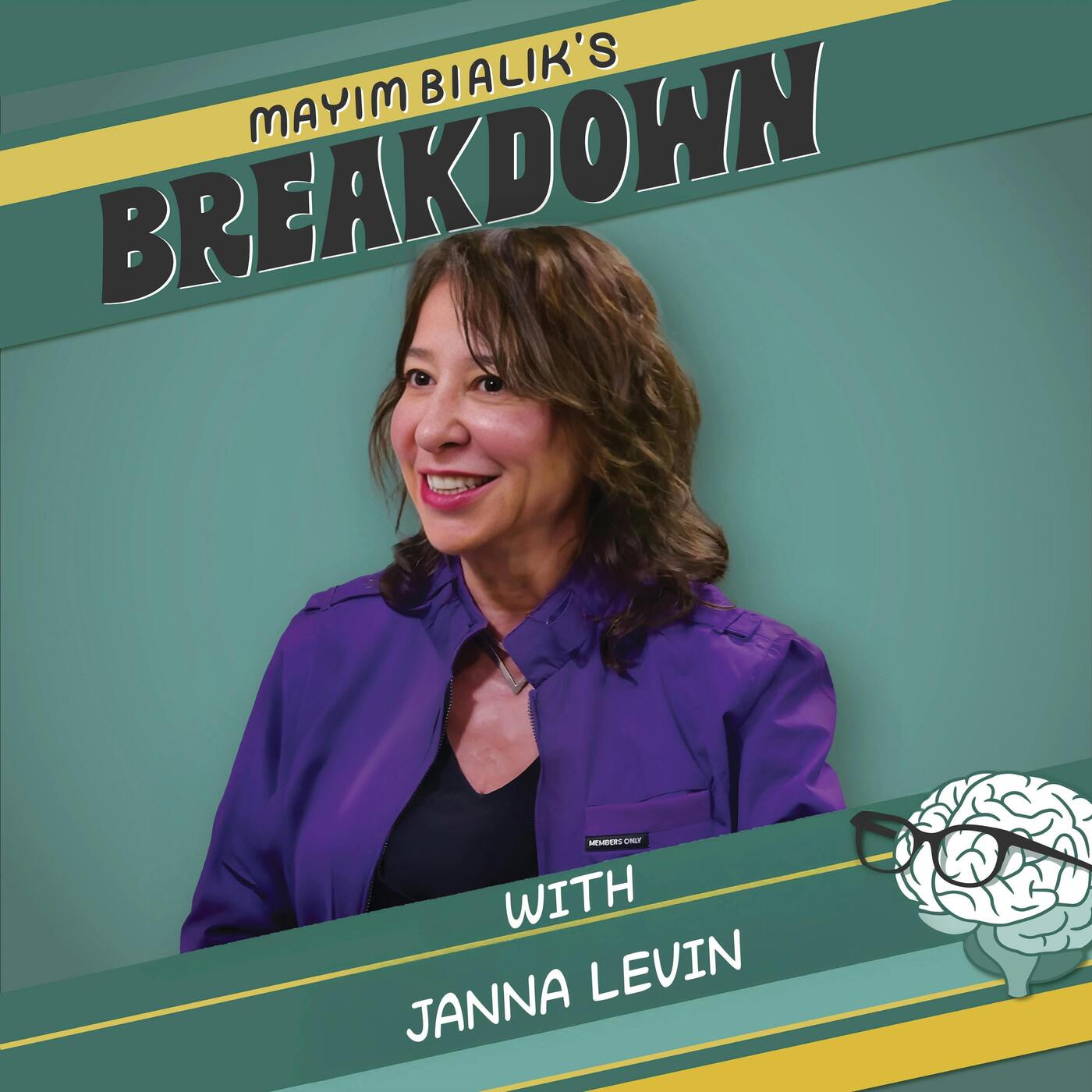
Mayim Bialik's Breakdown
Secrets of the Universe: What Happened Before The Big Bang, Life Across the Galaxy, Surviving a Black Hole & How We’re All Made of Stars | Astrophysicist Janna Levin
01:01:45
Loading summary
Transcript259 lines
- [00:00]
Jonathan Cohen
Mind Breakdown is supported by Helix Sleep
- [00:04]
Mayan Bialik
Spring is in the air and so are all of the allergens that come with it. Spring allergens means you need more sleep, but there are a ton of factors that can prevent us from getting a good night's rest. Night sweats, back pain, feeling the person next to you when they roll over a million times. We were so excited to hear that Helix wanted to partner with us. I've had my Helix mattress for about five years now and I have been sleeping so much better. Jonathan and also our kids love their Helix mattresses and all of those issues. Night sweats, back pain, motion transfer. Those things are significantly better with a Helix mattress. Helix delivers your mattress right to your door which is so much fun. With free shipping in the US they have a 120 night sleep trial and limited lifetime warranty plus their Happy With Helix guarantee. Rest easy with seamless returns and exchanges. The Happy with Helix guarantee offers a risk free customer first experience designed to ensure that you're completely satisfied with your new Mattress. Go to helixsleep do/breakdown for 27 off site wide that's helixsleep.com breakdown for 27 off site wide helixsleep.com breakdown With Verbal's
- [01:11]
Jana Levin
last minute deals, you can save over $50 on your spring getaway.
- [01:15]
Mayan Bialik
So whether it's a mountain escape with friends, a family week at the beach,
- [01:19]
Jana Levin
or sightseeing in a new city, there's
- [01:21]
Mayan Bialik
still time to get great discounts. Book your next day Now.
- [01:25]
Jana Levin
Average savings $72 select homes only. We have not begun to imagine what we could possibly be encountering. The most common misconception about the Big Bang is that it was an explosion in space. But it's so much more interesting than that flavor. Our elements are literally made in the cores of stars.
- [01:55]
Mayan Bialik
Wow.
- [01:55]
Jana Levin
This is why we're stardust. We are just a tiny bit of residue left over from the Big Bang. A little bit that sparkles in a sea of darkness.
- [02:04]
Mayan Bialik
Tell me why I should believe we're the only ones that are intelligent in this galaxy.
- [02:11]
Jana Levin
I wouldn't say that you should believe that.
- [02:13]
Mayan Bialik
Dr. Janna Levin is an astrophysicist and professor at Barnard College. She specializes in black holes, chaos theory, and quantum and theoretical physics. Jan is going to explain why so many people have a hunger to understand our place in the universe.
- [02:30]
Jana Levin
The supernova is one of the most important things that happens in the universe because it expels all its material. And that material has carbon, oxygen, nitrogen, and out of that you can make a rocky planet. We see hundreds of billions of galaxies, and they all seem to have supermassive planets. What we've discovered is that most stars have multiple planets like we do. So if you think about the vastness of the stars and the numbers that we talk about, there are more planets than that. So now our search for life becomes very interesting. There's two very different divergent paths. One is that we will kill ourselves or we fundamentally change as a species. It's the only possible future for us. If we're going to survive.
- [03:15]
Jonathan Cohen
Are we all going to fall into a black hole?
- [03:17]
Jana Levin
Well, here's the thing.
- [03:26]
Mayan Bialik
Hi, I'm Mayan Bialik.
- [03:27]
Jonathan Cohen
I'm Jonathan Cohen.
- [03:28]
Mayan Bialik
And welcome to our breakdown. We're going to be talking today about the nature of, essentially, desire, and it's the nature of our desire to understand the things that are so much bigger than us and what that means for our lives right now. Have you ever thought about how you got here? Have you ever expanded that out to how did everything get here? Have you ever expanded that out to how did everything outside of everything get there and what existed before we got here? We have the perfect person to talk to about this.
- [04:05]
Jonathan Cohen
Some of these fundamental questions are so important and are on the rise these days. So many people are curious about this because it's scratching this deep fundamental itch to help us understand ourselves, the world around us. And we're looking for purpose and meaning in a way that these conversations about the solar system, what's happening in the universe around us, are starting to help us answer.
- [04:32]
Mayan Bialik
We're going to be talking with Jana Levin, an astrophysicist who is a professor at the Barnard College of Columbia University. She's also the founding director of Sciences at PioneerWorks and the founding editor in chief of Pioneer Works Broadcast. She's a Guggenheim Fellow, and she specializes in black holes. She's written this delightful book, Black Hole Survival Guide, and it's very, very cute. And there's also beautiful artwork by Leah Halloran, and. But what we're gonna ask Jana to do today is to explain how we got here, why we're here, where we're going. Are we alone? And why should we care? It's a deeply moving conversation. It's also a deeply intellectual conversation. And Jana's gonna explain why so many people have a hunger to understand our place in the universe in a way that we never have before. And we now have the cap. Understand our place in the universe in a way that we never have before.
- [05:35]
Jonathan Cohen
Don't forget, we're also. There's a big part of this conversation, exploring black holes, the new information that is available about them only recently, the scientific breakthroughs that are happening, and how that information shapes everything else you discussed in terms of our role in the universe and the role of black holes in the orbiting of the Earth and the formation of our galaxy.
- [06:01]
Mayan Bialik
In case you're not sure if you want to understand black holes, I'm going to ask you to take a leap of faith. You want to understand black holes. And the best person to do that is Jana Levin, who joins us in person. Jana Levin, welcome to the Breakdown. Break it down.
- [06:18]
Jana Levin
Thanks for having me here.
- [06:20]
Mayan Bialik
We're very happy to have you here in person.
- [06:22]
Jana Levin
Yeah, in person's nice, right?
- [06:23]
Mayan Bialik
It's nice. It's a different kind of conversation. And I would say that you are an expert in some of the most difficult things to comprehend.
- [06:33]
Jana Levin
Somebody's gotta do it correct.
- [06:34]
Mayan Bialik
And I think it feels especially appropriate to get to have this conversation in person because I feel like there's gonna be a lot of. Wait. What? Can you go back? You know, one of the really special things about the work that you do, besides what you do academically, which is very significant and important, and all the good things, you communicate very, very complicated concepts to people in a way that is very beautiful and it's very lyrical. And in particular, your sub stack community is very, very devoted, dialed in and locked in to wanting to understand things not just in a scientific way, but in a beautifully scientific way.
- [07:13]
Jana Levin
Yeah.
- [07:14]
Mayan Bialik
What would you say your mission is and how did you arrive there?
- [07:18]
Jana Levin
I think with most things, I'm pursuing stuff selfishly because it appeals to me. And the hope is just it'll appeal to others as well, and people will join. And I think that's always surprising and astounding that people do join, but there's a sense in which it kind of hits people in the solar plexus, even if they're not technically understanding everything you're saying. I don't really want to lean into expository writing as though there has to be every detail transmitted. So at the end there's some kind of scientific comprehension. It's really more describing the view from a certain climb that you've had the opportunity to ascend. And why not share that view with people as best you can? And part of that view and why it's meaningful to us is the personal and poetic interpretation of it. And I think that's the sort of resonance people want to understand the big bang, black holes, dark matter, the universe, but they also want to understand how to sew that into the fabric of their own experience.
- [08:24]
Jonathan Cohen
Why do you think that this information now has sort of struck such a chord and people are so hungry to try to understand it? Because as you said, like, the details are way beyond my comprehension, beyond most people's comprehension, and yet it's still fascinating.
- [08:40]
Jana Levin
Yeah, I think that's an interesting question. I do think the appetite seems to be growing more and more. Maybe it's word of mouth, people sharing that. This changed my perspective. How many times has that happened to us? We hear the same things over and over again. Even sometimes in science. You know, our discussions can medical science or climate science can circulate around the same things and there isn't a sense of. I actually, there was a shift for me in that moment. I think when people start to experience that, that kind of. Wait, what. What does that mean for where we are in the universe? What are we? We're a little less than 5% of what's out there. And that. That they share that the way we do other kinds of revelations. And I think it's this kind of contagion that's been very organic. It's not coming from, you know, advertised intentional networking. It's coming from word of mouth.
- [09:37]
Jonathan Cohen
I think there's also something that we talk a lot about that just occurred to me in this moment is that thinking that we're only 5%, thinking that there is so much happening that is complex way beyond our understanding, that there's all these processes and systems happening in the universe and the galaxy. It makes us have a sense of awe and wonder and what else could be possible that we may not have any concept of?
- [10:02]
Jana Levin
Right. I think it's this interplay between the sense of the incomprehensibility, the kind of pleasure of the humility of the astronomical perspective, understanding where we are in this enormously complex scheme and reevaluating, reassessing that, but also the sense of the integration too, that somehow we're all connected. So it's not just, I feel so insignificant. And that's kind of the end of the analysis. It's really that there are these universal themes. There is this unreasonable power of fundamental principles, for instance, that we all can radiate according to a perfect universal law like Planck's law, we all are hot bodies and we all emit light. And that. That also can describe the sun. It can also describe a hot rock. It can describe an incandescent bulb. It can describe the Big Bang. That universal connection is profound.
- [11:04]
Jonathan Cohen
It feels like that also makes people feel like there's some order to the chaos, that things are following some sort of rules, even if they're too complex for us to understand, even if our understanding is still developing, that maybe all this chaos is not only chaos.
- [11:22]
Jana Levin
Absolutely. I mean, the entire paradigm of theoretical physics, cosmology, trying to understand the universe on the largest scales, is to distill our understanding of fundamental law to the simplest principles and to the shortest list, the one mathematical sentence from which everything can be derived in principle. So the goals are very reductionist, but the complexity that emerges is still enormous. And that you can have this kind of complexity emerge from something that really might be unified in some really profound way, that we are all fundamentally the same kind of, maybe it's a string, maybe it's a particle, maybe it's a membrane, but that it all maps back to this unity, I think, is really the whole paradigm. And so we're trying all the time to cut through the complexity and try to see that one law right, from, find that universal description. It's really hard,
- [12:24]
Mayan Bialik
said many physicists over time.
- [12:27]
Jana Levin
Yeah, right now we're operating at the edge of our understanding. We really are. We're looking at the possibility of extra spatial dimensions, that the universe isn't all we see. And it's hard. But the intention is on the other side of that obstacle is some simple description that we can take as a starting point, literally, of the universe.
- [12:56]
Jonathan Cohen
I'm fascinated by the statement the universe isn't all that we see.
- [13:01]
Jana Levin
Yeah, well, maybe I should say what we see isn't the whole universe. That's probably the more accurate way to put it.
- [13:09]
Jonathan Cohen
And we know that because our tools have changed drastically, even in the last 50 years.
- [13:14]
Jana Levin
Yeah, and as we were just saying, we had this stunning discovery in the past few decades that we are just a tiny bit of residue left over from the Big Bang. I mean, a little bit that sparkles, right? Literally interacts with light, is luminous in a sea of darkness, of matter and energy that can't be seen, that doesn't sparkle, doesn't interact with light.
- [13:38]
Jonathan Cohen
This episode is sponsored by Wondering Jews, an open door media brand.
- [13:43]
Mayan Bialik
If you've ever found yourself feeling like you have more questions than answers, you're in good company. The Jewish people have been like that for thousands of years. Wondering Jews with Michal and Noam is a podcast where two of today's most dynamic Jewish voices, Michal Bittone and Noam Weissman, dig into the biggest questions about life through a Jewish lens. It's the kind of conversation where you'll laugh, learn something new and probably shout in disagreement at least once. Michal and Noam tackle the tough topics like anti Semitism in America, what happens after we die, and the future of religion with guests like Bret Stephens, Michael Rapper Port and Sarah Hurwitz. And this past month, in honor of Jewish American Heritage Month, they've been celebrating some of the Jewish lives and institutions that have shaped American life, from food to music and comedy. Thoughtful, joyful and always honest. That's Wondering Jews with Michal and Noam, a production of Unpacked. Find it on your favorite podcast app or on YouTube and make sure to hit subscribe. Check out Wondering Jews with Michal and Noam podcast and subscribe at Unpacked. Bio NMX
- [14:44]
Jonathan Cohen
Mind Bialix Breakdown is supported by Bioptimizers.
- [14:48]
Mayan Bialik
You know, I struggled to get good quality sleep and I just assumed it was stress. But as I learned during perimenopause and menopause, your hormones shift in a way that affects your magnesium levels. And low magnesium, it makes everything harder. Not just sleep, focus, mood, your tolerance for stress. That's why I have added Magnesium Breakthrough Bye Bye Optimizers to my nightly routine. It's a blend of seven different forms of magnesium designed to support relaxation and overall sleep quality. Try it. See if you wake up more rested and refreshed, you've got nothing to lose and a lot to gain. BIOptimizers offers a 365 day no questions asked money back guarantee. Magnesium Breakthrough is a huge breakthrough to improve hormonal balance, to help with focus, decrease brain fog, improve sleep hygiene. Overall, Bioptimizers makes it very easy. Jonathan what do they get when they go to bioptimizers.com breaker and use the code breaker?
- [15:40]
Jonathan Cohen
You get 15% off your entire order and a free bottle of Masymes Bioptimizer's
- [15:45]
Mayan Bialik
best selling digestive enzyme that'll be added to your order automatically when you use our exclusive code.
- [15:50]
Jonathan Cohen
That's a $20 product, free on top of your discount already.
- [15:55]
Mayan Bialik
This is a limited time offer and while supplies last, you can't get it on Amazon, you can't get it in stores. This offer exists in one place. Our link, our code. That's it. So maybe you were already thinking about it. This is the sign. Go to buyoptimizers.com breaker. Use the code breaker. Grab it before it's gone. Make 2026 the year. Finally start sleeping again. It used to be that this field was very, very distant from really every other field. And even when I went to grad school, you know, 8,000 years ago, there was this notion that, like, oh, those are those people studying that over there. You know, there really wasn't a lot of conversation about overlap. And, you know, I, in studying cognitive neuroscience, like, oh, we got to talk to people in the philosophy department. And that was considered crazy. Right, Right. But to even have any conversations that might overl about consciousness, about reality itself, about our perceptions of who we are versus who we actually are, those are things that do now seem to have all of this overlap. And these are kind of those conversations that you get to help people have. So maybe you can start us off really basic. How did this get here? Meaning where. Where did we start and how did we get to this planet?
- [17:13]
Jana Levin
So you could start the story with the Big Bang. And it's the idea that the universe had a beginning. It's quite fundamentally observable, which is strange. And then I'm going to kind of reverse some of what I'm saying. But imagine the Big Bang really is the ultimate beginning. It's the beginning of space and time.
- [17:36]
Mayan Bialik
So what was before then?
- [17:38]
Jana Levin
Well, so at some point you have to say, if I really believe in the relativity of time, I really believe that time is a mutable aspect of the universe and it's not this rigid stage against which everything unfolds, but it's actually something that formed a form, then I can't. I have to by those dictates, say that might not be a meaningful question. Because if. If the time really originated in that moment, it's like saying, what's north of the North Pole? You're just wrapping round again. So there's a way in which space time can be a continuum in a profound sense, but also have a beginning, not be stretch infinitely far into the past.
- [18:23]
Mayan Bialik
Okay, so very hard for a lot of people to wrap their heads around. Okay, so something happened.
- [18:30]
Jana Levin
Something happened. So let's talk about the Big Bang. So the most common misconception about the Big Bang is that it was an explosion in space. That there was this large space and time just waiting around for the explosions.
- [18:43]
Mayan Bialik
That's how our brains can frame it.
- [18:44]
Jana Levin
And that's natural to have that first thought. But it's so much more interesting than that, really. The space itself is bursting out of that primordial event which we don't fully understand. What kicked it off? Is it just. Is it just randomly? Occasionally some quantum event happens and a universe bursts into existence. And that might be the case. So going just a fraction after it happens, we do understand it pretty well. It's not an explosion in Space which would have an identifiable center, you know, like a star exploding, you'd be able to see where the center had been. It's not like that at all. The explosion happens everywhere simultaneously. We are now in the center of what was once the Big Bang, as is another galaxy on the edge of the observable universe. We were all at the center. The center was everywhere. And that is a very perspective changing. So the center itself stretches, explodes. And how do you. And it happens everywhere.
- [19:44]
Mayan Bialik
How do we know? Great question, but I want you to explain. I'm not trying to be like Nadia, you know, I'm saying, can you explain in layperson's terms how can we understand this event with this kind of specificity?
- [20:00]
Jana Levin
Right.
- [20:01]
Mayan Bialik
What are you looking at?
- [20:02]
Jana Levin
Right. So this was first proposed when people were looking at Einstein's theory. Originally back in 1916, when he first wrote down the general theory, which was describing space time, there were scientists who went to Einstein and said, do you realize your theory predicts that the universe is actually expanding? And if you run the movie of this expanding universe, where all the galaxies are moving away from all the other galaxies, literally like the space between us is stretching. That's the way to think of it. The space between us is stretching everywhere.
- [20:37]
Jonathan Cohen
All of a sudden there was like, I'm putting my hands together this. And then all of a sudden it just expanded to the galaxies and universes that we understand.
- [20:45]
Jana Levin
Right.
- [20:46]
Mayan Bialik
I mean, even going like this is actually not accurate because that's indicating that there was something that came together, that was came together.
- [20:53]
Jana Levin
There is confusion about whether or not the universe is infinite, which isn't helping. But if we imagine even im that the universe is finite and there's only a certain amount of space, of space itself, let alone the stuff in it, and then we're imagining that every single region is expanding equally literally. Just one way to imagine is often taught or told is that imagine we live on the surface of a balloon. Only the surface. The surface is our whole reality. As that balloon stretches, the distance between, let's say, stains on the balloon gets greater and greater and greater. Right? And in that sense, the surface of the balloon has genuinely gotten bigger. And the problem with that analogy is it sure feels like the balloon's expanding into something. The three dimensions that the balloon lives in, and we're trying to do the exercise of, forget this higher dimension, just you live only on the surface of the balloon. All that matters is the surface of the balloon. In our three dimensional experience, it would literally mean, from my point of view, I would See every galaxy move away from me as though I was at the center of the entire universe. But if I displace myself to a galaxy billions of light years away, it will have the same impression that everything is moving away from it. And there is no place that you could find that would win the. The controversy that could, in unambiguous terms, prove, aha, I am at the center of the explosion. Everywhere you go, you appear to be at the center. But that's the same for everyone else as well.
- [22:34]
Mayan Bialik
And that's narcissism.
- [22:36]
Jana Levin
Well, it's, you know, it's one of these. It's narcissism. And then it's again that shift in the astronomical perspective that kind of makes you realize, oh, you know, it's very. It's very much the Copernican idea that we are not at the center. We are not at a special place. So, okay, so get back to how do you know? So Hubble. Hubble observes this, which is Edwin Hubble, the astronomer after whom the famed satellite is named. The satellite being more famous than the astronomer now in Mount Wilson nearby in these incredible. What was at the time the largest telescope in the world, was not even sure there were other galaxies out there. So even if you just start with that, we talk about our Milky Way galaxy. It's a collection of hundreds of billions of stars. It is this beautiful spiral pattern. That's our single galaxy. When Einstein was working, when Hubble was working before his discovery, they weren't sure there were any others out there. It could just have been us. It's kind of like not knowing there are. That other stars are suns, and suns have planetary systems. You know, how. How big does it scale up? How unique are we? And there was some turns out, not very. Not very. And there was some questions. Maybe there are these smudges on the sky. They look like nebula. Maybe those are entire galaxies.
- [23:55]
Mayan Bialik
And we're looking with telescopes now. With telescopes, we're like zooming in, right?
- [23:59]
Jana Levin
So this is the 1920s, like around 19, early 1920s. And Hubble looks at one of these famous objects in the sky. And he realizes by studying certain stars in that system that these are stars he understands so well from someone else named Henrietta Leavitt that he could place its distance. It was like knowing that you have a light bulb in your room. You can tell if it's up close or far away because you know that light bulb so well. So these stars were like these standard candles. He was able to say, oh, that is a very bright object very far away. And by pinning it to the galaxy or the nebula, he was able to say, this is another galaxy. It's an entire galaxy. It's millions of light years away. It's outside of the Milky. And it was Andromeda, which I know you've made jokes about. The Andromeda galaxy is a galaxy. It's very near to us. It's one of the only galaxies that's coming towards us and not going away, because actually, we're going to collide with Andromeda one day.
- [25:01]
Mayan Bialik
What does she want from us?
- [25:03]
Jana Levin
Yes, she wants to make a bigger black hole at the center of our galaxies.
- [25:09]
Mayan Bialik
So drink the good wine.
- [25:11]
Jana Levin
In about 6 billion years, a few billion years. So that first discovery, all of a sudden, the universe becomes much bigger, and it's full of galaxies. And then he proceeds to observe these galaxies that he can see. Now that study's gotten incredibly, you know, 100 years later, we're really good at that. And they're all essentially, statistically moving away from each other. They're certainly all moving away from us according to the. The famed Hubble's law, which is exactly the law you would expect if it was the space stretching between us and not the galaxies physically racing around.
- [25:50]
Mayan Bialik
And that relates back to an understanding of the Big Bang theory.
- [25:55]
Jana Levin
So the energy of the universe is so high energy in this initial moment really scales that we can only fantasize about ever reaching our most powerful colliders that we reached for incredibly high energy scales, are still trillions of times less energetic than anything we could possibly imagine from the Big Bang. And so here you have this hot, frothing universe. Matter is in its highest quantum state that we don't fully understand. But our predictions from back the first few minutes is so excellent. We can predict abundances of, like, hydrogen and helium, certain trace elements that come from the Big Bang. Most of this in your body comes from the Big Bang. And we have incredibly accurate understanding of that early synthesis of simple elements. There's also the light left over from the Big Bang is measurable.
- [26:47]
Mayan Bialik
What does that mean?
- [26:48]
Jana Levin
Yeah, so there was a hot. We were talking about hot radiating.
- [26:53]
Mayan Bialik
It was a hot mess is what it was.
- [26:54]
Jana Levin
It was a hot mess, and it radiated according to that universal law. And the light has been cooling as it comes out of this energetic event. Space itself feels the pressure of this creation of all this energy, and the space actually expands in direct reaction to this pressure from the matter in the universe. And so the universe comes out expanding, and bang. And a bang. And it's hot, very hot. As we're saying, trillions of times hotter than anything we can conceive of recreating here on Earth. And then it cools over the past nearly, you know, not quite 14 billion years.
- [27:34]
Mayan Bialik
But it produces light when it's that hot.
- [27:36]
Jana Levin
It produces light when it's that hot. And then eventually, you know, the light is scattering off the matter and it's all in this chaotic mess that you were describing at the beginning. And it kind of equilibrates. It comes to this really beautiful perfectly hot room, you know, space. And eventually the matter sort of decouples, breaks away. It gets so cold, it starts to fall into little seeds that formed in the early universe. And those become, after a very long time, the galaxies. But the light is left, it just doesn't tire, it doesn't go away, it doesn't get absorbed by anything. It fills all of space. And so we literally have a 13.8 billion year old hot bath of light that permeates the universe in every direction. And by now it's cooled tremendously. It's now only a few degrees above absolute zero. It's just cooled with the excitement, expansion of the universe. But we go out and we measure this light and it is unbelievable, stunning observations. One of the most important observations came back in the 1980s from a satellite called COBE. And it was such a perfect measurement of this hot body that clearly had all been together at one point in time that it drew spontaneous applause. It was like one of those Nobel Prize winning moments. And so we see the Big Bang, we see its afterglow.
- [29:13]
Mayan Bialik
Okay? So if you don't mind, I'm gonna have you keep walking us through this. So hot, bright, cooling.
- [29:22]
Jana Levin
Yes.
- [29:22]
Mayan Bialik
Take me to. So now I'm kind of grooving on a galaxy. Take me to planets.
- [29:29]
Jana Levin
Right.
- [29:30]
Mayan Bialik
Take me to these eight or nine if you're old.
- [29:33]
Jana Levin
Right.
- [29:34]
Mayan Bialik
You know, lots of stuff. And there's an orbit and they're kept in orbit. And like, what, how, how did that. Which sounds like beautiful and chaotic and entropic. Right? How to get me to planets, Right.
- [29:52]
Jana Levin
So when the matter, the material in the world starts to cool and decouple and fall into tiny little lumps that were seeded in the very, very early universe. Eventually entire galaxies form. They may well form simultaneously with black holes. There's probably a supermassive black hole that forms in the cores of every single galaxy. We see hundreds of billions of galaxies. That's just what we can see. Just as far as our instruments are able to probe. The universe is just full of Say that again. We see hundreds, hundreds of billions of galaxies. And they all seem to have supermassive black holes. As far as we can tell, at their cores, that's black holes. Millions or trillions, even sometimes the mass of the sun and they form together with the galaxies. And there's this. Yeah, you're like.
- [30:49]
Mayan Bialik
Well, I'm trying to place this also in terms of. Like, most of us, the farthest we know is. My very educated mother just served us nine pizza pies. That's the order that we learned the planets in back in the 80s. Most of us kind of stop there.
- [31:04]
Jana Levin
Right, Right.
- [31:05]
Mayan Bialik
We're the third rock from the sun, like, blah, blah. So take me to. So we get these gatherings of elements. Elements, naturally occurring elements that form for some freaking insane reason, distinct planets, each with a very different character. Different personalities.
- [31:26]
Jana Levin
Yes, very true. So how do we get there? Because that takes a while.
- [31:31]
Mayan Bialik
How do I need to incorporate black hol into this story?
- [31:35]
Jana Levin
Yeah. So let's start with just. Let's get to the planets. So planets cannot form out of the primordial material from the Big Bang.
- [31:45]
Mayan Bialik
It's a God.
- [31:45]
Jana Levin
No. Just kidding. Right. So there's always a place where you could fill in the gap. And remarkably, I'm sure you've heard this story. We are stardust, or we are made in stars. We need those stars to make heavier elements. So stars form out of the primordial stuff, and they can be made of the. Of the simplest things, like hydrogen, pure hydrogen stars. And they're burning thermonuclear fuel. They're thermonuclear furnaces. So they're fusing hydrogen and they're making the periodic element. It's a periodic table of elements.
- [32:18]
Mayan Bialik
What is the mechanism for that, though? Because, like, when people look at the periodic table, it's like if you take hydrogen and, you know, you put two of them with oxygen.
- [32:26]
Jana Levin
Yeah.
- [32:26]
Mayan Bialik
You get water. Right, right. Can you explain what a star actually is? Like, it doesn't have a motor.
- [32:32]
Jana Levin
Right. So the oxygen doesn't exist in the early universe. I mean, there's. The periodic table of elements would be empty. It would be theoretical. It would have some hydrogen, some helium, which is next up. Very light. Light. Light element and maybe tiny trace of some other things. So the star, it's so heavy that if you've ever heard of critical mass for nuclear weapons, one of the big problems they had to overcome in designing a nuclear weapon was they had to have the case implode. And they had to have the case implode. Because it had not reached critical mass gas. It's very hard to put things under the kind of pressure that it needs to be under to ignite a thermonuclear reaction. And the sun does this naturally because it's so incredibly heavy in its interior that it reaches these staggering pressures and temperatures that we can't reach artificially. And it very comfortably burns fuel, thermonuclear fuel. And just literally Earth's full of thermonuclear fuel. So stars take that hydrogen, they start making oxygen, carbon, these, these heavier elements that simply aren't made anywhere else.
- [33:44]
Jonathan Cohen
Mayimbialix breakdown is supported by Bio Optimizers.
- [33:47]
Mayan Bialik
I struggled to get good quality sleep and I just thought like, ugh, it's stress. But I learned during perimenopause and menopause, your hormones shift and it affects your magnesium levels. Low magnesium makes everything harder. Not just sleep, but focus, mood, stress, toler why we added Magnesium Breakthrough by Bio Optimizers to our nightly routine. It's a blend of seven different forms of magnesium designed to support relaxation and overall sleep quality. Try it. See if you wake up more rested and refreshed, you've got nothing to lose and a lot to gain. BIOptimizers offers a 365 day, no questions asked money back guarantee. Magnesium Breakthrough is a fantastic way to improve that hormonal imbalance that especially happens with magnesium. And then you have better focus, you have better sleep hygiene in general. Bioptimizers makes it so easy. Here's what you get when you go to buyoptimizers.com breaker and use the code breaker. 15 off your entire order and a free bottle of Mass Times. That's BioPhimizer's best selling digestive enzyme. Added to your order automatically when you use our exclusive code. That's a $20 product, free on top of your discount. This is a limited time offer while supplies last. You cannot get this on Amazon. You can't get it in stores. The offer exists in one place. Our link, our code, that's it. So if you were already thinking about trying it, this is the sign. Go to bioptimizers.com breaker use the code breaker. Grab it before it's gone.
- [35:12]
Jonathan Cohen
Make 2026 the year you finally start sleeping again.
- [35:16]
Mayan Bialik
I'm gonna do a poor job of this and then you can feel free to correct it when we talk about elements. So when you think about what the most basic element is, the reason that it's the most basic is it's the smallest collection, right, of protons. Electrons. Right. Of all the, like, you know, protons, electrons, neutrons. Right. That's usually where most people, at least of our generation, you know, kind of stopped. So what happens is. And this is like one of my favorite parts, you know, of physics, is that you start. You can start adding to them.
- [35:49]
Jana Levin
Yeah.
- [35:50]
Mayan Bialik
And when you add, they add in these rings, and they're pretty shapes, and it's, like, really dreamy. But what happens is that's what makes the other elements. Right. So these are. It's the building blocks.
- [35:59]
Jana Levin
Yeah.
- [36:00]
Mayan Bialik
But at the most basic, it's kind of like if you had a fireplace and you had perpetual wood that was constantly being placed there and you didn't have to place it, and it would just keep burning. That's a star.
- [36:13]
Jana Levin
The star is gonna keep burning until it runs out of fuel, until the reactions become expensive. But just for your discussion of elements, what's really relevant is just the nuclei.
- [36:23]
Mayan Bialik
Yes.
- [36:24]
Jana Levin
So if I have just a single proton floating around in the world, that's a hydrogen atom, as far as I'm concerned, even if it has no electron, it's just the nucleus. It's good enough for me. It's an ionized hydrogen nucleus. And that's mostly what's left over after the Big Bang. Just these single protons traveling around. Now, if you want to start jamming protons together into the nuclei to make it heavier and heavier, to make things like carbon, oxygen, nitrogen, everything, phosphorus, anything you're familiar with, really. Iron.
- [36:54]
Mayan Bialik
But that takes a long time.
- [36:55]
Jana Levin
It's really hard to do. And it's really hard to get those together into a single nuclei. Planets are made of these elements. And so there's no planets with the first generation of stars. None of the stars in the first generation have any planets. Cause there's no material to make planets out of. There's no rocks.
- [37:16]
Mayan Bialik
It's just OG stars.
- [37:17]
Jana Levin
Yeah, Right. There's just simple gas of hydrogen. And so the stars have to do a second thing after they perform their task of populating the periodic table. So they have to explode. If they don't explode, the material is locked inside the star forever. And that's no good for making planets. So a series of things have to happen. Is the next thing is that stars have to blow up. And not all of them do, but some of them do.
- [37:44]
Mayan Bialik
From the Big Bang, or are we at blowing up stars millions of years?
- [37:50]
Jana Levin
I mean, it's hard to say, because I had also kind of argued when is the first generation of stars? And was there also a different population that maybe that were. That we don't know of. Did black holes form directly and skip stars altogether? In the early universe, there's a lot of stuff we don't 100% know. But you've heard of a supernova explosion probably very popularizer. Or songs about supernova. Yes. The supernova is one of the most important things that happens in the universe because it expels all its material back out. And that material now has carbon, oxygen, nitrogen. And out of that you can make a rocky planet. And the rocky planet will form much, much later. Just kind of this snowplow effect. You have a lot of stars exploding. They kind of act like a snowplow. And somewhere enough material will be kind of pushed together.
- [38:37]
Mayan Bialik
And it's round.
- [38:38]
Jana Levin
Not yet. Not yet. And it gets reprocessed and eventually under gravity it starts to become round. That's the natural shape. It's a lot harder to make a gravitationally bound triangle or a prism.
- [38:51]
Mayan Bialik
We just answered why are planets round? Because they're impressive.
- [38:54]
Jana Levin
They tend to be. They rotate so they get a little oblate, a little fatter around the equator.
- [39:00]
Mayan Bialik
Which is why when you fly on a plane, you watch the arc of the.
- [39:03]
Jana Levin
And it helps with the tides and the moon torquing us and things like that. So we're second generation at the very least. And we know that in terms of the story of stars. And so then you have stars that start to have planets. And the characteristic of the planets has a lot to do with the material that formed it, the previous star. You know, this is why we're stardust. We are literally. Our elements are literally made in the cores of stars.
- [39:31]
Mayan Bialik
Why are they all different?
- [39:33]
Jana Levin
They're all different. That's actually a really tricky question. It has to largely do with the distance from the sun and how big. You can make certain planets in the inner orbits versus the outer orbits. So the rocky planets are all inner. Mercury, Venus, Earth, Mars. I didn't think about that. All the inner planets and then they start to become the gas giants. You start to get Jupiter, Neptune, Uranus, Saturn.
- [40:01]
Mayan Bialik
You know, I like to say Uranus.
- [40:03]
Jana Levin
You're welcome to. And they. In fact there's a lot of rocky moons around those planets. There's some 200 plus moons in our solar system.
- [40:19]
Mayan Bialik
It's not a planet.
- [40:20]
Jana Levin
It's also a good question.
- [40:21]
Mayan Bialik
Right. Like it's different than a planet.
- [40:22]
Jana Levin
Yeah, we tend to.
- [40:23]
Mayan Bialik
It's not the sun, that's a star.
- [40:24]
Jana Levin
Right.
- [40:25]
Mayan Bialik
What's the moon's? And we're not the only planet with moons.
- [40:27]
Jana Levin
We Only have one. We were pretty humble and that our moon probably sloughed off the Earth. There was probably a collision event that sloughed off a significant chunk of the Earth as it was still forming and not quite as hard and solid really yet. And that lump went out and then did its thing and kind of became a sphere and became the moon. Yeah, it's pretty mad. I mean our moon has wonderful, lots of wonderful coincidences.
- [40:58]
Mayan Bialik
So, okay, so I.
- [40:59]
Jana Levin
So we have a very special moon.
- [41:01]
Mayan Bialik
We do have a very special moon. My cycle is linked to it, as is yours and all the ladies. But so do other moons do what our moon does in terms of rotation and cycles.
- [41:14]
Jana Levin
We call a moon more or less a satellite that is trapped in orbit around a body that is trapped in orbit around the sun. Right.
- [41:21]
Mayan Bialik
Cause they're so.
- [41:22]
Jana Levin
They're not. If there's something behind us in orbit around the sun. We don't really call that a moon. Cause we haven't trapped it in separate orbit around us.
- [41:29]
Mayan Bialik
Right.
- [41:29]
Jana Levin
So we have things that will kind of trail behind us sometimes or orbit the sun. And we tend to not call those moons that are like moon sized or those are more like asteroids or they're on their own path or there's probably a planet that broke up that's made the asteroid belt. And that's why occasionally things in this cate that it broke into debris and the debris fills this orbit around the sun. Occasionally a little piece of rock goes our way.
- [41:55]
Mayan Bialik
I think humans are the least interesting part of the universe right now.
- [41:58]
Jana Levin
Yeah, I mean we're interesting because we haven't found any others and we should absolutely talk about that.
- [42:04]
Mayan Bialik
Oh, we will.
- [42:05]
Jana Levin
But the moons are very interesting here to look for life. So it's not likely to find. We don't think life on Jupiter, which is very gaseous and extremophiles maybe could survive there.
- [42:20]
Mayan Bialik
I was just gonna say things like us, you know, we expect to see like us on Jupiter.
- [42:24]
Jana Levin
The fertility of the Earth has to do with the liquid water. The liquid water has something to do with greenhouse gases, our atmosphere, the magnetic fields.
- [42:34]
Mayan Bialik
I'd like you to confirm this is a very special planet.
- [42:38]
Jana Levin
It's a very special planet. If you were to say, I mean, our list of planets, it's very special.
- [42:43]
Mayan Bialik
Right. So yeah. Can you give us a. Like, like pretending like you're, you know, an alien physicist from another, from another galaxy and you see our solar system?
- [42:52]
Jana Levin
Yeah.
- [42:52]
Mayan Bialik
What, what would you say is especially, you know, especially special about this planet?
- [42:58]
Jana Levin
Yeah. So the Earth is, even though we feel that we bathe in the sun's rays. We're actually far enough away that we should be an ice capped planet or an ice covered planet. And the, the fact that we're warm enough to thaw the oceans, which must contribute to why we're such a fertile and live planet, is because our magnetic field and our atmosphere and our atmosphere heats up much hotter than we would be without our greenhouse effect. The natural, the ones we want to curb that are running away, but there's a perfect temperate balance that we want from that, that thaws the oceans. And that plus the fact that we have carbon from some other star. And carbon is very clingy. Carbon likes to bind with lots of things, lots of clever combinations. Carbon becomes the basis for life here because of the way it tries. Carbon tries over and over again to combine, to bond, to experiment in a way that other elements aren't as. What's the word? Prolific. So we have seen the emergence of a carbon based life form on this planet. Plate tectonics actually, interestingly, also plays a huge part in the Earth. I think that we're the only planet in the solar system. 99% sure this is true. I'm sure this is true. That has plate tectonics. Why the rest are just kind of covered with a solid crust or just gaseous. So that's also been very understood to be very important in churning up material from the Earth and keeping things warm. And this cycle has been somehow really participated in the emergence of life.
- [44:42]
Mayan Bialik
So even when I was in college, you know, the going story was there was a little pool of liquid in, you know, this. It was like a primordial stew and like maybe lightning happened and it shook up some chemicals and we got, you know, like prokaryotes.
- [45:02]
Jana Levin
Yeah.
- [45:03]
Mayan Bialik
Is that still your definition of sort of how life as we know it evolved?
- [45:09]
Jana Levin
Yeah, I think it's something like that. There was a very subtle crossing between inanimate and animate. That must be very subtle. One of these things that if we could find. We still for some reason can't redo this in the lab. Right. We can't create a lab experiment where things come alive, but.
- [45:32]
Mayan Bialik
Well, right. We can create conditions that seem to suggest and support that, that if a few other magic things happen, Right. We'd have like, you can put electricity into goo and see what happens and
- [45:47]
Jana Levin
see these things happening. But probably if we could get there, we'd be hard pressed to say, is this alive or not alive? And then eventually it's so compellingly alive. Right. That it's transition that we have something that's self reproducing and we begin to see things like the structure of DNA and the structure in itself become complex and these single celled organisms. It's really interesting. Apparently waffled in the oceans for a billion years more maybe it was hard for life to get past that and become multicellular. And that step to multicellularity is something we think about when we look at other planets. Is that just really hard? Is that one of these filters or these stumbling blocks that make it hard for life to progress past its simplest phase?
- [46:36]
Mayan Bialik
Well, and that seems to be true for our solar system, as far as we know.
- [46:42]
Jana Levin
I mean, I'd be bargaining on life in moons over planets in the other parts of our solar system. There are moons, for instance, around Jupiter where they have a lot of thermal activity and there's probably liquid water and you know, things that we don't see really on other planets that we're seeing. So I think optimistically we should be looking a lot at moonshine.
- [47:03]
Mayan Bialik
How many moons does Jupiter have?
- [47:05]
Jana Levin
Gosh, I don't know how many. It's a lot.
- [47:07]
Mayan Bialik
Yeah.
- [47:08]
Jana Levin
But it has some special ones.
- [47:09]
Mayan Bialik
Oh, there's a lot.
- [47:11]
Jana Levin
Yeah, there's a lot.
- [47:12]
Mayan Bialik
I mean around 80 and 95.
- [47:15]
Jana Levin
Okay. I was gonna say around 100, but there's two, two more than 200 in our whole solar system. They're largely around those guys. They're not around these inner planets.
- [47:24]
Mayan Bialik
Right.
- [47:24]
Jana Levin
And some of them are almost Earth sized. I mean they're pretty substantial. What would you.
- [47:28]
Mayan Bialik
So I'm just gonna ask you to postulate. Let's say there's life on some of the moons in our solar system, not our moon.
- [47:40]
Jana Levin
Right.
- [47:40]
Mayan Bialik
What would you imagine this life would be like? Is it carbon based? Is it silica based? Is it artificial intelligence? Can we just not see it? And they're very advanced and we look like ants.
- [47:53]
Jana Levin
I think it's, it's very likely carbon based, simple bacterial, single cell organism style stuff because those, because we know enough about them to see similarities with our own conditions. The magnetic fields are also really protective for emergence of life. One of the problems in being a human being on Mars is that you're going to get cancer within a couple of years because there's no protection from the cosmic rays and things that are DNA damaging. And the magnetic field is very protective. You know, what gives us those beautiful northern lights is actually important.
- [48:29]
Mayan Bialik
But.
- [48:30]
Jana Levin
Right. What we've discovered, and this is also really quite recent, is that planets are the norm that we weren't sure if planets were just special to our solar system. I mean, you just don't know. We're saying there's hundreds of billions of stars in the Milky Way galaxy. That's a lot of stars. Just in our galaxy alone. That's our, like, neighborhood now, you know, this is what Hubble realized. Oh, wow. We're just. We're just a small place in this much bigger universe. Even in that place, the Milky Way, we think that most stars have planets and most stars have multiple planets like we do. And that means that there are more planets more than likely than there are stars. So if you think about that, if you think about the vastness of the stars and the numbers that we talk about, hundreds of billions of stars in our galaxy. Hundreds of billions.
- [49:24]
Mayan Bialik
More than the grains of sand on every ocean.
- [49:27]
Jana Levin
More than grains of sand on every beach. And we're saying, and there are more planets than that. So now our search for life becomes very interesting.
- [49:38]
Mayan Bialik
Tell me why I should believe we're the only ones that are intelligent in this galaxy.
- [49:45]
Jana Levin
I wouldn't say that you should believe that, but I think belief is the wrong word. I think we have to look at those numbers and with enthusiasm accept the possibility that we certainly should not be right by those numbers. Now, there's arguments that you can.
- [50:04]
Mayan Bialik
Alone, you mean.
- [50:05]
Jana Levin
Yeah, but the numbers are. That's not a very careful study of the numbers. And if we did a careful study, some people would argue, see, we're alone. And if you did a careful study, other people would argue, see, we're probably gonna discover life in the next 50 years.
- [50:18]
Mayan Bialik
50?
- [50:19]
Jana Levin
Yeah. I mean, I would say even sooner is a possibility.
- [50:22]
Mayan Bialik
Like tomorrow.
- [50:23]
Jana Levin
Well, I would say even sooner. But you have to understand, mostly we're saying, like, bacterial, Right. Everything has to start simple.
- [50:29]
Mayan Bialik
I want another me. I want to find out what she's like.
- [50:32]
Jana Levin
Well, imagine how come. How varied life is on Earth. You know, the jellyfish. Sure. And those weird algae and slugs.
- [50:42]
Mayan Bialik
Mushrooms are crazy.
- [50:43]
Jana Levin
Whales, you know, whales and fungi. You know, we should be pretty open to how weird they're going to be. The question is, is it generic to have sticks? Like, meaning arms and legs?
- [50:54]
Jonathan Cohen
The other you is going to have two heads.
- [50:57]
Jana Levin
Yeah, maybe that works, you know, or their light, their sun doesn't shine in the same wave band that our eyes have evolved to detect so we won't be unable to see each other.
- [51:09]
Mayan Bialik
We could be naked mole rats.
- [51:11]
Jana Levin
Right. Maybe they see in the gamma rays and they just don't see us. We don't emit or reflect Gamma rays.
- [51:18]
Mayan Bialik
Maybe it's a psi phenomenon. And all of these mean materialists are gonna be like, whoops, maybe they all have special abilities.
- [51:25]
Jana Levin
Yeah. I think we have not begun to imagine freely or liberally enough what we could possibly be encountering. There's some generic things we can ask about. What does intelligence mean? Does intelligence mean a species that wants to control fire, manipulate their environment, make houses, make tools? That could be what we meant.
- [51:47]
Mayan Bialik
Cheetos.
- [51:47]
Jana Levin
Yeah. Invent Cheetos and then explore space. So we have. You were talking about the substack I wrote a piece on there called Whales Don't Want to Go to Mars. And it really just. That line really sort of summed it up for me. Whales have an intelligence by all literary and scientific accounts. Right. And they care for their young and they communicate, they grieve, they have children and they grieve. And they're probably talking, singing, but they don't seem to have any desire to manipulate their environment and beyond very small things with garbage that we've foisted upon them. They don't tend to invent and tools and then build on those tools and then become so reliant on their tools that it changes their biology, which is what's happened to us.
- [52:47]
Mayan Bialik
Right. And other primates do phenomenal things with tools, phenomenal things and with communication. And, you know, we're really not that different, you know, in terms of, you know, evolution as, let's say, chimpanzees. However, there's something very special about Homo sapiens sapiens in that we can't live without our cell phones, as you talk about.
- [53:12]
Jana Levin
Yeah. And I mean, the domestication of fire is still something our chimpanzee cousins have not achieved. And not only can we capture it when natural fires occur, which was probably the first step in domestication, you know, carting around hot embers and knowing how to use them to warm your hands and then eventually knowing how to. To make fire. It actually changed. You know, our mandibles are different and our digestive systems, we eat pre cooked food. We're physiologically incapable of really living without maybe not our cell phones, but our technologies. And that to ask that of other evolutionary tracks on other planets around other stars might be a lot to ask.
- [53:58]
Mayan Bialik
So I think then that takes us out of. We have to go out of this galaxy, then we need to step out of this galaxy to have a larger conversation because there seems to be, you know, I mean, sort of an obsession. Right. In this field. Right. To talk about the Fermi paradox, to talk about if we haven't seen them. They're not here. Or are we being watched in a way that we are not aware of? And you know what, what people like Avi Loeb talk about, if there is something else, which is very likely, that there is, it is likely far older than we are, which means that it has achieved, that civilization would have achieved a level of sophistication that is far beyond even our comprehension. Where do you stand on this notion?
- [54:50]
Jana Levin
Well, I think there's. There's two very different divergent paths that we face right now. As an example, the singular example of a technological species that we know of. One is that we will kill ourselves and it will be a direct result of our sort of tragic flaw that we were so creative and we were so inventive and we had all those wonderful things, but it was our downfall.
- [55:17]
Mayan Bialik
It's very romantic.
- [55:18]
Jana Levin
It's very romantic. I really believe in tragic flowers, flaws. I think an entire species can have a tragic flaw. And as a technological species, I think that's ours. Or we overcome that. There really is. We can overcome our base natures. We can adapt again, fundamentally change as a species to live in a way where technology is more compatible with nature. I liked this term isotopia. This idea that we don't have a dystopian future, we don't have a utopian future. We have this isotopian future. It's the only possible future for us if we're going to survive for more than a few hundred more years. If we're going to survive thousands, hundreds of thousands of years, even millions of years like other species. We don't have that longevity right now.
- [56:08]
Mayan Bialik
Right. We're very recent.
- [56:09]
Jana Levin
We're very recent and doing so great. And not doing so great. Whales. Whales don't have the capacity to obliterate all other whales. And we're very strangely poised at that dramatic cusp right now. And it could be that other species develop an isotopia and they become indistinguishable from nature. We will find it very hard to find them because they look so compatible with nature. And ways you can find us are all the leaky ways we're not compatible with nature.
- [56:43]
Mayan Bialik
We're leaving our garbage in the universe.
- [56:45]
Jana Levin
We leave our garbage. We broadcast very sloppily. We're not, you know, we leak a lot and as we get better we'll actually be harder to find. So here we are.
- [56:57]
Mayan Bialik
I mean, I guess so if we have not found.
- [56:59]
Jana Levin
It's a lesson for the others out there.
- [57:01]
Mayan Bialik
So if there are. If There is life on other galaxies that let's say has had a head start, which there's really no reason to believe that they haven't. Part of the reason that we have not found them, which is something Adam Frank talked about with us, part of the reason that we haven't found them is that they're probably much more careful about the footprint that they are leaving.
- [57:23]
Jana Levin
It could be one of those two. They could also have faced the same fork in the road. I know Adam likes to say every a technological species. I'm maybe not saying it the way he would say it will confront a climate crisis. It's just a necessity of what it means to be using resources from your planet. And if you want to be a space faring civilization, then you're going to start to really tax the resources of your planet. And eventually, if you're really sophisticated, like some imaginary civilization that's older than us, that's explored the galaxy, you're imagining taxing the resources of your entire star system and maybe other star systems. And I would say this is like popcorn in the movie theater. Yes, exactly. I would say that that's what a climate crisis will be even bigger than a climate crisis, a solar system environmental crisis. And so I think that either they went extinct or yes, they became more compatible with nature, not less compatible with nature. And also maybe exploring every other planet out there does not become tenable. And we're talking about scales. It would take traveling at the speed of light over 100,000 years to cross just our galaxy. It would take millions of years to get to the neighboring galaxy.
- [58:48]
Mayan Bialik
No, the only way that we could actually fathom interaction or communication would be by some means of travel that we cannot articulate with the current science that we understand.
- [59:01]
Jana Levin
I mean, warp drive is a real thing. I assign it to some of my general relativity students. Well, you can, you know, you can deform space time with certain energies. We don't know if they exist. Squeeze things closer together, step right across the bridge and then push them back out again.
- [59:17]
Mayan Bialik
Energy workers do it all the time. Yeah.
- [59:19]
Jana Levin
So there's tricky ways where on paper at least we can imagine literally pulling another galaxy closer, jumping across and sending it back out again. We don't know how to do it.
- [59:29]
Jonathan Cohen
Obviously in practice, imagining it on paper is the first step. Yes, let's go to the. What you said about we haven't begun to freely imagine liberally enough, and the idea that the eyes of another intelligent form of life may not have evolved to even see us, or us to see them Right.
- [59:50]
Jana Levin
Huh.
- [59:52]
Jonathan Cohen
That's amazing.
- [59:53]
Jana Levin
Yeah, that's amazing. We, we.
- [59:54]
Jonathan Cohen
They could be here.
- [59:55]
Jana Levin
Right.
- [59:56]
Jonathan Cohen
Right next to me, and then we couldn't see.
- [59:57]
Mayan Bialik
Right.
- [59:58]
Jana Levin
I mean, there's presumably if they're made of atoms.
- [60:01]
Mayan Bialik
Right.
- [60:01]
Jana Levin
You know, they still scatter light in the way.
- [60:05]
Mayan Bialik
They have to obey some laws.
- [60:06]
Jana Levin
Right, some laws. But our eyes detect a very, very, very narrow range of light. It's 100% tuned to our specific star, and our star peaks in a certain light, and our eyes evolved to capture that light. And we don't want these huge dishes in our heads that are untenable. So we have these little eyes and they do pretty well for certain energies.
- [60:25]
Mayan Bialik
They're pretty amazing. They're pretty cool.
- [60:28]
Jana Levin
But we can't see infrared and we can't see ultraviolet, and it falls off, you know, so you can imagine a creature that evolves under a different star where their survival required mostly seeing infrared, for instance. They could see us and we, you know. Right. They could see us in the dark. We'd be like, sitting there hiding in the dark, and they'd be like, ah, I can see you.
- [60:52]
Mayan Bialik
My older son's colorblind, and I think it's, he's part of, like, some evolution that is necessary.
- [60:57]
Jana Levin
Right. I, I mean, we. Right. We don't have some of the senses that even other animals here on Earth have.
- [61:03]
Mayan Bialik
Sure.
- [61:03]
Jana Levin
Because we don't need them as much.
- [61:06]
Jonathan Cohen
Well, I, I'm fascinated by that because there are so many different wavelengths, sound spectrum that we are not processing. So to think that this is all that there is is somewhat naive.
- [61:19]
Jana Levin
Oh, absolutely. I mean, I think. Well, I think. To think that I'm a believer in an external reality that we are relating to as best we can, but I don't think that yellow exists. That's 100% in our minds. I think that there is this electromagnetic phenomena that it interacts with the atoms in my eyes and, and electrical signals are sent telling me the energy of the light. And that is somehow, in some, thank you, neuroscience way, leading to the qualia of this experience of this visual world
- [61:55]
Mayan Bialik
that we've decided to add the phonemes to that says this is yellow. And it's broad enough so that your yellow is my yellow. We think.
- [62:04]
Jana Levin
And we don't know. No, I don't know what that qualia is for you and all of that, but, but I do know that there's a way. I do believe that there is an external wavelength of light of that energy, you know, et cetera, et cetera, but it doesn't. There Is no way the world looks. That's meaningless. There is no way the world looks. That. That is in our minds.
- [62:22]
Mayan Bialik
Yeah. What does that, what does that mean to say that there's an external reality? What does it mean for you?
- [62:27]
Jana Levin
Yeah, for me, I think that our descriptions, that even the ones that we've been talking about have such powerful predictive value that even if I'm hanging on it, all kinds of human things as well. You know, the math is a human language that. But that, you know, but that also maybe my neural nets reflect because it is an external physical reality. I mean, we could, you know, we could probe this too. It's not like our minds dropped out of nowhere. They were formed under the pressure of the laws of physics and thereby reflect the logic of the external world. But even if that is flawed and imperfect and human, I believe it is reflecting some external reality and that it is true that there are electrons and elements in another galaxy on the other side of the universe and that we can expect stars are performing thermonuclear fusion
- [63:28]
Mayan Bialik
before we get to black holes. Is this where some of your appreciation for the beauty of this, you know, ability to even fathom any of this, Is that where some of that comes from? Because I instantly thought about love, right? What is love then? Like, what's the external reality of that collection of serotonin and oxytocin? Like, what. What is that? Is there, you know, an external reality of what love feels like? Thomas Campbell, you know, I joked, accidentally proved that God existed, right. You know, that if we're seeking a lower entropy and love is that, you know, pathway where. Where do sort of those kinds of human emotions fit into this kind of explanation?
- [64:15]
Jana Levin
Yeah, I feel we, we. I'm very much a fan of the tenets of evolutionary biology, and I feel a lot of this stuff is traceable to obviously our survival. But that doesn't mean it doesn't have parallels all over in the laws of physics. So, for instance, my first book was how the Universe Got Its Spots. Because there's a similarity between hot and cold spots and the light left over from the Big Bang and the hot, the bright and dark spots on a leopard's back. How the Leopard Got Its Spots. So just because the leopard's spots might have been dictated by some fluctuation in enzymes and some shape and geometry of the developing embryo doesn't mean it isn't in parallel with other phenomena as enormous as the origin of the universe. And so I think that this idea that we have this love pattern or this Poetic disposition could also find parallels in these, these larger stories, which religious
- [65:21]
Mayan Bialik
people would love because the notion is, you know, that if there's a God or a higher power, it created us out of love. Right? And then we then have these systems that mimic that kind of love.
- [65:34]
Jana Levin
Right. I think even with. I myself am very much a materialist, but I feel those beauties. I have the experience of communing with a universe that's 14 billion years old and 92 billion light years across. And that connectivity, I think for me comes from the naturalist's position.
- [66:03]
Mayan Bialik
We're gonna hit pause here on our conversation with astrophysicist Jana Levin. We covered so much that is so important for a fundamental foundation of understanding the next level of physics, which is Black Holes Part 2. We're going to talk all about the death of massive stars, how we know what black holes are, how we know what they aren't, and how harnessing the energy and the lessons that we have learned from black holes have impacted world wars, our ability to harness nuclear energy, and our ability to understand what compassion looks like in the universe.
- [66:45]
Jonathan Cohen
We also cover AI, how it may never be conscious, the role it may continue to play in our lives, and what distinguishes one galaxy from another, and how our galaxies are actually en route to collide.
- [67:00]
Mayan Bialik
We're also going to dip into how space and time actually can contract and bend. Jonathan turns that into can we age slower? And we'll talk about what it means to say that the universe is left handed. Can't wait to see you in part two of our conversation with Jan11. From our breakdown to the one we hope you never have. We'll see you next time.
- [67:19]
Jonathan Cohen
It's Maya Bialik's breakdown.
- [67:21]
Jana Levin
She's gonna break it down for you.
- [67:23]
Jonathan Cohen
She's got a neuroscience PhD or two and now she's gonna break down.
- [67:29]
Mayan Bialik
So break down.
- [67:30]
Jana Levin
She's going to break it down. Wherever you go,
- [67:40]
Mayan Bialik
whatever they get into, from chill time to everyday adventures, protect your dog from parasites with Credelio Quattro. For full safety information, side effects and warnings, Visit Cordelio Quattro label.com consult your VAT or call 1-888-8454-5973. Ask your vet for Cordelio Quattro and visit quattrodog. Com.